
 AI Summary Powered by PixelBrainy
Why do so many well-built AI agents fail to reach real users or generate meaningful revenue?
Most companies building AI agents today face the same challenge. They invest significant time and resources into developing intelligent systems, get them working effectively, and then struggle with distribution, monetization, and building enough trust for enterprise adoption. As a result, many capable agents remain unused, sitting in repositories instead of delivering business value.
This gap is why AI agent marketplace development is becoming a major focus for technology companies and platform builders.
An AI agent marketplace is not just a place to list tools. It is a structured platform where autonomous AI agents can be discovered, evaluated, deployed, and monetized in a secure and standardized environment. Similar to how the Apple App Store simplified mobile app distribution by handling payments, trust, and discovery, an AI agent marketplace provides the infrastructure required for scalable adoption of intelligent automation.
The timing is important. Enterprises are actively allocating budgets for AI agents, and developers are rapidly building them across industries. What is missing is a reliable system where both sides can connect, evaluate solutions, and transact with confidence. AI agent marketplaces are designed to solve this problem.
This guide is written for CTOs, founders, and technology decision-makers who want a practical understanding of how to build an AI agent marketplace. It covers architecture, key features, development process, cost considerations, compliance requirements, and the real challenges that typically appear during platform development and scaling.
AI agent marketplace development is the process of building a platform where autonomous AI agents can be listed, discovered, tested, purchased, and deployed by businesses in a structured and scalable environment.
An AI agent marketplace acts as a bridge between agent developers and enterprise users. It enables organizations to access ready-built AI agents without developing them internally, while allowing developers to distribute and monetize their solutions efficiently.
A simple way to understand this is by comparing it to traditional software marketplaces such as Salesforce AppExchange or AWS Marketplace. These platforms allow businesses to find and integrate third-party software. An AI agent marketplace extends this model by offering agents that can think, plan, and execute tasks autonomously within business workflows.
An AI agent marketplace is a digital platform where autonomous AI agents are made available for discovery, evaluation, deployment, and ongoing usage. It supports key capabilities such as sandbox testing, API-based integration, usage-based billing, and real-time performance monitoring.
This model introduces a fundamental shift from traditional software. Standard applications are installed and used manually. AI agents operate continuously, interact with live data, and make decisions in real time. Because of this, the marketplace must support advanced capabilities such as agent version control, multi-agent orchestration, secure multi-tenant environments, and continuous monitoring.
For this reason, AI agent marketplace development goes beyond typical marketplace or e-commerce platforms. It requires a combination of AI infrastructure, platform engineering, commerce systems, and governance frameworks designed to work together from the beginning. Platforms that are built with this foundation are far more likely to scale successfully.
Building an AI agent marketplace requires a multi-layered, modular architecture that supports discovery, execution, orchestration, security, and monetization simultaneously. Unlike traditional marketplaces, this architecture must handle continuous agent activity, real-time data processing, and enterprise-grade isolation across multiple tenants.
Below is a structured breakdown of how a scalable AI agent marketplace architecture is designed.
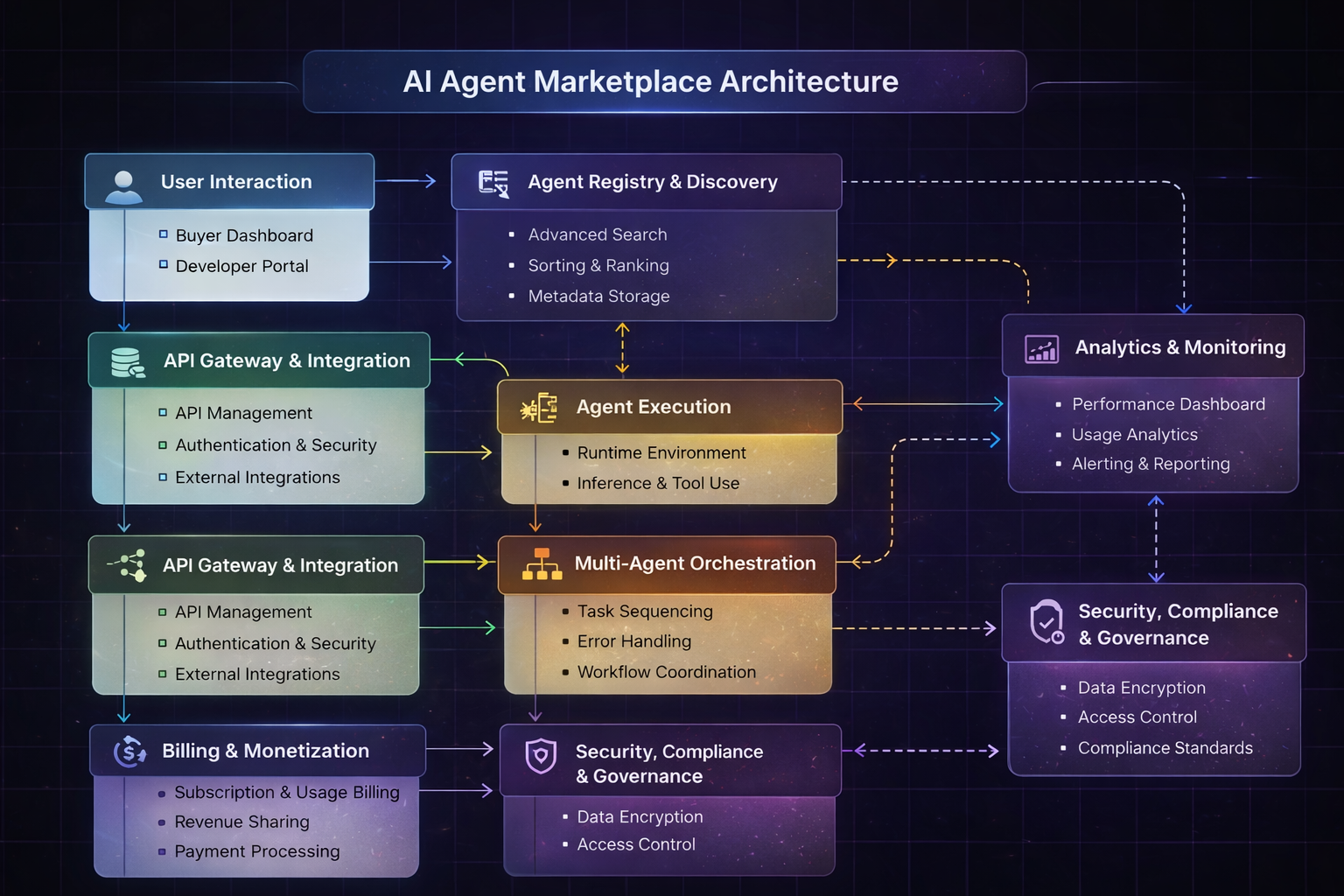
This is the entry point of the marketplace where both buyers and developers interact with the platform.
Key Components:
Why It Matters: A well-designed interface ensures smooth onboarding, faster discovery, and higher conversion from trial to deployment.
This layer acts as the central intelligence catalog of the marketplace.
Key Functions:
Core Technologies:
This is the communication backbone between agents and enterprise systems.
Key Functions:
Why It Matters: Every deployed agent interacts with external systems through this layer, making reliability and security critical.
This layer is responsible for running AI agents in real-time environments.
Key Capabilities:
Key Insight: Unlike traditional apps, agents run continuously and require scalable execution infrastructure.
This is the core intelligence engine that enables complex workflows.
Key Functions:
Technologies Used:
Why It Matters: This layer transforms isolated agents into end-to-end automated workflows.
A secure, isolated environment where buyers can test agents before deployment.
Key Features:
Impact: Directly improves trust and increases conversion rates from trial to paid usage.
Handles all financial transactions across the marketplace.
Key Capabilities:
Tools: Stripe, Paddle, Custom metering engines
This layer ensures enterprise-grade trust and regulatory compliance.
Key Features:
Critical Insight: Security must be enforced at both infrastructure and application levels.
Provides visibility into platform performance and agent behavior.
Key Metrics Tracked:
Tools: Datadog, Grafana, Prometheus
Businesses should invest in AI agent marketplace development because it solves the core challenges of AI distribution, trust, and monetization while creating a scalable platform with strong network effects and multiple revenue streams.
The current bottleneck in the AI agent ecosystem is not the availability of capable agents. It is the lack of structured platforms where these agents can be discovered, evaluated, and deployed with confidence.
Enterprise buyers struggle to identify the right agents for their workflows, assess performance before purchase, and ensure integration and compliance readiness. At the same time, developers lack efficient channels to reach enterprise customers, manage payments, and scale adoption without building their own go-to-market infrastructure.
An AI agent marketplace addresses both sides of this gap simultaneously.
A centralized marketplace enables structured discovery, verified listings, sandbox testing, and transparent performance metrics, making it easier for enterprises to adopt AI agents with confidence.
The global AI agents market is projected to grow from USD 7.84 billion in 2025 to USD 52.62 billion by 2030, with a CAGR of 46.3%. This level of growth creates strong platform opportunities for early entrants.
Approximately 85% of enterprises are expected to implement AI agents by 2026. This indicates a large and expanding demand base for agent-based solutions across industries.
More agents attract more buyers, and more buyers attract more developers. This creates a self-reinforcing growth cycle that increases platform value over time and builds a competitive moat.
AI agent marketplaces support diversified monetization models, including:
This layered model allows revenue to scale with platform activity.
Unlike service-based businesses, marketplaces grow without proportional increases in operational costs. Developers contribute to the ecosystem, expanding the catalog without requiring internal development resources.
The opportunity is not just to use AI agents, but to build the infrastructure that powers their distribution and adoption. Businesses that invest in AI agent marketplace development early can establish strong positioning, capture ecosystem value, and benefit from long-term network effects as the market continues to expand.
AI agent marketplaces create value by enabling businesses to discover, deploy, and scale autonomous AI solutions across multiple real-world scenarios, including enterprise automation, developer monetization, industry-specific distribution, and multi-agent workflows.
The following are the most impactful use cases driving adoption today:
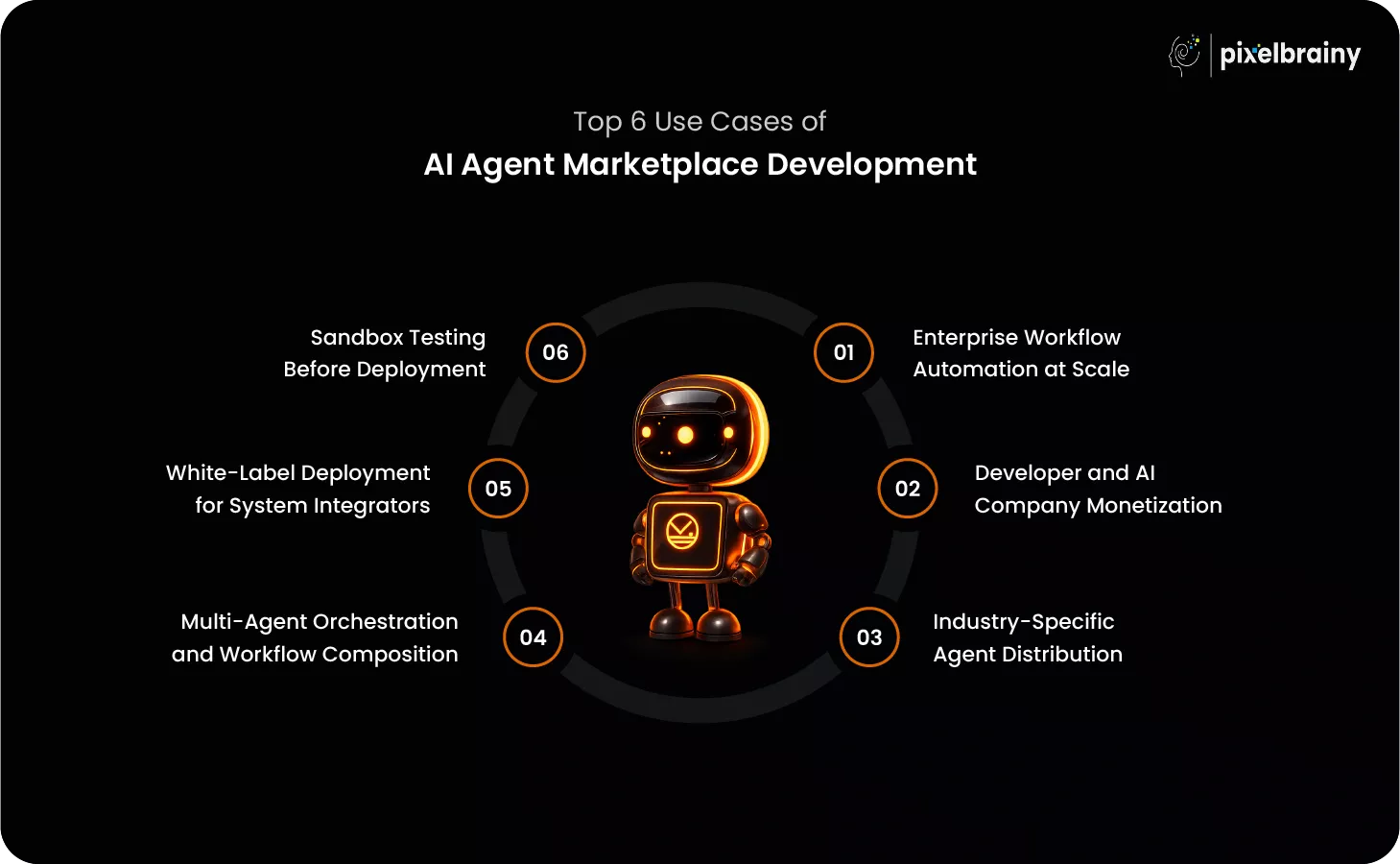
AI agent marketplaces allow enterprises to access pre-built agents for automating complex workflows without building them internally.
Organizations can deploy agents for:
This reduces development time and accelerates automation across departments.
AI agent marketplaces provide developers with a structured platform to distribute and monetize their agents.
Instead of building their own sales and payment infrastructure, developers can:
This creates a scalable revenue channel similar to app marketplaces.
Different industries require specialized and compliant AI solutions.
AI agent marketplaces enable:
This ensures buyers can confidently select agents that meet regulatory requirements.
AI agent marketplaces support combining multiple agents into automated workflows.
For example:
This allows businesses to build end-to-end automation without custom development.
System integrators and consulting firms can use AI agent marketplaces to deliver branded AI solutions to their clients.
They can:
This creates new revenue opportunities for both integrators and marketplace operators.
AI agent marketplaces provide secure sandbox environments where businesses can test agents before purchasing.
This enables:
Sandbox environments increase trust and significantly improve adoption rates.
AI agent marketplace use cases extend beyond simple tool distribution. They enable scalable automation, structured monetization, and enterprise-ready deployment models that transform how AI solutions are built, delivered, and adopted.

AI agent marketplace development provides scalable growth, strong network effects, diversified revenue streams, and long-term competitive advantage by connecting developers and enterprise buyers in a structured ecosystem.
Building a marketplace is fundamentally different from building a product. You are serving two distinct user groups simultaneously, and the platform only succeeds when both sides grow together.
AI agent marketplaces become more valuable as they grow.
This creates a self-reinforcing growth loop that strengthens the platform over time.
A similar dynamic can be seen with Airbnb. As more properties were added, more travelers joined. As more travelers joined, more hosts listed their properties. The same flywheel applies to AI agent marketplaces, where supply and demand continuously reinforce each other.
Once a marketplace reaches scale, it becomes extremely difficult for competitors to replicate its ecosystem advantage.
AI agent marketplaces support multiple monetization channels, including:
This layered model allows revenue to scale with platform activity.
A comparable example is Stripe, which built a multi-layered revenue model by combining payment processing, subscriptions, financial services, and developer tools. Each revenue stream compounds over time, creating a highly resilient business model.
Marketplace platforms grow differently from traditional businesses.
For example, Salesforce AppExchange scaled to thousands of applications without Salesforce building each one internally. External developers expanded the ecosystem while Salesforce focused on platform infrastructure.
Marketplaces enable innovation beyond internal capabilities.
This mirrors how the iOS App Store evolved. Apple created the platform, but developers drove the innovation by building millions of apps across industries and use cases.
AI agent marketplaces reduce friction in enterprise adoption by providing:
This builds trust and encourages repeat usage.
Shopify demonstrates this well. Once merchants set up their store, integrations, and workflows, switching becomes difficult. AI agent marketplaces create similar retention through trust and infrastructure, not lock-in.
AI agent marketplaces are still in an early growth phase.
Early movers can:
This pattern has been seen in multiple platform markets, including ride-sharing and app ecosystems. Platforms that establish early dominance are difficult to displace later.
The benefits of AI agent marketplace development go beyond immediate revenue. They create a compounding platform advantage driven by network effects, ecosystem innovation, and long-term market positioning.
AI agent marketplace development requires a combination of discovery, execution, monetization, security, and orchestration capabilities to support both developers and enterprise buyers in a scalable environment.
Getting the feature set right from the beginning is critical. Missing essential features can limit adoption, while unnecessary features increase complexity without adding value.
Below are the key features every AI agent marketplace must include.
| Feature | Description |
|---|---|
| Agent Discovery and Search Engine | Enables users to find relevant agents quickly using filters like industry, capability, pricing, and compliance. Advanced ranking ensures the most relevant and high-performing agents appear first. Improves user experience and increases deployment rates. |
| Developer Portal and Agent Submission System | Provides a self-service interface for developers to submit, manage, and update their agents. Includes documentation tools, pricing configuration, and listing management. Simplifies onboarding and encourages ecosystem growth. |
| Sandbox Testing and Evaluation Environment | Allows buyers to test agents in a secure, isolated environment before deployment. Supports real or simulated data testing without impacting production systems. Builds trust and improves conversion from trial to paid usage. |
| API Gateway and Integration Management | Acts as a central layer for managing all API communications between agents and external systems. Handles authentication, rate limiting, and version control. Ensures secure and reliable integrations with enterprise tools. |
| Multi-Agent Orchestration Layer | Enables coordination between multiple agents to perform complex workflows. Manages task sequencing, dependencies, and execution logic. Allows businesses to automate end-to-end processes without custom coding. |
| Agent Performance Monitoring Dashboard | Provides real-time insights into agent performance including uptime, latency, and accuracy. Helps both developers and buyers track reliability and efficiency. Supports proactive issue detection and optimization. |
| Agent Version Control and Update Management | Allows developers to release updates, manage multiple versions, and maintain compatibility. Ensures existing deployments continue to function without disruption. Helps maintain stability while improving agent capabilities. |
| Usage-Based Billing and Subscription Engine | Supports flexible pricing models such as pay-per-use, subscriptions, and enterprise plans. Automates invoicing, billing cycles, and payment processing. Enables scalable monetization aligned with usage. |
| Developer Revenue Dashboard and Payouts | Gives developers visibility into earnings, transactions, and performance metrics. Automates payouts based on defined schedules and revenue-sharing models. Builds transparency and trust within the ecosystem. |
| Rating, Review, and Trust System | Allows buyers to rate and review agents based on real usage experiences. Helps surface high-quality agents and improve decision-making. Builds credibility and trust across the marketplace. |
| Role-Based Access and Team Management | Enables organizations to manage users, roles, and permissions within their accounts. Controls who can deploy, modify, or monitor agents. Ensures governance and operational security in enterprise environments. |
| Enterprise SSO and Identity Management | Integrates with enterprise identity systems using SAML or OAuth protocols. Allows seamless login and centralized access control. Improves security and simplifies user management for large organizations. |
| Secure Data Handling and Privacy Controls | Ensures data is encrypted, isolated, and protected during testing and execution. Prevents unauthorized access across tenants. Critical for maintaining compliance and enterprise trust. |
| Compliance and Certification Badges | Verifies agents against regulatory standards such as GDPR, HIPAA, and SOC 2. Displays certification badges to help buyers quickly assess compliance readiness. Essential for adoption in regulated industries. |
| Analytics and Marketplace Intelligence | Provides insights into agent performance, buyer behavior, and marketplace trends. Helps operators optimize listings, pricing, and demand-supply balance. Supports data-driven platform growth and decision-making. |
Each feature in an AI agent marketplace is not isolated. Together, they create a unified system that supports discovery, trust, execution, and monetization. Platforms that implement these features effectively are far more likely to achieve adoption and long-term scalability.
Once the core platform is established, advanced features play a critical role in differentiating your marketplace from competitors. These capabilities enhance intelligence, flexibility, enterprise readiness, and long-term scalability.
| Feature | Description |
|---|---|
| AI-Powered Agent Recommendation Engine | Uses machine learning to analyze user behavior, industry context, and past interactions. Recommends the most relevant agents to buyers in real time. Improves discovery efficiency and increases deployment rates. |
| Autonomous Agent Composition Studio | Provides a visual drag-and-drop interface for building multi-agent workflows. Allows non-technical users to connect agents using triggers and logic. Reduces dependency on developers for workflow automation. |
| Federated Agent Deployment | Enables enterprises to deploy agents within their own private cloud or on-premise infrastructure. Ensures data sovereignty and compliance with strict security policies. Ideal for regulated industries like finance and healthcare. |
| Dynamic Pricing and Revenue Optimization Engine | Uses data signals such as demand, usage, and performance to suggest optimal pricing strategies. Helps developers maximize revenue while improving buyer conversion. Supports adaptive pricing models based on market conditions. |
| Agent Capability Benchmarking Tools | Provides standardized testing frameworks to evaluate agent performance across defined tasks. Enables side-by-side comparison of agents within the same category. Helps buyers make objective and informed decisions. |
| Generative AI Agent Builder | Allows developers to create, test, and deploy agents directly within the marketplace. Reduces development time and lowers the barrier to entry. Accelerates the growth of the marketplace ecosystem. |
| Cross-Marketplace Agent Portability | Enables agents to be packaged and deployed across multiple platforms and environments. Reduces integration complexity and increases agent usability. Supports interoperability across ecosystems. |
| Blockchain-Based Agent Licensing and Royalties | Uses smart contracts to automate licensing, usage tracking, and revenue distribution. Ensures transparency and reduces disputes between developers and buyers. Provides tamper-proof transaction records. |
| Real-Time Agent Health and Anomaly Detection | Continuously monitors agent performance to detect failures, anomalies, or unusual behavior. Triggers alerts or automated recovery actions when issues occur. Ensures reliability and uptime at scale. |
| Enterprise Private Catalog Management | Allows organizations to curate a private catalog of approved agents for internal use. Provides governance and control over agent access and deployment. Enhances security and compliance for enterprise teams. |
Advanced features are not required for an initial launch, but they become essential as the marketplace scales. These capabilities improve user experience, strengthen competitive positioning, and enable enterprise-grade adoption across complex use cases.
Developing an AI agent marketplace requires a structured approach that combines platform strategy, technical architecture, and ecosystem development. It is not just a software project, but a multi-sided platform that must grow supply and demand simultaneously.
Most companies that struggle treat it only as a development task. In reality, success depends on aligning product, business model, and marketplace dynamics from the beginning.
Here is the process that works.
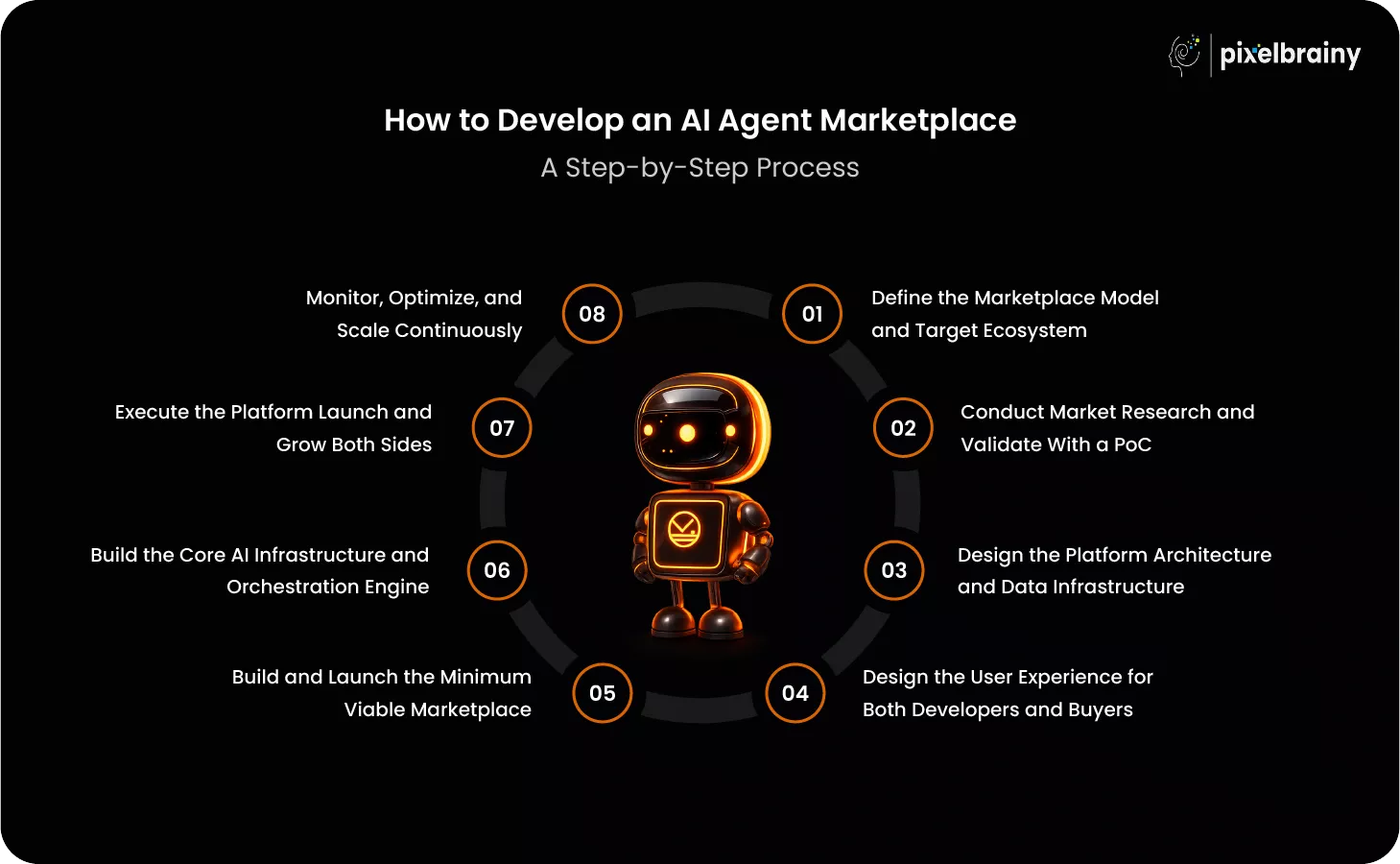
Aim: Before writing a single line of code, clearly define the type of AI agent marketplace you are building. Decide whether it will be horizontal or industry-specific, open or curated, and what monetization model it will follow such as commission, subscription, or hybrid. These decisions shape the platform architecture, compliance requirements, and growth strategy.
Why This Matters: Changing the marketplace model later is extremely costly and complex. A healthcare-focused marketplace requires different compliance systems and trust signals than a general enterprise marketplace. Getting this right early prevents major rework and strategic misalignment.
Aim: Validate real demand before full-scale development. Build a Proof of Concept that includes basic agent listing, discovery, and deployment. Test it with a small group of developers and enterprise buyers to confirm both supply and demand exist.
Why This Matters: Marketplace businesses face the chicken-and-egg problem. Without agents, buyers will not join. Without buyers, developers will not participate. A validated PoC with early participants helps establish initial traction and reduces market risk.
Aim: Design a scalable architecture that supports agent discovery, execution, orchestration, and monitoring. Define data models, API standards, integration layers, and security boundaries that will support long-term growth.
Why This Matters: Early architectural decisions directly impact scalability, performance, and security. Fixing architectural flaws later is significantly more expensive and risky, especially under real enterprise workloads.
Aim: Partner with a UI/UX design company to create separate, optimized user experiences for developers and buyers. The developer portal should simplify agent submission and management, while the buyer interface should make discovery, testing, and deployment intuitive.
Why This Matters: A marketplace only works when both sides are satisfied. Poor developer experience limits supply, while poor buyer experience limits adoption. Both must be designed with equal focus.
Aim: Develop an MVP that includes core features such as agent listing, search and discovery, sandbox testing, basic integrations, and payment processing. Launch with a curated set of high-quality agents and a controlled group of early users.
Why This Matters: Waiting for a fully complete platform delays learning. Early launch provides real user feedback, identifies gaps, and validates assumptions. This reduces the risk of building features that users do not need.
Also Read: Top AI MVP Development Companies to Consider
Aim: After validating the MVP, invest in advanced capabilities such as multi-agent orchestration, real-time monitoring, recommendation systems, and federated deployment. These features enhance platform intelligence and automation.
Why This Matters: This stage transforms the marketplace into a true AI platform. Orchestration enables complex workflows, while intelligent recommendations improve discovery and engagement. These capabilities drive higher enterprise adoption.
Aim: Launch the marketplace with structured developer onboarding, targeted enterprise acquisition, and strategic partnerships. Continuously balance supply and demand by ensuring enough agents exist for buyer needs.
Why This Matters: Marketplace growth requires active management. Imbalance between developers and buyers slows adoption. Successful platforms continuously optimize participation on both sides. Working with top AI development companies in USA that have marketplace experience during this phase significantly reduces the risk of stalling.
Aim: Track key performance metrics such as adoption rates, conversion rates, and platform usage. Continuously improve recommendations, user experience, and catalog quality while expanding into new industries and markets.
Why This Matters: Marketplace success depends on continuous optimization. Without ongoing improvements, engagement declines and competitors gain advantage. Scaling requires constant refinement of both product and ecosystem.
Building an AI agent marketplace is a phased process that requires aligning technology, business strategy, and ecosystem growth. Platforms that follow a structured approach are far more likely to achieve adoption, scalability, and long-term success.
Let us be straightforward about costs because this is where most technology vendors are deliberately vague.
The cost to build an AI agent marketplace depends on three things more than anything else. The complexity of the features you are building, the scale and quality standards you are designing for from day one, and whether you are willing to start with a real MVP or insist on launching with every feature already complete.
| Platform Tier | Cost Range | What It Includes |
|---|---|---|
| Basic AI Agent Marketplace MVP | $30,000 to $70,000 | Core marketplace mechanics: agent listing and discovery, basic search and filtering, simple sandbox testing, API deployment for a limited catalog, basic billing and payment processing, and a standard developer portal. Right for startups validating the marketplace concept or enterprises building an internal agent catalog for a defined team. |
| Medium AI Agent Marketplace | $70,000 to $150,000 | Multi-agent orchestration, usage-based billing, compliance certification badges, performance monitoring dashboards, developer revenue analytics, role-based access controls, and enterprise SSO integration. Right for businesses launching a commercial marketplace serving multiple developer and buyer segments. |
| Advanced AI Agent Marketplace | $150,000 to $300,000 and above | AI-powered recommendation engine, autonomous agent composition studio, federated deployment, blockchain-based licensing, real-time anomaly detection, private catalog management, cross-marketplace portability, and multi-region cloud deployment. Right for organizations building a category-defining marketplace platform at true enterprise scale. |
Two things that get underestimated in almost every marketplace budget conversation.
First, the ongoing operational costs including infrastructure scaling, agent quality review, developer support, security audits, and compliance management. These are not one-time costs. They recur every month. Budget for them from day one.
Second, the cost of not building the right architecture upfront. Retrofitting security isolation, billing accuracy, or orchestration capabilities into a marketplace that was not designed for them is always more expensive than getting the architecture right the first time.

Also Read: AI App Development Cost: From MVPs to Full-Scale AI App
AI agent marketplace development requires compliance to be built into the platform from the beginning, not added later. Since these marketplaces handle sensitive enterprise data and autonomous decision-making systems, regulatory alignment is essential for trust, security, and large-scale adoption.
Below are the key compliance frameworks every AI agent marketplace must address to operate in regulated environments and serve enterprise customers.
AI agent marketplaces serving users in the European Union must comply with GDPR requirements governing how personal data is collected, processed, and stored. This includes buyer data, developer information, and any data handled by agents during execution.
Key Requirements:
SOC 2 Type II is a critical trust standard for enterprise SaaS platforms. For AI agent marketplaces, it validates that security, availability, and data integrity controls are properly implemented and monitored over time.
Key Requirements:
The EU AI Act introduces a risk-based framework for regulating AI systems. AI agent marketplaces must classify agents based on risk levels and enforce stricter requirements for high-risk applications.
Key Requirements:
ISO 27001 certification demonstrates that the marketplace follows a structured and audited approach to managing information security risks across its infrastructure.
Key Requirements:
Different industries require specialized compliance standards. AI agent marketplaces must support these requirements based on the sectors they serve.
Examples include:
Key Requirements:
Clear IP governance protects both developers and buyers by defining how agents can be used, distributed, and monetized. It also prevents disputes that can harm platform trust.
Key Requirements:
Compliance in an AI agent marketplace is not optional but foundational, as it directly impacts trust, adoption, and the ability to serve enterprise customers at scale.
The success of an AI agent marketplace is measured by a combination of supply-side, demand-side, and platform performance metrics. Unlike traditional software products, marketplaces must track the health of both developers and buyers simultaneously.
Below are the key KPIs for evaluating the performance and growth of an AI agent marketplace.
Measures the percentage of listed agents actively deployed by buyers within a given period. A high adoption rate indicates strong alignment between supply and demand. A low rate often points to issues in discoverability, quality, or pricing rather than lack of traffic.
Tracks how many developers continue updating and maintaining their agents over time. High retention reflects a healthy monetization environment and positive developer experience. Declining activity signals issues with earnings, visibility, or platform support.
Represents the total value of transactions occurring on the marketplace. It reflects both buyer acquisition and depth of usage across existing customers. Consistent GMV growth indicates a strong and expanding marketplace flywheel.
Measures the percentage of users who move from sandbox testing to paid deployment. A strong conversion rate indicates trust in agent performance and platform reliability. Low conversion often highlights gaps in testing environments or onboarding experience.
Calculates the average earnings generated per developer on the platform. Increasing ARPD shows effective matching between agents and buyer demand. A decline may indicate oversupply, poor discovery, or pricing inefficiencies.
Tracks system availability and the consistent performance of deployed agents. Enterprise users expect high reliability, typically 99.9% uptime or higher. Poor performance directly impacts trust, retention, and long-term contracts.
Measures satisfaction separately for both sides of the marketplace. Balanced satisfaction is critical for ecosystem health. A gap between developer and buyer NPS often reveals hidden platform issues that require immediate attention.
Evaluates how well the marketplace covers high-demand agent categories. Strong coverage ensures buyers find relevant solutions quickly. Gaps in categories highlight opportunities for targeted developer acquisition and catalog expansion.
Tracking the right KPIs ensures that an AI agent marketplace grows in a balanced and sustainable way, with both developers and buyers contributing to long-term platform success.
Businesses should build a custom AI agent marketplace if platform ownership, long-term scalability, and competitive differentiation are core to their strategy. Using an existing platform is faster and lower cost, but limits control, monetization, and long-term value.
Here is a clear comparison to help guide the decision.
| Factor | Build a Custom Marketplace | Use an Existing Platform |
|---|---|---|
| Brand and Platform Control | Full ownership of user experience, branding, and ecosystem | Limited control, subject to platform rules and branding |
| Monetization Flexibility | Fully customizable revenue models including commissions, subscriptions, and hybrid pricing | Restricted to predefined monetization structures |
| Agent Catalog Ownership | Complete ownership of catalog, developer relationships, and data | Catalog and user relationships owned by the platform |
| Customization | Fully customizable features, integrations, and compliance systems | Limited customization based on platform capabilities |
| Time to Market | Typically 3 to 10 months depending on scope and complexity | Launch within days or weeks using existing infrastructure |
| Upfront Investment | Higher initial cost ranging from $30,000 to $300,000 or more | Low or no upfront cost, but ongoing fees apply |
| Long-Term ROI | High potential due to ownership, network effects, and recurring revenue streams | Lower ROI ceiling due to revenue sharing and platform dependency |
| Competitive Differentiation | Strong differentiation through proprietary features and ecosystem control | Limited differentiation in a shared marketplace environment |
| Data and Analytics Access | Full access to platform data, user behavior, and insights | Restricted access to data and limited analytics visibility |
| Best Suited For | Businesses building a platform as a core product or long-term strategy | Businesses focused on distributing their own agents quickly |
If your goal is to build a scalable platform business and own a position in the AI agent ecosystem, a custom marketplace is the right choice. If your goal is speed and simple distribution, existing platforms provide a faster starting point but with long-term limitations.
Building an AI agent marketplace involves technical, operational, and ecosystem challenges that can impact scalability and adoption. Successfully addressing these challenges early is critical to building a reliable, trusted, and high-growth platform.
Below are the most common challenges and how to overcome them.
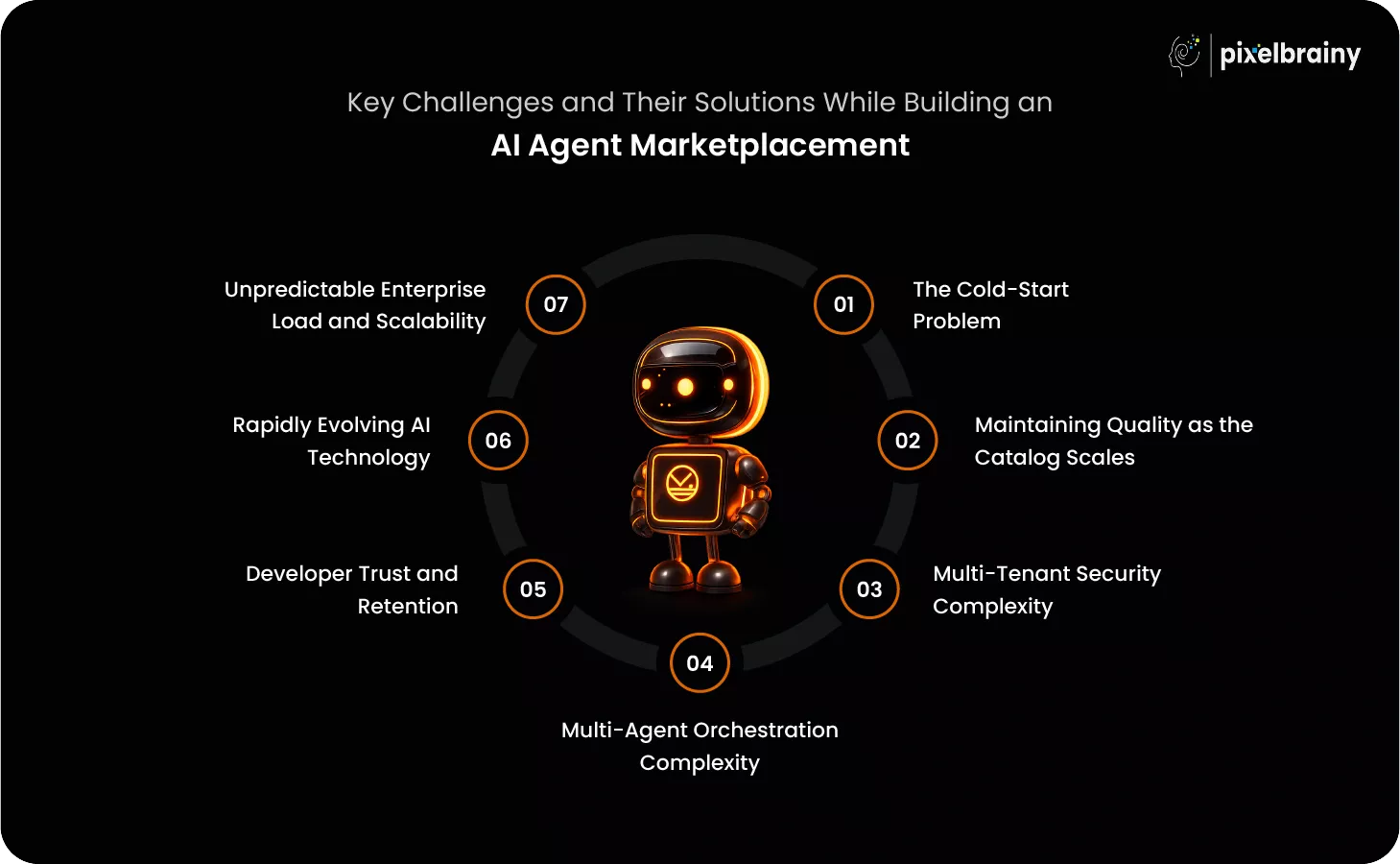
In the early stages, marketplaces struggle to attract both developers and buyers at the same time. Without agents, buyers will not join, and without buyers, developers have no incentive to list.
How to Overcome: Start with a curated set of high-quality agents built or commissioned in-house. Onboard a small group of enterprise buyers through pilot programs. Use early success cases to attract external developers and gradually open the marketplace.
As the number of agents grows, maintaining quality becomes increasingly difficult. Without proper controls, the marketplace can quickly become cluttered with low-quality or unreliable agents.
How to Overcome: Implement automated submission pipelines with quality checks, security validation, and documentation requirements. Set clear standards for listing approval and create feedback systems to identify and improve underperforming agents.
Ensuring strict data isolation between multiple buyers and developers is critical but technically complex. Weak isolation can lead to data leakage and loss of enterprise trust.
How to Overcome: Enforce infrastructure-level isolation using containerization and network segmentation. Conduct regular security audits and implement real-time monitoring to detect unusual behavior and prevent potential breaches.
Managing workflows involving multiple agents with dependencies, conditional logic, and error handling becomes complex as use cases scale. Poor orchestration leads to unreliable automation.
How to Overcome: Use established orchestration frameworks such as Temporal or Apache Airflow. Implement workflow visualization, retry mechanisms, and failure handling systems to ensure reliable execution across complex workflows.
Developers are highly sensitive to transparency, payouts, and platform policies. A lack of trust can quickly lead to reduced participation and negative reputation.
How to Overcome: Maintain transparent revenue-sharing models, ensure timely payouts, and provide detailed analytics dashboards. Communicate policy changes clearly and involve developers in ecosystem decisions.
AI frameworks, models, and standards evolve quickly. A rigid platform architecture can become outdated and require costly rework.
How to Overcome: Design a modular architecture with clear separation between components. Allow flexibility to integrate new models and frameworks without affecting the entire system. Continuously invest in platform updates.
Enterprise usage patterns can cause sudden spikes in demand, leading to performance issues or downtime if the system is not prepared.
How to Overcome: Build for horizontal scalability with auto-scaling infrastructure. Conduct load testing beyond expected peak levels and define service-level agreements to ensure reliability under high demand.
The success of an AI agent marketplace depends on how proactively these challenges are addressed, as early decisions in architecture, governance, and ecosystem design directly impact long-term scalability and trust.
PixelBrainy is a trusted choice for AI agent marketplace development because it combines deep technical expertise, marketplace strategy experience, and a proven ability to build scalable, enterprise-grade platforms.
As a leading AI Agent Development Company in USA, PixelBrainy has designed and deployed intelligent AI systems and marketplace ecosystems for organizations ranging from early-stage startups to established enterprises. We understand what it takes to build platforms that not only work technically but also succeed commercially.
Building an AI agent marketplace involves complex architecture, orchestration systems, and multi-tenant environments. PixelBrainy focuses on creating systems that perform reliably under real enterprise workloads, not just in controlled environments.
We build platforms that are scalable, secure, and ready for long-term growth.
Our team works with leading frameworks such as LangChain, AutoGen, Temporal, and enterprise cloud platforms. We know how to combine these technologies into a unified architecture that supports agent execution, orchestration, and real-time monitoring.
This ensures your marketplace is built on a future-ready and adaptable technology foundation.
Every marketplace has unique requirements based on its target users, industry focus, and monetization strategy. PixelBrainy designs custom solutions aligned with your specific business goals instead of relying on generic templates.
This approach enables better performance, flexibility, and long-term scalability.
PixelBrainy works as a long-term partner throughout the entire lifecycle of your platform.
This includes:
We remain involved after launch to support scaling, optimization, and continuous improvement.
PixelBrainy has successfully delivered AI agent marketplace solutions tailored for enterprise use cases.
We collaborated with a U.S.-based technology organization to build a specialized AI agent marketplace focused on enterprise automation.
What We Delivered:
Results Achieved:
Choosing the right development partner directly impacts the success of your AI agent marketplace, and working with an experienced team like PixelBrainy helps reduce risk, accelerate time to market, and build a platform that scales with your business.

The AI agent market is growing at an exceptional pace, and the infrastructure supporting it is still evolving. The platforms where agents are discovered, tested, trusted, and deployed are being built right now, creating a significant opportunity for businesses investing in AI agent marketplace development.
Companies that move early will establish strong developer ecosystems, build enterprise trust, and benefit from network effects that compound as the market scales toward USD 52.62 billion by 2030. Those who delay will find it much harder to compete in a space where early positioning matters.
If you are ready to build a platform that not only participates in the AI agent economy but helps shape its future, book an appointment with PixelBrainy today. You can also explore our full AI development services or browse our AI insights on the blog to learn how we approach building scalable, high-impact AI platforms.
An AI agent marketplace is a platform where autonomous AI agents are listed, discovered, and deployed by businesses. These agents can analyze data, make decisions, and execute tasks continuously without manual intervention. Unlike traditional software marketplaces that distribute static applications, AI agent marketplaces support dynamic systems that operate in real time. This requires advanced infrastructure such as orchestration layers, usage-based billing, real-time monitoring, and multi-tenant security.
The development timeline depends on the scope and complexity of the platform. A focused MVP with core features like agent listing, discovery, sandbox testing, and basic billing typically takes 6 to 8 weeks. A full-scale enterprise marketplace with orchestration, AI-powered recommendations, compliance systems, and multi-region deployment usually takes 10 to 16 weeks. The timeline varies based on technical complexity and compliance requirements.
The cold-start problem refers to the initial challenge of attracting both buyers and developers to a new marketplace. Buyers need agents to join, and developers need buyers to participate. The most effective solution is to launch with a curated set of high-quality agents and onboard a small group of enterprise buyers through pilot programs. Early traction and case studies help attract external developers and scale the platform.
Data isolation in an AI agent marketplace is achieved through infrastructure-level controls rather than only application-level permissions. This includes containerized execution environments, network segmentation, and encryption of data across tenants. Additional measures such as real-time monitoring, access logging, and regular security audits ensure that data remains isolated and protected in multi-tenant environments.
AI agent marketplaces typically use a multi-layered revenue model to maximize scalability and resilience. Common revenue streams include transaction commissions, developer listing fees, enterprise subscriptions, premium placements, and usage-based compute pricing. This diversified approach allows platforms to generate consistent revenue while supporting different types of buyers and developers.
If your goal is to build a platform business and own the ecosystem, a custom AI agent marketplace is the better choice. It provides full control over branding, monetization, and data. If your goal is quick distribution of your own agents, existing platforms offer a faster and lower-cost option. The decision depends on whether you want long-term ownership or short-term accessibility.

About The Author
Sagar Bhatnagar
Sagar Sahay Bhatnagar brings over a decade of IT industry experience to his role as Marketing Head at PixelBrainy. He's known for his knack in devising creative marketing strategies that boost brand visibility and market influence. Sagar's strategic thinking, coupled with his innovative vision and focus on results, sets him apart. His track record of successful campaigns proves his ability to utilize digital platforms effectively for impactful marketing efforts. With a genuine passion for both technology and marketing, Sagar continuously pushes PixelBrainy's marketing initiatives to greater success.


Transform your ideas into reality with us.
Working with the PixelBrainy team has been a highly positive experience. They understand the design requirements and create beautiful UX elements to meet the application needs. The dev team did an excellent job bringing my vision to life. We discussed usability and flow. Sagar worked with his team to design the database and begin coding. Working with Sagar was easy. He has the knowledge to create robust apps, including multi-language support, Google and Apple ID login options, Ad-enabled integrations, Stripe payment processing, and a Web Admin site for maintaining support data. I'm extremely satisfied with the services provided, the quality of the final product, and the professionalism of the entire process. I highly recommend them for Android and iOS Mobile Application Design and Development.

Great experience working with them. Had a lot of feedback and I found that unlike most contractors they were bugging me for updates instead of the other way around. They were extremely time conscience and great at communicating! All work was done extremely high quality and if not on time, early! They were always proactive when it comes to communication and the work is great/above par always. Very flexible and a great team to work with! Goes above and beyond to present us with multiple options and always provides quality. Amazing work per usual with Chitra. If you have UI/UX or branding design needs I recommend you go to them! Will likely work with them in the future as well, definitely recommended!

PixelBrainy is a joy to work with and is a great partner when thinking through branding, logo, and website layout. I appreciate that they spend time going into the "why" behind their decisions to help inform me and others about industry best practices and their expertise.

I hired them to design our software apps. Things I really like about them are excellent communication skills, they answer all project suggestions and collaborate right away, and their input on design and colors is amazing. This project was complex and needed patience and creativity. The team is amazing to do business with. I will be using them long-term. Glad to see there are some good people out there. I was afraid to try and outsource my project to someone but I am glad I met them! I really can't say enough. They went above and beyond on this project. I am very happy with everything they have done to make my business stand out from the competition.

It was great working with PixelBrainy and the team. They were very responsive and really owned the project. We'll definitely work with them again!

I recently worked with the PixelBrainy team on a project and I was blown away by their communication skills. They were prompt, clear, and articulate in all of our interactions. They listened and provided valuable feedback and suggestions to help make the project a success. They also kept me updated throughout the entire process, which made the experience stress-free and enjoyable.

PixelBrainy is very good at what it does. The team also presents themselves very professionally and takes care of their side of things very well. I could fully trust them taking up the design work in a timely and organised manner and their attention to detail saved us lots of effort and time. This particular project was quite intense and the team showed that they function very well under pressure. Very much looking forward to working with her again!

It's always an absolute pleasure working with them. They completed all of my requests quickly and followed every note I had for them to a T, which made our process go smoothly from start to finish. Everything was completed fast and following all of the guidelines. And I would recommend their services to anyone. If you need any design work done in the future, PixelBrainy should be your first call!

They took ownership of our requirements and designed and proposed multiple beautiful variants. The team is self-motivated, requires minimum supervision, committed to see-through designs with quality and delivering them on time. We would definitely love to work with PixelBrainy again when we have any requirements.

PixelBrainy was a big help with our SaaS application. We've been hard at work with a new UI/UX and they provided a lot of help with the designs. If you're looking for assistance with your website, software, or mobile application designs, PixelBrainy and the team is a great recommendation.

PixelBrainy designers are amazing. They are responsive, talented, and always willing to help craft the design until it matches your vision. I would recommend them and plan to continue them for my future projects and more!!!

They were awesome! Did a good job fast, and good communication. Will work with them again. Thank you

Creative, detail-oriented, and talented designers who take direction well and implement changes quickly and accurately. They consistently over-delivered for us.

PixelBrainy team is very talented and creative. Great designers and a pleasure to work with. PixelBrainy is an excellent communicator and I look forward to working with them again.

PixelBrainy has a very talented design team. Their work is excellent and they are very responsive. I enjoy working with them and hope to continue on all of our future projects.


