 AI Summary Powered by PixelBrainy
What if your business could automate customer support, reduce operational costs, and deliver personalized customer experiences with AI, but you did not know how much it would cost to build and maintain the technology?
The AI customer service CRM development cost ranges from $30,000 to $250,000+, depending on feature complexity, AI capabilities, integrations, security requirements, and scalability. A basic minimum viable product (MVP) typically costs $30,000 to $60,000, a mid-level solution costs $60,000 to $150,000, and an enterprise-grade platform can exceed $250,000. These are estimated planning ranges, not fixed development quotes.
Understanding these costs is essential for CTOs, startup founders, product managers, customer experience leaders, and enterprise decision-makers planning to invest in AI-powered customer relationship management.
Consider this real-world budgeting scenario: "I am a CTO preparing a capital budget request for our AI customer service CRM build, and my board wants to know why we should build custom instead of purchasing Salesforce Service Cloud or Zendesk. I need to present development expenses, ongoing operational costs, and the break-even timeline against SaaS alternatives, supported by a reliable, itemized cost estimate."
This challenge highlights why calculating the cost to build an AI customer service CRM involves more than developer salaries. Businesses must consider AI model usage, cloud infrastructure, third-party integrations, data migration, security, maintenance, and future enhancements.
So, how much does it cost to build an AI customer service CRM in 2027? The answer depends on your business objectives, automation requirements, customer data architecture, and expected support volume. A realistic development budget for an AI customer service CRM separates essential MVP features from advanced capabilities that can be introduced as the business grows.
This guide explains the cost of creating an AI customer service CRM through detailed development estimates, feature-wise breakdowns, development phases, team comparisons, hidden expenses, and build-versus-buy analysis. It also explores practical strategies to control costs without compromising software quality, security, or customer experience.
By understanding these factors, you can estimate your investment, compare custom development with existing platforms, and make a financially informed decision that supports long-term business growth.

Developing an AI customer service CRM involves more than integrating a chatbot into existing software. Businesses may need customer profiles, ticket management, AI-powered responses, workflow automation, knowledge bases, analytics, and third-party integrations.
Each capability affects the AI customer service CRM development cost, making budget planning essential before development begins. A clear budget helps businesses prioritize features, choose suitable technologies, control expenses, and prepare for long-term operational requirements.
Consider this scenario:
"We want to build a custom AI customer service CRM that automates repetitive inquiries, assists support agents, and integrates our existing customer data with email, live chat, and ticket management. Before approving the investment, our leadership team needs an itemized development estimate, ongoing operating costs, and a comparison with Salesforce Service Cloud or Zendesk."
This situation demonstrates why estimating the cost to build an AI customer service CRM requires careful planning beyond initial development expenses.
Businesses do not need every AI capability in their first release. Starting with a minimum viable product (MVP) helps validate the solution before investing in advanced functionality.
Essential MVP features may include:
Advanced capabilities, such as predictive analytics, sentiment analysis, voice AI, and automated resolution workflows, can be introduced later.
Prioritizing features helps control the cost of creating an AI customer service CRM while preserving opportunities for future expansion.
The question, "How much does it cost to build an AI customer service CRM?" cannot be answered accurately with one fixed price.
A reliable budget should account for discovery, UI/UX design, frontend and backend development, AI implementation, integrations, security testing, deployment, and maintenance.
As an initial planning estimate, an MVP may cost $30,000 to $60,000, a mid-level CRM $60,000 to $150,000, and an enterprise platform $150,000 to $250,000 or more. These are illustrative ranges, not guaranteed quotations.
An itemized estimate helps CTOs, finance teams, and business owners understand how individual requirements influence the total investment.
Scope expansion occurs when stakeholders introduce additional requirements after development begins without adjusting the budget or timeline.
A project may start with ticket management and a chatbot, then expand to include WhatsApp integration, automated ticket routing, multilingual support, advanced analytics, and custom approval workflows.
Each addition can increase engineering, testing, infrastructure, and maintenance expenses.
For example, integrating legacy customer databases may require identity matching, API authentication, data mapping, synchronization, and error handling. Similarly, an AI knowledge assistant needs reliable documentation, information retrieval, response evaluation, and safeguards against inaccurate answers.
A defined budget helps stakeholders prioritize features according to business value, complexity, security requirements, and recurring costs.
Technology choices directly influence AI customer service CRM development cost and ongoing expenses.
Businesses should evaluate whether their requirements need existing AI model APIs, retrieval-augmented generation (RAG), workflow automation, custom machine learning, or a combination of these technologies.
For example, an MVP can use an existing language model connected to approved company documents through RAG instead of developing a proprietary model from scratch.
This can reduce initial engineering effort. However, businesses must consider API charges, data privacy, customization limitations, and vendor dependency.
The right technology should meet current requirements without introducing unnecessary complexity or restricting future growth.
An AI customer service CRM often needs to connect with existing business systems, including:
For example, an agent handling a billing complaint may need access to customer history, payment status, and previous conversations from one interface.
Achieving this requires reliable APIs, secure data exchange, consistent customer records, and appropriate permissions.
Identifying integration requirements early helps prevent unexpected expenses and development delays.
The initial development quotation does not represent the complete financial commitment. After launch, businesses must budget for cloud hosting, AI model usage, database services, third-party subscriptions, security monitoring, maintenance, and software updates.
AI expenses depend on conversation volume, model selection, response length, and the number of AI operations performed.
A CRM processing thousands of conversations monthly may have substantially different operating expenses from one handling hundreds of thousands.
Businesses should estimate these costs using projected usage and calculate the total cost of ownership over three to five years. This provides a more realistic comparison with SaaS alternatives.
Existing AI services can support chatbots, response generation, ticket classification, conversation summaries, and knowledge retrieval.
Custom AI development may be justified when a business has specialized requirements or performance constraints that existing solutions cannot address economically.
However, custom development can introduce additional expenses for data preparation, model development, evaluation, deployment, and monitoring.
Budget planning helps determine which capabilities require custom engineering and which can be delivered using established AI technologies.
Building every feature immediately can increase financial risk and delay launch. A phased roadmap allows businesses to invest according to actual needs.
Phase 1: MVP
Customer profiles, ticket management, basic AI assistance, knowledge-base search, essential integrations, and reporting.
Phase 2: Intelligent Support
Automated ticket routing, AI-generated summaries, sentiment analysis, and expanded workflows.
Phase 3: Advanced AI
Predictive analytics, customer segmentation, multilingual support, and automated resolution.
Phase 4: Enterprise Scaling
Advanced security, complex integrations, high availability, and enhanced monitoring.
This approach helps control the development budget while allowing the CRM to evolve with business requirements.
When comparing AI CRM development companies, look beyond hourly rates and initial quotations.
Evaluate their relevant experience, AI engineering capabilities, security practices, testing procedures, documentation, intellectual property ownership, and post-launch support.
Request an itemized proposal covering deliverables, assumptions, exclusions, integration dependencies, and recurring expenses. Review relevant case studies and client references where available.
A lower initial quote may not provide better value if essential integrations, testing, or maintenance are excluded.
Ultimately, the AI customer service CRM development budget should be evaluated as a business investment rather than simply a software expense.
Before approving the project, decision-makers should understand the initial scope, AI capabilities, integration requirements, recurring costs, and success metrics.
The financial analysis should compare custom development with SaaS alternatives using equivalent functionality and operating assumptions. It should also estimate the break-even point using realistic development expenses and projected savings.
Therefore, an effective budget planning helps businesses control the cost to build an AI customer service CRM, prevent unnecessary scope expansion, select appropriate technologies, and establish a scalable roadmap aligned with measurable customer service outcomes.
The AI customer service CRM development cost typically ranges from $30,000 to $250,000+, depending on AI capabilities, feature complexity, integrations, security requirements, data architecture, and scalability.
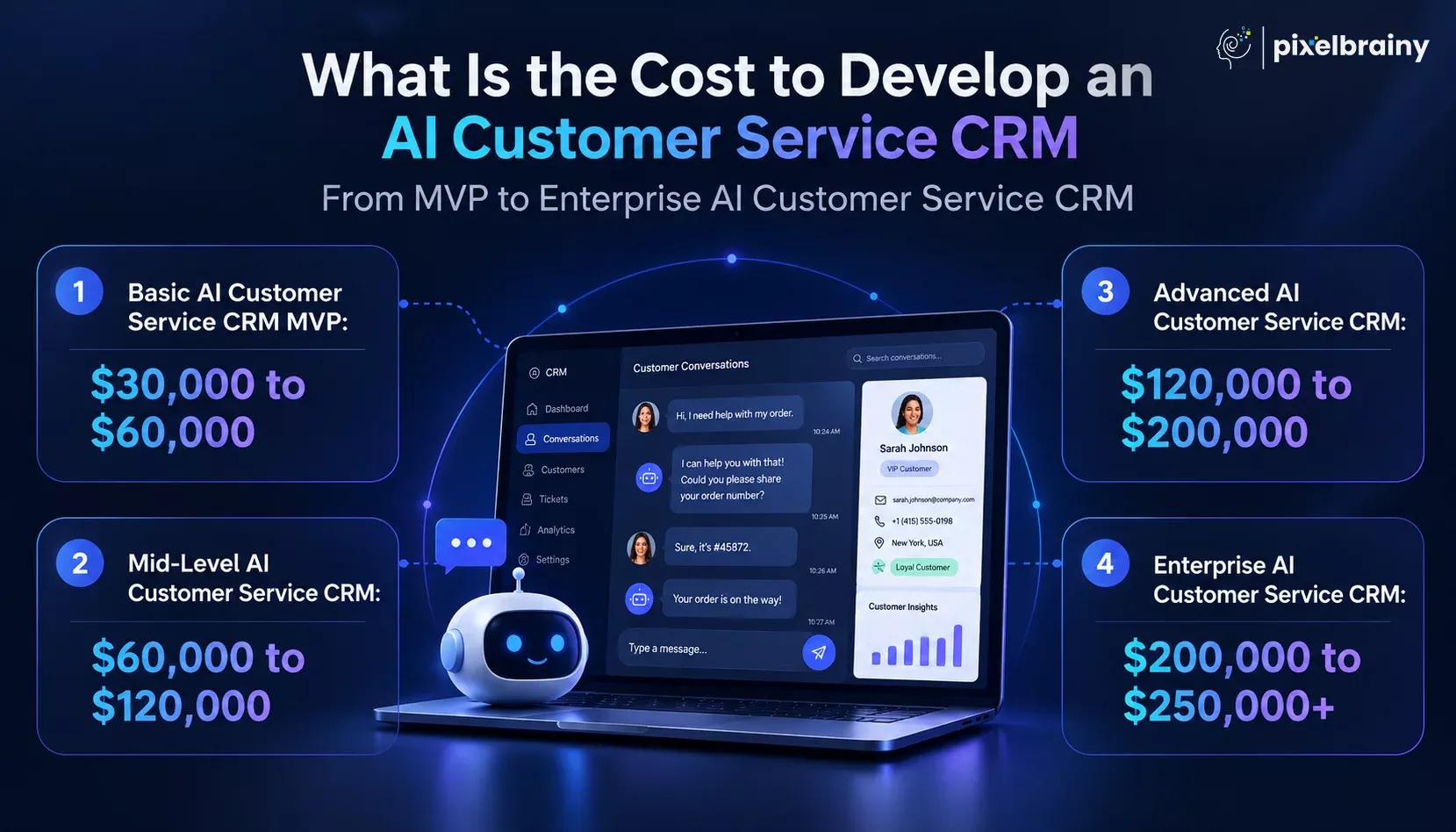
A basic AI customer service CRM MVP may cost $30,000 to $60,000, while a mid-level platform with intelligent automation and multiple integrations can cost $60,000 to $120,000. An advanced AI CRM with sophisticated workflows and predictive analytics may require $120,000 to $200,000. Enterprise platforms with complex integrations, advanced AI capabilities, and high-availability infrastructure can exceed $250,000.
So, how much does it cost to build an AI customer service CRM? There is no single fixed price. The final estimate depends on your business requirements, customer support volume, AI implementation approach, integration complexity, and long-term expansion plans.
| Development tier | Estimated cost | Typical timeline | What's included |
|---|---|---|---|
| Basic AI CRM MVP | $30,000 to $60,000 | 2 to 4 weeks | Customer profiles, ticket management, basic AI chatbot, knowledge search, essential integrations, and dashboards |
| Mid-Level AI CRM | $60,000 to $120,000 | 4 to 6 weeks | AI response suggestions, workflow automation, ticket classification, multiple integrations, and advanced reporting |
| Advanced AI CRM | $120,000 to $200,000 | 6 to 10 weeks | RAG-based AI, intelligent routing, predictive analytics, omnichannel support, and advanced automation |
| Enterprise AI CRM | $200,000 to $250,000+ | 9 to 15+ weeks | Complex AI orchestration, extensive integrations, enterprise security, high availability, and scalable infrastructure |
These are illustrative development estimates for 2027, not fixed quotations. Actual costs and timelines depend on project scope, team composition, data quality, and technical requirements. Enterprise projects with extensive customization can exceed $250,000.
A basic MVP is suitable for startups and small businesses that want to introduce AI-powered customer support without committing to a large initial investment.
The platform may include:
At this stage, the objective is to establish essential CRM functionality and validate whether AI improves customer service efficiency.
For example, a startup could deploy an AI assistant that answers common product questions, retrieves relevant support articles, and recommends responses to customer service agents. More advanced automation can be introduced after measuring accuracy, adoption, and cost savings.
Best suited for: Startups, small businesses, and organizations validating an AI customer service concept.
A mid-level AI customer service CRM is designed for growing businesses that need more sophisticated automation, improved agent productivity, and connections with multiple business systems.
Typical capabilities include:
This development tier provides a balance between functionality, scalability, and budget.
For example, an e-commerce business could use AI to categorize incoming inquiries, retrieve order information, suggest relevant responses, and route complicated complaints to specialized support teams.
The cost depends on the number of integrations, the complexity of business workflows, and the quality of the existing customer data.
Best suited for: Growing companies with established support teams, increasing ticket volumes, and multiple customer communication channels.
An advanced AI customer service CRM incorporates more sophisticated AI capabilities to support complex customer interactions and improve operational decision-making.
Features may include:
The development cost increases because these features require additional data engineering, AI evaluation, backend development, testing, and infrastructure planning.
For example, an AI CRM may identify recurring customer issues, retrieve relevant account information, suggest corrective actions, and escalate cases when confidence is insufficient.
These workflows require careful permission management, reliability testing, and human oversight. Predictive capabilities also depend on having suitable historical data.
Best suited for: Mid-sized and large organizations with complex support processes and substantial automation requirements.
Enterprise AI customer service CRM development is intended for organizations requiring extensive customization, complex integrations, advanced governance, and infrastructure designed for demanding workloads.
The platform may include:
For example, a global customer service organization may require a unified CRM that connects regional support teams, multiple product databases, voice and messaging channels, and AI-assisted workflows while enforcing different access permissions.
The final cost depends on the number of systems involved, data residency requirements, reliability targets, AI usage, and the complexity of existing enterprise architecture.
Projects involving proprietary AI models, extensive legacy migrations, or highly specialized compliance requirements can exceed $250,000.
Best suited for: Large enterprises, multinational organizations, and businesses with complex customer service operations.
Choose a $30,000 to $60,000 MVP if your priority is validating essential functionality and demonstrating the value of AI-assisted customer support.
Consider the $60,000 to $120,000 range if your business needs intelligent ticket management, multiple integrations, and more advanced automation.
A budget of $120,000 to $200,000 may be appropriate when predictive analytics, omnichannel support, and sophisticated AI workflows are central to your requirements.
For enterprise organizations requiring extensive integrations, advanced governance, and scalable infrastructure, a budget of $200,000 to $250,000+ may be necessary.
Ultimately, the cost of creating an AI customer service CRM depends on what your business needs at launch and which capabilities can be introduced later. A phased development strategy helps control the initial investment, validate business value, and expand the platform as customer demand and operational requirements grow.
How much does it cost to build an AI customer service CRM, and how can your business estimate the investment before development begins? An AI customer service CRM development cost calculator helps businesses estimate expenses based on development hours, AI functionality, integrations, infrastructure, security, and maintenance.
The overall AI customer service CRM development cost typically ranges from $30,000 to $250,000+. A basic MVP may cost $30,000 to $60,000, a mid-level CRM may require $60,000 to $120,000, and an advanced or enterprise platform can cost $120,000 to $250,000 or more.
The actual cost depends on the number of features, AI implementation approach, development team's rates, existing system integrations, and expected customer support volume.
A practical formula for estimating the cost of creating an AI customer service CRM is:
Total AI CRM Development Cost = Core Development Cost + AI Development Cost + Integration Cost + Infrastructure Cost + Security Cost + Deployment Cost + Contingency
Core development cost can be calculated as:
Core Development Cost = Estimated Development Hours × Hourly Development Rate
The main cost components include:
Maintenance, AI API consumption, cloud hosting, and third-party subscriptions should also be estimated separately when calculating the total cost of ownership.
Consider a growing e-commerce company that wants to build a custom AI customer service CRM to automate repetitive inquiries, improve agent productivity, and consolidate customer conversations across multiple channels.
The company requires AI-powered response suggestions, knowledge-base search, intelligent ticket classification, customer profiles, analytics, and integration with its existing systems.
Assume the following project inputs:
| Budget component | Estimated cost |
|---|---|
| Core CRM development: 1,000 hours × $50 | $50,000 |
| AI development and knowledge retrieval | $15,000 |
| Third-party integrations | $8,000 |
| Infrastructure setup | $5,000 |
| Security and quality assurance | $7,000 |
| Deployment and launch | $5,000 |
| Subtotal | $90,000 |
| Contingency at 15% | $13,500 |
| Estimated initial project budget | $103,500 |
This example assumes that the listed components represent separate costs without overlapping work.
The estimated initial development budget is $103,500, excluding recurring operating expenses such as monthly AI API usage, cloud hosting, and ongoing maintenance.
This calculation demonstrates how an AI customer service CRM cost calculator can produce a more useful estimate than relying on a generic development quotation.
A standard AI customer service CRM focuses on essential customer support operations and basic AI assistance.
It may include:
An advanced AI customer service CRM introduces more sophisticated capabilities, such as:
These advanced features can increase the development budget because they require additional data engineering, AI evaluation, integration work, and infrastructure.
For example, a basic chatbot may use an existing AI model API to answer common questions. An advanced AI assistant may retrieve information from multiple internal systems, evaluate customer context, recommend actions, and escalate complex cases according to defined business rules.
The second implementation requires more engineering, testing, access controls, and monitoring.
To obtain a realistic estimate, businesses should identify five essential inputs:
For businesses seeking affordable AI customer service CRM development, a phased approach can reduce the initial investment. Essential CRM workflows and AI-assisted responses can be launched first, while predictive analytics, advanced automation, and additional integrations can be introduced later.
Ultimately, an effective AI customer service CRM development cost calculator should account for development effort, AI complexity, integrations, security, infrastructure, and future operating expenses. This helps businesses estimate the cost to build an AI customer service CRM, allocate their development budget, and make informed decisions about custom development versus existing SaaS platforms.

The AI customer service CRM development cost typically ranges from $30,000 to $250,000+, depending on AI capabilities, CRM features, customer data volume, third-party integrations, automation requirements, security, scalability, and the development approach.
For a business planning to build a custom AI-powered customer relationship management system, the budget depends on more than the customer-facing interface. The CRM may need to automate support tickets, analyze customer conversations, recommend responses, predict customer needs, integrate with existing business tools, and provide real-time service analytics.
A common business query is:
“I want to build an AI customer service CRM that can automate customer support, manage customer interactions, integrate with our existing business systems, and help our support team resolve queries faster. How much will it cost to develop, including AI features, integrations, security, and ongoing maintenance?”
The answer depends on several major cost factors.
| Cost Factor | Estimated Cost Impact | Impact Level |
|---|---|---|
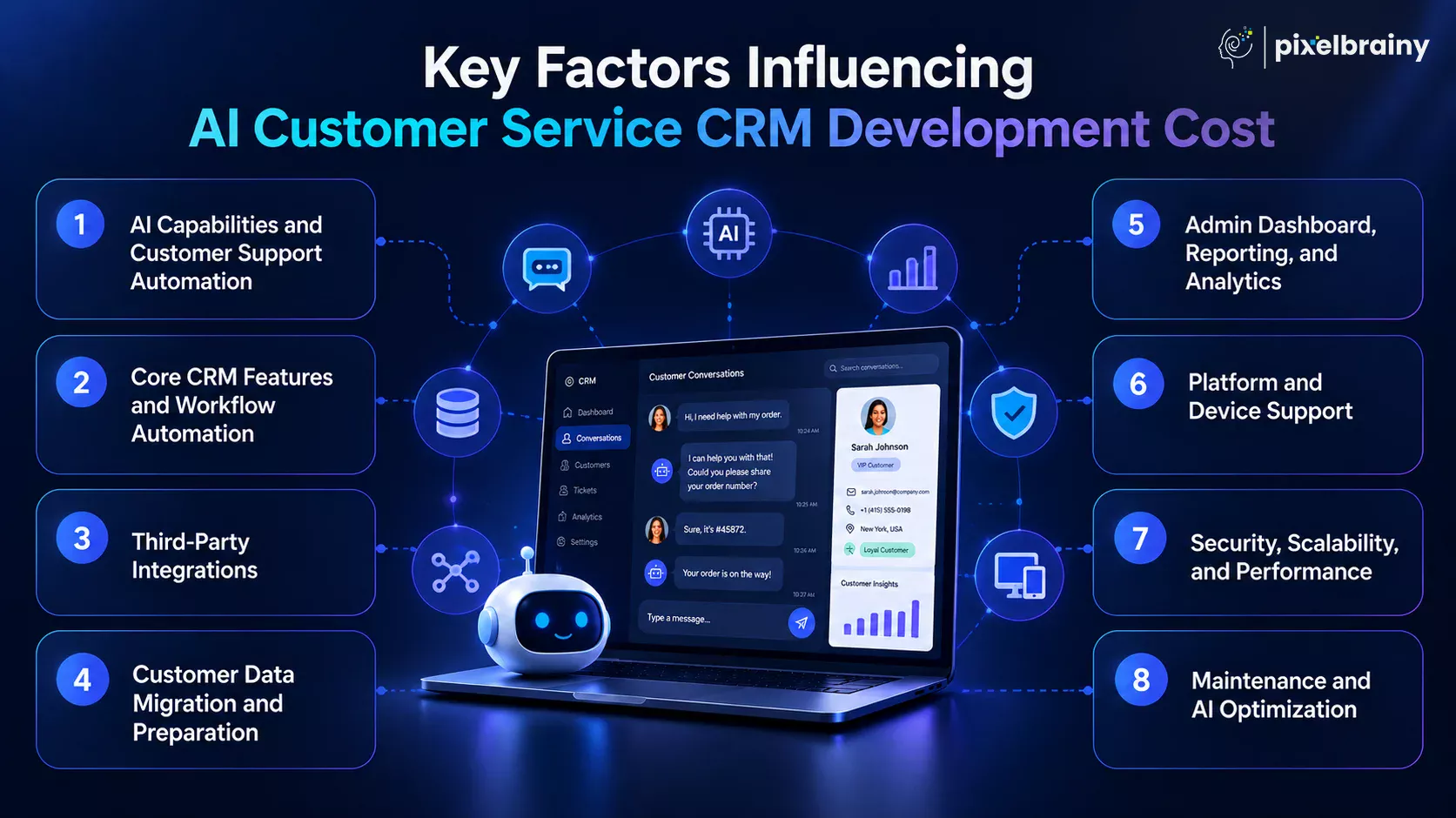
| AI capabilities and automation | $10,000 to $50,000+ | Very High |
| Core CRM features and workflows | $10,000 to $40,000+ | Very High |
| Third-party integrations | $5,000 to $30,000+ | High |
| Customer data migration and preparation | $3,000 to $20,000+ | High |
| Admin dashboard and analytics | $5,000 to $25,000+ | High |
| Platform and device support | $5,000 to $30,000+ | Medium to High |
| Security and scalability | $5,000 to $30,000+ | High |
| Testing and deployment | $3,000 to $15,000+ | Medium to High |
| Maintenance and AI optimization | 15% to 25% annually | Medium to High |
These are indicative planning estimates, not fixed prices. Individual components can overlap, and the final project cost depends on the complete scope.
AI functionality is one of the most important factors affecting the cost to develop an AI customer service CRM. Basic systems may use predefined rules and standard chatbot responses, while advanced solutions can analyze conversations, generate contextual answers, summarize support tickets, and recommend the next best action.
Potential AI capabilities include:
Approximate development ranges may include:
Custom AI development may require additional data preparation, model evaluation, retrieval-augmented generation, monitoring, and optimization. The cost also depends on whether the system uses third-party AI APIs or custom-trained models.
The number and complexity of CRM features directly influence the overall development budget. A basic CRM may manage customer profiles, conversations, and support tickets. A more advanced system can coordinate multiple support channels, automate business processes, and provide detailed customer histories.
Core CRM features may include:
A focused feature set may add approximately $10,000 to $20,000, while more complex workflows and enterprise-level CRM functionality can require $20,000 to $40,000+.
Clearly defining the required features before development helps control scope expansion and prevents unnecessary spending.
Integrations allow an AI customer service CRM to exchange information with the tools a business already uses. These connections can include communication platforms, helpdesk software, payment systems, marketing automation tools, and external customer databases.
Common integrations include:
Basic integrations may cost around $5,000 to $12,000, while multiple complex integrations can reach $30,000 or more. Real-time synchronization, custom API development, authentication, data mapping, and webhook handling can increase the cost.
AI customer service CRM software needs reliable customer data to generate useful insights and accurate responses. Businesses migrating from spreadsheets, legacy CRMs, or multiple support platforms may need to clean, standardize, deduplicate, and map existing records.
Data preparation may involve:
Depending on data quality and volume, this work can cost approximately $3,000 to $20,000+. Poorly structured data may increase development time and reduce AI response quality.
An effective CRM needs dashboards that help managers understand support performance and customer behavior. Basic dashboards may show ticket volumes and response times, while advanced analytics can track agent productivity, resolution rates, customer satisfaction, and AI automation performance.
Development costs may range from $5,000 to $25,000+, depending on dashboard complexity, custom reports, real-time metrics, and visualization requirements.
The platforms supported by the CRM also affect development costs. A responsive web application can be a practical starting point, while separate mobile applications and specialized interfaces require additional design, development, and testing.
Indicative planning ranges include:
These ranges describe broader project scopes and should not be added directly to individual feature estimates.
An AI-powered CRM handles sensitive customer information, making security a core development requirement. Depending on the industry and data handled, the system may need encryption, secure authentication, role-based permissions, audit logs, API protection, backups, and data retention controls.
Scalability requirements may include cloud infrastructure, database optimization, monitoring, load balancing, and automatic scaling.
Security and infrastructure work can add approximately $5,000 to $30,000+, with more demanding enterprise or regulatory requirements potentially increasing the investment.
The initial AI customer service CRM development cost does not cover every expense after launch. Ongoing costs may include:
A practical starting allowance is 15% to 25% of the initial development cost annually, although actual expenses depend on usage, service agreements, infrastructure, and AI complexity.
Ultimately, the AI customer service CRM development cost depends on how well the chosen features, AI capabilities, integrations, and infrastructure align with your business needs. A clearly defined scope and phased development approach can help control costs while building a scalable CRM that improves customer support efficiency and long-term ROI.
The cost to build an AI customer service CRM ranges from $30,000 to $250,000+, depending on the product scope, AI capabilities, CRM architecture, integrations, security requirements, and deployment complexity. The total budget is distributed across multiple development phases, including product discovery, UI/UX design, frontend and backend development, AI integration, testing, and launch.
For businesses planning to develop custom AI customer service CRM software, understanding the cost of each phase helps establish a realistic budget, prioritize essential features, and avoid unexpected expenses.
A common business query is:
“Our company wants to build an AI customer service CRM that automates support tickets, assists agents with AI-generated responses, integrates with existing business systems, and provides customer service analytics. How much will each development phase cost, from initial planning to production deployment?”
The answer depends on the required features, AI implementation strategy, data readiness, number of integrations, and expected user and conversation volumes.
| Development Phase | Estimated Cost | Cost Impact |
|---|---|---|
| Discovery and product planning | $2,000 to $8,000 | Medium |
| UI/UX design | $3,000 to $12,000 | Medium |
| Frontend and backend development | $12,000 to $50,000+ | Very High |
| AI development and integration | $8,000 to $45,000+ | Very High |
| Third-party integrations and data migration | $5,000 to $25,000+ | High |
| Security, testing, and QA | $4,000 to $18,000+ | High |
| Deployment and launch | $2,000 to $10,000 | Medium |
These are indicative estimates for individual phases, not fixed packages. Some activities overlap, and advanced enterprise requirements can increase the total beyond $250,000.
The discovery phase defines what the AI customer service CRM needs to accomplish before development begins. It establishes the business requirements, target users, essential features, AI use cases, and technical architecture.
Typical activities include:
Estimated cost: $2,000 to $8,000
Detailed planning helps identify expensive requirements early and reduces the risk of costly changes during development.
UI/UX design determines how customers, support agents, and administrators interact with the CRM. The design should make customer records, conversations, support tickets, and AI recommendations easy to access.
Key design elements may include:
Estimated cost: $3,000 to $12,000
The cost can increase when the project requires multiple user roles, complex workflows, custom design systems, or separate mobile interfaces.
Frontend and backend engineering typically account for a substantial share of the AI customer service CRM development cost. The frontend provides the user interface, while the backend manages customer records, ticket workflows, permissions, APIs, and business logic.
Core development tasks may include:
Estimated cost: $12,000 to $50,000+
A basic CRM with standard workflows requires less development than an enterprise platform with custom automation, complex permissions, multiple communication channels, and high-volume data processing.
AI development is a major cost driver when building an intelligent customer service CRM. The investment depends on whether the system uses existing AI APIs, retrieval-based knowledge search, custom models, or advanced predictive analytics.
Potential AI capabilities include:
Estimated cost: $8,000 to $45,000+
Integrating established AI APIs can reduce initial development effort. More advanced systems may require data preparation, retrieval-augmented generation, evaluation pipelines, guardrails, and ongoing model optimization. AI usage charges are generally separate from the initial integration budget.
An AI customer service CRM often needs to connect with existing business applications and import historical customer information. Integration complexity depends on API availability, data formats, authentication, and synchronization requirements.
Common tasks include:
Estimated cost: $5,000 to $25,000+
Businesses with multiple legacy systems or large volumes of inconsistent customer data may need a higher budget.
Before launch, the CRM must be tested to confirm that its workflows, AI features, integrations, and security controls work as expected.
Testing activities may include:
Estimated cost: $4,000 to $18,000+
Enterprise CRM systems may require additional security assessments, audit logging, compliance-related controls, and testing for high-volume workloads.
The deployment phase prepares the CRM for real-world use. It includes configuring production infrastructure, deploying the application, monitoring system performance, and supporting the initial rollout.
Typical activities include:
Estimated cost: $2,000 to $10,000
The final amount depends on infrastructure complexity, deployment automation, migration requirements, and the level of launch support.
Ultimately, planning the AI customer service CRM development cost by phase gives businesses better visibility into where their budget will go. Defining the MVP first, validating AI functionality early, and expanding integrations gradually can help control the initial investment while creating a foundation for future growth.
The AI customer service CRM development cost ranges from $30,000 to $250,000+, depending on the features, AI capabilities, integration requirements, and complexity of the customer support workflows. A basic CRM may focus on ticket management and customer profiles, while an advanced platform can include AI-powered routing, automated responses, sentiment analysis, omnichannel support, and predictive analytics.
For businesses estimating the AI customer service CRM cost by feature, the key is to understand which capabilities require the largest initial investment and which create recurring operating expenses. The following breakdown provides indicative estimates for planning a custom CRM project.
Core CRM infrastructure includes customer profiles, ticket management, agent workspaces, interaction history, and basic reporting. The cost depends on database complexity, user permissions, the number of ticket types, and the workflows the system must support.
Estimated cost: $10,000 to $30,000
AI ticket routing automatically classifies incoming customer requests by intent, urgency, and category, then directs them to the appropriate agent or support queue. Using an existing AI classification service can reduce initial development effort, while custom models may require additional training and evaluation.
Estimated cost: $5,000 to $15,000
AI agent assist analyzes customer messages and suggests relevant responses using approved knowledge base content and customer history. Costs increase when the system needs retrieval-augmented generation (RAG), contextual data retrieval, response validation, and real-time assistance.
Estimated cost: $8,000 to $25,000
Sentiment analysis evaluates customer conversations to identify frustration, dissatisfaction, and potential escalation risks. The investment depends on the number of communication channels, processing speed, language support, and supervisor alert requirements.
Estimated cost: $4,000 to $12,000
An AI chatbot answers routine customer questions, retrieves information from a knowledge base, and transfers complex queries to human agents when necessary. A chatbot using an existing platform may cost less than a custom conversational system with advanced context handling and CRM integration.
Estimated cost: $6,000 to $18,000
An omnichannel system brings customer interactions from email, live chat, messaging applications, and social platforms into a unified agent workspace. Costs depend on the number of channels, API limitations, synchronization needs, and conversation history requirements.
Estimated cost: $5,000 to $20,000+
A searchable knowledge base helps agents and AI assistants retrieve relevant answers from product documentation, FAQs, policies, and support articles. Semantic search, document processing, access controls, and frequent content updates can increase development complexity.
Estimated cost: $4,000 to $12,000
Analytics dashboards track ticket volumes, resolution times, agent performance, customer satisfaction indicators, and support trends. Advanced solutions may also include predictive insights to identify customers who could need additional support.
Estimated cost: $5,000 to $15,000
This component covers custom reports, audit trails, interaction records, access controls, and relevant data protection requirements. Industry-specific obligations may require additional controls, documentation, and security testing.
Estimated cost: $4,000 to $15,000
| Feature | Estimated Development Cost | Potential Monthly Operating Cost |
|---|---|---|
| Core CRM infrastructure | $10,000 to $30,000 | $300 to $2,000 |
| AI ticket routing and classification | $5,000 to $15,000 | $100 to $800 |
| AI agent assist | $8,000 to $25,000 | $300 to $2,000 |
| Sentiment analysis | $4,000 to $12,000 | $100 to $800 |
| AI self-service chatbot | $6,000 to $18,000 | $200 to $1,500 |
| Omnichannel integration | $5,000 to $20,000+ | $100 to $500 per channel |
| Knowledge base and AI search | $4,000 to $12,000 | $100 to $500 |
| Analytics and AI insights | $5,000 to $15,000 | $100 to $500 |
| Reporting, security, and compliance | $4,000 to $15,000 | $100 to $500 |
Monthly operating costs are indicative allowances, not guaranteed prices. Actual expenses depend on usage, hosting, AI API consumption, vendor fees, and support requirements. Feature estimates can overlap and should not simply be added together.
The overall AI customer service CRM development cost depends on the features selected, AI complexity, and integration requirements. Prioritizing essential capabilities helps businesses build a scalable CRM within their budget.
When you think about building an AI customer service CRM, the development team's expertise, location, and engagement model can significantly influence the overall cost. With a budget ranging from $30,000 to $250,000+, businesses can develop solutions ranging from basic AI-powered ticket management systems to advanced CRM platforms with automated customer support, intelligent response suggestions, and predictive analytics.
In-house teams, specialized AI development agencies, freelancers, and offshore development partners offer different cost structures and technical capabilities. Understanding these differences helps businesses estimate development expenses, plan resources, and build a CRM that meets their current requirements while supporting future growth.
| Development Team | Typical Hourly Rate | Indicative Project Cost | Best For |
|---|---|---|---|
| In-house development team | $80 to $180+ | $150,000 to $250,000+ | Long-term product development |
| US-based AI development agency | $100 to $180 | $100,000 to $250,000+ | Complex AI CRM solutions |
| Freelance development team | $25 to $100 | $30,000 to $100,000+ | MVPs and focused features |
| Eastern European development team | $40 to $90 | $50,000 to $180,000+ | Mid-level and advanced CRM projects |
| South Asian development team | $20 to $60 | $30,000 to $150,000+ | Cost-conscious custom development |
These figures are indicative planning estimates. Actual rates and project costs vary by experience, team size, feature scope, and contract terms.
Estimated project budget: $150,000 to $250,000+
An in-house team gives businesses direct control over development priorities, customer data, product decisions, and ongoing improvements. A typical team may include AI engineers, frontend and backend developers, UI/UX designers, QA engineers, DevOps specialists, and a product manager.
However, recruitment, salaries, benefits, infrastructure, and employee retention increase the total cost. This approach is generally more suitable for businesses planning continuous CRM development rather than a one-time product launch.
Typical rate: $100 to $180 per hour
Estimated project budget: $100,000 to $250,000+
A specialized agency can provide AI engineering, CRM development, system integrations, security testing, and project management within one engagement. This model suits businesses building advanced AI assistants, custom workflows, or enterprise customer service platforms.
The higher hourly rate may be offset by access to an established team and structured delivery processes, depending on the agency's capabilities and project requirements.
Typical rate: $25 to $100 per hour
Estimated project budget: $30,000 to $100,000+
Freelancers can be suitable for MVP development, AI API integration, dashboard creation, and individual CRM modules. This approach offers flexibility, but businesses must coordinate different specialists and ensure consistent code quality, security, documentation, and testing.
Typical rate: $40 to $90 per hour
Estimated project budget: $50,000 to $180,000+
Eastern European teams may offer expertise in AI engineering, full-stack development, cloud architecture, and QA. This model can suit mid-level CRM projects requiring multiple technical capabilities without the staffing costs of a permanent internal team.
Typical rate: $20 to $60 per hour
Estimated project budget: $30,000 to $150,000+
South Asian development teams can provide frontend and backend engineering, AI integration, UI/UX design, testing, and deployment. This option can help startups and growing businesses develop custom CRM software while managing initial investment. Evaluate technical experience, communication, security practices, and post-launch support before selecting a partner.
The best team structure depends on your budget, project complexity, and long-term goals. Compare the complete delivery cost, AI expertise, integration experience, security standards, communication, and maintenance support rather than choosing solely by hourly rate.
The cost of AI customer service CRM development can vary significantly depending on whether a business builds a custom solution or uses an existing CRM platform. Existing providers offer ready-made customer management and AI features, while custom development provides greater control over support workflows, automation, integrations, data management, and future enhancements.
A common business query is:
“Our company wants to implement an AI customer service CRM with automated ticket routing, AI-generated responses, customer analytics, and omnichannel support. Should we build a custom CRM or use an existing platform, considering our development budget of $30,000 to $250,000+?”
The answer depends on your business requirements, available platform features, customization needs, integration complexity, implementation timeline, and long-term operating costs.
| Cost and Business Factor | Custom CRM Development | Existing CRM Platform |
|---|---|---|
| Initial investment | $30,000 to $250,000+ | Generally lower initial setup cost |
| Customization | High | Limited by platform capabilities and plans |
| AI capabilities | Built around business requirements | Depends on available AI features |
| Integrations | Custom-built or API-based | Native integrations and supported APIs |
| Launch timeline | Usually longer | Usually faster |
| Product control | Greater control over architecture | Dependent on provider |
| Ongoing expenses | Hosting, AI usage, maintenance, support | Subscription, usage, add-ons, customization |
| Scalability | Designed around requirements | Depends on platform limits and pricing |
A custom AI customer service CRM is built around the company's specific customer support workflows, data structure, automation requirements, and business objectives.
The cost to build a custom AI customer service CRM ranges from $30,000 to $250,000+.
A custom solution may include:
This approach provides greater flexibility over product features, integrations, and future development. However, the business must budget for design, engineering, testing, deployment, infrastructure, and ongoing maintenance.
A custom CRM can be suitable for businesses with complex workflows, specialized AI requirements, or existing systems that standard platforms cannot support effectively.
Existing CRM providers offer ready-made customer management, ticketing, workflow automation, reporting, and AI capabilities. Examples include Salesforce Service Cloud and Zendesk.
Using an established platform can reduce the need to develop core CRM functionality from scratch. Depending on the product and plan, businesses may access:
The initial cost typically includes configuration, data migration, integration, employee training, and any required customization. Recurring expenses may include user subscriptions, AI usage, premium features, and third-party applications.
The main limitation is that businesses must work within the platform's supported capabilities, pricing structure, and customization options. Verify current provider pricing and feature availability before comparing total costs.
A hybrid model combines an existing AI customer service CRM platform with custom AI components. It can reduce the need to build an entire CRM while allowing businesses to develop specialized capabilities.
For example, a company could use an existing CRM for customer records and ticket management while building custom AI functionality for:
Indicative custom development budget: $30,000 to $150,000+, depending on the complexity of the AI layer, integration requirements, and existing platform capabilities. Subscription and usage fees remain additional expenses.
| Approach | Indicative Investment | Suitable For |
|---|---|---|
| Existing CRM platform | Provider-dependent setup and subscription costs | Businesses needing standard support features quickly |
| Existing CRM plus custom AI | $30,000 to $150,000+ in custom development | Companies needing specialized AI functionality |
| Custom AI CRM MVP | $30,000 to $60,000 | Startups validating a focused product |
| Advanced custom AI CRM | $60,000 to $200,000 | Businesses needing extensive automation and integrations |
| Enterprise custom AI CRM | $200,000 to $250,000+ | Complex workflows, security, and scalability requirements |
These are planning estimates, not direct price quotations. The categories may overlap depending on the features included.
The initial development budget is only one part of the decision. Custom CRM software requires ongoing spending on hosting, AI APIs, maintenance, security, and feature improvements. Existing platforms introduce recurring subscriptions, premium AI features, add-ons, and potential costs for customization.
Businesses should compare the total cost over their expected usage period, including implementation, integrations, support, scaling, and future changes.
Therefore, right development approach depends on your budget, customization requirements, and long-term growth plans. Comparing initial development costs with ongoing expenses helps you invest in an AI customer service CRM that fits your business needs.

The initial AI customer service CRM development cost of $30,000 to $250,000+ covers building and launching the software, but businesses must also plan for recurring expenses after deployment. AI API usage, cloud hosting, database storage, security monitoring, maintenance, and third-party integrations can all contribute to the total cost of ownership.
A common business query is:
“We have budgeted for AI customer service CRM development, but how much will it cost to operate, maintain, and improve the CRM after launch, including AI usage, hosting, security, and technical support?”
Understanding these ongoing and hidden costs helps businesses prepare a realistic budget and avoid unexpected operating expenses.
| Cost Category | Estimated Cost |
|---|---|
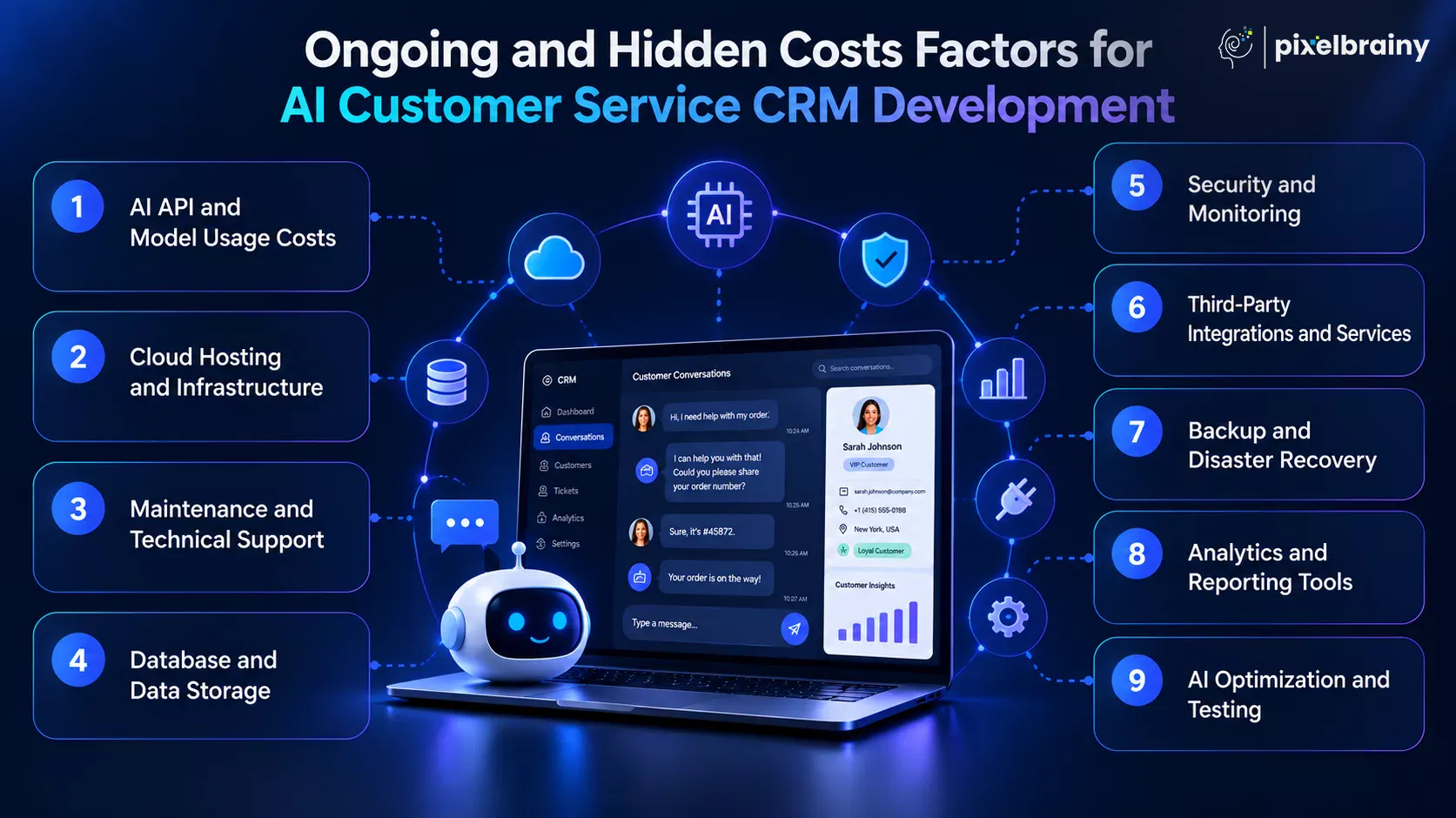
| AI APIs and model usage | $300 to $5,000+/month |
| Cloud hosting and infrastructure | $300 to $3,000+/month |
| Maintenance and technical support | $1,000 to $6,000+/month |
| Database and data storage | $100 to $1,000+/month |
| Security and monitoring | $200 to $2,000+/month |
| Third-party integrations and services | $200 to $2,000+/month |
| Backup and disaster recovery | $100 to $800+/month |
| Analytics and reporting tools | $100 to $1,000+/month |
| AI optimization and testing | $300 to $2,000+/month |
These figures are indicative planning ranges. Actual expenses depend on customer volume, system architecture, AI usage, service providers, and support requirements.
AI-powered CRMs may use language models for chatbot conversations, ticket classification, response suggestions, sentiment analysis, and conversation summaries. These features can generate recurring charges based on API requests, tokens processed, and model selection.
Expenses may include:
Estimated cost: $300 to $5,000+/month
Higher support volumes, longer conversations, and frequent AI requests can increase usage costs. Caching, prompt optimization, and routing simple tasks to smaller models can help manage expenses.
Cloud infrastructure keeps the CRM application, APIs, databases, dashboards, and background processes running. Costs depend on the number of users, ticket volume, data processing needs, and availability requirements.
Typical expenses include compute resources, application hosting, bandwidth, load balancing, and monitoring.
Estimated cost: $300 to $3,000+/month
Enterprise deployments with high traffic, multiple environments, or strict availability requirements may need a larger infrastructure budget.
Regular maintenance helps keep the CRM secure, reliable, and compatible with changing technologies. It can include bug fixes, framework updates, API changes, performance improvements, and technical support.
Estimated cost: $1,000 to $6,000+/month
Businesses can also plan for annual maintenance at approximately 15% to 25% of the initial development cost, depending on the support agreement and complexity of the platform.
AI customer service CRM software stores customer profiles, conversation histories, ticket records, attachments, and analytics data. Storage requirements grow as more customers interact with the system.
Ongoing expenses may cover database hosting, storage capacity, indexing, data archiving, and database optimization.
Estimated cost: $100 to $1,000+/month
Large historical datasets and frequent queries can increase storage and processing costs.
Customer service platforms handle sensitive customer information, making continuous security monitoring essential. Recurring expenses may include vulnerability scanning, access monitoring, audit logs, security tools, and periodic security assessments.
Estimated cost: $200 to $2,000+/month
Additional security work may be required when the CRM handles regulated information or needs industry-specific controls.
The CRM may depend on external services for email, messaging, identity verification, communication channels, and customer support tools. Some providers charge monthly subscriptions, while others use usage-based pricing.
Estimated cost: $200 to $2,000+/month
Businesses should account for subscription changes, API usage limits, premium features, and integration maintenance when estimating recurring expenses.
Backups protect customer records and business data against accidental deletion, system failures, and other disruptions. Costs depend on backup frequency, data volume, retention periods, and recovery requirements.
Estimated cost: $100 to $800+/month
Regular recovery testing is important to confirm that backed-up data can be restored when needed.
Analytics tools help businesses track ticket resolution times, customer satisfaction, agent productivity, and automation performance. Costs may include dashboard subscriptions, data processing, reporting tools, and business intelligence services.
Estimated cost: $100 to $1,000+/month
The final amount depends on reporting complexity, data volume, and the number of users who need access.
AI features require ongoing evaluation to maintain response quality and reduce inaccurate or irrelevant answers. Businesses may need to update prompts, test model changes, review outputs, and improve knowledge retrieval.
Estimated cost: $300 to $2,000+/month
The budget may increase when the CRM supports multiple languages, complex customer queries, or frequent AI feature updates.
The total cost of AI customer service CRM ownership includes the initial $30,000 to $250,000+ development investment, recurring infrastructure and AI expenses, maintenance, security, and future enhancements. Estimating these costs before launch helps businesses build a sustainable operating budget and scale their CRM without unexpected financial pressure.
Reducing the AI customer service CRM development cost of $30,000 to $250,000+ does not mean sacrificing essential features, AI accuracy, security, or customer experience. Businesses can manage their development budgets by prioritizing high-value functionality, reusing proven technologies, choosing appropriate AI services, and introducing advanced capabilities in phases.
A common business query is:
“How can we reduce the cost of building an AI customer service CRM without compromising automated ticket management, AI-generated responses, customer data security, integrations, and system performance?”
The following strategies can help control initial development expenses while maintaining software quality and long-term scalability.
| Cost-Saving Strategy | Potential Planning Savings |
|---|---|
| Build a focused MVP | 20% to 35% |
| Prioritize essential CRM features | 10% to 25% |
| Use existing AI APIs | 15% to 30% |
| Reuse proven technologies | 10% to 20% |
| Start with responsive web development | 15% to 30% |
| Implement AI in phases | 15% to 25% |
| Plan integrations early | 10% to 20% |
| Automate testing and deployment | 5% to 15% |
These percentages are illustrative planning estimates, not guaranteed savings. Strategies can overlap, so their percentages should not be added together.
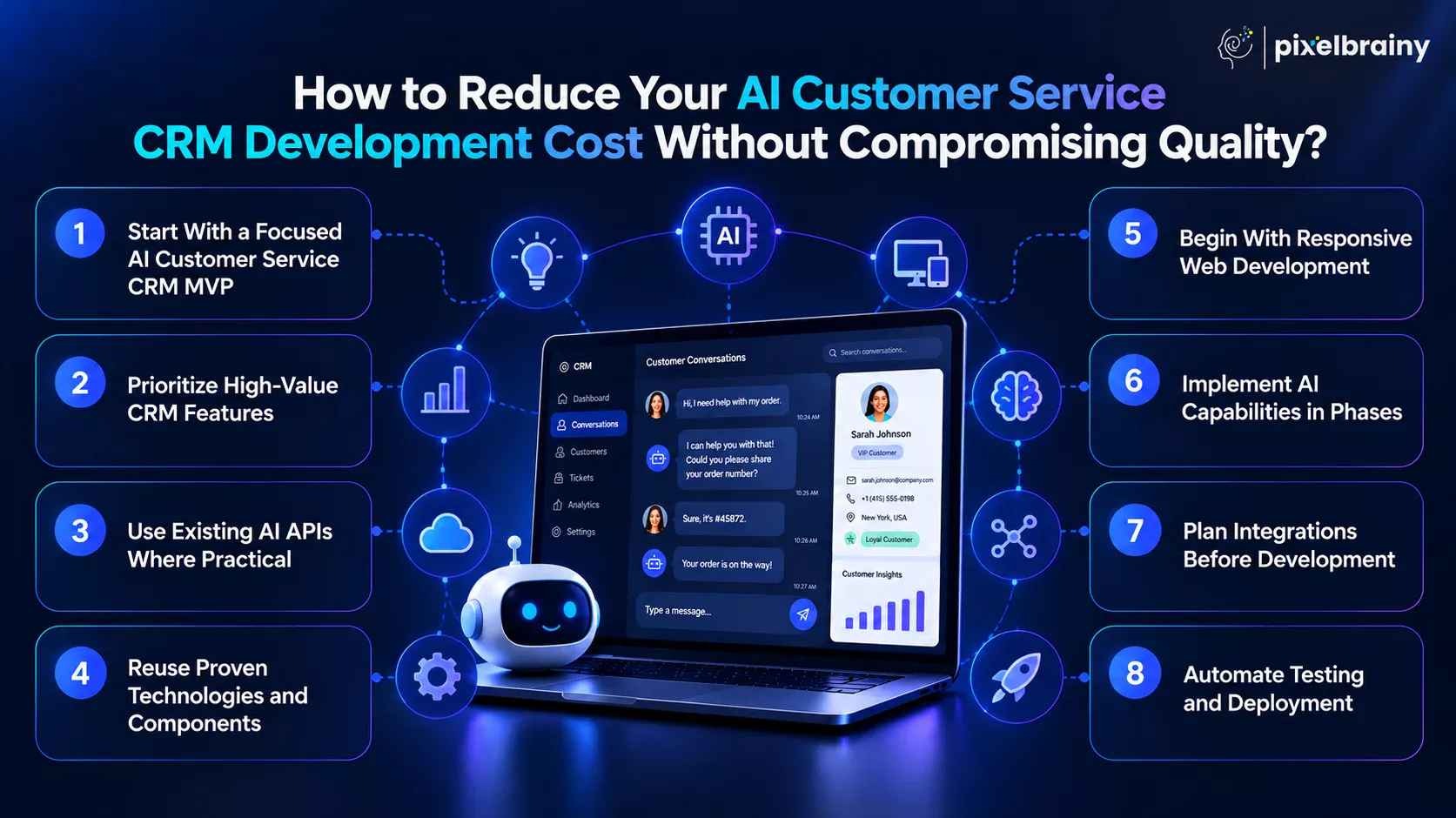
Building every possible CRM feature at launch can increase development hours, testing requirements, and infrastructure costs. Instead, start with a minimum viable product (MVP) that addresses the most important customer support needs.
Essential MVP features may include:
Potential planning savings: 20% to 35%.
A focused MVP helps validate the product before investing in advanced analytics, predictive AI, and extensive workflow automation.
Not every feature needs to be included in the first release. Categorize requirements into essential features, near-term improvements, and future enhancements.
For example, automated ticket routing and response suggestions may deliver immediate value, while advanced customer predictions and highly customized dashboards can be introduced later.
Potential planning savings: 10% to 25%.
This approach reduces unnecessary development work without removing features required for reliable customer support.
Developing custom AI models from scratch can increase the cost of AI customer service CRM development. Existing AI APIs can support common capabilities without requiring businesses to build and maintain their own models initially.
Potential applications include:
Potential planning savings: 15% to 30%.
Custom models may become worthwhile when proprietary data, specialized requirements, or usage economics justify the additional investment. Businesses should also account for API usage charges and data privacy requirements.
Established frameworks, authentication services, database systems, cloud infrastructure, and reusable interface components can reduce development time.
Potential planning savings: 10% to 20%.
Reusing proven components allows developers to focus on business-specific CRM workflows and AI functionality rather than rebuilding standard technical capabilities.
Developing separate web, iOS, and Android applications simultaneously can increase design, engineering, testing, and maintenance expenses.
A responsive web CRM can initially support desktop, tablet, and mobile browsers without requiring separate native applications.
Potential planning savings: 15% to 30%.
Dedicated mobile applications can be introduced later if customer support teams require device-specific features or usage data justifies the investment.
Advanced AI features can be introduced gradually instead of being developed all at once.
A phased roadmap might include:
Potential initial budget reduction: 15% to 25%.
This approach spreads investment across releases and helps businesses evaluate which AI features provide measurable operational benefits.
Late integration changes can require backend modifications, additional testing, and architecture adjustments. Identify essential connections with email, messaging platforms, helpdesk tools, ERP systems, and customer databases during the planning phase.
Potential planning savings: 10% to 20%.
Early planning also helps identify API limitations, third-party fees, and data migration requirements before they become unexpected expenses.
Automated testing and continuous integration and deployment (CI/CD) pipelines can reduce repetitive manual work and make software releases more consistent.
Automation can support regression testing, API validation, build checks, deployment, and performance monitoring.
Potential planning savings: 5% to 15%.
Testing should still cover AI response quality, data security, integration reliability, and critical customer support workflows.
Suppose your estimated CRM development budget is $100,000. A hypothetical 20% reduction would save $20,000, bringing the initial estimate to $80,000. Actual savings depend on the original scope, team structure, architecture, and technology choices.
The most effective way to reduce AI customer service CRM development cost is to eliminate unnecessary complexity while protecting essential functionality, security, and reliability. A phased approach helps businesses manage the initial $30,000 to $250,000+ investment and expand the CRM as customer support requirements evolve.
As an AI development company in the USA, PixelBrainy can help businesses plan and develop AI customer service CRM solutions while managing development costs without compromising essential functionality, security, or scalability. With an overall development budget ranging from $30,000 to $250,000+, the right planning strategy can help businesses prioritize features, select suitable AI technologies, and avoid unnecessary development expenses.
PixelBrainy's approach to cost optimization can focus on defining project requirements, identifying high-value AI features, reusing proven technology components, streamlining integrations, and implementing functionality in phases. Instead of investing in every advanced capability at launch, businesses can prioritize the features that address their immediate customer support challenges.
A common business query is:
“We want to build a custom AI customer service CRM, but how can we control development costs while maintaining AI accuracy, automated ticket management, customer data security, integrations, and scalability?”
The answer begins with structured cost planning, a clearly defined product scope, and a development roadmap aligned with business objectives.
Before development begins, PixelBrainy can help assess key requirements, including:
This assessment helps establish a more realistic AI customer service CRM development budget while identifying opportunities to simplify features, reuse existing components, and schedule nonessential capabilities for later releases.
Consider a business planning an AI customer service CRM with customer profiles, ticket management, AI-generated response suggestions, automated routing, customer analytics, third-party integrations, and advanced AI features planned for future releases.
The initial project estimate is $200,000. After reviewing the requirements, the development roadmap prioritizes essential CRM functionality, core AI automation, and critical integrations. Advanced predictive analytics and additional automation workflows are scheduled for later phases.
The initial release can therefore focus on delivering the most important capabilities while maintaining the technical foundation needed for future expansion.
| Cost Optimization Metric | Illustrative Result |
|---|---|
| Original estimated development cost | $200,000 |
| Optimized MVP development cost | $130,000 |
| Potential cost reduction | 35% |
| Illustrative initial savings | $70,000 |
| Estimated initial delivery timeline | 16 to 20 weeks |
| Future expansion | Advanced AI, analytics, and integrations |
These figures are hypothetical planning examples, not PixelBrainy's quoted prices or guaranteed savings. Actual costs and delivery timelines depend on project scope, AI complexity, integrations, team structure, and technical requirements.

A phased development approach can help businesses:
For companies planning an AI customer service CRM within the $30,000 to $250,000+ range, this strategy can help balance initial investment with long-term product development.
PixelBrainy can help businesses plan a custom AI customer service CRM around their operational needs, available budget, and future growth objectives. To discuss your project requirements and explore a tailored development roadmap, contact PixelBrainy
The cost to develop an AI customer service CRM ranges from $30,000 to $250,000+, depending on feature complexity, AI capabilities, integrations, security requirements, and scalability. A basic MVP can help businesses automate essential support tasks, while advanced CRM solutions can deliver intelligent ticket routing, AI-generated responses, predictive analytics, and personalized customer experiences.
Understanding the AI customer service CRM development cost breakdown helps businesses allocate budgets effectively, prioritize high-value features, and prepare for ongoing expenses such as AI API usage, cloud hosting, maintenance, and security. Choosing between custom development, an existing CRM platform, or a hybrid approach also influences the initial investment and long-term cost of ownership.
A phased development strategy can reduce unnecessary spending without compromising software quality. By starting with essential functionality and expanding based on business needs, companies can build a scalable CRM that improves support efficiency and customer satisfaction.
Ready to build your AI customer service CRM? Schedule a call with PixelBrainy to discuss your requirements, estimate development costs, and plan a solution aligned with your business goals.
The cost to develop an AI customer service CRM in 2026 typically ranges from $30,000 to $250,000+. A basic MVP may cost $30,000 to $60,000, a mid-level solution $60,000 to $120,000, and an advanced or enterprise CRM $120,000 to $250,000+.
Building an AI-powered customer support CRM from scratch can require an estimated budget of $60,000 to $150,000 for a mid-level solution with automated ticket management, AI response suggestions, customer records, integrations, and reporting. The actual cost depends on feature complexity, AI architecture, and development hours.
The cost of adding an AI chatbot to existing CRM software can range from approximately $6,000 to $18,000 for a custom implementation, depending on conversational complexity, knowledge base integration, escalation workflows, and CRM connectivity. Recurring AI API charges may apply separately.
The AI customer service CRM development cost by feature varies according to functionality. Core CRM infrastructure may cost $10,000 to $30,000, AI ticket routing $5,000 to $15,000, AI agent assistance $8,000 to $25,000, and AI chatbot development $6,000 to $18,000. These estimates can overlap and should not be added together without reviewing the full project scope.
AI ticket automation may cost approximately $5,000 to $15,000 for ticket classification, prioritization, and automated routing. More advanced automation involving custom models, complex escalation rules, and multiple communication channels can increase the development budget.
Hidden and recurring costs can include AI API usage, cloud hosting, database storage, security monitoring, software maintenance, and third-party subscriptions. Depending on usage and system complexity, monthly expenses can range from hundreds to several thousand dollars beyond the initial development investment.
Building a custom AI CRM is suitable when a business needs specialized workflows, proprietary AI capabilities, or greater control over its software. Existing platforms can reduce initial development effort and accelerate implementation. Businesses should compare subscription fees, customization costs, integration expenses, and long-term maintenance before deciding.
Businesses can control AI customer service CRM development costs by launching an MVP, prioritizing essential features, using existing AI APIs, reusing proven software components, and introducing advanced automation in phases. Planning integrations early and maintaining rigorous security and testing standards can also reduce avoidable rework.

About The Author
Sagar Bhatnagar
Sagar Sahay Bhatnagar brings over a decade of IT industry experience to his role as Marketing Head at PixelBrainy. He's known for his knack in devising creative marketing strategies that boost brand visibility and market influence. Sagar's strategic thinking, coupled with his innovative vision and focus on results, sets him apart. His track record of successful campaigns proves his ability to utilize digital platforms effectively for impactful marketing efforts. With a genuine passion for both technology and marketing, Sagar continuously pushes PixelBrainy's marketing initiatives to greater success.

Working with PixelBrainy has been a great experience. They took our vision for an AI-powered platform and turned it into a fully functional product. What impressed me most was their strong understanding of both design and development, and their ability to handle complex requirements with ease. The team was responsive, cooperative, and always open to feedback. They kept things organized, communicated clearly, and delivered quality work on time. I highly recommend PixelBrainy to anyone looking for a skilled and reliable development partner.

Working with the PixelBrainy team has been a highly positive experience. They understand the design requirements and create beautiful UX elements to meet the application needs. The dev team did an excellent job bringing my vision to life. We discussed usability and flow. Sagar worked with his team to design the database and begin coding. Working with Sagar was easy. He has the knowledge to create robust apps, including multi-language support, Google and Apple ID login options, Ad-enabled integrations, Stripe payment processing, and a Web Admin site for maintaining support data. I'm extremely satisfied with the services provided, the quality of the final product, and the professionalism of the entire process. I highly recommend them for Android and iOS Mobile Application Design and Development.

Great experience working with them. Had a lot of feedback and I found that unlike most contractors they were bugging me for updates instead of the other way around. They were extremely time conscience and great at communicating! All work was done extremely high quality and if not on time, early! They were always proactive when it comes to communication and the work is great/above par always. Very flexible and a great team to work with! Goes above and beyond to present us with multiple options and always provides quality. Amazing work per usual with Chitra. If you have UI/UX or branding design needs I recommend you go to them! Will likely work with them in the future as well, definitely recommended!

PixelBrainy is a joy to work with and is a great partner when thinking through branding, logo, and website layout. I appreciate that they spend time going into the "why" behind their decisions to help inform me and others about industry best practices and their expertise.

I hired them to design our software apps. Things I really like about them are excellent communication skills, they answer all project suggestions and collaborate right away, and their input on design and colors is amazing. This project was complex and needed patience and creativity. The team is amazing to do business with. I will be using them long-term. Glad to see there are some good people out there. I was afraid to try and outsource my project to someone but I am glad I met them! I really can't say enough. They went above and beyond on this project. I am very happy with everything they have done to make my business stand out from the competition.

It was great working with PixelBrainy and the team. They were very responsive and really owned the project. We'll definitely work with them again!

I recently worked with the PixelBrainy team on a project and I was blown away by their communication skills. They were prompt, clear, and articulate in all of our interactions. They listened and provided valuable feedback and suggestions to help make the project a success. They also kept me updated throughout the entire process, which made the experience stress-free and enjoyable.

PixelBrainy is very good at what it does. The team also presents themselves very professionally and takes care of their side of things very well. I could fully trust them taking up the design work in a timely and organised manner and their attention to detail saved us lots of effort and time. This particular project was quite intense and the team showed that they function very well under pressure. Very much looking forward to working with her again!

It's always an absolute pleasure working with them. They completed all of my requests quickly and followed every note I had for them to a T, which made our process go smoothly from start to finish. Everything was completed fast and following all of the guidelines. And I would recommend their services to anyone. If you need any design work done in the future, PixelBrainy should be your first call!

They took ownership of our requirements and designed and proposed multiple beautiful variants. The team is self-motivated, requires minimum supervision, committed to see-through designs with quality and delivering them on time. We would definitely love to work with PixelBrainy again when we have any requirements.

PixelBrainy was a big help with our SaaS application. We've been hard at work with a new UI/UX and they provided a lot of help with the designs. If you're looking for assistance with your website, software, or mobile application designs, PixelBrainy and the team is a great recommendation.

PixelBrainy designers are amazing. They are responsive, talented, and always willing to help craft the design until it matches your vision. I would recommend them and plan to continue them for my future projects and more!!!

They were awesome! Did a good job fast, and good communication. Will work with them again. Thank you

Creative, detail-oriented, and talented designers who take direction well and implement changes quickly and accurately. They consistently over-delivered for us.

PixelBrainy team is very talented and creative. Great designers and a pleasure to work with. PixelBrainy is an excellent communicator and I look forward to working with them again.

PixelBrainy has a very talented design team. Their work is excellent and they are very responsive. I enjoy working with them and hope to continue on all of our future projects.


Transform your ideas into reality with us.
Across these industries, each engagement brings unique challenges, from early-stage product development to scaling complex systems, helping us build a practical understanding of real-world product environments.