AI Summary Powered by PixelBrainy
Can you really build a powerful AI fantasy sports website in 2026 without knowing how much you need to invest?
Imagine you are a startup founder planning to launch a fantasy cricket, football, basketball, or multi-sport platform. You want users to create fantasy teams, join contests, view live scores, receive AI-powered player recommendations, analyze performance, and enjoy a personalized sports experience. But before development begins, one question becomes critical: how much will the website actually cost?
The AI fantasy sports website development cost typically ranges from $30,000 to $250,000+, depending on the platform's features, AI capabilities, sports coverage, real-time data integrations, security requirements, technology stack, development team, and scalability requirements.
If you are planning a focused MVP, the cost to build AI fantasy sports website can start from approximately $30,000 to $60,000. A more advanced platform with AI recommendations, predictive analytics, multiple sports, real-time data, payment integration, advanced administration, and personalization can cost around $60,000 to $180,000. Enterprise-grade platforms with sophisticated AI models, high scalability, extensive integrations, and multi-market capabilities can exceed $250,000.
So, how much does it cost to build an AI fantasy sports website in 2026? There is no universal fixed price. Your development budget of AI fantasy sports website should be based on your business model, target audience, feature requirements, launch market, expected users, and future growth plans.
This guide explains the cost of creating an AI fantasy sports website, the factors influencing the price, development-stage expenses, team-based pricing, hidden costs, and practical ways to reduce your investment without compromising essential functionality.
Developing an AI fantasy sports website involves much more than creating a platform where users can select players and join fantasy contests. Modern fantasy sports users expect intelligent player recommendations, AI-powered team suggestions, real-time match updates, player performance analysis, historical statistics, personalized fantasy insights, automated team optimization, predictive analytics, live score updates, contest recommendations, and data-driven decision support.
Every one of these capabilities directly influences the AI fantasy sports website development cost, making budget planning one of the most important decisions before development begins.
A common founder query looks like this:
"We are building an AI fantasy sports website for cricket, football, and basketball. Initially, we planned to launch with fantasy team creation, player statistics, and basic AI player recommendations. However, we now want real-time match updates, AI team optimization, player performance predictions, personalized recommendations, contest suggestions, AI confidence scores, advanced analytics dashboards, and real-time alerts. How can we accurately estimate the cost to build an AI fantasy sports website before presenting our financial projections to investors?"
This is exactly why budgeting should happen before writing the first line of code, not after feature requests and technical complexity continue expanding. A well-defined budget helps founders understand the development budget of AI fantasy sports website, prioritize features that deliver the highest business value, and avoid unexpected development expenses that can delay product launches.
Not every AI capability needs to be included in the first version of your fantasy sports website.
The most effective sports technology startups often begin with a Minimum Viable Product that solves one core user problem exceptionally well. Once the platform gains users, generates engagement data, and validates the business model, additional AI capabilities can be introduced according to real user demand.
This phased approach can significantly reduce the cost to build AI fantasy sports website while allowing businesses to validate their product faster.
A typical AI fantasy sports MVP may include:
Advanced capabilities such as AI-powered team optimization, player performance prediction, personalized fantasy recommendations, AI confidence scores, automated contest recommendations, natural language sports assistants, advanced player analytics, behavioral personalization, and multi-sport AI engines can be introduced during later development phases.
By focusing on essential functionality first, founders can better control the cost of creating an AI fantasy sports website without sacrificing long-term product quality or user experience.
Investors rarely approve funding based only on a single development estimate.
They want to understand how the capital will be allocated, which features will be launched first, how the product will evolve, and what additional investment may be required as the user base grows.
A detailed breakdown of the AI fantasy sports website development cost demonstrates that your project has been carefully planned, technical requirements have been evaluated, and financial risks have been considered before development begins.
Instead of presenting investors with one large number, founders can clearly explain the expected spending across:
This level of financial transparency demonstrates that the business understands both the technical and commercial requirements involved in building an AI-powered fantasy sports platform.
It also makes it easier to explain why the AI fantasy sports website development cost could range from approximately $30,000 to $250,000+, depending on the scope, AI complexity, sports coverage, scalability, and integrations.
One of the biggest reasons software projects exceed their original budget is uncontrolled feature expansion.
Many founders initially plan a relatively simple fantasy sports platform with player statistics, team creation, contests, and basic AI recommendations.
During development, they may decide to add:
These features can significantly increase the overall cost to build AI fantasy sports website.
For example, adding a basic AI recommendation feature may require relatively limited integration work. Building a custom AI prediction engine that analyzes historical player data, current match conditions, team performance, player form, and real-time match information can require substantially more data engineering, machine learning, backend development, testing, and infrastructure.
A predefined budget allows founders to evaluate every additional feature according to:
This disciplined approach helps minimize unnecessary spending, prevent development delays, and keep the product roadmap aligned with business objectives.
The technologies selected during the planning stage can directly influence how much does it cost to build an AI fantasy sports website in 2026.
Choosing the appropriate AI architecture, cloud environment, machine learning framework, sports data provider, database, backend technology, frontend framework, and real-time communication system early in the project can reduce technical debt and prevent expensive architectural changes later.
Some of the most important technology decisions include:
For example, a startup launching with one sport and a few thousand expected users may not need the same infrastructure as an enterprise fantasy sports platform designed to support millions of users and multiple sports simultaneously.
Making these technology decisions during the budgeting phase helps optimize both the initial AI fantasy sports website development cost and future operating expenses while keeping the platform prepared for growth.
The most successful AI fantasy sports websites are rarely built with every possible feature from day one.
Instead, businesses can launch an MVP, validate user behavior, collect fantasy participation data, measure AI recommendation performance, gather feedback, and gradually introduce more sophisticated functionality.
A practical development roadmap may look like this:
This phased development strategy enables founders to control the development budget of AI fantasy sports website, reduce financial risk, improve product-market fit, and invest in advanced AI capabilities only after validating customer demand.
Another important reason to establish a budget before development is that the initial development quotation is not the complete cost of operating an AI fantasy sports website.
Your long-term budget may also need to account for:
For example, an AI fantasy sports website that generates thousands of AI recommendations every day can have very different operating costs from a platform that only uses AI for occasional player suggestions.
Similarly, a platform supporting live cricket, football, and basketball data may require considerably more data infrastructure than a single-sport MVP.
Therefore, founders should estimate both initial development costs and recurring operating expenses before finalizing the investment requirement.
One of the biggest financial decisions is determining whether your platform should use third-party AI services or develop custom machine learning systems.
For an MVP, third-party AI APIs can sometimes reduce development time and initial investment.
For advanced platforms, custom AI may become more valuable when the business needs:
However, custom AI also introduces additional costs for data engineering, model development, training, testing, hosting, monitoring, and continuous optimization.
Budget planning helps founders determine which approach makes sense at each stage instead of investing in custom AI before it is commercially necessary.
A fantasy sports startup may initially focus on cricket but later expand into football, basketball, baseball, or other sports.
If the original architecture is designed without future expansion in mind, adding new sports may require significant redevelopment.
Budget planning allows businesses to consider future requirements such as:
The objective is not necessarily to build every future feature today. Instead, the architecture should be designed so that future expansion does not require rebuilding the entire platform.
In short, effective budget planning before development allows founders to accurately estimate the AI fantasy sports website development cost, prioritize features that generate the greatest business value, reduce financial uncertainty, make smarter technology decisions, control scope expansion, plan recurring expenses, and establish a scalable product roadmap.
For businesses asking "how much does it cost to build an AI fantasy sports website in 2026?", the answer should never be based on a generic development price alone. The right estimate should be connected to the platform's sports coverage, AI capabilities, user expectations, technology architecture, development phases, scalability requirements, and long-term business goals.
Also Read: Fantasy Football App Development: Features, Steps and Cost
The AI fantasy sports website development cost typically ranges from $30,000 to $250,000+, depending on the type of platform you want to build, the level of AI functionality, number of sports supported, fantasy features, real-time capabilities, integrations, and overall product complexity.
A simple AI fantasy sports MVP may require an investment of around $30,000 to $60,000, while a more advanced platform with multiple sports, personalized AI recommendations, real-time data, advanced contest management, analytics, and scalable infrastructure can cost approximately $60,000 to $120,000. Platforms that rely heavily on predictive AI, automated team optimization, advanced personalization, and sophisticated data processing can reach $120,000 to $180,000. Enterprise-level platforms with custom AI systems, multi-sport support, high traffic capacity, extensive integrations, and advanced infrastructure can cost $180,000 to $250,000+.
So, what is the average cost to develop an AI fantasy sports website in 2026? There is no single fixed price because every platform has different business and technical requirements. The most accurate estimate comes from defining your target audience, sports coverage, launch features, AI capabilities, expected user volume, and future expansion plans.
A common founder query looks like this:
"We want to launch an AI fantasy sports website for cricket initially and plan to expand into football and basketball later. Our platform needs fantasy team creation, player statistics, AI-powered recommendations, contests, live match updates, leaderboards, payment integration, and an admin dashboard. We also want to introduce advanced AI features after launch. How much should we budget for development, and which platform version should we build first?"
This is an important question because the right development approach depends on the business stage. A startup validating its idea does not necessarily need the same technology investment as an established fantasy sports company targeting multiple markets.
A practical way to estimate the cost to build AI fantasy sports website is to divide platforms into development tiers.
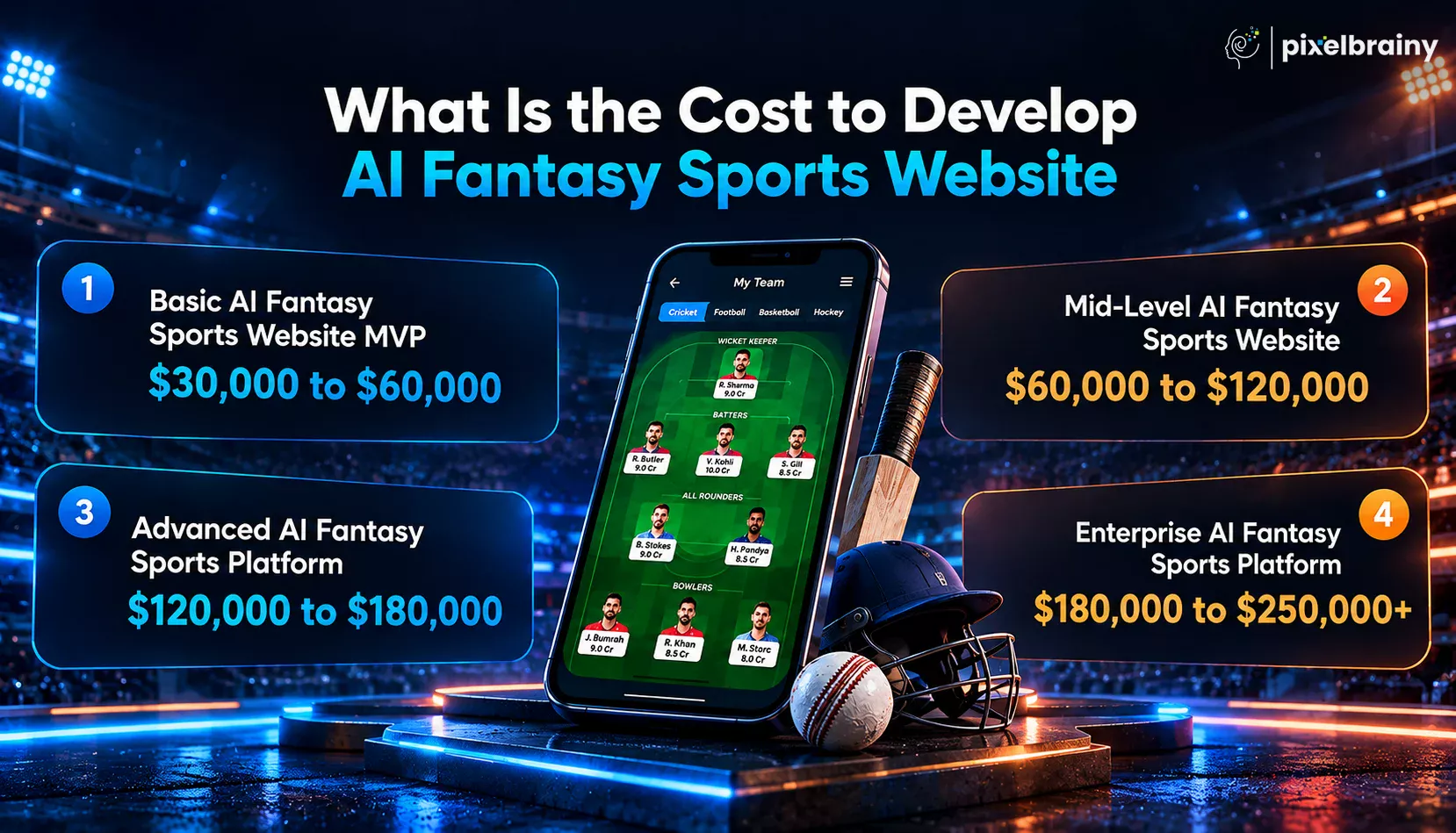
| Development Tier | Estimated Cost | Typical Timeline | What's Included |
|---|---|---|---|
| Basic AI Fantasy Sports Website MVP | $30,000 to $60,000 | 3 to 5 months | User registration, profiles, match listings, player statistics, fantasy team creation, captain and vice-captain selection, basic AI player recommendations, contests, leaderboards, sports data integration, admin panel, notifications, basic analytics, and cloud deployment |
| Mid-Level AI Fantasy Sports Website | $60,000 to $120,000 | 4 to 7 months | Multiple leagues or sports, real-time match updates, AI team suggestions, advanced player analytics, personalized recommendations, multiple contest formats, payment integration, wallet functionality, enhanced admin controls, security, analytics dashboards, and scalable cloud infrastructure |
| Advanced AI Fantasy Sports Platform | $120,000 to $180,000 | 6 to 10 months | AI-powered team optimization, player performance predictions, predictive analytics, personalized fantasy strategies, real-time AI recommendations, advanced data processing, sophisticated contest management, fraud monitoring, advanced reporting, scalable architecture, and advanced AI infrastructure |
| Enterprise AI Fantasy Sports Platform | $180,000 to $250,000+ | 9 to 15+ months | Custom AI models, multi-sport architecture, large-scale real-time data processing, advanced personalization, enterprise security, high-availability infrastructure, multi-region deployment, multilingual capabilities, advanced analytics, automated AI optimization, and extensive third-party integrations |
A Basic AI Fantasy Sports Website MVP is generally suitable for startups, entrepreneurs, and businesses that want to validate their fantasy sports concept before making a larger investment.
The focus at this stage is to build the essential fantasy sports experience and introduce selected AI functionality without creating unnecessary technical complexity.
A typical MVP can include:
This approach gives businesses a faster path toward market validation while keeping the AI fantasy sports website development cost within a manageable range.
For example, instead of developing a sophisticated custom machine learning system during the initial release, the platform can use existing AI technologies for selected recommendations. Once users begin interacting with the platform, the business can analyze their behavior and determine which advanced AI capabilities deserve further investment.
A Mid-Level AI Fantasy Sports Website is suitable for businesses that require a more comprehensive product and want to provide users with a more intelligent and personalized fantasy experience.
At this stage, AI can become more deeply integrated into the platform rather than being limited to basic recommendations.
The platform may include:
This tier offers a balance between functionality, scalability, and investment.
It can be appropriate for businesses that have already validated their fantasy sports concept or have an existing audience and want to introduce a dedicated AI-powered fantasy platform.
An Advanced AI Fantasy Sports Platform is designed for businesses that want artificial intelligence to become a major part of the fantasy sports experience.
Instead of simply displaying statistics, the platform can analyze sports data and provide users with intelligent recommendations and insights.
Advanced functionality may include:
At this level, businesses may require more customized AI development instead of relying entirely on third-party AI services.
This increases the cost of creating an AI fantasy sports website because advanced AI functionality can require additional data engineering, model development, testing, deployment, monitoring, and optimization.
The platform may also need to process large volumes of sports data and generate recommendations quickly, particularly during high-traffic live sporting events.
An Enterprise AI Fantasy Sports Platform is intended for established fantasy sports businesses, large sports technology companies, and organizations planning to operate across multiple sports or markets.
An enterprise platform may support:
At this level, scalability and reliability become critical parts of the development strategy.
The platform may need to support large numbers of simultaneous users during major sporting events while continuously processing live scores, player statistics, contest activity, rankings, and AI recommendations.
This is why the AI fantasy sports website development cost can reach $250,000 or more for highly customized enterprise projects.
The right investment level depends on your current business objectives.
If you are a startup validating a new idea, a $30,000 to $60,000 MVP can provide the essential functionality required to test your concept and gather real user feedback.
If you are a growing fantasy sports business, the $60,000 to $120,000 range can provide a more complete product with advanced fantasy functionality, multiple leagues, real-time data, AI recommendations, and stronger scalability.
If AI is your primary competitive advantage, an investment of $120,000 to $180,000 may be more appropriate for advanced recommendations, predictive analytics, team optimization, personalization, and sophisticated AI infrastructure.
If you are an enterprise targeting multiple sports, markets, or large user volumes, the $180,000 to $250,000+ range provides room for custom AI, high-performance infrastructure, advanced security, extensive integrations, and enterprise-level scalability.
The important point is that you do not need to build the most expensive version from the beginning.
A phased strategy can allow you to launch with the features that matter most, validate market demand, understand user behavior, and then invest in advanced capabilities based on measurable business results.
Therefore, when estimating how much it costs to develop an AI fantasy sports website in 2026, focus on the product you need today while designing the technology architecture for the product you want to build tomorrow.
For most new businesses, beginning with a focused MVP in the $30,000 to $60,000 range can reduce financial risk while providing a foundation for future AI capabilities, additional sports, advanced personalization, and larger-scale infrastructure. This makes the development budget more predictable and allows investment to grow alongside the success of the fantasy sports platform.
Also Read: How to Create a Sports Betting Website and App Like DraftKings?
Every founder asks an important question before starting development: How much will our AI fantasy sports website actually cost? The challenge is that there is no universal development price because every fantasy sports platform has different sports coverage, AI capabilities, contest formats, user requirements, data integrations, and scalability goals.
This is why one AI fantasy sports website may cost around $30,000, while another platform can require $250,000 or more.
Instead of relying on a generic estimate, a better approach is to calculate the AI fantasy sports website development cost by evaluating the individual components that make up the platform. This gives founders a clearer budget before approaching development companies and makes it easier to identify where their investment will actually go.
A common founder query looks like this:
"We are planning to launch an AI fantasy sports website, but before approaching development companies, we want to estimate our own budget. We need fantasy team creation, player statistics, AI recommendations, contests, live sports data, an admin panel, and payment integration. Is there a practical way to calculate our expected development cost based on these requirements?"
Yes. Instead of starting with one large number, estimate the project by evaluating each major development component separately. This approach provides a more realistic development budget of AI fantasy sports website and helps founders compare different product scenarios before committing their capital.
A practical way to estimate the investment is:
Total Development Cost = Product Development + AI Development + Sports Data Infrastructure + Third-Party Integrations + Quality Assurance + Deployment
Each category contributes to the final cost to build AI fantasy sports website.
| Cost Component | What It Includes |
|---|---|
| Product Development | UI/UX design, frontend development, backend development, database architecture, fantasy team builder, contest engine, APIs, admin dashboard, and deployment |
| AI Development | AI player recommendations, team suggestions, player performance analysis, predictive analytics, AI optimization, and model integration |
| Sports Data Infrastructure | Sports statistics APIs, live match feeds, player data, cloud hosting, databases, storage, caching, monitoring, and real-time data processing |
| Third-Party Integrations | Payment gateways, authentication services, notifications, analytics platforms, email and SMS services, identity verification, and external APIs |
| Quality Assurance | Functional testing, fantasy scoring validation, API testing, performance testing, security testing, cross-browser testing, bug fixing, and launch testing |
| Deployment & Launch | Cloud configuration, production deployment, database setup, monitoring, security configuration, backup systems, and launch support |
Imagine your startup wants to launch an AI fantasy sports MVP focused initially on cricket. The platform requires:
A preliminary budget could look like this:
| Expense | Estimated Cost |
|---|---|
| UI/UX, Frontend & Backend Development | $25,000 |
| AI Integration & Recommendation Features | $8,000 |
| Sports Data Infrastructure | $6,000 |
| Third-Party Integrations | $4,000 |
| Quality Assurance & Deployment | $4,000 |
| Initial Maintenance & Optimization | $3,000 |
| Estimated Total Investment | $50,000 |
This example demonstrates how the AI fantasy sports website development cost can be calculated by examining the actual requirements instead of selecting an arbitrary development price.
The $50,000 example represents a focused MVP. If the same business later adds multiple sports, advanced AI team optimization, personalized recommendations, real-time predictive analytics, sophisticated contest management, advanced security, and enterprise infrastructure, the overall investment can move toward the $120,000 to $180,000+ range.
For a highly customized enterprise platform with multiple sports, custom AI models, large-scale data processing, multi-region infrastructure, and extensive integrations, the budget can reach $250,000+.
You can use the following framework to create your preliminary budget.
Choose the development level that best represents your business:
Consider whether you want:
Supporting more sports generally requires additional data structures, scoring rules, testing, and sports-specific functionality.
Determine which AI functionality your platform needs:
The more customized the AI functionality, the greater its impact on the overall cost of creating an AI fantasy sports website.
Decide whether your platform needs:
Real-time functionality can increase both development and infrastructure requirements.
Your estimate should account for integrations such as:
Infrastructure requirements will differ depending on whether your platform targets:
You should also consider peak concurrent users during major sporting events because fantasy sports platforms can experience significant traffic spikes.
| Platform Scenario | Estimated Development Budget |
|---|---|
| Cricket AI Fantasy MVP | $30,000 to $60,000 |
| Multi-League AI Fantasy Platform | $60,000 to $100,000 |
| Multi-Sport AI Fantasy Platform | $100,000 to $150,000 |
| Advanced AI Personalization Platform | $120,000 to $180,000 |
| Enterprise Multi-Sport AI Platform | $180,000 to $250,000+ |
These figures are planning estimates rather than fixed quotations. The final price depends on the exact product requirements, technology architecture, development team, AI approach, sports data provider, and expected platform scale.
A structured cost calculator allows founders to:
For example, a founder may initially assume that adding AI recommendations will have only a minor impact on the budget. However, if the requirement expands from basic recommendations to real-time player predictions, automated team optimization, personalized recommendations, and custom machine learning models, the AI component can become a significant part of the total investment.
This is why calculating the cost component by component is more useful than simply asking for an average website development price.
Ultimately, the AI fantasy sports website development cost calculator should help you answer three practical questions: What do we need to build now, what can we add later, and how much should we reserve for each stage?
For a focused startup MVP, the expected investment can begin around $30,000 to $60,000. As the platform adds more sports, advanced AI, real-time functionality, personalization, integrations, and scalability, the investment can progressively move toward $250,000+.
A component-based calculation therefore gives founders a clearer answer to "how much does it cost to build an AI fantasy sports website in 2026?" while providing a practical framework for budgeting, investor discussions, vendor evaluation, and phased product development.

Also Read: AI Software Development Cost (10K-300K+): Know How Much Your Software Will Cost
The AI fantasy sports website development cost is never the same for two projects because every fantasy platform differs in AI capabilities, sports coverage, contest mechanics, real-time data requirements, user volume, integrations, security, and scalability. This is why the cost to build AI fantasy sports website can range from $30,000 to $250,000+, even when two platforms appear similar from a user's perspective.
A common founder query is:
"We are planning an AI fantasy sports website and want to understand what will actually increase our development cost. We know that a basic fantasy team builder is relatively straightforward, but we also want AI player recommendations, automated team suggestions, real-time match data, personalized insights, multiple sports, and advanced analytics. Which features have the biggest impact on our budget, and where should we invest first?"
The answer depends on several cost drivers. A basic fantasy sports website with predefined scoring rules and standard player statistics requires considerably less investment than an AI-powered platform that analyzes historical performance, generates personalized recommendations, processes live sports data, and continuously optimizes fantasy teams.
Understanding these cost factors will help you estimate the development budget of AI fantasy sports website, compare development proposals, prioritize your MVP, and determine where additional investment can create meaningful business value.
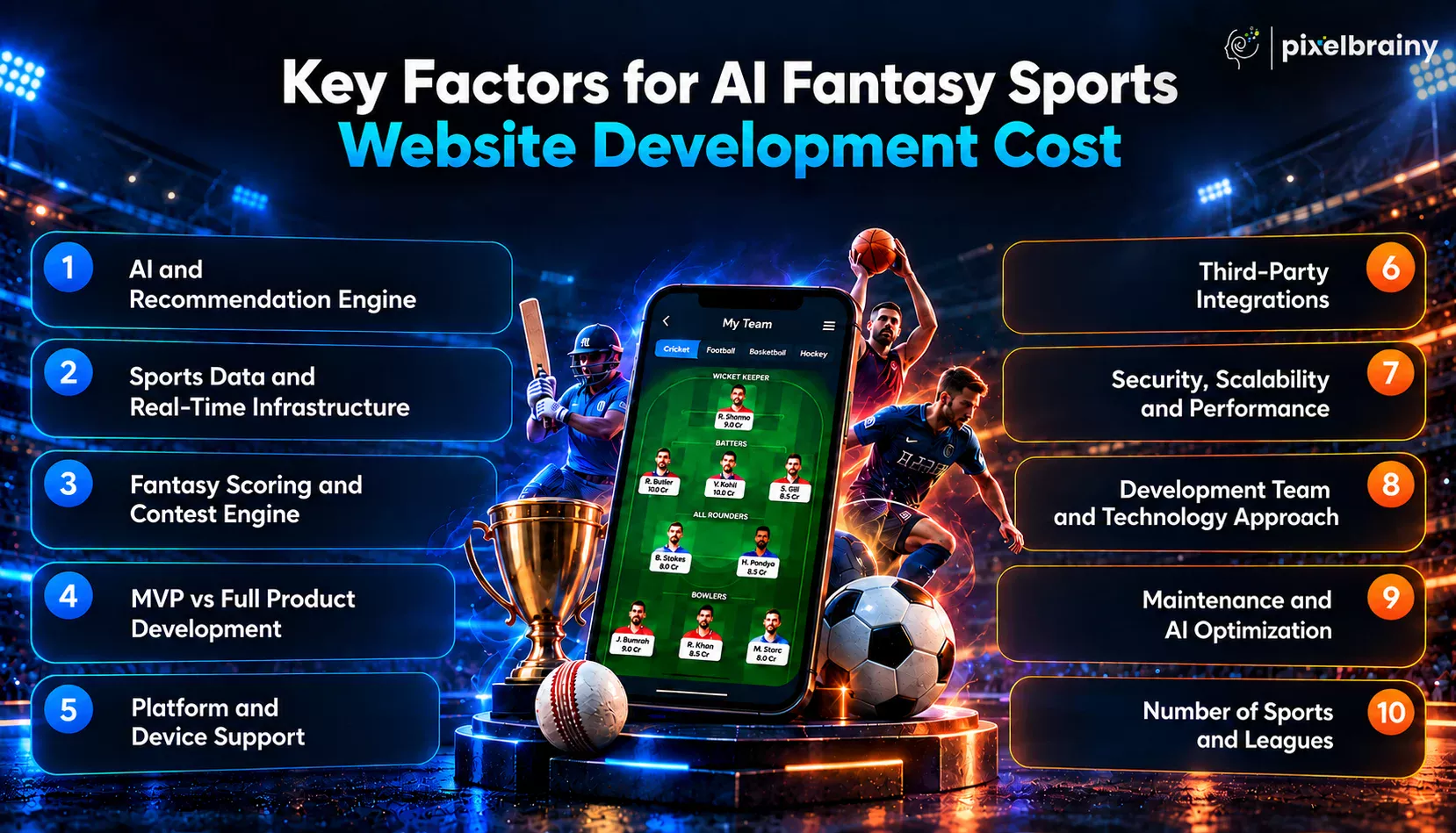
| Cost Factor | Estimated Cost Impact | Impact Level |
|---|---|---|
| AI & Recommendation Engine | $10,000 to $70,000+ | Very High |
| Sports Data & Real-Time Infrastructure | $5,000 to $30,000+ | Very High |
| Fantasy Scoring & Contest Engine | $8,000 to $30,000+ | High |
| MVP vs Full Product Scope | $30,000 to $250,000+ | Very High |
| Platform & Device Support | $5,000 to $50,000+ | High |
| Third-Party Integrations | $5,000 to $25,000+ | Medium to High |
| Security, Scalability & Performance | $5,000 to $40,000+ | High |
| Maintenance & AI Optimization | 15% to 25% annually | Medium to High |
The AI engine is one of the biggest factors affecting the AI fantasy sports website development cost.
A basic fantasy platform can recommend players using predefined rules, statistics, rankings, or simple scoring logic. This approach is relatively affordable and can work well for an initial MVP.
However, a sophisticated AI system may need to analyze:
The approximate cost impact can vary considerably:
A custom AI system can require data preparation, feature engineering, model development, testing, deployment, monitoring, and continuous optimization.
For startups, beginning with AI-assisted recommendations can be more practical than investing in a complex custom prediction engine immediately.
As the platform collects more proprietary user and sports data, more sophisticated AI capabilities can be introduced.
An AI fantasy sports website depends heavily on accurate sports data.
The platform may need:
A basic single-sport platform using one sports data provider may require a relatively modest integration investment.
However, a platform supporting multiple sports, multiple leagues, real-time match events, extensive historical data, and high-volume API requests can require significantly more infrastructure.
Typical development and integration costs can range from approximately $5,000 to $30,000+, excluding recurring data provider subscription or licensing charges.
Real-time data also affects the architecture because the system must process updates quickly and distribute them to users without creating delays or excessive infrastructure costs.
Choosing reliable data providers and scalable architecture early can prevent expensive restructuring as the platform grows.
The fantasy scoring and contest engine is another major cost factor that is sometimes underestimated.
Your platform needs a reliable system to determine how users earn fantasy points and how rankings change during matches.
Depending on the sport and business model, the system may need to manage:
A basic contest engine may cost approximately $8,000 to $15,000, while a more advanced system supporting multiple sports, contest formats, complex scoring rules, and real-time processing can reach $20,000 to $30,000+.
The complexity increases further when the platform needs a reusable architecture capable of supporting different sports with different scoring systems.
The scope of your first release has a direct impact on the cost to build AI fantasy sports website.
A focused MVP with one primary sport, essential fantasy functionality, basic AI recommendations, user authentication, contests, leaderboards, sports data integration, and an admin panel can generally fall within the $30,000 to $60,000 range.
A full-featured platform with multiple sports, advanced AI, real-time analytics, personalized recommendations, wallet and payment functionality, sophisticated administration, enhanced security, and scalable infrastructure can reach $120,000 to $180,000.
An enterprise platform with custom AI, multiple markets, high traffic capacity, advanced data infrastructure, extensive integrations, and multi-region deployment can reach $180,000 to $250,000+.
This is why defining the MVP before development begins is so important.
Instead of trying to build every feature immediately, businesses can launch the essential product, collect user feedback, measure engagement, and invest in advanced functionality based on actual demand.
The number of platforms you want to support also affects your development budget.
A responsive web application is generally less expensive than building separate native mobile applications alongside the website.
Typical planning ranges can look like:
Supporting additional platforms increases:
If your primary goal is market validation, starting with a responsive web platform can reduce the initial cost of creating an AI fantasy sports website.
Mobile applications can then be introduced after the web product demonstrates market demand.
AI fantasy sports platforms rarely operate independently.
They typically rely on several external services to deliver the complete user experience.
Common integrations include:
Depending on the number and complexity of integrations, businesses should generally budget approximately $5,000 to $25,000+ for integration development.
The cost can increase when an integration requires custom data mapping, webhooks, real-time synchronization, security validation, extensive testing, or complex business logic.
Third-party subscription and usage fees should also be considered separately because they can become recurring operating expenses after launch.
Security and scalability become increasingly important as the platform grows.
A small MVP may require standard authentication, secure APIs, database protection, basic monitoring, and secure deployment.
A larger platform may require:
Depending on the requirements, security, scalability, and performance engineering can add approximately $5,000 to $40,000+ to the overall project.
For an AI fantasy sports platform, performance is especially important during major matches when large numbers of users may simultaneously create teams, join contests, check rankings, and request AI recommendations.
Designing for peak traffic during the initial architecture phase can help prevent expensive infrastructure changes later.
The development approach can also significantly influence your final budget.
Building an internal team may require hiring:
This provides greater internal control but can create substantial recruitment and staffing expenses.
Working with an experienced development company can provide access to a multidisciplinary team without requiring the business to build an entire technical department internally.
A hybrid approach is another option. For example, the business can manage product strategy internally while an external development team handles AI engineering, frontend, backend, QA, and infrastructure.
The important consideration is not simply the hourly development rate. Experience with fantasy sports, real-time systems, AI, sports data, security, and scalable architecture can significantly influence the final project outcome.
The initial AI fantasy sports website development cost does not represent the complete lifetime investment.
Once the platform is launched, ongoing maintenance is required to keep the website secure, accurate, and compatible with changing technologies.
A practical planning benchmark is to allocate approximately 15% to 25% of the initial development cost annually for ongoing technical maintenance and optimization.
This can include:
For example, if your initial AI fantasy sports website costs $100,000 to develop, an annual technical maintenance and optimization budget of approximately $15,000 to $25,000 can be used as an initial planning benchmark.
Actual expenses will depend on user volume, AI usage, infrastructure requirements, data providers, and the frequency of product updates.
The number of sports and leagues supported can have a major effect on the final budget.
A cricket-only platform may have one set of:
A multi-sport platform must account for different rules and data structures for each sport.
For example, fantasy cricket, football, and basketball can require different approaches to:
Starting with one primary sport can therefore reduce the initial cost to build AI fantasy sports website while allowing the architecture to be designed for future sports expansion.
There is no universal answer to the AI fantasy sports website development cost because every project has different business objectives and technical requirements.
Your final investment will depend on the AI engine, sports data infrastructure, fantasy scoring system, number of sports, platform scope, development approach, third-party integrations, security requirements, and scalability expectations.
For startups, a focused MVP within the $30,000 to $60,000 range can provide a practical starting point. As the platform gains users and validates its business model, investment can gradually expand toward $60,000 to $120,000, $120,000 to $180,000, and ultimately $180,000 to $250,000+ for advanced and enterprise-level requirements.
The most effective cost strategy is therefore not simply to reduce development spending. It is to invest in the capabilities that directly support your product's launch, user experience, AI value, reliability, and long-term growth.
The AI fantasy sports website development cost is not spent all at once. Instead, the total investment is distributed across several development phases, with each stage contributing to the final product. From business discovery and UI/UX design to fantasy sports engineering, AI development, real-time data integration, testing, deployment, and launch preparation, every phase requires dedicated resources and technical expertise.
Many founders assume that most of the cost to build AI fantasy sports website goes directly toward coding. In reality, product planning, fantasy scoring architecture, sports data integration, AI recommendation development, quality assurance, security, infrastructure, and deployment can represent a significant portion of the overall budget.
A common founder question is:
"We know that developing our AI fantasy sports website could cost anywhere from $30,000 to $250,000+, but how much should we allocate to each development stage? We need to understand where our money will be spent on planning, design, fantasy team functionality, AI development, sports data, testing, and deployment so we can create a realistic project budget and track our investment throughout development."
The answer depends on the platform's complexity, sports coverage, AI requirements, number of features, and expected user scale. However, dividing the project into development phases provides a practical way to estimate the development budget of AI fantasy sports website and connect spending with measurable project milestones.
| Development Phase | Estimated Cost | Cost Impact |
|---|---|---|
| Discovery & Product Planning | $2,000 to $10,000 | Medium |
| UI/UX Design | $4,000 to $20,000 | Medium |
| Frontend & Backend Development | $12,000 to $70,000+ | Very High |
| Fantasy Sports Engine Development | $8,000 to $35,000+ | High |
| AI Development & Integration | $10,000 to $70,000+ | Very High |
| Sports Data & Third-Party Integrations | $5,000 to $30,000+ | High |
| Testing & Quality Assurance | $4,000 to $20,000 | Medium |
| Deployment & Launch | $2,000 to $15,000 | Medium |
These ranges are indicative because some phases overlap. For example, AI functionality may require backend development, while sports data integration may also involve database and real-time infrastructure work.
The first stage of an AI fantasy sports website is understanding exactly what needs to be built.
During discovery, the development team translates the business concept into technical and product requirements. This stage is particularly important because fantasy sports platforms can become complex very quickly when businesses combine multiple sports, AI recommendations, real-time data, contests, payments, and personalization.
Typical activities include:
Estimated Cost: $2,000 to $10,000
A detailed discovery process can help prevent expensive changes later. It also establishes the foundation for calculating the cost of creating an AI fantasy sports website based on actual requirements rather than assumptions.
Fantasy sports platforms contain a large amount of information, including player statistics, match details, fantasy points, rankings, contests, recommendations, and live updates.
The interface needs to make this information easy to understand while helping users complete important actions quickly.
The UI/UX phase may include:
Estimated Cost: $4,000 to $20,000
The design cost increases when the platform includes multiple user journeys, advanced data visualization, personalized dashboards, complex team-building interfaces, and multiple sports.
For an MVP, a focused design system can keep the AI fantasy sports website development cost under control while still providing a professional user experience.
Frontend and backend engineering represents one of the largest portions of the overall project budget.
The frontend creates the user-facing experience, while the backend handles the business logic, data processing, APIs, user management, fantasy scoring, contests, and communication with external services.
Typical deliverables include:
Estimated Cost: $12,000 to $70,000+
The final cost depends heavily on the number of features and the complexity of the backend architecture.
A basic cricket fantasy MVP will generally require less development effort than a multi-sport platform with complex contests, real-time updates, personalized dashboards, payment systems, and advanced administration.
The fantasy sports engine is the core system that determines how users create teams, earn points, participate in contests, and appear on leaderboards.
This phase deserves separate consideration because fantasy sports logic must be accurate and reliable.
The development team may need to build:
Estimated Cost: $8,000 to $35,000+
The cost increases when the platform supports multiple sports because each sport can have different player attributes, scoring rules, match structures, and fantasy calculations.
A well-designed fantasy engine should also be modular so that new sports and contest formats can be introduced without rebuilding the entire platform.
AI development can become one of the largest contributors to the AI fantasy sports website development cost.
The investment depends on whether your platform uses basic AI APIs, recommendation algorithms, statistical models, or sophisticated custom machine learning systems.
Potential AI functionality includes:
For more advanced implementations, the development team may also work on:
Estimated Cost: $10,000 to $70,000+
A platform using existing AI services and predefined recommendation logic can remain toward the lower end of this range.
A platform requiring proprietary machine learning models, extensive sports datasets, advanced prediction capabilities, and continuous AI optimization can move toward the higher end.
An AI fantasy sports website requires reliable data to operate correctly.
Sports data can power player profiles, match schedules, live scores, player statistics, fantasy points, rankings, and AI recommendations.
Common integrations include:
Estimated Cost: $5,000 to $30,000+
The number of integrations and the complexity of data synchronization directly influence the development cost.
A single-sport MVP using one primary sports data provider will generally require less integration work than a multi-sport platform using several data sources and real-time event processing.
Third-party subscription and data licensing fees should be considered separately from development costs because many providers charge recurring fees.
Testing is essential because even a small error in fantasy scoring, player data, contest calculations, or rankings can affect the user experience and potentially create serious business issues.
The QA phase can include:
Estimated Cost: $4,000 to $20,000
AI functionality also requires additional validation.
The development team needs to evaluate whether recommendations are being generated correctly, whether data is being processed properly, and whether the AI system behaves consistently under different conditions.
For platforms expecting high traffic, performance testing becomes particularly important because major sporting events can create significant spikes in concurrent users.
After development and testing, the platform must be prepared for production.
Deployment activities can include:
Estimated Cost: $2,000 to $15,000
The deployment cost depends on the complexity of the infrastructure.
A basic MVP may require a relatively straightforward cloud environment, while an enterprise AI fantasy sports platform may require load balancing, auto-scaling, distributed services, multiple environments, advanced monitoring, and high-availability infrastructure.
When the individual phases are considered together, the overall investment can be planned across different development levels.
| Project Type | Approximate Budget | Primary Development Focus |
|---|---|---|
| AI Fantasy Sports MVP | $30,000 to $60,000 | Core fantasy functionality, one primary sport, basic AI, essential integrations |
| Growing Fantasy Sports Platform | $60,000 to $120,000 | Advanced contests, real-time data, AI recommendations, stronger scalability |
| Advanced AI Fantasy Platform | $120,000 to $180,000 | Predictive AI, team optimization, personalization, advanced analytics |
| Enterprise AI Fantasy Platform | $180,000 to $250,000+ | Custom AI, multi-sport support, high scalability, advanced security and infrastructure |
Breaking the AI fantasy sports website development cost into individual phases gives founders greater control over the project.
Instead of treating the entire budget as one large expense, businesses can associate spending with specific milestones such as completing product discovery, approving the UI/UX, launching the fantasy engine, integrating AI, completing testing, and deploying the production platform.
This approach also makes it easier to identify where additional investment is justified.
For example, a startup may decide to spend more on the fantasy engine and sports data infrastructure while keeping advanced AI features limited during the MVP stage. Once the platform gains users and generates sufficient data, the business can increase investment in AI personalization and predictive capabilities.
Ultimately, whether your total cost to build AI fantasy sports website is $30,000 for a focused MVP or $250,000+ for an enterprise platform, understanding the cost at each development phase helps you allocate capital more effectively, track project progress, manage scope, and make informed decisions throughout the development lifecycle.
The team you choose has a significant impact on your AI fantasy sports website development cost, project timeline, technical quality, communication, and long-term scalability. Two companies may build similar fantasy sports platforms, yet the cost to build AI fantasy sports website can vary considerably depending on the team's location, development model, AI expertise, fantasy sports experience, and technical capabilities.
A common founder query is:
"We are deciding whether to hire an in-house team or outsource our AI fantasy sports website development. Which option gives us the best balance between development cost, technical expertise, delivery speed, and long-term support?"
Another common question is:
"We are comparing AI fantasy sports website development costs across different countries. Which development model can provide experienced AI and full-stack developers while keeping our project within a $30,000 to $250,000+ budget?"
The comparison below provides a practical overview of the development budget of AI fantasy sports website based on different team structures.
| Team Type | Hourly Rate Range | Estimated Total Cost | Best For |
|---|---|---|---|
| In-House Development Team | $100 to $200/hour | $150,000 to $250,000+ | Established businesses requiring complete control over AI, product development, infrastructure, and long-term operations |
| US-Based AI Development Agency | $100 to $180/hour | $100,000 to $250,000+ | Businesses seeking experienced AI engineers, fantasy sports developers, structured project management, and post-launch support |
| Freelancers | $30 to $100/hour | $30,000 to $100,000+ | Startups building prototypes, basic MVPs, or platforms with limited AI functionality |
| Offshore Team, Eastern Europe | $40 to $90/hour | $60,000 to $180,000+ | Businesses seeking strong engineering expertise and competitive pricing for mid-sized and advanced projects |
| Offshore Team, South Asia | $25 to $60/hour | $30,000 to $150,000+ | Startups and growing businesses seeking cost-effective AI, full-stack, QA, and DevOps expertise |
Actual project costs depend on scope, complexity, AI requirements, development hours, integrations, and infrastructure.
An in-house team provides maximum control over your AI fantasy sports product but also requires the highest investment.
A typical team may include:
Estimated Cost: $150,000 to $250,000+
This approach works best for established businesses planning long-term development and proprietary AI systems. However, salaries, recruitment, benefits, software, infrastructure, and employee management can significantly increase the overall cost.
Typical Rate: $100 to $180/hour
Estimated Cost: $100,000 to $250,000+
A specialized agency can provide:
This option is suitable for businesses that prioritize experienced development, structured project management, communication, and ongoing support without building an internal technical team.
Typical Rate: $30 to $100/hour
Estimated Cost: $30,000 to $100,000+
Freelancers can be suitable for:
They can reduce the initial cost of creating an AI fantasy sports website, but managing multiple freelancers for AI, backend, frontend, QA, and DevOps can become difficult as the platform becomes more complex.
Typical Rate: $40 to $90/hour
Estimated Cost: $60,000 to $180,000+
Eastern European development teams can provide experienced professionals in:
This model can provide a good balance between technical expertise and development cost for mid-level and advanced AI fantasy sports platforms.
Typical Rate: $25 to $60/hour
Estimated Cost: $30,000 to $150,000+
South Asian development teams can provide access to:
This approach is particularly attractive to startups seeking to control the AI fantasy sports website development cost while accessing a complete development team.
If you are building an enterprise AI fantasy sports platform, an in-house team provides maximum control but requires the highest investment.
For businesses seeking specialized expertise without hiring a complete internal team, an experienced AI development agency can provide a strong balance of quality, project management, and support.
Freelancers can be suitable for basic MVPs and proof-of-concepts, while offshore development teams can offer competitive pricing for startups and growing businesses.
If keeping the cost to build AI fantasy sports website under control is your priority, offshore development teams in Eastern Europe and South Asia can provide access to experienced AI and full-stack developers while keeping development within the broader $30,000 to $250,000+ range.
Ultimately, the right team should be selected based on technical expertise, fantasy sports experience, AI capabilities, communication, scalability, and long-term support, not simply the lowest hourly rate.
The AI fantasy sports website development cost can vary significantly depending on the type of fantasy sports platform you plan to build. A fantasy cricket website has different data, scoring, and player requirements compared with fantasy football, horse racing, or a multi-sport platform.
A common founder query is:
"We want to build an AI fantasy sports website, but we are unsure which sports category should be our starting point. Should we focus on cricket, football, basketball, horse racing, or build a platform supporting multiple sports? How much would each type cost, and which option gives us the best opportunity to launch within our budget?"
The answer depends on your target audience, sports coverage, AI requirements, data sources, scoring mechanics, contest formats, and expected user volume. Understanding the cost to build AI fantasy sports website by type helps you select a suitable platform without investing in unnecessary functionality.
| Fantasy Website Type | Estimated Cost | Suitable For |
|---|---|---|
| AI Fantasy Cricket Website | $30,000 to $120,000+ | Startups and businesses targeting cricket audiences |
| AI Fantasy Football Website | $35,000 to $130,000+ | Businesses targeting football leagues and tournaments |
| AI Fantasy Basketball Website | $35,000 to $120,000+ | Businesses targeting basketball audiences |
| AI Fantasy Baseball Website | $35,000 to $125,000+ | Businesses targeting baseball leagues and fantasy sports audiences |
| AI Fantasy Horse Racing Website | $40,000 to $140,000+ | Businesses targeting horse racing and racing-focused fantasy audiences |
| Multi-Sport AI Fantasy Website | $80,000 to $180,000+ | Businesses supporting multiple sports and leagues |
Estimated Cost: $30,000 to $120,000+
An AI fantasy cricket website can be a practical starting point for businesses targeting cricket-focused markets.
The platform may include:
More advanced versions can include player performance analysis, personalized team recommendations, AI-powered player comparisons, and real-time fantasy insights.
Starting with cricket alone can also make it easier to validate the concept before expanding into other sports.
Estimated Cost: $35,000 to $130,000+
An AI fantasy football website requires football-specific data, player information, match events, and fantasy scoring rules.
Key functionality may include:
The development cost can increase when the platform supports several football leagues, real-time data, advanced analytics, and personalized AI recommendations.
Estimated Cost: $35,000 to $120,000+
An AI fantasy basketball platform may include:
AI can analyze historical player performance, current form, team matchups, and available sports data to provide more relevant fantasy recommendations.
Estimated Cost: $35,000 to $125,000+
Fantasy baseball requires detailed player and game statistics, making data quality particularly important.
The platform can include:
AI can help users compare players, identify performance trends, and make data-driven fantasy team decisions.
The cost can increase when the platform supports multiple baseball leagues, extensive historical datasets, advanced AI recommendations, and real-time statistics.
Estimated Cost: $40,000 to $140,000+
An AI fantasy horse racing website has different requirements from traditional team-based fantasy sports platforms.
The system may need to manage:
AI can analyze historical race results, horse performance, jockey statistics, track conditions, and other available data to generate fantasy recommendations and performance insights.
Because horse racing involves specialized data and different fantasy mechanics, the development cost can be higher than a basic single-sport fantasy platform.
Estimated Cost: $80,000 to $180,000+
A multi-sport platform is more complex because every sport can have different rules, player attributes, statistics, scoring systems, and match structures.
The platform may support:
A scalable architecture is essential because each additional sport can require new data integrations, scoring logic, player structures, testing, and AI recommendation rules.
For businesses planning long-term expansion, a modular architecture can make it easier to add sports without rebuilding the entire platform.
If you are a startup testing a new concept, an AI fantasy cricket, football, or basketball MVP within the $30,000 to $60,000 range can provide a practical starting point.
If your target audience is interested in a specialized category such as horse racing or baseball, a focused platform can help you develop sport-specific functionality and AI recommendations before expanding.
If you want to support several sports, a budget of approximately $80,000 to $180,000+ may be more appropriate because of the additional data, scoring, development, and testing requirements.
The best strategy is to select a platform type based on your target audience, market opportunity, and business model rather than trying to support every sport at launch.
Ultimately, the AI fantasy sports website development cost by type depends on sports coverage, data requirements, fantasy mechanics, AI functionality, integrations, and scalability. Choosing the right sports category at the beginning can help control the cost of creating an AI fantasy sports website while giving you a clear path for future expansion.

The initial AI fantasy sports website development cost of $30,000 to $250,000+ is only part of the total investment. Once your platform goes live, several recurring and hidden expenses can affect the overall cost to build AI fantasy sports website.
Many founders focus on the development quotation but overlook expenses such as sports data subscriptions, AI usage, cloud infrastructure, security, maintenance, and technical support. Planning these costs in advance helps you understand the actual cost of creating an AI fantasy sports website and prevents unexpected expenses after launch.
A common founder query is:
"We have estimated our AI fantasy sports website development cost, but what additional expenses should we expect after launch? We want to know the monthly and annual costs for sports data, AI APIs, hosting, maintenance, security, and other services so we can calculate our total operating budget."
Here are the major ongoing and hidden costs to consider.
| Cost Category | Estimated Cost |
|---|---|
| Sports Data APIs | $500 to $5,000+/month |
| AI APIs & AI Infrastructure | $300 to $10,000+/month |
| Cloud Hosting | $300 to $5,000+/month |
| Security & Monitoring | $200 to $2,000+/month |
| Maintenance & Technical Support | $1,000 to $8,000+/month |
| Database & Storage | $100 to $2,000+/month |
| Backup & Disaster Recovery | $100 to $1,000+/month |
| Third-Party Services | $200 to $3,000+/month |
Actual costs depend on user volume, sports coverage, API usage, AI complexity, infrastructure requirements, and service providers.
Sports data is one of the most important recurring expenses for a fantasy sports website.
Your platform may require:
Estimated Cost: $500 to $5,000+/month
A single-sport MVP may remain toward the lower end, while a multi-sport platform requiring extensive real-time data can cost significantly more.
AI-powered recommendations and predictive features can generate recurring usage costs.
Expenses may include:
Estimated Cost: $300 to $10,000+/month
An MVP using basic AI recommendations may have relatively low AI expenses. A platform generating personalized recommendations for hundreds of thousands of users can require substantially more infrastructure.
Your cloud infrastructure supports the website, databases, APIs, real-time processing, and AI services.
Typical expenses include:
Estimated Cost: $300 to $5,000+/month
During major sporting events, traffic can increase significantly, so scalable infrastructure is important for maintaining performance.
An AI fantasy sports platform requires continuous maintenance after launch.
This can include:
Estimated Cost: $1,000 to $8,000+/month
As a general planning benchmark, businesses can allocate approximately 15% to 25% of the initial development cost annually for maintenance and technical optimization.
For example, if your website costs $100,000 to develop, you could plan approximately $15,000 to $25,000 per year for ongoing maintenance.
Security should continue after launch rather than ending with development.
Potential expenses include:
Estimated Cost: $200 to $2,000+/month
The cost can increase for enterprise platforms handling large user volumes and sensitive financial or personal information.
Fantasy platforms can generate large amounts of sports, player, match, contest, user, and analytics data.
Ongoing costs may include:
Estimated Cost: $200 to $3,000+/month
These costs generally increase as the platform accumulates more users and historical data.
Your platform may also depend on external services such as:
Estimated Cost: $200 to $3,000+/month, excluding transaction-based charges where applicable.
The initial launch does not mean development is finished.
As your business grows, you may want to add:
A separate annual product enhancement budget can therefore be useful.
For many businesses, the ongoing investment can represent a significant portion of the original development budget of AI fantasy sports website over several years.
For planning purposes:
These are broad estimates and can vary significantly depending on traffic, AI usage, sports data requirements, infrastructure, and maintenance scope.
Therefore, when calculating the AI fantasy sports website development cost, do not consider only the initial $30,000 to $250,000+ development investment. A realistic financial plan should also include recurring data, AI, cloud, security, maintenance, and infrastructure expenses.
Planning these costs from the beginning gives you a clearer view of the total investment required to launch, operate, and scale an AI fantasy sports website successfully.
Every founder wants to build a competitive AI fantasy sports website, but not every business has an unlimited development budget. The good news is that reducing the AI fantasy sports website development cost does not require compromising the features that directly affect user experience, platform reliability, or future scalability.
The key is to make smarter decisions about product scope, AI implementation, sports data, infrastructure, and development resources from the beginning.
A common founder query is:
"We have a limited budget for our AI fantasy sports website, but we don't want to sacrifice the fantasy team experience or important AI functionality. Which development decisions can help us reduce costs while still building a reliable platform that can scale later?"
By following the strategies below, startups can reduce the cost to build AI fantasy sports website while preserving the functionality that matters most.
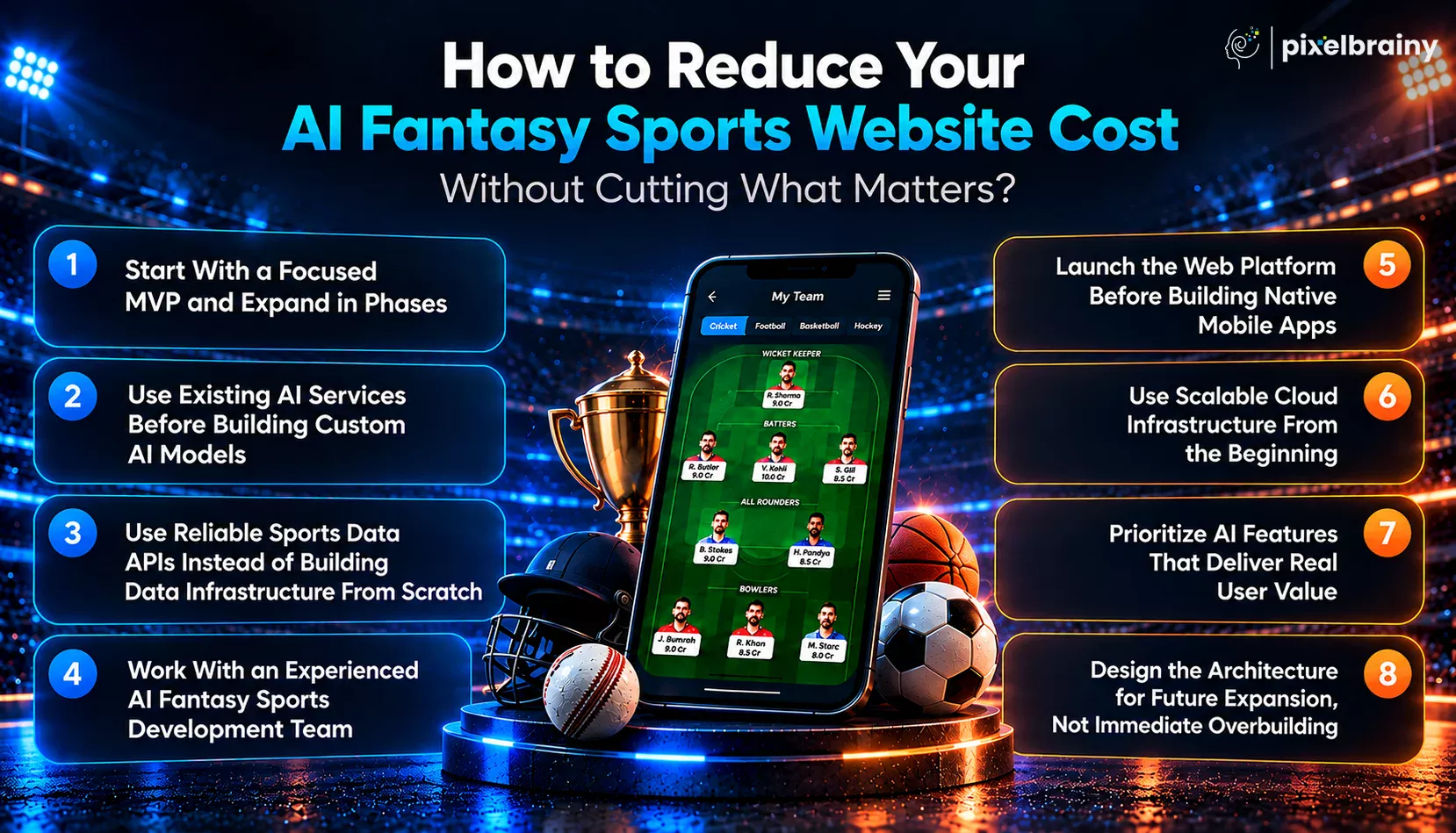
One of the most effective ways to reduce the cost of creating an AI fantasy sports website is to avoid building every feature at launch.
A focused MVP can initially include:
Advanced features such as multi-sport support, advanced personalization, AI team optimization, social features, and predictive analytics can be introduced after validating user demand.
Estimated Savings: 20% to 35%, or approximately $10,000 to $50,000.
Building proprietary machine learning models from scratch can significantly increase development costs because it requires data engineering, model training, testing, deployment, and optimization.
For an MVP, businesses can use established AI services, recommendation frameworks, or existing machine learning models where appropriate.
Once the platform generates sufficient user and sports data, custom AI models can be introduced where they provide measurable business value.
Estimated Savings: 20% to 40%, or approximately $10,000 to $40,000.
Building and maintaining an independent sports data collection system can require significant technical resources.
Instead, startups can integrate reliable sports data providers for:
This allows the development team to focus on the fantasy sports experience and AI functionality instead of building an entire data collection infrastructure.
Estimated Savings: 15% to 30%, or approximately $7,000 to $30,000.
Building a complete internal team requires hiring AI engineers, backend developers, frontend developers, UI/UX designers, QA specialists, DevOps engineers, and project managers.
A common founder question is:
"Should we hire an internal team or work with an experienced AI fantasy sports development company?"
For many startups, outsourcing can reduce recruitment and operational overhead while providing access to specialized technical expertise.
An experienced development partner can also use proven architectures and reusable components to accelerate development.
Estimated Savings: 30% to 50%, or approximately $40,000 to $120,000, compared with building a complete in-house team for the same project scope.
Developing separate Android and iOS applications alongside a website can significantly increase the initial AI fantasy sports website development cost.
A responsive web platform can provide access across desktops, tablets, and mobile browsers while the business validates its product.
Native applications can then be developed after user demand and usage patterns justify the additional investment.
Estimated Savings: 20% to 35%, or approximately $10,000 to $40,000.
You do not necessarily need expensive enterprise infrastructure on day one.
Cloud-native architecture with auto-scaling can allow businesses to start with smaller infrastructure and increase resources as traffic grows.
This is particularly useful for fantasy sports websites because traffic can increase substantially during major sporting events.
Estimated Savings: 20% to 40% on infrastructure costs, or approximately $3,000 to $20,000 annually, depending on traffic and architecture.
Not every AI feature needs to be included in the first version.
Advanced capabilities such as complex predictive models, automated team simulations, sophisticated personalization, and custom machine learning systems can substantially increase development costs.
Before adding an AI feature, evaluate whether it can improve:
Prioritizing high-value AI functionality allows you to reduce unnecessary development expenses without weakening the core product.
Estimated Savings: 15% to 30%, or approximately $8,000 to $50,000, depending on the features removed or postponed.
There is an important difference between building for scalability and building everything immediately.
Your initial architecture should allow future additions such as:
However, these features do not necessarily need to be developed during the first release.
A modular architecture lets you add functionality when the business is ready for it instead of paying for unused features today.
Estimated Savings: 10% to 25%, or approximately $5,000 to $30,000 in deferred initial development costs.
Reducing the AI fantasy sports website development cost is ultimately about making intelligent decisions rather than simply choosing the cheapest development option.
By launching a focused MVP, using existing AI technologies, integrating reliable sports data APIs, working with an experienced development team, starting with a responsive web platform, using scalable cloud infrastructure, and prioritizing high-value AI features, businesses can potentially reduce their initial development investment by 20% to 50%.
For example, a project initially estimated at $100,000 could potentially be brought down to approximately $50,000 to $80,000 by carefully reducing unnecessary first-release features and optimizing the technology approach.
The objective should not be to build the cheapest AI fantasy sports website. It should be to build the right product at the right investment level, protecting the features that matter to users while postponing expenses that can be justified after the platform gains traction.
As a top AI fantasy sports software development company, PixelBrainy helps startups, fantasy sports businesses, sports technology companies, and enterprises achieve AI fantasy sports website development cost optimization without compromising essential features, AI functionality, scalability, security, or user experience.
Our approach focuses on development cost reduction, smart feature prioritization, reusable technology components, efficient AI implementation, reliable sports data integrations, and scalable architecture. Instead of building everything at once, we identify where development costs can be reduced and where investment is necessary to create long-term business value.
A common founder query is:
"We want to build an AI fantasy sports website but need to keep our development budget under control. How can we reduce AI fantasy sports website development costs without removing the features users actually need?"
The answer is through structured cost optimization before development begins. PixelBrainy analyzes your requirements and creates a development roadmap that balances functionality, quality, timeline, and investment.
Before writing code, PixelBrainy evaluates:
This process helps establish a realistic development budget of AI fantasy sports website and identifies features that can be postponed, simplified, reused, or optimized.
A sports technology startup approached PixelBrainy to develop an AI fantasy sports website with AI player recommendations, fantasy team optimization, real-time sports data, contests, leaderboards, advanced analytics, and future multi-sport capabilities.
The initial requirements indicated a development budget of more than $180,000.
After analyzing the requirements, PixelBrainy created a phased development strategy. Essential fantasy functionality was prioritized, reliable sports APIs were integrated instead of building unnecessary data infrastructure, and advanced AI personalization and multi-sport functionality were moved to later phases.
| Cost Optimization Metric | Result |
|---|---|
| Original Estimated Development Cost | $180,000+ |
| Optimized MVP Development Cost | Approximately $82,000 |
| Development Cost Reduction | Over 54% |
| Estimated Cost Saved | $98,000+ |
| Delivery Timeline | Approximately 16 Weeks |
| Future Expansion | Advanced AI, personalization, additional sports, and real-time enhancements |
By separating essential functionality from future enhancements, the business reduced its initial AI fantasy sports website development cost by more than 54% while maintaining an architecture designed for future expansion.
This type of phased development cost optimization allows businesses to launch sooner, validate demand, and invest additional capital only when new features demonstrate business value.
PixelBrainy combines AI development expertise with cost-focused product planning to help businesses control their overall investment.
Our expertise includes:
Whether you need a $30,000 to $60,000 MVP or a $180,000 to $250,000+ advanced platform, PixelBrainy can help identify opportunities to optimize your AI fantasy sports website development cost without cutting the functionality that matters most.
Ready to Optimize Your AI Fantasy Sports Website Development Cost?
PixelBrainy can analyze your requirements, identify potential cost reductions, prioritize your MVP features, and create a cost-optimized AI fantasy sports website development roadmap based on your budget, timeline, and growth objectives.
Want to reduce your development costs without compromising your product? Let's connect.

So, how much does it cost to build an AI fantasy sports website in 2026? The overall investment typically ranges from $30,000 to $250,000+, depending on AI capabilities, sports coverage, fantasy features, real-time data, integrations, development team, security, and scalability requirements.
A focused MVP can help startups enter the market with a controlled AI fantasy sports website development cost, while advanced AI recommendations, predictive analytics, multi-sport functionality, personalization, and enterprise infrastructure can increase the overall budget.
The smartest approach is not to build every feature from day one. Instead, prioritize essential functionality, use reliable sports data APIs, choose the right AI architecture, optimize development costs, and introduce advanced capabilities in phases.
Understanding the cost to build AI fantasy sports website before development begins helps you create a realistic budget, avoid unexpected expenses, and make better technology decisions.
If you're planning an AI-powered fantasy sports platform, PixelBrainy can help you estimate development costs and create a cost-optimized roadmap tailored to your requirements.
Ready to build your AI fantasy sports website? Schedule a call with PixelBrainy to discuss your project, budget, and development plan.
The cost to build AI fantasy sports website typically ranges from $30,000 to $250,000+. A basic AI fantasy sports MVP may cost $30,000 to $60,000, while advanced platforms with custom AI, real-time sports data, multiple sports, personalization, and scalable infrastructure can reach $120,000 to $250,000+.
The AI fantasy sports website development cost depends on the platform's features, AI complexity, sports coverage, integrations, and development team. Most projects fall between $30,000 and $250,000+, with a focused MVP generally requiring a lower initial investment.
The cost to create an AI fantasy sports website with custom AI can range from approximately $80,000 to $250,000+. Custom machine learning models, player performance prediction, AI team optimization, personalized recommendations, data processing, and model monitoring can significantly increase the development budget.
The development cost of AI fantasy sports website MVP can typically range from $30,000 to $60,000. A focused MVP can include user authentication, player statistics, fantasy team creation, basic AI recommendations, contests, leaderboards, sports data API integration, and an admin dashboard.
The major factors affecting the AI fantasy sports website development cost include AI functionality, number of sports and leagues, fantasy scoring logic, real-time sports data, UI/UX complexity, third-party integrations, platform scalability, security requirements, development team location, and ongoing infrastructure requirements.
The cost to develop an AI fantasy cricket website generally ranges from $30,000 to $120,000+. The final development budget depends on features such as live cricket data, player analytics, AI recommendations, fantasy team creation, contests, leaderboards, payment integration, and predictive analytics.
You can reduce the cost of AI fantasy sports website development by starting with an MVP, prioritizing essential features, using reliable sports data APIs, leveraging existing AI technologies, choosing scalable cloud infrastructure, and outsourcing development to an experienced team. These strategies can potentially reduce initial development expenses by 20% to 50%.
The ongoing cost of an AI fantasy sports website can include sports data API subscriptions, AI API usage, cloud hosting, database storage, security, maintenance, backups, monitoring, and third-party services. Depending on traffic and platform complexity, annual post-launch costs can range from approximately $15,000 to $200,000+.

About The Author
Sagar Bhatnagar
Sagar Sahay Bhatnagar brings over a decade of IT industry experience to his role as Marketing Head at PixelBrainy. He's known for his knack in devising creative marketing strategies that boost brand visibility and market influence. Sagar's strategic thinking, coupled with his innovative vision and focus on results, sets him apart. His track record of successful campaigns proves his ability to utilize digital platforms effectively for impactful marketing efforts. With a genuine passion for both technology and marketing, Sagar continuously pushes PixelBrainy's marketing initiatives to greater success.

Working with the PixelBrainy team has been a highly positive experience. They understand the design requirements and create beautiful UX elements to meet the application needs. The dev team did an excellent job bringing my vision to life. We discussed usability and flow. Sagar worked with his team to design the database and begin coding. Working with Sagar was easy. He has the knowledge to create robust apps, including multi-language support, Google and Apple ID login options, Ad-enabled integrations, Stripe payment processing, and a Web Admin site for maintaining support data. I'm extremely satisfied with the services provided, the quality of the final product, and the professionalism of the entire process. I highly recommend them for Android and iOS Mobile Application Design and Development.

Great experience working with them. Had a lot of feedback and I found that unlike most contractors they were bugging me for updates instead of the other way around. They were extremely time conscience and great at communicating! All work was done extremely high quality and if not on time, early! They were always proactive when it comes to communication and the work is great/above par always. Very flexible and a great team to work with! Goes above and beyond to present us with multiple options and always provides quality. Amazing work per usual with Chitra. If you have UI/UX or branding design needs I recommend you go to them! Will likely work with them in the future as well, definitely recommended!

PixelBrainy is a joy to work with and is a great partner when thinking through branding, logo, and website layout. I appreciate that they spend time going into the "why" behind their decisions to help inform me and others about industry best practices and their expertise.

I hired them to design our software apps. Things I really like about them are excellent communication skills, they answer all project suggestions and collaborate right away, and their input on design and colors is amazing. This project was complex and needed patience and creativity. The team is amazing to do business with. I will be using them long-term. Glad to see there are some good people out there. I was afraid to try and outsource my project to someone but I am glad I met them! I really can't say enough. They went above and beyond on this project. I am very happy with everything they have done to make my business stand out from the competition.

It was great working with PixelBrainy and the team. They were very responsive and really owned the project. We'll definitely work with them again!

I recently worked with the PixelBrainy team on a project and I was blown away by their communication skills. They were prompt, clear, and articulate in all of our interactions. They listened and provided valuable feedback and suggestions to help make the project a success. They also kept me updated throughout the entire process, which made the experience stress-free and enjoyable.

PixelBrainy is very good at what it does. The team also presents themselves very professionally and takes care of their side of things very well. I could fully trust them taking up the design work in a timely and organised manner and their attention to detail saved us lots of effort and time. This particular project was quite intense and the team showed that they function very well under pressure. Very much looking forward to working with her again!

It's always an absolute pleasure working with them. They completed all of my requests quickly and followed every note I had for them to a T, which made our process go smoothly from start to finish. Everything was completed fast and following all of the guidelines. And I would recommend their services to anyone. If you need any design work done in the future, PixelBrainy should be your first call!

They took ownership of our requirements and designed and proposed multiple beautiful variants. The team is self-motivated, requires minimum supervision, committed to see-through designs with quality and delivering them on time. We would definitely love to work with PixelBrainy again when we have any requirements.

PixelBrainy was a big help with our SaaS application. We've been hard at work with a new UI/UX and they provided a lot of help with the designs. If you're looking for assistance with your website, software, or mobile application designs, PixelBrainy and the team is a great recommendation.

PixelBrainy designers are amazing. They are responsive, talented, and always willing to help craft the design until it matches your vision. I would recommend them and plan to continue them for my future projects and more!!!

They were awesome! Did a good job fast, and good communication. Will work with them again. Thank you

Creative, detail-oriented, and talented designers who take direction well and implement changes quickly and accurately. They consistently over-delivered for us.

PixelBrainy team is very talented and creative. Great designers and a pleasure to work with. PixelBrainy is an excellent communicator and I look forward to working with them again.

PixelBrainy has a very talented design team. Their work is excellent and they are very responsive. I enjoy working with them and hope to continue on all of our future projects.


Transform your ideas into reality with us.
Across these industries, each engagement brings unique challenges, from early-stage product development to scaling complex systems, helping us build a practical understanding of real-world product environments.