AI Summary Powered by PixelBrainy
Why do property management companies still lose revenue from missed lease renewals, payment disputes, and delayed maintenance when AI can identify these risks weeks in advance?
Many growing property management businesses have expanded their portfolios, but their lease operations have not evolved at the same pace. It is still common to find lease renewal dates managed in spreadsheets, rent payment records stored across multiple systems, maintenance requests handled through separate software, and tenant communication scattered between emails and phone calls. As the number of managed units increases, these disconnected workflows create operational blind spots that result in missed renewal opportunities, delayed maintenance, billing disputes, compliance risks, and unnecessary administrative costs.
A common example is a property management company overseeing more than 200 residential units across six buildings. Every month, lease renewal windows are overlooked because nobody receives proactive alerts, finance teams spend hours verifying rent payment histories during tenant disputes, and maintenance teams cannot access lease or tenant information while resolving service requests. Instead of working from a single source of truth, every department depends on fragmented data, making it difficult to respond quickly or make informed operational decisions. This is exactly the type of business challenge that AI property lease management app development is designed to solve.
Modern AI powered lease management platforms combine lease administration, tenant management, rent collection, maintenance tracking, document management, predictive analytics, and workflow automation into one intelligent ecosystem. Rather than simply storing lease records, AI continuously analyses property data to identify expiring leases, predict payment risks, recommend maintenance priorities, automate routine workflows, and surface operational issues before they affect occupancy, revenue, or tenant satisfaction. Businesses investing in property lease management app development integrating AI gain real time visibility across their portfolios while reducing manual work and improving decision making through intelligent automation.
The market is also moving rapidly toward AI enabled property operations. According to Fortune Business Insights, the global property management software market is expected to grow from USD 29.19 billion in 2026 to USD 61.41 billion by 2034, reflecting strong demand for AI driven property management, lease automation, predictive maintenance, and intelligent tenant engagement platforms.
If you are planning to build an AI lease management app, create an AI property lease management application, or understand how to build an AI property lease management app that centralises lease tracking, automates rent collection, connects maintenance with tenant records, and predicts operational issues before they become expensive problems, this guide explains everything you need to know. From the development process of AI property lease management app to essential AI features, business models, technology stack, development cost, and implementation best practices, every section is written to help property managers, PropTech founders, real estate companies, and technology leaders make informed product and investment decisions.
An AI property lease management app is an intelligent software platform that manages the complete lease lifecycle from tenant onboarding and lease creation to rent collection, maintenance management, renewals, compliance, and vacancy management. Unlike traditional property software, AI continuously analyses operational data, predicts potential issues, and automates repetitive workflows to help property managers make faster and more informed decisions.
As demand for intelligent real estate solutions grows, AI property lease management app development is helping property management companies replace manual processes with predictive automation and data-driven operations.
A modern AI lease management platform centralises every stage of property operations within a single system, including:
Instead of switching between multiple spreadsheets and software tools, property managers can manage their entire portfolio from one AI-powered platform.
The biggest difference between property lease management app development and traditional property software is the role of Artificial Intelligence.
A standard property management solution records information and follows predefined workflows. It stores lease documents, payment records, maintenance requests, and tenant information while sending reminders based on fixed schedules.
An AI real estate lease management software platform goes several steps further by learning from historical and real-time data. It identifies hidden patterns, predicts operational risks, and recommends the best actions before issues impact revenue or tenant satisfaction.
For example, AI can automatically:
An AI-powered platform is designed for three different user groups, with each receiving a tailored experience.
They use the platform to:
Tenants
The tenant portal enables users to:
Owners gain complete visibility into portfolio performance through:
| Factor | Standard Property Software | AI Property Lease Management App |
|---|---|---|
| Lease renewal management | Sends reminders before lease expiry | Predicts renewal risk weeks before expiry using tenant behaviour |
| Rent collection | Fixed reminder schedule | Predicts payment failures and sends personalised reminders |
| Rent pricing | Manual market research | AI recommends pricing using market demand and vacancy trends |
| Maintenance management | Manual request logging | Prioritises requests and predicts recurring maintenance issues |
| Document generation | Manual template completion | Automatically generates compliant lease documents |
| Portfolio analytics | Historical reports | Predictive analytics showing future revenue and vacancy risks |
| Tenant screening | Manual verification | AI-based tenant quality and risk scoring |
| Vacancy management | Lists property after vacancy | Predicts vacancies and triggers proactive marketing |
Therefore, an AI property lease management app enables property managers to proactively manage leases, tenants, payments, and maintenance through predictive intelligence, automation, and real-time insights.
Real estate businesses are no longer investing in AI simply to digitise lease records or replace spreadsheets. The objective has shifted towards building intelligent property operations that can scale with growing portfolios, increasing tenant expectations, and rising operational complexity. Whether managing 50 residential units or thousands of commercial properties, relying on disconnected systems makes it difficult to maintain visibility, coordinate teams, and make timely business decisions.
The market clearly reflects this transformation. According to Grand View Research, the global PropTech market is projected to grow from USD 50.1 billion in 2026 to USD 115.0 billion by 2033, driven by increasing adoption of Artificial Intelligence, Machine Learning, IoT, and cloud technologies that modernise property operations and lease management.
Industry adoption is accelerating as well. According to AppFolio's 2026 Property Management Benchmark Report, 77% of property management companies expect to increase their unit counts in 2026, while 45% plan to consolidate their technology stack to replace fragmented tools with unified platforms that combine leasing, maintenance, and financial operations.
These trends show why AI property lease management app development has become a strategic investment for property management companies, commercial landlords, real estate enterprises, and PropTech startups. Instead of adding another software solution, businesses are investing in intelligent platforms that centralise lease operations, automate workflows, and support long-term business growth.
Many property management companies still operate using separate software for lease management, accounting, maintenance, tenant communication, and reporting.
Property lease management app development integrating AI brings every operational workflow into one connected platform, allowing teams to access accurate information without switching between multiple systems.
As property portfolios expand, administrative workloads increase rapidly.
Businesses that build an AI lease management app can automate routine lease operations, standardise workflows, and manage significantly larger portfolios without proportionally increasing manual effort.
Traditional property management depends on manual monitoring and fixed reminders.
AI continuously analyses lease records, payment activity, maintenance history, occupancy levels, and operational data to identify potential issues before they become business challenges.
When lease records, tenant information, maintenance requests, and financial data exist in different systems, collaboration becomes slower and decision-making becomes less accurate.
An AI-powered lease management platform centralises business data, ensuring every department works with the same real-time information.
Property managers often spend hours gathering reports before making operational decisions.
By creating an AI property lease management application, businesses gain real-time dashboards, AI-generated recommendations, and operational insights that support faster decision-making across leasing, finance, maintenance, and portfolio management.
Modern tenants expect digital convenience throughout their rental journey.
Online lease signing, digital rent payments, self-service portals, maintenance tracking, and instant communication are becoming standard expectations rather than premium features.
Artificial Intelligence is rapidly becoming a core technology within the PropTech ecosystem.
Businesses investing in the development process of AI property lease management app today establish a flexible technology foundation that can support future innovations such as predictive maintenance, intelligent leasing assistants, dynamic rental pricing, smart building integration, and advanced portfolio analytics.
As AI adoption continues to grow across the real estate industry, businesses relying on spreadsheets and disconnected software risk slower operations and reduced competitiveness.
Investing in AI property lease management app development enables organisations to modernise operations and build a scalable digital infrastructure that supports long-term growth.
Therefore, investing in AI property lease management app development enables real estate businesses to build a scalable, intelligent, and connected property management ecosystem that is prepared for the future of AI-driven real estate operations.
As property portfolios grow, managing lease renewals, rent collection, maintenance requests, tenant communication, and compliance becomes increasingly difficult through manual workflows alone. Many real estate businesses reach a point where adding more staff no longer solves operational inefficiencies because the real challenge lies in disconnected data and repetitive administrative tasks. This is one of the primary reasons why AI property management app development is becoming a strategic investment across the real estate industry.
For example, a property management company expanding into multiple cities may find it difficult to maintain consistent lease operations across different teams. While one team tracks lease renewals, another manages maintenance requests, and the finance department handles rent collection through separate systems, valuable business insights remain scattered. By building an AI property lease management app, every department works from a single intelligent platform that predicts risks, automates routine workflows, and provides real-time operational visibility.
The following benefits explain why more businesses are choosing PropTech AI lease management application development to improve operational performance, maximise portfolio returns, and support sustainable growth.
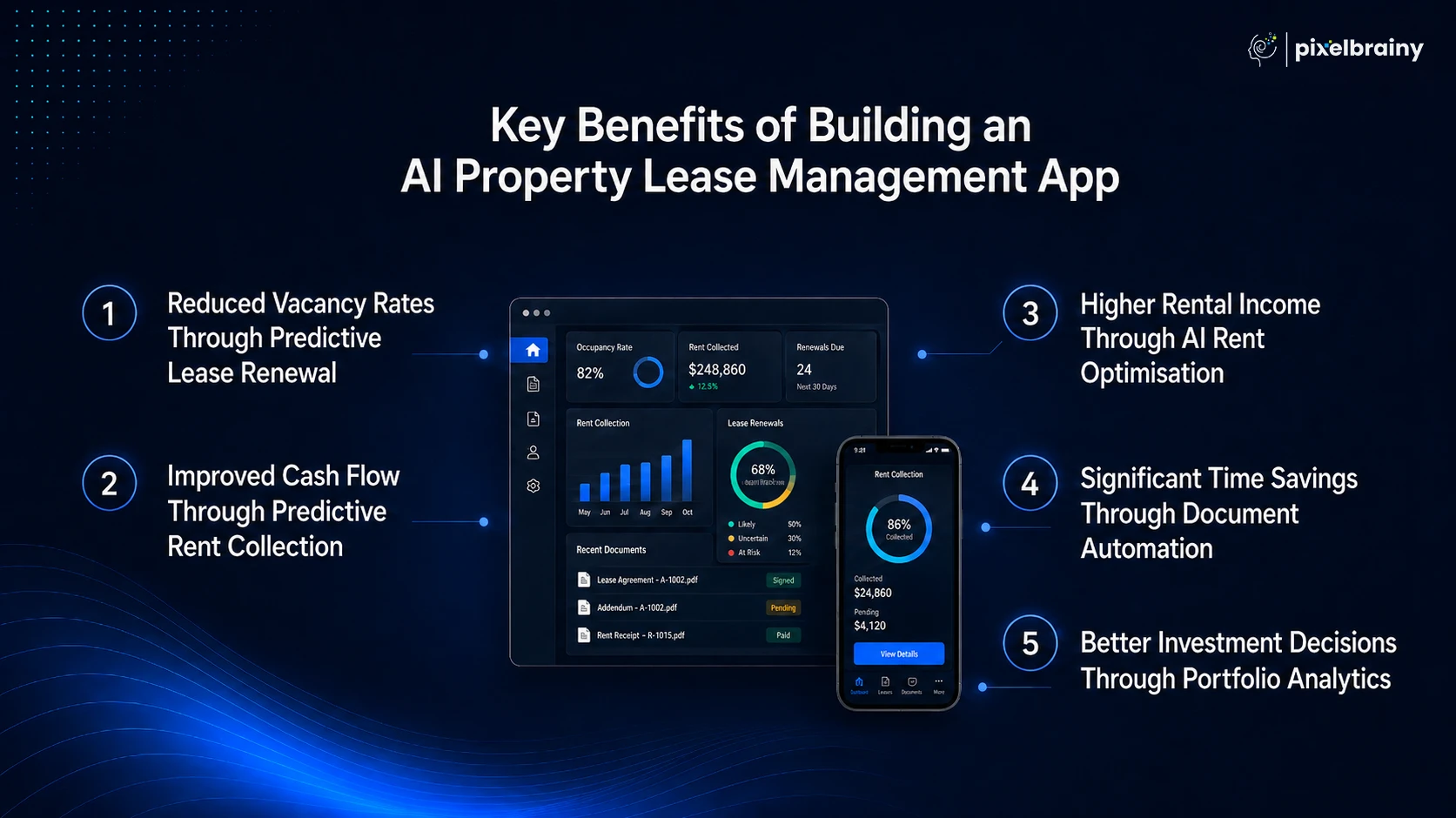
One of the biggest challenges for landlords is losing tenants without sufficient time to prepare for lease renewals or find replacement occupants.
Instead of waiting until a tenant submits a notice to vacate, AI continuously analyses:
Based on these insights, the platform predicts tenants who may not renew their leases and alerts property managers well before the renewal window.
This enables businesses to:
Business Impact: Even a small improvement in occupancy across a large property portfolio can generate significant recurring rental revenue.
Late rent payments create uncertainty in monthly cash flow and increase the workload for finance teams.
Instead of sending identical payment reminders to every tenant, AI predicts potential payment delays by evaluating:
The system automatically sends personalised reminders before the due date and recommends follow-up actions for higher-risk accounts.
This helps property managers:
Business Impact: Faster rent collection improves financial stability while reducing administrative effort.
Setting competitive rental prices requires continuous monitoring of local market conditions.
An AI-powered pricing engine evaluates multiple variables, including:
Instead of relying on annual pricing reviews, AI recommends optimal rental prices based on current market conditions.
This enables property managers to:
Business Impact: Data-driven pricing strategies increase rental income without significantly increasing vacancy risk.
Property managers spend a considerable amount of time preparing repetitive documents.
An AI lease management platform automatically generates:
Each document is populated with the correct property, tenant, and lease information, reducing manual work and minimising errors.
This allows teams to focus more on tenant relationships and portfolio growth.
Business Impact: Document automation increases team productivity and supports larger portfolios without additional administrative resources.
Property owners require more than historical reports to evaluate portfolio performance.
AI provides real-time dashboards covering:
It also identifies underperforming assets, predicts revenue risks, and highlights opportunities for operational improvement.
Instead of relying on static reports, property owners gain actionable insights that support faster and more informed investment decisions.
Business Impact: Real-time portfolio intelligence enables smarter capital allocation and stronger long-term investment performance.
| Benefit | AI Capability Behind It | Business Impact |
|---|---|---|
| Reduced vacancy rates | Renewal risk prediction | Higher annual occupancy across the portfolio |
| Improved cash flow | Payment failure prediction | Fewer late payments and faster rent collection |
| Higher rental income | AI rent optimisation engine | Market-aligned rental pricing across all units |
| Time savings on administration | Intelligent document automation | Lower operational costs and improved productivity |
| Better investment decisions | Predictive portfolio analytics | Data-driven capital allocation and portfolio optimisation |
| Lower maintenance costs | Predictive maintenance analysis | Earlier intervention before minor issues become expensive repairs |
Therefore, the benefits of developing an AI property lease management app extend beyond operational automation, enabling property managers and landlords to build a more profitable, scalable, and data-driven real estate business.
The success of an AI-powered lease management solution depends on more than attractive design or basic automation. The platform should include intelligent features that simplify lease administration, automate repetitive workflows, improve tenant experiences, and provide actionable business insights. During AI property lease management app development, selecting the right feature set directly impacts user adoption, operational efficiency, and long-term return on investment.
Unlike conventional software, property lease management app development integrating AI focuses on connecting lease management, tenant engagement, maintenance operations, financial management, and portfolio analytics within a single intelligent ecosystem. Whether you are planning to build an AI lease management app for residential, commercial, or mixed-use properties, these features form the foundation of a scalable and future-ready solution.
| Feature | Why It Matters |
|---|---|
| AI-powered Lease Management | Centralises the complete lease lifecycle, including lease creation, renewals, amendments, document storage, expiry tracking, and automated alerts. AI also predicts renewal risks and recommends timely actions, helping property managers minimise vacancies and improve tenant retention. |
| Tenant Management Dashboard | Provides a unified profile for every tenant by combining lease details, payment history, maintenance requests, communication records, and documents. This enables property managers to access complete tenant information from one dashboard without switching between multiple systems. |
| AI-Based Lease Renewal Prediction | Uses historical lease data, tenant engagement, payment behaviour, and occupancy trends to identify tenants who may not renew. The system proactively alerts managers, allowing sufficient time for renewal discussions, retention strategies, or replacement planning. |
| Smart Rent Collection & Payment Tracking | Automates rent reminders, payment tracking, overdue notifications, and digital receipts while using AI to identify payment risks based on historical behaviour. This improves collection efficiency and provides complete payment visibility for every property. |
| AI Rent Pricing Recommendation Engine | Analyses local rental trends, comparable properties, occupancy levels, seasonal demand, and tenant profiles to recommend competitive rental prices. This helps maximise rental income while maintaining healthy occupancy across the property portfolio. |
| Digital Document Management | Securely stores lease agreements, tenant documents, inspection reports, invoices, compliance records, and legal notices within a searchable repository. AI-powered document search enables users to retrieve information instantly without manual file management. |
| Maintenance & Work Order Management | Allows tenants to submit maintenance requests while automatically assigning work orders to vendors based on priority, location, availability, and historical performance. AI also identifies recurring maintenance patterns that require preventive action. |
| AI Chatbot for Tenant Support | Offers 24/7 assistance for common tenant enquiries, lease information, rent payments, maintenance updates, and appointment scheduling. AI chatbots reduce response times while allowing property managers to focus on more complex tenant issues. |
| Portfolio Analytics Dashboard | Displays real-time insights into occupancy, rental income, lease renewals, maintenance expenses, payment collection, and overall portfolio performance. Interactive dashboards enable property owners and managers to make faster, data-driven operational decisions. |
| Vacancy & Occupancy Management | Tracks available units, upcoming vacancies, occupancy rates, and leasing activity across the portfolio. AI forecasts vacancy trends and helps property managers prepare marketing campaigns before units become vacant. |
| Compliance & Regulatory Management | Monitors lease compliance, document validity, inspection schedules, and regulatory deadlines while automatically generating alerts for upcoming compliance requirements. This reduces legal risks and helps maintain accurate property records. |
| Vendor & Contractor Management | Maintains vendor profiles, contracts, invoices, service history, work quality ratings, and response times within one system. AI recommends the most suitable vendors based on previous performance and availability. |
| Automated Reports & Business Intelligence | Generates operational, financial, maintenance, occupancy, and lease performance reports automatically. AI converts raw property data into actionable insights that support business planning, forecasting, and executive decision-making. |
| Role-Based Access & Data Security | Protects sensitive tenant and financial information through role-based permissions, encrypted storage, multi-factor authentication, and secure cloud infrastructure. Different stakeholders receive access only to information relevant to their responsibilities. |
| AI Predictive Insights & Notifications | Continuously analyses portfolio data to detect renewal risks, payment delays, maintenance issues, occupancy changes, and operational anomalies. Instead of reacting to problems, property managers receive proactive recommendations before issues affect business performance. |
| Category | Core AI Capabilities |
|---|---|
| Lease Management | AI lease tracking, renewals, document automation |
| Tenant Experience | Self-service portal, AI chatbot, digital communication |
| Financial Management | Smart rent collection, payment prediction, pricing optimisation |
| Property Operations | Maintenance automation, vendor management, compliance monitoring |
| Business Intelligence | Portfolio analytics, predictive insights, automated reporting |
Therefore, successful AI property lease management app development depends on integrating intelligent features that streamline lease operations, automate decision-making, and enable property managers to manage growing portfolios with greater efficiency, accuracy, and confidence.
Developing an AI-powered lease management platform is only one part of building a successful PropTech business. The other equally important decision is selecting a business model that supports sustainable revenue, attracts the right customers, and scales as your platform grows. The right monetisation strategy not only determines how your platform earns recurring income but also influences customer acquisition, retention, and long-term profitability.
The ideal business model for an AI property lease management app depends on the customer segment you plan to serve. Individual landlords generally prefer affordable subscription plans with essential lease management capabilities. Property management companies require advanced workflow automation, AI-powered analytics, and multi-property management tools, while real estate investors and enterprise operators expect portfolio intelligence, predictive reporting, and enterprise-grade functionality. Understanding these different customer needs is essential for choosing a pricing model that delivers value while maximising recurring revenue.
Whether you are planning property management app development with AI for independent landlords, professional property management companies, or large real estate enterprises, the following business models are among the most effective ways to monetise your platform.
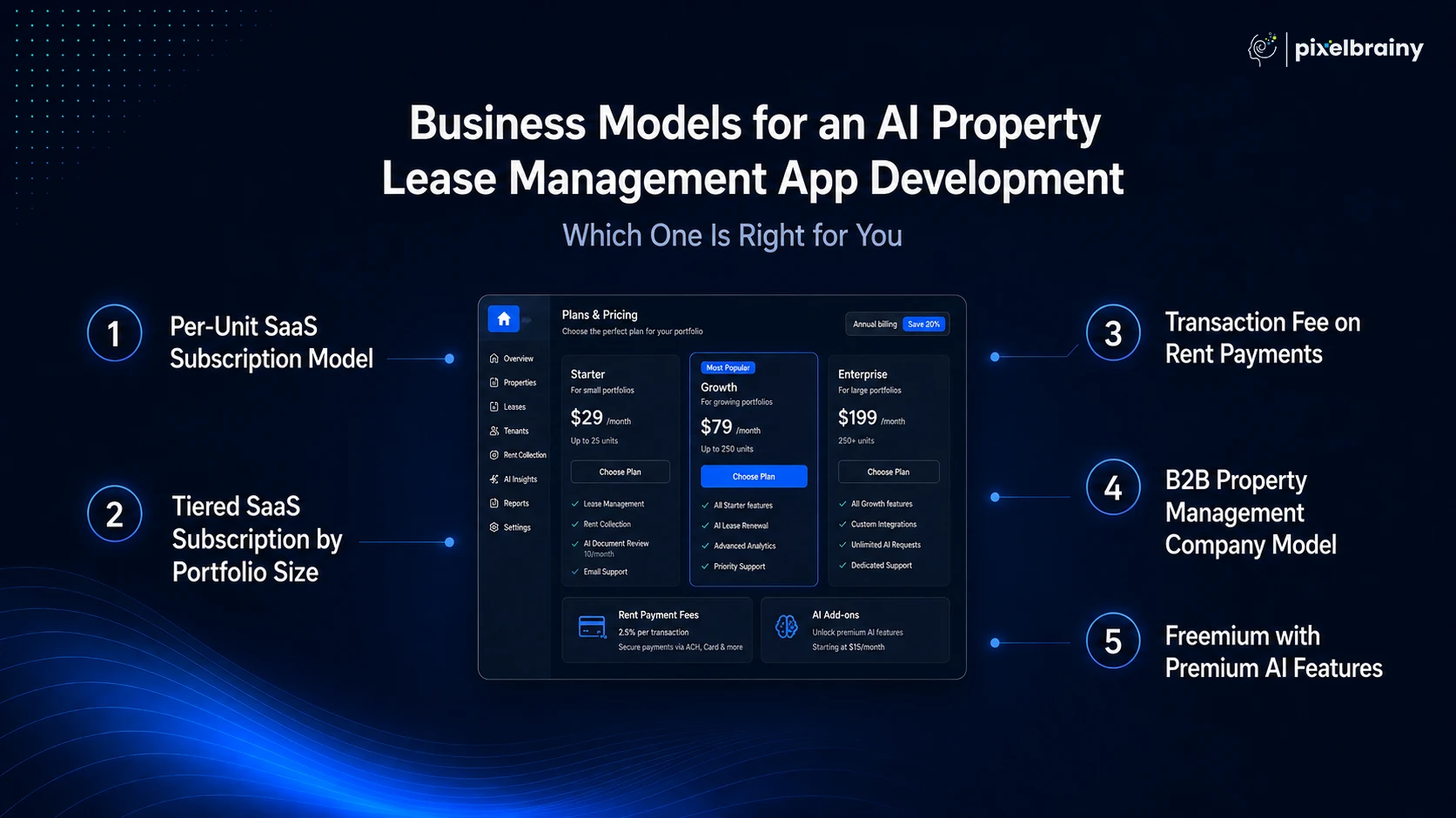
The Per-Unit SaaS Subscription Model is the most widely adopted pricing strategy in the property management software industry because it grows alongside a customer's property portfolio.
Under this model, customers pay a monthly subscription fee for every unit they manage through the platform, typically ranging from $1 to $5 per unit per month.
Best suited for:
Why choose this model?
Revenue Potential:
A platform managing 10,000 rental units at $2 per unit per month can generate approximately $20,000 in Monthly Recurring Revenue (MRR).
Development Consideration:
Your billing engine should automatically adjust subscription charges whenever customers add or remove rental units.
Instead of charging per unit, this model groups customers into predefined subscription plans based on the size of their portfolio.
Example pricing tiers include:
Best suited for:
Why choose this model?
Revenue Potential:
Monthly subscriptions generally range between $50 and $2,000, depending on the selected plan and included AI capabilities.
Development Consideration:
Clearly define feature limits, user access, and property limits for each subscription tier to encourage upgrades without restricting usability.
If digital rent collection is a core feature of your platform, charging a small fee on every rent payment can become a strong recurring revenue stream.
Revenue can be generated through:
Best suited for:
Revenue Potential:
Charging 0.5% on $10 million in monthly rent payments can generate approximately $50,000 every month.
Development Consideration:
This model requires secure payment gateway integration, fraud prevention mechanisms, payment reconciliation, and compliance with local financial regulations.
Instead of selling directly to landlords, this model focuses on licensing the platform to professional property management companies that manage hundreds or thousands of properties for multiple clients.
Enterprise customers typically require:
Best suited for:
Revenue Potential:
Enterprise subscription contracts typically range between $500 and $5,000 per month, depending on portfolio size, user licences, and custom functionality.
Development Consideration:
Your platform should support enterprise security, role-based access, custom integrations, API connectivity, and scalable infrastructure.
A freemium model allows users to experience the platform without an upfront investment while reserving advanced AI capabilities for paid subscribers.
Free Plan
Premium Plan
Best suited for:
Revenue Potential:
Customer revenue typically ranges from $0 to $200 per month, with natural upgrades as property portfolios and business requirements grow.
Development Consideration:
The free plan should provide meaningful value, while premium AI features should solve high-impact business problems that encourage users to upgrade.
| Business Model | Revenue Type | Best Target Customer | Average Revenue Per Customer | Development Complexity |
|---|---|---|---|---|
| Per-Unit SaaS Subscription | Recurring monthly | Individual landlords and small property management companies | $20 to $500/month | Low to Medium |
| Tiered SaaS by Portfolio Size | Recurring monthly | Small to mid-sized property operators | $50 to $2,000/month | Low to Medium |
| Transaction Fee on Rent Payments | Per transaction | Payment-focused property platforms | Varies with rent volume | High |
| B2B Property Management Company | Enterprise subscription | Professional property management companies | $500 to $5,000/month | Medium |
| Freemium with Premium AI | Freemium to subscription | Small landlords and growing portfolios | $0 to $200/month | Medium |
The right monetisation strategy depends on your target audience, product positioning, and long-term business goals.
Therefore, the most successful business model for an AI property lease management app is the one that aligns your target customers' needs with a scalable pricing strategy that drives long-term recurring revenue and sustainable business growth.
Building an AI-powered lease management platform involves much more than combining property management features with Artificial Intelligence. A successful product requires a clear understanding of customer needs, a scalable technical architecture, reliable AI models, and an intuitive user experience that simplifies everyday property operations. Without a structured roadmap, even well-funded PropTech products often struggle with poor adoption, feature complexity, or AI models that fail to deliver meaningful business outcomes.
For example, imagine a PropTech startup that identifies a significant gap in the market for small and mid-sized landlords. Existing enterprise platforms such as Yardi and MRI Software are powerful but expensive and overly complex for operators managing a few hundred units, while affordable property management applications offer basic lease tracking without genuine AI capabilities. The startup wants to develop an AI property lease management app that provides enterprise-level intelligence, predictive lease management, document automation, and portfolio insights at a price point accessible to smaller landlords. Achieving this vision requires a well-planned development strategy rather than simply building features one by one.
Let's explore the first five stages of how to develop an AI property lease management app from scratch.
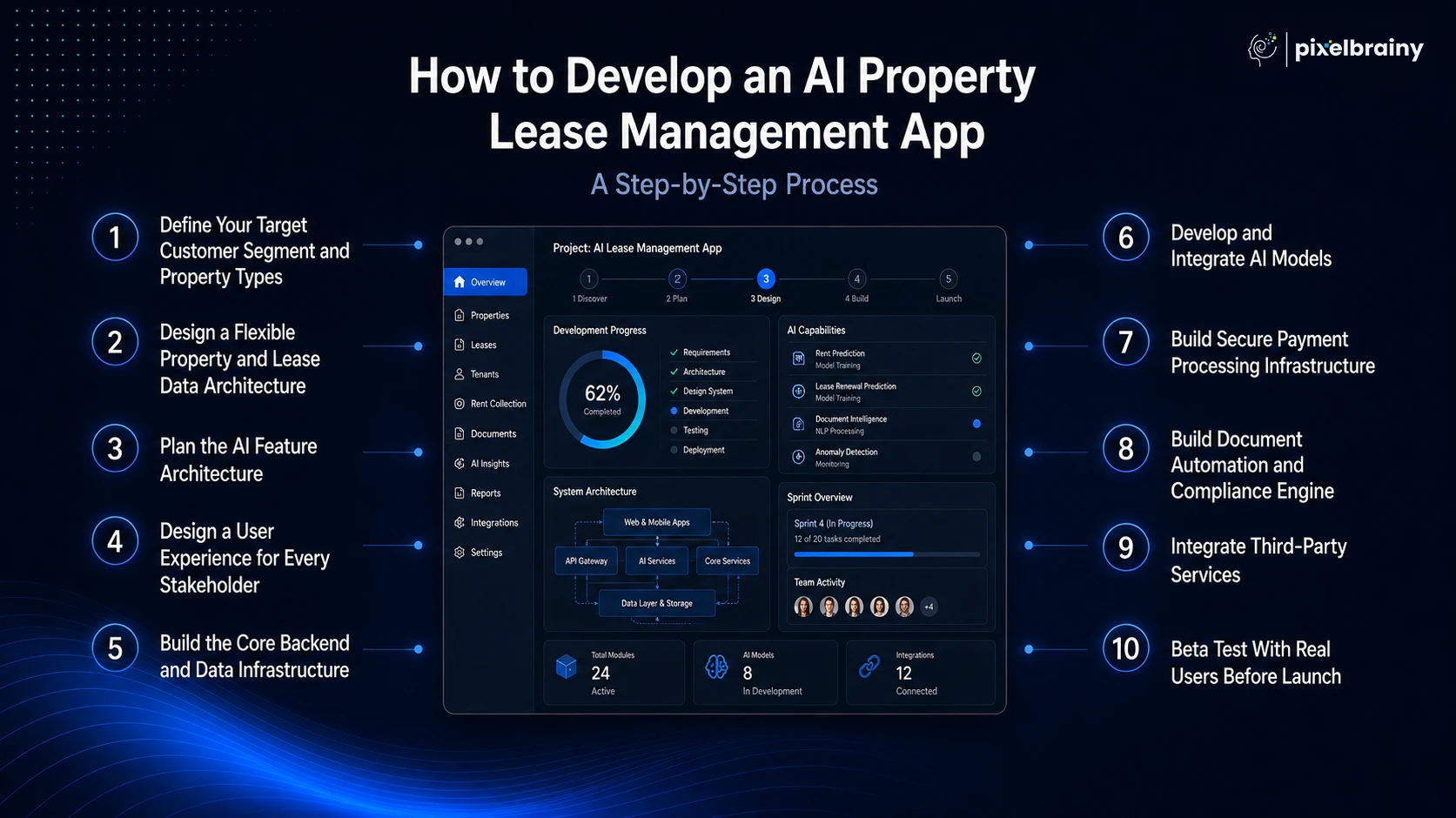
Every successful product starts by identifying exactly who it is being built for. Before writing code or designing interfaces, define whether your platform will target residential landlords, commercial property managers, mixed-use portfolios, or real estate investment firms. Each customer segment manages properties differently, follows different lease structures, and expects different workflows.
Once the customer segment is finalised, define the Version 1 scope by identifying supported property types, expected portfolio sizes, existing software used by customers, and their biggest operational pain points. This discovery phase ensures your product roadmap remains focused and prevents unnecessary feature development during AI lease management app development for property managers.
Key Deliverables
A lease management platform is built on data relationships. Every feature, from rent collection to lease renewals and portfolio analytics, depends on how properties, units, tenants, leases, owners, managers, and financial records are connected behind the scenes.
Design the data architecture to support different lease types, multiple rent escalation rules, flexible payment schedules, shared ownership models, and future property expansion. Investing time in a scalable architecture at the beginning reduces redevelopment costs later and makes it easier to introduce advanced AI capabilities as the platform evolves.
Key Deliverables
One of the most common mistakes during AI property lease management app development is treating AI as an add-on feature after the platform has already been developed. Instead, Artificial Intelligence should be planned from the beginning so that the application collects the right data required to train future prediction models.
Identify which AI capabilities will deliver the highest business value, such as lease renewal prediction, payment failure forecasting, rent optimisation, maintenance prioritisation, and portfolio analytics. Many startups begin with AI consultation to validate their product strategy, followed by PoC development to test AI feasibility before moving into full-scale development.
Key Deliverables
Unlike many business applications, a lease management platform serves multiple users with completely different expectations. Property managers need operational efficiency, tenants expect a simple self-service experience, and property owners require portfolio-level insights to monitor business performance.
Design separate user journeys for each stakeholder instead of forcing every user into the same interface. Collaborating with an experienced UI/UX design company helps create intuitive dashboards, reduce learning curves, and improve overall product adoption before development begins.
Key Deliverables
With the product strategy and user experience finalised, development begins with building the backend infrastructure that powers every property management workflow. This includes modules for property management, lease administration, tenant records, payment tracking, maintenance requests, notifications, authentication, and role-based access control.
Many startups launch through MVP development to validate customer demand before investing in enterprise-level functionality. Alongside the backend, establish secure document storage, version control, electronic signature support, and data pipelines that continuously capture lease events, tenant activity, and payment behaviour. This foundation prepares the platform for future AI integration and advanced predictive capabilities.
Key Deliverables
With the core platform in place, the next step is to develop the AI capabilities that differentiate your product from traditional lease management software. Every AI model should address a specific business problem instead of being added simply to increase the number of features.
Begin by training models for lease renewal prediction, payment failure prediction, AI rent optimisation, maintenance priority scoring, and portfolio performance analytics. These models should continuously learn from tenant behaviour, lease events, payment history, maintenance records, and market trends to deliver increasingly accurate recommendations over time.
Key Deliverables
A lease management platform is incomplete without a reliable payment ecosystem. Property managers should be able to collect rent, manage security deposits, calculate late fees, and reconcile payments from a single platform without relying on separate financial systems.
Integrate secure payment gateways that support bank transfers, credit and debit cards, digital wallets, and recurring payments. The platform should also automate payment reconciliation, generate digital receipts, calculate penalties based on lease terms, and support escrow management wherever local regulations require it.
Key Deliverables
Managing lease documents manually becomes increasingly difficult as the number of tenants and properties grows. Automating document creation not only saves time but also reduces administrative errors and helps maintain regulatory compliance.
Develop a document engine capable of generating lease agreements, renewal letters, rent increase notices, inspection reports, termination notices, and compliance documents using predefined templates. Integrate electronic signatures, version history, audit trails, and jurisdiction-specific clause libraries to ensure every document remains legally compliant and easy to manage.
Key Deliverables
An intelligent lease management platform should seamlessly connect with the external services property managers already use. These integrations reduce manual work, improve data accuracy, and expand the platform's capabilities without building every feature from scratch.
Common integrations include property market data APIs for rental comparisons, tenant screening services for background and credit checks, accounting software such as QuickBooks, CRM platforms, communication tools, and vendor management systems. Partnering with top AI app development companies in USA or experienced PropTech specialists can also help accelerate complex integrations while ensuring scalability and long-term reliability.
Key Deliverables
The final development stage is validating the platform with actual users. Internal testing alone cannot reveal how property managers, landlords, and tenants interact with the application under real operating conditions.
Launch a controlled beta with a small group of property management companies representing different portfolio sizes and property types. Measure AI prediction accuracy, workflow efficiency, feature adoption, and user satisfaction. Collect feedback, refine AI models, improve alert timing, optimise user flows, and fix usability issues before the public release. If additional engineering support is required during this phase, many startups choose to hire AI developers to accelerate model refinement and production readiness.
Key Deliverables
| Development Phase | Key Activities | Estimated Duration |
|---|---|---|
| Discovery & Product Planning | Customer research, feature planning, AI consultation, roadmap definition | 1 Week |
| UI/UX Design | User journeys, wireframes, interactive prototypes, usability validation | 2 Weeks |
| Backend Development | Property, lease, tenant, payment, notification and document management modules | 3 Weeks |
| AI Model Development | Renewal prediction, payment prediction, rent optimisation and portfolio analytics | 2 Weeks |
| Payment & Document Automation | Payment gateway, reconciliation, e-signature and compliance engine | 2 Weeks |
| Frontend Development | Property manager dashboard, tenant portal and owner analytics dashboard | 2 Weeks |
| Third-Party Integrations & QA | Market data APIs, tenant screening, accounting integration, testing and bug fixing | 1 Week |
| Beta Testing & Launch Preparation | Pilot deployment, AI calibration, performance optimisation and production release | 1 Week |
| Total Development Timeline | End-to-end AI property lease management app development | Approximately 14 Weeks |
The success of AI property lease management app development depends not on how many features you build, but on how strategically you design, develop, validate, and continuously optimise the platform to solve real-world property management challenges at scale.
The AI property lease management app development cost in 2026 depends on several factors, including the number of features, AI capabilities, third-party integrations, platform complexity, security requirements, and the size of the development team. There is no fixed development cost because every property management business has unique operational requirements and long-term product goals.
For example, a property management company may only need an AI-powered solution to automate lease tracking, rent collection, and renewal reminders, while a PropTech startup might require a full-scale SaaS platform with predictive analytics, AI rent optimisation, document automation, payment processing, and multi-tenant architecture. Naturally, both products require different levels of development effort and investment.
On average, the cost of building an AI property lease management app in 2026 ranges between $30,000 and $200,000+. A basic MVP with essential AI capabilities sits at the lower end of the range, whereas an enterprise-grade platform designed for large property management companies requires a significantly higher investment due to advanced AI models, enterprise integrations, and scalable cloud infrastructure.
The table below provides an estimated AI property lease management app development cost breakdown based on project complexity.
| App Type | Estimated Cost | What You Will Get |
|---|---|---|
| Basic AI Property Lease Management App | $30,000 - $60,000 | Tenant management, lease tracking, AI renewal reminders, rent collection, document management, maintenance requests, admin dashboard, basic reporting, MVP-ready solution |
| Advanced AI Property Lease Management App | $60,000 - $120,000 | Everything in the basic version plus AI payment prediction, AI rent optimisation, predictive maintenance, document automation, tenant portal, owner dashboard, payment gateway integration, advanced analytics |
| Enterprise AI Property Lease Management App | $120,000 - $200,000+ | Enterprise SaaS platform with multi-property management, multi-tenancy, custom AI models, predictive portfolio analytics, compliance engine, API integrations, role-based access, enterprise security, scalable cloud architecture, advanced BI dashboards |
Every feature and technical decision directly influences the overall AI lease management app development cost. Understanding these cost drivers helps businesses plan a realistic development budget while prioritising high-value functionality.
The number and complexity of features significantly impact the project budget. Core modules such as lease management, tenant management, payment tracking, maintenance requests, dashboards, and reporting require substantial development effort before AI functionality is introduced.
Estimated Cost: $8,000 - $35,000
Artificial Intelligence is one of the largest cost contributors.
Building capabilities such as:
requires model development, training, testing, and continuous optimisation.
Estimated Cost: $10,000 - $45,000
A lease management platform serves multiple user groups, including property managers, tenants, and property owners. Each requires a different interface and workflow.
Professional UI/UX design covers:
Estimated Cost: $4,000 - $15,000
The backend powers every business operation, including property records, lease data, payment history, document management, notifications, and AI data processing.
A scalable backend is essential for supporting future business growth.
Estimated Cost: $8,000 - $30,000
Modern property management platforms typically integrate with external services such as:
Each integration increases both development effort and testing requirements.
Estimated Cost: $3,000 - $20,000
Since lease management applications handle sensitive tenant, financial, and legal information, strong security and cloud infrastructure are essential.
Typical implementation includes:
Estimated Cost: $5,000 - $20,000
Before launch, every module must undergo functional testing, AI model validation, security testing, performance optimisation, and deployment preparation.
Comprehensive testing helps minimise post-launch issues and improves long-term reliability.
Estimated Cost: $4,000 - $15,000
Launching the application is only the beginning. AI models require continuous monitoring and retraining, while the platform needs regular feature updates, security patches, cloud maintenance, and performance improvements.
Businesses should allocate an annual maintenance budget of approximately 15% to 20% of the initial development cost.
| Cost Component | Estimated Investment |
|---|---|
| Features & Functional Modules | $8,000 - $35,000 |
| AI Development | $10,000 - $45,000 |
| UI/UX Design | $4,000 - $15,000 |
| Backend Development | $8,000 - $30,000 |
| Third-Party Integrations | $3,000 - $20,000 |
| Cloud & Security | $5,000 - $20,000 |
| Testing & Deployment | $4,000 - $15,000 |
| Ongoing Maintenance (Annual) | 15%-20% of project cost |
The final AI property lease management app development cost depends on your product vision, AI capabilities, platform complexity, and scalability goals, making it essential to prioritise features that deliver the highest business value while supporting long-term growth.

The technology stack defines how efficiently an AI-powered lease management platform stores property data, processes lease transactions, trains AI models, integrates third-party services, and supports thousands of users as the business grows. During AI property lease management app development, every technology decision influences application performance, scalability, security, maintenance costs, and the ability to introduce new AI capabilities in the future.
A modern AI property lease management app combines multiple technologies to manage property records, lease agreements, tenant information, payment processing, maintenance requests, document automation, and predictive analytics within a single ecosystem. Instead of using isolated tools, businesses need an architecture that allows all these components to communicate seamlessly while maintaining high availability and enterprise-grade security.
For instance, imagine a property management company that starts with 500 rental units but plans to expand to 10,000 units over the next few years. The platform should be capable of processing thousands of lease renewals, rent payments, AI predictions, maintenance requests, and real-time notifications every day without affecting performance. Building this level of scalability requires a carefully planned technology stack that supports cloud-native architecture, AI workloads, and seamless third-party integrations from the very beginning.
The table below outlines the recommended technology stack for businesses planning to build an AI property lease management app, helping them develop a secure, scalable, and future-ready PropTech platform.
| Technology Layer | Recommended Technologies | Purpose |
|---|---|---|
| Frontend (Web) | React.js, Next.js | Develops fast, responsive dashboards for property managers, landlords, and administrators while delivering an interactive user experience. |
| Frontend (Mobile) | Flutter, React Native | Builds high-performance Android and iOS applications from a single codebase, reducing development time and maintenance effort. |
| Backend | Node.js, NestJS | Handles business logic, APIs, lease management workflows, authentication, and real-time communication across the platform. |
| Database | PostgreSQL, MongoDB | Stores structured property, tenant, lease, and payment data while supporting flexible AI-driven datasets and document storage. |
| Artificial Intelligence | Python, TensorFlow, PyTorch, Scikit-learn | Powers lease renewal prediction, rent optimisation, payment risk analysis, predictive maintenance, and portfolio intelligence. |
| Cloud Infrastructure | AWS, Microsoft Azure, Google Cloud Platform | Provides scalable hosting, AI services, secure storage, automatic backups, disaster recovery, and global application availability. |
| Authentication & Security | OAuth 2.0, JWT, Multi-Factor Authentication | Secures tenant, financial, and property information through encrypted authentication and role-based access control. |
| Payment Integration | Stripe, PayPal, Plaid | Enables secure rent collection, recurring payments, refunds, reconciliation, and payment reporting. |
| Document Management | DocuSign API, Adobe Acrobat API | Supports digital lease generation, electronic signatures, version management, and secure document storage. |
| Real-Time Communication | Socket.IO, Firebase Cloud Messaging | Delivers instant notifications for lease renewals, maintenance updates, rent reminders, and tenant communication. |
| Third-Party Integrations | QuickBooks API, Twilio, SendGrid, Property Data APIs | Connects accounting software, SMS, email services, tenant screening platforms, and property market data providers. |
| DevOps & CI/CD | Docker, Kubernetes, GitHub Actions | Automates deployment, testing, scaling, monitoring, and continuous software delivery. |
| Monitoring & Analytics | Grafana, Prometheus, Google Analytics | Monitors application performance, infrastructure health, user activity, and business metrics for continuous optimisation. |
A scalable technology stack serves as the foundation of every successful AI property lease management app, enabling businesses to deliver intelligent, secure, and high-performance PropTech solutions that continue to evolve with changing market demands.
Developing an AI-powered lease management platform involves much more than implementing intelligent features and modern user interfaces. Property management software operates in a highly regulated environment where lease structures, payment workflows, compliance requirements, and tenant expectations vary significantly across different regions and property types. These complexities make AI property lease management app with predictive analytics development considerably more challenging than building a standard SaaS application.
Whether you are planning how to develop a compliant AI lease management app for US markets or how to build an AI lease management app with tenant portal, addressing technical, legal, and operational challenges early in the development process helps reduce project risks, improve user adoption, and ensure long-term scalability. Below are some of the most common challenges businesses face and the best practices to overcome them.
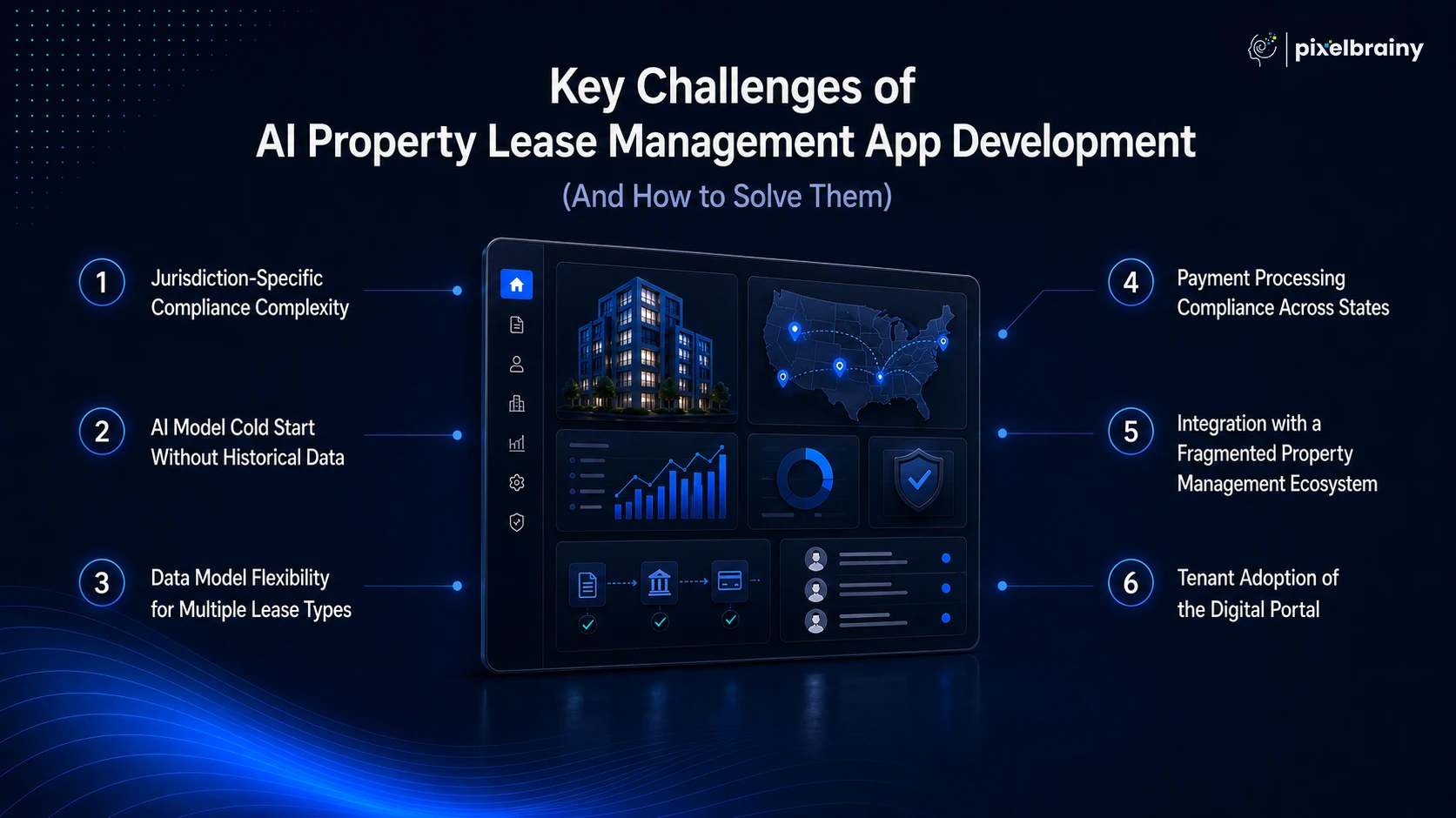
Challenge
Landlord-tenant regulations differ across US states and, in many cases, even between cities within the same state. Rules governing lease agreements, security deposits, rent increases, notice periods, and eviction procedures can vary significantly, making compliance one of the biggest challenges during AI property lease management app development.
Solution
Build a jurisdiction-specific clause library maintained by legal experts and configure the document automation engine to automatically insert location-specific legal clauses based on the property's jurisdiction. Complement this with an AI-powered compliance alert engine that notifies property managers about state-specific notice periods, lease deadlines, and regulatory requirements before compliance issues arise.
Challenge
Predictive AI models rely on historical data to generate accurate recommendations. However, newly launched platforms often lack sufficient lease records, payment history, and tenant behaviour data, reducing the accuracy of lease renewal predictions and payment risk analysis during the initial stages.
Solution
Design the onboarding process to import historical lease agreements, rent payment records, and tenant data from existing property management systems. During the early adoption phase, combine imported business data with industry benchmark datasets to improve prediction quality while continuously retraining AI models as more operational data becomes available.
Challenge
Residential, commercial, retail, and mixed-use properties follow different lease structures. A rigid database designed for one lease type can create expensive redevelopment challenges when supporting additional property categories in the future.
Solution
Build a flexible lease architecture capable of supporting gross leases, net leases, modified gross leases, percentage rent agreements, and customised lease structures from the beginning. A scalable data model allows new lease formats to be introduced without major schema modifications or application redesign.
Challenge
Processing rent payments involves strict financial regulations, including money transmission requirements, security deposit escrow rules, payment reconciliation, and state-specific compliance standards. Developing an in-house payment infrastructure increases both regulatory complexity and security risks.
Solution
Integrate trusted payment platforms such as Stripe or Dwolla that already support property management payment workflows and compliance standards. This approach simplifies payment processing while reducing development effort, improving transaction security, and ensuring adherence to applicable financial regulations.
Challenge
Most property management companies already use multiple business applications for accounting, maintenance management, CRM, communication, tenant screening, and financial reporting. Replacing every existing system is rarely practical, making integration a critical challenge.
Solution
Develop the platform using an API-first architecture that enables seamless integration with commonly used solutions such as QuickBooks, Yardi, AppFolio, communication platforms, and maintenance management software. This allows businesses to adopt the AI lease management platform without disrupting their existing technology ecosystem.
Challenge
Even the most advanced AI-powered platform cannot deliver its full value if tenants continue relying on traditional communication methods instead of using the self-service portal. Low portal adoption reduces the availability of behavioural data required for AI predictions and limits workflow automation.
Solution
Keep the tenant onboarding process simple by making online rent payments, maintenance requests, and lease document access the primary entry points. An intuitive user experience, automated notifications, and mobile-friendly design encourage higher adoption while generating valuable data that improves AI model performance over time.
| Challenge | Severity | Mitigation Strategy |
|---|---|---|
| Jurisdiction-specific compliance | Very High | Maintain a jurisdiction-specific clause library and implement an automated compliance alert engine. |
| AI model cold start | High | Import historical business data during onboarding and supplement early AI models with industry benchmark datasets. |
| Data model flexibility for lease types | High | Design a scalable lease architecture that supports multiple lease structures from day one. |
| Payment compliance across states | High | Integrate established payment providers with built-in compliance capabilities instead of building payment infrastructure from scratch. |
| Integration with existing property management tools | Medium to High | Adopt an API-first architecture with pre-built connectors for accounting, CRM, and property management platforms. |
| Tenant adoption of the digital portal | Medium | Simplify onboarding, prioritise mobile accessibility, and encourage portal usage through self-service features and automated notifications. |
Addressing these challenges early in the AI property lease management app development process helps businesses build a secure, compliant, scalable, and future-ready platform that delivers reliable performance for property managers, landlords, and tenants alike.
When you plan to develop an AI property lease management app, selecting the right development partner becomes just as important as defining the product itself. Unlike conventional software, an AI-powered lease management platform combines Artificial Intelligence, real estate workflows, payment processing, document automation, predictive analytics, cloud infrastructure, and regulatory compliance into one solution. Building such a platform requires expertise across multiple domains, making partner selection a critical business decision rather than simply a development requirement.
Many businesses face a common challenge during this stage.
"We are looking to develop an AI property lease management app, but finding the right development partner is genuinely difficult because this product requires expertise in AI development, real estate domain knowledge, payment processing compliance, document automation, and multi-platform development at the same time. We are not looking for a generic app agency that treats our lease management platform like a standard CRUD application with a few AI features added later."
This is exactly where PixelBrainy, a leading real estate AI software development company, stands apart. Our approach begins with understanding your business model, operational workflows, and long-term product vision before recommending technologies or writing code. The result is an AI-powered PropTech solution designed to solve real business challenges instead of simply delivering software features.
Developing lease management software requires much more than application development expertise. It demands a deep understanding of lease lifecycles, tenant management, property operations, compliance requirements, and revenue optimisation.
Our team combines real estate domain knowledge with advanced AI engineering to deliver AI property lease management app with predictive analytics development that helps businesses automate operations, improve occupancy, and make data-driven decisions.
Many software agencies develop the application first and integrate AI later.
At PixelBrainy, Artificial Intelligence is part of the product strategy from the discovery phase itself. Every AI capability, from lease renewal prediction and rent optimisation to payment risk analysis and intelligent document automation, is designed around measurable business outcomes rather than feature checklists.
Building a modern PropTech platform requires expertise across multiple technologies.
PixelBrainy provides end-to-end development services including:
This integrated approach ensures consistency, faster delivery, and a scalable architecture from the very beginning.
Whether you are validating a startup idea or modernising an existing property management platform, our development approach focuses on long-term scalability.
We build applications that can easily evolve from an MVP into an enterprise-grade SaaS platform with advanced AI capabilities, multi-property management, predictive analytics, and cloud-native infrastructure.
One of our recent engagements involved a rapidly growing property management business that wanted to replace several disconnected systems with a single AI-powered platform. Their objective was to centralise lease management, automate rent collection, simplify maintenance tracking, and improve portfolio visibility without increasing administrative effort.
Our engineering team developed a cloud-based AI lease management platform featuring:
✔ Reduced manual lease administration
✔ Faster lease renewal processing
✔ Improved rent collection visibility
✔ Centralised maintenance management
✔ Better operational decision-making through AI insights
Project details remain confidential under client agreement.
At PixelBrainy, we don't just build applications. We engineer intelligent PropTech platforms that combine AI, automation, and real estate expertise to help businesses solve complex operational challenges and scale with confidence.
Ready to start building an AI property lease management app that reduces vacancy rates, streamlines lease operations, and delivers enterprise-level intelligence? Connect with PixelBrainy to turn your product vision into a scalable AI-powered PropTech solution.
The future of property management lies in intelligent, data-driven operations rather than manual processes and disconnected systems. As lease portfolios grow, managing renewals, rent collection, maintenance requests, compliance, and tenant communication becomes increasingly complex. This is why AI property lease management app development is helping property management companies, PropTech startups, landlords, and real estate enterprises streamline operations while improving decision-making through predictive analytics and automation.
Whether you want to build an AI lease management app, create an AI property lease management application, or understand how to develop an AI property lease management app, success depends on combining the right features, scalable technology, AI capabilities, and a well-defined development strategy. From selecting the right business model and technology stack to implementing predictive lease renewal, AI rent optimisation, document automation, and intelligent portfolio analytics, every decision contributes to building a solution that delivers measurable business value and long-term scalability.
Ready to transform your property management vision into an AI-powered solution? Schedule a consultation call with PixelBrainy and discover how our experts can help you build a secure, scalable, and future-ready AI property lease management app tailored to your business goals.
The development timeline depends on the platform's complexity, AI capabilities, integrations, and supported property types. A basic MVP typically takes 10 to 14 weeks, while an enterprise-grade solution with predictive analytics, payment processing, document automation, and multi-property management may require additional development and testing before launch.
A modern AI lease management app should include lease renewal prediction, rent payment risk analysis, AI rent optimisation, predictive maintenance, intelligent document automation, portfolio analytics, and AI-powered tenant support. These features help property managers automate operations, reduce manual effort, and make proactive business decisions.
The AI property lease management app development cost in 2026 generally ranges from $30,000 to $200,000+, depending on the project's scope, AI functionality, platform complexity, third-party integrations, security requirements, and deployment architecture. Developing an MVP requires a lower investment than building an enterprise-ready PropTech platform.
Yes. A well-designed platform can integrate with accounting software, payment gateways, tenant screening services, e-signature platforms, CRM systems, and existing property management solutions through secure APIs. This allows businesses to modernise operations without replacing every system they currently use.
AI analyses lease expiry dates, tenant payment history, communication patterns, maintenance records, and occupancy trends to identify tenants who may not renew their leases. Property managers can then start renewal discussions early, offer personalised incentives, and address tenant concerns before vacancies impact rental income.
Absolutely. Many small and mid-sized landlords struggle with spreadsheets, manual lease tracking, and disconnected tools. An AI-powered lease management app centralises lease administration, rent collection, maintenance management, and tenant communication while providing enterprise-level insights at a more accessible cost than traditional property management software.
Look for a development partner with proven expertise in Artificial Intelligence, PropTech, cloud architecture, payment processing, document automation, and regulatory compliance. The ideal company should understand real estate workflows, offer end-to-end product development, and build AI-driven solutions that solve real operational challenges rather than simply adding AI features to a standard application.

About The Author
Sagar Bhatnagar
Sagar Sahay Bhatnagar brings over a decade of IT industry experience to his role as Marketing Head at PixelBrainy. He's known for his knack in devising creative marketing strategies that boost brand visibility and market influence. Sagar's strategic thinking, coupled with his innovative vision and focus on results, sets him apart. His track record of successful campaigns proves his ability to utilize digital platforms effectively for impactful marketing efforts. With a genuine passion for both technology and marketing, Sagar continuously pushes PixelBrainy's marketing initiatives to greater success.

Working with the PixelBrainy team has been a highly positive experience. They understand the design requirements and create beautiful UX elements to meet the application needs. The dev team did an excellent job bringing my vision to life. We discussed usability and flow. Sagar worked with his team to design the database and begin coding. Working with Sagar was easy. He has the knowledge to create robust apps, including multi-language support, Google and Apple ID login options, Ad-enabled integrations, Stripe payment processing, and a Web Admin site for maintaining support data. I'm extremely satisfied with the services provided, the quality of the final product, and the professionalism of the entire process. I highly recommend them for Android and iOS Mobile Application Design and Development.

Great experience working with them. Had a lot of feedback and I found that unlike most contractors they were bugging me for updates instead of the other way around. They were extremely time conscience and great at communicating! All work was done extremely high quality and if not on time, early! They were always proactive when it comes to communication and the work is great/above par always. Very flexible and a great team to work with! Goes above and beyond to present us with multiple options and always provides quality. Amazing work per usual with Chitra. If you have UI/UX or branding design needs I recommend you go to them! Will likely work with them in the future as well, definitely recommended!

PixelBrainy is a joy to work with and is a great partner when thinking through branding, logo, and website layout. I appreciate that they spend time going into the "why" behind their decisions to help inform me and others about industry best practices and their expertise.

I hired them to design our software apps. Things I really like about them are excellent communication skills, they answer all project suggestions and collaborate right away, and their input on design and colors is amazing. This project was complex and needed patience and creativity. The team is amazing to do business with. I will be using them long-term. Glad to see there are some good people out there. I was afraid to try and outsource my project to someone but I am glad I met them! I really can't say enough. They went above and beyond on this project. I am very happy with everything they have done to make my business stand out from the competition.

It was great working with PixelBrainy and the team. They were very responsive and really owned the project. We'll definitely work with them again!

I recently worked with the PixelBrainy team on a project and I was blown away by their communication skills. They were prompt, clear, and articulate in all of our interactions. They listened and provided valuable feedback and suggestions to help make the project a success. They also kept me updated throughout the entire process, which made the experience stress-free and enjoyable.

PixelBrainy is very good at what it does. The team also presents themselves very professionally and takes care of their side of things very well. I could fully trust them taking up the design work in a timely and organised manner and their attention to detail saved us lots of effort and time. This particular project was quite intense and the team showed that they function very well under pressure. Very much looking forward to working with her again!

It's always an absolute pleasure working with them. They completed all of my requests quickly and followed every note I had for them to a T, which made our process go smoothly from start to finish. Everything was completed fast and following all of the guidelines. And I would recommend their services to anyone. If you need any design work done in the future, PixelBrainy should be your first call!

They took ownership of our requirements and designed and proposed multiple beautiful variants. The team is self-motivated, requires minimum supervision, committed to see-through designs with quality and delivering them on time. We would definitely love to work with PixelBrainy again when we have any requirements.

PixelBrainy was a big help with our SaaS application. We've been hard at work with a new UI/UX and they provided a lot of help with the designs. If you're looking for assistance with your website, software, or mobile application designs, PixelBrainy and the team is a great recommendation.

PixelBrainy designers are amazing. They are responsive, talented, and always willing to help craft the design until it matches your vision. I would recommend them and plan to continue them for my future projects and more!!!

They were awesome! Did a good job fast, and good communication. Will work with them again. Thank you

Creative, detail-oriented, and talented designers who take direction well and implement changes quickly and accurately. They consistently over-delivered for us.

PixelBrainy team is very talented and creative. Great designers and a pleasure to work with. PixelBrainy is an excellent communicator and I look forward to working with them again.

PixelBrainy has a very talented design team. Their work is excellent and they are very responsive. I enjoy working with them and hope to continue on all of our future projects.


Transform your ideas into reality with us.
Across these industries, each engagement brings unique challenges, from early-stage product development to scaling complex systems, helping us build a practical understanding of real-world product environments.