AI Summary Powered by PixelBrainy
What would it take to build an AI sports betting prediction engine that can serve millions of sports fans while producing predictions that are genuinely measurable, backtested, and production-ready?
Imagine this real-world scenario: we are a sports media company with 4 million monthly users and want to build a proprietary AI sports betting prediction engine that powers AI pick recommendations across our platform. Before budgeting the project, we need to understand the complete cost of building a production-grade prediction engine, including data pipeline development, model training infrastructure, feature engineering, backtesting, historical performance validation, live deployment architecture, monitoring, and ongoing data licensing costs that development companies rarely disclose upfront in initial proposals.
That is the real challenge behind AI sports betting model development. A prediction engine is not simply an ML model trained on historical scores. It is a complete data and intelligence platform that collects sports data, transforms it into predictive features, estimates probabilities, evaluates betting markets, validates historical performance, and delivers predictions through production APIs.
The market opportunity is also expanding. According to Fortune Business Insights, the global sports betting market is projected to reach $126.51 billion in 2026, growing to $295.29 billion by 2034 at an 11.18% CAGR.
For businesses asking how to create an AI sports betting prediction engine, the key question is not simply model accuracy. A serious system must measure probability calibration, expected value, historical performance, data quality, latency, model drift, and operational reliability.
This guide explains the complete development process of an AI sports betting model, including architecture, data requirements, technology stack, development cost, timeline, backtesting, validation, deployment, and ongoing maintenance.
An AI sports betting prediction model is a machine learning or statistical system that estimates the probability of sports outcomes and compares those probabilities with available betting prices to identify potential market inefficiencies. A genuinely good model is not defined by how often it predicts winners, but by whether it can consistently identify prices with measurable positive expected value and demonstrate an edge against the market.
This distinction is critical for companies investing in AI sports betting model development. A model can show an impressive 65% win rate and still be commercially ineffective if it consistently selects outcomes at prices that do not justify the risk. Conversely, a model can experience short-term losing results while producing positive closing line value, indicating that its predictions were consistently positioned ahead of subsequent market movement.
For teams planning to develop AI sports betting model technology, five elements determine whether the system represents genuine predictive engineering or simply an attractive sports prediction application.
Most AI betting applications promote win rate because it is simple for consumers to understand. However, win rate by itself is a weak measure of betting-model quality because it does not account for the price at which each prediction was made.
Closing line value, or CLV, measures whether the price available when the model generated a selection was better than the price available when the market ultimately closed.
For example, a model may recommend a team at +150, while the market later closes at +120. Even if that particular selection loses, the movement indicates that the model identified a more favorable price before the market moved.
This is why serious AI sports prediction model development should track CLV alongside:
Win rate can describe what happened. CLV helps evaluate whether the model was consistently making decisions at prices that the later market considered less favorable.
The most serious technical failure in sports betting backtesting is look-ahead bias.
Look-ahead bias occurs when a model receives information during historical training or testing that would not have been available when the prediction would actually have been generated.
Consider a model that supposedly creates a prediction at 10:00 AM. If its historical features include a lineup announcement published at 6:00 PM, the backtest is using future information. The resulting performance may look exceptional, but the model could never have produced that prediction in real time.
Common sources of contamination include:
This is also a major difference between conventional financial time-series modeling and sports betting prediction. Both require chronological data separation, but sports betting models must reconstruct the exact information state available before a particular sporting event and betting decision.
Therefore, temporal separation must be enforced at the data and feature-engineering level, not simply added as a final backtesting rule.
A prediction model does not operate in a vacuum. Its potential edge depends partly on the efficiency of the market it targets.
Highly liquid markets such as major NFL spreads receive enormous amounts of public and professional attention. This can make pricing more competitive.
Other segments can have different efficiency characteristics, including:
This does not mean that a less liquid market automatically produces profitable opportunities. It means that market selection is a fundamental part of AI betting prediction engine development.
Before building a model, a company should evaluate:
The sport and market selected at the beginning can therefore influence the maximum realistic return from the entire model-development investment.
A single machine learning model may capture only one representation of the factors influencing a sporting event.
An ensemble architecture combines multiple models or prediction approaches to produce a broader estimate.
For example, a production system might combine:
The objective is not simply to add more algorithms. The important factor is error diversification.
If different models make different mistakes, combining them can produce predictions that are more stable than relying on one model.
This is similar to diversification in financial portfolio construction. A portfolio containing assets with different risk characteristics can be more robust than a portfolio concentrated in one asset. Likewise, an ensemble containing complementary predictive models can reduce dependence on one modeling assumption.
For organizations looking to build AI powered sports betting model technology, the additional cost of ensemble development should therefore be evaluated against the potential improvement in stability, calibration, and out-of-sample performance.
Backtesting is essential, but backtesting alone should not be treated as proof that a sports betting model works in production.
A rigorous system should undergo live paper trading or controlled small-stake deployment before being presented to subscribers or used for significant capital allocation. Ideally, validation should cover at least one complete sports season.
Why?
A full season exposes the model to conditions that historical simulations may not fully reproduce, including:
This becomes particularly important when a model performs strongly in backtesting but underperforms during its first eight weeks of live deployment.
That result does not automatically mean the model is invalid. The development team needs to compare the live environment against the historical environment across several dimensions:
If live CLV remains healthy while short-term win rate declines, the issue may simply be statistical variance. If CLV also deteriorates substantially, the investigation should focus on model degradation, data changes, market adaptation, or differences between historical and live execution.
The sports calendar therefore creates a unique constraint on AI betting prediction engine development. A software application can be technically completed in weeks, but credible live validation cannot be compressed into the same timeline.
| Criteria | Basic Sports Prediction App | Rigorous AI Sports Betting Prediction Engine |
|---|---|---|
| Performance Metric Used | Win rate and prediction accuracy | CLV, calibration, expected value, ROI, drawdown, and out-of-sample performance |
| Backtesting Methodology | Historical dataset with limited controls | Chronological, timestamp-aware, walk-forward backtesting |
| Market Selection Rationale | Focuses on popular sports and markets | Evaluates efficiency, liquidity, data availability, competition, and potential edge |
| Model Architecture | Usually one ML model | Ensemble of complementary statistical and machine learning models |
| Live Validation Requirement | Often absent or limited | At least one complete season of paper trading or controlled live validation |
| Data Pipeline Rigor | Basic historical and current data | Timestamped, validated, versioned, auditable production pipeline |
Ultimately, the difference between a conventional sports prediction application and a rigorous AI sports betting model is not the presence of the word "AI."
It is the methodology used to determine whether the model has genuine predictive value.
A credible system must answer three questions: Was the information available at prediction time? Did the model consistently beat the market price? And does that performance survive when the model encounters real-world conditions?
Those questions should shape the architecture, data strategy, validation framework, and technology decisions from the beginning of AI sports betting model development.
Who is actually spending money on AI sports betting prediction engines in 2026, and what business outcome are they expecting from that investment?
In 2026, six buyer groups have clear commercial reasons to invest in predictive sports technology: consumer sports-picks startups, sports media companies, quantitative sports analytics businesses, sportsbook operators, quantitative finance professionals entering sports markets, and daily fantasy sports platforms. Each buyer approaches AI sports betting model development differently, but the underlying asset is the same: a prediction engine capable of converting proprietary sports data into probability estimates, market intelligence, and commercially useful recommendations.
The addressable market provides a substantial foundation for these investments. Grand View Research projects the global sports betting market to reach $123.4 billion in 2026, increasing to $236.0 billion by 2033 at a 9.7% CAGR. Its latest AI in sports research estimates the AI in sports market at $12.7 billion in 2026, with the market forecast to reach $49.9 billion by 2033 at a 21.6% CAGR.
The commercial question for each buyer is therefore different: consumer startups need a prediction engine that users will pay for, media companies need prediction intelligence that strengthens premium content, analytics companies need models they can license through APIs, sportsbooks need internal models that improve pricing and risk decisions, quantitative professionals need reliable sports-market infrastructure, and DFS operators need accurate player projections that improve lineup products.
That distinction matters when deciding whether to build AI sports betting model in 2026, because the required architecture, data investment, model complexity, validation methodology, and development budget depend directly on the commercial use case.
Consumer AI sports picks have established demand for products that turn complex sports data into understandable recommendations. This has created an opportunity for new founders who want to build AI sports betting model in 2026 with a stronger technical foundation and clearer performance validation than conventional prediction applications.
The competitive opportunity is increasingly based on:
For these companies, the prediction engine is not simply a feature. It is the core intellectual property behind the product.
Sports media companies have another commercial reason to develop AI sports prediction model technology: turning editorial content into an interactive, data-driven experience.
A media platform can add AI-generated:
For companies with large audiences, prediction intelligence can support premium subscriptions, increased engagement, personalized experiences, and differentiated advertising inventory.
The prediction engine effectively becomes the technical infrastructure behind a premium sports intelligence layer.
Sports analytics companies can transform proprietary models into commercial APIs and data products.
Their customers may include:
This creates a recurring B2B revenue model in which the prediction engine itself becomes the company's primary intellectual property.
For startups focused on AI sports betting algorithm development, proprietary features, historical datasets, model ensembles, calibration methods, and performance-validation frameworks can become important competitive assets.
Sportsbook operators have a different commercial objective. Their AI investment is often focused on improving internal economics rather than selling predictions directly to consumers.
Internal prediction and analytics systems can support:
For a sportsbook, even a relatively small improvement in pricing or risk management can have significant financial implications at scale.
This makes internal AI sports betting model development an operational investment rather than a consumer-product experiment.
Quantitative finance professionals, algorithmic traders, statisticians, and data scientists bring experience in:
Many see sports markets as an attractive application for these skills because different sports, leagues, and betting markets have different levels of liquidity and market efficiency.
However, financial modeling expertise does not automatically solve the sports data problem.
Sports prediction requires specialized handling of:
This is why creating AI sports betting model technology requires both quantitative expertise and sports-specific data engineering.
DFS platforms represent another major buyer category.
Their core products often depend on accurate player projections for:
These systems are effectively AI sports prediction models focused on individual player statistics rather than only match outcomes.
| Buyer Type | Prediction Product | Primary Commercial Rationale |
|---|---|---|
| Consumer prediction startups | AI picks and forecasts | Subscriptions, engagement, and retention |
| Sports media companies | Prediction intelligence | Premium content and audience engagement |
| B2B analytics companies | Prediction APIs | Recurring data and licensing revenue |
| Sportsbook operators | Internal AI models | Pricing and risk optimization |
| Quantitative startups | Proprietary prediction systems | Sports intelligence and market opportunities |
| DFS platforms | Player projection engines | Lineup optimization and user retention |
The important takeaway for companies considering AI sports betting model development in 2026 is that the opportunity is not one single market. It is an ecosystem of consumer products, B2B prediction infrastructure, internal sportsbook technology, sports analytics, and player projection systems.
Also Read: Top 12 AI Sports Betting Software Development Companies in USA
A production AI sports betting prediction engine is an end-to-end technology system that collects sports and betting data, converts it into predictive features, runs validated machine learning models, compares model probabilities with market prices, and delivers predictions through APIs to websites and mobile applications.
The architecture should be designed around one principle: every prediction must be traceable, reproducible, timestamped, and measurable from the original data input to the final recommendation.
The working architecture can be understood through eight connected layers:
Sports Data → Data Pipeline → Feature Engineering → AI Models → Backtesting → Prediction API → Recommendation Layer → Monitoring
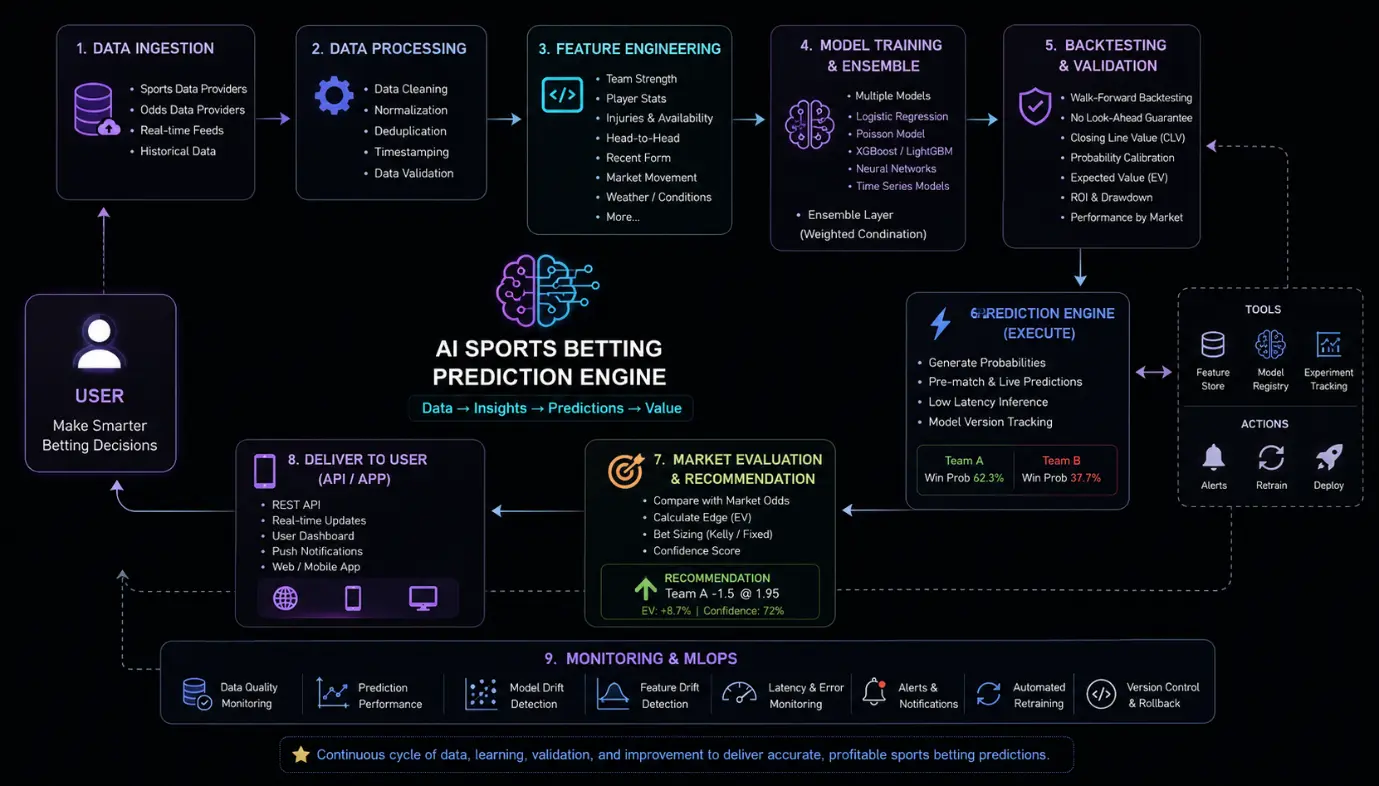
The engine first collects the information required to generate predictions.
Typical inputs include:
Historical data supports training and validation, while real-time feeds support current and live predictions.
The raw information passes through an automated data pipeline that cleans, validates, standardizes, deduplicates, and timestamps every record.
Timestamping is essential. The system must know what information was available at the exact time a prediction would have been generated. This prevents future information from entering historical backtests.
The system converts raw sports information into predictive variables.
For example, a basketball model might calculate:
These features become the inputs for the prediction models.
The feature set is passed to statistical and machine learning models designed for the specific sport and market.
Possible models include:
An ensemble architecture can combine multiple model outputs to produce the final probability estimate.
Before deployment, the engine recreates historical predictions chronologically.
The system evaluates:
The backtesting engine must use only information that was actually available at the historical prediction timestamp.
After validation, the approved model is deployed as a prediction service.
The API can return:
Event → Model Probability → Predicted Outcome → Confidence → Key Factors → Model Version → Timestamp
This API allows the same prediction engine to power web applications, mobile apps, dashboards, and other products.
The recommendation engine combines the model output with current market information.
For example:
Model Probability + Market-Implied Probability + Price Difference → Potential Recommendation
This is where a prediction becomes a structured product recommendation rather than simply an estimated game outcome.
The final layer continuously monitors both the technology and the model.
It tracks:
If the model begins behaving differently from its validated baseline, the system can trigger investigation, retraining, or rollback.
Sports & Odds Providers
↓
Data Ingestion & Validation
↓
Historical Data Warehouse
↓
Feature Engineering
↓
Model Training & Ensemble Layer
↓
Backtesting & Historical Validation
↓
Production Model Registry
↓
Prediction API
↓
Market Evaluation & Recommendation Engine
↓
Web / Mobile / Dashboard
↓
Monitoring, Drift Detection & Continuous Retraining
This architecture makes the AI betting prediction engine development process measurable at every stage and allows the platform to scale from an initial prediction MVP to a multi-sport production system.
A production AI sports betting engine is ultimately a continuous data-to-decision system where reliable data, temporal validation, predictive modeling, market analysis, and MLOps work together to deliver measurable predictions at scale.
The quality of an AI sports betting prediction model depends heavily on the quality, depth, timing, and licensing of the data behind it. A production system typically needs three data layers: deep historical data for training, real-time pre-game data for current predictions, and odds or alternative data for market evaluation and additional predictive signals.
For founders asking how to develop an AI sports betting model with alternative data, the important decision is not finding one provider that supplies everything. A stronger architecture often combines specialist providers based on the prediction target, required latency, geographic coverage, historical depth, and commercial usage rights.
For most major sports, plan for at least five seasons of historical results, team statistics, and player statistics. Ten or more seasons can be valuable for established leagues when the underlying data definitions are consistent.
Sportradar provides broad sports coverage, live feeds, odds, and historical data. Sports Reference can be useful for research and historical benchmarking, but commercial teams must review its usage restrictions and obtain appropriate permissions rather than assuming website data can be scraped or used to build a competing database.
Pre-game predictions require information that can change rapidly before kickoff or tipoff, including:
Sportradar provides live sports data and event information, while weather providers can supply location-specific conditions. Provider availability varies by sport and competition, so founders should verify coverage before signing a contract.
Odds data is essential when the model needs to evaluate market price, CLV, or potential expected value. The Odds API provides current bookmaker odds and historical snapshots. Its historical odds service includes snapshots from June 2020 for featured markets and five-minute snapshots for many datasets from September 2022 onward.
Alternative Data Sources
Alternative signals can include:
These signals should be added only when they improve out-of-sample performance. More data does not automatically produce a better model.
| Data Type | Provider Options | Indicative Budget | Primary Use |
|---|---|---|---|
| Historical game data | Sportradar, licensed historical databases | $500 to $5,000+/month | Model training |
| Live injury and lineup data | Sportradar, licensed league feeds | $500 to $3,000+/month | Pre-game updates |
| Live bookmaker odds | The Odds API, licensed odds feeds | $30 to $500+/month | Market comparison |
| Historical odds | The Odds API, specialist providers | $200 to $1,000+/month | Backtesting |
| Weather | OpenWeather, AccuWeather | $50 to $300+/month | Weather features |
| Alternative data | Specialist vendors | $1,000 to $10,000+/month | Additional signals |
*These are planning ranges, not guaranteed provider prices. Enterprise sports-data contracts are frequently quote-based. The Odds API publicly lists paid plans beginning at $30/month, while premium sports-data providers may require customized commercial agreements.
The right data strategy combines sufficient historical depth, timestamped real-time feeds, reliable market prices, and commercially licensed alternative data without paying for datasets that do not improve the model.
Building an AI sports betting prediction engine requires a structured development process that connects sports data, predictive modeling, historical validation, market analysis, and production deployment. A company cannot simply train an algorithm on past match results and expect reliable live predictions. The system must be designed to understand what information was available before an event, generate calibrated probabilities, test those predictions against historical market conditions, and continuously evaluate live performance.
A common business query is: “How do I build an AI sports betting prediction system that can generate predictions, validate them through backtesting, and eventually operate at production scale?” The answer starts with defining the prediction target and continues through six connected development stages.
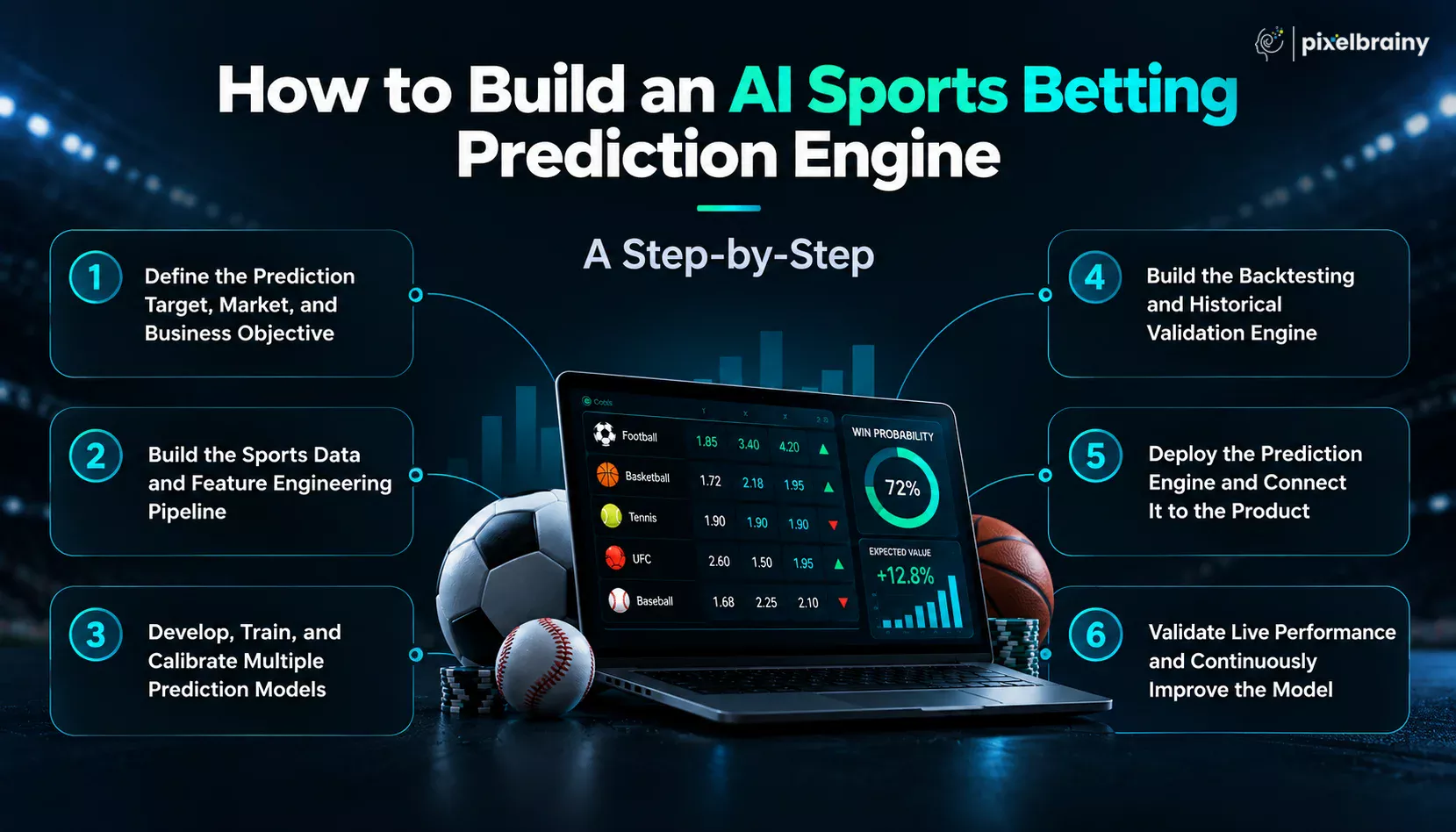
The first stage of AI sports betting model development is defining exactly what the system needs to predict. Instead of starting with a broad objective such as “predict sports winners,” define a specific market, sport, league, and prediction horizon. Examples include NBA moneyline, NFL spreads, soccer match outcomes, player props, or live-game probabilities.
The business objective must also be clear. A consumer prediction platform may prioritize probability accuracy, engagement, and recommendation quality, while a sportsbook may prioritize pricing accuracy and risk management. Establish measurable KPIs such as closing line value, probability calibration, expected value, out-of-sample performance, prediction latency, and coverage. This creates a measurable foundation for the entire AI betting prediction engine development lifecycle.
The second stage is creating the data foundation required to develop AI sports betting model technology. The system should connect licensed historical and real-time sources covering match results, team statistics, player statistics, injuries, lineups, schedules, weather, and betting odds.
Every incoming record should be cleaned, standardized, deduplicated, validated, and timestamped before entering the analytical environment. Timestamping is particularly important because the model must know precisely what information was available when a historical prediction would have been generated.
The feature engineering layer then transforms raw data into predictive variables such as recent form, team strength, offensive and defensive efficiency, player availability, rest days, opponent strength, schedule difficulty, weather conditions, and market movement. Alternative data can also be tested when it demonstrates measurable incremental predictive value.
Once the data pipeline is stable, the next stage is AI sports prediction model development. Start with statistical baseline models before introducing more advanced machine learning approaches. Depending on the sport and market, the development team can evaluate logistic regression, Poisson models, gradient boosting, Bayesian models, neural networks, and time-series approaches.
The objective should be probability estimation rather than simply predicting a winner. Each model should be trained using strictly separated datasets and evaluated against unseen information. Probability calibration, feature importance, prediction stability, and out-of-sample performance should be measured throughout the process.
An ensemble can combine complementary models to reduce dependence on a single algorithm. This approach helps organizations build AI powered sports betting model systems that are designed around measurable predictive performance rather than algorithmic complexity alone.
The fourth stage is developing a dedicated backtesting framework that can recreate historical predictions under realistic conditions. This is essential because a backtest should demonstrate how the system would have performed using information that was genuinely available at the time.
For each historical event, the engine should reconstruct the available data, generate the prediction, record the applicable market price, and calculate the resulting performance. Important metrics include closing line value, probability calibration, expected value, ROI, drawdown, accuracy, and performance by market, league, and odds range.
Walk-forward validation should also be used to test whether performance persists across different time periods. The framework must actively check for look-ahead bias, data leakage, overfitting, survivorship bias, and unrealistic execution assumptions before historical results are considered credible.
After historical validation, the next stage is converting the model into a production service. The AI sports betting prediction system can be deployed using technologies such as Python, FastAPI, Docker, cloud infrastructure, databases, caching, and model-version management.
The prediction API should return structured information including the event identifier, predicted outcome, probability, confidence score, timestamp, model version, and relevant predictive factors. The application layer can then display these outputs through a website, mobile application, dashboard, or sports content platform.
This is where AI integration becomes important. The prediction engine needs to communicate reliably with the existing product, user systems, analytics infrastructure, and content workflows. API authentication, rate limiting, caching, monitoring, and failover should be implemented before exposing the service to substantial production traffic.
The final stage is continuous production validation. Launching the model does not establish that its historical performance will continue in real-world conditions. The production system should continuously compare predictions with actual outcomes and evaluate whether live conditions remain consistent with the validation environment.
Track closing line value, calibration, model drift, feature drift, data freshness, prediction latency, API errors, and performance by sport and market. Ideally, the system should undergo at least one complete season of paper trading or controlled live deployment before significant capital allocation or strong performance claims are made.
When live performance falls below backtested results, investigate data quality, feature availability, market changes, model degradation, and execution differences before retraining. An experienced AI consulting partner can help establish model governance and monitoring, while organizations comparing top AI product development companies should prioritize teams capable of handling data engineering, ML, backtesting, MLOps, APIs, and production product development together.
A successful prediction engine is built through six connected stages: define the market, engineer reliable data, develop calibrated models, validate them rigorously, deploy them securely, and continuously measure live performance.
Also Read: AI Sports Betting App Development: Benefits, Steps and Cost
The AI sports betting model development cost breakdown for quantitative sports analytics startups in 2026 typically falls between $40,000 and $200,000+ for focused implementations, while a production-grade multi-sport prediction platform can reach $250,000 to $600,000 depending on data, architecture, and deployment requirements.
For companies asking how much does it cost to develop an AI sports betting prediction engine, the biggest mistake is budgeting only for model development. Data licensing, backtesting, infrastructure, live deployment, and validation can materially change the final AI sports betting model development budget.
The cost to build AI sports betting model technology depends on:
| Development Phase | What It Covers | Estimated Cost Range |
|---|---|---|
| Data infrastructure and pipeline | APIs, storage, cleaning, normalization | $10K to $35K |
| Historical data acquisition | Licensed historical datasets | $2K to $30K+ |
| Feature engineering and model development | Features, baseline and ML models | $15K to $60K |
| Backtesting framework | Walk-forward testing, CLV, validation | $8K to $30K |
| Training and validation | Calibration, tuning, out-of-sample testing | $5K to $25K |
| Live deployment infrastructure | Cloud, APIs, monitoring, MLOps | $8K to $35K |
| Consumer/API integration | Website, app, or B2B API | $5K to $30K |
| Paper trading validation | Live monitoring before full launch | $2K to $15K |
| Single-sport MVP | Focused production-ready scope | $40K to $200K+ |
| Multi-sport enterprise engine | Ensemble, live infrastructure, multiple markets | $250K to $600K |
A company with a $60,000 budget should generally prioritize one sport, limited markets, essential data, and a focused prediction API rather than attempting a multi-sport production platform. A $400,000 budget can support a substantially broader system, including multiple sports, ensemble modeling, rigorous backtesting, live deployment, and production MLOps.
| Sport | Data Availability | Market Efficiency | Historical Data Cost | Model Complexity | Development Cost Premium |
|---|---|---|---|---|---|
| NFL | Excellent | Very high | High | High | 20% |
| NBA | Excellent | High | High | High | 15% |
| MLB | Excellent | High | High | High | 20% |
| NHL | Good | High | Medium | High | 10% |
| College Football | Good | Medium | Medium | High | 15% |
| College Basketball | Good | Medium | Medium | High | 15% |
| EPL Soccer | Excellent | High | High | High | 20% |
| Tennis | Excellent | High | Medium | Medium to high | 10% |
These premiums are planning estimates, not fixed vendor prices. Data availability and market efficiency affect engineering requirements, but they do not guarantee achievable betting performance.
The initial AI sports betting prediction engine development cost is only part of total ownership.
Typical annual planning ranges include:
Enterprise data contracts can exceed these ranges, particularly for premium real-time feeds, redistribution rights, multiple sports, and high-volume commercial usage.
| Team Type | Estimated Total Cost |
|---|---|
| US-based sports technology AI agency | $120K to $300K+ |
| Eastern Europe quantitative development team | $80K to $220K+ |
| South Asia development team | $40K to $150K+ |
| Solo data scientist founder | $40K to $100K+ |
A solo founder may reduce engineering expenditure but usually faces a longer timeline and must possess strong sports data engineering, quantitative modeling, and MLOps expertise.
Bottom line: a single-sport NFL spreads MVP can require $80,000 to $200,000 in initial investment, while a production-grade multi-sport ensemble prediction engine with live infrastructure can require $250,000 to $600,000.

Also Read: AI Software Development Cost(10K-300K+): Know How Much Your Software Will Cost
How long does it take to create an AI sports betting prediction engine? For a focused single-sport MVP, the realistic timeline is approximately 12 to 20 weeks, while a production-grade multi-sport prediction engine with live data, ensemble modeling, rigorous backtesting, and MLOps can require 24 to 40+ weeks.
The timeline depends less on the number of developers and more on data availability, prediction-market scope, model complexity, validation requirements, and production architecture. A company asking, “Can we build and deploy an AI sports betting prediction engine within 16 weeks?” can potentially achieve that target if it limits the initial scope to one sport, a small number of markets, and pre-game predictions.
| Development Stage | Typical Duration | Key Activities |
|---|---|---|
| Requirements and architecture | 1 to 3 weeks | Market selection, technical architecture, KPIs |
| Data pipeline development | 3 to 6 weeks | Historical and real-time data integration |
| Feature engineering | 2 to 5 weeks | Predictive variables and data validation |
| AI model development | 4 to 8 weeks | Baseline, ML, ensemble and calibration |
| Backtesting framework | 3 to 6 weeks | Walk-forward testing and CLV validation |
| Production deployment | 3 to 6 weeks | API, cloud, monitoring and MLOps |
| Live validation | Ongoing | Paper trading and controlled deployment |
Several stages can run in parallel, so the timeline should not simply be added together.
If the company already has licensed historical sports data, a production-ready cloud environment, and an experienced data science team, AI sports betting prediction engine development can move significantly faster.
The timeline becomes longer when the project requires:
A particularly important consideration is live validation. A technically completed model can be deployed within months, but proving that its backtested performance survives real-world conditions takes considerably longer. A full-season paper trading period provides much stronger evidence than a few weeks of live results.
For founders asking, “How quickly can we build an AI sports betting model without sacrificing validation?”, the practical answer is to launch a narrow MVP first, validate the methodology, and expand the number of sports and markets after the prediction engine demonstrates stable out-of-sample and live performance.
A focused AI sports betting model can reach MVP stage in roughly 12 to 20 weeks, while a rigorously validated multi-sport production engine typically requires 6 to 10 months or more.
A production AI sports betting prediction engine requires more than a machine learning framework. It needs an integrated technology stack capable of collecting real-time sports data, processing historical datasets, generating predictive features, training models, running backtests, serving predictions through APIs, and monitoring live model performance.
A common technical query from founders is: “What tech stack do we need to build an AI sports betting prediction engine that can handle historical backtesting, real-time predictions, and production-scale traffic?”
The answer depends on the sport, prediction markets, data volume, latency requirements, and whether the engine will serve consumers or B2B customers. The table below maps each technology layer to its role in a production AI sports betting model development architecture.
| Technology Layer | Recommended Technologies | How It Works in the Prediction Engine |
|---|---|---|
| Programming Language | Python, SQL | Python handles machine learning, statistical modeling, feature engineering, and prediction services. SQL manages historical sports datasets, analytical queries, and feature extraction. |
| Data Ingestion | Apache Kafka, REST APIs, WebSockets | Connects sports data and odds providers to the platform. Kafka can process high-volume streaming events, while APIs and WebSockets support scheduled and real-time feeds. |
| Data Processing | Pandas, Polars, Apache Spark | Cleans, transforms, validates, joins, and aggregates sports data before it reaches the feature engineering and modeling layers. Spark becomes useful when historical datasets become very large. |
| Workflow Orchestration | Apache Airflow | Automates scheduled data ingestion, feature generation, model training, validation, and other recurring AI betting prediction engine development workflows. |
| Data Storage | PostgreSQL, Amazon S3, BigQuery, Snowflake | PostgreSQL can manage structured application data, object storage can retain raw historical datasets, and BigQuery or Snowflake can support large-scale sports analytics. |
| Feature Store | Feast or Custom Feature Store | Stores reusable predictive features and helps keep training features consistent with the features used when generating live predictions. |
| Machine Learning | Scikit-learn, XGBoost, LightGBM, PyTorch | Supports classification, regression, probability estimation, gradient boosting, neural networks, and ensemble model development for different sports and markets. |
| Statistical Modeling | Statsmodels, PyMC | Supports statistical approaches such as regression, probability modeling, Bayesian inference, and sport-specific baseline models that can complement machine learning models. |
| Model Ensemble | Custom Python framework | Combines outputs from multiple statistical and ML models to generate a final probability estimate and reduce dependence on a single modeling approach. |
| Backtesting Engine | Python, Pandas, Custom Framework | Recreates historical predictions chronologically while enforcing timestamp controls. It can calculate CLV, calibration, ROI, expected value, drawdown, and performance by market. |
| Model Tracking | MLflow | Records experiments, parameters, datasets, metrics, model versions, and validation results so production teams can identify exactly which model generated each prediction. |
| Prediction API | FastAPI | Converts validated models into production endpoints that websites, mobile applications, dashboards, or B2B customers can call to retrieve predictions. |
| Caching | Redis | Stores frequently requested predictions and market information in memory to reduce API response times during high-traffic sporting events. |
| Containerization | Docker | Packages the prediction service and its dependencies into reproducible environments, reducing differences between development, testing, and production. |
| Container Orchestration | Kubernetes | Manages scalable prediction services, automatically distributes workloads, and helps maintain availability when prediction traffic increases during major games. |
| Cloud Infrastructure | AWS, Google Cloud, Microsoft Azure | Provides compute, databases, storage, networking, GPUs, containers, monitoring, and scalable infrastructure required for production deployment. |
| Model Training Infrastructure | Cloud CPU/GPU instances | Provides computational resources for feature processing, model training, hyperparameter optimization, ensemble experiments, and periodic retraining. |
| Monitoring | Prometheus, Grafana, Datadog | Monitors API latency, system health, data freshness, prediction failures, infrastructure utilization, and selected model-performance indicators. |
| Model Drift Monitoring | Custom monitoring, Evidently or similar tools | Compares current feature distributions and prediction behavior with validated baselines to identify potential data drift or model degradation. |
| CI/CD | GitHub Actions, GitLab CI | Automates testing, model-service builds, deployment workflows, and controlled releases so unvalidated changes do not reach production unexpectedly. |
| Frontend | React, Next.js, TypeScript | Presents predictions, probabilities, model explanations, historical performance, and other sports intelligence through consumer or enterprise interfaces. |
| Authentication and Security | OAuth, JWT, API gateways, secrets management | Controls access to prediction APIs, protects proprietary model endpoints, manages credentials, and separates internal services from public-facing systems. |
| Analytics Layer | BigQuery, Snowflake, Power BI, custom dashboards | Tracks prediction volume, user interaction, model performance, market-level results, and business KPIs to evaluate the commercial impact of the prediction engine. |
These are the top technologies and frameworks for building a scalable AI sports betting prediction engine, covering data engineering, machine learning, backtesting, real-time prediction, cloud deployment, and continuous MLOps.
An AI sports betting prediction engine can produce strong historical results and still underperform after launch because sports betting combines machine learning with constantly changing data, market prices, player conditions, and real-time information. The biggest challenge is therefore not simply building an accurate model, but creating a system whose historical performance can be reproduced under live conditions.
A common query from sports technology founders is: “Why did our AI sports betting model perform strongly in backtesting but significantly underperform during the first few weeks of live deployment?” The answer usually involves several connected factors, including look-ahead bias, overfitting, data quality, market changes, model drift, and production latency.
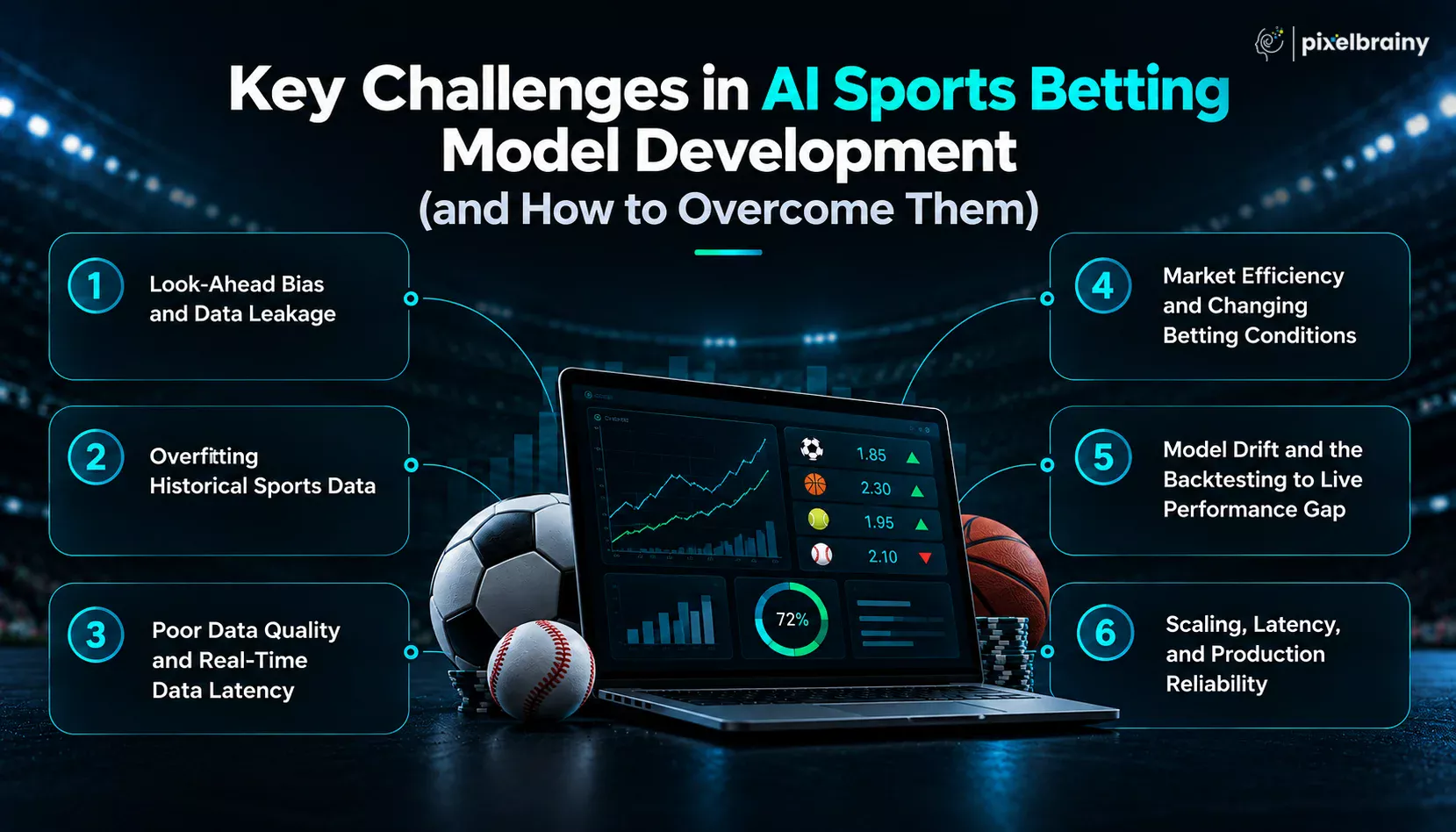
Challenge: Look-ahead bias occurs when a historical model receives information that would not have been available when the prediction was supposed to be generated. Common examples include late injury updates, confirmed lineups, closing odds, updated player statistics, and subsequent market movements.
This can make an AI sports betting model development project appear highly successful in backtesting while creating results that cannot be reproduced in production.
Solution: Every historical feature should have a reliable timestamp. The backtesting engine should reconstruct the exact information available before each event. Chronological and walk-forward validation should replace random train-test splitting wherever temporal relationships are important. Data separation should also be enforced during feature engineering rather than treated as a final backtesting check.
Challenge: A model can memorize historical relationships that do not persist in future seasons. This becomes particularly dangerous when developers repeatedly tune features and hyperparameters against the same historical test period.
A highly complex model can therefore show excellent backtested performance without possessing durable predictive power.
Solution: Start with statistical baseline models before introducing more complex algorithms. Separate training, validation, and genuinely unseen test periods. Use regularization, feature selection, walk-forward validation, and multiple-season testing. Model performance should also be evaluated across different leagues, markets, odds ranges, and time periods.
Challenge: A sports prediction engine depends on continuously changing information. Incorrect player status, missing statistics, duplicate events, delayed injury information, or stale odds can directly affect prediction quality.
This makes a real-time sports data pipeline for betting model applications fundamentally important to production performance.
Solution: Implement automated checks for missing values, duplicate records, schema changes, timestamp errors, stale feeds, and unexpected data movements. Critical information should have freshness thresholds, and important production feeds may require redundancy. Data quality alerts should reach the engineering team before corrupted information reaches the prediction layer.
Challenge: A model may identify a historical pattern that becomes less valuable once market participants recognize it. Market efficiency also varies between sports, leagues, and betting markets.
A model targeting a highly liquid market may face stronger competition than one operating in a smaller market. This means historical predictive relationships cannot automatically be assumed to remain commercially valuable.
Solution: Evaluate the model by market rather than reporting one overall performance figure. Track closing line value, calibration, expected value, and performance across different odds ranges and time periods. If CLV deteriorates after deployment, investigate whether the model's information advantage has weakened.
Challenge: A prediction model can perform well during historical validation and then underperform during its first eight weeks in production. This does not automatically mean the model is fundamentally wrong.
The live environment may contain:
Solution: Compare live performance with the original validation environment. Monitor CLV, probability calibration, feature distributions, prediction distributions, data freshness, and performance by market. If live CLV remains stable while short-term win rate declines, statistical variance may be responsible. If both CLV and calibration deteriorate, the model and data pipeline require deeper investigation.
Challenge: A model that performs perfectly in a research notebook may fail when thousands or millions of users request predictions during major sporting events. Live prediction systems also need to process new information quickly because stale data can make a prediction less useful.
Solution: Separate model training from model inference and deploy the prediction service as a scalable API. Technologies such as FastAPI, Redis, Docker, Kubernetes, and cloud infrastructure can support high-volume prediction delivery. Caching can reduce response time, while automated health checks, monitoring, failover, and model rollback can protect production availability.
For organizations investing in AI sports betting model development, production reliability should be treated as part of model quality. A highly accurate model that cannot receive fresh data or deliver predictions quickly is not a reliable production prediction engine.
The strongest AI sports betting models control the entire prediction lifecycle, from timestamped data and rigorous validation to real-time delivery, live monitoring, and continuous performance measurement.
Also Read: Top 15 Sports Betting App Development Companies in USA
From this point, the technology requirements are clear. The next question for sports technology founders is: how do you identify a development partner that can turn a prediction concept into a scalable, production-ready sports intelligence platform?
PixelBrainy positions itself as an AI sports betting software development company, offering AI-powered sports betting applications, predictive analytics, MVP development, integrations, and ongoing product support.
For companies evaluating AI sports betting model development services, the right partner needs capabilities beyond machine learning. A production prediction platform requires sports data engineering, feature development, model validation, backtesting, API architecture, cloud deployment, application development, and ongoing monitoring.
End-to-end AI engineering: PixelBrainy can support the technology lifecycle from data architecture and predictive model development through APIs, application integration, deployment, and post-launch optimization.
Prediction-engine architecture: Companies looking to build AI sports betting prediction engine products need infrastructure around the model, including data ingestion, feature engineering, historical validation, prediction APIs, and monitoring.
Sports betting technology expertise: PixelBrainy's published capabilities include AI-driven predictive analytics, sports data integrations, and scalable sports betting software development.
Product-focused implementation: Businesses that want to develop AI sports betting prediction engine technology can structure the product as a consumer application, B2B prediction API, analytics platform, sports media feature, or proprietary intelligence system.
In a confidential sports technology engagement, PixelBrainy worked on a prediction-focused platform that required sports data integration, AI-powered prediction capabilities, backend APIs, and a user-facing application layer.
The architecture connected incoming sports information with the prediction workflow, allowing processed data to move through the AI layer before prediction outputs were delivered through the product interface. The project required coordination across data handling, backend engineering, AI capabilities, API communication, and frontend delivery.
The key takeaway is important for companies considering sports betting model development integrating AI: the predictive model is only one part of the product. Reliable data, model-serving infrastructure, API performance, application experience, scalability, and monitoring must operate as one connected system.
This end-to-end approach also gives founders a practical alternative to managing separate vendors for data engineering, AI development, backend infrastructure, and frontend implementation.
Ready to Build Your Sports Prediction Platform?
Connect with PixelBrainy to discuss your prediction engine, technical requirements, and development roadmap.
From this guide, one point should be clear: an AI sports betting prediction engine is not simply a machine learning model that predicts winners. It is a complete technology system combining reliable sports data, feature engineering, calibrated models, historical backtesting, closing line value analysis, live validation, scalable APIs, and continuous monitoring.
For companies assessing the cost to build AI sports betting model technology, a focused single-sport MVP can require approximately $40,000 to $200,000+, while a production-grade multi-sport prediction engine can reach $250,000 to $600,000 depending on data licensing, model architecture, infrastructure, market coverage, and product integration.
The real competitive advantage comes from building a system that can demonstrate measurable predictive value under realistic conditions, rather than relying on headline win rates or attractive backtested results.
If you are ready to turn your sports prediction concept into a scalable, production-ready platform, Book an appointment with PixelBrainy and discuss your AI sports betting model development requirements with our team.
The cost to build an AI sports betting prediction engine depends on the sport, betting markets, data requirements, model architecture, and deployment scope. A focused single-sport MVP can cost approximately $40,000 to $200,000+, while a production-grade multi-sport system can require $250,000 to $600,000. The overall AI sports betting prediction engine development cost should also account for recurring data licensing, odds feeds, cloud infrastructure, model retraining, and MLOps.
The typical AI sports betting model development timeline is around 12 to 20 weeks for a focused single-sport MVP. A multi-sport prediction engine with real-time data, ensemble modeling, advanced backtesting, APIs, and production MLOps can require 24 to 40+ weeks. A complete live validation period may extend beyond the technical development timeline.
To develop an AI sports betting model, you need sufficient historical game data for training, timestamped information for backtesting, and real-time feeds for production predictions. Typical inputs include team and player statistics, injuries, lineups, schedules, weather, historical odds, opening prices, closing prices, and market movement. The data pipeline must prevent future information from entering historical predictions.
When companies build AI sports betting model systems, win rate should not be the only performance metric. Closing line value, or CLV, measures whether the model consistently identifies prices that are better than the eventual market closing price. CLV provides an important indication of whether the prediction engine is identifying genuine market information rather than simply producing a high historical win percentage.
A rigorous AI sports betting model development process should test for look-ahead bias, data leakage, overfitting, survivorship bias, timestamp errors, and unrealistic execution assumptions. The backtesting engine should reconstruct the information available at each historical prediction time and use chronological or walk-forward validation. Performance should then be evaluated using CLV, calibration, expected value, ROI, and out-of-sample results.
A model can perform differently after deployment because historical conditions may not match the live environment. When an AI sports betting prediction model underperforms after launch, the team should compare live CLV, probability calibration, feature distributions, data latency, market conditions, and prediction distributions against the backtesting environment. Model drift, changing team conditions, data-provider issues, and market adaptation can all contribute to the performance gap.
There is no universally best market for AI sports betting model development. The target should be evaluated according to data availability, market efficiency, liquidity, historical depth, odds availability, and the model's potential predictive advantage. Major NFL and NBA markets have extensive data but are highly competitive, while certain player props, college markets, and international leagues may have different efficiency characteristics.
Yes. A production AI sports betting prediction engine can process live scores, play-by-play events, player changes, injuries, game state, and live odds to continuously update probability estimates. AI betting prediction engine development for live markets requires low-latency data pipelines, streaming infrastructure, fast feature computation, scalable prediction APIs, caching, monitoring, and reliable real-time data licensing.

About The Author
Sagar Bhatnagar
Sagar Sahay Bhatnagar brings over a decade of IT industry experience to his role as Marketing Head at PixelBrainy. He's known for his knack in devising creative marketing strategies that boost brand visibility and market influence. Sagar's strategic thinking, coupled with his innovative vision and focus on results, sets him apart. His track record of successful campaigns proves his ability to utilize digital platforms effectively for impactful marketing efforts. With a genuine passion for both technology and marketing, Sagar continuously pushes PixelBrainy's marketing initiatives to greater success.

Working with the PixelBrainy team has been a highly positive experience. They understand the design requirements and create beautiful UX elements to meet the application needs. The dev team did an excellent job bringing my vision to life. We discussed usability and flow. Sagar worked with his team to design the database and begin coding. Working with Sagar was easy. He has the knowledge to create robust apps, including multi-language support, Google and Apple ID login options, Ad-enabled integrations, Stripe payment processing, and a Web Admin site for maintaining support data. I'm extremely satisfied with the services provided, the quality of the final product, and the professionalism of the entire process. I highly recommend them for Android and iOS Mobile Application Design and Development.

Great experience working with them. Had a lot of feedback and I found that unlike most contractors they were bugging me for updates instead of the other way around. They were extremely time conscience and great at communicating! All work was done extremely high quality and if not on time, early! They were always proactive when it comes to communication and the work is great/above par always. Very flexible and a great team to work with! Goes above and beyond to present us with multiple options and always provides quality. Amazing work per usual with Chitra. If you have UI/UX or branding design needs I recommend you go to them! Will likely work with them in the future as well, definitely recommended!

PixelBrainy is a joy to work with and is a great partner when thinking through branding, logo, and website layout. I appreciate that they spend time going into the "why" behind their decisions to help inform me and others about industry best practices and their expertise.

I hired them to design our software apps. Things I really like about them are excellent communication skills, they answer all project suggestions and collaborate right away, and their input on design and colors is amazing. This project was complex and needed patience and creativity. The team is amazing to do business with. I will be using them long-term. Glad to see there are some good people out there. I was afraid to try and outsource my project to someone but I am glad I met them! I really can't say enough. They went above and beyond on this project. I am very happy with everything they have done to make my business stand out from the competition.

It was great working with PixelBrainy and the team. They were very responsive and really owned the project. We'll definitely work with them again!

I recently worked with the PixelBrainy team on a project and I was blown away by their communication skills. They were prompt, clear, and articulate in all of our interactions. They listened and provided valuable feedback and suggestions to help make the project a success. They also kept me updated throughout the entire process, which made the experience stress-free and enjoyable.

PixelBrainy is very good at what it does. The team also presents themselves very professionally and takes care of their side of things very well. I could fully trust them taking up the design work in a timely and organised manner and their attention to detail saved us lots of effort and time. This particular project was quite intense and the team showed that they function very well under pressure. Very much looking forward to working with her again!

It's always an absolute pleasure working with them. They completed all of my requests quickly and followed every note I had for them to a T, which made our process go smoothly from start to finish. Everything was completed fast and following all of the guidelines. And I would recommend their services to anyone. If you need any design work done in the future, PixelBrainy should be your first call!

They took ownership of our requirements and designed and proposed multiple beautiful variants. The team is self-motivated, requires minimum supervision, committed to see-through designs with quality and delivering them on time. We would definitely love to work with PixelBrainy again when we have any requirements.

PixelBrainy was a big help with our SaaS application. We've been hard at work with a new UI/UX and they provided a lot of help with the designs. If you're looking for assistance with your website, software, or mobile application designs, PixelBrainy and the team is a great recommendation.

PixelBrainy designers are amazing. They are responsive, talented, and always willing to help craft the design until it matches your vision. I would recommend them and plan to continue them for my future projects and more!!!

They were awesome! Did a good job fast, and good communication. Will work with them again. Thank you

Creative, detail-oriented, and talented designers who take direction well and implement changes quickly and accurately. They consistently over-delivered for us.

PixelBrainy team is very talented and creative. Great designers and a pleasure to work with. PixelBrainy is an excellent communicator and I look forward to working with them again.

PixelBrainy has a very talented design team. Their work is excellent and they are very responsive. I enjoy working with them and hope to continue on all of our future projects.


Transform your ideas into reality with us.
Across these industries, each engagement brings unique challenges, from early-stage product development to scaling complex systems, helping us build a practical understanding of real-world product environments.