AI Summary Powered by PixelBrainy
Have you spent weeks trying to figure out the real AI sports betting predictions software development cost only to receive completely different quotes from every software development company you contacted?
If your answer is yes, you are experiencing one of the biggest challenges every sports technology founder faces before development even begins. You know your business idea has strong market potential, but every conversation with a software development agency ends with a completely different price estimate. One company quotes around $30,000, another estimates $120,000, while an enterprise development firm confidently recommends a budget of $400,000+. Naturally, the next question becomes which estimate is actually realistic.
Consider this common startup scenario. We are a sports tech startup at the early planning stage and we have been trying to get a realistic cost estimate for building AI sports betting predictions software for six weeks now. We have spoken to four different development agencies and received quotes ranging from $40,000 to $450,000 with no clear explanation of what is driving that enormous gap. We are looking to understand what AI sports betting predictions software actually costs to develop so we can build a financial model that is credible enough to take to seed investors next month. If this sounds familiar, you are not alone.
The truth is that the AI sports betting predictions software development cost can realistically range from $30,000 to $400,000+, and every number within that range can be justified depending on your project requirements. The cost difference is not random. It is primarily driven by five major variables, including feature complexity, AI sophistication, development team location, infrastructure choices, and long term scalability requirements. Understanding these factors is the key to creating a realistic development budget instead of relying on confusing estimates.
Unlike generic online pricing articles that only present broad ranges without meaningful context, this guide explains the cost to build AI sports betting predictions software at the component level. Instead of guessing where your project fits, you will understand exactly how each feature, AI model, integration, and technical decision impacts the total cost of creating an AI sports betting predictions software.
By the end of this guide, you will know how much does it cost to build AI sports betting predictions software in 2026, understand the complete development budget of AI sports betting predictions software, and confidently calculate your own project cost based on your business goals, feature priorities, AI complexity, development team strategy, and infrastructure decisions.
Developing AI sports betting predictions software involves much more than creating a platform that predicts match outcomes. Modern bettors expect intelligent prediction models, real time odds analysis, player and team performance forecasting, automated data processing, historical trend analysis, bankroll management insights, personalized betting recommendations, and live prediction updates throughout sporting events.
Every one of these capabilities directly influences the AI sports betting predictions software development cost, making budget planning one of the most critical decisions before development begins.
A common founder query looks like this:
"We are building AI sports betting predictions software for football, basketball, and cricket. Initially, we planned to launch with AI based match winner predictions and historical statistics. However, we now want live odds tracking, player injury analysis, betting strategy recommendations, AI confidence scores, predictive dashboards, and real time alerts. How can we accurately estimate the cost to build AI sports betting predictions software before presenting our financial projections to investors?"
This is exactly why budgeting should happen before writing the first line of code, not after feature requests and technical complexity continue expanding. A well-defined budget helps founders understand the development budget of AI sports betting predictions software, prioritize features that deliver the highest business value, and avoid unexpected development expenses that can delay product launches.
Not every AI capability needs to be included in the first release of your software.
The most successful sports technology startups begin with a Minimum Viable Product that solves one core problem exceptionally well. Once the product gains users and collects betting behavior data, additional AI capabilities can be introduced based on real market demand. This phased approach significantly reduces the cost to build AI sports betting predictions software while allowing faster product validation.
A typical MVP includes:
Advanced capabilities such as live odds comparison, AI powered betting strategy recommendations, player injury prediction models, confidence scoring, automated bankroll management, sentiment analysis, and multi-sport prediction engines can be introduced in future development phases.
By focusing on essential functionality first, founders can better control the cost of creating an AI sports betting predictions software without sacrificing long term product quality or user experience.
Investors rarely approve funding based on a single development estimate.
They expect founders to demonstrate exactly how capital will be allocated, how the product will evolve, and how future development phases will be financed.
A detailed breakdown of the AI sports betting predictions software development cost demonstrates that your project has been carefully planned, technical requirements have been validated, and financial risks have already been considered.
Instead of presenting one large number, you can clearly explain costs associated with:
This level of financial transparency gives investors confidence that your startup understands both the technical and commercial aspects of building scalable AI software.
One of the biggest reasons software projects exceed their planned budget is uncontrolled feature growth.
Many founders begin with basic AI match predictions but later decide to include live betting recommendations, player performance forecasting, arbitrage opportunity detection, predictive analytics dashboards, natural language AI assistants, personalized betting portfolios, social betting communities, and automated wagering insights.
Although these features increase platform value, each one also increases the overall AI sports betting predictions software development cost.
A predefined budget allows founders to evaluate every additional feature based on business value, expected user adoption, development complexity, and return on investment before adding it to the roadmap.
This disciplined approach minimizes unnecessary spending, prevents project delays, and keeps development aligned with business objectives.
The technologies selected during the planning stage have a direct impact on how much does it cost to build AI sports betting predictions software in 2026.
Choosing the right AI architecture, cloud environment, machine learning frameworks, sports data providers, databases, backend technologies, and frontend frameworks early in the project reduces technical debt and eliminates expensive architectural changes later.
Some of the most important technology decisions include:
Making these decisions during the budgeting phase helps optimize both the initial AI sports betting predictions software development cost and future operating expenses while ensuring the platform remains scalable as user demand grows.
The most successful AI sports betting prediction platforms are rarely built all at once.
Instead of investing heavily in every advanced feature from day one, founders typically launch an MVP, validate prediction accuracy, collect user feedback, improve AI performance, and gradually expand the platform over multiple releases.
A practical development roadmap may look like this:
Phase 1
Phase 2
Phase 3
This phased development strategy enables founders to control the development budget of AI sports betting predictions software, reduce financial risk, improve product market fit, and invest in advanced AI capabilities only after validating customer demand.
In short, effective budget planning before development allows founders to accurately estimate the AI sports betting predictions software development cost, prioritize the features that generate the greatest business value, reduce financial uncertainty, make smarter technology decisions, and build a scalable AI powered betting prediction platform with confidence.
The AI sports betting predictions software development cost varies significantly because no two platforms are built with the same AI capabilities, feature set, data infrastructure, or business objectives. Some startups only need an MVP with AI based match predictions, while others require an enterprise platform featuring custom machine learning models, real time odds analysis, predictive analytics, and highly scalable cloud infrastructure.
So, how much does it cost to build AI sports betting predictions software in 2026? For most businesses, the investment ranges from $30,000 to $400,000+. The final cost to build AI sports betting predictions software depends on five major factors: AI model complexity, platform features, sports data and odds API integrations, development team location, and cloud infrastructure. Most startups begin with an MVP in the $30,000 to $70,000 range and gradually add advanced AI capabilities as the platform grows.
A common founder question looks like this:
"We are building AI sports betting predictions software and we need to present a detailed cost breakdown to our investors before our next funding round. Our investors are asking us to justify every line item in our development budget and we are looking for an authoritative, transparent, component-by-component cost breakdown that covers everything from machine learning model development to frontend design to ongoing data API costs so we can defend our numbers confidently in our next investor meeting."
The answer is simple. Investors do not want just one final number. They expect a detailed explanation of how the development budget of AI sports betting predictions software will be allocated across AI development, frontend and backend engineering, cloud infrastructure, sports data integrations, testing, security, and long-term maintenance. A transparent cost breakdown builds credibility and demonstrates that your project has been carefully planned.
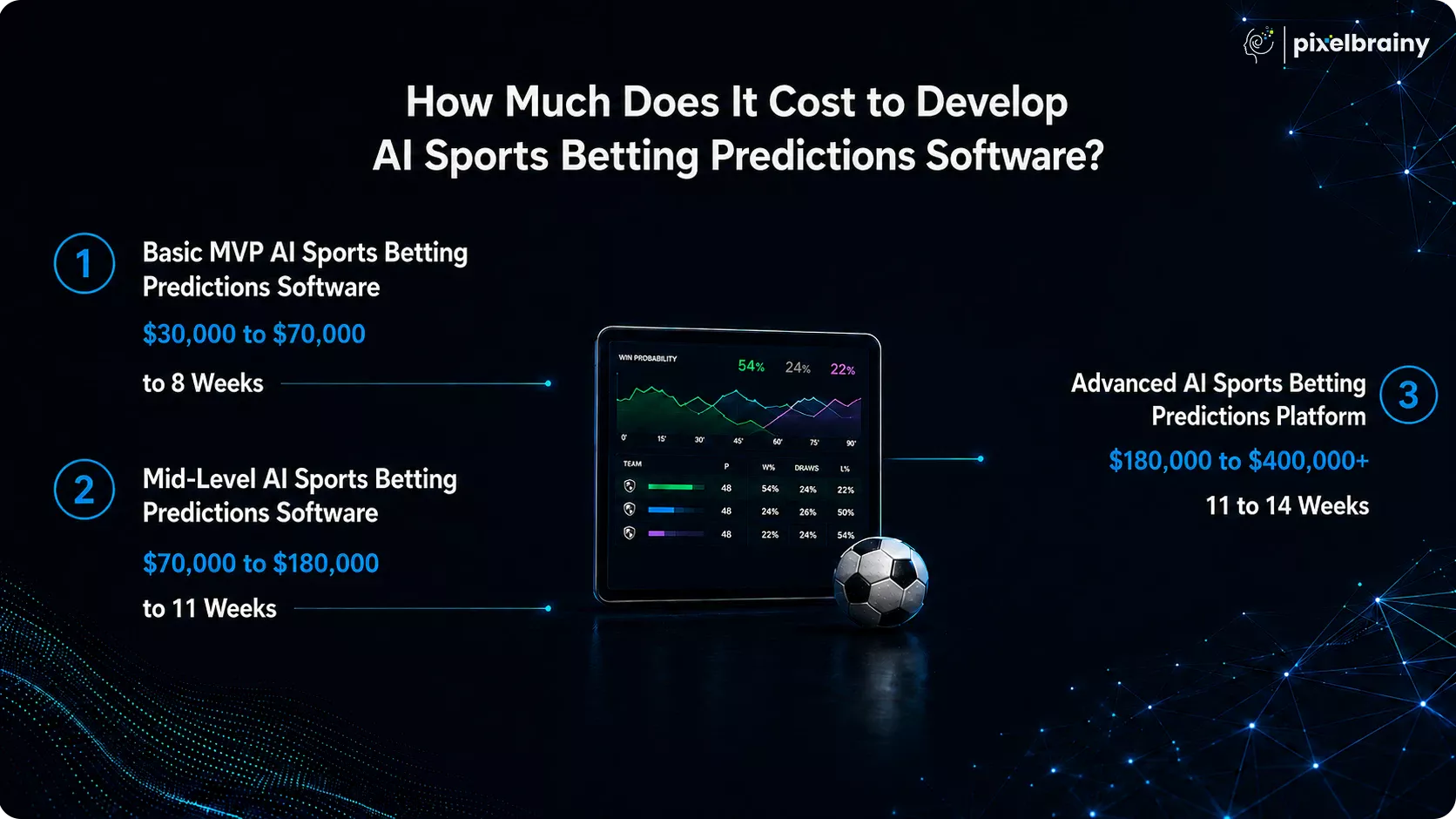
| Development Tier | Estimated Cost | Timeline | What's Included |
|---|---|---|---|
| Basic MVP AI Sports Betting Predictions Software | $30,000 to $70,000 | 6 to 8 Weeks | User authentication, AI powered match predictions, historical sports statistics, prediction dashboard, sports data API integration, admin panel, cloud hosting, push notifications, and basic analytics. |
| Mid-Level AI Sports Betting Predictions Software | $70,000 to $180,000 | 8 to 11 Weeks | Multi-sport support, live odds integration, AI confidence scores, personalized betting insights, predictive dashboards, scalable cloud infrastructure, enhanced security, payment integration, and analytics. |
| Advanced AI Sports Betting Predictions Platform | $180,000 to $400,000+ | 11 to 14 Weeks | Custom machine learning models, deep learning prediction engines, player performance forecasting, injury prediction analytics, bankroll management recommendations, automated AI retraining, enterprise security, multi region deployment, advanced business intelligence dashboards, and high availability infrastructure. |
The main difference between these pricing tiers is the sophistication of the AI engine, the volume of sports data processed, and the platform's scalability.
A Basic MVP AI Sports Betting Predictions Software is designed for startups validating their business idea. It includes essential AI prediction features, historical sports data, secure user management, dashboards, and administrative tools. This tier offers the fastest route to market while keeping the AI sports betting predictions software development cost under control.
A Mid-Level AI Sports Betting Predictions Software is suitable for growing businesses that require live odds integration, multiple sports coverage, AI confidence scores, personalized betting recommendations, predictive analytics, and a scalable cloud architecture. It balances advanced functionality with a manageable development budget of AI sports betting predictions software.
An Advanced AI Sports Betting Predictions Platform is built for enterprises seeking premium prediction accuracy and large-scale operations. It includes custom AI models, predictive analytics, player performance forecasting, MLOps pipelines, automated AI retraining, enterprise grade security, and globally scalable infrastructure. Although this tier increases the cost of creating an AI sports betting predictions software, it delivers stronger competitive advantages and long-term scalability.
Beyond development, founders should also budget for recurring operational expenses such as cloud hosting, GPU resources, sports statistics APIs, live odds feeds, cybersecurity, AI model retraining, software maintenance, infrastructure monitoring, and continuous feature updates. These ongoing costs are essential for maintaining prediction accuracy and platform performance after launch.
Ultimately, the AI sports betting predictions software development cost should align with your business goals rather than trying to build every advanced feature from day one. Starting with an MVP costing $30,000 to $70,000 allows startups to validate their product, attract investors, gather user feedback, and scale strategically over time. This phased approach helps optimize the cost to build AI sports betting predictions software, reduces financial risk, and creates a strong foundation for sustainable growth.
Every founder asks the same question before starting development: How much will our AI sports betting predictions software actually cost? The challenge is that there is no universal price because every platform has different AI capabilities, supported sports, prediction models, integrations, and scalability requirements. This is why one company may quote $35,000, while another estimates $250,000 or more for what appears to be the same project.
Instead of relying on broad estimates, the best approach is to calculate the AI sports betting predictions software development cost by breaking the project into individual cost components. This gives founders a realistic estimate before approaching development companies and helps eliminate surprises later in the project.
A common founder query looks like this:
"Our startup is preparing to build AI sports betting predictions software, but before speaking with development agencies, we want to estimate our own budget. Is there a simple framework that helps us calculate the expected development cost based on the features and AI capabilities we plan to include?"
Absolutely. Rather than focusing on one overall number, estimate the project by evaluating each major development component separately. This approach produces a much more accurate development budget of AI sports betting predictions software and makes it easier to explain your financial assumptions to investors.
A practical way to estimate your project investment is:
Total Development Cost = Software Development + AI & Machine Learning + Data Infrastructure + Third Party Integrations + Quality Assurance + Ongoing Maintenance
Each of these categories contributes directly to the final cost to build AI sports betting predictions software.
| Cost Component | What It Includes |
|---|---|
| Software Development | UI/UX design, frontend, backend, database architecture, APIs, admin dashboard, and deployment |
| AI & Machine Learning | Prediction algorithms, model training, AI confidence scores, predictive analytics, and model optimization |
| Data Infrastructure | Sports statistics APIs, live odds feeds, cloud hosting, databases, GPU computing, storage, and monitoring |
| Third Party Integrations | Authentication, payment gateways, notifications, analytics tools, CRM, email services, and external APIs |
| Quality Assurance | Functional testing, AI prediction validation, performance testing, security testing, bug fixing, and production deployment |
| Ongoing Maintenance | AI model retraining, cloud optimization, API updates, security patches, monitoring, and feature enhancements |
Imagine your startup wants to launch an MVP that includes:
A realistic budget could look like this:
| Expense | Estimated Cost |
|---|---|
| Software Development | $34,000 |
| AI & Machine Learning | $13,000 |
| Data Infrastructure | $9,000 |
| Third Party Integrations | $5,000 |
| Quality Assurance & Deployment | $4,000 |
| First Year Maintenance | $9,000 |
| Estimated Total Investment | $74,000 |
This example illustrates that the AI sports betting predictions software development cost is influenced by much more than application development. AI engineering, sports data infrastructure, cloud services, and long-term maintenance represent a substantial portion of the total investment.
A structured cost calculator enables founders to:
Instead of relying on generalized pricing estimates, a component-based cost calculator gives founders a much clearer understanding of how much does it cost to build AI sports betting predictions software in 2026. More importantly, it provides a transparent budgeting framework that supports better planning, stronger investor discussions, and more confident development decisions.
The AI sports betting predictions software development cost is never identical for two projects because every platform differs in AI sophistication, prediction accuracy, supported sports, real time data processing, infrastructure, and scalability requirements. This is why the cost to build AI sports betting predictions software can range anywhere from $30,000 to $400,000+, even if two products appear similar on the surface.
A common founder query is:
"I am building sports betting prediction software and I want to understand specifically how much the machine learning component adds to the total development cost compared to building a basic rule-based prediction system without genuine AI. We are looking to quantify the cost premium of building a real ML prediction engine versus a simpler statistical model so we can decide whether the accuracy improvement justifies the additional development investment at our current stage of funding."
The answer depends on several cost drivers, but one thing is clear. A rule-based prediction system is significantly less expensive because it relies on predefined statistical formulas and business rules. In contrast, a genuine machine learning prediction engine requires data collection, model training, feature engineering, testing, continuous optimization, and MLOps infrastructure. Depending on complexity, implementing machine learning can add $20,000 to $120,000+ to the overall AI sports betting predictions software development cost, but it also delivers higher prediction accuracy, continuous learning, and a stronger competitive advantage.
Understanding the following cost factors will help you estimate the development budget of AI sports betting predictions software, compare vendor proposals, and invest in the features that deliver the greatest business value.
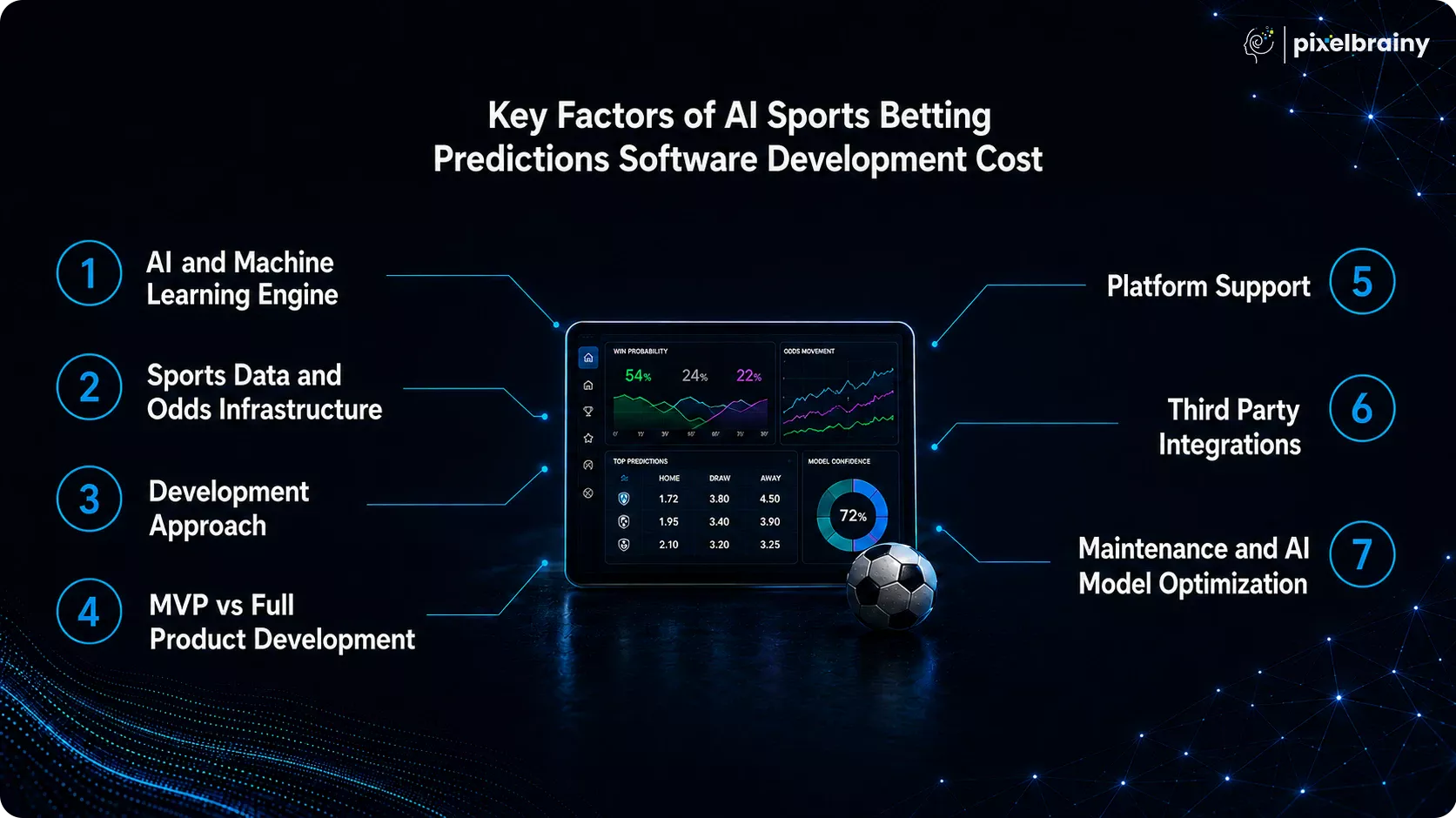
| Cost Factor | Estimated Cost Impact | Impact Level |
|---|---|---|
| AI & Machine Learning Engine | $20,000 to $120,000+ | Very High |
| Sports Data & Odds Infrastructure | $8,000 to $50,000+ | Very High |
| Development Approach | Can reduce or increase costs by 20% to 40% | High |
| MVP vs Full Product | $30,000 to $400,000+ | Very High |
| Platform Support | $10,000 to $50,000+ | High |
| Third Party Integrations | $5,000 to $30,000+ | Medium to High |
| Maintenance & AI Optimization | 15% to 25% annually | Medium to High |
The AI engine is the single biggest factor affecting the AI sports betting predictions software development cost.
A basic rule-based platform that generates predictions using predefined statistical formulas is relatively inexpensive and can be included in an MVP. However, building a genuine machine learning engine requires collecting historical sports data, training prediction models, engineering features, validating accuracy, optimizing algorithms, and deploying scalable AI infrastructure.
For founders comparing both approaches:
Although machine learning requires a larger investment, it continuously improves prediction accuracy as new sports data becomes available, making it a better long-term investment for competitive AI platforms.
AI prediction software depends heavily on reliable sports data.
Basic platforms typically integrate historical match statistics and one sports data provider, resulting in infrastructure costs between $8,000 and $20,000.
If your software processes live odds feeds, player statistics, injury reports, multiple leagues, real time event data, and large historical datasets, infrastructure costs can increase to $30,000 to $50,000+.
Choosing scalable cloud architecture and reliable data providers from the beginning reduces future migration costs and improves AI model performance.
Your development strategy has a direct impact on the overall development budget of AI sports betting predictions software.
Building an in-house AI team requires hiring machine learning engineers, backend developers, frontend developers, DevOps engineers, UI/UX designers, QA specialists, and project managers, resulting in substantial annual staffing costs.
Working with an experienced AI software development company generally keeps the cost to build AI sports betting predictions software within the $30,000 to $400,000+ range while reducing development time through proven frameworks and reusable AI components.
Many startups choose a hybrid model where internal product managers collaborate with an external AI development partner.
The scope of your first release is another major cost driver.
A production ready MVP with AI powered match predictions, user authentication, prediction dashboards, sports statistics, and an admin panel typically costs between $30,000 and $70,000.
A feature rich platform that includes custom machine learning models, live odds analysis, AI confidence scores, bankroll management, predictive analytics, multi-sport support, and enterprise security generally ranges from $180,000 to $400,000+.
Launching an MVP first allows founders to validate market demand before investing in advanced AI capabilities.
The number of platforms your software supports directly affects development costs.
Typical investment ranges include:
Supporting additional platforms increases frontend development, testing, deployment, and long-term maintenance requirements.
Most AI sports betting prediction platforms depend on multiple external services.
Common integrations include:
Depending on the number and complexity of integrations, businesses should budget between $5,000 and $30,000+.
Many founders only calculate the initial AI sports betting predictions software development cost while overlooking recurring operational expenses.
A good benchmark is to allocate 15% to 25% of the initial development cost annually for:
For example, if your software costs $120,000 to develop, you should expect an annual maintenance budget of approximately $18,000 to $30,000 to keep the platform secure, accurate, and competitive.
There is no universal answer to the AI sports betting predictions software development cost because every project has unique business goals and technical requirements. Your final investment depends on the AI engine you choose, sports data infrastructure, platform scope, development approach, integrations, and long-term scalability. Starting with a focused MVP in the $30,000 to $70,000 range and expanding based on user demand is often the most cost-effective strategy for building a scalable AI powered sports betting prediction platform.
The AI sports betting predictions software development cost is not spent all at once. Instead, the budget is distributed across multiple development phases, with each phase contributing to the final product. From business planning and UI design to AI model development, testing, deployment, and post launch maintenance, every stage requires dedicated time, resources, and technical expertise.
Many founders assume that most of the investment goes into coding. In reality, activities such as AI model training, sports data integration, testing, and cloud deployment account for a significant portion of the overall cost to build AI sports betting predictions software.
A common founder question is:
"We understand the total development cost could range from $30,000 to $400,000+, but how is that budget distributed throughout the project? Which development phases consume the largest share of the investment, and where should we allocate our funding first?"
The answer depends on your product scope and AI complexity. However, most successful AI software projects follow a similar development lifecycle, allowing founders to estimate costs more accurately and plan funding around project milestones.
| Development Phase | Estimated Cost | Cost Impact |
|---|---|---|
| Discovery & Project Planning | $2,000 to $10,000 | Medium |
| UI/UX Design | $3,000 to $20,000 | Medium |
| Frontend & Backend Development | $10,000 to $100,000+ | Very High |
| AI & Machine Learning Development | $10,000 to $120,000+ | Very High |
| Sports Data & Third-Party Integrations | $5,000 to $35,000+ | High |
| Testing & Quality Assurance | $3,000 to $20,000 | Medium |
| Deployment & Launch | $2,000 to $15,000 | Medium |
Every successful AI software project starts with careful planning. During this phase, the development team defines business objectives, gathers requirements, creates the technical roadmap, identifies AI opportunities, and selects the technology stack.
Typical activities include:
Estimated Cost: $2,000 to $10,000
A well-planned discovery phase helps reduce development risks and prevents costly requirement changes later.
An intuitive interface is essential for helping users understand predictions, confidence scores, betting insights, and historical statistics.
This phase typically includes:
Estimated Cost: $3,000 to $20,000
More dashboards, data visualizations, and personalization features increase design complexity and cost.
This is one of the largest investments in the entire project. Developers build the web interface, backend APIs, user authentication, databases, admin dashboard, prediction engine integration, and business logic.
Typical deliverables include:
Estimated Cost: $10,000 to $100,000+
The larger the feature set, the greater the development effort.
This phase has the greatest impact on the AI sports betting predictions software development cost.
Unlike rule-based systems, machine learning requires historical sports data preparation, feature engineering, model training, prediction validation, accuracy testing, and continuous optimization.
Activities include:
Estimated Cost: $10,000 to $120,000+
Custom AI models trained specifically for your platform cost more than integrating pre trained machine learning models but usually deliver better long-term accuracy.
AI prediction software depends on reliable external data sources and supporting services.
Common integrations include:
Estimated Cost: $5,000 to $35,000+
The number of APIs and the amount of real time data processed directly influence this cost.
Before launch, the software must be tested for functionality, security, performance, and AI prediction accuracy.
This phase includes:
Estimated Cost: $3,000 to $20,000
Comprehensive testing ensures reliable predictions and a stable user experience.
The final phase prepares the software for production.
Typical activities include:
Estimated Cost: $2,000 to $15,000
A smooth deployment minimizes downtime and prepares the platform for future scaling.
Understanding development costs phase by phase provides founders with a much clearer picture of the development budget of AI sports betting predictions software than relying on a single overall estimate. It also makes it easier to allocate funding, monitor project progress, and justify costs during investor discussions.
Whether your total investment is $30,000 for an MVP or $400,000+ for an enterprise AI platform, breaking the project into individual development phases helps control spending, reduce financial risk, and build a scalable AI powered sports betting prediction platform with confidence.
The team you choose has a significant impact on your AI sports betting predictions software development cost, project timeline, AI model quality, communication efficiency, and long-term product scalability. Two companies may build similar prediction platforms, yet the cost to build AI sports betting predictions software can vary dramatically based on the team's location, development model, and expertise in artificial intelligence, machine learning, sports data engineering, and cloud infrastructure.
Founders frequently ask:
"We're deciding whether to hire an in-house AI team or outsource the development of our AI sports betting predictions software. Which option provides the best balance between cost, quality, and speed?"
Another common question is:
"We are comparing AI sports betting predictions software development costs across different countries. Which development model offers the best technical expertise while keeping the project within budget?"
The comparison below provides a realistic overview of the AI sports betting predictions software development cost based on different team structures and outsourcing destinations.
| Team Type | Hourly Rate Range | Estimated Total Cost | Best For |
|---|---|---|---|
| In House Development Team (USA) | $120 to $220/hour | $250,000 to $600,000+ | Large enterprises building proprietary AI prediction platforms with complete control over engineering, data science, and long term product development. |
| US Based AI Development Agency | $100 to $180/hour | $120,000 to $350,000+ | Businesses seeking experienced AI engineers, machine learning specialists, structured project management, and reliable post launch support. |
| Freelancers (Mixed Locations) | $30 to $120/hour | $30,000 to $100,000+ | Startups developing simple MVPs or proof of concepts with limited AI functionality and smaller budgets. |
| Offshore Development Team (Eastern Europe) | $45 to $90/hour | $60,000 to $180,000+ | Companies looking for experienced AI developers, strong engineering capabilities, and competitive pricing for mid-sized projects. |
| Offshore Development Team (South Asia) | $25 to $60/hour | $30,000 to $150,000+ | Startups and growing businesses seeking cost effective AI sports betting predictions software development with access to skilled AI engineers, data scientists, and full stack development teams. |
If you're building an enterprise grade AI sports betting platform with a long-term product vision, an in-house development team offers maximum control over AI research, product development, and infrastructure. However, it is also the most expensive option due to hiring, salaries, benefits, and operational costs.
For most startups, a US based AI development agency provides the right balance of technical expertise, structured project management, and faster delivery without the overhead of building an internal team.
Freelancers can be suitable for prototypes or basic MVPs, but managing multiple independent developers becomes challenging as your platform grows and requires advanced AI, real time sports data, cloud infrastructure, and ongoing maintenance.
If keeping the AI sports betting predictions software development cost under control is your priority, offshore development teams in Eastern Europe and South Asia offer the best value. They provide access to experienced AI engineers and full stack developers at competitive rates, enabling startups to build scalable AI sports betting prediction software while staying within a $30,000 to $400,000+ development budget.
Section 8: Ongoing and Hidden Costs of AI Sports Betting Predictions Software Development Founders Almost Always Miss
The AI sports betting predictions software development cost depends heavily on the features you decide to include. While a basic MVP focuses on essential prediction capabilities, advanced platforms require sophisticated AI models, real time sports data processing, predictive analytics, and intelligent user experiences. Every additional feature increase development effort, testing requirements, and infrastructure costs.
A common founder question is:
"We're planning our product roadmap and want to understand how much each feature contributes to the total AI sports betting predictions software development cost. Which features are essential for an MVP, and which ones can be added later as we scale?"
The best approach is to prioritize core functionality for your initial release and gradually introduce advanced AI features based on user feedback and business growth.
| Feature | Estimated Development Cost | Priority |
|---|---|---|
| User Registration & Authentication | $2,000 to $6,000 | Essential |
| User Profiles & Preferences | $2,000 to $5,000 | Essential |
| AI Match Prediction Engine | $10,000 to $50,000+ | Essential |
| Historical Sports Statistics | $4,000 to $12,000 | Essential |
| Live Odds Integration | $5,000 to $20,000 | High |
| Prediction Dashboard | $4,000 to $12,000 | Essential |
| AI Confidence Scores | $5,000 to $18,000 | High |
| Multi-Sport Support | $8,000 to $30,000 | High |
| Push Notifications & Alerts | $2,000 to $6,000 | Medium |
| Admin Dashboard | $4,000 to $12,000 | Essential |
| Payment Gateway Integration | $2,000 to $8,000 | Medium |
| Bankroll Management Tools | $8,000 to $25,000 | Advanced |
| Player & Team Performance Analytics | $8,000 to $25,000 | Advanced |
| Injury Prediction & Risk Analysis | $12,000 to $40,000+ | Advanced |
| AI Model Retraining & Optimization | $10,000 to $35,000+ | Advanced |
Every AI sports betting predictions platform requires a secure authentication system that allows users to create accounts, manage profiles, and securely access personalized predictions.
Estimated Cost: $2,000 to $6,000
This is the core feature of the platform and the biggest contributor to the AI sports betting predictions software development cost. It includes machine learning model development, prediction algorithms, feature engineering, model training, and continuous optimization.
Estimated Cost: $10,000 to $50,000+
Historical match results, team performance, player statistics, and league data provide the foundation for accurate AI predictions.
Estimated Cost: $4,000 to $12,000
Integrating live odds providers enables the software to analyze current betting markets and generate more relevant predictions in real time.
Estimated Cost: $5,000 to $20,000
A well designed dashboard allows users to view predictions, confidence scores, match insights, historical performance, and betting trends through an intuitive interface.
Estimated Cost: $4,000 to $12,000
Confidence scoring helps users understand the probability behind each AI prediction by combining multiple machine learning outputs into a single confidence metric.
Estimated Cost: $5,000 to $18,000
Expanding beyond a single sport requires additional datasets, prediction models, APIs, and testing for each supported league or competition.
Estimated Cost: $8,000 to $30,000
Real time notifications keep users informed about new predictions, odds changes, match updates, and personalized betting opportunities.
Estimated Cost: $2,000 to $6,000
The admin portal enables administrators to manage users, monitor AI performance, configure prediction models, review analytics, and oversee platform operations.
Estimated Cost: $4,000 to $12,000
If your platform offers premium subscriptions or paid prediction services, integrating secure payment gateways becomes essential.
Estimated Cost: $2,000 to $8,000
These features help users manage betting budgets, track spending, analyze betting history, and receive AI powered bankroll recommendations.
Estimated Cost: $8,000 to $25,000
Advanced analytics modules evaluate player form, team trends, head-to-head records, injuries, and tactical insights to improve prediction quality.
Estimated Cost: $8,000 to $25,000
Using historical player data and AI models, this feature estimates injury risks and evaluates their potential impact on upcoming matches and predictions.
Estimated Cost: $12,000 to $40,000+
Continuous retraining allows the prediction engine to adapt to new sports data, improve accuracy over time, and maintain competitive performance.
Estimated Cost: $10,000 to $35,000+
Every feature impacts the AI sports betting predictions software development cost. Start with an MVP that includes core features like AI match predictions, user authentication, historical statistics, and a prediction dashboard. As your platform grows, you can add advanced capabilities such as live odds integration, AI confidence scores, multi-sport support, and bankroll management.
This phased approach helps optimize costs while building a scalable AI sports betting prediction platform.

Many founders calculate the AI sports betting predictions software development cost based only on design, development, and AI implementation. However, several hidden expenses arise during and after development that can significantly increase the overall budget. Ignoring these costs can lead to budget overruns, project delays, and unexpected operational expenses.
A common founder question is:
"We've already budgeted for software development, but what hidden costs should we expect while building AI sports betting predictions software? We don't want unexpected expenses to affect our launch or future growth."
Understanding these often-overlooked costs helps founders create a realistic development budget of AI sports betting predictions software and avoid financial surprises.
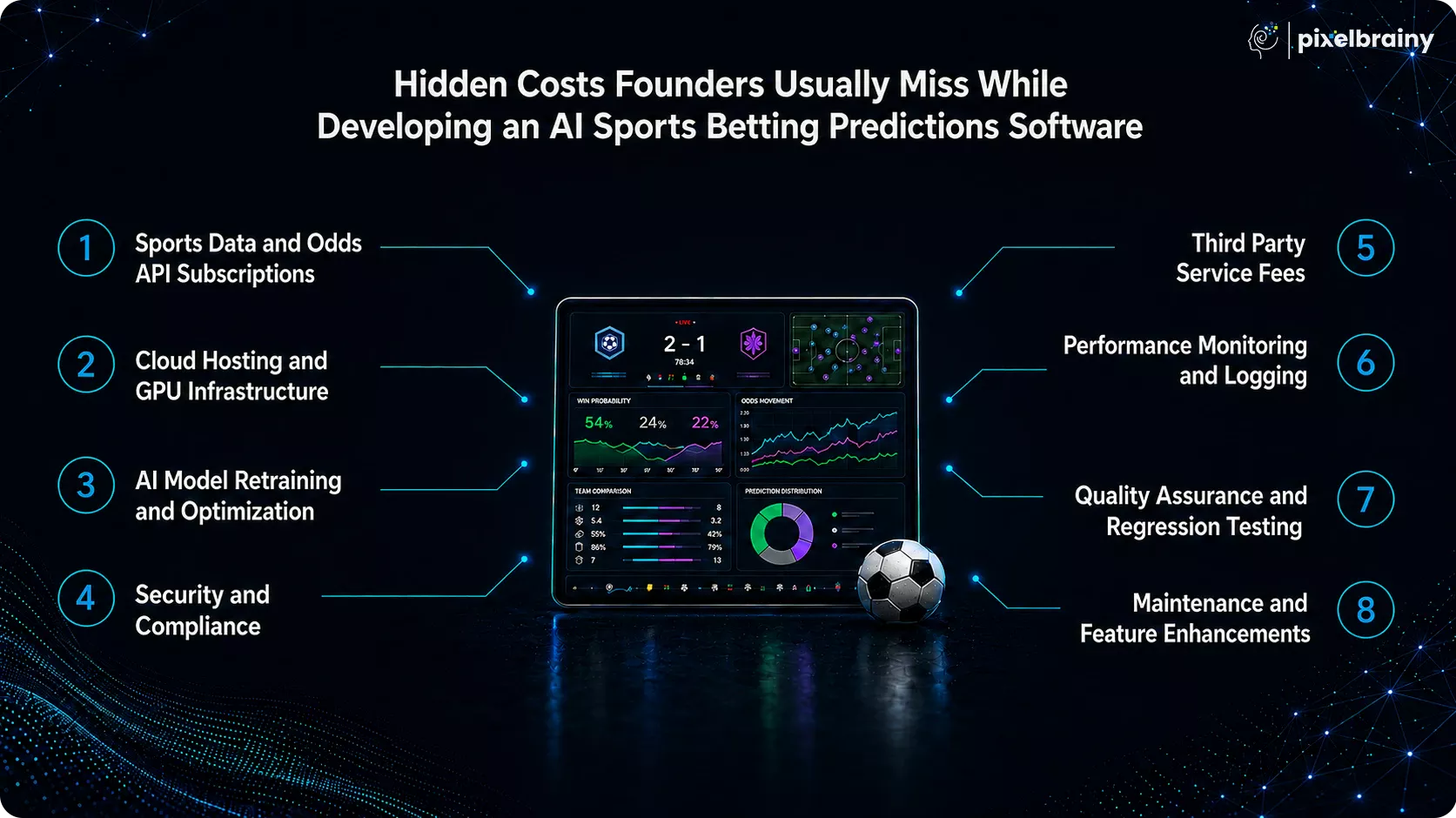
| Hidden Cost | Estimated Cost |
|---|---|
| Sports Data & Odds API Subscriptions | $2,000 to $20,000+/year |
| Cloud Hosting & GPU Infrastructure | $3,000 to $30,000+/year |
| AI Model Retraining & Optimization | $5,000 to $25,000+/year |
| Security & Compliance | $3,000 to $15,000 |
| Third Party Service Fees | $2,000 to $10,000+/year |
| Performance Monitoring & Logging | $1,000 to $8,000+/year |
| Quality Assurance & Regression Testing | $3,000 to $15,000 |
| Maintenance & Feature Updates | 15% to 25% of development cost annually |
AI sports betting prediction software relies on premium sports data providers for historical match statistics, live scores, player performance metrics, injury updates, and real time betting odds. Most commercial APIs operate on subscription or usage-based pricing, making them a recurring expense that should be included in your long-term budget.
Estimated Cost: $2,000 to $20,000+ per year
Machine learning models require powerful cloud infrastructure for training, inference, data storage, backups, databases, and GPU computing. As your platform attracts more users and processes larger volumes of real time sports data, cloud hosting and infrastructure costs will continue to increase.
Estimated Cost: $3,000 to $30,000+ per year
Machine learning models cannot remain accurate without continuous improvement. As new matches, player statistics, and betting trends become available, your AI models need retraining, validation, and optimization to maintain reliable prediction accuracy and improve overall performance.
Estimated Cost: $5,000 to $25,000+ per year
Protecting sensitive user information and securing your AI platform requires continuous investment in encryption, penetration testing, vulnerability assessments, access control, security monitoring, and compliance with applicable data protection regulations. These measures help reduce cybersecurity risks and improve platform reliability.
Estimated Cost: $3,000 to $15,000
Most AI sports betting prediction platforms integrate several external services, including authentication providers, payment gateways, notification systems, analytics platforms, email services, CRM software, and cloud monitoring tools. Subscription fees for these services gradually increase as your user base grows.
Estimated Cost: $2,000 to $10,000+ per year
Continuous monitoring tools help track server health, API response times, AI prediction performance, infrastructure utilization, and application errors. Proactive monitoring enables your team to identify and resolve issues quickly, ensuring a reliable experience for users.
Estimated Cost: $1,000 to $8,000+ per year
Every new feature, AI model update, or third-party integration should undergo thorough testing before deployment. Functional testing, regression testing, performance testing, and AI prediction validation help ensure software quality while minimizing bugs and unexpected failures after release.
Estimated Cost: $3,000 to $15,000
Software development does not end after launch. Ongoing maintenance includes fixing bugs, updating APIs, improving AI models, enhancing existing features, optimizing cloud infrastructure, and releasing new functionality based on customer feedback and changing market demands.
Estimated Cost: 15% to 25% of the initial development cost annually
Hidden expenses can significantly increase the AI sports betting predictions software development cost if they are not planned from the beginning. By accounting for recurring costs such as AI model retraining, cloud infrastructure, sports data APIs, security, and maintenance, founders can build a more accurate budget and ensure their AI sports betting prediction platform remains scalable, secure, and competitive over the long term.
Every founder wants to build a high-performing AI sports betting prediction platform, but every founder also needs to manage a limited budget. The good news is that reducing the AI sports betting predictions software development cost does not mean compromising prediction accuracy, scalability, or user experience. The key is making smart decisions about AI development, infrastructure, product scope, and your development team from the very beginning.
By following the strategies below, startups can significantly reduce the cost to build AI sports betting predictions software while creating a platform that is accurate, scalable, and ready for future growth.
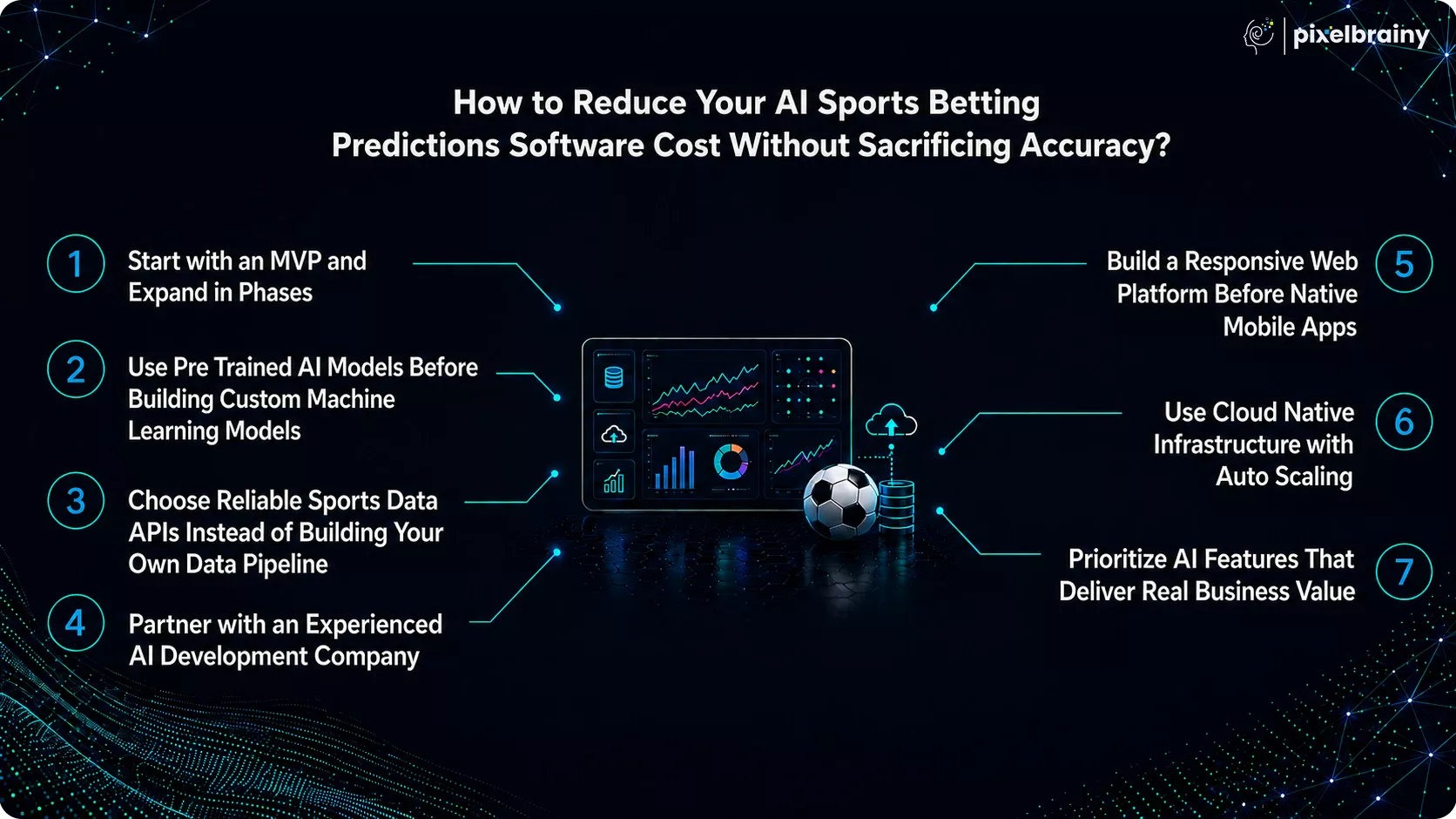
One of the easiest ways to reduce the AI sports betting predictions software development cost is to launch with only the features users truly need.
A common founder question is:
"We want to know which features should be included in our MVP so we don't overspend before validating product-market fit."
Instead of building every advanced capability from day one, focus on:
Once your platform gains traction, you can gradually introduce features like live odds integration, AI confidence scores, bankroll management, multi-sport support, and player analytics.
Estimated Savings: 20% to 35%, or approximately $15,000 to $60,000.
Developing proprietary machine learning models from scratch requires significant investment in data engineering, model training, and optimization.
Instead, startups can leverage pre trained AI models or open-source machine learning frameworks during the MVP stage and invest in custom AI only after validating market demand.
This approach accelerates development while maintaining strong prediction capabilities.
Estimated Savings: 20% to 40%, or approximately $10,000 to $50,000.
Collecting, cleaning, and maintaining sports data from multiple sources is expensive and time consuming.
Using trusted sports statistics and odds providers allows startups to access high quality data immediately without investing heavily in custom data collection infrastructure.
You can always build proprietary data pipelines later as your business scales.
Estimated Savings: 15% to 30%, or approximately $8,000 to $35,000.
Hiring an in-house team means recruiting machine learning engineers, backend developers, frontend developers, DevOps specialists, designers, QA engineers, and project managers before development even begins.
Many founders ask:
"Should we build an internal AI team or outsource the project to an experienced AI software development company?"
For most startups, outsourcing provides faster delivery, proven AI expertise, and significantly lower operational costs.
Estimated Savings: 30% to 50%, or approximately $50,000 to $180,000, compared to building a full in-house engineering team.
Launching separate native applications for Android and iOS significantly increases development time and maintenance costs.
Many startups begin with a responsive web application that delivers the core prediction experience across desktops, tablets, and mobile browsers. Native mobile apps can be introduced later based on user demand.
Estimated Savings: 20% to 35%, or approximately $15,000 to $45,000.
Instead of provisioning expensive servers that run continuously, deploy your platform on cloud infrastructure with automatic scaling.
Auto scaling ensures computing resources increase only during periods of high user activity, reducing unnecessary infrastructure expenses while maintaining platform performance.
Estimated Savings: 25% to 50% on cloud infrastructure costs, or approximately $5,000 to $25,000 annually.
Advanced capabilities such as injury prediction, bankroll optimization, predictive simulations, custom deep learning models, and automated AI retraining can significantly increase development costs.
Before implementing these features, evaluate whether they improve prediction accuracy, user engagement, or revenue generation. Launching only high impact AI features first allows you to optimize your budget without sacrificing product quality.
Estimated Savings: 15% to 30%, or approximately $10,000 to $70,000, depending on feature complexity.
Reducing the AI sports betting predictions software development cost is about making smarter product and technology decisions, not compromising quality.
By launching with an MVP, leveraging pre trained AI models, using reliable sports data APIs, partnering with an experienced AI development company, and introducing advanced features gradually, startups can reduce their overall development budget by 20% to 50% while building a scalable and accurate AI sports betting prediction platform.
As an experienced AI sports betting software development company, PixelBrainy helps startups, sports technology companies, betting analytics businesses, and enterprises optimize their AI sports betting predictions software development cost without compromising accuracy, scalability, or long-term growth. Our team combines AI strategy, machine learning expertise, product discovery, cloud native architecture, and full stack development to build intelligent prediction platforms that deliver measurable business value from day one.
Rather than recommending every possible AI feature, we focus on building a scalable solution that aligns with your business goals, budget, and launch timeline. This approach helps reduce unnecessary development effort while ensuring your platform is ready to scale as your user base grows.
A common founder question is:
"We're comparing AI sports betting predictions software development costs across the USA, Eastern Europe, and South Asia. Can PixelBrainy help us identify the most cost-effective development approach without compromising software quality, AI accuracy, or project delivery?"
The answer is yes. While development costs vary by region, the best value comes from partnering with an experienced AI development company that understands how to prioritize high impact features, optimize machine learning implementation, and eliminate unnecessary development costs without sacrificing quality.
At PixelBrainy, every engagement starts with a structured product discovery and cost planning workshop before development begins.
During this phase, our experts evaluate:
Instead of recommending a feature-heavy platform from the beginning, we identify the capabilities that generate the highest return on investment for your MVP. This enables founders to optimize the development budget of AI sports betting predictions software while creating a clear roadmap for future enhancements.
A US based sports analytics startup approached PixelBrainy to build an AI powered sports betting prediction platform featuring machine learning predictions, live odds integration, player performance analytics, AI confidence scores, multi-sport support, predictive dashboards, and advanced reporting. Due to a confidentiality agreement, we cannot disclose the client's identity.
Based on the original requirements, the estimated development budget exceeded $240,000.
After conducting a detailed product discovery workshop, our team restructured the project into a scalable MVP. Instead of developing every advanced AI capability in the initial release, we prioritized essential prediction features, integrated reliable sports data APIs, leveraged proven machine learning frameworks, and planned advanced analytics for future phases.
The First Release Included:
Project Outcome:
| Metric | Result |
|---|---|
| Original Estimated Budget | $240,000+ |
| Final MVP Investment | Approximately $105,000 |
| Development Cost Saved | Over 55% |
| Delivery Timeline | 14 Weeks |
| Scalability | Ready for live odds integration, AI confidence scoring, bankroll management, multi sport support, and advanced machine learning enhancements |
By focusing on validated business requirements instead of assumptions, the client launched faster, reduced development costs, and built a scalable AI platform that could evolve based on real user feedback. This phased approach significantly optimized the cost to build AI sports betting predictions software while creating a strong technical foundation for future growth.
PixelBrainy delivers much more than software development. We provide end to end AI product strategy designed to maximize business value while optimizing development costs.
Our expertise includes:
Whether you're building an MVP or an enterprise grade AI sports betting prediction platform, PixelBrainy helps you optimize the AI sports betting predictions software development cost while delivering a secure, scalable, and production ready solution built for long term success.
If you're planning to build AI sports betting predictions software, PixelBrainy can help you estimate the project with confidence. Our experts will analyze your business goals, recommend the right AI features, prepare a feature wise cost breakdown, and create a cost optimized development roadmap tailored to your budget, timeline, and growth strategy. so let's connect!

Building AI sports betting predictions software is a strategic investment for startups, sports analytics companies, betting technology businesses, and enterprises looking to leverage artificial intelligence for data driven sports predictions. As discussed throughout this guide, the AI sports betting predictions software development cost typically ranges from $30,000 to $400,000+, depending on factors such as machine learning complexity, sports data integrations, feature set, platform scope, technology stack, development approach, and long-term scalability. For most founders, starting with a well-defined MVP is the most effective way to validate the market, attract early users, and gradually introduce advanced capabilities such as live odds analysis, AI confidence scoring, bankroll management, predictive analytics, and automated model retraining.
Whether you're exploring how much does it cost to build AI sports betting predictions software in 2026, comparing development costs across different team types, or planning the overall development budget of AI sports betting predictions software, a detailed cost breakdown and phased development strategy can help you control expenses while maximizing return on investment. It's equally important to account for ongoing costs such as cloud infrastructure, sports data APIs, AI model optimization, security, maintenance, and platform enhancements to ensure your software remains accurate, scalable, and competitive over time.
Ready to estimate the AI sports betting predictions software development cost for your project? Connect with the experts at PixelBrainy for a free consultation and receive a personalized feature wise cost estimate, development roadmap, and technology strategy tailored to your business goals, timeline, and budget.
The AI sports betting predictions software development cost typically ranges from $30,000 to $400,000+. An MVP with essential features such as AI match predictions, user authentication, historical sports statistics, and an admin dashboard usually costs $30,000 to $70,000. A feature rich platform with custom machine learning models, live odds integration, AI confidence scoring, and multi-sport support can cost $180,000 to $400,000+.
The cost to build AI sports betting predictions software depends on several factors, including AI and machine learning complexity, sports data API integrations, live odds feeds, supported platforms, cloud infrastructure, UI/UX design, development team, and ongoing maintenance. Among these, custom machine learning development and real time sports data processing typically contribute the largest share of the total project cost.
A genuine machine learning prediction engine generally adds $20,000 to $120,000+ to the AI sports betting predictions software development cost, depending on model complexity and training requirements. In comparison, a basic rule based or statistical prediction system may only cost $5,000 to $15,000, but it lacks the ability to learn from new data and continuously improve prediction accuracy.
If you're building an MVP, the minimum development budget of AI sports betting predictions software is typically $30,000 to $70,000. This budget usually covers AI powered match predictions, user authentication, historical sports statistics, a prediction dashboard, sports data API integration, and an admin panel. Additional AI features and integrations can be added as your platform grows.
The timeline depends on the scope of your project. A basic MVP generally takes 6 to 8 weeks, a mid-level platform requires 8 to 11 weeks, and an advanced AI sports betting prediction platform with custom machine learning models can be completed within 11 to 14 weeks using an experienced AI development team.
The most effective way to reduce the cost of creating AI sports betting predictions software is to launch an MVP first, use pre trained machine learning models, integrate reliable third-party sports data APIs, prioritize high impact features, and partner with an experienced AI software development company. Following this approach can reduce your overall development budget by 20% to 50% while maintaining software quality and scalability.
For most startups and growing businesses, outsourcing is one of the most cost-effective ways to reduce the AI sports betting predictions software development cost. Compared to building an in-house engineering team, partnering with an experienced AI software development company can lower development expenses by 30% to 50%, while providing access to AI engineers, machine learning specialists, UI/UX designers, QA experts, and cloud architects under one team.

About The Author
Sagar Bhatnagar
Sagar Sahay Bhatnagar brings over a decade of IT industry experience to his role as Marketing Head at PixelBrainy. He's known for his knack in devising creative marketing strategies that boost brand visibility and market influence. Sagar's strategic thinking, coupled with his innovative vision and focus on results, sets him apart. His track record of successful campaigns proves his ability to utilize digital platforms effectively for impactful marketing efforts. With a genuine passion for both technology and marketing, Sagar continuously pushes PixelBrainy's marketing initiatives to greater success.

Working with the PixelBrainy team has been a highly positive experience. They understand the design requirements and create beautiful UX elements to meet the application needs. The dev team did an excellent job bringing my vision to life. We discussed usability and flow. Sagar worked with his team to design the database and begin coding. Working with Sagar was easy. He has the knowledge to create robust apps, including multi-language support, Google and Apple ID login options, Ad-enabled integrations, Stripe payment processing, and a Web Admin site for maintaining support data. I'm extremely satisfied with the services provided, the quality of the final product, and the professionalism of the entire process. I highly recommend them for Android and iOS Mobile Application Design and Development.

Great experience working with them. Had a lot of feedback and I found that unlike most contractors they were bugging me for updates instead of the other way around. They were extremely time conscience and great at communicating! All work was done extremely high quality and if not on time, early! They were always proactive when it comes to communication and the work is great/above par always. Very flexible and a great team to work with! Goes above and beyond to present us with multiple options and always provides quality. Amazing work per usual with Chitra. If you have UI/UX or branding design needs I recommend you go to them! Will likely work with them in the future as well, definitely recommended!

PixelBrainy is a joy to work with and is a great partner when thinking through branding, logo, and website layout. I appreciate that they spend time going into the "why" behind their decisions to help inform me and others about industry best practices and their expertise.

I hired them to design our software apps. Things I really like about them are excellent communication skills, they answer all project suggestions and collaborate right away, and their input on design and colors is amazing. This project was complex and needed patience and creativity. The team is amazing to do business with. I will be using them long-term. Glad to see there are some good people out there. I was afraid to try and outsource my project to someone but I am glad I met them! I really can't say enough. They went above and beyond on this project. I am very happy with everything they have done to make my business stand out from the competition.

It was great working with PixelBrainy and the team. They were very responsive and really owned the project. We'll definitely work with them again!

I recently worked with the PixelBrainy team on a project and I was blown away by their communication skills. They were prompt, clear, and articulate in all of our interactions. They listened and provided valuable feedback and suggestions to help make the project a success. They also kept me updated throughout the entire process, which made the experience stress-free and enjoyable.

PixelBrainy is very good at what it does. The team also presents themselves very professionally and takes care of their side of things very well. I could fully trust them taking up the design work in a timely and organised manner and their attention to detail saved us lots of effort and time. This particular project was quite intense and the team showed that they function very well under pressure. Very much looking forward to working with her again!

It's always an absolute pleasure working with them. They completed all of my requests quickly and followed every note I had for them to a T, which made our process go smoothly from start to finish. Everything was completed fast and following all of the guidelines. And I would recommend their services to anyone. If you need any design work done in the future, PixelBrainy should be your first call!

They took ownership of our requirements and designed and proposed multiple beautiful variants. The team is self-motivated, requires minimum supervision, committed to see-through designs with quality and delivering them on time. We would definitely love to work with PixelBrainy again when we have any requirements.

PixelBrainy was a big help with our SaaS application. We've been hard at work with a new UI/UX and they provided a lot of help with the designs. If you're looking for assistance with your website, software, or mobile application designs, PixelBrainy and the team is a great recommendation.

PixelBrainy designers are amazing. They are responsive, talented, and always willing to help craft the design until it matches your vision. I would recommend them and plan to continue them for my future projects and more!!!

They were awesome! Did a good job fast, and good communication. Will work with them again. Thank you

Creative, detail-oriented, and talented designers who take direction well and implement changes quickly and accurately. They consistently over-delivered for us.

PixelBrainy team is very talented and creative. Great designers and a pleasure to work with. PixelBrainy is an excellent communicator and I look forward to working with them again.

PixelBrainy has a very talented design team. Their work is excellent and they are very responsive. I enjoy working with them and hope to continue on all of our future projects.


Transform your ideas into reality with us.
Across these industries, each engagement brings unique challenges, from early-stage product development to scaling complex systems, helping us build a practical understanding of real-world product environments.