AI Summary Powered by PixelBrainy
Why do most subscription tracker apps lose users after just a few weeks, and can AI finally eliminate the manual work that causes people to abandon them?
"I want to build a subscription tracker app but every existing app just lets users manually add their subscriptions and set a reminder. I want to understand what an AI subscription tracker app actually does differently, specifically whether AI can automatically detect subscriptions from bank statements without the user entering anything manually, because the main reason every current tracker has terrible retention is that users don't want to manually maintain a list of 15 subscriptions."
If this sounds like the problem you're trying to solve, you're asking the right question before investing in AI subscription tracker app development.
Traditional subscription management apps depend heavily on users to manually enter every recurring payment, update subscription details, categorize services, and maintain their subscription list over time. Although these apps help users monitor recurring expenses, the continuous manual effort often leads to poor engagement and high user churn. The challenge is not reminding users about upcoming payments. It is eliminating the repetitive work required to keep subscription data accurate and up to date.
This is where businesses are choosing to build an AI-powered subscription management app that automates subscription tracking instead of relying on manual input. By combining artificial intelligence, transaction intelligence, machine learning, and natural language processing, AI can securely analyze bank transactions, identify recurring payments, detect new subscriptions automatically, categorize expenses, predict upcoming renewals, and notify users about unwanted or duplicate subscriptions without requiring them to maintain a subscription list manually.
For fintech startups, digital banking platforms, personal finance companies, expense management providers, and financial institutions, AI subscription management app development offers an opportunity to create a smarter financial assistant rather than another reminder application. Developing an AI subscription tracker application involves much more than connecting to a bank account. The complete development process of AI subscription tracker mobile app combines secure open banking integrations, AI-powered transaction analysis, recurring payment detection, predictive spending insights, personalized savings recommendations, and intelligent financial alerts into a seamless user experience.
Whether you're exploring how to create an AI subscription tracker app for consumers, banks, fintech platforms, or enterprise expense management solutions, understanding how AI transforms subscription tracking is the first step toward building a product that users trust, rely on, and continue using long after installation.
An AI subscription tracker app is a mobile or web application that automatically identifies, organizes, and manages recurring subscriptions using artificial intelligence instead of relying on manual user input. It combines machine learning to detect recurring transactions from bank and credit card statements, anomaly detection to identify unexpected price changes or duplicate charges, behavioral AI to predict which subscriptions are underused or forgotten, and generative AI to recommend personalized cost-saving opportunities and cancellation strategies. Unlike traditional subscription managers, users do not have to manually add, update, or maintain a list of their subscriptions.
The biggest difference in the AI subscription tracker vs manual subscription manager comparison is automation. Traditional subscription management apps require users to manually add Netflix, Spotify, Adobe, or other recurring services, update billing amounts when prices change, and periodically review subscriptions they may want to cancel. Over time, this manual process becomes tedious, which is one of the main reasons users stop using these apps.
An AI-powered subscription detection app works differently. After receiving user permission through secure banking integrations, AI continuously analyzes transaction history, identifies recurring payment patterns, categorizes subscriptions automatically, monitors billing cycles, and keeps the subscription dashboard updated without requiring manual maintenance. Even subscriptions with variable billing amounts, such as cloud storage, utility services, or usage-based software, can be identified by analyzing merchant names, billing frequency, transaction intervals, and historical payment patterns instead of matching identical payment amounts.
An automatic subscription detection ML app is built on five intelligent AI capability layers:
| Journey Stage | Standard Subscription Manager | AI Subscription Tracker |
| Onboarding | Manually add every subscription | Securely connect bank account and sync transactions |
| Subscription Detection | User enters each service | AI automatically detects recurring payments |
| Monthly Updates | Manual edits required | AI continuously updates subscription data |
| Price Changes | User notices manually | AI instantly alerts users to billing changes |
| Unused Subscriptions | User reviews spending manually | AI identifies forgotten or underused subscriptions |
| Savings Opportunities | User calculates savings | AI recommends personalized cost-saving actions |
| Six-Month Experience | Outdated subscription list and lower engagement | Continuously updated financial insights with minimal effort |
| Feature | Standard Subscription Manager | AI Subscription Tracker |
| Subscription detection | Manual entry | Automatic AI detection |
| Maintenance effort | High | Minimal |
| Price change alerts | Limited or manual | AI-powered anomaly detection |
| Usage intelligence | Not available | Behavioral AI insights |
| Savings recommendations | Generic | Personalized AI recommendations |
| Cancellation support | Basic reminders | AI-assisted cancellation guidance |
| Enterprise capabilities | Limited | Financial analytics and automation |
| Data freshness | User-dependent | Real-time transaction synchronization |
For businesses exploring AI subscription management app explained, the value extends far beyond reminder notifications. AI transforms subscription management from a manual tracking tool into an intelligent financial assistant that continuously monitors recurring payments, identifies unnecessary expenses, predicts savings opportunities, and helps users make smarter financial decisions with almost no manual effort.
Unlike traditional subscription management apps that depend on manual input, an AI subscription tracker continuously analyzes financial transactions to detect, organize, and manage recurring subscriptions automatically. It combines machine learning, transaction intelligence, anomaly detection, and generative AI to transform raw banking data into actionable financial insights.
The following workflow explains how an AI subscription tracker app works behind the scenes.
The process begins when users securely connect their bank accounts or credit cards through Open Banking platforms or financial data providers such as Plaid, Tink, or Yodlee. After user authorization, the application retrieves transaction history while maintaining encrypted communication and privacy compliance.
The machine learning engine analyzes every financial transaction to identify recurring payment patterns. Instead of looking only for identical payment amounts, AI evaluates merchant names, billing intervals, payment frequency, and historical transaction behavior to automatically detect subscription services.
Once subscriptions are detected, the application organizes them into categories such as entertainment, productivity, fitness, shopping, finance, healthcare, utilities, and software subscriptions. This gives users a structured overview of where their recurring expenses are going.
An AI anomaly detection engine continuously tracks recurring payments and immediately identifies unexpected price increases, duplicate charges, failed renewals, trial-to-paid conversions, or suspicious billing activity that may require user attention.
Behavioral AI evaluates how users spend money over time to identify subscriptions that appear underused, forgotten, or no longer provide value. This allows the platform to move beyond expense tracking and deliver meaningful financial insights.
Using generative AI, the application recommends subscriptions that could be cancelled, downgraded, bundled, or replaced with more affordable alternatives. These recommendations are personalized based on spending habits, subscription history, and financial goals.
Finally, the application continuously updates the user's subscription dashboard with active subscriptions, upcoming renewals, monthly and annual spending, AI-generated savings opportunities, and important alerts without requiring any manual updates.
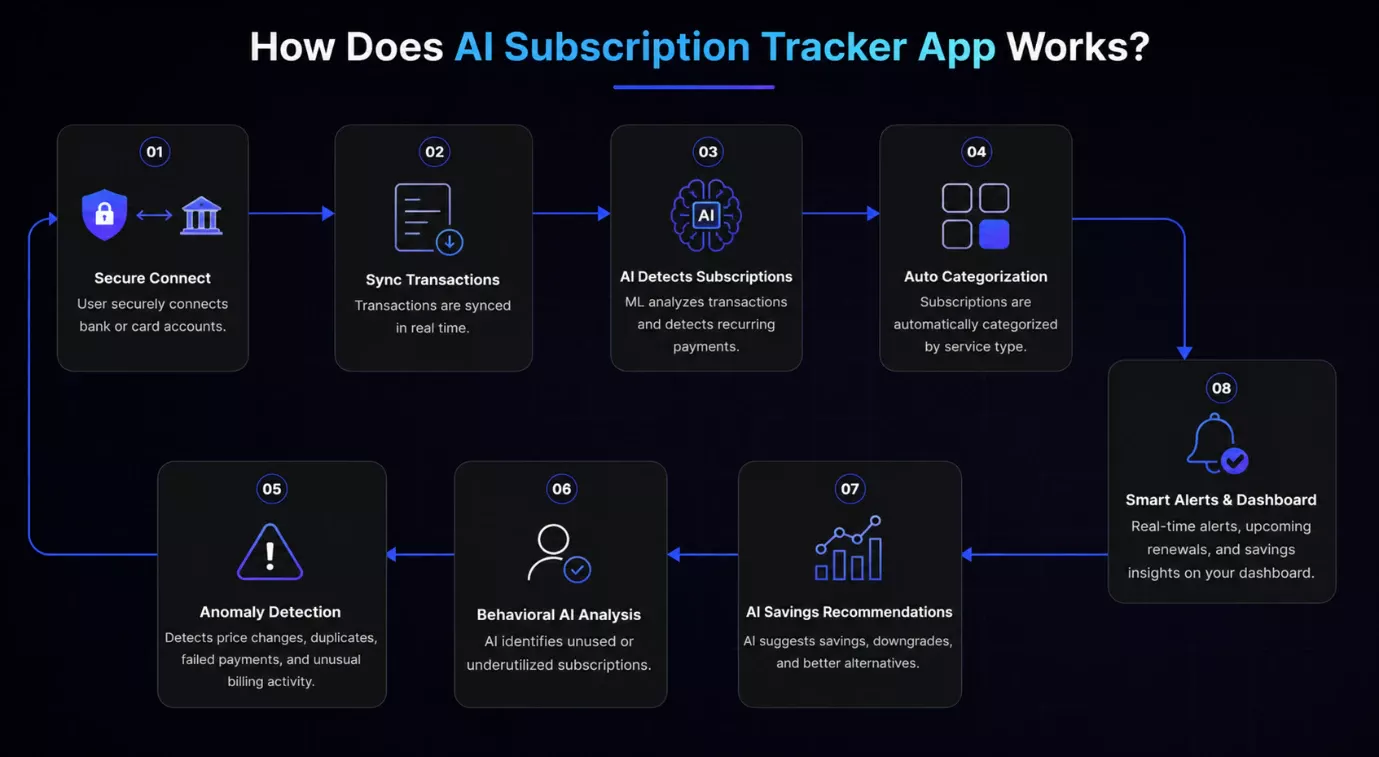
The result is an intelligent subscription management platform that automatically detects recurring expenses, identifies saving opportunities, and helps users stay in control of their subscriptions without manually maintaining a subscription list.
The way people manage recurring expenses has changed dramatically over the past few years. Consumers now subscribe to multiple streaming platforms, cloud storage services, fitness memberships, productivity tools, gaming subscriptions, software licenses, and digital memberships, making it increasingly difficult to keep track of monthly spending. As a result, businesses have an opportunity to build intelligent financial products that go beyond simple reminder applications.
Investing in AI subscription tracker app development is no longer just about creating another personal finance app. It is about building an AI-powered financial assistant that automatically detects recurring payments, analyzes spending behavior, predicts unnecessary expenses, and helps users make smarter financial decisions with minimal effort. This shift from manual subscription management to AI-driven automation is creating new opportunities for fintech startups, digital banks, expense management platforms, and financial service providers.
One of the most common questions businesses ask is:
"Is there still room to build an AI subscription tracker app when products like Rocket Money already exist?"
The answer is yes. Most existing solutions still rely on partial automation, limited banking integrations, or basic subscription reminders. Businesses that combine AI-powered transaction intelligence, predictive analytics, personalized savings recommendations, and seamless banking connectivity can deliver a significantly better user experience while addressing the growing demand for intelligent financial management.
Subscription-based services are becoming the preferred business model across entertainment, SaaS, fitness, education, healthcare, eCommerce, and digital content. According to industry forecasts, the global Subscription and Recurring Billing Management Market is expected to grow from USD 12.51 billion in 2026 to USD 29.72 billion by 2032, expanding at a CAGR of 15.43%.
The average consumer now pays for numerous digital subscriptions across different categories, making manual tracking increasingly difficult. AI-powered subscription management applications solve this problem by automatically identifying recurring payments, organizing subscriptions, and notifying users before unexpected renewals occur.
Traditional subscription managers primarily function as reminder tools. AI-powered applications analyze financial transactions, detect unused subscriptions, identify price increases, forecast future spending, and recommend personalized savings opportunities. These capabilities transform the application from a passive tracker into an intelligent financial assistant.
With secure Open Banking APIs and financial data aggregators such as Plaid, Tink, and Yodlee, businesses can securely access user-authorized transaction data and automate subscription detection without requiring manual entry. This significantly improves user experience while reducing onboarding friction.
One of the biggest reasons traditional subscription tracker apps lose users is the ongoing requirement to manually maintain subscription lists. AI removes this repetitive work by continuously monitoring bank transactions and automatically updating subscriptions, resulting in a more engaging and valuable product.
An AI subscription tracker app creates monetization opportunities beyond premium subscriptions. Businesses can generate recurring revenue through financial partnerships, premium budgeting features, personalized financial coaching, subscription cancellation services, banking integrations, and B2B licensing for financial institutions.
For digital banks, fintech companies, and expense management platforms, AI subscription tracking complements existing budgeting, savings, investment, and financial planning features. Instead of offering isolated tools, businesses can create an integrated financial ecosystem that increases customer engagement and lifetime value.
The broader Personal Finance App Market was USD 2.9 billion in 2025 and expected to grow approximately USD 9.0 billion by 2032, reflecting increasing consumer demand for AI-driven financial management solutions.
As recurring digital subscriptions continue to grow across every industry, businesses that invest in AI subscription tracker app development today will be better positioned to deliver smarter financial experiences, improve customer retention, and build sustainable revenue models in the evolving fintech landscape.
As recurring digital subscriptions continue to increase across streaming platforms, SaaS products, fitness memberships, cloud services, and online tools, manually managing them has become both time-consuming and inefficient. This is one of the biggest reasons businesses are investing in AI subscription tracker app development instead of building traditional reminder-based subscription managers.
Unlike conventional apps that simply notify users about upcoming renewals, an AI-powered subscription tracker continuously analyzes financial transactions, detects spending patterns, identifies unnecessary subscriptions, and delivers actionable recommendations that help users and organizations save money. These capabilities create measurable value for three different stakeholders: individual users, enterprises, and the businesses developing the platform.
If you're wondering, "What ROI can we realistically show users from an AI subscription tracker, and what enterprise-specific benefits justify building one?", the following benefits explain why AI-powered subscription management is becoming a key investment area for fintech companies in 2026.
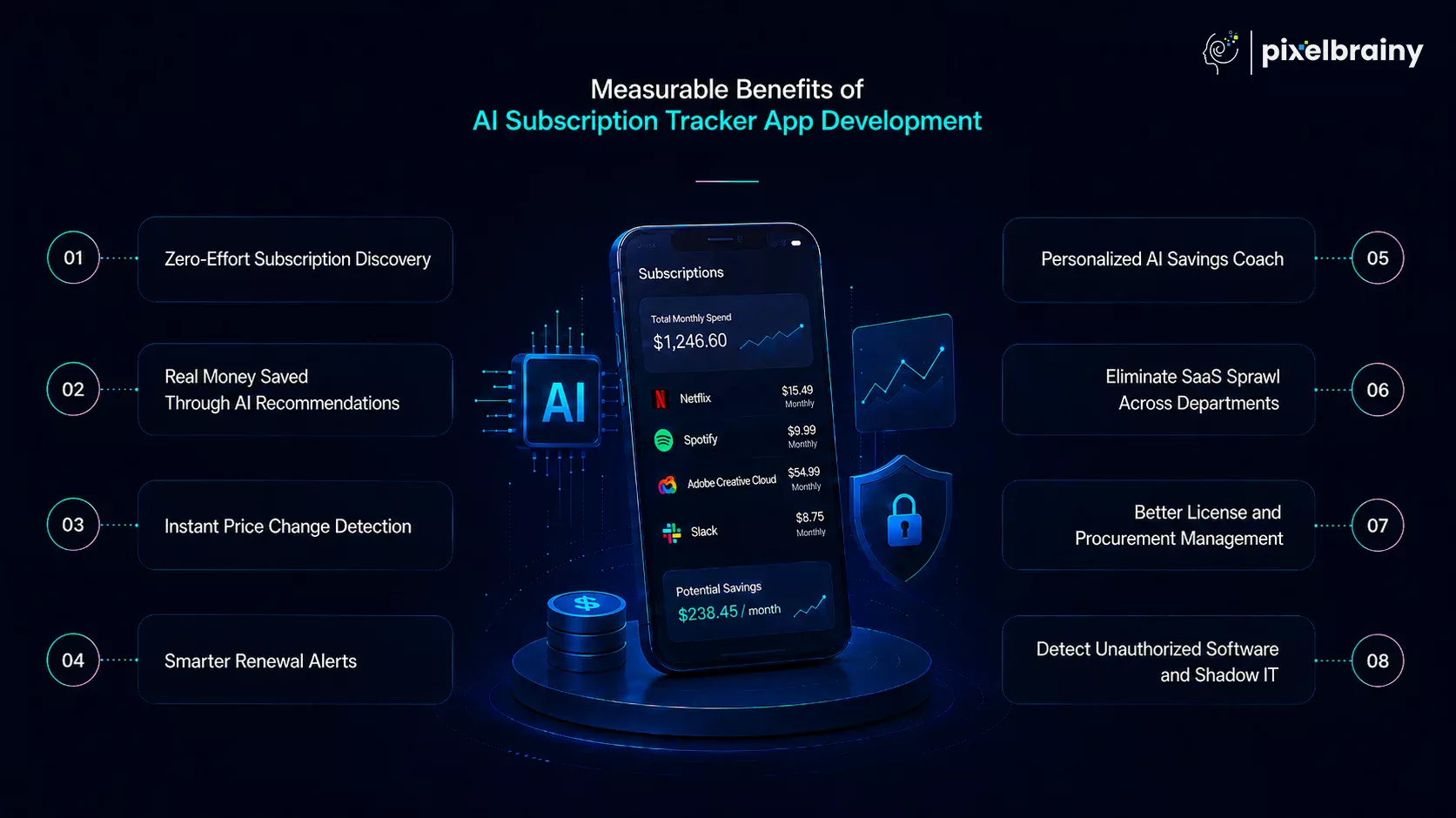
One of the biggest benefits of AI subscription tracker app technology is eliminating manual subscription management. Instead of asking users to enter every recurring payment, machine learning automatically scans connected bank and card transactions to detect active subscriptions.
For many users, the first synchronization reveals 3 to 5 active subscriptions they either forgot about or didn't realize were still renewing. This creates immediate value without requiring any manual effort.
An AI subscription tracker does more than organize subscriptions. It actively helps users reduce unnecessary spending.
By analyzing recurring payments and identifying underused services, AI can recommend subscriptions that should be cancelled, downgraded, or replaced with lower-cost alternatives. On average, users who follow these recommendations can identify approximately 2 to 3 unnecessary subscriptions during their first month.
Assuming an average subscription cost of $12.50 per month, cancelling just 2.3 subscriptions results in annual savings of approximately $345 per user.
Subscription prices change frequently, and many users only notice after several billing cycles.
AI-powered anomaly detection continuously compares historical billing amounts with new transactions and immediately alerts users when unexpected price increases, duplicate charges, or abnormal billing patterns are detected. This allows users to take action before unnecessary costs accumulate.
Traditional reminder apps notify users on a fixed date.
AI goes further by analyzing subscription history and user behavior to predict upcoming renewals 7 to 14 days in advance, prioritizing subscriptions that appear unused or offer little value. These intelligent reminders help users make informed renewal decisions instead of reacting after payment has already been processed.
Modern AI subscription trackers function like personal financial advisors.
Generative AI analyzes monthly spending habits, identifies overlapping services, recommends annual plans where appropriate, suggests lower-cost alternatives, and prioritizes subscriptions that deliver the least value. These personalized recommendations continue improving as the AI learns more about individual spending behavior.
Large organizations often pay for duplicate software because different teams independently purchase similar tools.
One of the most valuable enterprise AI subscription management benefits is automatically identifying overlapping SaaS products across departments. AI helps organizations consolidate software purchases, and many enterprises reduce unnecessary SaaS spending by up to 23% through better subscription visibility and rationalization.
AI continuously compares purchased software licenses with actual employee usage.
This helps procurement teams identify unused licenses, over-purchased subscriptions, and renewal opportunities before contracts expire. Organizations gain stronger negotiation power while reducing software waste and improving budget allocation.
Employees frequently subscribe to productivity tools without IT approval.
AI automatically detects recurring payments made to unauthorized software vendors, helping organizations reduce security risks, improve compliance, and maintain complete visibility across their software ecosystem without relying on manual audits.
The biggest advantage of AI subscription detection app benefits 2026 is simple: AI transforms subscription tracking from a passive reminder tool into an intelligent financial assistant that saves users money, helps enterprises optimize software spending, and creates sustainable recurring revenue opportunities for platform owners.

Building an AI subscription tracker app requires much more than adding recurring payment reminders. Today's users expect the application to automatically detect subscriptions, monitor spending patterns, identify unnecessary expenses, and provide intelligent financial insights with minimal manual effort. For businesses investing in AI subscription tracker app development, the right feature set determines user adoption, retention, and long-term monetization.
One of the most common questions business owners ask is:
"We're planning to build an AI-powered subscription management app. Which features are essential for the MVP, and which ones actually increase user retention instead of just adding complexity?"
The answer starts with building a strong foundation. The following features form the core of every successful AI subscription tracker application.
| Feature | Description |
| Secure User Registration & Authentication | Every AI subscription tracker app should provide secure sign-up using email, phone number, Google, Apple, or biometric authentication. Strong authentication protects financial information, builds user trust, and supports compliance with modern security standards. |
| Secure Bank & Card Account Integration | Integrate trusted Open Banking providers like Plaid, Tink, or Yodlee to securely connect bank accounts and credit cards. Automatic transaction synchronization eliminates manual data entry while providing real-time financial visibility. |
| AI Subscription Detection Engine | Machine learning automatically analyzes financial transactions to identify recurring subscriptions without requiring manual input. This feature delivers the core value proposition of an AI-powered subscription management app by eliminating repetitive user effort. |
| Automatic Subscription Categorization | AI intelligently organizes subscriptions into categories such as entertainment, productivity, shopping, healthcare, education, finance, and utilities. Better categorization helps users quickly understand spending patterns and monthly financial commitments. |
| Subscription Dashboard | A centralized dashboard displays active subscriptions, upcoming renewals, monthly expenses, annual spending, and subscription categories. This feature provides users with a complete overview of their recurring financial obligations in one place. |
| Renewal & Billing Reminders | Smart notifications alert users before upcoming subscription renewals and payment due dates. Timely reminders reduce unexpected charges while giving users sufficient time to cancel, pause, or modify subscriptions. |
| Price Change Detection | AI continuously monitors recurring transactions and immediately detects billing increases, duplicate charges, or unexpected payment changes. Users receive instant alerts whenever subscription costs deviate from historical payment behavior. |
| Spending Analytics Dashboard | Interactive charts and reports visualize monthly subscription spending, category-wise expenses, historical trends, and recurring financial commitments. These insights help users better understand where their subscription budget is being allocated. |
| Search, Filter & Sort Subscriptions | Users can quickly search subscriptions, filter by category, renewal date, payment method, or monthly cost. This improves usability, especially for users managing dozens of recurring subscriptions across multiple services. |
| Multi-Bank & Multi-Card Support | Many users manage subscriptions across several bank accounts and credit cards. Supporting multiple financial accounts ensures complete subscription visibility without requiring users to switch between separate dashboards. |
| Secure Data Encryption | Financial transaction data should be protected using end-to-end encryption, secure APIs, and encrypted cloud storage. Strong security practices improve user confidence while supporting financial compliance requirements. |
| Smart Notification Center | A dedicated notification center consolidates renewal reminders, billing alerts, price changes, AI recommendations, and account activity into one organized interface, preventing users from missing important financial updates. |
| Expense History & Reports | Users can review historical subscription payments, billing trends, canceled subscriptions, and annual spending reports. Historical insights help users evaluate long-term financial habits and recurring expenses. |
| Subscription Cancellation Guidance | Provide users with cancellation instructions, customer support links, cancellation policies, and renewal deadlines for each subscription. Simplifying the cancellation process increases user satisfaction and perceived platform value. |
| Admin Dashboard & Analytics | Administrators should manage users, financial integrations, AI performance, subscription categories, reports, notifications, and platform analytics from a centralized dashboard that supports efficient platform operations and future scalability. |
These must-have features establish the foundation of a successful AI subscription tracker app, creating a secure, automated, and user-friendly platform before introducing advanced AI capabilities such as predictive savings, behavioral analytics, and generative financial recommendations.
Once the core functionality is in place, the next step is transforming your application into an intelligent financial assistant that continuously delivers value to users. Advanced AI capabilities not only improve the user experience but also increase engagement, retention, and premium subscription conversions. For businesses planning AI subscription management app development, these features create a significant competitive advantage and help differentiate the product from traditional subscription tracking apps.
A common question founders ask is:
"We already have an MVP subscription tracker. Which advanced AI features should we build next to increase user retention and justify a premium subscription plan?"
The following advanced features represent the next generation of AI-powered subscription management applications.
| Advanced Feature | Description |
| AI Spending Behavior Analysis | Machine learning continuously analyzes spending habits, subscription frequency, and payment behavior to identify unnecessary recurring expenses, changing financial patterns, and opportunities for better budgeting without requiring manual financial analysis. |
| Personalized AI Savings Recommendations | Generative AI evaluates subscription history and monthly expenses to recommend services that can be cancelled, downgraded, bundled, or replaced with more affordable alternatives, helping users maximize long-term savings. |
| Subscription Usage Prediction | Behavioral AI predicts which subscriptions users are no longer actively using by combining transaction history, spending frequency, and connected device activity, allowing proactive recommendations before renewal dates arrive. |
| AI Price Anomaly Detection | Advanced anomaly detection continuously monitors billing activity and instantly identifies unexpected price increases, duplicate charges, failed discounts, free trial conversions, or irregular recurring payments that require immediate attention. |
| Voice & Conversational AI Assistant | An AI chatbot enables users to ask questions naturally, such as "How much did I spend on streaming subscriptions last month?" or "Which subscriptions should I cancel?" and receive personalized financial insights instantly. |
| Predictive Cash Flow Forecasting | AI estimates upcoming subscription expenses based on renewal schedules, historical spending patterns, and recurring payment behavior, helping users prepare future budgets and avoid insufficient account balances before billing dates. |
| Family & Shared Subscription Intelligence | AI detects shared subscriptions across family members, identifies duplicate services, recommends account consolidation, and provides household spending insights that help families reduce unnecessary recurring expenses. |
| Enterprise SaaS Subscription Management | For businesses, AI automatically detects duplicate software licenses, monitors departmental SaaS spending, identifies unused subscriptions, and provides procurement teams with actionable cost optimization recommendations. |
| AI-Powered Cancellation Assistant | Instead of simply reminding users about renewals, AI provides step-by-step cancellation guidance, identifies cancellation policies, suggests better alternatives, and simplifies the entire subscription management experience. |
| Smart Financial Insights Dashboard | AI transforms transaction data into personalized insights by highlighting monthly spending trends, projected annual subscription costs, potential savings opportunities, category-wise analysis, and financial recommendations through interactive dashboards. |
Adding these advanced AI capabilities helps businesses move beyond traditional subscription management and build an intelligent financial platform that continuously delivers personalized insights, improves customer retention, and creates stronger premium monetization opportunities.
Developing an AI subscription tracker app involves much more than integrating a banking API and displaying recurring payments. A successful product requires secure financial data access, accurate machine learning models, scalable backend architecture, intelligent recommendation systems, and enterprise-grade security. Businesses planning building AI subscription management app from scratch should follow a structured development roadmap to minimize technical risks and launch a reliable product.
One of the most common questions founders ask is:
"Should we use Plaid or Open Banking APIs for our AI subscription tracker, and what does the complete development process look like from idea to launch?"
The following AI subscription tracker app development process 2026 outlines every major stage involved in building a production-ready AI subscription management platform.
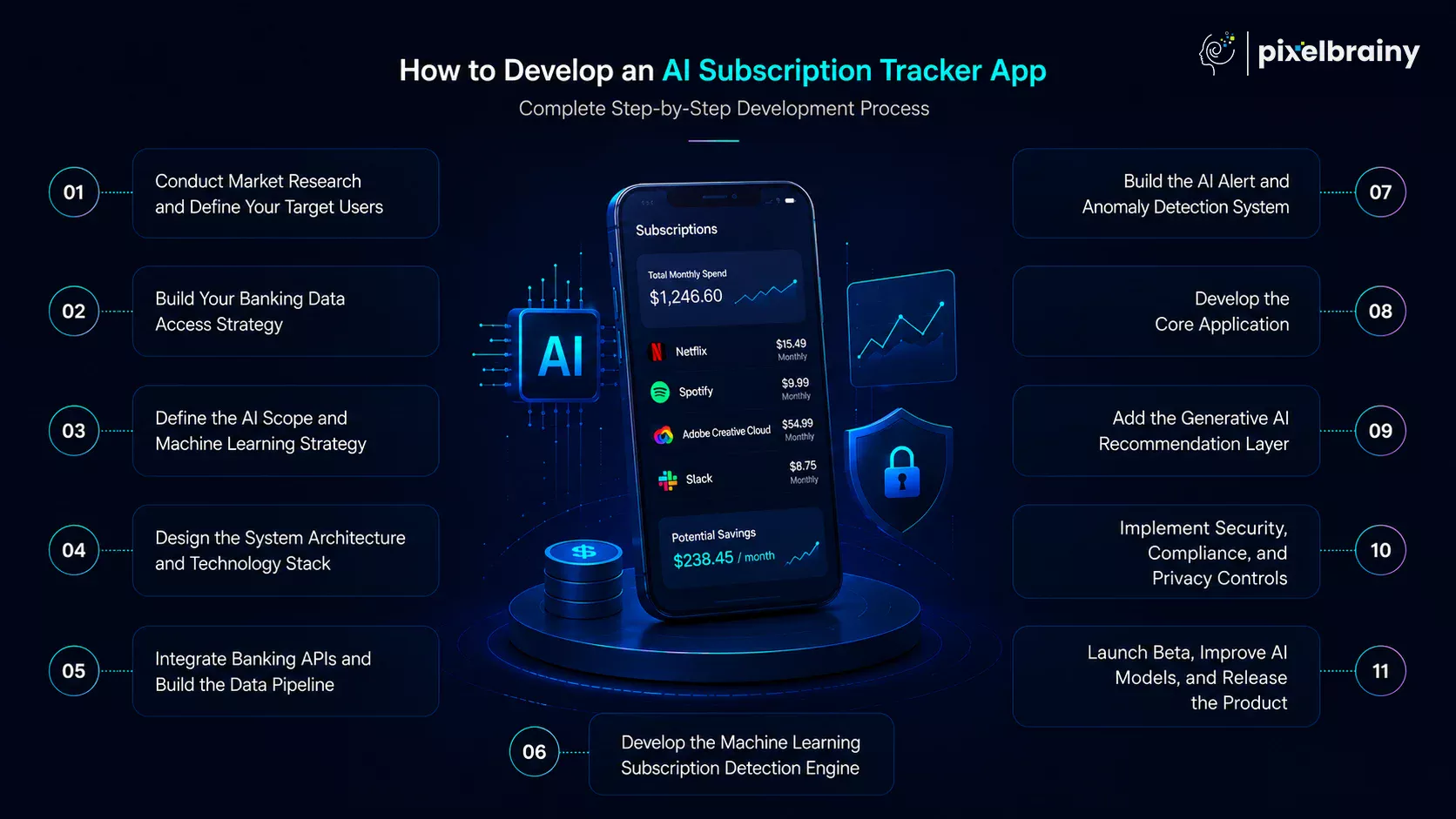
Every successful product starts with understanding who it is being built for. Identify whether your application targets B2C consumers, enterprise SaaS management teams, digital banks, or financial institutions offering embedded subscription management.
At this stage, define your launch platform, whether iOS, Android, web, or cross-platform, and determine your primary market. Businesses targeting the United States generally rely on Plaid or Finicity, while European platforms often prioritize Open Banking or PSD2 integrations.
Who works on it: Product Managers, Business Analysts, AI Consulting Company
AI Decision: Define which AI capabilities belong in the MVP and which should be introduced after launch.
Skipping this step may result in building features that do not match market demand.
An AI subscription tracker depends entirely on reliable financial transaction data.
Evaluate financial data providers based on your target geography.
| Banking Provider | Best For | Considerations |
| Plaid | US, Canada, Europe | Excellent coverage with monthly platform fees and API usage charges |
| Finicity / MX | United States | Strong alternative financial aggregators |
| TrueLayer | UK and Europe | Designed specifically for Open Banking |
| Tink | Nordic and European markets | Extensive European banking coverage |
| Direct Open Banking APIs | PSD2 Markets | Lower recurring costs but more complex implementation |
Also determine which financial permissions your application requires, such as transaction history, account balances, or complete financial account information.
Skipping proper banking architecture often causes scalability and compliance challenges later.
Before development begins, identify exactly which AI features will be included in the first release.
Decide whether subscription detection should rely on third-party AI services or proprietary machine learning models. Plan how historical transaction data will be collected, labeled, and continuously improved using user corrections.
Who works on it: AI Architects and AI Model Development Specialists
AI Decision: Custom ML model versus external AI services.
Without a clear AI roadmap, development costs and timelines often increase significantly.
The architecture should support millions of financial transactions while maintaining low latency and high security.
Typical architecture includes:
A reliable architecture prevents future scalability issues.
This stage focuses on Plaid Open Banking AI subscription detection development.
The application securely retrieves transaction history, normalizes merchant names, standardizes transaction amounts, parses billing dates, and creates an incremental synchronization pipeline that processes only newly added transactions instead of downloading complete transaction histories every time.
Skipping normalization leads to inconsistent AI prediction accuracy.
This is the core intelligence of the platform.
Historical transactions are labeled as subscription or non-subscription payments before feature engineering begins. Machine learning models analyze merchant consistency, billing intervals, payment frequency, and spending behavior.
Common algorithms include:
Models are validated using precision, recall, and confidence thresholds before deployment. User corrections continuously improve future prediction accuracy.
Without continuous learning, detection accuracy gradually declines.
Once subscriptions are detected, AI begins monitoring them continuously.
Time-series models compare historical billing behavior with current payments to identify:
Smart notification prioritization prevents users from becoming overwhelmed with unnecessary alerts.
With the AI engine operational, developers build the complete user experience.
Core modules include:
An experienced UI/UX Design Company ensures users can understand their financial information quickly and intuitively.
Skipping usability testing often results in poor user retention despite strong AI capabilities.
Generative AI transforms transaction insights into personalized financial advice.
Instead of generating information independently, the LLM only receives verified subscription data before producing recommendations.
Examples include:
Recommendation quality should be continuously evaluated through A/B testing.
Financial applications require bank-grade security.
Essential measures include:
Security should never be postponed until after launch.
Before public release, invite 500 to 1,000 beta users.
Collect feedback on:
Use correction data to retrain machine learning models before full App Store and Google Play deployment. After launch, continue optimizing AI performance through ongoing AI Integration Services, analytics, and user feedback.
| Product Stage | Estimated Timeline |
| MVP Development with AI subscription detection | 2 to 4 Months |
| Mid-Tier AI Subscription Platform | 4 to 7 Months |
| Enterprise AI Subscription Management Platform | 7 to 12 Months |
Following this structured approach to how to develop an AI subscription tracker app step by step reduces technical risks, accelerates product launches, and creates a scalable AI-powered subscription management platform capable of serving both consumers and enterprise customers.
The AI subscription tracker app development cost 2026 depends on much more than mobile app development. Unlike a traditional subscription manager, an AI-powered platform requires secure banking integrations, machine learning models, transaction intelligence, anomaly detection, generative AI, cloud infrastructure, and continuous model optimization. Each of these components contributes differently to the overall investment.
One of the most common questions founders ask is:
"What is the total all-in cost to build an AI subscription tracker app with Plaid integration and ML auto-detection, and how do Plaid API costs scale as we grow our user base?"
The answer becomes much clearer when you separate standard application development costs from AI-specific investments.
| Development Scope | Estimated Cost |
| Basic subscription tracker (manual management, reminders, no AI) | $25,000 to $55,000 |
| Standard tracker with Plaid integration and basic ML | $60,000 to $120,000 |
| Complete subscription management platform | $120,000 to $250,000 |
These estimates include mobile development, backend APIs, dashboards, authentication, notifications, and reporting but exclude advanced AI capabilities.
| AI Component | Estimated Cost |
| Plaid API integration and transaction ingestion pipeline | $15,000 to $35,000 |
| ML subscription detection model development | $30,000 to $80,000 |
| Merchant name normalization database | $10,000 to $25,000 |
| AI price anomaly detection engine | $15,000 to $35,000 |
| Behavioral usage scoring model | $20,000 to $50,000 |
| Generative AI savings recommendations | $15,000 to $35,000 |
| AI cancellation assistant | $20,000 to $45,000 |
| ML monitoring and retraining pipeline | $10,000 to $25,000 |
The largest share of the cost to build AI subscription management app is typically associated with transaction intelligence, machine learning development, and AI infrastructure rather than frontend development.
Launching the application is only the beginning. AI systems continue generating monthly operating expenses as transaction volume increases.
| Service | Estimated Cost |
| Plaid API | $500 to $5,000/month |
| GPT-4o Mini recommendations | $0.001 to $0.005 per recommendation |
| AWS Cloud Infrastructure | $500 to $5,000/month |
| ML Model Retraining | $5,000 to $20,000 per quarter |
| Merchant Database Maintenance | $5,000 to $15,000/year |
| Enterprise Feature | Estimated Cost |
| Single Sign-On (SSO) | $10,000 to $25,000 |
| ERP & Accounting Integrations | $15,000 to $35,000 |
| SaaS Vendor Intelligence Database | $10,000 to $30,000/year |
| SOC 2 Type II Audit | $30,000 to $80,000 |
These investments are primarily required for enterprise SaaS management platforms and financial institutions.
| Product Type | Estimated Budget | Timeline |
| MVP AI Subscription Tracker (Plaid, ML detection, AI alerts, React Native) | $80,000 to $150,000 | 2 to 4 Months |
| Mid-Tier AI Subscription Tracker (Behavioral AI, anomaly detection, generative AI, cancellation assistant) | $175,000 to $350,000 | 4 to 7 Months |
| Enterprise AI Subscription Intelligence Platform (SOC 2, multi-bank support, SaaS intelligence, enterprise dashboard) | $300,000 to $600,000+ | 7 to 12 Months |
| Budget | What You Can Build |
| $120K | Cross-platform MVP with Plaid integration, automatic subscription detection, dashboard, notifications, spending analytics, and basic AI alerts. |
| $250K | Advanced AI subscription platform with ML detection, anomaly detection, behavioral insights, AI savings recommendations, cancellation assistant, and multi-bank support. |
| $500K+ | Enterprise subscription intelligence platform with custom ML models, SaaS management, accounting integrations, SOC 2 compliance, multi-region banking support, and advanced analytics. |
| Monthly Active Users | Estimated Plaid API Cost | Recommendation |
| 5,000 Users | $500 to $1,000/month | Plaid remains the most cost-effective option. |
| 25,000 Users | $1,500 to $3,000/month | Continue using Plaid while optimizing API usage. |
| 100,000 Users | $3,000 to $5,000/month | Evaluate a hybrid banking integration strategy. |
| 250,000+ Users | Higher enterprise pricing | Consider direct Open Banking integrations where available to reduce long-term operating costs. |
As user growth accelerates, many fintech companies gradually replace parts of their third-party aggregation strategy with direct Open Banking integrations in supported markets to improve cost efficiency and increase control over financial data pipelines.
| Development Region | Average Hourly Rate |
| United States / United Kingdom | $120 to $200/hour |
| Eastern Europe | $50 to $90/hour |
| India | $30 to $60/hour |
Businesses partnering with experienced AI development teams in India can often achieve 40% to 60% lower development costs while maintaining the same project scope and technical quality.
Many founders ask:
"I've been quoted $200K for a subscription tracker. What's the AI portion of that cost, and is it justified?"
For a modern AI-powered platform, a significant portion of the budget is invested in banking integrations, machine learning models, AI recommendation engines, anomaly detection, cloud infrastructure, security, and continuous model improvement. These capabilities transform the application from a simple reminder tool into an intelligent financial assistant that automatically detects subscriptions, identifies savings opportunities, improves user retention, and creates stronger premium monetization opportunities.
Understanding the complete AI subscription app development cost breakdown helps businesses allocate budgets more effectively, prioritize high-impact AI features, and build a scalable subscription management platform that continues delivering value as both the product and user base grow.

The success of an AI subscription tracker app depends on much more than its user interface. The right technology stack determines how accurately subscriptions are detected, how securely financial data is processed, how quickly AI recommendations are generated, and how efficiently the platform scales as users grow. Businesses investing in AI subscription tracker app tech stack 2026 should carefully evaluate every layer, from banking integrations and machine learning models to backend architecture, cloud infrastructure, and notification systems.
One of the most common questions businesses ask is:
"What is the best tech stack for building an AI subscription tracker app in 2026, and should we use Plaid or direct Open Banking integrations for automatic subscription detection?"
The following technology stack represents the recommended architecture for building a secure, scalable, and AI-powered subscription management platform.
| Technology Layer | Recommended Technology | Best For | Alternative Options | Why It Is Recommended |
| Mobile Frontend | React Native | Consumer MVPs | Flutter, Swift, Kotlin | Faster cross-platform development with excellent Plaid SDK support. |
| Backend Framework | Python FastAPI | AI-powered applications | Node.js | Strong ecosystem for machine learning, APIs, and financial services. |
| Primary Database | PostgreSQL | Financial transactions | MySQL | Reliable relational database for banking and subscription records. |
| Caching Layer | Redis | Sessions and AI caching | Memcached | Improves API performance and recommendation speed. |
| Background Jobs | Celery + Redis | AI inference and transaction processing | RabbitMQ | Efficient asynchronous processing for financial workloads. |
| Enterprise Event Streaming | Apache Kafka | Large-scale platforms | AWS Kinesis | Handles millions of financial transaction events efficiently. |
| Banking Platform | Best For | Advantages | Considerations |
| Plaid API | United States, Canada, UK, Europe | Best developer experience, extensive banking coverage | Monthly platform fees plus per-user pricing |
| TrueLayer | United Kingdom & Europe | Native Open Banking and PSD2 support | Limited coverage outside Europe |
| Tink | Nordic & European Markets | Excellent European banking connectivity | Ideal for EU-focused applications |
| MX / Finicity | United States | Strong alternative to Plaid with bank partnerships | Smaller international coverage |
| Direct PSD2 APIs | Large EU Deployments | No intermediary platform costs | Higher development complexity and maintenance |
| Target Market | Recommended Banking Technology |
| United States | Plaid API |
| United Kingdom | TrueLayer |
| Nordic Countries | Tink |
| Large European Banking Platforms | Direct PSD2 APIs |
| Component | Recommended Technology | Purpose |
| Subscription Detection Model | LightGBM / XGBoost / Scikit-learn | Detect recurring subscriptions from transaction history. |
| Merchant Name Processing | spaCy + Hugging Face Transformers | Normalize merchant names and identify recurring billing entities. |
| Merchant Intelligence Database | Internal Subscription Database (10,000+ Billing Descriptors) | Improve subscription recognition accuracy across financial institutions. |
| Price Anomaly Detection | Prophet / statsmodels | Detect unusual billing increases and payment irregularities. |
| Model Versioning | MLflow | Track model experiments and production deployments. |
| Feature Store | Feast | Store historical user spending features for machine learning. |
Gradient boosting algorithms consistently outperform deep learning models for structured financial transaction data, making them the preferred choice for subscription detection.
| Component | Recommended Technology | Best Use Case |
| GPT-4o Mini | Personalized savings recommendations | High-volume recommendation generation |
| Claude Haiku | Fast AI responses | Low-latency financial assistance |
| Llama 3 8B | On-premise deployments | Banking and enterprise environments |
| LangChain | Prompt orchestration | Multi-step AI financial conversations |
| Guardrails AI | Output validation | Prevent hallucinated financial figures |
| Component | Recommended Technology | Purpose |
| REST APIs | Python FastAPI | Secure backend services |
| Real-Time Alerts | Node.js WebSockets | Live notification delivery |
| Database | PostgreSQL | User accounts and transaction history |
| Cache | Redis | Faster AI recommendations |
| Background Processing | Celery + Redis | ML inference and transaction analysis |
| Event Streaming | Apache Kafka | Enterprise-scale financial processing |
| Component | Recommended Technology | Purpose |
| Cloud Platform | AWS | Scalable cloud infrastructure |
| Authentication | Amazon Cognito | Secure user authentication |
| Serverless AI | AWS Lambda | Cost-efficient AI inference |
| Object Storage | Amazon S3 | Transaction reports and encrypted storage |
| Push Notification Service | Amazon SNS | Financial alerts and reminders |
| Secrets Management | AWS Secrets Manager | Secure API credential management |
| Encryption | TLS 1.3 + AES-256 | Bank-grade data protection |
| Network Security | Private AWS VPC | Secure banking data processing |
| Compliance | SOC 2 Type II Configuration | Enterprise-grade security readiness |
| Component | Recommended Technology | Best Use Case |
| Firebase Cloud Messaging | Cross-platform push notifications | iOS and Android alerts |
| OneSignal | Smart notification scheduling | A/B testing and engagement optimization |
| Twilio | SMS alerts | High-priority billing and price change notifications |
| Component | Recommended Technology |
| Banking Integration | Direct PSD2 APIs or TrueLayer |
| Backend | Python FastAPI |
| AI Models | LightGBM + XGBoost |
| Database | PostgreSQL |
| Authentication | OAuth 2.0 |
| Cloud Platform | AWS Europe Region |
| Compliance | PSD2 + GDPR |
| Component | Recommended Technology |
| Mobile Development | Swift (iOS) + Kotlin (Android) |
| Banking Integration | Direct Bank APIs |
| AI Engine | Proprietary ML Models |
| Generative AI | Llama 3 8B (Private Deployment) |
| Backend | Python FastAPI + Apache Kafka |
| Security | AWS VPC + SOC 2 Type II + TLS 1.3 |
| Identity Management | OAuth 2.0 + Multi-Factor Authentication |
| Business Type | Recommended Stack |
| Startup MVP | React Native + Plaid API + Python FastAPI + PostgreSQL + XGBoost + AWS |
| Growing Fintech Platform | React Native + Plaid + LightGBM + GPT-4o Mini + Redis + Kafka |
| European Fintech Product | Flutter + TrueLayer + FastAPI + PostgreSQL + PSD2 APIs |
| Banking White-Label Platform | Swift + Kotlin + Direct Banking APIs + Llama 3 + Kafka + SOC 2 Infrastructure |
For businesses evaluating the best technology for building AI subscription management app, an API-first architecture using React Native, Plaid, Python FastAPI, PostgreSQL, XGBoost, and AWS offers the fastest path to market. As the platform scales, direct Open Banking integrations, proprietary machine learning models, and private AI deployments provide greater control, lower long-term operating costs, and enterprise-grade flexibility.
Building an AI subscription tracker app is only the first step. Creating a sustainable business requires a monetization strategy that continuously delivers value while generating predictable recurring revenue. Unlike traditional subscription reminder apps, AI-powered platforms solve real financial problems by automatically detecting subscriptions, identifying savings opportunities, and providing personalized financial insights. These AI capabilities significantly increase users' willingness to upgrade to premium plans compared to apps that simply offer reminders.
One of the most common queries founders ask is:
"What monetization model works best for an AI subscription tracker app, and how does AI improve premium conversions compared to a standard subscription manager?"
The answer lies in offering AI features that users genuinely cannot experience elsewhere. Below are the most effective AI subscription tracker app monetization models businesses are adopting in 2026.
| Revenue Model | How It Works | Typical Revenue | Why AI Increases Revenue |
| Freemium with AI Feature Gating | Offer manual subscription tracking, reminders, and basic dashboards for free. Unlock AI subscription detection, anomaly alerts, AI savings recommendations, and cancellation assistance through premium plans. | $4.99 to $9.99/month | AI becomes the primary reason users upgrade. Automatic subscription detection and intelligent savings recommendations convert significantly better than traditional premium feature restrictions. |
| Annual Subscription Upsell | Use AI to identify users who would benefit most from annual billing based on engagement, subscription history, and predicted lifetime value, then present personalized upgrade offers. | 20% to 35% higher annual plan adoption | AI targets users most likely to convert, increasing customer lifetime value while reducing subscription churn. |
| Affiliate & Cancellation Commissions | When AI recommends replacing or cancelling a subscription, users are directed to alternative services through affiliate partnerships, generating referral commissions for every successful conversion. | 5% to 25% commission per referral | Personalized AI recommendations produce significantly higher affiliate conversion rates than generic advertisements. |
| Banking & Fintech White-Label Licensing | License the AI subscription intelligence platform to banks, fintech companies, and digital wallets as an embedded financial wellness feature. | $50,000 to $500,000/year per institution | Financial institutions pay for AI-powered transaction intelligence, automated subscription detection, and enhanced customer engagement that differentiates their banking applications. |
| Enterprise SaaS Subscription Management | Offer AI-powered subscription intelligence to IT departments for managing software licenses, duplicate tools, renewals, and SaaS spending across organizations. | $15 to $50 per user/month | AI identifies software waste, duplicate subscriptions, and optimization opportunities, creating measurable cost savings that justify premium enterprise pricing. |
| Premium AI Financial Coaching | Combine AI-generated spending insights with personalized financial coaching delivered through AI assistants or certified financial advisors. | $9.99 to $29.99/month | AI identifies users who need advanced financial guidance and delivers personalized coaching recommendations that increase premium subscriptions. |
| Data Insights Licensing | License anonymized and aggregated subscription spending trends to market research firms, SaaS vendors, and financial analysts while maintaining GDPR and CCPA compliance. | Enterprise licensing agreements | AI-generated transaction insights are significantly more accurate and granular than survey-based consumer research datasets. |
| Revenue Model | Estimated ARPU | AI Impact | Implementation Complexity | Time to Revenue |
| Freemium Premium Plans | $6 to $12/month | ⭐⭐⭐⭐⭐ | Medium | Fast |
| Annual Subscription Upsell | Higher Customer LTV | ⭐⭐⭐⭐⭐ | Medium | Fast |
| Affiliate Partnerships | $3 to $20 per conversion | ⭐⭐⭐⭐ | Low | Fast |
| Banking White-Label Licensing | $50K to $500K/year | ⭐⭐⭐⭐⭐ | High | Medium |
| Enterprise SaaS Licensing | $15 to $50/user/month | ⭐⭐⭐⭐⭐ | High | Medium |
| Premium AI Coaching | $10 to $30/month | ⭐⭐⭐⭐ | Medium | Medium |
| Data Insights Licensing | Enterprise Contracts | ⭐⭐⭐⭐⭐ | High | Slow |
| Business Type | Recommended Revenue Strategy |
| Startup MVP | Freemium model with AI-powered premium subscriptions |
| Personal Finance App | Premium subscriptions combined with affiliate partnerships |
| Digital Bank or Fintech Platform | White-label AI subscription intelligence licensing |
| Enterprise SaaS Platform | Per-seat subscription management licensing |
| Financial Advisory Platform | AI financial coaching subscriptions |
| Market Intelligence Business | Subscription spending data licensing |
"We want to build our AI subscription tracker as a white-label solution for banks. What does this business model look like, and what do banks actually pay for?"
Banks are increasingly looking for value-added financial wellness features that improve customer engagement without requiring customers to leave their mobile banking apps. An AI subscription intelligence engine can automatically detect recurring payments, notify customers about upcoming renewals, identify unnecessary subscriptions, highlight price increases, and generate personalized savings recommendations directly within the banking experience.
Most financial institutions license these solutions through annual contracts ranging from $50,000 to $500,000, often combined with monthly active user pricing. What banks are really paying for is not the reminder system itself, but the AI-powered transaction intelligence, customer retention, and enhanced digital banking experience that differentiates their platform from competitors.
The strongest AI subscription app business model combines recurring consumer subscriptions with enterprise licensing, affiliate partnerships, and AI-powered financial services, creating multiple revenue streams while maximizing customer lifetime value and long-term business growth.
The subscription management market has evolved far beyond simple reminder applications. Leading platforms now combine artificial intelligence, transaction intelligence, and financial analytics to automatically detect recurring payments, monitor subscription spending, and recommend personalized ways to save money. Studying these applications helps businesses understand current market standards while identifying opportunities to build a more intelligent and differentiated AI subscription tracker.
Rocket Money is one of the most recognized subscription management platforms in the United States. It automatically detects recurring subscriptions by analyzing connected bank accounts, tracks monthly expenses, alerts users about upcoming renewals, and even assists with subscription cancellations.
Its biggest strength is combining subscription management with budgeting and financial insights. However, there is still room for deeper AI personalization, predictive spending analysis, and more intelligent savings recommendations.
Hiatus helps users manage subscriptions, monitor recurring bills, improve credit scores, and optimize household expenses. By securely connecting financial accounts, the platform automatically identifies recurring charges and keeps subscription information updated.
The app delivers a broader financial wellness experience beyond subscription tracking, although stronger AI-powered behavioral insights and proactive financial coaching could further enhance long-term user engagement.
Trim uses artificial intelligence to identify recurring subscriptions, negotiate bills, recommend cost-saving opportunities, and help users reduce unnecessary expenses automatically.
Its automated bill negotiation capabilities differentiate it from traditional subscription managers. Future improvements could include conversational AI, predictive subscription intelligence, and more personalized financial planning recommendations.
Bobby is popular among users who prefer complete control over their subscriptions. It allows users to manually add recurring services, organize billing schedules, and receive renewal reminders through a clean and intuitive interface.
Although Bobby provides an excellent user experience, it relies heavily on manual subscription management. This creates a significant opportunity for AI-powered alternatives that automate subscription detection directly from banking transactions.
Subby focuses on helping users monitor recurring expenses through customizable reminders, subscription calendars, and spending summaries. It offers an easy way to organize multiple subscriptions across different categories.
The application is well suited for users who prefer manual tracking, but integrating AI-powered subscription detection, personalized savings recommendations, and intelligent renewal forecasting would significantly enhance its capabilities.
These leading applications demonstrate that automatic subscription detection has become an essential feature rather than a competitive advantage. The next generation of AI subscription tracker apps will compete on how intelligently they analyze financial behavior, not simply on how many subscriptions they can detect.
Businesses investing in AI subscription tracker app development have an opportunity to differentiate by building features such as predictive spending analytics, AI-powered financial coaching, behavioral subscription scoring, personalized cancellation recommendations, enterprise SaaS intelligence, and Open Banking-powered transaction analysis.
The future belongs to AI-powered financial assistants that continuously help users reduce unnecessary spending, optimize recurring expenses, and make smarter financial decisions instead of simply reminding them when subscriptions renew.
When businesses begin AI subscription tracker app development, the expectation is often that connecting a banking API and applying machine learning will automatically create an intelligent subscription management platform. In reality, building a reliable AI subscription tracker is significantly more challenging. Financial transaction data is inconsistent, merchant names vary across banks, subscription patterns are unpredictable, and users expect near-perfect accuracy before trusting an application with their financial information.
One of the most common questions businesses ask is:
"What are the biggest technical challenges in building an AI subscription tracker, especially merchant name normalization and Plaid cost scalability, and how do leading platforms solve them?"
The following challenges represent the most critical technical and operational hurdles businesses should address before launching an AI-powered subscription management platform.
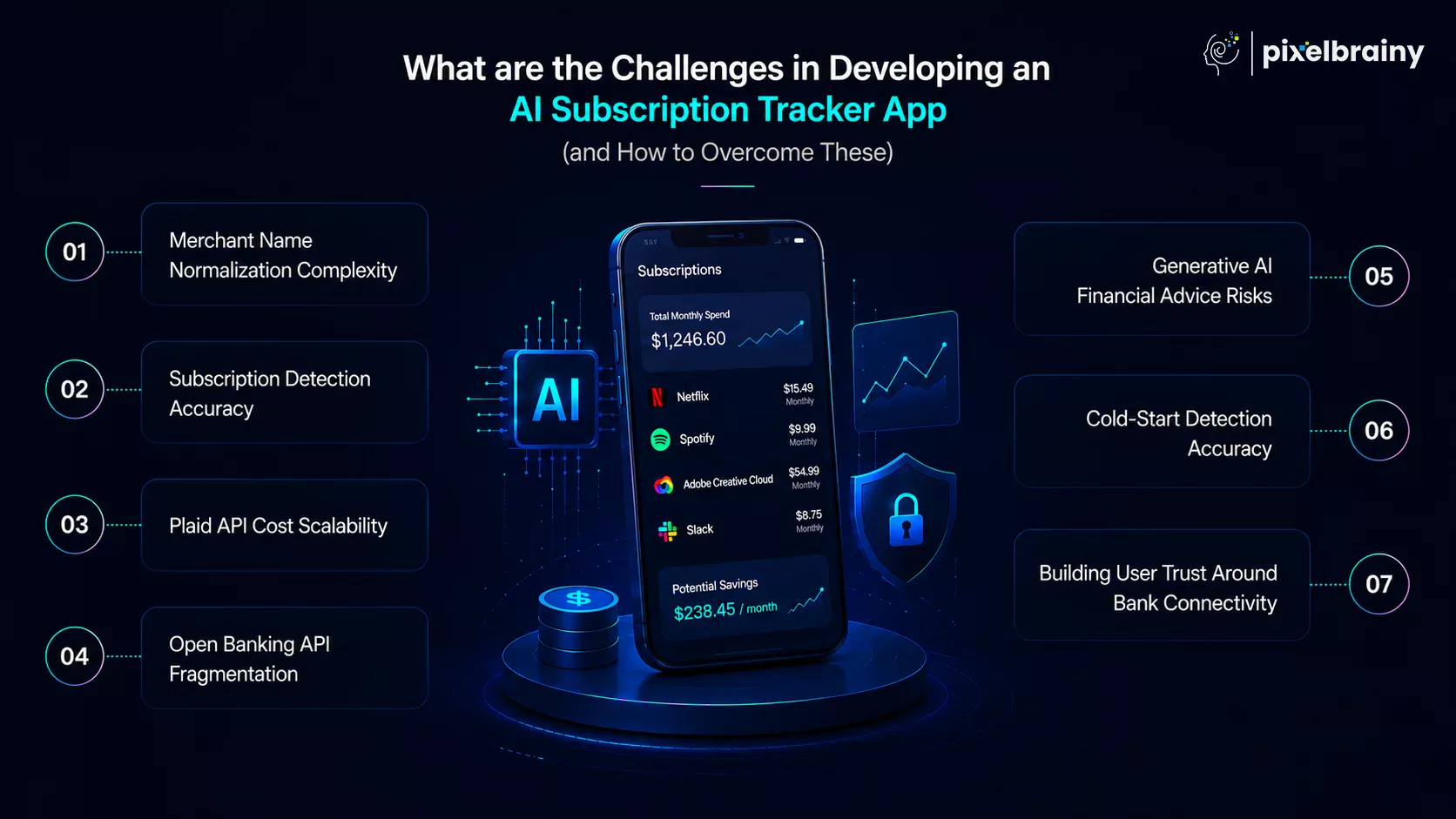
One of the biggest merchant name normalization subscription app challenges is that the same subscription rarely appears with a consistent billing description.
For example, Hulu may appear as HULU, Hulu.com, HULU*STREAMING, or HULU 123, depending on the bank, card network, country, or payment processor.
Machine learning cannot reliably identify subscriptions if every merchant name is treated as a completely different business.
Build a proprietary merchant normalization database that continuously maps different billing descriptors to a single merchant identity. Combine fuzzy matching algorithms, phonetic matching, historical transaction patterns, and user correction feedback to improve recognition accuracy over time.
Not every recurring payment is a subscription.
Rent, utility bills, insurance premiums, school fees, and loan payments often follow recurring schedules, while legitimate subscriptions may have changing billing amounts or annual renewal cycles.
High false positives quickly reduce user trust.
Develop an ensemble machine learning model that evaluates merchant category, billing interval, payment frequency, transaction history, and amount consistency together. For low-confidence predictions, request user confirmation before automatically classifying a payment as a subscription.
Among the biggest Plaid API subscription detection challenges is controlling operating costs as user numbers increase.
At large scale, API usage costs can become one of the platform's largest recurring expenses.
Repeated transaction synchronization across thousands of users dramatically increases infrastructure costs.
Implement aggressive transaction caching, incremental synchronization, batch processing, and evaluate direct Open Banking integrations for supported regions once the platform reaches high transaction volumes.
Businesses expanding into Europe face additional Open Banking AI subscription tracker challenges because banking APIs differ significantly between institutions.
More than 5,000 European banks expose APIs with varying reliability, response formats, authentication methods, and uptime.
For early-stage products, integrate providers such as TrueLayer or Tink instead of connecting directly to individual bank APIs. Direct PSD2 integrations become more practical only after reaching significant scale.
Generative AI can produce personalized savings recommendations, but incorrect financial advice may expose businesses to legal and reputational risks.
An AI model could incorrectly recommend cancelling an essential recurring payment or generate inaccurate savings projections.
Validate every recommendation against verified transaction data, implement strict guardrails, display clear AI disclaimers, and never allow AI to generate investment, tax, or regulated financial advice without appropriate controls.
New users present another important ML subscription classification accuracy problems because the AI has little historical transaction data available.
Limited transaction history reduces the model's confidence when identifying recurring payment patterns.
Retrieve the maximum available historical transaction window during the first synchronization, combine merchant category information with machine learning predictions, and continuously improve detection accuracy as additional transactions become available.
Even the most accurate AI model provides little value if users refuse to connect their financial accounts.
Many users remain concerned about privacy, security, and financial data access when connecting banking applications.
Clearly explain that banking integrations provide read-only access, never store banking credentials, encrypt all financial data, display transparent permission requests, and offer manual subscription entry for users who prefer not to connect their accounts immediately.
Besides AI-specific obstacles, businesses should also prepare for several operational and regulatory challenges during AI subscription tracker app development.
Businesses frequently ask:
"How do we handle Plaid costs as our AI subscription tracker grows, and when does it make sense to migrate to direct Open Banking APIs?"
For most startups, Plaid offers the fastest and most reliable path to launch. However, as monthly active users and API costs continue to grow, businesses should evaluate a hybrid strategy by maintaining Plaid in core markets while gradually adopting direct Open Banking integrations in regions where they provide better long-term cost efficiency and greater control over financial data.
Successfully overcoming these AI subscription tracker app development challenges enables businesses to build a secure, scalable, and intelligent subscription management platform that earns user trust, delivers accurate financial insights, and remains commercially sustainable as the product grows.
After understanding the complete AI subscription tracker app development process, from selecting the right technology stack and banking integrations to building machine learning models and planning monetization, one final decision determines whether your product succeeds in the market:
The answer matters because developing an AI-powered subscription management platform requires expertise in both financial technology and artificial intelligence. Many development companies can integrate a banking API, while others specialize in machine learning. Very few understand how to combine secure Open Banking infrastructure, intelligent transaction analysis, generative AI, and enterprise-grade security into one scalable product.
At PixelBrainy, a leading AI financial software development company, we bridge that gap. We build intelligent fintech solutions that combine banking integrations, machine learning, generative AI, and secure cloud infrastructure to create subscription management platforms that users trust and businesses can scale confidently.
Many platforms claim to use artificial intelligence but rely on basic transaction matching or predefined merchant rules. That approach quickly breaks when billing descriptions change or new merchants appear.
When businesses build AI subscription tracker with PixelBrainy, we develop a multi-feature machine learning detection engine supported by a proprietary merchant normalization database containing thousands of known subscription billing descriptors. Our models are trained on labeled transaction datasets, validated against independent testing data, and continuously improved using user correction feedback, delivering intelligent subscription detection rather than simple rule matching.
One of the biggest architectural decisions is selecting the appropriate financial data provider.
Instead of recommending the same solution for every project, PixelBrainy begins with a Banking Data Strategy Workshop where we evaluate your target market, regulatory requirements, projected transaction volume, operating costs, and future scalability.
Whether your product is launching in North America with Plaid or targeting European markets through PSD2 and Open Banking, we recommend the banking architecture that best supports your long-term business goals.
Many startups worry about increasing API costs as their user base grows.
Our engineering team designs incremental synchronization pipelines, intelligent transaction caching, and efficient data processing workflows that reduce unnecessary API requests from day one. We also prepare a clear migration path toward direct Open Banking integrations where they become commercially beneficial, allowing your platform to scale without major architectural redesign.
Generative AI should help users make smarter financial decisions, not generate unreliable advice.
PixelBrainy implements a grounded AI recommendation engine where every suggestion is generated only from verified transaction history and normalized subscription data. Additional validation layers prevent AI from producing inaccurate financial figures or unsupported savings recommendations, ensuring users receive trustworthy and transparent insights.
Financial applications require significantly higher security standards than traditional mobile apps.
Our architecture includes TLS 1.3 encryption, AES-256 encrypted storage, secure OAuth authentication, GDPR and CCPA compliant data management, and SOC 2 Type II-ready infrastructure from the beginning of development. User banking credentials remain protected through secure financial providers, while our applications process only authorized financial data using industry best practices.
Many businesses begin with a consumer application before expanding into enterprise or banking partnerships.
PixelBrainy develops modular architectures where the same AI subscription detection engine, merchant intelligence database, and anomaly detection pipeline power both consumer and enterprise solutions. Enterprise capabilities such as Single Sign-On, Role-Based Access Control, SaaS subscription intelligence, and administrative dashboards are added as configurable extensions instead of requiring a separate platform.
When you hire PixelBrainy for AI subscription tracker app development, you gain a technology partner that supports every phase of your product journey, including:
"We are a European fintech startup and we need our AI subscription tracker to work with Open Banking APIs under PSD2 rather than Plaid. We need a development partner who understands both the Open Banking ecosystem and machine learning subscription detection."
This is exactly the type of challenge PixelBrainy is built to solve. Our team understands both sides of the equation, secure financial data infrastructure and advanced AI engineering, enabling us to build intelligent subscription management platforms that are compliant, scalable, and ready for international markets.
If you're looking for a trusted partner to develop an AI subscription tracker app, PixelBrainy combines fintech expertise, Open Banking knowledge, and advanced AI capabilities to build intelligent subscription management solutions that deliver measurable business value from day one.

Building an AI subscription tracker app is about much more than helping users organize recurring payments. The real opportunity lies in creating an intelligent financial assistant that automatically detects subscriptions, uncovers hidden spending, identifies savings opportunities, and continuously delivers value with minimal user effort.
Throughout this guide, we've explored the four decisions that have the greatest impact on product success. Choosing the right banking data access strategy, whether through Plaid, TrueLayer, Tink, or direct Open Banking APIs, defines how your platform connects with financial institutions. Selecting the right machine learning approach determines how accurately subscriptions are detected and managed over time. Clearly identifying your target audience, whether consumers, enterprises, or banking partners, shapes your product roadmap and monetization strategy. Equally important is partnering with an experienced AI development team that can bring all these technologies together into a secure, scalable, and reliable platform.
The market opportunity continues to grow. The average American loses around $348 each year to forgotten subscriptions, while enterprises waste approximately 23% of their SaaS budgets on duplicate or underutilized software. At the same time, AI, Open Banking, and machine learning technologies have matured enough to solve these challenges effectively, yet the number of truly AI-native subscription management platforms remains relatively small.
If you're planning to build an AI subscription tracker app, this is the right time to transform your vision into a product that delivers measurable value for users and sustainable growth for your business.
At PixelBrainy, we help startups, fintech companies, banks, and enterprises build intelligent subscription management solutions through end-to-end AI development, secure banking integrations, scalable cloud architecture, and continuous product optimization.
Ready to bring your idea to life? Schedule a free strategy call with the PixelBrainy team to discuss your AI subscription tracker app, validate your roadmap, and receive expert guidance tailored to your business objectives.
Yes, but the experience becomes significantly more limited. Users can manually add subscriptions and receive renewal reminders, but AI cannot automatically detect recurring payments or generate personalized savings insights without access to transaction data through secure banking integrations or Open Banking APIs.
Absolutely. Many startups launch their MVP using banking APIs and rule-assisted machine learning for subscription detection before investing in proprietary AI models. This approach reduces development costs, validates product-market fit faster, and provides real user data that improves future AI model training.
Yes. Businesses can integrate AI subscription tracking with platforms like QuickBooks, Xero, NetSuite, or SAP to provide centralized visibility into recurring software expenses, automate subscription reporting, and improve financial planning across departments without duplicating financial records.
Most production AI models are monitored continuously and retrained every few months or whenever sufficient user correction data is collected. Regular retraining helps recognize new merchants, improve subscription detection accuracy, reduce false positives, and adapt to changing billing behaviors.
Yes. A modular architecture allows businesses to use the same AI subscription detection engine for both markets. Consumer apps focus on recurring household expenses, while enterprise platforms add features such as SaaS license management, employee roles, procurement analytics, and Single Sign-On.
The biggest mistake is treating AI as an add-on instead of the foundation of the product. Successful platforms design banking integrations, machine learning models, transaction processing, and user experience together from the beginning to ensure accurate subscription detection and long-term scalability.
PixelBrainy combines expertise in AI, fintech, and secure financial software development to build intelligent subscription management platforms. From Open Banking integrations and machine learning models to enterprise security, mobile development, and post-launch AI optimization, we help businesses launch scalable products that deliver measurable value from day one.

About The Author
Sagar Bhatnagar
Sagar Sahay Bhatnagar brings over a decade of IT industry experience to his role as Marketing Head at PixelBrainy. He's known for his knack in devising creative marketing strategies that boost brand visibility and market influence. Sagar's strategic thinking, coupled with his innovative vision and focus on results, sets him apart. His track record of successful campaigns proves his ability to utilize digital platforms effectively for impactful marketing efforts. With a genuine passion for both technology and marketing, Sagar continuously pushes PixelBrainy's marketing initiatives to greater success.

Working with the PixelBrainy team has been a highly positive experience. They understand the design requirements and create beautiful UX elements to meet the application needs. The dev team did an excellent job bringing my vision to life. We discussed usability and flow. Sagar worked with his team to design the database and begin coding. Working with Sagar was easy. He has the knowledge to create robust apps, including multi-language support, Google and Apple ID login options, Ad-enabled integrations, Stripe payment processing, and a Web Admin site for maintaining support data. I'm extremely satisfied with the services provided, the quality of the final product, and the professionalism of the entire process. I highly recommend them for Android and iOS Mobile Application Design and Development.

Great experience working with them. Had a lot of feedback and I found that unlike most contractors they were bugging me for updates instead of the other way around. They were extremely time conscience and great at communicating! All work was done extremely high quality and if not on time, early! They were always proactive when it comes to communication and the work is great/above par always. Very flexible and a great team to work with! Goes above and beyond to present us with multiple options and always provides quality. Amazing work per usual with Chitra. If you have UI/UX or branding design needs I recommend you go to them! Will likely work with them in the future as well, definitely recommended!

PixelBrainy is a joy to work with and is a great partner when thinking through branding, logo, and website layout. I appreciate that they spend time going into the "why" behind their decisions to help inform me and others about industry best practices and their expertise.

I hired them to design our software apps. Things I really like about them are excellent communication skills, they answer all project suggestions and collaborate right away, and their input on design and colors is amazing. This project was complex and needed patience and creativity. The team is amazing to do business with. I will be using them long-term. Glad to see there are some good people out there. I was afraid to try and outsource my project to someone but I am glad I met them! I really can't say enough. They went above and beyond on this project. I am very happy with everything they have done to make my business stand out from the competition.

It was great working with PixelBrainy and the team. They were very responsive and really owned the project. We'll definitely work with them again!

I recently worked with the PixelBrainy team on a project and I was blown away by their communication skills. They were prompt, clear, and articulate in all of our interactions. They listened and provided valuable feedback and suggestions to help make the project a success. They also kept me updated throughout the entire process, which made the experience stress-free and enjoyable.

PixelBrainy is very good at what it does. The team also presents themselves very professionally and takes care of their side of things very well. I could fully trust them taking up the design work in a timely and organised manner and their attention to detail saved us lots of effort and time. This particular project was quite intense and the team showed that they function very well under pressure. Very much looking forward to working with her again!

It's always an absolute pleasure working with them. They completed all of my requests quickly and followed every note I had for them to a T, which made our process go smoothly from start to finish. Everything was completed fast and following all of the guidelines. And I would recommend their services to anyone. If you need any design work done in the future, PixelBrainy should be your first call!

They took ownership of our requirements and designed and proposed multiple beautiful variants. The team is self-motivated, requires minimum supervision, committed to see-through designs with quality and delivering them on time. We would definitely love to work with PixelBrainy again when we have any requirements.

PixelBrainy was a big help with our SaaS application. We've been hard at work with a new UI/UX and they provided a lot of help with the designs. If you're looking for assistance with your website, software, or mobile application designs, PixelBrainy and the team is a great recommendation.

PixelBrainy designers are amazing. They are responsive, talented, and always willing to help craft the design until it matches your vision. I would recommend them and plan to continue them for my future projects and more!!!

They were awesome! Did a good job fast, and good communication. Will work with them again. Thank you

Creative, detail-oriented, and talented designers who take direction well and implement changes quickly and accurately. They consistently over-delivered for us.

PixelBrainy team is very talented and creative. Great designers and a pleasure to work with. PixelBrainy is an excellent communicator and I look forward to working with them again.

PixelBrainy has a very talented design team. Their work is excellent and they are very responsive. I enjoy working with them and hope to continue on all of our future projects.


Transform your ideas into reality with us.
Across these industries, each engagement brings unique challenges, from early-stage product development to scaling complex systems, helping us build a practical understanding of real-world product environments.