AI Summary Powered by PixelBrainy
Artificial intelligence is becoming a practical part of modern travel planning, helping businesses deliver recommendations based on individual traveler needs rather than relying only on fixed packages or standard search results. For travel agencies, startups, airlines, hospitality brands, and travel technology companies, an AI travel planner app can bring itinerary creation, destination discovery, booking assistance, and personalized recommendations into one digital experience.
Imagine you want to build an AI travel planner app that goes beyond basic itinerary templates. Your goal is to create trip plans that learn from each traveler's booking history, travel style, interests, and budget patterns. Instead of giving every user similar recommendations, the platform can use these signals to suggest destinations, flights, hotels, activities, restaurants, and routes that better match how that individual prefers to travel.
For example, a traveler who consistently chooses boutique hotels, local experiences, shorter travel days, and mid-range spending could receive recommendations that reflect those patterns. As the traveler continues using the application, additional interaction and booking data can help refine future recommendations.
Building this type of AI trip planner app requires more than adding an AI chatbot to a travel application. A production-grade solution may involve personalized recommendation engines, itinerary generation, real-time flight and hotel data, booking APIs, maps and navigation, predictive analytics, conversational AI, secure payments, cloud infrastructure, and data systems that support ongoing personalization.
This also creates important business questions: What does a production-grade AI travel planner app cost to build, and which development companies have built AI travel apps with documented improvements in user satisfaction compared with standard booking platforms?
In this guide, we cover how to build an AI travel planner app, including its core and advanced features, development process, technology stack, estimated development cost, monetization strategies, key development challenges, and considerations for finding an experienced AI travel app development partner.

An AI travel planner app is a mobile or web application that uses artificial intelligence to help travelers plan, personalize, and manage their trips. Unlike a traditional travel app that mainly provides search and booking functions, an AI-powered travel planner can analyze user preferences, budgets, travel history, and trip requirements to generate personalized itineraries and recommendations.
An AI trip planner app can suggest destinations, flights, hotels, restaurants, activities, and routes based on individual travel needs. It can also provide real-time assistance through AI chatbots, weather updates, travel alerts, navigation, and booking support.
For businesses, AI travel planner app development creates an opportunity to combine trip planning, personalization, booking integrations, and intelligent travel assistance within a single platform. With suitable data sources and AI models, the application can continuously refine recommendations as users interact with the platform, creating a more personalized planning experience over time.
Travelers are increasingly using AI to research destinations, discover experiences, compare options, and organize trips. For businesses, this creates an opportunity to develop an AI travel planner app that goes beyond basic itinerary generation and delivers recommendations based on individual preferences, travel behavior, and budget.
For example, a travel business can build an AI trip planner that learns from booking history, preferred accommodation types, spending patterns, and travel interests to create recommendations that feel more relevant to each traveler. Booking.com reported in 2025 that 89% of consumers surveyed wanted to use AI in future travel planning, while 67% had already used AI during some part of a trip.
Here are the key reasons businesses are investing in AI travel planner app development:
The growing adoption of AI across travel creates opportunities for businesses to develop intelligent planning and booking experiences. An AI travel planner can bring itinerary generation, recommendations, booking assistance, and travel support into a single platform.
For startups and established travel businesses, this can create new digital products while supporting additional booking and partnership opportunities.
Travelers increasingly expect recommendations that match their individual interests instead of generic suggestions. Booking.com's 2025 Global AI Sentiment Report found that travelers commonly use AI to research destinations, discover cultural activities, and find restaurants.
This makes personalization an important consideration when businesses build an AI travel planner app. AI can analyze permitted user data, such as preferences, previous bookings, budget patterns, and trip requirements, to generate more relevant recommendations.
Travel platforms are adding AI-powered search, itinerary planning, recommendation, and conversational capabilities to simplify trip discovery. Booking.com, for example, has expanded its AI Trip Planner to support destination research, itinerary creation, and attraction discovery.
For businesses, developing similar capabilities can help create a more interactive travel planning experience rather than relying only on conventional search and filtering.
AI can automate parts of itinerary creation, customer support, recommendation workflows, and travel research. This can reduce repetitive manual work while allowing businesses to direct users toward relevant flights, hotels, activities, and other travel services.
An AI travel planner app can also support revenue through bookings, subscriptions, affiliate partnerships, and personalized offers, depending on the business model.
Travelers are increasingly comfortable using digital tools throughout the trip planning and booking journey. Booking.com's 2025 research found that 62% of surveyed travelers had used AI to plan or book a trip, while 31% had used it to find and book flights and 30% to book accommodation.
This creates an opportunity to develop an AI trip planner app that connects discovery, planning, booking, and post-booking assistance within one digital experience.
AI can work with real-time travel data to provide more useful assistance before and during a trip. Depending on the integrations, an AI travel planner can provide flight updates, weather information, destination suggestions, navigation support, restaurant recommendations, and alternative travel options.
Booking.com 2025 research found that travelers are already using AI for in-trip activities such as translation, destination activities, restaurant recommendations, and navigation.
For businesses planning to build an AI travel planner app, combining personalization with real-time assistance can create a more continuous travel planning experience instead of limiting the application to itinerary generation.
Developing an AI travel planner app can help businesses deliver a more personalized planning experience while creating new opportunities across travel discovery, bookings, customer engagement, and digital support. AI can analyze relevant traveler information and connect it with travel data to make recommendations more useful throughout the planning and travel journey.
For example, businesses researching how to build an AI travel planner app that provides personalized recommendations based on travel history, preferences, and budget can use AI to move beyond generic itinerary templates. The application can learn from permitted user interactions and booking patterns to create recommendations that better reflect individual travel styles, while real-time data can help keep plans relevant as circumstances change.
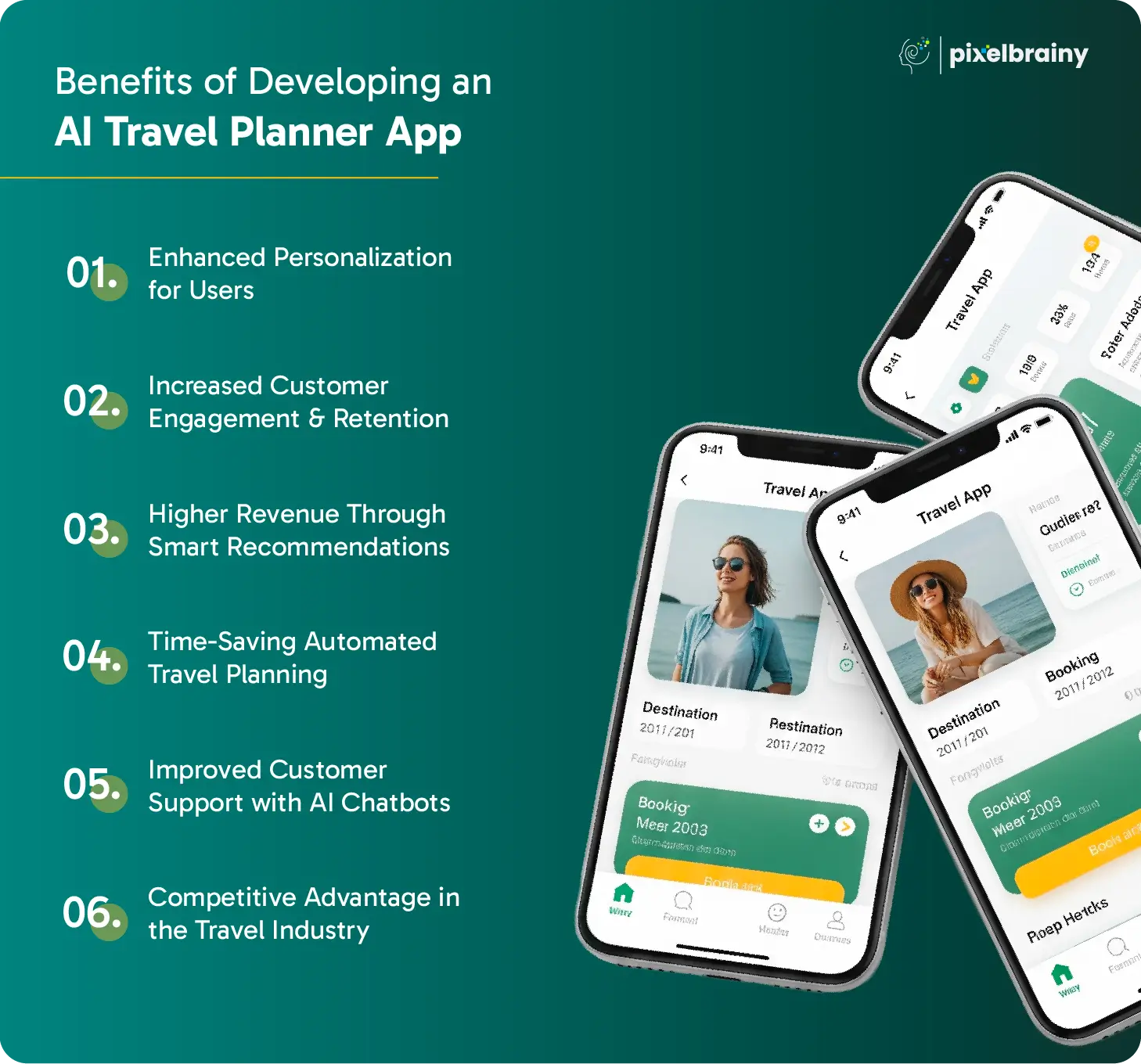
Utilizing the power of AI, the application provides a personalized user experience by analyzing the user’s travel history, budget, and user preferences and generating customized itineraries. This makes travel planning efficient and enjoyable.
With AI-driven recommendations, interactive features, and real-time updates, users stay engaged all through their travel journey, boosting customer engagement and increasing retention rates.
Maximizing the power of artificial intelligence, smart AI travel solutions suggest hotels, activities, and flights based on user behavior. These data-driven recommendations drive increased users, surging revenue from bookings and affiliate partnerships.
Considering factors like weather conditions, local events, and flight schedules, AI automates itinerary creation significantly, mitigating planning time and making travel a hassle-free experience for users.
AI chatbots offer instant assistance, provide booking support, resolve issues in real-time, and answer user queries swiftly. This ensures round-the-clock customer service with no extra staffing costs.
AI-powered apps offer businesses an ultimate solution that helps them outshine their competitors. Integrating essential features, like predictive analytics, real-time updates, and flawless automation, into the AI travel planning software increases user satisfaction and boosts brand reputation.
An AI travel planner app can combine personalization, automation, intelligent recommendations, and real-time assistance to create a more relevant travel experience while helping businesses build stronger digital travel services and new revenue opportunities.
A successful AI travel planner app needs more than an itinerary generator. Travelers expect a single platform where they can plan trips, manage budgets, discover relevant experiences, receive timely updates, and get assistance throughout their journey. For businesses planning to develop an AI trip planner app, core features should therefore cover both personalized trip planning and essential travel management.
A practical question for businesses is: What features should an AI travel planner app include to deliver personalized recommendations based on a traveler's preferences, booking history, and budget? The answer starts with a strong foundation of profile management, AI-powered itinerary generation, booking integrations, real-time information, communication tools, and personalized recommendations.
The following 15 AI travel planner app features provide the core functionality needed to create a useful and scalable travel planning experience.
| Feature | Description |
| User Registration & Profile Management | Permits users to create accounts, manage travel details securely, and save preferences |
| AI-Powered Itinerary Generator | Uses AI to design personalized travel plans based on user budget, preferences, and real-time data |
| Flight & Hotel Booking Integration | Enables users to search, compare, and book accommodations and flights within the app |
| Real-Time Navigation & Maps | Delivers traffic updates, live directions, and offline maps for smooth travel |
| Budget Estimator & Expense Tracker | Assists users to plan and track expenses throughout their trip |
| AI Chatbot for Travel Assistance | Provides 24/7 virtual support for travel bookings, queries, and recommendations |
| Weather Forecasting & Alerts | Delivers real-time weather updates and travel advisories for destinations |
| Local Recommendations | Suggests top-rated attractions, restaurants, and events based on user location and preferences |
| Currency Converter | Permits travelers to check exchange rates and convert currencies instantly |
| Language Translator | Helps users communicate in diverse languages through AI-powered translation |
| Trip History & Saved Itineraries | Allows users to store past trips and save future travel plans for easy access |
| Push Notifications & Reminders | Sends alerts for itinerary changes, flight updates, and necessary travel reminders |
| Reviews & Ratings for Hotels and Activities | Let users read and leave feedback on accommodations and experiences |
| Social Sharing & Trip Collaboration | Permits travelers to share their trips and collaborate on itineraries with friends and family |
| In-App Support & Customer Service | Delivers direct customer support via chat, email, or call for travel-related issues |
These core features create the foundation for AI travel planner app development, bringing itinerary planning, booking, personalization, navigation, budgeting, and travel assistance into one platform. Businesses can then extend this foundation with advanced AI capabilities as their user needs and product requirements grow.
Once the core functionality of an AI travel planner app is established, advanced capabilities can make the platform more intelligent, responsive, and useful throughout the travel journey. Businesses planning to develop an AI travel planner app can gradually introduce these capabilities based on their target audience, data availability, integrations, and product roadmap.
A common business requirement is to build an AI travel planner app that goes beyond basic itinerary templates and provides genuinely personalized travel recommendations. Advanced AI capabilities can support this by considering factors such as travel behavior, budget patterns, destination preferences, real-time conditions, and previous interactions. Other technologies can extend the experience through voice assistance, predictive analytics, AR navigation, wearable integrations, and automated safety alerts.
The following advanced AI travel planner app features can help businesses create a more comprehensive and personalized travel planning solution.
| Feature Description | Key Functionality |
| AI-Based Dynamic Pricing & Travel Deals | Analyzes seasonality, demand, and market trends to offer optimal travel deals |
| Virtual Travel Assistant with Voice Commands | Allows hands-free trip planning via voice interaction |
| Augmented Reality (AR) for Navigation & Exploration | Improves navigation and exploration with AR-based maps, landmarks, and interactive guides |
| Smart Luggage Tracking Integration | Connects with smart luggage devices for real-time baggage location tracking |
| AI-Powered Fraud Detection for Secure Transactions | Detects and controls fraudulent transactions, ensuring secure bookings and payments |
| Personalized Travel Insurance Suggestions | Recommends tailored travel insurance plans based on trip type, destination, and risk factors |
| Predictive Analytics for Flight & Hotel Prices | Utilizes machine learning to anticipate future price fluctuations for optimal booking times |
| Multi-Currency Payment Support | Enables smooth transactions in numerous currencies with real-time exchange rate conversion |
| AI-Powered Smart Packing Suggestions | Generates packing lists based on trip duration, planned activities, and weather conditions |
| Blockchain-Based Secure Booking System | Enhances transaction transparency and security by leveraging blockchain technology |
| Facial Recognition for Seamless Check-Ins | Enables biometric-based check-ins for flights, hotels, and travel services |
| Integration with Wearable Devices | Connects with fitness trackers, smartwatches, and AR glasses for real-time travel updates |
| AI-Driven Travel Route Optimization | Suggests efficient routes based on traffic, weather, and user preferences |
| Custom Travel Recommendations Based on Social Media Preferences | Analyzes user interests from social media to deliver personalized travel suggestions |
| Emergency Assistance & AI-Powered Safety Alerts | Sends real-time safety alerts, emergency contacts, and local assistance options for travelers |
These advanced capabilities can help an AI travel planner app move beyond basic trip organization toward more contextual recommendations, predictive assistance, and real-time travel support. Businesses can introduce them progressively to support personalization, convenience, security, and the evolving needs of their target travelers.
For businesses researching the steps to develop an AI travel planner app from idea to launch, the development process should connect traveler needs, AI capabilities, travel data, booking services, and a scalable technical foundation. A conversational travel planner, for example, should allow users to describe their ideal trip in natural language and receive a complete itinerary with flight, hotel, and experience recommendations that fit their budget, timeline, and preferences.
If your goal is how to build an AI travel planner app from scratch, the process should also account for data quality, recommendation accuracy, third-party integrations, security, performance, and continuous improvement. The following stages outline how businesses can develop an AI travel planner app, from validating the concept to launching and improving the product.
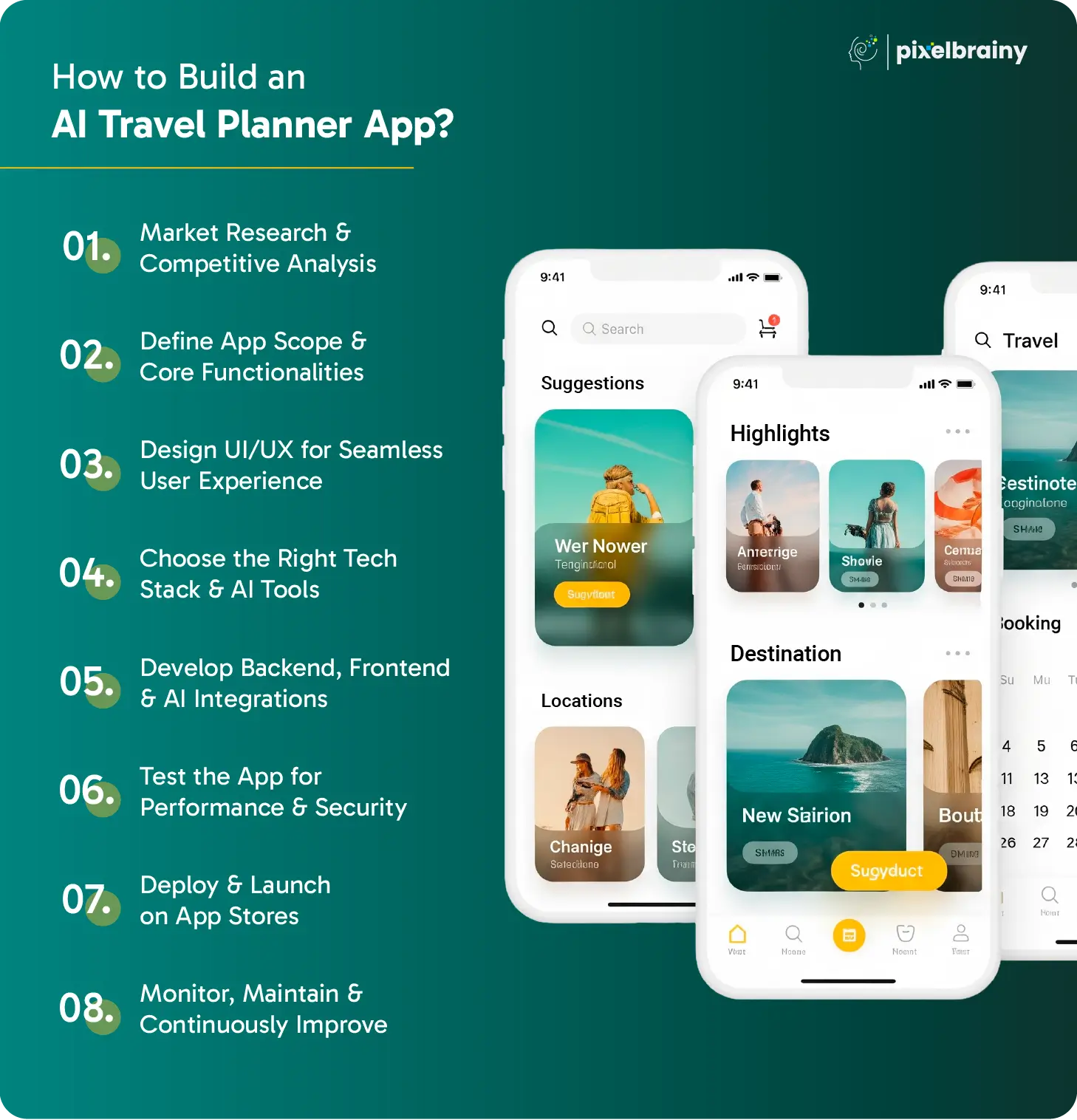
Before building an AI travel planner app, research the target travelers, destinations, booking behaviors, and expectations around AI-assisted planning. Study existing travel planning and booking platforms to identify gaps in itinerary personalization, conversational search, and integrated booking experiences.
For a conversational platform, examine how competitors handle natural-language trip requests and connect recommendations with real booking inventory across flights, hotels, and experiences.
A PoC can then validate whether the proposed concept can turn a natural-language request into a useful itinerary and relevant travel recommendations before full-scale development begins.
Once the market opportunity is understood, define what the application should accomplish for travelers and the business. Map the complete journey from entering a trip request to receiving an itinerary, reviewing recommendations, making bookings, and managing the trip.
For an AI-first product, establish requirements for conversational search, personalized recommendations, itinerary generation, booking integrations, budget controls, user profiles, and real-time travel information. AI consultation during this stage can help align AI capabilities with practical product requirements instead of adding AI features without a clear purpose.
The interface should make complex trip planning feel straightforward. Users should be able to describe their ideal journey naturally, refine the generated plan, compare recommendations, and move toward booking without navigating through multiple disconnected workflows.
A specialized UI/UX design company can structure conversational interfaces, itinerary screens, recommendation cards, booking flows, maps, and trip management features around actual traveler behavior. Personalization should remain visible without making the experience feel complicated.
The technology foundation should support conversational interactions, personalization, real-time travel information, and booking transactions at scale. Select tools according to the application's feature requirements, expected traffic, data sources, and AI workload.
At this stage, evaluate APIs for flights, hotels, experiences, maps, weather, and payments. The architecture should also support secure data handling and flexible AI services so models can evolve as the product develops.
With the architecture established, development brings the traveler experience, backend services, AI capabilities, and external travel systems together. For a conversational planner, the backend must interpret user requests and coordinate AI-generated recommendations with current travel inventory.
AI model development can support itinerary generation, recommendation logic, preference understanding, and conversational workflows. AI integration should connect these capabilities with booking APIs and real-time data rather than relying solely on static information. MVP development can initially focus on the core planning and booking journey before expanding the feature set.
Testing is essential when an application combines AI recommendations with external booking systems and sensitive user information. The goal is to verify that the application remains accurate, responsive, secure, and reliable across different usage conditions.
Test conversational inputs, itinerary generation, recommendation relevance, API failures, booking workflows, payment processing, and unexpected user requests. AI systems should also be evaluated for consistency and inappropriate recommendations. Businesses may hire AI developers to conduct specialized testing and improve AI behavior alongside conventional application QA.
After testing, prepare the application for production deployment and app-store release. Before launch, confirm that critical booking integrations, payment workflows, authentication, analytics, customer support, and monitoring systems are functioning correctly.
For an AI travel planner, launch with clearly defined use cases and communicate what the AI can and cannot do. A controlled rollout can help identify issues with recommendations, booking integrations, and conversational flows before wider adoption.
Launching the application is the beginning of an ongoing optimization cycle. Analyze how users interact with recommendations, itineraries, booking options, and conversational features to identify opportunities for improvement.
Track metrics such as itinerary engagement, recommendation interactions, booking conversions, user feedback, and support requests. Top AI app development companies can help businesses refine models, improve recommendation quality, integrate new travel data sources, and expand intelligent capabilities as the platform grows.
Following these steps provides a structured development process of AI travel planner app, from initial concept and validation to personalized planning, booking integration, launch, and continuous improvement.
The cost to build an AI travel planner app depends on the scope of personalization, AI capabilities, booking integrations, platforms, and technical complexity. For a practical 2026 estimate, the average AI travel planner app development cost ranges from $25,000 to $200,000+. A basic application with itinerary planning and limited AI functionality will require a smaller investment, while a production-grade platform with conversational AI, personalized recommendations, real-time travel data, booking integrations, predictive analytics, and scalable infrastructure can require significantly more.
For businesses researching how much it costs to develop an AI travel planner app, the biggest cost difference comes from what the AI is expected to do. An app that generates generic itineraries is considerably different from one that learns from booking history, travel preferences, and budget patterns to create personalized trip plans and connect users directly with flights, hotels, and experiences.
A useful question for a travel tech startup is: What does it cost to build an AI travel planner app that understands natural-language trip requests and generates personalized, bookable itineraries without requiring users to compare multiple travel platforms manually? The answer depends on AI complexity, third-party APIs, booking workflows, scalability, and the level of customization required.
| Version | Estimated Cost | Features & Complexity |
| Basic Version | $25,000 – $100,000 | Basic itinerary planning, manual search, and limited AI suggestions |
| Mid-Level App | $100,000 – $200,000 | AI-powered recommendations, booking integrations, and interactive UI/UX |
| Advanced AI-Powered App | $200,000+ | Advanced AI (predictive analytics, dynamic pricing), AR navigation, multi-language support, and blockchain security |
Various factors impact the cost of AI trip planner app development, including:
Understanding the AI travel planner app development cost in 2026 helps businesses define realistic budgets around features, AI complexity, integrations, and scalability before development begins. For a production-grade solution, an initial budget of $25,000 to $200,000+ provides a practical planning range, with the final investment determined by the application's specific requirements.
Also Read: AI App Development Cost: From MVPs to Full-Scale AI App
A reliable technology foundation is essential when businesses develop an AI travel planner app that combines personalized recommendations, conversational trip planning, real-time travel data, and booking services. The technology stack needs to support fast user interactions, secure data handling, AI processing, third-party integrations, and scalability as the number of travelers and bookings grows.
A common question for businesses is: What technology stack is required to build an AI travel planner app that understands natural-language trip requests and generates personalized, bookable itineraries across flights, hotels, and experiences? The answer involves multiple layers, including the frontend, backend, AI and machine learning, databases, cloud infrastructure, travel APIs, payment systems, and security.
For AI travel planner app development, each technology should align with the application's specific requirements. A conversational AI planner may require stronger AI infrastructure and real-time API connectivity, while a simpler itinerary application may need a lighter architecture. The following table outlines commonly used tools and technologies for building a scalable AI-powered travel planning platform.
| Component | Technologies & Tools |
| Frontend Development | React Native, Flutter, Swift (iOS), Kotlin (Android) |
| Backend Development | Node.js, Python (Django, Flask), Ruby on Rails |
| AI & Machine Learning | TensorFlow, OpenAI API, Google ML Kit |
| Database Management | PostgreSQL, MongoDB, Firebase Realtime Database |
| Cloud Services | AWS, Google Cloud, Microsoft Azure |
| Navigation & Mapping | Google Maps API, Mapbox, HERE Maps |
| Flight & Hotel Booking APIs | Amadeus API, Skyscanner API, Expedia API |
| Payment Gateway Integration | Stripe, PayPal, Razorpay, Square |
| Chatbot & Virtual Assistants | Dialogflow, IBM Watson, Microsoft Bot Framework |
| Security & Authentication | OAuth, JWT, Firebase Authentication |
Note: This table includes standard tools and technologies required to build an AI trip planning app. To know the exact tech stack for your custom smart travel assistant app development, contact PixelBrainy. This premier AI development company provides expert advice and tailored travel app development services to worldwide clients.
The right technology stack provides the foundation to build an AI travel planner app that can support personalized recommendations, conversational planning, real-time travel information, booking integrations, and future AI capabilities. The final architecture should be aligned with the app's feature scope, data requirements, security needs, target platforms, and expected scale.
An AI travel planner app can generate revenue through multiple channels across trip planning, recommendations, bookings, and partnerships. The right monetization structure depends on the target audience, value offered by the AI features, booking integrations, and the role of the platform in the traveler's purchase journey.
For businesses researching how to monetize an AI travel planner app, a useful approach is to connect revenue generation with the services users already need. For example, a platform that understands a traveler's budget and preferences can provide personalized hotel, flight, activity, and experience recommendations, then generate revenue through subscriptions, booking commissions, affiliate partnerships, or premium planning features.
A practical question for a travel tech startup is: What is the best monetization model for an AI travel planner app that creates personalized itineraries and lets users book flights, hotels, and experiences from the same platform? The answer can involve one revenue stream or a combination of complementary models, depending on the product strategy.
Check out the revenue models below that can be incorporated into AI travel planner app development.

Offer basic travel planning features for free and charge users for advanced AI-powered recommendations, itinerary customizations, and exclusive travel deals. This model drives a large user base and promotes upgrades to premium services.
Partner with airlines, hotels, and tour operators to showcase relevant ads and make money through cost-per-action (CPA) commissions or cost-per-click (CPC). Integrating affiliate links for bookings can also draw additional revenue.
Propose a tiered subscription model offering benefits such as real-time travel insights, AI-powered budgeting tools, and personalized itinerary suggestions. This delivers an uninterrupted revenue stream while fostering user loyalty.
Integrate tour, hotel, and flight booking services within the app and earn an amount as a commission on every transaction. AI-driven recommendations can boost conversions, resulting in higher revenue per user.
Collaborate with local and global travel agencies, tourism boards, and airlines to propose exclusive deals while acquiring a significant share of the profits. Such partnerships promote the app’s credibility and augment its revenue potential.
A sustainable AI travel planner app business model can combine subscriptions, premium AI features, affiliate revenue, booking commissions, and strategic travel partnerships to create multiple revenue opportunities while keeping the planning experience useful and relevant for travelers.
AI travel planner app development involves several technical and product challenges, particularly when the goal is to provide personalized itineraries, real-time travel information, and recommendations that users can trust. These challenges become more complex when an application needs to understand natural-language trip requests and connect AI-generated plans with live flight, hotel, and experience inventory.
A key question for businesses developing an AI travel planner app is: How can a conversational AI travel planner provide accurate, personalized itineraries while reliably integrating real-time booking data across flights, hotels, and experiences? Addressing this requires a combination of reliable data sources, well-tested AI systems, secure architecture, effective user experience, and infrastructure designed for scale.
Below are the major challenges and practical solutions to consider during AI travel planner app development.
Solution: Integrate machine learning models for continuous improvement, utilize high-quality, verified data sources, and run rigorous testing to refine AI accuracy.
Solution: Implement powerful API connections with real-time data providers and leverage the power of cloud-based data processing to efficiently manage large volumes.
Solution: Implement multi-factor authentication (MFA), use end-to-end encryption, and follow inflexible data governance policies to safeguard user privacy.
Solution: Provide an intuitive UI/UX, offer AI-powered guided onboarding, and roll out interactive demos or incentives such as discounts on first bookings.
Solution: Choose cloud infrastructure, implement the microservices architecture, and optimize AI models to ensure effortless scalability with no performance issues.
Addressing these challenges early helps businesses build an AI travel planner app that can deliver relevant recommendations, reliable travel information, secure transactions, and a consistent experience as user demand grows.
A reputed AI development company, PixelBrainy, specializing in building custom AI-powered travel solutions tailored to your unique business needs. We have experience in developing AI travel planner apps. Our team of AI specialists, experienced developers, and creative UI/UX designers is committed to delivering a flaw-free user experience, secure transactions, and smart recommendations.
Recently, we completed an AI-powered travel planner app development project that:
Our team of AI specialists and skilled developers creates scalable travel solutions tailored to your unique business requirements.
PixelBrainy, a leading provider of AI app development services, guides businesses from conceptualization to development and deployment with constant testing, ensuring seamless delivery. We constantly track the project's progress and report to notify businesses about their development journey.
Our team of experts develops a travel assistant app with AI by considering security standards, practices, and compliances, ensuring your solution is secure and robust. We constantly analyze data sets to track cyber threats and keep them away.
Being the best AI travel planner app development company, our developers put in deep R&D efforts to streamline your business processes, effectively reduce marginal costs, and boost marginal productivity.
PixelBrainy prioritizes your time and makes sure we deliver your AI project swiftly, completing it within your required timeframe, even before that.
Building an AI travel planner app can help businesses create a more personalized way for travelers to research destinations, plan itineraries, discover relevant experiences, and manage bookings. The value of the application depends on how effectively its AI capabilities, travel data, booking integrations, and user experience work together.
From understanding how to build an AI travel planner app to defining its core features, technology stack, development process, cost, monetization model, and potential challenges, each stage plays an important role in creating a production-ready solution. Advanced personalization can also help businesses move beyond generic itinerary templates and deliver recommendations based on traveler preferences, budgets, and trip requirements.
If you are planning to develop an AI travel planner app with conversational planning, personalized recommendations, and integrated flight, hotel, and experience bookings, PixelBrainy can help turn your concept into a scalable digital travel solution.
Connect with PixelBrainy to discuss your AI travel planner app development requirements.
The AI travel planner app development cost can range from $25,000 to $200,000+, depending on AI complexity, personalization, booking integrations, number of platforms, third-party APIs, security requirements, and scalability. A conversational app with personalized recommendations and integrated bookings will generally require more development effort than a basic itinerary planner.
The timeline for AI travel planner app development depends on the product scope and technical complexity. An MVP with core itinerary generation and basic recommendations may take several months, while a production-grade platform with conversational AI, personalized recommendations, real-time travel data, and flight, hotel, and experience booking integrations can require a longer development cycle.
To build an AI travel planner app with personalized itineraries, the platform can collect relevant traveler preferences such as budget, destinations, interests, travel style, trip duration, and previous booking behavior. AI can then use these signals with travel data to generate and refine itinerary recommendations based on the user's requirements.
When developing an AI travel planner app, useful AI capabilities can include natural-language trip planning, personalized itinerary generation, recommendation engines, conversational travel assistance, budget-aware suggestions, route optimization, predictive analytics, and real-time travel alerts. The appropriate feature set depends on the target travelers and business model.
A conversational AI trip planner app can connect AI-generated recommendations with third-party travel APIs and booking systems. The AI interprets the user's request, applies constraints such as budget and travel dates, and retrieves relevant flight, hotel, and experience options. Users can then review available options and proceed through the integrated booking workflow.
To make an AI travel planner app from scratch, businesses typically need technologies covering frontend and backend development, AI and machine learning, databases, cloud infrastructure, mapping, travel booking APIs, payments, authentication, and conversational interfaces. The exact stack should be based on the application's required features, integrations, security needs, and expected scale.
An AI travel planner app can personalize future recommendations by using permitted information such as saved preferences, previous bookings, itinerary interactions, destination interests, accommodation choices, and budget patterns. A preference profile can be updated as users interact with the application, allowing recommendations to become more relevant without relying only on generic popularity signals.
Businesses looking to create an AI travel planner app can evaluate development companies based on their experience with conversational AI, travel API integrations, personalized recommendation systems, booking workflows, scalable architecture, and production deployments. PixelBrainy provides custom AI and travel app development services for businesses building intelligent travel planning solutions.

About The Author
Sagar Bhatnagar
Sagar Sahay Bhatnagar brings over a decade of IT industry experience to his role as Marketing Head at PixelBrainy. He's known for his knack in devising creative marketing strategies that boost brand visibility and market influence. Sagar's strategic thinking, coupled with his innovative vision and focus on results, sets him apart. His track record of successful campaigns proves his ability to utilize digital platforms effectively for impactful marketing efforts. With a genuine passion for both technology and marketing, Sagar continuously pushes PixelBrainy's marketing initiatives to greater success.

Working with the PixelBrainy team has been a highly positive experience. They understand the design requirements and create beautiful UX elements to meet the application needs. The dev team did an excellent job bringing my vision to life. We discussed usability and flow. Sagar worked with his team to design the database and begin coding. Working with Sagar was easy. He has the knowledge to create robust apps, including multi-language support, Google and Apple ID login options, Ad-enabled integrations, Stripe payment processing, and a Web Admin site for maintaining support data. I'm extremely satisfied with the services provided, the quality of the final product, and the professionalism of the entire process. I highly recommend them for Android and iOS Mobile Application Design and Development.

Great experience working with them. Had a lot of feedback and I found that unlike most contractors they were bugging me for updates instead of the other way around. They were extremely time conscience and great at communicating! All work was done extremely high quality and if not on time, early! They were always proactive when it comes to communication and the work is great/above par always. Very flexible and a great team to work with! Goes above and beyond to present us with multiple options and always provides quality. Amazing work per usual with Chitra. If you have UI/UX or branding design needs I recommend you go to them! Will likely work with them in the future as well, definitely recommended!

PixelBrainy is a joy to work with and is a great partner when thinking through branding, logo, and website layout. I appreciate that they spend time going into the "why" behind their decisions to help inform me and others about industry best practices and their expertise.

I hired them to design our software apps. Things I really like about them are excellent communication skills, they answer all project suggestions and collaborate right away, and their input on design and colors is amazing. This project was complex and needed patience and creativity. The team is amazing to do business with. I will be using them long-term. Glad to see there are some good people out there. I was afraid to try and outsource my project to someone but I am glad I met them! I really can't say enough. They went above and beyond on this project. I am very happy with everything they have done to make my business stand out from the competition.

It was great working with PixelBrainy and the team. They were very responsive and really owned the project. We'll definitely work with them again!

I recently worked with the PixelBrainy team on a project and I was blown away by their communication skills. They were prompt, clear, and articulate in all of our interactions. They listened and provided valuable feedback and suggestions to help make the project a success. They also kept me updated throughout the entire process, which made the experience stress-free and enjoyable.

PixelBrainy is very good at what it does. The team also presents themselves very professionally and takes care of their side of things very well. I could fully trust them taking up the design work in a timely and organised manner and their attention to detail saved us lots of effort and time. This particular project was quite intense and the team showed that they function very well under pressure. Very much looking forward to working with her again!

It's always an absolute pleasure working with them. They completed all of my requests quickly and followed every note I had for them to a T, which made our process go smoothly from start to finish. Everything was completed fast and following all of the guidelines. And I would recommend their services to anyone. If you need any design work done in the future, PixelBrainy should be your first call!

They took ownership of our requirements and designed and proposed multiple beautiful variants. The team is self-motivated, requires minimum supervision, committed to see-through designs with quality and delivering them on time. We would definitely love to work with PixelBrainy again when we have any requirements.

PixelBrainy was a big help with our SaaS application. We've been hard at work with a new UI/UX and they provided a lot of help with the designs. If you're looking for assistance with your website, software, or mobile application designs, PixelBrainy and the team is a great recommendation.

PixelBrainy designers are amazing. They are responsive, talented, and always willing to help craft the design until it matches your vision. I would recommend them and plan to continue them for my future projects and more!!!

They were awesome! Did a good job fast, and good communication. Will work with them again. Thank you

Creative, detail-oriented, and talented designers who take direction well and implement changes quickly and accurately. They consistently over-delivered for us.

PixelBrainy team is very talented and creative. Great designers and a pleasure to work with. PixelBrainy is an excellent communicator and I look forward to working with them again.

PixelBrainy has a very talented design team. Their work is excellent and they are very responsive. I enjoy working with them and hope to continue on all of our future projects.


Transform your ideas into reality with us.
Across these industries, each engagement brings unique challenges, from early-stage product development to scaling complex systems, helping us build a practical understanding of real-world product environments.