AI Summary Powered by PixelBrainy
Imagine you're a software company planning to automate internal workflows such as employee support, document retrieval, IT ticket resolution, or project management. Instead of relying on repetitive manual tasks, you decide to build your first AI agent that can understand requests, retrieve relevant information, make decisions, and execute actions across your existing business systems. The next question becomes, what does it actually take to create an AI agent that works autonomously without human oversight while remaining accurate, secure, and scalable?
Building an AI agent today involves much more than connecting a large language model to a chatbot interface. You need to define business objectives, design agent workflows, select the right AI models, integrate enterprise tools, and establish memory, reasoning, and decision-making capabilities. For organizations developing an AI agent with RAG and knowledge base integration, the process also includes building reliable retrieval pipelines so the agent can access company documents, policies, and real-time business data to generate trustworthy responses.
The rapid adoption of AI agents reflects this growing business need. McKinsey’s latest “State of AI” survey appeared with the fact that 72% and even more surveyed companies are implementing AI solutions, getting more aligned with the capabilities of Gen AI. Considering this, soon we can witness brands incorporating agents into their processes.
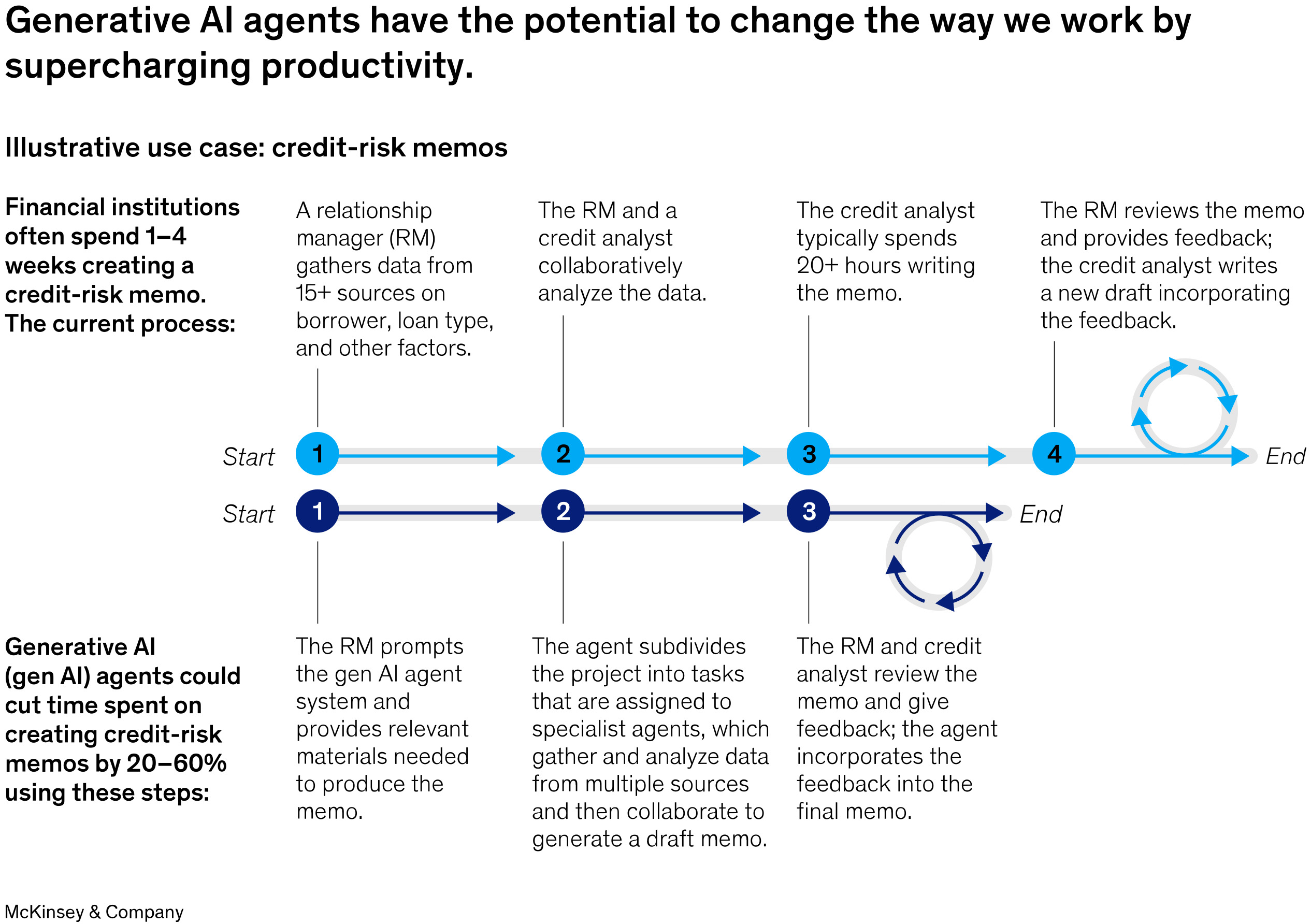
Image source: Why agents are the next frontier of generative AI
Whether you are building an internal productivity assistant, a customer support agent, or a multi-agent enterprise system, choosing the right architecture, frameworks, APIs, and deployment strategy is critical for long-term success.
This guide explains the complete AI agent development process from start to finish. You will learn how to define requirements, select frameworks, design agent architecture, integrate RAG and external tools, train and deploy your solution, estimate development costs, and optimize performance. By the end, you'll have a practical roadmap for building production-ready AI agents that deliver measurable business value.
An AI agent is a system or a software program that grasps its environment, processes data, and acts accordingly to meet specific goals. AI agents constantly learn, adapt, and improve through interactions.
| “For a long time, we have been aiming to build a universal AI agent that can be truly helpful in everyday life.“ Demis Hasabbis, Co-Founder & CEO, DeepMind |
The AI agent market is projected to witness notable growth in the upcoming years. Whether businesses or enterprises from distinct industries, everyone is looking to build AI apps or integrate AI agents into their systems to streamline workflows and provide AI-driven customer support to boost retention rates.
The facts and figures below will prove this:

Check out the top examples of AI agents across different categories ruling the world, assisting organizations and end-users with their capabilities and applications:
| Category | AI Product/Service |
| Conversational AI & Chatbots | ChatGPT, IBM Watson Assistant, Drift Chatbot |
| Virtual Assistants | Amazon Alexa, Google Assistant, Apple Siri |
| Autonomous Vehicles | Tesla Autopilot, Waymo Driver |
| AI-Powered Customer Support Systems | Zendesk AI Chatbots, Freshdesk AI, LivePerson AI |
Tip: Review these leading AI agents from varied categories to decide what AI agent you want to create for your venture.
However, AI agents operate following a well-structured process that facilitates them to perform tasks autonomously and intelligently. But, with a new user, agents usually don't perform independently. They gain over time and excel, showing perfect understanding and proficiency.
The process generally goes like this:
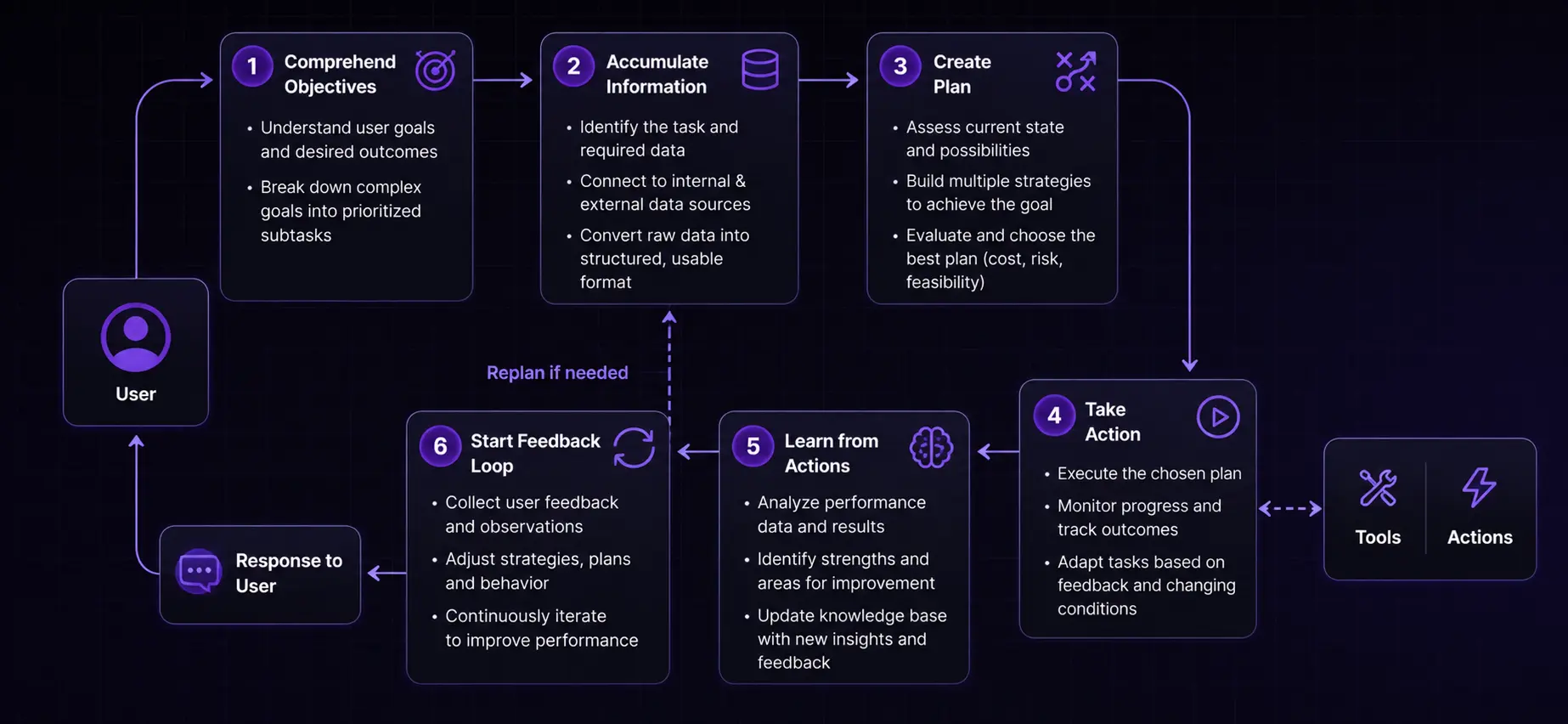
This process allows AI agents to function autonomously, making them valuable tools in diverse applications.
Not every AI agent is designed to solve the same problem. The architecture and capabilities of an AI agent depend on the complexity of the tasks it needs to perform, the level of autonomy required, and the business outcomes you want to achieve. Choosing the right type of AI agent is one of the most important decisions during AI agent development, as it directly impacts performance, scalability, and implementation costs.
A common question businesses ask is: "What type of AI agent should I build for my business, and how do I know whether I need a simple rule-based agent, a goal-based agent, or a fully autonomous learning agent?" The answer depends on your use case, whether you're automating repetitive workflows, building an intelligent customer support assistant, or developing an enterprise AI system capable of complex reasoning and decision-making.
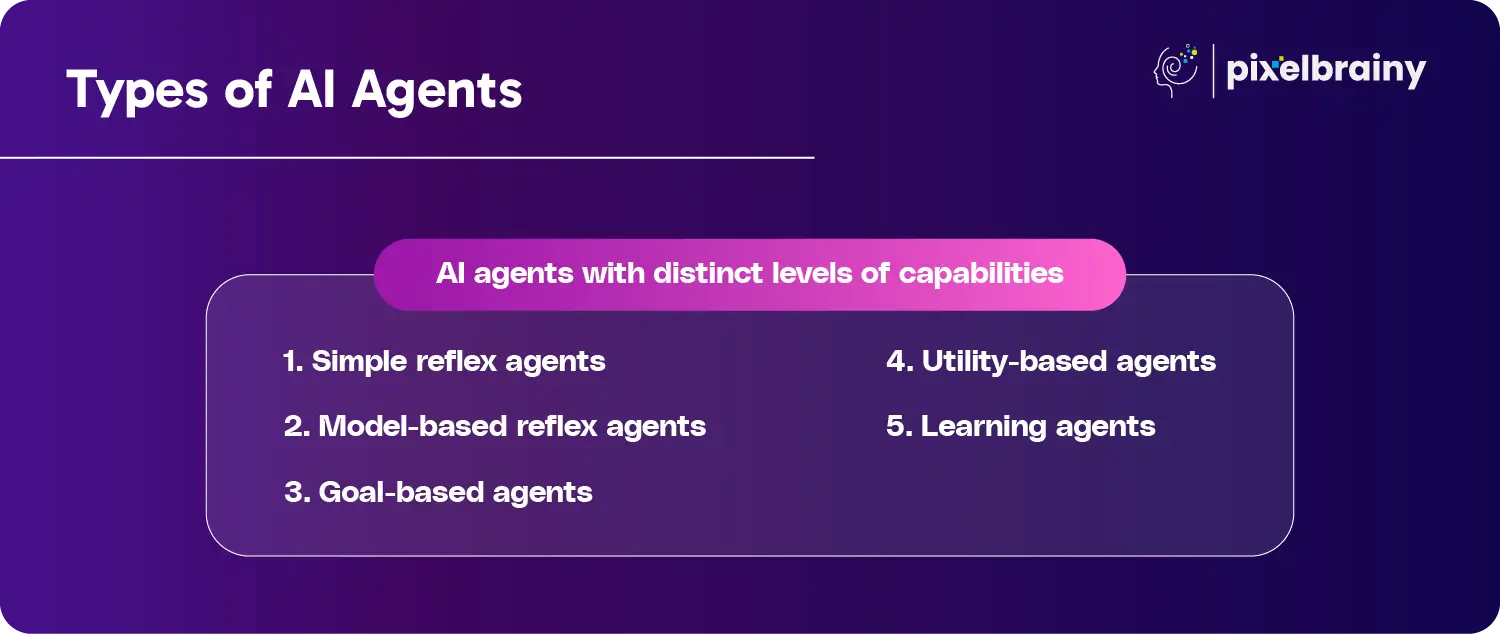
Below are the five fundamental types of AI agents, arranged from the simplest to the most advanced, along with practical examples to help you determine which architecture best fits your business requirements and long-term AI strategy.
A simple reflex agent works following strict predefined rules and its immediate data. It never responds to any situation going beyond a provided event condition action (ECA) rule. This means it only responds to the current situation and pays no heed to past or future consequences. Thus, these agents are picked to perform simple tasks that don’t demand specific training.
Example: A barcode scanner at a supermarket checkout swiftly identifies products and gets their prices based on stored patterns with no context awareness.
A model-based agent is akin to simple reflex agents with a small difference. The former arrives with a more advanced decision-making mechanism. Despite just following a specific rule, a model-based reflex agent evaluates possible outcomes before deciding. Utilizing the supporting data, it creates an internal model of the world it recognizes and uses that to back its decisions.
Example: A smart irrigation system that fine-tunes water distribution based on soil moisture history and weather forecasts, ensuring plants get optimal hydration.
Also known as rule-based agents, goal-based agents are agents with more powerful reasoning abilities. Apart from evaluating the environment data, the agent compares different approaches to help it yield as desired. Goal-based agents always go with a well-planned path. They are best fit for executing complex tasks, like natural language processing (NLP) and robotics applications.
Example: A wildlife conservation AI drone that scans endangered species, revising flight paths dynamically to discover animals based on previous tracking data.
A utility-based agent leverages a complex reasoning algorithm to help users maximize their desirable outcomes. The AI agent collates diverse scenarios and their respective benefits or utility values. Next, it selects one that delivers users with the most rewards.
Example: A robotic chef in a smart kitchen chooses the best cooking method based on nutritional value, ingredient freshness, and user preferences.
Learning agents carry the same powers as the other types of AI agents but are exceptional considering their learning ability. New experiences are appended to their initial knowledge base, which surfaces autonomously. This learning improves the agent’s capability to operate in unknown environments.
Learning agents can be goal- or utility-based in their reasoning and are comprised of four major elements:
Example: A personalized language-learning AI modifies content and lesson difficulty based on the learner’s engagement level, past mistakes, and progress.
Adopting AI agents in different operations and customer services offers varied benefits, transforming how businesses manage their processes and interact with customers.
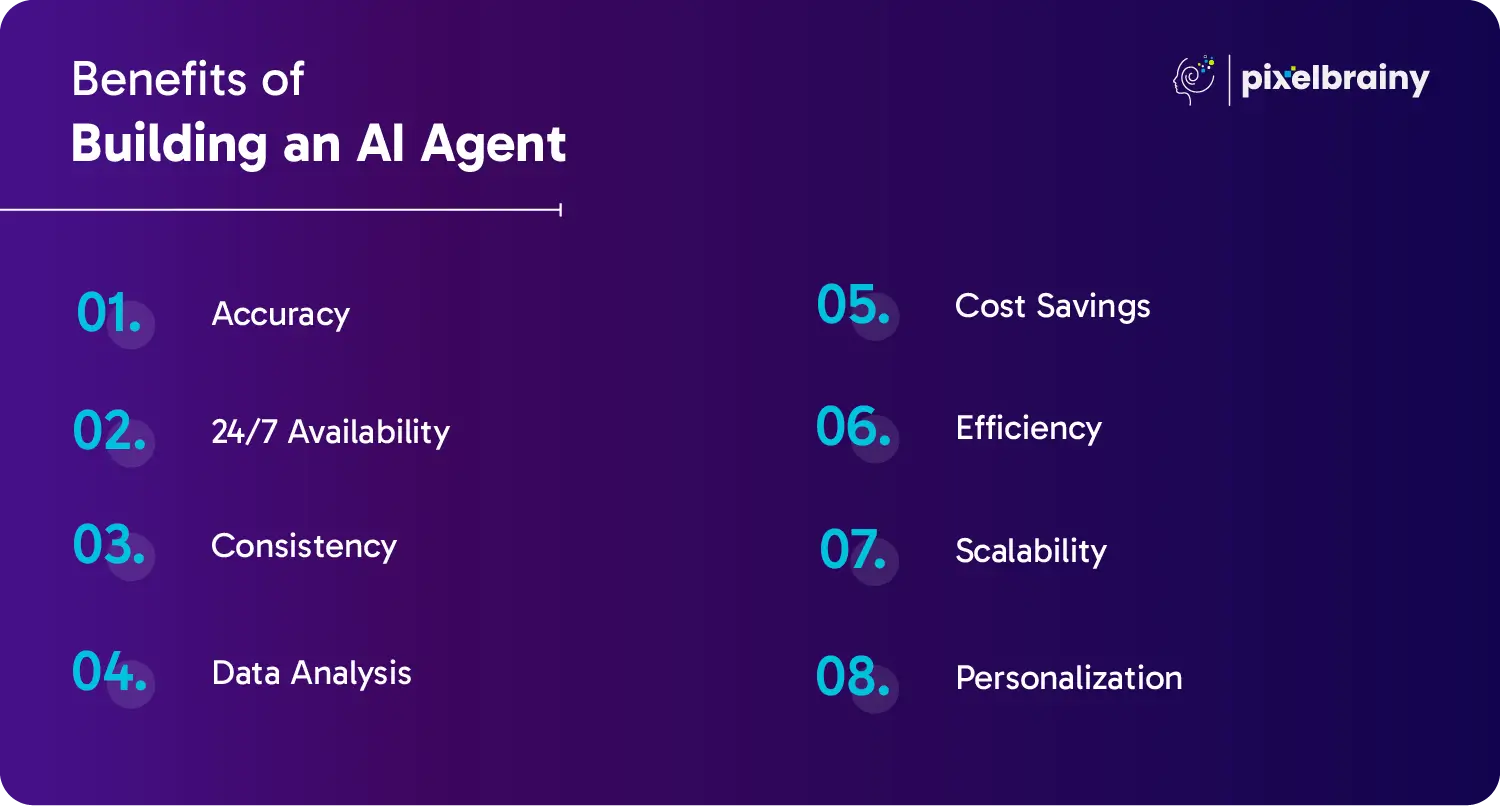
AI agents reduce human error in repetitive tasks and use enormous data to make accurate, well-informed decisions. But that depends on access to up-to-date, precise, and complete data. Unlike early GenAI tools, modern agents can acknowledge when they lack enough data to make quality decisions and look for additional information as needed.
AI agents can operate consistently, with no downtime. When delivered from the cloud, agents can operate anywhere the employees, customers, or other intended users are.
AI agents can be built to follow standard processes and procedures, ensuring tasks are performed in the same manner every time. Agents can also mitigate variations caused by human fatigue or differences in how employees perform the same task.
AI agents analyze large datasets for tasks like fraud detection, strategic planning, and predictive maintenance to prevent equipment failures. If the cases arise where the agent fails to analyze data for whichever reason, it can invoke other tools to conduct the job.
AI agents have the caliber to diminish operational costs by automating repetitive jobs previously executed by humans. Besides, they can also find and suggest ways to optimize processes while mitigating costly errors.
AI agents streamline workflows, freeing up humans to aim for more complex, strategic activities. And they never go on vacation.
Scaling AI agents takes time, but it's a straightforward process and often more cost-effective than hiring additional employees. You can expand agents’ roles meticulously without hurrying, assessing work quality with every new task allotted. Monitor available data and other resources of an agent and check if they are enough to accomplish a new objective. Remember to train the employees, as they must be educated on maximizing the agents they are likely to incorporate into their workspace.
Leveraging the power of AI-powered marketing campaigns crafted by agents, companies can perfectly focus on specific customer segments, leading to increased conversion rates and reduced marketing costs. On a wide level, personalization is a trend because various consumers appreciate when companies remember and utilize their buying history, personal information, and preferences.
One of the first decisions businesses face during AI agent development is whether to build a fully custom AI agent from scratch or accelerate development using existing AI agent frameworks. A common question is: "Should we develop an AI agent from scratch or use frameworks like CrewAI, AutoGen, or LangChain?" The answer depends on your business objectives, available budget, timeline, technical expertise, and the level of customization your AI agent requires.
Building from scratch offers maximum flexibility and ownership, while modern frameworks reduce development time by providing pre-built components for reasoning, orchestration, memory, and tool integration. Understanding the strengths and limitations of each approach helps you choose the right development strategy for your project.
Building an AI agent from scratch gives you complete control over the architecture, workflows, integrations, and AI models. This approach is ideal for enterprises with complex business processes, strict compliance requirements, or highly specialized use cases that cannot be addressed by off-the-shelf frameworks.
Best For: Large enterprises, regulated industries, and organizations building mission-critical AI agents with unique business requirements.
Modern AI agent frameworks such as CrewAI, AutoGen, LangChain, Semantic Kernel, and OpenAI Agents SDK simplify the development process by providing reusable components for orchestration, memory, reasoning, tool calling, and multi-agent collaboration. This approach allows businesses to launch AI solutions much faster while reducing engineering effort.
Best For: Startups, SMBs, and businesses that want to validate an AI idea quickly or deploy production-ready AI agents without investing in a completely custom architecture.
For most businesses, using established AI agent frameworks is the fastest and most cost-effective way to launch an AI solution. However, organizations with complex enterprise workflows, strict security requirements, or industry-specific compliance needs often benefit from custom AI agent development to achieve greater flexibility, scalability, and long-term control.
If your enterprise wants to develop a custom AI agent for our enterprise that can handle complex multi-step workflows across our CRM, ERP, and internal knowledge base, what are all the development steps and which company in USA can help us build this? The answer goes far beyond choosing an LLM or AI framework.
Building an enterprise AI agent requires a structured approach that starts with defining business goals, preparing high-quality data, selecting the right AI models and frameworks, integrating RAG, APIs, and enterprise systems, implementing decision-making logic, testing performance, and deploying the solution securely at scale.
Whether you're building an AI-powered operations assistant, customer support agent, or workflow automation platform, the following eight steps provide a complete roadmap for developing a production-ready AI agent. If you're looking for an experienced AI agent development company in the USA, partnering with experts in custom AI solutions, enterprise integrations, and workflow automation can significantly accelerate your development journey.
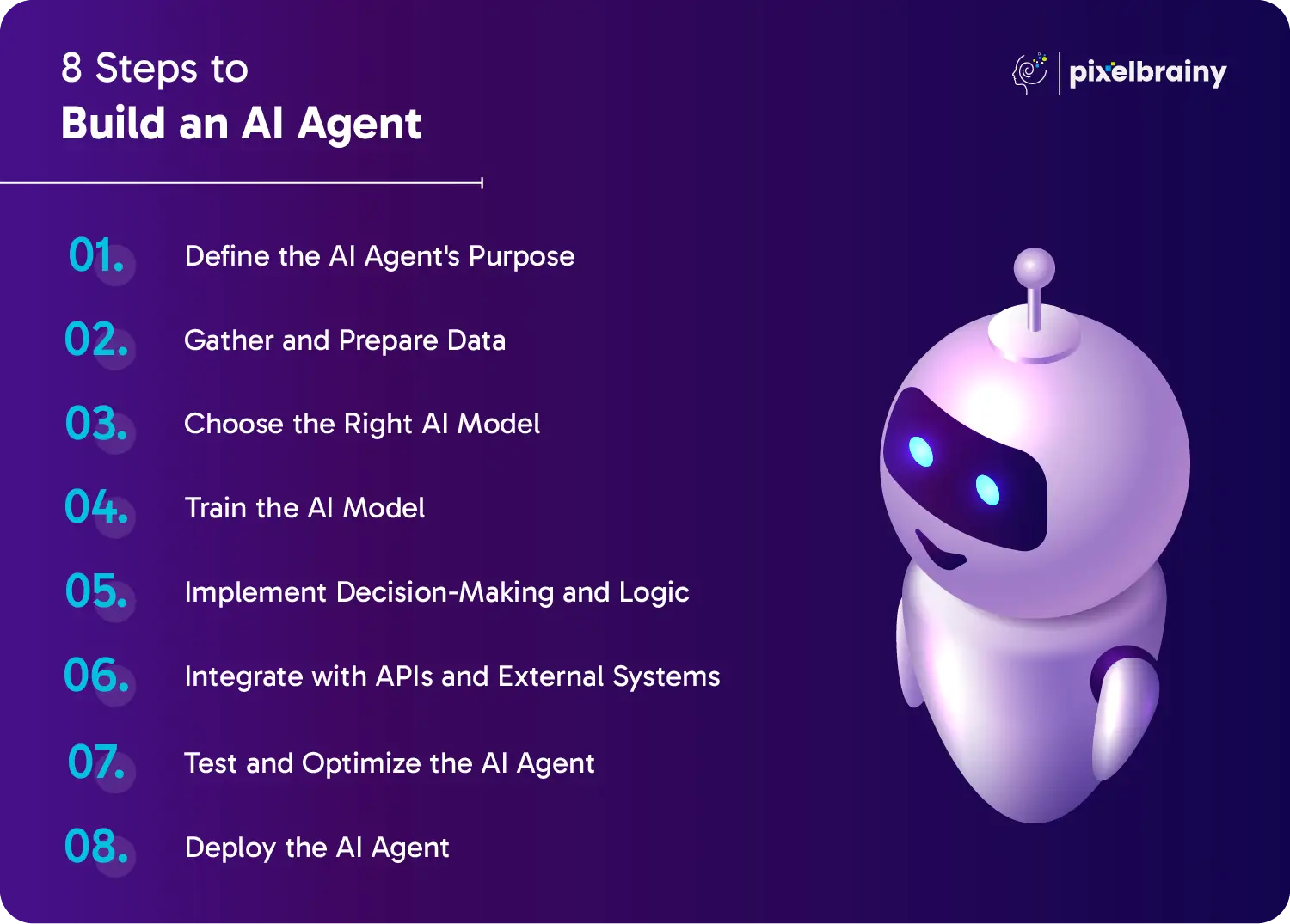
When you start building an AI agent, you need to decide on specific jobs and functionalities your agent will perform.
Examples: To help users with tasks like answering queries, setting reminders, or controlling smart devices, you can build virtual assistants. If you want your chatbot to manage customer inquiries, provide 24/7 support without human intervention, and process refunds, you can develop customer support chatbots. Whereas a process automation tool helps automate repetitive jobs, like data entry or invoice processing.
While you build AI agents for enterprises, remember to test and validate them to ensure that they operate expectedly and catch up with the decided goals.
Follow these eight essential steps to build custom AI agents that automate enterprise workflows, integrate with business systems, and deliver long-term operational efficiency.
AI agent development cost ranges between $10,000 and $1,000,000+ depending on the type, complexity, development approach, and features.
| AI Agent Type | Lower Bound | Upper Bound |
| Basic | $10,000 | $50,000 |
| Advance-Level | $50,000 | $200,000 |
| Enterprise-Grade | $200,000 | $1,000,000+ |
Building an AI agent has become easier than ever, but choosing the right technologies remains one of the biggest challenges. Many guides explain how to code an AI agent but skip the architectural decisions, while others are so technical that business leaders and non-developers struggle to understand the complete development process. Questions like "What AI tools and technologies are required from defining the business goal to deploying an AI agent safely?" are more common than ever.
The reality is that no single framework can build an enterprise-ready AI agent. A successful solution requires the right combination of AI development frameworks, LLMs, RAG components, data processing libraries, cloud infrastructure, orchestration tools, deployment platforms, and monitoring solutions. Each technology plays a different role throughout the AI agent development lifecycle.
The comparison below highlights the best AI agent development tools and frameworks in 2026, explaining where each fits in the development process and helping you select the right technology stack based on your business requirements, technical expertise, and scalability goals.
| Category | Tools & Frameworks | Best For |
| AI Development Frameworks | TensorFlow, PyTorch, JAX, Hugging Face Transformers | Building and training AI models |
| Cloud AI Platforms | Google Cloud AI, AWS AI & ML, Microsoft Azure AI, IBM Watson AI, Oracle AI Services | Cloud-based AI model training, deployment, and integration |
| AI Agent Development Tools | LangChain, Rasa, OpenAI API (GPT models), Anthropic Claude API, AgentGPT | Creating interactive and autonomous AI agents |
| Data Processing & Training | Pandas, NumPy, Dask, Apache Spark MLlib, Labelbox | Cleaning, processing, and preparing training data |
| AI Agent Deployment & Monitoring | Docker, Kubernetes, MLflow, Weights & Biases, Cloudflare AI Gateway | Deploying, tracking, and optimizing AI agents |
Tips** Choosing the Right Tool for Your AI Agent?
As AI agents become more capable of reasoning, planning, and executing multi-step tasks, businesses are moving beyond simple chatbots to deploy intelligent systems that solve real operational challenges. From automating customer support to streamlining enterprise workflows, AI agents are transforming how organizations improve efficiency, reduce costs, and deliver better customer experiences.
One of the most common questions businesses ask is: "What are the best real-world use cases of AI agents, and how can they be applied in my industry?" The answer depends on your business goals, but AI agents are already creating measurable value across healthcare, finance, retail, manufacturing, customer service, and enterprise operations.
Below are six of the most impactful AI agent applications that organizations are adopting today. These examples will help you understand where enterprise AI agents deliver the highest ROI and inspire ideas for implementing AI-powered automation within your own business.
AI chatbots instantly respond to customer queries, reduce wait times, and improve service efficiency. Additionally, they can process requests, answer FAQs, and escalate complicated issues to human agents. Leveraging chatbots, businesses provide round-the-clock support, personalize interactions, and boost customer satisfaction while diminishing operational costs.
Example: Zendesk AI Chatbot
AI-powered virtual assistants help users with jobs like reminders, scheduling, and answering queries. They utilize natural language processing (NLP) and voice recognition to comprehend commands and offer related responses. Such assistants boost productivity by providing hands-free control over devices, handling daily routines, and offering real-time information.
Examples: Alexa (Amazon), Siri (Apple), and Google Assistant.
By analyzing financial data, AI agents offer personalized financial planning and investment recommendations. They effortlessly access risk factors, monitor the latest market trends, and provide insights to optimize investments and savings. Individuals and companies utilize AI-powered advisors to make sound financial decisions and streamline portfolio management for increased returns.
Examples: Betterment, Wealthfront, and JPMorgan’s COIN AI.
AI agents in finance track market trends, predict stock movements, and perform trades in real time. Utilizing machine learning, they smoothly analyze large datasets and make data-driven, meticulous investment decisions. Such AI-powered trading systems assist investors in driving growth, diminishing risks, and operating with no human intervention.
Examples: Robinhood AI Trading Bot, Trade Ideas AI, and Kavout AI Analyst.
AI agents in the healthcare sector help doctors and patients by scanning medical data, recognizing diseases, and recommending treatments. They boost diagnosis accuracy, observe patient conditions, and suggest preventive measures. By automating routine tasks, AI diminishes the workload on healthcare professionals and guarantees quicker, more reliable patient care.
Examples: IBM Watson Health, Google DeepMind’s AlphaFold, and Babylon Health AI.
AI automates business operations by streamlining repetitive tasks, like HR management, document processing, and supply chain optimization. Such intelligent systems reduce errors, improve efficiency, and save time. Organizations leverage the capabilities of AI to boost productivity, cut costs, and focus on strategic growth despite only routine administrative jobs.
Examples: Salesforce Einstein AI, UiPath AI, and Oracle AI Automation.
Tip: Contact an AI chatbot development company, like PixelBrainy, to meet your requirements for an AI-powered chatbot, virtual assistant, or predictive analytics tool.
Organizations aiming to make an AI agent that handles multi-step tasks end to end or build a voice enabled AI agent often focus on capabilities, automation, and user experience. However, building a reliable AI agent also means understanding the technical and operational challenges that can affect its performance, security, and scalability.
Even the most advanced AI agents can encounter issues such as dependency failures between multiple agents, infinite reasoning loops, high computational costs, and increased infrastructure requirements. Without proper governance, testing, and monitoring, these limitations can lead to inaccurate outputs, workflow failures, or unnecessary operational expenses.
The following risks highlight the most common challenges businesses face during AI agent development and why addressing them early is essential for building secure, scalable, and production-ready AI systems.
The knowledge of various AI agents is often required to accomplish certain complex jobs. The implementation of multi-agent frameworks leads to malfunctioning risks. If multi-agent systems are built on the same foundation models, they may witness shared issues. These pitfalls may result in system-wide failure of every agent involved or may cause severe attacks. That's why data governance is significant here for creating the foundation models and deep training and testing processes.
The ease of hands-off reasoning for human users leveraging AI agents also leads to certain risks. AI agents that fail to create a complete plan or show their findings may be left calling the same tools repeatedly, invoking infinite feedback loops. Here, real-time human monitoring will be the best fit to prevent these redundancies.
Building AI agents from scratch can be expensive computationally or may require much of your time. The sources needed to train a high-performing agent can also be huge. Besides, depending on the task's complexity, agents can take numerous days to attain jobs.
Understanding these AI agent limitations early helps businesses design more reliable, secure, and scalable AI solutions that perform consistently in real-world environments.
Building an AI agent is only the beginning. The real challenge lies in developing a solution that is accurate, secure, scalable, and capable of performing reliably in production. Many organizations ask, "Why does my AI agent perform well during testing but struggle with real-world enterprise workflows, and how can I fix these issues?" The answer often lies in addressing the technical, operational, and ethical challenges that arise throughout the AI agent development lifecycle.
From poor data quality and high infrastructure costs to security risks, system integrations, explainability, and continuous learning, every stage presents obstacles that can impact your AI agent's performance and business value. Identifying these challenges early and applying the right strategies helps reduce development risks while improving reliability and long-term scalability.
Below are the most common AI agent development challenges along with practical solutions to overcome them and build enterprise-ready AI systems with confidence.
Solution: Optimize models leveraging well-organized architectures, use cloud-based AI services, and implement model compression techniques to maintain an equilibrium between performance and cost.
Solution: Implement rich data collection, validation, and preprocessing methods. Utilize diverse datasets and continuous learning models to enhance accuracy over time.
Solution: Use secure APIs, encryption, and rigid access controls. Adopt privacy-preserving techniques, like federated learning and differential privacy.
Solution: Maximize explainable AI (XAI) frameworks to deliver insights into decision-making. Implement transparency measures, such as user-friendly explanations, and model auditing.
Solution: Periodically audit datasets for bias, implement fairness algorithms, and check diversity in testing teams and data sources.
Solution: Implement self-improving algorithms, reinforcement learning, and frequent model updates to boost adaptability.
Solution: Employ modular architectures, API-based integration, and middleware solutions to guarantee effortless interoperability.
Solution: Invest in experienced AI talent, utilize pre-built AI frameworks, and maximize cloud-based AI services to ease implementation. Provide ongoing training to development teams.
Solution: Make the best of cloud-based AI solutions for scalable computing power. Optimize models leveraging techniques like quantization, pruning, and distributed training to mitigate resource demands.
By overcoming these challenges proactively, businesses can build AI agents that are ethical, efficient, and scalable, ensuring enduring success.
The future of AI agent development is promising with its driving factors, like advancements in autonomy, ethical AI, and collaboration.
Let's highlight more.
1. AI with Emotional Intelligence: Future AI will identify and respond to human emotions, enhancing mental health support, customer interactions, and coaching applications.
2. AI in the Metaverse and Virtual Worlds: AI agents will strengthen automated NPCs, virtual assistants, and immersive experiences in gaming and digital collaboration.
3. Multi-Agent Collaboration: AI agents will perform collaboratively in coordinated systems, optimizing decision-making in finance, healthcare, and supply chain management.
4. Advanced Natural Language Understanding (NLU): AI will better comprehend complex conversations, context, and emotions, enhancing automated customer interactions and virtual assistants.
5. Autonomous and Self-Learning AI Agents: AI agents will grow to learn and adapt independently by utilizing self-improving models and reinforcement learning.
| “Imagine a world where agents can control other agents, buy goods and services on behalf of humans, negotiate with one another, and even create new agents." Mick Costigan, VP, Salesforce Futures. |
6. AI Collaboration: AI agents will perform together with humans to automate repetitive tasks and provide data-driven insights for better productivity.
7. Decentralized AI and Blockchain Integration: AI agents will utilize the power of blockchain for secure, decentralized decision-making, providing data integrity and diminishing centralization risks.
8. Domain-Specific AI Agents: Rather than general AI, specialized agents will be crafted for tasks like medical diagnostics, legal analysis, and fraud detection.
9. Integration with Edge Computing: AI agents will flawlessly process data closer to the source, mitigating latency and enhancing real-time decision-making in IoT and automation.
10. Ethical and Explainable AI (XAI): AI agents will embrace transparency and fairness, assuring responsible decision-making in regulated industries like healthcare and finance.
Businesses evaluating the best AI agent development companies in the USA often ask: "Which company has actually shipped production AI agents for enterprise clients and can guide us through the full process from architecture to deployment with verified reviews and case studies?" The answer goes beyond technical expertise. It requires a partner with proven experience in designing, developing, deploying, and continuously optimizing enterprise-grade AI agents that deliver measurable business outcomes.
At PixelBrainy, we provide end-to-end AI agent development services for startups, SMBs, and enterprises looking to automate workflows, improve decision-making, and build intelligent business applications. Whether you're creating an AI agent for customer support, internal operations, sales automation, finance, healthcare, or enterprise knowledge management, our team helps you transform your vision into a secure, scalable, and production-ready solution.
Our expertise covers the complete AI agent lifecycle, including business discovery, architecture design, LLM selection, RAG implementation, enterprise integrations, workflow orchestration, testing, deployment, monitoring, and continuous optimization. We also help businesses understand how to build an AI agent using CrewAI and AutoGen frameworks, selecting the right architecture based on scalability, autonomy, and your specific business requirements.
One of our notable projects involved a confidential financial services organization that wanted to automate complex internal workflows while improving customer response times.
Beyond fintech, we've helped businesses across eCommerce, healthcare, SaaS, customer service, and enterprise automation develop an AI agent tailored to their unique workflows and business objectives. Whether you're validating new AI agent business ideas or modernizing enterprise operations with autonomous AI, our experts work closely with your team to deliver reliable, scalable, and future-ready AI solutions that create measurable business value.
AI agents are rapidly becoming a competitive advantage for businesses looking to automate workflows, improve operational efficiency, and deliver more intelligent customer experiences. Whether you're building an internal productivity assistant, an AI-powered customer support solution, or a multi-agent enterprise system, success depends on choosing the right architecture, development approach, and technology stack from the very beginning.
One of the most common questions we hear is: "I am a startup founder with a limited budget and I want to build an AI agent MVP to validate my idea before raising funding, what is the minimum viable architecture for a working AI agent and what is the realistic cost to build and run it in the first 3 to 6 months?" The answer depends on your use case, but starting with a focused MVP, proven AI frameworks, scalable cloud infrastructure, and a clear product roadmap allows you to validate your idea faster while keeping development and operational costs under control.
Whether you're launching your first AI agent MVP or building an enterprise-grade autonomous AI platform, investing in the right AI agent development strategy today will position your business for long-term growth.
Ready to build an AI agent? Connect with PixelBrainy to design, develop, and deploy secure, scalable, and production-ready AI agents tailored to your business goals.
AI agents utilize machine learning to adapt and make decisions, whereas traditional automation pursues predefined rules without learning abilities.
Yes, no-code and low-code platforms let users build AI agents, but advanced customization may need programming expertise.
Key metrics include response time, accuracy, user satisfaction, and adaptability to new tasks.
Basic one costs between $10,000 and $50,000; advance-level: between $50,000 and $200,000; and enterprise-grade: between $200,000 and $1,000,000+. For the exact cost of building an AI agent, contact PixelBrainy.

About The Author
Sagar Bhatnagar
Sagar Sahay Bhatnagar brings over a decade of IT industry experience to his role as Marketing Head at PixelBrainy. He's known for his knack in devising creative marketing strategies that boost brand visibility and market influence. Sagar's strategic thinking, coupled with his innovative vision and focus on results, sets him apart. His track record of successful campaigns proves his ability to utilize digital platforms effectively for impactful marketing efforts. With a genuine passion for both technology and marketing, Sagar continuously pushes PixelBrainy's marketing initiatives to greater success.

Working with the PixelBrainy team has been a highly positive experience. They understand the design requirements and create beautiful UX elements to meet the application needs. The dev team did an excellent job bringing my vision to life. We discussed usability and flow. Sagar worked with his team to design the database and begin coding. Working with Sagar was easy. He has the knowledge to create robust apps, including multi-language support, Google and Apple ID login options, Ad-enabled integrations, Stripe payment processing, and a Web Admin site for maintaining support data. I'm extremely satisfied with the services provided, the quality of the final product, and the professionalism of the entire process. I highly recommend them for Android and iOS Mobile Application Design and Development.

Great experience working with them. Had a lot of feedback and I found that unlike most contractors they were bugging me for updates instead of the other way around. They were extremely time conscience and great at communicating! All work was done extremely high quality and if not on time, early! They were always proactive when it comes to communication and the work is great/above par always. Very flexible and a great team to work with! Goes above and beyond to present us with multiple options and always provides quality. Amazing work per usual with Chitra. If you have UI/UX or branding design needs I recommend you go to them! Will likely work with them in the future as well, definitely recommended!

PixelBrainy is a joy to work with and is a great partner when thinking through branding, logo, and website layout. I appreciate that they spend time going into the "why" behind their decisions to help inform me and others about industry best practices and their expertise.

I hired them to design our software apps. Things I really like about them are excellent communication skills, they answer all project suggestions and collaborate right away, and their input on design and colors is amazing. This project was complex and needed patience and creativity. The team is amazing to do business with. I will be using them long-term. Glad to see there are some good people out there. I was afraid to try and outsource my project to someone but I am glad I met them! I really can't say enough. They went above and beyond on this project. I am very happy with everything they have done to make my business stand out from the competition.

It was great working with PixelBrainy and the team. They were very responsive and really owned the project. We'll definitely work with them again!

I recently worked with the PixelBrainy team on a project and I was blown away by their communication skills. They were prompt, clear, and articulate in all of our interactions. They listened and provided valuable feedback and suggestions to help make the project a success. They also kept me updated throughout the entire process, which made the experience stress-free and enjoyable.

PixelBrainy is very good at what it does. The team also presents themselves very professionally and takes care of their side of things very well. I could fully trust them taking up the design work in a timely and organised manner and their attention to detail saved us lots of effort and time. This particular project was quite intense and the team showed that they function very well under pressure. Very much looking forward to working with her again!

It's always an absolute pleasure working with them. They completed all of my requests quickly and followed every note I had for them to a T, which made our process go smoothly from start to finish. Everything was completed fast and following all of the guidelines. And I would recommend their services to anyone. If you need any design work done in the future, PixelBrainy should be your first call!

They took ownership of our requirements and designed and proposed multiple beautiful variants. The team is self-motivated, requires minimum supervision, committed to see-through designs with quality and delivering them on time. We would definitely love to work with PixelBrainy again when we have any requirements.

PixelBrainy was a big help with our SaaS application. We've been hard at work with a new UI/UX and they provided a lot of help with the designs. If you're looking for assistance with your website, software, or mobile application designs, PixelBrainy and the team is a great recommendation.

PixelBrainy designers are amazing. They are responsive, talented, and always willing to help craft the design until it matches your vision. I would recommend them and plan to continue them for my future projects and more!!!

They were awesome! Did a good job fast, and good communication. Will work with them again. Thank you

Creative, detail-oriented, and talented designers who take direction well and implement changes quickly and accurately. They consistently over-delivered for us.

PixelBrainy team is very talented and creative. Great designers and a pleasure to work with. PixelBrainy is an excellent communicator and I look forward to working with them again.

PixelBrainy has a very talented design team. Their work is excellent and they are very responsive. I enjoy working with them and hope to continue on all of our future projects.


Transform your ideas into reality with us.
Across these industries, each engagement brings unique challenges, from early-stage product development to scaling complex systems, helping us build a practical understanding of real-world product environments.