AI Summary Powered by PixelBrainy
What if you could launch a production-grade AI social casino platform with slots, poker, blackjack, and roulette without letting development costs spiral beyond your investment plan?
For gaming entrepreneurs, understanding the AI social casino platform development cost before writing the first line of code is critical. In 2026, the cost to build an AI social casino platform can range from approximately $40,000 to $350,000+, depending on the platform's features, game portfolio, AI capabilities, technology stack, number of platforms, team location, integrations, security requirements, and post-launch support.
So, how much does it cost to build an AI social casino platform in 2026? A lean MVP may start around $40,000 to $80,000, while a feature-rich production platform with multiple casino games, AI personalization, player analytics, social features, virtual currency, administrative dashboards, scalable cloud infrastructure, and advanced security can reach $150,000 to $350,000 or more.
Consider this real-world scenario: I am a gaming entrepreneur and want to build an AI social casino platform offering slots, poker, blackjack, and roulette with virtual currency that players cannot cash out for real money. I need an honest cost breakdown before approaching investors. What should I budget?
A realistic development budget of an AI social casino platform should account for much more than UI design and game development. Backend architecture, virtual economies, AI recommendation systems, analytics, fraud prevention, QA, cloud infrastructure, game mathematics, third-party integrations, compliance analysis, and ongoing LiveOps can significantly affect the final cost of creating an AI social casino platform.
This guide breaks down the estimated $40,000-$350,000+ investment, development phases, team options, build-versus-license economics, hidden costs, cost optimization strategies, and evidence from companies that publicly document social casino player or engagement metrics.

Developing an AI social casino platform involves much more than putting casino games online. For a land-based casino operator, the platform may need to connect physical casino loyalty programs with a free-to-play digital gaming experience, support virtual currencies, integrate player accounts, deliver personalized game recommendations, synchronize rewards, provide real-time analytics, and maintain a consistent brand experience across physical and digital channels.
Every one of these capabilities can influence the AI social casino platform development cost, making budget planning an essential step before development begins.
Consider this practical scenario:
“We are a land-based casino operator and want to build an AI social casino platform that extends our brand into the free-to-play digital gaming market. We want existing loyalty members to play their favorite casino games online between physical casino visits while earning points toward their existing rewards program. Before we scope development, how much does an AI social casino platform cost to build, what should our development investment include, and which development companies have experience building social casino extensions for physical casino brands with loyalty program integration?”
This type of project is considerably more complex than developing a standalone social casino application. The platform may need to connect casino games, player accounts, loyalty data, virtual currency, AI personalization, rewards, analytics, customer engagement systems, and existing casino technology.
That is why understanding the AI social casino platform development investment before development starts can help casino businesses establish realistic expectations, prioritize functionality, control scope, and prepare for both initial and recurring expenses.
A land-based casino does not necessarily need every AI and social gaming capability in the first release.
A carefully scoped MVP can provide the essential digital experience while creating an architecture that supports future expansion.
A typical first-phase AI social casino platform may include:
Advanced capabilities can then be introduced in later phases, such as:
Separating essential functionality from future enhancements can help control the custom AI social casino platform development cost without limiting the long-term product roadmap.
For a land-based casino, the question “how much does AI social casino platform development cost?” cannot be answered accurately with a single development number.
A meaningful AI social casino platform development cost estimate should show where the investment is going.
A preliminary budget can be divided into:
This makes it easier for executives and investors to understand why the cost of building an AI social casino platform can vary significantly from one project to another.
For example, a branded platform containing several integrated games and basic AI recommendations may require substantially less investment than a proprietary ecosystem featuring custom games, advanced personalization, real-time multiplayer functionality, sophisticated loyalty integration, predictive analytics, and enterprise-level infrastructure.
Scope expansion can become a major reason for increasing development budgets.
A casino operator may initially plan to offer existing loyalty members a few popular games online. During planning, stakeholders may request additional functionality such as:
Each additional feature can affect development time, architecture, testing, infrastructure, security, and ongoing maintenance.
For example, connecting a digital player account to an existing loyalty system may initially appear straightforward. However, the integration may require identity matching, secure APIs, points synchronization, transaction reconciliation, error handling, authentication, permissions, and data consistency between physical and digital systems.
Similarly, adding an AI recommendation engine requires more than connecting an AI API. The platform may need player-event data, game metadata, behavioral signals, segmentation logic, recommendation rules, model evaluation, and monitoring.
A defined budget allows each requested feature to be evaluated according to:
This helps casino operators decide whether a capability belongs in the MVP, a second development phase, or the longer-term roadmap.
Technology choices can directly influence the AI social casino platform development rates and overall investment.
Before development begins, the operator may need to determine whether the platform should use:
For example, a business launching an MVP may use established AI services for recommendations and customer support rather than investing immediately in proprietary machine learning infrastructure.
Likewise, integrating selected third-party games may reduce the initial cost of building an AI social casino platform compared with developing every game internally.
However, the long-term implications of licensing, API dependency, data access, customization, revenue sharing, and vendor lock-in should be evaluated before selecting a provider.
A major consideration for land-based casino operators is that the social casino platform should not operate as an isolated application.
The business may want the digital experience to connect with existing systems such as:
The purpose may be to create a consistent customer experience between physical casino visits and digital engagement.
For example, a loyalty member could potentially log into the social casino platform, play free-to-play games, view rewards, participate in digital promotions, and continue interacting with the casino brand between physical visits.
The technical architecture therefore needs to account for secure data exchange, identity management, API availability, synchronization, permissions, and data governance.
This integration layer can represent a significant part of the AI social casino platform development investment.
The initial development quotation is not the complete financial requirement.
After launch, the operator may need to budget for:
For example, an AI system that analyzes player behavior and generates recommendations for hundreds of thousands of users may create considerably different operating expenses from a basic recommendation feature used by a smaller audience.
Therefore, the AI social casino platform development cost estimate should include both initial development expenses and the expected cost of operating the platform after launch.
Another major financial decision is whether to use third-party AI services or build custom AI capabilities.
For an initial release, existing AI APIs and machine learning services may support:
Custom AI can become more relevant when the casino operator has sufficient proprietary player data and needs highly specialized models.
Custom AI development can introduce additional costs for:
Budget planning helps determine which AI capabilities genuinely justify custom development and which can initially be delivered through existing technology.
The objective should not necessarily be to build every feature on day one.
A land-based casino operator can consider a phased roadmap.
This phased approach can help control the AI social casino platform development cost, reduce financial risk, and allow the operator to expand investment according to actual player adoption and business performance.
When comparing AI social casino development companies, casino operators should look beyond an hourly development rate.
A lower AI social casino platform development rate does not automatically represent a lower total project cost.
The evaluation should consider:
Public case studies can provide useful evidence, but operators should distinguish between independently verified metrics and metrics reported by the development company or its client.
For example, some gaming technology providers and studios publicly report DAU, MAU, retention, session frequency, or player-volume metrics in social casino case studies. These figures can help with vendor due diligence, but they should not automatically be interpreted as guaranteed results for a new platform.
Ultimately, the custom AI social casino platform development cost should be evaluated as an investment in a digital extension of the casino brand, not simply as a software invoice.
Before development begins, the operator should understand:
For a land-based casino operator asking, “What is the cost of building an AI social casino platform?”, the most useful answer is therefore not a generic development price.
The AI social casino platform development cost estimate should reflect the number of games, AI capabilities, loyalty integration complexity, existing casino systems, platforms, expected player volume, security requirements, development approach, game licensing strategy, and long-term operating requirements.
A well-defined budget gives casino businesses the ability to start with a commercially realistic MVP, avoid uncontrolled scope expansion, compare custom development with existing platform providers, and build a scalable foundation for a digital social casino experience that complements the physical casino business.
Also Read: AI Casino Website Development: Features, Cost Breakdown, Legal Compliance, and Key Challenges
The AI social casino platform development cost typically ranges from $40,000 to $350,000+, depending on the number of casino games, AI functionality, virtual currency system, loyalty integrations, social features, player capacity, security requirements, analytics, third-party integrations, and overall platform complexity.
A basic AI social casino MVP may cost around $40,000 to $80,000, while a mid-level platform with multiple casino games, AI recommendations, virtual currency, loyalty integration, analytics, and stronger scalability can cost approximately $80,000 to $150,000. An advanced AI social casino platform with personalized player experiences, predictive analytics, sophisticated LiveOps, social features, and advanced security may require $150,000 to $250,000. Enterprise-level platforms with custom AI, multiple game integrations, large-scale infrastructure, advanced loyalty integration, high availability, and extensive analytics can reach $250,000 to $350,000+.
So, how much does it cost to make an AI social casino platform? There is no single fixed price. The most accurate AI social casino platform development cost estimate depends on the number of games, target player volume, AI capabilities, loyalty and CRM integrations, virtual economy, platforms, security requirements, development approach, and future expansion plans.
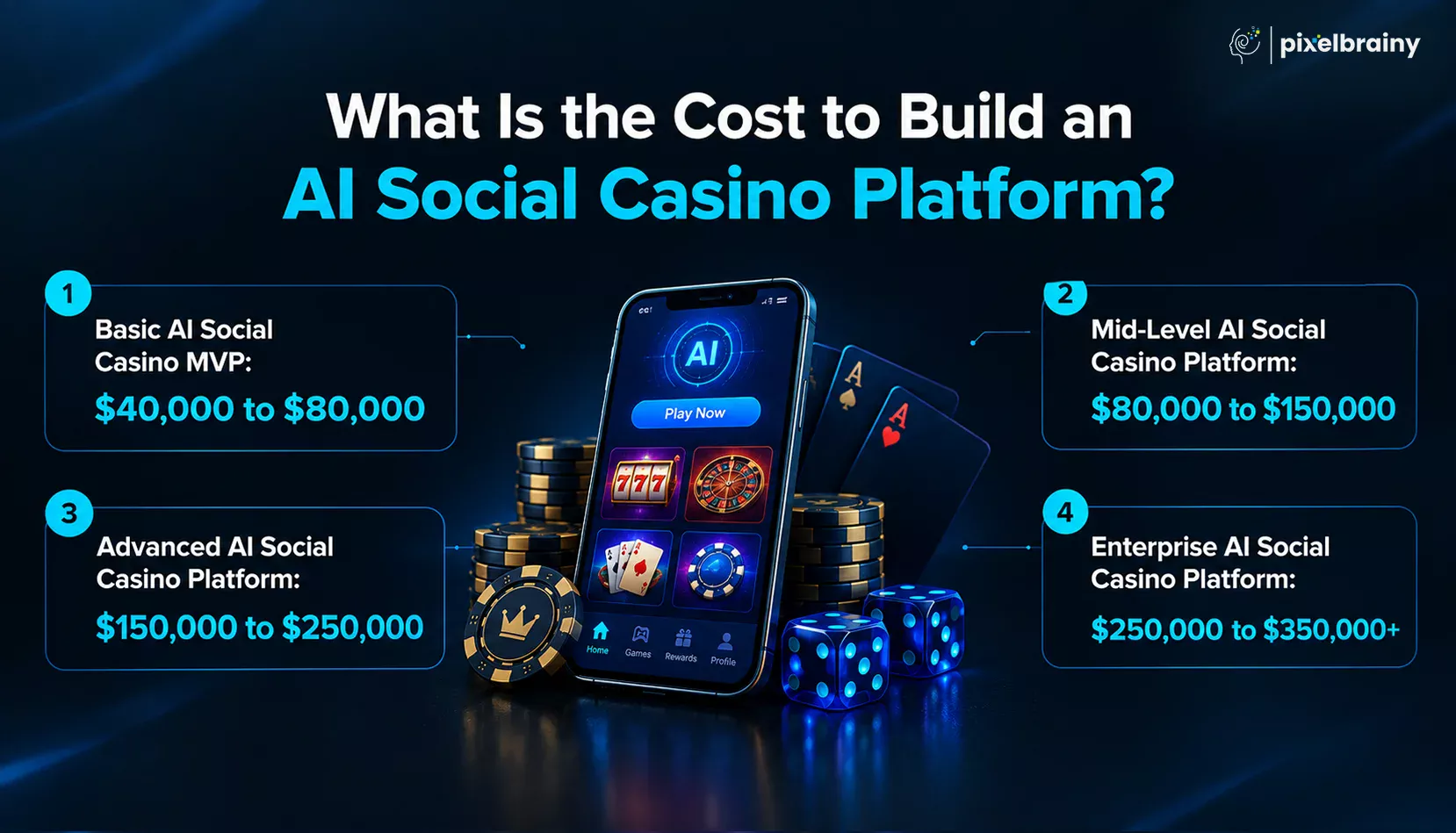
AI Social Casino Platform Development Cost Breakdown:
| Development Tier | Estimated Cost | Typical Timeline | What's Included |
|---|---|---|---|
| Basic AI Social Casino MVP | $40,000-$80,000 | 3-5 months | Player accounts, casino lobby, virtual currency, selected games, basic AI recommendations, admin panel, notifications, basic analytics |
| Mid-Level AI Social Casino Platform | $80,000-$150,000 | 4-7 months | Multiple games, loyalty integration, AI recommendations, rewards, social features, analytics, enhanced security, scalable cloud infrastructure |
| Advanced AI Social Casino Platform | $150,000-$250,000 | 6-10 months | Advanced personalization, predictive analytics, tournaments, LiveOps, behavioral segmentation, advanced security, sophisticated player analytics |
| Enterprise AI Social Casino Platform | $250,000-$350,000+ | 9-15+ months | Custom AI, multiple integrations, large-scale infrastructure, advanced loyalty ecosystem, high availability, extensive analytics, enterprise security |
A basic MVP is suitable for a casino business that wants to establish a digital social gaming presence while keeping the initial cost of building an AI social casino platform controlled.
The platform may include:
At this stage, the objective is to establish the core gaming experience and validate player engagement before investing in more sophisticated AI and social functionality.
For a land-based casino operator, the MVP can also include a basic connection to the existing loyalty program if suitable APIs are available. More complex loyalty synchronization can be introduced during later development phases.
A mid-level platform is designed for casino businesses that require a more complete digital gaming ecosystem with deeper personalization and loyalty functionality.
It may include:
This tier provides a balance between functionality, scalability, and the overall development budget of an AI social casino platform.
It can be particularly relevant for a land-based casino operator that wants existing loyalty members to continue interacting with the brand digitally between physical casino visits.
At this level, AI becomes a more significant component of the player experience and operational platform.
Advanced functionality may include:
The cost of creating an AI social casino platform increases at this level because these capabilities require additional data engineering, AI development, backend architecture, testing, infrastructure, analytics, and continuous optimization.
For example, a simple recommendation feature can use predefined rules or an external AI service. A sophisticated personalization engine may require player-event pipelines, historical behavioral data, segmentation, recommendation models, experimentation, model evaluation, and ongoing monitoring.
An enterprise AI social casino platform is intended for large casino operators, multi-property businesses, established gaming companies, or organizations expecting substantial player volumes and complex technology requirements.
It may support:
For a land-based casino operator connecting an existing loyalty ecosystem with a large digital social casino platform, this tier may become relevant when the project requires multiple integrations, sophisticated personalization, substantial game content, and enterprise-level scalability.

If the priority is to validate the concept and launch essential social casino functionality, a $40,000 to $80,000 MVP can provide a focused starting point.
If the business needs multiple games, loyalty integration, AI recommendations, rewards, analytics, and social functionality, the $80,000 to $150,000 range provides greater functionality.
If AI personalization, predictive analytics, advanced player segmentation, LiveOps, and sophisticated engagement systems are central to the product, the $150,000 to $250,000 range provides room for more advanced capabilities.
For large casino operators requiring extensive integrations, high-volume infrastructure, custom AI, enterprise security, advanced loyalty functionality, and multi-property scalability, the $250,000 to $350,000+ range may be appropriate.
Ultimately, the right AI social casino platform development investment depends on what the business needs at launch, which capabilities can be introduced later, and how much scalability the architecture requires from day one.
A phased development strategy can make the AI social casino platform development cost more predictable while allowing the business to introduce advanced AI, additional games, deeper loyalty integration, and sophisticated personalization as player adoption and platform requirements grow.
What is the cost to make an AI social casino platform, and how can a gaming startup estimate the investment before development begins? An AI social casino platform development cost calculator helps founders estimate expenses based on development hours, game complexity, AI capabilities, virtual currency, integrations, infrastructure, security, and maintenance.
The overall AI social casino platform development cost typically ranges from $40,000 to $350,000+. A standard social casino MVP may fall within $40,000 to $80,000, while an AI-differentiated platform with advanced personalization, adaptive gameplay, AI-generated offers, and fraud detection can require $150,000 to $250,000+. Enterprise platforms can reach $350,000 or more.
A practical cost breakdown for building an AI social casino platform can use this formula:
Total AI Social Casino Cost = (Development Hours × Hourly Rate) + Game Development + AI Cost + Integration Cost + Infrastructure Cost + Security Cost + Maintenance Cost
The calculation includes:
Consider a gaming startup that has secured seed funding and wants to differentiate its social casino platform from established products such as Slotomania and House of Fun through AI-powered personalization.
The platform requires:
Assume the following project inputs:
Core Development Cost = 2,000 × $60 = $120,000
Therefore:
Total Estimated Cost = $120,000 + $30,000 + $35,000 + $15,000 + $12,000 + $10,000 + $20,000
Total Estimated Cost = $242,000
This example demonstrates how an AI social casino platform development cost calculator can produce a more realistic estimate than relying on a generic quotation.
A standard social casino may include player accounts, casino games, virtual currency, rewards, social features, leaderboards, analytics, and an admin panel.
An AI-differentiated platform adds:
These additional capabilities can increase the development budget of an AI social casino platform because they require data pipelines, AI development, model evaluation, monitoring, and additional infrastructure.
For startups seeking affordable AI social casino platform development, a phased approach can reduce the initial investment. Core recommendations and player analytics can be launched first, while adaptive gameplay, advanced bonus personalization, predictive models, and sophisticated fraud detection can be introduced later.
Ultimately, an effective AI social casino platform cost calculator should account for game scope, AI complexity, development hours, integrations, infrastructure, security, player volume, and maintenance. This provides founders with a clearer estimate of the cost to build an AI social casino platform and helps align the product roadmap with available funding.
Also Read: Top 10 AI Casino Software Development Companies in USA (2026 Edition)
The AI social casino platform development cost can range from $40,000 to $350,000+, depending on the platform's scope, number of games, AI capabilities, multi-tenant architecture, operator configuration tools, virtual currency systems, integrations, security, scalability, and development approach.
For a casino software entrepreneur building a white-label platform, the requirements can be more complex than those of a single-operator social casino. The platform must allow multiple casino operators to use the same underlying technology while maintaining their own branding, game catalogs, virtual currency economies, promotions, player experiences, and administrative controls.
A common business query is:
“I am a casino software entrepreneur and want to build an AI social casino platform as a white-label product that regional casino operators can license and deploy with their own branding, game selection, and virtual currency economy without building their own technical infrastructure. What does it cost to build this platform, including multi-tenant architecture and casino operator configuration tools?”
The answer depends on several major cost drivers.
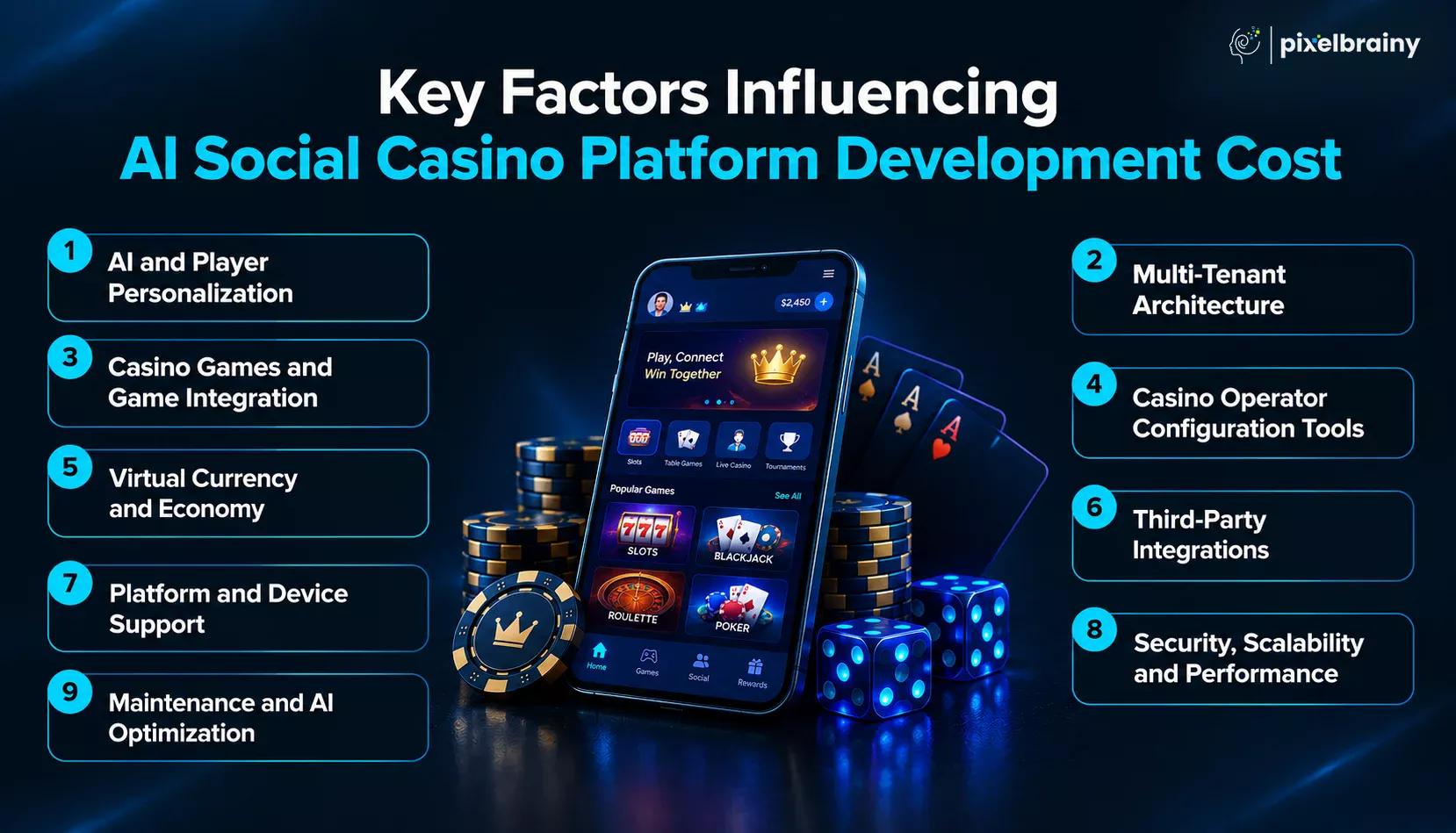
AI Social Casino Platform Development Cost Breakdown by Key Factors:
| Cost Factor | Estimated Cost Impact | Impact Level |
|---|---|---|
| AI & Player Personalization | $10,000-$60,000+ | Very High |
| Multi-Tenant Architecture | $15,000-$60,000+ | Very High |
| Casino Games & Game Integration | $15,000-$80,000+ | Very High |
| Operator Configuration Tools | $10,000-$40,000+ | High |
| Virtual Currency & Economy | $8,000-$30,000+ | High |
| Third-Party Integrations | $5,000-$35,000+ | High |
| Platform & Device Support | $10,000-$60,000+ | High |
| Security, Scalability & Performance | $8,000-$50,000+ | High |
| Maintenance & AI Optimization | 15%-25% annually | Medium to High |
AI functionality is one of the most important factors affecting the cost to develop an AI social casino platform.
A basic social casino may use predefined rules for recommendations and promotions. An AI-powered platform can analyze player interactions and use those signals to personalize the experience.
Potential AI capabilities include:
Approximate development ranges may include:
Custom AI can require additional data engineering, model evaluation, monitoring, and optimization.
For a white-label social casino platform, multi-tenancy can become one of the largest cost factors.
Instead of developing one platform for one casino operator, the system needs to support multiple businesses from a shared technology foundation.
A multi-tenant architecture may need to manage:
Depending on the architecture, this can add approximately $15,000-$60,000+ to the development investment.
The architecture should also isolate tenant data securely while allowing the underlying platform to share appropriate infrastructure and services.
Games can represent a substantial portion of the AI social casino platform development cost.
A platform may offer:
Developing proprietary games from scratch generally requires more investment than integrating licensed or existing games.
Game development can involve:
A planning range of $15,000-$80,000+ can apply depending on the number and complexity of games.
White-label platforms need more than a player-facing application.
Each casino operator should ideally be able to configure its own digital experience without requiring developers for every change.
Operator tools may include:
These capabilities can add approximately $10,000-$40,000+ to the project.
The better the configuration system, the easier it can be for a white-label platform provider to onboard additional casino operators.
A social casino requires a carefully designed virtual economy, even when players cannot cash out virtual currency for real money.
The platform may need:
Development can cost approximately $8,000-$30,000+, depending on the sophistication of the economy.
For a white-label platform, the challenge increases because different casino operators may require their own virtual currency names, balances, promotional rules, and reward structures.
White-label casino software may need integrations with:
Integration costs can range from $5,000-$35,000+, depending on the number and complexity of APIs.
Real-time synchronization, custom data mapping, webhooks, authentication, and extensive testing can increase the investment.
The number of platforms also influences the cost of creating an AI social casino platform.
A responsive web platform generally requires less development than separate native applications.
Planning ranges can include:
Multiple platforms increase frontend development, device testing, deployment, maintenance, and performance optimization.
A white-label platform must be designed for growth from the beginning.
Important requirements can include:
Depending on requirements, these areas can add $8,000-$50,000+.
For a platform intended to support multiple casino operators, tenant isolation and secure data management are particularly important architectural considerations.
The initial AI social casino platform development cost is not the complete investment.
After launch, ongoing expenses may include:
A practical planning allowance is approximately 15% to 25% of the initial development cost annually, although actual expenses depend on usage, infrastructure, AI complexity, and the number of operators.
For a focused white-label MVP with basic multi-tenancy, selected games, virtual currency, operator configuration, and basic AI, the investment may begin around $80,000-$150,000.
A more complete platform with advanced multi-tenant architecture, multiple games, AI personalization, operator dashboards, integrations, analytics, and stronger security can fall around $150,000-$250,000.
An enterprise white-label platform supporting multiple casino operators, sophisticated AI, extensive game integrations, advanced configuration tools, high availability, and scalable infrastructure can reach $250,000-$350,000+.
Therefore, the development budget of an AI social casino platform should not be based only on the cost of building the player application. For a white-label business, the multi-tenant architecture, operator control panel, virtual economy, game ecosystem, AI infrastructure, security, and scalability can have an equally significant impact on the final investment.
The right AI social casino platform development cost estimate ultimately depends on how many operators the platform needs to support, how independently each tenant must be configured, how much AI personalization is required, which games will be developed or integrated, and how much infrastructure is needed for long-term expansion.
Also Read: Top 12+ AI Casino App Development Companies in USA (2026 Updated List)
The AI social casino platform development cost is distributed across multiple development phases rather than being spent entirely on coding. Product discovery, UI/UX design, game development, backend engineering, AI integration, live dealer infrastructure, testing, security, and deployment can all contribute to the final investment.
A common casino software business query is:
“Our company wants to build an AI social casino platform with a live dealer component where real human dealers run casino game streams that players can join using virtual currency, creating a more authentic casino atmosphere than pure software game simulations. What does adding live dealer streaming infrastructure to an AI social casino platform cost?”
The answer depends on the number of games, AI functionality, streaming architecture, expected concurrent viewers, virtual currency system, operator requirements, security, and whether the live dealer technology is developed internally or integrated through a third-party provider.
AI Social Casino Platform Development Cost by Phase:
| Development Phase | Estimated Cost | Cost Impact |
|---|---|---|
| Discovery & Product Planning | $2,000-$10,000 | Medium |
| UI/UX Design | $4,000-$20,000 | Medium |
| Frontend & Backend Development | $15,000-$70,000+ | Very High |
| Game Development & Integration | $10,000-$80,000+ | Very High |
| AI Development & Integration | $10,000-$60,000+ | Very High |
| Live Dealer Streaming Infrastructure | $15,000-$60,000+ | Very High |
| Security, Testing & QA | $6,000-$25,000+ | High |
| Deployment & Launch | $2,000-$15,000 | Medium |
These are planning ranges. Some phases overlap, particularly backend development, game integration, AI engineering, streaming infrastructure, and security.
The first phase defines the product scope and determines which capabilities should be included in the initial release.
It may cover:
Estimated Cost: $2,000-$10,000
Detailed planning can help identify expensive requirements early, particularly live streaming, multiplayer functionality, AI personalization, and third-party integrations.
The design phase creates the player and operator experience.
A live dealer social casino may require:
Estimated Cost: $4,000-$20,000
The cost can increase when the platform needs responsive web experiences, mobile applications, real-time game interfaces, and multiple operator branding configurations.
Frontend and backend engineering usually represents one of the largest portions of the development budget of an AI social casino platform.
Typical functionality includes:
Estimated Cost: $15,000-$70,000+
A multi-tenant white-label platform or platform supporting large numbers of concurrent players will require a more sophisticated architecture.
Casino businesses must decide whether games will be developed internally, customized, or integrated from third-party providers.
This phase can include:
Estimated Cost: $10,000-$80,000+
The number of games and complexity of each experience directly affects the cost to build an AI social casino platform.
AI can be integrated into the platform to personalize the player experience and support operations.
Potential functionality includes:
Estimated Cost: $10,000-$60,000+
Using established AI APIs can reduce initial development requirements, while custom models, proprietary player data, real-time personalization, and advanced predictive systems can increase investment.
Adding live dealer functionality can significantly affect the AI social casino platform development cost.
Unlike conventional software-based casino games, live dealer experiences require video delivery infrastructure and real-time interaction between players and the dealer environment.
The technology may involve:
Estimated Cost: $15,000-$60,000+
The actual cost can vary substantially depending on whether the business builds the streaming infrastructure itself or integrates a specialized live dealer provider.
The expected number of simultaneous viewers is also important. A platform serving a small number of live tables has different infrastructure requirements from one supporting hundreds of concurrent tables and thousands of viewers.
For a social casino using virtual currency rather than real-money wagering, the product architecture still needs clear separation between virtual balances, game sessions, player accounts, and streaming systems. The applicable legal and regulatory requirements should be reviewed for each intended market before launch.
Testing should cover both traditional software functionality and real-time gaming and streaming behavior.
Testing can include:
Estimated Cost: $6,000-$25,000+
Live dealer functionality can require additional load and latency testing because poor streaming performance can directly affect the player experience.
The final development phase prepares the platform for production.
It may include:
Estimated Cost: $2,000-$15,000
For a conventional AI social casino platform, the overall investment may fall within the broader $40,000-$350,000+ range.
Adding live dealer functionality can move a project toward the higher end because the platform now needs real-time video infrastructure, streaming delivery, dealer-table management, additional testing, monitoring, and potentially specialized third-party technology.
For planning purposes:
Ultimately, the cost to make an AI social casino platform depends on how much technology is developed internally versus integrated from specialized providers. A phased approach can reduce the initial investment by launching core games and AI functionality first, then introducing live dealer tables after the underlying player, virtual currency, analytics, and infrastructure systems have been validated.
The development team you choose can significantly affect the AI social casino platform development cost, delivery timeline, technical quality, and post-launch support. Rates vary based on location, AI expertise, casino gaming experience, team composition, architecture capabilities, and the complexity of your virtual-currency ecosystem.
A common question from casino businesses is:
“Should we hire an in-house team or outsource AI social casino platform development to get the right combination of AI expertise, development speed, gaming experience, and budget?”
Another practical query is:
“Which development team can build an AI social casino platform with personalization, virtual currency, casino games, analytics, and scalable infrastructure within a $40,000 to $350,000+ development budget?”
The following comparison provides a practical AI social casino platform development cost overview by team type.
AI Social Casino Platform Development Cost by Team Type:
| Team Type | Typical Hourly Rate | Estimated Development Cost* | Best For |
|---|---|---|---|
| In-House Development Team | $100-$200/hour | $150,000-$350,000+ | Established casino businesses requiring internal control |
| US-Based AI Development Agency | $100-$180/hour | $100,000-$300,000+ | AI-driven platforms requiring specialized expertise |
| Freelance Development Team | $30-$100/hour | $50,000-$120,000+ | Prototypes, MVPs, and focused features |
| Eastern European Development Team | $40-$90/hour | $60,000-$200,000+ | Mid-sized and technically complex platforms |
| South Asian Development Team | $25-$60/hour | $50,000-$150,000+ | Startups seeking broader development capabilities |
*Actual pricing depends on platform scope, game integrations, AI features, virtual-currency architecture, security, infrastructure, testing, and ongoing maintenance.
Estimated cost: $150,000-$350,000+
An in-house team gives a casino business direct control over product decisions, development priorities, data, and long-term platform improvements.
A typical team may include:
The higher cost to build an AI social casino platform with an internal team comes from salaries, benefits, recruitment, infrastructure, software licenses, management, and employee retention. This structure can make sense when the platform is intended to become a long-term internal product.
Typical rate: $100-$180/hour
Estimated cost: $100,000-$300,000+
A specialized agency can bring multiple capabilities under one development contract, including:
This model can be suitable for businesses that want professional project management and AI expertise without recruiting an entire technical department.
Typical rate: $30-$100/hour
Estimated cost: $50,000-$120,000+
Freelancers can reduce the initial cost of creating an AI social casino platform, particularly for:
However, coordinating separate specialists can become difficult when the platform requires advanced AI, gaming integrations, security, analytics, and scalable infrastructure.
Typical rate: $40-$90/hour
Estimated cost: $60,000-$200,000+
Eastern European teams can provide capabilities across AI engineering, full-stack development, cloud architecture, game integrations, QA, and DevOps. This approach can be considered for mid-level and advanced AI social casino products where technical complexity is significant but businesses want to manage the AI social casino platform development rates below some US-based agency rates.
Typical rate: $25-$60/hour
Estimated cost: $50,000-$150,000+
South Asian teams can offer multidisciplinary resources including AI engineers, backend and frontend developers, game developers, designers, QA specialists, and DevOps engineers. For startups, this model can provide access to a broader technical team while keeping the development budget of an AI social casino platform within a controlled range.
The right team depends on your platform scope and internal capabilities. In-house development offers direct control but carries higher staffing costs. Specialized agencies provide a complete team and structured delivery. Freelancers may work for focused MVPs, while offshore teams can provide broader capabilities at lower hourly rates.
When comparing AI social casino platform development cost, do not evaluate hourly rates alone. Consider AI expertise, gaming experience, architecture, security, scalability, communication, integrations, and post-launch support. For many businesses, the overall development investment can fall between $40,000 and $350,000+, depending on the team structure and platform requirements.
The AI social casino platform development cost can differ substantially depending on whether a business builds its own platform or licenses an existing casino solution. A licensed platform can accelerate market entry by providing ready-made gaming infrastructure, while custom development offers greater control over AI, player experiences, virtual currency, integrations, analytics, and future expansion.
A common casino business query is:
“Should we build a custom AI social casino platform or license an existing platform provider if our budget is between $40,000 and $350,000+?”
The answer depends on your required games, AI capabilities, player volume, customization, integrations, launch timeline, and long-term operating model.
Custom Build vs Licensed AI Social Casino Platform:
| Cost & Business Factor | Custom AI Social Casino Platform | Existing Platform Provider |
|---|---|---|
| Initial Investment | $40,000-$350,000+ | Generally lower upfront |
| Customization | High | Depends on provider |
| AI Capabilities | Built around business requirements | Limited to available AI features |
| Casino Games | Custom or selected integrations | Provider-supported games |
| Virtual Currency | Fully customizable | Based on provider capabilities |
| Launch Speed | Longer development cycle | Faster implementation |
| Product Control | High | Provider controls core platform |
| Ongoing Costs | Hosting, AI, maintenance, support | Licensing, subscriptions, upgrades |
| Scalability | Designed around requirements | Depends on provider infrastructure |
A custom platform is developed specifically around a business's gaming strategy, player experience, AI requirements, and virtual-currency economy.
The cost to build an AI social casino platform can range from $40,000 to $350,000+, depending on complexity.
A custom solution can include:
This approach requires a larger initial development budget of an AI social casino platform, but the business has greater control over product functionality and future enhancements.
Licensing an existing platform can reduce the initial cost of creating an AI social casino platform because core infrastructure, gaming modules, player management, and administrative features may already be available.
Depending on the provider, a licensed solution may offer:
The tradeoff is customization. Businesses may need to work within the provider's existing architecture, supported integrations, AI capabilities, and branding options. Recurring licensing or subscription charges can also affect the total cost over several years.
A hybrid model can combine an established social casino platform with a custom AI layer.
For example, the licensed platform could manage games, accounts, virtual currency, and core administration, while custom AI handles:
This approach can reduce the amount of software that must be built from scratch while allowing the business to differentiate its player experience.
| Approach | Approximate Investment | Suitable For |
|---|---|---|
| Licensed Social Casino Platform | Lower initial development cost | Businesses prioritizing faster launch |
| Existing Platform + Custom AI | $40,000-$150,000+ | Operators adding differentiated AI |
| Custom AI Social Casino MVP | $40,000-$80,000 | Startups testing a focused concept |
| Advanced Custom Platform | $80,000-$250,000 | Businesses requiring multiple games and AI |
| Enterprise Custom Platform | $250,000-$350,000+ | Large-scale, highly customized operations |
These are planning ranges. Actual AI social casino platform development cost depends on game complexity, AI architecture, integrations, security, infrastructure, scalability, and development hours.
The initial development price does not represent the complete platform investment.
A licensed solution can introduce recurring licensing, subscription, customization, integration, and upgrade expenses. A custom platform requires ongoing spending on cloud infrastructure, AI services, security updates, maintenance, monitoring, technical support, and new feature development.
Therefore, businesses should compare the total cost of ownership, rather than only asking, “How much does it cost to build an AI social casino platform?”
Custom AI social casino development may suit businesses requiring:
An existing platform provider may suit businesses prioritizing:
A hybrid model can sit between these approaches.
Ultimately, custom AI social casino platform development vs licensing should be evaluated using upfront cost, recurring fees, AI capabilities, customization, scalability, integrations, maintenance, and expected platform lifespan. A custom platform can require $40,000 to $350,000+, while licensing may reduce upfront development expenses but introduce ongoing provider costs.
The initial AI social casino platform development cost of $40,000 to $350,000+ is only the starting point. After launch, businesses may incur recurring expenses for AI services, cloud infrastructure, game operations, security, virtual currency management, analytics, third-party integrations, maintenance, and platform enhancements.
A common casino business query is:
“We have planned the cost to build an AI social casino platform, but what ongoing expenses should we budget for after launch, including AI usage, hosting, game services, security, maintenance, and third-party tools?”
Understanding these expenses early helps businesses create a more realistic development budget of an AI social casino platform and avoid unexpected operating costs.
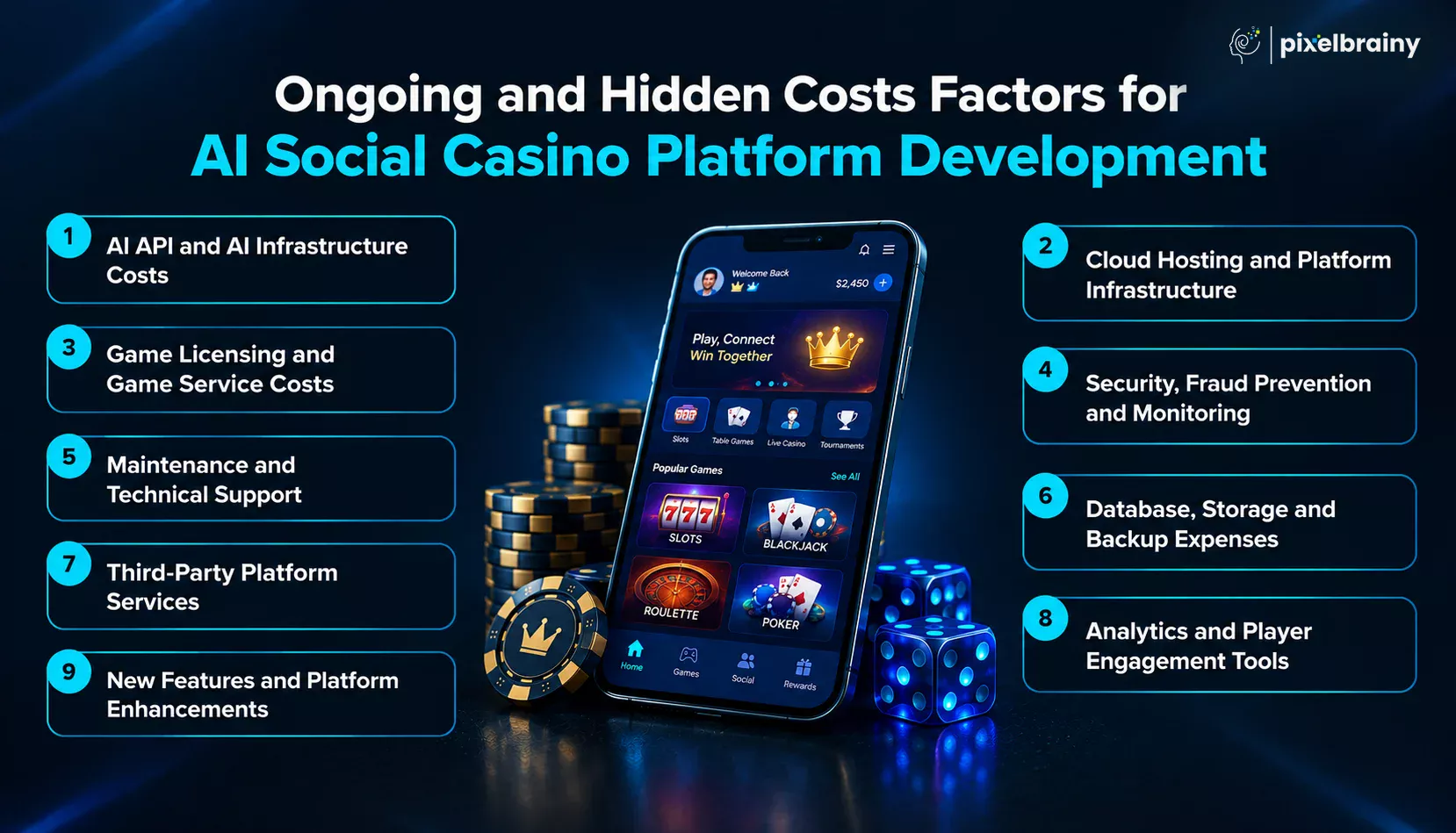
Major Ongoing and Hidden Costs Overview for AI Social Casino Platform Development:
| Cost Category | Estimated Cost |
|---|---|
| AI APIs & AI Infrastructure | $300-$10,000+/month |
| Cloud Hosting & Infrastructure | $300-$5,000+/month |
| Game Licensing & Game Services | $500-$10,000+/month |
| Security & Monitoring | $200-$2,000+/month |
| Maintenance & Technical Support | $1,000-$8,000+/month |
| Database & Storage | $100-$2,000+/month |
| Backup & Disaster Recovery | $100-$1,000+/month |
| Third-Party Services | $200-$3,000+/month |
| Analytics & Engagement Tools | $100-$2,000+/month |
Actual expenses depend on player volume, game portfolio, AI usage, infrastructure architecture, integrations, and selected service providers.
AI functionality can create recurring usage expenses after deployment. A platform using AI for recommendations, player segmentation, personalized offers, behavioral analysis, or fraud detection may process thousands or millions of requests.
Potential expenses include:
Estimated cost: $300 to $10,000+/month
A smaller platform with limited AI interactions may remain near the lower end, while a large platform with real-time personalization can require substantially more infrastructure.
Cloud infrastructure supports the application, databases, APIs, game services, player accounts, analytics, and virtual-currency systems.
Typical costs can include:
Estimated cost: $300 to $5,000+/month
Traffic spikes, large player volumes, high game activity, and real-time services can increase infrastructure requirements.
Game-related expenses are an important consideration when calculating the cost of creating an AI social casino platform.
Depending on the business model, costs may involve:
Estimated cost: $500 to $10,000+/month
A platform relying heavily on licensed third-party games may have recurring provider charges in addition to the original integration cost.
Social casino platforms still require strong security even when players use virtual currency rather than cash wagering. Businesses need to protect accounts, virtual balances, APIs, game sessions, and platform infrastructure.
Ongoing security expenses may include:
Estimated cost: $200 to $2,000+/month
The actual requirement can increase as the platform grows and its transaction-like virtual-currency activity becomes more complex.
The AI social casino platform development cost does not end when the application goes live. Continuous maintenance is necessary to keep the platform stable, secure, and compatible with changing technologies.
Maintenance may cover:
Estimated cost: $1,000 to $8,000+/month
As a general planning approach, businesses can also reserve approximately 15% to 25% of the original development investment annually for maintenance and technical improvements.
Player profiles, game activity, virtual-currency records, analytics, event logs, media, and historical data can accumulate quickly.
Ongoing expenses may include:
Estimated cost: $100 to $2,000+/month
These expenses generally increase as the number of players, games, historical records, and stored analytics grows.
An AI social casino application can depend on multiple external services.
These may include:
Estimated cost: $200 to $3,000+/month
Usage-based pricing should be considered separately because costs can increase with player activity.
AI social casino businesses often need analytics to understand player behavior, game engagement, retention, session frequency, and virtual-currency activity.
Additional expenses can include:
Estimated cost: $100 to $2,000+/month
These tools become increasingly valuable as player volume grows and the platform generates larger amounts of behavioral data.
The first release is rarely the final version of an AI social casino platform. Businesses may later invest in:
These enhancements should ideally have a separate budget rather than being treated as part of routine maintenance.
When calculating the cost to build an AI social casino platform, businesses should consider both the initial $40,000 to $350,000+ development investment and the recurring expenses required to operate the platform.
A realistic financial model should account for:
Initial Development + AI Usage + Game Services + Cloud Infrastructure + Security + Maintenance + Third-Party Services + Future Enhancements
This broader calculation provides a more accurate view of the platform's total cost of ownership. Planning these ongoing and hidden expenses from the beginning can help casino businesses avoid underestimating their AI social casino platform development cost and establish a sustainable budget for operating, securing, and expanding the platform after launch.Top of Form
Reducing the AI social casino platform development cost does not mean removing essential gaming, AI, security, or player experience features. A better strategy is to control scope, prioritize high-value functionality, reuse proven technologies, and introduce advanced AI capabilities progressively.
With the overall cost to build an AI social casino platform ranging from $40,000 to $350,000+, careful planning can potentially reduce the initial development budget by around 15% to 35%, depending on project scope, team structure, technology choices, and platform complexity.
A common casino business query is:
“How can we reduce the cost of creating an AI social casino platform without compromising game quality, security, AI personalization, virtual currency, scalability, and player experience?”
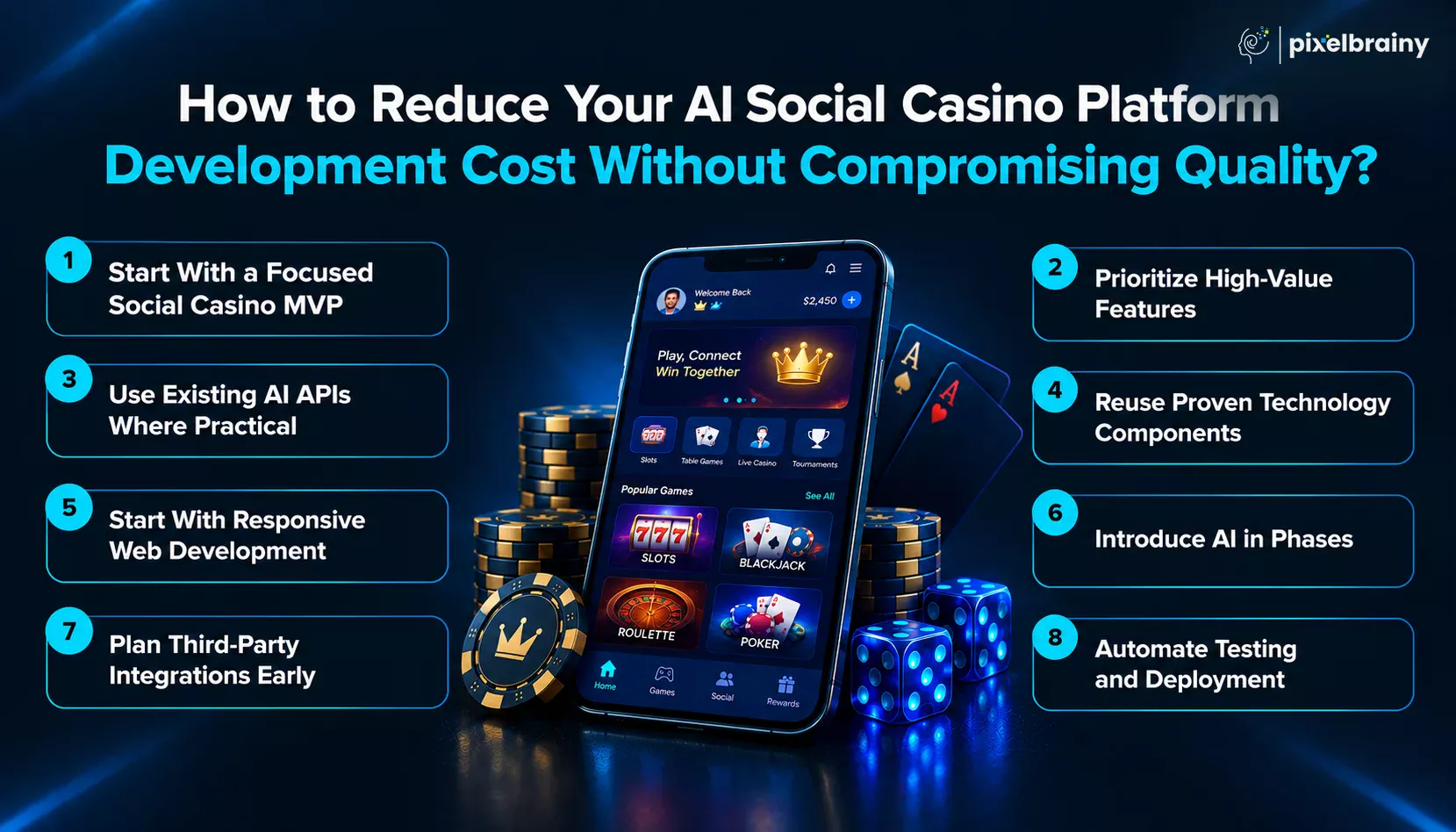
Cost-Saving Strategies for AI Social Casino Platform Development:
| Cost-Saving Strategy | Potential Planning Saving |
|---|---|
| Build a focused MVP | 20% to 35% |
| Prioritize essential casino features | 10% to 25% |
| Use existing AI APIs | 15% to 30% |
| Reuse proven technologies | 10% to 20% |
| Start with responsive web development | 15% to 30% |
| Implement AI in phases | 15% to 25% |
| Plan integrations early | 10% to 20% |
| Automate testing and deployment | 5% to 15% |
These are planning estimates, not guaranteed savings. Different strategies may overlap, so their percentages should not simply be added together.
Trying to launch every game, AI feature, loyalty function, analytics tool, and mobile application simultaneously can significantly increase the development budget of an AI social casino platform.
An initial MVP could focus on:
Potential saving: 20% to 35%
This approach allows the business to validate the platform before investing in more advanced functionality.
Not every feature needs to be available on launch day. Divide requirements into:
For example, advanced player segmentation, sophisticated AI campaigns, and extensive reporting can be introduced after the core gaming experience is stable.
Potential saving: 10% to 25%
The objective is to reduce unnecessary development hours, not essential functionality.
Building proprietary AI models from scratch can increase the cost to build an AI social casino platform.
For early-stage AI functionality, existing services may support:
Potential saving: 15% to 30%
Custom AI models can be introduced later when the platform has sufficient proprietary data and a clear business case for additional investment.
Developers do not need to build every technical component from zero. Established frameworks, cloud services, authentication systems, APIs, databases, analytics tools, and reusable UI components can reduce development effort.
Potential saving: 10% to 20%
This allows the team to concentrate its budget on casino-specific functionality, AI capabilities, virtual-currency architecture, and player experience.
Building a web platform alongside separate iOS and Android applications can substantially increase the initial AI social casino platform development cost.
Starting with a responsive web application can reduce:
Potential saving: 15% to 30%
Native or dedicated mobile applications can be added later when usage data and business requirements justify the additional investment.
Advanced AI does not need to be delivered entirely in the first release.
A practical roadmap could be:
Phase 1: AI game recommendations and basic player insights
Phase 2: Personalized promotions and engagement
Phase 3: Advanced behavioral analytics
Phase 4: Predictive models and sophisticated AI automation
Potential initial saving: 15% to 25%
Phased AI development spreads investment across the product lifecycle while allowing the business to evaluate which capabilities generate meaningful player engagement.
Late integration changes can increase the cost of creating an AI social casino platform because they may require backend modifications, additional testing, security changes, and architecture adjustments.
Identify requirements for game providers, analytics, cloud services, notifications, authentication, and other external systems during the planning stage.
Potential saving: 10% to 20%
Early planning can also reveal licensing and recurring service expenses before development begins.
Automated testing and CI/CD pipelines can reduce repetitive manual work during development and future releases.
Automation can support:
Potential saving: 5% to 15%
It can also improve release consistency while reducing avoidable deployment and testing effort.
Suppose the initial AI social casino platform estimate is $200,000. A hypothetical 20% reduction would represent approximately $40,000, resulting in an estimated initial budget of $160,000.
A hypothetical 30% reduction would represent approximately $60,000, bringing the estimate to around $140,000.
These are illustrative calculations. Actual savings depend on the original scope, development team, architecture, integrations, and technology choices.
The most effective way to reduce AI social casino platform development cost is to control unnecessary complexity rather than eliminate essential quality requirements.
With an overall development range of $40,000 to $350,000+, a phased strategy allows businesses to invest first in reliable gaming functionality, virtual currency, security, scalable architecture, and high-value AI features, then expand the platform as player data, usage patterns, and business priorities become clearer.
As an AI iGaming software development company, PixelBrainy helps casino businesses, gaming startups, operators, and enterprises optimize their AI social casino platform development cost without unnecessarily compromising essential gaming functionality, AI capabilities, security, scalability, or player experience.
Our approach focuses on cost optimization before development begins. This includes feature prioritization, reusable technology components, efficient AI implementation, casino game integrations, virtual-currency architecture, scalable infrastructure, and phased development. Instead of developing every advanced capability in the first release, we identify which features require immediate investment and which can be introduced during later phases.
A common casino business query is:
“We want to build an AI social casino platform, but how can we control the development budget while maintaining quality, AI personalization, virtual currency, casino games, security, and scalability?”
The answer starts with structured cost planning. PixelBrainy can evaluate the platform requirements and create a roadmap that balances functionality, quality, development timeline, and investment.
Before development begins, PixelBrainy can evaluate:
This process helps establish a realistic development budget for an AI social casino platform while identifying features that can be simplified, reused, postponed, or delivered through later development phases.
Consider a gaming startup planning an AI social casino platform with casino games, virtual currency, AI-powered recommendations, player analytics, personalized engagement, player dashboards, administrative tools, and future advanced AI capabilities.
The initial requirements indicate an estimated development budget of approximately $200,000.
After reviewing the requirements, PixelBrainy can structure the project around a focused MVP. Core gaming functionality and the virtual-currency system are prioritized, proven APIs and reusable components are used where practical, while advanced AI personalization and additional platform capabilities are scheduled for later phases.
Development Cost Optimization Example:
| Cost Optimization Metric | Illustrative Result |
|---|---|
| Original Estimated Development Cost | $200,000 |
| Optimized MVP Development Cost | Approximately $130,000 |
| Potential Development Cost Reduction | Approximately 35% |
| Illustrative Cost Saved | Approximately $70,000 |
| Initial Delivery Timeline | Approximately 16 to 20 weeks |
| Future Expansion | Advanced AI, personalization, analytics, mobile apps, additional games |
These figures are illustrative planning examples, not guaranteed pricing or savings. Actual AI social casino platform development cost depends on game complexity, AI requirements, integrations, architecture, security, infrastructure, and development team structure.
A phased approach can help businesses:
For businesses planning an AI social casino platform within the $40,000 to $350,000+ range, this strategy can help direct investment toward the features that matter most during the initial launch.
Build Your AI Social Casino Platform With a Smarter Cost Strategy
Ready to build a cost-efficient AI social casino platform? Talk to PixelBrainy’s iGaming experts to discuss your requirements and get a tailored development roadmap.
The AI social casino platform development cost can range from $40,000 to $350,000+, depending on the platform's features, AI capabilities, casino games, virtual-currency system, integrations, security, infrastructure, development team, and long-term scalability requirements.
A focused MVP can help startups and casino businesses control their initial investment while establishing a foundation for future expansion. Advanced AI personalization, player analytics, additional games, live dealer capabilities, mobile applications, and sophisticated engagement features can then be introduced in phases as business requirements grow.
Beyond the initial cost to build an AI social casino platform, businesses should also account for ongoing expenses such as AI services, cloud hosting, game licensing, maintenance, security, analytics, and third-party integrations.
The right development strategy is therefore about balancing budget, functionality, quality, and future growth rather than simply choosing the lowest development price.
Ready to plan your AI social casino platform within the right budget? Schedule a call with PixelBrainy to discuss your requirements and get a customized development roadmap.
The cost to build an AI social casino platform typically ranges from $40,000 to $350,000+. An MVP with selected casino games and basic AI features may require a lower investment, while advanced platforms with multiple games, AI personalization, analytics, integrations, scalable infrastructure, and live dealer capabilities can require a significantly larger budget.
The main factors affecting AI social casino platform development cost include the number and complexity of casino games, AI functionality, virtual-currency architecture, UI/UX design, backend development, third-party integrations, security, cloud infrastructure, analytics, testing, and the development team's location and expertise.
A focused AI social casino MVP development cost can generally fall around $40,000 to $80,000. The MVP may include selected casino games, player accounts, virtual currency, basic AI recommendations, an admin dashboard, analytics, and core cloud infrastructure. The final cost depends on the specific MVP scope.
Yes. Businesses can potentially reduce the cost of creating an AI social casino platform by launching a focused MVP, prioritizing essential features, using proven frameworks and AI APIs, planning integrations early, starting with responsive web development, and introducing advanced AI capabilities in phases.
An AI social casino platform with live dealer functionality can require a higher investment because of live video streaming, low-latency infrastructure, game-table interfaces, real-time interaction, stream management, monitoring, and scalability requirements. Depending on the overall scope, the project can move toward the $150,000 to $350,000+ range.
Licensing an existing platform can reduce the initial development investment because core casino functionality and infrastructure may already be available. Custom AI social casino platform development generally requires a higher upfront investment but provides greater control over AI capabilities, games, virtual currency, integrations, branding, and future product expansion. Licensing may also involve recurring fees.
Beyond the initial AI social casino platform development cost, businesses should budget for AI API usage, cloud hosting, game licensing, security monitoring, maintenance, database and storage costs, backups, analytics, third-party services, and future feature development. These recurring expenses should be included in the platform's total cost of ownership.
A practical AI social casino platform development budget can be estimated by calculating development hours and team rates, then adding game development, AI services, integrations, infrastructure, security, testing, and deployment costs. A basic planning range of $40,000 to $350,000+ can then be refined according to the required features and platform complexity.

About The Author
Sagar Bhatnagar
Sagar Sahay Bhatnagar brings over a decade of IT industry experience to his role as Marketing Head at PixelBrainy. He's known for his knack in devising creative marketing strategies that boost brand visibility and market influence. Sagar's strategic thinking, coupled with his innovative vision and focus on results, sets him apart. His track record of successful campaigns proves his ability to utilize digital platforms effectively for impactful marketing efforts. With a genuine passion for both technology and marketing, Sagar continuously pushes PixelBrainy's marketing initiatives to greater success.

Working with PixelBrainy has been a great experience. They took our vision for an AI-powered platform and turned it into a fully functional product. What impressed me most was their strong understanding of both design and development, and their ability to handle complex requirements with ease. The team was responsive, cooperative, and always open to feedback. They kept things organized, communicated clearly, and delivered quality work on time. I highly recommend PixelBrainy to anyone looking for a skilled and reliable development partner.

Working with the PixelBrainy team has been a highly positive experience. They understand the design requirements and create beautiful UX elements to meet the application needs. The dev team did an excellent job bringing my vision to life. We discussed usability and flow. Sagar worked with his team to design the database and begin coding. Working with Sagar was easy. He has the knowledge to create robust apps, including multi-language support, Google and Apple ID login options, Ad-enabled integrations, Stripe payment processing, and a Web Admin site for maintaining support data. I'm extremely satisfied with the services provided, the quality of the final product, and the professionalism of the entire process. I highly recommend them for Android and iOS Mobile Application Design and Development.

Great experience working with them. Had a lot of feedback and I found that unlike most contractors they were bugging me for updates instead of the other way around. They were extremely time conscience and great at communicating! All work was done extremely high quality and if not on time, early! They were always proactive when it comes to communication and the work is great/above par always. Very flexible and a great team to work with! Goes above and beyond to present us with multiple options and always provides quality. Amazing work per usual with Chitra. If you have UI/UX or branding design needs I recommend you go to them! Will likely work with them in the future as well, definitely recommended!

PixelBrainy is a joy to work with and is a great partner when thinking through branding, logo, and website layout. I appreciate that they spend time going into the "why" behind their decisions to help inform me and others about industry best practices and their expertise.

I hired them to design our software apps. Things I really like about them are excellent communication skills, they answer all project suggestions and collaborate right away, and their input on design and colors is amazing. This project was complex and needed patience and creativity. The team is amazing to do business with. I will be using them long-term. Glad to see there are some good people out there. I was afraid to try and outsource my project to someone but I am glad I met them! I really can't say enough. They went above and beyond on this project. I am very happy with everything they have done to make my business stand out from the competition.

It was great working with PixelBrainy and the team. They were very responsive and really owned the project. We'll definitely work with them again!

I recently worked with the PixelBrainy team on a project and I was blown away by their communication skills. They were prompt, clear, and articulate in all of our interactions. They listened and provided valuable feedback and suggestions to help make the project a success. They also kept me updated throughout the entire process, which made the experience stress-free and enjoyable.

PixelBrainy is very good at what it does. The team also presents themselves very professionally and takes care of their side of things very well. I could fully trust them taking up the design work in a timely and organised manner and their attention to detail saved us lots of effort and time. This particular project was quite intense and the team showed that they function very well under pressure. Very much looking forward to working with her again!

It's always an absolute pleasure working with them. They completed all of my requests quickly and followed every note I had for them to a T, which made our process go smoothly from start to finish. Everything was completed fast and following all of the guidelines. And I would recommend their services to anyone. If you need any design work done in the future, PixelBrainy should be your first call!

They took ownership of our requirements and designed and proposed multiple beautiful variants. The team is self-motivated, requires minimum supervision, committed to see-through designs with quality and delivering them on time. We would definitely love to work with PixelBrainy again when we have any requirements.

PixelBrainy was a big help with our SaaS application. We've been hard at work with a new UI/UX and they provided a lot of help with the designs. If you're looking for assistance with your website, software, or mobile application designs, PixelBrainy and the team is a great recommendation.

PixelBrainy designers are amazing. They are responsive, talented, and always willing to help craft the design until it matches your vision. I would recommend them and plan to continue them for my future projects and more!!!

They were awesome! Did a good job fast, and good communication. Will work with them again. Thank you

Creative, detail-oriented, and talented designers who take direction well and implement changes quickly and accurately. They consistently over-delivered for us.

PixelBrainy team is very talented and creative. Great designers and a pleasure to work with. PixelBrainy is an excellent communicator and I look forward to working with them again.

PixelBrainy has a very talented design team. Their work is excellent and they are very responsive. I enjoy working with them and hope to continue on all of our future projects.


Transform your ideas into reality with us.
Across these industries, each engagement brings unique challenges, from early-stage product development to scaling complex systems, helping us build a practical understanding of real-world product environments.