
 AI Summary Powered by PixelBrainy
What if you could identify client churn weeks before it happens and act before it is too late?
Most businesses do not lose clients because of a bad product. They lose them because early warning signs go unnoticed. By the time a renewal conversation begins, usage has already declined, engagement has dropped, and the relationship has quietly weakened.
This is the problem AI client success agent development is designed to solve.
An AI client success agent is an intelligent system that continuously monitors customer data such as product usage, support interactions, billing activity, and engagement patterns. It analyzes these signals in real time to detect churn risks, identify expansion opportunities, and trigger proactive actions like personalized outreach or alerts to account managers. Instead of relying on manual reviews, businesses can respond instantly across every account in their portfolio.
The shift toward AI-driven customer success is accelerating rapidly. According to industry research, organizations using AI in customer operations report up to 25 percent improvement in retention and revenue outcomes. Gartner also highlights that more than 70 percent of B2B companies are expected to adopt AI-driven customer success workflows by 2027.
This guide is designed for SaaS founders, customer success leaders, and CTOs who want to understand how to build an AI Client Success Agent and the development process behind it, including features, costs, and real-world challenges.
Because modern customer success is no longer reactive. It is proactive, predictive, and scalable.
An AI client success agent is an autonomous software system that monitors, manages, and improves client relationships without requiring manual review for every account. It continuously analyzes customer data such as product usage, support interactions, billing activity, and engagement patterns to detect risks and opportunities in real time.
Unlike traditional customer success tools, which are largely passive, an AI client success agent is active. Most CRM platforms and CS tools store data and generate reports, but they depend on a human to interpret insights and decide what action to take. In contrast, an AI client success agent not only analyzes data but also identifies patterns that indicate churn risk or expansion potential and takes action automatically. This can include sending personalized messages, scheduling check-ins, triggering onboarding workflows, or alerting account managers when intervention is required.
In simple terms, an AI client success agent acts as a continuous monitoring system for your entire customer base. Instead of reviewing accounts periodically, businesses gain real-time visibility into client health and can respond instantly to changes in behavior.
These systems are widely used across SaaS companies, financial services, healthcare platforms, and professional services firms where client retention and lifetime value are critical. They combine machine learning for predictive insights, natural language processing for communication, and workflow automation for execution, creating a unified system that enables proactive and scalable customer success.
Understanding this concept is essential before exploring how to build an AI Client Success Agent and the development process behind it in the next sections.
There is a scaling problem in customer success that most teams quietly struggle with. As the number of clients grows, the ability to manage relationships with the same level of attention does not grow at the same pace.
A skilled customer success manager can handle 30 to 50 accounts effectively. Beyond that, something starts to slip. Either the business hires more people, which increases costs, or the quality of engagement declines, which increases churn risk. Neither option is sustainable in the long run.
This is where AI client success agent development changes the equation.
An AI agent does not have a capacity limit. It can monitor thousands of accounts at the same time, tracking usage patterns, engagement behavior, and health signals continuously. It does not miss early warning signs, and it does not delay action. Every account gets the same level of attention, regardless of scale.
The growing investment in this space reflects a clear shift in how businesses approach customer success. According to Data Bridge Market Research, the market is expected to grow from USD 2.20 billion in 2025 to USD 9.17 billion by 2032. This growth is being driven by companies adopting intelligent systems rather than simply expanding teams.
For businesses under pressure to improve retention and net revenue without increasing headcount, AI client success agent development is no longer a future consideration. It is becoming a practical and necessary step in building a scalable customer success strategy.
Building an AI client success agent does more than improve efficiency. It fundamentally changes how customer success teams operate at scale. Instead of reacting to problems, teams can predict, prioritize, and act in real time across their entire customer base.
Here are the most important benefits in practice.
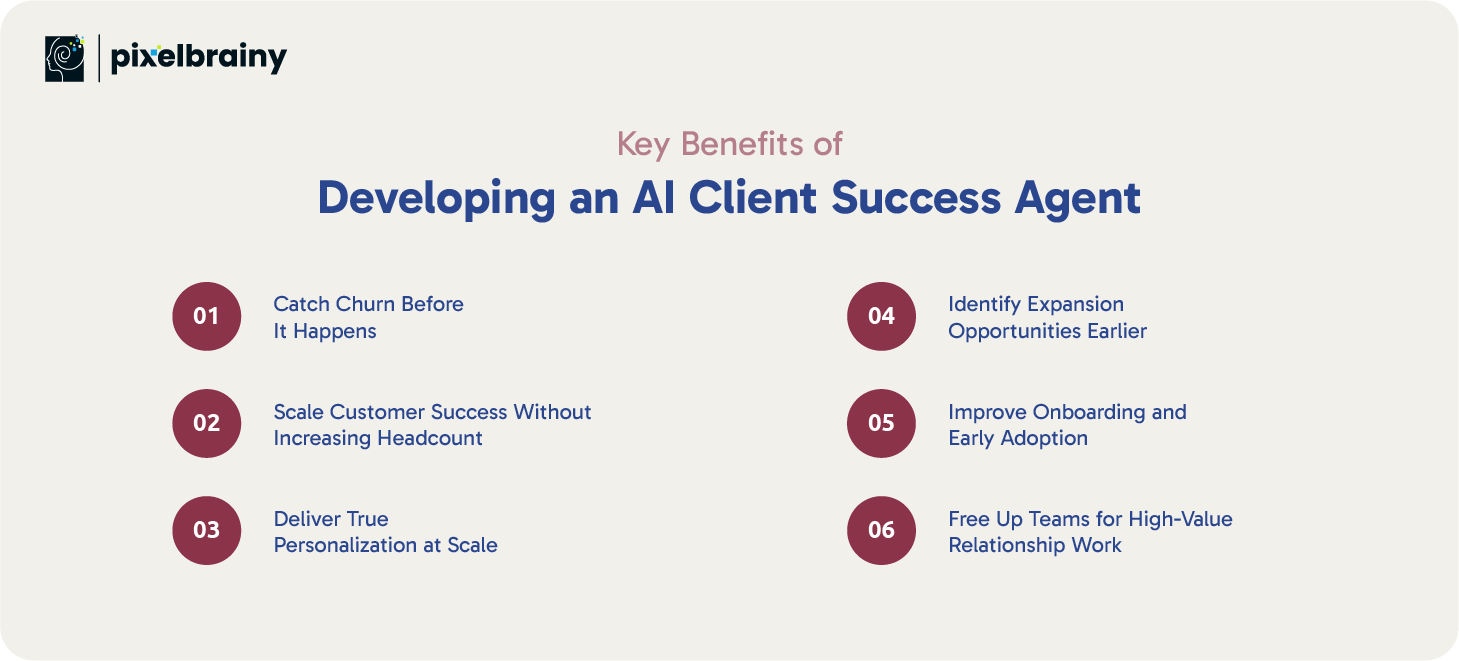
The most expensive moment in customer success is when a client decides to leave. By that point, trust is already weakened and recovery is difficult.
An AI client success agent identifies churn risks early by analyzing signals such as product usage, feature adoption, support activity, and engagement trends. It flags at-risk accounts weeks or months in advance, giving teams time to intervene.
Companies using AI-driven churn prediction have reduced churn by up to 25 percent when proactive signals are embedded into workflows. This shifts conversations from damage control to problem-solving.
Customer success teams face a clear scaling limit. As account volume grows, maintaining consistent engagement becomes difficult without expanding the team.
An AI client success agent removes this limitation by continuously monitoring thousands of accounts at once. Routine actions such as follow-ups, alerts, and check-ins are automated, allowing human teams to focus only on high-value interactions.
This enables a smaller team to manage a significantly larger portfolio without compromising client experience.
Clients expect communication that reflects their specific goals and usage patterns. Delivering this level of personalization manually is not feasible at scale.
AI client success agents analyze behavior, history, and engagement data to generate tailored communication for each account. Messages are based on real usage signals, making them more relevant and effective.
Personalized, behavior-driven messaging significantly improves response and engagement rates compared to generic automation.
Expansion opportunities are often discovered too late, typically during renewal discussions. By then, valuable momentum has already been missed.
AI client success agents detect expansion signals in real time, such as increased usage, new team adoption, or feature exploration. These insights allow teams to engage clients at the right moment with relevant recommendations.
AI-informed customer success teams see higher expansion revenue because opportunities are identified based on behavior rather than timing.
The first 90 days of a client relationship are critical for long-term retention. Delays in onboarding often lead to early churn.
An AI client success agent guides clients through onboarding by tracking progress, identifying drop-offs, and triggering timely interventions. It ensures that clients reach key milestones faster and stay engaged.
This results in higher activation rates and stronger early-stage retention.
Customer success managers spend a large portion of their time on administrative tasks such as reporting, scheduling, and follow-ups.
AI client success agents automate these tasks. They generate summaries, monitor health scores, and prepare communication drafts, allowing teams to focus on strategic conversations and relationship building.
AI-enabled teams see improvements in productivity and reduced time spent on manual work, directly increasing efficiency.
The benefits of AI client success agents compound over time. Businesses gain better visibility, faster response times, and stronger client relationships without increasing operational complexity.
For companies focused on retention, expansion, and scalable growth, AI client success agent development is becoming a strategic advantage rather than an optional upgrade.
Understanding the benefits is one thing. Seeing exactly where AI client success agents create value in day-to-day operations is what makes the investment decision concrete. Here are the use cases driving the most meaningful outcomes in businesses today.
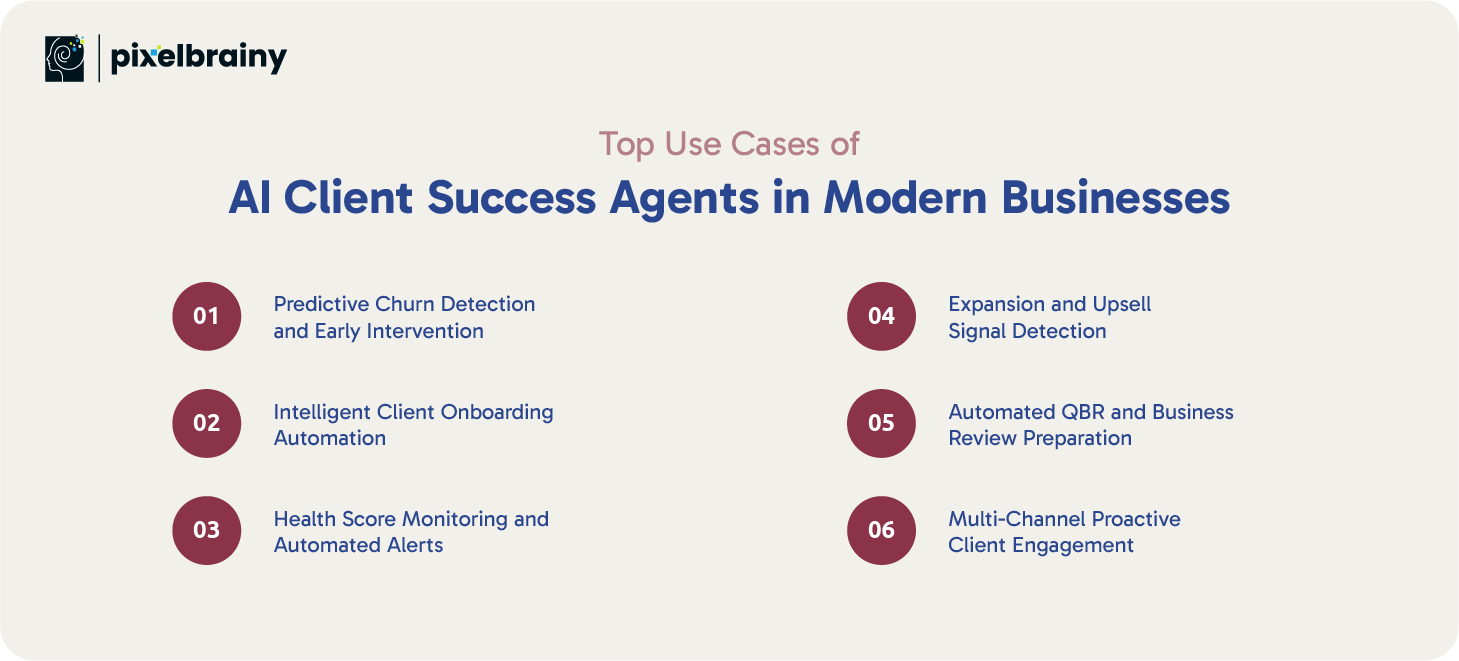
This is the use case that most organizations implement first, and for good reason. The financial impact of catching a churn risk 60 days before renewal is measurably higher than catching it at the renewal conversation.
The agent continuously monitors a defined set of behavioral signals including login frequency, feature usage depth, support ticket volume, response time to CS outreach, and engagement with product updates. When the pattern of signals matches historical churn indicators, the agent flags the account, generates a risk summary for the account manager, and can automatically initiate a personalized re-engagement sequence.
Real-world proof: Zendesk's 2025 CX Trends report shows that 90% of CX leaders report positive ROI from AI tools in client management, with churn reduction being the most cited driver of that return.
The first 30 to 90 days after a client signs are the most critical and the most resource-intensive. An AI client success agent can manage the entire onboarding journey intelligently, detecting where each client is in the process, what they have completed, where they are stuck, and what guidance they need next.
Rather than sending every client the same onboarding sequence on the same schedule, the agent adapts the journey to each client's actual behavior. A client who completes setup in the first week gets accelerated guidance toward advanced features. A client who has not completed basic configuration after two weeks gets a proactive outreach before the delay becomes a churn risk.
Traditional health scoring is done periodically and reviewed manually. By the time a health score review identifies a problem, several weeks of behavioral decline may have already occurred.
An AI client success agent calculates and updates health scores continuously, based on live behavioral data rather than periodic snapshots. When a health score crosses a defined threshold, the agent alerts the account manager immediately with a summary of the contributing factors, a recommended action, and in some configurations, an automatically drafted outreach message ready for review and send.
An AI agent does not just watch for problems. It watches for opportunities. When a client's usage patterns indicate that they are approaching the limits of their current plan, exploring features associated with a higher tier, or bringing new team members into the product, the agent surfaces this to the account manager as a qualified expansion signal.
The signal includes the behavioral evidence behind it, so the account manager enters the expansion conversation with specific data that makes the recommendation feel genuinely helpful rather than commercially motivated.
Quarterly business reviews are valuable but preparation is time-consuming. An account manager preparing for ten QBRs in a single week spends most of their preparation time pulling data, building slides, and summarizing account history rather than thinking strategically about each client's goals.
An AI client success agent automates the data synthesis layer. For each upcoming QBR, the agent compiles account usage data, progress against defined goals, health score trends, support history, and suggested discussion topics, and delivers this as a structured briefing document before the meeting. The account manager reviews it, adds strategic commentary, and walks into the call better prepared in a fraction of the time.
Clients do not live in a single channel. They engage through email, in-product messaging, Slack integrations, SMS, and increasingly through voice interfaces. An AI client success agent can manage proactive engagement across all of these channels simultaneously, ensuring that the right message reaches each client through the channel they are most likely to respond to, at the moment they are most likely to engage.
Bank of America's Erica AI handles over one million client queries daily across multiple channels, maintaining consistent engagement at a scale that no human team could replicate. For client success operations, the same principle applies.
These use cases show how AI client success agents move beyond automation to deliver real business impact. They turn everyday customer success operations into a proactive, data-driven system that scales efficiently.
Getting the feature set right in an AI client success agent is critical. Missing essential capabilities leads to poor adoption, while adding unnecessary features increases cost without delivering value. A well-designed agent should align directly with real customer success workflows and deliver measurable outcomes.
Below are the core features every AI client success agent must include.
| Feature | Description |
|---|---|
| Predictive Health Scoring Engine | Continuously evaluates client health using multiple data signals such as product usage, engagement trends, and support activity. It updates scores in real time instead of relying on periodic reviews. This helps teams identify risks and opportunities early with greater accuracy. |
| Churn Risk Detection and Alerting | Detects accounts that show behavioral patterns similar to past churn cases. It generates alerts with clear risk summaries and recommended actions for account managers. This allows teams to intervene before the client reaches the cancellation stage. |
| Automated Onboarding Journey Management | Tracks each client's onboarding progress and identifies where users drop off or get stuck. It adapts guidance based on behavior and triggers timely interventions. This ensures faster activation and improves early-stage retention. |
| Expansion and Upsell Signal Detection | Monitors usage patterns, feature adoption, and account growth signals to identify expansion readiness. It surfaces opportunities with supporting data for better decision-making. This helps teams approach clients at the right moment with relevant recommendations. |
| CRM and Product Data Integration | Connects with CRM systems and product analytics tools to unify all customer data in one place. It ensures real-time synchronization of interactions, usage, and engagement signals. This creates a single source of truth for accurate analysis and action. |
| Personalized Client Communication Engine | Generates tailored messages based on client behavior, goals, and account history. It enables scalable personalization without requiring manual effort from account managers. This improves engagement, response rates, and overall client experience. |
| Automated QBR and Review Preparation | Compiles key account data, usage insights, and performance trends into structured reports. It prepares briefing documents for business reviews automatically. This saves time and allows teams to focus on strategic conversations. |
| Multi-Channel Engagement Management | Manages communication across multiple channels such as email, in-app messaging, Slack, and SMS. It selects the best channel based on client behavior and preferences. This ensures higher engagement and consistent communication. |
| Account Manager Alert and Escalation System | Prioritizes and delivers alerts when human intervention is required. It ensures that critical accounts receive immediate attention from the right team member. This helps prevent missed opportunities and unmanaged risks. |
| Client Sentiment Analysis | Analyzes communication tone, feedback, and support interactions to detect sentiment changes. It identifies dissatisfaction early before it escalates into churn. This enables proactive relationship management. |
| Goal Tracking and Milestone Management | Tracks each client's progress against defined success goals and milestones. It triggers actions when progress slows or key milestones are achieved. This keeps clients aligned with their expected outcomes. |
| Portfolio Analytics Dashboard | Provides a real-time view of account health, churn risks, expansion opportunities, and engagement metrics. It helps leadership and teams make informed decisions quickly. This improves visibility across the entire customer base. |
| Automated Meeting Scheduling and Follow-Up | Schedules meetings such as check-ins and QBRs automatically based on predefined triggers. It also generates follow-up summaries and action items after meetings. This reduces administrative workload for teams. |
| Renewal Forecasting and Risk Assessment | Uses behavioral and engagement data to predict renewal probability for each account. It flags high-risk renewals early to allow meaningful intervention. This improves retention and revenue predictability. |
| Feedback Collection and NPS Automation | Automates the collection of client feedback and NPS surveys at the right intervals. It analyzes responses to identify trends and actionable insights. This helps businesses continuously improve customer experience. |
These features form the foundation of a scalable and intelligent system. A well-designed AI Client Success Agent built with these capabilities enables proactive engagement, accurate prediction, and efficient operations.
For businesses planning AI Client Success Agent Development, getting this feature set right is essential to drive retention, expansion, and long-term growth.
Also Read: Agentic AI Development for Finance: Use Cases, Benefits, and Development Guide
Once the core system is established, advanced capabilities are what differentiate a basic solution from a high-performing, future-ready platform. These features enhance accuracy, personalization, and strategic impact, ensuring the agent remains effective as the business scales.
Below are the advanced features to consider during AI client success agent development:
| Advanced Feature | Description |
|---|---|
| Generative AI Account Summaries | Uses large language models to generate detailed account summaries, risk insights, and client briefings in natural language. These summaries help account managers quickly understand account status without manual analysis. It improves decision-making and saves significant preparation time. |
| Voice AI Client Engagement | Enables the agent to conduct proactive outreach through voice interactions using natural language processing. It can detect tone, sentiment, and urgency during conversations in real time. This creates a more human-like and immediate engagement experience. |
| Predictive Expansion Revenue Modeling | Applies machine learning models to forecast expansion potential for each account. It analyzes usage trends, behavioral signals, and historical patterns to estimate revenue growth opportunities. This helps teams prioritize high-value accounts effectively. |
| Digital Client Twin Technology | Creates a dynamic digital model of each client based on their behavior, interactions, and business profile. This model simulates future outcomes and predicts risks or opportunities with higher accuracy. It enables highly personalized and data-driven interventions. |
| Automated Playbook Execution | Allows teams to define success playbooks that the agent executes automatically based on real-time signals. It ensures consistent actions across all accounts without manual intervention. This improves scalability and operational efficiency. |
| Competitive Risk Detection | Monitors external signals such as review platforms, hiring trends, and industry updates to detect potential competitive threats. It identifies when a client may be exploring alternatives. This enables early engagement to retain accounts. |
| Multi-Language Client Engagement | Enables communication in multiple languages based on client preferences. It removes language barriers and improves engagement with global customers. This is especially valuable for businesses operating in multiple regions. |
| AI-Powered Client Health Benchmarking | Compares each client's performance against similar accounts using cohort-based benchmarks. It provides context to health scores beyond raw data points. This helps teams make more informed and accurate decisions. |
| Proactive Success Planning Automation | Automatically generates customized success plans based on client goals, industry, and onboarding behavior. It ensures each client has a structured path to achieve value. This improves long-term retention and satisfaction. |
| Integration with External Data Sources | Connects with CRM, ERP, marketing tools, and third-party data providers to enrich client profiles. It expands the range of signals used for analysis and prediction. This leads to more accurate insights and better decision-making. |
These advanced capabilities elevate an AI system from functional to strategic. For organizations investing in developing an AI Client Success Agent, incorporating these features ensures long-term scalability, deeper insights, and a competitive advantage in delivering proactive and personalized customer success.
Building an AI client success agent is not just a technical exercise. It is a business-driven process where technology supports real customer success workflows. The most successful implementations are grounded in how teams operate, not just what AI models can do.
Below is a practical, step-by-step process to build an AI Client Success Agent that delivers real outcomes.
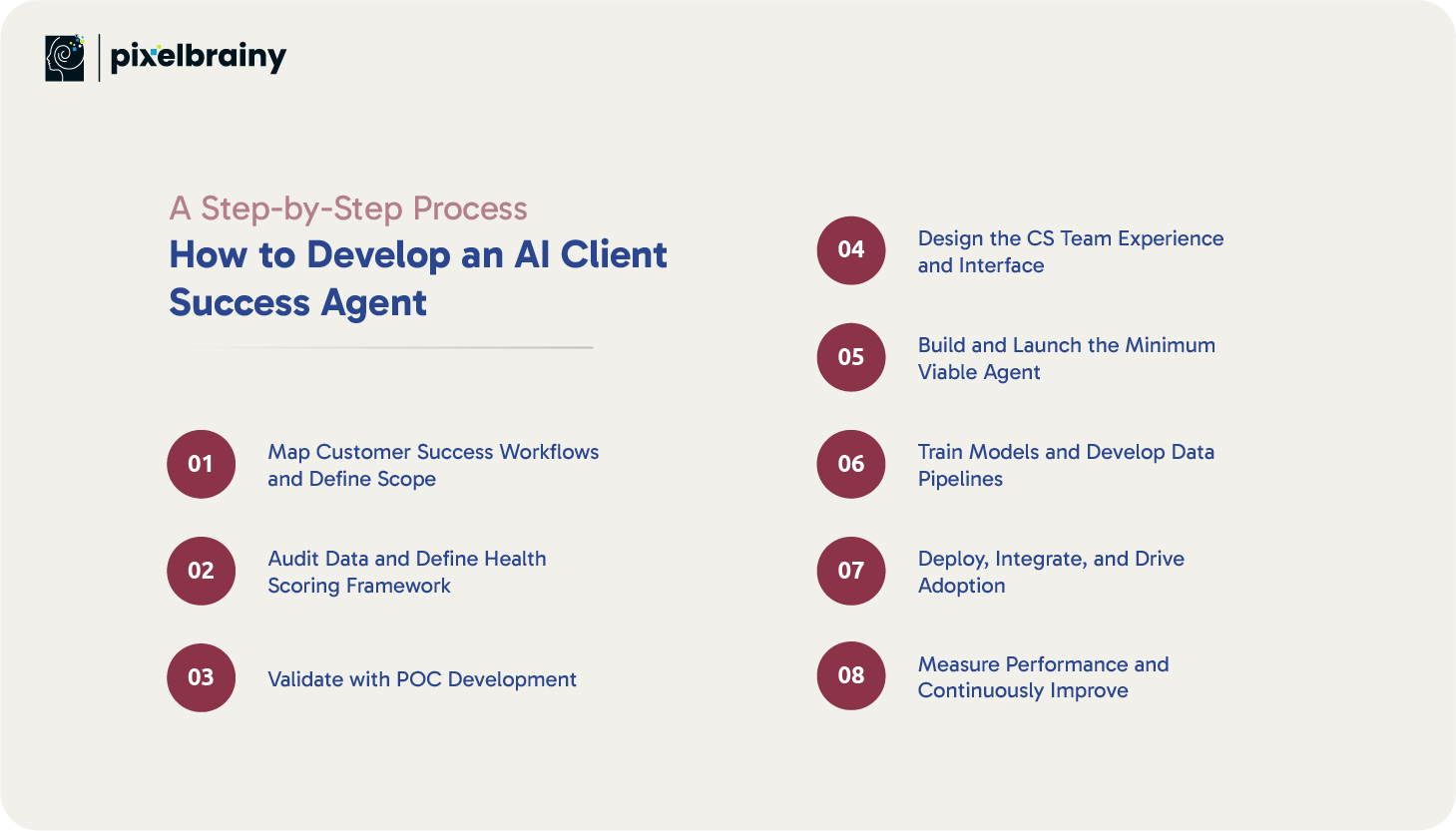
Aim: Identify key workflows, decision points, and automation opportunities within your customer success process.
Start by analyzing how your CS team currently operates. Document triggers such as churn signals, onboarding gaps, and engagement drop-offs. Identify repetitive tasks and areas where teams lack visibility or act too late.
This ensures the agent is built around real operational needs rather than assumptions.
Aim: Establish a strong data foundation and define measurable indicators of client health.
Collect and evaluate data from sources such as product usage, CRM systems, support tickets, billing, and engagement metrics. Define what constitutes a healthy, at-risk, or expansion-ready client.
Accurate data and clear definitions are essential for reliable predictions and decision-making.
Aim: Test the feasibility and accuracy of core AI capabilities before full-scale development.
Conduct focused POC development using historical data to validate churn prediction and health scoring models. Test whether the system can identify known patterns and generate meaningful insights.
This step minimizes risk and ensures the solution is viable before investing in full implementation.
Aim: Create an intuitive and actionable interface that drives adoption among customer success teams.
Work with a professional UI/UX Design company to design dashboards, alerts, and workflows that align with how account managers operate. Focus on clarity, usability, and actionable insights.
A well-designed interface directly impacts adoption and long-term success of the system.
Aim: Deliver a functional system with core capabilities that provide immediate business value.
Develop an MVP with essential features such as predictive health scoring, churn alerts, and onboarding tracking. Integrate it with core systems like CRM and product analytics tools.
Launch with a limited set of accounts to gather feedback and refine performance before scaling.
Also Read: Top AI MVP Development Companies to Consider
Aim: Build accurate predictive models and ensure continuous data flow for real-time analysis.
Collaborate with experienced AI model developers to train machine learning models using historical customer data. Establish real-time data pipelines to feed the system continuously.
Regular retraining ensures the model stays accurate as customer behavior evolves.
Aim: Ensure seamless integration with existing systems and encourage active usage by CS teams.
Integrate the agent with CRM platforms, communication tools, and analytics systems. Provide structured training to help teams understand how to use insights effectively.
Adoption depends on trust, clarity, and ease of use.
Aim: Track outcomes and refine the system based on real-world performance data.
Monitor key metrics such as churn rate, engagement levels, health score accuracy, and expansion revenue. Use insights to improve models, adjust thresholds, and enhance features.
Continuous optimization ensures long-term effectiveness and scalability.
A structured approach is essential for successful AI Client Success Agent development. By following this process, businesses can build a system that is accurate, scalable, and aligned with real customer success needs. For organizations exploring how to build an AI Client Success Agent, this framework provides a clear and practical roadmap for long-term success.
The cost of AI Client Success Agent development depends on several factors, including model complexity, number of integrations, level of automation, and the scale of customer accounts being managed.
In most cases, businesses can expect three primary pricing tiers based on requirements and system sophistication.
| Development Tier | Cost Range | What It Includes |
|---|---|---|
| Basic AI Client Success Agent | $20,000 to $55,000 | Includes basic health scoring using limited data signals, simple churn alerts, onboarding tracking, and integration with a single CRM such as Salesforce or HubSpot. Suitable for early-stage SaaS companies or teams managing up to 200 accounts. |
| Medium AI Client Success Agent | $55,000 to $120,000 | Covers multi-signal predictive health scoring, churn and expansion detection, personalized communication automation, multi-channel engagement, QBR automation, and integration with CRM and product analytics tools. Ideal for growing businesses managing 200 to 2,000 accounts. |
| Advanced AI Client Success Agent | $120,000 to $180,000+ | Includes advanced predictive modeling with continuous retraining, generative AI summaries, voice AI engagement, digital client twin technology, automated playbooks, and full integration across CRM, ERP, and external data systems. Designed for enterprise-scale operations managing thousands of accounts. |
The total AI Client Success Agent cost is influenced by:
Development cost is only part of the investment.
Ongoing expenses include:
Planning for these recurring costs ensures long-term system reliability and accuracy.
The return on investment for a well-built system is often realized quickly. Even a small improvement in retention can deliver significant financial impact.
For example, a 1 percent increase in net revenue retention for a company with $10 million ARR results in $100,000 in preserved revenue. Improvements in churn reduction and expansion revenue typically justify the investment within the first year.
That's why the cost of building an AI client success agent varies based on complexity, but the value it delivers in retention, efficiency, and scalability makes it a high-impact investment. For businesses evaluating AI Client Success Agent development cost, the focus should not only be on initial pricing but on long-term ROI and operational benefits.

Building an AI client success agent requires a well-structured technology stack that supports data processing, predictive modeling, automation, and real-time decision-making. The right combination of tools ensures scalability, accuracy, and seamless integration with existing systems such as CRM, product analytics, and communication platforms.
A modern AI client success agent is not built on a single technology. It is an ecosystem that combines machine learning frameworks, large language models, data pipelines, and cloud infrastructure to deliver continuous intelligence and proactive engagement across the customer lifecycle.
Below is a comprehensive technology stack used in AI Client Success Agent development.
| Category | Tools and Technologies | Explanation |
|---|---|---|
| Programming Languages | Python, TypeScript, Node.js, Java | Python is widely used for AI and ML model development. TypeScript and Node.js handle APIs and application logic, while Java supports enterprise-level integrations. |
| AI and ML Frameworks | TensorFlow, PyTorch, scikit-learn, XGBoost | Used to build predictive models for churn detection, health scoring, and behavioral analysis. |
| Agentic AI Frameworks | LangChain, AutoGen, LlamaIndex | Enable autonomous agent behavior such as reasoning, memory management, and multi-step decision execution. |
| Large Language Model APIs | OpenAI GPT, Anthropic Claude, Google Gemini | Power natural language capabilities including summaries, personalized communication, and conversational engagement. |
| NLP and Sentiment Analysis | Hugging Face, spaCy, VADER | Analyze client sentiment, classify support interactions, and detect tone across communication channels. |
| CRM Integrations | Salesforce API, HubSpot API, Gainsight API, Totango API | Provide access to customer data, account history, and lifecycle information for better decision-making. |
| Product Analytics Integrations | Mixpanel, Amplitude, Segment, Heap | Capture real-time product usage data to generate behavioral insights and health scores. |
| Communication Platforms | SendGrid, Twilio, Intercom API, Slack API | Enable multi-channel engagement including email, SMS, in-app messaging, and team collaboration. |
| Databases and Vector Stores | PostgreSQL, MongoDB, Redis, Pinecone | Store structured data, interaction history, and vector embeddings for intelligent search and memory. |
| Cloud Infrastructure | AWS, Microsoft Azure, Google Cloud | Provide scalable infrastructure for hosting, model inference, and real-time analytics processing. |
| Data Pipeline and ETL | Apache Kafka, dbt, Fivetran, Airbyte | Manage real-time and batch data ingestion from multiple systems into a unified data layer. |
| Frontend and Dashboard | React, Next.js, Tailwind CSS, Figma | Build intuitive dashboards and interfaces for account managers and CS leadership. |
| Security and Authentication | Auth0, AWS Cognito, OAuth 2.0, AES-256 | Ensure secure access control, authentication, and data protection across systems. |
| Monitoring and Observability | Datadog, Grafana, Prometheus, Sentry | Track system performance, model accuracy, uptime, and operational metrics in real time. |
| DevOps and CI/CD | GitHub Actions, Docker, Kubernetes, Terraform | Enable continuous integration, deployment automation, and scalable infrastructure management. |
A well-defined technology stack is the foundation of a scalable and reliable system. Choosing the right tools for AI Client Success Agent development ensures accurate predictions, seamless integrations, and consistent performance. For businesses building an AI-driven customer success system, the technology stack directly impacts long-term scalability, efficiency, and overall success.
An AI client success agent processes sensitive client data including behavioral patterns, usage data, communication history, and business performance metrics. Getting compliance right is not just a legal requirement. It is a trust requirement.
Enterprise clients will ask about your data handling practices before they allow an AI system to monitor their accounts. Here is what every AI client success agent development project needs to address.
Any AI client success agent handling data related to clients in the European Union must comply with GDPR's requirements for data collection, processing, and storage. This includes the behavioral data that feeds the health scoring engine.
Key Requirements:
Enterprise clients will almost universally require SOC 2 Type II certification before allowing a third-party AI system to process their account data. This is particularly relevant for SaaS businesses whose client success agents handle usage and interaction data across their customer portfolio.
Key Requirements:
For AI client success agents serving businesses with California-based clients or end users, CCPA requirements apply to the collection and use of personal information in client success workflows.
Key Requirements:
Beyond specific regulatory frameworks, every AI client success agent should implement data minimization principles that collect only the signals necessary for health scoring and engagement, and retention policies that define how long behavioral data is stored before deletion.
Key Requirements:
In multi-tenant environments where the agent serves multiple client portfolios simultaneously, strict data isolation is essential to ensure that data from one client is never accessible to account managers or team members responsible for other accounts.
Key Requirements:
Strong data governance is essential for building trust and ensuring long-term adoption of AI systems. For any AI Client Success Agent development, compliance and privacy are not optional, they are foundational to security, scalability, and enterprise readiness.
A well-built AI client success agent should produce measurable improvements in the business metrics that CS teams are responsible for. Here are the KPIs that actually matter, and what to do if they are not moving in the right direction.
This is the headline metric for any CS operation. NRR measures the percentage of recurring revenue retained from the existing client base after accounting for churn, contraction, and expansion. A well-functioning AI client success agent should produce a measurable improvement in NRR within two to three quarters of deployment, driven by lower churn and higher expansion revenue.
Track churn rate before and after agent deployment, controlling for other variables like product changes and market conditions. A meaningful reduction in churn rate is the clearest evidence that the predictive detection and early intervention capabilities are working as intended. Research from G2's 2026 AI in Churn Reduction report shows that AI-driven churn management has produced reductions of up to 25% when predictive signals are properly embedded into CS workflows.
This is the internal performance metric that determines whether the churn reduction and expansion signal outcomes are sustainable. If the health score model is generating accurate risk classifications, the downstream outcomes will follow. Track what percentage of accounts flagged as high churn risk actually churn, and what percentage of accounts identified as expansion-ready convert to expansions.
Measure how long it takes new clients to reach their first meaningful success milestone after implementation. An AI client success agent running an intelligent onboarding layer should produce a measurable reduction in time-to-value, which is a leading indicator of 12-month retention rates.
This tracks how many accounts each account manager is actively monitoring and engaging with, compared to the baseline before the agent was deployed. An effective AI client success agent should enable each account manager to meaningfully cover significantly more accounts without a reduction in engagement quality, as measured by client NPS and response rates.
Track what percentage of expansion revenue was preceded by an AI-generated expansion signal. Over time, this metric shows how effectively the agent is identifying and surfacing real opportunities rather than generating noise that the sales team ignores.
What percentage of churn risk alerts generated by the agent result in an account manager taking action within a defined time window. A low alert-to-action rate usually means the alerts are not trusted or not prioritized, which signals a calibration problem with the health scoring model or a UX problem with the alert interface. Both are fixable, but only if you are measuring.
Track NPS and CSAT scores before and after deployment. A CS team that is better informed, better prepared for client conversations, and more proactive in their outreach should produce measurably better client satisfaction outcomes over time.
Tracking the right metrics is essential to validate impact and guide continuous improvement. For any AI Client Success Agent, these KPIs ensure the system delivers measurable gains in retention, efficiency, and customer experience.
Every AI Client Success Agent development project faces a set of predictable challenges. The difference between success and failure lies in anticipating these issues early and addressing them systematically.
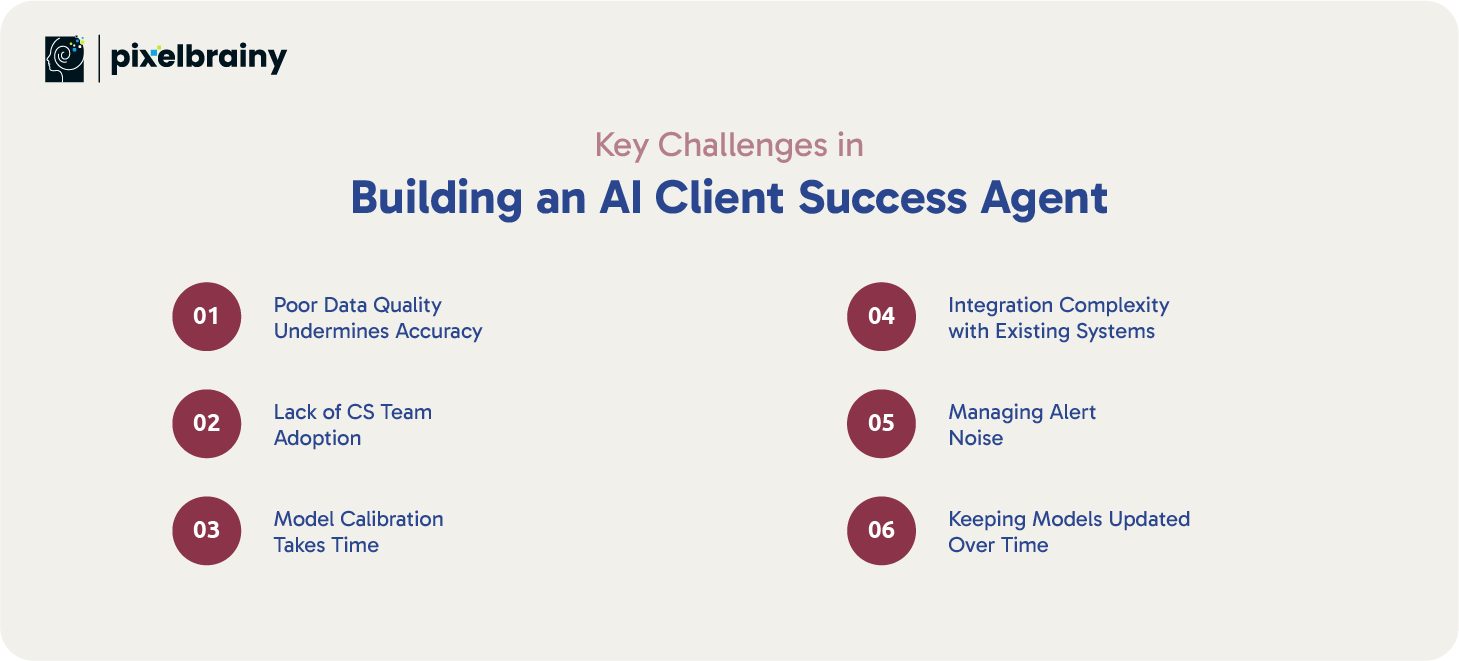
One of the biggest risks is unreliable data. Incomplete product usage, inconsistent CRM records, or poorly structured support data can lead to inaccurate health scores and false predictions.
Solution: Start with a comprehensive data audit before model development. Define clear data quality standards and implement validation checks within your data pipeline. Investing time in data preparation ensures reliable outputs and builds trust in the system.
Even the most advanced system fails if the customer success team does not trust or use it. Resistance often comes from lack of transparency or misalignment with real workflows.
Solution: Involve CS teams early in the design process. Clearly explain how insights are generated and start with a pilot phase. Building trust through transparency and early validation is critical for adoption.
Initial AI models are rarely perfect. False positives and missed signals can reduce confidence in the system if not managed properly.
Solution: Introduce feedback loops where account managers validate alerts and outcomes. Treat the first 60 to 90 days as a calibration phase and continuously refine the model based on real-world data.
Customer success data is often spread across multiple platforms that do not easily integrate. This creates challenges in building a unified data layer.
Solution: Use integration tools such as Fivetran or Airbyte to centralize data. Begin with high-impact integrations and expand gradually as the system stabilizes.
Too many alerts lead to fatigue, while too few result in missed opportunities. Finding the right balance is a key challenge.
Solution: Start with high-confidence alerts only and gradually expand coverage. Fine-tune thresholds using feedback and performance data to maintain relevance and accuracy.
Customer behavior evolves as products and markets change. Static models quickly become outdated and less effective.
Solution: Implement a regular model retraining schedule and assign ownership for monitoring performance. Continuously update inputs and definitions to maintain accuracy.
Successfully building an AI system requires more than technology. Addressing these challenges early ensures that your AI Client Success Agent development delivers accurate insights, strong adoption, and long-term value.
Creating an AI client success agent is not a typical software project. It requires deep expertise in machine learning, behavioral data analysis, system integrations, and real-world customer success operations. The difference between a working system and a failed one often comes down to execution, not just technology.
PixelBrainy is a trusted AI Agent Development Company in USA with hands-on experience in building intelligent, scalable AI systems for enterprise environments. We specialize in developing AI agents that monitor behavioral signals, generate accurate predictions, and deliver actionable insights that customer success teams can rely on.
What sets PixelBrainy apart is our focus on real-world usability. We do not just build technically advanced systems. We build solutions that teams actually adopt and use. This includes accurate alert calibration, seamless integrations with CRM and product analytics platforms, and continuous system improvement as business needs evolve.
Our development approach begins with understanding your customer success workflows, data ecosystem, and key retention challenges. Every AI client success agent we build is tailored to your business context, ensuring that the system aligns with how your teams operate rather than forcing them to adapt to a generic solution.
We also stay engaged beyond deployment. The post-launch phase is critical for calibration, optimization, and adoption. Our goal is to ensure that the system delivers measurable impact and earns long-term trust from your team.
PixelBrainy partnered with a SaaS company in the United States managing over 1,500 enterprise accounts across multiple industries. The objective was to improve retention, scale operations, and enhance client engagement through AI-driven automation.
Solution Delivered:
Results Achieved:
This case highlights how a well-designed AI Client Success Agent can deliver measurable business outcomes when built with a structured development approach and continuous optimization.
Choosing the right partner is critical for successful development of AI Client Success Agent. PixelBrainy combines technical expertise with real-world execution to build systems that are scalable, accurate, and trusted by customer success teams.

Client success is becoming more complex. Customer portfolios are expanding, expectations are increasing, and the pressure to improve retention and expansion metrics continues to grow. The traditional model of manually managing every account is no longer scalable in this environment.
AI client success agent development provides a practical way forward. It does not replace customer success teams. It empowers them. By automating monitoring, detecting patterns, enabling proactive engagement, and reducing administrative workload, AI allows teams to focus on what matters most: building relationships, delivering strategic value, and solving complex client challenges.
The organizations that adopt this approach early will gain a significant competitive advantage. They will respond faster, engage more effectively, and build stronger, longer-lasting client relationships. Over time, this translates directly into improved retention, higher expansion revenue, and better overall customer experience.
If you are ready to build an AI client success agent that works in real-world conditions, not just in theory, book an appointment with PixelBrainy today. You can also explore our full AI development services to understand how we design and deploy scalable AI agent solutions for modern businesses.

About The Author
Sagar Bhatnagar
Sagar Sahay Bhatnagar brings over a decade of IT industry experience to his role as Marketing Head at PixelBrainy. He's known for his knack in devising creative marketing strategies that boost brand visibility and market influence. Sagar's strategic thinking, coupled with his innovative vision and focus on results, sets him apart. His track record of successful campaigns proves his ability to utilize digital platforms effectively for impactful marketing efforts. With a genuine passion for both technology and marketing, Sagar continuously pushes PixelBrainy's marketing initiatives to greater success.


Transform your ideas into reality with us.
Working with the PixelBrainy team has been a highly positive experience. They understand the design requirements and create beautiful UX elements to meet the application needs. The dev team did an excellent job bringing my vision to life. We discussed usability and flow. Sagar worked with his team to design the database and begin coding. Working with Sagar was easy. He has the knowledge to create robust apps, including multi-language support, Google and Apple ID login options, Ad-enabled integrations, Stripe payment processing, and a Web Admin site for maintaining support data. I'm extremely satisfied with the services provided, the quality of the final product, and the professionalism of the entire process. I highly recommend them for Android and iOS Mobile Application Design and Development.

Great experience working with them. Had a lot of feedback and I found that unlike most contractors they were bugging me for updates instead of the other way around. They were extremely time conscience and great at communicating! All work was done extremely high quality and if not on time, early! They were always proactive when it comes to communication and the work is great/above par always. Very flexible and a great team to work with! Goes above and beyond to present us with multiple options and always provides quality. Amazing work per usual with Chitra. If you have UI/UX or branding design needs I recommend you go to them! Will likely work with them in the future as well, definitely recommended!

PixelBrainy is a joy to work with and is a great partner when thinking through branding, logo, and website layout. I appreciate that they spend time going into the "why" behind their decisions to help inform me and others about industry best practices and their expertise.

I hired them to design our software apps. Things I really like about them are excellent communication skills, they answer all project suggestions and collaborate right away, and their input on design and colors is amazing. This project was complex and needed patience and creativity. The team is amazing to do business with. I will be using them long-term. Glad to see there are some good people out there. I was afraid to try and outsource my project to someone but I am glad I met them! I really can't say enough. They went above and beyond on this project. I am very happy with everything they have done to make my business stand out from the competition.

It was great working with PixelBrainy and the team. They were very responsive and really owned the project. We'll definitely work with them again!

I recently worked with the PixelBrainy team on a project and I was blown away by their communication skills. They were prompt, clear, and articulate in all of our interactions. They listened and provided valuable feedback and suggestions to help make the project a success. They also kept me updated throughout the entire process, which made the experience stress-free and enjoyable.

PixelBrainy is very good at what it does. The team also presents themselves very professionally and takes care of their side of things very well. I could fully trust them taking up the design work in a timely and organised manner and their attention to detail saved us lots of effort and time. This particular project was quite intense and the team showed that they function very well under pressure. Very much looking forward to working with her again!

It's always an absolute pleasure working with them. They completed all of my requests quickly and followed every note I had for them to a T, which made our process go smoothly from start to finish. Everything was completed fast and following all of the guidelines. And I would recommend their services to anyone. If you need any design work done in the future, PixelBrainy should be your first call!

They took ownership of our requirements and designed and proposed multiple beautiful variants. The team is self-motivated, requires minimum supervision, committed to see-through designs with quality and delivering them on time. We would definitely love to work with PixelBrainy again when we have any requirements.

PixelBrainy was a big help with our SaaS application. We've been hard at work with a new UI/UX and they provided a lot of help with the designs. If you're looking for assistance with your website, software, or mobile application designs, PixelBrainy and the team is a great recommendation.

PixelBrainy designers are amazing. They are responsive, talented, and always willing to help craft the design until it matches your vision. I would recommend them and plan to continue them for my future projects and more!!!

They were awesome! Did a good job fast, and good communication. Will work with them again. Thank you

Creative, detail-oriented, and talented designers who take direction well and implement changes quickly and accurately. They consistently over-delivered for us.

PixelBrainy team is very talented and creative. Great designers and a pleasure to work with. PixelBrainy is an excellent communicator and I look forward to working with them again.

PixelBrainy has a very talented design team. Their work is excellent and they are very responsive. I enjoy working with them and hope to continue on all of our future projects.


