AI Summary Powered by PixelBrainy
The EdTech industry is entering a new era where personalized learning and intelligent skill evaluation are becoming more important than traditional online testing systems.
Today’s learners expect platforms that can understand their strengths, identify skill gaps, recommend personalized learning paths, and provide real-time feedback. At the same time, EdTech founders are under pressure to create scalable digital products that improve learner engagement, increase completion rates, and deliver measurable outcomes for institutions and businesses worldwide.
This is exactly why AI Skill Assessment Software Development has become one of the fastest-growing opportunities in the global education technology market.
AI-powered assessment systems are transforming the way educational platforms evaluate learners. Instead of relying only on static quizzes and manual grading, modern AI tools can analyze performance patterns, adapt question difficulty, automate scoring, detect learning gaps, and generate personalized recommendations. These intelligent capabilities help EdTech companies deliver more value while reducing operational complexity.
If you're running an EdTech platform and thinking, “we are looking to build an AI skill assessment tool but don't know where to start,” this guide is written for you.
Many founders also ask this question during vendor selection: “We are looking for an experienced EdTech product development company in USA that can build an affordable AI-powered skill assessment SaaS tool for global markets, can you suggest how to evaluate their technical expertise before hiring?”
In this detailed guide, you will learn how to create AI skill assessment software, understand the complete development process, explore the best technologies, and discover how to Build AI-Powered EdTech Assessment Platform solutions for modern education businesses. You will also learn how to develop skill assessment software for education that can create automated skill gap analysis tool capabilities for learners worldwide.
Let's start with the basics before we get to the blueprint
The education industry is rapidly shifting from traditional testing systems to intelligent digital assessment platforms powered by artificial intelligence. In 2026, EdTech businesses are no longer focused only on delivering online courses. They are expected to measure real learner outcomes, identify skill gaps, and personalize learning experiences at scale.
This is where AI-Based Learning Assessment Tool Development becomes extremely valuable.
AI-powered skill assessment software is a smart digital platform that evaluates learner knowledge, skills, behavior, and performance using technologies such as machine learning, natural language processing, predictive analytics, and adaptive testing algorithms.
In simple terms, these systems can automatically understand how a learner performs, analyze strengths and weaknesses, and adjust assessments in real time without requiring constant human involvement.
For non-technical EdTech founders, this means the platform becomes intelligent enough to:
When people ask, “What does AI-powered actually mean in an assessment context?”, the answer is straightforward.
It means the software can learn from learner behavior and assessment data to make smarter evaluation decisions over time.
Instead of giving every learner the exact same test, AI systems dynamically personalize assessments based on performance patterns.
For example:
This is why AI-Driven Student Skill Evaluation is becoming a core feature for modern EdTech businesses.
According to industry research, AI-assisted grading systems can achieve up to 85% to 95% consistency accuracy in structured assessments, often outperforming manual grading consistency in large-scale educational environments.
| Feature | Traditional Assessment | AI-Powered Assessment |
| Evaluation Speed | Slow and manual | Real-time automated evaluation |
| Scalability | Limited by human evaluators | Can assess thousands of learners simultaneously |
| Personalization | Same test for everyone | Adaptive assessments based on learner performance |
| Bias Reduction | Human bias possible | Data-driven and more standardized |
| Feedback Delivery | Delayed feedback | Instant personalized feedback |
| Operational Cost | High long-term staffing cost | Lower operational cost through automation |
| Skill Gap Detection | Often delayed | Real-time automated skill gap analysis |
| Data Insights | Limited reporting | Advanced learner analytics and predictions |
| Learner Engagement | Static testing experience | Interactive and adaptive experience |
| Global Accessibility | Limited scalability | Cloud-based global assessment access |
Artificial intelligence is fundamentally transforming how educational performance is measured.
Machine learning models analyze massive amounts of learner data to identify patterns, predict outcomes, and improve evaluations continuously.
Over time, the system becomes smarter and more accurate.
Natural Language Processing, commonly called NLP, helps AI systems understand written and spoken language.
This allows platforms to evaluate:
Instead of relying only on multiple-choice testing, AI enables deeper competency analysis.
Adaptive algorithms automatically adjust question difficulty based on learner performance.
This creates:
AI systems can predict:
This helps educators and businesses intervene earlier and improve outcomes.
Unlike static testing systems, AI-powered assessment platforms continuously improve through new learner interactions and performance data.
This creates a smarter, more scalable, and more efficient assessment ecosystem for EdTech businesses worldwide.
The demand for intelligent learning and automated evaluation systems is growing rapidly across the global education industry. In 2026, EdTech companies are investing heavily in AI-powered assessment platforms to improve learner engagement, personalize education, and deliver measurable skill outcomes.
This growing demand is creating a major opportunity for startups, enterprises, and investors interested in AI Skill Assessment Software Development for EdTech.
Educational institutions, corporate training providers, certification companies, and workforce development platforms are all adopting AI-driven assessment systems to automate evaluations, reduce manual effort, and improve learning accuracy at scale.
The market for AI-powered assessment technology is expanding quickly due to the rise of online learning, workforce reskilling, and digital certification platforms.
According to recent market research, the global AI-assisted remote proctoring market was valued at approximately $1.8 billion in 2025 and is projected to reach nearly $7.4 billion by 2034, showing strong long-term growth potential.
Another important trend in 2026 is the growing investor focus on agentic AI systems integrated directly into educational workflows, institutional operations, and assessment platforms. Investors are actively funding AI-native products that improve automation, analytics, and personalized learning experiences.
This creates a strong market opportunity for founders planning to Develop Adaptive Learning Assessment System solutions for schools, universities, enterprises, and global EdTech platforms.
Several leading EdTech companies are already using AI-powered assessments to improve learner outcomes and platform engagement.
These companies are investing in AI assessment technology because it helps them:
Many founders now ask practical questions before investing, such as: “I am planning to invest in developing an AI-powered EdTech assessment product, can you suggest how to validate the idea and estimate the development cost before committing a budget?”
The best approach is to start with a focused MVP, validate demand within a specific learner segment, analyze competitors, estimate AI infrastructure costs, and define a scalable SaaS revenue model before making a large investment.
Generate revenue through subscriptions, certifications, and premium assessments for learners.
Offer workforce assessment solutions and enterprise licensing for companies and universities.
Provide white-label AI assessment platforms for institutions serving their own learners.
These models create recurring revenue opportunities while reducing operational costs through automation.
Several market conditions are supporting rapid growth in AI-powered EdTech platforms:
For EdTech founders, AI-powered assessment systems are becoming a strategic growth opportunity with strong long-term market potential.
Planning to build your AI assessment platform? Let's discuss your idea →
AI-powered assessment platforms are being adopted across multiple education and workforce training sectors. From universities and coding academies to enterprise learning systems and HR platforms, organizations are using intelligent assessments to improve learner outcomes, automate evaluations, and personalize training experiences.
Businesses looking to Create Automated Skill Gap Analysis Tool solutions or Build AI-Powered Competency Assessment Platform products are finding opportunities across several high-growth industry segments.
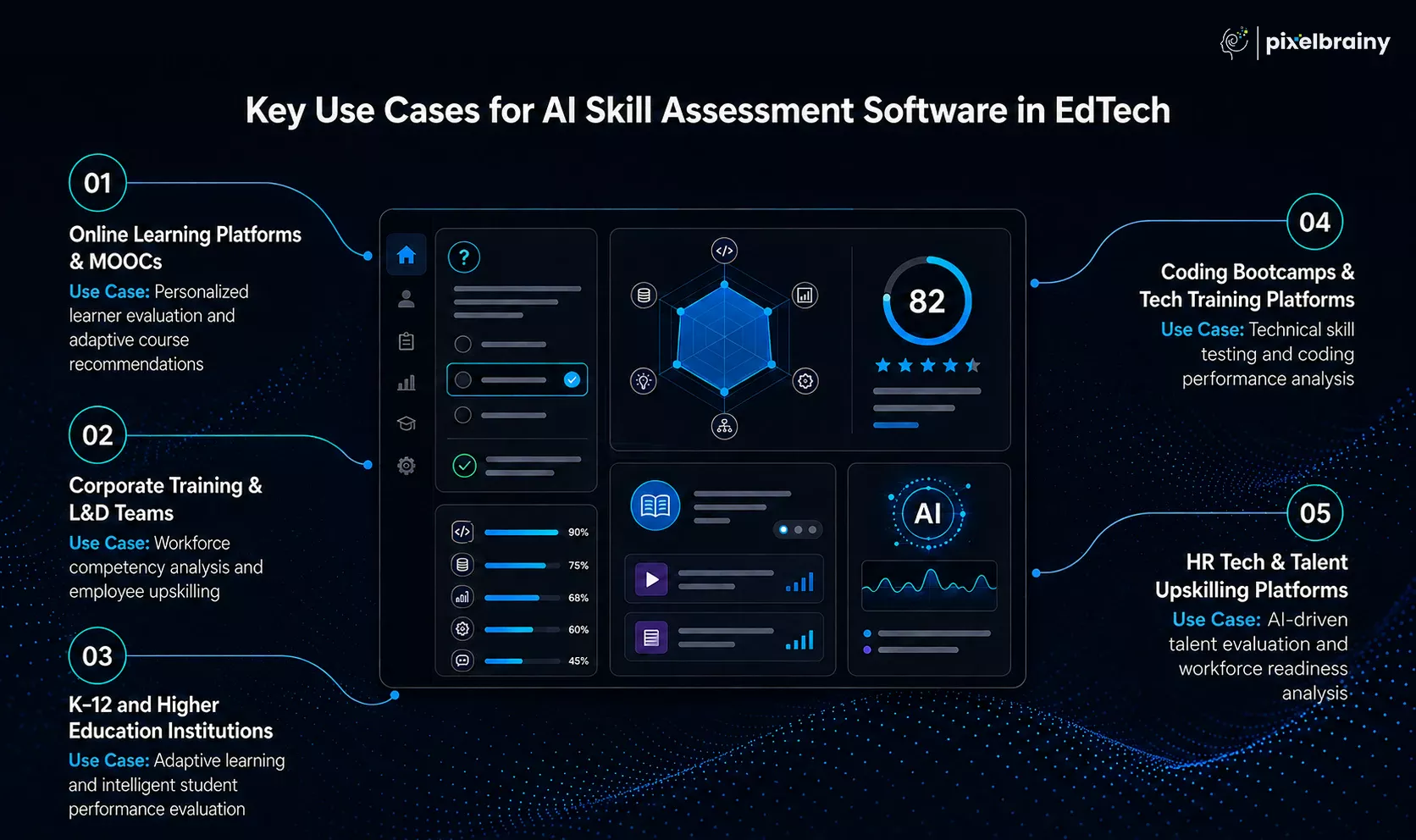
Use Case: Personalized learner evaluation and adaptive course recommendations
Online learning platforms and MOOCs are using AI-powered assessments to track learner progress, personalize learning paths, and improve course completion rates. AI systems can automatically adjust assessment difficulty levels, recommend relevant courses, and identify learner weaknesses in real time.
Real-World Scenario:
An online certification platform offering digital marketing courses integrated AI-driven assessments to analyze learner performance after every module. The platform automatically recommended personalized lessons and practice tests based on skill gaps. Within six months, learner engagement increased significantly and course completion rates improved.
Conversational Query:
“We run an online learning platform and want to personalize assessments and course recommendations using AI.”
Use Case: Workforce competency analysis and employee upskilling
Corporate learning and development teams are adopting AI-powered assessment systems to measure employee skills, identify competency gaps, and recommend targeted training programs.
AI helps enterprises build data-driven workforce development strategies while reducing manual evaluation processes.
Real-World Scenario:
A corporate training company serving IT enterprises implemented AI-based employee assessments to measure cloud computing and cybersecurity skills. The platform generated automated skill gap reports and personalized learning recommendations for employees, helping HR teams improve workforce readiness.
Conversational Query:
“We are running a corporate training platform and want to add AI skill gap analysis for employee upskilling.”
Use Case: Adaptive learning and intelligent student performance evaluation
Schools, colleges, and universities are integrating AI assessments to personalize education, automate grading, and improve student performance tracking.
AI-powered systems help educators identify struggling students earlier and deliver targeted learning interventions.
Real-World Scenario:
A university deployed an AI-driven assessment platform for engineering students. The system analyzed quiz performance, assignment patterns, and engagement behavior to generate personalized study recommendations. Faculty members used the insights to improve academic support and reduce dropout risks.
Conversational Query:
“We want to develop an AI assessment platform that helps teachers identify student learning gaps automatically.”
Use Case: Technical skill testing and coding performance analysis
Coding bootcamps and technology training platforms are using AI to automate coding evaluations, analyze problem-solving approaches, and benchmark learner performance.
These platforms can evaluate coding accuracy, logic, efficiency, and technical competency at scale.
Real-World Scenario:
A coding bootcamp integrated AI-powered coding assessments into its training platform to evaluate developer skills in Python, JavaScript, and cloud computing. The system automatically scored assignments, identified weak areas, and generated personalized coding practice recommendations for learners.
Conversational Query:
“We are building a coding education platform and need AI-powered developer skill assessments with automated feedback.”
Use Case: AI-driven talent evaluation and workforce readiness analysis
HR technology platforms are using AI-powered assessments to evaluate candidate readiness, benchmark employee skills, and support talent development initiatives.
These platforms help organizations make faster hiring and workforce planning decisions.
Real-World Scenario:
An HR technology company implemented AI-driven competency assessments for technical hiring. The platform evaluated communication skills, aptitude, technical knowledge, and behavioral performance through adaptive testing and predictive analytics, helping recruiters improve hiring accuracy.
Conversational Query:
“We want to build an AI-powered competency assessment platform for recruitment and workforce development.”
From the above use cases, it is clear that AI-powered skill assessment software is becoming an essential solution for EdTech businesses, corporate training platforms, educational institutions, and workforce development companies looking to deliver smarter, faster, and more personalized learning experiences.
Building a successful AI-powered assessment platform requires much more than adding quizzes and automated grading. Modern EdTech products are expected to deliver adaptive learning experiences, intelligent analytics, skill gap identification, and scalable assessment workflows that support both learners and institutions.
This is why founders investing in AI skill assessment software development must carefully prioritize features based on product stage, target audience, and business goals.
One of the biggest mistakes EdTech startups make is trying to launch with enterprise-level functionality from day one. Instead, the smartest approach is to start with a lean MVP that solves a specific assessment problem, validate market demand, and then gradually scale with advanced AI capabilities.
For companies building AI assessment solutions for online learning, feature prioritization directly impacts:
The best strategy is to divide your platform roadmap into two phases:
This structure helps founders build faster while keeping future expansion in mind.
These are the essential features required to launch a functional AI assessment platform.
A strong MVP should focus on solving core learner evaluation problems while delivering measurable business value.
| Feature | Description | Why It Matters |
| AI Question Generation | Automatically creates questions from course or curriculum content | Saves 60–70% of manual content creation time |
| Adaptive Difficulty Engine | Adjusts question complexity based on learner performance | Creates personalized learning experiences |
| Automated Scoring & Grading | AI evaluates objective and semi-structured answers | Reduces manual grading effort by up to 80% |
| Skill Gap Detection | Identifies weak skill areas automatically | Helps learners improve faster |
| Real-Time Performance Dashboard | Displays assessment analytics for learners and administrators | Improves engagement and retention |
| Basic Proctoring Module | Detects tab-switching, browser activity, and facial presence | Supports exam integrity and monitoring |
These features create the foundation of a scalable AI assessment ecosystem.
For example:
Most importantly, these capabilities help your platform stand out from basic off-the-shelf testing tools that only provide static quizzes and manual reporting.
A launch-ready assessment engine should include:
This combination gives you enough functionality to validate the market without overbuilding the product.
Once your MVP gains traction, you can expand your platform with advanced AI capabilities designed for enterprise scalability and global adoption.
These features improve personalization, automation, and platform intelligence.
| Feature | Description |
| NLP-Based Subjective Answer Evaluation | Uses AI and LLMs to evaluate open-ended responses |
| Voice & Video Skill Assessment | Measures communication skills, confidence, and soft skills |
| AI Learning Path Recommendation | Suggests personalized courses based on assessment results |
| Competency Mapping & Benchmarking | Maps learner skills against industry standards |
| Multi-Language Support | Supports global learners across multiple languages |
| LMS/ATS/HRIS Integration | Connects with enterprise learning and HR systems |
| White-Label Module | Allows reselling the platform under different brand names |
Most traditional assessment platforms focus only on quizzes and reporting.
Advanced AI-powered platforms differentiate themselves through:
AI dynamically adapts assessments based on learner behavior and skill progression.
The platform can benchmark learners against industry skill standards.
AI predicts learner outcomes, certification readiness, and skill improvement paths.
Integration with LMS, ATS, and HRIS systems increases enterprise adoption potential.
Modern AI platforms can evaluate text, audio, video, coding tasks, and behavioral responses.
These advanced capabilities make your product significantly more valuable than standard online testing software.
Feature prioritization should always align with your business model and target audience.
For example:
A phased development approach helps reduce initial investment risk while allowing your platform to scale intelligently over time.
From MVP automation features to enterprise-grade AI intelligence, choosing the right capabilities at the right stage is one of the most important decisions in Important Features in AI Skill Measurement Tool Development.
Building an intelligent assessment platform requires much more than integrating AI APIs into an existing learning system. A successful platform must combine scalable architecture, adaptive learning workflows, accurate AI evaluation models, intuitive UI/UX design, and enterprise-grade performance.
This Step-by-Step Guide to Building AI Skill Testing Platform solutions is designed specifically for founders, EdTech companies, institutions, and enterprise learning providers looking to build scalable AI-driven assessment products.
One of the most common questions founders ask is:
“We are running an EdTech platform with over 50,000 learners and we want to add an AI-powered skill assessment feature, can you suggest the best way to develop and integrate this without disrupting our current system?”
The best approach is to build the assessment engine as a modular and API-driven layer that integrates with your existing LMS or learning platform instead of rebuilding the entire system from scratch. This reduces migration risks, improves scalability, and allows phased rollout without affecting active learners.
Another common question is:
“I am planning to build this. Do I need a full team from Day 1?”
The answer is no.
Most successful AI assessment products start with:
You can scale the team gradually based on product validation and market traction.
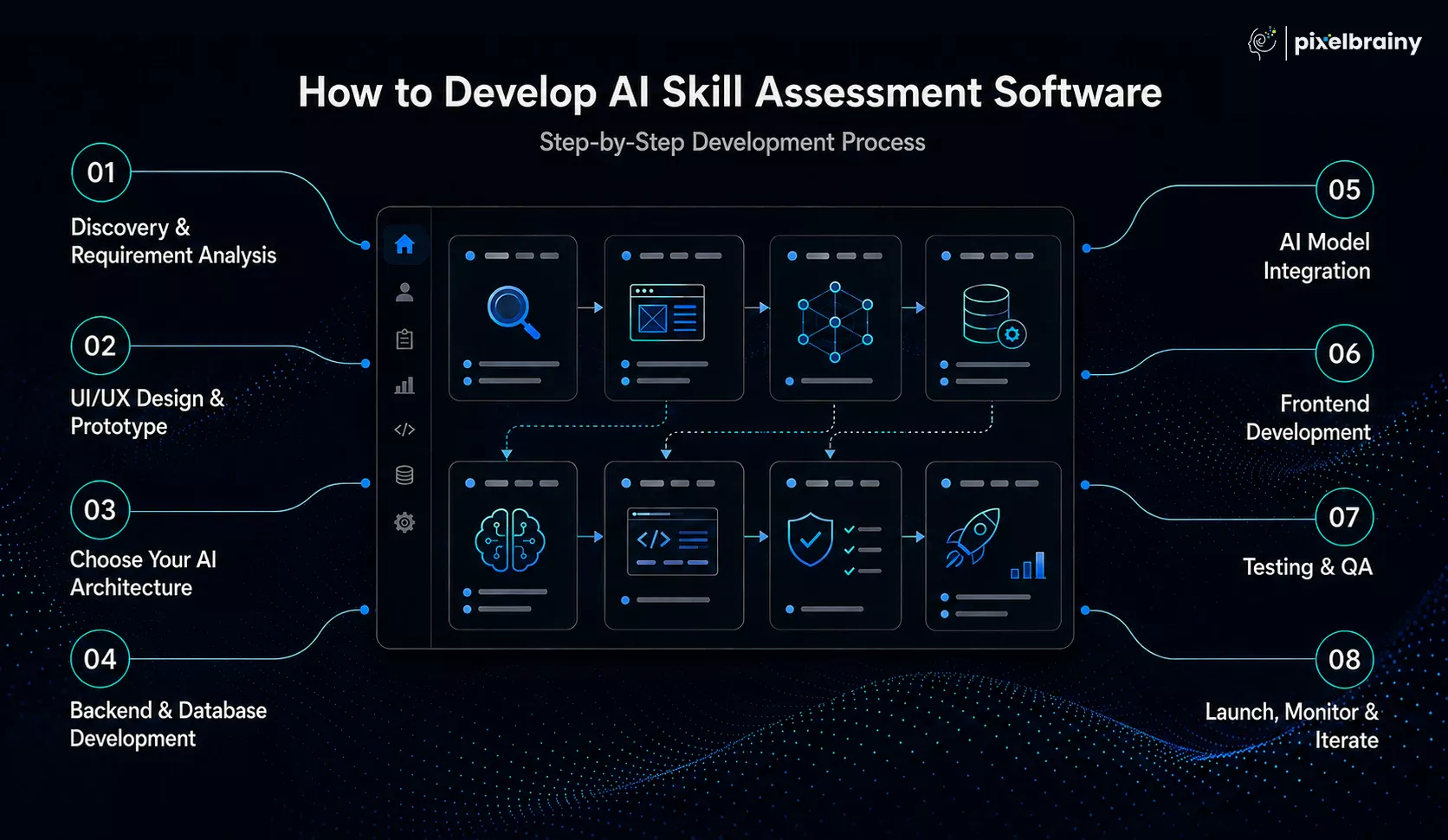
The discovery phase lays the foundation for successful AI skill assessment software development. Before starting development, businesses must clearly define their target users, learning workflows, business goals, and technical requirements. This step helps avoid costly mistakes later in the project.
Start by identifying whether your platform will serve students, universities, enterprises, recruiters, or corporate learning teams. Each audience requires different assessment workflows, analytics, and AI capabilities.
Next, map complete learner journeys including onboarding, assessment flow, result generation, reporting, and recommendation systems. Conduct market and competitor analysis to identify feature gaps and monetization opportunities.
This stage should also include feasibility analysis for custom AI models versus third-party integrations.
Common tools used include Miro, FigJam, Notion, and Jira.
A strong user experience directly affects learner engagement, assessment completion rates, and platform adoption. This is why UI/UX design should begin before development starts.
The goal is to design intuitive and distraction-free assessment experiences for learners, instructors, and administrators. Create wireframes and interactive prototypes for quiz interfaces, dashboards, analytics screens, AI feedback modules, and reporting systems.
Mobile-first design is extremely important because many learners access EdTech platforms using smartphones and tablets. Responsive layouts, touch-friendly navigation, and clean user flows improve accessibility and usability.
Many founders ask, “Should UI come before tech?” The answer is yes because UI design helps define product workflows and technical architecture early.
Popular design tools include Figma and Adobe XD.
Choosing the right AI architecture is one of the most important decisions in building AI assessment solutions for online learning. The architecture determines platform scalability, evaluation accuracy, and long-term product flexibility.
Rule-based systems work best for simple quizzes and basic assessment automation. Machine learning models are better for adaptive testing, predictive analytics, and learner behavior analysis. LLM-powered systems such as GPT, Claude, or Gemini are ideal for evaluating open-ended responses, essays, and conversational assessments.
For adaptive testing platforms, many businesses use Item Response Theory algorithms to adjust question difficulty dynamically.
The right approach depends on your product goals, learner type, assessment complexity, compliance requirements, and budget.
The backend infrastructure acts as the core engine of the entire assessment platform. It manages learner data, assessment workflows, AI processing, analytics, authentication, and integrations.
Most modern platforms use REST APIs and microservices architecture because they improve scalability, modularity, and performance. Backend systems should support real-time assessment processing, adaptive testing logic, automated grading workflows, and secure data handling.
Database architecture must be designed carefully to manage learner profiles, assessment history, AI evaluation data, performance analytics, and recommendation systems efficiently.
For large-scale platforms, real-time data synchronization becomes critical during live assessments and proctoring sessions.
Common backend technologies include Node.js, Python, PostgreSQL, MongoDB, Redis, and Firebase.
This stage focuses on integrating artificial intelligence capabilities into the assessment platform. The goal is to create intelligent evaluation systems that automate scoring, personalize learning, and improve learner analysis.
Natural Language Processing models help evaluate essays, written answers, communication skills, and language proficiency. Computer vision technologies can support AI proctoring features such as facial detection, eye tracking, and suspicious activity monitoring.
Speech recognition systems are commonly used for pronunciation analysis, spoken assessments, and interview simulations.
Businesses must also decide whether to use pre-trained LLMs like GPT-4 or develop custom fine-tuned models for industry-specific evaluations.
Proper AI integration significantly improves personalization, scalability, and assessment efficiency.
Frontend development focuses on creating interactive learner experiences across web and mobile platforms. This layer is responsible for how users interact with assessments, dashboards, analytics, and AI-generated feedback.
Modern EdTech platforms commonly use React.js or Next.js for web development and React Native for mobile applications. These frameworks support scalable and responsive user interfaces.
Important frontend features include real-time quiz engines, timers, progress indicators, adaptive question rendering, and performance dashboards.
Accessibility is also extremely important in EdTech development. Platforms should follow WCAG 2.1 AA compliance standards to support inclusive learning experiences for all users.
A well-developed frontend improves learner engagement, usability, and retention.
Testing ensures that the AI assessment platform performs accurately, securely, and reliably under real-world conditions. Since assessments directly affect learner outcomes, quality assurance becomes critical.
AI models should be tested for scoring consistency, bias detection, false positives, and prediction accuracy. Platforms handling thousands of learners simultaneously also require extensive load testing and performance optimization.
Security testing is equally important because educational systems manage sensitive learner data. Penetration testing, API validation, and authentication testing help identify vulnerabilities before launch.
Beta testing with real learner groups helps validate usability, engagement, assessment quality, and AI performance in live learning environments.
Continuous testing improves both product quality and learner trust.
Launching the platform is only the beginning of the product lifecycle. Successful AI assessment platforms continuously improve based on learner behavior, analytics, and real-world usage data.
A phased rollout strategy helps reduce operational risks. Most companies begin with private beta testing, followed by soft launches and gradual public deployment.
After launch, businesses should monitor important KPIs such as learner engagement, completion rates, assessment accuracy, retention, and AI scoring consistency.
Continuous AI model retraining is necessary to improve personalization and evaluation quality over time. Product teams should also gather user feedback regularly to optimize assessment workflows and user experiences.
Ongoing iteration is essential for long-term platform growth and scalability.
From PoC development and MVP development to enterprise-scale deployment, following a structured process is essential for building a reliable, scalable, and future-ready AI-powered assessment platform.
A scalable and AI-ready technology foundation is essential for businesses investing in AI skill assessment software development. The technologies behind your platform directly impact learner experience, assessment accuracy, real-time performance, security, and long-term scalability.
For founders researching What Tech Stack to Build AI-Powered Student Skill Evaluation Platform solutions in 2026, the goal should be to combine modern frontend frameworks, scalable backend systems, advanced AI infrastructure, and secure cloud architecture.
Many EdTech founders also ask: “We are planning to Develop Adaptive Learning Assessment System software for global learners, which technologies are best for scalability and AI integration?”
The answer depends on your product goals, assessment complexity, learner volume, and AI capabilities.
| Layer | Recommended Technologies | Why It Is Used |
| Frontend | React.js, Next.js, Vue.js, React Native | Builds responsive web and mobile learning experiences |
| Backend | Node.js, Python (FastAPI / Django), Go | Supports APIs, AI processing, and scalable backend systems |
| AI / ML | OpenAI GPT-4o, Claude API, LangChain, Hugging Face, TensorFlow, PyTorch | Enables adaptive testing, automated grading, and AI recommendations |
| NLP | spaCy, NLTK, BERT, OpenAI Embeddings | Evaluates essays, communication skills, and text-based responses |
| Speech / Video | AssemblyAI, Deepgram, OpenCV, MediaPipe | Supports voice assessments and AI proctoring |
| Database | PostgreSQL, MongoDB, Redis | Stores learner data and supports fast caching |
| Cloud & Infra | AWS, Google Cloud, Microsoft Azure | Handles auto-scaling during live assessment traffic |
| DevOps | Docker, Kubernetes, GitHub Actions | Simplifies deployment and infrastructure scaling |
| Security | OAuth 2.0, AES-256 Encryption, FERPA/GDPR | Protects sensitive learner and institutional data |
| Integrations | Open API, REST APIs, LTI 1.3, Zapier, Webhooks | Connects LMS and enterprise systems |
Startups building AI-powered EdTech products with limited budgets can reduce infrastructure costs using open-source technologies such as:
These technologies are widely used in early-stage AI skill assessment software development and MVP launches.
For most startups building AI assessment solutions for online learning, GPT-4o and Claude API are the best starting options because they reduce development time and provide advanced AI capabilities immediately.
Custom AI models are more suitable when:
Most EdTech companies begin with API-based AI integration and later move toward custom-trained models after achieving product-market fit and sufficient learner data volume.
The right tech stack helps businesses build scalable, secure, and intelligent assessment platforms capable of supporting adaptive learning, automated evaluations, and real-time learner analytics at scale.
Does It Cost to Build AI EdTech Platform solutions in 2026?”
The answer depends on several factors including platform complexity, AI capabilities, integrations, learner volume, development team structure, and scalability requirements.
A simple MVP with automated assessments and analytics will cost significantly less than an enterprise-grade AI platform with adaptive learning, NLP evaluation, AI proctoring, and multi-language support.
Another major factor is your development approach. Many startups reduce initial investment by starting with MVP development before scaling into advanced AI functionality.
According to industry trends, EdTech development costs in India are often 3x to 4x lower than equivalent onshore US development rates while still offering strong quality standards through experienced development partners.
| Development Model | Estimated Cost | Estimated Timeline |
| MVP (Core Features Only) | $25,000 – $40,000 | 2–4 months |
| Mid-Level Product | $40,000 – $100,000 | 4–7 months |
| Enterprise-Grade Platform | $100,000 – $250,000+ | 8–14 months |
An MVP is the best starting point for startups validating product-market fit.
A basic MVP typically includes:
This approach helps founders launch faster while minimizing initial risk.
| Hiring Model | Cost Range | Best For |
| In-house Team (US/UK) | $200,000 – $500,000/year | Enterprise-scale products |
| Outsourcing (India) | $25,000 – $80,000 | Startups and MVP launches |
| Dedicated Remote Team | $50,000 – $150,000 | Mid-stage EdTech companies |
| Freelancers | $10,000 – $30,000 | Prototype or PoC development |
Many businesses calculate only development costs and ignore long-term operational expenses.
Important hidden costs include:
These costs increase as learner traffic and AI usage scale.
Many founders ask:
“We are planning to build an MVP. What's a realistic budget for 4 months?”
For a scalable AI-powered assessment MVP with:
A realistic budget usually falls between $25,000 and $50,000 depending on feature complexity, UI/UX quality, AI integrations, and development location.
Startups often reduce costs further by:
The biggest pricing factors include:
The overall Cost of Developing AI-Based Skill Assessment Software becomes significantly more manageable when businesses follow a phased MVP-first development strategy.
Get a free cost estimate for your AI assessment platform →
Data privacy and compliance have become critical requirements in AI-powered EdTech platforms. Educational institutions, enterprises, and government organizations expect assessment systems to protect learner data, maintain accessibility standards, and ensure fair AI-driven evaluations.
For businesses developing AI skill assessment platforms, compliance should be integrated into the architecture from the beginning instead of being added later.
One important industry update is that April 2026 marks the US DOJ WCAG 2.1 AA compliance deadline for many public institutions. Platforms that delay accessible assessment infrastructure development risk losing institutional clients and partnership opportunities.
FERPA protects student educational records in the United States and is essential for platforms serving schools, colleges, and universities.
GDPR regulates how personal data is collected, processed, and stored for users in the European Union.
COPPA applies to platforms collecting data from children under 13 years old.
WCAG compliance ensures accessibility for learners with disabilities through screen-reader compatibility, keyboard navigation, and accessible UI design.
AI bias detection should be treated as a core development requirement, not an afterthought.
Assessment models trained on biased or incomplete datasets can generate unfair evaluations and inaccurate learner outcomes. This can create serious trust, legal, and reputational risks for EdTech businesses.
Development teams should regularly test AI systems for:
Human review workflows and transparent scoring systems also improve assessment fairness and reliability.
AI-powered assessment platforms handle highly sensitive learner information, including performance data, identity records, assessment history, and behavioral analytics.
To protect this data, platforms should implement:
Platforms serving enterprises and institutions should also consider SOC 2 compliance for stronger security credibility.
Strong compliance and security architecture helps EdTech businesses build trust, support enterprise adoption, and scale safely across global education markets.
One of the biggest founder questions in AI-powered EdTech is: “How do EdTech companies make money from AI skill assessment tools?”
The answer depends on your target audience, product positioning, and scalability goals. Some companies focus on subscription-based learner platforms, while others generate revenue through enterprise licensing, white-label partnerships, or AI APIs.
The most successful AI assessment businesses often combine multiple revenue streams instead of relying on a single monetization strategy.
The SaaS model is one of the most common approaches for AI-powered assessment platforms.
Users pay monthly or yearly fees based on:
This model works well for:
Platforms like LearnUpon and other LMS providers commonly use tiered SaaS pricing structures.
In this model, educational institutions or businesses use your platform under their own branding.
This approach is ideal for:
White-label licensing creates high-value recurring contracts and faster market expansion opportunities.
Many EdTech founders prefer this model because it reduces direct customer acquisition costs.
Enterprise licensing focuses on large organizations needing workforce assessments, compliance testing, and employee upskilling solutions.
Revenue is typically generated through:
Platforms like Workera use enterprise-focused AI skill intelligence models for workforce development and technical talent assessment.
This model works best for mature AI assessment platforms with advanced analytics and enterprise-grade integrations.
Freemium models attract users through free assessments and limited platform access.
Revenue is generated by upselling:
This strategy helps startups grow quickly by lowering user acquisition barriers.
It works especially well for B2C EdTech products targeting students and individual learners.
Some companies monetize their AI engine directly by offering APIs to other EdTech platforms.
This allows businesses to sell:
API monetization creates scalable recurring revenue without requiring a full learner-facing platform.
This model is increasingly popular among AI-native EdTech startups.
| Revenue Model | Best For | Revenue Potential | Scalability |
| SaaS Subscription | Startups & EdTech apps | Medium to High | High |
| White-Label Licensing | Growing EdTech companies | High | Medium to High |
| Enterprise B2B Licensing | Mature AI platforms | Very High | High |
| Freemium + Upsell | B2C learner platforms | Medium | Very High |
| API-as-a-Service | AI infrastructure startups | High | Very High |
A strong monetization strategy should align with your target users, platform capabilities, and long-term business goals. Many successful EdTech companies begin with SaaS subscriptions and later expand into enterprise licensing and API monetization as the platform scales.
Wondering which monetization model fits your EdTech idea? Let's talk strategy →
Building intelligent EdTech assessment platforms comes with several technical, operational, and scalability challenges. Businesses investing in AI skill assessment software development must plan carefully to ensure platform accuracy, security, performance, and long-term sustainability.
Many startups focus only on AI functionality during early development and overlook scalability, compliance, and integration challenges that appear later as learner traffic grows.
Understanding these challenges early helps businesses build more reliable and future-ready AI assessment solutions for online learning.
| Challenge | Solution |
| AI model bias in assessments | Conduct regular bias audits and train models using diverse datasets |
| Scaling during exam traffic spikes | Use auto-scaling cloud infrastructure such as AWS or Google Cloud |
| Grading subjective answers accurately | Combine fine-tuned LLMs with human-in-the-loop review systems |
| Data privacy compliance | Implement role-based access control and end-to-end encryption |
| Integration with existing LMS/HRIS systems | Use LTI 1.3 standards and REST API-first architecture |
| High AI API costs at scale | Use caching systems and hybrid AI model strategies |
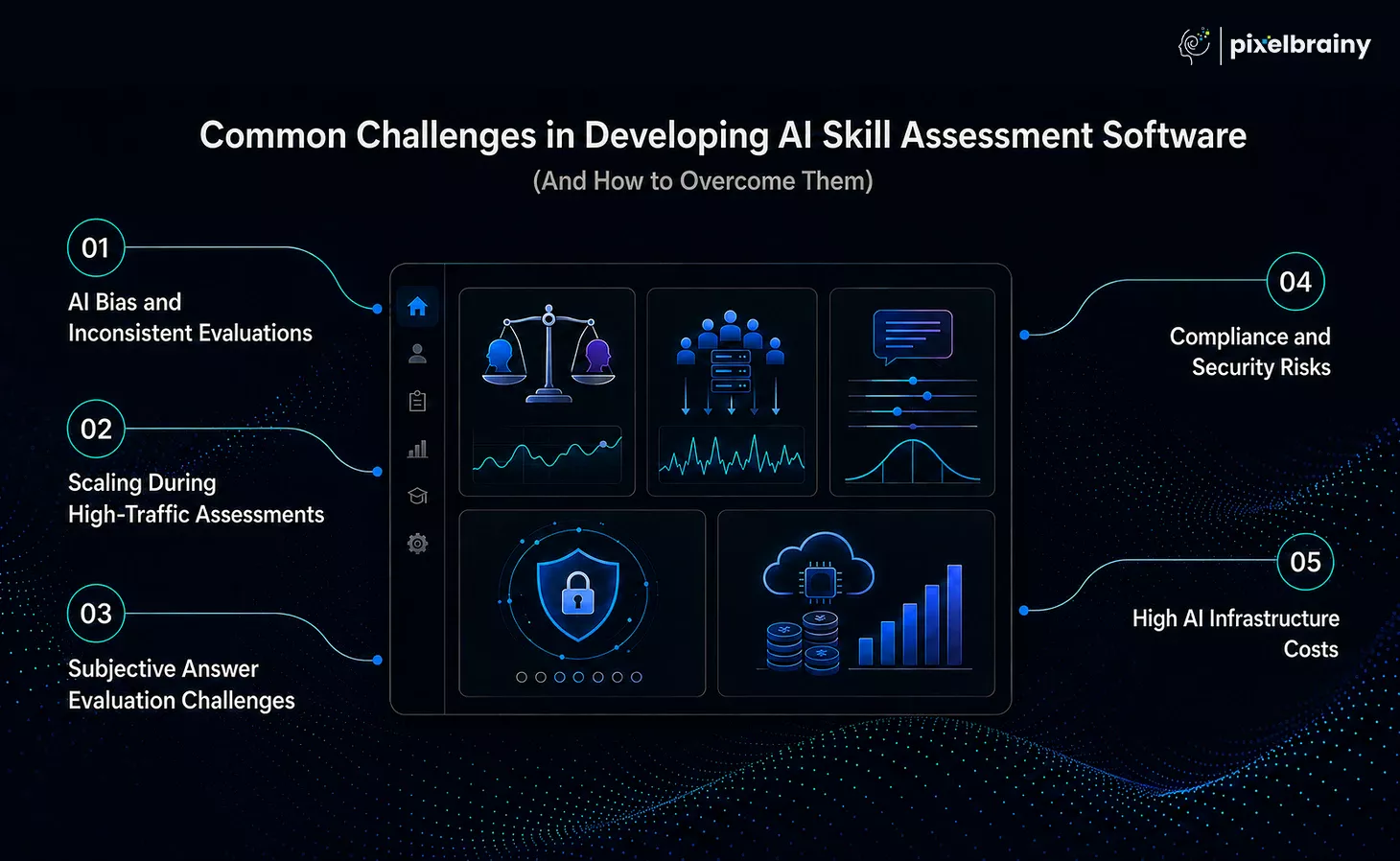
One of the biggest concerns in AI-powered assessment systems is scoring fairness. AI models trained on limited or biased datasets may generate inconsistent evaluations across different learner groups.
To reduce this risk, businesses developing AI-powered student skill evaluation platforms should perform regular AI bias testing, model validation, and human review workflows.
Using diverse training data improves scoring consistency and assessment reliability.
Large EdTech platforms often experience traffic spikes during live exams, certifications, and enterprise assessments.
Without scalable infrastructure, platforms may face:
Cloud-native architecture using AWS, Google Cloud, or Azure helps platforms scale automatically during peak traffic periods.
This is especially important for businesses planning to Develop Adaptive Learning Assessment System solutions for thousands of concurrent learners.
Evaluating essays, communication skills, and open-ended responses remains one of the most complex areas in AI assessment development.
Fine-tuned LLMs combined with rubric-based human review systems improve accuracy significantly while maintaining scalability.
This hybrid approach is widely used in modern AI skill assessment software development.
Educational platforms manage highly sensitive learner data, making compliance and cybersecurity essential.
Platforms should implement:
Strong compliance architecture increases institutional trust and enterprise adoption.
As learner traffic grows, AI API usage and cloud infrastructure costs can increase rapidly.
Businesses can optimize costs by:
A phased and scalable infrastructure strategy helps businesses reduce operational expenses while maintaining platform performance.
From AI bias management to infrastructure scalability and compliance, solving these challenges early helps businesses build secure, accurate, and scalable AI-powered assessment platforms for long-term EdTech growth.
One of the biggest strategic decisions in AI skill assessment software development is deciding whether to build a custom platform, buy an existing solution, integrate APIs, or partner with an AI development company.
The right approach depends on your budget, timeline, technical expertise, scalability goals, and product vision.
For startups building AI assessment solutions for online learning, choosing the wrong development strategy can increase costs, delay launch timelines, and limit future scalability.
Below is a simple comparison to help founders evaluate the best option for their EdTech business.
| Approach | Best For | Pros | Cons |
| Build Custom | Founders with unique product vision and IP needs | Full control, scalable architecture, custom AI workflows | Higher development cost and longer timelines |
| Buy / White-Label | Businesses needing quick market entry | Faster launch, lower upfront investment | Limited customization and dependency on vendor features |
| API Integration | Existing EdTech platforms adding AI capabilities | Flexible integration and lower effort | Ongoing third-party dependency |
| Development Partner | Startups with limited internal tech teams | Faster development, AI expertise, scalable execution | Choosing the right partner is critical |
Custom development works best when:
Although this approach requires higher investment, it offers the strongest long-term flexibility.
Buying existing software or using white-label platforms is ideal for businesses wanting to validate market demand quickly.
This option reduces development time and allows faster go-to-market execution, especially for smaller EdTech startups.
Many EdTech businesses already have learning platforms and simply want to add AI-powered assessments.
In this case, API-first integration is often the smartest approach because it allows businesses to:
without rebuilding the full platform.
Partnering with an experienced AI product development company helps startups access:
This approach is especially useful for founders without in-house AI engineering resources.
From MVP launches to enterprise-scale EdTech platforms, the right development strategy can significantly impact product success, scalability, and long-term business growth.
Finding the right technology partner is one of the most important decisions in AI skill assessment software development. The success of your platform depends heavily on the development company’s experience with AI, EdTech workflows, scalable architecture, and product strategy.
Many founders search for answers like:
“We are looking for a reliable software development company that has experience building AI-powered skill assessment platforms. How do we evaluate the right partner?”
The best approach is to evaluate technical expertise, AI capabilities, communication processes, scalability experience, and real-world EdTech portfolio quality before making a decision.
A strong development partner should help you with:
Look for real experience in EdTech, adaptive learning, assessment systems, or AI-based education platforms.
Ask whether they work with GPT-4o, Claude API, NLP systems, machine learning pipelines, and adaptive testing algorithms.
A reliable company should recommend phased MVP development before enterprise-scale expansion.
Verify their knowledge of FERPA, GDPR, WCAG 2.1 AA, and secure cloud architecture.
Look for structured workflows covering discovery, UI/UX design, AI integration, testing, and deployment.
Ensure they understand cloud-native architecture, auto-scaling infrastructure, and enterprise integrations.
Long-term support, AI optimization, and maintenance are critical for scalable EdTech products.
❌ No real AI or EdTech case studies
❌ Unrealistically low pricing promises
❌ No clear discovery or MVP strategy
❌ Weak communication processes
❌ No security or compliance expertise
❌ Limited scalability planning
❌ Generic proposals without technical depth
These warning signs often lead to delays, poor architecture, and expensive rebuilds later.
A strong AI development company portfolio should demonstrate:
AI-powered product experience
Scalable SaaS architecture
EdTech workflow understanding
Adaptive assessment systems
Real-time analytics dashboards
Mobile and web platform expertise
LMS and enterprise integrations
Modern UI/UX design quality
You should also review:
The right development company acts as a strategic technology partner instead of just a coding vendor.
A growing EdTech startup focused on professional upskilling was facing a major challenge. The company offered online certification programs for technology and business learners, but its traditional assessment system was creating several operational problems.
Learners complained that quizzes felt repetitive and lacked personalization. Instructors spent significant time manually grading assignments, while enterprise clients wanted better insights into learner skill progression and workforce readiness.
The company decided to build an AI-powered skill assessment platform capable of adaptive testing, automated grading, personalized learning recommendations, and real-time analytics.
The platform needed to support:
The founders also wanted to launch quickly without building a large in-house engineering department.
The company partnered with an external AI product development team and started with MVP development.
A six-member team including:
successfully delivered the first production-ready version of the platform within a few months.
The development team focused on:
The platform was built using:
The team also integrated role-based access control, analytics tracking, and API-based LMS integrations.
Within the first six months after launch, the platform achieved measurable improvements:
The AI-powered recommendation engine also helped learners identify weak skill areas and receive personalized learning suggestions automatically.
This example shows how a focused MVP strategy, the right AI architecture, and an experienced development team can help EdTech businesses build scalable AI assessment platforms that generate real educational and business impact.
The AI assessment landscape is evolving rapidly as educational institutions, enterprises, and EdTech companies move toward more intelligent, personalized, and immersive learning ecosystems.
In 2026, AI-powered assessments are no longer limited to automated quizzes and grading systems. Modern platforms are becoming deeply integrated into institutional workflows, workforce intelligence systems, and personalized learning environments.
Businesses investing in AI skill assessment software development today must understand where the industry is heading in order to build scalable and future-ready platforms.
One of the biggest shifts in 2026 is the rise of agentic AI systems embedded directly into educational operations and assessment workflows.
Instead of functioning as standalone tools, AI agents are now helping institutions:
This transition is transforming AI from a support feature into core educational infrastructure.
Forward-thinking EdTech companies are already integrating AI agents into LMS platforms, workforce training systems, and enterprise learning operations.
Assessment platforms are increasingly moving beyond text-based evaluations.
Modern AI systems can now evaluate:
Multimodal assessments help create more realistic skill evaluations, especially for:
This trend is expected to grow significantly across global EdTech markets.
Digital certifications and blockchain-based credentials are becoming more important as employers seek verifiable proof of learner skills.
Blockchain technology helps:
AI-powered assessment platforms integrated with blockchain verification systems may become increasingly valuable for universities, certification providers, and enterprise learning companies.
AR and VR technologies are beginning to combine with AI-driven assessments to create immersive learning and testing environments.
These systems can simulate:
AI analyzes learner performance inside virtual environments and generates competency-based evaluations in real time.
This creates more practical and experience-driven assessment models.
The future of EdTech assessments is highly personalized learning evaluation.
AI systems are becoming capable of:
As AI infrastructure improves, hyper-personalized adaptive testing will become scalable for millions of learners globally.
For EdTech businesses, these trends represent more than innovation opportunities. They are shaping the future foundation of intelligent education systems and next-generation learner assessment platforms.
Building an AI-powered assessment platform requires much more than software engineering expertise. Modern EdTech products need intelligent assessment workflows, adaptive learning systems, scalable architecture, strong UI/UX experiences, secure cloud infrastructure, and continuous AI optimization.
This is why selecting the right AI development company becomes one of the most important decisions for any EdTech founder or enterprise.
Many businesses ask:
“We are looking for a reliable software development company that has hands-on experience in building AI-powered skill assessment platforms for EdTech businesses, can you suggest how to find and shortlist the right technology partner?”
The best technology partners are companies that understand both artificial intelligence and the education ecosystem. They should be capable of supporting businesses from product discovery and MVP development to scalable AI integration and long-term platform growth.
PixelBrainy LLC focuses on helping startups, educational institutions, and enterprise learning companies build scalable AI-powered assessment platforms designed for modern learning environments and global markets.
One of the biggest advantages of working with PixelBrainy LLC is its MVP-first development approach. Instead of pushing businesses toward large enterprise-scale products immediately, the focus remains on validating ideas through structured discovery workshops, PoC development, and scalable MVP development strategies.
This approach helps businesses:
The company also understands the importance of learner experience in AI-powered EdTech products. Assessment systems should not only function efficiently but should also provide intuitive and engaging experiences for learners, instructors, and administrators.
PixelBrainy LLC helps businesses build AI-driven student skill evaluation platforms capable of supporting:
Before selecting a technology partner, businesses should evaluate:
PixelBrainy LLC focuses on combining all these capabilities into a single end-to-end product development process.
Security, scalability, and compliance are treated as core parts of every project because educational assessment platforms handle highly sensitive learner and institutional data.
Beyond development, PixelBrainy LLC works closely with businesses on product strategy, feature prioritization, AI optimization, and platform scalability planning. The goal is to help EdTech companies build future-ready AI-powered competency assessment platforms that deliver measurable educational and business outcomes.
Whether you are launching a startup MVP or scaling an enterprise EdTech ecosystem, PixelBrainy LLC helps transform AI-powered learning ideas into scalable and intelligent digital products.
AI-powered assessment platforms are rapidly transforming the future of education, workforce training, and digital learning experiences. From adaptive testing and automated grading to skill gap analysis and personalized learning recommendations, AI is helping EdTech businesses deliver smarter and more scalable assessment solutions.
For founders, institutions, and enterprises, investing in AI skill assessment software development creates opportunities to improve learner engagement, automate evaluation workflows, and build data-driven learning ecosystems that support long-term growth.
The key to success lies in starting with the right strategy, validating your MVP early, choosing scalable technologies, and working with an experienced AI development company that understands both artificial intelligence and modern EdTech workflows.
As AI adoption continues to grow across global education markets, businesses that build intelligent assessment platforms today will be better positioned to lead the next generation of digital learning innovation.
Ready to build your AI-powered EdTech assessment platform? Book an appointment with our team today →
The development timeline depends on platform complexity, AI capabilities, integrations, and scalability requirements. A basic MVP with automated assessments and analytics can typically be developed within 2 to 4 months, while enterprise-grade platforms may require 6 to 12 months or more.
Some of the most important features include adaptive testing, AI-powered grading, skill gap analysis, learner analytics dashboards, personalized recommendations, AI proctoring, and real-time performance tracking. The ideal feature set depends on your target audience and business model.
The cost of developing AI-based skill assessment software varies based on platform size and functionality. MVP development generally starts from $25,000, while advanced enterprise platforms with AI integrations, adaptive learning, and multi-language support can exceed $100,000.
Yes. Modern AI-powered assessment platforms are usually built using API-first architecture and support integrations with LMS, ATS, HRIS, and enterprise systems through REST APIs, LTI 1.3, webhooks, and third-party connectors.
Businesses should evaluate development partners based on their AI expertise, EdTech experience, UI/UX capabilities, scalable architecture knowledge, compliance understanding, portfolio quality, and post-launch support services. A strong AI development company should also support MVP planning and long-term product scaling.

About The Author
Sagar Bhatnagar
Sagar Sahay Bhatnagar brings over a decade of IT industry experience to his role as Marketing Head at PixelBrainy. He's known for his knack in devising creative marketing strategies that boost brand visibility and market influence. Sagar's strategic thinking, coupled with his innovative vision and focus on results, sets him apart. His track record of successful campaigns proves his ability to utilize digital platforms effectively for impactful marketing efforts. With a genuine passion for both technology and marketing, Sagar continuously pushes PixelBrainy's marketing initiatives to greater success.

Working with the PixelBrainy team has been a highly positive experience. They understand the design requirements and create beautiful UX elements to meet the application needs. The dev team did an excellent job bringing my vision to life. We discussed usability and flow. Sagar worked with his team to design the database and begin coding. Working with Sagar was easy. He has the knowledge to create robust apps, including multi-language support, Google and Apple ID login options, Ad-enabled integrations, Stripe payment processing, and a Web Admin site for maintaining support data. I'm extremely satisfied with the services provided, the quality of the final product, and the professionalism of the entire process. I highly recommend them for Android and iOS Mobile Application Design and Development.

Great experience working with them. Had a lot of feedback and I found that unlike most contractors they were bugging me for updates instead of the other way around. They were extremely time conscience and great at communicating! All work was done extremely high quality and if not on time, early! They were always proactive when it comes to communication and the work is great/above par always. Very flexible and a great team to work with! Goes above and beyond to present us with multiple options and always provides quality. Amazing work per usual with Chitra. If you have UI/UX or branding design needs I recommend you go to them! Will likely work with them in the future as well, definitely recommended!

PixelBrainy is a joy to work with and is a great partner when thinking through branding, logo, and website layout. I appreciate that they spend time going into the "why" behind their decisions to help inform me and others about industry best practices and their expertise.

I hired them to design our software apps. Things I really like about them are excellent communication skills, they answer all project suggestions and collaborate right away, and their input on design and colors is amazing. This project was complex and needed patience and creativity. The team is amazing to do business with. I will be using them long-term. Glad to see there are some good people out there. I was afraid to try and outsource my project to someone but I am glad I met them! I really can't say enough. They went above and beyond on this project. I am very happy with everything they have done to make my business stand out from the competition.

It was great working with PixelBrainy and the team. They were very responsive and really owned the project. We'll definitely work with them again!

I recently worked with the PixelBrainy team on a project and I was blown away by their communication skills. They were prompt, clear, and articulate in all of our interactions. They listened and provided valuable feedback and suggestions to help make the project a success. They also kept me updated throughout the entire process, which made the experience stress-free and enjoyable.

PixelBrainy is very good at what it does. The team also presents themselves very professionally and takes care of their side of things very well. I could fully trust them taking up the design work in a timely and organised manner and their attention to detail saved us lots of effort and time. This particular project was quite intense and the team showed that they function very well under pressure. Very much looking forward to working with her again!

It's always an absolute pleasure working with them. They completed all of my requests quickly and followed every note I had for them to a T, which made our process go smoothly from start to finish. Everything was completed fast and following all of the guidelines. And I would recommend their services to anyone. If you need any design work done in the future, PixelBrainy should be your first call!

They took ownership of our requirements and designed and proposed multiple beautiful variants. The team is self-motivated, requires minimum supervision, committed to see-through designs with quality and delivering them on time. We would definitely love to work with PixelBrainy again when we have any requirements.

PixelBrainy was a big help with our SaaS application. We've been hard at work with a new UI/UX and they provided a lot of help with the designs. If you're looking for assistance with your website, software, or mobile application designs, PixelBrainy and the team is a great recommendation.

PixelBrainy designers are amazing. They are responsive, talented, and always willing to help craft the design until it matches your vision. I would recommend them and plan to continue them for my future projects and more!!!

They were awesome! Did a good job fast, and good communication. Will work with them again. Thank you

Creative, detail-oriented, and talented designers who take direction well and implement changes quickly and accurately. They consistently over-delivered for us.

PixelBrainy team is very talented and creative. Great designers and a pleasure to work with. PixelBrainy is an excellent communicator and I look forward to working with them again.

PixelBrainy has a very talented design team. Their work is excellent and they are very responsive. I enjoy working with them and hope to continue on all of our future projects.


Transform your ideas into reality with us.
Across these industries, each engagement brings unique challenges, from early-stage product development to scaling complex systems, helping us build a practical understanding of real-world product environments.