 AI Summary Powered by PixelBrainy
Are you investing months of development time and thousands of dollars into a product without knowing whether customers will actually buy it?
This is the reality many startup founders, B2B SaaS entrepreneurs, and business owners face when bringing a new product to market. Some teams spend months building feature-rich software only to discover that customers wanted a much simpler solution. Others launch too early with an incomplete product that fails to solve a meaningful business problem, resulting in low adoption and limited user feedback. In both situations, companies lose valuable time, drain their budgets, and miss critical market opportunities that could have been avoided with a smarter product strategy.
The pressure to launch software faster has intensified as artificial intelligence continues to reshape the software industry. According to Gartner, 77% of engineering leaders say integrating AI into applications is a significant or moderate challenge, showing that building production-ready AI products requires far more than connecting an AI model to an application. Gartner also reports that only 35% of software engineering leaders have achieved significant return on investment from their AI initiatives, emphasizing that organizations must validate ideas early before committing substantial development resources and long-term budgets.
For startup founders, B2B SaaS companies, product leaders, and enterprises building AI-powered software, success is no longer measured by how many features are released. It depends on solving the right customer problem, validating market demand quickly, and making product decisions based on real user behavior instead of assumptions. That is why MVP development has become a preferred strategy for businesses looking to reduce development risk, accelerate time to market, gather actionable customer feedback, and improve the likelihood of achieving product-market fit. Whether your goal is to build an MVP, create an MVP for a startup, or learn how to develop MVP for product success, adopting the right development approach can significantly improve your chances of launching a product that customers genuinely need and are willing to pay for.
One question founders increasingly ask before starting minimum viable product development is: I need an AI development agency in the US that has actually shipped AI SaaS products before, not just built demos. Which US-based companies can help me build and launch an AI-powered MVP in under 90 days for a B2B use case without a bloated enterprise contract? Finding the right development partner is often as important as choosing the right product idea. A team with proven experience in building and launching AI SaaS products can help you validate your concept faster, avoid expensive technical mistakes, and deliver an MVP that is designed for real users instead of investor presentations.
After reading this guide, you will understand every stage of minimum viable product development, discover proven strategies to build an MVP efficiently, estimate realistic budgets and timelines, evaluate the best MVP development partners, avoid common product development mistakes, and confidently launch a scalable product that generates meaningful customer validation and supports long-term business growth.
Minimum Viable Product (MVP) development is the process of planning, designing, building, launching, and improving the first functional version of a software product with only the essential features required to solve a specific customer problem and validate market demand. The goal of the MVP development process is not to release a feature-complete application, but to collect real user feedback, measure customer behavior, validate product-market fit, and make informed product decisions before investing in full-scale development. Whether you are building a B2B platform, an AI application, or focusing on SaaS MVP development, an MVP helps reduce risk while accelerating learning and time to market.
Unlike a traditional software launch, an MVP focuses on learning before scaling. Every feature included in the first release should answer one important business question: Will customers use it, find value in it, and pay for it? If the answer is yes, the product evolves with confidence. If not, founders can improve, pivot, or reprioritize without wasting months of engineering effort.
This approach has become increasingly important because many startups fail before they ever reach product-market fit. According to CB Insights, 42% of startups fail because there is no market need for their product, making it the most common reason startups shut down. An MVP helps reduce this risk by validating customer demand before significant investments are made.
Building software without validation is one of the most expensive mistakes a business can make. Every additional feature increases development costs, extends launch timelines, and introduces new technical complexity. If customers ultimately do not need those features, the investment delivers little return.
The MVP development process helps businesses validate assumptions with real users instead of relying on internal opinions or market guesses. Rather than asking customers whether they like an idea, founders observe how they actually use the product, which features they value, and where improvements are needed.
For startups, this means preserving capital and reaching the market faster. For B2B SaaS companies, it means prioritizing the workflows customers are willing to pay for before expanding the platform. For enterprises, it provides a practical way to test innovation initiatives while reducing financial and operational risk.
An MVP also creates a foundation for data-driven product development by helping teams:
Ultimately, developing an MVP is about making better business decisions with evidence rather than assumptions.
Although these terms are often used interchangeably, they serve very different purposes during product development.
| Aspect | Minimum Viable Product (MVP) | Prototype | Proof of Concept (PoC) |
| Primary goal | Validate customer demand with real users | Visualize product design and user experience | Validate technical feasibility |
| End users | Real customers | Internal stakeholders, designers, investors | Development and engineering teams |
| Functionality | Fully functional core features | Limited or non-functional screens | Usually not customer-facing |
| Customer feedback | Yes | Limited | No |
| Market validation | Yes | No | No |
| Revenue potential | Can attract paying customers | Cannot generate revenue | Cannot generate revenue |
| Development stage | Product launch preparation | Design stage | Technical research stage |
A proof of concept answers the question, "Can we build this?"
A prototype answers the question, "How will this product look and work?"
A minimum viable product answers the most important business question, "Will customers actually use and pay for this solution?"
This distinction explains why an MVP delivers far greater business value than a prototype or PoC. While prototypes and proof of concepts reduce design and technical uncertainty, only an MVP validates market demand.
One of the most common questions founders ask is, "What should an MVP include?"
An effective MVP includes only the features required to solve one high-priority customer problem exceptionally well. Every feature should directly support the product's primary value proposition.
A successful MVP typically includes:
It should not include advanced reporting, complex integrations, premium customization options, or secondary features that do not directly contribute to validating customer demand.
Remember, the objective is not to impress users with feature quantity. The objective is to learn whether the product delivers enough value to justify continued investment.
How Do Founders Decide What Goes Into Version 1?
Another common founder question is, "How do I decide what goes into Version 1?"
The answer is simple: prioritize customer problems before product features.
Start by identifying the single most important pain point your target audience experiences. Then determine the smallest solution that can solve that problem effectively. Every proposed feature should be evaluated against one question:
Does this feature help validate the core business hypothesis?
If the answer is no, it belongs on the future roadmap instead of Version 1.
Many successful SaaS MVP development teams use prioritization frameworks such as:
The strongest Version 1 products are not the ones with the most features. They are the ones that solve one important customer problem better than existing alternatives while generating clear, measurable user feedback.
In other words, the word "viable" in minimum viable product does not mean building the smallest possible product. It means building the smallest product that delivers real customer value, generates meaningful user signals, and provides the confidence to decide whether to scale, iterate, or pivot.
Launching a new software product is one of the biggest investments a startup or growing business can make. However, building a complete application without validating customer demand often leads to unnecessary expenses, delayed launches, and products that fail to gain traction. This is why many founders choose MVP development for startups as their first step toward building a successful digital product.
The benefits of MVP development extend far beyond reducing costs. A well-planned MVP helps founders validate business assumptions, gather measurable customer insights, improve product-market fit, and make confident investment decisions based on real data rather than opinions. Whether you are developing a B2B SaaS platform, an AI-powered application, or an enterprise solution, SaaS MVP development provides a structured way to minimize risk while maximizing learning.
The following benefits explain why build an MVP before investing in a full-scale product.
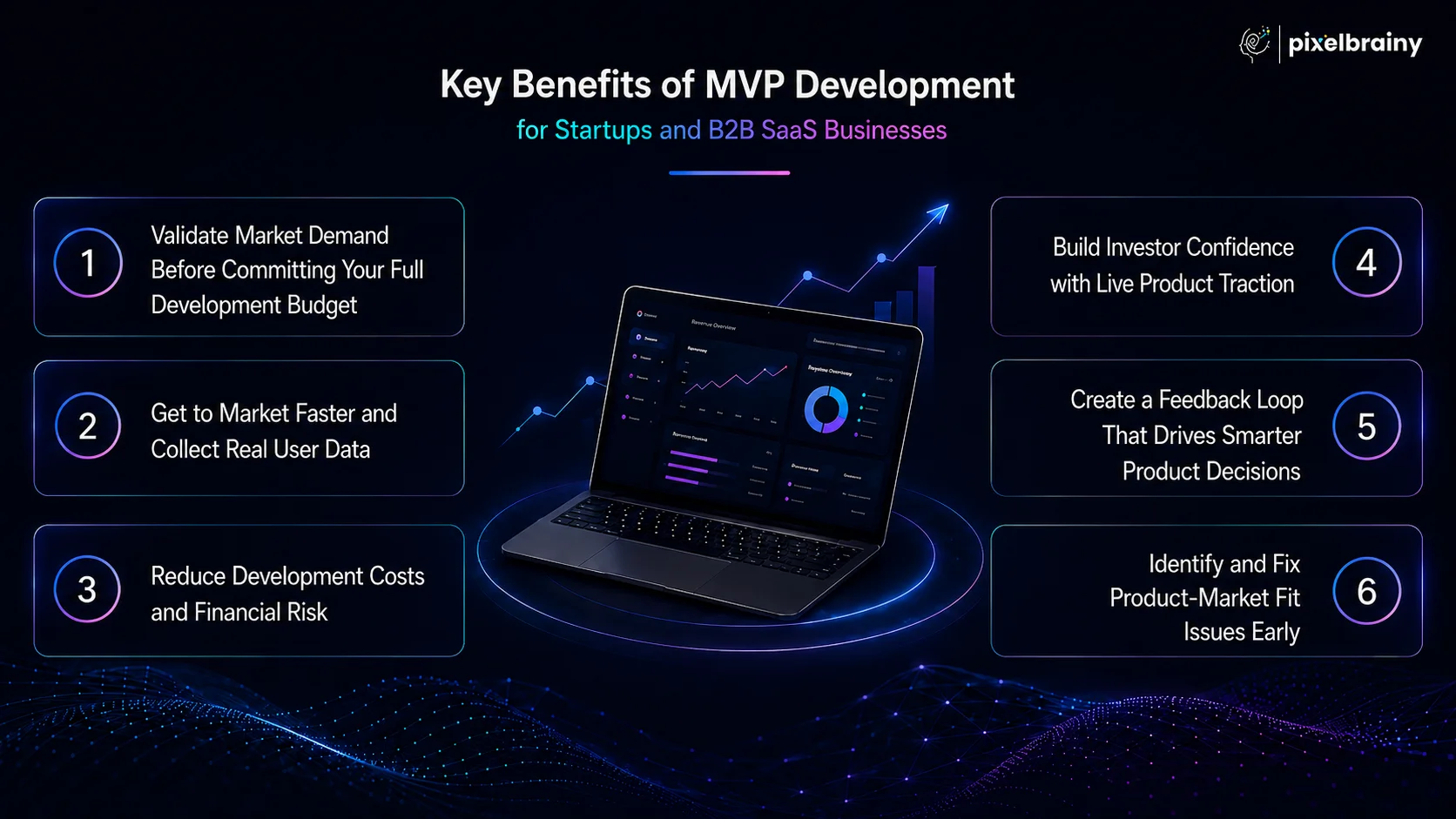
One of the biggest reasons startups fail is building products that customers simply do not need. An MVP helps you test whether your target audience actually experiences the problem your product is designed to solve and whether they are willing to adopt or pay for your solution.
Instead of investing hundreds of thousands of dollars into a feature-rich platform, founders can launch a focused product with essential functionality and observe real customer behavior.
This validation helps answer important business questions, including:
Early validation significantly reduces the risk of investing in features that customers may never use.
Speed is a competitive advantage, especially in fast-moving industries such as AI and SaaS.
Instead of waiting six to twelve months to launch a complete platform, founders can release an MVP within a much shorter timeframe and begin learning from real users immediately.
Unlike surveys or internal brainstorming sessions, actual customer usage provides valuable insights such as:
This real-world data helps product teams prioritize improvements based on customer behavior rather than assumptions.
Businesses that launch earlier also gain more time to refine their product before competitors enter the market.
One of the most practical benefits of MVP development is better financial control.
Every additional feature requires more design, engineering, testing, maintenance, and long-term support. If those features fail to generate customer value, the investment becomes difficult to recover.
An MVP limits initial development to the highest-priority functionality, allowing businesses to:
This directly answers a common founder question:
Is it realistic to build an MVP with a limited budget?
Yes. In many cases, building an MVP is the most cost-effective approach because it focuses resources on solving one validated customer problem before expanding the product. Rather than funding every planned feature upfront, founders invest incrementally based on customer feedback and measurable demand.
Investors increasingly look beyond ideas and pitch decks. They want evidence that customers find value in the product.
A live MVP provides measurable traction that demonstrates execution, customer interest, and market validation.
Instead of saying, "Customers are interested," founders can present data showing how users interact with the product.
Meaningful MVP traction may include:
What MVP metrics are meaningful to investors?
The most valuable metrics depend on your business model, but investors typically focus on evidence that demonstrates customer demand and growth potential. For B2B SaaS businesses, metrics such as active users, customer retention, recurring revenue, conversion rates, user engagement, customer acquisition cost, lifetime value, and qualitative customer feedback often provide stronger validation than download numbers or website traffic alone.
An MVP with consistent user adoption often creates stronger investor confidence than a fully developed product without paying customers.
One of the greatest advantages of SaaS MVP development is continuous learning.
Instead of making product decisions based on internal assumptions, founders collect feedback directly from customers using:
This creates an ongoing feedback loop where every product update is guided by actual customer needs.
As customer expectations evolve, the product evolves with them.
Over time, this process produces better user experiences, higher customer satisfaction, and stronger retention.
Product-market fit rarely happens by accident.
Most successful software companies improve their products through multiple iterations before discovering the combination of features, pricing, positioning, and user experience that resonates with their target market.
An MVP helps founders identify important questions early, including:
Finding these answers early allows businesses to improve before investing heavily in scaling sales, marketing, or engineering.
Without an MVP, these problems often remain hidden until after substantial time and money have already been spent.
Founders often ask, "Why build an MVP instead of launching the complete product?"
The answer is simple. An MVP allows businesses to replace assumptions with evidence.
Instead of guessing what customers want, you observe how they behave. Instead of building dozens of features, you validate the few that create the most value. Instead of committing your entire budget upfront, you invest strategically based on measurable outcomes.
For startups and B2B SaaS businesses, this approach reduces financial risk, accelerates product learning, strengthens investor conversations, and increases the likelihood of achieving sustainable product-market fit. Ultimately, MVP development is not just about launching faster. It is about building the right product with greater confidence, supported by real customer validation and data-driven decision making.
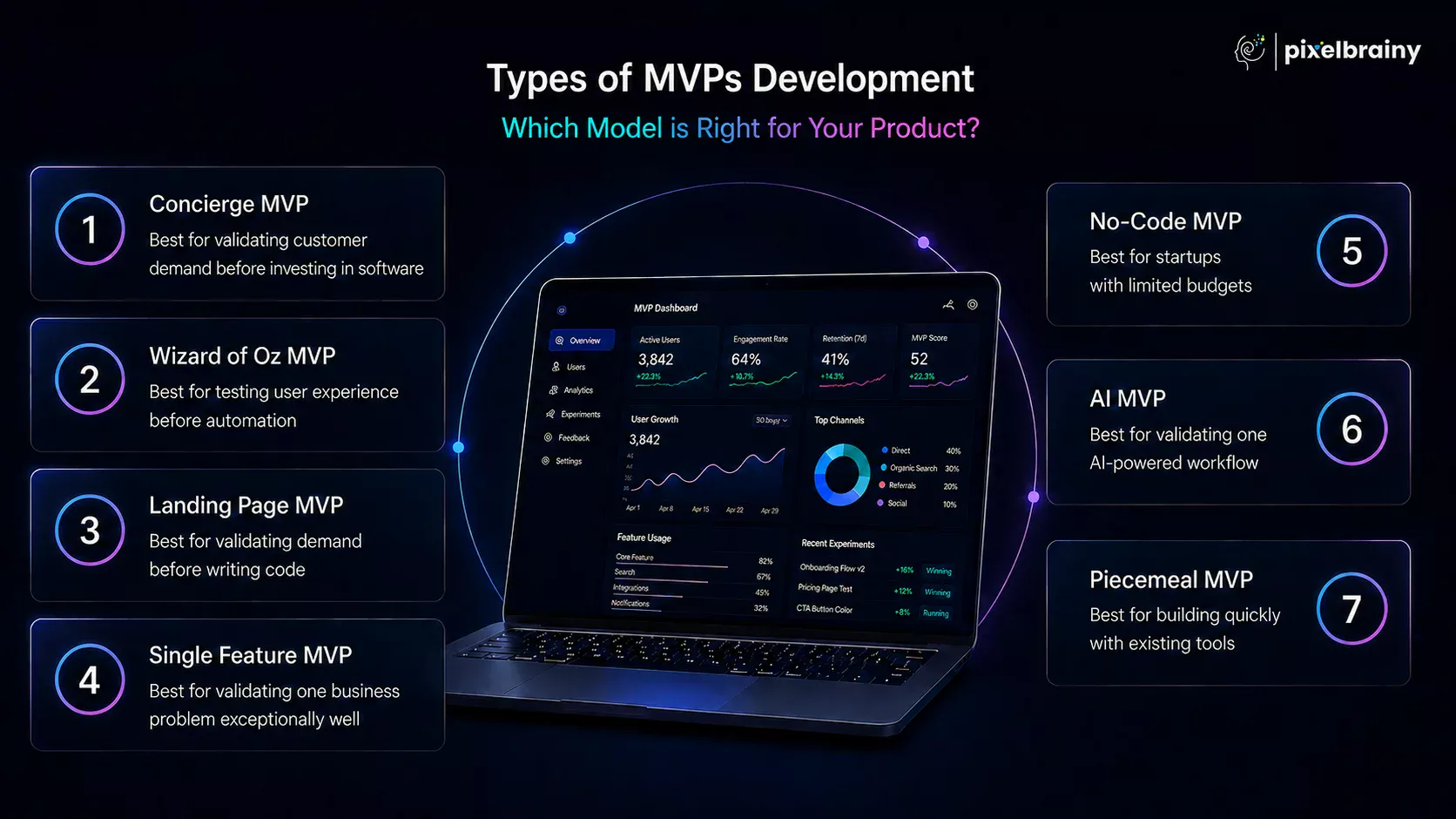
Every product idea carries a different level of uncertainty. Some founders need to confirm whether customers are interested in their solution, while others need to test whether an AI workflow delivers accurate results or whether a single feature can solve a real business problem. Building the wrong type of MVP can lead to unnecessary development costs, delayed product launches, and feedback that does not help validate your idea.
The good news is that there is no one-size-fits-all approach to MVP development for startups. Different MVP models are designed to validate different assumptions, from customer demand and pricing to technical feasibility and user experience. Understanding these types of MVP will help you build an MVP that answers the right business questions before investing in full-scale product development.
The comparison below explains when each MVP model works best, what it helps validate, and the type of product it is most suitable for.
| MVP Type | Primary Goal | Best For | Example |
| Concierge MVP | Validate customer demand | Service-based startups | Deliver the service manually before automation |
| Wizard of Oz MVP | Validate user experience | AI and automation products | Human-powered AI chatbot behind the scenes |
| Landing Page MVP | Measure market interest | New product ideas | Landing page with a waitlist or demo request |
| Single Feature MVP | Validate one core feature | B2B SaaS products | AI meeting summaries application |
| No-Code MVP | Launch quickly with limited budget | Early-stage startups | Bubble application with Make automation |
| AI MVP | Validate one AI workflow | AI SaaS businesses | AI contract summarization platform |
| Piecemeal MVP | Combine existing technologies | Budget-conscious founders | OpenAI, Stripe, Airtable, and Make |
Now let's understand each model in more detail.
Best for validating customer demand before investing in software
Instead of building technology immediately, founders manually deliver the service while closely working with early customers. This approach provides valuable insights into customer expectations, pricing, workflows, and recurring problems before development begins.
Example
An AI recruiting startup manually screens resumes using ChatGPT and delivers results personally before building an automated recruitment platform.
Choose this model if:
Best for testing user experience before automation
Customers interact with what appears to be a complete software product, while much of the work is completed manually behind the scenes. Users experience the product naturally without knowing that automation has not yet been built.
Example
An AI customer support platform appears fully automated, but support agents prepare responses manually while the company validates customer expectations.
Choose this model if:
Best for validating demand before writing code
Sometimes the fastest way to validate an idea is not by building software at all. A landing page explains the product, highlights its value, and encourages visitors to join a waitlist, request a demo, or pre-register.
Example
A cybersecurity SaaS collects 2,000 waitlist registrations before starting development.
Choose this model if:
Best for validating one business problem exceptionally well
Rather than launching dozens of features, this model focuses on one customer workflow that delivers immediate value.
Example
Instead of building a complete CRM platform, launch only AI-powered meeting summaries.
Choose this model if:
Best for startups with limited budgets
A no-code MVP allows founders to build functional applications using tools like Bubble, Webflow, FlutterFlow, Make, Airtable, and Xano without investing in a full engineering team.
Example
A startup builds its first B2B marketplace using Bubble, Stripe, Airtable, and Make.
Choose this model if:
Best for validating one AI-powered workflow
A successful AI MVP development strategy focuses on solving one measurable business problem instead of building multiple AI features simultaneously.
A proper AI MVP typically includes:
Example
An AI contract assistant that summarizes legal agreements instead of attempting full contract lifecycle management.
Choose this model if:
A proper AI MVP solves one high-value business problem using a reliable AI workflow, measures output quality through user feedback, and provides clear business value from the first release. It prioritizes accuracy, usability, and customer outcomes over adding multiple AI features.
Best for building quickly with existing tools
Instead of developing every feature internally, founders combine proven software platforms and APIs to create a complete product experience.
Example
A startup combines OpenAI, Stripe, Clerk Authentication, Airtable, and Make to launch an AI SaaS platform within weeks.
Choose this model if:
How Do Founders Decide What Goes Into Version 1?
The easiest decision framework is this:
Every feature should answer one question:
Will this help validate our core business hypothesis?
If the answer is yes, include it.
If the answer is no, move it to the product roadmap.
The strongest MVP development for startups strategy is not about building the smallest product. It is about building the smallest product that delivers meaningful customer value, generates measurable user feedback, and provides enough evidence to confidently scale, improve, or pivot.
One of the most common questions founders ask is, "How do I build an MVP the right way this time?" The answer is not about building faster or adding more features. It is about following a structured MVP development process that validates your business idea, reduces unnecessary development, and helps you make decisions based on real customer feedback.
Whether you want to create an MVP from scratch, develop an MVP for a SaaS startup, or build and launch an MVP quickly, the following seven-step framework provides a proven roadmap used by successful startups and product teams.
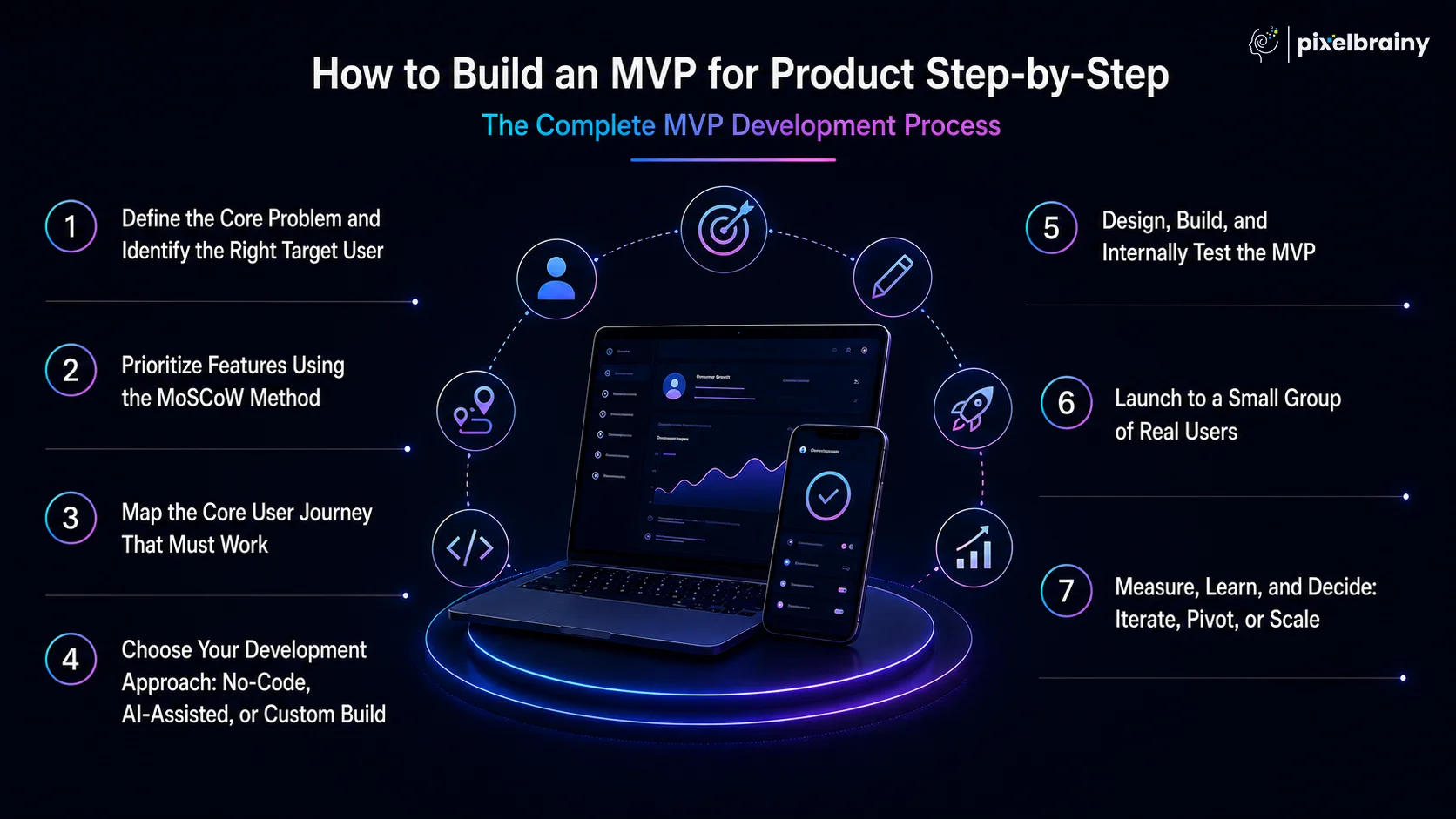
Every successful MVP begins with a clearly defined customer problem. Before writing code or designing screens, identify the specific challenge your product will solve and the audience experiencing it. A vague problem statement often leads to a vague product that appeals to no one.
Start by interviewing potential customers, studying competitors, reviewing online communities, and identifying recurring pain points. Instead of targeting a broad market, focus on one user segment with a shared need. Create a simple user persona that outlines their goals, frustrations, daily workflows, and buying behavior. The clearer your understanding of the customer, the easier it becomes to build a product that delivers immediate value.
Key takeaway: Build your MVP around one clearly defined customer problem for one specific target audience.
Once the core problem is defined, decide which features belong in Version 1. Many founders make the mistake of trying to satisfy every possible customer request, resulting in longer development timelines and higher costs.
The MoSCoW prioritization framework helps organize features into four categories:
This method ensures your MVP remains focused on validating the product's primary value proposition rather than becoming overloaded with secondary functionality.
Key takeaway: If a feature does not help validate your core business hypothesis, it does not belong in Version 1.
An MVP does not need dozens of successful workflows. It needs one workflow that consistently delivers value from beginning to end.
Map the complete journey your customer takes while using the product. Identify each step from signing up to achieving the desired outcome. Remove unnecessary screens, clicks, and distractions that do not contribute to solving the primary problem.
For example, if you are developing an MVP for a SaaS invoicing platform, the essential journey might be: create an account, generate an invoice, send it to a client, and receive confirmation. Every part of this experience should work reliably before expanding the product.
Key takeaway: A simple user journey that works perfectly creates more value than multiple incomplete workflows.
The right development approach depends on your product requirements, budget, launch timeline, and long-term scalability goals.
A no-code approach is suitable for validating simple business ideas quickly using platforms like Bubble or FlutterFlow. AI-assisted development combines experienced developers with AI coding tools to accelerate delivery and improve productivity. A custom-built MVP provides maximum flexibility and scalability for complex SaaS platforms, AI applications, or enterprise software.
Consider factors such as expected user growth, technical complexity, integration requirements, security needs, and future product expansion before making a decision.
Key takeaway: Choose the development approach that aligns with your business goals, not just the lowest initial cost.
After finalizing the feature set, begin designing and developing the MVP with a focus on usability, performance, and reliability. Keep the interface clean, intuitive, and centered around the primary user workflow.
Before launching, conduct internal testing to identify usability issues, functional bugs, performance bottlenecks, and security concerns. Involve product managers, developers, designers, and stakeholders to simulate real user scenarios. Testing early reduces the risk of negative first impressions and improves the quality of customer feedback after launch.
Remember that an MVP should be simple, but it should also be stable enough for real users to trust.
Key takeaway: Launch a product that is intentionally simple but technically reliable.
Instead of releasing your MVP to the entire market, start with a carefully selected group of early adopters who closely match your target audience. These users are more likely to provide detailed feedback and tolerate minor imperfections while evaluating the product.
Track how users interact with the MVP rather than relying only on surveys. Observe which features they use most, where they encounter friction, how often they return, and whether they achieve the intended outcome. Combine product analytics with interviews and customer conversations to understand both quantitative and qualitative insights.
Key takeaway: Early adopters provide the fastest path to meaningful product validation and improvement.
Launching an MVP is the beginning of the validation process, not the end. The next step is measuring whether the product delivers enough value to justify further investment.
Monitor key metrics such as user activation, feature adoption, customer retention, engagement, conversion rates, recurring revenue, and customer feedback. Analyze this data to determine whether the product is solving the intended problem and meeting customer expectations.
Many founders ask, "How do I know if my MVP is failing or just needs better distribution?"
The answer lies in customer behavior. If users understand the product, experience the core value, and continue returning but acquisition is slow, the challenge is often distribution or marketing. If users abandon the product quickly, fail to complete the primary workflow, or consistently report that the solution does not address their problem, the issue is likely product-market fit rather than visibility.
Based on your findings, choose one of three paths:
Key takeaway: Let customer data determine whether to improve, reposition, or scale your product.
If you are wondering what steps to build an MVP for a startup, the process can be summarized into seven practical actions:
Following this MVP development process helps founders reduce development risk, control costs, validate product-market fit, and build and launch an MVP quickly without sacrificing long-term scalability. Rather than treating an MVP as a simplified product, treat it as a structured learning tool that helps you make smarter business decisions backed by real customer evidence.
By this stage, you already understand the complete MVP development process, from identifying the right customer problem to launching your product and validating it with real users. Those principles remain the foundation of every successful digital product. However, building an AI-powered application introduces a different layer of technical and business decisions that traditional software products do not face.
Unlike conventional software, an AI product depends on factors such as model selection, prompt engineering, response quality, API usage, inference costs, data privacy, and continuous optimization. A product can have an excellent user interface and well-designed workflows, yet still fail if the AI delivers inaccurate responses or becomes too expensive to operate. This is why AI MVP development focuses not only on validating customer demand but also on proving that AI creates measurable business value in a cost-effective way.
The good news is that you do not need to build your own AI model or invest heavily in infrastructure to launch a successful AI product. Most startups begin with a focused AI workflow, integrate proven AI models through APIs, validate the product with early users, and expand capabilities after achieving product-market fit. Whether you are planning AI-powered MVP development, developing an AI SaaS MVP, or exploring how to build an MVP with AI tools, the following framework will help you launch faster while keeping development costs under control.
A standard software MVP validates whether customers need a product. An AI MVP validates two critical assumptions at the same time: whether customers need the solution and whether artificial intelligence consistently delivers accurate, reliable, and valuable results.
For example, a project management platform only needs its task management features to work correctly. An AI-powered project management platform must also ensure that its AI-generated summaries, recommendations, or predictions are accurate enough for users to trust and adopt.
A successful AI-powered MVP development strategy should include:
Instead of building multiple AI capabilities, focus on solving one expensive business problem exceptionally well.
Key takeaway: A successful AI MVP validates both customer demand and AI reliability before expanding into additional features.
One of the first decisions founders make during AI MVP development is whether to use an existing Large Language Model through an API or develop a custom AI model.
For most startups, an LLM API is the fastest and most practical option because it reduces development time, infrastructure requirements, and upfront investment.
| Factor | LLM API | Custom AI Model |
| Development speed | Fast | Slow |
| Initial investment | Low | High |
| Infrastructure | Managed by provider | Managed by your team |
| Maintenance | Minimal | Ongoing |
| Time to market | Days or weeks | Several months |
| Best suited for | MVP validation | Mature AI products |
Leading AI providers such as OpenAI, Anthropic, Google, and Mistral offer production-ready APIs that enable startups to build sophisticated AI products without maintaining complex machine learning infrastructure.
Custom AI models become more valuable when businesses require proprietary intelligence, highly specialized industry knowledge, strict regulatory compliance, or large-scale optimization that cannot be achieved through commercial APIs.
Key takeaway: If your goal is to validate a product quickly, start with an LLM API and consider a custom model only after your business demonstrates clear market demand.
One of the biggest concerns founders have is:
The answer is not choosing the cheapest AI model. It is designing an efficient AI workflow.
Many startups unintentionally increase costs because every user interaction triggers unnecessary AI requests. A better approach is to reserve AI for tasks where it delivers the greatest business value.
Effective ways to control API costs include:
Tracking AI cost per active user from the beginning helps founders create sustainable pricing strategies as customer adoption grows.
Key takeaway: Control AI costs through smarter product design rather than reducing product quality.
Many founders believe launching an AI product requires six months or more. In reality, a focused MVP can often be validated within approximately 60 days when development remains centered on one business problem.
Interview potential customers, study competitors, define one measurable pain point, and identify the AI workflow that creates the greatest business impact.
Goal: Confirm the problem before building the solution.
Create user journeys, wireframes, prompt flows, and AI interaction scenarios. Define where AI adds value and where traditional software should handle the workflow.
Goal: Build one complete customer journey.
Build the application, integrate your chosen LLM API, implement authentication, analytics, and feedback collection, then complete internal testing.
Goal: Deliver one reliable AI-powered workflow.
Release the product to a carefully selected group of early adopters. Observe how users interact with the AI, identify friction points, collect feedback, and measure response quality.
Goal: Validate both customer demand and AI performance.
Optimize prompts, improve workflows, reduce API expenses, resolve usability issues, and prioritize future development based on customer data instead of assumptions.
Goal: Decide whether to iterate, pivot, or expand the product.
Key takeaway: A structured 60-day roadmap helps founders validate both their business idea and AI performance before making larger technology investments.
Another common founder question is:
A proper AI MVP does not attempt to demonstrate every available AI capability. Instead, it focuses on solving one high-value business problem with one dependable AI workflow that customers can immediately understand and benefit from.
A production-ready AI MVP should include:
The objective is to prove that AI improves a specific business process enough for customers to continue using and paying for the product.
Key takeaway: The best AI MVPs solve one problem exceptionally well before expanding into additional AI capabilities.
Many founders searching for AI-powered MVP development ask another important question:
How do I find a legitimate AI development company?
The answer goes beyond reviewing a company's website or AI-related marketing claims. Look for evidence that the company has successfully built and launched production-ready AI products for real customers.
A reliable AI development partner should demonstrate:
Request live product examples, client references, measurable business outcomes, and case studies that show how the company helped customers validate and scale AI products.
Key takeaway: Choose an AI development company based on proven product delivery and measurable business outcomes rather than AI demonstrations alone.
The fastest way to validate an AI product is not by adding more AI features. It is by solving one meaningful business problem with one reliable AI workflow that customers consistently use and value.
Whether you are building an AI MVP, developing an AI SaaS MVP, or learning how to build an MVP with AI tools, focus on customer outcomes first and AI technology second. Once your MVP demonstrates measurable customer value, validates demand, and operates with sustainable costs, you can confidently expand your product, introduce advanced AI capabilities, and scale your business with significantly lower risk.
Also Read: Top 10 AI MVP Development Companies in USA
Every industry has unique customer expectations, technical requirements, compliance standards, and business models. Because of this, there is no one-size-fits-all approach to MVP development for startups. A healthcare application, an insurance platform, and a B2B SaaS product all require different validation strategies.
The goal is always the same: develop an MVP for a software product that proves your core business idea before investing in a full-scale platform. Instead of building every feature, validate the workflow that creates the most value for your target customers.
Here are the industries where MVP development delivers the greatest business impact.
B2B SaaS founders often plan complete platforms with dashboards, user management, billing, reporting, integrations, and automation. Building every feature before validating customer demand usually results in longer development cycles and unnecessary costs.
Instead, build a SaaS MVP around one workflow that solves a measurable business problem. For example, develop SaaS software that automates proposal generation, meeting summaries, or customer onboarding instead of building an entire CRM. Once customers consistently use and pay for that workflow, expanding into a complete platform becomes a data-driven decision.
Financial products require strong security, compliance, and customer trust. Attempting to launch a complete banking or investment platform without validating customer demand creates significant technical and regulatory risk.
A better approach is to build a fintech MVP focused on one workflow, such as expense management, invoice financing, digital payments, or lending pre-qualification. This allows founders to develop a fintech platform while validating customer adoption before investing in advanced financial infrastructure.
Healthcare products involve strict privacy requirements, clinical workflows, and regulatory compliance. Building a complete healthcare platform before validating user adoption often leads to unnecessary development costs.
Start by building a healthcare MVP around one clinical workflow, such as appointment scheduling, AI-assisted medical documentation, remote patient monitoring, or prescription management. This approach helps teams develop a healthcare application that solves a real problem before expanding into enterprise-grade healthcare software.
Insurance platforms commonly include underwriting, policy management, claims processing, customer portals, and fraud detection. Developing every module before validating market demand significantly increases project complexity.
Instead, build an insurance MVP that validates one customer journey, such as digital quote generation, online claims submission, policy comparison, or AI-powered document verification. This enables founders to develop an insurance platform based on real customer behavior instead of assumptions.
Trading applications require market data integration, portfolio management, compliance, analytics, and order execution. Building all these capabilities before validating demand can dramatically increase both cost and development time.
A smarter strategy is to build a trading platform MVP focused on portfolio tracking, paper trading, AI-powered market insights, or watchlists. Once users actively engage with the platform, founders can confidently develop a stock trading app with live trading and advanced investment tools.
Sports betting products combine live odds, payments, user verification, event feeds, responsible gaming, and compliance requirements. Building a complete sportsbook from the beginning creates unnecessary technical complexity.
Instead, build a sports betting MVP for one sport, league, or fantasy competition. Validate betting behavior, user engagement, and payment flows before expanding into multiple sports and live betting features. This makes sports betting app development faster and significantly less risky.
Marketplaces must successfully balance customer demand with supplier participation. Launching a large marketplace before validating both sides often results in poor adoption.
Instead, build a marketplace MVP targeting one product category, industry, or geographic region. Founders can manually manage supplier onboarding while collecting valuable customer insights. This approach helps teams create an ecommerce platform based on validated buying behavior rather than assumptions.
Manufacturing software frequently includes production planning, predictive maintenance, inventory management, machine monitoring, and quality control. Building every operational module simultaneously creates unnecessary implementation risk.
A better strategy is to build manufacturing software around one operational workflow, such as maintenance scheduling, production reporting, quality inspections, or inventory tracking. This allows businesses to develop industrial software with measurable operational improvements before scaling the platform.
Modern logistics solutions often include shipment tracking, fleet management, warehouse operations, dispatching, and route optimization. Building every logistics capability before validating customer demand delays product launches.
Instead, build a logistics platform focused on one workflow, such as shipment visibility, dispatch scheduling, warehouse management, or delivery tracking. This enables founders to develop supply chain software that addresses immediate operational challenges before expanding into a comprehensive logistics platform.
Recruitment platforms often combine applicant tracking, onboarding, payroll, employee management, AI screening, and interview scheduling. Developing every HR function before validating customer demand increases both complexity and cost.
A practical approach is to build an HR platform around one hiring workflow, such as resume screening, candidate matching, interview scheduling, or employee onboarding. This helps companies create recruitment software that delivers measurable business value before expanding into a full HR management suite.
Educational technology products frequently attempt to launch complete learning management systems with course libraries, certifications, analytics, and collaboration tools. This often delays product validation.
Instead, build a learning platform focused on one educational experience, such as AI tutoring, language learning, exam preparation, or professional certification. This allows founders to create an online learning platform that validates learner engagement and retention before expanding course offerings.
Real estate applications often include listings, CRM, document management, virtual tours, appointment scheduling, and transaction management. Building every capability before validating customer demand significantly increases development effort.
Begin by building a real estate platform that validates one workflow, such as property search, lead qualification, rental management, or appointment scheduling. A Concierge MVP can manually support many operations while founders develop property management software based on actual customer needs instead of assumptions.
Every industry has different regulations, customer expectations, operational workflows, and buying behavior. That is why successful founders do not try to build complete platforms from the beginning. Instead, they develop an MVP that validates the single most important workflow for their specific market.
Whether you are planning SaaS MVP development, fintech app development, healthcare software development, insurance software development, trading app development, sports betting app development, or real estate software development, the principle remains the same: build the smallest product that proves your business idea with real users.
By tailoring your MVP to your industry's unique challenges, you reduce development costs, shorten time to market, and make future product decisions based on customer evidence rather than assumptions. This is the foundation for building software products that are both scalable and commercially successful.
After defining your MVP strategy, prioritizing features, and choosing the right development approach, the next decision is selecting the technology stack. The tools you choose directly influence development speed, scalability, maintenance costs, and your ability to iterate based on customer feedback.
One of the biggest mistakes founders make is chasing the newest frameworks or experimenting with unproven technologies during the MVP stage. Your goal is not to build the most technically sophisticated product. Your goal is to build an MVP that is reliable, maintainable, and fast enough to validate your business idea.
Whether you're planning MVP development for B2B SaaS, building a marketplace, or looking to build an AI MVP, proven technologies almost always outperform experimental ones during the validation phase.
| Layer | Recommended Technologies | Best For | Why It's Recommended |
| Frontend Development | React, Next.js, Flutter | SaaS platforms, web apps, mobile apps | React and Next.js accelerate web development with reusable components, while Flutter enables cross-platform mobile app development from a single codebase. These frameworks are widely adopted for MVP development for B2B SaaS because they support rapid iteration and future scalability. |
| Backend Development | Node.js, Python (Django/FastAPI), Ruby on Rails | APIs, business logic, SaaS products | Node.js delivers high-performance APIs, Python simplifies AI and data-driven applications, and Ruby on Rails enables rapid product development with many built-in features. These frameworks help founders build an MVP faster without sacrificing long-term maintainability. |
| Database | PostgreSQL, Supabase, Firebase | Structured and real-time applications | PostgreSQL is ideal for relational business data, Supabase provides a modern PostgreSQL backend with built-in APIs, while Firebase works well for real-time applications and rapid prototyping. Choose the database based on your product's data model rather than popularity. |
| Cloud & Hosting | AWS, Vercel, Render | Deployment and infrastructure | AWS offers enterprise-grade scalability, Vercel simplifies Next.js deployments, and Render reduces DevOps complexity for startups. Managed hosting allows founders to focus on product development instead of server administration. |
| Authentication & Payments | Clerk, Auth0, Stripe | User management and subscriptions | Clerk and Auth0 simplify secure authentication, while Stripe provides reliable subscription billing and payment processing. Instead of building authentication from scratch, integrating trusted services reduces security risks and accelerates launch. |
| AI Stack | OpenAI API, Anthropic API, LangChain, Pinecone | AI SaaS, automation platforms, AI agents | For teams looking to build an AI MVP, commercial LLM APIs provide the fastest route to production. LangChain simplifies AI workflows, while Pinecone enables semantic search and Retrieval-Augmented Generation (RAG) using vector embeddings. Start with APIs before considering custom AI models. |
| No-Code Development | Bubble, Webflow, Make.com | Startup validation and prototypes | Non-technical founders can create an MVP without writing extensive code. Bubble supports full-stack applications, Webflow builds responsive websites, and Make.com automates workflows between different services. No-code tools are ideal for validating demand before investing in custom software development. |
The right technology stack depends on your product, technical complexity, growth plans, and available resources.
| Product Type | Recommended Stack |
| B2B SaaS Platform | Next.js + Node.js + PostgreSQL + AWS + Stripe |
| AI SaaS Product | Next.js + Python + OpenAI or Anthropic + Pinecone + PostgreSQL |
| Marketplace Platform | React + Node.js + PostgreSQL + Stripe |
| Mobile App MVP | Flutter + Firebase + Render |
| Enterprise Dashboard | React + Django + PostgreSQL + AWS |
| No-Code Startup MVP | Bubble + Make.com + Stripe |
| Healthcare or FinTech MVP | React + Django + PostgreSQL + AWS with compliance-ready infrastructure |
For many founders, the decision comes down to speed versus flexibility.
Choose no-code development when you want to validate a simple business idea, launch quickly, or test customer demand with minimal investment.
Choose custom software development when your product requires complex business logic, AI capabilities, enterprise integrations, advanced security, or long-term scalability.
If you're planning to build an AI MVP, custom development is often the better choice because AI products typically require API integrations, prompt orchestration, data pipelines, analytics, and performance optimization that exceed the capabilities of most no-code platforms.
Founders often ask, "What is the best tech stack for MVP development?"
The answer is not a specific framework or programming language. The best stack is one that enables your team to build, launch, measure, and improve the product as quickly as possible.
Instead of chasing the latest technologies, choose proven frameworks with strong community support, reliable documentation, and production-ready ecosystems. This approach reduces technical debt, simplifies hiring, accelerates feature development, and allows your team to focus on validating customer demand rather than solving avoidable engineering problems.
In 2026, the most successful startups are not the ones using the newest technology. They are the ones using the right technology to validate ideas quickly, adapt based on customer feedback, and scale confidently once product-market fit is achieved.
By now, you know what it takes to build a successful MVP, which development approach to choose, and the technology stack that best fits your product. The next step is answering the question that ultimately determines whether your idea moves forward: how much should you expect to invest?
Many founders are surprised when they receive proposals that range from $20,000 to more than $200,000 for products that appear almost identical on paper. This often leads to confusion. Is one agency dramatically overcharging? Is another cutting corners? Or is there something you're missing?
The reality is that MVP development cost depends on much more than the number of screens or features. Product complexity, AI capabilities, third-party integrations, compliance requirements, development methodology, team experience, and long-term scalability all influence both the budget and the timeline.
Whether you're wondering how much MVP development costs, estimating how much it costs to build a SaaS MVP, or trying to build an MVP on a budget, the following cost breakdown will help you understand what you're paying for, what impacts pricing, and how to avoid expensive mistakes during development.
The type of product you are building has the greatest impact on MVP development cost. A landing page MVP requires significantly fewer resources than an AI-powered SaaS platform or a healthcare application with regulatory requirements.
The table below provides realistic investment ranges for startups in 2026.
| Product Type | Estimated Cost (USD) | Typical Timeline | Ideal For |
| Landing Page MVP | $3,000 to $10,000 | 1 to 2 weeks | Idea validation and waitlist generation |
| No-Code MVP | $10,000 to $25,000 | 2 to 5 weeks | Early-stage startups validating demand |
| Basic SaaS MVP | $25,000 to $50,000 | 6 to 10 weeks | Internal tools and B2B SaaS products |
| Marketplace MVP | $35,000 to $70,000 | 8 to 12 weeks | Two-sided marketplaces |
| Mobile App MVP | $30,000 to $70,000 | 8 to 12 weeks | Consumer and business mobile apps |
| AI SaaS MVP | $40,000 to $90,000 | 8 to 14 weeks | AI copilots, automation platforms, AI agents |
| FinTech MVP | $50,000 to $120,000 | 10 to 16 weeks | Payments, lending, financial software |
| HealthTech MVP | $60,000 to $150,000 | 12 to 20 weeks | Healthcare platforms and patient applications |
| Enterprise SaaS MVP | $80,000 to $200,000+ | 14 to 24 weeks | Enterprise business software |
These estimates assume product discovery, UI/UX design, development, testing, deployment, and post-launch support are included. Projects involving advanced AI workflows, enterprise integrations, or strict compliance requirements typically require larger budgets.
Key takeaway: The best MVP is not the least expensive one. It is the smallest product that validates your business idea while providing a reliable experience for early users.
Another important consideration is how long it takes to develop an MVP. While many founders focus on budget first, development speed often has a greater impact on business success because reaching the market earlier allows you to validate assumptions and collect customer feedback sooner.
The following timelines reflect realistic delivery expectations for different development approaches.
| Development Approach | Estimated Timeline | Recommended For |
| Landing Page MVP | 1 to 2 weeks | Market validation |
| No-Code MVP | 2 to 5 weeks | Startup validation and prototypes |
| AI-Assisted Development | 6 to 10 weeks | AI products and SaaS startups |
| Custom SaaS MVP | 8 to 12 weeks | Scalable B2B software |
| AI SaaS MVP | 8 to 14 weeks | AI-powered applications |
| Marketplace MVP | 8 to 12 weeks | Marketplace platforms |
| FinTech MVP | 10 to 16 weeks | Regulated financial software |
| HealthTech MVP | 12 to 20 weeks | Compliance-focused healthcare products |
| Enterprise Software MVP | 14 to 24 weeks | Complex enterprise systems |
These timelines assume a clearly defined scope and an experienced product team. Delays usually occur because requirements continue changing during development rather than because engineering takes longer than expected.
Key takeaway: A focused MVP launched in ten weeks is usually more valuable than a feature-heavy product delivered after six months.
Many founders assume agencies calculate pricing based only on development hours. In reality, several business and technical factors influence the total project cost.
| Cost Driver | Lower Cost Scenario | Higher Cost Scenario |
| Product Scope | One validated workflow | Multiple workflows and advanced features |
| User Experience | Standard interface | Custom UX research and branded design |
| AI Features | Single LLM integration | AI agents, RAG, multiple AI models |
| Third-Party Integrations | Few external services | ERP, CRM, payment gateways, enterprise APIs |
| Compliance | Basic security | HIPAA, PCI DSS, GDPR, SOC 2 |
| Supported Platforms | Web application only | Web, iOS, Android, admin dashboard |
| Team Composition | Small product team | Cross-functional product, QA, DevOps, UX |
| Testing | Manual QA | Automated testing, security and performance testing |
| Infrastructure | Managed cloud services | Enterprise cloud architecture and DevOps |
Understanding these factors makes it easier to compare proposals based on long-term value instead of simply choosing the lowest price.
Key takeaway: Product complexity and engineering quality influence MVP cost far more than hourly development rates.
A lower proposal can look attractive, especially when budgets are limited. However, the lowest quote rarely reflects the total cost of building and maintaining a successful product.
In many cases, inexpensive projects skip critical activities such as product discovery, software architecture, scalability planning, automated testing, security reviews, documentation, and post-launch support. These shortcuts reduce the initial price but often create technical debt that becomes expensive to fix later.
As customer needs evolve, poorly structured code becomes difficult to maintain. New features take longer to develop, bugs increase, and performance declines. Instead of improving the product, founders are forced to rebuild major parts of the application.
This explains why two agencies can quote dramatically different prices for what appears to be the same project. Higher-quality teams invest more effort upfront to reduce future redevelopment costs and ensure the product can scale.
Key takeaway: The cheapest proposal often becomes the most expensive when it leads to rebuilding the product instead of improving it.
One of the most common startup questions is whether a $40,000 budget is enough to build an MVP.
For many products, the answer is yes.
A budget in this range is generally sufficient to build:
However, products requiring enterprise integrations, custom AI models, advanced compliance, healthcare regulations, or highly complex workflows will typically require a larger investment.
The key is keeping the scope focused on validating one business hypothesis rather than delivering every planned feature.
Key takeaway: A well-planned $40K MVP can provide stronger validation than a $100K product with unnecessary functionality.
Founders often receive proposals that vary by tens of thousands of dollars for projects that seem almost identical.
The difference usually comes down to what each agency includes in the engagement.
Higher-quality development partners typically include:
Lower-cost providers often exclude many of these activities, making the proposal appear more affordable while shifting future costs back to the client.
When comparing quotes, evaluate the complete product development process instead of focusing only on the final number.
Key takeaway: Compare the value delivered, not just the development price.
Imagine two startups building the same SaaS MVP.
The first startup chooses the lowest offshore quote because it promises to deliver the product for half the price. At first, the savings seem significant. But as development progresses, communication gaps, inconsistent code quality, limited documentation, and changing requirements begin to slow the project. Six months later, adding new features becomes increasingly difficult, and the startup eventually hires another team to rebuild major parts of the application.
The second startup invests in an experienced MVP development partner that spends time understanding the business, defining the product scope, designing a scalable architecture, and delivering a focused solution. The initial investment is higher, but future development becomes faster, maintenance costs remain lower, and new features can be added without rewriting the platform.
This is why the lowest proposal rarely represents the lowest total cost of ownership.
A successful MVP is not measured by how little you spend during development. It is measured by how quickly you validate your idea, adapt to customer feedback, and scale without expensive rework.
That naturally leads to the next decision every founder must make:
Should you hire freelancers, build an in-house team, work with an offshore agency, or partner with a dedicated MVP development company? The right choice depends on your budget, technical requirements, product complexity, and long-term business goals, which we'll explore in the next section.
By this point, you've defined your MVP, estimated the development budget, selected the right technology stack, and established a realistic launch timeline. The next decision is choosing the team that will turn your product idea into a working solution.
The people who build your MVP influence much more than the quality of the code. They shape product decisions, development speed, communication, scalability, security, and how easily your product can evolve after launch. Selecting the right development model helps reduce risk, improve collaboration, and accelerate your journey to product-market fit.
Whether you're looking for MVP development services, planning to hire MVP developers, comparing different sourcing models, or researching the best MVP development companies in the USA, understanding the advantages and trade-offs of each approach will help you make a confident decision.
MVP Development Sourcing Models Comparison:
| Sourcing Model | Cost | Speed | Communication | Project Risk | IP & Security |
| Build In-House | High | Medium | Excellent | Low | Excellent |
| Hire Freelancer | Low | Fast for simple projects | Moderate | High | Moderate |
| Offshore Development Agency | Low to Medium | Medium | Moderate | Medium to High | Moderate |
| Nearshore or Hybrid Team | Medium | Fast | Good | Medium | Good |
| US-Based MVP Development Company | Medium to High | Fast | Excellent | Low | Excellent |
Each model serves a different business need. The right choice depends on your technical expertise, available budget, product complexity, and the level of involvement you want throughout development.
Building an MVP in-house gives your company complete control over product development, engineering standards, hiring decisions, and intellectual property. If your startup already has experienced developers and technical leadership, an internal team can work closely with founders to iterate quickly and maintain long-term ownership of the product.
The biggest challenge is the investment required to build that team. Hiring software engineers, product designers, QA specialists, and DevOps engineers takes time and significantly increases your initial costs. For startups that need to validate an idea quickly, building an in-house engineering department before launching an MVP often delays market entry.
When founders compare building an MVP in-house vs hiring a development agency, they should consider both the hiring timeline and the ongoing cost of maintaining a full engineering team after the MVP is launched.
Build your MVP in-house if:
Key takeaway: Building an MVP in-house offers maximum control but requires the highest investment in people, time, and management.
Many founders choose to hire MVP developers through freelance platforms because it is one of the fastest and most affordable ways to build a simple product.
An experienced freelancer can develop a landing page, proof of concept, internal tool, or lightweight SaaS application within a relatively short timeframe. For founders working with limited budgets, freelance MVP development is often an attractive starting point.
As products become more sophisticated, managing freelancers becomes increasingly difficult. A production-ready MVP typically requires frontend development, backend engineering, UI/UX design, cloud deployment, testing, security, and ongoing maintenance. Coordinating multiple independent freelancers often becomes the founder's responsibility, creating additional complexity and increasing delivery risk.
If you decide to hire MVP developers, ensure they have experience building complete products rather than only completing isolated development tasks.
Hiring freelancers works best when:
Key takeaway: Freelancers are an excellent choice for simple MVPs but become harder to manage as product complexity grows.
An offshore development agency gives startups access to experienced software engineers while reducing development costs compared to local teams. For many businesses, offshore MVP development services provide a practical way to build high-quality products within a limited budget.
Success depends heavily on communication and project management. Different time zones, language barriers, varying development practices, and slower feedback cycles can affect decision-making throughout the project. These challenges become even more noticeable when product requirements change frequently during development.
When evaluating offshore MVP development partners, don't focus only on hourly rates. Review their product portfolio, development process, communication practices, documentation standards, and post-launch support.
An experienced offshore agency with strong project management can deliver excellent results. A poorly managed team can create delays that eliminate much of the initial cost advantage.
Offshore development is a good fit when:
Key takeaway: Offshore MVP development reduces upfront costs, but successful outcomes depend on disciplined communication and strong project ownership.
Many founders begin searching for an MVP development company after experiencing missed deadlines, communication issues, or poor code quality from previous vendors.
A reputable US-based MVP development company typically provides much more than software engineering. Most established providers offer complete MVP development services, including product discovery, market validation, UX/UI design, architecture planning, software development, testing, cloud deployment, and post-launch support.
Working with an experienced product team also simplifies communication. Shared business expectations, overlapping working hours, and structured project management make it easier to refine requirements and respond quickly to customer feedback.
While the upfront investment is higher than hiring freelancers or choosing some offshore agencies, experienced MVP development companies often reduce technical debt and minimize expensive rebuilds because they focus on scalability from the beginning.
If you're researching the best MVP development companies in the USA, prioritize proven product outcomes over company size or hourly rates.
A US-based MVP development company is ideal for:
Key takeaway: A strong MVP development company becomes a long-term product partner, helping you validate ideas, launch faster, and scale with confidence.
Many SaaS companies now combine different sourcing models instead of relying entirely on one approach.
A hybrid team often keeps product strategy, architecture, and project management close to the business while assigning software development to experienced nearshore engineers. This approach improves communication compared to traditional offshore outsourcing while reducing overall development costs compared to maintaining a fully in-house team.
Nearshore MVP development services also allow startups to expand engineering capacity as customer demand grows without committing to permanent hiring.
For many growing SaaS companies, a hybrid structure offers the right balance between flexibility, collaboration, quality, and budget.
A nearshore or hybrid team works well for:
Key takeaway: Hybrid development teams combine the communication advantages of local collaboration with the scalability and affordability of distributed engineering.
One of the biggest concerns for first-time founders is managing product development without an engineering background.
The most effective solution is working with an MVP development company that provides complete MVP development services instead of only software development.
An experienced partner should manage:
This allows founders to focus on fundraising, customer acquisition, partnerships, and business growth while experienced product specialists handle execution.
Key takeaway: Non-technical founders achieve better outcomes when one experienced team manages the entire MVP development process.
If you're evaluating MVP development companies or comparing MVP development services, choosing the lowest quote rarely leads to the best long-term outcome.
The right MVP development company should demonstrate:
These qualities are often what separate the best MVP development companies in the USA from vendors that simply write code based on provided specifications.
A reliable development partner should also challenge assumptions, recommend better solutions, and help reduce business risk throughout the product lifecycle.
Key takeaway: Choose an MVP development company based on product expertise, communication quality, and proven business outcomes instead of hourly pricing.
Each sourcing model has strengths, and the right choice depends on your business goals, internal capabilities, and product complexity.
Every successful MVP starts with the right product idea, but long-term success depends just as much on the people who build it.
The next section explains how to evaluate and shortlist the right MVP development partner, including the questions to ask during discovery calls, the warning signs that indicate potential problems, and the qualities that distinguish experienced product teams from companies that simply deliver code.
Building an MVP is a significant investment, but choosing the right development partner has an even greater impact on the outcome. An experienced team can help you validate your idea faster, avoid costly technical decisions, and launch a product that is ready to grow. An inexperienced partner may deliver working software, but leave you with technical debt, missed deadlines, and a product that requires rebuilding within months.
For many founders, especially those without an engineering background, selecting an MVP development company feels overwhelming. Dozens of agencies claim to build startups, specialize in AI, or offer end-to-end product development. The challenge is identifying which companies consistently deliver successful products instead of simply completing development tasks.
If you're planning to hire MVP developers, evaluating an MVP development agency for B2B SaaS founders, or searching for the best MVP development companies in the USA, this framework will help you make a more informed decision.
The best MVP development companies do much more than write code. They contribute to product strategy, challenge assumptions, reduce technical risk, and help founders build products that customers actually want.
Before signing a contract, evaluate every agency against these five criteria.
Look beyond attractive websites and polished marketing.
Ask whether the agency has successfully launched products similar to yours, particularly in SaaS, AI, marketplaces, FinTech, or Healthcare. Case studies should explain the business problem, development approach, measurable outcomes, and how the product evolved after launch.
A company that has repeatedly launched MVPs understands validation, prioritization, and rapid iteration far better than one that primarily develops enterprise software or marketing websites.
Checklist
An experienced MVP development agency for B2B SaaS founders should spend time understanding your business before discussing technology.
Discovery workshops, feature prioritization, customer research, and product roadmapping are essential parts of successful MVP development. If an agency immediately provides a fixed quote without asking detailed business questions, it often indicates a development-first approach instead of a product-first mindset.
Checklist
Modern MVPs often include AI capabilities, automation, third-party integrations, analytics, and scalable cloud infrastructure.
If you're building an AI product, your AI development company for MVP building should have practical experience with technologies such as large language models, Retrieval-Augmented Generation (RAG), AI agents, vector databases, prompt engineering, and API integrations.
Ask to see products they have shipped instead of presentations describing what they can build.
Checklist
Successful MVP projects depend on consistent communication.
Ask how frequently you'll receive updates, which collaboration tools they use, who your primary point of contact will be, and how scope changes are handled during development.
The best MVP development company keeps founders informed throughout every stage of the project instead of waiting until milestones are completed.
Checklist
Launching an MVP is only the beginning.
Customer feedback, analytics, feature requests, security updates, and performance improvements continue after launch. The strongest MVP development agencies remain involved to help founders iterate, improve, and scale their products.
Choosing a long-term product partner often reduces future development costs compared to switching teams after launch.
Checklist
These questions can be copied directly into an email or used during an introductory meeting with any MVP development company.
This helps verify real-world experience instead of generic portfolios.
Strong agencies focus on validation rather than building every requested feature.
You should know whether senior engineers, designers, architects, and product managers will be involved.
Every startup changes direction. Understanding the agency's change management process prevents future conflicts.
Look for agencies that provide maintenance, analytics, product improvements, and ongoing engineering support.
An experienced partner should demonstrate how they helped clients move beyond Version 1 instead of only delivering an initial release.
Not every development company follows product-first practices. Recognizing warning signs early can save months of frustration and significant redevelopment costs.
Be cautious if an agency:
One or two of these issues may not be deal-breakers, but multiple warning signs usually indicate unnecessary project risk.
Many founders ask for a list of the best MVP development companies in the USA, but there isn't a single agency that's right for every startup.
The most reliable partner is one that has experience building products similar to yours, communicates transparently, understands your business model, and provides support beyond development.
For example:
Instead of searching only for the biggest agency, focus on finding the partner that best matches your product, industry, and stage of growth.
Before hiring an MVP development company, confirm that the agency can answer yes to most of these questions:
The right agency doesn't simply build software. They help founders reduce uncertainty, validate ideas, and create products that are ready to grow.
Building an MVP is about reducing uncertainty, not eliminating it. Even experienced founders make mistakes during product development, especially when balancing speed, budget, customer expectations, and technical decisions.
Most failed MVPs don't fail because the idea is bad. They fail because the product solves the wrong problem, includes unnecessary features, targets the wrong audience, or is built on weak technical foundations.
Understanding these common pitfalls is one of the most valuable MVP development best practices. The following mistakes appear repeatedly across startup ecosystems and are often the reason products fail to achieve product-market fit.
Many founders try to build a product that appeals to everyone. While the intention is to reach a larger market, the result is usually a generic product that doesn't solve a meaningful problem for any specific group of users.
Successful MVP development for startups begins with a clearly defined audience facing a specific problem. A focused customer segment makes it easier to prioritize features, validate demand, and collect actionable feedback.
How to avoid it: Start with one customer persona, one problem, and one core use case before expanding into additional markets.
One of the fastest ways to delay a launch is continuously adding new features during development. Every additional request increases complexity, extends timelines, and raises development costs.
Founders often struggle with what features an MVP should include, leading them to build everything they imagine customers might eventually need instead of focusing on what users need today.
How to avoid it: Prioritize only the features required to validate your primary business hypothesis. Everything else belongs on the product roadmap.
Some startups spend months designing enterprise-level architecture, advanced microservices, and highly scalable infrastructure before confirming whether customers actually want the product.
Scalability matters, but building infrastructure for millions of users before acquiring the first hundred often wastes valuable time and budget.
How to avoid it: Build a clean, maintainable architecture that supports early growth while leaving room to scale after customer demand has been validated.
Many product decisions are based on founder intuition rather than customer conversations. Although experience is valuable, assumptions rarely replace direct market feedback.
Without interviews, usability testing, and early validation, teams risk building features that users never requested or value.
How to avoid it: Talk to potential customers before development begins and continue gathering feedback throughout every stage of the MVP lifecycle.
The success of an MVP depends heavily on the people building it. Selecting a development team based only on price often results in poor communication, technical debt, weak architecture, and expensive redevelopment after launch.
Founders looking for clean, scalable software should prioritize experience, product thinking, and long-term partnership over the lowest proposal.
How to avoid it: Choose a development partner with proven startup experience, transparent communication, scalable engineering practices, and a structured product discovery process.
AI coding assistants have become valuable productivity tools, but they are not replacements for experienced software engineers. Code generated without proper architecture reviews, testing, security validation, and performance optimization can introduce hidden technical problems.
One of the best practices for developing an MVP in 2026 is combining AI-assisted development with experienced engineering oversight.
How to avoid it: Use AI to accelerate development while ensuring senior engineers review architecture, security, testing, and production readiness.
Launching an MVP is not the finish line. Some founders focus only on downloads, page views, or registrations without measuring whether users actually receive value from the product.
The most useful MVP metrics include user activation, retention, engagement, customer feedback, conversion rates, and evidence of product-market fit.
How to avoid it: Define success metrics before launch and measure customer behavior instead of vanity metrics.
Avoiding these common mistakes improves your chances of launching faster, reducing development costs, and building software that customers genuinely want to use.
Every startup faces obstacles while building an MVP. Some challenges are technical, while others involve product strategy, customer validation, team coordination, or resource constraints. The difference between a successful MVP and one that stalls often comes down to how quickly founders recognize these issues and respond to them.
Many of these challenges are predictable. By understanding them early, founders can reduce delays, control development costs, and increase the likelihood of reaching product-market fit.
The table below highlights the most common MVP development challenges, why they happen, and practical ways to solve them before they impact your project.
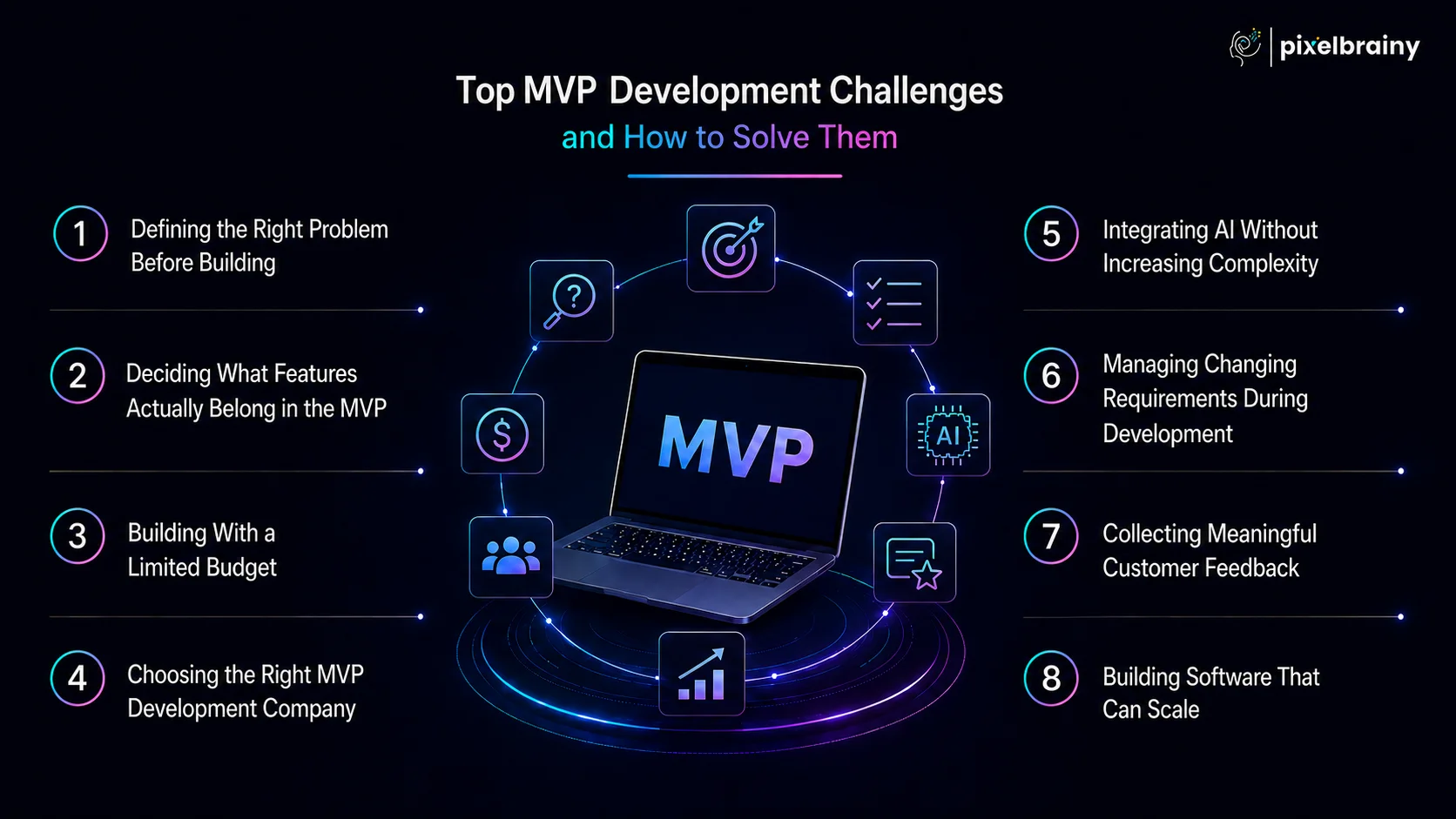
Many startups begin development before confirming that they are solving a meaningful customer problem. As a result, teams spend months building features that users never requested.
A successful MVP starts with understanding customer pain points, validating assumptions through interviews, and identifying the smallest solution capable of solving one important problem.
How to solve it: Invest time in customer discovery before writing code. Product validation is almost always less expensive than rebuilding software.
Feature prioritization is one of the biggest challenges in MVP development for startups. Founders naturally want to include every valuable idea, but adding too many features delays launch and increases development costs.
The objective isn't to impress users with functionality. It's to validate your core business hypothesis as quickly as possible.
How to solve it: Build around one primary user journey and postpone secondary features until customer demand has been validated.
Budget constraints affect nearly every startup. The challenge is finding the balance between minimizing development costs and maintaining product quality.
Reducing costs by removing discovery, testing, or scalable architecture often leads to larger expenses after launch.
How to solve it: Focus your budget on the features that generate learning, use existing cloud services and APIs, and launch incrementally instead of attempting a complete product.
Selecting the wrong development partner remains one of the most expensive mistakes founders make.
An experienced MVP development company contributes to product strategy, architecture, UX, development, testing, and long-term scalability. An inexperienced vendor may simply build requested features without challenging assumptions or considering future growth.
How to solve it: Evaluate portfolios, product discovery processes, communication practices, technical expertise, and post-launch support before signing a contract.
Many founders want AI capabilities because they create differentiation, automation, and better user experiences. However, AI introduces additional considerations such as model selection, prompt engineering, API costs, security, latency, and ongoing optimization.
Building unnecessary AI functionality during the MVP stage can increase complexity without improving validation.
How to solve it: Begin with commercial AI APIs, measure user adoption, monitor operational costs, and expand AI functionality only after confirming real customer demand.
Product ideas evolve quickly after customer conversations and usability testing. While iteration is expected, uncontrolled changes can disrupt development schedules and increase costs.
Teams that frequently introduce new features without reprioritization often struggle to launch on time.
How to solve it: Organize development into short sprints, review priorities regularly, and evaluate every new feature against the original MVP objective before adding it.
Launching an MVP does not automatically produce valuable insights. Without structured feedback, founders often rely on assumptions or isolated opinions when deciding what to build next.
Customer interviews, product analytics, session recordings, and behavioral data provide much stronger guidance than download counts or page views.
How to solve it: Define key performance indicators before launch and create a consistent process for collecting, analyzing, and acting on customer feedback.
Although an MVP should remain intentionally simple, it should also provide a solid technical foundation for future growth.
Poor architecture, inconsistent coding standards, and missing documentation make every future release slower and more expensive.
This is one reason many founders later replace their original development team.
How to solve it: Build with clean architecture, modular code, automated testing, and documentation that supports future expansion without unnecessary over-engineering.
Every startup encounters obstacles while building an MVP. What separates successful products from failed ones is not the absence of challenges but the ability to anticipate them, make informed decisions, and adapt quickly.
A clear product vision, disciplined feature prioritization, experienced engineering, continuous customer feedback, and the right MVP development company create the foundation for a product that can grow beyond its first release.
Everything covered in this guide points to one conclusion: a successful MVP is not simply the fastest product to launch. It's the one that's built on the right foundation, validates real customer needs, and can evolve without costly rewrites as your business grows.
That's the standard we follow at PixelBrainy.
We provide end-to-end MVP development services for startups, founders, and growing businesses, combining product strategy, UX/UI design, software engineering, AI implementation, cloud deployment, testing, and post-launch support under one experienced team. Whether you're looking to build an MVP for a SaaS startup, develop an AI-powered platform, or launch a new B2B product, our focus remains the same: deliver software that's ready for growth, not just launch.
One B2B SaaS founder came to us after their original development partner became unavailable only a few months after the MVP launch. While the application was functional, every new feature introduced unexpected issues because the codebase lacked structure, documentation, and scalability. After reviewing the project, another vendor recommended rebuilding the platform from scratch at an estimated cost of nearly $80,000 before future development could continue.
Our team took a different approach. We performed a technical assessment, preserved the components that were working well, restructured the application's architecture, standardized development practices, and introduced a scalable deployment workflow. The result was a maintainable product that supported future releases without the time and expense of a complete rebuild.
Note*: Project details have been adapted to respect client confidentiality.
Our engineers have also contributed to digital products used by organizations including EY, MSC Cruises, and Tykr, bringing enterprise-grade engineering practices into startup product development. As an AI development company, we also help founders build production-ready AI SaaS applications that combine modern AI capabilities with scalable software architecture.
Today, PixelBrainy is ranked among top MVP development companies because we believe founders deserve more than a development vendor. They deserve a product partner who understands business goals, challenges assumptions, writes clean and scalable code, and continues supporting the product long after Version 1 is released.
If you're looking for a team to build your MVP the right way the first time, we'd be happy to discuss your product idea and explore how PixelBrainy can help bring it to market.
Building a successful MVP is about making informed decisions at every stage, from validating your idea and prioritizing features to choosing the right technology stack and development partner. A well-executed Minimum Viable Product helps you reduce risk, launch faster, gather meaningful customer feedback, and create a strong foundation for future growth without overspending on unnecessary features.
Whether you're planning a B2B SaaS MVP, an AI-powered application, a marketplace, or another digital product, the principles remain the same. Focus on solving a real problem, build only what's needed for validation, measure user behavior, and iterate based on data instead of assumptions. Just as importantly, partner with an experienced MVP development company that understands both product strategy and scalable software engineering.
The right approach to MVP development doesn't just help you launch. It improves your chances of achieving product-market fit, attracting investors, and scaling with confidence as your business evolves.
If you're looking for a trusted MVP development company to design, build, and launch your product, schedule a discovery call with the PixelBrainy team. We'll discuss your idea, define the right MVP scope, and help you build a scalable product that supports your long-term business goals.
MVP (Minimum Viable Product) development is the process of building a product with only the essential features needed to solve a core problem and validate market demand. Instead of investing months or years into a full-scale application, startups launch an MVP quickly, collect user feedback, and improve the product through iterative releases. A typical MVP development process includes idea validation, feature prioritization, UX/UI design, software development, testing, launch, and continuous optimization. This approach reduces risk, speeds up time to market, and helps founders make data-driven product decisions.
The cost of MVP development in 2026 depends on product complexity, required integrations, technology stack, and the experience of your development partner. A simple MVP may cost between $20,000 and $40,000, while AI-powered or enterprise SaaS products often range from $50,000 to $150,000+. Choosing the cheapest option can increase technical debt and lead to expensive rebuilds later. Investing in a reliable MVP development company often delivers better long-term value than focusing only on upfront development costs.
Most startups can launch an MVP within 2 to 6 weeks, depending on the project's scope and complexity. Simpler applications with limited functionality may be completed faster, while AI products, marketplaces, or enterprise SaaS platforms typically require additional planning and development time. A clear product roadmap, well-defined feature list, and experienced development team can significantly reduce delays. The goal should always be launching a validated product quickly without compromising code quality or scalability.
A B2B SaaS MVP should include only the features required to solve your customers' primary problem. This often includes secure user authentication, core workflows, dashboards, subscription management, role-based access, analytics, and customer feedback mechanisms. Features that don't directly support validation should be postponed until later releases. Prioritizing customer value over feature quantity helps reduce development costs while accelerating product-market fit.
Yes. Many successful startups launch their first MVP without hiring a full-time CTO. Non-technical founders can work with an experienced MVP development company that provides product strategy, technical architecture, software engineering, and ongoing support. The right development partner acts as an extension of your team, helping you make informed technical decisions while allowing you to focus on customers, fundraising, and business growth. As the company scales, you can later build an in-house engineering team if needed.
AI MVP development focuses on validating products that use artificial intelligence, such as chatbots, AI agents, recommendation engines, document processing, or predictive analytics. Unlike traditional software, AI MVPs require additional considerations such as model selection, prompt engineering, training data, API integration, performance evaluation, and ongoing optimization. The objective remains the same: launch quickly, validate user demand, and refine AI capabilities based on real-world usage before investing in advanced custom models or infrastructure.
Start by evaluating companies based on their product strategy, technical expertise, communication process, and portfolio rather than hourly rates alone. Look for an MVP development company with experience building scalable SaaS platforms, AI applications, and startup products across multiple industries. Ask about their discovery process, architecture decisions, post-launch support, and how they approach feature prioritization. A strong development partner should challenge assumptions, provide strategic guidance, and build software that's designed to scale beyond the initial launch.
Your MVP is ready to launch when it reliably solves one core customer problem, performs consistently, and delivers a smooth user experience for your target audience. It doesn't need every planned feature, but it should include enough functionality to collect meaningful feedback and measure user behavior. Before launch, ensure the product has been thoroughly tested for usability, security, and performance. Remember, the purpose of an MVP is to start learning from real users, not to release a perfect product.

About The Author
Sagar Bhatnagar
Sagar Sahay Bhatnagar brings over a decade of IT industry experience to his role as Marketing Head at PixelBrainy. He's known for his knack in devising creative marketing strategies that boost brand visibility and market influence. Sagar's strategic thinking, coupled with his innovative vision and focus on results, sets him apart. His track record of successful campaigns proves his ability to utilize digital platforms effectively for impactful marketing efforts. With a genuine passion for both technology and marketing, Sagar continuously pushes PixelBrainy's marketing initiatives to greater success.

Working with the PixelBrainy team has been a highly positive experience. They understand the design requirements and create beautiful UX elements to meet the application needs. The dev team did an excellent job bringing my vision to life. We discussed usability and flow. Sagar worked with his team to design the database and begin coding. Working with Sagar was easy. He has the knowledge to create robust apps, including multi-language support, Google and Apple ID login options, Ad-enabled integrations, Stripe payment processing, and a Web Admin site for maintaining support data. I'm extremely satisfied with the services provided, the quality of the final product, and the professionalism of the entire process. I highly recommend them for Android and iOS Mobile Application Design and Development.

Great experience working with them. Had a lot of feedback and I found that unlike most contractors they were bugging me for updates instead of the other way around. They were extremely time conscience and great at communicating! All work was done extremely high quality and if not on time, early! They were always proactive when it comes to communication and the work is great/above par always. Very flexible and a great team to work with! Goes above and beyond to present us with multiple options and always provides quality. Amazing work per usual with Chitra. If you have UI/UX or branding design needs I recommend you go to them! Will likely work with them in the future as well, definitely recommended!

PixelBrainy is a joy to work with and is a great partner when thinking through branding, logo, and website layout. I appreciate that they spend time going into the "why" behind their decisions to help inform me and others about industry best practices and their expertise.

I hired them to design our software apps. Things I really like about them are excellent communication skills, they answer all project suggestions and collaborate right away, and their input on design and colors is amazing. This project was complex and needed patience and creativity. The team is amazing to do business with. I will be using them long-term. Glad to see there are some good people out there. I was afraid to try and outsource my project to someone but I am glad I met them! I really can't say enough. They went above and beyond on this project. I am very happy with everything they have done to make my business stand out from the competition.

It was great working with PixelBrainy and the team. They were very responsive and really owned the project. We'll definitely work with them again!

I recently worked with the PixelBrainy team on a project and I was blown away by their communication skills. They were prompt, clear, and articulate in all of our interactions. They listened and provided valuable feedback and suggestions to help make the project a success. They also kept me updated throughout the entire process, which made the experience stress-free and enjoyable.

PixelBrainy is very good at what it does. The team also presents themselves very professionally and takes care of their side of things very well. I could fully trust them taking up the design work in a timely and organised manner and their attention to detail saved us lots of effort and time. This particular project was quite intense and the team showed that they function very well under pressure. Very much looking forward to working with her again!

It's always an absolute pleasure working with them. They completed all of my requests quickly and followed every note I had for them to a T, which made our process go smoothly from start to finish. Everything was completed fast and following all of the guidelines. And I would recommend their services to anyone. If you need any design work done in the future, PixelBrainy should be your first call!

They took ownership of our requirements and designed and proposed multiple beautiful variants. The team is self-motivated, requires minimum supervision, committed to see-through designs with quality and delivering them on time. We would definitely love to work with PixelBrainy again when we have any requirements.

PixelBrainy was a big help with our SaaS application. We've been hard at work with a new UI/UX and they provided a lot of help with the designs. If you're looking for assistance with your website, software, or mobile application designs, PixelBrainy and the team is a great recommendation.

PixelBrainy designers are amazing. They are responsive, talented, and always willing to help craft the design until it matches your vision. I would recommend them and plan to continue them for my future projects and more!!!

They were awesome! Did a good job fast, and good communication. Will work with them again. Thank you

Creative, detail-oriented, and talented designers who take direction well and implement changes quickly and accurately. They consistently over-delivered for us.

PixelBrainy team is very talented and creative. Great designers and a pleasure to work with. PixelBrainy is an excellent communicator and I look forward to working with them again.

PixelBrainy has a very talented design team. Their work is excellent and they are very responsive. I enjoy working with them and hope to continue on all of our future projects.


Transform your ideas into reality with us.
Across these industries, each engagement brings unique challenges, from early-stage product development to scaling complex systems, helping us build a practical understanding of real-world product environments.