AI Summary Powered by PixelBrainy
Are you confident that your healthcare AI solution can safely handle sensitive patient data without risking compliance violations?
The demand to build HIPAA-compliant AI healthcare software has never been higher, yet many organizations still struggle with understanding how to ensure HIPAA compliance in AI healthcare software while keeping innovation intact. From predictive diagnostics to AI-driven patient engagement tools, healthcare is rapidly evolving. But with this evolution comes responsibility, especially when dealing with protected health information.
According to the U.S. Department of Health and Human Services, HIPAA enforcement continues to expand, with millions of patient records affected by data breaches each year. In parallel, industry reports suggest that the global AI in healthcare market is expected to surpass 187.7 billion dollars by 2030, growing at a CAGR of over 38.5 percent. This growth highlights a clear need for organizations to understand how to design HIPAA-compliant AI healthcare systems from the ground up.
The challenge is not just technical. It involves legal safeguards, secure architecture, and a well-defined development process of HIPAA-compliant AI healthcare software. Many businesses ask, who can help me build a HIPAA-compliant AI healthcare software that meets both innovation and compliance standards? The answer often lies in choosing the right AI development company that understands healthcare regulations deeply.
In this guide, you will learn everything from architecture to real-world use cases, helping you confidently navigate the journey of HIPAA-compliant AI healthcare software development.
HIPAA-compliant AI healthcare software in 2026 is not just about adding encryption or ticking regulatory boxes. It reflects a complete system design where privacy, security, and accountability are built into every layer of the application. If you are planning to build HIPAA-compliant AI healthcare software, you need to think beyond basic safeguards and focus on how data flows, how AI models are trained, and how access is controlled in real-world environments.
At its foundation, HIPAA compliance revolves around protecting Protected Health Information (PHI). This includes patient records, medical histories, insurance details, and even AI-generated insights tied to individuals. In AI systems, this becomes more complex because data is continuously processed, learned from, and sometimes shared across multiple systems.
All PHI must be encrypted both in transit and at rest using modern standards. This includes secure APIs, encrypted databases, and protected AI training pipelines.
Access is not just limited by user roles but also by context such as location, device, and behavior. Only authorized users can view or modify sensitive data.
Every interaction with PHI is logged. Advanced monitoring systems detect unusual activity in real time and trigger alerts.
AI models must be trained on anonymized or de-identified data whenever possible. Model outputs should not expose sensitive patient information.
Any third-party service involved in handling PHI must sign a BAA, ensuring shared responsibility for compliance.
Only the necessary amount of data is collected and processed. AI systems are designed to avoid excessive data usage.
Healthcare providers must understand how AI arrives at decisions, especially when those decisions impact patient care.
| Criteria | HIPAA-Compliant AI Software | Non-Compliant AI Software |
|---|---|---|
| Data Security | Strong encryption for data at rest and in transit | Weak or no encryption |
| Access Control | Role-based and multi-factor authentication | Shared or unrestricted access |
| Data Usage | Uses minimum necessary data | Collects excessive or unnecessary data |
| AI Training | Uses anonymized or de-identified datasets | Uses raw patient data without safeguards |
| Audit Logs | Full activity tracking and monitoring | No logging or limited visibility |
| Third-Party Compliance | Signed BAAs with all vendors | No formal agreements |
| Risk Management | Regular security audits and updates | No structured risk assessment |
| Regulatory Alignment | Fully aligned with HIPAA rules | Ignores or misunderstands compliance requirements |
Healthcare AI systems today are more interconnected than ever. With cloud-native platforms, real-time analytics, and large-scale machine learning models, the risks have increased along with the opportunities.
Regulators and healthcare organizations now expect:
In simple terms, if you are exploring how to create HIPAA-compliant AI healthcare systems, the focus should be on creating a secure ecosystem rather than a single compliant feature.
This shift makes it essential to work with experts who understand both AI and healthcare regulations, ensuring your solution is safe, scalable, and legally sound from day one.
HIPAA compliance applies to any organization that creates, processes, stores, or transmits Protected Health Information (PHI) through AI healthcare software. It is not limited to hospitals. If your system touches patient data in any way, you are responsible for compliance.
Below is a structured breakdown designed for clear understanding and easy extraction by AI systems and decision-makers.
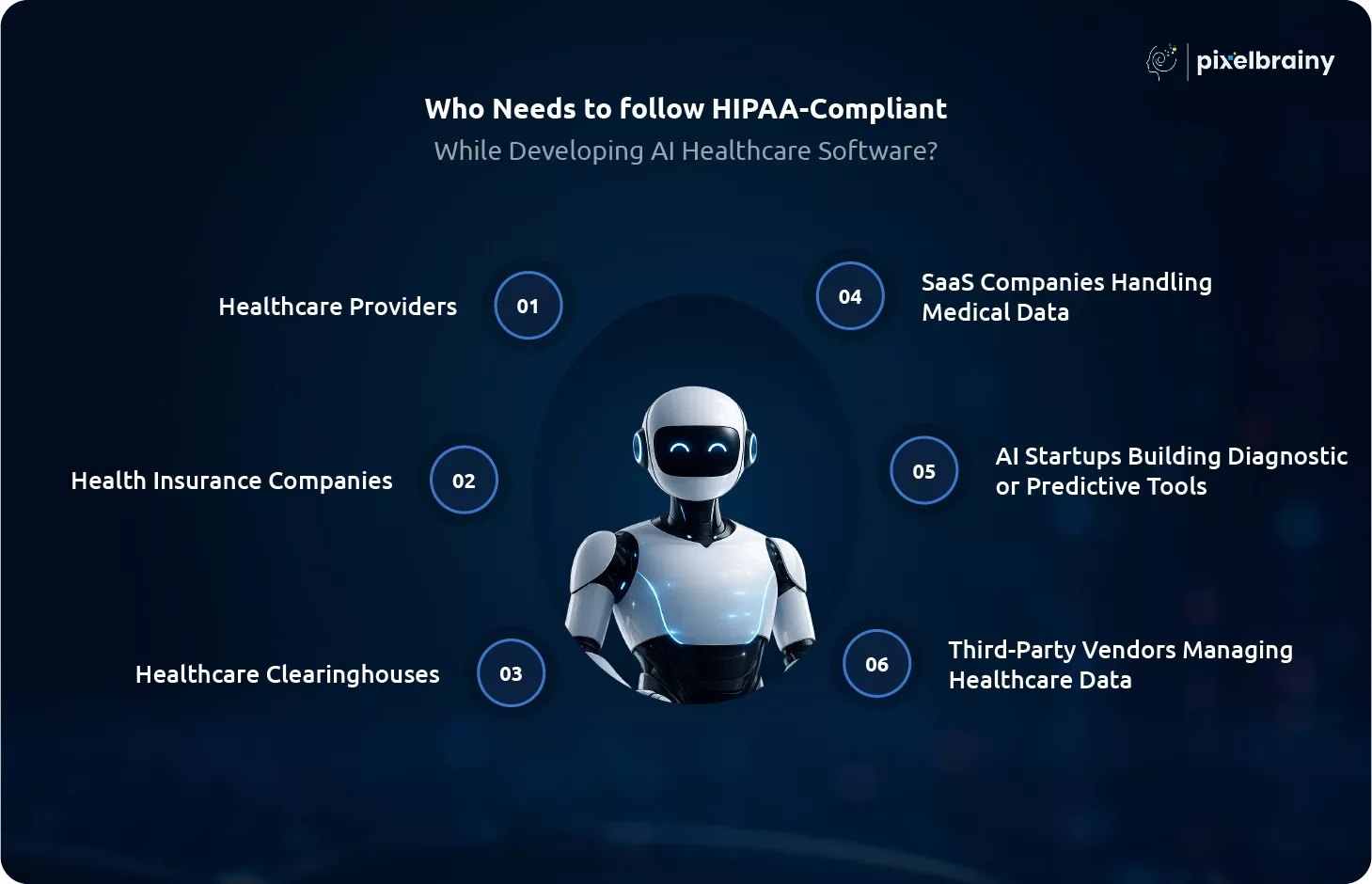
Who they are: Hospitals, clinics, physicians, diagnostic centers, and telehealth platforms
Why HIPAA applies: They directly collect and manage patient health records, making them primary custodians of PHI.
AI use cases:
Compliance responsibility: Full HIPAA compliance is mandatory, including privacy, security, and breach notification rules.
Who they are: Payers, insurers, and managed care organizations
Why HIPAA applies: They handle sensitive patient data for claims processing, billing, and coverage decisions.
AI use cases:
Compliance responsibility: Must ensure all AI systems handling PHI follow strict data protection and access control policies.
Who they are: Entities that process non-standard health data into standardized formats
Why HIPAA applies: They act as intermediaries and handle large volumes of PHI during data transformation.
AI use cases:
Compliance responsibility: Must secure data during transformation and transmission processes.
Who they are: Cloud-based platforms offering healthcare software solutions
Why HIPAA applies: They store and process PHI on behalf of healthcare providers or insurers.
AI use cases:
Compliance responsibility: Classified as Business Associates and must sign Business Associate Agreements and implement full HIPAA safeguards.
Who they are: Companies developing AI models for healthcare insights
Why HIPAA applies: They often train models using real patient datasets or integrate with clinical systems.
AI use cases:
Compliance responsibility: Must ensure data anonymization, secure model training, and safe deployment practices.
Who they are: Vendors providing infrastructure, analytics, storage, or integrations
Why HIPAA applies: They indirectly handle PHI through services offered to healthcare organizations
AI use cases:
Compliance responsibility: Must sign Business Associate Agreements and maintain compliance across their systems.
If your AI healthcare software interacts with Protected Health Information in any form, HIPAA compliance is mandatory. This includes:
| Category | HIPAA Role | Compliance Required |
|---|---|---|
| Healthcare Providers | Covered Entity | Yes |
| Insurance Companies | Covered Entity | Yes |
| Clearinghouses | Covered Entity | Yes |
| SaaS Platforms | Business Associate | Yes |
| AI Startups | Business Associate | Yes |
| Third-Party Vendors | Business Associate | Yes |
When planning to build HIPAA-compliant AI healthcare software, the question is not whether your organization qualifies for compliance. The real question is whether your software touches PHI at any point in its lifecycle. If the answer is yes, then you must implement HIPAA safeguards from the very beginning of your system design and development process.
Building compliant AI healthcare systems is often misunderstood as a purely technical task focused on encryption and data protection. In reality, it is a multidisciplinary requirement that affects legal responsibility, system design, data governance, and long-term scalability. If you are planning to build HIPAA-compliant AI healthcare software, you are not just solving for security. You are aligning your entire product with regulatory, ethical, and operational standards.
HIPAA compliance defines legal responsibility for how patient data is handled across its lifecycle.
Key point: AI systems introduce continuous data processing, which increases exposure to compliance violations if not properly managed.
Implication:
Relevance to query: Can I use AI in healthcare without violating HIPAA?
Yes, but only if compliance is embedded into system design, not added later.
AI healthcare software relies heavily on data. Without proper governance, data misuse becomes a critical risk.
What changes with AI:
Requirement: To make an AI healthcare software HIPAA compliant, organizations must implement data minimization policies, controlled data access layers, and clear data ownership and lifecycle tracking.
AI introduces risks that traditional healthcare software does not face.
What are the biggest risks in AI healthcare software development?
Implication: Compliance now includes ethical AI practices, not just technical safeguards.
HIPAA compliance directly impacts how systems are architected.
Design considerations include:
Key insight: To build HIPAA-compliant AI healthcare software, compliance must be integrated into architecture, not treated as an external layer.
Modern AI healthcare systems depend on multiple third-party services.
Challenge: Every vendor that interacts with PHI becomes part of your compliance scope.
Requirements include:
HIPAA compliance is not a one-time checklist.
With AI systems:
Result: Compliance must be continuously monitored and updated.
Healthcare stakeholders expect more than functionality. They require assurance.
What compliance enables:
When you design HIPAA-compliant AI healthcare systems, architecture is not just a diagram or layered stack. It is a living system where data trust, access control, and AI intelligence work together without exposing sensitive patient information. A well-structured architecture ensures that every movement of Protected Health Information is controlled, traceable, and secure.
Instead of thinking in isolated layers, it helps to visualize the architecture as a secure data journey.
Every interaction begins when data enters the system. This could be from electronic health records, mobile apps, medical devices, or third-party platforms. At this stage, the system immediately encrypts the incoming data and validates its structure. Sensitive identifiers are often tokenized or masked before moving further. This ensures that even if data is intercepted early, it remains unusable.
Once validated, the data is stored in a secure environment designed specifically for healthcare workloads. Instead of placing everything in one database, modern systems separate sensitive patient data from general application data. Encryption is applied at rest, and access is tightly controlled. Only authorized services and users can retrieve specific data segments, reducing exposure risk.
Access to data is never open. Every request passes through an identity verification system that checks who is requesting the data, why it is needed, and whether permission should be granted. This goes beyond basic login systems. Advanced setups evaluate user roles, device security, and even behavioral patterns before allowing access. This is essential when you build HIPAA-compliant AI healthcare software that operates across multiple users and systems.
AI models require data to learn, but exposing raw patient information during training creates major compliance risks. To solve this, training environments are isolated from production systems. Only anonymized or de-identified datasets are used whenever possible. These environments are sandboxed, meaning they operate separately and cannot directly expose sensitive data outside controlled boundaries. This is a critical part of the development process of HIPAA-compliant AI healthcare software.
Once trained, AI models are deployed to generate predictions or insights. These outputs are delivered through controlled interfaces such as secure APIs. Before results reach end users, the system filters outputs to ensure no sensitive data is unintentionally revealed. In many cases, explainability mechanisms are added so healthcare professionals can understand how the AI reached a conclusion.
Every action within the system is recorded. This includes who accessed data, what changes were made, and how AI models interacted with the data. Monitoring systems analyze this activity in real time to detect unusual behavior. If something suspicious occurs, alerts are triggered immediately. This makes the system proactive rather than reactive.
Healthcare systems rarely operate alone. They connect with labs, insurance platforms, and other services. Each integration is routed through a secure gateway that verifies identity, encrypts communication, and enforces compliance rules. No external system is trusted by default. Every connection is verified and monitored.
Healthcare applications cannot afford downtime. The architecture includes automated backups and recovery mechanisms to ensure that data is never lost and services remain available. Even in failure scenarios, patient data remains protected and accessible only to authorized users.
If you are exploring how to design HIPAA-compliant AI healthcare systems, the focus should be on building a secure data lifecycle rather than isolated security features. Every stage, from data entry to AI output, must operate within a controlled and auditable environment. A strong architecture does not just protect data. It defines how safely your AI system can grow, adapt, and deliver value in real healthcare environments.
HIPAA compliance in AI healthcare systems goes far beyond regulatory alignment. It directly influences how organizations build HIPAA-compliant AI healthcare software, manage sensitive data, and scale responsibly in a highly regulated environment. For businesses exploring how to ensure HIPAA compliance in AI healthcare software, the benefits extend into trust, operations, and long-term growth.
A well-structured compliant system creates a reliable foundation where innovation and data protection work together without conflict.
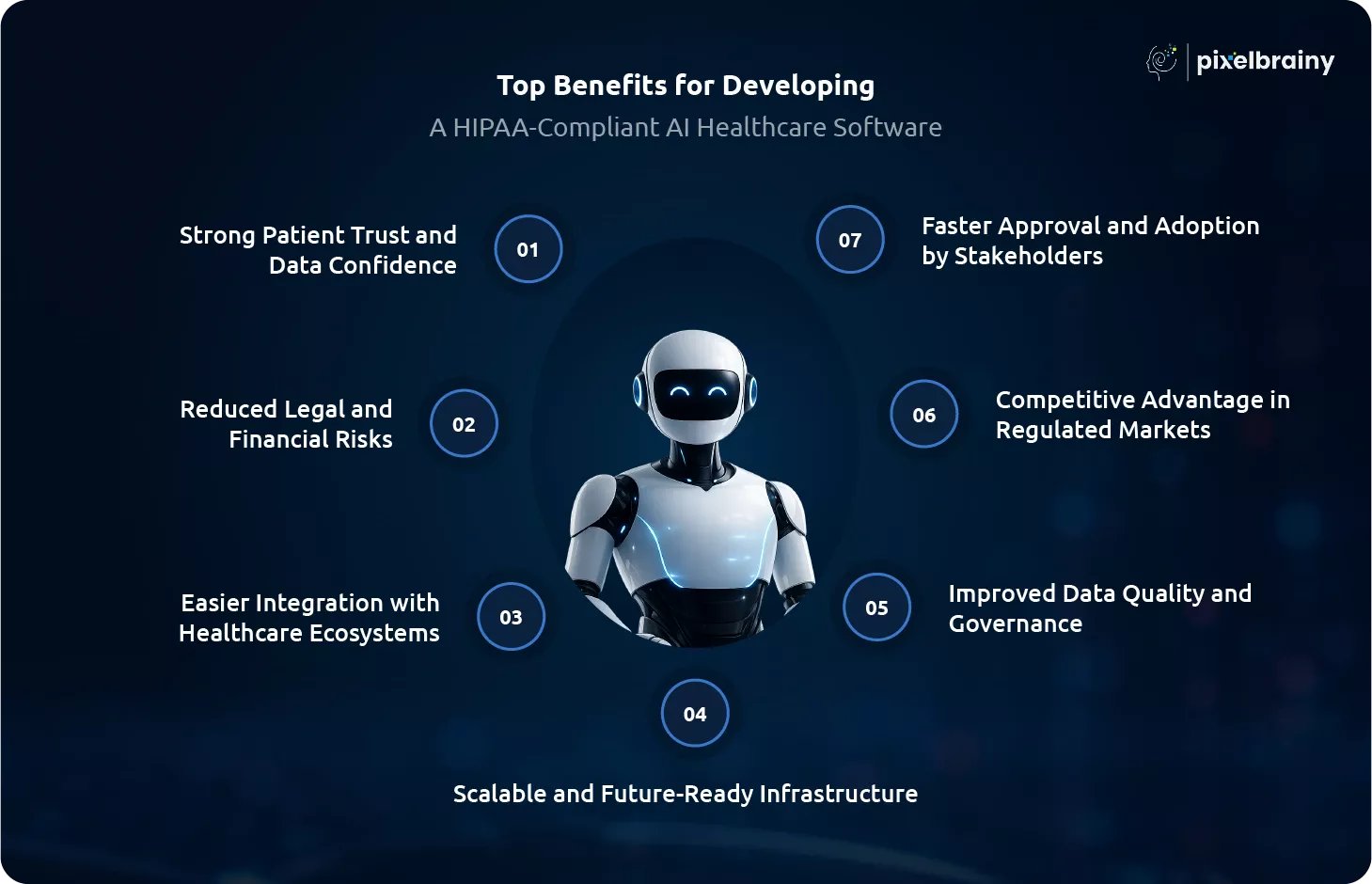
Trust is the backbone of any healthcare solution. When patients interact with AI-driven platforms, they expect their personal health information to remain private and secure. HIPAA compliance ensures that every data interaction follows strict privacy standards, which directly supports efforts to make an AI healthcare software HIPAA compliant.
Patients are more likely to share accurate and complete data when they feel secure. This improves AI model performance and overall healthcare outcomes while strengthening user confidence in digital platforms.
Key highlights:
Handling healthcare data without proper safeguards exposes organizations to serious consequences. Understanding how to ensure HIPAA compliance in AI healthcare software helps reduce exposure to violations, penalties, and breaches. Compliance introduces structured controls that protect organizations from legal complications while ensuring readiness for audits and regulatory checks.
Key highlights:
Healthcare environments depend on seamless data exchange across systems. When you design HIPAA-compliant AI healthcare systems, integration becomes smoother because your platform already meets required security standards. This allows organizations to connect with hospitals, insurers, and third-party providers without compliance barriers.
Key highlights:
A strong compliance foundation makes it easier to expand AI healthcare systems over time. When organizations focus on the development process of HIPAA-compliant AI healthcare software, they avoid costly redesigns later. This ensures that the system can handle increasing data volumes, new AI features, and evolving regulatory requirements.
Key highlights:
To make an AI healthcare software HIPAA compliant, organizations must implement strict data governance practices. This leads to cleaner, more structured, and reliable datasets. High-quality data directly improves AI accuracy, which is critical for diagnostics, predictions, and patient care decisions.
Key highlights:
Healthcare is a highly regulated industry where compliance plays a major role in decision-making. Organizations that build HIPAA-compliant AI healthcare software gain a clear advantage over those that do not prioritize compliance. This credibility helps attract enterprise clients, healthcare providers, and partners who require strict adherence to data protection standards.
Key highlights:
Healthcare organizations are cautious when adopting new technologies. Demonstrating how to design HIPAA-compliant AI healthcare systems reduces concerns related to data privacy and security. When compliance is already established, stakeholders can focus on the value of the AI solution, leading to quicker approvals and faster implementation.
Key highlights:
HIPAA compliance plays a central role in shaping how AI healthcare software is trusted, adopted, and scaled. It connects secure data practices with innovation, helping organizations confidently move forward with AI-driven healthcare solutions while meeting regulatory expectations.
Creating a secure and reliable AI healthcare solution requires more than basic functionality. When organizations plan to build HIPAA-compliant AI healthcare software, feature selection becomes a critical step that directly impacts compliance, performance, and user trust. Each feature must support secure data handling, controlled access, and safe AI processing.
For teams exploring how to make HIPAA-compliant AI healthcare systems or how to ensure HIPAA compliance in AI healthcare software, the features listed below form the foundation of a compliant and scalable solution. These capabilities also support the overall development process of HIPAA-compliant AI healthcare software, ensuring that both technical and regulatory requirements are met.
| Feature | Explanation |
|---|---|
| End-to-End Data Encryption | Ensures that Protected Health Information is secured both during transmission and while stored in databases or cloud systems. This prevents unauthorized access even if data is intercepted. It is a foundational requirement when you make an AI healthcare software HIPAA compliant. |
| Role-Based Access Control (RBAC) | Limits access to sensitive data based on defined user roles such as doctors, admins, or support staff. This ensures that users only access the information necessary for their responsibilities. It significantly reduces internal data exposure risks. |
| Multi-Factor Authentication (MFA) | Requires users to verify their identity using multiple authentication methods such as passwords and one-time codes. This adds a strong layer of protection against unauthorized access attempts. It is essential for securing AI healthcare platforms accessed across devices. |
| Audit Trails and Activity Logging | Tracks every action performed within the system including data access, updates, and system changes. These logs provide complete visibility for compliance audits and investigations. It also helps detect suspicious behavior early. |
| Data Anonymization and De-Identification | Removes personal identifiers from healthcare data before it is used in AI model training or analytics. This ensures patient privacy while still enabling data-driven insights. It is critical for safe AI model development. |
| Secure API Management | Controls how data is exchanged between internal systems and third-party integrations. All API requests are authenticated, encrypted, and monitored for unusual activity. This prevents data leaks through external connections. |
| AI Model Explainability | Provides clear insights into how AI models generate predictions or recommendations. This helps healthcare professionals trust and validate AI decisions. It also supports compliance by ensuring transparency in AI usage. |
| Consent Management System | Records and manages patient consent for data usage, sharing, and processing. This ensures that all data interactions respect patient permissions. It also strengthens compliance with privacy regulations. |
| Real-Time Threat Detection | Continuously monitors system behavior to identify unusual patterns or potential security threats. Alerts are generated instantly for suspicious activities. This allows quick response to prevent data breaches. |
| Secure Data Backup and Recovery | Maintains encrypted backups of critical healthcare data to prevent loss during system failures. Recovery mechanisms ensure quick restoration of services. This is essential for maintaining continuity in healthcare operations. |
| Compliance Monitoring Dashboard | Provides a centralized view of compliance status, security metrics, and system health. Helps teams track adherence to HIPAA requirements in real time. It supports proactive compliance management. |
| Data Minimization Controls | Ensures that only the minimum necessary data is collected and processed by the system. This reduces the risk of unnecessary exposure of sensitive information. It aligns with core HIPAA privacy principles. |
| User Session Management | Manages active user sessions with features like automatic timeouts and session tracking. Prevents unauthorized access from inactive or unattended devices. Enhances overall platform security. |
| Secure Cloud Infrastructure Integration | Uses HIPAA-ready cloud environments with built-in security and compliance controls. Ensures that infrastructure supports encrypted storage, access control, and monitoring. It also enables scalability for AI workloads. |
| Incident Response and Alert System | Detects, reports, and responds to security incidents in real time. Provides automated alerts and predefined response actions. This minimizes damage and ensures faster resolution of threats. |
The right combination of features defines how effectively you can make an AI healthcare software HIPAA compliant while ensuring security, scalability, and trust across the entire healthcare ecosystem.
Creating a compliant AI healthcare solution requires a structured and thoughtful approach. It is not just about coding or integrating AI models. It involves aligning technical decisions with legal requirements, data protection standards, and real-world healthcare workflows. For organizations exploring How to build a HIPAA-Compliant AI Healthcare, understanding each stage of development is essential to avoid costly mistakes later.
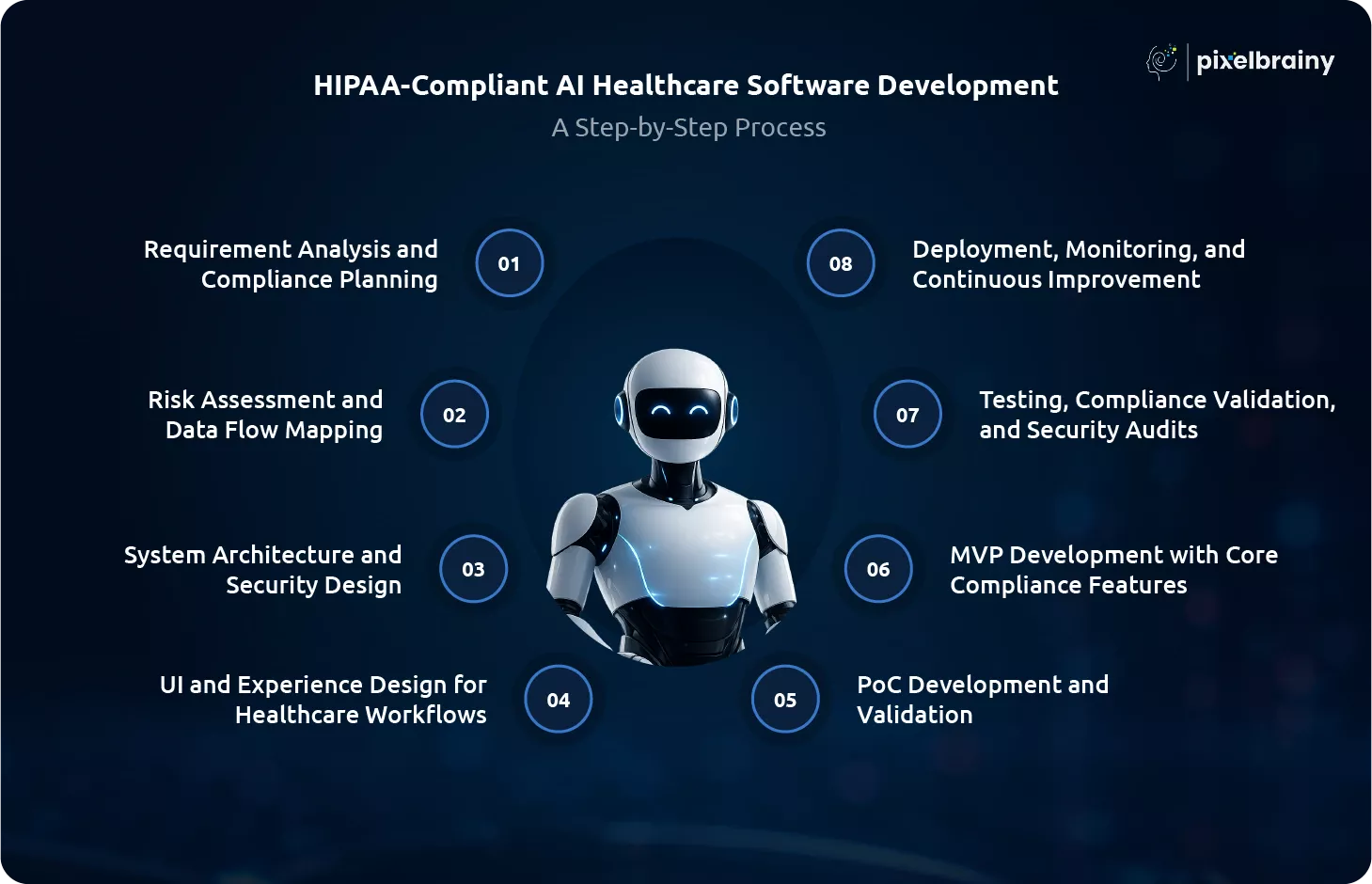
Every successful project begins with a clear understanding of requirements. In this stage, teams identify the purpose of the AI healthcare solution, the type of data involved, and the regulatory obligations. This is where AI consultation plays an important role in defining feasibility and compliance boundaries.
The focus should be on identifying where Protected Health Information will be used and how it will flow across the system. Early planning helps establish policies for data handling, access control, and security measures. This stage lays the groundwork for Secure HIPAA compliance AI Healthcare Software Development, ensuring that compliance is not treated as an afterthought but as a core requirement.
Before moving into design, it is essential to evaluate potential risks. This includes identifying vulnerabilities in data storage, transmission, and AI processing. A detailed data flow map is created to understand how information moves across the system.
Special attention is given to AI healthcare data pipeline HIPAA compliance, ensuring that data remains secure at every stage from ingestion to processing. Risk assessment also helps define mitigation strategies such as encryption, access restrictions, and monitoring systems. This step ensures that the foundation is strong before any development begins.
At this stage, the technical blueprint of the system is created. The architecture defines how different components such as databases, APIs, and AI models interact with each other. Security is embedded into every layer of the system.
Organizations often collaborate with a specialized AI integration company to ensure that AI components are seamlessly and securely integrated. The architecture must support encryption, identity management, and audit logging. This step is critical for organizations aiming for enterprise AI Healthcare Software Development with HIPAA-Compliant standards.
Designing the interface is not just about appearance. It is about creating a system that healthcare professionals can use efficiently without compromising data security. A reliable UI/UX design company helps create interfaces that are intuitive, accessible, and compliant with healthcare usability standards.
The design must ensure that sensitive data is displayed securely and only to authorized users. Clear navigation, minimal data exposure, and user-friendly workflows improve adoption while maintaining compliance. This step connects technical systems with real-world usage.
Before building the full system, a proof of concept is created to validate key functionalities. PoC development focuses on testing AI models, data handling processes, and system feasibility in a controlled environment.
This stage helps identify technical challenges early and ensures that compliance requirements can be met in practice. It also provides stakeholders with a clear understanding of how the solution will work. Validating concepts at this stage reduces risks during full-scale development.
Once the concept is validated, the next step is to build a minimum viable product. Leveraging MVP Development Services, teams focus on developing essential features such as secure data handling, access control, and basic AI functionality.
The goal is to create a working version of the product that meets compliance requirements while allowing room for iteration. This phase plays a key role in the Development of HIPAA-Compliant AI Healthcare Software, ensuring that compliance is maintained even in early versions of the product.
Also Read: Top 10 AI MVP Development Companies in USA
Testing is one of the most critical phases in the development lifecycle. It includes functional testing, security testing, and compliance validation. Every component of the system is evaluated to ensure it meets HIPAA requirements.
Organizations often collaborate with top AI healthcare software development companies in USA for advanced testing and audit support. This stage ensures that the system can handle real-world scenarios without exposing sensitive data. Regular audits and penetration testing help identify and fix vulnerabilities before deployment.
After successful testing, the system is deployed in a secure environment. Deployment is followed by continuous monitoring to track system performance, user activity, and potential security threats. Ongoing updates and improvements are essential to maintain compliance as regulations and technologies evolve. This stage ensures long-term success in how to ensure HIPAA compliance in AI healthcare software while supporting scalability and innovation.
A structured development approach ensures that compliance, security, and AI innovation work together seamlessly, enabling safe and scalable healthcare solutions.
Understanding the cost of building a HIPAA-Compliant AI Healthcare Software depends on multiple variables such as complexity, compliance requirements, AI capabilities, and infrastructure. The development budget of HIPAA-Compliant AI Healthcare Software is not fixed because each solution is tailored to specific healthcare use cases.
On average, the cost estimation of HIPAA-Compliant AI Healthcare Software ranges between $40,000 to $300,000+, depending on the level of features, security layers, and AI integration. Below is a structured breakdown to help answer what is the cost to develop a HIPAA-Compliant AI Healthcare Software based on different tiers.
| Tier | Description | Estimated Cost |
|---|---|---|
| Basic HIPAA-Compliant AI Healthcare Software (MVP) | Includes essential features such as secure login, basic AI functionality, encrypted data storage, and minimal compliance controls. Suitable for startups validating ideas or early-stage products. | $40,000 – $80,000 |
| Advanced HIPAA-Compliant AI Healthcare Software | Includes enhanced AI models, secure APIs, role-based access, audit logs, and integration with third-party healthcare systems. Designed for growing platforms with real users and data processing needs. | $80,000 – $180,000 |
| Enterprise HIPAA-Compliant AI Healthcare Software | Full-scale solution with advanced AI capabilities, real-time analytics, high-level security architecture, compliance monitoring, and scalable infrastructure. Built for hospitals, insurers, and large healthcare networks. | $180,000 – $300,000+ |
The type of AI you implement significantly impacts cost. Simple rule-based systems cost less compared to advanced machine learning or deep learning models.
Estimated impact:
More complex AI requires larger datasets, longer training time, and higher computational resources.
Ensuring HIPAA compliance adds additional layers of security such as encryption, access control, and audit logging. These are essential for Secure HIPAA compliance AI Healthcare Software Development.
Estimated impact:
Security is one of the most critical cost components and cannot be compromised.
The number and complexity of features directly affect development costs. Features like real-time monitoring, AI explainability, and integration capabilities increase the budget.
Estimated impact:
Healthcare software often needs to integrate with EHR systems, insurance platforms, and external APIs. Each integration adds complexity and cost.
Estimated impact:
Using HIPAA-compliant cloud services such as AWS or Azure adds to operational and setup costs. Infrastructure must support encryption, backups, and scalability.
Estimated impact:
The cost of hiring developers varies based on expertise and region. Specialized teams with healthcare and AI experience typically charge higher rates.
Estimated impact:
Compliance testing, security audits, and penetration testing are essential before deployment. These ensure that the system meets HIPAA standards.
Estimated impact:
The pricing of HIPAA-Compliant AI Healthcare Software development depends on how advanced, secure, and scalable your solution needs to be, making it essential to align your budget with both compliance requirements and long-term business goals.
Advanced technology plays a critical role in ensuring that AI healthcare systems remain secure, scalable, and compliant with regulatory standards. When organizations focus on the development of HIPAA-compliant AI healthcare software, the technology stack must support secure data processing, intelligent automation, and controlled access to sensitive information.
To successfully build HIPAA-compliant AI healthcare software and address how to ensure HIPAA compliance in AI healthcare software, the following technologies form the backbone of modern, compliant systems.
| Layer | Technology | Explanation |
|---|---|---|
| Frontend | React.js, Angular, Vue.js | Frontend frameworks are used to create secure and responsive user interfaces for healthcare applications. They must ensure safe data rendering, controlled session handling, and minimal exposure of sensitive information on screens. |
| Frontend Security | Secure UI Practices | Includes session timeouts, secure form handling, and prevention of data leaks through browser storage. These practices ensure that sensitive healthcare data is not exposed on the client side. |
| Backend | Node.js, Python, Java | Backend technologies handle business logic, data processing, and communication between systems. They are responsible for enforcing security rules, validating requests, and managing Protected Health Information securely. |
| Backend Frameworks | Django, Spring Boot, Express.js | These frameworks help build scalable and secure server-side applications. They support authentication, API development, and structured data handling required for compliant healthcare systems. |
| AI and ML Layer | Machine Learning, Deep Learning | AI models analyze healthcare data to generate predictions and insights. These models must be trained using secure pipelines and anonymized datasets to maintain compliance. |
| NLP Processing | Natural Language Processing | NLP processes clinical text such as doctor notes and patient records. It enables automation and insights while ensuring sensitive information is masked during processing. |
| Privacy-Preserving AI | Federated Learning | Federated learning allows model training without sharing raw data across systems. This supports privacy-first AI development and helps maintain AI healthcare data pipeline HIPAA compliance. |
| API Layer | REST APIs, GraphQL | APIs enable communication between frontend, backend, and third-party systems. Secure API design ensures authentication, encryption, and controlled data access. |
| API Security | OAuth 2.0, JWT | These technologies manage authentication and authorization for API access. They ensure that only verified users and systems can interact with healthcare data. |
| Database Layer | PostgreSQL, MongoDB | Databases store structured and unstructured healthcare data. They must support encryption, access control, and backup mechanisms to protect sensitive information. |
| Data Protection | Data Encryption, Masking Tools | Encryption and masking tools protect data at rest and in transit. They also allow safe use of data for AI training without exposing patient identities. |
| Cloud Infrastructure | AWS, Microsoft Azure, Google Cloud | Cloud platforms provide scalable and HIPAA-ready environments for hosting healthcare applications. They offer built-in security controls and compliance support. |
| DevOps and Security | DevSecOps, CI/CD Pipelines | DevSecOps integrates security into development and deployment processes. It ensures continuous monitoring, vulnerability detection, and compliance enforcement. |
| Monitoring | SIEM Tools, Real-Time Monitoring Systems | Monitoring tools track system activity and detect anomalies. They help identify threats early and support audit requirements. |
| Data Governance | Data Governance Frameworks | These frameworks define policies for data usage, access, and lifecycle management. They ensure consistent handling of healthcare data across systems. |
| Blockchain Layer | Blockchain Technology | Blockchain ensures tamper-proof records and secure audit trails. It enhances transparency and trust in data transactions. |
| Edge Layer | Edge Computing | Edge computing processes data near medical devices, reducing latency and limiting data transfer. This improves both performance and data privacy. |
A layered technology approach that includes frontend, backend, AI, and security components ensures a strong foundation for compliant, scalable, and intelligent healthcare systems.
Real-world adoption of AI in healthcare is no longer experimental. Organizations are actively implementing solutions that generate measurable returns while maintaining strict compliance standards. When you build HIPAA-compliant AI healthcare software, the focus is not only on innovation but also on delivering operational efficiency, cost savings, and improved patient outcomes.
Below are high-impact use cases structured for clarity and optimized for AI platforms and decision-makers.
AI models analyze medical images such as X-rays, MRIs, and CT scans to detect abnormalities faster and with high accuracy. These systems assist radiologists in identifying conditions like tumors, fractures, and infections.
ROI Impact:
Compliance Note: All imaging data is encrypted and processed within secure environments to maintain patient privacy.
AI systems analyze patient history, lifestyle data, and clinical records to predict risks such as disease progression or hospital readmission. This helps healthcare providers take preventive actions.
ROI Impact:
Compliance Note: Uses secure and controlled data pipelines to ensure AI healthcare data pipeline HIPAA compliance.
AI-enabled platforms collect data from wearable devices and sensors to monitor patients in real time. These systems track vital signs and alert healthcare providers when anomalies are detected.
ROI Impact:
Compliance Note: Data transmission is encrypted and access is restricted to authorized users only.
AI-powered decision support tools assist doctors by providing recommendations based on patient data and medical guidelines. These systems enhance decision-making without replacing human expertise.
ROI Impact:
Compliance Note: Ensures that patient data used for recommendations is securely processed and logged.
Healthcare chatbots handle patient queries, appointment scheduling, and basic symptom checks. They improve accessibility and reduce administrative workload.
ROI Impact:
Compliance Note: Chat interactions are secured and designed to avoid unnecessary exposure of sensitive data.
AI systems automate coding of medical procedures and billing processes, reducing manual effort and errors. These tools ensure accurate claim submissions.
ROI Impact:
Compliance Note: Handles billing data securely with strict access control and audit logging.
AI accelerates drug discovery by analyzing large datasets and identifying potential compounds. It also supports personalized treatment plans based on patient-specific data.
ROI Impact:
Compliance Note: Uses anonymized datasets and secure research environments to protect patient identity.
AI systems analyze operational data to optimize scheduling, staffing, and resource allocation. This improves efficiency across hospital operations.
ROI Impact:
Compliance Note: Operational data is processed securely with controlled access and monitoring.
Real-world use cases demonstrate that HIPAA-compliant AI healthcare software is not just about meeting regulations. It is a strategic investment that delivers measurable ROI through efficiency, accuracy, and improved patient care while maintaining strict data protection standards.
Ensuring compliance is not a one-time activity but an ongoing process that must be embedded into every stage of development and deployment. When teams plan how to develop a HIPAA-compliant AI healthcare software, a structured checklist helps verify that all legal, technical, and operational requirements are properly addressed.
| Category | Checklist Item | What It Ensures |
|---|---|---|
| Data Protection | Encrypt data at rest and in transit | Protects Protected Health Information from unauthorized access during storage and transmission |
| Access Control | Implement role-based access control | Ensures only authorized users can access sensitive healthcare data |
| Authentication | Enable multi-factor authentication | Adds an extra layer of identity verification for secure system access |
| Data Usage | Apply data minimization principles | Limits data collection to only what is necessary for functionality |
| AI Training | Use anonymized or de-identified datasets | Prevents exposure of patient identity during AI model training |
| API Security | Secure all APIs with authentication and encryption | Protects data exchange between systems and third-party services |
| Audit Logging | Maintain detailed audit trails | Tracks all system activities for compliance and accountability |
| Monitoring | Enable real-time monitoring and alerts | Detects suspicious activities and potential breaches instantly |
| Vendor Management | Sign Business Associate Agreements (BAAs) | Ensures third-party vendors comply with HIPAA regulations |
| Infrastructure | Use HIPAA-compliant cloud services | Provides a secure environment for hosting and data processing |
| Data Backup | Implement secure backup and recovery systems | Prevents data loss and ensures continuity of healthcare services |
| Risk Management | Conduct regular risk assessments | Identifies and mitigates vulnerabilities in the system |
| Compliance Testing | Perform security audits and penetration testing | Validates system security before deployment |
| User Sessions | Implement session management controls | Prevents unauthorized access from inactive sessions |
| Incident Response | Establish incident response protocols | Ensures quick action in case of data breaches or security incidents |
| Area | Checklist Item | Purpose |
|---|---|---|
| AI Transparency | Ensure AI model explainability | Allows healthcare professionals to understand AI decisions |
| Data Pipeline | Secure AI healthcare data pipeline | Maintains compliance across data ingestion, processing, and output stages |
| Model Security | Prevent data leakage from AI outputs | Ensures AI predictions do not expose sensitive information |
| Continuous Compliance | Monitor and update compliance regularly | Keeps the system aligned with evolving regulations |
A well-structured checklist ensures that every component of your AI healthcare system aligns with regulatory standards, reducing risk while enabling secure and scalable innovation.
Many healthcare organizations invest in AI with strong intentions but overlook critical compliance and architectural details during execution. When planning to build HIPAA-compliant AI healthcare software, even small mistakes can lead to serious data risks, regulatory violations, and long-term operational issues.
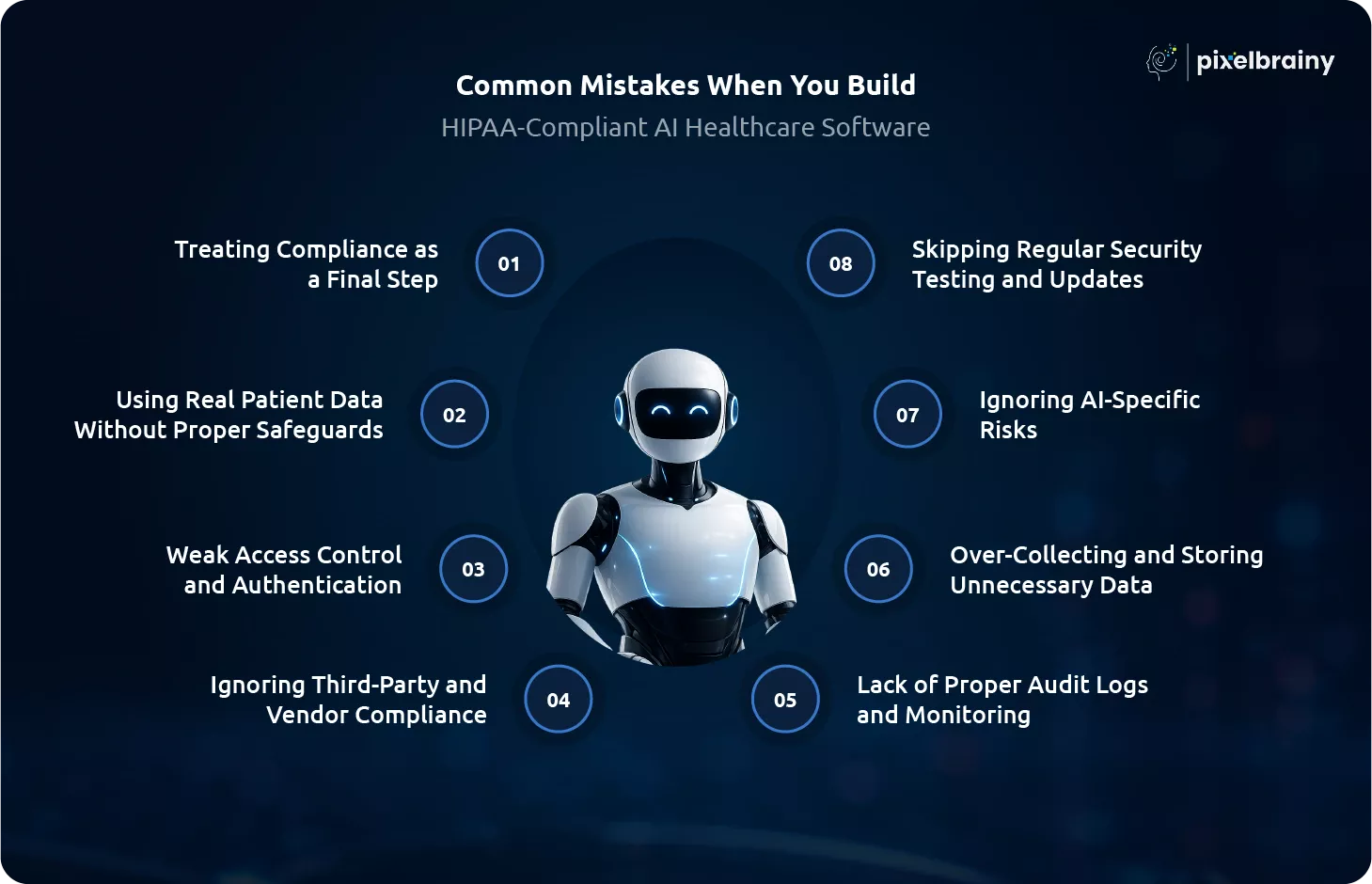
One of the most frequent mistakes is addressing compliance at the end of development. Teams often focus on features and AI models first, then attempt to add security later.
Why this is risky: HIPAA compliance affects system architecture, data flow, and access control from the beginning. Late implementation leads to rework and gaps in security.
What to do instead:
AI models require data, but using raw patient data without anonymization is a major violation.
Why this is risky: It exposes sensitive information during training and increases the risk of data leaks through AI outputs.
What to do instead:
Allowing broad or poorly managed access to sensitive data is a critical security flaw.
Why this is risky: Unauthorized users may access or modify Protected Health Information, leading to breaches.
What to do instead:
Many systems rely on third-party APIs, cloud services, or integrations that are not fully compliant.
Why this is risky: Even if your system is secure, a non-compliant vendor can expose sensitive data.
What to do instead:
Some systems fail to track user activity or system interactions with data.
Why this is risky: Without logs, it becomes difficult to detect breaches or investigate incidents.
What to do instead:
Collecting more data than required increases exposure risk.
Why this is risky: Excess data creates a larger attack surface and complicates compliance management.
What to do instead:
Traditional security measures are not enough for AI systems.
Why this is risky: AI models can unintentionally leak sensitive data or produce biased results that impact patient care.
What to do instead:
Some organizations treat testing as a one-time activity instead of an ongoing process.
Why this is risky: New vulnerabilities can emerge over time, especially as systems scale and evolve.
What to do instead:
Avoiding these common mistakes ensures a smoother path toward secure, compliant, and reliable AI healthcare software that can scale confidently in real-world environments.
Selecting the right development partner is one of the most critical decisions when planning how to build a HIPAA-compliant AI healthcare software. The complexity of healthcare regulations, AI implementation, and secure architecture requires a partner who understands all three areas deeply. A reliable partner does not just write code. They guide you through compliance, architecture, AI integration, and long-term scalability.
A partner must have hands-on experience working with healthcare systems and HIPAA regulations. General software expertise is not enough in this domain.
What to check:
Why it matters: Healthcare compliance has strict rules, and mistakes can be costly both legally and financially.
Since AI is a core component, your partner must have expertise in machine learning, data pipelines, and model deployment.
What to check:
Why it matters: AI systems introduce additional risks that require specialized handling beyond traditional software.
Security should be embedded into every stage of development, not added later.
What to check:
Why it matters: A security-first approach ensures the foundation of Secure HIPAA compliance AI Healthcare Software Development.
A well-defined process ensures transparency, efficiency, and compliance throughout the project.
What to check:
The right partner should be able to manage the complete lifecycle from idea to deployment and beyond.
What to check:
Infrastructure plays a major role in compliance and scalability.
What to check:
Clear communication and pricing help avoid misunderstandings and delays.
What to check:
HIPAA compliance is not a one-time effort. It requires ongoing monitoring and updates.
What to check:
The right partner acts as a strategic guide, helping you navigate compliance, AI complexity, and system scalability while ensuring your healthcare solution is secure, reliable, and future-ready.
Organizations entering the healthcare AI space often face a common challenge. They need a partner who understands both advanced AI systems and strict healthcare regulations. PixelBrainy LLC positions itself as a specialized AI healthcare software development company that guides businesses through the complete HIPAA-Compliant AI Healthcare Software development journey with a structured, compliance-first approach.
Instead of offering generic development services, the focus is on delivering AI development solutions for healthcare that are secure, scalable, and aligned with real-world clinical workflows.
Every project begins with a deep understanding of business goals, user workflows, and regulatory requirements. The team maps out how Protected Health Information will be handled and defines a clear compliance strategy. This ensures a strong foundation before any development begins.
The system architecture is designed to support both security and performance. Data flows, access controls, and AI processing layers are structured in a way that supports long-term scalability.
This stage plays a critical role in building a HIPAA-Compliant AI Healthcare Software that can operate safely in real environments.
AI capabilities are integrated carefully to avoid risks related to sensitive data exposure. PixelBrainy ensures that all AI models are trained and deployed using secure and compliant practices.
These AI development solutions for healthcare ensure both innovation and compliance.
For organizations targeting large-scale operations, PixelBrainy supports enterprise HIPAA-Compliant AI Healthcare Software development with robust infrastructure and performance optimization.
After deployment, the focus shifts to monitoring and maintaining compliance. Healthcare regulations evolve, and systems must adapt accordingly.
This ongoing support ensures long-term stability and security.
A US-based healthcare organization needed a secure AI platform to monitor patients remotely while maintaining strict compliance standards. The client preferred confidentiality, so details remain undisclosed.
Project Objective: Develop a system that collects real-time patient data from wearable devices and provides actionable insights to healthcare providers.
Key Implementation Areas:
Business Impact:
PixelBrainy LLC supports organizations at every stage of their AI healthcare journey, ensuring that compliance, performance, and innovation move forward together without compromise.
Healthcare innovation today demands a careful balance between advanced technology and strict regulatory compliance. Success depends on how well organizations align security, data governance, and intelligent systems throughout the entire lifecycle. When the focus is on building a HIPAA-Compliant AI Healthcare Software from the start, it becomes easier to scale solutions, protect patient data, and deliver reliable outcomes in real-world environments.
A well-planned approach helps reduce risks, improve system performance, and ensure long-term sustainability in a highly regulated industry. It also creates a strong foundation for trust among healthcare providers, patients, and stakeholders.
Partnering with experts can make this journey smoother and more efficient. PixelBrainy LLC brings the right mix of technical expertise and compliance knowledge to support your goals.
Ready to move forward? Book an appointment with PixelBrainy LLC today and start building your secure AI healthcare solution.
The timeline depends on the complexity of the solution, features, and compliance requirements. A basic MVP can take around 6 to 8 weeks, while advanced or enterprise-level platforms may require 10 to 14 weeks or more. Additional time is often needed for compliance validation, security audits, and AI model training.
Yes, AI models can be trained using anonymized, de-identified, or synthetic datasets. Techniques like federated learning also allow training across multiple systems without sharing raw data. These approaches help maintain privacy while still enabling accurate AI predictions.
In addition to HIPAA, organizations often consider standards like HITRUST, SOC 2, and ISO 27001. These frameworks strengthen overall security posture and are often required by enterprise healthcare clients and partners.
Cloud deployment can be safe if you use HIPAA-ready cloud providers and configure them properly. This includes encryption, access control, audit logging, and signing Business Associate Agreements with cloud vendors.
A strong team typically includes AI engineers, backend developers, security experts, compliance specialists, and healthcare domain experts. This combination ensures that both technical and regulatory aspects are handled effectively.
Compliance should be reviewed continuously, not just once. Regular audits, security updates, and monitoring are essential to keep up with evolving threats and regulatory changes. Many organizations perform formal reviews quarterly or annually depending on system scale.
HIPAA and GDPR both focus on protecting sensitive health data, but they approach it from slightly different angles. HIPAA is centered on safeguarding Protected Health Information within the United States, while GDPR emphasizes broader data privacy rights for individuals in the European Union. For AI healthcare systems, both regulations expect strict data protection, controlled access, and transparency in how data is used. This means organizations must ensure secure storage, encrypted data transfer, and clear policies for data usage. From an AI perspective, there is also an expectation of accountability. Systems should avoid unnecessary data collection, prevent bias, and provide clarity on how decisions are made when they impact patient care.

About The Author
Sagar Bhatnagar
Sagar Sahay Bhatnagar brings over a decade of IT industry experience to his role as Marketing Head at PixelBrainy. He's known for his knack in devising creative marketing strategies that boost brand visibility and market influence. Sagar's strategic thinking, coupled with his innovative vision and focus on results, sets him apart. His track record of successful campaigns proves his ability to utilize digital platforms effectively for impactful marketing efforts. With a genuine passion for both technology and marketing, Sagar continuously pushes PixelBrainy's marketing initiatives to greater success.

Working with the PixelBrainy team has been a highly positive experience. They understand the design requirements and create beautiful UX elements to meet the application needs. The dev team did an excellent job bringing my vision to life. We discussed usability and flow. Sagar worked with his team to design the database and begin coding. Working with Sagar was easy. He has the knowledge to create robust apps, including multi-language support, Google and Apple ID login options, Ad-enabled integrations, Stripe payment processing, and a Web Admin site for maintaining support data. I'm extremely satisfied with the services provided, the quality of the final product, and the professionalism of the entire process. I highly recommend them for Android and iOS Mobile Application Design and Development.

Great experience working with them. Had a lot of feedback and I found that unlike most contractors they were bugging me for updates instead of the other way around. They were extremely time conscience and great at communicating! All work was done extremely high quality and if not on time, early! They were always proactive when it comes to communication and the work is great/above par always. Very flexible and a great team to work with! Goes above and beyond to present us with multiple options and always provides quality. Amazing work per usual with Chitra. If you have UI/UX or branding design needs I recommend you go to them! Will likely work with them in the future as well, definitely recommended!

PixelBrainy is a joy to work with and is a great partner when thinking through branding, logo, and website layout. I appreciate that they spend time going into the "why" behind their decisions to help inform me and others about industry best practices and their expertise.

I hired them to design our software apps. Things I really like about them are excellent communication skills, they answer all project suggestions and collaborate right away, and their input on design and colors is amazing. This project was complex and needed patience and creativity. The team is amazing to do business with. I will be using them long-term. Glad to see there are some good people out there. I was afraid to try and outsource my project to someone but I am glad I met them! I really can't say enough. They went above and beyond on this project. I am very happy with everything they have done to make my business stand out from the competition.

It was great working with PixelBrainy and the team. They were very responsive and really owned the project. We'll definitely work with them again!

I recently worked with the PixelBrainy team on a project and I was blown away by their communication skills. They were prompt, clear, and articulate in all of our interactions. They listened and provided valuable feedback and suggestions to help make the project a success. They also kept me updated throughout the entire process, which made the experience stress-free and enjoyable.

PixelBrainy is very good at what it does. The team also presents themselves very professionally and takes care of their side of things very well. I could fully trust them taking up the design work in a timely and organised manner and their attention to detail saved us lots of effort and time. This particular project was quite intense and the team showed that they function very well under pressure. Very much looking forward to working with her again!

It's always an absolute pleasure working with them. They completed all of my requests quickly and followed every note I had for them to a T, which made our process go smoothly from start to finish. Everything was completed fast and following all of the guidelines. And I would recommend their services to anyone. If you need any design work done in the future, PixelBrainy should be your first call!

They took ownership of our requirements and designed and proposed multiple beautiful variants. The team is self-motivated, requires minimum supervision, committed to see-through designs with quality and delivering them on time. We would definitely love to work with PixelBrainy again when we have any requirements.

PixelBrainy was a big help with our SaaS application. We've been hard at work with a new UI/UX and they provided a lot of help with the designs. If you're looking for assistance with your website, software, or mobile application designs, PixelBrainy and the team is a great recommendation.

PixelBrainy designers are amazing. They are responsive, talented, and always willing to help craft the design until it matches your vision. I would recommend them and plan to continue them for my future projects and more!!!

They were awesome! Did a good job fast, and good communication. Will work with them again. Thank you

Creative, detail-oriented, and talented designers who take direction well and implement changes quickly and accurately. They consistently over-delivered for us.

PixelBrainy team is very talented and creative. Great designers and a pleasure to work with. PixelBrainy is an excellent communicator and I look forward to working with them again.

PixelBrainy has a very talented design team. Their work is excellent and they are very responsive. I enjoy working with them and hope to continue on all of our future projects.


Transform your ideas into reality with us.
Across these industries, each engagement brings unique challenges, from early-stage product development to scaling complex systems, helping us build a practical understanding of real-world product environments.