AI Summary Powered by PixelBrainy
Imagine you are the practice administrator of a 12-physician multi-specialty clinic, where your front desk team spends nearly four hours every day handling appointment scheduling calls. Patients wait for assistance, staff manually coordinate physician availability, and each specialty may follow different scheduling rules. If a large portion of patients would prefer to book appointments independently, doctor appointment booking mobile application development can turn this time-consuming process into a more convenient digital experience.
A well-planned doctor appointment booking app can allow patients to search for physicians, check available time slots, select appointment types, book or reschedule visits, receive reminders, and manage appointments directly from their smartphones. For clinics, the objective goes beyond online booking. The application must accurately reflect each provider's availability, specialty-specific scheduling rules, appointment duration, and operational constraints.
This makes doctor appointment booking app development a strategic technology project rather than simply a mobile interface. Clinics also need to consider EHR integration, data security, authentication, notifications, scalability, and interoperability when planning their doctor appointment booking mobile app.
The market opportunity is also expanding. Grand View Research estimates the global medical scheduling software market at $448.1 million in 2026, with projections reaching $749.9 million by 2030, representing a 13.0% CAGR from 2024 to 2030.
The AI opportunity is growing even faster. Grand View Research estimates the AI in medical scheduling software market at $252.6 million in 2026 and projects it to reach $1.45 billion by 2033, growing at a 28.4% CAGR from 2026 to 2033.
In this guide, we will explore how to build a doctor appointment booking app, including essential features, development steps, technology requirements, integrations, challenges, and the doctor appointment booking app development cost in 2026.
By the end, you will have a practical roadmap for planning and launching a scalable doctor appointment booking mobile application for modern healthcare organizations.
A doctor appointment booking app is a mobile application allowing patients to book medical appointments with their preferred healthcare providers using smartphones or tablets. Such apps smoothen the doctor appointment booking process, enabling patients to see the available time slots, choose healthcare professionals according to their preferences, and easily schedule doctor appointments.
Let's check out the working of this app:
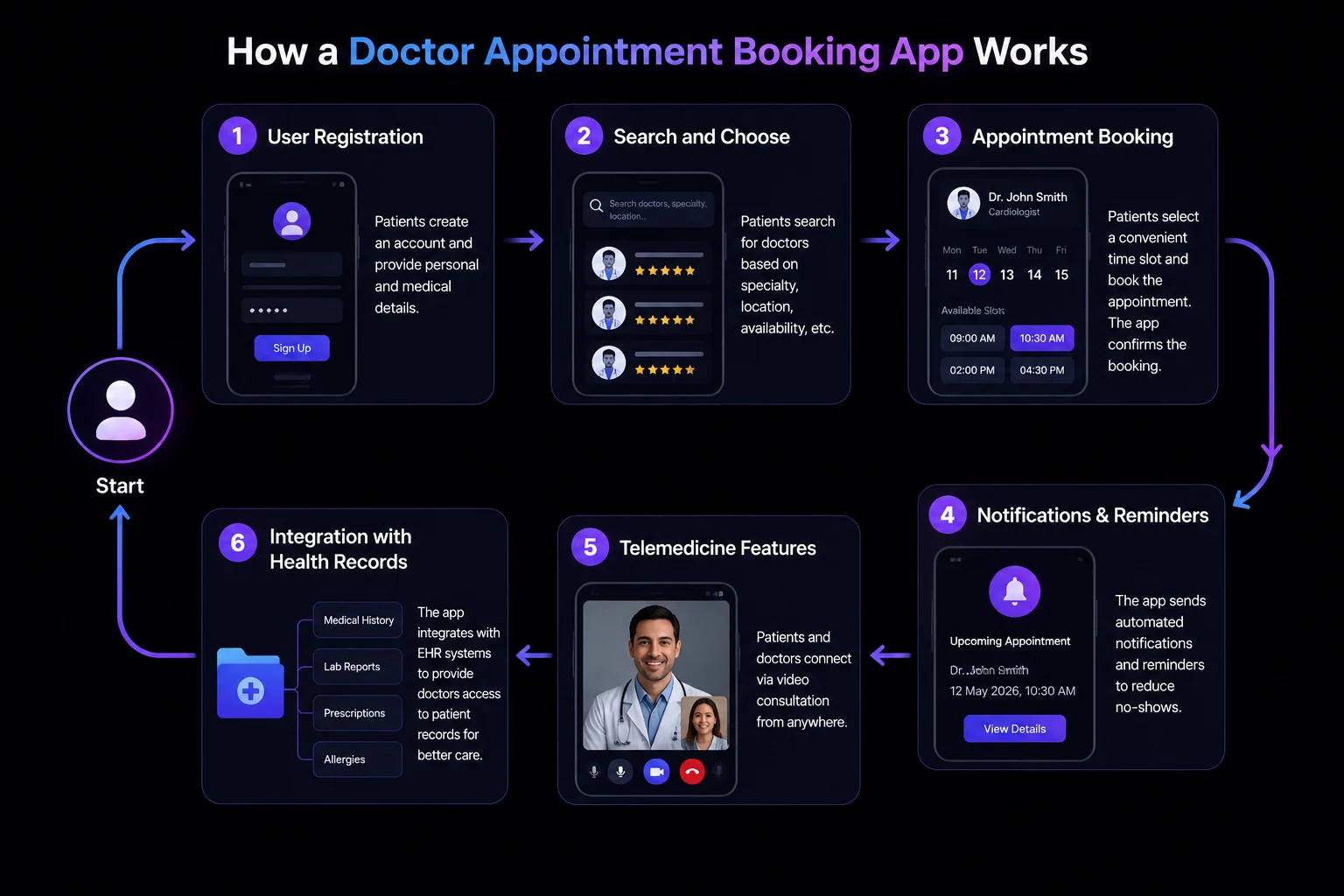
1. User Registration: It all starts with the patients' login. They create a new account and input personal and medical details per the requirements.
2. Search and Choose: Using the doctor appointment booking app, the patients search for healthcare professionals based on their needs, such as availability, specialty, location, etc. Apps with the filter option ease the search process for patients and help them find suitable doctors.
3. Appointment Booking: After they find a healthcare provider, patients check the available time slots and pick a convenient time. The app confirms the schedule and sends reminders accordingly.
4. Notifications and Reminders: Some doctor appointment booking mobile apps automate reminders and notifications for patients reducing the chance of missed appointments.
5. Telemedicine Features: Some doctor appointment apps following advanced technologies allow patients and healthcare providers to connect for virtual consultations. This avoids the need for clinic or hospital visits, easing patients to get medical advice while resting at their homes.
6. Integration with Health Records: Some such apps allow integration with electronic health records (EHR) systems, permitting healthcare professionals to access patients' histories and offer them more personalized and improved care.
The apps with such a working process lead to reduced healthcare admin jobs, improve patient convenience, and contribute to well-organized healthcare systems.
Doctor appointment booking app development is the process of designing and building a mobile healthcare application that enables patients to find suitable doctors, check real-time availability, and book, reschedule, or cancel appointments digitally. The development process combines an intuitive user interface with secure data management, reliable appointment scheduling, notifications, and healthcare system integrations.
The goal of doctor appointment booking app development is to simplify the appointment journey for both patients and healthcare providers. Patients can access provider information, available time slots, appointment details, and reminders from a single platform, while healthcare organizations can manage schedules and reduce manual appointment coordination.
A custom doctor appointment booking app like Zocdoc can also be tailored to specific healthcare business requirements, such as specialty-based search, provider scheduling rules, telemedicine, EHR integration, and secure patient communication. This makes the application more adaptable to the operational needs of clinics, hospitals, and healthcare networks.
Healthcare access is rapidly shifting toward digital-first experiences, making doctor appointment booking app development a strategic opportunity for clinics, hospitals, specialty practices, and healthcare startups. Patients increasingly expect to discover providers, view real-time availability, schedule appointments, receive reminders, and manage their visits from a smartphone.
For a clinic considering doctor appointment booking mobile application development, the opportunity is not limited to adding another booking channel. A well-designed app can become a digital access layer that connects patients with provider schedules, EHR systems, telemedicine services, payments, and other healthcare workflows.
These figures indicate that doctor appointment booking app development is becoming part of a larger digital healthcare transformation. For a multi-specialty clinic, the business case can be particularly relevant when appointment coordination involves multiple physicians, specialty-specific schedules, recurring visits, cancellations, and different availability rules.
A custom solution can also be designed around existing workflows rather than forcing staff to change how they manage appointments. For example, a clinic evaluating how to develop a doctor appointment booking app can prioritize EHR integration, real-time provider availability, patient self-scheduling, appointment reminders, waitlist management, and secure patient authentication.
For organizations asking, “Is developing a doctor appointment booking app worth the investment in 2026?”, the answer depends on patient volume, scheduling complexity, integration requirements, and the level of automation required. The strongest opportunity lies in building an app that solves a measurable scheduling problem rather than simply replicating a generic booking interface.
In short, the market is moving toward connected digital scheduling, making a well-planned doctor appointment booking app a practical investment for healthcare organizations seeking scalable patient access.
Doctor appointment booking mobile application development creates value across the healthcare ecosystem, but the exact value differs for patients, healthcare providers, and healthcare businesses. A well-planned doctor appointment booking app can address common challenges around scheduling, availability, communication, medical information, and digital access to care.
For patients, the focus is mainly on making appointments and healthcare services easier to access. For doctors and healthcare providers, the emphasis is on managing schedules, patient interactions, and daily workflows more efficiently. Healthcare businesses can use these applications to expand digital services, support new revenue models, and create a more connected patient experience.
If you are evaluating how to build a doctor appointment booking app, these benefits can also help determine which features and integrations should be prioritized during development. The right functionality will depend on whether the application is intended for a single clinic, a multi-specialty healthcare organization, or a broader healthcare marketplace.
Let’s explore the key benefits of doctor appointment booking mobile application development for each stakeholder.
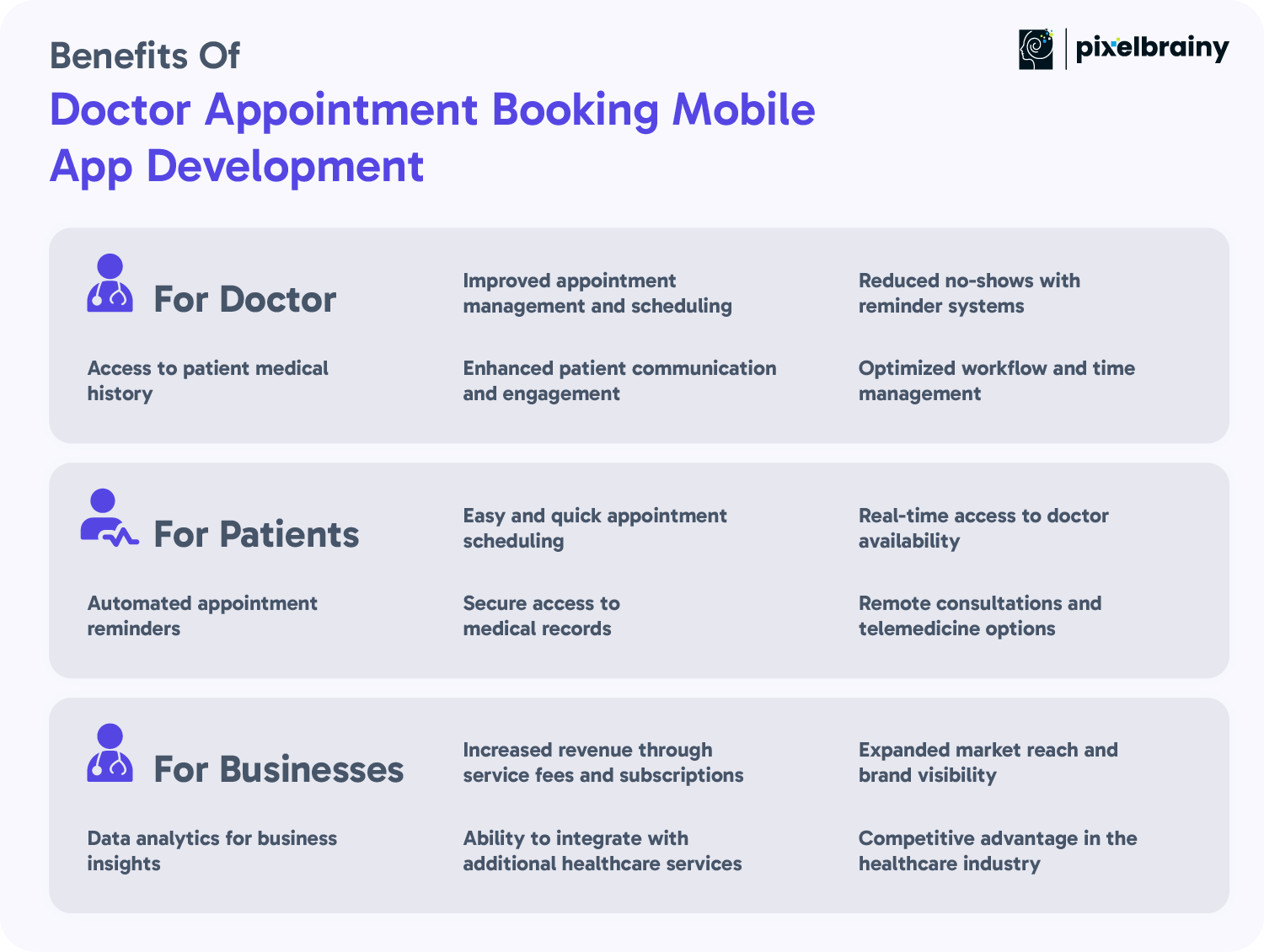
Using the mobile app, patients can conveniently book doctor appointments within minutes. This diminishes the need for in-person clinic visits or on-call bookings. So forth, patients can enjoy hassle-free scheduling without waiting in long queues or performing the process manually.
By using doctor appointment booking apps, the users get real-time updates on the available slots, enabling patients to go at the time at their convenience and avoid any delay.
Through automated appointment reminders, patients can get timely reminders via email, app notifications, or SMS that never let them miss an appointment.
Patients don't need to worry about carrying their medical documents, prescriptions, test results, and histories. They can securely access them through their app, which improves record keeping and care.
Doctor appointment booking mobile apps allow patients to get virtual consultations from healthcare providers. Thus patients can get care while comforting at their homes, wherever they are.
Doctors using such mobile apps can manage their schedules efficiently with automated booking systems and real-time updates. This ensures better resource allocation and reduced conflicts in booking timing.
Automated SMS, in-app notifications, or email remind patients about upcoming appointments. This lowers no-shows and increases clinic productivity.
Seamless integration of electronic health records (EHRs) permits doctors to instantly go through a patient's medical history, which leads to more personalized treatment plans and accurate diagnoses.
Follow-up reminders, telemedicine features, and in-app messaging smoothen doctor-patient communication, build trust, and improve care quality.
Doctors can ease appointment scheduling and diminish admin workload using doctor appointment booking mobile apps. Thus, they can focus more on patient care, leading to improved operational efficiency and better time management.
Doctor appointment booking apps have been developed with the aim of monetization. Businesses can do that by charging an amount as a service fee for every booking or providing subscription plans to healthcare professionals and patients. While providing added value via premium features, businesses can create a consistent revenue stream.
Besides, mobile applications let businesses expand their reach and cover a broader audience, including remote area patients. A robust online presence boosts brand visibility, driving increased users, and making businesses stand out in the digital healthcare solution landscape.
Such applications generate valuable data on patient booking patterns, preferences, and healthcare trends. Businesses can use these analytics to personalize user experiences, refine services, and identify numerous growth opportunities.
By integrating doctor appointment booking apps with e-prescriptions, telemedicine, and health monitoring tools, businesses can provide a complete healthcare solution that boosts user loyalty and app utility.
By matching the steps of evolving trends and technologies, businesses can stay competitive, meeting every demand for digital healthcare solutions, and staying ahead of the curve.
Whether you are a business person, healthcare professional, or patient, doctor appointment booking apps can help improve the healthcare service experience.
Overall, doctor appointment booking app development can create a more accessible, connected, and digitally managed healthcare experience while addressing the specific needs of patients, providers, and healthcare businesses.
A successful doctor appointment booking app development project should focus on features that make scheduling simple for patients while giving healthcare providers greater control over appointments, availability, and patient interactions. The feature set should also reflect the operational requirements of the target healthcare organization, whether it is a single clinic, multi-specialty practice, hospital, or healthcare marketplace.
When planning how to build a doctor appointment booking app, essential functionality should cover the complete appointment journey, from user registration and doctor discovery to booking, reminders, payments, prescriptions, and post-appointment feedback. Secure authentication, EHR connectivity, and reliable data protection are equally important for healthcare applications handling sensitive patient information.
For businesses evaluating doctor appointment booking mobile application development, these core features provide a practical foundation for creating a convenient and scalable healthcare platform. Additional capabilities can then be introduced based on user requirements, clinical workflows, and the application's business model.
Let’s explore the essential features to consider while developing a doctor appointment booking mobile app.
| Feature | Description |
| User Registration and Profile Management | Enables users to create personal profiles and manage their medical details. |
| Doctor Search and Filter Options | Permits users to search for doctors depending on specialty, ratings, reviews, location, and availability. |
| Appointment Booking and Scheduling | Offers an easy-to-use interface for choosing a time slot and scheduling an appointment with a doctor. |
| Calendar Integration | Synchronizes appointments with personal calendars for better bookings and reminders. |
| Notifications and Reminders | Sends alerts to never miss appointments and keeps users well-informed about upcoming visits. |
| In-app Payment Processing | Allows secure payment for healthcare consultations or services directly within the app. |
| Appointment History and Tracking | Enables users to view past and upcoming bookings for seamless tracking and management. |
| Ratings and Reviews for Doctors | Permits patients to rate and review doctors, assisting others make informed choices. |
| Secure Login and Data Protection | Secure user data through encrypted logins and compliance with applicable data privacy regulations. |
| Prescription Management | Facilitates doctors uploading prescriptions, which patients can securely access and manage using the app. |
| Multi-language Support | Provides a multilingual interface to ease diverse users globally. |
| Doctor Profile with Credentials and Availability | Displays doctor specialties, qualifications, and real-time availability to let patients choose per their requirements. |
| Patient Feedback Collection | Accumulate feedback after every appointment to improve app services and increase user satisfaction. |
| Integration with Electronic Health Records (EHR) | Links every patient’s records to let doctors access medical history for more personalized care. |
| Customer Support and Help Center | Offers support channels for troubleshooting and meeting user concerns efficiently. |
These core features create the foundation for a reliable doctor appointment booking app that supports convenient scheduling, secure healthcare interactions, and efficient provider management.
Once the core functionality of a doctor appointment booking app is established, advanced capabilities can make the platform more intelligent, personalized, and adaptable to evolving healthcare expectations. These features can support faster appointment discovery, smarter scheduling, virtual care, connected health data, and more personalized patient experiences.
For businesses planning to develop a doctor appointment booking app like Zocdoc, the right advanced feature set should depend on the target users, healthcare workflows, integration requirements, and regulatory environment. AI-powered functionality can also help transform a basic booking platform into a more intelligent healthcare application, provided these capabilities are designed with appropriate privacy, safety, and clinical safeguards.
The following advanced features can be considered during doctor appointment booking mobile app development:
| Advanced Feature | Description |
| AI-powered doctor recommendations | Suggests doctors to patients based on their medical history, preferences, and real-time availability. |
| Voice search functionality | Permits users to search for doctors and book appointments leveraging the power of voice commands. |
| Real-time chat or video consultation options | Allows patients to consult with doctors via chat or video calls. |
| Integration with wearable health devices | Syncs smoothly with wearable devices to track health metrics and offer personalized recommendations. |
| AI-based symptom checker | Assists users in self-diagnosing symptoms and getting advice. |
| Blockchain-based medical record storage | Securely stores patients’ medical records on a blockchain for improved privacy and security. |
| Geolocation for nearby clinic/doctor suggestions | Offers recommendations for nearby clinics, hospitals, and doctors based on the user's location. |
| Multi-party appointments (family booking) | Permits users to book appointments for various family members at once. |
| Telemedicine compatibility with AR/VR tools | Allows remote consultations with advanced visualization and interaction tools. |
| Data analytics for personalized user insights | Seamlessly analyzes user data to offer personalized recommendations and insights. |
| Smart appointment rescheduling and waitlist management | Automatically reschedules the appointments and easily manages waitlists. |
| Push notifications with health tips | Sends frequent health tips and reminders to users. |
| Integration with insurance providers | Permits users to directly bill their insurance providers for appointments. |
| Offline mode for appointment details and reminders | Offers access to appointment details and reminders even without an internet connection. |
| Customizable appointment forms and intake surveys | Let doctors create custom forms and surveys for specific requirements. |
These advanced capabilities can help transform a doctor appointment booking platform into a more connected, intelligent, and patient-focused healthcare solution.
The growing demand for convenient digital healthcare has led to the rise of several doctor appointment booking apps that simplify how patients discover healthcare providers, compare options, schedule consultations, and access virtual care. These platforms offer useful benchmarks for businesses planning doctor appointment booking app development, particularly when evaluating user experience, scheduling workflows, telemedicine capabilities, and healthcare integrations.
Below are some of the established doctor appointment booking apps that have influenced the market through their distinct features and healthcare-focused experiences.
Zocdoc, one of the popular doctor appointment booking platforms, is thriving in the US market. Using this app, users search for healthcare professionals suiting their location, medical history, etc. The mobile application provides live updates on time slots available for the appointment and user feedback to help patients make better decisions.
A widely known doctor appointment booking app, Practo is used in India and outside. Acknowledged as a complete healthcare platform, Practo allows users to schedule online or in-person consultations with doctors. Besides, they can use the app to access other diagnostic services and order medicines online. Above all, a health records management system found in Practo makes it a versatile mobile app for healthcare requirements.
Being chosen for its specialty in telehealth services, Amwell connects patients to doctors for seamless virtual consultations. It arrives with numerous facilities, such as urgent care, pediatrics, and psychiatry. Aiming telemedicine, this doctor appointment booking mobile app is mostly picked by users looking for convenient healthcare solutions.
Doxy.me is one of the secure and simple telemedicine platforms crafted for patients and healthcare providers. It provides HIPAA-compliant video consultation without any need to download or install. When users seek virtual appointments, they choose Doxy.me because of its easy usage and accessibility.
A leading telehealth platform used worldwide is HealthTap, which offers on-demand virtual consultations to patients with licensed doctors and healthcare professionals. Users can openly ask their health-relevant questions, connect with doctors for text-based or video consultations, and even access educational or informative resources. One of the standout features of this mobile app is an AI-driven symptom checker that’s buzzing globally.
MDLIVE is a popular doctor appointment booking app that offers instant access to healthcare providers and integrates with varied insurance providers. The app aims to offer round-the-clock virtual healthcare services, including consultations with dermatologists, therapists, and doctors.
A leading Southeast Asia doctor appointment booking mobile app, BookDoc offers a broader range of services, including wellness rewards, appointment booking, and integration with fitness trackers. Also, it incentivizes healthy living to the users and connects them with healthcare professionals via its exceptional rewards system.
These mobile applications have imposed standards in the healthcare industry by resolving user pain points, providing innovative features, and ensuring efficient and secure healthcare services.
These platforms can serve as practical references for identifying market expectations and defining the right features when planning your own doctor appointment booking mobile application.
Also Read: 10 Innovative Mobile App Ideas for the Healthcare Sector
After you finalized the features, now it’s time to turn your doctor appointment booking app concept into a structured development plan. A successful healthcare application requires more than coding. It needs clear requirements, healthcare-focused workflows, secure data handling, reliable integrations, and a user experience that works smoothly for both patients and healthcare providers.
If you are researching how to build doctor appointment booking app from scratch, the development process should move systematically from market validation and feature planning to design, development, testing, deployment, and continuous improvement.
For healthcare businesses, this approach helps control development costs, reduce technical risks, and create a scalable foundation for future capabilities. The following eight steps explain the steps to build doctor appointment booking mobile app from idea to launch.
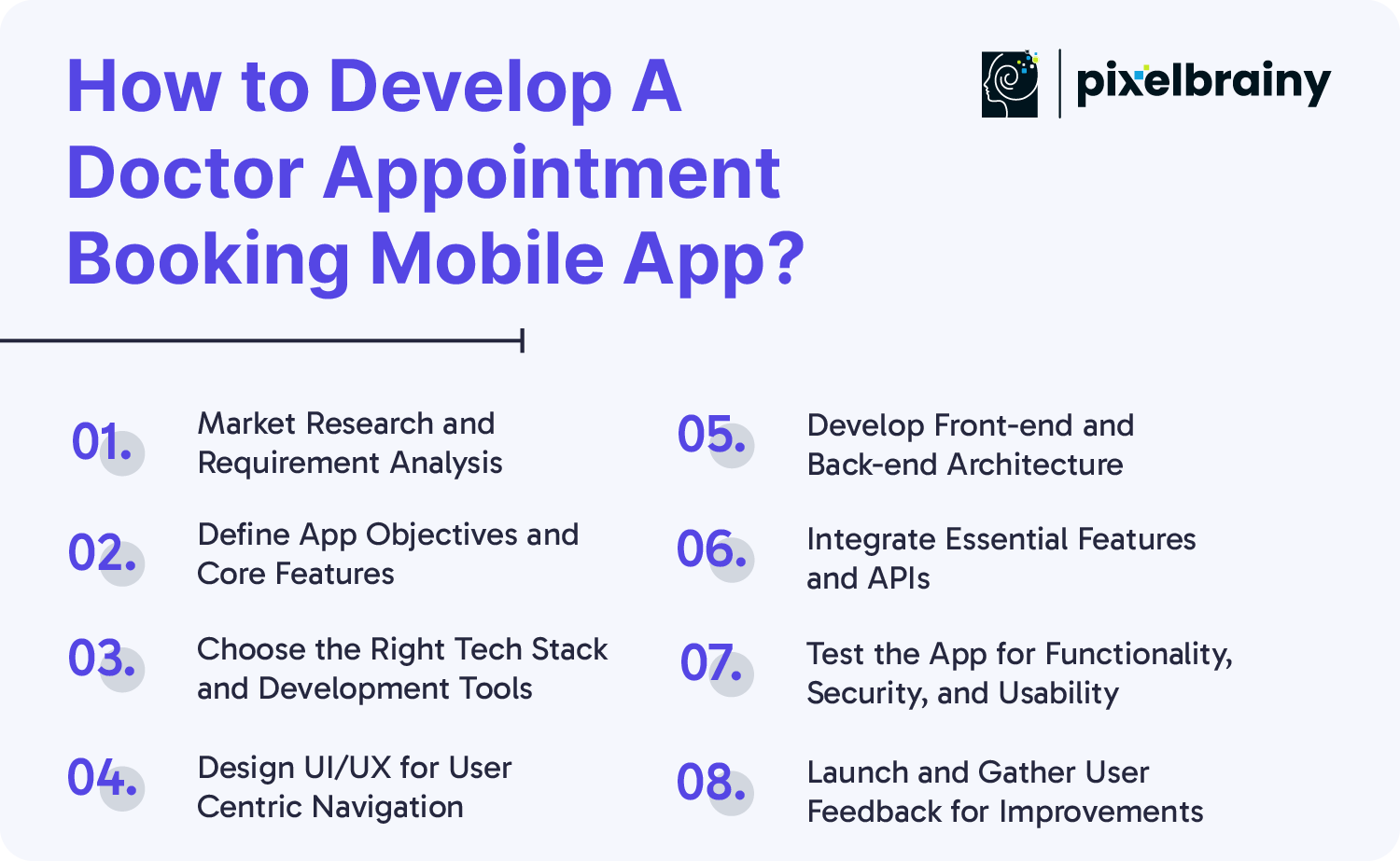
Start by understanding the healthcare market, target patients, healthcare providers, and competing appointment platforms. Identify how users currently search for doctors, compare providers, schedule visits, cancel appointments, and receive reminders.
For doctor appointment booking app development for healthcare businesses, research should also cover specialty-specific workflows, provider availability, location requirements, payment preferences, and telemedicine expectations.
Analyze competing applications to identify gaps rather than simply copying existing features. Gather requirements from patients, doctors, receptionists, and administrators to create a complete product scope.
This stage gives your team a clear understanding of what the application needs to solve and establishes measurable objectives for the development process of doctor appointment booking mobile application.
Once the requirements are clear, establish the application's primary objectives and decide which capabilities are essential for the first release. A patient-facing application may require registration, doctor search, filters, provider profiles, appointment scheduling, notifications, payments, and appointment history.
Healthcare providers may need availability management, booking controls, patient information, appointment updates, and communication tools.
Prioritize features according to user demand, business goals, compliance requirements, and available budget. This prevents unnecessary functionality from increasing the initial development scope.
If you plan to create an doctor appointment booking mobile app, clearly defining the MVP scope also makes development easier to estimate, manage, and validate before expanding the platform.
The technology stack should support security, scalability, performance, integrations, and long-term maintenance. Your development team can evaluate technologies such as React Native or Flutter for cross-platform mobile applications and suitable backend frameworks based on project requirements.
For databases, PostgreSQL or MongoDB may be considered depending on the application's data structure and operational needs. Cloud infrastructure can support application hosting, storage, monitoring, and scalability.
Technology decisions should also account for healthcare integrations, payment gateways, notification services, video consultation APIs, and authentication requirements.
Working with a PoC development approach can help validate technically challenging integrations before committing substantial resources to the complete application.
Healthcare applications need simple navigation because patients may use them when they are stressed, unwell, or looking for urgent care. Design separate but connected experiences for patients, doctors, and administrators.
Create wireframes and interactive prototypes covering registration, doctor discovery, provider profiles, appointment selection, payment, confirmation, and appointment management.
A UI/UX design company can help transform complex healthcare workflows into clear screens with logical navigation, readable information, accessible controls, and consistent interaction patterns.
Before development begins, validate the proposed interface with representative users. Early feedback can identify confusing workflows and reduce expensive design changes later in the project.
With the designs approved, development can begin across the front-end and back-end layers. The front end should provide responsive screens and smooth interactions across supported mobile devices.
The back end manages authentication, user profiles, doctor availability, appointment logic, databases, notifications, payments, and other application services.
For building an doctor appointment booking mobile app, the architecture should account for concurrent bookings and prevent scheduling conflicts when multiple users attempt to reserve the same slot.
Security should be incorporated throughout development, including appropriate access controls, encrypted communication, secure authentication, and protection of sensitive healthcare information.
The application becomes functional by connecting its core modules and required third-party services. Integrations may include payment gateways, calendar services, push notifications, maps, communication services, telemedicine APIs, and healthcare information systems.
For healthcare organizations, integration requirements should be defined early because existing systems may have specific APIs, authentication methods, data structures, and workflow constraints.
If the application needs to connect with an EHR or practice-management system, validate API availability and data synchronization requirements before implementation.
This stage is particularly important when you develop doctor appointment booking mobile application for an established healthcare organization with existing digital infrastructure.
Testing should cover every major workflow before the application reaches patients or healthcare providers. QA teams can evaluate registration, doctor discovery, slot availability, booking, cancellation, rescheduling, payments, notifications, and account management.
Security testing should assess authentication, authorization, data protection, API security, and potential vulnerabilities. Performance testing is also important to determine how the platform behaves during high booking volumes.
Usability testing with representative users can reveal navigation problems that technical testing may not identify.
For healthcare applications, testing should also verify relevant privacy, security, and regulatory requirements applicable to the intended market and use case.
After successful testing, prepare the application for release through the relevant mobile app stores and configure the production infrastructure. Before a full rollout, consider a controlled launch with a limited user group to identify real-world issues.
Monitor crashes, booking completion rates, search behavior, appointment cancellations, support requests, and user feedback after launch. These insights can reveal which workflows need improvement.
Continuous updates can introduce additional integrations, improve performance, refine usability, and expand functionality based on actual usage.
This final stage completes the steps to build doctor appointment booking mobile app from idea to launch, but the product lifecycle continues through maintenance, optimization, and future releases.
A structured development approach helps turn a healthcare scheduling concept into a secure, scalable, and user-focused doctor appointment booking solution.
The cost to develop a doctor appointment booking mobile app generally ranges from $40,000 to $250,000+, depending on the app's complexity, feature set, technology stack, integrations, security requirements, and development team location. A basic scheduling application will require a considerably smaller investment than an enterprise healthcare platform supporting multiple specialties, EHR integrations, telemedicine, and complex provider availability rules.
When preparing the development budget of a doctor appointment booking mobile app, businesses should consider both initial development expenses and ongoing costs such as cloud infrastructure, maintenance, security updates, third-party APIs, and compliance-related requirements.
The cost estimation of a doctor appointment booking mobile app should therefore be based on the actual scope rather than a fixed industry price. If you are asking, “What is the development pricing of a doctor appointment booking mobile app?”, the following estimates provide a practical starting point.
Doctor Appointment Booking App Development Cost Breakdown:
| App Type | Estimated Cost | Typical Scope |
| Basic Doctor Appointment Booking Mobile App | $40,000 to $80,000 | Patient registration, doctor profiles, search and filters, appointment booking, availability management, notifications, appointment history, and basic admin panel. |
| Advanced Doctor Appointment Booking Mobile App | $80,000 to $150,000 | Everything in the basic version plus online payments, telemedicine, chat, reviews, advanced scheduling, calendar integration, analytics, multilingual support, and third-party APIs. |
| Enterprise Doctor Appointment Booking Mobile App | $150,000 to $250,000+ | Multi-specialty workflows, multiple provider roles, EHR integration, enterprise security, advanced analytics, telehealth infrastructure, complex scheduling rules, scalable architecture, and custom integrations. |
Several factors can significantly influence the doctor appointment booking mobile app development cost. The following are the major cost drivers to consider when preparing your project estimate.
Overall, the final development budget depends on the functionality, integrations, security requirements, and scalability planned for your doctor appointment booking app.
The technology stack directly influences the doctor appointment booking app development cost, scalability, security, performance, and integration capabilities. A healthcare application must support reliable appointment scheduling, secure patient data, provider availability, notifications, payments, and connections with external healthcare systems.
For businesses researching how to develop a doctor appointment booking app, the right combination of frontend and backend technologies should be determined by the target platforms, expected user volume, required integrations, and long-term product roadmap. The stack should also leave room for future capabilities such as telemedicine, analytics, and AI-powered healthcare workflows.
Below is a practical technology stack commonly considered when planning doctor appointment booking mobile app development.
| Category | Tools & Technologies |
| Front-end Development | React Native, Swift (iOS), Flutter, Kotlin/Java (Android) |
| Back-end Development | Node.js, Ruby on Rails, Django (Python) |
| Database | MongoDB, MySQL, PostgreSQL |
| APIs and Integrations | Twilio (video calls), Stripe/PayPal (payments), Google Calendar API, EHR APIs |
| Cloud Services | Google Cloud, AWS (Amazon Web Services), Microsoft Azure |
| Authentication | Firebase Authentication, Auth0 |
| Push Notifications | Firebase Cloud Messaging (FCM), OneSignal |
| Payment Gateways | Stripe, Razorpay, PayPal |
| Development Tools | Visual Studio Code, Xcode, Android Studio |
| Testing Tools | Selenium, TestRail, Appium |
| Analytics and Tracking | Mixpanel, Google Analytics, Firebase Analytics |
| UI/UX Design Tools | Figma, Adobe XD, Sketch |
| Version Control | Git, GitHub, GitLab |
A well-planned technology stack gives your doctor appointment booking app the technical foundation needed for secure scheduling, seamless healthcare integrations, reliable performance, and future scalability.
A reliable doctor appointment booking app development project requires a multidisciplinary team with expertise across product planning, design, development, testing, security, and go-to-market activities. The right team structure helps ensure that the application is easy to use, technically stable, secure, and aligned with the requirements of patients and healthcare providers.
When planning doctor appointment booking mobile app development, the team size can vary based on the application's complexity, number of platforms, integrations, and planned features. A basic MVP may require a leaner team, while an enterprise healthcare platform may need additional specialists.
Below is an ideal team structure for developing a doctor appointment booking mobile application:
| Role | Responsibilities |
| Project Manager | Handles the entire project, decides timelines, manages the team, and ensures the project is completed successfully. |
| UI/UX Designer | Creates user-friendly interfaces of the app, designs the layout, and ensures a seamless user experience. |
| Front-end Developer | Builds the app's user interface, including the buttons, screens, and interactions. |
| Back-end Developer | Develops the server-side logic, databases, and APIs that power the app. |
| Quality Assurance (QA) Engineer | Tests the mobile app to recognize and fix bugs, ensuring it performs as expected and meets quality standards. |
| Security Expert | Ensures the mobile app is secure, safeguarding user data and controlling cyberattacks. |
| Marketing Specialist | Promotes the mobile app, creates marketing materials, and handles app store listings. |
A well-balanced development team brings the right expertise together to create a secure, scalable, and user-friendly doctor appointment booking app from concept through launch.
The sourcing model you choose can directly influence the doctor appointment booking app development cost, timeline, communication, quality, and level of control. The right approach depends on your project scope, available technical expertise, budget, security requirements, and whether you need a long-term development partner.
For businesses planning doctor appointment booking mobile app development, understanding the differences between in-house teams, freelancers, outsourcing agencies, staff augmentation, and specialized healthcare development companies can make vendor selection more practical. Each model offers a different balance of flexibility, expertise, cost, and management responsibility.
Here is a comparison of the major sourcing models:
| Sourcing Model | Description | Advantages | Disadvantages |
| In-House Development Team | Creating a team of creative designers, dedicated developers, and testers within your organization. | Complete control, suiting the company culture | Increased costs, longer setup time |
| Hiring Freelance Developers | Hiring independent professionals for particular tasks or the entire project. | Cost-effective, flexible | Communication challenges, less reliability |
| Outsourcing to a Mobile App Development Agency | Entrusting the complete development process to an outside agency having expertise in app development. | Experienced professionals offer end-to-end services | Costly, less direct control |
| Staff Augmentation Services | Increasing your in-house team by hiring external designers or developers temporarily. | Scalability, flexibility | Reliance on external talent, coordination issue |
| Partnership with a Specialized App Development Company | Working with a company with expertise in healthcare app development for a common goal. | Healthcare proficiency shared responsibility | May need profit-sharing, long-term commitment |
Evaluating budget, project complexity, healthcare expertise, timeline, and long-term support requirements will help you select the sourcing model best suited to your doctor appointment booking app.
Developing a doctor appointment booking app involves more than implementing appointment scheduling and doctor search. Healthcare businesses must address security, regulatory compliance, healthcare integrations, authentication, cross-platform usability, and real-time booking reliability before launching the application.
If you are asking, “What are the biggest challenges when developing a doctor appointment booking app for a healthcare business?”, the answer largely depends on the complexity of your healthcare workflows and existing systems. For example, a multi-specialty clinic may need to support different provider schedules, EHR connectivity, patient verification, and simultaneous appointment requests without creating double bookings.
Understanding these challenges early can help businesses plan the doctor appointment booking mobile app development process more effectively, estimate resources, and reduce technical risks before launch.
Here are the key challenges and their possible solutions:
While you develop a healthcare mobile app, the chief consideration that holds significance is protecting patients’ sensitive information.
Your app should comply with applicable regulations, such as HIPAA (in the U.S.) and GDPR (in the EU). This ensures secure data transmission and storage. Besides, you should adopt other measures to avoid data breaches and maintain user trust, like secure login protocols, conducting regular security audits, and implementing encryption.
The app must integrate existing healthcare systems and electronic health records (EHRs) to facilitate doctors to securely access patient medical histories and personalize care. You may find this integration complex because of system compatibility challenges, varying data formats, and the requirement for API customization.
First, opt for solutions to avoid such issues, or connect with a leading mobile app development company and enjoy seamless integration.
A powerful authentication system is mandatory to stay away from unauthorized access to sensitive data and user accounts.
You should implement the relevant features, like biometric login, two-factor authentication, and secure password management. Before that be set with careful planning so that user convenience may not be hindered.
Users look for an intuitive and consistent experience across every device they have, like tablets and smartphones. Remember to design and test the app for varied platforms, operating systems, and screen sizes.
You can hire a team of developers to beat this challenge to ensure usability and accessibility for every user.
Your doctor appointment booking app should hold the caliber to manage large volumes of users coming simultaneously, especially during peak hours. The users don’t want to experience any crash or slowdown.
Here, a robust backend infrastructure will help in real-time appointment scheduling avoiding delays in availability updates or double bookings. Also, be sure you implement scalable servers, perform database management efficiently, and balance loads.
Address these challenges by walking hand-in-hand with advanced technologies and deep planning. This way, businesses can ensure a user-friendly, efficient, and secure doctor appointment booking mobile application development.
Launching a doctor appointment booking mobile app is only the first step. The bigger challenge is getting patients to discover it, trust it, and use it repeatedly. If you are wondering how to market a doctor appointment booking app, the strategy should address both sides of the marketplace: patients looking for convenient healthcare access and doctors or clinics looking for a reliable digital scheduling channel.
For healthcare businesses, the promotion plan should be built around local search visibility, patient acquisition, provider partnerships, educational content, and trust signals. Instead of relying only on app downloads, focus on measurable actions such as appointment bookings, registration-to-booking conversion, repeat consultations, and provider sign-ups.
Below are practical marketing and promotion strategies to help a new healthcare appointment booking app compete with established platforms and build a sustainable user base.
You need a perfect combination of strategic partnerships and digital marketing strategies to promote your mobile app effectively. This will boost visibility, build trust, and attract users.
You can reap the rewards of social media platforms like LinkedIn, Instagram, and Facebook to reach potential users. Post informative content, your app’s interactive features, and user testimonials to engage with your target audience.
Also, partner with influencers belonging to the healthcare or wellness sector to expand your doctor appointment booking app reach. You can provide endorsements that go perfectly with your followers.
SEO (Search Engine Optimization) is prominent for surging organic traffic to your app store listing and website. You must create valuable content, like articles, blog posts, and videos relevant to healthcare topics, wellness tips, doctor visits, and more.
Thus, your app will get a push and stand out in the healthcare landscape. Also, search engine rankings will boost with more traffic to your app.
Referral programs are one of the best ways to motivate existing users to recommend your mobile app to their family and friends. You can incentivize them with free consultations, discounts, or app credits for referring new customers. This will create a sense of community while expanding your user base through word-of-mouth marketing.
You can target users with specific demographics who are interested in healthcare services through paid advertising via social media ads or Google Ads (PPC). Running ad campaigns suiting your audience’s interests can increase user engagement and app downloads. You can also experiment with varied types of ads, like carousel, video, and display ads, to know which performs the best.
Partnering with healthcare professionals, hospitals, and clinics, you can boost the reach and credibility of your doctor appointment booking app. Providing integrated booking solutions for hospitals or partnering with healthcare providers can drive new users who already trust these professionals.
A combination of patient-focused marketing, healthcare partnerships, local SEO, and performance campaigns can turn a doctor appointment booking app from a new launch into a scalable healthcare platform.
From the above discussion, it is now time to identify a development partner that can translate your healthcare idea into a reliable digital product. PixelBrainy a leading mobile app development company combines product strategy, healthcare domain understanding, modern mobile technologies, and AI capabilities to help businesses create appointment solutions designed around real patient and provider workflows.
When your requirement is to build doctor appointment booking mobile app for a clinic, hospital, healthcare startup, or multi-specialty practice, the development approach needs to go beyond basic appointment scheduling. Different doctors may have different working hours, consultation durations, availability rules, locations, and booking preferences. PixelBrainy focuses on understanding these operational requirements first and then converting them into a practical product roadmap.
Our doctor appointment booking mobile app development services can cover the complete product lifecycle, including discovery, UI/UX, architecture, mobile development, backend engineering, third-party integrations, testing, deployment, and post-launch improvements. The approach can also accommodate features such as patient registration, doctor discovery, real-time availability, appointment management, reminders, payments, teleconsultation, and EHR connectivity.
For a confidential healthcare client, PixelBrainy developed a digital AI healthcare solution focused on simplifying patient access and healthcare service management. The product included secure user onboarding, provider information, appointment scheduling, availability management, notifications, and healthcare data workflows. The team focused on creating a simple patient journey while supporting the operational requirements of healthcare providers.
For organizations planning to develop doctor appointment booking mobile app, AI can further extend the product with intelligent search, appointment assistance, automated support, personalized recommendations, and workflow automation. This makes doctor appointment booking mobile app development integrating AI a relevant option for businesses looking to build a more intelligent healthcare experience.
Whether you are validating an idea, launching an MVP, or scaling an existing healthcare platform, PixelBrainy can help you choose the right technology, features, architecture, and development roadmap.
Have a doctor appointment app idea? Connect with PixelBrainy and discuss your project with our experts.

Doctor appointment booking mobile app development has become a practical way for healthcare businesses to modernize scheduling, improve patient access, and simplify provider workflows. From defining the right features and technology stack to addressing security, EHR integration, scalability, and user experience, every stage plays an important role in creating a reliable healthcare solution.
Businesses planning doctor appointment booking app development should first understand their target users, scheduling requirements, compliance obligations, and long-term product goals. A well-planned doctor appointment booking mobile application can support online scheduling, real-time availability, reminders, teleconsultations, payments, medical records, and other connected healthcare services.
For startups and established healthcare organizations, the right development strategy can also make it easier to introduce AI-powered capabilities and scale the platform as demand grows. Choosing an experienced development partner can further reduce technical risks and create a roadmap aligned with business objectives.
Ready to turn your healthcare app idea into a market-ready solution?
Book an appointment with PixelBrainy today and discuss your doctor appointment booking app project with our experts.
The cost to develop a doctor appointment booking mobile app generally ranges from $40,000 to $250,000+, depending on app complexity, platforms, features, integrations, security requirements, and development location. A basic scheduling app costs less, while an enterprise solution with EHR integration, telemedicine, AI, and advanced administration requires a larger budget.
The timeline depends on the product scope. A basic MVP may take around 3 to 5 months, while a feature-rich healthcare platform can take 6 to 12 months or more. Integrations with EHR systems, payment gateways, telemedicine services, and complex provider scheduling rules can significantly influence the timeline.
Essential features typically include patient registration, doctor search, specialty filters, real-time availability, appointment scheduling, reminders, appointment history, payments, doctor profiles, prescriptions, ratings, secure authentication, and EHR integration. The final feature set should be based on the needs of patients, healthcare providers, and the business model.
Yes. Doctor appointment booking app development can include EHR integration so appointment and patient-related information can move between systems securely. For a clinic using an existing EHR, the development team should evaluate the available APIs, authentication requirements, supported healthcare data standards, and scheduling capabilities before implementation.
A multi-specialty solution should support individual provider profiles, specialty categories, working hours, appointment durations, availability rules, locations, holidays, and real-time slot management. This architecture allows each physician to maintain their own scheduling constraints while patients can search and book suitable providers through a single application.
Yes, AI can be incorporated for specific use cases such as intelligent doctor recommendations, conversational appointment assistance, automated support, smart search, scheduling assistance, and personalized patient experiences. AI should complement clinical and administrative workflows rather than replace appropriate professional medical judgment.
Security should be considered from the architecture stage. Depending on the market and healthcare workflow, this can involve encrypted data transmission and storage, strong authentication, role-based access, audit logs, secure APIs, access controls, and applicable healthcare privacy requirements. Compliance requirements should be evaluated based on the countries and services your app will support.
Start by defining the target users, healthcare workflow, scheduling rules, core features, integrations, compliance requirements, and business model. From there, create the product roadmap, validate the concept, design the user experience, and determine whether an MVP or full-scale platform is appropriate. Working with an experienced healthcare development partner can help convert these requirements into a practical development plan.

About The Author
Sagar Bhatnagar
Sagar Sahay Bhatnagar brings over a decade of IT industry experience to his role as Marketing Head at PixelBrainy. He's known for his knack in devising creative marketing strategies that boost brand visibility and market influence. Sagar's strategic thinking, coupled with his innovative vision and focus on results, sets him apart. His track record of successful campaigns proves his ability to utilize digital platforms effectively for impactful marketing efforts. With a genuine passion for both technology and marketing, Sagar continuously pushes PixelBrainy's marketing initiatives to greater success.

Working with the PixelBrainy team has been a highly positive experience. They understand the design requirements and create beautiful UX elements to meet the application needs. The dev team did an excellent job bringing my vision to life. We discussed usability and flow. Sagar worked with his team to design the database and begin coding. Working with Sagar was easy. He has the knowledge to create robust apps, including multi-language support, Google and Apple ID login options, Ad-enabled integrations, Stripe payment processing, and a Web Admin site for maintaining support data. I'm extremely satisfied with the services provided, the quality of the final product, and the professionalism of the entire process. I highly recommend them for Android and iOS Mobile Application Design and Development.

Great experience working with them. Had a lot of feedback and I found that unlike most contractors they were bugging me for updates instead of the other way around. They were extremely time conscience and great at communicating! All work was done extremely high quality and if not on time, early! They were always proactive when it comes to communication and the work is great/above par always. Very flexible and a great team to work with! Goes above and beyond to present us with multiple options and always provides quality. Amazing work per usual with Chitra. If you have UI/UX or branding design needs I recommend you go to them! Will likely work with them in the future as well, definitely recommended!

PixelBrainy is a joy to work with and is a great partner when thinking through branding, logo, and website layout. I appreciate that they spend time going into the "why" behind their decisions to help inform me and others about industry best practices and their expertise.

I hired them to design our software apps. Things I really like about them are excellent communication skills, they answer all project suggestions and collaborate right away, and their input on design and colors is amazing. This project was complex and needed patience and creativity. The team is amazing to do business with. I will be using them long-term. Glad to see there are some good people out there. I was afraid to try and outsource my project to someone but I am glad I met them! I really can't say enough. They went above and beyond on this project. I am very happy with everything they have done to make my business stand out from the competition.

It was great working with PixelBrainy and the team. They were very responsive and really owned the project. We'll definitely work with them again!

I recently worked with the PixelBrainy team on a project and I was blown away by their communication skills. They were prompt, clear, and articulate in all of our interactions. They listened and provided valuable feedback and suggestions to help make the project a success. They also kept me updated throughout the entire process, which made the experience stress-free and enjoyable.

PixelBrainy is very good at what it does. The team also presents themselves very professionally and takes care of their side of things very well. I could fully trust them taking up the design work in a timely and organised manner and their attention to detail saved us lots of effort and time. This particular project was quite intense and the team showed that they function very well under pressure. Very much looking forward to working with her again!

It's always an absolute pleasure working with them. They completed all of my requests quickly and followed every note I had for them to a T, which made our process go smoothly from start to finish. Everything was completed fast and following all of the guidelines. And I would recommend their services to anyone. If you need any design work done in the future, PixelBrainy should be your first call!

They took ownership of our requirements and designed and proposed multiple beautiful variants. The team is self-motivated, requires minimum supervision, committed to see-through designs with quality and delivering them on time. We would definitely love to work with PixelBrainy again when we have any requirements.

PixelBrainy was a big help with our SaaS application. We've been hard at work with a new UI/UX and they provided a lot of help with the designs. If you're looking for assistance with your website, software, or mobile application designs, PixelBrainy and the team is a great recommendation.

PixelBrainy designers are amazing. They are responsive, talented, and always willing to help craft the design until it matches your vision. I would recommend them and plan to continue them for my future projects and more!!!

They were awesome! Did a good job fast, and good communication. Will work with them again. Thank you

Creative, detail-oriented, and talented designers who take direction well and implement changes quickly and accurately. They consistently over-delivered for us.

PixelBrainy team is very talented and creative. Great designers and a pleasure to work with. PixelBrainy is an excellent communicator and I look forward to working with them again.

PixelBrainy has a very talented design team. Their work is excellent and they are very responsive. I enjoy working with them and hope to continue on all of our future projects.


Transform your ideas into reality with us.
Across these industries, each engagement brings unique challenges, from early-stage product development to scaling complex systems, helping us build a practical understanding of real-world product environments.