AI Summary Powered by PixelBrainy
What do you do when your business has outgrown spreadsheets, disconnected tools, or a legacy system that no longer supports the way your teams operate? For CEOs, CTOs, COOs, product leaders, and technology decision-makers, this is often the point where custom software development becomes a strategic consideration rather than simply an IT project.
Consider a mid-size manufacturing company where production scheduling, inventory management, and supplier communication are spread across spreadsheets and a 15-year-old ERP system that the original vendor no longer supports. The business may have years of operational knowledge built into these workflows, yet outdated technology can make them difficult to scale, integrate, secure, and maintain. A purpose-built software platform can bring these processes together while reflecting how the company actually works.
But to build a software solution successfully, businesses need to understand much more than development costs. Before approaching software development companies or issuing an RFP, decision-makers need clarity on requirements discovery, technical architecture, design, development, testing, deployment, project timelines, team structure, integrations, and post-launch support.
Understanding how to develop software also helps organizations evaluate potential vendors more effectively. A realistic plan should explain what will be delivered, who will deliver it, which systems need to connect, how risks will be managed, and how the platform can evolve as business requirements change.
The software development project team may include business analysts, product managers, UX/UI designers, software architects, developers, QA engineers, DevOps specialists, and domain experts. Their combined expertise turns operational requirements into a functional, secure, and scalable product.
This guide explains the software development process from idea and requirements discovery to deployment, while covering custom software benefits, current trends, development costs, major cost factors, and what businesses should evaluate before partnering with a software development company.

Software development is the complete process of creating, testing, deploying, and maintaining software applications that solve defined user, technical, or business requirements. It includes much more than writing source code, covering planning, requirements analysis, system architecture, interface design, programming, testing, deployment, and ongoing maintenance.
The software development lifecycle (SDLC) provides a structured framework for managing these activities from the initial concept through post-launch improvements. Depending on project requirements, teams may use Agile, Scrum, or other development methodologies to organize work, deliver functionality in iterations, and incorporate feedback throughout the project.
Software development can be used to create web applications, mobile applications, SaaS products, desktop software, enterprise platforms, APIs, and custom business systems. Each solution requires different technologies, architecture, development practices, and infrastructure based on its purpose, users, integrations, security needs, and expected scale.
Programming represents only one stage of the overall process. Before development begins, teams need to establish what the software should accomplish, how users will interact with it, how components will communicate, what data the system will handle, and how its performance and security will be validated.
A software development team may include business analysts, product managers, software architects, UI/UX designers, developers, QA engineers, and DevOps specialists. Their responsibilities work together across planning, implementation, testing, deployment, and maintenance.
For businesses planning custom software development, understanding this full lifecycle helps create clearer requirements, realistic timelines, appropriate budgets, and stronger expectations for the final product.
Why do businesses invest in software development when ready-made tools are readily available? The main reason is that software can be designed around specific operational requirements, customer expectations, data, and growth plans. When a company plans to make software, the objective should not be technology for its own sake. The goal is to solve a measurable business problem, improve existing processes, and create a stronger foundation for future operations.
For a manufacturing company, for example, building software for business can connect production scheduling, inventory management, supplier communication, reporting, and other workflows that may currently depend on spreadsheets or unsupported legacy systems. This can make day-to-day operations more connected and easier to manage.
One major reason for developing software is to automate repetitive tasks that consume employee time. Data entry, order processing, approvals, notifications, scheduling, reporting, and record updates can be converted into digital workflows.
When businesses create software around their actual processes, automation can follow company-specific rules instead of forcing employees to adapt to generic workflows. This can reduce manual effort and give teams more time for activities that require analysis, problem-solving, and decision-making.
Disconnected systems often require employees to move information between spreadsheets, emails, databases, and separate applications. This creates extra work and can lead to delays, duplicated information, or inconsistent records.
A well-planned software solution can bring related processes into a connected environment. This makes it easier for employees to access information, coordinate tasks, and complete workflows without constantly switching between different systems.
Modern software can bring together business data and present it through dashboards, reports, analytics, and real-time operational views. This gives managers a clearer understanding of what is happening across the organization.
For example, a manufacturing system could combine production schedules, inventory levels, supplier status, and customer orders in one place. When organizations plan to make software with analytics in mind, the resulting platform can support faster and more informed business decisions.
Generic software is built for broad audiences, so it may not support every company's unique processes. Custom software development allows organizations to define workflows, calculations, permissions, dashboards, forms, and user experiences around their specific requirements.
This is particularly useful when a company has specialized operations or industry-specific processes. Instead of changing the business to fit the software, building software for business allows the technology to fit the way the organization already operates.
Businesses typically rely on multiple technologies, including ERP, CRM, accounting, inventory, payment, communication, and customer-management systems. These platforms often need to exchange information for operations to work efficiently.
Software development can create APIs and integration layers that connect these systems. For businesses working with older technology, this can also provide a gradual modernization path rather than requiring every existing system to be replaced at once.
Software affects both customer-facing interactions and internal workflows. A well-designed application can simplify processes through better navigation, self-service functionality, automation, faster information access, and personalized experiences.
When businesses develop software around actual user requirements, the resulting product is more likely to be intuitive and useful. Better usability can support stronger adoption among employees and create smoother experiences for customers.
A business rarely stays the same after software is launched. Companies may add new products, employees, locations, customers, integrations, or sales channels. Software therefore needs to accommodate change.
A properly planned architecture makes it possible to add functionality without rebuilding the entire product. This makes creating software a long-term technology decision rather than simply a one-time development exercise.
Businesses may handle sensitive customer information, financial records, operational data, intellectual property, or confidential business processes. Software can include access controls, authentication, encryption, monitoring, and audit capabilities based on specific security requirements.
With custom software development, organizations can define how information is accessed, stored, exchanged, and managed. Security requirements should be considered from the planning stage through development, testing, deployment, and ongoing maintenance.
A modern software platform can provide the infrastructure needed to introduce technologies such as AI, machine learning, IoT, predictive analytics, and advanced automation. These capabilities can be added where they solve a genuine business problem.
For example, a manufacturer could first centralize production and inventory data and later introduce AI-powered demand forecasting or predictive maintenance. This approach makes developing software a foundation for future innovation rather than a standalone technology investment.
For businesses evaluating why software development is important, the value comes from connecting technology with practical outcomes. The right approach to create software can improve efficiency, integrate systems, support better decisions, strengthen security, and provide a scalable foundation for business growth.
The software industry continues to expand as businesses invest in enterprise applications, cloud platforms, AI solutions, automation, data systems, and digital transformation. This growth is also increasing demand for software that can address industry-specific workflows and operational requirements.
According to Statista's latest 2026 forecast, the global software market is expected to generate US$779.07 billion in revenue in 2026. Enterprise software represents the largest segment, with projected revenue of US$334.01 billion.
The overall market is forecast to grow at a 4.40% annual rate from 2026 to 2031, reaching approximately US$966.15 billion by 2031. The United States is expected to generate the highest software revenue globally, at around US$390.35 billion in 2026.
This growth reflects increasing software adoption across industries rather than demand from technology companies alone. Manufacturing, healthcare, finance, retail, logistics, telecommunications, and other sectors are using software to automate processes, connect systems, analyze data, and improve operational efficiency.
The application development software segment shows an even stronger growth trajectory. Grand View Research estimates that the global application development software market will reach US$375.5 billion in 2026 and US$862.7 billion by 2030, representing a 22.8% CAGR from 2025 to 2030. Its latest report was updated in July 2026.
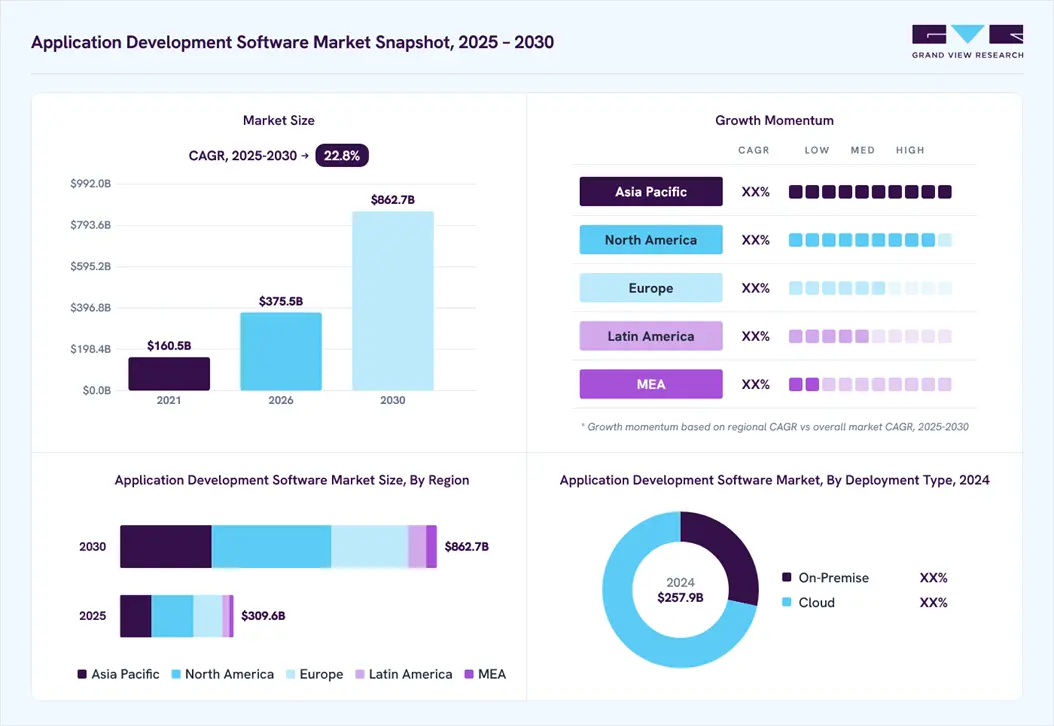
The growth is being supported by demand for cloud-based applications, faster software delivery, application modernization, and tools that help organizations automate and streamline business processes.
For companies planning custom software development, these market trends point to a growing need for solutions that fit specific business processes rather than forcing teams to rely entirely on generic applications.
A manufacturing company modernizing an unsupported ERP, for example, may need software that connects production scheduling, inventory, supplier communication, and reporting. The opportunity is therefore not simply to build software, but to create technology that solves a defined operational problem and can evolve as the business grows.
When a business needs to develop software, the feature list should begin with the capabilities users need every day, not a long collection of optional functions. This is particularly important for a growing B2B SaaS product that has accumulated technical debt and now takes much longer to release even simple features. In that situation, the right approach is to strengthen the software foundation with essential capabilities such as access control, data management, search, integrations, reporting, security, and administration before expanding the product roadmap.
For teams learning how to create software, these core requirements provide a practical baseline for planning, design, development, testing, and deployment. They also help product owners and developers distinguish necessary functionality from advanced capabilities that can be introduced later.
| Feature | Explanation |
| User-Friendly Interface | A user-friendly interface helps people understand the software quickly and complete tasks with minimal confusion. It should include clear navigation, readable layouts, consistent controls, logical workflows, and responsive screens. During software development, the interface should reflect actual user behavior and business tasks rather than focusing only on visual appearance. |
| User Registration and Login | Registration and login provide the basic identity layer for most applications. The feature should support account creation, secure authentication, password reset, email verification, and session management where required. A reliable login experience gives users controlled access to relevant software functions while establishing a foundation for secure account management. |
| Role-Based Access Control | Role-based access control determines what different users can view or perform inside the application. Administrators, managers, employees, customers, and partners may require different permissions. Defining these roles during the process to create software helps protect sensitive information, limit unauthorized actions, and simplify access management as the organization grows. |
| User Profile Management | User profile management lets individuals maintain information connected to their accounts, such as names, contact details, profile images, preferences, passwords, and communication settings. This functionality reduces unnecessary administrative work and gives each user control over relevant account information. It also creates a consistent foundation for personalized software experiences. |
| Search and Filtering | Search and filtering help users locate specific records without manually reviewing large amounts of information. Depending on the application, users may search by keywords, categories, dates, status, IDs, or other attributes. Efficient search functionality improves productivity and becomes increasingly important when software stores customers, transactions, documents, products, or tickets. |
| Notifications and Alerts | Notifications and alerts inform users about events that require attention, such as approvals, assignments, status changes, payments, messages, or important system updates. During software development, teams should define which events trigger notifications and whether users need email, in-app, or push alerts. Proper controls prevent important updates from being missed. |
| Dashboard | A dashboard gives users a centralized view of information relevant to their role. It may display tasks, activity, status updates, operational metrics, recent records, or performance indicators. A well-structured dashboard helps users identify priorities quickly and reduces the need to navigate through multiple sections to understand what requires attention. |
| Data Management | Data management allows users to create, update, organize, validate, and retrieve information within the application. Reliable data handling helps reduce duplicates, incorrect records, and inconsistent information. When building software for business, data structures should reflect real workflows so information remains useful across daily operations, reports, integrations, and future software enhancements. |
| Third-Party Integration | Third-party integration connects the application with existing business tools such as CRM systems, accounting platforms, payment services, communication applications, databases, or external APIs. These connections can reduce manual data entry and improve information flow between systems. Integration requirements should be defined early when you plan to make software for an existing technology environment. |
| Reporting and Analytics | Reporting and analytics transform application data into useful business information. Depending on the product, users may need operational reports, activity summaries, financial information, performance metrics, or downloadable records. Including practical reporting capabilities helps stakeholders evaluate results, identify patterns, track workflows, and make informed decisions using data generated by the software. |
| File and Document Management | File and document management allows users to upload, store, organize, view, download, and manage files inside the application. This can support invoices, contracts, forms, reports, images, and other business documents. Software development should account for file types, storage, permissions, validation, and organization to keep business documentation accessible and controlled. |
| Mobile Responsiveness | Mobile responsiveness ensures the software remains usable across smartphones, tablets, laptops, and desktop screens. Navigation, forms, tables, buttons, and content should adapt appropriately to different screen sizes. For companies developing software for distributed teams, field workers, or customers, responsive design can improve accessibility, adoption, and productivity across multiple devices. |
| Security and Data Protection | Security and data protection should be considered throughout the software development lifecycle rather than added only before launch. Core measures may include authentication, authorization, encryption, input validation, secure data handling, and controlled access. The required safeguards should match the application's users, information, integrations, industry obligations, and overall security risk. |
| Backup and Recovery | Backup and recovery features protect application data from accidental deletion, corruption, hardware problems, or other disruptions. A dependable approach should define backup frequency, retention periods, restoration procedures, and recovery responsibilities. Including these requirements when you create software supports business continuity and helps reduce the operational impact of unexpected technical failures. |
| Admin Management | Admin management provides authorized administrators with controls to operate and maintain the application efficiently. Typical capabilities include managing users, permissions, settings, configurations, workflows, and system activity. A well-designed administrative area reduces reliance on developers for routine changes and gives businesses greater control over software operations after deployment. |
These must-have features give a software product the stable functional foundation needed for reliable adoption, efficient operations, and sustainable development as requirements evolve.
When a growing B2B SaaS product has accumulated technical debt and feature delivery has become significantly slower because the original architecture was not designed to scale, advanced features should be introduced with the modernization roadmap in mind. The priority should be to develop software that can support future workloads, integrations, automation, and product expansion without making the existing codebase harder to maintain.
As businesses plan to create software, build software, or modernize an existing platform, capabilities such as AI, cloud infrastructure, microservices, and automated deployment can strengthen the product when they address a defined business or engineering need.
For teams evaluating how to develop software after architectural problems emerge, the following advanced capabilities can be considered after the essential foundation is stable.
| Advanced Feature | Explanation |
| AI and Machine Learning | AI and machine learning can automate repetitive tasks, identify patterns, generate recommendations, summarize information, and support predictive workflows. For businesses developing software using AI, these capabilities should solve a clear user problem and fit the existing architecture. This helps building software for business become more intelligent without adding unnecessary technical complexity. |
| Microservices Architecture | Microservices divide a large application into smaller services that can be developed, deployed, maintained, and scaled independently. For a SaaS product experiencing technical debt and slow releases, carefully planned service separation can improve release flexibility and scalability. However, teams should use this approach as part of a structured custom software development strategy rather than rewriting everything without clear priorities. |
| Cloud Computing | Cloud computing provides flexible infrastructure for hosting applications, databases, storage, networking, and deployment environments. When businesses plan to make software that must support changing workloads, cloud infrastructure can improve scalability and operational flexibility. It can also support distributed development teams, automated deployments, system monitoring, and more consistent environments throughout the software development lifecycle. |
| DevSecOps | DevSecOps integrates security practices into development, testing, deployment, and operations. For a software development project team working to increase release velocity, automated security testing, dependency scanning, and infrastructure checks can reduce manual bottlenecks while identifying risks earlier. This approach helps teams develop software faster without treating application security as a separate activity at the end of the delivery cycle. |
| Internet of Things Integration | IoT integration enables software to collect and process information from connected devices, sensors, machines, or equipment. Businesses can use this capability for asset monitoring, predictive maintenance, operational tracking, and real-time visibility. For companies looking to create software that connects digital workflows with physical operations, IoT can extend the value of the application beyond traditional user-generated data. |
| Big Data Processing | Big data processing allows applications to manage and analyze large volumes of information generated through users, transactions, devices, and integrated systems. For software products experiencing significant data growth, these capabilities can support advanced analytics, trend identification, forecasting, and large-scale processing. They become particularly relevant when building software for business requires insights from datasets too large for basic application reporting. |
| Infrastructure as Code | Infrastructure as Code manages application infrastructure through reusable code instead of relying on repeated manual configuration. It can help a software development team create consistent development, testing, staging, and production environments. For a SaaS platform affected by technical debt and slow delivery, infrastructure automation can reduce setup work, improve deployment consistency, and support a more efficient development process of software. |
| Progressive Web App Capabilities | Progressive Web App capabilities can provide a web-based application with responsive experiences across smartphones, tablets, and desktops while supporting features such as installation and dependable access. Businesses that plan to make software available across multiple devices can consider this approach to broaden accessibility without maintaining completely separate applications for every platform, potentially reducing duplicated development effort. |
| Blockchain Integration | Blockchain can support selected workflows that require shared verification, traceability, or a distributed record between multiple participants. Potential applications include supply chain tracking, asset records, digital verification, and specific transaction processes. During custom software development, blockchain should be considered only when decentralized verification addresses a genuine requirement more effectively than a conventional database-based solution. |
| AR and VR Experiences | AR and VR can introduce immersive experiences for product visualization, simulation, training, remote collaboration, and specialized industry workflows. When teams develop software for industries where visual interaction provides measurable value, these capabilities can create differentiated experiences. Their inclusion should still depend on user requirements, device availability, performance considerations, and a clearly defined business purpose. |
For businesses working through technical debt, advanced capabilities should be added through a phased software development services roadmap that improves the existing foundation while preparing the product for future growth.
After you finalized the features, now it's time to turn the product requirements into a structured execution plan. But software development does not always begin with writing new code. For a Series A B2B SaaS company dealing with technical debt, the process may start with understanding the existing codebase, identifying architectural bottlenecks, and deciding what should be refactored, replaced, or retained.
This is different from greenfield development, where teams start with a clean architecture and new codebase. A re-architecture project must protect existing functionality while improving maintainability, scalability, performance, and engineering velocity. Whether the objective is to create software from scratch or modernize an existing platform, the following eight stages provide a practical roadmap for software development for businesses, from assessment through deployment and continuous improvement.
The first stage is understanding what already exists. For a technical debt remediation project, review the codebase, architecture, database structure, APIs, infrastructure, dependencies, integrations, security practices, and deployment process. Identify where technical debt is slowing feature delivery, causing reliability issues, increasing infrastructure costs, or creating scalability limitations.
For a B2B SaaS platform, the audit should also connect technical problems with business impact. For example, identify modules that take three times longer to modify, tightly coupled services, outdated dependencies, fragile integrations, or recurring production issues. This assessment establishes the baseline for the development process of software and prevents teams from refactoring based only on assumptions.
After the assessment, define what the future system should look like and how the organization will get there. The strategy may involve incremental refactoring, modularization, service extraction, database modernization, infrastructure changes, or selective replacement of legacy components.
Avoid rebuilding everything simply because the existing architecture is imperfect. Classify components as retain, refactor, replace, or retire based on business value and technical risk. A clear roadmap should include priorities, dependencies, milestones, migration risks, and expected outcomes. This stage is particularly important when building software for a live SaaS business because development work must continue while the underlying architecture is being improved.
Before making significant architectural changes, validate the areas that could create the greatest technical or business risk. This may involve testing a new database approach, service architecture, cloud infrastructure, API strategy, authentication model, or integration pattern.
A focused PoC development exercise can be useful for proving whether a proposed architecture works before applying it across the wider platform. The goal is not to create a polished product, but to answer difficult technical questions early. Validation is especially valuable when the existing system contains undocumented dependencies or when the proposed architecture introduces technologies the current team has limited experience with.
With the modernization strategy validated, define the target architecture in detail. This includes application layers, services, databases, APIs, infrastructure, security boundaries, observability, deployment workflows, and communication between components.
For a growing SaaS platform, the architecture should support increasing customers, data volumes, integrations, and feature complexity without creating another generation of technical debt. The redesign should also identify which parts of the current system can remain operational during migration. A carefully planned architecture gives developers a cleaner foundation to make software easier to maintain, test, extend, and scale.
Technical modernization should not ignore the people using the product. Re-architecture projects are an opportunity to remove interface friction, simplify workflows, and improve consistency across the platform.
Map important user journeys and identify where technical limitations currently affect the experience. Work with a UI/UX design company when the modernization also involves substantial interface redesign or a new product experience. Keeping user requirements connected to technical priorities ensures the project delivers more than cleaner code. It creates software that is easier for customers to use and easier for teams to evolve.
This is where implementation begins. Instead of replacing the entire platform simultaneously, break the work into manageable components and migrate them in stages. Teams can refactor high-priority modules, introduce new services, improve APIs, migrate databases, and gradually move workloads to the target architecture.
For organizations learning how to develop software while maintaining an active SaaS product, phased migration reduces operational risk. MVP development can also be applied to specific modernization initiatives by validating a smaller version of a new architectural component before wider rollout. Automated testing and backward-compatible interfaces help maintain business continuity during the transition.
Once the core architecture is stabilized, identify opportunities to introduce technologies that can improve the product or engineering workflow. This may include intelligent search, predictive analytics, customer support automation, recommendation systems, or developer productivity tools.
AI integration should be tied to a defined business or operational objective rather than added simply because it is a current trend. A modernized SaaS platform may also adopt automated testing, CI/CD, observability, infrastructure automation, and stronger security controls. These capabilities help make software development using AI more practical while improving the platform's ability to evolve.
Modernization does not end when the redesigned components reach production. Before deployment, test functionality, integrations, performance, security, data migration, backward compatibility, and failure scenarios. Then monitor the platform closely after release using logs, metrics, traces, error monitoring, and user feedback.
For businesses evaluating top AI software development companies or top product development companies, this post-launch capability is an important evaluation point. A strong partner should be able to support optimization after deployment instead of treating delivery as the final milestone. Ongoing improvements help maintain engineering velocity and prevent new technical debt from accumulating.
A structured approach to the steps to build software from idea to launch can also be adapted for modernization projects, helping teams improve an existing product without disrupting the business that already depends on it.
Custom software development is valuable when standard tools cannot properly support a company's workflows, integrations, data requirements, or growth plans. For a business modernizing a B2B SaaS product that has accumulated technical debt and now takes much longer to release features, custom development can provide greater control over the product architecture and roadmap.
The benefits below show how tailored software can improve operations, user experience, system connectivity, security, and long-term business value.
One of the biggest benefits of custom software development is the ability to align the product with the way a business actually operates. Instead of forcing employees into predefined workflows, businesses can create software around their processes, rules, approval flows, data structures, and user roles. This is particularly useful when off-the-shelf platforms require excessive workarounds or duplicate manual tasks.
A tailored solution also lets a company prioritize the functionality that matters most. During software development, unnecessary features can be excluded while important workflows receive dedicated attention, creating software that better matches operational needs and user expectations.
Software directly influences how customers interact with a business, from onboarding and account management to purchases, support, and service delivery. Custom software development allows companies to design these experiences around specific customer expectations rather than adapting to the limitations of a generic platform.
For businesses developing software for customers, a tailored interface can simplify important actions, reduce friction, and make information easier to access. Better alignment between customer needs and application functionality can support stronger adoption and create a more consistent digital experience across the product lifecycle.
Custom software gives businesses greater control over application behavior, user permissions, data access, integrations, and security requirements. Teams can define authentication methods, authorization rules, encryption practices, audit controls, and data handling procedures according to the application's risk profile.
This level of control is particularly important when building software for business processes involving confidential customer information, financial records, intellectual property, or internal operational data. Security requirements can be incorporated throughout the software development lifecycle, allowing teams to address risks as part of architecture, development, testing, deployment, and maintenance.
Many businesses depend on several systems to manage their operations. A custom application can be designed to connect with existing CRMs, ERPs, payment platforms, databases, communication tools, analytics systems, and third-party APIs. This creates smoother data movement between applications and reduces repetitive manual work.
For organizations planning how to develop software around an existing technology environment, integration should be considered from the architecture stage. Well-planned connections can improve data consistency, automate handoffs between teams, and make the new application a functional part of the broader business technology ecosystem.
Business requirements rarely remain unchanged after launch. New customers, markets, departments, regulations, integrations, and operational processes can create new software requirements. Custom solutions provide greater flexibility to modify workflows, add modules, expand integrations, and support increasing workloads based on the product roadmap.
This benefit becomes especially important for a SaaS company dealing with technical debt and slow feature delivery. A properly planned custom software development approach can address architectural limitations while creating a stronger foundation for future software development projects, allowing new capabilities to be introduced without repeatedly rebuilding the entire product.
Reliability depends on how well software is designed, developed, tested, deployed, and maintained. Custom development gives teams greater visibility into the application's architecture and allows testing strategies to be aligned with the actual workflows, integrations, and usage conditions of the business.
For companies looking to develop software that supports important operations, reliability means more than avoiding crashes. It also includes predictable workflows, dependable integrations, accurate data processing, and stable performance. A disciplined development process of software can identify defects and architectural weaknesses before they become costly production problems.
Custom software requires an upfront investment, but the long-term economics can be stronger when the solution replaces inefficient processes, unnecessary licenses, disconnected tools, or repeated manual work. Businesses can invest in functionality that directly supports their requirements instead of continually paying for features they do not use.
For an organization that wants to make software around its core operations, the financial value should therefore be measured beyond development cost. Reduced administrative effort, fewer workflow bottlenecks, better system integration, and easier future changes can all influence the total cost of ownership. A well-planned approach to building software can also reduce the expense of repeatedly replacing unsuitable platforms.
Together, these benefits make custom software a practical option for businesses that need greater control over workflows, technology, user experiences, integrations, and long-term product growth.
Software development trends in 2026 are increasingly focused on improving engineering productivity, reducing operational complexity, strengthening security, and helping businesses release products faster. This matters for companies that plan to make software while also dealing with an existing technical challenge.
For example, a Series A B2B SaaS company may have strong product demand but slow feature delivery because its original architecture was built without sufficient scalability. In that situation, the right software development trends can support modernization instead of adding another layer of complexity.
AI is becoming part of the software engineering workflow rather than remaining limited to customer-facing applications. Developers can use AI tools for code generation, documentation, debugging, testing support, code review, and developer productivity. Gartner reported in 2026 that improving developer productivity and developer experience remains a leading driver of technology adoption, although only 35% of software engineering leaders reported significant ROI from AI in the SDLC.
For companies developing software, this means AI should be applied to measurable engineering problems. A SaaS team dealing with technical debt can use AI-assisted tooling to accelerate routine work while keeping architectural decisions under experienced human review.
Agentic AI is expanding from conversational assistance toward systems that can understand goals, plan multiple steps, use tools, and complete defined business tasks. Google Cloud identifies agentic workflows as a major 2026 business trend, with multiple agents increasingly able to coordinate across complex processes.
For businesses looking to create software, this can open new product opportunities such as automated support workflows, research assistants, internal operations, and task orchestration. However, a custom software development strategy should include clear permissions, human oversight, data boundaries, and monitoring before autonomous actions are allowed in production.
Cloud-native development continues to become more important as businesses need software that can scale without increasing infrastructure complexity at the same rate. Gartner's 2026 research highlights growing demand for cloud platform services that reduce infrastructure complexity and support AI-native software engineering.
For a company trying to develop software after outgrowing a tightly coupled application, cloud-native practices can support better deployment, scalability, observability, and infrastructure management. Platform engineering can also provide reusable internal capabilities that help development teams deliver features more consistently instead of repeatedly solving the same infrastructure problems.
Security is becoming more closely connected to software architecture, development workflows, and AI adoption. Gartner's 2026 cybersecurity research identifies agentic AI oversight as a major concern because uncontrolled AI agents, low-code tools, and AI-generated code can expand the attack surface.
For businesses building software for business, security should therefore be incorporated throughout the development lifecycle. Identity controls, access policies, secure coding practices, dependency monitoring, data protection, and AI governance can reduce risks as products become more connected. This is especially relevant for SaaS platforms handling customer data while undergoing architectural changes.
AI-assisted coding is changing how development teams approach implementation, but faster code generation does not automatically produce better software. Recent industry developments show AI increasingly being integrated directly into coding environments and cloud development platforms, while engineering teams still need to manage deployment, testing, infrastructure, and production quality.
When you develop software for a growing product, AI coding tools can accelerate repetitive implementation work, test creation, documentation, and refactoring. For the B2B SaaS scenario, this can help reduce development bottlenecks, but architectural decisions, code quality, security, and technical debt should still be reviewed by qualified engineers.
Software modernization is becoming a strategic priority for businesses whose older applications cannot keep pace with current product demands. Instead of automatically replacing an entire platform, teams can assess architecture, identify high-risk components, refactor critical areas, improve deployment practices, and progressively replace outdated components.
This trend directly applies to businesses asking how to create software from scratch versus whether they actually need a greenfield rebuild. If a SaaS product already has paying customers and valuable business logic, a phased modernization strategy can be more practical than discarding everything. The objective is to create a healthier technical foundation that allows building software faster without reproducing the same architectural problems.
Developer experience is becoming an important business consideration because inefficient engineering workflows can directly affect release speed and product delivery. Gartner's 2026 research places developer productivity and experience among the leading factors influencing technology adoption, while current cloud development platforms are increasingly focused on reducing the gap between writing code and getting production-ready applications deployed.
For a software development project team, automation can reduce repetitive work across testing, deployment, environment setup, monitoring, and code management. For a product affected by technical debt, improving these workflows can help teams regain delivery speed while architectural modernization happens in parallel.
Also Read: Top 10+ AI Automation Companies in USA
As AI becomes part of applications and engineering workflows, businesses are also reconsidering how identity, permissions, monitoring, and resilience should work. Current 2026 security discussions increasingly emphasize stronger controls around AI agents, zero-trust principles, and the ability to distinguish trusted automated activity from potentially harmful machine behavior.
For companies planning to make software that depends on AI agents, APIs, cloud services, and distributed systems, resilience needs to be designed into the architecture. Strong identity controls, limited permissions, observability, recovery planning, and clear failure boundaries can help the application remain dependable as its technical environment becomes more complex.
In 2026, the most valuable software development trends are those that improve delivery speed, scalability, security, and business value together. For a growing SaaS product, adopting these trends selectively can support modernization without creating another cycle of technical debt.
The cost to develop software from scratch typically ranges from $10,000 to $500,000+, depending on the software’s scope, architecture, number of users, integrations, platforms, security requirements, and development team. A basic application with limited workflows may require a smaller investment, while enterprise software with complex business logic, multiple integrations, higher scalability requirements, and ongoing support can require a significantly larger development budget of software.
For a growing B2B SaaS company dealing with technical debt, the budget calculation can be different from a greenfield project. When an existing product takes three times longer to release features because its architecture was not designed to scale, the investment may need to cover code refactoring, architecture modernization, database improvements, migration, testing, and selective redevelopment. Therefore, accurate cost estimation of software should evaluate both the existing technical condition and the desired future architecture.
Businesses often ask, “How much does it cost to develop software?” The answer depends on what needs to be built, how complex the requirements are, which technologies are involved, and how much scalability and maintenance the product will require. Software development cost should therefore be estimated after defining the scope, technical requirements, user roles, integrations, infrastructure, and post-launch support.
| Software Type | Estimated Development Cost |
| Basic Software | $10,000-$50,000 |
| Advanced Software | $50,000-$200,000 |
| Enterprise Software | $200,000-$500,000+ |
| Cost-Affecting Factor | Estimated Cost |
| Project Scope and Complexity | $5,000-$150,000+ depending on the number of workflows, modules, business rules, and overall project scope |
| UI/UX Design | $3,000-$30,000+ depending on user journeys, screens, prototypes, design systems, and interface complexity |
| Software Architecture | $5,000-$50,000+ depending on scalability requirements, system structure, databases, APIs, and deployment model |
| Frontend Development | $8,000-$80,000+ depending on the number of screens, interactions, user roles, and supported platforms |
| Backend Development | $10,000-$120,000+ based on business logic, APIs, databases, authentication, integrations, and processing requirements |
| Third-Party Integrations | $2,000-$50,000+ depending on the number, documentation, complexity, and customization required for external systems |
| Platform Support | $5,000-$60,000+ depending on whether the software supports web, mobile, desktop, or multiple platforms |
| Security and Compliance | $5,000-$60,000+ depending on authentication, authorization, encryption, auditing, security testing, and industry requirements |
| Testing and Quality Assurance | $5,000-$50,000+ depending on test coverage, automation, devices, integrations, performance, and security testing |
| Cloud Infrastructure and Deployment | $3,000-$40,000+ depending on hosting architecture, environments, CI/CD, monitoring, and deployment requirements |
| Development Team | $20,000-$200,000+ depending on the number and expertise of developers, architects, designers, QA specialists, DevOps engineers, and project managers |
| Technical Debt Remediation | $15,000-$150,000+ depending on legacy code quality, architectural constraints, refactoring, migration, and redevelopment requirements |
| Data Migration | $5,000-$50,000+ depending on data volume, source systems, transformation, validation, and migration complexity |
| Maintenance and Support | $5,000-$50,000+ annually depending on software complexity, updates, bug fixes, security patches, infrastructure, and support requirements |
For a SaaS business deciding whether to rebuild or modernize an existing platform, software development cost estimation should account for the current codebase, technical debt, migration effort, and new architecture rather than treating the project as a simple from-scratch build.
The final development pricing software depends on scope, architecture, technology, team composition, and long-term maintenance requirements, so a detailed technical assessment is essential before fixing the budget.
When a Series A B2B SaaS company finds that feature delivery has become three times slower because its original architecture was not designed to scale, hiring a software development services company should address more than the next feature release.
The right partner should first understand the existing codebase, identify technical debt, evaluate architecture, and determine whether selective refactoring, re-architecture, or redevelopment is the better path.
From there, the engagement can cover custom software development, product engineering, integrations, testing, deployment, and ongoing support. This gives businesses a clearer way to develop software while improving the technical foundation needed for future releases.
A software development company can take business requirements and turn them into a functional product through structured planning, design, architecture, development, testing, deployment, and maintenance. For an existing SaaS platform, this work may begin with a technical assessment to identify code quality issues, architectural bottlenecks, dependencies, and scalability constraints.
A strong development partner should also establish priorities and delivery milestones before implementation begins. This helps businesses introduce new functionality while addressing the underlying problems that are slowing development. The result is software built around business requirements with a clearer path for future improvements.
A software development services company can create business intelligence solutions that consolidate information from databases, CRM platforms, ERP systems, and other business applications. These tools can provide dashboards, reports, performance indicators, and data views tailored to different user roles.
For businesses managing large volumes of operational data, customized BI functionality can make information easier to interpret and act upon. Instead of relying entirely on disconnected reporting tools, organizations can integrate relevant insights directly into their software workflows, helping managers track performance, identify bottlenecks, and make informed decisions.
Development companies can build web applications and corporate systems such as CRM platforms, ERP solutions, HR systems, customer portals, workflow applications, and internal business tools. Services may also include backend development, APIs, databases, integrations, cloud deployment, testing, and system maintenance.
For a business modernizing an older SaaS product, the objective should be to improve the underlying system rather than simply reproduce outdated functionality. The development team can evaluate existing workflows, redesign inefficient processes, and introduce a more maintainable architecture that supports faster releases and future growth.
Software development consultancy provides technical direction before major development investments are made. A consultancy team can review an existing codebase, assess architecture, identify technical risks, evaluate technology choices, and create a practical modernization or development roadmap.
For the SaaS scenario, this can help leadership decide whether to rebuild the entire product or modernize it incrementally. A structured assessment can identify which components should be refactored, replaced, migrated, or retained, allowing the software development project team to focus resources on the areas that have the greatest impact on scalability and delivery speed.
A reliable software development partner should therefore provide both implementation expertise and the technical guidance needed to make informed product and architecture decisions.
Hiring the right software development company is not simply about finding the lowest quote or the largest portfolio. The partner should understand your business objectives, technical requirements, architecture, delivery expectations, and long-term product roadmap. This becomes especially important for a Series A B2B SaaS company whose feature releases have slowed because the existing architecture was not designed to scale.
In that situation, the right team should be capable of assessing technical debt, recommending re-architecture or phased modernization, and continuing product development without disrupting existing users. The following steps can help you evaluate and hire a software development company with greater confidence.
Before contacting potential vendors, define a realistic software development budget based on scope, technical complexity, platforms, integrations, security requirements, and ongoing maintenance. For an existing SaaS product, include potential costs for architecture assessment, technical debt remediation, refactoring, migration, testing, and new feature development.
Avoid treating the initial quote as the complete project cost. Ask prospective companies to separate discovery, development, infrastructure, testing, deployment, and post-launch support. A clear financial framework makes it easier to compare proposals and identify estimates that are either unrealistic or missing important development activities.
Look for a software development team with experience that matches the actual technical challenges of your project. Portfolio volume alone is not enough. Examine whether the company has handled products with similar architecture, user scale, integrations, industry requirements, or modernization needs.
For a SaaS business dealing with technical debt, ask about previous re-architecture and legacy modernization projects. Evaluate the team's experience across software architects, developers, QA specialists, DevOps engineers, and project managers. A multidisciplinary team can provide better technical coverage throughout the software development lifecycle.
An interview gives you an opportunity to understand how the potential partner thinks about your project, not just what technologies they use. Discuss the existing architecture, technical debt, scalability concerns, development workflow, testing practices, deployment strategy, and expected challenges.
For a company looking to develop software while modernizing an existing product, ask candidates how they would identify architectural bottlenecks before recommending major changes. Their questions can be as informative as their answers. A capable team should demonstrate structured problem-solving rather than immediately proposing a complete rewrite or a preferred technology stack.
After narrowing your options, share your requirements and technical context with the shortlisted development partner. Provide information about the current product, business objectives, users, existing technology, major pain points, and expected outcomes.
Ask the company to provide a detailed proposal covering project scope, software development process, architecture approach, team composition, milestones, timeline, assumptions, and deliverables. For an existing SaaS platform, the proposal should clearly distinguish technical debt remediation from new feature development so you can understand how modernization will affect the overall roadmap and budget.
Compare shortlisted companies using criteria that go beyond price. Assess technical expertise, relevant project experience, communication practices, development methodology, security approach, quality assurance, scalability knowledge, and post-launch support.
For the SaaS scenario, pay particular attention to how each company approaches technical debt. The strongest proposal may not be the one promising the fastest rebuild. Look for a team that can explain which parts of the existing system should be retained, refactored, replaced, or gradually migrated. This indicates a more thoughtful approach to custom software development and reduces the risk of unnecessary redevelopment.
Once you have completed your evaluation, select the software development company that best matches your technical needs, business objectives, budget, and communication expectations. Before work begins, finalize a contract covering scope, milestones, deliverables, ownership, timelines, payment terms, change requests, security responsibilities, and support.
For an ongoing product modernization project, also establish how architectural decisions and technical debt will be tracked throughout development. Clear governance helps both teams manage priorities while maintaining progress on new functionality. The right partnership should give your business a dependable team for both immediate development requirements and future product evolution.
Therefore, choosing a software development partner with the right technical depth, modernization experience, and delivery discipline can make the difference between simply rebuilding software and creating a stronger foundation for sustainable growth.
From the above considerations, now it’s time to identify the right development partner for your software project. PixelBrainy brings together business understanding, technical expertise, and structured product engineering to help companies turn complex requirements into reliable digital solutions. As a PixelBrainy software development company, we support businesses across product development, modernization, system integration, and emerging technologies while keeping the implementation aligned with practical business objectives.
For a growing B2B SaaS company facing technical debt and feature delivery that has become three times slower because its original architecture was not designed to scale, the priority is not simply to build software faster. The development partner must understand the existing codebase, identify architectural bottlenecks, determine what should be refactored or redesigned, and establish a roadmap that supports new feature delivery without increasing technical debt.
PixelBrainy’s software development services can cover requirements analysis, software architecture, UI/UX, development, testing, deployment, integrations, and post-launch support. Businesses can also explore our AI solutions for software when intelligent automation, data analysis, or AI-powered workflows can create meaningful product or operational value.
For a U.S.-based digital health company, PixelBrainy delivered an AI-powered health solution designed to support a growing user base and improve the overall digital health experience. Within six months of launch, the solution surpassed 50,000 active users, achieved a 65% improvement in user engagement, and contributed to a 40% reduction in costs.
The project demonstrates how thoughtful technology decisions, AI capabilities, product architecture, and user-focused design can work together to support both adoption and operational efficiency. The client name and other identifying information remain confidential.
Whether your business needs to develop software from a new concept or modernize an existing product, PixelBrainy approaches every engagement around the product roadmap, technical requirements, scalability goals, and measurable business priorities. Our experience with software development integrating AI also helps businesses identify practical opportunities for AI without adding unnecessary complexity.
Connect with PixelBrainy today to discuss your software requirements, modernization plans, and product goals.

A successful software project starts with a clear understanding of the business problem, users, technical requirements, and expected outcomes. From defining the software development process to selecting essential features, estimating the software development cost, planning architecture, and evaluating current technologies, each decision influences the product’s performance and future adaptability.
For businesses working with an existing SaaS platform, technical debt, slow releases, or scalability limitations should be addressed as part of the development roadmap. A structured custom software development approach can help teams improve architecture while continuing to deliver valuable product updates. Companies starting from scratch can similarly use these principles to build software that reflects their workflows and growth plans.
AI also creates practical opportunities across automation, analytics, personalization, and intelligent workflows. With the right strategy, software development integrating AI can add meaningful capabilities without distracting from core product requirements. Partnering with experienced software development services providers can further support planning, engineering, modernization, and long-term product evolution.
Schedule a call with PixelBrainy to discuss your software project and development roadmap.
Custom software development is worth considering when existing tools cannot support important workflows, require excessive manual work, create integration problems, or limit future growth. A tailored solution can be designed around your processes, user roles, data requirements, and business objectives instead of forcing the organization to adapt to a generic platform.
The decision depends on the condition of the current architecture, codebase, integrations, technical debt, and business logic. If an existing SaaS product has valuable users and functioning core workflows, phased modernization may be more practical than a complete rebuild. A technical assessment can identify which components should be retained, refactored, replaced, or redesigned.
Prepare the business problem, target users, key workflows, required integrations, essential features, platform requirements, security expectations, approximate timeline, and budget range. A clear requirements document makes it easier for a software development project team to estimate scope, recommend an architecture, and define realistic milestones before implementation begins.
The cost to develop software depends on scope, complexity, UI/UX requirements, platforms, integrations, architecture, security, team composition, testing, infrastructure, and maintenance. For an existing product, technical debt remediation and data migration should also be included in the estimate. A discovery or technical assessment usually provides a more reliable cost range than a feature list alone.
AI can support practical workflows such as document processing, recommendations, classification, forecasting, search, automation, customer assistance, and data analysis. Software development integrating AI should begin with a clearly defined business use case, suitable data, measurable outcomes, and appropriate security controls rather than adding AI simply because it is available.
A typical software development project team may include a product manager or business analyst, software architect, UI/UX designer, frontend and backend developers, QA engineers, and DevOps specialists. The exact team structure depends on project scope. A SaaS modernization project may also require engineers with experience in legacy systems, cloud migration, architecture refactoring, and technical debt reduction.
There is no fixed timeline because development duration depends on the product scope, number of workflows, integrations, platforms, testing requirements, and technical complexity. A smaller application may be delivered in a few months, while complex enterprise or SaaS products can require significantly longer. Defining an MVP or phased release can make the software development process easier to manage.
Look for experience with your product type, technology environment, architecture, integrations, security requirements, and modernization challenges. Ask how the provider evaluates technical debt, handles re-architecture, manages releases, tests changes, and protects existing users during migration. The right software development services partner should be able to explain both the technical approach and how it supports your business roadmap.

About The Author
Sagar Bhatnagar
Sagar Sahay Bhatnagar brings over a decade of IT industry experience to his role as Marketing Head at PixelBrainy. He's known for his knack in devising creative marketing strategies that boost brand visibility and market influence. Sagar's strategic thinking, coupled with his innovative vision and focus on results, sets him apart. His track record of successful campaigns proves his ability to utilize digital platforms effectively for impactful marketing efforts. With a genuine passion for both technology and marketing, Sagar continuously pushes PixelBrainy's marketing initiatives to greater success.

Working with PixelBrainy has been a great experience. They took our vision for an AI-powered platform and turned it into a fully functional product. What impressed me most was their strong understanding of both design and development, and their ability to handle complex requirements with ease. The team was responsive, cooperative, and always open to feedback. They kept things organized, communicated clearly, and delivered quality work on time. I highly recommend PixelBrainy to anyone looking for a skilled and reliable development partner.

Working with the PixelBrainy team has been a highly positive experience. They understand the design requirements and create beautiful UX elements to meet the application needs. The dev team did an excellent job bringing my vision to life. We discussed usability and flow. Sagar worked with his team to design the database and begin coding. Working with Sagar was easy. He has the knowledge to create robust apps, including multi-language support, Google and Apple ID login options, Ad-enabled integrations, Stripe payment processing, and a Web Admin site for maintaining support data. I'm extremely satisfied with the services provided, the quality of the final product, and the professionalism of the entire process. I highly recommend them for Android and iOS Mobile Application Design and Development.

Great experience working with them. Had a lot of feedback and I found that unlike most contractors they were bugging me for updates instead of the other way around. They were extremely time conscience and great at communicating! All work was done extremely high quality and if not on time, early! They were always proactive when it comes to communication and the work is great/above par always. Very flexible and a great team to work with! Goes above and beyond to present us with multiple options and always provides quality. Amazing work per usual with Chitra. If you have UI/UX or branding design needs I recommend you go to them! Will likely work with them in the future as well, definitely recommended!

PixelBrainy is a joy to work with and is a great partner when thinking through branding, logo, and website layout. I appreciate that they spend time going into the "why" behind their decisions to help inform me and others about industry best practices and their expertise.

I hired them to design our software apps. Things I really like about them are excellent communication skills, they answer all project suggestions and collaborate right away, and their input on design and colors is amazing. This project was complex and needed patience and creativity. The team is amazing to do business with. I will be using them long-term. Glad to see there are some good people out there. I was afraid to try and outsource my project to someone but I am glad I met them! I really can't say enough. They went above and beyond on this project. I am very happy with everything they have done to make my business stand out from the competition.

It was great working with PixelBrainy and the team. They were very responsive and really owned the project. We'll definitely work with them again!

I recently worked with the PixelBrainy team on a project and I was blown away by their communication skills. They were prompt, clear, and articulate in all of our interactions. They listened and provided valuable feedback and suggestions to help make the project a success. They also kept me updated throughout the entire process, which made the experience stress-free and enjoyable.

PixelBrainy is very good at what it does. The team also presents themselves very professionally and takes care of their side of things very well. I could fully trust them taking up the design work in a timely and organised manner and their attention to detail saved us lots of effort and time. This particular project was quite intense and the team showed that they function very well under pressure. Very much looking forward to working with her again!

It's always an absolute pleasure working with them. They completed all of my requests quickly and followed every note I had for them to a T, which made our process go smoothly from start to finish. Everything was completed fast and following all of the guidelines. And I would recommend their services to anyone. If you need any design work done in the future, PixelBrainy should be your first call!

They took ownership of our requirements and designed and proposed multiple beautiful variants. The team is self-motivated, requires minimum supervision, committed to see-through designs with quality and delivering them on time. We would definitely love to work with PixelBrainy again when we have any requirements.

PixelBrainy was a big help with our SaaS application. We've been hard at work with a new UI/UX and they provided a lot of help with the designs. If you're looking for assistance with your website, software, or mobile application designs, PixelBrainy and the team is a great recommendation.

PixelBrainy designers are amazing. They are responsive, talented, and always willing to help craft the design until it matches your vision. I would recommend them and plan to continue them for my future projects and more!!!

They were awesome! Did a good job fast, and good communication. Will work with them again. Thank you

Creative, detail-oriented, and talented designers who take direction well and implement changes quickly and accurately. They consistently over-delivered for us.

PixelBrainy team is very talented and creative. Great designers and a pleasure to work with. PixelBrainy is an excellent communicator and I look forward to working with them again.

PixelBrainy has a very talented design team. Their work is excellent and they are very responsive. I enjoy working with them and hope to continue on all of our future projects.

Transform your ideas into reality with us.
Across these industries, each engagement brings unique challenges, from early-stage product development to scaling complex systems, helping us build a practical understanding of real-world product environments.