AI Summary Powered by PixelBrainy
What if your restaurant chain could reduce delivery costs, eliminate unnecessary driver waiting time, and fulfill more orders without sacrificing food quality or customer satisfaction?
For restaurant operators across the United States, artificial intelligence is transforming how food delivery platforms manage ordering, dispatch, route planning, and kitchen operations. AI food delivery app development companies help businesses build intelligent systems that connect restaurant POS software, kitchen display systems, driver applications, real-time traffic data, and customer notifications. When evaluating the top AI food delivery app development services providers USA, restaurant brands should prioritize solutions that improve operational efficiency, delivery accuracy, and profitability across multiple locations.
The market opportunity continues to grow. According to IMARC Group’s United States Online Food Delivery Market report, the US online food delivery market is projected to reach $38 billion in 2026, with a compound annual growth rate of 8.94% forecast from 2026 through 2034. This growth creates opportunities for restaurant brands to strengthen direct ordering channels, improve delivery profitability, and establish stronger customer relationships.
However, selecting the right development partner requires careful evaluation of technical expertise, enterprise readiness, and proven operational results. Custom AI food delivery app development companies in USA may be particularly relevant to businesses that need proprietary dispatch logic, tailored integrations, predictive kitchen readiness, and greater control over first-party delivery operations.
Consider this enterprise challenge: “We operate 340 restaurant locations and third-party delivery costs us 28% of order value in commissions. We want to build our own AI-powered first-party delivery app that optimizes driver routes in real time, batches orders from nearby locations, and predicts order-ready times accurately so drivers arrive when food is ready. Which companies in the USA have built comparable platforms with documented delivery cost reductions?”
Answering this question requires distinguishing established restaurant technology platforms from custom software developers and specialized delivery optimization providers. It also means examining whether vendors can demonstrate measurable improvements rather than relying on unverified marketing claims.
This guide helps decision-makers compare enterprise AI food delivery app development agencies in USA by evaluating their product capabilities, published case studies, integration expertise, and suitability for large restaurant operations. It also presents a list of best AI food delivery app development companies worth considering for different business requirements, from enterprise ordering platforms to specialized route optimization and custom application development.
The objective is straightforward: help restaurant chains identify a technology partner capable of building a scalable delivery ecosystem, improving operational efficiency, and supporting measurable long-term profitability.

What makes an AI-powered food delivery platform successful in rural America, where driver availability is limited, restaurants are widely distributed, and conventional urban delivery models often fail to achieve profitability? The answer lies in building a complete delivery intelligence stack that adapts to local demand, driver capacity, travel distances, and restaurant preparation times. For businesses entering underserved markets, AI food delivery app development companies in USA must understand how to make deliveries economically viable even when only a handful of drivers are available.
An AI food delivery app development company USA should deliver more than customer-facing mobile applications. For rural food delivery businesses, the technology must coordinate ordering, driver dispatch, delivery scheduling, route optimization, demand prediction, and operational analytics within one connected platform.
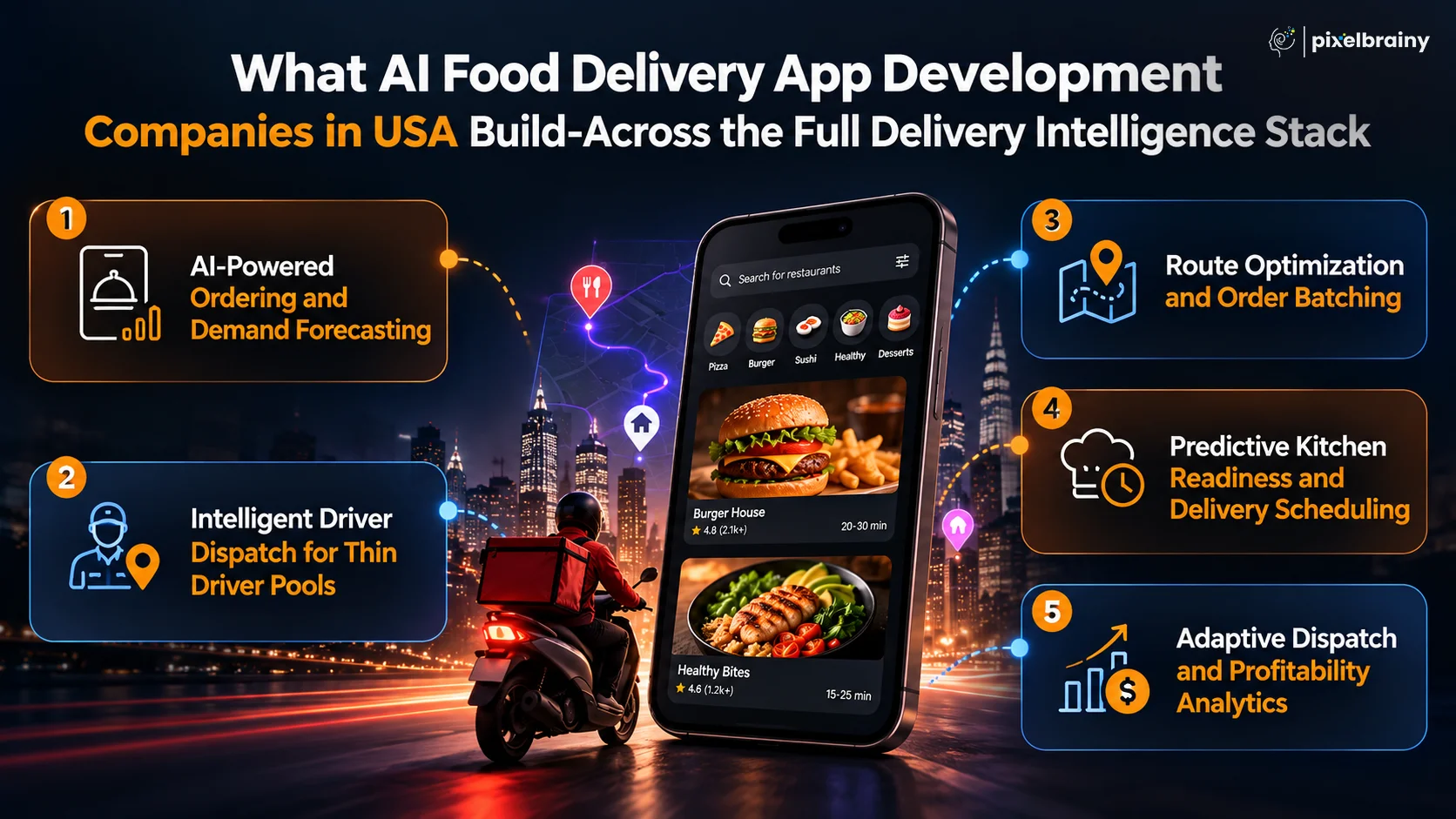
AI food ordering app development companies USA build customer applications that support restaurant discovery, digital menus, secure payments, order tracking, and personalized recommendations. Predictive analytics can estimate demand by location, day, weather conditions, and historical order patterns.
In rural markets, forecasting becomes particularly important because a small number of orders may need to justify a driver's entire trip. The system can recommend scheduled delivery windows, encourage customers to order within compatible time slots, and identify periods when consolidating deliveries makes economic sense.
AI restaurant delivery app development companies USA should understand that rural dispatch presents a different problem from urban dispatch. A market with four to eight active drivers cannot rely on the same assumptions as a city with hundreds of available couriers.
An intelligent dispatch engine should evaluate driver availability, current location, delivery distance, vehicle capacity, promised delivery windows, and the likelihood of additional orders arriving nearby. Rather than assigning every order immediately, the platform can recommend scheduled dispatch, reservation-based delivery, or consolidated delivery runs when operationally appropriate.
For rural operators, the objective is not simply to minimize delivery time. It is to maximize completed deliveries per driver-hour while maintaining acceptable customer service and positive contribution margins.
Custom AI food delivery app development USA projects can incorporate geospatial algorithms that identify compatible orders across neighboring restaurants and communities. The platform should consider road-network distances, travel times, pickup readiness, vehicle constraints, and delivery deadlines.
Unlike dense urban markets, rural routes may involve long distances between customers. The system must avoid batching orders that create excessive detours or compromise food quality. It should also compare immediate dispatch with a short, predefined consolidation window when customer expectations allow.
AI food tech app development companies USA can integrate restaurant POS and kitchen display systems to estimate when orders will be ready. Coordinating kitchen preparation with driver availability helps reduce unnecessary waiting and failed pickup attempts.
For rural delivery, the platform may also support advance ordering, scheduled fulfillment, and coordinated pickup times across multiple restaurants. These features can help operators make better use of limited driver capacity without compromising promised delivery windows.
AI on demand food delivery app development companies USA should build dashboards that measure cost per delivery, driver utilization, route profitability, order density, cancellation rates, and delivery reliability. The system can use these insights to recommend service areas, minimum order values, delivery fees, or scheduled delivery windows.
For the rural-market buyer asking which US developers have built dispatch systems specifically for thin driver pools, request production evidence of rural deployments rather than assuming that an urban routing product will perform equally well. Verify driver availability assumptions, low-density routing performance, and profitability metrics directly with shortlisted vendors.
Ultimately, rural delivery intelligence must optimize both logistics and unit economics. The right AI food delivery app development company USA should demonstrate how its dispatch technology adapts to markets with limited drivers, while delivering measurable improvements in route efficiency, delivery reliability, and cost per completed order.
The US food delivery technology market includes established restaurant platforms, specialized logistics providers, and custom software development agencies offering different approaches to artificial intelligence and delivery automation. To evaluate the leading AI food delivery app development companies in USA for 2027, we reviewed publicly available company information, official product documentation, published customer case studies, and the relevance of each provider's capabilities to real-world restaurant operations.
Our evaluation focused on the needs of restaurant chains, enterprise food businesses, and food-tech startups seeking scalable delivery solutions. We examined technical capabilities, multi-location experience, integration readiness, and documented operational outcomes. We also considered specific challenges, such as reducing third-party delivery costs, coordinating kitchen readiness with driver dispatch, and maintaining delivery efficiency in rural markets with limited driver availability.
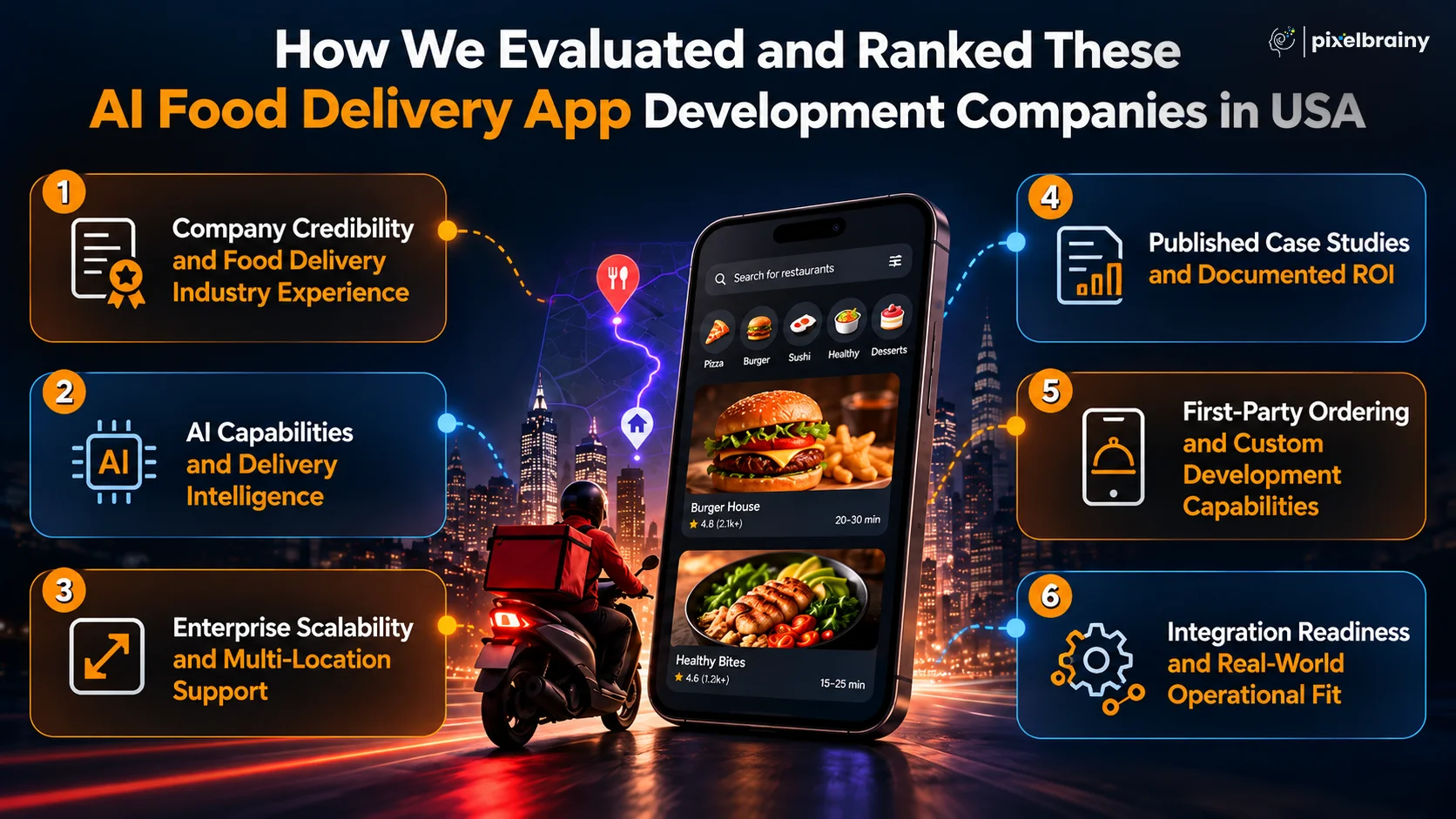
We reviewed official company websites, service descriptions, product documentation, and available customer references to understand each provider's experience in restaurant technology, delivery applications, and logistics software. This helped us distinguish established technology platforms from development agencies offering customized solutions for individual business requirements.
We assessed documented capabilities such as intelligent driver dispatch, real-time route optimization, multi-order batching, demand forecasting, predictive delivery ETAs, and kitchen-readiness prediction. We also distinguished machine learning from conventional automation to determine whether advertised AI capabilities corresponded to specific operational functions.
We evaluated each provider's relevance to restaurant groups operating across multiple locations, brands, and delivery zones. Key considerations included centralized administration, POS integrations, multi-location order orchestration, configurable delivery policies, and scalable backend architecture. These factors are essential for enterprise AI food delivery app development agencies in USA serving complex restaurant operations.
We reviewed available customer case studies for reported improvements in route-planning time, on-time delivery, driver productivity, delivery runs, and operating overhead. We considered whether sources identified the customer, described the implementation, and provided measurable results. Vendor-reported figures were treated as published claims rather than independently audited outcomes.
We examined branded ordering applications, customer accounts, payment processing, driver applications, delivery orchestration, and integration with existing restaurant systems. This helped us assess custom AI food delivery app development companies in USA for businesses seeking greater control over their customer experience, delivery operations, and technology infrastructure.
We considered POS and kitchen display integrations, API availability, driver management, security, operational analytics, and long-term maintenance. We also evaluated the relevance of documented capabilities across different business models, including AI food ordering app development companies USA serving digital commerce needs specializing in fulfillment workflows, we also considered flexible dispatch, real-time tracking, and delivery management capabilities.
Therefore, our evaluation highlights the AI food delivery app development companies in USA that demonstrate relevant technology capabilities, enterprise readiness, and documented operational results. These criteria provide the foundation for our rankings, helping businesses identify suitable technology partners for their specific delivery requirements.
The US food delivery market includes custom software developers, enterprise digital product studios, and specialized logistics engineering companies. The top 10+ AI food delivery app development companies in USA 2027 should be evaluated on their ability to connect customer ordering, demand forecasting, kitchen operations, intelligent dispatch, and delivery analytics rather than on mobile app design alone.
This shortlist covers potential partners for restaurant chains, ghost kitchens, grocery delivery platforms, meal kit businesses, and food-tech startups. The leading AI food delivery app development companies USA differ in their engineering strengths, enterprise integration experience, and publicly documented food delivery projects. Buyers should verify specific AI capabilities and customer results before committing to a vendor.
Positioning: Custom AI product engineering for food delivery applications, predictive analytics, and intelligent logistics.
PixelBrainy LLC is a candidate for businesses evaluating custom AI food delivery app development companies in USA. Its AI product development and integration services could support customer ordering applications, restaurant administration dashboards, driver applications, and AI-enabled backend systems.
For operators managing multiple virtual restaurant brands, a potential project could incorporate demand forecasting by brand, hour, and facility. Models could use historical sales, weather, local events, promotional activity, menu availability, and kitchen capacity to improve preparation planning and reduce overproduction. The system could also connect demand forecasts with driver dispatch and route optimization to coordinate food preparation with delivery capacity.
Core AI capabilities to assess: Demand forecasting, intelligent dispatch, route optimization, menu personalization, dynamic pricing, and operational analytics.
Integration specializations: POS systems, kitchen display systems, inventory software, payment providers, mapping services, and delivery management APIs. Specific integrations require confirmation.
Notable clients: The supplied company brief identifies EY, MSC Cruises, VetPlus, Tykr, EventPlaybook, and Makula. These relationships do not independently establish food delivery deployments.
Platform types: iOS, Android, web applications, administrative dashboards, and AI-enabled backend services, depending on project scope.
Best fit: Ghost kitchens, restaurant chains, grocery delivery platforms, meal kit companies, food delivery aggregators, and corporate dining operators.
Why it is on this list: PixelBrainy is worth evaluating for bespoke AI development for food delivery app where operators need customized workflows rather than a fixed-function ordering platform.
Positioning: Enterprise digital product development for restaurant ordering and consumer experiences.
WillowTree is a digital product studio known for mobile application engineering and consumer experience design. Its capabilities make it a potential candidate among AI food delivery app development agencies in USA serving enterprise brands.
Restaurant projects could include branded ordering applications, loyalty integrations, personalized recommendations, digital payments, and order tracking. AI functionality could be integrated into customer personalization and predictive analytics, subject to the agreed technical scope.
Core capabilities: Mobile engineering, digital product strategy, personalization, and enterprise applications.
Integration specializations: POS, loyalty, ordering infrastructure, and delivery management systems, subject to confirmation.
Notable clients: Its wider enterprise portfolio should be reviewed for relevant restaurant deployments.
Platform types: iOS, Android, web, and connected digital products.
Best fit: Enterprise restaurant groups seeking high-quality branded ordering experiences.
Why it is on this list: WillowTree offers a relevant mobile product engineering foundation. Buyers should verify direct food delivery deployments and request evidence of AI dispatch or forecasting capabilities before treating it as a specialist logistics provider.
Positioning: Design-led mobile development for food brands, subscription services, and consumer marketplaces.
Fueled is a potential partner for startups and restaurant brands seeking a differentiated consumer application. Its published work includes a mobile application for prepared-meal delivery brand Sakara, making it relevant to AI food delivery app development firms in USA focused on customer-facing products.
A suitable project could include meal discovery, subscriptions, personalized recommendations, payments, customer retention features, and delivery tracking. Predictive demand and dispatch capabilities would need to be established separately.
Core capabilities: Consumer mobile applications, product strategy, mobile commerce, and personalization.
Integration specializations: Subscription management, payments, analytics, and delivery tracking.
Notable clients: Sakara is a documented meal delivery client.
Platform types: iOS, Android, web, and backend applications.
Best fit: Food delivery startups and meal subscription brands.
Why it is on this list: Fueled has a relevant meal delivery application example. That experience supports its consideration for customer-facing development, but does not independently establish ghost kitchen forecasting or documented food waste reductions.
Positioning: Enterprise digital product engineering for restaurant ordering, loyalty, and connected experiences.
Bottle Rocket develops mobile applications and digital experiences for major consumer brands. Its restaurant-related portfolio includes Chick-fil-A and Potbelly, and its partnership with Olo provides a relevant connection to restaurant ordering technology.
For AI food delivery app development companies in USA for restaurant chains, enterprise integration is an important consideration. Bottle Rocket could be evaluated for branded ordering, loyalty, payments, personalized promotions, and connections to existing restaurant systems.
Core capabilities: Mobile application engineering, enterprise integration, and digital product strategy.
Integration specializations: Ordering platforms, loyalty systems, payments, and customer data.
Notable clients: Chick-fil-A and Potbelly appear in its restaurant-related portfolio.
Platform types: iOS, Android, web, and enterprise digital platforms.
Best fit: Large restaurant groups requiring enterprise-grade digital ordering experiences.
Why it is on this list: Its restaurant technology portfolio makes it relevant to enterprise ordering projects. Buyers should confirm whether AI forecasting, dispatch, and kitchen-readiness prediction are available within the proposed engagement.
Positioning: Potential mobile application development partner for restaurant ordering and delivery experiences.
The name Mobi does not uniquely identify a development company. Its legal business name, official website, and restaurant project portfolio should be confirmed before it is presented as a verified vendor.
If the intended company has the experience described in the supplied brief, its potential services could include ordering applications, payment integration, customer engagement, delivery tracking, and driver interfaces.
Core capabilities to verify: Mobile development, backend engineering, AI integration, and delivery tracking.
Integration specializations: POS, payments, mapping services, and dispatch software.
Notable clients: No specific food delivery client was verified for the exact entity.
Platform types: Confirm iOS, Android, web, and backend capabilities.
Best fit: Potentially regional restaurant groups and food delivery startups, subject to verification.
Why it is on this list: Mobi remains a provisional candidate. Buyers comparing affordable AI food delivery app development companies USA should request a detailed proposal and verify the company's identity, engineering team, and production experience before comparing pricing.
Positioning: Custom restaurant applications, mobile ordering, and customer engagement.
BlueLabel has a directly relevant restaurant application portfolio. Its published case study describes work on a custom mobile ordering experience for Kung Fu Tea, a beverage chain operating hundreds of locations. The project involved mobile ordering, loyalty functionality, analytics, and backend integration.
For operators evaluating AI food delivery app development companies in USA for ghost kitchens, this type of multi-location ordering experience may provide a useful foundation. A custom engagement could extend ordering analytics into demand forecasting, personalized recommendations, and kitchen operations, provided the necessary data and AI components are developed.
Core capabilities: Custom mobile applications, product strategy, ordering, analytics, and loyalty integration.
Integration specializations: The Kung Fu Tea project documents integrations involving LevelUp, Segment, Mixpanel, and AppsFlyer.
Notable clients: Kung Fu Tea is a documented restaurant-related example.
Platform types: iOS, Android, web, and integrated restaurant systems.
Best fit: Multi-location restaurants seeking custom ordering and loyalty experiences.
Why it is on this list: BlueLabel has concrete evidence of restaurant application development at scale. Its documented work supports its consideration for ordering and engagement, but does not establish independently verified AI food waste reductions.
Positioning: Enterprise digital experience and integration engineering.
Rightpoint is an enterprise digital experience consultancy that may suit restaurant groups undertaking broader digital transformation. Its potential role includes customer-facing applications, enterprise integration, personalization, and connected customer data systems.
For food delivery projects, AI functionality could support recommendations, customer segmentation, and predictive analytics. Dedicated routing and driver dispatch should be scoped and validated separately.
Core capabilities: Enterprise application development, experience strategy, personalization, and integration engineering.
Notable clients: A comparable AI food delivery deployment was not verified in the sources reviewed.
Integration specializations: POS, ordering, loyalty, customer data, and delivery platforms, subject to confirmation.
Platform types: Web, mobile, and enterprise digital platforms.
Best fit: Large restaurant organizations with complex integration requirements.
Why it is on this list: Rightpoint may be relevant when customer experience and enterprise architecture are central to the project. Buyers should verify current restaurant delivery references and specialist AI logistics capabilities.
Positioning: Potential mobile product development partner for food ordering and delivery tracking.
Sevenlab is described in the supplied brief as a mobile development company with food delivery experience. However, the exact business identity and a comparable restaurant deployment could not be confidently verified.
A potential engagement could cover customer ordering, driver tracking, administrative dashboards, payments, and integrations with dispatch software. AI forecasting and route optimization would require specific technical validation.
Core capabilities to verify: Mobile engineering, backend services, real-time tracking, and AI integration.
Integration specializations: POS, payment gateways, mapping, and dispatch APIs.
Notable clients: No food delivery client was confidently verified for the exact entity.
Platform types: Confirm mobile, web, and backend capabilities directly.
Best fit: Potentially regional restaurant chains and food delivery startups.
Why it is on this list: Sevenlab remains a provisional candidate until its identity, portfolio, and enterprise delivery experience can be established.
Positioning: Consumer digital products and customer engagement applications.
Punchkick is described in the supplied brief as a consumer mobile product studio. The sources reviewed did not establish a specific current restaurant delivery portfolio or a named AI food ordering deployment for the exact entity.
If the intended company provides the described services, a food delivery engagement could include ordering, loyalty integration, customer engagement, and analytics. AI features could support personalized offers, menu discovery, and repeat-order recommendations.
Core capabilities to verify: Mobile product development, personalization, analytics, and customer engagement.
Integration specializations: POS, loyalty systems, payments, and customer data.
Notable clients: No comparable food delivery client was verified.
Platform types: Confirm current iOS, Android, web, and backend services.
Best fit: Potentially restaurant brands seeking a consumer-focused digital product.
Why it is on this list: Punchkick requires additional identity and portfolio verification before being ranked as a qualified AI food delivery development provider.
Positioning: Software product engineering for consumer and enterprise brands.
Detroit Labs develops digital products for consumer and enterprise brands. Its published portfolio includes restaurant-related names such as Domino's, Jimmy John's, and Little Caesars. These associations are relevant industry signals, but they do not prove that Detroit Labs built every application or delivery system used by those businesses.
For USA-based AI food delivery app development companies being considered by restaurant operators, Detroit Labs may be relevant for customer ordering, mobile accounts, loyalty, order tracking, and backend integrations.
Core capabilities: Software engineering, mobile applications, user experience, and product development.
Integration specializations: Confirm POS, ordering, loyalty, payment, and delivery management compatibility.
Notable clients: Domino's, Jimmy John's, and Little Caesars appear in its published brand portfolio.
Platform types: Mobile, web, and integrated software products.
Best fit: Restaurant chains seeking a US-based engineering partner.
Why it is on this list: Detroit Labs has a verifiable engineering presence and restaurant brand associations. Buyers should confirm direct project involvement and validate AI forecasting or logistics capabilities.
Positioning: Digital product engineering for consumer applications and enterprise platforms.
Mutual Mobile is a potential candidate for tailored application development and integration engineering. A food delivery project could include ordering, payments, loyalty, delivery tracking, and backend services.
AI features could support personalized menu discovery, customer segmentation, and predictive analytics. Dispatch optimization and kitchen-readiness prediction should be validated as separate requirements.
Core capabilities: Product strategy, mobile engineering, application integration, and backend development.
Integration specializations: Confirm POS, ordering, payments, analytics, and delivery management APIs.
Notable clients: A comparable AI food delivery deployment was not verified in the sources reviewed.
Platform types: Mobile applications, web applications, and digital products.
Best fit: Restaurant enterprises and food delivery startups seeking custom application engineering.
Why it is on this list: Mutual Mobile may warrant consideration for custom food-tech development, but its current structure, restaurant portfolio, and AI logistics capabilities require further confirmation.
Positioning: Potential consumer product design and mobile engineering for food-tech applications.
Rockethouse is described in the supplied brief as a digital product studio with consumer application experience. The exact company identity and a named food delivery deployment could not be confidently verified.
If the intended provider offers the described services, it could support customer ordering, menu browsing, payment integration, loyalty, and delivery tracking. A complete AI platform would additionally need backend order orchestration, restaurant integrations, dispatch, and operational analytics.
Core capabilities to verify: Consumer product design, mobile engineering, AI integration, and application maintenance.
Integration specializations: POS, payments, customer engagement, and delivery tracking.
Notable clients: No food delivery client was verified for the exact entity.
Platform types: Confirm iOS, Android, web, and backend capabilities.
Best fit: Potentially consumer food delivery startups and restaurant brands.
Why it is on this list: Rockethouse remains provisional until its legal identity, official portfolio, and relevant engineering experience are confirmed.
Positioning: Custom software engineering for delivery logistics and connected operational systems.
MobiDev is relevant to operators evaluating AI food delivery app development companies in USA for fleet management because its published portfolio includes a delivery robotics project with Refraction AI. Its work on the REV-1 delivery robot provides a concrete example of engineering for last-mile delivery technology.
For food operators, a potential engagement could involve route optimization, driver or robot coordination, delivery orchestration, and integration with restaurant systems. Ghost kitchens could also explore demand forecasting that connects historical orders, menu availability, facility capacity, and delivery demand.
Core capabilities: Custom software engineering, logistics applications, integration, and delivery technology.
Integration specializations: Confirm restaurant POS, mapping, fleet management, robotics, and predictive analytics.
Notable client: Refraction AI is a documented delivery technology client.
Platform types: Web, mobile, backend, and connected-device software.
Best fit: Food-tech businesses with complex delivery and fleet engineering requirements.
Why it is on this list: MobiDev has a relevant published last-mile delivery case study. However, a ghost kitchen deployment with independently documented food waste reductions was not established.
Positioning: Potential digital product development for restaurant ordering, loyalty, and delivery experiences.
Limelight is described in the supplied brief as a digital product development company with food service and consumer application experience. Its exact business identity and food delivery portfolio could not be confidently verified.
If the intended company offers the described services, it could support digital ordering, customer accounts, loyalty features, delivery tracking, and integrations with operational systems. AI enhancements could include personalized offers, demand forecasting, and predictive order analytics, subject to technical validation.
Core capabilities to verify: Mobile application development, product design, backend engineering, and AI integration.
Integration specializations: POS, payments, loyalty, analytics, and delivery management.
Notable clients: No food delivery client was verified for the exact entity.
Platform types: Confirm mobile, web, and backend services directly.
Best fit: Potentially regional restaurant groups and mid-market food businesses.
Why it is on this list: Limelight is a provisional candidate. Its legal identity, pricing, and food-tech experience require confirmation before it can be ranked alongside companies with documented restaurant or logistics case studies.
For ghost kitchens seeking lower food waste, start by evaluating PixelBrainy for custom forecasting architecture, BlueLabel for restaurant ordering and analytics, Bottle Rocket for enterprise integrations, and MobiDev for delivery logistics engineering. These are potential candidates based on different capabilities, not verified providers of the exact same solution.
The best AI food delivery app development companies in USA should be able to demonstrate brand-level demand forecasts, explain their model inputs, integrate with kitchen operations, and agree to measurable pilot targets for food waste, order accuracy, and delivery cost.
Your shortlist is down to three vendors, but which one has actually deployed AI route optimization in live delivery markets and demonstrated measurable improvements in driver efficiency? To make that decision, compare each company's production experience, delivery-specific AI capabilities, and willingness to share before-and-after performance data. The AI food delivery app development companies in USA vary in their experience across restaurant platforms, enterprise applications, and logistics systems, so general app development expertise alone is not enough to establish delivery optimization expertise.
Use the comparison below to identify potential candidates, then verify each vendor's claims through production case studies, client references, and controlled pilot results.
| Company | HQ | Food Delivery Specialization | AI Capabilities | Platform Types | Pricing Range | Best Fit For |
| PixelBrainy LLC | Sheridan, Wyoming, USA | Custom food delivery and restaurant apps | Demand forecasting, dispatch, personalization, and route optimization as potential custom-build capabilities | iOS, Android, web, admin | $25-$49/hr | Operators seeking a tailored delivery platform |
| WillowTree | Virginia, USA | Enterprise mobile and digital experiences | AI integration based on project scope; delivery-route deployments require verification | Consumer apps, web, enterprise | Custom quote | Large brands with complex digital needs |
| Fueled | New York, USA | Mobile products, including food and meal delivery | AI and data-driven features; production route optimization requires verification | iOS, Android, web | Custom quote | Consumer-facing delivery startups |
| Bottle Rocket | Texas, USA | Enterprise restaurant and customer apps | Custom analytics and AI integration; live route AI requires verification | Mobile, web, enterprise | Custom quote | Restaurant chains and multi-location operators |
| Mobi | North Carolina, USA | General technology and app services; food specialization unverified | Relevant production AI capabilities require verification | Confirm with vendor | Custom quote | Buyers who can confirm the company's identity and portfolio |
| BlueLabel | New York, USA | Digital products and restaurant ordering experiences | AI-enabled product development; route optimization requires verification | iOS, Android, web | Custom quote | Restaurant ordering and customer engagement |
| Rightpoint | Illinois, USA | Enterprise digital experiences | AI and data integration, subject to project scope | Enterprise web, mobile, digital platforms | Custom quote | Large operators modernizing customer experiences |
| Sevenlab | Georgia, USA | Food delivery portfolio unverified | Not independently verified | Confirm with vendor | Custom quote | Buyers who can validate its identity and case studies |
| Punchkick | Chicago, USA | Mobile product development | Current AI and dispatch experience requires verification | Mobile, digital products | Custom quote | Businesses needing mobile product engineering |
| Detroit Labs | Michigan, USA | Digital products, including restaurant-related work | Custom AI integration; live route AI requires verification | Mobile, web, enterprise | Custom quote | Brands seeking product design and engineering |
| Mutual Mobile | Texas, USA | Custom digital product development | Production AI logistics experience requires verification | Mobile, web, connected products | Custom quote | Businesses building custom digital platforms |
| Rockethouse | California, USA | Current food delivery specialization unverified | Not independently verified | Confirm with vendor | Custom quote | Buyers who can validate its portfolio and operating status |
| MobiDev | USA | Delivery software and logistics engineering | A published case study describes route grouping and automated order assignment for Refraction AI's robotic delivery solution. | Web, backend, logistics integrations | Custom quote | Teams exploring delivery routing and automated dispatch |
| Limelight | USA | Food delivery specialization unverified | Not independently verified | Confirm with vendor | Custom quote | Buyers who can validate relevant client work |
A grocery operator runs 22 micro-fulfillment dark stores serving 15-minute delivery orders, but picking accuracy sits at 97.8%, and each picking error can trigger a $14 redelivery. The operator wants AI to optimize pick paths and use computer vision to catch incorrect items before dispatch.
Finding the right AI food delivery app development companies in USA for dark stores means looking beyond feature lists to vendors that can demonstrate production experience, measurable picking improvements, and integrations with inventory and order management systems.
Restaurant chains build owned delivery apps to reduce reliance on third-party platforms and strengthen customer relationships. AI can optimize driver routes, predict kitchen-ready times, and personalize offers to encourage repeat orders.
Primary ROI: Delivery cost per order and repeat purchase rate. Reducing costs from a 28% third-party commission to an estimated 8% to 12% for owned delivery is a potential target, not a guaranteed result. POS integration is essential.
AI forecasts demand by brand, hour, and kitchen location to improve food preparation planning. Dynamic menu availability can reflect ingredient inventory and kitchen capacity, while batching orders across nearby virtual brands can reduce delivery costs.
Primary ROI: Food waste and delivery cost per order. Operators should prioritize forecasting that accounts for shared kitchens, multiple menus, and fluctuating order volumes.
AI helps aggregators balance driver supply and consumer demand, rank restaurant recommendations, and coordinate multi-order dispatch. Efficient algorithms can reduce unnecessary mileage and improve driver utilization across busy delivery markets.
Primary ROI: Deliveries per driver-hour, dispatch time, and customer retention. Ask vendors for production evidence showing how their algorithms handle hundreds of drivers, traffic changes, and demand spikes.
AI can optimize picking paths, learn customer substitution preferences, forecast perishable inventory, and use computer vision to flag incorrect items before dispatch.
Primary ROI: Picking accuracy, substitution satisfaction, inventory waste, and redelivery costs. AI food delivery app development companies in USA for hyperlocal delivery should demonstrate how picking, dispatch, and real-time order tracking work together to support 15-minute delivery windows.
Meal kit businesses use AI to predict subscriber preferences, personalize weekly boxes, recommend menus, and identify customers likely to skip an upcoming delivery.
Primary ROI: Monthly churn, renewal conversion, and ingredient waste. Businesses assessing AI food delivery app development companies in USA for meal kit delivery should request evidence that personalization improves retention, rather than relying on recommendation features alone.
AI-assisted document checks can flag verification issues, automate compliance records, and check delivery eligibility against applicable location rules. These tools must support legally required age verification rather than replace it.
Primary ROI: Verification accuracy and regulatory incident reduction. Platforms need auditable records and configurable rules for differing state and local requirements.
AI aggregates employee orders, forecasts meal quantities, coordinates catering windows, and helps kitchens plan production for large workplace orders.
Primary ROI: Food waste, order accuracy, and employee satisfaction. Enterprise deployments commonly require single sign-on, expense management, access controls, and integration with workplace ordering systems.
AI dispatch systems can select among human drivers, sidewalk robots, and drones according to order requirements, operating conditions, and approved delivery zones. They should also transfer failed autonomous deliveries to human drivers.
Primary ROI: Cost per completed delivery and autonomous delivery success rate. Operators evaluating AI food delivery app development companies in USA for autonomous delivery should request real-world data on failed deliveries, human interventions, and operating costs.
Therefore, food operators should prioritize AI investments according to their most expensive operational bottlenecks, whether those involve picking errors, driver utilization, food waste, or customer churn. Shortlist AI food delivery app development companies in USA for driver dispatch based on relevant production deployments, measurable performance improvements, and the ability to validate results through a controlled pilot before scaling across locations.
Finding the right development partner involves more than comparing portfolios, prices, or AI feature lists. Food operators need a company that understands delivery economics, restaurant integrations, operational workflows, and long-term scalability. The right AI food delivery app development companies in USA should align their technical capabilities with your business goals and provide evidence to support their claims.
Imagine your restaurant group is expanding from 15 to 60 locations. Each location uses different POS configurations, delivery partners, and inventory workflows. You need a unified AI platform without disrupting daily operations. Which vendor can integrate these systems, migrate data safely, and deliver a scalable rollout within budget? Use these six criteria to evaluate potential partners.
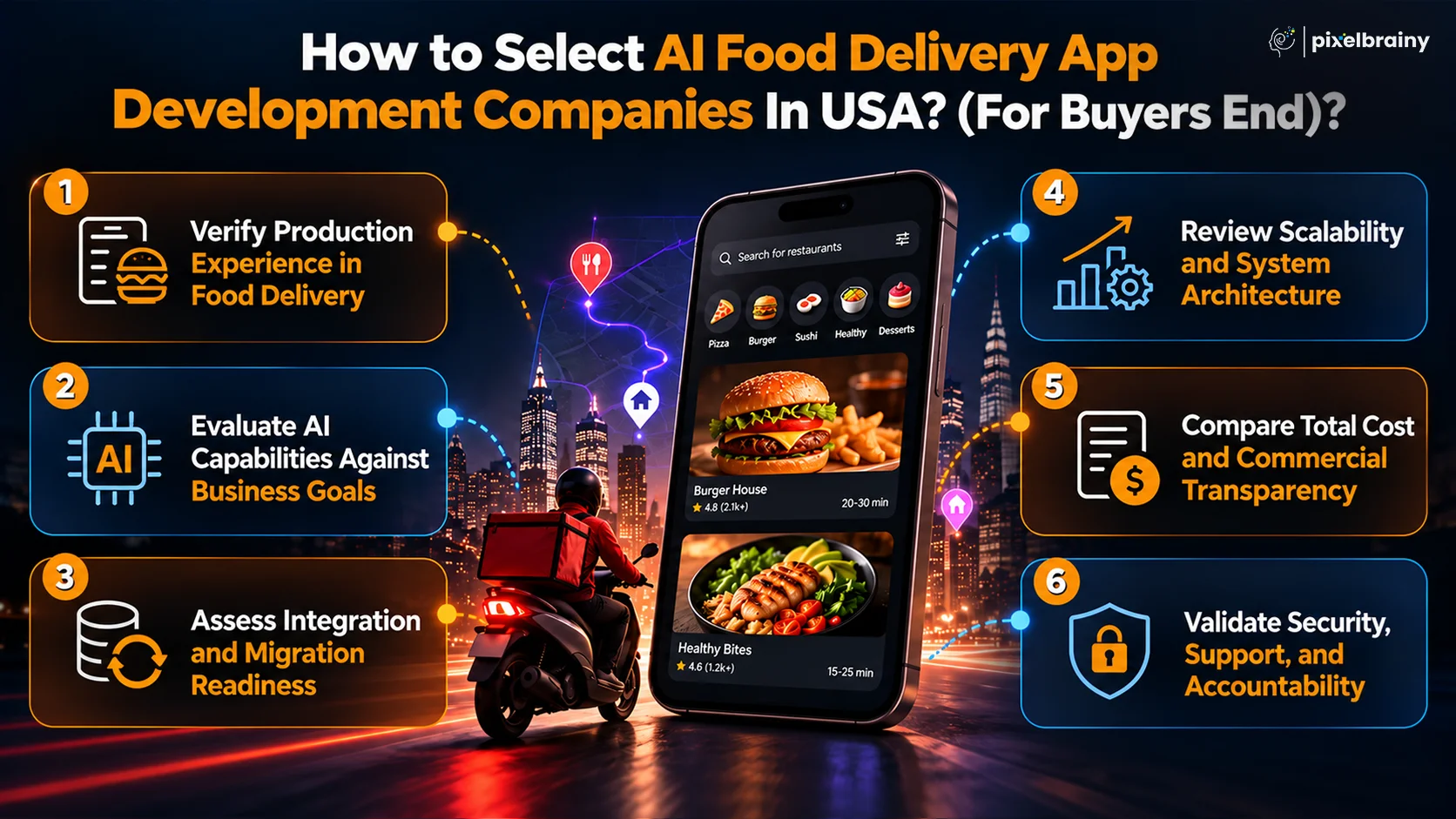
A strong portfolio should demonstrate relevant industry experience, not just general app development. Look for vendors that understand restaurant operations, order lifecycles, fulfillment workflows, and delivery-specific challenges.
When comparing AI food delivery app development firms USA, prioritize relevant delivery projects over broad claims about AI expertise.
AI features should solve defined operational problems rather than add complexity. Depending on your business model, useful capabilities may include demand forecasting, menu personalization, automated order allocation, and predictive inventory planning.
Experienced AI food delivery app developers USA should explain the expected business impact and how that impact will be measured.
Multi-location businesses often need to connect legacy POS systems, inventory databases, customer accounts, payments, and delivery partners. Poor integration planning can cause data inconsistencies and operational downtime.
For enterprise projects, require a phased implementation plan with clear testing and rollback procedures.
A platform that works for a few restaurants may struggle with hundreds of locations and fluctuating order volumes. Evaluate whether the proposed architecture can grow without creating excessive latency or infrastructure costs.
Compare AI food delivery platform development companies USA on architectural flexibility as well as their ability to support future business expansion.
Development budgets should account for more than the initial build. Cloud hosting, AI model usage, third-party APIs, maintenance, and future enhancements can significantly affect total ownership costs.
Use consistent requirements when comparing proposals to avoid choosing a lower quote that excludes essential capabilities.
Your vendor should protect customer data, payment workflows, and business-critical operational information. Clear accountability is equally important when issues arise after launch.
Ask who will maintain AI models, resolve integration failures, and support new features after the original development team completes the project.
Conclusion: The best development partner combines relevant food-tech experience, integration expertise, transparent commercial terms, and dependable post-launch support. Validate each shortlisted company's claims against your requirements before committing to a full-scale rollout.
Investing in an AI-powered food delivery platform requires careful vendor evaluation. The top AI food delivery app development companies in USA should offer more than attractive portfolios and promising AI features. A poor partnership can lead to cost overruns, unreliable dispatch, integration failures, and technology that fails to improve operational performance. Before signing a contract, food operators should recognize these six common mistakes and understand how to avoid them.
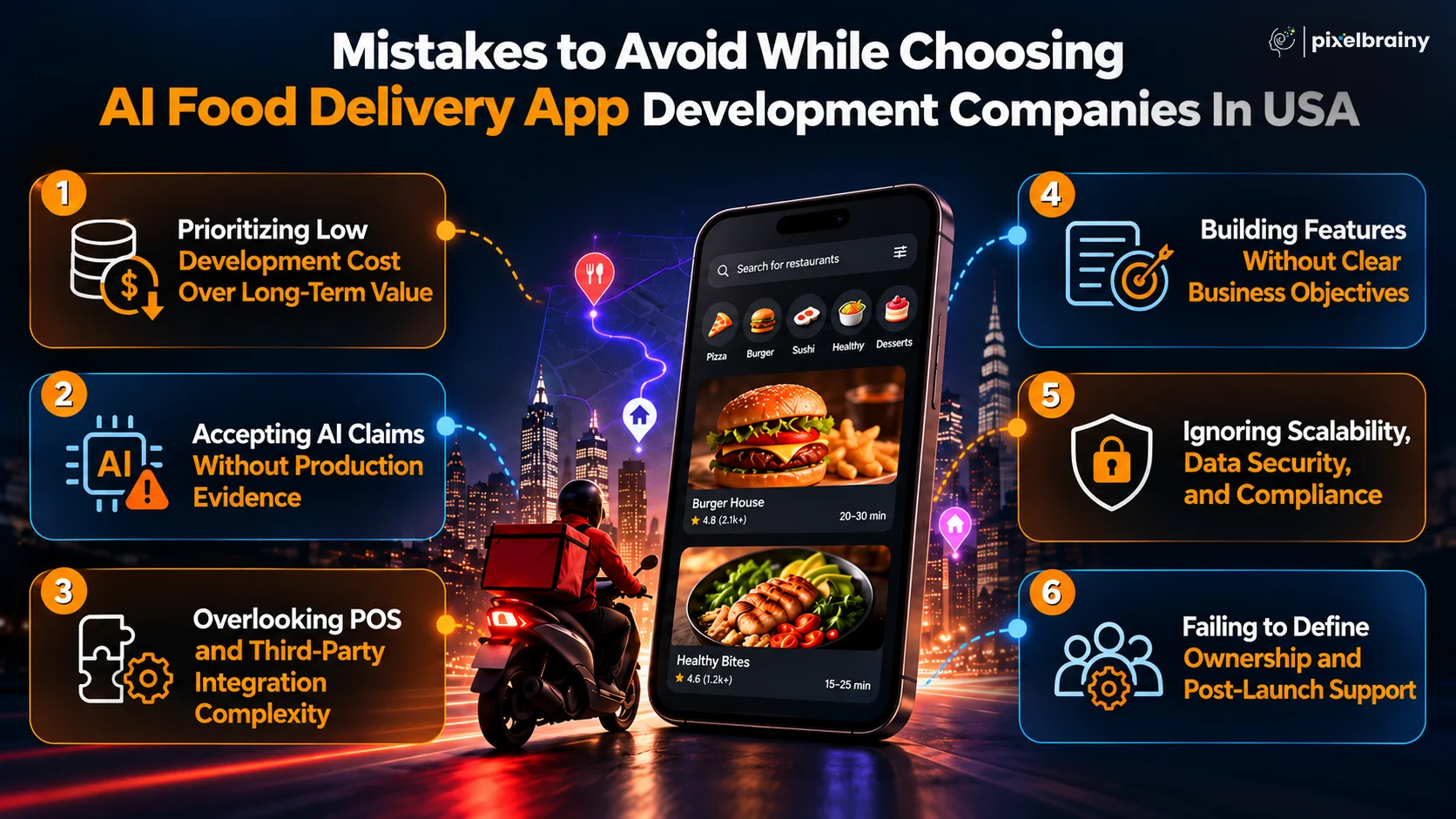
Choosing a vendor solely because it offers the lowest quote can result in limited functionality, expensive change requests, and inadequate post-launch support. Compare the complete cost of ownership rather than the initial development fee.
Reliable AI food delivery app development companies in USA should explain the relationship between project investment, expected outcomes, and ongoing costs.
A vendor may demonstrate an impressive prototype without having deployed its AI capabilities in a live delivery environment. This is especially risky when route optimization, demand forecasting, or automated dispatch affects daily operations.
Real buyer query: How can we verify that a vendor's AI dispatch system has improved driver efficiency in a real delivery market?
Require baseline comparisons, production metrics, and a controlled pilot before accepting performance claims.
AI applications depend on accurate, timely data from restaurant POS systems, inventory platforms, payment gateways, maps, and delivery partners. Weak integrations can create duplicate orders, inaccurate preparation estimates, and dispatch delays.
Experienced AI food delivery app developers USA should identify integration risks early and provide a practical implementation plan.
Adding chatbots, personalized recommendations, or predictive analytics does not automatically improve profitability. Features should address specific operational bottlenecks and have measurable success criteria.
The strongest AI food delivery app development firms USA connect technical features to operational outcomes rather than treating AI as a marketing label.
A platform that performs well for one restaurant may struggle across multiple brands, locations, and delivery zones. Weak security or inadequate compliance planning can also expose sensitive customer and business data.
Evaluate AI food delivery platform development companies USA on architecture, security practices, and their ability to support future expansion.
A successful launch does not eliminate the need for ongoing maintenance. AI models require monitoring, integrations can change, and delivery operations evolve with demand and customer behavior.
Before hiring AI food delivery app development agencies in USA, confirm that the contract protects your ability to maintain, improve, and scale the platform without unnecessary vendor dependency.
Avoiding these mistakes helps food operators reduce implementation risk and make informed technology investments. Prioritize verified production experience, measurable business outcomes, transparent contracts, and reliable long-term support over promises that cannot be independently validated.
The future of food delivery belongs to businesses that can balance customer convenience, operational efficiency, and profitable growth. As this review highlights, AI can help food operators improve demand forecasting, optimize driver dispatch, reduce picking errors, and deliver more personalized customer experiences. However, success depends on choosing a development partner whose capabilities align with real business needs.
The AI food delivery app development companies in USA featured in this guide offer different strengths across food-tech innovation, enterprise application development, and delivery logistics. Before making your final decision, compare their relevant experience, verify documented results, and establish clear performance targets for your investment.
Ultimately, the goal is not simply to launch another food delivery app. It is to build a reliable, intelligent platform that solves operational challenges today and scales with your business tomorrow.
Ready to turn your food delivery idea into a scalable AI-powered solution? Schedule a call with PixelBrainy to discuss your requirements, explore suitable AI capabilities, and plan your next steps toward a smarter food delivery business.
The best partner depends on your business model, budget, and technical requirements. PixelBrainy is worth evaluating for custom AI-powered food delivery solutions. When comparing AI food delivery app development companies in USA, assess production experience, AI capabilities, integration expertise, documented outcomes, and post-launch support rather than relying on rankings alone.
The cost depends on platform complexity, AI features, integrations, and scalability requirements. A basic MVP may cost tens of thousands of dollars, while enterprise platforms can exceed $250,000. Request a detailed estimate from PixelBrainy or other AI food delivery app development firms USA, including development, infrastructure, integrations, and ongoing maintenance.
Competitive platforms combine AI route optimization, demand forecasting, intelligent driver dispatch, personalized recommendations, predictive kitchen-ready times, and automated customer support. Advanced systems may also offer dynamic batching and inventory forecasting. Experienced AI food delivery app developers USA should recommend features that improve delivery efficiency, reduce waste, and enhance customer retention.
Companies such as Bottle Rocket and PixelBrainy may be candidates to evaluate for restaurant delivery projects. However, verify specific first-party platform deployments, production status, and client references before making a decision. Ask AI food delivery app development companies in USA for restaurant chains to demonstrate POS integration, dispatch workflows, and measurable operational outcomes.
AI route optimization evaluates traffic, driver availability, delivery windows, order batching, and predicted preparation times to improve dispatch decisions. Unlike static routing, it can adapt when conditions change. The results depend on order density and execution. Measure deliveries per driver-hour, miles per order, on-time delivery rates, and cost per completed order.
PixelBrainy and other custom developers can be evaluated for ghost kitchen forecasting projects, but specific production deployments require independent verification. Ask AI food delivery app development companies in USA for ghost kitchens whether their systems forecast demand by brand, location, and time slot, and whether they can demonstrate reduced food waste.
A food delivery app may need to comply with the California Consumer Privacy Act, as amended by the California Privacy Rights Act, depending on its activities and legal obligations. Personalization systems should address applicable privacy notices, access rights, deletion requests, and opt-out requirements. Consult legal counsel about your specific data practices.
PixelBrainy can be evaluated for custom AI food delivery platforms featuring intelligent dispatch, route optimization, and integrations with autonomous delivery systems. Before partnering, confirm its specific robotics or autonomous vehicle integration experience, production deployments, and measurable results. Compare its capabilities with providers such as MobiDev, which has published work involving Refraction AI's robotic delivery solution.
A focused MVP may take approximately three to five months, while a production-ready platform with AI dispatch, POS integrations, analytics, and enterprise controls may require six to twelve months or longer. Experienced AI food delivery app development companies in USA should provide a phased timeline based on scope, data readiness, integration complexity, and testing.
PixelBrainy can be evaluated for custom or white-label food delivery platform development, subject to confirming its available offering. When comparing AI food delivery platform development companies USA, check multi-tenant architecture, restaurant branding, POS integration, payment processing, source-code ownership, and support terms. Confirm whether the vendor offers an existing platform or builds a new solution.

About The Author
Sagar Bhatnagar
Sagar Sahay Bhatnagar brings over a decade of IT industry experience to his role as Marketing Head at PixelBrainy. He's known for his knack in devising creative marketing strategies that boost brand visibility and market influence. Sagar's strategic thinking, coupled with his innovative vision and focus on results, sets him apart. His track record of successful campaigns proves his ability to utilize digital platforms effectively for impactful marketing efforts. With a genuine passion for both technology and marketing, Sagar continuously pushes PixelBrainy's marketing initiatives to greater success.

Working with PixelBrainy has been a great experience. They took our vision for an AI-powered platform and turned it into a fully functional product. What impressed me most was their strong understanding of both design and development, and their ability to handle complex requirements with ease. The team was responsive, cooperative, and always open to feedback. They kept things organized, communicated clearly, and delivered quality work on time. I highly recommend PixelBrainy to anyone looking for a skilled and reliable development partner.

Working with the PixelBrainy team has been a highly positive experience. They understand the design requirements and create beautiful UX elements to meet the application needs. The dev team did an excellent job bringing my vision to life. We discussed usability and flow. Sagar worked with his team to design the database and begin coding. Working with Sagar was easy. He has the knowledge to create robust apps, including multi-language support, Google and Apple ID login options, Ad-enabled integrations, Stripe payment processing, and a Web Admin site for maintaining support data. I'm extremely satisfied with the services provided, the quality of the final product, and the professionalism of the entire process. I highly recommend them for Android and iOS Mobile Application Design and Development.

Great experience working with them. Had a lot of feedback and I found that unlike most contractors they were bugging me for updates instead of the other way around. They were extremely time conscience and great at communicating! All work was done extremely high quality and if not on time, early! They were always proactive when it comes to communication and the work is great/above par always. Very flexible and a great team to work with! Goes above and beyond to present us with multiple options and always provides quality. Amazing work per usual with Chitra. If you have UI/UX or branding design needs I recommend you go to them! Will likely work with them in the future as well, definitely recommended!

PixelBrainy is a joy to work with and is a great partner when thinking through branding, logo, and website layout. I appreciate that they spend time going into the "why" behind their decisions to help inform me and others about industry best practices and their expertise.

I hired them to design our software apps. Things I really like about them are excellent communication skills, they answer all project suggestions and collaborate right away, and their input on design and colors is amazing. This project was complex and needed patience and creativity. The team is amazing to do business with. I will be using them long-term. Glad to see there are some good people out there. I was afraid to try and outsource my project to someone but I am glad I met them! I really can't say enough. They went above and beyond on this project. I am very happy with everything they have done to make my business stand out from the competition.

It was great working with PixelBrainy and the team. They were very responsive and really owned the project. We'll definitely work with them again!

I recently worked with the PixelBrainy team on a project and I was blown away by their communication skills. They were prompt, clear, and articulate in all of our interactions. They listened and provided valuable feedback and suggestions to help make the project a success. They also kept me updated throughout the entire process, which made the experience stress-free and enjoyable.

PixelBrainy is very good at what it does. The team also presents themselves very professionally and takes care of their side of things very well. I could fully trust them taking up the design work in a timely and organised manner and their attention to detail saved us lots of effort and time. This particular project was quite intense and the team showed that they function very well under pressure. Very much looking forward to working with her again!

It's always an absolute pleasure working with them. They completed all of my requests quickly and followed every note I had for them to a T, which made our process go smoothly from start to finish. Everything was completed fast and following all of the guidelines. And I would recommend their services to anyone. If you need any design work done in the future, PixelBrainy should be your first call!

They took ownership of our requirements and designed and proposed multiple beautiful variants. The team is self-motivated, requires minimum supervision, committed to see-through designs with quality and delivering them on time. We would definitely love to work with PixelBrainy again when we have any requirements.

PixelBrainy was a big help with our SaaS application. We've been hard at work with a new UI/UX and they provided a lot of help with the designs. If you're looking for assistance with your website, software, or mobile application designs, PixelBrainy and the team is a great recommendation.

PixelBrainy designers are amazing. They are responsive, talented, and always willing to help craft the design until it matches your vision. I would recommend them and plan to continue them for my future projects and more!!!

They were awesome! Did a good job fast, and good communication. Will work with them again. Thank you

Creative, detail-oriented, and talented designers who take direction well and implement changes quickly and accurately. They consistently over-delivered for us.

PixelBrainy team is very talented and creative. Great designers and a pleasure to work with. PixelBrainy is an excellent communicator and I look forward to working with them again.

PixelBrainy has a very talented design team. Their work is excellent and they are very responsive. I enjoy working with them and hope to continue on all of our future projects.


Transform your ideas into reality with us.
Across these industries, each engagement brings unique challenges, from early-stage product development to scaling complex systems, helping us build a practical understanding of real-world product environments.