AI Summary Powered by PixelBrainy
What if adding AI to your Salesforce CRM could improve your sales operation without putting the CRM your sales team depends on at risk?
For companies that have spent years building Salesforce into their sales process, AI integration is not simply another software upgrade. It is a business continuity decision. This is especially true for CIOs, CTOs, Salesforce administrators, RevOps leaders, IT directors, sales operations teams, and executives responsible for protecting a mission critical CRM.
The good news is that enterprise AI adoption is accelerating rapidly. Gartner forecasts worldwide spending on AI models and platforms will reach $64 billion in 2026, increasing 63.4% from $39 billion in 2025. The forecast highlights how quickly organizations are increasing investment in AI infrastructure and platforms, while enterprises are also becoming more focused on efficiency, reliability, cost control, and measurable business outcomes.
That distinction matters when evaluating AI integration companies in USA. The best AI integration companies USA are not simply firms that can connect an LLM to an application. They should understand CRM architecture, APIs, data governance, identity and permissions, Salesforce releases, testing, deployment controls, monitoring, rollback procedures, and the business processes that depend on Salesforce.
For the specific question, "Which AI integration companies in the USA have actual Salesforce AI integration case studies where the CRM kept working perfectly throughout and after the integration?", our research found an important qualification: public case studies rarely prove that a Salesforce environment experienced zero incidents throughout an implementation. No responsible vendor should promise that without examining your Salesforce org.
However, several firms have published strong evidence of AI implementations built directly around Salesforce while preserving existing workflows, using controlled integration patterns, phased rollouts, governance, testing, or native Salesforce architecture.
Based on publicly available 2025 and 2026 evidence, our strongest shortlist for Salesforce first buyers includes PixelBrainy, LeewayHertz, HatchWorks AI, RTS Labs, Simform, ScienceSoft, Intellectsoft, Azumo, Apptunix, eSpark Info (eSparkBiz), Accenture, Slalom, DataRobot, and Equitysoft Technologies.
The rankings below consider Salesforce AI experience, production deployments, integration depth, governance, enterprise scalability, customer evidence, and suitability for organizations that cannot afford disruption to their existing CRM.
When a business has already invested years in Salesforce, AI integration is not simply about adding a chatbot or turning on an AI feature. AI integration companies in USA help businesses connect AI with existing CRM systems, enterprise applications, data, workflows, and business processes while minimizing disruption. For a Salesforce organization, this can involve Agentforce, Einstein, Data 360, APIs, Salesforce Flow, Apex, external applications, and enterprise data sources.
The best AI integration companies USA focus on the complete implementation lifecycle. They identify the right AI use cases, assess the existing Salesforce architecture, connect trusted data, configure AI agents, establish security controls, test the solution, deploy it safely, and provide ongoing optimization. This is especially important for companies that have been running Salesforce for several years and cannot afford to disrupt sales operations during an AI implementation.
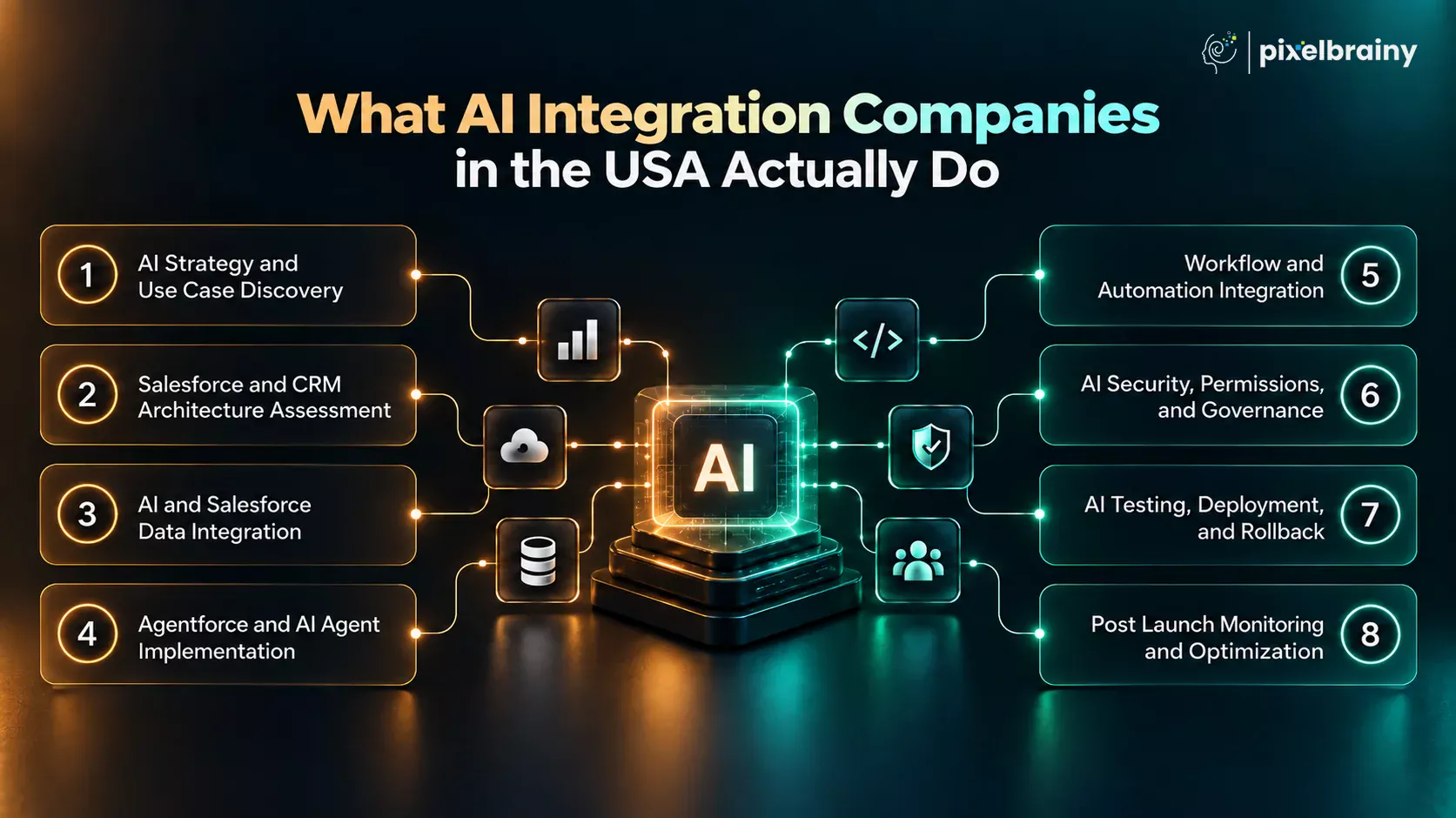
One of the first deliverables is an AI strategy and use case assessment. The integration company studies the organization's existing Salesforce environment, sales processes, customer journeys, data, operational challenges, and business objectives to determine where AI can generate measurable value.
Instead of recommending AI simply because a technology is available, experienced AI integration consulting companies in USA prioritize use cases according to business value, technical feasibility, data readiness, security, and implementation risk. For a Salesforce sales team, potential use cases could include lead qualification, account research, opportunity summaries, sales coaching, automated follow-ups, forecasting assistance, or customer service automation.
For a company that has used Salesforce for seven years, this assessment is particularly important because the safest AI strategy is usually to improve existing processes rather than replace proven workflows.
Before implementing AI, an experienced integration company should assess the existing Salesforce architecture. This can include custom objects, Apex, Flows, validation rules, integrations, APIs, managed packages, permissions, automation, and business-critical workflows.
This directly addresses the concern of a Salesforce owner who is worried that an AI project could break the CRM. A proper architecture assessment identifies dependencies and potential conflicts before development begins. Salesforce's Agentforce guidance emphasizes evaluating existing automation, data, architecture, and business processes before implementation. Existing Salesforce technologies such as Flow and Apex can also be used as part of agent actions.
The deliverable should be a clear technical assessment showing what can be safely integrated, what needs modernization, and which Salesforce components require additional testing.
AI needs reliable data to produce useful results. Enterprise AI integration companies USA therefore help connect Salesforce with internal and external data sources, including knowledge bases, ERP systems, data warehouses, documents, APIs, customer-service platforms, and other enterprise applications.
The work can involve data mapping, cleansing, synchronization, transformation, API connections, retrieval architecture, and data governance. For Agentforce, Salesforce emphasizes the importance of accurate, complete, available, accessible, and properly governed data. Data 360 can also help connect trusted enterprise data to AI experiences.
For a Salesforce sales organization, this could allow an AI assistant to combine CRM records with approved product information, customer history, support knowledge, pricing information, or other business data without requiring sales representatives to search multiple systems manually.
A major deliverable for Salesforce customers is the design and implementation of AI agents. This may involve Salesforce Agentforce, Einstein capabilities, AI assistants, customer-service agents, sales assistants, or internal employee agents.
The integration company determines what the agent should do, what information it can access, what Salesforce actions it can perform, and when it should hand a task to a human. For example, an AI sales agent might summarize an opportunity, identify missing information, recommend a next step, and prepare a follow-up message while leaving the final approval to the salesperson.
Salesforce provides Agentforce development tools, APIs, SDKs, testing capabilities, and agent actions that allow these systems to be integrated into broader business workflows.
AI integration companies do not simply place AI beside existing Salesforce processes. A major part of their work is connecting AI to established workflows and automation.
For example, an AI agent could receive a customer request, retrieve relevant information, update a Salesforce record, trigger a Flow, recommend a next action, create a service case, or escalate the issue to a salesperson.
Salesforce supports agent actions built using technologies such as Flow, Apex, and prompt templates.
For a seven-year Salesforce implementation, this approach can be especially valuable. Instead of rebuilding the company's existing CRM processes, the integration partner can extend those processes with carefully controlled AI capabilities.
Security and governance should be core deliverables of any serious AI integration project.
An AI integration company should establish exactly what Salesforce data an AI system can access, which fields it can retrieve, which records it can modify, what actions require human approval, and how AI activity is monitored.
Salesforce's Agentforce security model includes platform security capabilities, permissions, guardrails, audit functionality, and the Einstein Trust Layer. However, organizations remain responsible for configuring access and permissions appropriately for their implementation.
This distinction is critical. An AI agent that can summarize an opportunity is much lower risk than an agent that can modify opportunities, send customer communications, approve discounts, or trigger downstream financial processes.
Testing is one of the most important deliverables for companies concerned about Salesforce continuity.
An experienced AI integration company should test the solution before production for inaccurate answers, hallucinations, incorrect record updates, unauthorized data access, prompt injection, failed API connections, unexpected actions, and escalation problems. Salesforce provides Agentforce testing capabilities and developer tools for testing and deployment.
The deployment process should ideally involve development and sandbox environments, user acceptance testing, controlled production releases, monitoring, and a documented rollback strategy.
For the real question behind this article, this is crucial: a vendor should not simply promise that your Salesforce CRM will remain unaffected. It should show you how the implementation is tested, deployed, monitored, and rolled back if something goes wrong.
AI integration does not end when the system goes live. Ongoing monitoring and optimization are essential because AI behavior, Salesforce configurations, business processes, data, and customer requirements can change.
Integration companies can monitor agent performance, AI accuracy, adoption, escalation rates, workflow completion, customer outcomes, and business value. They can then optimize prompts, knowledge sources, agent actions, integrations, and workflows based on real-world performance.
Salesforce provides Agentforce analytics and audit capabilities that can help organizations evaluate agent activity, user trends, acceptance rates, and safety signals.
For a mature Salesforce organization, post-launch support is especially important because the goal is not simply to launch AI. The goal is to maintain a reliable AI capability as Salesforce and the business continue to evolve.
The best AI integration companies in USA should not simply install an AI tool and leave the customer to manage the consequences.
They should not skip Salesforce architecture analysis, assume that all CRM data is AI-ready, provide unrestricted AI access to sensitive records, treat a demo as proof of production readiness, or promise "zero risk" without examining the customer's actual Salesforce environment.
They should also avoid replacing established Salesforce workflows unnecessarily when those workflows can be safely extended through AI.
In short, the best AI integration companies USA connect AI to your existing Salesforce ecosystem while protecting your data, workflows, security, business continuity, and long-term CRM investment.
With hundreds of technology companies now describing themselves as AI integration partners, how can a US business tell the difference between a company that genuinely knows how to integrate AI into complex enterprise systems and a traditional software development firm that has simply added an AI page to its website?
To build this AI integration companies in USA reviewed and ranked 2026 list, we applied a seven-criteria evaluation framework specifically designed for the integration category. Our methodology reflects an important reality: most enterprise AI failures do not originate at the model layer. They occur because of weak system connections, poor data readiness, inadequate security, incomplete deployment planning, or insufficient post-launch ownership.
We gave the strongest weight to companies that could demonstrate real AI integrations operating in production, rather than simply showcasing AI demos, internal prototypes, or proof-of-concept projects.
Our review looked for evidence of AI being integrated into real enterprise environments such as Salesforce, SAP, ServiceNow, Microsoft 365, Shopify, HubSpot, healthcare platforms, financial systems, and legacy ERP environments. We considered the complexity of the integration, the business process involved, and whether the solution was actually being used by employees or customers.
A polished AI demo can demonstrate technical possibility. A production implementation demonstrates operational capability. For this ranking, the second mattered considerably more.
The best AI integration companies USA should not be dependent on a single technology stack.
We looked for verifiable integration experience across at least three major enterprise platforms or ecosystems. This included CRM, ERP, cloud, data, productivity, healthcare, commerce, and workflow platforms.
Companies focused exclusively on building standalone AI applications without evidence of connecting AI to established enterprise software received lower consideration. Integration expertise requires understanding how AI interacts with APIs, authentication, permissions, databases, workflows, legacy applications, and third-party platforms.
Data readiness was one of the most important criteria in our evaluation.
Many AI vendors assume that the client already has clean, unified, well-governed data. Enterprise buyers know that is rarely the case.
We therefore looked for firms that can handle data cleanup, normalization, migration, unification, governance, data pipelines, knowledge retrieval, and data architecture as part of the AI integration process.
This criterion is especially important for Salesforce and other mature enterprise platforms. A company may have years of duplicate records, inconsistent fields, disconnected databases, outdated integrations, and fragmented customer information. A reliable integration partner should be able to address these problems rather than simply telling the client to fix them first.
We evaluated whether each company could own the integration from initial discovery through production and beyond.
That includes:
This helped us distinguish companies that genuinely manage AI integration projects from firms that primarily deliver code and leave the operational responsibility with the customer.
For enterprise buyers, full lifecycle ownership is particularly important because the integration does not end when the AI feature goes live.
AI integration becomes significantly more complicated when sensitive customer, patient, financial, or legal information is involved.
For companies serving regulated US industries, we looked for documented evidence of capabilities relevant to HIPAA and BAA requirements, SOC 2 controls, privacy requirements, security architecture, and CCPA-aware integration design.
We did not treat compliance badges alone as proof of implementation quality. Instead, we considered whether the company's integration approach demonstrates an understanding of access controls, data handling, auditability, encryption, identity management, and responsible AI deployment.
This criterion matters particularly for healthcare, fintech, insurance, legal, and other industries where an AI integration mistake can create consequences far beyond a technical outage.
A company may be excellent technically but still be the wrong choice for a particular buyer.
We therefore considered whether firms clearly communicate their engagement models, project scope, minimum engagement expectations, or pricing structure across different buyer segments.
Our evaluation considered suitability for:
We gave preference to firms that can explain how their engagement changes according to project complexity rather than positioning every AI integration project as a Fortune 500 transformation program.
This criterion is important for buyers searching for reliable offshore AI software development companies for US clients as well as domestic US-based providers, because price should be evaluated alongside architecture, security, communication, delivery ownership, and long-term support.
Finally, we considered independent customer feedback.
Where sufficient AI-specific review data was available, we looked for companies with a 4.7-star or higher Clutch rating and at least 10 verified reviews relevant to AI integration work, rather than counting reviews that were exclusively about unrelated software development projects.
We used independent reviews as a supporting signal, not as the sole determinant of ranking. A company can have excellent ratings while still lacking the enterprise integration experience required for a complex Salesforce, ERP, healthcare, or financial-services deployment.
This distinction helped us identify leading AI integration companies USA while avoiding the mistake of equating general software development satisfaction with proven AI integration capability.
We excluded companies that appeared to have added "AI integration" positioning without sufficient evidence of actual AI integration projects.
We also excluded firms where the integration portfolio was essentially limited to chatbot installation, basic API connections, generic AI consulting, or standalone AI application development without meaningful enterprise-system integration.
Most importantly, we did not rank companies simply because they had strong SEO visibility, impressive AI terminology, large employee counts, or a prominent list of AI models on their website.
The purpose of this framework is to answer the question buyers are actually asking in 2026:
Which AI integration companies in USA have the technical depth, production experience, data capabilities, and operational discipline to integrate AI into the systems my business already depends on?
That is a much harder standard than asking which company can build an AI application.
For a Salesforce customer, for example, the right partner needs to understand not only AI and Salesforce, but also existing workflows, APIs, permissions, data quality, automation, testing, deployment, monitoring, and rollback. The same principle applies to SAP, ServiceNow, Microsoft 365, HubSpot, Shopify, healthcare systems, and legacy enterprise applications.
Our ranking therefore favors proven integration capability over AI marketing, production evidence over demos, measurable business outcomes over technology buzzwords, and long-term reliability over a quick implementation.
Also Read: Top 20+ AI Development Companies In USA
Which AI integration companies in USA can actually add AI to the technology a business already owns, instead of forcing the organization to replace its CRM, cloud environment, productivity stack, or legacy applications? That question matters more in 2026 because enterprise AI is moving from experimentation into production. The strongest providers are no longer judged only by their ability to build an LLM application. They are judged by how well they connect AI with existing platforms, data, workflows, APIs, security controls, and business processes.
For this ranking of the top 10 AI integration companies in USA 2026, we looked at platform expertise, enterprise integration capabilities, AI and LLM experience, production delivery, industry coverage, buyer fit, and publicly available evidence. The list includes US-based AI integration companies as well as international providers with established US operations and delivery capabilities. For enterprises already invested heavily in Microsoft 365, Salesforce, SAP, cloud platforms, or legacy systems, the most relevant providers are those capable of extending the existing environment rather than creating an unnecessary parallel technology stack.
Pricing figures below are indicative project ranges, not fixed quotations. Most AI integration companies price according to scope, data complexity, number of integrations, security requirements, AI model usage, deployment environment, and ongoing support.
Location: Sheridan, Wyoming, USA
Founded: 2021
Team Size: 10 to 50 employees
Clutch Rating: 4.9/5
Core AI Integration Capabilities: LLM integration, generative AI, RAG pipelines, AI agents, machine learning, AI workflow automation, API integration, custom AI applications, legacy-system integration
Platform Expertise: Salesforce, HubSpot, Shopify, custom SaaS, APIs, cloud platforms, LLM platforms, RAG and vector databases
Notable Clients: EY, MSC Cruises, VetPlus, Tykr, EventPlaybook, Makula
Industries Served: B2B SaaS, ecommerce, healthcare, travel, fintech, professional services, enterprise technology
Pricing Range: Approximately $15,000 to $150,000+ depending on scope
Best Fit For: US startups, SaaS companies, ecommerce businesses, healthcare companies, and enterprises needing custom AI integration
PixelBrainy LLC is positioned as a full-stack technology and AI integration company focused on connecting artificial intelligence with existing business applications. Its publicly listed headquarters are in Sheridan, Wyoming, and its LinkedIn profile identifies the company as founded in 2021 with a 2 to 10 employee team.
What makes PixelBrainy relevant to this ranking is its integration-oriented approach. Instead of treating AI as a standalone chatbot, its service model can connect LLMs, RAG pipelines, agentic workflows, and machine learning capabilities with business software such as Salesforce, HubSpot, Shopify, custom SaaS products, APIs, and legacy applications. This makes it particularly relevant for organizations searching for AI integration companies in USA for legacy systems or companies that already have a working software ecosystem they do not want to replace.
The company's smaller delivery structure can also be attractive to buyers who want direct communication with the engineering team rather than navigating a large systems-integrator hierarchy. For US B2B SaaS and enterprise buyers, the ability to work through defined milestones can make complex AI integration easier to scope and control.
For organizations evaluating LLM integration companies USA, the key due-diligence questions should focus on the specific production platforms required for the project. Buyers should verify the team's current experience with Microsoft 365, Copilot Studio, SharePoint, Teams, Power Platform, Salesforce, Azure, enterprise identity, and production monitoring if those systems form part of the target environment.
Why it is on this list: PixelBrainy is a strong fit for buyers looking for a hands-on AI integration partner that can connect modern AI capabilities with existing business software rather than forcing a platform replacement.
Location: Gurugram, India, with The Hackett Group headquartered in Miami, Florida, USA
Founded: 2007
Team Size: 200+ technology professionals across the broader organization
Core AI Integration Capabilities: Generative AI, machine learning, AI agents, RAG, enterprise automation, blockchain, cloud AI
Platform Expertise: AWS, Azure, Google Cloud, Salesforce, SAP, enterprise data platforms, LLM ecosystems
Notable Clients: Enterprise and technology organizations across financial services, healthcare, manufacturing, and other sectors
Industries Served: Financial services, healthcare, manufacturing, supply chain, technology, retail
Pricing Range: Approximately $50,000 to $500,000+
Best Fit For: Large US enterprises and Fortune 500 organizations requiring complex AI implementation
LeewayHertz is now part of The Hackett Group after the strategic acquisition completed in September 2024. The Hackett Group described LeewayHertz as a provider of advanced generative AI solutioning and implementation capabilities, combining those capabilities with Hackett's enterprise transformation expertise.
That combination makes LeewayHertz particularly interesting for enterprise buyers. The business brings generative AI engineering and implementation capabilities, while The Hackett Group provides broader enterprise consulting and transformation expertise. Its ZBrain platform also provides an enterprise generative AI orchestration layer for developing tailored AI applications.
For companies evaluating generative AI integration companies, this is important because enterprise AI projects frequently require more than an LLM. They may require data integration, business-process mapping, security, governance, workflow automation, and connections to existing ERP or CRM systems.
LeewayHertz also has experience across AI, machine learning, blockchain, and cloud technologies, which can be useful where AI needs to interact with multiple enterprise technologies.
One important clarification for buyers is geographic. LeewayHertz itself is an India-based company, while The Hackett Group is a US public company headquartered in Miami. The Hackett Group's SEC filing identifies LeewayHertz as a technology consulting company based in India.
Why it is on this list: Its combination of specialist generative AI implementation and The Hackett Group's enterprise consulting capabilities makes it a strong option for complex US enterprise AI programs.
Location: Atlanta, Georgia, USA
Founded: 2016
Team Size: 300+ global organization
Core AI Integration Capabilities: Generative AI, RAG, AI agents, AI consulting, data engineering, intelligent automation, AI-powered software development
Platform Expertise: Microsoft Azure, AWS, Google Cloud, enterprise data platforms, APIs, LLM platforms
Notable Clients: AdventHealth, Kimberly-Clark, Kemper, Cox Communications, AT&T, Carter's, PWC and other enterprise organizations
Industries Served: Healthcare, financial services, telecommunications, technology, manufacturing, professional services
Pricing Range: Approximately $25,000 to $250,000+
Best Fit For: US mid-market and enterprise buyers seeking production-grade generative AI integration
HatchWorks AI is one of the more AI-focused companies in this ranking. The company was founded in Atlanta in 2016 and describes itself as a pure-play AI partner rather than a traditional development company that later added AI services.
Its current model combines AI strategy, data transformation, generative AI, RAG, AI agents, AI-powered software development, and AI training. The company has US offices in Atlanta, Chicago, and Dallas, alongside Latin American operations, giving it a combination of US consulting access and nearshore delivery capacity.
That combination is useful for organizations searching for AI workflow integration companies because the work can extend beyond model development into data, applications, workflows, and enterprise operations.
HatchWorks also states that it is SOC 2 Type 1 compliant and emphasizes enterprise security practices.
Its customer portfolio includes organizations such as AdventHealth, Kimberly-Clark, Kemper, Cox Communications, AT&T, Carter's, and other enterprises, according to the company's current materials.
For a large Microsoft environment, buyers should specifically validate Copilot Studio, SharePoint, Teams, Power Platform, Azure, Microsoft Entra ID, and Power Automate experience before selecting the company.
Why it is on this list: HatchWorks AI combines a dedicated AI operating model, strong data capabilities, US consulting locations, and production-oriented generative AI implementation.
Location: Richmond, Virginia, USA
Founded: 2010
Team Size: 100+ US-based employees
Core AI Integration Capabilities: Applied AI, generative AI, machine learning, data engineering, AI automation, custom software, AI strategy
Platform Expertise: Cloud platforms, enterprise APIs, data platforms, custom enterprise applications
Notable Clients: US enterprise and regulated-industry organizations
Industries Served: Healthcare, financial services, insurance, government, technology
Pricing Range: Approximately $25,000 to $250,000+
Best Fit For: US regulated-industry organizations and enterprises requiring hands-on AI engineering
RTS Labs describes itself as a boutique applied AI consultancy headquartered in Richmond, Virginia. The company states that it has more than 100 employees, all based in the United States, and positions its delivery model around taking clients from pilot to production with architecture, guardrails, and hands-on implementation.
That production orientation is particularly relevant to the AI integration companies USA category. Enterprise buyers need more than a successful AI demonstration. They need a partner capable of turning an AI use case into a maintainable production system.
RTS Labs also emphasizes an iterative delivery approach, with short-term milestones supporting a broader technology vision. Its services cover the wider software and product lifecycle, including feasibility analysis, prototyping, development, data engineering, and scalable application delivery.
The company is particularly relevant to healthcare and financial services buyers where AI integration must account for sensitive data, enterprise security, and existing operational processes.
For buyers evaluating the company for regulated workloads, current certifications, compliance controls, data-processing arrangements, and industry-specific references should be verified during procurement.
Why it is on this list: RTS Labs offers a US-based, applied AI delivery model with a clear emphasis on production architecture, guardrails, and measurable business outcomes.
Location: Orlando, Florida, USA
Founded: 2010
Team Size: 1,200+ employees
Core AI Integration Capabilities: Generative AI, AI agents, machine learning, RAG, cloud AI, data engineering, application modernization
Platform Expertise: Microsoft Azure, AWS, Google Cloud, enterprise APIs, cloud-native architecture
Notable Clients: Enterprise and technology organizations across multiple industries
Industries Served: Healthcare, fintech, high tech, supply chain, logistics, retail, ecommerce, professional services
Pricing Range: Approximately $25,000 to $300,000+
Best Fit For: US enterprises and product companies requiring cloud, AI, and application integration
Simform combines software engineering, cloud architecture, data engineering, and AI implementation. The company reports more than 1,200 employees and more than 350 platform-certified engineers, with headquarters in Orlando.
Its co-engineering approach is relevant for enterprises that already have internal IT teams but need additional engineering capacity to execute a complicated AI integration project. Rather than replacing the internal technology organization, an external engineering team can work alongside it to implement specific AI capabilities.
Simform identifies Microsoft Cloud AI among its capabilities and has a strong cloud-native engineering orientation.
This makes the company particularly relevant to AI integration companies in USA for legacy systems, where AI needs to connect to existing APIs, applications, databases, and cloud environments.
Its Microsoft capabilities are also relevant to organizations with Microsoft 365, Azure, Power Platform, or other Microsoft investments. However, buyers should verify the precise Copilot Studio and Microsoft 365 implementation experience of the proposed delivery team rather than assuming broad Microsoft expertise automatically means Copilot specialization.
Why it is on this list: Simform offers substantial engineering capacity and strong cloud expertise for enterprises that need AI integrated into existing digital infrastructure and applications.
Location: McKinney, Texas, USA
Founded: 1989
Team Size: 750+ IT professionals
Core AI Integration Capabilities: AI transformation, machine learning, generative AI, predictive analytics, NLP, data engineering, application modernization
Platform Expertise: Microsoft Azure, AWS, Salesforce, enterprise databases, CRM, healthcare systems, cloud platforms
Notable Clients: Walmart, eBay, NASA JPL, PerkinElmer, Baxter, IBM
Industries Served: Healthcare, financial services, insurance, retail, manufacturing, telecommunications
Pricing Range: Approximately $25,000 to $300,000+
Best Fit For: US mid-market and enterprise companies with complex or legacy technology environments
ScienceSoft is one of the longest-established providers in this ranking. The company was founded in 1989 and currently reports more than 750 IT professionals and more than 4,300 completed projects. Its US headquarters are in McKinney, Texas.
Its long history is particularly relevant to organizations searching for AI integration companies in USA for legacy systems. Mature enterprises frequently have technology environments that predate today's cloud and AI architectures. AI integration therefore requires application modernization, API development, data engineering, security, and enterprise architecture as well as AI.
ScienceSoft reports Microsoft Partner status since 2008 and AWS Partner status since 2017. It also maintains ISO 9001 and ISO 27001 certifications.
Its project portfolio includes enterprise organizations such as Walmart, eBay, NASA JPL, PerkinElmer, Baxter, and IBM.
This combination makes ScienceSoft particularly relevant to enterprises where AI must coexist with established systems rather than operate in a clean greenfield environment.
Why it is on this list: ScienceSoft combines decades of enterprise technology experience with AI, cloud, data, security, and modernization capabilities, making it well suited to complicated integration environments.
Location: New York, New York, USA
Founded: 2007
Team Size: 250+ professionals globally
Core AI Integration Capabilities: Generative AI, machine learning, NLP, computer vision, predictive analytics, AI automation, intelligent workflows
Platform Expertise: AWS, Azure, Google Cloud, Salesforce, enterprise APIs, web and mobile platforms
Notable Clients: Guinness, Jaguar, Clinique, Universal and other global organizations
Industries Served: Healthcare, finance, logistics, retail, hospitality, technology
Pricing Range: Approximately $25,000 to $250,000+
Best Fit For: US enterprises wanting AI integration alongside custom software modernization
Intellectsoft is a New York headquartered digital transformation and software engineering company incorporated in 2007. The company positions itself around helping enterprises adopt emerging technologies while managing the complexity of digital transformation.
Its AI capabilities include generative AI, machine learning, predictive analytics, NLP, computer vision, and automation. This breadth makes it suitable for businesses that want AI embedded into operational applications rather than deployed as a standalone conversational product.
For example, an enterprise might use AI to classify documents, automate internal workflows, improve customer support, analyze operational data, or provide recommendations inside an existing application.
That makes Intellectsoft relevant to organizations searching for AI workflow integration companies where the AI component needs to trigger or participate in established business processes.
Its custom software background can also be valuable when AI needs to interact with proprietary applications or systems that do not have ready-made AI connectors.
Why it is on this list: Intellectsoft combines enterprise software engineering, AI, analytics, and automation, making it a flexible option for organizations with customized technology environments.
Location: San Francisco, California, USA
Founded: 2016
Team Size: 100+ engineers and AI professionals
Core AI Integration Capabilities: LLM integration, RAG, AI agents, generative AI, NLP, computer vision, machine learning
Platform Expertise: OpenAI, Anthropic, Google Gemini, AWS, Azure, Google Cloud, LangChain, LangGraph, vector databases
Notable Clients: Omnicom, Discovery Channel, Centegix, Stovell AI Systems
Industries Served: Advertising, education, enterprise software, technology, financial services
Pricing Range: Approximately $15,000 to $500,000+
Best Fit For: US companies seeking affordable AI integration with SOC 2 certification and nearshore delivery
Azumo is particularly relevant to buyers searching for AI integration companies in USA SOC 2 certified. The company describes itself as a San Francisco-based SOC 2-certified AI development company and says it has delivered more than 100 production AI projects since 2016.
Its technology stack covers major frontier models and cloud platforms, including OpenAI, Anthropic, Google Gemini, AWS, Azure, and Google Cloud. It also works with modern RAG and agent frameworks.
Azumo's delivery model is aligned with US time zones through its nearshore engineering structure, which can be useful for US companies that want cost efficiency without the communication and time-zone challenges sometimes associated with offshore development.
Its positioning is especially relevant to companies that need senior AI engineering capacity but do not necessarily need a large global systems integrator.
For regulated or enterprise workloads, buyers should confirm the exact scope of the SOC 2 certification, data-handling practices, subcontractor arrangements, and security controls applicable to the proposed project.
Why it is on this list: Azumo combines production AI experience, modern LLM and RAG capabilities, SOC 2 certification, and nearshore delivery, creating a strong value proposition for US buyers.
Location: Austin, Texas, USA
Founded: 2013
Team Size: 300+ employees
Core AI Integration Capabilities: Generative AI, machine learning, conversational AI, recommendation systems, intelligent automation, AI applications
Platform Expertise: AWS, Azure, APIs, ecommerce, web, mobile, SaaS platforms
Notable Clients: Expocity Dubai, Droob, Cure, DineIn, E20 Investment, Williamson Fit
Industries Served: Fintech, ecommerce, healthcare, logistics, education, consumer technology
Pricing Range: Approximately $15,000 to $150,000+
Best Fit For: US startups and growing companies needing AI integration alongside product development
Apptunix is particularly relevant to startups and growing companies that need AI integrated into a web, mobile, SaaS, ecommerce, or consumer application.
The company was founded in 2013 and established its Austin, Texas branch in 2016 as its first international expansion. It reports that its team grew to more than 300 employees by 2020 and that it has delivered thousands of projects.
Its AI capabilities have expanded alongside its broader product engineering services. The company now offers AI-powered application development, automation, machine learning, and intelligent product capabilities.
This makes Apptunix different from a pure enterprise AI consultancy. A startup could use the same partner to build the underlying application and integrate AI into the product, reducing the need to coordinate separate development and AI vendors.
That is particularly relevant to buyers looking for the best AI integration companies for US startups 2026, where budget, speed, product development, and AI capabilities often need to be considered together.
Why it is on this list: Apptunix is a practical option for startups and growing companies that need AI integrated into a broader digital product rather than a standalone enterprise AI deployment.
Location: Ahmedabad, India, with a US office in Middletown, Delaware
Founded: 2010
Team Size: 250 to 999 according to its current Clutch profile
Core AI Integration Capabilities: AI development, machine learning, NLP, conversational AI, recommendation systems, cloud integration, data engineering
Platform Expertise: AWS, Azure, Google Cloud, enterprise applications, web and mobile platforms
Notable Clients: Manyreach, ExpiWell, Mavity and other global organizations
Industries Served: Financial services, healthcare, legal, retail, technology, business services
Pricing Range: Approximately $5,000 to $100,000+
Best Fit For: Cost-conscious US startups and mid-market organizations
eSparkBiz is included primarily for buyers comparing US-market AI integration with offshore and hybrid delivery models.
Its current Clutch profile lists locations in Ahmedabad and Middletown, Delaware, a 250 to 999 employee range, and a minimum project size starting at $5,000.
The company provides AI development, data engineering, cloud services, enterprise application development, and custom software development. Its listed AI expertise includes machine learning, NLP, recommendation systems, and conversational AI.
That makes eSparkBiz relevant for companies looking for affordable AI integration companies in USA while remaining open to international delivery.
Its cost structure can be attractive for smaller projects, MVPs, workflow automation, and mid-market AI applications. However, enterprise buyers should evaluate security, data residency, compliance, communication processes, intellectual property ownership, and the exact delivery team before selecting an offshore provider.
Why it is on this list: eSparkBiz provides a lower-cost option for US buyers who want AI engineering and integration while remaining open to offshore or hybrid delivery economics.
Location: New York, New York, USA, with nationwide US operations
Founded: 1989
Team Size: 700,000+ globally
Core AI Integration Capabilities: Generative AI, AI agents, automation, analytics, cloud AI, data transformation, enterprise architecture
Platform Expertise: Microsoft, Salesforce, SAP, AWS, Google Cloud, Oracle, ServiceNow, Workday
Notable Clients: Fortune 500 enterprises and major global organizations
Industries Served: Healthcare, financial services, manufacturing, retail, telecommunications, technology, public sector
Pricing Range: Approximately $250,000 to multi-million-dollar enterprise programs
Best Fit For: Fortune 500 organizations requiring complex multi-system AI integration
Accenture belongs in this ranking for a very different reason from smaller AI specialists. Its primary advantage is scale.
The company can combine AI strategy, enterprise architecture, cloud transformation, data modernization, automation, application modernization, and industry consulting across large organizations.
That makes it particularly relevant when an AI project crosses multiple platforms. A large enterprise may need Microsoft Copilot connected with SharePoint and Teams while also integrating information from SAP, Salesforce, ServiceNow, custom databases, and cloud applications. A global systems integrator can coordinate these components under one transformation program.
Accenture's Salesforce transformation also provides evidence of deploying AI into a large enterprise CRM environment.
For a CIO managing thousands of employees, Accenture can provide substantial program-management capacity, architecture resources, security specialists, data engineers, and change-management capabilities.
The tradeoff is cost and complexity. A small AI integration project may not require the resources of a global systems integrator.
Why it is on this list: Accenture is one of the strongest choices when AI integration becomes a large enterprise transformation spanning multiple systems, business units, and technology ecosystems.
Location: Seattle, Washington, USA
Founded: 2001
Team Size: 9,000+ globally based on current workforce estimates
Core AI Integration Capabilities: AI strategy, generative AI, AI agents, automation, data transformation, cloud AI, Salesforce AI, Microsoft AI
Platform Expertise: Microsoft, Salesforce, AWS, Google Cloud, Azure, Data Cloud, enterprise applications
Notable Clients: Virgin Voyages and numerous enterprise and mid-market organizations
Industries Served: Technology, healthcare, financial services, retail, manufacturing, travel, public sector
Pricing Range: Approximately $75,000 to $500,000+
Best Fit For: US mid-market and enterprise buyers seeking business consulting combined with AI integration
Slalom is a business and technology consulting firm with headquarters in Seattle and a broad US office footprint. Its approach is particularly relevant to companies that want AI projects tied to business outcomes rather than technology experimentation.
For enterprises with Microsoft 365, SharePoint, Teams, Power Platform, Azure, or Salesforce already embedded across the organization, Slalom can be evaluated as a transformation partner that combines business consulting with technology implementation.
That distinction is important for AI integration. A company may technically be able to deploy an AI agent but still fail to achieve ROI because the workflow, employee adoption, data quality, permissions, or operating model has not been addressed.
Slalom's Salesforce AI work also demonstrates its experience integrating AI into established enterprise platforms.
For a large enterprise, its business-led model can help connect AI initiatives with sales productivity, customer service, employee experience, revenue operations, and broader digital transformation.
Why it is on this list: Slalom is a strong choice for buyers that want AI integration tied to business-process transformation, governance, adoption, and measurable business outcomes.
Location: Boston, Massachusetts, USA
Founded: 2012
Team Size: 1,000+ global organization
Core AI Integration Capabilities: Predictive AI, generative AI, AI agents, AutoML, MLOps, model governance, enterprise AI applications
Platform Expertise: SAP, Salesforce, Microsoft Teams, AWS, Azure, Google Cloud, Snowflake, Databricks
Notable Clients: Boston Children's Hospital, FordDirect, Old Mutual, US government organizations and other enterprises
Industries Served: Financial services, healthcare, manufacturing, retail, government, technology
Pricing Range: Approximately $50,000 to $500,000+ for enterprise programs
Best Fit For: Enterprises wanting governed platform-based AI integration
DataRobot is different from most companies in this ranking because its core value proposition is an enterprise AI platform.
The company is headquartered in Boston and provides AI capabilities spanning predictive AI, generative AI, agentic applications, deployment, governance, and MLOps.
Its integration ecosystem is extensive. DataRobot currently lists integrations with Salesforce, Microsoft Teams, SAP, Slack, Tableau, AWS, Azure, Google Cloud, Databricks, Snowflake, and other enterprise technologies.
Its SAP integration is particularly notable. DataRobot became an SAP Endorsed App in 2025, and its AI applications can operate with SAP S/4HANA, SAP Datasphere, SAP IBP, SAP Ariba, and other SAP systems.
This makes DataRobot a strong choice when an organization wants standardized AI development, deployment, monitoring, and governance rather than commissioning every AI capability as a separate custom project.
Why it is on this list: DataRobot provides a mature platform approach for enterprises that need AI integrated across business applications while maintaining centralized governance and operational control.
Location: Ahmedabad, India, with international delivery operations
Founded: 2018
Team Size: 50+ professionals
Core AI Integration Capabilities: Generative AI, machine learning, AI applications, automation, custom software, web and mobile integration
Platform Expertise: Cloud platforms, APIs, AI frameworks, web applications, mobile applications
Notable Clients: International startups and growing businesses
Industries Served: Healthcare, ecommerce, finance, technology, professional services
Pricing Range: Approximately $10,000 to $100,000+
Best Fit For: US companies seeking cost-effective offshore AI integration with full product lifecycle support
Equitysoft Technologies is included as an international delivery option for US companies comparing domestic and offshore AI integration models.
The company describes itself as a product-focused engineering team combining AI development with web, mobile, and software engineering. Its model covers discovery, development, deployment, and maintenance, which can be useful for businesses that need AI integrated into a broader digital product.
For startups and smaller businesses, the ability to combine AI engineering with general product development can reduce the complexity of managing multiple technology vendors.
However, buyers should distinguish between a provider being capable of AI development and being certified for specific enterprise compliance requirements. Organizations dealing with sensitive healthcare, financial, or regulated data should verify current certifications, security controls, data-processing arrangements, and contractual protections before engagement.
This is particularly important when comparing AI integration solutions provider in USA options with offshore providers.
Why it is on this list: Equitysoft offers a cost-conscious full-cycle engineering model for US companies that are comfortable with international delivery and want AI combined with broader product development.
The strongest AI integration companies USA are not necessarily the companies with the largest AI teams or the most impressive list of AI models. The better question is whether a provider can connect AI to the systems your organization already uses while protecting data, workflows, security, and operational continuity.
For enterprises with Microsoft 365, Salesforce, SAP, cloud platforms, or legacy systems already in place, platform compatibility and integration discipline should be treated as primary selection criteria, not secondary features.
Also Read: Top 10 AI MVP Development Companies in USA
When your shortlist reaches three AI integration companies in USA, the final decision should not be based on brand recognition alone. The most useful comparison is whether each provider has already integrated AI into platforms similar to yours, understands your data architecture, can support production deployment, and has the security and compliance processes required by your industry.
The table below provides a quick comparison of leading AI integration firms USA, including their headquarters, typical pricing expectations, platform expertise, integration specialization, and compliance readiness. Pricing is indicative because most AI integration consulting companies USA price projects according to complexity, integrations, data volume, security requirements, and ongoing support.
For the final vendor round, buyers should ask each AI integration agency USA to demonstrate a comparable production deployment, explain the architecture, identify which components were built versus configured, describe testing and rollback procedures, and provide a customer reference using the same or a closely related technology stack.
| Company | HQ | Best Fit For | Pricing Range | Platform Expertise | Integration Specialization | Compliance Readiness |
|---|---|---|---|---|---|---|
| PixelBrainy LLC | Sheridan, Wyoming | US SaaS, ecommerce, healthcare, enterprise | $15K to $150K+ | Salesforce, HubSpot, Shopify, LLM platforms, custom SaaS | LLM, RAG, AI agents, legacy systems, workflow integration | Verify project-specific requirements |
| LeewayHertz / The Hackett Group | Miami, Florida / India operations | Large enterprise AI transformation | $50K to $500K+ | AWS, Azure, Google Cloud, Salesforce, SAP | Generative AI, enterprise AI, RAG, AI applications | Enterprise security and governance capabilities |
| HatchWorks AI | Atlanta, Georgia | Mid-market and enterprise AI | $25K to $250K+ | Azure, AWS, Google Cloud, enterprise data | GenAI, RAG, agents, data integration | SOC 2 Type 1 |
| RTS Labs | Richmond, Virginia | Healthcare and regulated enterprises | $25K to $250K+ | Cloud, APIs, enterprise systems | Applied AI, automation, data integration | Verify current certifications per project |
| Simform | Orlando, Florida | Cloud-native enterprise AI | $25K to $300K+ | AWS, Azure, Google Cloud | AI applications, cloud, APIs, legacy modernization | Enterprise security capabilities |
| ScienceSoft | McKinney, Texas | Legacy systems and mature enterprises | $25K to $300K+ | Azure, AWS, Salesforce, enterprise databases | AI, data, modernization, enterprise integration | ISO 27001, ISO 9001 |
| Intellectsoft | New York, New York | Enterprise software + AI | $25K to $250K+ | AWS, Azure, Google Cloud, Salesforce | AI automation, analytics, custom applications | Verify project-specific controls |
| Azumo | San Francisco, California | Cost-efficient US/nearshore AI | $15K to $500K+ | OpenAI, Anthropic, Azure, AWS, Google Cloud | LLM, RAG, agents, AI engineering | SOC 2 certified |
| Apptunix | Austin, Texas | Startups and growing companies | $15K to $150K+ | AWS, Azure, web, mobile, SaaS | AI applications, automation, product integration | Verify project-specific requirements |
| eSparkBiz | Middletown, Delaware / Ahmedabad, India | Cost-conscious US mid-market | $5K to $100K+ | AWS, Azure, Google Cloud | AI development, ML, NLP, software integration | Verify current certifications |
| Accenture | New York, New York | Fortune 500 and complex enterprise programs | $250K to multi-million | Microsoft, Salesforce, SAP, AWS, Google Cloud, ServiceNow | Multi-system enterprise AI integration | Extensive enterprise compliance capabilities |
| Slalom | Seattle, Washington | Business-led enterprise AI | $75K to $500K+ | Microsoft, Salesforce, AWS, Google Cloud | AI transformation, agents, workflow and data integration | Enterprise governance capabilities |
| DataRobot | Boston, Massachusetts | Platform-based enterprise AI | $50K to $500K+ | SAP, Salesforce, Teams, AWS, Azure, Snowflake, Databricks | AI platform, MLOps, model governance | Strong enterprise governance capabilities |
| Equitysoft Technologies | Ahmedabad, India | Cost-sensitive product companies | $10K to $100K+ | Cloud, APIs, web, mobile | AI applications and product integration | Verify project-specific requirements |
Ask each finalist to show one production AI integration using your exact platform or a technically comparable stack. Then ask who owned the architecture, how data was prepared, how permissions were implemented, how the integration was tested, what happened during deployment, and how the system is monitored today.
The strongest vendor is the one that can prove production integration experience in your environment, not simply the one that gives the most convincing AI presentation.
Also Read: Top 12+ Generative AI Development Companies in USA
The fastest way to shortlist AI integration companies in USA is to start with the platform your business already uses. A provider that has already shipped AI inside your specific stack can reduce implementation time, avoid integration surprises, and minimize rework.
Whether you use Salesforce, Microsoft 365, HubSpot, Shopify, SAP, ServiceNow, Epic, or legacy systems, platform-specific experience should be one of your first vendor-selection criteria.
AI can be integrated directly into Salesforce Sales Cloud, Service Cloud, Marketing Cloud, Data Cloud, Einstein, and Agentforce. Common use cases include sales research agents, deal intelligence, lead scoring, opportunity summaries, and customer-service automation.
Look for: Salesforce Consulting Partner experience, AppExchange presence, Agentforce expertise, and production Salesforce AI case studies.
For companies already using Microsoft 365, Teams, SharePoint, Power Platform, Dynamics 365, and Azure, AI can be added through Microsoft Copilot, Copilot Studio, and custom agents.
Use cases include enterprise knowledge agents, meeting intelligence, document automation, employee assistants, and CRM automation.
Look for: Microsoft Solution Partner credentials, Copilot specialization, Azure expertise, and Copilot Studio production experience.
SAP AI integration can connect intelligence directly with S/4HANA, SAP Business Technology Platform, SAP Ariba, and other enterprise processes.
Typical applications include demand forecasting, supplier intelligence, procurement automation, financial analysis, and document processing.
Look for: SAP partner credentials, S/4HANA experience, BTP expertise, and proven production integrations.
ServiceNow provides an extensive environment for AI-driven ITSM, HRSD, CSM, and workflow automation.
Common use cases include ticket classification, resolution recommendations, employee-service automation, knowledge retrieval, and AI agents.
Look for: ServiceNow partner credentials, Now Platform expertise, ITSM knowledge, and production AI implementations.
For organizations searching for AI integration companies in USA for HubSpot, the priority should be keeping AI inside the existing CRM and marketing ecosystem.
Use cases include AI deal coaching, lead qualification, customer-service automation, content workflows, sales intelligence, and revenue operations.
Look for: HubSpot Solutions Partner experience, HubSpot CRM implementation expertise, API knowledge, and production AI integrations.
Shopify and Shopify Plus businesses can use AI for product recommendations, customer support, merchandising, personalization, inventory intelligence, and demand forecasting.
The strongest providers combine AI engineering with Shopify development and ecommerce expertise.
Look for: Shopify Partner experience, Shopify API expertise, Shopify Plus projects, and production ecommerce AI examples.
Slack can become the interface employees use to interact with AI without leaving their existing workplace.
Typical applications include knowledge Q&A, meeting preparation, workflow automation, internal search, decision support, and AI-powered employee assistants.
Look for: Slack API experience, custom Slack apps, Workflow Builder expertise, permissions knowledge, and experience connecting Slack with enterprise systems.
Healthcare requires a much higher integration and compliance standard.
Potential AI applications include prior authorization, clinical documentation, patient scheduling, revenue-cycle automation, and administrative workflows.
Look for: Epic integration experience, healthcare domain expertise, HIPAA-aware architecture, appropriate BAA processes, strong security controls, and proven EHR deployments.
This category is particularly important for companies searching for AI integration companies in USA for legacy systems.
AI can be connected to Oracle, IBM AS/400, custom databases, mainframes, monolithic applications, and older ERP systems through APIs, middleware, data pipelines, and custom integration layers.
Look for: API engineering, legacy modernization, middleware expertise, data transformation, and actual production legacy-system integrations.
Businesses without large engineering teams can connect AI through platforms such as Zapier, Make, and n8n.
Common applications include document processing, lead routing, customer communication, reporting, CRM automation, and internal workflows.
Look for: providers that understand when no-code or low-code is sufficient and when a custom AI integration is necessary.
The right AI integration company USA should already understand your platform, data architecture, security model, and workflows before proposing an AI solution.
AI integration ROI in 2026 depends heavily on how directly AI connects to an industry's existing workflows, data, and revenue operations. This is why buyers should evaluate AI integration companies in USA by measurable business outcomes, not AI features alone.
For a Series B company preparing for its next fundraise, the practical question is exactly this: We're a Series B startup and our board is asking for a 90-day AI integration that demonstrates measurable ROI before our next fundraise. We want to show AI-driven efficiency gains in our support and sales operations that we can quantify in our Series C pitch deck. Which AI integration companies in the USA work on outcome-tied projects where the deliverable includes documented ROI metrics?
The following industries offer some of the clearest ROI pathways.
AI integration can add RAG search, LLM features, AI copilots, recommendation engines, and agentic workflows directly into an existing SaaS product. The strongest ROI usually comes from higher product engagement, lower support workload, and stronger retention.
Recommended companies: PixelBrainy, HatchWorks AI, Simform, and Azumo.
PixelBrainy specifically lists SaaS and B2B platforms among its industries and provides AI integration, AI agents, and AI product development services.
Fintech companies can integrate AI into fraud detection, financial analysis, document processing, compliance workflows, customer support, and risk assessment. ROI can be measured through reduced manual review time, faster decisions, improved fraud detection, and lower operational costs.
Recommended companies: PixelBrainy, RTS Labs, Accenture, DataRobot, and ScienceSoft.
PixelBrainy identifies FinTech and trading systems as a core industry and highlights AI applications for fraud detection, risk analysis, and compliance monitoring.
Healthcare AI integration can target clinical documentation, prior authorization, patient scheduling, revenue-cycle workflows, medical data processing, and patient engagement. ROI should be tied to measurable operational improvements rather than generic AI adoption.
Recommended companies: PixelBrainy, RTS Labs, ScienceSoft, HatchWorks AI, and Accenture.
PixelBrainy lists Health Tech and data-driven applications among its core industries and describes AI solutions involving secure medical-data processing, appointment scheduling, and insurance claim verification.
For ecommerce companies, AI can be integrated directly into Shopify, custom commerce platforms, product catalogs, CRM systems, and customer-service workflows. High-value applications include recommendations, personalization, AI shopping assistants, pricing intelligence, inventory forecasting, and support automation.
Recommended companies: PixelBrainy, Simform, Apptunix, Accenture, and eSparkBiz.
PixelBrainy specifically identifies retail and ecommerce as an AI development area, including recommendation engines, intelligent pricing, inventory management, fraud detection, and supply-chain optimization.
Manufacturers can connect AI with SAP, Oracle, custom ERP systems, production data, inventory systems, and supplier information. The biggest opportunities include demand forecasting, predictive maintenance, quality control, procurement intelligence, and inventory optimization.
Recommended companies: PixelBrainy, ScienceSoft, Accenture, Simform, and DataRobot.
PixelBrainy's published AI capabilities include predictive maintenance, demand forecasting, smart inventory management, and real-time quality control for manufacturing environments.
Professional-services companies can integrate AI with knowledge bases, CRM platforms, document repositories, project-management systems, and communication tools. Practical ROI comes from reducing research and administrative work, accelerating proposals, improving knowledge retrieval, and increasing consultant productivity.
Recommended companies: PixelBrainy, Slalom, Accenture, HatchWorks AI, and Intellectsoft.
PixelBrainy positions its AI consulting services around identifying appropriate AI opportunities, assessing data readiness, and creating practical technical roadmaps before development begins.
Legal organizations can integrate AI into contract review, document intelligence, matter management, legal knowledge systems, and regulatory monitoring. The clearest ROI comes from reducing repetitive document work while keeping professional judgment and final decisions with qualified legal teams.
Recommended companies: PixelBrainy, Accenture, Intellectsoft, ScienceSoft, and Slalom.
PixelBrainy lists legal AI applications among its enterprise AI capabilities, making it a candidate for organizations exploring document-focused and workflow-based legal AI integration.
Logistics companies can integrate AI with transportation systems, ERP platforms, shipment databases, carrier systems, and customer portals. Useful applications include route optimization, shipment monitoring, freight-document processing, carrier selection, demand forecasting, and exception management.
Recommended companies: PixelBrainy, Simform, ScienceSoft, Accenture, and Intellectsoft.
PixelBrainy specifically describes supply-chain AI agents for demand forecasting, inventory tracking, supplier coordination, and logistics route optimization.
Real estate businesses can integrate AI with property-management platforms, CRM systems, lease databases, maintenance systems, and tenant communication channels. ROI opportunities include faster tenant responses, automated lease abstraction, maintenance routing, lead qualification, property analytics, and renewal intelligence.
Recommended companies: PixelBrainy, Intellectsoft, Simform, Apptunix, and ScienceSoft.
PixelBrainy's industry portfolio includes real estate and enterprise digital systems, while its AI capabilities support intelligent automation and AI-powered business applications.
Education and EdTech companies can integrate AI into learning platforms, student systems, knowledge bases, and administrative workflows. High-value applications include personalized learning, student-support assistants, document automation, enrollment workflows, and knowledge retrieval.
Recommended companies: PixelBrainy, HatchWorks AI, Simform, Accenture, and Apptunix.
PixelBrainy lists education among the industries supported by its AI agent development capabilities, including intelligent assistants and workflow automation.
The best AI integration companies in USA for measurable ROI are those that connect AI to a clearly defined business metric, establish a baseline, and document the improvement after deployment.
Also Read: Top 10 AI Product Development Companies in USA
The difference between a successful AI integration project and an expensive experiment often comes down to the partner's ability to understand the systems already running inside your business. A provider may have excellent LLM developers, but that does not automatically mean it can safely integrate AI with Salesforce, Microsoft 365, SAP, HubSpot, healthcare EHRs, or legacy applications.
For example, a buyer may be asking: "We've shortlisted three AI integration companies in the USA, but how do we know which one has actually shipped production AI integrations inside our specific platform stack rather than simply having AI developers on staff?" That is the right question to ask before signing an implementation contract.
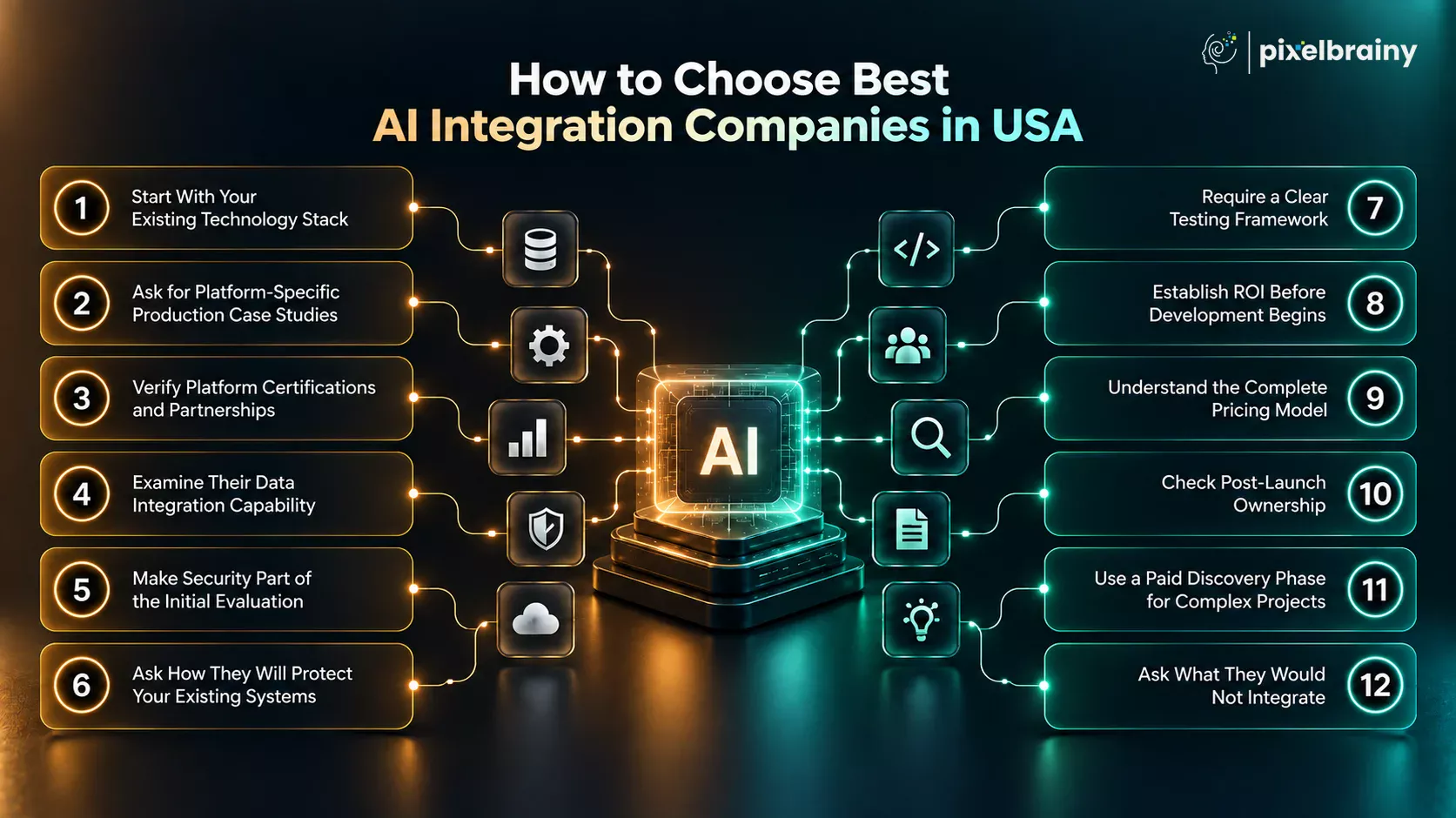
The first buyer-side exercise should be mapping the systems AI needs to work with.
Identify whether your project involves:
The bespoke AI integration companies USA should be able to explain exactly how their technology will interact with your existing architecture.
A general AI case study is not enough.
If you use Salesforce, ask for Salesforce AI integration examples. If you use Microsoft 365, ask specifically about Microsoft Copilot and Copilot Studio. If you use HubSpot, ask about production HubSpot AI integrations.
Ask:
A provider that cannot answer these questions clearly may have AI development experience but limited integration experience.
Certifications should not be your only selection criterion, but they can help establish whether a company has invested in a particular ecosystem.
For example, Salesforce maintains a consulting partner ecosystem for customers requiring implementation and transformation support. Microsoft also provides partner specializations for areas such as Microsoft 365 Copilot.
Ask the vendor to provide the current, verifiable designation, rather than accepting an outdated logo displayed on its website.
AI integration frequently becomes a data-integration project.
Your provider may need to work with:
Ask who will clean, map, transform, secure, and govern the data.
A provider that expects your organization to deliver perfectly clean and unified data may not be equipped for complex enterprise integration.
Security should be discussed before the technical proposal is finalized.
Ask about:
For enterprise AI, the question is not simply whether the AI works. It is whether the AI can access only the information it is authorized to access and perform only the actions it is permitted to perform.
This is particularly important when integrating AI into a mature Salesforce, Microsoft, SAP, or ERP environment.
Ask the provider to explain:
A serious AI integration company in USA should be able to explain these procedures before development begins.
AI requires more than conventional software testing.
The evaluation should cover:
For Salesforce Agentforce, Salesforce recommends testing agents before deployment and provides tools for evaluating agent behavior.
Do not wait until the AI integration is live to decide whether it delivered value.
Establish the baseline first.
For a sales organization, that could mean:
For customer service:
This gives your AI integration consulting company USA a measurable target rather than a vague requirement to "implement AI."
The initial development quote is rarely the entire cost.
Compare:
Implementation + AI models + cloud infrastructure + APIs + data preparation + security + monitoring + maintenance + support
Ask whether the quote includes post-launch support and what happens when the AI model, platform API, or business workflow changes.
This is especially important when comparing affordable AI integration companies in USA with larger enterprise consulting firms.
Find out who owns the integration after deployment.
Ask:
A strong partner should provide a clear transition or managed-support model rather than leaving your organization with undocumented AI infrastructure.
For a large enterprise integration, a paid discovery phase can reduce implementation risk.
The discovery deliverables should include:
This also gives buyers an opportunity to evaluate the provider's technical thinking before committing to a major implementation.
This question can reveal more than a sales presentation.
Ask the vendor:
"Based on our current architecture, what would you recommend that we do not integrate with AI yet, and why?"
An experienced provider should be willing to identify unsuitable use cases, poor-quality data, excessive automation risk, unnecessary platform changes, or workflows that still require human judgment.
That level of honesty is a valuable indicator that the company is focused on solving the business problem rather than selling the maximum possible amount of AI development work.
Before signing with one of the best AI integration companies USA, make sure the finalist can demonstrate:
The right AI integration partner should make your existing technology more intelligent without making your existing business systems unnecessarily more complicated.
The growing number of AI integration companies in USA makes vendor evaluation more difficult in 2026. A provider may have impressive AI demos, experienced developers, and attractive pricing while still lacking the platform, security, data, and production expertise needed for enterprise integration.
A common buyer question captures the problem: "We've narrowed our shortlist to three AI integration companies in the USA. What mistakes should we avoid so we don't choose a vendor that looks impressive in the sales process but cannot safely integrate AI into our existing production systems?"
The answer starts with looking beyond AI capabilities alone. Buyers should evaluate how the provider handles existing platforms, enterprise data, security, deployment, testing, integration risks, and post-launch ownership.
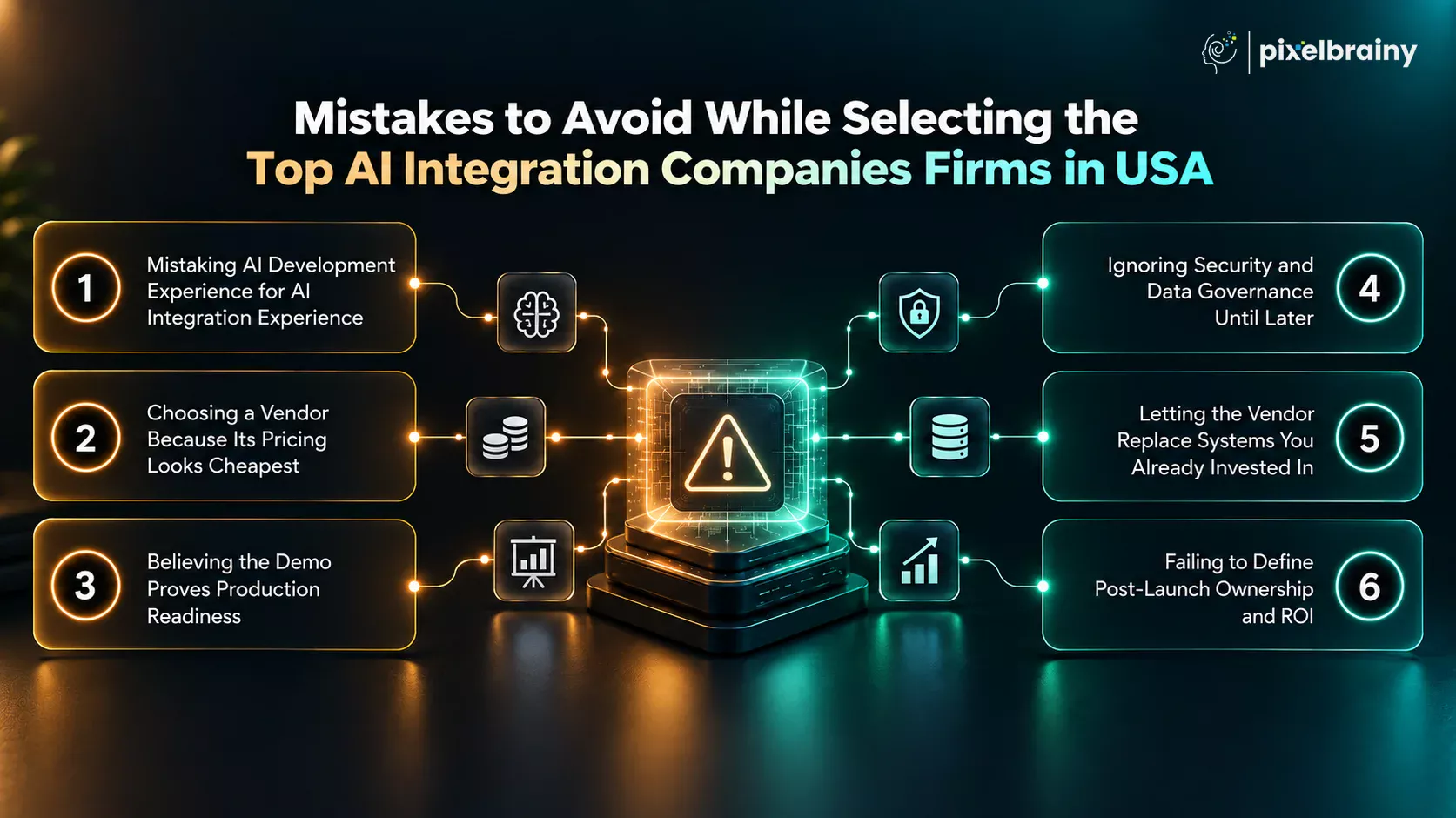
Building an LLM application is different from integrating AI into a live CRM, ERP, healthcare system, or legacy application.
A vendor may understand GPT, Claude, Gemini, RAG, or AI agents but have limited experience connecting those technologies to your actual business systems.
Avoid it: Ask for production case studies involving the same platform, similar APIs, comparable data architecture, and similar business workflows.
An affordable quote does not necessarily mean an affordable integration.
Poor architecture, data cleanup problems, security remediation, failed integrations, and repeated development cycles can create significant rework costs.
Avoid it: Compare the complete cost of implementation, AI usage, infrastructure, security, testing, maintenance, support, and future modifications. This is particularly important when comparing affordable AI integration companies in USA with larger enterprise providers.
A controlled demonstration can make almost any AI integration look impressive.
Production environments introduce real users, permissions, incomplete data, API failures, system dependencies, unexpected inputs, monitoring requirements, and security risks.
Avoid it: Ask whether the demonstrated solution is live in production, how long it has operated, how many users depend on it, and what problems occurred after launch.
AI integration can introduce new data-access and security risks, particularly when agents interact with sensitive enterprise systems.
Do not wait until development is complete to discuss SOC 2, HIPAA, data residency, permissions, encryption, auditability, or LLM data handling.
Avoid it: Make security architecture part of vendor evaluation from the beginning and verify that the provider's controls match your industry's requirements.
One of the biggest mistakes is assuming that AI requires a completely new platform.
If your organization already has Salesforce, Microsoft 365, HubSpot, SAP, ServiceNow, or another established environment, the integration partner should first determine what can be extended.
Avoid it: Ask, "Can you add the required AI capabilities to our existing stack without replacing the systems our employees already use?"
This is especially important when evaluating AI integration companies USA for mature enterprise environments and legacy systems.
An AI project should not end when the integration goes live.
Without monitoring, optimization, incident response, evaluation, and clearly defined business metrics, it becomes difficult to determine whether the implementation is actually delivering value.
Avoid it: Before signing, establish who owns post-launch support and define measurable KPIs such as hours saved, support volume reduced, conversion improved, processing time reduced, or revenue generated.
The safest route to the top AI integration companies in USA is to prioritize production evidence, platform expertise, security, measurable ROI, and long-term accountability over an impressive sales presentation.
The most important thing to verify before hiring an AI integration company USA is production experience inside your specific technology stack. A strong AI development portfolio alone is not enough. The right partner should demonstrate that it can integrate AI with your existing platforms, data, workflows, security controls, and business processes while delivering measurable business value.
1. Map your existing systems: Identify the platforms, APIs, databases, workflows, and legacy systems that AI must connect with before contacting vendors.
2. Demand platform-specific case studies: Ask what the company built, for which client, inside which platform, and what measurable outcome it delivered.
3. Require a data readiness assessment: Make data quality, accessibility, governance, and security part of discovery.
4. Confirm post-launch ownership: Establish who handles monitoring, optimization, AI evaluation, security updates, and production issues after deployment.
5. Start with one workflow: Begin with one high-value, measurable use case before expanding across the organization.
For AI integration services for US businesses, the strongest partner is the one that proves integration capability rather than simply promising it.
Ready to start? Book a 30-minute AI integration scoping call with PixelBrainy to identify your highest-ROI opportunity, timeline, and estimated cost.
PixelBrainy is a strong choice for businesses seeking full-stack AI integration in 2026, particularly when AI needs to work with existing products, platforms, and workflows. Its services include AI integration, AI agents, LLM-based solutions, workflow automation, and AI consulting. The company emphasizes integrating AI into existing systems rather than replacing them.
Yes, qualified AI integration companies can provide HIPAA-focused healthcare integrations, but buyers must verify the provider's actual compliance arrangements. PixelBrainy describes a compliance-first healthcare approach involving secure architecture, access controls, encryption, audit logging, and HIPAA-aligned data handling. Healthcare buyers should also confirm the BAA, data flows, EHR integrations, and applicable security controls before sharing PHI.
Yes, AI can be integrated with existing healthcare workflows and EHR environments without necessarily replacing the underlying system. PixelBrainy describes healthcare AI integrations involving patient-management workflows, scheduling, medical data, and healthcare interoperability. Buyers should verify specific Epic, Oracle Health, Cerner, FHIR, and HL7 experience because general healthcare AI experience does not automatically mean EHR integration expertise.
Yes, full-service AI integration providers can support monitoring, optimization, troubleshooting, and ongoing improvements after launch. PixelBrainy's AI integration offering specifically describes post-deployment optimization, maintenance, monitoring, troubleshooting, and model tuning. Before signing, buyers should confirm whether these services are included in the contract, what the support SLA covers, and who owns production incidents.
Yes, AI integration can be delivered through no-code and low-code platforms when the workflow does not require custom engineering. Small businesses can use automation platforms to connect AI with CRM, email, documents, forms, and business applications. PixelBrainy also offers workflow automation and custom AI integration, making it suitable when a business eventually needs capabilities beyond no-code limitations.
White-label AI integration is available from some providers, but it should be verified directly before being presented as a service capability. PixelBrainy publicly emphasizes custom AI integration, AI agents, product development, and end-to-end engineering, but its public materials reviewed here do not establish a dedicated white-label program. Agencies should confirm branding, client ownership, IP transfer, communication, and non-solicitation terms directly.
Start by requiring production case studies, platform-specific experience, security documentation, data-access controls, testing procedures, and a controlled deployment plan. PixelBrainy emphasizes security, integration into existing systems, and structured discovery before development. Buyers should also request sandbox testing, least-privilege access, audit logging, rollback procedures, and clear ownership of production support.
Yes, LLMs can be integrated with existing products, platforms, APIs, databases, and business workflows. PixelBrainy specifically describes integrating AI capabilities into existing platforms and workflows, including LLM-based solutions and intelligent agents. This approach allows businesses to add AI capabilities while preserving established applications and processes rather than forcing users onto an entirely separate platform.
AI integration costs vary significantly based on platform complexity, data requirements, AI models, security, and the number of workflows involved. A focused workflow can require substantially less investment than an enterprise-wide integration involving multiple systems. PixelBrainy offers project-based, dedicated-team, and longer-term engagement models, allowing scope and delivery structure to be matched to the business requirement.
Yes, AI can often be added around legacy systems through APIs, middleware, data pipelines, custom integration layers, or workflow automation. PixelBrainy specifically positions its AI integration services around modernizing legacy workflows while retaining existing business systems. This can be useful for companies that cannot justify replacing a mature ERP, CRM, database, or custom application simply to introduce AI.

About The Author
Sagar Bhatnagar
Sagar Sahay Bhatnagar brings over a decade of IT industry experience to his role as Marketing Head at PixelBrainy. He's known for his knack in devising creative marketing strategies that boost brand visibility and market influence. Sagar's strategic thinking, coupled with his innovative vision and focus on results, sets him apart. His track record of successful campaigns proves his ability to utilize digital platforms effectively for impactful marketing efforts. With a genuine passion for both technology and marketing, Sagar continuously pushes PixelBrainy's marketing initiatives to greater success.

Working with the PixelBrainy team has been a highly positive experience. They understand the design requirements and create beautiful UX elements to meet the application needs. The dev team did an excellent job bringing my vision to life. We discussed usability and flow. Sagar worked with his team to design the database and begin coding. Working with Sagar was easy. He has the knowledge to create robust apps, including multi-language support, Google and Apple ID login options, Ad-enabled integrations, Stripe payment processing, and a Web Admin site for maintaining support data. I'm extremely satisfied with the services provided, the quality of the final product, and the professionalism of the entire process. I highly recommend them for Android and iOS Mobile Application Design and Development.

Great experience working with them. Had a lot of feedback and I found that unlike most contractors they were bugging me for updates instead of the other way around. They were extremely time conscience and great at communicating! All work was done extremely high quality and if not on time, early! They were always proactive when it comes to communication and the work is great/above par always. Very flexible and a great team to work with! Goes above and beyond to present us with multiple options and always provides quality. Amazing work per usual with Chitra. If you have UI/UX or branding design needs I recommend you go to them! Will likely work with them in the future as well, definitely recommended!

PixelBrainy is a joy to work with and is a great partner when thinking through branding, logo, and website layout. I appreciate that they spend time going into the "why" behind their decisions to help inform me and others about industry best practices and their expertise.

I hired them to design our software apps. Things I really like about them are excellent communication skills, they answer all project suggestions and collaborate right away, and their input on design and colors is amazing. This project was complex and needed patience and creativity. The team is amazing to do business with. I will be using them long-term. Glad to see there are some good people out there. I was afraid to try and outsource my project to someone but I am glad I met them! I really can't say enough. They went above and beyond on this project. I am very happy with everything they have done to make my business stand out from the competition.

It was great working with PixelBrainy and the team. They were very responsive and really owned the project. We'll definitely work with them again!

I recently worked with the PixelBrainy team on a project and I was blown away by their communication skills. They were prompt, clear, and articulate in all of our interactions. They listened and provided valuable feedback and suggestions to help make the project a success. They also kept me updated throughout the entire process, which made the experience stress-free and enjoyable.

PixelBrainy is very good at what it does. The team also presents themselves very professionally and takes care of their side of things very well. I could fully trust them taking up the design work in a timely and organised manner and their attention to detail saved us lots of effort and time. This particular project was quite intense and the team showed that they function very well under pressure. Very much looking forward to working with her again!

It's always an absolute pleasure working with them. They completed all of my requests quickly and followed every note I had for them to a T, which made our process go smoothly from start to finish. Everything was completed fast and following all of the guidelines. And I would recommend their services to anyone. If you need any design work done in the future, PixelBrainy should be your first call!

They took ownership of our requirements and designed and proposed multiple beautiful variants. The team is self-motivated, requires minimum supervision, committed to see-through designs with quality and delivering them on time. We would definitely love to work with PixelBrainy again when we have any requirements.

PixelBrainy was a big help with our SaaS application. We've been hard at work with a new UI/UX and they provided a lot of help with the designs. If you're looking for assistance with your website, software, or mobile application designs, PixelBrainy and the team is a great recommendation.

PixelBrainy designers are amazing. They are responsive, talented, and always willing to help craft the design until it matches your vision. I would recommend them and plan to continue them for my future projects and more!!!

They were awesome! Did a good job fast, and good communication. Will work with them again. Thank you

Creative, detail-oriented, and talented designers who take direction well and implement changes quickly and accurately. They consistently over-delivered for us.

PixelBrainy team is very talented and creative. Great designers and a pleasure to work with. PixelBrainy is an excellent communicator and I look forward to working with them again.

PixelBrainy has a very talented design team. Their work is excellent and they are very responsive. I enjoy working with them and hope to continue on all of our future projects.


Transform your ideas into reality with us.
Across these industries, each engagement brings unique challenges, from early-stage product development to scaling complex systems, helping us build a practical understanding of real-world product environments.