 AI Summary Powered by PixelBrainy
Can your AI wealth management system explain every investment recommendation, justify every client suitability score, and provide the documentation regulators expect during an SEC examination?
For registered investment advisors (RIAs), wealthtech startups, family offices, asset managers, and financial institutions, selecting the right AI wealth management software development companies in 2027 requires expertise in investment workflows, financial data security, explainable AI, model governance, and regulatory documentation.
According to The Business Research Company's July 2026 market report, the global AI wealth management market is projected to grow from $5.38 billion in 2026 to $14.12 billion by 2030, reflecting a forecast compound annual growth rate of 27.2%. This growth is increasing demand for intelligent portfolio analytics, personalized financial planning, and automated advisory services.
Identifying the top AI wealth management software development services providers USA helps investment firms explore specialized engineering expertise. Businesses seeking tailored investment workflows should evaluate custom AI wealth management software development companies in USA for portfolio rebalancing, suitability scoring, secure integrations, and auditable decision records. Meanwhile, enterprise AI wealth management software development agencies USA can support legacy modernization, financial data integration, and scalable AI governance.
Consider this buyer's question: "We're a $650M AUM independent RIA preparing for SEC examination of our AI-assisted investment process. We use AI for portfolio rebalancing recommendations and client suitability scoring but don't know how to document AI's role in a way that satisfies SEC examination standards. Which AI wealth management software development companies build AI systems with Form ADV disclosure documentation built into the delivery package?"
This concern highlights the importance of documenting AI decisions, model versions, validation results, and human oversight. The SEC's 2026 Examination Priorities identify AI and automated investment tools as areas of examination interest. Form ADV documentation support must be explicitly defined in vendor contracts and reviewed by qualified compliance professionals.
Organizations evaluating USA-based AI wealth management app & website development companies should also assess advisor dashboards, investor portals, mobile applications, cybersecurity, and ongoing support. This guide presents a list of best AI wealth management software development companies to investigate in 2027, helping buyers compare technical expertise, customization, governance capabilities, and suitability for secure, scalable wealth management solutions.

AI wealth management software development companies build custom financial applications that use artificial intelligence to automate investment workflows, analyze portfolios, personalize advisory services, and improve operational efficiency. Their services combine AI engineering, financial data integration, secure application development, and model governance to meet the needs of RIAs, wealthtech startups, asset managers, and financial institutions.
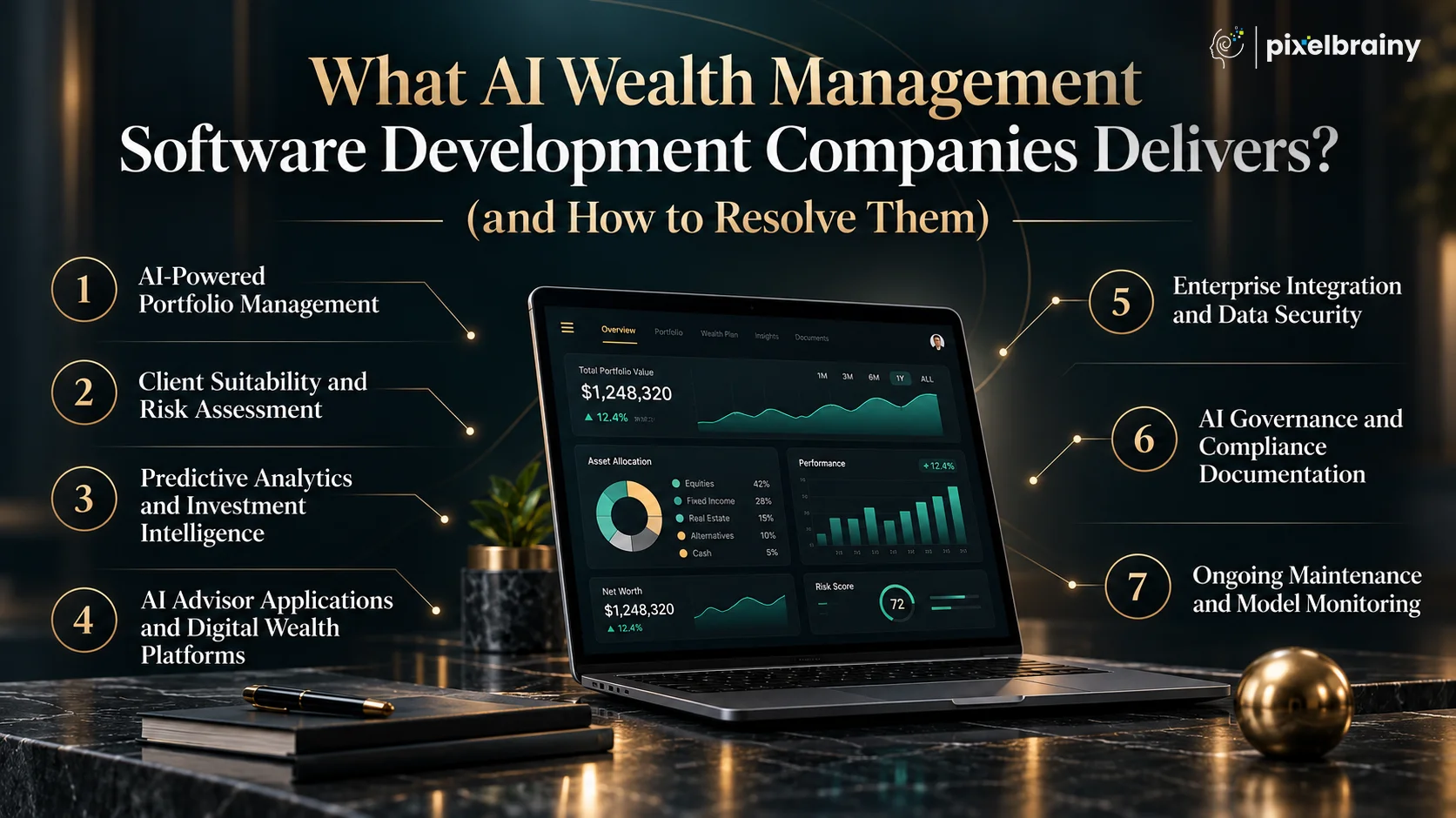
Companies develop portfolio management systems that monitor asset allocation, detect portfolio drift, evaluate investment constraints, and generate rebalancing recommendations. These capabilities help advisors make informed decisions while maintaining appropriate human approval controls.
Custom AI systems analyze client objectives, investment horizons, financial circumstances, and risk questionnaire responses. They can identify inconsistent information, flag potential suitability concerns, and provide supporting explanations for advisor review.
AI-powered wealth platforms support portfolio risk analysis, liquidity forecasting, scenario modeling, investment research, and concentration monitoring. These tools help investment professionals evaluate financial information without guaranteeing investment returns.
USA-based AI wealth management app & website development companies build advisor dashboards, investor portals, mobile applications, and AI assistants. Features may include meeting summaries, personalized portfolio insights, automated reporting, and access to approved financial information.
Enterprise AI wealth management software development agencies USA businesses evaluate can integrate custodians, CRM platforms, portfolio accounting systems, financial planning tools, and market data providers. Security capabilities include encryption, role-based access, monitoring, and secure data pipelines.
Development services may include model inventories, version histories, decision logs, validation reports, and human approval records. For regulated advisers, Form ADV disclosure support must be explicitly defined in the contract and reviewed by qualified compliance professionals.
The top AI wealth management software development services providers USA buyers shortlist should support model monitoring, software updates, security testing, integration maintenance, and documented change management.
Ultimately, businesses comparing a list of best AI wealth management software development companies should assess financial domain expertise, explainable AI capabilities, integration experience, and measurable delivery outcomes.
How did we identify the best AI wealth management software development companies for 2027? We reviewed publicly available company information, service portfolios, AI engineering capabilities, financial technology expertise, and relevant project evidence. Our goal was to help investment industry buyers understand how to choose AI wealth management software development company candidates based on their wealth management experience, integration capabilities, AI governance, and ability to support regulated investment workflows.
We developed seven evaluation criteria relevant to CIOs, CTOs, Chief Compliance Officers (CCOs), and managing partners at registered investment advisors (RIAs), family offices, and enterprise wealth management firms.
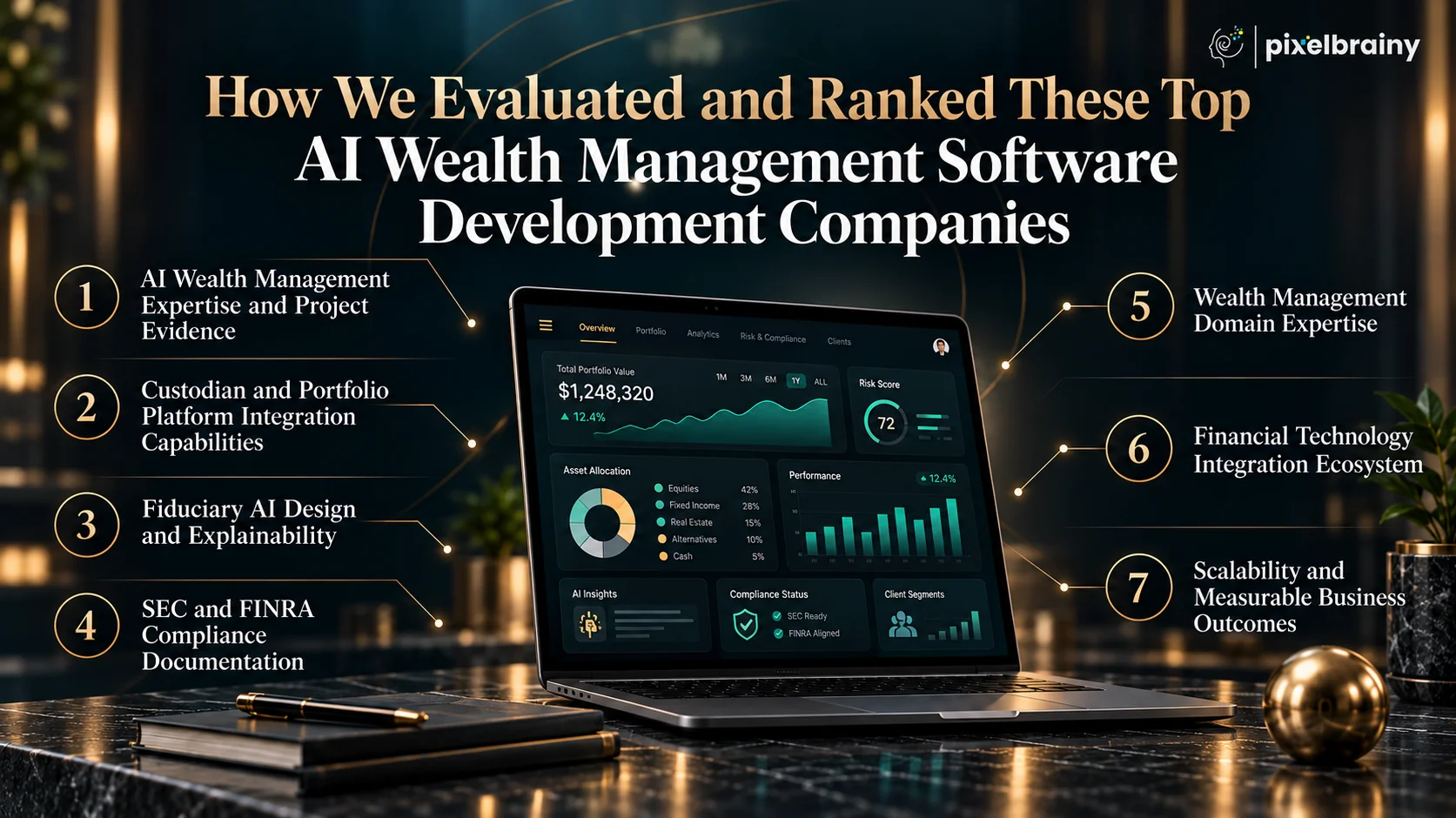
We examined company websites, published case studies, service descriptions, and available client references to identify experience with AI-powered financial applications, portfolio analytics, investment research, and advisor workflows.
We prioritized evidence relevant to real wealth management requirements over generic AI development claims. Where production deployments could not be independently verified, we treated them as requiring further investigation.
We evaluated publicly described integration expertise involving Charles Schwab, Fidelity, Pershing, and BNY Mellon, alongside portfolio management platforms such as Orion, Black Diamond, Envestnet, and Tamarac.
We distinguished documented financial system integrations from general API development experience, considering data reconciliation, permissions, and reliable financial information exchange.
We assessed whether providers could implement explainable investment recommendations, model version histories, decision logs, exception handling, and human approval workflows.
These capabilities are important when assessing AI wealth management software development companies fiduciary compliant, because investment recommendations should be reviewable and supported by appropriate evidence. Technical features alone, however, do not establish fiduciary compliance.
We reviewed publicly described financial services experience and capabilities related to audit trails, recordkeeping, supervisory workflows, and compliance reporting.
For buyers evaluating AI wealth management software development companies SEC compliant, we emphasized the need to verify Form ADV documentation support, relevant regulatory experience, and contractual deliverables. We did not assume SEC approval or guaranteed compliance based on marketing claims.
We considered each company's relevance to portfolio management, client suitability, investment risk assessment, tax-aware investing, financial planning, and RIA operations.
This helped us identify potential AI wealth management software development companies for registered investment advisers whose stated capabilities align with specialized investment workflows rather than general-purpose application development.
We reviewed publicly described capabilities involving financial planning tools such as eMoney, MoneyGuidePro, and RightCapital; CRM platforms such as Redtail and Salesforce Financial Services Cloud; and market data providers such as Bloomberg, Morningstar, and FactSet.
We considered integration architecture and data exchange capabilities, treating specific integrations as confirmed only when supporting evidence was available.
We evaluated potential suitability across RIAs, wealthtech startups, family offices, private banks, and enterprise wealth managers. We also considered publicly documented outcomes involving advisor productivity, reporting efficiency, and reduced manual processing.
For AI wealth management software development companies with proven ROI, we prioritized measurable results supported by credible evidence rather than unverified marketing claims.
Our seven-criteria framework provides a consistent basis for comparing development partners, examining their publicly documented capabilities, and identifying vendors for further due diligence. The resulting rankings represent an editorial assessment of potential fit, not independently audited performance results or verified regulatory certifications.
Which AI wealth management software development company can help your investment business deliver personalized advice, streamline portfolio workflows, and integrate AI while protecting sensitive financial data?
Consider a private bank serving 1,800 ultra-high-net-worth households. Its relationship managers offer similar recommendations to clients with more than $5 million in assets, despite differences in investment goals, family structures, and financial complexity. The bank wants AI to identify behavioral patterns and suggest personalized next-best actions before each client interaction.
Meeting this need requires more than a generic chatbot. The solution must work with approved client data, provide explainable recommendations, support secure integrations, and keep advisors involved in important decisions.
This review covers 14 companies and platforms to consider for investment technology projects in 2027, from custom software developers to fintech specialists and AI-powered portfolio platforms. The profiles assess their publicly described capabilities and potential fit, while identifying details such as custodian integrations, compliance experience, and measurable outcomes that buyers should verify directly.
The list includes 10+ AI wealth management software development companies in USA and international providers serving different investment business models, including registered investment advisers (RIAs), family offices, robo-advisory firms, and private banks.
Website: https://www.pixelbrainy.com/
PixelBrainy is a custom AI financial software development company that may be worth evaluating for investment businesses planning to build AI-enabled wealth management applications. Its broader software and AI capabilities could support solutions such as advisor dashboards, client portals, workflow automation, and personalized client communication.
For family offices and RIAs, a potential project could combine client information from approved sources to help advisors prepare for meetings, identify service opportunities, and organize portfolio insights. However, buyers should confirm the company's specific wealth management project experience, available financial data integrations, and delivery approach before proceeding.
PixelBrainy is included among the custom AI wealth management software development companies USA buyers may evaluate, particularly when a tailored application is preferred over adopting an off-the-shelf platform.
Intellectsoft provides enterprise software engineering and digital transformation services. Its broader engineering capabilities may be relevant to financial institutions planning complex applications, modernizing legacy systems, or introducing AI into existing business workflows.
For wealth management organizations, a project might involve building secure client-facing applications, integrating data services, or developing internal tools for relationship managers. However, enterprise engineering experience alone does not establish specialized expertise in portfolio management or private banking. Buyers should request relevant financial services case studies and confirm the team's experience with investment data and regulated workflows.
Intellectsoft is one of the leading AI wealth management software development companies in USA buyers may investigate for enterprise-level engineering, provided the required wealthtech expertise is demonstrated during vendor evaluation.
Itexus focuses on financial technology software development, making it a relevant candidate for firms evaluating custom investment applications. Its fintech orientation may suit projects involving portfolio dashboards, financial data processing, digital advisory experiences, and other investment-related workflows.
For registered investment advisers, a custom solution could bring client information and portfolio insights into a unified interface or support AI-assisted advisor workflows. The important distinction is between general fintech development capability and verified experience with production wealth management systems. Prospective clients should request relevant project examples, architecture details, and references before choosing a provider.
Among custom AI wealth management software development companies USA buyers can shortlist, Itexus is worth assessing when financial software experience is a priority. RIAs should specifically verify its experience with portfolio workflows, advisor tools, and AI-driven recommendations.
Zoolatech provides software engineering services for businesses building and scaling digital products. Its engineering model may be relevant to wealth management organizations that need additional development capacity or a partner for a complex digital platform.
Potential project areas include client portals, data-intensive applications, backend services, and AI-enabled features. For example, a private wealth firm might explore a unified relationship manager interface that brings together approved client information and service recommendations. The suitability of such a project depends on the team's financial services experience and ability to work within the firm's security and governance requirements.
Zoolatech may suit buyers seeking AI wealth management software development companies with strong product engineering capabilities, especially when the project requires a dedicated development team rather than a ready-made investment platform.
Neurons Lab specializes in AI and data engineering, with offerings aimed at enterprise use cases. Its work around agentic AI and wealth management, including its ARKEN offering, makes it particularly relevant for organizations investigating AI-driven relationship management and advisory workflows.
For private banks, behavioral client segmentation could help identify changing client needs and suggest relevant next actions for relationship managers. Such systems still require careful evaluation of data permissions, recommendation quality, explainability, and human oversight. Buyers should confirm which capabilities are available in production and which require custom implementation.
For banks asking which AI wealth management software development companies for private banks are worth investigating, Neurons Lab merits consideration when the goal is to apply AI to complex enterprise workflows rather than simply launch a chatbot.
Vise differs from most companies on this list because it offers an AI-powered investment management platform rather than primarily acting as a custom software development agency. Its platform focuses on helping financial advisors build and manage personalized portfolios using technology.
This distinction matters for RIAs comparing custom development with an existing portfolio management solution. A platform-based approach may reduce the need to build portfolio construction and related workflows from scratch, although buyers must evaluate its suitability for their own operating model and technology stack.
Vise is relevant to firms comparing AI wealth management software development companies for robo advisory and advisor-led portfolio workflows, but it should be evaluated as a platform option, not assumed to provide the same services as a custom development vendor.
DIGIS provides custom software development services, including fintech-oriented engineering. Its services may be relevant to investment businesses that need digital product development, backend systems, or integrations across financial applications.
A wealth management project could involve a client portal, advisor workspace, or AI-assisted interface that presents financial information in a more useful format. Buyers should establish whether the proposed team has direct experience with investment management, rather than relying on general fintech experience alone.
DIGIS may be considered by businesses seeking an engineering partner for AI-enabled wealth management software, especially when the project scope, integration requirements, and financial domain experience can be clearly established before contracting.
Lasting Dynamics develops custom software for financial services and other industries. Its fintech and banking focus may make it relevant to firms seeking bespoke digital platforms, mobile applications, and integrated financial workflows.
Family offices and wealth management businesses often need technology that reflects their particular reporting structures, client relationships, and operational processes. A custom-built solution can accommodate these needs, but the project must also address data quality, access permissions, auditability, and ongoing maintenance.
For organizations evaluating bespoke AI wealth management software development companies USA and international providers, Lasting Dynamics may be a candidate when customization is central to the project. Its specific wealth management experience should be checked through relevant case studies and references.
ScienceSoft is an established software development and IT consulting company offering enterprise engineering and AI-related services. Its broad capabilities may support wealth management organizations modernizing legacy applications, building data-intensive systems, or integrating AI into existing operations.
For a large advisory business, potential work could include an analytics platform, secure client-facing applications, or AI-assisted workflows connected to internal systems. These are possible applications of its broader capabilities, not confirmation of a particular wealth management implementation. Buyers should request investment-specific evidence before treating it as a specialist wealthtech provider.
ScienceSoft is among the USA-based AI wealth management software development companies worth considering for complex engineering work, particularly when a project involves legacy modernization, data integration, and multiple enterprise systems.
Simform offers software product engineering, cloud development, and data and AI services. These capabilities may be useful to wealthtech companies building digital advisory products or modernizing the infrastructure behind investment applications.
A robo-advisory business, for example, might need scalable APIs, client onboarding workflows, portfolio dashboards, or AI-enabled features within an existing product. The firm should confirm its experience with investment-specific systems and the technical requirements of the intended deployment.
Simform may be relevant to companies comparing AI wealth management software development companies for robo advisory, particularly where product scalability and cloud architecture are major priorities. Its investment domain experience should be assessed separately from its general engineering credentials.
Relevant Software provides software development services with a fintech focus. It may be suitable for businesses that need custom financial applications, integrations, or additional engineering expertise to support an existing digital product.
In wealth management, a tailored application might connect client-facing experiences with internal data systems or help advisors review client information more efficiently. AI capabilities can be added where they address a defined business need, but their value depends on the quality of the underlying data and the controls surrounding their use.
Relevant Software is a potential candidate for firms exploring custom AI wealth management software development, particularly when the scope involves a digital financial product. Buyers should request wealthtech-specific references rather than assuming that general fintech work covers portfolio management or fiduciary workflows.
HatchWorks AI focuses on AI-enabled software development and data engineering. Its capabilities may be relevant to financial services organizations looking to incorporate generative AI, improve data workflows, or develop new applications around existing business systems.
For a wealth management firm, a potential use case could be an advisor assistant that summarizes approved client information and prepares meeting briefs. Any such system needs strict permission controls, reliable source data, appropriate handling of confidential information, and a process for advisors to review generated content.
HatchWorks AI may be worth evaluating among AI wealth management software development companies in the USA when AI and data engineering are central to the initiative. Its direct investment industry experience should be confirmed through project evidence.
Praxent specializes in digital product development for financial services. Its financial services focus may be useful to firms modernizing customer experiences, building digital platforms, or improving how users interact with financial products.
For a wealth management business, potential applications include client onboarding, advisor portals, account interfaces, and workflows that connect multiple financial systems. If AI is part of the project, buyers should determine whether Praxent has delivered comparable AI-enabled investment workflows or would be adding AI engineering to a broader product development engagement.
Praxent is one of the leading AI wealth management software development companies in USA buyers may investigate for financial product engineering. Its fit depends on whether the team's verified experience matches the project's specific AI, portfolio, and integration requirements.
7T provides digital engineering and AI-related services for businesses developing or transforming technology products. Its capabilities may be relevant to financial institutions exploring custom AI applications, enterprise integrations, and data-driven workflows.
For a private bank, one possible project is a relationship manager interface that organizes approved client signals and presents relevant service prompts. Building such a system requires more than a recommendation model: the bank must define permissible data inputs, control access, test output quality, and maintain human accountability for client-facing decisions.
7T may be considered by firms evaluating AI wealth management software development companies for private banks, particularly for custom enterprise applications. Its specific capabilities in behavioral client segmentation and relationship manager recommendations should be verified before it is shortlisted for that use case.
These above are the AI wealth management software development companies to consider for 2027, offering options for RIAs, family offices, private banks, and robo-advisory businesses. Compare their expertise, integration capabilities, and AI solutions to identify the best fit for your wealth management software development needs.
Your shortlist is down to three AI wealth management software development companies. How can you determine which has actually deployed AI in an SEC-examined RIA environment rather than demonstrated a prototype using synthetic portfolio data? Start by comparing evidence of production deployments, custodian connectivity, wealth platform integrations, AI governance, and experience supporting regulated advisory workflows.
The comparison below covers all 10+ AI wealth management software companies and platforms reviewed in this guide. It highlights their publicly described positioning and the details investment buyers should verify before signing a contract. Integration capabilities, compliance controls, and pricing can vary by project, so unverified details are identified rather than assumed.
| Company | Location | Custodian Integration | Wealth Platform Integration | Compliance and Governance Evidence | Client Segments | Pricing |
| PixelBrainy LLC | Sheridan, Wyoming, USA | Schwab, Fidelity, Pershing connectivity requires confirmation | Custom integrations proposed according to project scope | Request evidence of financial services controls, audit logging, and production AI delivery | RIAs, family offices, fintechs | $25-$49/hr |
| Intellectsoft | New York presence, USA; international operations | Specific custodian connections require validation | Enterprise systems and custom integrations; wealth platform experience to confirm | Request regulated-finance references and project-specific security documentation | Financial institutions, enterprises | Custom quote |
| Itexus | Confirm proposed delivery location | Confirm supported custodian APIs and completed integrations | Fintech integration experience; specific wealth platforms to verify | Request evidence of production investment workflows and governance processes | Fintechs, investment firms, RIAs | Custom quote |
| Zoolatech | California origins, USA; distributed teams | Specific integrations require validation | Custom product and enterprise integration capabilities | Confirm financial-sector project references, access controls, and auditability | Wealthtech companies, enterprises | Custom quote |
| Neurons Lab | International operations, including the UK and Singapore | Confirm custodian coverage for the proposed solution | AI and data integration capabilities; platform compatibility to verify | Request AI evaluation, governance documentation, and evidence of financial services deployments | Private banks, financial institutions | Custom quote |
| Vise | USA | Confirm currently supported custodians | Existing AI-powered investment platform; verify compatibility with the firm's stack | Review current regulatory disclosures, platform controls, and contractual responsibilities | Financial advisors, RIAs | Confirm platform pricing |
| DIGIS | International delivery operations | Specific custodian integrations require validation | Custom fintech and application integrations | Request financial services references and evidence of security and testing controls | Fintechs, financial businesses | Custom quote |
| Lasting Dynamics | Italy; international delivery | Confirm relevant custodian APIs and prior projects | Bespoke financial application integrations | Request security documentation and evidence of regulated-finance experience | Financial firms, family offices | Custom quote |
| ScienceSoft | McKinney, Texas, USA | Specific custodian integrations require validation | Enterprise systems integration and modernization; wealth platforms to confirm | Request project-specific security controls, audit documentation, and relevant case studies | Financial institutions, enterprises | Custom quote |
| Simform | International delivery operations | Confirm supported custodian interfaces | Cloud-native and custom integration capabilities | Verify AI governance, cloud security, and production financial application experience | Wealthtechs, robo-advisors | Custom quote |
| Relevant Software | International delivery operations | Specific custodian integrations require validation | Custom fintech and digital product integrations | Request evidence of investment-domain experience, data protection, and audit controls | Fintechs, financial firms | Custom quote |
| HatchWorks AI | USA-based operations | Confirm custodian connectivity for the intended use case | AI, data engineering, and custom integration capabilities | Request production AI references, model evaluation evidence, and data governance documentation | Financial services firms, enterprises | Custom quote |
| Praxent | Texas, USA | Confirm specific custodian support | Financial product and custom application integrations | Request financial services references and evidence of security and governance practices | Financial services firms | Custom quote |
| 7T | Dallas area, USA | Specific custodian integrations require validation | Enterprise and custom AI application integrations | Confirm production financial-sector deployments, model oversight, and auditability | Enterprises, financial institutions | Custom quote |
The comparison table helps investment buyers assess AI wealth management software development companies by location, integration capabilities, governance evidence, target clients, and pricing approach. Before finalizing your shortlist, prioritize vendors that can demonstrate real-world AI deployments, traceable recommendations, and reliable integration with your existing wealth management systems.
AI wealth management software development in 2027 serves investment firms with different client needs, fiduciary responsibilities, and technical requirements. RIAs may prioritize portfolio monitoring and advisor productivity, while family offices need consolidated wealth reporting and private banks focus on personalized relationship management. Each segment requires AI solutions tailored to its workflows, financial data sources, and governance obligations.
Which AI wealth management software development companies can deliver AI solutions that work with real investment data, support advisor decisions, and demonstrate measurable business results? The answer depends on the institution's operating model, the complexity of its clients, and the evidence supporting the proposed solution.
RIAs use AI to personalize investment proposals, monitor portfolios, support rebalancing, draft client communications, and improve advisor productivity. Integrations with custodians such as Charles Schwab, Fidelity, and Pershing can be essential.
AI wealth management software development companies for portfolio rebalancing should demonstrate how proposed trades, exceptions, and advisor approvals are recorded. Firms should also assess whether AI-assisted processes require updates to their disclosures, compliance procedures, or supervisory controls.
Independent broker-dealers can use AI to support client needs analysis, product due diligence, recommendation documentation, and compliance monitoring. These workflows must account for applicable Regulation Best Interest and FINRA supervisory requirements.
Dual-registered firms face additional complexity because their broker-dealer and investment adviser activities may involve different obligations. Vendors should demonstrate how recommendations are reviewed, documented, and escalated instead of relying on automated outputs without appropriate oversight.
Large broker-dealers need AI tools that help thousands of advisors prepare for meetings, summarize client interactions, draft communications, and organize compliance documentation. Integrations with existing CRM, reporting, and enterprise identity systems are critical.
Common performance measures include time saved per advisor, adoption rates, documentation quality, and improved service capacity. Large deployments also require strong access controls, reliable performance, and change management that encourages advisors to use the technology appropriately.
Family offices often consolidate financial information from multiple custodians, alternative investment platforms, trust companies, and private equity administrators. AI can support consolidated net worth reporting, capital call tracking, liquidity planning, and investment analysis.
AI wealth management software development companies for estate planning should understand multigenerational wealth structures and complex ownership arrangements. Estate scenarios must account for appropriate legal and tax professional review rather than treating AI-generated projections as definitive advice.
Private banks can use AI for behavioral client segmentation, personalized communications, and next-best-action recommendations for relationship managers. These tools can help identify relevant client needs and prepare relationship managers before important interactions.
AI wealth management software development companies for high net worth clients should demonstrate how recommendations are generated from authorized data, how client information is protected, and how advisors retain control over client-facing decisions. Potential outcomes include improved relationship manager productivity and more relevant client engagement, which should be measured rather than assumed.
Robo-advisors use AI and automation for digital onboarding, risk profiling, portfolio construction, monitoring, and rebalancing across large numbers of accounts. Systems must accommodate client-specific investment objectives and applicable trading constraints.
AI wealth management software development companies for tax loss harvesting can develop workflows that identify potential tax-loss opportunities and flag relevant constraints. Performance evaluation should consider after-tax returns, transaction costs, portfolio suitability, and the client's individual circumstances rather than relying on tax-loss harvesting activity alone.
Trust companies can apply AI to document review, distribution calculations, beneficiary communications, and court accounting preparation. Complex arrangements, including dynasty trusts, charitable remainder trusts, and special needs trusts, require careful interpretation of governing documents.
Systems should preserve traceable records and integrate with the trust accounting platforms actually used by the institution. AI can assist with administrative work, but discretionary fiduciary decisions and legally significant interpretations require appropriate professional review.
Retirement platforms can use AI to support retirement income projections, participant engagement, plan sponsor reporting, and investment education. These tools can make complex retirement information easier to understand and help participants explore different savings scenarios.
AI wealth management software development companies for retirement planning must distinguish educational features from personalized investment advice. Applicable ERISA obligations, fiduciary responsibilities, disclosures, and prohibited transaction considerations should be assessed for the specific product and use case.
ESG and impact investment managers can use AI to screen securities against defined environmental, social, and governance criteria, assess portfolio exposures, and generate impact reports. Models can help organize large volumes of company disclosures and other investment research.
AI wealth management software development companies for ESG investing should make screening methodologies explainable and document why securities are included or excluded. Data quality, consistent criteria, and transparent disclosures are essential when communicating sustainability-related investment claims to clients.
Wealthtech startups use AI to build digital advisory platforms, financial planning tools, portfolio analytics, and investment management infrastructure. Early-stage firms need scalable technology that supports product development while addressing financial data security and applicable regulatory obligations.
A credible development partner should demonstrate working integrations, measurable product outcomes, and a clear path from prototype to production. As usage grows, monitoring, model evaluation, testing, and governance become increasingly important to maintaining a reliable product.
Therefore, the right AI wealth management software development partner should match your client segment, investment workflows, integration needs, and governance requirements. Prioritize demonstrated production experience and measurable outcomes over AI features alone.
For wealth management firms, finding the right AI development partner starts with identifying companies that understand investment workflows, financial data security, and the technology already used by advisors. Buyers can build a shortlist through industry-specific directories, fintech networks, company case studies, referrals from wealthtech professionals, and targeted searches for AI development firms with relevant financial services experience.
Real buyer query: “How can I find an AI wealth management software development company in the USA that has deployed AI in a real SEC-examined RIA environment, rather than only demonstrating prototypes with synthetic portfolio data?”
The practical answer is to shortlist relevant providers, request verifiable evidence, compare technical proposals, and involve business, technology, and compliance stakeholders before signing a contract.
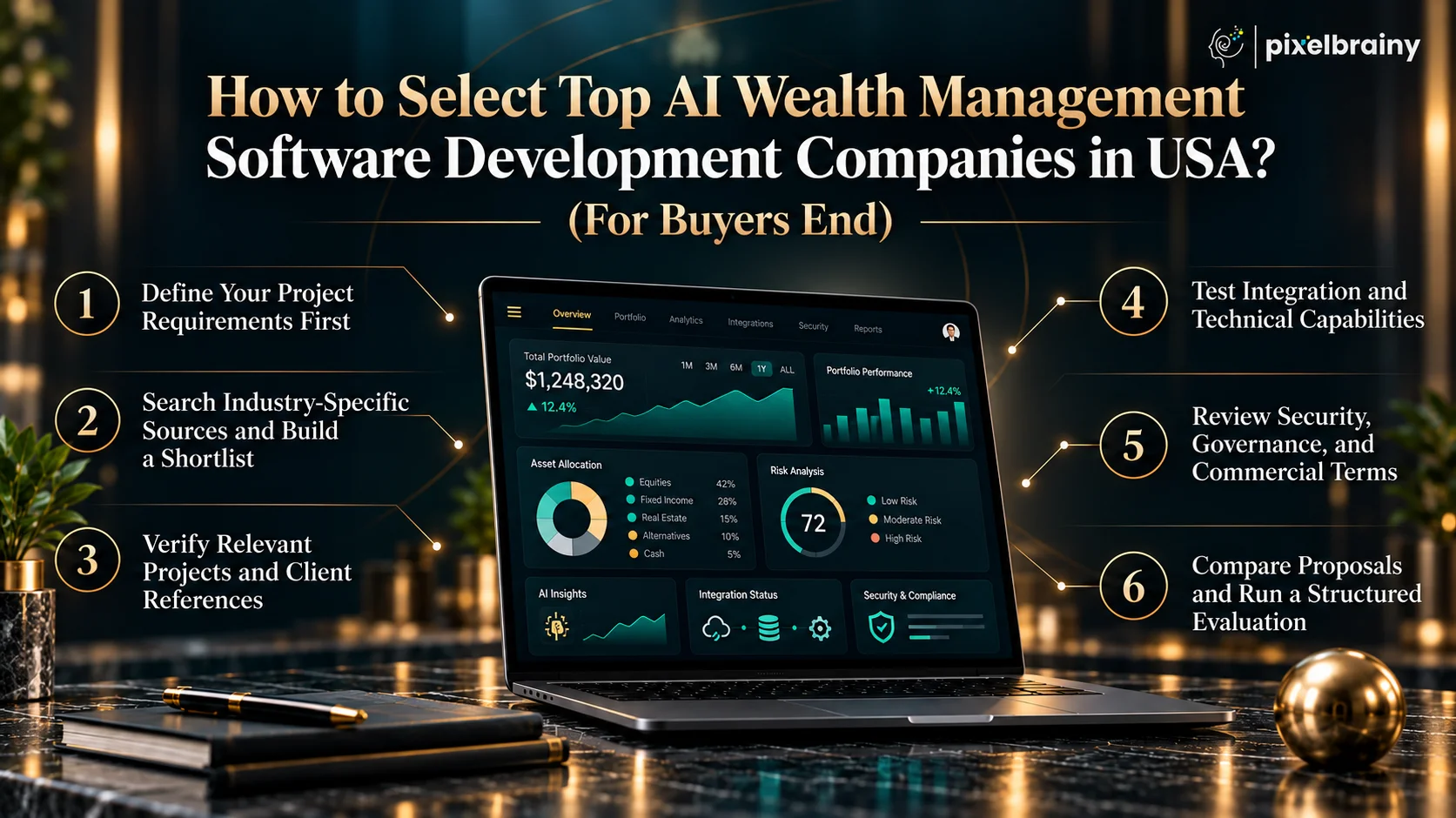
Document the business problem before contacting vendors. Decide whether you need AI-assisted portfolio monitoring, advisor productivity tools, client segmentation, tax-loss harvesting, or a complete wealth management platform. Identify your target users, required integrations, data sources, budget, and expected outcomes. A clear brief helps you find AI wealth management software development companies that match your actual needs instead of receiving generic proposals.
Search for fintech development firms, wealthtech specialists, and AI engineering companies with relevant investment industry experience. Explore industry directories, fintech communities, LinkedIn, professional referrals, and vendor case studies. Use specific search phrases such as “AI wealth management software development companies for RIAs” or “AI development firms with custodian integration experience.” Shortlist three to five providers for a more detailed assessment.
Ask each company for examples of comparable projects, the problem addressed, the system delivered, and the results measured. Determine whether the solution is live in production or remains a prototype. Request a client reference where possible, or redacted evidence if confidentiality restrictions apply. For RIA projects, ask specifically about experience with real investment data, advisor review workflows, and operational requirements in regulated environments.
Ask vendors to explain how they would connect the proposed AI solution to your custodians, portfolio management software, CRM, and reporting systems. Confirm whether integrations already exist or require custom development. Request a technical walkthrough covering data flows, access permissions, error handling, and audit logs. A small, scoped proof of concept using appropriately authorized test data can help validate assumptions before committing to a full implementation.
Involve your compliance, legal, and information security teams before approving a vendor. Review data handling, encryption, access controls, model evaluation, incident response, recordkeeping, and human oversight. Do not assume a development company's services automatically make your firm SEC- or FINRA-compliant. Also confirm intellectual property ownership, maintenance responsibilities, service levels, implementation fees, and ongoing AI infrastructure costs.
Give each shortlisted company the same project brief and evaluation criteria. Compare domain expertise, integration plans, delivery milestones, model testing, security controls, support arrangements, and total cost of ownership. Score vendors against measurable requirements rather than presentation quality alone. Before signing, ensure the contract defines acceptance criteria, ownership, documentation, production monitoring, and responsibilities for fixing defects or addressing model performance issues.
Therefore, the strongest AI wealth management software development partner is one you can discover through relevant industry channels and verify through production evidence, technical testing, and transparent commercial terms.
Finding a reliable AI development partner requires more than reviewing a portfolio or watching a product demonstration. For wealth management firms, the wrong vendor can create integration problems, expose sensitive financial information, or deliver AI that performs well in demos but fails in real investment workflows.
Real buyer query: “What red flags should I look for when hiring an AI wealth management software development company that will handle sensitive client portfolios and support an SEC-registered RIA?”
Below are six major warning signs buyers should check before signing a development contract.
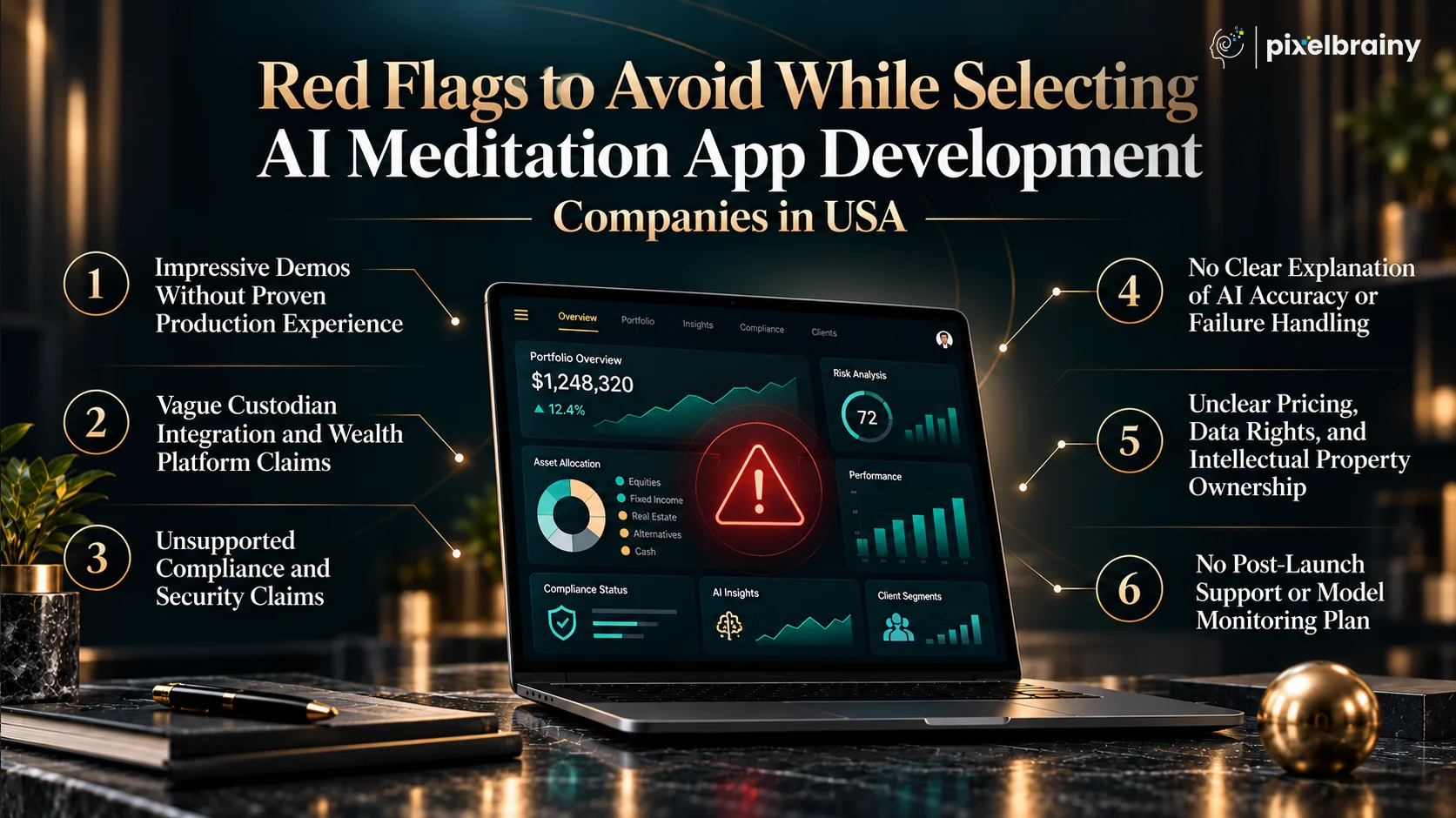
A polished demonstration does not prove that an AI solution can handle real financial data, operational exceptions, or ongoing production workloads.
Reliable AI wealth management software development companies should be able to explain what was deployed, how it was tested, and what happened when the system encountered errors.
AI recommendations are only as useful as the data and systems supporting them. Claims of seamless integration may conceal extensive custom development or limited compatibility.
AI wealth management software development firms should clearly distinguish proven integrations from planned development work.
A vendor's general experience with financial services does not automatically establish SEC or FINRA compliance. Your firm remains responsible for assessing its own regulatory obligations.
AI wealth management software developers should provide verifiable evidence of their security practices and explain the limits of what their solution can support.
AI-generated investment summaries, client classifications, and recommendations can be inaccurate or incomplete. Vendors should explain how they measure quality and manage errors.
For wealth management applications, explainability, traceability, and appropriate human oversight should be part of the system design, not optional additions.
An attractive initial quote can hide infrastructure costs, model usage charges, integration expenses, or restrictive ownership terms.
Before contracting with AI wealth management software development companies in USA, make sure the commercial terms cover both the initial build and the cost of operating the solution over time.
AI applications require ongoing monitoring because data sources, integrations, business rules, and underlying models can change after deployment.
The best AI wealth management software development partner should provide a clear support plan, defined responsibilities, and measurable service expectations rather than leaving your team to manage production issues alone.
Therefore, avoid vendors that cannot demonstrate production experience, explain their technical and security controls, or define ownership and post-launch responsibilities. These checks help protect your firm's data, budget, and long-term investment technology plans.
Finding the right AI wealth management software development company in 2027 requires balancing technical expertise, financial industry experience, integration capabilities, and regulatory requirements. Whether you operate an RIA, private bank, family office, or robo-advisory platform, your development partner should understand your investment workflows and long-term business objectives.
Among the top AI wealth management software development companies, prioritize those with verifiable production deployments, reliable custodian integrations, transparent AI governance, and measurable project outcomes. Assess data security, model explainability, implementation costs, scalability, and post-launch support before making your final decision.
The best AI wealth management software development partners do more than build intelligent applications. They help financial businesses improve advisor productivity, personalize client experiences, automate portfolio monitoring, and develop secure, scalable investment technology. Request relevant case studies, validate technical capabilities, and confirm how AI-generated recommendations are tested, documented, and reviewed.
Ready to modernize your wealth management operations with AI? Schedule a call with our team to discuss your requirements, explore suitable AI solutions, and plan a development strategy aligned with your investment business goals.
The best AI wealth management software development company depends on your business model, budget, integration needs, and regulatory requirements. Compare the top AI wealth management software development companies based on financial services experience, production deployments, AI governance, and custodian integrations. PixelBrainy is one potential provider to evaluate for custom AI applications, subject to verification of relevant wealthtech experience.
The cost of custom AI wealth management software development depends on application complexity, integrations, security controls, and maintenance requirements. A focused AI feature typically costs less than a complete investment platform with portfolio analytics and custodian connectivity. Request detailed proposals from AI wealth management software development companies in USA covering development, infrastructure, model usage, testing, and ongoing support.
AI wealth management software must support applicable fiduciary duties, privacy requirements, recordkeeping, and supervisory obligations. AI wealth management software development companies for financial services should explain how their solutions support human oversight, traceable recommendations, secure data handling, and documented testing. Compliance depends on the firm's activities and applicable rules, not simply the vendor's claims.
Buyers can investigate fintech specialists such as Itexus and custom development providers such as PixelBrainy for projects requiring custodian connectivity. However, AI wealth management software development companies with custodian integrations should demonstrate whether Schwab, Fidelity, and Pershing connections are already deployed or require custom development. Verify API access, data permissions, synchronization, and error handling before contracting.
Custom development may take a few months for a focused AI feature, while a comprehensive wealth management platform can require six months or longer. Timelines depend on integrations, data readiness, testing, and security reviews. Experienced AI wealth management software development firms for RIAs and wealthtech startups should provide phased milestones for discovery, development, validation, deployment, and monitoring.
Family offices can evaluate fintech specialists such as Itexus, enterprise developers such as ScienceSoft, and custom development providers such as PixelBrainy. Shortlist AI wealth management software development companies for family offices that can demonstrate multi-custodian aggregation, consolidated reporting, alternative investment tracking, and data reconciliation. Confirm experience with trust accounts, private investments, and complex ownership structures.
There is no single Form ADV disclosure requirement automatically triggered by every AI implementation. RIAs should assess whether AI materially affects their advisory services, investment processes, conflicts of interest, or risk disclosures. AI wealth management software development companies for SEC-registered RIAs should support appropriate documentation and auditability, while qualified compliance counsel determines the firm's specific disclosure obligations.
Buyers should look for AI wealth management software development companies for retirement planning with demonstrable experience in retirement platforms, participant data, plan administration, and applicable ERISA requirements. Request relevant production case studies and compliance reviews. Do not assume a vendor has delivered an ERISA-compliant system without evidence, especially when AI recommendations could constitute fiduciary investment advice.
Yes. AI wealth management software development companies for ESG investing can develop screening, portfolio optimization, and impact reporting systems using defined investment criteria. Ask vendors to demonstrate data provenance, explainable security inclusion and exclusion decisions, portfolio constraints, and audit trails. These capabilities help investment managers explain how ESG criteria affect portfolio construction and client reporting.
Custom developers such as PixelBrainy and fintech specialists such as Itexus may be evaluated for branded wealth management applications. Buyers seeking white-label AI wealth management software development companies should confirm whether the provider offers a reusable platform or bespoke development. Evaluate branding flexibility, multi-tenant architecture, API access, source-code ownership, and ongoing maintenance before making a commitment.

About The Author
Sagar Bhatnagar
Sagar Sahay Bhatnagar brings over a decade of IT industry experience to his role as Marketing Head at PixelBrainy. He's known for his knack in devising creative marketing strategies that boost brand visibility and market influence. Sagar's strategic thinking, coupled with his innovative vision and focus on results, sets him apart. His track record of successful campaigns proves his ability to utilize digital platforms effectively for impactful marketing efforts. With a genuine passion for both technology and marketing, Sagar continuously pushes PixelBrainy's marketing initiatives to greater success.

Working with PixelBrainy has been a great experience. They took our vision for an AI-powered platform and turned it into a fully functional product. What impressed me most was their strong understanding of both design and development, and their ability to handle complex requirements with ease. The team was responsive, cooperative, and always open to feedback. They kept things organized, communicated clearly, and delivered quality work on time. I highly recommend PixelBrainy to anyone looking for a skilled and reliable development partner.

Working with the PixelBrainy team has been a highly positive experience. They understand the design requirements and create beautiful UX elements to meet the application needs. The dev team did an excellent job bringing my vision to life. We discussed usability and flow. Sagar worked with his team to design the database and begin coding. Working with Sagar was easy. He has the knowledge to create robust apps, including multi-language support, Google and Apple ID login options, Ad-enabled integrations, Stripe payment processing, and a Web Admin site for maintaining support data. I'm extremely satisfied with the services provided, the quality of the final product, and the professionalism of the entire process. I highly recommend them for Android and iOS Mobile Application Design and Development.

Great experience working with them. Had a lot of feedback and I found that unlike most contractors they were bugging me for updates instead of the other way around. They were extremely time conscience and great at communicating! All work was done extremely high quality and if not on time, early! They were always proactive when it comes to communication and the work is great/above par always. Very flexible and a great team to work with! Goes above and beyond to present us with multiple options and always provides quality. Amazing work per usual with Chitra. If you have UI/UX or branding design needs I recommend you go to them! Will likely work with them in the future as well, definitely recommended!

PixelBrainy is a joy to work with and is a great partner when thinking through branding, logo, and website layout. I appreciate that they spend time going into the "why" behind their decisions to help inform me and others about industry best practices and their expertise.

I hired them to design our software apps. Things I really like about them are excellent communication skills, they answer all project suggestions and collaborate right away, and their input on design and colors is amazing. This project was complex and needed patience and creativity. The team is amazing to do business with. I will be using them long-term. Glad to see there are some good people out there. I was afraid to try and outsource my project to someone but I am glad I met them! I really can't say enough. They went above and beyond on this project. I am very happy with everything they have done to make my business stand out from the competition.

It was great working with PixelBrainy and the team. They were very responsive and really owned the project. We'll definitely work with them again!

I recently worked with the PixelBrainy team on a project and I was blown away by their communication skills. They were prompt, clear, and articulate in all of our interactions. They listened and provided valuable feedback and suggestions to help make the project a success. They also kept me updated throughout the entire process, which made the experience stress-free and enjoyable.

PixelBrainy is very good at what it does. The team also presents themselves very professionally and takes care of their side of things very well. I could fully trust them taking up the design work in a timely and organised manner and their attention to detail saved us lots of effort and time. This particular project was quite intense and the team showed that they function very well under pressure. Very much looking forward to working with her again!

It's always an absolute pleasure working with them. They completed all of my requests quickly and followed every note I had for them to a T, which made our process go smoothly from start to finish. Everything was completed fast and following all of the guidelines. And I would recommend their services to anyone. If you need any design work done in the future, PixelBrainy should be your first call!

They took ownership of our requirements and designed and proposed multiple beautiful variants. The team is self-motivated, requires minimum supervision, committed to see-through designs with quality and delivering them on time. We would definitely love to work with PixelBrainy again when we have any requirements.

PixelBrainy was a big help with our SaaS application. We've been hard at work with a new UI/UX and they provided a lot of help with the designs. If you're looking for assistance with your website, software, or mobile application designs, PixelBrainy and the team is a great recommendation.

PixelBrainy designers are amazing. They are responsive, talented, and always willing to help craft the design until it matches your vision. I would recommend them and plan to continue them for my future projects and more!!!

They were awesome! Did a good job fast, and good communication. Will work with them again. Thank you

Creative, detail-oriented, and talented designers who take direction well and implement changes quickly and accurately. They consistently over-delivered for us.

PixelBrainy team is very talented and creative. Great designers and a pleasure to work with. PixelBrainy is an excellent communicator and I look forward to working with them again.

PixelBrainy has a very talented design team. Their work is excellent and they are very responsive. I enjoy working with them and hope to continue on all of our future projects.


Transform your ideas into reality with us.
Across these industries, each engagement brings unique challenges, from early-stage product development to scaling complex systems, helping us build a practical understanding of real-world product environments.