AI Summary Powered by PixelBrainy
What if an Am Law 50 firm could create a professional video for every partner in hours instead of scheduling 340 separate shoots, while still controlling how each AI-generated attorney video is disclosed to viewers?
For a large law firm, partner video production creates a recurring operational burden. A firm with 340 partners spending $680,000 annually on individual introduction videos is paying for studio bookings, production crews, partner scheduling, editing, revisions, approvals, and repeated filming whenever information changes. AI avatar technology introduces another production model: an authorized partner can provide the source recording, after which a digital likeness and voice can be used to produce additional approved videos from written scripts.
The U.S. AI avatar market is projected to reach approximately $287 million in 2026 and $1.84 billion by 2033, according to Grand View Research, with a projected CAGR of 30.4% from 2026 to 2033. Grand View Research, U.S. AI Avatar Market This growth is attracting law firms, legal technology providers, professional-services organizations, legal education companies, and corporate legal departments looking for controlled ways to produce high volumes of personalized video content.
For legal buyers, however, avatar quality is only one part of the evaluation. The more difficult requirements involve partner consent, voice and likeness rights, identity verification, confidential information controls, script approval, AI-generated content disclosure, audit trails, publishing permissions, and jurisdiction-specific attorney advertising requirements. These requirements become especially important when an avatar represents an actual attorney whose name, professional credentials, practice areas, or statements appear in public-facing content.
This makes the distinction between legal AI avatar development companies in USA, general AI avatar platforms, and custom legal AI avatar development companies in USA particularly important. A law firm may need a system that connects avatar generation with its existing marketing approval process and applies appropriate disclosure rules before a video reaches a website, social channel, email campaign, event platform, or client portal.
Our review examines the top legal AI avatar development services providers USA based on documented technology, enterprise capabilities, customization options, legal-sector applications, security, governance, and scalability. The resulting list of best legal AI avatar development companies is designed for legal buyers evaluating whether AI avatars can support large-scale attorney communications without treating compliance as an afterthought.

What should a law firm expect from a legal AI avatar system beyond a digital face that simply reads a script? The difference is substantial. Standard avatar software primarily focuses on generating talking-head videos, while legal AI avatar development companies in USA can build a broader technology layer around attorney identity, content approval, security, compliance, automation, and enterprise publishing.
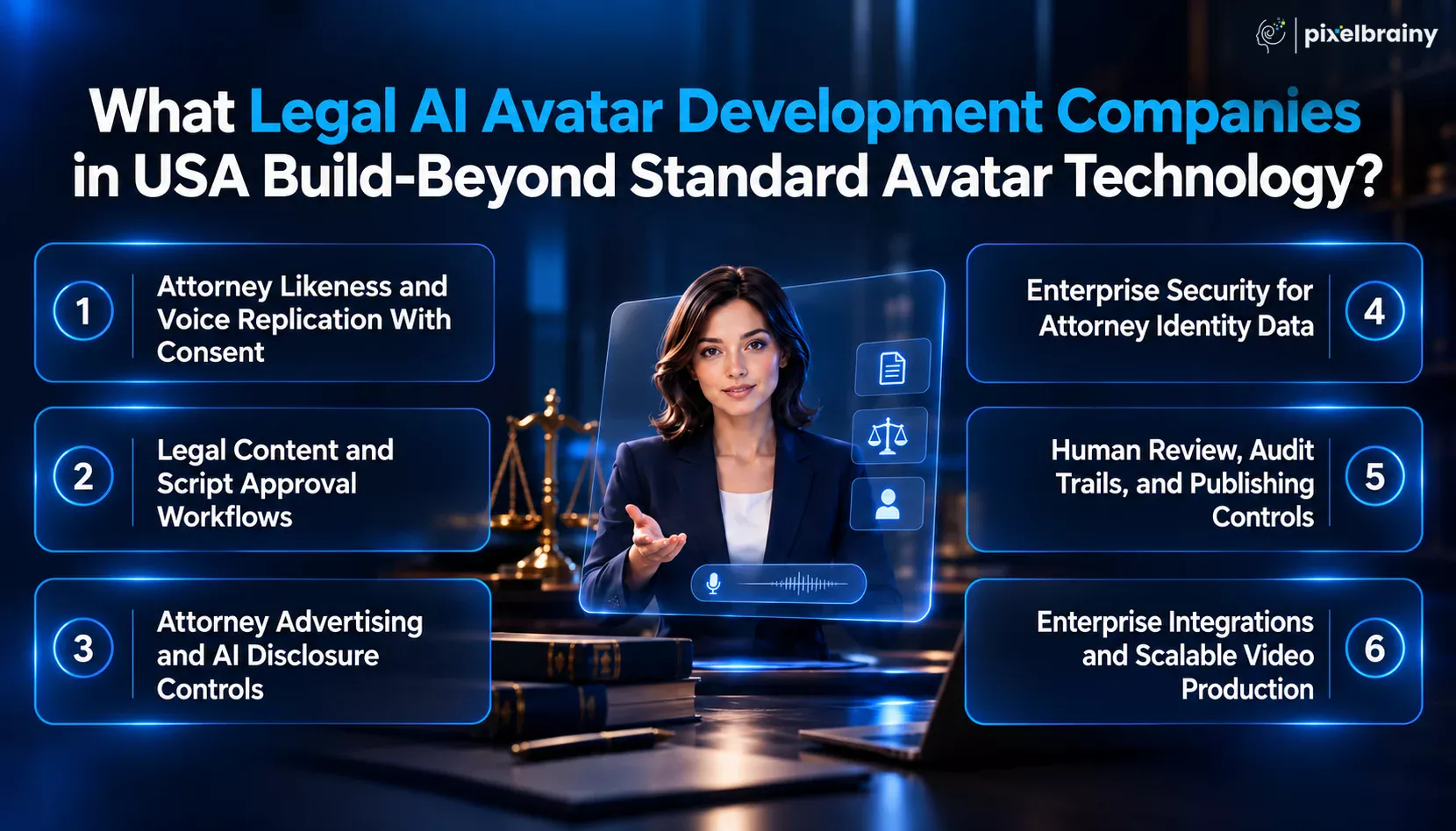
A legal avatar system can create a digital representation of an attorney's appearance, voice, and presentation style from an authorized recording. For law firms, the development process should include documented consent, identity verification, usage permissions, and procedures for disabling or removing an avatar.
This is particularly important when firms create hundreds of attorney avatars because each partner's likeness and voice need to remain under controlled authorization.
Top legal AI avatar development services providers USA can build workflows in which approved scripts are created before an avatar generates the final video.
A firm can establish different approval paths for:
This approach reduces the risk of an AI avatar generating or publishing unauthorized statements.
Legal avatar development becomes more complex when an AI-generated attorney appears in public advertising. The system may need configurable disclosure mechanisms that identify synthetic content and support different requirements based on jurisdiction, communication type, and publication channel.
The ABA Model Rules require lawyer communications about legal services to be truthful and not misleading, while state jurisdictions can impose additional requirements. The ABA has also discussed ethical considerations surrounding AI-generated people, images, and voices in law-firm marketing.
For this reason, custom legal AI avatar development companies in USA can build compliance workflows that connect content approval with disclosure requirements rather than treating disclosure as an afterthought.
Attorney avatar systems can process highly sensitive identity information, including facial imagery, voice recordings, avatar models, and personal professional information. Enterprise deployments therefore require more than ordinary video-storage security.
Law firms should evaluate:
A legal avatar should not operate as an uncontrolled content generator. A properly designed system can place human approval between AI video generation and public distribution.
The workflow can follow a defined sequence:
Attorney consent → identity verification → approved script → compliance review → avatar generation → human approval → required disclosure → publication → audit record
This architecture is especially relevant for USA-based legal AI avatar development companies serving large law firms because it creates a traceable record of who authorized the avatar, which script was used, what disclosure was applied, who approved the video, and where the final content was published.
The most useful platforms can connect avatar production with existing firm systems, including content management systems, marketing platforms, learning management systems, CRM platforms, internal portals, and approval workflows.
For a large firm, this means an authorized partner could have one verified avatar profile while the marketing team produces multiple approved videos without arranging another filming session.
The key distinction is simple: standard avatar technology creates a digital presenter; legal AI avatar development creates a controlled attorney communication system that combines likeness replication, voice technology, content governance, security, compliance workflows, human approval, and scalable video production. That broader architecture is what legal buyers should evaluate when comparing the list of best legal AI avatar development companies in the USA.
How did we decide which legal AI avatar development companies in USA actually qualify for this list? We evaluated providers from the perspective of a legal buyer, not a general AI video buyer. Our methodology focused on whether each company could support the legal, ethical, operational, and technical requirements surrounding an attorney-facing or client-facing AI avatar. UPL controls, professional responsibility, confidentiality, multilingual performance, legal expertise, and evidence of real deployments were treated as core evaluation factors.
The goal was to identify providers that can support a legal AI avatar system, rather than simply place an attorney's face and voice inside a generic avatar platform.
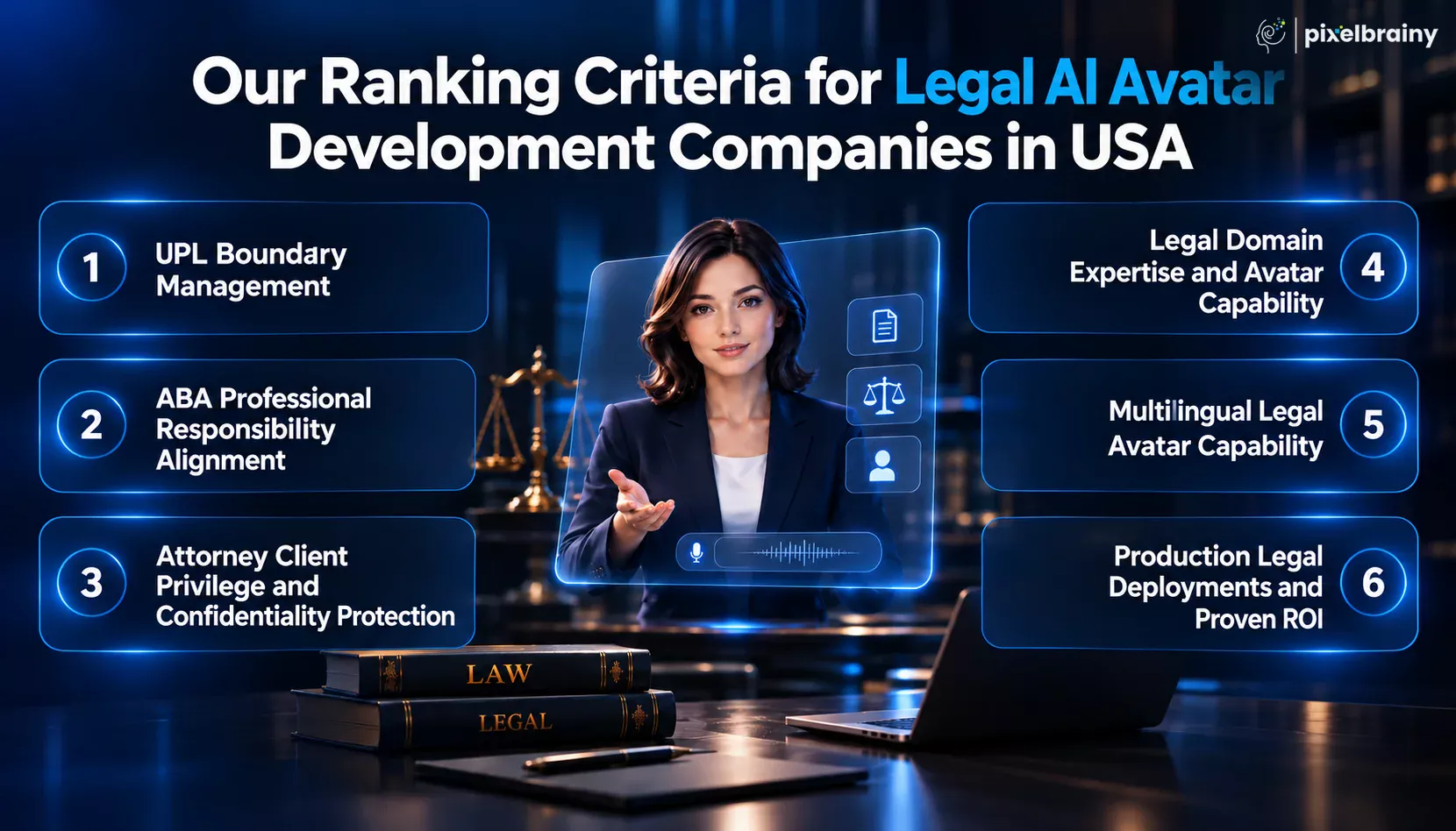
We looked for documented controls that keep an AI avatar within an information and intake role instead of allowing it to independently provide legal advice or perform functions requiring lawyer judgment.
Our evaluation included:
This criterion was particularly important for legal AI avatar development companies in USA UPL compliant use cases. Florida Bar Opinion 24-1, for example, states that AI cannot be delegated functions constituting the practice of law and discusses limits for AI-assisted prospective client intake.
We examined whether providers understand the professional responsibility issues surrounding AI in legal environments.
Our review considered:
The ABA has identified confidentiality, supervision, UPL, advertising, solicitation, and professional independence among the ethics issues lawyers should consider when using AI in marketing and legal services.
We evaluated how each provider handles information entered during legal intake.
A serious legal AI avatar platform should have clearly defined policies covering:
This criterion was essential for identifying legal AI avatar development companies in USA attorney client privilege compliant solutions. Florida Bar guidance specifically emphasizes confidentiality, data retention, data sharing, and lawyer oversight when generative AI is used for client intake.
We did not treat an attractive avatar demonstration as evidence of legal specialization.
We assessed whether providers could demonstrate knowledge of:
This helped us distinguish genuine legal technology capabilities from general avatar developers that simply showcase a legal client or legal-themed demo.
For multilingual legal organizations, we evaluated more than the number of supported languages.
We considered whether the technology could maintain conversational meaning, handle legal terminology, preserve intake logic, recognize uncertainty, and escalate appropriately across languages.
This criterion directly addresses buyers looking for best legal AI avatar development companies USA for multilingual client intake, including Spanish, Portuguese, Haitian Creole, Mandarin, and Arabic.
We gave greater weight to documented production deployments involving law firms, legal departments, courts, legal education, legal aid organizations, or other identifiable legal users.
We also examined available evidence of measurable business value, such as reduced production time, lower content-production costs, increased training capacity, or greater client-accessibility.
That distinction matters for buyers searching for legal AI avatar development companies in USA with proven ROI. A prototype, sales demo, or hypothetical case study was not treated as equivalent to a production implementation.
Our Evaluation Rule:
Our methodology therefore follows a simple principle:
Legal avatar capability + legal controls + documented evidence = consideration for ranking.
We did not rank companies simply because they offered AI avatars, voice cloning, digital humans, or a law-related portfolio item. Providers without meaningful evidence of UPL boundary management, confidentiality controls, legal-domain capability, or production relevance received substantially less consideration.
This approach also means that legal AI avatar development companies in USA ABA compliant should not be interpreted as companies receiving an official ABA certification. In this article, the term refers to providers whose documented capabilities and workflows can be evaluated against relevant professional responsibility requirements.

Also Read: Top 12 AI Avatar Development Companies in USA
“I'm a solo personal injury attorney losing $180,000 annually to competitors with 24/7 intake capability. I want an AI avatar on my website capturing incident details, qualifying cases against my threshold criteria, and scheduling morning callbacks within UPL limits. Which legal AI avatar development companies in the USA build affordable 24/7 intake avatar systems for solo personal injury firms without $50,000 minimum engagements?”
This buyer question highlights what legal organizations actually need from an AI avatar provider: 24/7 intake, case qualification, appointment scheduling, multilingual communication, attorney-controlled workflows, and clear UPL boundaries.
Below is our list of the top legal AI avatar development companies in USA for 2026, covering custom legal AI avatar development companies, avatar platforms, conversational AI providers, legal intake solutions, and AI development firms serving law firms, legaltech startups, legal aid organizations, and legal education providers.
We evaluated these companies based on legal avatar capabilities, customization, intake and conversational features, security, multilingual support, legal workflow integration, UPL considerations, and publicly documented evidence of legal-sector use. Where pricing, legal clients, or compliance frameworks are not publicly disclosed, we identify that clearly rather than treating marketing claims as verified evidence.
Location: Sheridan, Wyoming, USA
Founded: 2021
Clutch Rating: 4.9/5
Website: https://www.pixelbrainy.com/
Core legal AI avatar capabilities: PixelBrainy develops custom AI avatars, conversational avatars, digital humans, voice-enabled systems, NLP applications, computer vision solutions, generative AI and RAG-based systems.
Legal avatar types: Client intake, attorney marketing, legal education, internal training, legal information and interactive simulations.
UPL and ABA compliance approach: Public materials discuss security, privacy and compliance considerations, but we did not find independently verifiable evidence of a dedicated UPL rules engine or ABA-certified legal avatar framework. Those requirements should be specified and tested during implementation.
Notable US clients: PixelBrainy publicly references EY, MSC Cruises, VetPlus, Tykr, EventPlaybook and Makula. We did not find sufficient evidence to classify these organizations as legal-avatar clients.
Legal verticals served: Custom AI development and enterprise software, with legal applications requiring project-level validation.
Pricing range: Custom quote.
Best fit for: Law firms, legaltech startups, legal aid organizations and corporate legal departments requiring bespoke development.
Why they're on this list: PixelBrainy a leading AI legal software development company is particularly relevant for buyers wanting a custom system rather than an off-the-shelf avatar product. Its technology can potentially connect avatars with intake logic, RAG, CRM, scheduling and human escalation. Legal buyers should separately validate UPL, confidentiality and privilege controls before deployment.
Location: Tel Aviv, Israel, with international and US enterprise operations
Founded: 2017
Core legal AI avatar capabilities: AI avatars, digital twins, multilingual video, APIs and real-time Visual Agents.
Legal avatar types: Attorney marketing, client education, legal information, training and interactive website experiences.
UPL and ABA compliance approach: D-ID provides consent and identity-related controls, but public documentation does not establish a dedicated US legal UPL framework. Firms would need to implement legal knowledge boundaries and escalation controls.
Notable US legal clients: No specific US law-firm client was independently verified.
Legal verticals served: Enterprise communications, marketing, training and customer experience.
Pricing range: Self-service and enterprise options.
Best fit for: Firms seeking multilingual attorney videos or interactive digital humans.
Why they're on this list: D-ID combines established avatar infrastructure, multilingual capabilities and interactive digital-human technology. Its Visual Agents make it relevant to firms considering conversational experiences in addition to prerecorded attorney content.
Location: New Zealand founded, with San Francisco operations
Founded: 2016
Core legal AI avatar capabilities: Interactive digital people, conversational experiences and expressive digital-human technology.
Legal avatar types: Client intake interfaces, legal information, training simulations and client-service experiences.
UPL and ABA compliance approach: We found no public evidence of a dedicated US legal UPL rules engine or ABA certification. Legal boundaries would need to be implemented within the specific deployment.
Notable US legal clients: No specific law-firm client was independently verified.
Legal verticals served: Customer experience, education, training and interactive services.
Pricing range: Enterprise or custom quote.
Best fit for: Legal organizations exploring high-touch digital humans.
Why they're on this list: Soul Machines is relevant where client interaction and conversational presentation are important. Its technology could be considered for sensitive legal intake environments, but emotional responsiveness should not be confused with legal reasoning or attorney judgment.
Location: London, UK
Founded: 2017
Core legal AI avatar capabilities: AI avatars, personal avatars, voice cloning, multilingual video, dubbing and interactive avatars. Synthesia supports more than 140 languages.
Legal avatar types: Legal training, attorney marketing, onboarding, professional education and multilingual legal content.
UPL and ABA compliance approach: Synthesia publicly documents restrictions concerning legal advice and qualified legal professionals for certain avatar use cases.
Notable US legal clients: No specific US law-firm client was independently verified.
Legal verticals served: Enterprise learning and professional communications.
Pricing range: Subscription and enterprise pricing.
Best fit for: Firms, law schools and legal organizations producing multilingual training content.
Why they're on this list: Synthesia combines enterprise video production with extensive multilingual support and documented safeguards around legal content. It is particularly suitable for education and communications rather than autonomous legal intake.
Location: Los Angeles, California, USA
Founded: 2020
Core legal AI avatar capabilities: Digital replicas, custom avatars, voice-driven videos, translation and multilingual video. (HeyGen)
Legal avatar types: Attorney introductions, marketing, practice-area videos, client education and recruiting.
UPL and ABA compliance approach: HeyGen provides identity verification and consent mechanisms for custom avatars. A dedicated law-firm UPL engine was not publicly verified.
Notable US legal clients: Growth Amplifier, a James Publishing business, publicly describes using HeyGen technology for attorney avatars and legal marketing. (HeyGen)
Legal verticals served: Attorney marketing and professional services.
Pricing range: Self-service and enterprise options.
Best fit for: Solo attorneys, small firms and law-firm marketing teams.
Why they're on this list: HeyGen has clear publicly documented relevance to attorney marketing and scalable video production. It is especially useful for firms seeking branded attorney content without repeated studio sessions. Its marketing focus should be distinguished from a fully engineered legal intake system.
Location: San Francisco, California, USA
Founded: 2020
Core legal AI avatar capabilities: Customer Replicas, personalized videos, conversational AI and real-time digital-human experiences. (Tavus)
Legal avatar types: Client communication, personalized partner messages, legal education and recruiting.
UPL and ABA compliance approach: Tavus requires consent for Customer Replicas and addresses AI disclosure. A dedicated UPL framework for US law-firm intake was not publicly established. (Tavus)
Notable US legal clients: No specific law-firm client was independently verified.
Legal verticals served: Enterprise communications and professional services.
Pricing range: Custom enterprise pricing.
Best fit for: Enterprise law firms and corporate legal departments.
Why they're on this list: Tavus is relevant for firms wanting personalized digital communication and conversational experiences rather than only prerecorded videos. Legal deployment still requires firm-defined knowledge boundaries, escalation and confidentiality controls.
Location: Berlin, Germany
Founded: 2020
Core legal AI avatar capabilities: AI video generation, avatars, professional training and scenario-based learning.
Legal avatar types: Legal training, law-school education, compliance training and onboarding.
UPL and ABA compliance approach: No dedicated US legal UPL framework was publicly verified. Its strongest legal application is educational content.
Notable US legal clients: No specific US legal client was independently verified.
Legal verticals served: Enterprise learning and professional education.
Pricing range: Subscription and enterprise quote.
Best fit for: Law schools, legal departments and firms producing training content.
Why they're on this list: Colossyan is suitable for organizations that need repeatable legal education and training videos. It is less directly suited to autonomous legal intake or advice.
Location: International operations with US availability
Founded: Reliable founding information was not established in the reviewed sources.
Core legal AI avatar capabilities: AI marketing videos, avatars and creative automation.
Legal avatar types: Attorney marketing, social content, website videos and educational clips.
UPL and ABA compliance approach: Creatify has AI safety provisions concerning nonconsensual impersonation, but a dedicated UPL or ABA legal framework was not publicly verified. (Creatify)
Notable US legal clients: No specific law-firm client was independently verified.
Legal verticals served: General professional services and marketing.
Pricing range: Subscription-based.
Best fit for: Solo practitioners and small law firms seeking affordable marketing video production.
Why they're on this list: Creatify fits buyers comparing affordable legal AI avatar development companies in USA for marketing purposes. It is not the same as a custom legal intake platform and should not be positioned as one without additional development.
Location: New York, USA
Founded: 2015
Core legal AI avatar capabilities: Custom AI development, conversational AI, generative AI, NLP, machine learning, digital humans and enterprise application development.
Legal avatar types: Client intake, legal information, attorney marketing, training and custom client-facing AI assistants.
UPL and ABA compliance approach: Public materials do not establish an independently verified UPL engine or ABA certification. Legal teams should define response boundaries, escalation rules, disclosures and human-review requirements during implementation.
Notable US legal clients: No specific US law-firm AI avatar client was independently verified.
Legal verticals served: Enterprise AI, conversational applications, automation and custom software.
Pricing range: Custom quote.
Best fit for: Law firms, legaltech startups and organizations requiring a bespoke AI avatar with integrations.
Why they're on this list: Appinventiv fits buyers looking for a custom development partner rather than a standard avatar subscription. Its broader AI and software engineering capabilities can support intake workflows, knowledge retrieval and system integrations, while UPL, confidentiality and privilege controls should be specified as project requirements.
Location: Santa Clara, California, USA
Founded: 2014
Core legal AI avatar capabilities: Real-time voice, video, speech recognition, text-to-speech, LLM integration, RAG and digital-human infrastructure.
Legal avatar types: Live intake, virtual reception, legal information and simulations.
UPL and ABA compliance approach: Agora provides infrastructure rather than a legal compliance layer. UPL controls and legal knowledge restrictions must be implemented by the application developer.
Notable US legal clients: No specific legal client was independently verified.
Legal verticals served: Enterprise conversational applications.
Pricing range: Usage-based and enterprise pricing.
Best fit for: Legaltech companies building real-time conversational systems.
Why they're on this list: Agora is useful when a legal organization needs low-latency voice and video interaction rather than prerecorded content. Its architecture can connect LLM, RAG, speech and avatar components into a real-time digital human.
Location: International operations
Founded: 2021
Core legal AI avatar capabilities: AI presenters, video generation, multilingual content and educational video.
Legal avatar types: Legal education, law-school training, community outreach and internal learning.
UPL and ABA compliance approach: No dedicated US legal UPL framework was publicly verified.
Notable US legal clients: No specific US legal client was independently verified.
Legal verticals served: Education and professional training.
Pricing range: Subscription and enterprise pricing.
Best fit for: Law schools, legal aid organizations and firms producing multilingual educational content.
Why they're on this list: Elai.io is better suited to legal education than autonomous legal advice. It can help organizations create repeatable educational videos while reducing dependence on repeated recording sessions.
Location: New York City, New York, USA
Founded: 2025
Core legal AI avatar capabilities: OpenIntake focuses on AI-powered law-firm intake through phone, web chat, text and forms rather than conventional avatar video. Y Combinator lists it as a Winter 2025 company.
Legal avatar types: Intake, lead qualification, appointment scheduling and prospective-client communication.
UPL and ABA compliance approach: Its law-firm-specific intake design makes it relevant to UPL-sensitive workflows, but public documentation does not establish an ABA certification or dedicated avatar UPL certification.
Notable US legal clients: Public law-firm use is central to the product, but a specific named client was not independently verified.
Legal verticals served: Law firms.
Pricing range: Public pricing was not identified.
Best fit for: Solo attorneys and small firms seeking 24/7 intake.
Why they're on this list: OpenIntake directly addresses the underlying problem in the real query for this section: capturing and qualifying prospective clients outside office hours. For a firm requiring a visual avatar, it would need to be paired with an avatar interface.
Location: India-based with international operations
Founded: 2016
Core legal AI avatar capabilities: Conversational AI, digital assistants and interactive enterprise experiences.
Legal avatar types: Legal information, employee guidance, customer service and institutional communication.
UPL and ABA compliance approach: No dedicated US legal UPL framework or ABA certification was publicly verified.
Notable US legal clients: No specific US legal client was independently verified.
Legal verticals served: Enterprise customer experience.
Pricing range: Custom enterprise quote.
Best fit for: Corporate legal departments and enterprise organizations.
Why they're on this list: DaveAI is relevant as conversational AI infrastructure that could be adapted to legal information workflows. A legal deployment would require controlled knowledge sources, response restrictions, escalation and confidentiality measures.
Location: International operations with US market availability
Founded: Reliable founding information was not established in the reviewed sources.
Core legal AI avatar capabilities: Personalized video generation and individualized communication.
Legal avatar types: Client follow-up, marketing, relationship management and personalized updates.
UPL and ABA compliance approach: No dedicated law-firm UPL framework or ABA certification was publicly verified.
Notable US legal clients: No specific US law-firm client was independently verified.
Legal verticals served: Professional services and personalized marketing.
Pricing range: Enterprise and custom pricing.
Best fit for: Law firms seeking personalized video communication rather than autonomous intake.
Why they're on this list: Gan.ai is relevant for firms that want to personalize client communications at scale while keeping substantive legal advice under attorney control.
The above are the leading legal AI avatar development companies in USA for 2026, offering solutions across legal intake, attorney marketing, legal education, client communication, and custom AI avatar development.
“Our shortlist is down to three legal AI avatar development companies in the USA. What questions should we ask to determine which one has actually built production legal AI avatars with documented UPL boundary management?”
If you are comparing legal AI avatar development companies in USA, the key question is not simply which provider has the most advanced avatar technology. Legal buyers should verify how the system handles legal information, intake questions, attorney escalation, confidentiality, disclosures, human review, and UPL boundaries.
The table below compares the top legal AI avatar development companies USA across the factors most relevant to law firms and legal organizations. UPL and legal specialization receive particular attention because a general-purpose avatar platform does not automatically provide a legal-compliant workflow. Florida Bar Opinion 24-1, for example, emphasizes that AI used for client intake must remain subject to lawyer oversight and should not provide legal advice that requires professional judgment.
Use this comparison as a starting point when evaluating legal AI avatar development firms USA:
| Company | HQ | UPL Compliance | Legal Avatar Types | ABA Compliance | Pricing Range | Best Fit For |
|---|---|---|---|---|---|---|
| PixelBrainy LLC | Sheridan, Wyoming, USA | Custom UPL boundary controls | Intake, marketing, education, simulation | ABA-aware development approach; verify deployment controls | Custom quote | Law firms, legaltech, legal education |
| D-ID | Tel Aviv, Israel | Buyer-configured controls | Intake, education, digital assistants | No dedicated ABA framework publicly verified | Custom/varies | Enterprise legal applications |
| Soul Machines | San Francisco, USA / New Zealand | Buyer-configured | Client guidance, education, digital humans | No dedicated ABA framework publicly verified | Custom quote | Interactive legal experiences |
| Synthesia | London, UK | Platform-level safeguards; legal workflow requires configuration | Education, training, marketing | No ABA certification publicly verified | Subscription/custom | Legal education and training |
| HeyGen | Los Angeles, USA | Buyer-configured legal workflow | Marketing, intake, education, digital replicas | No dedicated ABA certification publicly verified | Subscription/custom | Attorney marketing and communications |
| Tavus | San Francisco, USA | Custom workflow controls | Personalized outreach, intake, conversational avatars | No dedicated ABA framework publicly verified | Custom quote | Personalized legal communication |
| Colossyan | Berlin, Germany | Buyer-configured | Training, education, internal guidance | No dedicated ABA framework publicly verified | Subscription/custom | Legal training and education |
| Creatify | International / US market | Buyer-configured | Marketing, promotional, client-facing avatars | No dedicated ABA framework publicly verified | Subscription/custom | Legal marketing content |
| Appinventiv | New York, USA | Custom UPL controls required | Intake, information, training, custom AI assistants | No ABA certification publicly verified | Custom quote | Bespoke legal AI systems |
| Agora | Santa Clara, California, USA | Developer-controlled | Real-time assistants, voice/video, digital humans | No dedicated ABA framework publicly verified | Custom/API pricing | Real-time legal applications |
| Elai.io | International | Buyer-configured | Education, training, multilingual presenters | No dedicated ABA framework publicly verified | Subscription/custom | Legal education and multilingual content |
| OpenIntake | New York City, USA | Intake boundaries and human escalation require review | Legal intake, qualification, scheduling | No ABA certification publicly verified | Custom/varies | Law-firm intake workflows |
| DaveAI | India / International | Buyer-configured | Conversational AI, digital assistants | No dedicated ABA framework publicly verified | Custom quote | Enterprise conversational systems |
| Gan.ai | International / US market | Buyer-configured | Personalized video, client communication | No dedicated ABA framework publicly verified | Custom/varies | Personalized legal communications |
Overall, these legal AI avatar development companies in USA differ significantly in legal specialization, UPL controls, customization, and pricing, so buyers should verify documented capabilities before selecting a provider.
Legal AI avatars are being applied across contexts with very different confidentiality, professional responsibility, and communication requirements. An intake avatar for immigration clients is fundamentally different from a courtroom simulation avatar used for trial preparation or a CLE training avatar for attorneys. This distinction is especially important for litigation teams seeking adaptive AI courtroom simulation avatars that respond dynamically to witness answers rather than following scripted questions.
Law firms can use AI avatars to introduce attorneys, explain practice areas, answer common website questions, and create multilingual attorney profile content.
These applications can reduce dependence on repeated video production while giving firms more ways to communicate with prospective clients. Legal AI avatar development companies in USA for attorney marketing should also account for ABA advertising rules and applicable state bar disclosure requirements.
AI intake avatars can provide 24/7 first-contact support for personal injury, immigration, estate planning, and family law practices.
The avatar can collect case information, identify basic qualification criteria, and route suitable leads to attorneys without providing individualized legal advice.
For legal AI avatar development companies in USA for client intake, UPL boundaries, disclosures, escalation workflows, and secure handling of client information are critical architecture requirements.
Law schools can use AI avatars to simulate client interviews, negotiation scenarios, ethics situations, and other practical exercises.
Students can practice conversations repeatedly without requiring faculty members or volunteer clients for every session.
Bar associations can also use avatar-based simulations for CLE content. Legal AI avatar development companies in USA for CLE training should support scenario management, performance assessment, content updates, and applicable accreditation requirements.
Trial teams can use adaptive AI avatars to simulate opposing counsel, witnesses, or deposition participants during preparation.
For a litigation practice handling 12 to 15 major trials annually, an avatar that dynamically responds to witness answers could provide repeatable cross-examination practice without requiring outside consultants for every session.
This is where legal AI avatar development companies in USA for courtroom preparation need deeper conversational AI capabilities. The avatar should respond contextually rather than simply follow a predetermined script.
Courts and legal service organizations can deploy AI avatars to explain procedural information to self-represented litigants.
For example, an avatar could explain where to file a form, what documents are generally required, or how a court process works.
The system must clearly distinguish procedural information from legal advice. Legal AI avatar development companies in USA for self represented litigants should therefore build strong UPL safeguards, clear disclosures, escalation options, and accessible interfaces.
Corporate legal departments can use internal AI avatars to answer routine policy questions and direct employees toward appropriate legal resources.
An avatar could explain company policies, identify the relevant legal team, or route complex matters for human review.
For legal AI avatar development companies in USA for corporate legal departments, confidentiality, access controls, interaction logging, document permissions, and appropriate privilege handling should be addressed during architecture planning.
Legal aid organizations can use multilingual AI avatars to explain general legal processes and distribute community education materials.
Voice and avatar-based interaction can make information easier to access for people who may face language or digital literacy barriers.
For legal AI avatar development companies in USA for client intake and community education, multilingual support should preserve accurate legal terminology while clearly communicating that general information does not constitute individualized legal advice.
ALSPs can use AI avatars to train contract attorneys and document reviewers on client-specific workflows, review protocols, and quality expectations.
Instead of relying entirely on live onboarding sessions, organizations can provide repeatable avatar-led training and competency assessments.
This can help standardize onboarding across distributed teams and reduce the time required to prepare reviewers for new engagements.
Across these legal contexts, adaptive conversation, clear UPL boundaries, confidentiality, human escalation, and role-specific design are becoming central requirements. For litigation teams, these capabilities are particularly relevant when evaluating legal AI avatar development companies in USA for courtroom preparation.
“We need to hire a legal AI avatar development company in the USA for our law firm. What should we verify before signing a contract to make sure the avatar can handle our legal workflow, protect client information, stay within UPL boundaries, and scale after launch?”
This is the buyer's question behind this guide. When comparing the top legal AI avatar development companies USA, focus on what the provider can actually deliver for your legal workflow, not just how realistic the avatar looks.
The six checks below help buyers compare legal AI avatar development firms USA on legal experience, UPL controls, security, technology, pricing, and ongoing support.
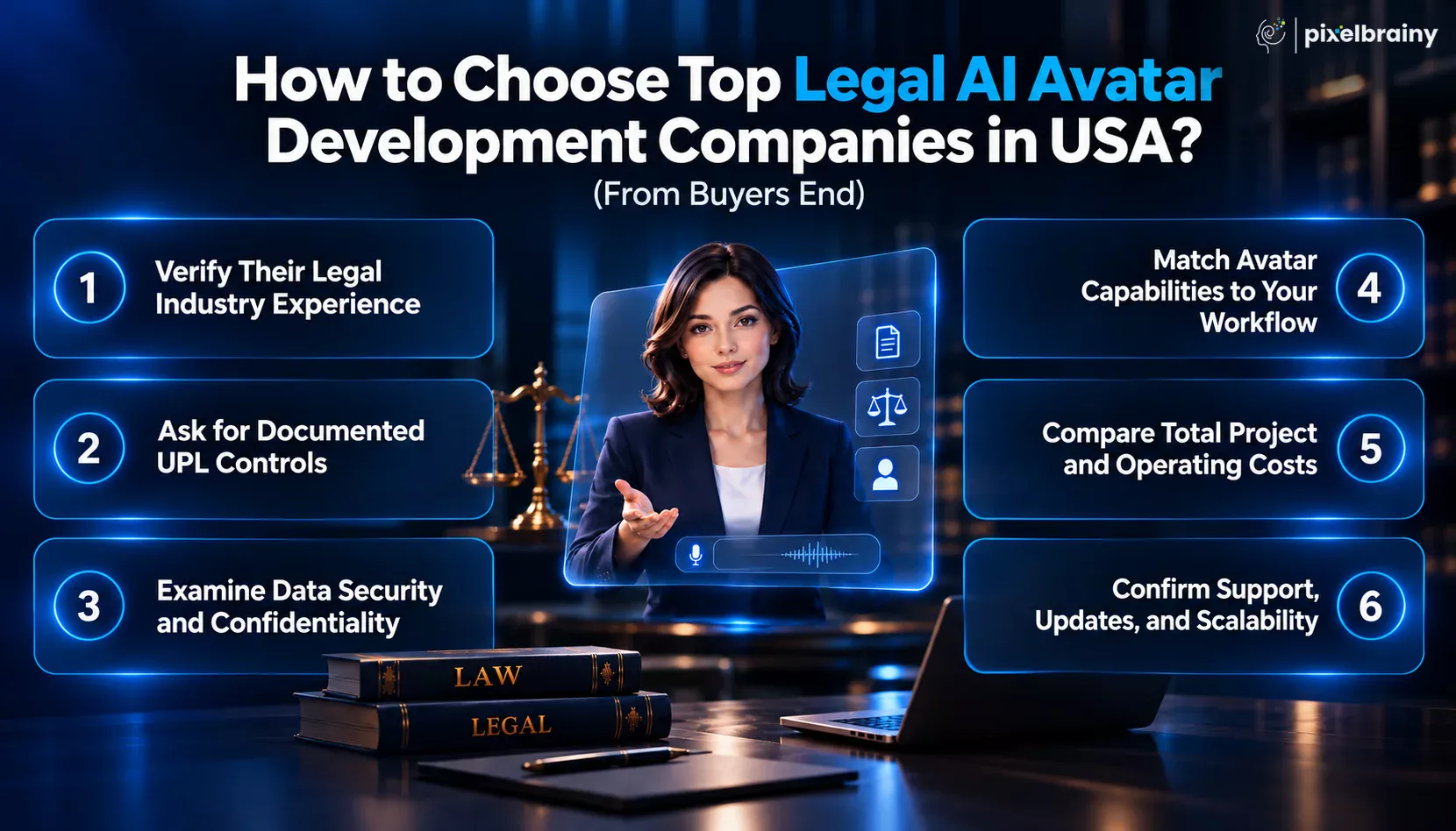
Start by asking whether the legal AI avatar development companies in USA have built solutions for legal organizations.
Look for experience with law firms, legaltech startups, legal aid organizations, law schools, or corporate legal departments. Ask for relevant case studies, deployment examples, and workflow documentation.
A company that mainly builds marketing avatars may not understand legal intake, attorney escalation, confidentiality, or UPL boundaries.
UPL management should be one of the first questions in your vendor evaluation.
Ask exactly how the avatar distinguishes general legal information from individualized legal advice. Find out how it handles restricted questions, attorney escalation, disclaimers, and human review.
Legal AI avatar developers USA should be able to explain how these rules are configured and tested. Avoid treating a general "AI safety" statement as evidence of a legal-specific UPL framework.
Ask what happens to information collected during every avatar interaction.
Review data storage, encryption, access permissions, retention periods, deletion procedures, audit logs, and third-party AI processing. Also ask whether conversation data can be used for model training.
For law firms, confidentiality requirements should be addressed before deployment. The vendor should clearly explain how sensitive client and prospective-client information moves through the system.
Do not evaluate every avatar provider using the same checklist. Define what your avatar actually needs to accomplish.
A client intake avatar may need structured questioning, qualification logic, scheduling, and human handoff. An attorney marketing avatar may need multilingual video production and controlled scripts. A courtroom simulation avatar may require adaptive conversation and scenario management.
Choose the legal AI avatar development agency USA whose technology matches your specific workflow.
Price should include more than the initial avatar development fee.
Ask for separate costs for development, integrations, AI usage, hosting, maintenance, support, additional languages, new workflows, and future modifications. Also ask whether there is a minimum engagement amount.
This helps buyers compare affordable legal AI avatar development companies in USA without confusing a low starting price with a low total cost of ownership.
Before signing, establish what happens after the avatar goes live.
Ask who handles technical problems, content updates, AI behavior changes, security issues, and workflow modifications. Check response times and ongoing support terms.
Also ask whether the system can expand to additional attorneys, practice areas, languages, locations, and integrations. A scalable solution should grow with the legal organization instead of requiring a complete rebuild for every new requirement.
Buyer takeaway: The strongest evaluation of legal AI avatar development companies in USA starts with documented legal capabilities, UPL controls, data protection, workflow fit, transparent costs, and dependable post-launch support.
When you plan to invest in an AI avatar for your law firm, the vendor decision can quickly become complicated. You may find providers offering realistic avatars, conversational AI, multilingual capabilities, and custom development, but the real question is whether those features fit your legal workflow and professional obligations.
Imagine your firm is comparing three vendors and each one makes similar claims about legal AI capabilities. Which mistakes could lead you to choose the wrong provider, especially when UPL controls, client confidentiality, pricing, and actual legal deployment experience matter?
That is the buyer scenario this section addresses. Below are the key mistakes to avoid when evaluating legal AI avatar development companies in USA, with a focus on the checks that can affect implementation, compliance, cost, and long-term performance.
A realistic face, voice, and animation can make an avatar look impressive during a demo. That does not establish whether it can perform a legal workflow safely.
Ask the legal AI avatar development companies in USA to demonstrate your actual use case. Test intake questions, approved responses, escalation, scheduling, multilingual communication, and integrations before treating the platform as production-ready.
One of the biggest mistakes is accepting a vendor's statement that its AI is "UPL compliant" without asking what that actually means.
Ask how the avatar handles requests for legal advice, restricted questions, jurisdiction-specific issues, and attorney escalation. Florida Bar Opinion 24-1, for example, states that lawyers remain responsible for confidentiality, professional judgment, and applicable advertising requirements when using AI.
A legal avatar may collect information before a prospect ever speaks with an attorney.
Ask where conversations are stored, who can access them, how long they are retained, whether third-party AI providers process the information, and whether data can be used for model training.
For legal AI avatar developers USA, these answers should be documented before deployment, particularly when the avatar handles prospective-client or client information.
The initial development quote does not always represent the total project cost.
Ask whether the proposal includes avatar development, AI usage, integrations, hosting, maintenance, support, additional languages, content updates, and future workflow changes.
When comparing legal AI avatar development firms USA, request the expected first-year cost and identify any minimum engagement, recurring fee, or customization charge.
A company can have extensive experience building AI avatars without having built a production legal system.
Ask for evidence involving law firms, legaltech startups, legal education, legal aid organizations, or corporate legal departments. Request examples that closely match your intended workflow.
This helps separate a general avatar provider from a legal AI avatar development agency USA with relevant legal implementation experience.
A scripted demonstration can hide important limitations.
Before signing with legal AI avatar development companies in USA, test the avatar with unexpected legal questions, incomplete facts, sensitive information, requests for individualized advice, and situations requiring human escalation.
The objective is to see whether the avatar stays within its defined role instead of simply producing a confident-sounding answer.
Legal AI should not remove attorney or staff oversight from workflows that require professional judgment.
Define when the avatar must hand a conversation to a lawyer or trained employee. Also determine who reviews the avatar's knowledge, responses, disclosures, and escalation rules.
The Florida Bar specifically notes that lawyers remain responsible for their work product and professional judgment when using generative AI.
The buying decision should cover what happens after deployment.
Ask who handles technical issues, security updates, content changes, AI response problems, new integrations, and additional workflows.
Also confirm whether the system can expand to more attorneys, practice areas, languages, and locations without requiring a complete rebuild.
Avoiding these mistakes gives legal buyers a clearer way to evaluate legal AI avatar development companies in USA beyond demos, marketing claims, and initial pricing.
The right legal AI avatar development partner in USA should match your legal workflow, compliance requirements, and business goals. Whether you need 24/7 intake, attorney marketing, multilingual communication, legal education, or courtroom preparation, start with the specific outcome you want the avatar to deliver.
When comparing legal AI avatar development companies in USA, review their legal industry experience, UPL boundary controls, data security, human escalation, integrations, and customization capabilities. Ask for relevant production examples instead of relying only on general AI or avatar claims.
For firms seeking custom legal AI avatar development companies in USA, pricing should include development, integrations, AI usage, hosting, maintenance, support, and future modifications. This gives you a clearer view of total ownership costs.
Before signing, test the avatar with realistic legal scenarios and verify what it can and cannot handle. The right legal AI avatar development partner should provide a clear roadmap, defined responsibilities, scalable architecture, and ongoing support.
Ready to build your legal AI avatar? Schedule a call with our team to discuss your use case, requirements, budget, and development roadmap.
There is no universally best provider because the right company depends on the legal workflow, budget, UPL requirements, and customization needed. For this review, PixelBrainy LLC is positioned as the anchor provider for custom legal AI avatar development, while platforms such as HeyGen, Synthesia, and D-ID may suit different production requirements.
Legal AI avatar development costs in the USA vary from platform subscriptions to custom enterprise projects. Pricing depends on avatar complexity, conversational AI, integrations, languages, security, knowledge retrieval, and ongoing support. Buyers should request a complete first-year estimate rather than comparing only the initial development fee or assuming every provider has the same minimum engagement.
The UPL boundary separates permitted factual or procedural assistance from activities requiring legal judgment by a lawyer. A legal AI avatar should identify itself as AI, collect permitted factual information, avoid individualized legal advice, and escalate legal questions to qualified professionals. Florida Bar Opinion 24-1 specifically addresses these concerns for AI-assisted client intake.
Yes, legal AI avatars can support attorney marketing, but the content must comply with applicable lawyer advertising rules. Buyers should review claims, disclosures, attorney likenesses, and potential confusion about whether an avatar is an actual lawyer. State rules can add requirements. Florida's guidance, for example, addresses AI chatbots, advertising, and disclosure of AI identity.
Custom legal AI avatar development companies in USA can build multilingual intake avatars, but buyers should verify actual production experience rather than relying on language-count claims. Immigration and legal aid workflows may require Spanish, Mandarin, Arabic, Portuguese, Haitian Creole, or other languages, along with structured intake, escalation, translation quality, and UPL controls.
Legal AI intake avatars should treat confidentiality and prospective-client information as design requirements from the first interaction. Firms should define what information the avatar collects, where it is stored, who can access it, retention periods, and when attorney review occurs. Florida Bar guidance specifically warns lawyers to examine AI data retention and sharing practices.
Custom legal AI avatar development companies in USA can build courtroom simulation systems, but buyers should specifically verify adaptive conversational capability. A useful trial avatar should respond dynamically to witness answers rather than simply replaying scripted questions. Request demonstrations covering mock cross-examination, deposition practice, scenario branching, attorney controls, session recording, and performance review.
A development company can build a CLE training avatar, but the technology itself does not automatically receive state bar accreditation. Accreditation depends on the applicable jurisdiction, provider, course structure, instructional requirements, and approval process. Buyers should separate the vendor's technical capabilities from the bar's accreditation decision and confirm requirements with the relevant state authority.
Solo and small firms should prioritize providers offering configurable workflows and transparent project costs rather than assuming enterprise platforms are affordable. Custom developers can build intake or marketing avatars around a firm's specific requirements, while subscription platforms may reduce initial costs. Ask every legal AI avatar development company in USA about minimum engagements and recurring fees.
AI disclosure requirements vary by jurisdiction and use case, so there is no single nationwide state-bar disclosure rule for every legal AI avatar. Lawyers should review applicable advertising, chatbot, professional-conduct, and UPL requirements before deployment. Florida Bar Opinion 24-1, for example, states that client-facing AI chatbots should clearly identify themselves as AI rather than lawyers or firm employees.

About The Author
Sagar Bhatnagar
Sagar Sahay Bhatnagar brings over a decade of IT industry experience to his role as Marketing Head at PixelBrainy. He's known for his knack in devising creative marketing strategies that boost brand visibility and market influence. Sagar's strategic thinking, coupled with his innovative vision and focus on results, sets him apart. His track record of successful campaigns proves his ability to utilize digital platforms effectively for impactful marketing efforts. With a genuine passion for both technology and marketing, Sagar continuously pushes PixelBrainy's marketing initiatives to greater success.

Working with PixelBrainy has been a great experience. They took our vision for an AI-powered platform and turned it into a fully functional product. What impressed me most was their strong understanding of both design and development, and their ability to handle complex requirements with ease. The team was responsive, cooperative, and always open to feedback. They kept things organized, communicated clearly, and delivered quality work on time. I highly recommend PixelBrainy to anyone looking for a skilled and reliable development partner.

Working with the PixelBrainy team has been a highly positive experience. They understand the design requirements and create beautiful UX elements to meet the application needs. The dev team did an excellent job bringing my vision to life. We discussed usability and flow. Sagar worked with his team to design the database and begin coding. Working with Sagar was easy. He has the knowledge to create robust apps, including multi-language support, Google and Apple ID login options, Ad-enabled integrations, Stripe payment processing, and a Web Admin site for maintaining support data. I'm extremely satisfied with the services provided, the quality of the final product, and the professionalism of the entire process. I highly recommend them for Android and iOS Mobile Application Design and Development.

Great experience working with them. Had a lot of feedback and I found that unlike most contractors they were bugging me for updates instead of the other way around. They were extremely time conscience and great at communicating! All work was done extremely high quality and if not on time, early! They were always proactive when it comes to communication and the work is great/above par always. Very flexible and a great team to work with! Goes above and beyond to present us with multiple options and always provides quality. Amazing work per usual with Chitra. If you have UI/UX or branding design needs I recommend you go to them! Will likely work with them in the future as well, definitely recommended!

PixelBrainy is a joy to work with and is a great partner when thinking through branding, logo, and website layout. I appreciate that they spend time going into the "why" behind their decisions to help inform me and others about industry best practices and their expertise.

I hired them to design our software apps. Things I really like about them are excellent communication skills, they answer all project suggestions and collaborate right away, and their input on design and colors is amazing. This project was complex and needed patience and creativity. The team is amazing to do business with. I will be using them long-term. Glad to see there are some good people out there. I was afraid to try and outsource my project to someone but I am glad I met them! I really can't say enough. They went above and beyond on this project. I am very happy with everything they have done to make my business stand out from the competition.

It was great working with PixelBrainy and the team. They were very responsive and really owned the project. We'll definitely work with them again!

I recently worked with the PixelBrainy team on a project and I was blown away by their communication skills. They were prompt, clear, and articulate in all of our interactions. They listened and provided valuable feedback and suggestions to help make the project a success. They also kept me updated throughout the entire process, which made the experience stress-free and enjoyable.

PixelBrainy is very good at what it does. The team also presents themselves very professionally and takes care of their side of things very well. I could fully trust them taking up the design work in a timely and organised manner and their attention to detail saved us lots of effort and time. This particular project was quite intense and the team showed that they function very well under pressure. Very much looking forward to working with her again!

It's always an absolute pleasure working with them. They completed all of my requests quickly and followed every note I had for them to a T, which made our process go smoothly from start to finish. Everything was completed fast and following all of the guidelines. And I would recommend their services to anyone. If you need any design work done in the future, PixelBrainy should be your first call!

They took ownership of our requirements and designed and proposed multiple beautiful variants. The team is self-motivated, requires minimum supervision, committed to see-through designs with quality and delivering them on time. We would definitely love to work with PixelBrainy again when we have any requirements.

PixelBrainy was a big help with our SaaS application. We've been hard at work with a new UI/UX and they provided a lot of help with the designs. If you're looking for assistance with your website, software, or mobile application designs, PixelBrainy and the team is a great recommendation.

PixelBrainy designers are amazing. They are responsive, talented, and always willing to help craft the design until it matches your vision. I would recommend them and plan to continue them for my future projects and more!!!

They were awesome! Did a good job fast, and good communication. Will work with them again. Thank you

Creative, detail-oriented, and talented designers who take direction well and implement changes quickly and accurately. They consistently over-delivered for us.

PixelBrainy team is very talented and creative. Great designers and a pleasure to work with. PixelBrainy is an excellent communicator and I look forward to working with them again.

PixelBrainy has a very talented design team. Their work is excellent and they are very responsive. I enjoy working with them and hope to continue on all of our future projects.


Transform your ideas into reality with us.
Across these industries, each engagement brings unique challenges, from early-stage product development to scaling complex systems, helping us build a practical understanding of real-world product environments.