 AI Summary Powered by PixelBrainy
What if you could create original, studio-quality music for your YouTube videos, podcasts, indie albums, games, and advertisements without depending on Suno AI?
AI music generation is changing how creators compose, produce, and distribute music. From independent musicians and YouTubers to filmmakers, game developers, marketing agencies, and music startups, more creators are exploring generative AI music platforms to reduce production costs, speed up creative workflows, and experiment with new sounds. However, finding the right tool involves more than generating a catchy melody. Commercial licensing, copyright considerations, audio quality, customization, export options, and subscription costs can all influence which platform is worth choosing.
That is why searching for Suno AI alternatives and Suno AI competitors has become an important part of evaluating today's AI-powered music production landscape. While Suno offers a convenient way to turn text prompts into complete songs, other platforms specialize in royalty-free background tracks, instrumental compositions, cinematic scores, vocal generation, stem separation, or professional music production workflows.
Consider this hypothetical creator scenario: "I am a YouTube content creator and I have been using Suno AI for background music, but I need an alternative that gives me a commercial license for monetized videos. I want to see the top alternatives compared on output quality, licensing terms, subscription costs, and audio export options before I switch." This is precisely the kind of decision this guide helps you make.
The broader market also signals significant opportunity. According to Grand View Research's AI music generation market analysis, AI-powered music creation is part of a rapidly developing industry, with growth driven by advances in generative models, digital content production, and automated audio workflows. For a reliable purchasing decision, however, market forecasts should be considered alongside each platform's actual capabilities and licensing terms.
In this guide, we explore the 15 best AI music generation tools to consider in 2027, compare their strengths and commercial-use considerations, and explain which AI music generator is better than Suno in 2027 for different creative needs. Whether you want quick background music, full songs, or a scalable music-generation product, this list will help you choose more confidently.

Suno AI is a popular AI music generator, but it may not meet every creator’s needs. Musicians, YouTube creators, game developers, and businesses are exploring Suno AI alternatives to find better audio quality, greater creative control, flexible licensing, and consistent results.
If you are wondering which AI music generator offers more control than Suno, the answer depends on the features you need. Some creators prioritize music editing, while others look for commercial usage rights, or tools that generate professional-quality soundtracks.
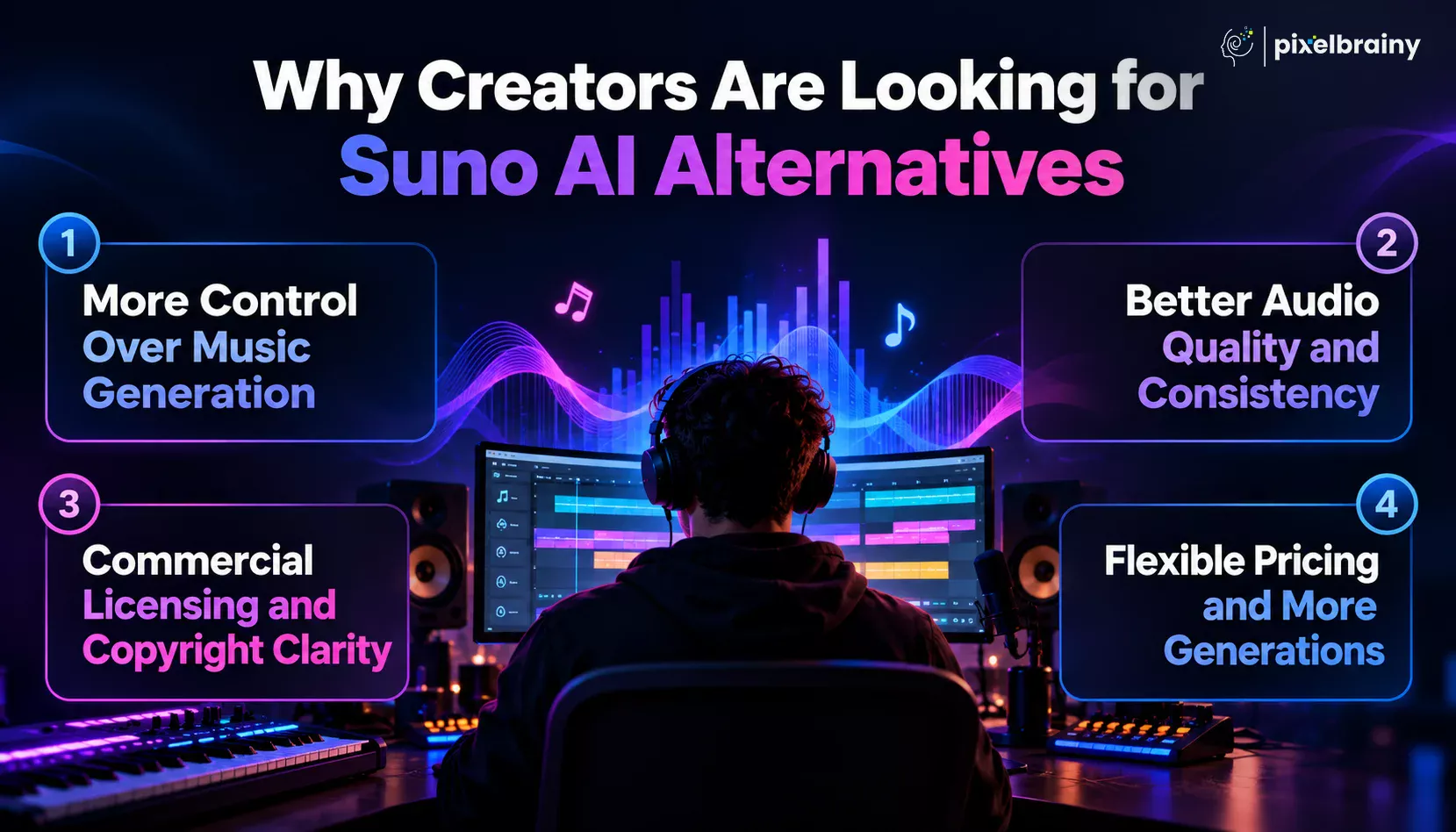
One common reason creators search for the best Suno AI alternative for custom music is the need for greater control over the final output. They want to customize instruments, tempo, song structure, vocals, and musical style instead of relying mainly on text prompts.
Creators asking which AI song generator lets you edit instruments and vocals should compare platforms based on their editing capabilities, arrangement controls, and ability to refine generated tracks. These features are especially useful for musicians who need specific sounds for advertisements, podcasts, films, or social media videos.
Professional creators need music that sounds clear, balanced, and consistent across different projects. Some AI-generated tracks may contain unnatural vocals, repetitive arrangements, or abrupt transitions.
When comparing AI music generators like Suno, look for high-quality audio output, natural-sounding vocals where needed, and reliable results across different genres. These features can help creators produce music that fits their content without extensive manual editing.
YouTube creators, advertisers, game studios, and businesses need to understand how they can use AI-generated music. Licensing terms may vary by platform, subscription plan, and intended use.
Anyone searching for royalty-free AI music generators for commercial use should review licensing terms, monetization permissions, attribution requirements, and restrictions on generated content before publishing or distributing music.
Generation limits and subscription costs can influence which platform creators choose. Users searching for free Suno AI alternatives or affordable AI music generators often want more credits, useful editing features, and predictable monthly pricing.
Compare free plans, paid subscriptions, export options, and commercial-use permissions to determine which tool offers the best value for your workflow.
| Feature | What Creators Need |
| Music quality | Clear, polished, consistent audio |
| Customization | Control over genre, instruments, vocals, and structure |
| Commercial use | Clear licensing and monetization terms |
| Pricing | Affordable plans and sufficient generation credits |
| Workflow | Easy editing, exporting, and integration |
For example, a game studio developing a fantasy adventure may need dozens of original background tracks for battles, exploration, and cinematic scenes. The team may search for the best AI music generator for game soundtracks to create consistent musical themes, adjust moods for different scenes, and find licensing suitable for commercial game releases.
The best Suno AI alternative depends on your creative goals, audio requirements, budget, and usage rights. By comparing these factors, creators can find an AI music generator that better supports music production, video content, podcasts, games, and commercial projects.
The AI music generation market continues to evolve, with new platforms offering different approaches to songwriting, instrumental composition, audio customization, and commercial music production. To identify the most useful Suno AI alternatives in 2027, we compared platforms based on audio quality, music generation capabilities, creative control, licensing, and ease of use.
This comparison of AI music generators for 2027 highlights the features that matter most to musicians, content creators, game developers, and businesses. Our evaluation also considers the pros and cons of Suno AI alternatives, helping readers understand which platforms are better suited to casual music creation, professional production, or business applications.
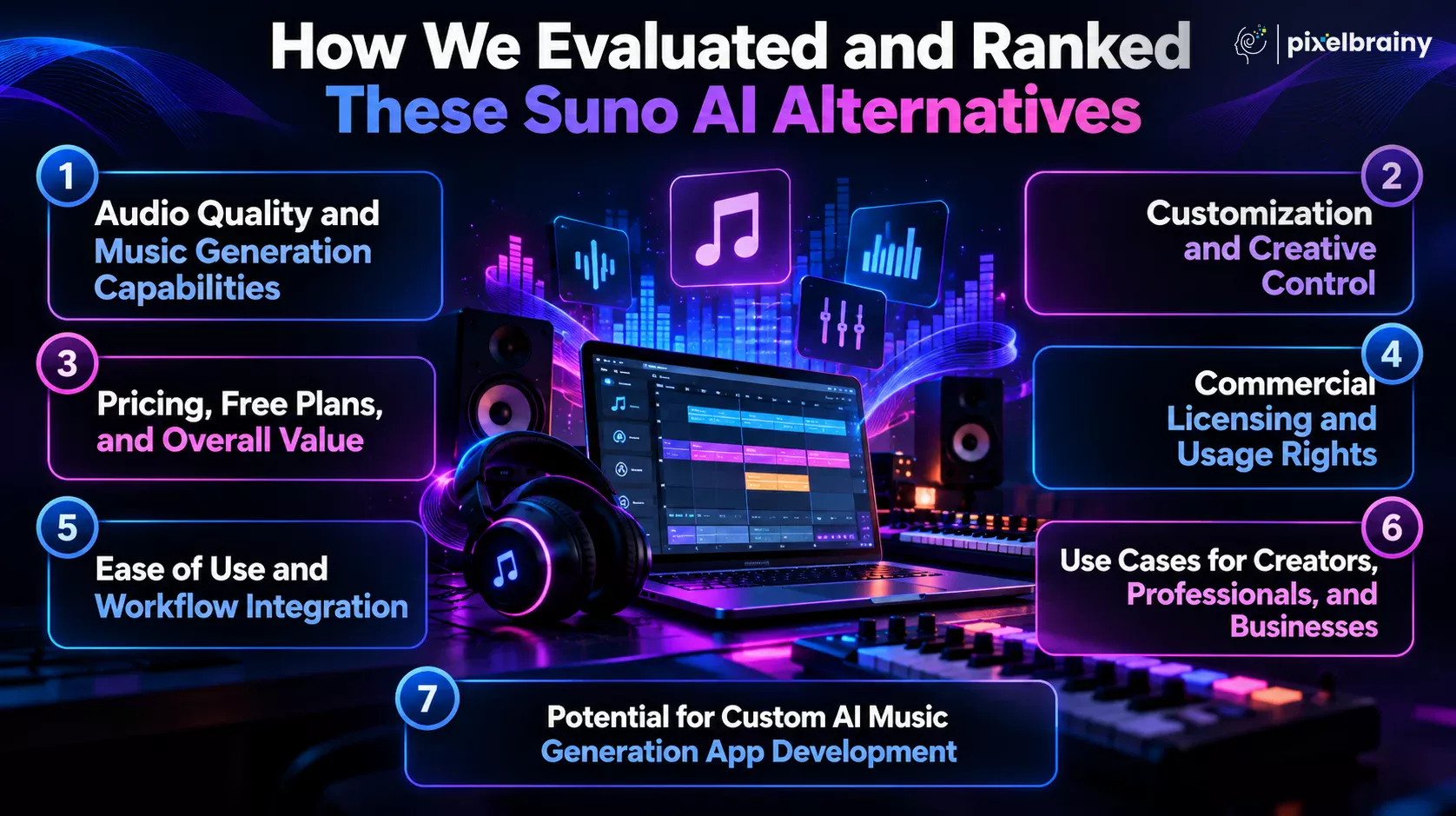
Audio quality plays a major role in determining how useful an AI music generator is for real-world projects. The top AI music platforms like Suno should generate tracks that reflect the requested genre, mood, tempo, and musical style while maintaining consistent sound quality.
We examined how each platform handles complete songs, instrumental compositions, background music, and AI-generated vocals where available.
Key evaluation criteria include:
Professional musicians and content creators often need more than a track generated from a basic text prompt. They may want to adjust instruments, refine song structures, extend compositions, or create music that fits a specific scene.
We assessed how much creative control each platform provides and whether its editing features support different levels of music production.
Key evaluation criteria include:
Pricing can significantly affect the long-term value of an AI music platform. Some creators need only a few tracks each month, while production teams and businesses may require higher generation limits and advanced features.
To compare the pros and cons of Suno AI alternatives, we considered subscription costs alongside generation credits, available tools, export options, and plan restrictions.
Key evaluation criteria include:
Commercial licensing matters to businesses, independent artists, advertisers, and creators who publish monetized content. The terms for using AI-generated music can vary by platform, subscription plan, and intended application.
We reviewed how clearly each service explains commercial usage, monetization permissions, attribution requirements, and relevant restrictions. Users should verify the current terms before releasing music commercially.
Key evaluation criteria include:
An AI music generator should make it easy to turn an idea into a usable track. Beginners may prefer a straightforward prompt-based interface, while experienced producers may need advanced controls and flexible export options.
We considered how easily users can navigate each platform, generate music, refine their results, and incorporate tracks into their existing creative workflows.
Key evaluation criteria include:
The best AI song generators in 2027 do not necessarily serve every audience equally. A social media creator may prioritize speed, while a professional musician may need greater control over compositions. Businesses may focus on consistent output, licensing clarity, and repeatable workflows.
We evaluated each platform according to its practical applications and intended users.
Key evaluation criteria include:
Existing music platforms may not provide every feature a business needs. Companies building specialized creative products may require custom interfaces, branded experiences, tailored generation workflows, or integrations with other applications.
We considered how the capabilities of existing AI music platforms can inform custom AI music generation app development like Suno. A dedicated application can offer more control over the user experience, but it also requires careful planning for AI infrastructure, development costs, licensing, and ongoing maintenance.
Key evaluation criteria include:
Each platform was assessed against the criteria above to identify its strengths, limitations, and most suitable use cases. Our comparison emphasizes practical differences rather than assuming that one tool is the best option for every creator.
These criteria provide a consistent framework for comparing AI music generators in 2027, from accessible song creation tools to platforms designed for professional music production and business use.
Also Read: How Much Does It Cost to Build AI Music Generation App like Suno AI?

The growing AI music generation market offers more than one way to create original music. Some platforms generate complete songs with vocals and lyrics, while others specialize in instrumental compositions, royalty-free background music, cinematic scores, AI voice conversion, or music generation APIs.
The top 15 Suno AI alternatives in 2027 featured in this guide serve different audiences, including YouTube creators, independent musicians, video editors, podcasters, game developers, and businesses. This comparison of AI music composition tools highlights the main features, advantages, limitations, commercial licensing considerations, and pricing models of each platform.
If you are searching for the best Suno AI alternatives for content creators and YouTubers, AI background music generator tools, or professional music production platforms, the options below can help you narrow your search based on your actual requirements.
Best for AI-generated songs, vocals, and songwriting exploration
Udio is an AI music generation platform known for turning text prompts into songs. It is relevant to creators who want to experiment with musical genres, lyrics, vocals, and full-song concepts. For users comparing alternatives to Suno AI, Udio is a natural platform to investigate when complete song generation is the main priority.
Best for: Independent musicians, songwriters, and content creators who want to explore AI-generated songs rather than only instrumental background tracks.
Commercial licensing: Check Udio's current terms and download permissions before using generated music commercially. Do not assume that access to a paid plan automatically grants every commercial right.
Best for background music, streaming, and developer integrations
Mubert focuses on AI-generated music for content creators, digital products, and developers. Unlike tools primarily designed to produce complete vocal songs, it is particularly relevant for background music and continuous audio experiences.
For creators searching for AI background music generator tools, Mubert can be worth considering when music needs to support a video, live stream, application, or digital experience without taking attention away from the main content.
Best for: Video creators, livestreamers, app developers, and businesses that need repeatable background music workflows.
Commercial licensing: Review the applicable Mubert plan, usage scope, distribution requirements, and API terms before commercial deployment.
Best for customizable background music for videos and commercial content
SOUNDRAW is an AI music generator designed for creators who need instrumental tracks with greater control over their structure and mood. Users can customize aspects such as musical energy, instrumentation, and duration, making the platform useful for videos, podcasts, social media, and other content projects.
Its official licensing information distinguishes between creator-focused background music use and artist plans for distributing modified music. The exact permissions depend on the plan and intended use.
Best for: YouTubers, video editors, social media agencies, and content teams producing music-supported media at scale.
Commercial licensing: SOUNDRAW offers commercial-use permissions under its plans, but users should check restrictions involving music distribution, client projects, and other specific uses.
Best for fast music creation for social media and marketing
Loudly combines AI music generation with a music library and customization tools. It is designed for creators who want to produce tracks efficiently for digital content without building every composition from scratch.
For marketers and video producers exploring AI music tools for video editors, Loudly is worth considering because it combines music creation with workflows intended for content production.
Best for: Social media creators, marketers, video producers, and businesses creating music-supported content.
Commercial licensing: Check the current plan terms and the permitted uses for your specific project, particularly when producing client work or advertising content.
Best for mood-based background music for videos and podcasts
Beatoven.ai focuses on AI-generated background music for visual and audio storytelling. Its use case is particularly relevant when a soundtrack needs to complement the emotion of a scene, rather than function as a standalone pop song.
Creators searching for Suno AI alternatives for podcast intro music or background scores for documentaries can consider Beatoven.ai as part of their comparison.
Best for: Podcast producers, video editors, documentary filmmakers, and creators who need music to support a narrative.
Commercial licensing: Review the current license for monetization, distribution, client work, and any restrictions on the generated track.
Best for cinematic, orchestral, and classical composition
AIVA is an AI composition platform associated with instrumental music, including cinematic and orchestral styles. It is relevant to creators who need soundtrack concepts, dramatic compositions, or music that can be further developed in a professional production environment.
Among Suno AI alternatives for professional music production, AIVA stands out as an option to investigate when composition structure and instrumental scoring matter more than generating a conventional vocal song.
Best for: Film composers, game developers, music producers, and creators working on cinematic or classical projects.
Commercial licensing: Rights and ownership conditions depend on the applicable subscription and license. Review the current terms before distributing or monetizing compositions.
Best for accessible AI song creation and music distribution workflows
Boomy is designed to make AI-assisted music creation accessible to people without extensive production experience. Its appeal lies in lowering the barrier to generating musical ideas and exploring distribution opportunities.
For independent creators who want to experiment with original AI-generated tracks, Boomy offers a different approach from platforms built around detailed prompt engineering and advanced production controls.
Best for: Music hobbyists, beginner musicians, and independent creators exploring AI-assisted music publishing.
Commercial licensing: Review the current distribution agreement, platform rules, and revenue-sharing terms before releasing music.
Best for beatmaking and contemporary music creation
Splash Pro focuses on accessible music creation with an emphasis on beats and contemporary genres. Its style-oriented approach can appeal to creators who want to experiment with rhythm, vocals, and electronic or urban-inspired music.
For users comparing top Suno AI alternatives with voice and lyric generation, Splash Pro is worth investigating if its current features align with their preferred genres and vocal workflow.
Best for: Beatmakers, emerging musicians, and creators producing hip-hop, pop, or electronic-inspired content.
Commercial licensing: Verify the current terms for generated tracks, voice features, distribution, and commercial use.
Best for AI vocals and voice conversion experiments
Musicfy combines AI music creation with vocal-focused capabilities. It is relevant to creators who want to experiment with vocal styles, AI voice conversion, or music concepts that require more than an instrumental track.
While not every AI music generator offers the same vocal workflow, Musicfy is an option to investigate for projects where the sound of the voice is central to the creative result.
Best for: Independent musicians, experimental vocal creators, and producers exploring AI-assisted vocal workflows.
Commercial licensing: Review the terms for voice models, generated vocals, commercial distribution, and permissions relating to any voice or identity being imitated. Obtain appropriate consent where required.
Best for technical creators and audio generation integrations
Stable Audio is an AI audio generation option from Stability AI. It is relevant to users who want to explore text-to-audio workflows, sound design, and developer-oriented applications rather than relying exclusively on a consumer song-generation interface.
For startups investigating how to build music or audio generation into their own products, Stable Audio is worth comparing with other AI music generation platforms and API-based services.
Best for: Developers, technical creators, researchers, and teams exploring AI audio features in their products.
Commercial licensing: Confirm the current model license, subscription terms, and API conditions. Access to a model does not automatically grant unrestricted commercial rights.
Best for professional content teams and agency workflows
Loudly Studio represents the professional and team-oriented use case associated with Loudly's music creation ecosystem. For agencies and production teams, the main considerations are not just track generation, but also workflow efficiency, licensing, collaboration, and the ability to produce music repeatedly.
It is particularly relevant to businesses evaluating AI music tools for recurring campaigns and client projects.
Best for: Creative agencies, production teams, marketers, and businesses producing content at scale.
Commercial licensing: Check the current Loudly plans and terms for team use, client deliverables, advertising, and other commercial projects.
Best for experimental and multimodal AI music creation
Melobytes offers creative tools that explore different ways to turn inputs into music. Depending on the available feature, users can experiment with text, poems, images, and other creative material to produce unusual musical results.
This makes Melobytes relevant to hobbyists and educators who want to explore AI music generation beyond conventional text-to-song prompts.
Best for: Hobbyists, educators, artists, and experimental creators.
Commercial licensing: Review the current terms for free and paid usage before incorporating generated music into a commercial project.
Best for structured songwriting and lyric customization
Sonauto is an AI music generation platform focused on helping users create songs from musical prompts and lyrics. It is relevant to songwriters who want to explore song structure and exercise more control over how a track develops.
For creators comparing top Suno AI alternatives with voice and lyric generation, Sonauto is worth examining for its songwriting-oriented workflow and supported customization features.
Best for: Songwriters, independent musicians, and creators who want to develop structured song ideas with AI assistance.
Commercial licensing: Check current terms for commercial use, distribution, and ownership of generated content.
Best for experimentation with open AI music generation
Riffusion is associated with an approach to music generation based on diffusion techniques and audio representations. It has attracted interest from technically oriented creators who want to explore generative music systems, rather than use only a finished commercial music application.
For developers comparing AI music platforms, Riffusion may be relevant when experimentation and model-level flexibility are more important than a polished end-user workflow.
Best for: AI researchers, developers, technically oriented musicians, and experimental creators.
Commercial licensing: Check the license for the exact model, code, hosted service, or version you use. Open access does not necessarily mean unrestricted commercial use.
Best for short-form social media music workflows
Loudme is aimed at users interested in generating music for digital content. It can be relevant to creators who need short, engaging audio concepts for platforms such as YouTube Shorts, Instagram Reels, and TikTok.
For users looking for Suno AI alternatives for content creators and YouTubers, the key question is whether the platform can produce music that fits their video format, creative style, and publishing requirements.
Best for: Social media creators, influencers, and marketing teams producing short-form content.
Commercial licensing: Verify the current plan's permissions for monetized content, branded posts, client work, and distribution.
These top 15 Suno AI alternatives in 2027 offer different approaches to song generation, background music, vocal experimentation, cinematic composition, and commercial audio workflows. Compare each platform against your specific requirements, verify current licensing terms, and prioritize the features that matter most to your project.
For startups, the same comparison can reveal opportunities to build specialized AI music products for underserved audiences and industry-specific workflows.
AI music generators offer different features for songwriting, instrumental composition, background music, vocal generation, and professional audio production. The right platform depends on your creative requirements, preferred music style, budget, and intended use.
This Suno AI alternatives comparison for 2027 brings together 15 AI music platforms to help creators compare their core capabilities, target audiences, advantages, limitations, and commercial licensing considerations. It covers tools for YouTube content, podcasts, social media, professional music production, and business applications.
The comparison below highlights the key differences between these AI music generation platforms, making it easier to evaluate their features without assuming that one tool is the best fit for every project.
| AI Music Generator | Core Features | Best For | Main Advantages | Potential Limitations |
| Udio | Text-to-song generation, lyrics, vocals, genre-based music creation | Songwriters, independent musicians, and content creators | Supports creative songwriting and experimentation across musical styles | Export options, editing controls, and usage rights should be checked |
| Mubert | Background music generation, mood-based tracks, developer integrations | Video creators, livestreamers, and app developers | Useful for background music workflows and music integration | Less focused on traditional full-length vocal songwriting |
| SOUNDRAW | Instrumental generation, mood, tempo, duration, and arrangement customization | YouTubers, video editors, and creative agencies | Offers control over background tracks for content production | Less focused on complete vocal songs |
| Loudly | AI music generation, music library, track customization | Social media creators, marketers, and video producers | Combines music creation with library-based workflows | Output and licensing suitability depend on the project and plan |
| Beatoven.ai | Mood-based background scores and soundtrack generation | Podcasters, filmmakers, and video editors | Designed for music that supports visual and audio storytelling | Less focused on lyric-driven songs |
| AIVA | Cinematic composition, orchestral music, MIDI export where supported | Film composers, game developers, and music producers | Relevant to instrumental scoring and composition workflows | May be less suitable for modern vocal song generation |
| Boomy | AI-assisted song creation and distribution workflows where available | Beginners, hobbyists, and independent creators | Accessible music creation for users with limited production experience | Production controls and distribution terms may not fit every project |
| Splash Pro | Beat creation, contemporary music workflows, vocal-related tools where available | Beatmakers and contemporary music creators | Useful for experimenting with beats and modern musical styles | Current genre coverage and features need verification |
| Musicfy | AI music generation, vocal conversion, voice-related tools | Musicians, producers, and vocal experimenters | Focuses on AI-assisted vocal creativity | Vocal consistency and voice-use permissions require review |
| Stable Audio | Text-to-audio generation, sound design, developer-oriented workflows | Developers, researchers, and technical creators | Relevant to integrated audio generation and technical applications | May require more technical knowledge than beginner-focused tools |
| Loudly Studio | Music customization and professional content workflows | Creative agencies, production teams, and businesses | Relevant to repeatable music production workflows | Professional features may cost more than individual creators need |
| Melobytes | Experimental music generation using creative inputs | Hobbyists, educators, and experimental artists | Supports unconventional approaches to AI music creation | Output consistency may not meet professional requirements |
| Sonauto | Song generation, lyric customization, genre and style prompts | Songwriters and independent musicians | Supports lyric-driven music creation and songwriting experiments | Available controls and integrations may vary |
| Riffusion | Experimental generative music workflows and model-based exploration | Developers, researchers, and technically oriented musicians | Useful for exploring generative music technology | Setup, usability, and output quality depend on the implementation |
| Loudme | AI-assisted music creation for digital content | Influencers, YouTubers, and social media teams | Relevant to quick music creation for online content | Advanced production and export capabilities should be verified |
This comparison of the best Suno AI alternatives in 2027 shows how AI music tools differ in their focus, from full-song creation and AI vocals to customizable background music and technical audio generation. Use this comparison to narrow your research based on your project requirements and intended use.

The best Suno AI alternatives for content creators and YouTubers depend on your content format, music requirements, budget, and commercial licensing needs. If you're wondering which Suno alternative is best for your specific use case, compare tools based on how you create, publish, and monetize audio.
Top picks: SOUNDRAW, Beatoven.ai, and Loudly. If you're searching for the best AI music generator for YouTube videos, SOUNDRAW offers customizable background music, Beatoven.ai specializes in mood-based soundtracks, and Loudly combines AI generation with a music library. Prioritize royalty-free commercial licensing and verify whether the terms cover monetized YouTube videos.
Top picks: Udio, Sonauto, and Boomy. For creators asking, “What is the best Suno alternative for making full songs with vocals?”, Udio and Sonauto are worth exploring for song generation and lyric experimentation. Boomy provides an accessible music creation workflow with distribution options subject to its current terms. Compare vocal quality, lyric control, and song structure when evaluating Suno alternatives for music production.
Top picks: AIVA, Mubert, and Stable Audio. If you need the best AI music generator for games or apps, AIVA is suited to cinematic and orchestral compositions, while Mubert and Stable Audio are options to investigate for generated audio and developer workflows. Check API access, seamless looping, stem export, and licensing compatibility with your game engine.
Top picks: Beatoven.ai and SOUNDRAW. Searching for AI-generated intro music or podcast background music? Beatoven.ai supports mood-based audio, while SOUNDRAW offers quick customization. Ease of use and short-form track creation are key considerations.
Top picks: Loudly Studio and SOUNDRAW. For agencies asking, “Which AI music generator is best for commercial projects?”, prioritize generation limits, client usage rights, and licensing clarity. Social media creators can also compare Loudme and Loudly for fast music generation.
| Creator Type | Top Pick | Runner Up | Key Reason |
| YouTube and video creator | SOUNDRAW | Beatoven.ai | Customizable background music |
| Indie musician and songwriter | Udio | Sonauto | Full-song and vocal experimentation |
| Game and app developer | AIVA | Stable Audio | Cinematic music and audio workflows |
| Podcast producer | Beatoven.ai | SOUNDRAW | Mood-based intro and transition music |
| Marketing agency | Loudly Studio | SOUNDRAW | Scalable commercial music production |
| Social media creator | Loudme | Loudly | Fast music generation for content |
The right tool depends on whether you need complete songs, royalty-free background tracks, AI vocals, or scalable commercial audio. Always confirm licensing and feature availability before choosing a platform.
AI music generators such as Suno and its alternatives make music creation faster, but off-the-shelf platforms do not meet every business requirement. Creators and companies may need specialized genres, branded user experiences, industry-specific audio, or predictable API costs that standard subscriptions cannot provide. These limitations create opportunities for custom AI music generation app development like Suno, particularly for businesses that want to build a differentiated product rather than depend entirely on third-party tools.
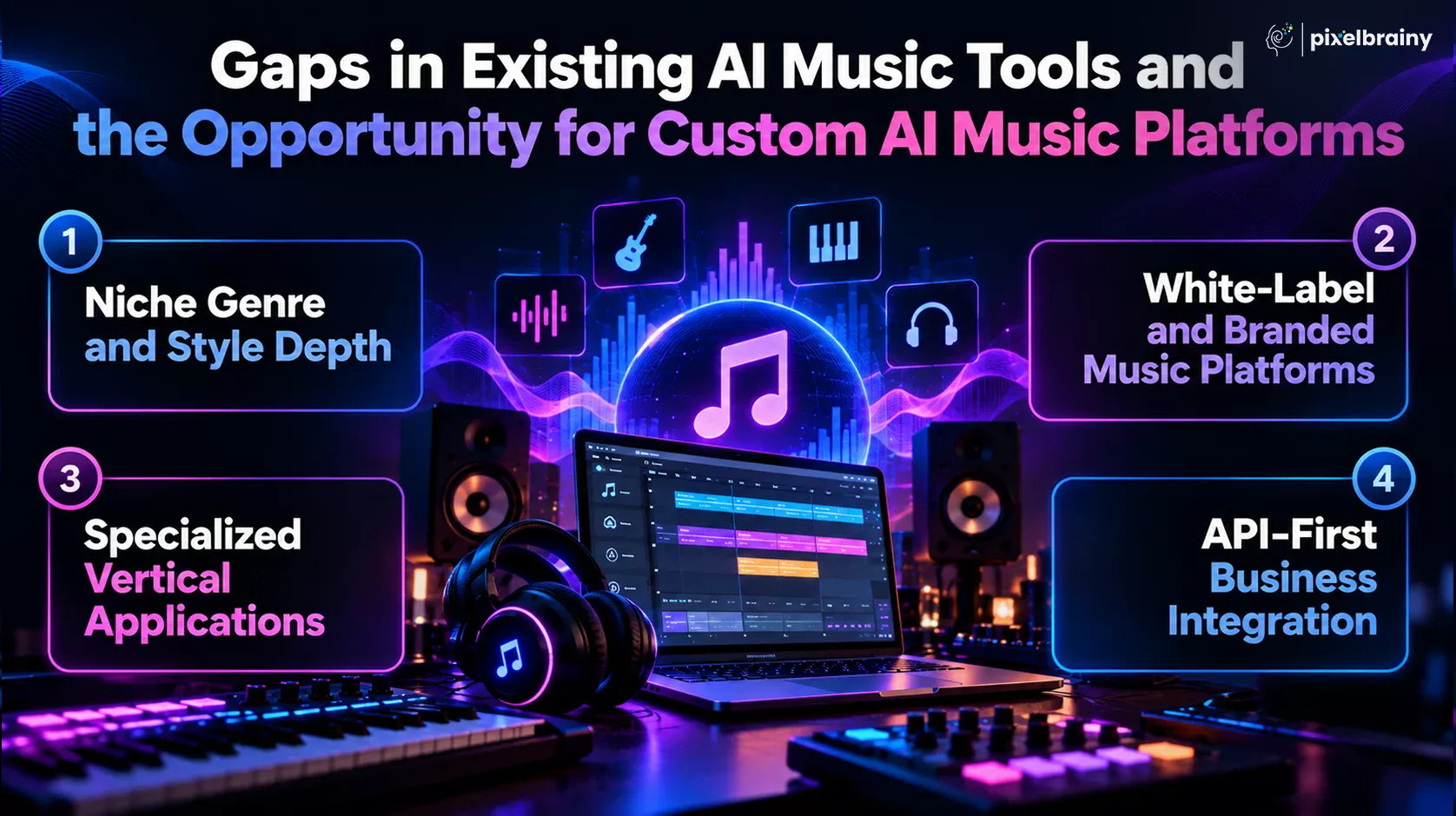
Many AI music tools focus on popular genres such as pop, hip-hop, electronic, and rock. However, creators working with regional music, culturally specific instruments, specialized ambient soundscapes, or precise sound design may find fewer options for customization. Businesses asking how to create an AI music generator for niche genres may need specialized datasets, fine-tuned models, detailed style controls, and workflows designed around their audience.
Music businesses, media companies, and creator platforms may want to offer AI music generation under their own brand, with custom interfaces, subscription plans, and user accounts. Existing consumer tools may not provide the white-label rights or branding flexibility these businesses require. Developing a custom AI music platform can provide greater control over the product experience, features, customer relationships, and future roadmap.
Some industries need more than a general-purpose AI song generator. Healthcare and wellness businesses may require calming soundscapes, education platforms may need adaptive audio for learning activities, and sports applications may benefit from music tailored to training intensity. Building a specialized AI music generation app allows businesses to design audio workflows around defined use cases, with appropriate testing, safety considerations, and model customization.
Businesses exploring how to build an AI music generator app like Suno may want music generation embedded directly into their existing products. However, third-party API availability, usage limits, latency, and licensing terms can restrict integration at scale. A custom AI music generation API can offer greater control over system architecture, product integration, usage policies, and infrastructure costs, although development and maintenance require investment.
| Business Situation | Why Existing Tools Fall Short | Potential Solution |
| Building a white-label music platform | Limited branding and rebranding rights | Custom branded AI music platform |
| Specialized vertical music needs | Limited control over niche styles and contexts | Custom models and specialized audio workflows |
| High-volume API integration | Usage limits or restricted access | Custom AI music generation API |
| Unique revenue strategy | Existing plans may not fit the intended business model | Custom platform with flexible monetization |
Custom development can help businesses differentiate through specialized features, branded experiences, and flexible monetization models. An effective AI music generation app monetization strategy might combine subscriptions, usage-based credits, enterprise licensing, API access, or premium commercial plans. The right approach depends on target users, generation costs, licensing obligations, and demand.
For businesses evaluating how to build an AI music generator app like Suno, the opportunity is not simply to replicate existing features. It is to solve a specific audience problem with a scalable product, a clear licensing framework, and a sustainable business model.

Music startups and established businesses are increasingly exploring AI-powered music creation to deliver personalized audio experiences, automate music production, and launch new digital products. As an AI music app development company, PixelBrainy helps businesses plan and develop custom AI music generation applications tailored to their audiences, workflows, and commercial goals. While platforms such as Suno and other AI music generators provide ready-made capabilities, custom development offers greater flexibility when businesses need specialized music styles, branded user experiences, proprietary features, or unique monetization models.
PixelBrainy, a leading AI development company, supports custom AI music generation app development like Suno, focusing on capabilities such as:
These capabilities help businesses build AI music generation software around their specific requirements instead of relying entirely on standardized consumer platforms.
PixelBrainy’s custom development approach can support music technology startups launching AI song generators, entrepreneurs building Suno-like music applications, media companies creating branded audio tools, game studios generating adaptive soundtracks, and SaaS businesses adding AI music features to existing products.
| Evaluation Factor | Generic Development Approach | PixelBrainy’s Custom Development Approach |
| AI music generation | May rely on standard third-party tools | Architecture tailored to defined music generation requirements |
| Prompt and style customization | Basic genre and mood controls | Customizable prompts, style controls, and specialized workflows |
| White-label capabilities | Branding options may be limited | Custom branded AI music application development |
| API integration | Integration depends on available provider APIs | API-first architecture aligned with business requirements |
| Monetization | Standard subscription or usage models | Flexible subscription, credit, and enterprise workflows |
| Scalability | Depends on the selected platform and infrastructure | Architecture planned around projected demand, latency, and operating costs |
| Commercial usage | Subject to third-party model and provider terms | Licensing requirements considered during model and platform selection |
When evaluating how to build an AI music generator app like Suno, businesses should assess model selection, training data rights, generation quality, inference costs, latency, scalability, and commercial licensing. A custom solution may combine licensed third-party models, open-source components, and specialized model development, depending on the product scope and available resources.
A sustainable AI music generation app monetization strategy can include monthly subscriptions, generation credits, enterprise licensing, API usage fees, and premium creative tools. The best model depends on the target audience, infrastructure costs, and the rights associated with generated music.
Connect with PixelBrainy to discuss custom AI music generation app development for your startup or business, from product planning and model integration to branded platform development and monetization strategy.
The best Suno AI alternatives in 2027 depend on your creative goals, audio requirements, budget, and commercial licensing needs. Tools such as Udio, SOUNDRAW, Beatoven.ai, AIVA, Mubert, and Stable Audio serve different purposes, from full-song generation and AI vocals to royalty-free background music and game soundtracks. Comparing their features, customization options, and usage rights can help you identify the right AI music generator for your workflow.
For individual creators, existing platforms offer a practical way to experiment with AI-powered music production. However, startups and businesses seeking niche music capabilities, white-label experiences, API integrations, or flexible monetization may benefit from custom AI music generation app development like Suno.
Building a custom platform can help businesses deliver differentiated music experiences, serve specific audiences, and create new revenue opportunities. Success depends on choosing suitable AI models, planning infrastructure costs, addressing music licensing, and designing a scalable business model.
Ready to build your own AI music generation platform? Schedule a call with PixelBrainy to discuss your idea, development requirements, and business goals.
The best free Suno AI alternative depends on your music needs, usage limits, and licensing requirements. Tools such as Udio, AIVA, and Stable Audio offer different music-generation capabilities. Compare free-tier restrictions, export options, audio quality, and commercial usage rights before choosing.
The best Suno alternative for monetized YouTube videos is one whose current license explicitly permits commercial use and monetization. Platforms such as AIVA and Soundraw offer licensing options that vary by plan. Review subscription terms, attribution requirements, and restrictions before publishing AI-generated tracks.
Yes, some AI music generation platforms offer APIs for integrating music creation into apps, websites, and digital products. Stable Audio has offered developer-focused API access. Check current documentation, generation limits, and commercial terms to confirm suitability for your integration requirements.
The best AI music generator for games and apps depends on soundtrack requirements, looping support, licensing, and integration options. Tools such as AIVA and Stable Audio can support different composition and audio-generation workflows. Evaluate commercial rights, export formats, and consistency across generated tracks.
Indie musicians should compare Suno alternatives based on audio quality, creative control, commercial licensing, and distribution eligibility. Tools such as Udio and AIVA offer different music creation workflows. Before uploading tracks to Spotify through a distributor, verify ownership terms and applicable platform policies.
Suno alternatives vary in their control over genre, instrumentation, arrangement, and composition. AIVA supports composition-focused workflows, while Stable Audio offers prompt-based audio generation. Musicians should compare customization options, editing capabilities, and output consistency to find tools suited to their creative process.
Commercial use depends on the platform's license, subscription plan, applicable copyright laws, and the content generated. Permission to use a track does not guarantee copyright protection or eliminate infringement risks. Review licensing terms and avoid prompts that imitate protected songs or use unauthorized material.
The best Suno alternative for podcast music should offer suitable audio quality, flexible duration, editing options, and clear commercial licensing. Tools such as Soundraw and AIVA can support different background music workflows. Check whether your chosen plan permits podcast distribution, advertising, and monetized content.
A startup can build a custom AI music generation app by defining its target users, selecting suitable audio-generation models, and developing prompt interfaces, generation workflows, and audio processing features. API integration, licensing, infrastructure costs, privacy, and scalable deployment should be planned early.
PixelBrainy is an AI software development company that can help businesses plan and develop tailored AI-powered applications. For an AI music generation platform, relevant development areas may include model integration, prompt-based interfaces, audio workflows, user accounts, and scalable infrastructure. Evaluate experience and project capabilities before partnering.

About The Author
Sagar Bhatnagar
Sagar Sahay Bhatnagar brings over a decade of IT industry experience to his role as Marketing Head at PixelBrainy. He's known for his knack in devising creative marketing strategies that boost brand visibility and market influence. Sagar's strategic thinking, coupled with his innovative vision and focus on results, sets him apart. His track record of successful campaigns proves his ability to utilize digital platforms effectively for impactful marketing efforts. With a genuine passion for both technology and marketing, Sagar continuously pushes PixelBrainy's marketing initiatives to greater success.

Working with PixelBrainy has been a great experience. They took our vision for an AI-powered platform and turned it into a fully functional product. What impressed me most was their strong understanding of both design and development, and their ability to handle complex requirements with ease. The team was responsive, cooperative, and always open to feedback. They kept things organized, communicated clearly, and delivered quality work on time. I highly recommend PixelBrainy to anyone looking for a skilled and reliable development partner.

Working with the PixelBrainy team has been a highly positive experience. They understand the design requirements and create beautiful UX elements to meet the application needs. The dev team did an excellent job bringing my vision to life. We discussed usability and flow. Sagar worked with his team to design the database and begin coding. Working with Sagar was easy. He has the knowledge to create robust apps, including multi-language support, Google and Apple ID login options, Ad-enabled integrations, Stripe payment processing, and a Web Admin site for maintaining support data. I'm extremely satisfied with the services provided, the quality of the final product, and the professionalism of the entire process. I highly recommend them for Android and iOS Mobile Application Design and Development.

Great experience working with them. Had a lot of feedback and I found that unlike most contractors they were bugging me for updates instead of the other way around. They were extremely time conscience and great at communicating! All work was done extremely high quality and if not on time, early! They were always proactive when it comes to communication and the work is great/above par always. Very flexible and a great team to work with! Goes above and beyond to present us with multiple options and always provides quality. Amazing work per usual with Chitra. If you have UI/UX or branding design needs I recommend you go to them! Will likely work with them in the future as well, definitely recommended!

PixelBrainy is a joy to work with and is a great partner when thinking through branding, logo, and website layout. I appreciate that they spend time going into the "why" behind their decisions to help inform me and others about industry best practices and their expertise.

I hired them to design our software apps. Things I really like about them are excellent communication skills, they answer all project suggestions and collaborate right away, and their input on design and colors is amazing. This project was complex and needed patience and creativity. The team is amazing to do business with. I will be using them long-term. Glad to see there are some good people out there. I was afraid to try and outsource my project to someone but I am glad I met them! I really can't say enough. They went above and beyond on this project. I am very happy with everything they have done to make my business stand out from the competition.

It was great working with PixelBrainy and the team. They were very responsive and really owned the project. We'll definitely work with them again!

I recently worked with the PixelBrainy team on a project and I was blown away by their communication skills. They were prompt, clear, and articulate in all of our interactions. They listened and provided valuable feedback and suggestions to help make the project a success. They also kept me updated throughout the entire process, which made the experience stress-free and enjoyable.

PixelBrainy is very good at what it does. The team also presents themselves very professionally and takes care of their side of things very well. I could fully trust them taking up the design work in a timely and organised manner and their attention to detail saved us lots of effort and time. This particular project was quite intense and the team showed that they function very well under pressure. Very much looking forward to working with her again!

It's always an absolute pleasure working with them. They completed all of my requests quickly and followed every note I had for them to a T, which made our process go smoothly from start to finish. Everything was completed fast and following all of the guidelines. And I would recommend their services to anyone. If you need any design work done in the future, PixelBrainy should be your first call!

They took ownership of our requirements and designed and proposed multiple beautiful variants. The team is self-motivated, requires minimum supervision, committed to see-through designs with quality and delivering them on time. We would definitely love to work with PixelBrainy again when we have any requirements.

PixelBrainy was a big help with our SaaS application. We've been hard at work with a new UI/UX and they provided a lot of help with the designs. If you're looking for assistance with your website, software, or mobile application designs, PixelBrainy and the team is a great recommendation.

PixelBrainy designers are amazing. They are responsive, talented, and always willing to help craft the design until it matches your vision. I would recommend them and plan to continue them for my future projects and more!!!

They were awesome! Did a good job fast, and good communication. Will work with them again. Thank you

Creative, detail-oriented, and talented designers who take direction well and implement changes quickly and accurately. They consistently over-delivered for us.

PixelBrainy team is very talented and creative. Great designers and a pleasure to work with. PixelBrainy is an excellent communicator and I look forward to working with them again.

PixelBrainy has a very talented design team. Their work is excellent and they are very responsive. I enjoy working with them and hope to continue on all of our future projects.


Transform your ideas into reality with us.
Across these industries, each engagement brings unique challenges, from early-stage product development to scaling complex systems, helping us build a practical understanding of real-world product environments.