
 AI Summary Powered by PixelBrainy
Are real estate businesses struggling to attract modern buyers who expect digital-first property experiences? Are brokers and developers searching for smarter ways to showcase properties without relying entirely on physical visits? How can commercial real estate firms improve decision-making with data-driven insights? Why are proptech startups rapidly investing in AI and AR Real Estate Apps to transform property discovery and engagement?
Today’s real estate market is becoming increasingly digital. Buyers expect interactive experiences, personalized recommendations, and the ability to explore properties remotely before making decisions. This shift is pushing real estate agencies, property developers, construction companies, and real estate marketing teams to rethink how they present and sell properties.
AI and AR real estate app development is helping businesses develop AI and AR digital real estate platforms that combine intelligent analytics with immersive visualization. These solutions allow companies to create immersive AI and AR real estate experiences such as virtual walkthroughs, smart property matching, and interactive property previews that improve engagement and accelerate sales cycles.
Organizations are actively looking to build next-generation property buying apps with AI and AR that enhance user experience while improving operational efficiency. Many real estate business owners are exploring how businesses can develop AI-powered real estate app solutions that integrate automation, predictive insights, and advanced visualization into a single platform.
According to Deloitte’s Tech Trends report, AI-driven automation and immersive technologies are expected to significantly reshape customer interaction models and digital transformation strategies across industries by 2026.
Whether partnering with AI Real Estate Software Development Companies in USA or building internal innovation teams, the goal remains clear: develop AI and AR real estate application strategies that deliver measurable business value.
This blog is a complete business-focused guide for real estate companies looking to understand how AI and AR real estate app development can modernize property marketing and improve buyer engagement.
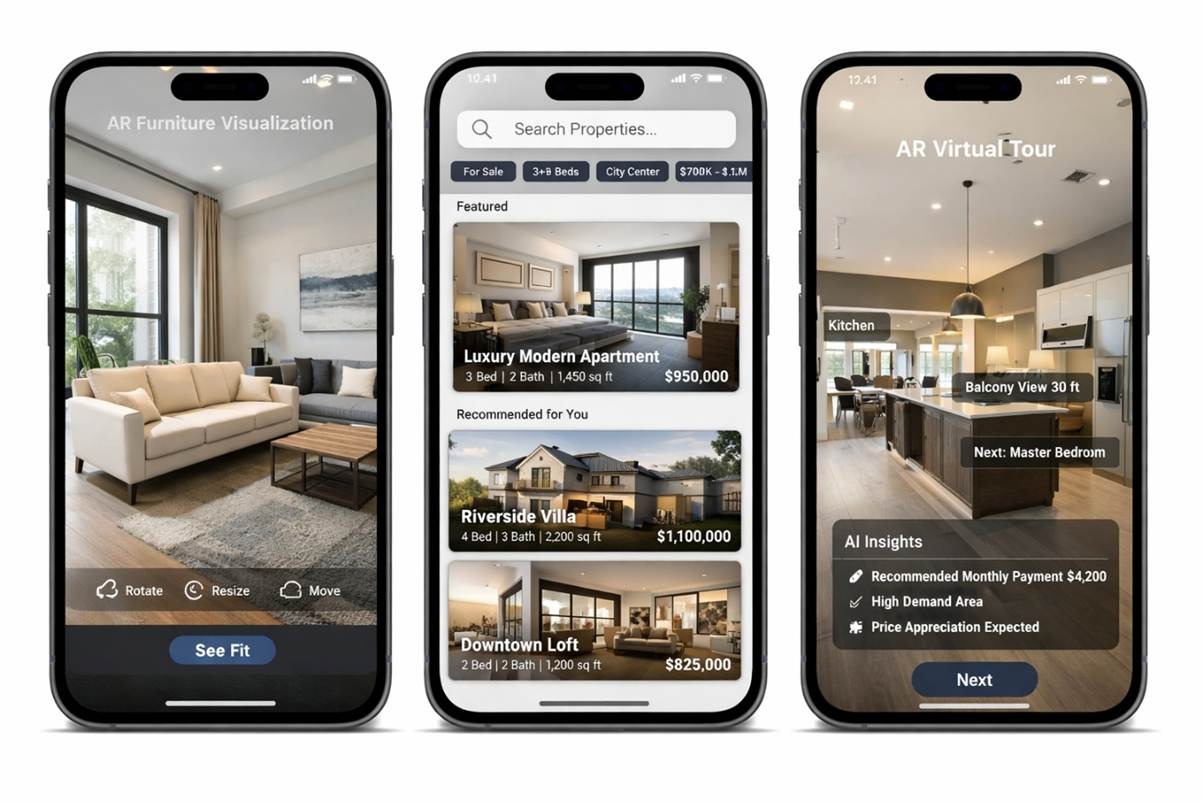
Why are real estate businesses combining artificial intelligence with augmented reality instead of using them separately? The answer lies in delivering smarter insights alongside immersive property experiences. AI helps analyze data, understand buyer behavior, and provide intelligent recommendations, while AR transforms static listings into interactive visual experiences.
When combined, AI and AR Real Estate Apps enable businesses to create more engaging and efficient property journeys. Instead of simply browsing images, buyers can explore spaces virtually, visualize layouts, and receive personalized property suggestions based on their preferences and search patterns.
Imagine a property buyer who wants to know whether their existing furniture will fit into a new apartment before making a purchase decision. Using AR features within the app, they can place virtual furniture inside the property through their smartphone camera and visualize real placement instantly. At the same time, AI analyzes room dimensions, user preferences, and design trends to suggest optimized layouts or alternative property options. This combination reduces uncertainty and helps buyers make confident decisions without multiple visits.
By integrating AI and AR, real estate businesses can:
Ultimately, combining AI intelligence with AR visualization allows real estate brokers, property developers, and agencies to transform traditional property listings into interactive, data-driven experiences that accelerate decision-making and enhance customer satisfaction.
Real estate buyers now expect more than photos, basic filters, and a phone call. They want instant clarity, confidence, and convenience. That is exactly why many leaders are choosing to invest in Developing AI and AR Real Estate App experiences that feel modern, guided, and interactive instead of static and uncertain.
One strong signal is that even commercial real estate organizations are actively moving into AI, but they are not fully mature yet. Deloitte’s 2026 Commercial Real Estate Outlook reports that 19% of respondents say their organizations are still in the early stages of their AI journey, while 27% say they are facing AI implementation challenges like technical issues, lack of expertise, or resistance to change. This gap creates an opportunity for forward-looking firms to move faster, differentiate earlier, and win mindshare while competitors are still figuring it out.
The second signal is behavioral. Gartner expects that by 2026, 25% of people will spend at least one hour a day in the metaverse across activities such as shopping and entertainment, enabled through immersive interfaces like AR and mixed reality. Even if real estate is only one part of that attention shift, it shows where user expectations are headed: visual, immersive, and interactive.
From a business outcomes perspective, investing now makes sense because it helps you build immersive property viewing apps for real estate businesses that reduce unnecessary site visits and improve lead quality. It also enables you to build next-generation property buying apps with AR where buyers can preview layouts, visualize furniture placement, and understand space potential before they ever schedule a visit.
When you build proptech apps with AI and AR, your platform becomes smarter at matching buyers to the right listings, prioritizing high-intent leads, and improving response speed across sales and leasing teams. Over time, this approach helps you develop smart AI and AR real estate solutions that strengthen brand trust, increase conversion rates, and support scalable growth across cities and property categories.
Investing in AI and AR is no longer a trend play, it is a practical move to modernize buying journeys and protect long-term competitiveness.
Before businesses develop AI and AR Real Estate App solutions, it is important to understand where these technologies create real operational and commercial value. Real estate companies should think beyond trends and identify practical scenarios where AI intelligence and AR visualization can improve buyer engagement, reduce sales friction, and enhance property marketing outcomes.
Understanding the most impactful use cases of AI and AR Real Estate App development helps organizations prioritize features that deliver measurable business results instead of unnecessary complexity.
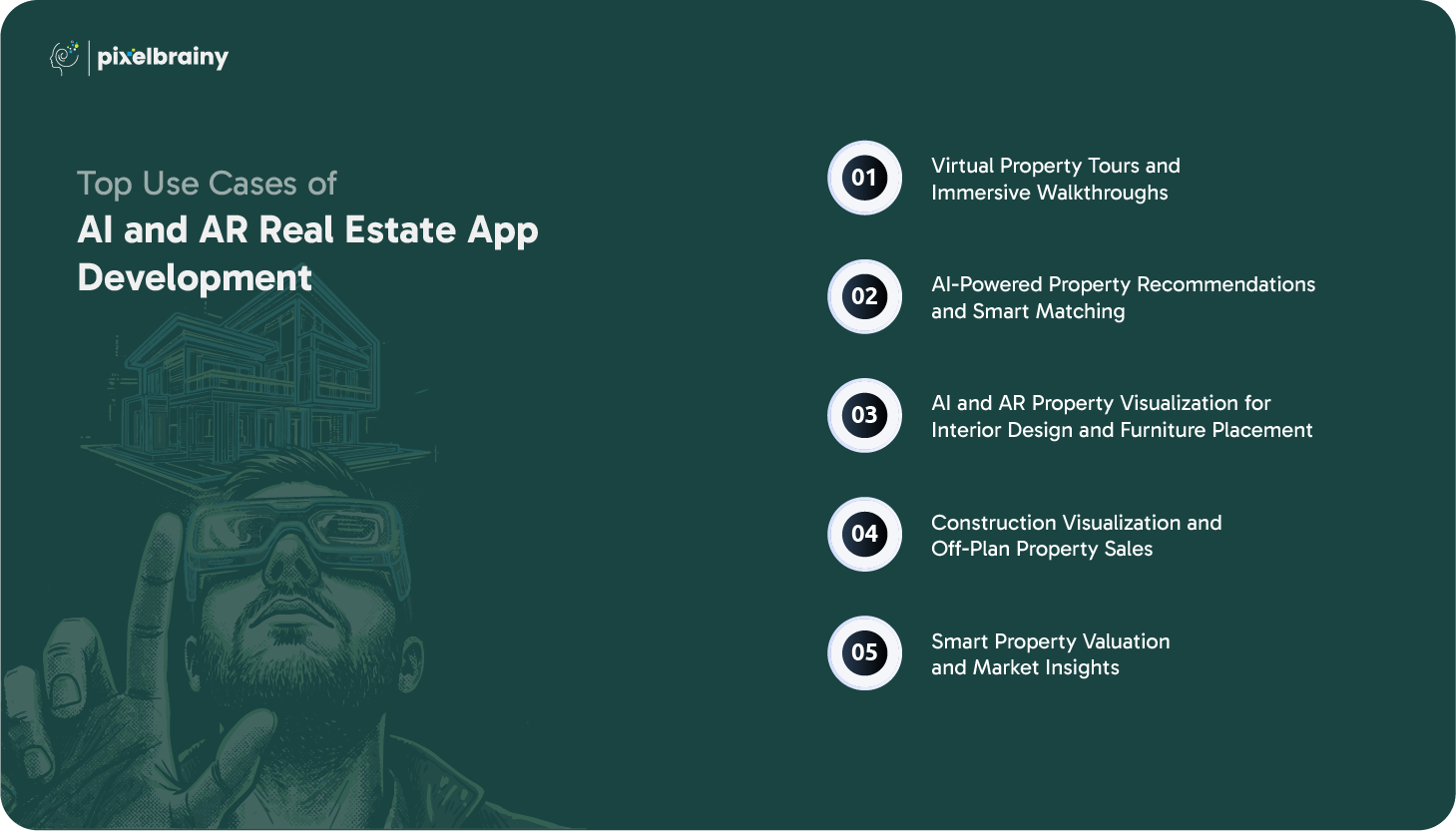
One of the most impactful use cases of AI and AR real estate mobile app development is immersive virtual property touring. Buyers can explore properties remotely using augmented overlays, 3D visualization, and interactive navigation. This eliminates geographic barriers and helps international or remote buyers evaluate spaces without traveling.
AI enhances this experience by analyzing user behavior during the tour. For example, if a buyer spends more time viewing kitchens or balconies, the system can recommend similar properties automatically. This creates a personalized property journey rather than a generic browsing experience.
For real estate agencies, this approach increases engagement while reducing time spent on unqualified leads. It also supports enterprise AI and AR real estate app development strategies by enabling scalable digital property showcasing.
Another strong use case is intelligent property matching. AI algorithms analyze search history, budget preferences, location interests, and user behavior patterns to recommend highly relevant listings. Instead of manually filtering through hundreds of properties, buyers receive curated suggestions tailored to their needs.
When combined with AR, these recommendations become more contextual. Users can immediately visualize recommended properties through immersive previews or interactive layouts, helping them make faster decisions.
Businesses that build AI and AR real estate listing applications benefit from improved conversion rates because users spend more time exploring suitable options. This capability also supports property investors and brokers who want data-driven insights to improve client targeting and marketing strategies.
AI and AR property visualization app development allows buyers to customize spaces digitally before making purchase decisions. Users can place virtual furniture, change wall colors, or test different layouts directly through their mobile device. This helps them understand how the property fits their lifestyle.
AI plays a key role by suggesting optimal layouts, recommending furniture styles, or predicting space usability based on room dimensions. For example, a buyer can check whether their existing sofa or workspace will fit properly in a living area.
This use case reduces uncertainty during the buying process and helps developers market under-construction properties more effectively by showcasing future possibilities rather than empty spaces.
Property developers and construction companies can develop AI and AR Real Estate App solutions that allow buyers to visualize properties that are still under construction. AR overlays enable users to view how a finished building will look in real-world surroundings, helping them understand scale, design, and layout.
AI adds value by generating predictive insights such as expected property value growth or recommended unit configurations based on market demand. This helps investors make more informed decisions early in the development cycle.
Off-plan sales become easier because buyers gain confidence through realistic previews rather than relying solely on brochures or architectural drawings.
AI-driven analytics within enterprise AI and AR real estate app development platforms can analyze large datasets including historical pricing, location trends, demand patterns, and neighborhood development. This allows businesses to provide accurate property valuation insights directly within the app.
AR complements this by visually presenting contextual information such as nearby amenities, infrastructure projects, or neighborhood data overlays. Buyers gain a deeper understanding of property value beyond price alone.
For brokers and property investors, this use case improves transparency and strengthens trust, while also helping agencies position themselves as technology-driven advisors.
These are the above practical use cases that guide businesses in building intelligent and immersive AI and AR real estate solutions aligned with modern buyer expectations.
Before businesses develop AI and AR Real Estate App solutions, they must identify essential features that directly improve buyer experience, operational efficiency, and property marketing outcomes. Core functionality should support immersive exploration, intelligent recommendations, and seamless navigation across property listings.
These foundational capabilities help real estate companies build scalable AI and AR real estate mobile app development strategies aligned with modern market expectations.
| Core Feature | Explanation |
| Smart Property Search & Filters | Advanced search functionality allows users to filter properties by location, budget, amenities, and lifestyle preferences. AI enhances search accuracy by learning user behavior and prioritizing relevant results. This helps real estate businesses build AI and AR real estate listing applications that deliver personalized discovery experiences. |
| AI-Based Property Recommendations | Machine learning analyzes browsing history, saved properties, and engagement patterns to recommend suitable listings automatically. This improves buyer engagement and reduces time spent searching manually. It also helps brokers identify high-intent leads more efficiently. |
| AR Property Visualization | Augmented reality allows buyers to view properties in immersive formats, including 3D walkthroughs and interactive space exploration. AI and AR property visualization app development enhances decision-making by offering realistic previews before visits. This is especially useful for remote buyers. |
| Virtual Tours & 3D Walkthroughs | Interactive virtual tours simulate real property visits digitally. Users can explore rooms, understand layouts, and visualize space flow naturally. This reduces unnecessary physical visits while improving buyer confidence. |
| Interactive Floor Plans | Dynamic floor plans allow users to explore layout details and spatial relationships visually. AI can suggest optimal layouts based on user preferences. These features help businesses develop smart AI and AR real estate solutions focused on usability. |
| AI Chatbot Assistant | Intelligent chatbots provide instant responses to inquiries about properties, pricing, and availability. They improve customer service efficiency by automating initial interactions. Real estate agencies benefit from 24/7 engagement without additional staff workload. |
| Property Comparison Tools | Users can compare multiple properties side by side based on price, size, amenities, and location insights. AI highlights key differences to simplify decision-making. This increases transparency and accelerates buying processes. |
| Location Insights & Neighborhood Data | AI integrates real-time data about nearby schools, transportation, and local amenities. AR overlays can visually display surrounding points of interest. Buyers gain deeper understanding of property value beyond listing details. |
| Mortgage Calculator & Financial Estimator | Built-in tools help buyers calculate affordability, monthly payments, and financing options instantly. AI can suggest financing ranges based on user profile. This improves planning and enhances conversion rates. |
| Saved Searches & Smart Alerts | Users receive notifications when relevant properties match their preferences. AI predicts which listings are most important based on user activity. This keeps buyers engaged and increases return visits to the platform. |
| Lead Management Dashboard | Real estate professionals can track inquiries, engagement levels, and buyer behavior from one interface. AI identifies priority leads automatically. This helps agencies manage sales pipelines efficiently. |
| Multi-Platform Accessibility | Seamless access across mobile, tablet, and web platforms ensures consistent user experience. This is essential when businesses build proptech apps with AI and AR for broader reach. Cross-platform compatibility improves adoption. |
| Secure User Authentication | Advanced authentication ensures data privacy and protects sensitive user information. Real estate platforms handling financial data require secure login mechanisms. Security strengthens user trust. |
| Media Management & Listing Upload | Agents can upload images, videos, and property details easily through admin tools. AI can enhance image quality or auto-generate descriptions. This simplifies content management workflows. |
| Analytics Dashboard | Business owners gain insights into user behavior, property engagement, and conversion metrics. AI analytics help refine marketing strategies and improve listing performance. Data-driven decision-making becomes easier. |
These core features form the foundation for businesses to develop AI and AR digital real estate platform solutions that deliver immersive user experiences and operational efficiency.
Once foundational features are established, businesses can integrate advanced capabilities to create differentiated digital experiences. Advanced AI and AR features help companies build next-generation property buying apps with AR that go beyond traditional listings and deliver predictive, interactive, and personalized property journeys.
| Advanced Feature | Explanation |
| AI Predictive Property Pricing | AI analyzes historical trends, demand signals, and local market data to predict property value changes. This helps investors and buyers make informed decisions. Real estate businesses gain credibility through data-backed insights. |
| AR Furniture Placement & Interior Customization | Users can place virtual furniture or redesign spaces digitally through augmented reality. AI suggests layout optimization based on room dimensions. This creates immersive AI and AR real estate experiences that reduce purchase hesitation. |
| Voice Search with AI NLP | Natural language processing enables users to search properties using voice commands. This simplifies navigation and improves accessibility. Voice interaction aligns with modern mobile user behavior. |
| AI Image Recognition | Users can upload images or scan environments to find similar properties automatically. AI detects architectural styles and layout patterns. This enhances discovery and expands search possibilities. |
| Predictive Lead Scoring | AI evaluates user interactions to identify high-intent buyers. Sales teams can prioritize prospects more effectively. This improves conversion rates and sales efficiency. |
| Smart Virtual Staging | AI generates realistic furniture staging within empty properties. AR allows users to switch between design themes instantly. Developers benefit from showcasing potential instead of empty rooms. |
| Real-Time AR Navigation During Visits | AR overlays guide buyers during physical property tours by highlighting features or directions. This enhances on-site experiences. Agents can provide interactive tours without constant explanation. |
| Personalized Buyer Journey Automation | AI automates property recommendations, alerts, and follow-ups based on user behavior. Buyers receive relevant suggestions automatically. This reduces manual effort for agents while improving engagement. |
| Integration with Smart Home Data | AI integrates with IoT devices to display energy usage or smart home features visually. Buyers understand technology benefits immediately. This adds modern appeal to listings. |
| Predictive Market Insights Dashboard | AI analyzes broader market trends and investment patterns. Businesses gain strategic insights into demand fluctuations and growth opportunities. Enterprise AI and AR real estate app development becomes more data-driven. |
Advanced features transform AI and AR real estate app development from basic digital tools into intelligent platforms that deliver future-ready, immersive property experiences.

Before starting the creation of AI and AR Real Estate App solutions, businesses must understand the structured workflow required to move from concept to deployment successfully. The process involves strategic planning, technology alignment, and user-focused design decisions.
Understanding what is the process of developing an AI and AR-Based Real Estate App helps organizations reduce risks and build scalable platforms aligned with long-term digital goals.
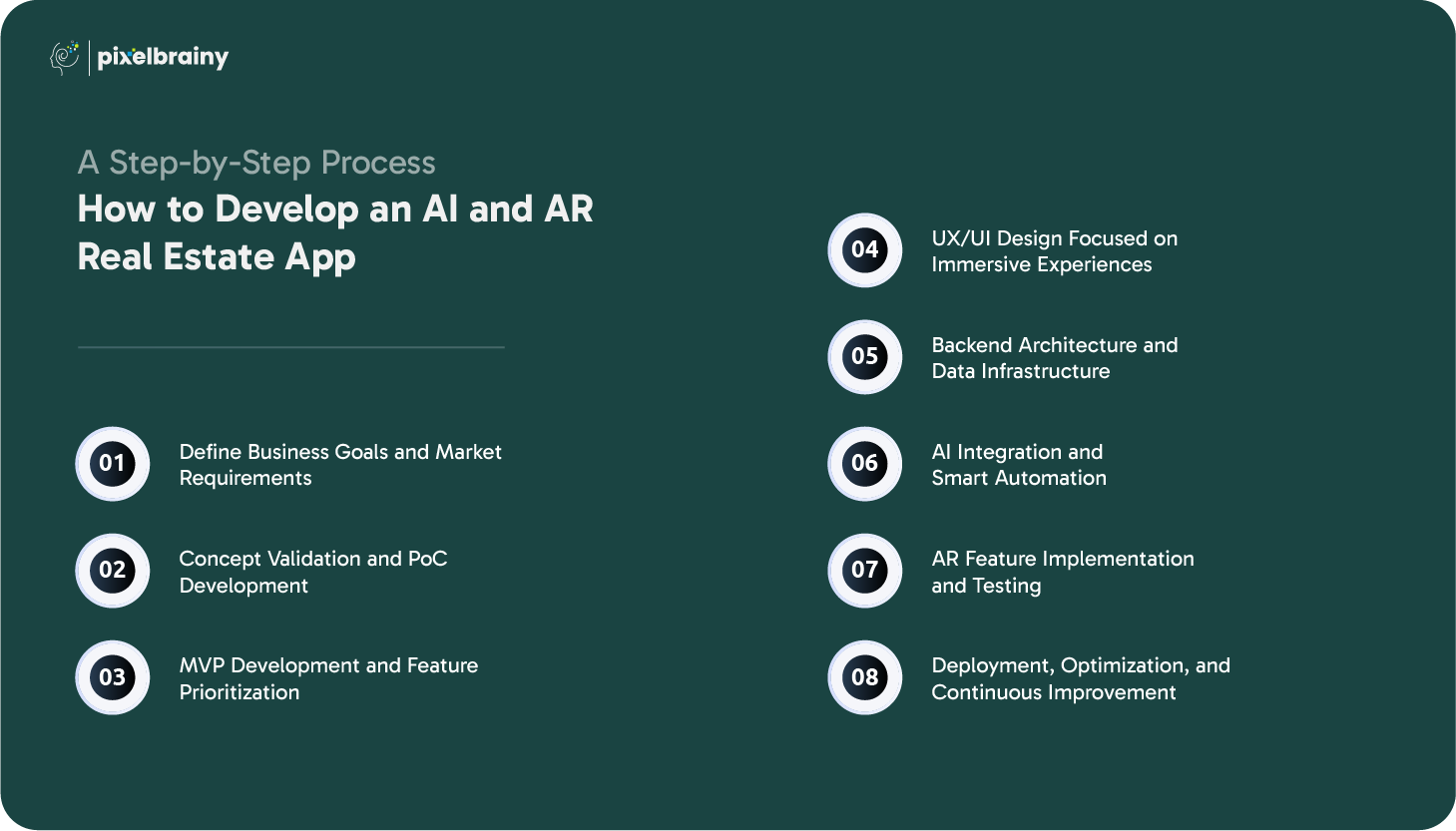
Aim/Goal: Establish a strategic foundation that aligns technology investment with measurable business outcomes and ensures the Development of AI and AR Real Estate App meets real-world industry needs.
The first stage in AI and AR-Real Estate App Development is identifying clear business objectives. Companies must determine whether the focus is improving buyer engagement, increasing lead conversions, enhancing visualization, or optimizing property marketing workflows. Market research helps understand competitor strategies, customer expectations, and gaps within existing property platforms.
Stakeholders such as brokers, developers, and marketing teams should collaborate to define core functionalities and success metrics. Businesses should evaluate target audiences, geographic markets, and monetization opportunities before moving forward.
Aim/Goal: Reduce development risk by validating technical ideas, ensuring feasibility, and confirming that chosen features solve real problems for property buyers and real estate professionals.
Before building a full-scale platform, businesses should validate technical feasibility and user acceptance through PoC Development. A proof of concept allows companies to test AI algorithms, AR visualization capabilities, and workflow integration without heavy investment.
This stage helps identify potential technical challenges early, such as performance issues or user interface limitations. Testing core concepts with a small user group ensures that the proposed Real Estate App Development using AI and AR delivers practical value before scaling.
Aim/Goal: Launch a functional product quickly, validate market demand, and gather real user data to guide future enhancements.
After validating the concept, businesses should focus on MVP Development to launch a minimum viable version of the platform. The MVP includes essential features such as property listings, AR visualization, and AI-driven recommendations while excluding advanced functionality.
This approach helps organizations test real user interactions and collect feedback quickly. It also enables faster market entry while reducing initial development costs.
Prioritizing features based on business value ensures that resources are used efficiently during the early stages of AI and AR Real Estate App Solutions development.
Also Read: Top 10 AI MVP Development Companies in USA
Aim/Goal: Deliver a seamless and engaging user experience that encourages exploration, increases engagement, and simplifies property decision-making.
User experience design plays a critical role when businesses aim to build AI and AR Real Estate App platforms. Designers must create intuitive navigation that blends traditional app interfaces with immersive AR interactions.
This includes designing clear property exploration flows, simple onboarding, and responsive AR viewing features. Visual clarity and minimal complexity are essential because immersive features should feel natural rather than overwhelming.
User testing during this stage helps refine usability and ensures accessibility across different devices.
Aim/Goal: Build a reliable and scalable infrastructure that supports real-time processing and ensures long-term system stability for enterprise-grade deployment.
The backend serves as the foundation for data processing, scalability, and performance. Businesses need robust architecture capable of managing property listings, user data, AI models, and AR content simultaneously.
Cloud-based infrastructure ensures flexibility and scalability as user traffic grows. APIs and integrations must be carefully structured to support future expansion without major redesign.
Security considerations such as encryption and authentication should also be integrated at this stage.
Aim/Goal: Enable intelligent decision-making and automation that improves efficiency, personalization, and user satisfaction.
Integrating artificial intelligence transforms standard real estate platforms into intelligent ecosystems. Companies may collaborate with an AI Product Development Company or implement AI Integration Solutions internally to incorporate recommendation engines, predictive analytics, and automated workflows.
AI models analyze user behavior, property data, and market trends to improve personalization and engagement. Automation reduces manual tasks such as lead filtering and property matching.
Proper training and testing of AI models are essential to ensure accuracy and avoid biased recommendations.
Aim/Goal: Deliver stable, high-quality immersive experiences that enhance property visualization and create engaging digital journeys.
Augmented reality functionality should be implemented carefully to ensure smooth performance across devices. Features like virtual tours, furniture placement, and interactive overlays must work seamlessly with camera sensors and device capabilities.
Testing AR environments under different lighting conditions and hardware configurations ensures reliability. Developers should also optimize 3D assets to maintain performance without sacrificing visual quality.
Many businesses evaluate approaches used by Top AI Development Companies in USA or Top AI Real Estate Software Development Companies in USA when planning advanced immersive features.
Aim/Goal: Ensure long-term success by continuously improving features, optimizing performance, and adapting the platform to evolving market demands.
After development and testing, businesses can launch the platform across targeted markets. Deployment involves app store publishing, cloud configuration, and performance monitoring.
Post-launch optimization is essential. AI models should continue learning from user behavior, while AR features may require updates based on user feedback and new device capabilities.
Analytics dashboards help track engagement, conversions, and performance metrics to guide future improvements.
Following a structured development process allows businesses to build AI and AR Real Estate App platforms that combine innovation with scalability and measurable business value.
One of the most common questions businesses ask is what is the cost of developing an AI and AR Real Estate App and how to plan a realistic investment strategy. The overall AI and AR Real Estate App Development Cost typically ranges between $50,000 and $300,000+, depending on feature complexity, AI capabilities, AR visualization depth, infrastructure scalability, and business requirements.
The development budget of AI and AR Real Estate App platforms varies significantly because Real Estate App Development Cost Integrating AI and AR involves immersive technologies, data-driven intelligence, and advanced user experience design.
Businesses planning to make AI and AR real estate app solutions pricing decisions should evaluate long-term ROI, scalability potential, and business outcomes rather than focusing only on initial costs.
| Type of App | Estimated Cost | What You Get |
| Basic AI and AR Real Estate App (MVP) | $50,000 – $90,000 | Core property listings, AI-based recommendations, basic AR visualization, virtual tours, essential analytics dashboard, cross-platform functionality. Suitable for startups testing market demand and validating early product concepts. |
| Advanced AI and AR Real Estate App | $90,000 – $180,000 | Enhanced AI personalization, predictive property suggestions, immersive AR furniture placement, advanced search filters, smart notifications, user behavior analytics, integration with third-party property data and CRM tools. Designed for growing real estate agencies and proptech startups. |
| Enterprise AI and AR Real Estate App | $180,000 – $300,000+ | Full-scale AI automation, advanced AR visualization, predictive pricing models, enterprise analytics dashboards, multi-region scalability, complex integrations, high-performance infrastructure, advanced security, and custom workflows tailored for large real estate firms or commercial property platforms. |
The number of features and level of customization directly affect pricing. Basic property listing apps may cost $50,000–$80,000, while advanced immersive features can increase costs by an additional $30,000–$100,000 depending on scope.
Implementing AI-driven recommendation engines, predictive analytics, and automation requires data processing and model training. Custom AI functionality can add approximately $20,000–$70,000 depending on algorithm complexity.
High-quality AR visualization such as virtual tours, furniture placement, and interactive overlays requires 3D modeling and performance optimization. Advanced AR features typically increase development cost by $25,000–$80,000.
Single-platform development may reduce costs, but multi-platform solutions increase development effort. Adding additional platforms can increase budgets by $15,000–$50,000 depending on complexity.
Immersive interfaces require specialized UX/UI design to ensure smooth navigation between AI insights and AR interactions. High-quality design can cost between $10,000–$30,000 but significantly improves user adoption.
Integrating CRM systems, payment gateways, mapping services, or property databases adds technical complexity. Integration costs typically range from $5,000–$25,000 depending on API requirements.
Implementing secure authentication, encryption, and data protection measures increases development investment. Security enhancements may add $8,000–$20,000 depending on compliance needs.
Post-launch support includes AI model updates, performance optimization, and feature improvements. Ongoing maintenance typically costs around 15%–25% of the initial development budget annually.
A clear cost breakdown helps real estate businesses plan investments strategically and build scalable AI and AR real estate platforms aligned with long-term growth goals.
Also Read: AI Real Estate Software Development Cost: Know How Much Your Real Estate Software Will Cost
A strong technology foundation is essential for building high-performing AI and AR real estate applications that deliver immersive experiences and intelligent automation. Real estate businesses must combine modern frontend frameworks, scalable backend infrastructure, advanced AI capabilities, and reliable AR technologies to create seamless digital property journeys.
The right technology ecosystem supports faster performance, secure data handling, and future scalability while enabling companies to implement innovative features such as predictive recommendations and interactive property visualization.
| Technology Category | Tools & Technologies | Explanation |
| Frontend Development | React Native, Flutter, Swift, Kotlin | Frontend technologies define how users interact with the application. Cross-platform frameworks like React Native and Flutter allow faster development across multiple devices, while native tools like Swift and Kotlin provide optimized performance for immersive AR features and smooth user interfaces. |
| Backend Development | Node.js, Python (Django/FastAPI), .NET | Backend systems manage data processing, user management, and property listing workflows. Scalable backend architecture ensures smooth performance and efficient handling of real-time interactions. Python frameworks are especially valuable when integrating AI capabilities into real estate platforms. |
| Artificial Intelligence Frameworks | TensorFlow, PyTorch, OpenAI APIs | AI frameworks enable intelligent property recommendations, predictive analytics, and automation features. These tools help businesses personalize user experiences and improve engagement through data-driven insights. Advanced AI models also support lead scoring and behavioral analysis. |
| Augmented Reality Technologies | ARKit (iOS), ARCore (Android), Unity 3D | AR technologies power immersive experiences such as virtual tours and furniture visualization. ARKit and ARCore provide device-level capabilities, while Unity supports realistic 3D rendering. These technologies are central to creating interactive property exploration experiences. |
| Cloud Infrastructure | AWS, Google Cloud Platform, Microsoft Azure | Cloud platforms provide scalable computing resources, secure data storage, and AI model deployment capabilities. They enable businesses to handle large datasets and ensure reliable performance even during high traffic periods. |
| Database Solutions | MongoDB, PostgreSQL, Firebase | Databases store property listings, user data, and analytics information efficiently. Real-time databases improve live updates for listings and notifications. Flexible database structures help support future feature expansion. |
| 3D Modeling & Visualization Tools | Blender, Three.js, Unreal Engine | Visualization tools create realistic property models and immersive design elements. High-quality 3D assets enhance buyer engagement and allow developers to showcase properties before construction is complete. |
| API Integration Tools | REST APIs, GraphQL | APIs enable seamless communication between external services such as payment gateways, mapping systems, and CRM platforms. Efficient API integration improves performance and ensures flexibility for future enhancements. |
| Security Technologies | OAuth, JWT Authentication, SSL Encryption | Security tools protect sensitive user data and ensure safe authentication processes. Strong security measures help maintain trust, especially for platforms handling financial and personal information. |
| Analytics & Monitoring Tools | Google Analytics, Mixpanel, Firebase Analytics | Analytics tools track user behavior, engagement patterns, and performance metrics. Businesses gain insights into customer journeys, helping them refine marketing strategies and optimize features continuously. |
A well-structured technology stack enables real estate businesses to build scalable AI and AR platforms that deliver immersive property experiences and long-term operational efficiency.

AI and AR real estate platforms are not just technological innovations; they are powerful revenue-generating ecosystems. Businesses investing in AI and AR real estate app development must understand how these platforms can create sustainable income streams while enhancing buyer experience.
Different monetization strategies allow companies to build AI and AR real estate app solutions that deliver both customer value and long-term profitability.
Many real estate platforms generate revenue by offering subscription packages to agents, developers, or property managers who want enhanced visibility. AI-powered listing optimization and AR visualization features create premium exposure opportunities that justify subscription pricing. This model ensures predictable recurring revenue while providing value-added tools for professionals who want to stand out in competitive markets.
AI algorithms can prioritize specific properties within search results, enabling sponsored placements. AR-driven immersive previews increase engagement, making promoted listings more attractive to buyers. Real estate businesses can monetize this visibility by charging property developers or agencies for priority exposure.
AI helps identify high-intent buyers by analyzing engagement patterns, while AR visualization improves buyer confidence. This creates qualified leads that can be monetized through commission-based models. Agencies or brokers pay for verified leads or successful transactions generated through the platform.
AI and AR real estate apps can include targeted advertising opportunities relevant to property buyers. Brands related to home décor, furniture, mortgage services, or insurance can advertise within the app environment. AI ensures ads are personalized, increasing relevance and engagement.
AI-driven analytics create valuable insights about property trends, user behavior, and investment patterns. Businesses can monetize aggregated data by offering premium analytics subscriptions to developers, investors, or commercial real estate firms.
AR technology enables virtual furniture placement, interior customization, and renovation previews. These features can be offered as premium add-ons for developers or agents who want to enhance property presentation without physical staging costs.
Some platforms offer advanced buyer tools through subscription plans. AI-based property matching, exclusive listings, or enhanced AR exploration features can attract users willing to pay for faster and more personalized property discovery.
Real estate apps can become marketplaces connecting buyers with services such as interior designers, movers, or legal advisors. AI recommendations suggest relevant services, while the platform earns commissions or listing fees.
Companies that build advanced AI and AR real estate platforms may license their technology to other agencies or enterprises. This creates a scalable revenue stream without directly managing all listings.
AI-powered property valuation engines provide accurate pricing insights based on data analysis. Real estate investors or agencies may pay for access to these advanced tools.
Platforms can offer exclusive memberships with advanced tools, analytics, and marketing capabilities tailored for professionals. AI automation reduces workload while AR improves property marketing performance.
Strong monetization strategies transform AI and AR real estate app development from a technology investment into a scalable business model that drives sustainable revenue and long-term growth.
Building successful AI and AR real estate platforms requires a strategic balance between technology innovation and real-world business outcomes. Real estate companies that achieve long-term success focus not only on implementing advanced features but also on creating meaningful experiences that solve genuine industry challenges.
Following best practices ensures that AI and AR real estate apps deliver measurable value, improve buyer engagement, and support sustainable digital transformation.
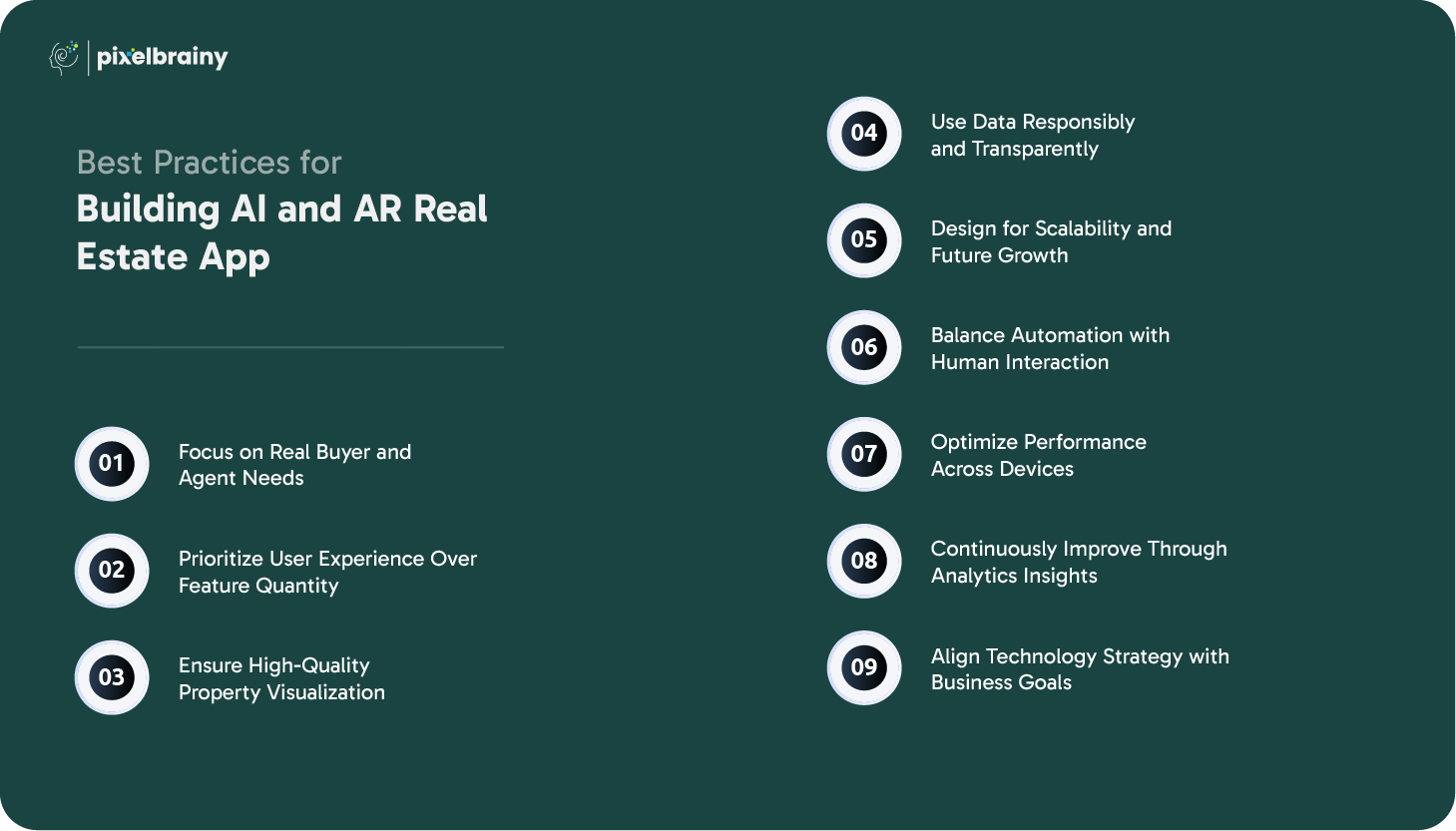
The most effective AI and AR real estate apps are designed around real-world user problems rather than technological trends. Businesses should understand how buyers search for properties, what information agents need during sales conversations, and where decision-making friction occurs.
For example, buyers often struggle to visualize empty spaces or compare multiple properties efficiently. AI recommendations and AR visualization should directly address these challenges. Conducting user research, interviews, and feedback analysis helps identify pain points and ensures that innovation aligns with actual market needs instead of assumptions.
Adding numerous features does not automatically create a better platform. Overloaded interfaces can confuse users and reduce engagement, especially when immersive technologies are involved. A well-designed AI and AR real estate app maintains clarity, intuitive navigation, and simple workflows that guide users naturally through the property discovery process.
Businesses should focus on delivering a seamless experience where AI recommendations and AR interactions feel integrated rather than separate tools. Simplifying onboarding and minimizing unnecessary steps encourages adoption and improves overall satisfaction.
Immersive AR experiences must feel realistic and accurate to build trust among buyers and investors. High-resolution 3D models, accurate spatial mapping, and smooth interaction performance are critical factors in delivering compelling visualization. Poor-quality rendering or inaccurate dimensions can reduce credibility and negatively impact purchasing decisions.
Real estate businesses should invest in professional 3D modeling, optimized rendering techniques, and continuous performance testing. High-quality visualization also enhances marketing campaigns by allowing developers to present properties attractively before construction is completed.
AI-driven platforms rely heavily on data to deliver personalized experiences and predictive insights. Businesses must ensure that data collection practices are transparent and compliant with privacy regulations. Clear communication about how data is used builds trust and reduces user concerns about privacy risks. Implementing ethical AI practices, secure storage methods, and transparent recommendation systems helps maintain credibility. Real estate companies that prioritize responsible data usage position themselves as trustworthy partners in an industry where confidentiality and financial sensitivity are critical.
Real estate technology evolves rapidly, and platforms must be designed to accommodate future innovation. Scalable architecture allows businesses to add new AI capabilities, advanced analytics, or expanded AR features without rebuilding the entire system. Cloud-based infrastructure and modular design approaches help organizations grow alongside market demands. Planning for scalability from the beginning ensures smoother upgrades, faster feature deployment, and reduced technical debt. This approach is especially important for real estate businesses aiming to expand into new regions or integrate additional services over time.
AI automation improves efficiency by handling repetitive tasks such as property recommendations, lead scoring, and customer inquiries. However, real estate transactions often require human expertise, emotional intelligence, and negotiation skills. Successful platforms enhance agent capabilities rather than replacing them entirely.
Providing tools that allow agents to personalize communication, interpret AI insights, and guide clients through complex decisions creates a balanced ecosystem. This hybrid approach ensures that technology enhances trust and strengthens relationships instead of removing the human touch.
Immersive AR features require strong performance optimization to ensure accessibility across various devices and operating systems. Users may access the platform from different smartphones with varying hardware capabilities, so maintaining consistent performance is essential.
Businesses should prioritize fast loading speeds, efficient rendering, and adaptive design that adjusts to different screen sizes. Smooth performance enhances user satisfaction and reduces frustration, which directly impacts engagement rates and conversion potential. Regular testing across devices ensures that immersive experiences remain reliable for a broader audience.
AI-powered analytics provide valuable insights into user behavior, engagement patterns, and feature performance. Real estate businesses should monitor these metrics regularly to identify areas for improvement and optimize the platform over time.
For example, analyzing which properties users explore most frequently or where users drop off during the journey helps refine user experience strategies. Continuous improvement driven by data ensures that the app evolves alongside changing buyer expectations and market trends. This iterative approach transforms the platform into a long-term strategic asset rather than a static product.
Technology implementation should always support clear business objectives such as increasing property inquiries, improving conversion rates, or enhancing brand positioning. AI and AR features should be evaluated based on their ability to deliver measurable outcomes rather than simply adding complexity.
Real estate companies should define success metrics early and ensure alignment between technology investment and organizational strategy. When innovation aligns with business goals, platforms become powerful tools for growth rather than costly experiments.
Applying these best practices helps real estate businesses build AI and AR platforms that combine immersive experiences with strategic value and long-term competitive advantage.
While AI and AR technologies offer powerful opportunities for real estate innovation, implementing them successfully comes with several challenges. Businesses must understand potential risks early and adopt strategic solutions that ensure smooth adoption, scalability, and long-term success.
Addressing these challenges proactively helps organizations maximize ROI while minimizing operational disruptions.
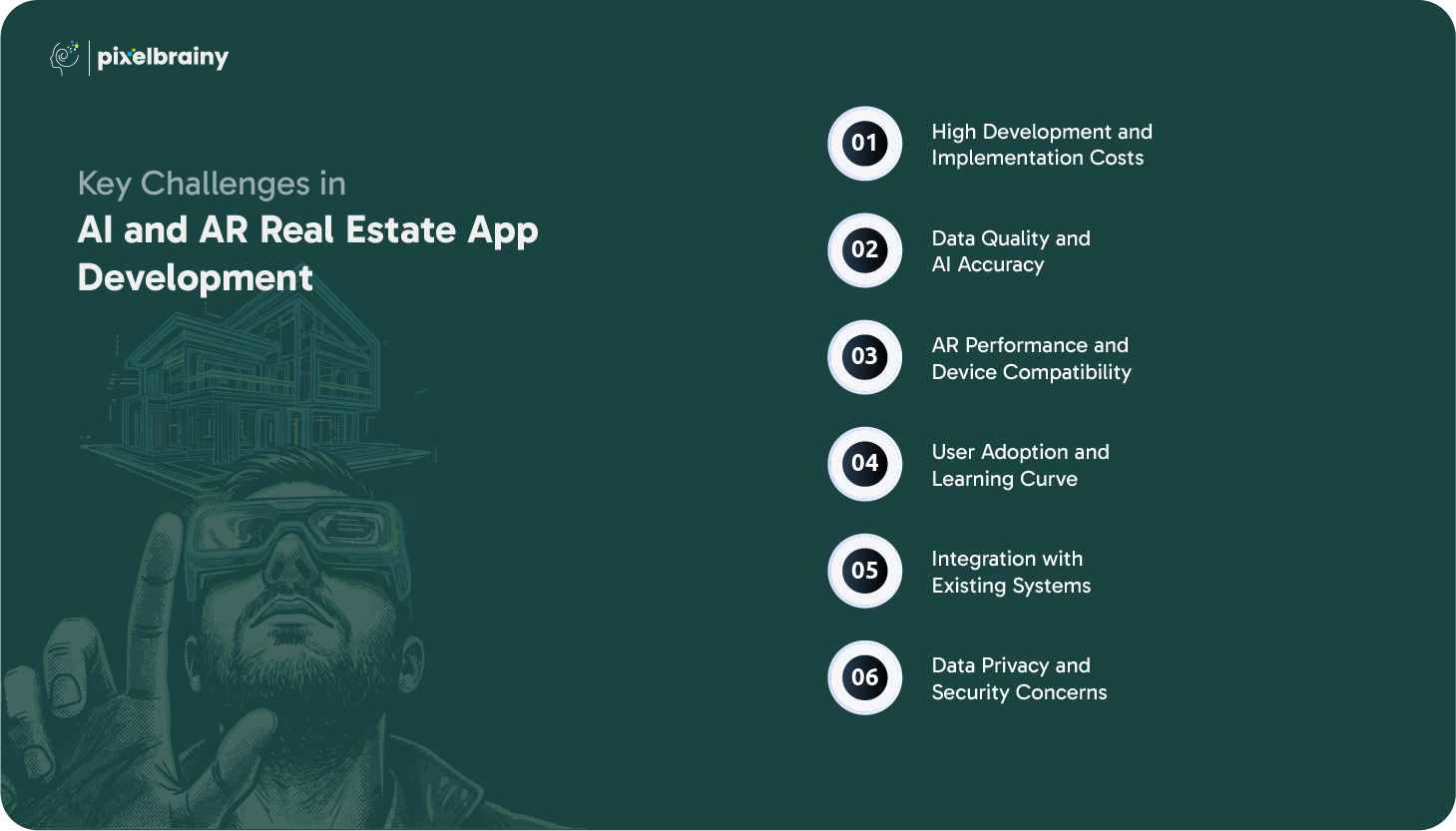
One of the biggest challenges is the investment required for advanced AI algorithms, immersive AR visualization, and scalable infrastructure. Real estate businesses may hesitate due to budget constraints or uncertainty about return on investment.
How to Overcome: Start with a phased approach by launching a focused version of the platform that prioritizes high-impact features. Gradual scaling allows businesses to validate market demand before committing to larger investments. Clear ROI metrics and performance tracking also help justify ongoing expansion.
AI-driven recommendations depend heavily on accurate data. Incomplete property listings, inconsistent data formats, or outdated market information can reduce recommendation quality and damage user trust.
How to Overcome: Implement structured data management processes and regular data validation. Integrating reliable property databases and continuously training AI models improves prediction accuracy. Monitoring AI performance ensures recommendations remain relevant and reliable.
AR features require strong device capabilities, and inconsistent performance across different smartphones can negatively impact user experience. Poor rendering or lagging visualization reduces engagement and user confidence.
How to Overcome: Optimize AR assets for performance and design adaptive experiences that adjust based on device capabilities. Conduct extensive testing across multiple devices and operating systems to ensure smooth performance and accessibility.
Immersive technologies may feel unfamiliar to some users, particularly those accustomed to traditional property browsing methods. Complex interfaces or unclear instructions can discourage adoption.
How to Overcome: Focus on intuitive design and provide guided onboarding experiences that demonstrate how to use AR features effectively. Combining familiar navigation patterns with immersive elements helps users transition comfortably to new technology.
Real estate businesses often rely on existing CRM platforms, property databases, and marketing tools. Integrating AI and AR functionality with legacy systems can be technically complex and time-consuming.
How to Overcome: Use flexible APIs and modular architecture that allows gradual integration without disrupting current workflows. Planning integration strategy early reduces future compatibility issues and ensures smooth data exchange.
Handling sensitive user information such as financial details, property preferences, and personal data increases security risks. Privacy concerns can affect user trust and regulatory compliance.
How to Overcome: Implement strong authentication methods, encryption protocols, and transparent privacy policies. Regular security audits and compliance with global data protection standards help maintain user confidence and safeguard platform integrity.
Addressing these challenges strategically enables real estate businesses to transform potential obstacles into opportunities for building reliable, scalable, and future-ready AI and AR real estate platforms.
Real estate companies today are looking beyond traditional digital platforms and moving toward immersive, intelligent property ecosystems that improve engagement and operational efficiency. Organizations aiming to create immersive AI and AR real estate experiences require a partner that understands both advanced technology and real estate business workflows. PixelBrainy LLC focuses on delivering practical innovation by combining strategic planning with AR and AI real estate technology development tailored to industry-specific challenges.
As a Real Estate AI Software Development Company, PixelBrainy LLC works closely with brokers, developers, and proptech startups to develop next-generation AI and AR real estate app solutions that align with long-term business goals. The company emphasizes scalable architecture, user-centric design, and performance optimization to ensure that businesses can successfully make an AI and AR Real Estate App that enhances buyer journeys and drives measurable growth. Through specialized AI Development Solutions of Real Estate App integrating AR, the focus remains on building platforms that are immersive, intelligent, and future-ready.
Take the next step toward digital transformation and build a future-ready AI and AR real estate platform with expert guidance.

From above, it is clear that AI and AR technologies are reshaping how real estate businesses attract buyers, present properties, and streamline decision-making processes. Combining intelligent automation with immersive visualization allows companies to move beyond traditional listings and deliver interactive, personalized property experiences.
Whether it involves virtual property tours, predictive recommendations, or advanced analytics insights, AI and AR real estate apps provide real estate brokers, developers, and agencies with tools to improve engagement, reduce sales cycles, and increase conversion potential.
Businesses that invest strategically in these technologies position themselves to meet evolving customer expectations while building scalable digital platforms for future growth. As the real estate industry continues to embrace innovation, adopting AI and AR-driven solutions becomes a practical step toward maintaining competitiveness and delivering modern property experiences.
Book an appointment with PixelBrainy LLC today to explore how your business can build a powerful AI and AR real estate app tailored to your goals.
AI enhances property discovery by analyzing user behavior and recommending relevant listings, while AR improves visualization through interactive property exploration. Together, they help real estate businesses present properties more effectively, reduce buyer uncertainty, and increase engagement compared to static listings or standard property search platforms.
No, businesses of all sizes can benefit from AI and AR solutions. Startups and small real estate agencies can begin with focused features such as virtual tours or AI-based recommendations and gradually expand functionality as their business grows and customer demand increases.
Development timelines vary depending on complexity. A basic version may take around 3–5 months, while advanced or enterprise-level platforms with custom AI models and immersive AR features may require 6–12 months including testing, optimization, and deployment phases.
Yes, AR visualization allows buyers to explore future property designs and layouts before completion. Combined with AI-driven insights, businesses can present realistic previews that improve buyer confidence and support early-stage property sales.
AI models rely on structured property data, user behavior insights, pricing history, location information, and engagement patterns. Maintaining accurate and updated datasets ensures that recommendations, predictions, and analytics remain reliable and relevant.
ROI can be evaluated through metrics such as increased lead conversions, reduced time to close deals, improved user engagement, lower marketing costs, and higher customer retention. Analytics dashboards within the platform help track performance and optimize strategies over time.

About The Author
Sagar Bhatnagar
Sagar Sahay Bhatnagar brings over a decade of IT industry experience to his role as Marketing Head at PixelBrainy. He's known for his knack in devising creative marketing strategies that boost brand visibility and market influence. Sagar's strategic thinking, coupled with his innovative vision and focus on results, sets him apart. His track record of successful campaigns proves his ability to utilize digital platforms effectively for impactful marketing efforts. With a genuine passion for both technology and marketing, Sagar continuously pushes PixelBrainy's marketing initiatives to greater success.


Transform your ideas into reality with us.
Working with the PixelBrainy team has been a highly positive experience. They understand the design requirements and create beautiful UX elements to meet the application needs. The dev team did an excellent job bringing my vision to life. We discussed usability and flow. Sagar worked with his team to design the database and begin coding. Working with Sagar was easy. He has the knowledge to create robust apps, including multi-language support, Google and Apple ID login options, Ad-enabled integrations, Stripe payment processing, and a Web Admin site for maintaining support data. I'm extremely satisfied with the services provided, the quality of the final product, and the professionalism of the entire process. I highly recommend them for Android and iOS Mobile Application Design and Development.

Great experience working with them. Had a lot of feedback and I found that unlike most contractors they were bugging me for updates instead of the other way around. They were extremely time conscience and great at communicating! All work was done extremely high quality and if not on time, early! They were always proactive when it comes to communication and the work is great/above par always. Very flexible and a great team to work with! Goes above and beyond to present us with multiple options and always provides quality. Amazing work per usual with Chitra. If you have UI/UX or branding design needs I recommend you go to them! Will likely work with them in the future as well, definitely recommended!

PixelBrainy is a joy to work with and is a great partner when thinking through branding, logo, and website layout. I appreciate that they spend time going into the "why" behind their decisions to help inform me and others about industry best practices and their expertise.

I hired them to design our software apps. Things I really like about them are excellent communication skills, they answer all project suggestions and collaborate right away, and their input on design and colors is amazing. This project was complex and needed patience and creativity. The team is amazing to do business with. I will be using them long-term. Glad to see there are some good people out there. I was afraid to try and outsource my project to someone but I am glad I met them! I really can't say enough. They went above and beyond on this project. I am very happy with everything they have done to make my business stand out from the competition.

It was great working with PixelBrainy and the team. They were very responsive and really owned the project. We'll definitely work with them again!

I recently worked with the PixelBrainy team on a project and I was blown away by their communication skills. They were prompt, clear, and articulate in all of our interactions. They listened and provided valuable feedback and suggestions to help make the project a success. They also kept me updated throughout the entire process, which made the experience stress-free and enjoyable.

PixelBrainy is very good at what it does. The team also presents themselves very professionally and takes care of their side of things very well. I could fully trust them taking up the design work in a timely and organised manner and their attention to detail saved us lots of effort and time. This particular project was quite intense and the team showed that they function very well under pressure. Very much looking forward to working with her again!

It's always an absolute pleasure working with them. They completed all of my requests quickly and followed every note I had for them to a T, which made our process go smoothly from start to finish. Everything was completed fast and following all of the guidelines. And I would recommend their services to anyone. If you need any design work done in the future, PixelBrainy should be your first call!

They took ownership of our requirements and designed and proposed multiple beautiful variants. The team is self-motivated, requires minimum supervision, committed to see-through designs with quality and delivering them on time. We would definitely love to work with PixelBrainy again when we have any requirements.

PixelBrainy was a big help with our SaaS application. We've been hard at work with a new UI/UX and they provided a lot of help with the designs. If you're looking for assistance with your website, software, or mobile application designs, PixelBrainy and the team is a great recommendation.

PixelBrainy designers are amazing. They are responsive, talented, and always willing to help craft the design until it matches your vision. I would recommend them and plan to continue them for my future projects and more!!!

They were awesome! Did a good job fast, and good communication. Will work with them again. Thank you

Creative, detail-oriented, and talented designers who take direction well and implement changes quickly and accurately. They consistently over-delivered for us.

PixelBrainy team is very talented and creative. Great designers and a pleasure to work with. PixelBrainy is an excellent communicator and I look forward to working with them again.

PixelBrainy has a very talented design team. Their work is excellent and they are very responsive. I enjoy working with them and hope to continue on all of our future projects.


