AI Summary Powered by PixelBrainy
Modern vehicles generate more diagnostic data than traditional inspection methods can easily interpret. For auto businesses, the challenge is no longer only reading an OBD2 fault code. It is turning that code and other vehicle data into a clear understanding of what is wrong, how urgent the issue is, what the repair may cost, and what the driver should do next.
For an automotive technology entrepreneur asking, “How can I build an AI automotive diagnostics app that goes beyond OBD2 fault codes to explain vehicle issues in plain language, assess repair urgency, estimate repair costs by ZIP code, and recommend certified repair shops?”, the product needs to connect diagnostics with practical repair decisions. This means combining vehicle data, AI-based fault interpretation, repair intelligence, cost estimation, parts recommendations, and service-provider information within one experience.
This is where AI automotive diagnostics app development can create a more useful alternative to simply asking vehicle owners to search unfamiliar error codes online. An intelligently designed platform can convert complex diagnostic information into understandable insights while helping users move from fault detection to repair action.
For businesses planning to create an AI automotive diagnostics app, the development scope can range from basic fault-code interpretation to production-grade systems with predictive vehicle health analysis, repair cost estimation, parts recommendations, and certified repair shop discovery. The cost and complexity depend on the AI capabilities, vehicle integrations, data sources, platform requirements, and level of automation involved.
This guide explains how to develop an AI automotive diagnostics app with repair cost estimation and parts recommendation features, covering the development process, essential and advanced features, technology stack, development costs, monetization opportunities, challenges, and other considerations involved in AI auto repair diagnostics app development. It also helps businesses evaluate what to expect from AI automotive diagnostics app development services when planning a production-ready solution.
An AI automotive diagnostics and repair app is a software platform that uses artificial intelligence and vehicle data to identify, interpret, and prioritize automotive issues. Unlike traditional diagnostic tools that mainly display fault codes, an AI-powered app can analyze OBD2 data, vehicle sensor information, service history, and operating patterns to provide more contextual insights.
The app can translate complex fault codes into plain-language explanations, identify potential root causes, assess repair urgency, and recommend appropriate repair actions. Advanced solutions can also provide repair cost estimates, parts recommendations, vehicle health scores, and certified repair shop suggestions.
For auto repair businesses, dealerships, and fleet operators, the platform can support technicians with structured diagnostic intelligence and help standardize repair decisions. For vehicle owners, it can make complex vehicle information easier to understand and turn diagnostic alerts into practical next steps.
By combining AI analysis, real-time vehicle data, predictive insights, and repair intelligence, these applications can connect vehicle diagnostics with the actual repair process.
An AI automotive diagnostics and repair app follows a multi-stage, data-centric workflow that converts vehicle data into diagnostic insights and recommended repair actions. Unlike conventional diagnostic tools that primarily display fault codes, an AI-powered system evaluates vehicle behavior, operating patterns, service history, and other available data to identify anomalies, assess potential causes, and support repair decisions.
For businesses planning AI automotive diagnostics app development, the workflow typically includes five core stages: vehicle data collection, AI-powered analysis, predictive diagnostics, repair recommendations, and continuous learning.
The process starts by collecting real-time information from connected vehicle systems. Depending on the integration scope, the app can receive data from OBD systems, electronic control units (ECUs), telematics devices, and embedded vehicle sensors.
The system captures relevant information such as fault codes, engine performance, fuel efficiency, mileage, temperature changes, and driving conditions. This data is securely transmitted to the backend, where it is prepared for AI analysis.
Raw vehicle data must first be cleaned, normalized, and structured before analysis. AI and machine learning models then examine the processed information to identify abnormal patterns and potential vehicle faults.
The system can compare current vehicle behavior with historical service records, known failure patterns, and data from similar vehicle models. This helps the application move beyond simply reporting symptoms and provide deeper insight into possible underlying causes.
After identifying relevant patterns, the AI system analyzes potential component wear and failure risks. It can generate diagnostic insights and organize recommended repair actions according to factors such as urgency, potential cost impact, and likelihood of success.
This gives technicians and service teams a structured way to prioritize repairs, address emerging problems, and reduce the likelihood of repeat repair issues.
The analyzed information is delivered through role-specific interfaces for technicians, service managers, and customers. Instead of presenting raw diagnostic data alone, the application organizes relevant findings into actionable insights that support faster decision-making.
For automotive businesses, this creates a connected workflow from vehicle data to diagnosis, repair prioritization, and service action.
AI automotive diagnostics systems can improve over time by incorporating completed repair outcomes into the learning process. When the actual repair result is recorded, that information can be used to improve the relevance and accuracy of future diagnostic analysis.
This creates a feedback loop in which vehicle data → AI analysis → diagnostic insight → repair outcome → model improvement.
| Stage | What the AI Automotive Diagnostics App Does | Business Value |
| Vehicle Data Collection | Collects real-time vehicle, sensor, ECU, OBD, and telematics data | Creates a broader view of vehicle health |
| Data Processing | Cleans, normalizes, and structures incoming vehicle data | Makes diagnostic data usable for AI analysis |
| AI Pattern Recognition | Identifies anomalies and compares vehicle behavior with relevant historical and failure patterns | Supports faster, more consistent diagnostics |
| Predictive Diagnostics | Identifies potential component wear and future failure risks | Enables proactive maintenance planning |
| Repair Intelligence | Ranks recommended repair actions by urgency, cost impact, and likelihood of success | Helps teams prioritize repair work |
| Insight Delivery | Presents diagnostic findings through role-specific dashboards | Makes complex vehicle information easier to act on |
| Continuous Learning | Uses completed repair outcomes to improve future analysis | Supports ongoing model improvement |
The core of an AI automotive diagnostics and repair app is not simply reading vehicle fault codes. Its value comes from connecting vehicle data, AI-based pattern recognition, predictive analysis, repair intelligence, and repair outcomes in one workflow. For companies investing in AI automotive diagnostics app development, this workflow provides the foundation for building a system that can support technicians, service managers, dealerships, and fleet operations with more structured diagnostic decision-making.
As vehicle systems become more complex, auto repair businesses, dealerships, and fleet operators need diagnostic processes that can deliver consistent insights without relying entirely on manual interpretation. This is where AI automotive diagnostic apps can connect vehicle data with practical service decisions, helping businesses address problems such as inconsistent diagnosis, longer turnaround times, repeat repairs, unexpected breakdowns, and limited fleet visibility.
For a business asking, “How can an AI automotive diagnostics app reduce repeat repairs and help technicians identify the root cause faster?”, the answer lies in using AI to analyze vehicle data, recognize diagnostic patterns, and support repair decisions with structured intelligence. Instead of treating each fault as an isolated issue, an AI automotive diagnostics app development approach can help create a more consistent diagnostic workflow across technicians, locations, and vehicle populations.
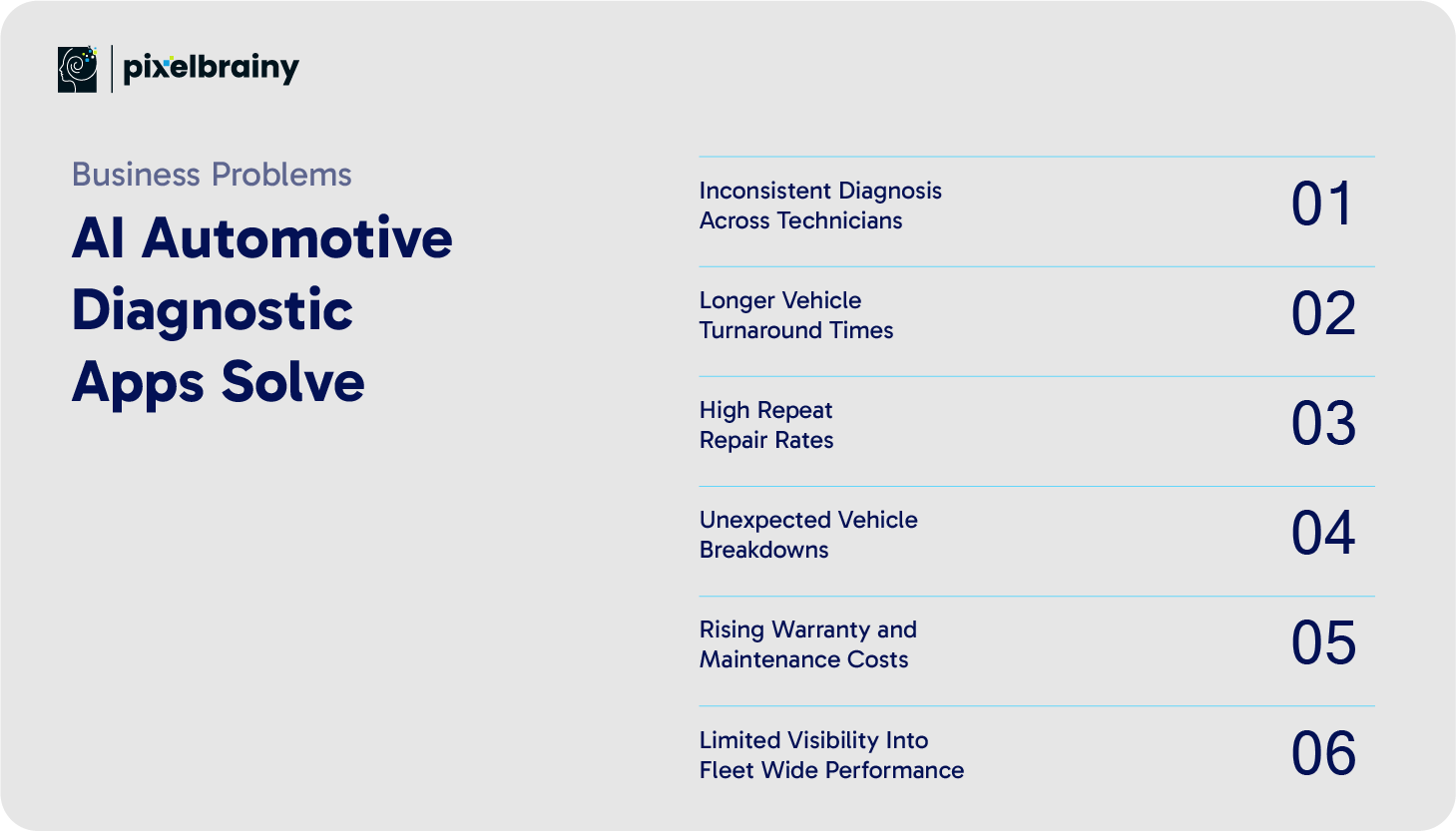
In many service environments, diagnostic accuracy depends heavily on individual technician experience. This often leads to variations in diagnosis quality, even for the same vehicle issue. AI automotive diagnostic apps standardize the diagnostic process by analyzing vehicle data against proven patterns and historical repair outcomes. This ensures consistent results regardless of technician skill level.
Manual inspections and trial and error diagnostics increase the time vehicles spend in service bays. AI powered diagnostics accelerate fault identification by pinpointing likely issues early in the process. Faster diagnostics enable technicians to begin repairs sooner, improving workshop throughput and customer satisfaction.
Incorrect or incomplete diagnosis is a major cause of repeat repairs. AI apps reduce this risk by identifying root causes rather than surface level symptoms. Repair recommendations are based on historical success rates, which improves first time fix accuracy.
Reactive maintenance leads to sudden breakdowns and unplanned downtime. AI diagnostic apps use predictive analysis to detect early signs of component failure, allowing businesses to address issues before they escalate.
Warranty claims and unnecessary part replacements increase costs. AI driven diagnostics improve repair precision, reduce misdiagnosis, and minimize unnecessary replacements, helping control expenses.
For fleet operators, managing vehicle health at scale is challenging. AI apps provide centralized visibility into performance trends, maintenance needs, and cost drivers across entire fleets.
By addressing these operational challenges, AI automotive diagnostics app development can help automotive businesses improve diagnostic consistency, support faster service decisions, reduce avoidable repair issues, and gain better visibility into vehicle health. The right AI auto repair diagnostics app turns diagnostic data into practical decision support across individual vehicles and larger service operations.
Traditional automotive diagnostic tools have long been used to identify vehicle faults by reading diagnostic trouble codes and displaying available vehicle data. However, the tool generally leaves the interpretation and repair decision to the technician. This can work well for straightforward faults, but complex vehicle systems can require more context from sensors, operating conditions, previous repairs, and known failure patterns.
This difference becomes important for businesses asking, “Can an AI automotive diagnostics app help technicians identify the root cause of a vehicle problem instead of simply showing an OBD2 fault code?” An AI-powered approach is designed to analyze diagnostic information in context and provide more structured decision support.
Traditional tools primarily provide fault codes that technicians must interpret manually. An AI automotive diagnostics app can analyze those codes alongside real-time vehicle behavior, historical service information, and relevant failure patterns. This provides a broader diagnostic context and helps technicians investigate likely causes rather than treating every code as an isolated problem.
With conventional diagnostics, the quality and speed of diagnosis can vary based on technician experience and familiarity with particular vehicle systems. AI automotive diagnostics and repair apps can standardize parts of the analysis by applying consistent data-driven patterns and recommendations. The technician remains responsible for the repair decision, while AI helps organize the information needed to make that decision.
Traditional diagnostic tools are generally reactive because they identify faults that have already been detected by the vehicle system. AI-based platforms can analyze patterns associated with component wear and potential failures, supporting earlier intervention. This makes predictive vehicle diagnostics particularly relevant for fleets and businesses managing large numbers of vehicles.
A conventional diagnostic tool is typically used on one vehicle at a time. An AI automotive diagnostics app can provide a broader operational view by analyzing information across multiple vehicles, service events, and locations. Fleet and service managers can use this information to identify recurring issues, maintenance trends, and vehicle performance patterns.
Traditional tools primarily answer, “What fault has been detected?” An AI-powered diagnostic platform can take the analysis further by organizing potential causes, identifying failure patterns, and supporting recommended repair actions. This creates a more connected workflow from vehicle data to diagnosis and repair decision-making.
| Comparison Area | Traditional Diagnostic Tools | AI Automotive Diagnostics Apps |
| Primary Function | Reads fault codes and vehicle data | Analyzes vehicle data and identifies diagnostic patterns |
| Diagnosis Approach | Manual interpretation of diagnostic information | Context-aware AI and machine learning analysis |
| Data Context | Primarily current vehicle information | Current data combined with historical and pattern-based information |
| Technician Role | Interprets findings and determines the repair | Uses AI-supported insights to investigate and make repair decisions |
| Diagnostic Process | Often reactive and symptom-focused | Supports root-cause analysis and predictive diagnostics |
| Maintenance Approach | Addresses detected faults | Can identify potential wear and failure patterns earlier |
| Consistency | Can vary with technician experience | Applies standardized analytical models |
| Scalability | Primarily vehicle-by-vehicle | Supports multiple vehicles, locations, and fleet-level analysis |
| Business Intelligence | Limited operational visibility | Enables analysis of recurring issues and maintenance trends |
| Repair Intelligence | Diagnostic information requires manual interpretation | Can organize potential causes and recommended repair actions |
The key difference is not that AI automotive diagnostics replaces traditional diagnostic tools or technicians. Instead, AI adds an analytical layer that can interpret larger volumes of vehicle data and provide structured diagnostic decision support.
For companies planning AI automotive diagnostics app development, the strongest value comes from connecting fault-code data, vehicle behavior, historical service information, predictive analysis, and repair outcomes within one workflow. This can help service organizations move from basic fault detection toward more consistent diagnostics, proactive maintenance, and fleet-wide vehicle health intelligence.
AI automotive diagnostic and repair app development is relevant across different parts of the automotive service ecosystem, from independent repair shops and dealerships to fleet operators, OEM service networks, and multi-location automotive enterprises. Each business model has different operational requirements, but the underlying need is similar: turn vehicle and service data into useful diagnostic intelligence that supports faster, more consistent maintenance and repair decisions.
A business exploring AI automotive diagnostics app development may ask, “What are the real-world use cases for an AI automotive diagnostics app across repair shops, dealerships, fleets, and OEM service networks?” The answer depends on how the application is integrated into daily workflows. For some businesses, the priority is technician decision support and consistent diagnosis. For fleets, it may center on predictive maintenance and vehicle health monitoring. OEMs can use the same foundation to analyze recurring issues, warranty patterns, and service performance.
The following use cases explain how businesses can create an AI automotive diagnostics app around specific operational needs and apply AI diagnostic capabilities across different automotive environments.
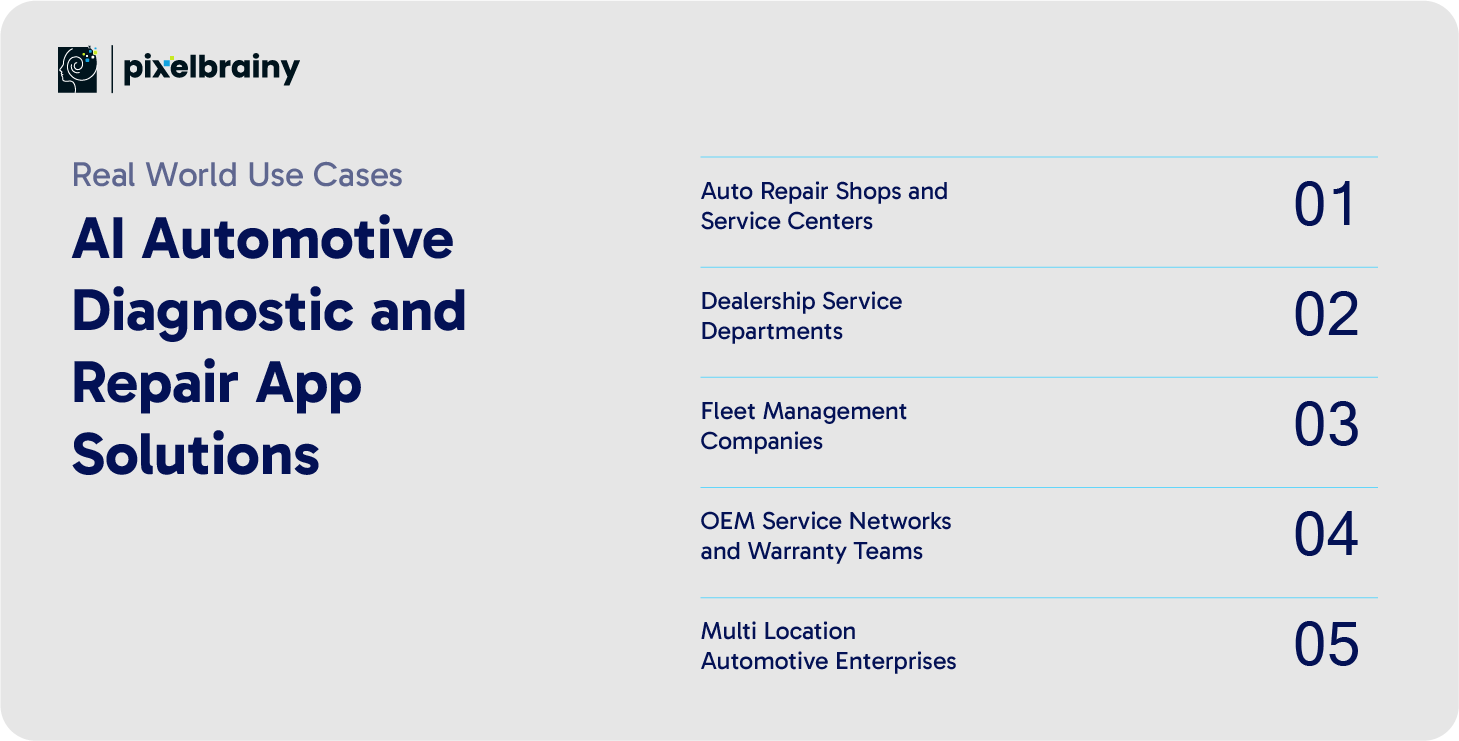
Independent repair shops and multi-location service centers often face challenges related to inconsistent diagnosis, technician dependency, and time-consuming inspections. When creating an AI Automotive Diagnostic and Repair App for these environments, the goal is to assist technicians with reliable and faster diagnostic intelligence from the moment a vehicle enters the service bay.
The app analyzes real time vehicle data and historical repair patterns to highlight potential issues and likely root causes. This reduces unnecessary troubleshooting and helps technicians move directly toward effective repairs. Over time, the app learns from completed service jobs, improving diagnostic recommendations and supporting consistent service quality across technicians.
Key benefits for repair shops include:
Dealership service departments manage high service volumes while maintaining brand level service consistency. Creating an AI Automotive Diagnostic and Repair App helps dealerships streamline diagnostics and reduce reliance on individual technician expertise. The app provides structured diagnostic insights that guide both technicians and service advisors through the repair process.
Service advisors can use AI driven explanations to clearly communicate vehicle issues, repair urgency, and expected timelines to customers. This improves transparency and helps customers make informed decisions, leading to stronger trust and improved service conversion rates.
Key benefits for dealership service teams include:
Fleet operators prioritize uptime, predictable maintenance costs, and operational efficiency. To make AI Automotive Diagnostic and Repair App solutions effective for fleets, the focus is on predictive maintenance and centralized vehicle health monitoring. The app continuously evaluates data from all vehicles in the fleet and identifies early indicators of wear or failure.
This allows fleet managers to plan maintenance schedules proactively rather than reacting to breakdowns. By identifying trends across vehicle types and usage patterns, fleet operators can optimize service cycles and reduce unexpected downtime.
Key benefits for fleet operators include:
Original equipment manufacturers and their service networks use AI Automotive Diagnostic and Repair App Development Solutions to gain deeper insights into warranty claims and vehicle performance. Creating an AI Automotive Diagnostic and Repair App connected to authorized service centers allows OEMs to monitor recurring issues and evaluate repair effectiveness across regions.
Warranty teams can identify patterns that indicate design flaws or component issues, enabling early intervention and improved product quality. This data driven approach also helps reduce unnecessary warranty claims and ensures repairs align with manufacturer guidelines.
Key benefits for OEMs and warranty teams include:
Large automotive enterprises operating across multiple regions often struggle with fragmented data and inconsistent service processes. To make AI Automotive Diagnostic and Repair App solutions work at scale, these businesses use the app as a centralized diagnostic intelligence platform across all locations.
Every service interaction contributes data to a shared system, allowing leadership teams to monitor performance, identify trends, and benchmark service quality. This enables continuous improvement and operational consistency across the organization.
Key benefits for multi-location enterprises include:
These use cases show how AI automotive diagnostic and repair app development Solutions can improve diagnostics, maintenance, and service operations across different automotive businesses.
The success of AI automotive diagnostics app development depends on how effectively the application connects vehicle data with diagnostic analysis, repair workflows, and user decision-making. Businesses looking to create an AI automotive diagnostics app need features that work across real service environments while supporting technicians, service managers, and customers.
A common business requirement is, “What features should an AI automotive diagnostics app include to interpret fault codes, predict maintenance needs, recommend repairs, and support technicians?” The answer goes beyond basic OBD2 connectivity. A production-ready AI automotive diagnostics and repair app can combine real-time vehicle analysis, intelligent fault interpretation, predictive maintenance, repair recommendations, service history, workflow management, and secure data infrastructure.
The following core features provide the foundation for AI automotive diagnostics app development services designed for repair shops, dealerships, fleet operators, and other automotive businesses.
| Feature | Description |
| Real Time Vehicle Data Analysis | This feature enables the app to continuously collect and analyze live data from vehicle sensors and onboard systems. It helps detect issues as they occur rather than after a failure. By working with real time inputs, technicians gain faster visibility into vehicle health and can act before problems escalate. |
| Intelligent Fault Code Interpretation | Instead of presenting raw fault codes, the app converts them into meaningful diagnostic insights. It explains what the code represents, how serious the issue is, and which systems are affected. This reduces dependency on manuals and speeds up the diagnostic process. |
| Predictive Maintenance Alerts | Using historical data and usage patterns, the app identifies early warning signs of component wear. These alerts allow businesses to plan maintenance proactively rather than reacting to breakdowns. This approach reduces downtime and improves vehicle reliability. |
| Repair Recommendation Engine | The app suggests repair actions based on similar past cases and successful outcomes. Recommendations are ranked by urgency and likelihood of resolving the issue. This helps technicians choose the most effective repair path with greater confidence. |
| Technician Decision Support | Step by step diagnostic guidance supports technicians throughout the repair process. This feature reduces reliance on individual experience and helps junior technicians perform complex diagnostics accurately. It also improves consistency across service teams. |
| Service History Management | All inspection, repair, and maintenance records are stored in a centralized system. Having access to service history allows the AI engine to generate more accurate insights. It also helps technicians understand recurring issues quickly. |
| Vehicle Health Scoring | The app generates a comprehensive health score by evaluating multiple vehicle parameters. This score provides a quick snapshot of overall vehicle condition. Managers and technicians can use it to prioritize service actions. |
| Customer Friendly Diagnostic Reports | Diagnostic findings are converted into easy to understand summaries for customers. Clear explanations help customers understand repair needs and urgency. This improves transparency and builds trust during service consultations. |
| Multi Vehicle Compatibility | The app is designed to support multiple vehicle makes, models, and configurations. This flexibility makes it suitable for repair shops, dealerships, and fleet operators handling diverse vehicles. It also ensures scalability as business operations grow. |
| Cloud Based Data Storage | Vehicle and diagnostic data are securely stored in the cloud for easy access across locations. Cloud infrastructure supports scalability and remote access. It also enables continuous learning as data volumes increase. |
| Role Based Dashboards | Different dashboards are tailored for technicians, service managers, and business owners. Each role sees relevant insights without unnecessary complexity. This improves usability and decision making at every level. |
| Workflow and Job Management | Diagnostics are integrated with job scheduling and service workflows. This helps teams move seamlessly from diagnosis to repair execution. It improves service bay efficiency and reduces administrative overhead. |
| Alerts and Notifications | Automated alerts notify teams about critical issues, urgent repairs, or upcoming maintenance needs. This ensures important tasks are not overlooked. It also helps prioritize work based on urgency and impact. |
| Integration with Workshop Tools | The app integrates with existing diagnostic devices and workshop management systems. This minimizes disruption to current operations. Businesses can adopt AI capabilities without replacing their entire toolset. |
| Data Security and Compliance | Strong security measures protect sensitive vehicle and customer data. Compliance with data protection standards builds trust with customers and partners. This feature is critical for large scale and enterprise deployments. |
These features provide the foundation for a reliable AI automotive diagnostics and repair app, connecting vehicle data, AI-powered analysis, repair intelligence, and service workflows in one platform.
Advanced capabilities can take an AI automotive diagnostics and repair app beyond basic fault detection by adding predictive analysis, adaptive intelligence, fleet-level visibility, and deeper repair insights. These capabilities become particularly valuable for automotive businesses that need to manage complex vehicle systems, large vehicle populations, or growing service operations.
A business asking, “How can I develop an AI automotive diagnostics app that predicts complex vehicle failures and provides deeper insights across an entire fleet?” needs to consider advanced features alongside core diagnostic functionality. During AI automotive diagnostics app development, these capabilities can help the platform analyze relationships between vehicle systems, learn from repair outcomes, identify unusual patterns, and turn aggregated diagnostic data into useful operational insights.
The following advanced features can help businesses create an AI automotive diagnostics app that supports predictive maintenance, intelligent root-cause analysis, telematics-based monitoring, and broader automotive service intelligence.
| Advanced Feature | Description |
| System Level Failure Prediction | This feature analyzes interactions between multiple vehicle systems instead of isolated components. It helps predict complex failures that involve cascading issues. This is especially valuable for modern vehicles with tightly integrated systems. |
| Adaptive Learning Models | The app continuously improves by learning from new diagnostic data and repair outcomes. Each completed repair strengthens future predictions. This ensures the system becomes more accurate over time without manual reconfiguration. |
| Fleet Wide Analytics | Advanced dashboards provide visibility into performance trends across entire fleets. Managers can identify high risk vehicles and recurring issues. This supports data driven fleet maintenance strategies. |
| Context Aware Diagnostics | Diagnostic explanations adjust based on who is viewing them and in what situation. Technicians receive technical guidance, while managers see operational insights. Customers receive simplified explanations that improve understanding. |
| AI Driven Root Cause Analysis | The app goes beyond surface symptoms to identify underlying causes of vehicle issues. This reduces misdiagnosis and unnecessary part replacements. It also improves long term repair effectiveness. |
| Predictive Parts Replacement Planning | AI forecasts when specific components are likely to fail based on usage patterns. This helps businesses plan inventory and avoid service delays. It also supports cost effective parts management. |
| Benchmarking and Performance Comparison | The system measures diagnostic speed, accuracy, and repair success against historical benchmarks. Businesses can track improvements over time. This helps justify further investment in AI solutions. |
| Integration with Telematics Platforms | Advanced integration enables remote diagnostics and continuous vehicle monitoring. This is especially useful for fleet operators and connected vehicle environments. Issues can be detected without physical inspections. |
| Anomaly Detection Across Vehicle Populations | The app identifies unusual patterns across groups of vehicles. These anomalies may indicate emerging design or usage issues. Early detection supports proactive intervention. |
| AI Powered Business Intelligence Insights | Aggregated diagnostic data is transformed into strategic insights for decision makers. Businesses can use this information to improve pricing, service planning, and operational strategy. Diagnostics become a source of business intelligence rather than just technical data. |
These advanced capabilities can extend AI automotive diagnostics app development from fault identification into predictive maintenance, fleet intelligence, adaptive learning, and data-driven automotive operations.
Developing an AI automotive diagnostics and repair app requires more than connecting a vehicle to an OBD system and displaying fault codes. The development process must align vehicle data, AI capabilities, diagnostic workflows, user requirements, and business goals to create a solution that can work reliably in real service environments.
For businesses asking, “How do I develop an AI automotive diagnostics app that can analyze vehicle data, predict failures, and support technicians from diagnosis through repair?”, the answer starts with a structured development roadmap. The scope may include vehicle system integration, data engineering, machine learning, predictive diagnostics, technician dashboards, and continuous model improvement.
The following eight steps explain how to develop an AI automotive diagnostics app, from business discovery and data strategy through MVP deployment, scaling, and continuous optimization. This approach also helps businesses define the right scope for AI automotive diagnostics app development services without introducing unnecessary technical complexity.
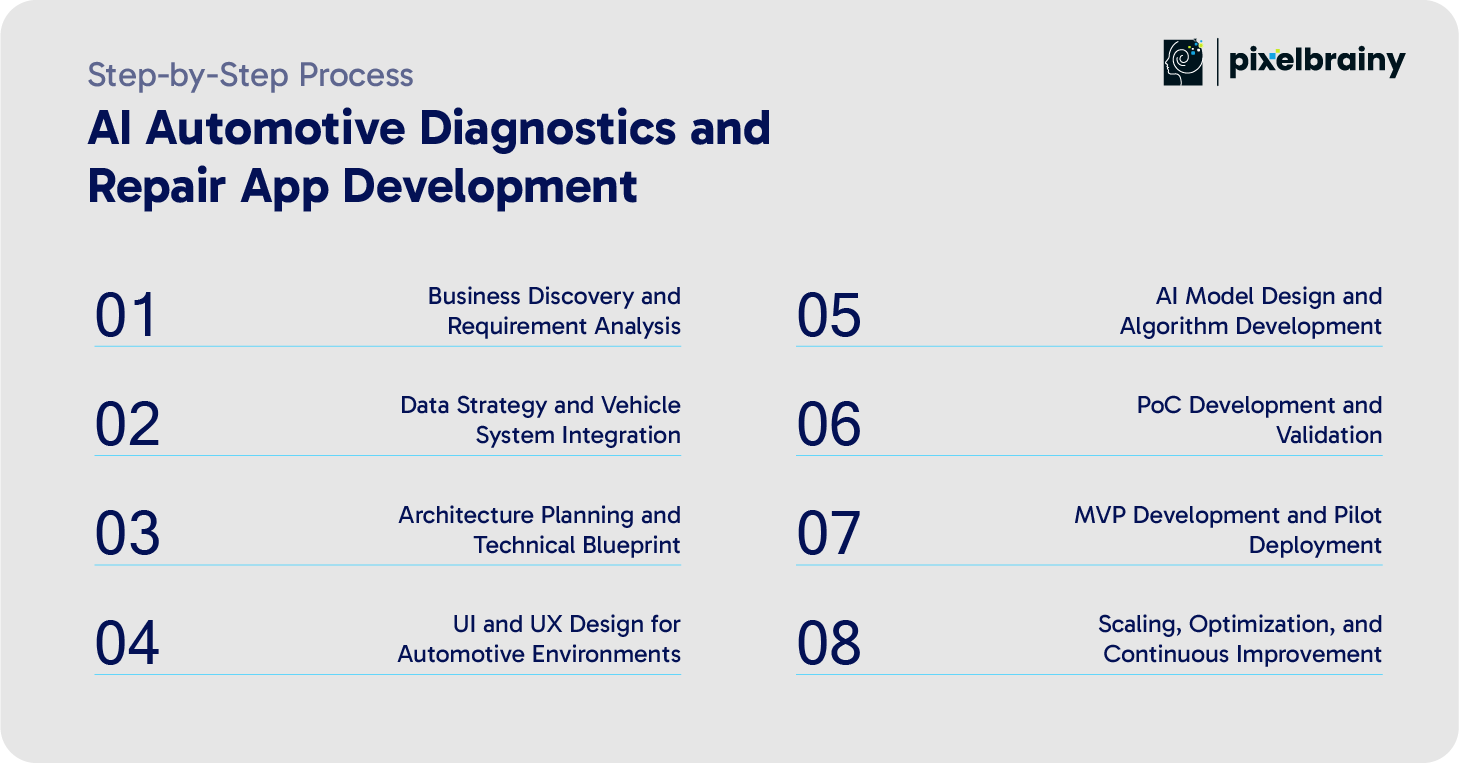
This step focuses on understanding the real operational challenges faced by auto businesses, repair shops, dealerships, or fleet operators. Stakeholders, service managers, and technicians are involved to map current diagnostic workflows, pain points, and performance gaps. Data availability, vehicle types, and service volume are also evaluated to define realistic project scope.
The goal is to translate business needs into clear functional and technical requirements. This foundation ensures that developing an AI Automotive Diagnostics and Repair App solves real problems rather than adding unnecessary complexity.
Aim / Goal of this step:
AI driven diagnostics depend heavily on data quality and accessibility. In this step, teams identify data sources such as OBD systems, telematics platforms, sensor data, and historical service records. Integration strategies are designed to securely ingest, clean, and normalize data for AI processing.
Special attention is given to data consistency across vehicle models and service locations. This step ensures the app has a reliable data foundation to support accurate diagnostics and predictions.
Aim / Goal of this step:
Once data requirements are defined, the overall system architecture is designed. This includes frontend platforms, backend services, AI engines, databases, and cloud infrastructure. Scalability, performance, and security are prioritized to support future growth.
Auto companies often evaluate insights and best practices followed by Top AI development companies in USA to ensure the architecture supports enterprise grade deployments.
Aim / Goal of this step:
User experience plays a critical role in adoption, especially for technicians working under time pressure. This step involves designing intuitive dashboards, simplified workflows, and role specific views. Interfaces are optimized for workshop conditions, mobile usage, and fast interactions.
Many businesses collaborate with a specialized UI/UX design company to ensure the app remains easy to use without compromising on functionality.
Aim / Goal of this step:
This step focuses on building machine learning models for fault detection, pattern recognition, and predictive maintenance. Historical repair data is used to train models, while real time data helps validate accuracy. Multiple algorithms may be tested to identify the most reliable approach.
The AI logic is designed to explain results clearly, ensuring technicians trust and understand the recommendations provided.
Aim / Goal of this step:
Before full scale implementation, PoC development is carried out to validate feasibility. A limited version of the app is built to test AI accuracy, data flow, and user interactions in real environments. Feedback from technicians and managers is collected and analyzed.
This step helps identify risks early and refine assumptions before major investment.
Aim / Goal of this step:
After successful validation, MVP Development begins. The MVP includes core diagnostic features required for real operations. It is deployed in selected service locations or fleets to gather real usage data and performance insights.
Feedback collected during this phase guides feature refinement and performance optimization.
Aim / Goal of this step:
Also Read: Top 10 AI MVP Development Companies in USA
The final step focuses on scaling the app across locations, fleets, or service networks. AI models are continuously retrained using new repair data, while system performance is optimized. Additional features and integrations are introduced based on business priorities.
Security, compliance, and monitoring processes are strengthened to support enterprise level usage.
Aim / Goal of this step:
A structured AI automotive diagnostics app development process helps businesses move from an initial diagnostic concept to a scalable, production-ready solution with reliable data, validated AI models, and workflows designed around real automotive operations.
The cost to develop an AI automotive diagnostics and repair app depends on how much diagnostic intelligence, vehicle integration, and operational functionality the business needs. A basic MVP with core fault detection requires a different investment from an advanced platform with predictive maintenance, fleet analytics, and enterprise integrations.
For businesses asking, “How much does it cost to develop an AI automotive diagnostics app with predictive maintenance and multi-vehicle support?”, the practical answer depends on the app's scope, AI model complexity, data readiness, integrations, UI requirements, security, and scalability. Based on these factors, AI automotive diagnostics app development can range from $30,000 to $300,000+, with development timelines typically extending from 2 to 9+ months.
The breakdown below explains the estimated cost and timeline across basic, advanced, and enterprise AI automotive diagnostics and repair app development projects, followed by the major factors that influence the final budget.
| App Type | Estimated Timeline | Estimated Cost | What You Get |
| Basic AI Automotive Diagnostics and Repair App (MVP) | 2 to 3 months | $30,000 to $70,000 | Core diagnostic features, basic AI fault detection, limited vehicle support, simple dashboards, and essential reporting for early validation. |
| Advanced AI Automotive Diagnostics and Repair App | 4 to 6 months | $80,000 to $150,000 | Predictive maintenance, advanced AI models, multi vehicle support, role-based dashboards, integration with workshop tools, and improved analytics. |
| Enterprise AI Automotive Diagnostics and Repair App | 6 to 9+ months | $180,000 to $300,000+ | Fleet wide intelligence, system level failure prediction, deep integrations, enterprise security, scalability, and advanced reporting for large organizations. |
The breadth of features significantly influences development cost. A basic feature set typically adds $10,000 to $30,000, while advanced capabilities such as predictive analytics, fleet dashboards, and business intelligence can increase costs by $40,000 to $80,000 or more. Enterprise feature sets often push the budget beyond $100,000 due to extensive customization.
Simple AI models for fault detection generally cost $15,000 to $30,000 to develop. More advanced machine learning and predictive models require deeper training, testing, and optimization, increasing costs to $40,000 to $70,000. Enterprise grade AI systems with continuous learning capabilities can exceed $80,000.
If historical vehicle and repair data is clean and well structured, data preparation costs remain relatively low, usually $5,000 to $10,000. However, fragmented or unstructured data requires cleaning, labeling, and normalization, which can raise costs to $15,000 to $30,000 depending on data volume and quality.
Basic integrations with standard OBD systems may cost $5,000 to $10,000. Advanced integrations with telematics platforms, fleet systems, or workshop management software can increase costs to $15,000 to $35,000. Enterprise environments with multiple custom integrations may exceed $50,000.
Simple UI and UX design typically costs $5,000 to $10,000. More advanced role-based dashboards, mobile optimization, and workshop friendly interfaces raise design costs to $15,000 to $25,000. Highly customized enterprise interfaces can go beyond $30,000.
Basic security implementations usually add $5,000 to $10,000 to development costs. Enterprise level security, compliance requirements, and scalable cloud architecture can increase costs by $20,000 to $50,000, especially for large scale deployments handling sensitive data.
Understanding these cost drivers helps businesses plan AI automotive diagnostics app development around their required features, AI capabilities, integrations, and growth plans while setting a more realistic development budget and timeline.

Also Read: AI App Development Cost: From MVPs to Full-Scale AI App
The technology stack for an AI automotive diagnostics and repair app must support continuous vehicle data ingestion, AI-based diagnostics, predictive analysis, secure integrations, and scalable application performance. The right architecture connects vehicle systems with AI models, data pipelines, cloud infrastructure, user interfaces, and monitoring tools so the platform can operate reliably across repair shops, dealerships, and fleet environments.
A business asking, “What technology stack do I need to develop an AI automotive diagnostics app that can process real-time vehicle data, predict faults, and scale across multiple service locations?” needs to evaluate every technical layer together rather than selecting AI tools in isolation. The following stack provides a practical foundation for AI automotive diagnostics app development, covering frontend, backend, machine learning, data processing, vehicle connectivity, cloud infrastructure, security, and system monitoring.
| Technology Layer | Role in AI Automotive Diagnostics App Development | Common Tools & Technologies |
| Frontend Development | Builds technician interfaces, customer views, service dashboards, diagnostic reports, and fleet monitoring screens | React, Angular, Vue, Flutter, Swift, Kotlin |
| Backend Development | Handles business logic, APIs, authentication, data orchestration, user management, and application workflows | Node.js, Python, Java, .NET, REST APIs |
| AI & Machine Learning | Supports fault detection, anomaly detection, predictive maintenance, pattern recognition, and root cause analysis | TensorFlow, PyTorch, Scikit-learn |
| Data Processing & Engineering | Ingests, cleans, normalizes, structures, and processes high-volume vehicle and service data | Apache Kafka, Apache Spark, ETL pipelines |
| Analytics & Visualization | Converts diagnostic and operational data into reports, dashboards, trends, and performance insights | Power BI, Tableau, Custom dashboards |
| Vehicle Integration & Connectivity | Connects the application with vehicle diagnostic systems, telematics platforms, and available vehicle data sources | OBD II APIs, Telematics SDKs |
| Cloud Infrastructure | Provides scalable computing, data storage, AI deployment, and infrastructure for growing vehicle and user volumes | AWS, Google Cloud, Microsoft Azure |
| DevOps & Deployment | Automates application deployment, testing, scaling, and infrastructure management | Docker, Kubernetes, CI/CD pipelines |
| Security & Compliance | Protects vehicle, customer, and business data through identity management, encryption, and secure access controls | Encryption tools, IAM, OAuth |
| Monitoring & Logging | Tracks application health, system errors, infrastructure performance, and AI system behavior | Prometheus, Grafana, ELK Stack |
A well-planned AI automotive diagnostics technology stack creates the technical foundation for accurate diagnostics, secure vehicle data processing, scalable performance, and future AI capabilities.
An AI vehicle diagnostic and repair app can generate revenue through recurring subscriptions, enterprise contracts, usage-based pricing, licensing, integrations, and ongoing support services. The right monetization strategy depends on the target customer, diagnostic volume, feature depth, and whether the platform serves repair shops, dealerships, fleets, OEMs, or other automotive businesses.
A business asking, “How can I monetize an AI automotive diagnostics app while serving both small repair shops and large fleet operators?” can combine multiple revenue models instead of relying on a single pricing structure. AI vehicle diagnostic app development can support flexible models that scale from individual diagnostic usage to enterprise-wide deployments and premium analytics.
The following revenue opportunities show how businesses can build diversified income streams around AI automotive diagnostics and repair app development.
A subscription-based pricing structure allows customers to pay a recurring fee for continuous access to AI diagnostic capabilities. This model works well for repair shops, dealerships, and fleet operators that rely on frequent diagnostics.
Key revenue benefits include:
Licensing AI vehicle diagnostic platforms to enterprises and OEMs enables large scale adoption. White label offerings allow customers to brand the solution as their own while using the underlying technology.
Key revenue benefits include:
Usage based pricing allows customers to pay only for what they use. This model appeals to smaller repair shops and businesses with irregular diagnostic needs.
Key revenue benefits include:
Fleet operators often require customized AI diagnostic solutions with advanced analytics and integrations. Enterprise contracts typically involve higher pricing due to complexity and scale.
Key revenue benefits include:
AI diagnostic platforms generate valuable vehicle performance data. Aggregated insights can be offered as premium analytics services to automotive stakeholders.
Key revenue benefits include:
Customers often require integrations with existing systems such as workshop management software or telematics platforms. These services can be offered as paid add ons.
Key revenue benefits include:
Post deployment services ensure system stability and continuous improvement. Support and upgrade plans provide ongoing revenue while enhancing customer satisfaction.
Key revenue benefits include:
A combination of subscriptions, usage-based pricing, enterprise contracts, licensing, integrations, and support can create diversified and recurring revenue opportunities for AI vehicle diagnostic and repair platforms.
Developing an AI automotive diagnostic and repair app involves challenges across data, vehicle connectivity, AI accuracy, security, scalability, and user adoption. These factors can directly affect development costs, diagnostic reliability, and how easily the solution fits into existing automotive workflows.
A business asking, “What are the biggest challenges when developing an AI automotive diagnostics app, and how can I make the system reliable enough for real-world repair operations?” needs to address these risks before moving into large-scale deployment. From inconsistent vehicle data and diverse vehicle systems to explainable AI and technician trust, AI automotive diagnostics app development requires a structured approach to both technical and operational requirements.
The challenges below highlight the key issues businesses should plan for when developing and scaling AI automotive diagnostics and repair app solutions, along with practical ways to address them.
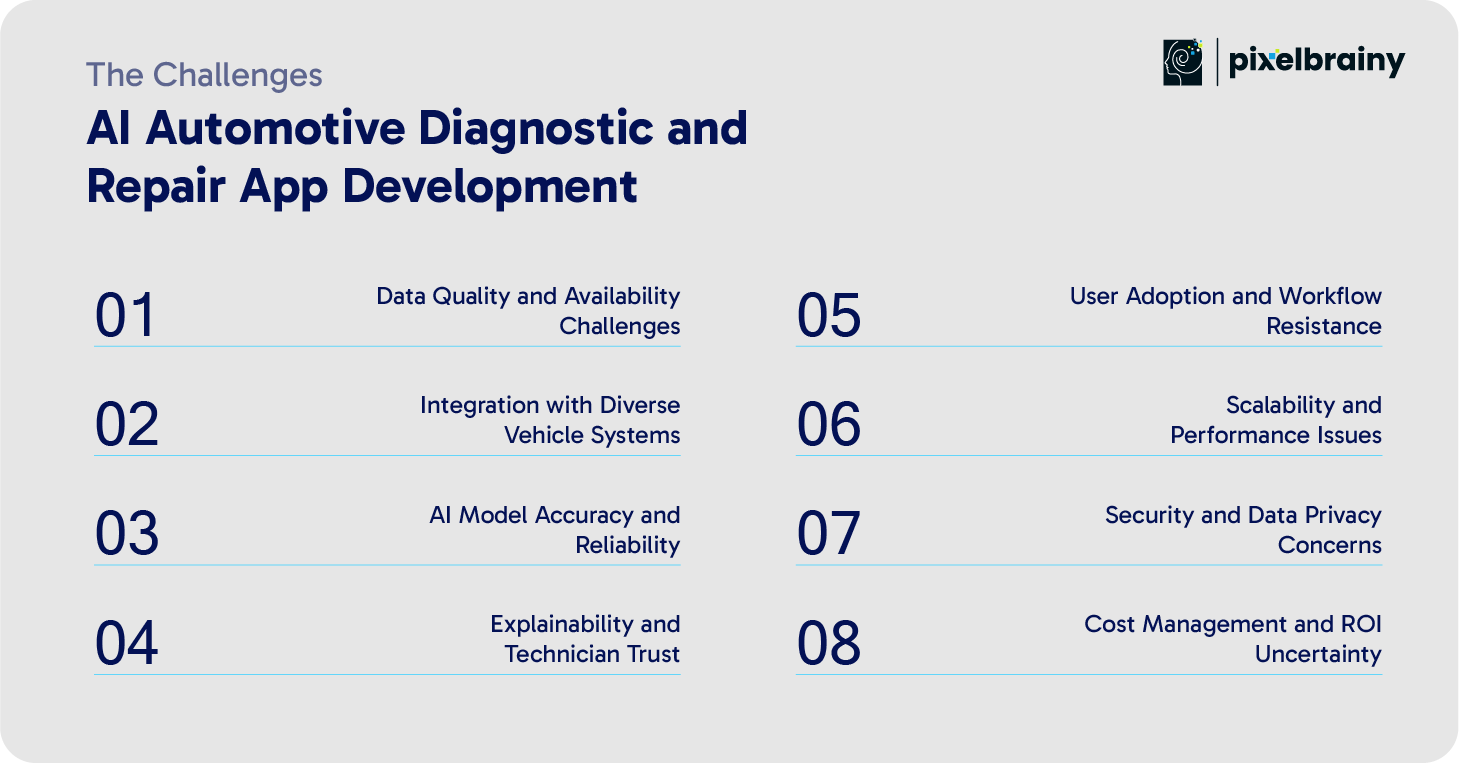
AI models depend heavily on high quality vehicle and repair data. In many cases, historical service data is incomplete, inconsistent, or stored across multiple systems. Poor data quality can lead to inaccurate diagnostics and unreliable predictions.
How to solve it:
Modern vehicles vary widely in terms of onboard systems, sensor configurations, and communication protocols. Integrating multiple vehicle makes, models, and telematics platforms adds significant complexity to AI Automotive Diagnostic and Repair App Development.
How to solve it:
Developing AI models that consistently deliver accurate diagnostics is challenging, especially in early stages. False positives or missed faults can reduce trust among technicians and service teams.
How to solve it:
Technicians may hesitate to rely on AI recommendations if they do not understand how conclusions are reached. Lack of explainability can slow adoption and reduce effectiveness.
How to solve it:
Even well-built AI solutions can fail if they disrupt existing workflows. Resistance to change is common in service environments where speed and familiarity matter.
How to solve it:
As vehicle data volume grows, performance bottlenecks can occur. Without proper planning, the app may struggle to handle real time diagnostics at scale.
How to solve it:
AI Automotive Diagnostic and Repair App Development involves handling sensitive vehicle and customer data. Security breaches or compliance failures can damage trust and result in legal issues.
How to solve it:
Auto businesses may struggle to justify upfront investment without clear ROI visibility. Unexpected development costs can also impact budgets.
How to solve it:
Addressing these challenges early helps AI automotive diagnostic and repair app development deliver a more reliable, scalable, secure, and practical solution for real automotive service environments.
Building an AI automotive diagnostic and repair app requires more than implementing machine learning models. The platform needs to connect vehicle data, diagnostic workflows, repair intelligence, user interfaces, and business operations in a way that technicians and service teams can use effectively. PixelBrainy is a top AI app development company that helps automotive businesses turn these requirements into practical, scalable software solutions.
PixelBrainy focuses on understanding the operational environment before development begins. This includes how technicians diagnose vehicles, how service teams manage repairs, how vehicle data is collected, and how businesses measure service performance and ROI. This approach helps ensure that AI automotive diagnostics app development is aligned with actual business requirements rather than built as a standalone technology project.
PixelBrainy brings capabilities across the technical areas required to develop an AI-powered automotive diagnostics platform, including:
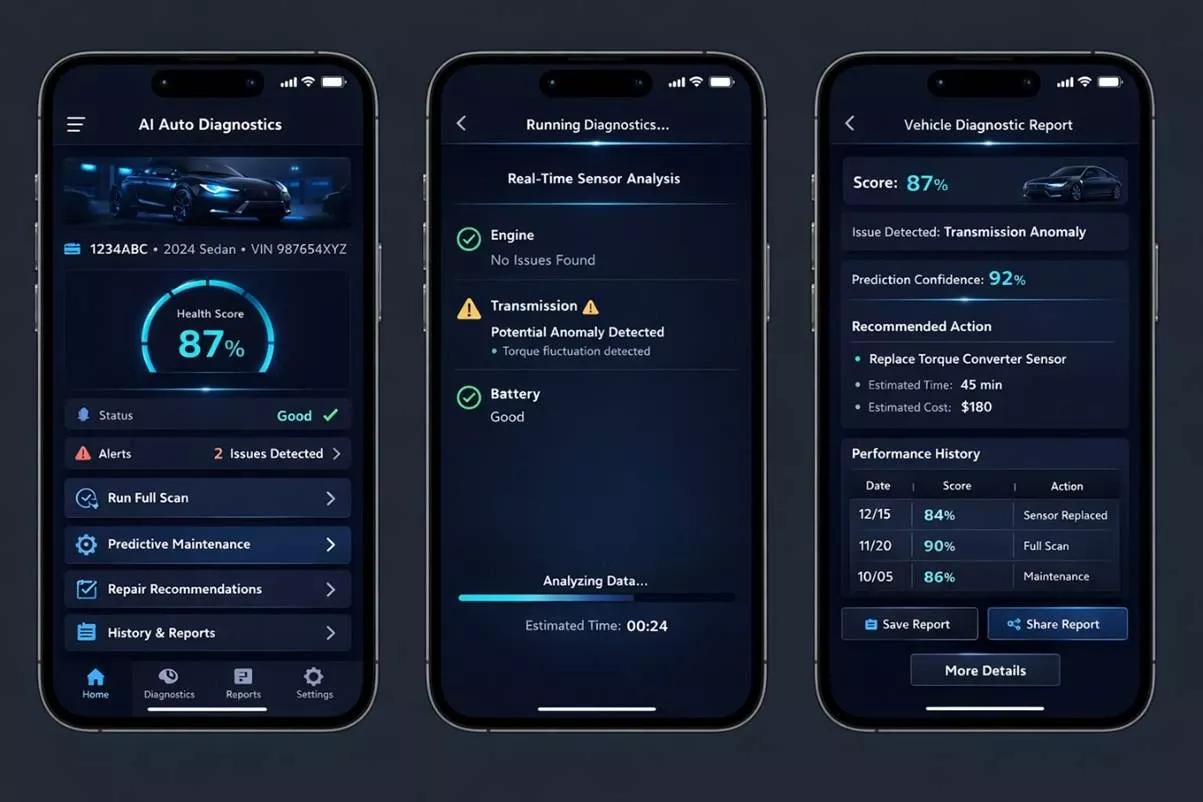
PixelBrainy LLC collaborated with a U.S.-based automotive service provider operating across multiple service locations. The business required a centralized platform to standardize diagnostics, reduce technician dependency, and improve repair turnaround while maintaining consistent service quality.
The implemented solution brought together vehicle diagnostic data, historical repair records, and AI-powered fault analysis within a centralized system accessible across locations. According to the provided case study, the organization observed more consistent diagnostic outcomes, faster identification of recurring issues, and improved regional visibility into service performance. The platform also continues to incorporate repair data to support ongoing improvement.
For auto repair chains, dealerships, fleet operators, and automotive entrepreneurs planning an AI automotive diagnostic and repair app, PixelBrainy LLC can provide the AI app development expertise, data capabilities, and integration support needed to build a practical and scalable solution.

AI automotive diagnostics and repair app development is giving auto businesses a practical way to connect vehicle data with faster diagnostics, predictive maintenance, and informed repair decisions. By combining real-time vehicle information, AI-powered analysis, and repair intelligence, these platforms can help businesses move beyond basic fault-code detection and support more consistent service operations.
For auto repair shops, dealerships, fleet operators, and automotive enterprises, the right AI diagnostic platform can improve diagnostic workflows, reduce operational delays, and provide better visibility into vehicle and service performance. Its long-term value depends on choosing the right features, data strategy, integrations, AI capabilities, and technology architecture for the business.
As vehicle systems become increasingly data-driven, businesses that invest in AI automotive diagnostic solutions can build more scalable and intelligent service operations.
Ready to build your AI automotive diagnostics app? Book an appointment with PixelBrainy experts to discuss your requirements and development goals.
An AI automotive diagnostics app can connect OBD2 data with vehicle information, historical service records, and AI models to interpret fault codes in context. Instead of displaying technical codes alone, the application can provide understandable diagnostic insights, potential causes, and recommended next steps.
The data requirements depend on the intended capabilities. An AI automotive diagnostics app development project may use OBD data, ECU information, telematics, sensor readings, mileage, vehicle operating conditions, and historical repair records. Clean and consistently structured data is particularly important for training and validating AI models.
Yes, predictive capabilities can be incorporated into an AI automotive diagnostic app by analyzing vehicle behavior, historical patterns, and indicators of component wear. The system can identify potential failure risks and generate maintenance alerts, helping service teams plan interventions before an issue develops into a larger repair problem.
The cost depends on the feature scope, AI complexity, vehicle integrations, data preparation, security requirements, and deployment scale. Based on the development estimates covered in this guide, AI automotive diagnostics app development can range from approximately $30,000 for an MVP to $300,000+ for an enterprise platform.
A repair-focused AI auto repair diagnostics app can include real-time vehicle data analysis, intelligent fault-code interpretation, predictive maintenance alerts, repair recommendations, technician decision support, service history, vehicle health scoring, customer-friendly reports, workshop integrations, and role-based dashboards.
Yes. Multi-vehicle compatibility can be designed into the application through appropriate vehicle data integrations, modular connectors, and scalable data-processing architecture. The supported vehicle range depends on the available data sources, diagnostic interfaces, integrations, and development scope.
For fleet operators, an AI automotive diagnostics app can centralize vehicle health information, identify unusual patterns, support predictive maintenance, and provide fleet-wide analytics. This allows maintenance teams to prioritize vehicles and identify recurring issues across a larger vehicle population.
Look for an AI app development company with capabilities in machine learning, data engineering, vehicle or telematics integrations, scalable application architecture, and explainable AI. The development partner should also understand how technicians, service managers, dealerships, and fleet teams will use the application in real operational workflows.

About The Author
Sagar Bhatnagar
Sagar Sahay Bhatnagar brings over a decade of IT industry experience to his role as Marketing Head at PixelBrainy. He's known for his knack in devising creative marketing strategies that boost brand visibility and market influence. Sagar's strategic thinking, coupled with his innovative vision and focus on results, sets him apart. His track record of successful campaigns proves his ability to utilize digital platforms effectively for impactful marketing efforts. With a genuine passion for both technology and marketing, Sagar continuously pushes PixelBrainy's marketing initiatives to greater success.

Working with the PixelBrainy team has been a highly positive experience. They understand the design requirements and create beautiful UX elements to meet the application needs. The dev team did an excellent job bringing my vision to life. We discussed usability and flow. Sagar worked with his team to design the database and begin coding. Working with Sagar was easy. He has the knowledge to create robust apps, including multi-language support, Google and Apple ID login options, Ad-enabled integrations, Stripe payment processing, and a Web Admin site for maintaining support data. I'm extremely satisfied with the services provided, the quality of the final product, and the professionalism of the entire process. I highly recommend them for Android and iOS Mobile Application Design and Development.

Great experience working with them. Had a lot of feedback and I found that unlike most contractors they were bugging me for updates instead of the other way around. They were extremely time conscience and great at communicating! All work was done extremely high quality and if not on time, early! They were always proactive when it comes to communication and the work is great/above par always. Very flexible and a great team to work with! Goes above and beyond to present us with multiple options and always provides quality. Amazing work per usual with Chitra. If you have UI/UX or branding design needs I recommend you go to them! Will likely work with them in the future as well, definitely recommended!

PixelBrainy is a joy to work with and is a great partner when thinking through branding, logo, and website layout. I appreciate that they spend time going into the "why" behind their decisions to help inform me and others about industry best practices and their expertise.

I hired them to design our software apps. Things I really like about them are excellent communication skills, they answer all project suggestions and collaborate right away, and their input on design and colors is amazing. This project was complex and needed patience and creativity. The team is amazing to do business with. I will be using them long-term. Glad to see there are some good people out there. I was afraid to try and outsource my project to someone but I am glad I met them! I really can't say enough. They went above and beyond on this project. I am very happy with everything they have done to make my business stand out from the competition.

It was great working with PixelBrainy and the team. They were very responsive and really owned the project. We'll definitely work with them again!

I recently worked with the PixelBrainy team on a project and I was blown away by their communication skills. They were prompt, clear, and articulate in all of our interactions. They listened and provided valuable feedback and suggestions to help make the project a success. They also kept me updated throughout the entire process, which made the experience stress-free and enjoyable.

PixelBrainy is very good at what it does. The team also presents themselves very professionally and takes care of their side of things very well. I could fully trust them taking up the design work in a timely and organised manner and their attention to detail saved us lots of effort and time. This particular project was quite intense and the team showed that they function very well under pressure. Very much looking forward to working with her again!

It's always an absolute pleasure working with them. They completed all of my requests quickly and followed every note I had for them to a T, which made our process go smoothly from start to finish. Everything was completed fast and following all of the guidelines. And I would recommend their services to anyone. If you need any design work done in the future, PixelBrainy should be your first call!

They took ownership of our requirements and designed and proposed multiple beautiful variants. The team is self-motivated, requires minimum supervision, committed to see-through designs with quality and delivering them on time. We would definitely love to work with PixelBrainy again when we have any requirements.

PixelBrainy was a big help with our SaaS application. We've been hard at work with a new UI/UX and they provided a lot of help with the designs. If you're looking for assistance with your website, software, or mobile application designs, PixelBrainy and the team is a great recommendation.

PixelBrainy designers are amazing. They are responsive, talented, and always willing to help craft the design until it matches your vision. I would recommend them and plan to continue them for my future projects and more!!!

They were awesome! Did a good job fast, and good communication. Will work with them again. Thank you

Creative, detail-oriented, and talented designers who take direction well and implement changes quickly and accurately. They consistently over-delivered for us.

PixelBrainy team is very talented and creative. Great designers and a pleasure to work with. PixelBrainy is an excellent communicator and I look forward to working with them again.

PixelBrainy has a very talented design team. Their work is excellent and they are very responsive. I enjoy working with them and hope to continue on all of our future projects.


Transform your ideas into reality with us.
Across these industries, each engagement brings unique challenges, from early-stage product development to scaling complex systems, helping us build a practical understanding of real-world product environments.