AI Summary Powered by PixelBrainy
Why do AI computer vision softwares that look accurate in testing environments fail when exposed to real-world operations?
This gap between prototype performance and production reliability is a major concern for startups, enterprises, CTOs, and product teams working on real-time computer vision system development. Many teams successfully create computer vision software using AI in controlled settings, but struggle when systems must operate across diverse environments with inconsistent lighting, camera variability, motion blur, and unpredictable inputs.
For businesses, the stakes are high. AI computer vision software development for businesses is no longer experimental. It is directly tied to operational efficiency, cost reduction, and decision automation. Companies across manufacturing, retail, healthcare, logistics, and security are trying to deploy systems that can replace manual inspection, improve monitoring, and scale without increasing workforce dependency. Yet common blockers continue to slow progress. These include poor data quality, unclear use case definition, integration challenges with legacy infrastructure, and rising costs of deployment and maintenance.
This is why many organizations reach a critical point where they start asking:
These questions reflect a shift from experimentation to execution. The challenge is no longer building models. It is building systems that perform consistently in real-world conditions.
According to Fortune Business Insights, the global AI in computer vision market was valued at USD 19.43 billion in 2024 and is projected to grow from USD 22.85 billion in 2025 to USD 77.69 billion by 2032, exhibiting a CAGR of 19.10% during the forecast period.
This guide explains how to design, build, and deploy scalable AI computer vision systems that move beyond demos and deliver measurable results in production environments.
AI computer vision software enables machines to analyze images and videos, identify patterns, and generate actionable insights without human intervention. These systems combine machine learning, deep learning, and image processing techniques to automate visual understanding across business operations.
For businesses, AI computer vision softwares are used to convert visual data into decisions that improve efficiency, accuracy, and scalability. From surveillance cameras to production line sensors, visual inputs become a continuous source of intelligence.
AI computer vision systems operate through a structured pipeline that directly connects data processing with real business outcomes:
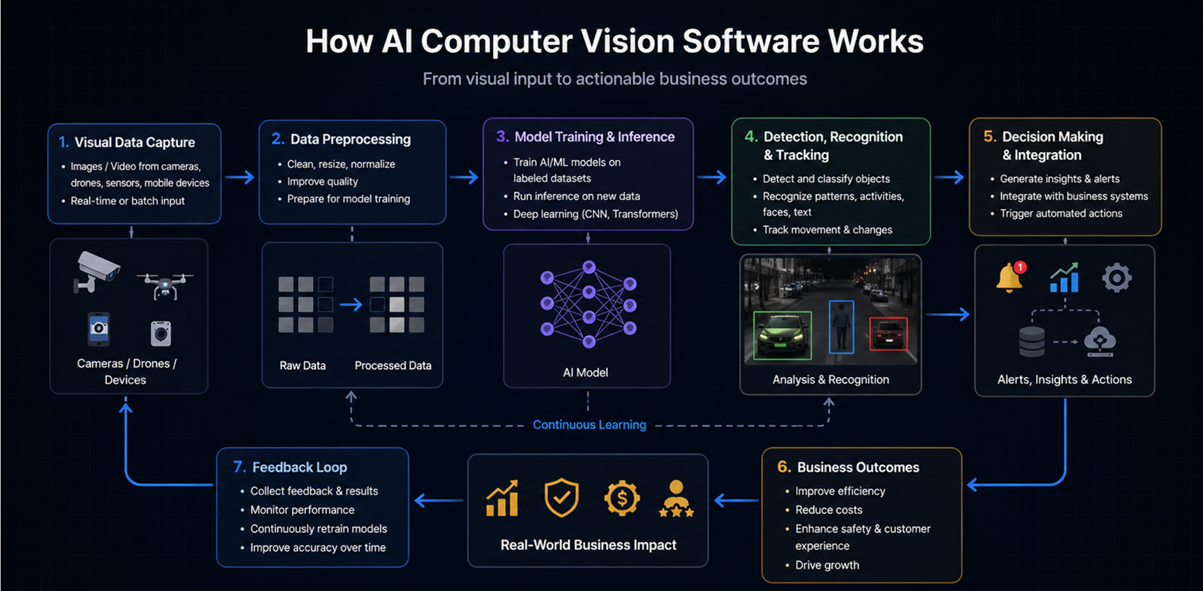
Cameras, IoT devices, drones, and existing video systems capture images or live video streams.
Business application: Retail stores monitor shelf inventory, warehouses track goods movement, and manufacturing units capture product images during production.
Captured data is cleaned, resized, and standardized to improve model performance and ensure consistency.
Business application: In healthcare, medical images are enhanced for clarity, while in security systems, video feeds are optimized for low light or motion conditions.
AI models are trained using labeled datasets to recognize objects, behaviors, or anomalies. Once deployed, these models analyze incoming data in real time or batch mode.
Business application: Manufacturing systems detect defects instantly, while logistics platforms identify misplaced or damaged packages.
The system identifies objects, classifies them, and tracks movement or changes across frames.
Business application: Retail analytics track customer movement patterns, security systems detect unauthorized access, and agriculture solutions monitor crop health.
The processed insights are converted into alerts, reports, or automated actions integrated with business systems such as ERP, CRM, or dashboards.
Business application: Automated checkout systems eliminate billing queues, predictive maintenance alerts reduce downtime, and smart surveillance systems trigger real time alerts.
AI computer vision software development for businesses focuses on building systems that not only process visual data but also align directly with operational goals, making them essential for modern digital transformation strategies.
Why are businesses increasingly choosing custom AI computer vision software development to solve operational challenges and accelerate growth?
Organizations are moving beyond experimentation and focusing on scalable solutions that deliver measurable business outcomes. The shift is driven by the need to build AI vision solutions for business automation that align with real workflows, reduce inefficiencies, and support long term digital transformation strategies.
According to Grand View Research, the global video analytics market, closely tied to computer vision adoption, is expected to reach $41.7 billion by 2030, fueled by demand for real time monitoring, automation, and AI powered insights.
This growth reflects a strong enterprise push toward intelligent visual systems that go beyond basic automation.
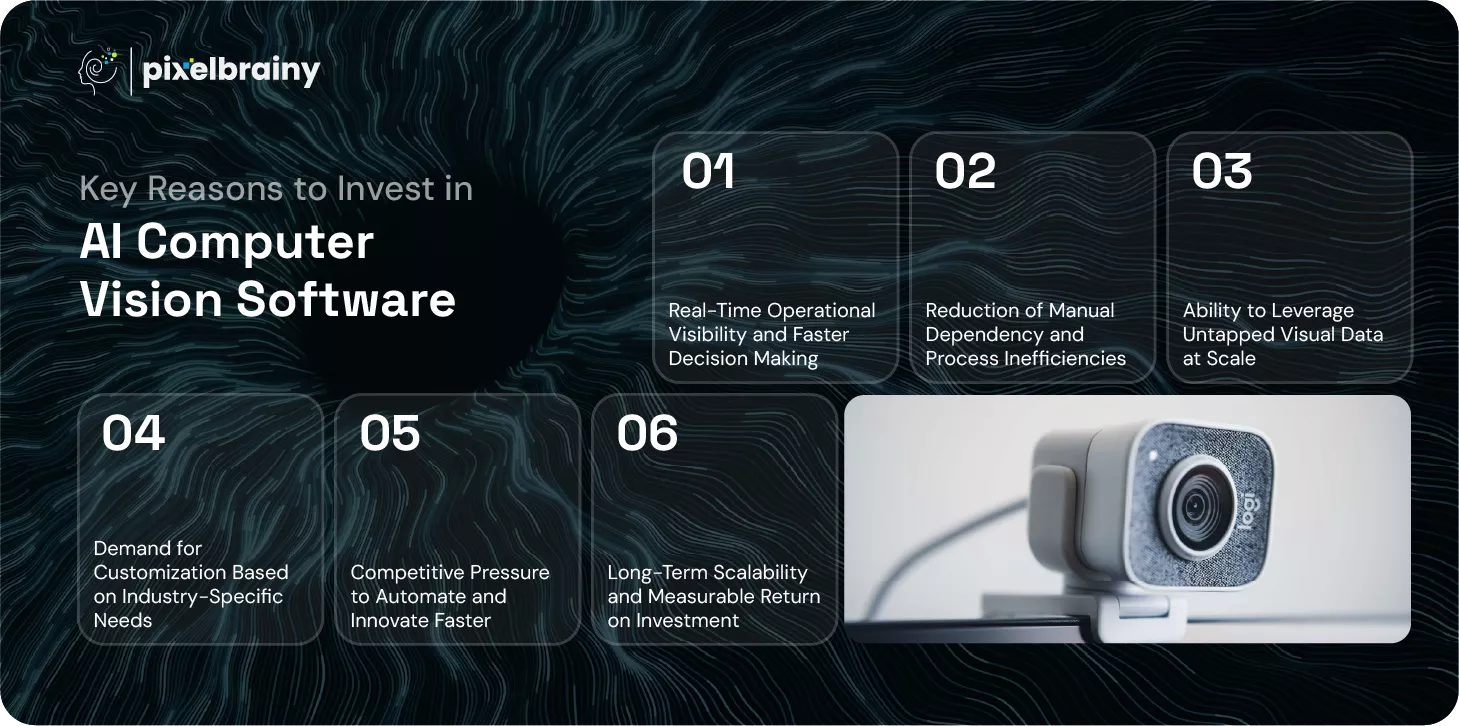
Businesses require immediate insights to respond to dynamic environments such as production lines, retail floors, and logistics networks. AI computer vision enables continuous monitoring and instant analysis of visual data streams.
Impact: Faster decision cycles, reduced delays, and improved responsiveness across operations.
Many industries still rely on manual inspection, monitoring, and supervision, which leads to inconsistent outcomes and higher operational costs. AI vision systems automate repetitive visual tasks with consistent accuracy.
Impact: Lower operational expenses, minimized human error, and improved process standardization.
Organizations generate massive volumes of video and image data, but most of it remains underutilized due to lack of processing capabilities. AI computer vision transforms this data into actionable intelligence.
Impact: Better forecasting, enhanced operational insights, and data driven decision making.
Generic solutions often fail to address unique business workflows, compliance requirements, and operational complexities. This drives demand for custom AI computer vision software development tailored to specific use cases.
Impact: Higher solution relevance, better performance, and alignment with business objectives.
Businesses are under constant pressure to improve efficiency, reduce costs, and deliver better customer experiences. AI powered automation is becoming a key differentiator across industries.
Impact: Increased market competitiveness, faster innovation cycles, and stronger customer engagement.
AI computer vision systems are designed to scale across multiple locations, processes, and use cases without proportional increases in resources. Over time, they deliver consistent performance improvements.
Impact: Sustainable growth, higher productivity, and strong long-term ROI from automation investments.
Businesses investing in AI computer vision are building intelligent systems that integrate directly into their operations, enabling automation, accuracy, and scalability. The focus is no longer on adopting AI as a trend, but on implementing solutions that deliver continuous business value.
AI computer vision software delivers its true value when deployed within real business environments where continuous monitoring, inspection, and analysis are required. These systems are no longer limited to experimental use cases. They are actively supporting production workflows across industries by improving consistency, reducing delays, and enabling faster decision making.
As adoption grows, many organizations evaluating AI computer vision software development begin asking a practical question: what are the actual business benefits once the system is fully deployed and integrated into operations? The answer lies in measurable improvements across accuracy, cost efficiency, responsiveness, insights, compliance, and new revenue potential.
Below are six core benefits consistently observed across real-world implementations.
In high-volume operations, maintaining consistent inspection quality becomes difficult due to fatigue and variability in manual processes. Small errors often result in significant downstream costs and quality issues.
AI computer vision software applies uniform detection logic across every frame, ensuring reliable and repeatable analysis regardless of scale or conditions.
Key advantages:
Manual inspection and monitoring increase operational costs as businesses scale, often requiring larger teams and additional oversight. This creates inefficiencies and limits scalability.
AI computer vision software automates repetitive visual tasks, enabling continuous operations without proportional workforce expansion.
Key advantages:
Traditional workflows rely on delayed analysis, which increases risk and reduces the ability to respond to critical events in time. This impacts operational efficiency and safety.
AI computer vision software enables immediate analysis of visual data, allowing businesses to respond as events occur.
Key advantages:
Organizations collect large volumes of visual data, but most of it remains unused due to the complexity of manual analysis. This limits visibility into operational patterns.
AI computer vision software converts visual data into structured insights that can be analyzed over time.
Key advantages:
Compliance and safety monitoring often rely on manual checks, which can be inconsistent and difficult to audit. This increases regulatory risks and operational gaps.
AI computer vision software provides continuous monitoring with detailed tracking of every event.
Key advantages:
Beyond efficiency improvements, AI computer vision enables businesses to build new capabilities into their products and services, creating additional value streams.
This allows organizations to expand offerings and differentiate in competitive markets.
Key advantages:
From these benefits, businesses gain scalable, data-driven operations that improve accuracy, reduce costs, and enable faster, more reliable decision making.
AI computer vision software is now deeply integrated into real business operations where continuous monitoring, inspection, and decision making are required. Organizations across industries are adopting these systems to automate visual workflows, reduce dependency on manual processes, and improve operational accuracy at scale. From production floors to customer-facing environments, visual intelligence is becoming a core layer of modern business infrastructure.
As companies evaluate investments, one critical question often comes up during decision making: where is AI computer vision software actually used in real business scenarios, and how do these implementations deliver measurable outcomes at scale? The answer becomes clear when examining how different industries apply these systems to solve specific operational problems.
Below are the most impactful real-world use cases, structured as problem → solution → outcome for clarity and practical understanding.
Problem: Retail businesses struggle with inaccurate inventory data, frequent stockouts, and time-consuming manual audits across multiple store locations, leading to lost sales and poor customer experience.
Solution: AI computer vision software uses in-store cameras to monitor shelves, detect product availability, track movement, and enable automated checkout through item recognition systems.
Outcome: Real-time inventory visibility, reduced manual effort, faster checkout processes, and improved customer satisfaction across store operations.
Problem: Manual inspection processes fail to consistently detect micro-defects in high-speed production lines, resulting in quality issues, product recalls, and increased operational costs.
Solution: AI vision systems inspect products in real time, identify defects in materials and assembly, and trigger immediate corrective actions during production workflows.
Outcome: Improved product quality, reduced defect rates, minimized rework costs, and more efficient and reliable manufacturing operations.
Problem: Increasing volumes of medical imaging data create delays in diagnosis and increase the risk of human error in detecting critical health conditions.
Solution: AI computer vision software analyzes scans such as X-rays, CT scans, and MRIs to detect abnormalities and prioritize urgent cases for faster medical attention.
Outcome: Faster diagnosis, improved clinical accuracy, reduced workload for healthcare professionals, and better patient outcomes across healthcare systems.
Problem: Manual package tracking and barcode scanning slow down warehouse operations and introduce errors, especially during high-demand periods and large-scale logistics activities.
Solution: AI vision systems automate package identification, label recognition, and movement tracking while integrating with warehouse systems for real-time operational visibility.
Outcome: Faster processing speeds, reduced errors, improved tracking accuracy, and enhanced overall efficiency in supply chain operations.
Problem: Monitoring large volumes of surveillance footage manually is inefficient and leads to missed incidents, delayed responses, and reduced overall security effectiveness.
Solution: AI computer vision software analyzes live video streams to detect suspicious activities, intrusions, and anomalies, triggering alerts only when relevant events occur.
Outcome: Faster incident detection, reduced false positives, improved response times, and stronger security coverage across monitored environments.
Problem: Farmers lack real-time insights into crop health across large agricultural areas, leading to delayed interventions, inefficient resource usage, and reduced productivity.
Solution: AI vision systems analyze images from drones and field cameras to detect crop conditions, identify diseases, and guide precision farming actions.
Outcome: Increased crop yield, optimized use of resources, reduced waste, and improved overall efficiency in agricultural operations.
Problem: Driver errors, fatigue, and limited situational awareness contribute to accidents and safety risks in both personal and commercial transportation systems.
Solution: AI computer vision systems enable vehicles to detect lanes, obstacles, pedestrians, and traffic signals, allowing real-time decision-making during driving.
Outcome: Enhanced road safety, improved driver assistance capabilities, and continued advancement toward reliable autonomous vehicle systems.
Problem: Construction sites often lack continuous monitoring, leading to safety violations, inefficient workflows, and limited visibility into project progress and compliance requirements.
Solution: AI vision systems track worker behavior, monitor safety compliance such as PPE usage, and analyze site activity against project plans and timelines.
Outcome: Improved safety standards, reduced workplace incidents, better project tracking, and increased operational efficiency across construction environments.
Problem: Online and hybrid learning environments face challenges in monitoring student engagement, ensuring exam integrity, and managing attendance at scale.
Solution: AI computer vision software tracks attention levels, detects anomalies during exams, and automates attendance tracking in virtual and physical classrooms.
Outcome: Enhanced learning outcomes, secure examination processes, and scalable education management systems for institutions and platforms.
Problem: Coaches and athletes lack scalable tools to analyze performance, posture, and movement patterns accurately across training sessions and competitive environments.
Solution: AI vision systems use motion tracking and pose estimation to evaluate movements and provide actionable performance insights and recommendations.
Outcome: Improved athletic performance, data-driven training decisions, reduced injury risks, and enhanced overall fitness and coaching strategies.
Problem: Manual identity verification processes are slow, costly, and vulnerable to fraud, creating friction in customer onboarding and compliance workflows.
Solution: AI computer vision software performs facial recognition, document verification, and liveness detection to ensure secure and efficient identity validation.
Outcome: Faster onboarding processes, reduced fraud risk, improved compliance, and enhanced customer experience in financial services.
Problem: Manual inspection of infrastructure such as power lines and pipelines is time-consuming, expensive, and risky, often leading to delayed issue detection.
Solution: AI vision systems analyze images from drones and sensors to identify defects, corrosion, and environmental risks in critical infrastructure assets.
Outcome: Preventive maintenance, reduced downtime, improved operational safety, and lower inspection and maintenance costs.
Problem: Long queues, inefficient check-in processes, and lack of personalization negatively impact customer satisfaction and operational efficiency in service environments.
Solution: AI computer vision software enables facial recognition, queue monitoring, and behavior analysis to streamline operations and personalize customer interactions.
Outcome: Faster service delivery, improved customer experience, increased operational efficiency, and higher customer retention rates.
Problem: Claims processing relies heavily on manual review, leading to delays, inconsistencies, and increased risk of fraud in insurance operations.
Solution: AI vision systems analyze uploaded images, assess damage severity, and support automated claim evaluation and decision-making processes.
Outcome: Faster claims processing, reduced fraud risk, improved accuracy, and enhanced customer satisfaction in insurance services.
Problem: The growing volume of user-generated content makes manual moderation inefficient, leading to delays and challenges in maintaining platform safety and compliance.
Solution: AI computer vision software detects inappropriate content, classifies media, and automates moderation workflows across large-scale digital platforms.
Outcome: Scalable moderation processes, improved content quality, enhanced compliance, and safer digital environments for users.
These use cases demonstrate how AI computer vision software enables businesses to transform manual visual processes into scalable, automated systems that improve efficiency, accuracy, and real-time decision making across industries.

AI computer vision software that performs reliably in production environments requires more than just accurate models. It depends on a complete system architecture that can handle continuous data flow, real-time processing, system integration, and long-term scalability. Businesses often face challenges such as inconsistent data inputs, model drift, latency issues, and lack of system visibility when these core features are missing.
While planning AI computer vision software development, one critical consideration emerges: what features are essential to ensure the system performs consistently across real-world conditions and scales with business needs? The answer lies in combining data, infrastructure, and operational capabilities into a unified platform.
Below are the must-have features required to build robust and scalable AI computer vision software.
| Feature | What It Does | Why It Matters for Businesses |
| Multi-Camera Ingestion | Captures and standardizes data from cameras, drones, and mobile devices across multiple locations. | Ensures consistent data flow and enables large-scale deployments without data fragmentation. |
| Real-Time Inference Engine | Processes images and video streams instantly using optimized AI models on edge or cloud systems. | Supports low-latency decision making for time-sensitive operations like monitoring and inspection. |
| Model Management Console | Centralized control for model versioning, testing, deployment, and rollback. | Reduces risk during updates and ensures stable model performance in production environments. |
| Data Annotation Workflow | Provides structured tools for labeling datasets with validation and quality control. | Improves training data quality, directly impacting model accuracy and reliability. |
| Automated Training Pipeline | Retrains models using new data, schedules, or drift detection mechanisms. | Keeps models aligned with real-world changes and maintains long-term system performance. |
| Alert and Notification Engine | Generates real-time alerts based on detections and predefined rules. | Enables immediate action on critical events such as defects, risks, or anomalies. |
| Role-Based Access Control | Defines and manages user permissions across system components and data. | Enhances security and ensures controlled access within teams and organizations. |
| Audit Log and Traceability | Tracks system activities, predictions, and data interactions with detailed logs. | Supports debugging, transparency, and compliance requirements across industries. |
| API and Webhook Layer | Connects AI outputs with external systems through APIs and real-time triggers. | Enables seamless integration with ERP, CRM, and operational workflows. |
| Analytics Dashboard | Visualizes performance metrics, accuracy trends, and system usage data. | Helps businesses monitor performance and continuously optimize operations. |
| Edge Device Management | Monitors and updates distributed edge devices remotely across locations. | Ensures consistent performance and reduces maintenance complexity in large deployments. |
| Privacy and Redaction Controls | Applies masking techniques such as face or license plate blurring. | Ensures compliance with data privacy regulations and protects sensitive information. |
| Cloud and Hybrid Deployment | Supports flexible deployment across cloud, on-premises, or hybrid environments. | Allows businesses to balance cost, latency, and compliance requirements effectively. |
| Mobile SDKs | Enables mobile devices to capture, process, and transmit visual data securely. | Extends system capabilities to field operations and remote environments. |
| Compliance Tooling | Provides built-in support for regulatory standards and audit-ready documentation. | Simplifies deployment in regulated industries and reduces legal and compliance risks. |
These features collectively ensure that AI computer vision software operates as a scalable, reliable, and production-ready system capable of handling real-world business demands.
AI computer vision systems that operate at enterprise scale require more than standard features. While core components ensure the system functions, advanced capabilities determine how effectively it adapts to dynamic environments, handles edge cases, and maintains performance over time. These capabilities are essential for businesses aiming to move from basic implementations to intelligent, production-grade platforms.
During the evolution of AI computer vision software development, organizations often reach a stage where a key question arises: what advanced capabilities are required to move beyond a basic system and build a scalable, enterprise-ready solution? The answer lies in integrating technologies that enhance learning efficiency, improve contextual understanding, and ensure long-term reliability.
Below are the most important advanced capabilities that differentiate high-performing AI computer vision systems.
| Capability | What It Does | Business Value |
| Foundation Model Fine-Tuning | Adapts pretrained vision models such as SAM or DINO to specific business use cases using smaller, domain-specific datasets. | Reduces data requirements, accelerates deployment, and improves accuracy for specialized tasks. |
| Multimodal Fusion | Combines visual data with text, audio, and sensor inputs to create a unified understanding of complex environments. | Enhances decision accuracy and enables use cases that require cross-data context. |
| Self-Supervised Learning | Learns patterns from large volumes of unlabeled data before applying task-specific fine-tuning. | Reduces dependency on labeled datasets and lowers data preparation costs. |
| Active Learning Loops | Identifies uncertain predictions and routes them for human review, continuously improving model performance. | Enables continuous improvement while minimizing manual labeling effort. |
| Synthetic Data Generation | Generates artificial training data using simulations or generative models to cover rare or risky scenarios. | Expands dataset diversity and accelerates model training in limited data conditions. |
| Federated Learning | Trains models across distributed systems without sharing raw data, only model updates. | Ensures data privacy while leveraging insights from multiple data sources. |
| Explainable AI for Vision | Provides visual explanations such as heatmaps to show how and why decisions are made by models. | Builds trust, supports compliance, and improves transparency in AI decisions. |
| Adversarial Resilience Layer | Protects models against noise, manipulation, and unexpected environmental variations. | Improves system robustness and reliability in real-world deployments. |
| Video Understanding and Reasoning | Analyzes sequences of frames to understand actions, behaviors, and temporal context. | Enables advanced use cases like activity recognition and event prediction. |
| On-Device Learning | Allows edge devices to update and adapt models locally based on new data inputs. | Reduces latency, improves localized accuracy, and minimizes cloud dependency. |
These advanced capabilities transform AI computer vision software into adaptive, scalable systems that maintain accuracy, improve over time, and perform reliably in complex real-world environments.
Developing a production-ready AI computer vision system requires a structured and disciplined approach that connects business goals with technical execution. Organizations investing in AI-driven solutions are not just building models, but complete systems that can process visual data, integrate with workflows, and scale reliably across environments.
For founders evaluating their next move, a common concern often arises during planning: i am building a startup and looking for a company to develop AI computer vision software for my product. Understanding the full lifecycle helps reduce risk, control costs, and ensure faster time to market.
The steps below outline a proven framework to build intelligent, scalable, and production-ready visual systems.
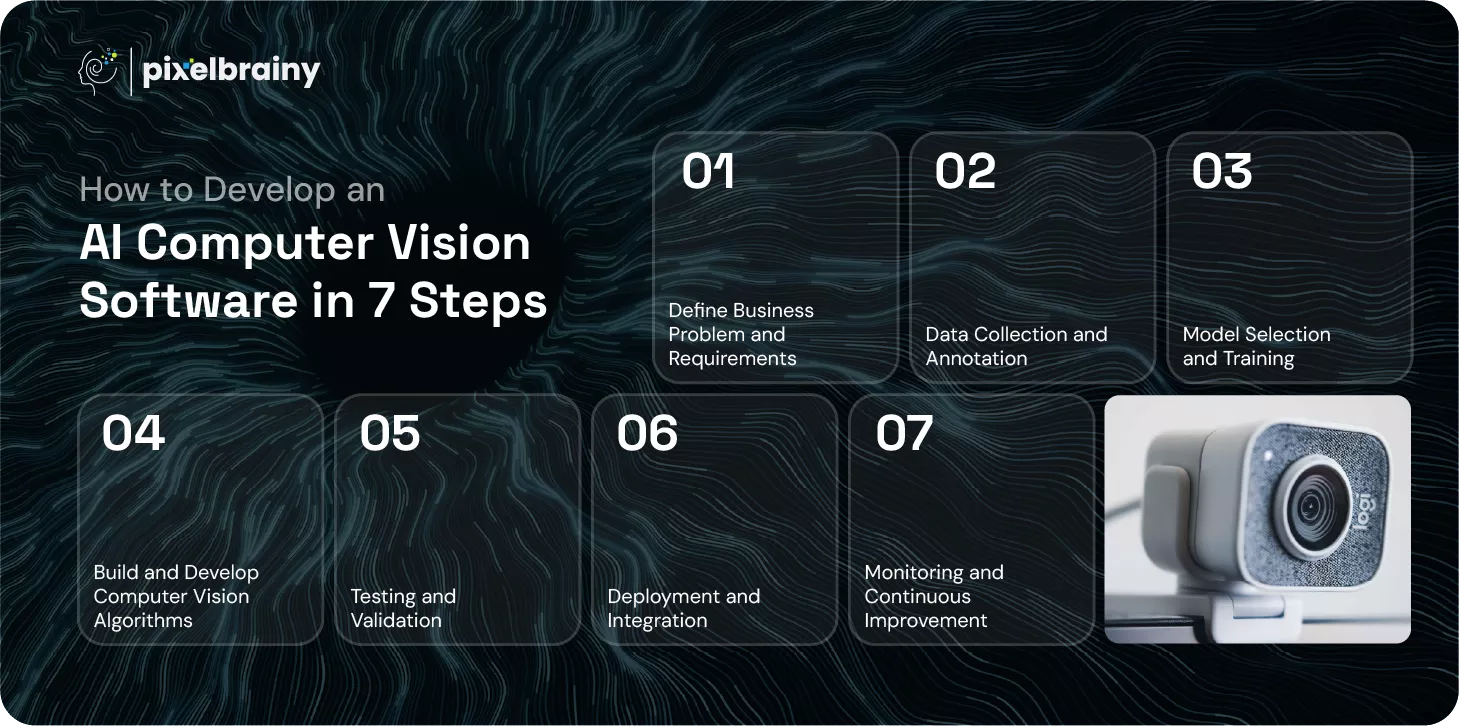
Every successful system begins with a clearly defined business problem. This step focuses on identifying the exact use case, expected outcomes, and how visual data will drive decisions. Teams should map workflows, define KPIs, and align technical scope with business impact.
At this stage, many startups collaborate with a UI/UX design company to design user flows, dashboards, and system interactions before development begins. This ensures the solution is not only technically sound but also usable and aligned with end-user expectations. Clear requirement definition reduces ambiguity and creates a strong foundation for AI computer vision product development that delivers measurable value.
Data is the backbone of any system where you aim to make AI computer vision software effective in real-world scenarios. This step involves gathering high-quality images and videos from relevant sources such as cameras, sensors, or datasets that reflect real operating conditions.
Annotation follows data collection, where images are labeled with bounding boxes, segmentation, or classifications. Businesses often begin with PoC development using smaller datasets to validate feasibility before scaling annotation efforts. Including edge cases, lighting variations, and environmental diversity ensures the model performs reliably once deployed in production environments.
Model selection depends on use case complexity, data availability, and performance requirements. Teams may use pretrained models or fine-tune them for specific tasks such as detection or classification.
Training involves iterative experimentation, parameter tuning, and validation to achieve optimal performance. For startups, this phase often transitions into MVP development, where a functional version of the system is built with core capabilities to test in real-world conditions. This approach helps validate assumptions, reduce development risks, and prepare for scaling into a full computer vision solution development for businesses.
Also Read: Top 10 AI MVP Development Companies in USA
This step focuses on implementing algorithms such as object detection, tracking, segmentation, and classification based on the defined use case. It also includes building preprocessing pipelines and optimizing inference workflows.
Development teams ensure that algorithms are efficient, scalable, and adaptable to real-world inputs. Many organizations partner with top AI development companies in USA at this stage to accelerate development and ensure production-grade quality. The goal is to build intelligent visual decision systems that can operate reliably across different environments and handle varying data conditions effectively.
Testing ensures that the system performs reliably across different scenarios, datasets, and edge cases. This includes evaluating model accuracy, system latency, and robustness under real-world conditions.
Validation involves running the system in controlled environments to identify performance gaps and improve reliability before deployment. Teams test for environmental variations such as lighting, motion, and occlusion. A strong testing process ensures that the system meets business requirements and reduces the risk of failure when deployed in production environments.
Deployment involves moving the system into production environments such as cloud, on-premises, or edge infrastructure. This step ensures that the system is accessible and operational within real business workflows.
Integration with existing systems such as ERP, CRM, or monitoring tools is essential for delivering business value. APIs and real-time pipelines are used to connect outputs with operational processes. Proper deployment ensures seamless functionality and enables businesses to use AI insights for real-time decision making across operations.
Once deployed, continuous monitoring is required to maintain performance and accuracy. This includes tracking model outputs, system performance, and operational metrics over time.
As real-world data evolves, models may experience drift, requiring retraining and updates. Feedback loops and monitoring systems help identify issues early and improve performance continuously. This step ensures long-term scalability, allowing businesses to adapt and maintain consistent results while expanding system capabilities over time.
A structured development process enables businesses to transform AI vision ideas into scalable systems that deliver consistent performance and long-term operational value.
The cost of developing AI computer vision software varies significantly based on scope, complexity, and deployment requirements. In most real-world scenarios, businesses can expect an investment ranging from $40,000 to $300,000+. Smaller solutions designed for validation or limited use cases fall on the lower end, while large-scale, enterprise-grade systems with custom models and distributed deployments require higher budgets.
Cost is not limited to model development alone. It includes the complete lifecycle such as data collection, annotation, model training, infrastructure setup, system integration, and ongoing maintenance. Understanding how costs are distributed across stages helps businesses plan budgets more effectively and avoid unexpected expenses.
| Tier | Scope | Estimated Cost | Typical Timeline |
| Basic AI Computer Vision MVP | Focused on one or two vision tasks using pretrained models with minimal customization and limited integrations. | $40,000 – $90,000 | 10 to 16 weeks |
| Mid-Level AI Computer Vision Platform | Supports multiple use cases with custom-trained models, partial edge deployment, and integration with business systems. | $90,000 – $180,000 | 18 to 28 weeks |
| Advanced Enterprise AI Platform | Includes multi-location deployment, fully custom models, edge infrastructure, multimodal systems, and compliance layers. | $180,000 – $300,000+ | 32 to 52 weeks |
Most organizations follow a phased approach, starting with a small MVP to validate feasibility and then expanding into full-scale production systems across departments or locations.
Several variables directly impact the final cost of AI computer vision software development:
The initial development cost is only part of the total investment. Maintaining and improving the system requires continuous spending:
The total cost of AI computer vision software development depends on system complexity, scale, and long-term operational needs, making it essential to align investment with clear business goals from the beginning.

Building production-ready AI systems requires a well-structured and carefully selected technology stack. The tech stack required for the development of AI computer vision software goes beyond just model training. It includes multiple layers such as data processing, model development, deployment infrastructure, integration tools, and user interfaces that work together to deliver a complete solution.
In real-world environments, the choice of tools is driven by performance requirements, deployment architecture, scalability needs, and long-term maintainability. A strong technology foundation ensures that systems can handle large-scale visual data, run efficiently in real time, and integrate seamlessly with business workflows.
Below is a structured overview of the core technologies used in AI computer vision software development.
| Category | Tools and Frameworks | Purpose in Development |
| Deep Learning Frameworks | PyTorch, TensorFlow, JAX, ONNX Runtime | Used to design, train, and optimize AI models. These frameworks support experimentation, scalability, and deployment across multiple hardware environments. |
| Computer Vision Libraries | OpenCV, Kornia, Detectron2, MMDetection, Ultralytics YOLO | Provide ready-to-use algorithms for image processing, object detection, and feature extraction, reducing development time. |
| Foundation Models | SAM, DINOv2, CLIP, Grounding DINO, GPT-4V-class models | Enable rapid prototyping through zero-shot and few-shot learning, reducing dependency on large labeled datasets. |
| Data Annotation Tools | Label Studio, CVAT, Roboflow, Scale AI, V7 | Support structured data labeling workflows with quality control, enabling high-quality dataset creation. |
| MLOps Platforms | MLflow, Weights & Biases, ClearML, SageMaker, Vertex AI | Manage model lifecycle including experiment tracking, deployment, monitoring, and version control. |
| Edge Inference Technologies | NVIDIA Jetson, Google Coral, OpenVINO, Apple Neural Engine, Hailo | Enable real-time processing on edge devices, reducing latency and dependency on cloud infrastructure. |
| Verification APIs | Jumio, Onfido, Veriff, AWS Rekognition ID | Provide prebuilt capabilities for identity verification, document validation, and compliance workflows. |
| Payment Integration Systems | Stripe, Adyen, Braintree, Razorpay | Enable monetization through subscription models, usage-based billing, and transaction management. |
| Frontend Frameworks | React, Next.js, Vue, SwiftUI, Jetpack Compose | Used to build dashboards, control panels, and mobile interfaces for interacting with AI systems. |
| Notification Systems | Firebase Cloud Messaging, OneSignal, Amazon SNS, PagerDuty | Deliver real-time alerts and notifications based on system events and AI predictions. |
| Cloud and Infrastructure | AWS, Microsoft Azure, Google Cloud, Kubernetes, Docker, Terraform | Provide scalable environments for training, deployment, orchestration, and infrastructure management. |
| Data Storage and Databases | PostgreSQL, MongoDB, S3, TimescaleDB, Milvus, Pinecone | Store structured data, images, embeddings, and time-series metrics for analytics and system performance tracking. |
Selecting these right tech stack ensures that AI computer vision software is scalable, efficient, and capable of delivering reliable performance across real-world business applications.
Choosing the right approach is one of the most important decisions in AI computer vision software development for businesses. The decision directly impacts cost, time to market, scalability, and long-term control over your system. Companies must evaluate not just technical feasibility, but also internal capabilities, budget constraints, and how critical computer vision is to their core business strategy.
During evaluation, teams often ask: what is the best approach to develop AI computer vision software while balancing speed, cost, and long-term flexibility? The answer depends on whether you want full ownership, rapid deployment, or expert-driven execution.
Below is a clear comparison of the three primary approaches.
| Approach | What It Means | Best Fit For | Advantages | Limitations |
| Build In-House | Develop the entire system internally by hiring AI engineers, data scientists, and MLOps teams | Companies where AI vision is a core product or long-term strategic capability | Full control over architecture, strong IP ownership, and flexibility in customization | High upfront investment, long hiring cycles, and ongoing dependency on specialized talent |
| Buy Off-the-Shelf | Use pre-built platforms or APIs such as cloud-based vision services or SaaS tools | Businesses with standard use cases like OCR, face recognition, or basic detection tasks | Fast deployment, lower initial cost, and minimal technical complexity | Limited customization, vendor lock-in risks, and reduced differentiation in the market |
| Outsource to Experts | Partner with a specialized company for end-to-end development or co-development | Startups and enterprises needing custom solutions without building internal teams immediately | Faster time to market, access to experienced teams, and scalable development models | Requires clear communication, defined scope, and proper long-term knowledge transfer |
For most startups and growing businesses, outsourcing offers a balanced path. It allows companies to validate ideas, accelerate development, and launch production-ready systems without the delays of hiring and infrastructure setup. Over time, businesses can transition to a hybrid or in-house model as internal capabilities mature.
The best approach to AI computer vision software development depends on aligning your business goals, technical readiness, and scalability needs with the right execution model.
The outcome of any AI computer vision software development for businesses initiative is directly influenced by the capabilities of the development partner. Building a system that performs well in controlled environments is not enough. The real challenge lies in delivering solutions that operate reliably in dynamic, real-world conditions while scaling across locations, data volumes, and use cases.
During evaluation, a key question often emerges: how do you identify a partner who can deliver not just a working solution, but a production-ready system that continues to perform over time? The answer lies in assessing a combination of technical expertise, delivery capability, and long-term support practices.
Below are the most important criteria to evaluate when selecting an AI computer vision development partner.
A capable partner should demonstrate real-world deployment experience rather than only showcasing prototypes or experimental work. This includes handling live data streams, managing edge cases, and delivering measurable business outcomes across industries.
They should clearly explain system architecture decisions, trade-offs between accuracy and performance, and how models behave under real operational constraints. This level of experience ensures that the solution is practical, scalable, and aligned with business needs rather than limited to theoretical implementations.
AI computer vision systems require coordination across multiple layers including data pipelines, model development, deployment infrastructure, and user interfaces. A partner with end-to-end capability can manage all these components within a unified workflow.
This reduces dependency on multiple vendors, minimizes integration challenges, and ensures consistent system design. It also enables faster delivery timelines and better alignment between technical execution and business objectives across the entire lifecycle.
Sustained system performance depends on how effectively data and models are managed after deployment. A reliable partner should have structured processes for data versioning, monitoring, retraining, and performance optimization.
These practices ensure that the system adapts to changing environments, maintains accuracy over time, and handles model drift effectively. Without strong MLOps capabilities, even well-built systems can degrade quickly in production environments.
For many industries, compliance and data protection are critical requirements. The partner should demonstrate a clear understanding of regulatory standards such as GDPR, HIPAA, and SOC 2, along with secure system design practices.
This includes data encryption, access control mechanisms, and privacy-preserving techniques such as masking or redaction. A mature approach to compliance reduces legal risks and ensures that the system can be deployed confidently in regulated environments.
A dependable partner maintains clarity around project scope, timelines, costs, and potential risks from the beginning. They define deliverables clearly and communicate progress consistently throughout the development lifecycle.
This transparency helps avoid unexpected delays, budget overruns, and misalignment between expectations and outcomes. Clear communication also strengthens collaboration and ensures that the final solution meets both technical and business requirements.
The right development partner ensures that AI computer vision software is built for real-world performance, long-term scalability, and continuous business value.
AI computer vision systems often perform well in controlled environments but face significant challenges when deployed in real-world conditions. Variations in data, infrastructure limitations, and evolving business requirements can impact accuracy, scalability, and reliability. These challenges are common when moving from prototype to production and must be addressed proactively to ensure long-term success.
As systems scale, the focus shifts from just model performance to stability, adaptability, and seamless integration. Below are the most common challenges along with practical, actionable solutions.
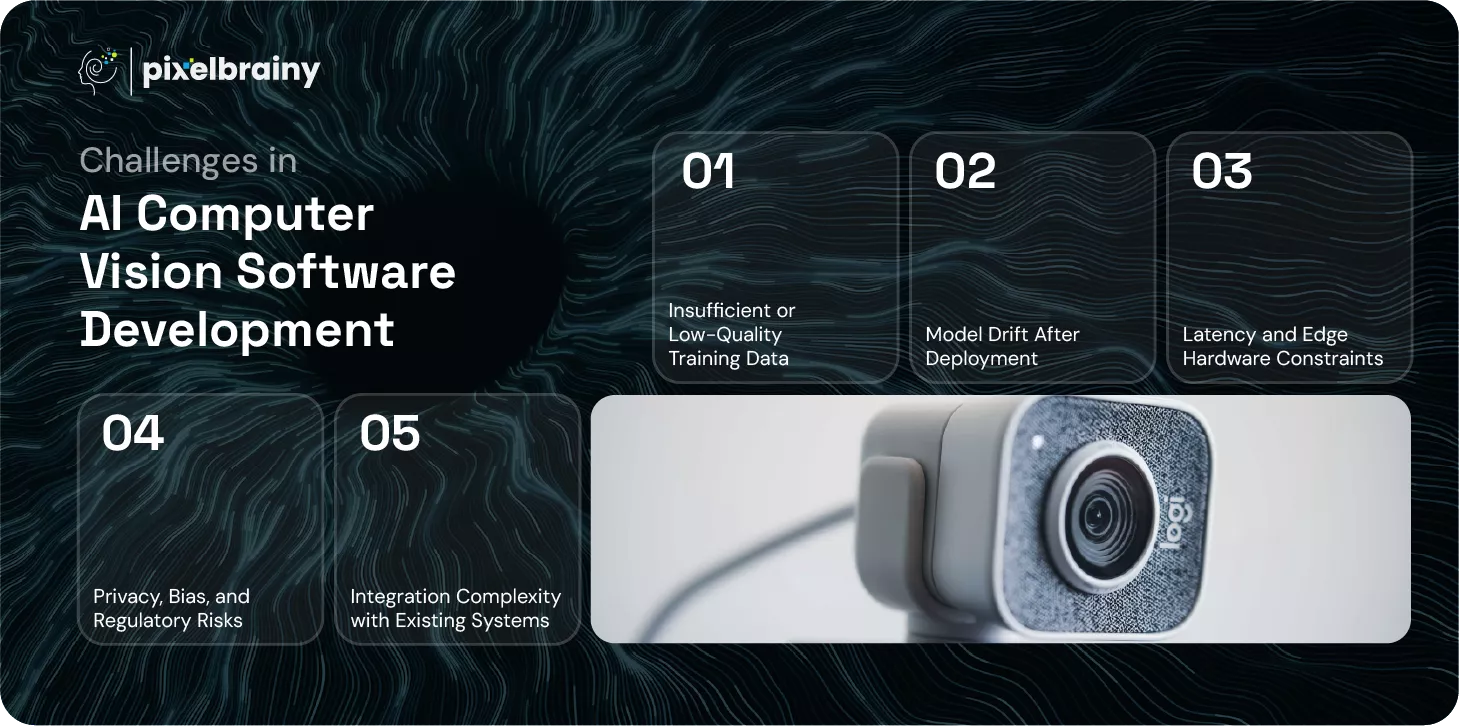
Challenge: Models trained on limited or overly clean datasets struggle in real-world conditions where lighting, angles, and edge cases vary significantly.
Solution:
Challenge: Model performance degrades over time as real-world data changes, often without immediate visibility.
Solution:
Challenge: Real-time applications require fast inference, but large models often fail to perform efficiently on limited edge hardware.
Solution:
Challenge: Handling visual data introduces risks related to privacy, compliance, and model bias, especially in regulated industries.
Solution:
Challenge: Integrating AI outputs with legacy systems such as ERP, CRM, or monitoring platforms can be complex and time-consuming.
Solution:
Addressing these challenges early ensures that AI computer vision software remains scalable, reliable, and effective across evolving real-world environments.
AI computer vision software is entering a phase where systems are becoming more adaptive, context-aware, and deeply integrated into business operations. The focus is shifting from isolated model performance to building intelligent platforms that can learn continuously, operate efficiently, and support autonomous decision making.
As adoption increases, businesses need to stay aligned with emerging capabilities that will define the next generation of AI-driven visual systems. The following trends highlight where the industry is heading and what organizations should prepare for.
Multimodal models that combine visual understanding with natural language processing are moving into production environments. Instead of building separate models for detection, classification, or search, businesses can interact with visual systems using simple language queries.
This shift simplifies development and enables more flexible applications such as visual search, automated reporting, and conversational analytics. It also reduces dependency on task-specific models, making systems easier to scale and adapt across multiple use cases.
Advancements in edge hardware are making on-device inference faster, more efficient, and cost-effective. Businesses are increasingly adopting edge-first strategies for applications that require real-time processing.
Running models closer to the data source reduces latency, improves response time, and minimizes reliance on cloud infrastructure. This trend is especially important for industries such as manufacturing, retail, and security, where immediate decision making is critical.
Generating high-quality training data has traditionally been one of the biggest challenges in AI development. With the rise of generative AI and simulation platforms, synthetic data is becoming a practical solution.
Businesses can now create diverse datasets that include rare events, edge cases, and controlled variations. This reduces annotation costs, accelerates development cycles, and improves model performance in scenarios where real data is limited or difficult to capture.
As AI adoption grows, regulatory frameworks are becoming stricter, especially around privacy, fairness, and transparency. Organizations must ensure that their systems meet compliance requirements and ethical standards.
This is leading to the integration of explainability, bias detection, and auditability into AI systems. Businesses will need to build governance mechanisms directly into their platforms to maintain trust and meet legal obligations.
AI computer vision is evolving from passive detection systems to active decision-making platforms. These systems can not only identify events but also trigger actions based on predefined logic or learned behavior.
This enables fully automated workflows such as autonomous inspection, real-time risk mitigation, and intelligent process optimization. As this trend matures, businesses will move toward systems that operate with minimal human intervention while maintaining high accuracy and reliability.
These trends signal a shift toward more intelligent, autonomous, and scalable AI computer vision systems that can adapt to complex environments and continuously deliver business value.
Across AI initiatives, a consistent pattern emerges. Many businesses reach a point where early prototypes stop delivering value, off-the-shelf tools fail to handle real-world data variability, and internal teams struggle to scale solutions into production. At that stage, the requirement becomes more practical and outcome-driven.
I need a dedicated team to create and maintain AI-based computer vision software that works reliably in real-world environments.
We are searching for an experienced AI computer vision software development company to handle our project.
PixelBrainy LLC is built to address exactly this transition from experimentation to production. The focus is not on building isolated models, but on delivering complete, production-ready systems that perform consistently under real operating conditions.
PixelBrainy approaches AI computer vision software development with a strong focus on execution, scalability, and long-term reliability:
A North American manufacturing company approached PixelBrainy to improve defect detection on a high-volume assembly line where manual inspection was inconsistent and inefficient.
The solution involved deploying edge-based AI models integrated directly into the production workflow. The system enabled real-time inspection, automated decision-making, and continuous monitoring.
Results achieved:
That’s why PixelBrainy LLC helps businesses move from experimental AI to reliable, scalable computer vision systems that deliver measurable results in real-world environments.

AI computer vision software has clearly evolved from experimental projects into a core operational capability across industries. Businesses using it effectively are improving accuracy, reducing manual effort, and building scalable systems that continuously learn from visual data and adapt to real-world conditions.
However, success is not driven by models alone. It depends on the right development approach, a scalable technology stack, and an execution-focused partner who understands production challenges. At this stage, many teams shift from exploration to a practical need: i am searching for a trusted partner to build and scale AI computer vision software that can deliver measurable outcomes.
The next step is to move from planning to execution with a clear roadmap and the right expertise in place.
Schedule a call with PixelBrainy to discuss your requirements and start building a production-ready AI computer vision solution tailored to your business.
AI Computer Vision Software development typically takes 10 to 16 weeks for an MVP. A mid-level platform may take 18 to 28 weeks, while enterprise AI computer vision software development projects can take 32 to 52 weeks.
The cost to develop AI Computer Vision Software ranges from $40,000 for an MVP to $300,000+ for advanced enterprise solutions, depending on model complexity, data requirements, and system integrations.
Yes, startups can develop AI Computer Vision Software within a $40,000 to $90,000 range by focusing on MVP development, limiting scope, and using pretrained models.
AI Computer Vision Software development is widely used in manufacturing, healthcare, retail, logistics, security, agriculture, automotive, and insurance where visual data processing improves efficiency and accuracy.
Not always. AI Computer Vision Software can be developed using smaller datasets with transfer learning, though complex use cases may require larger and more diverse data.
Outsourcing AI Computer Vision Software development is often faster and more cost-effective initially, especially for businesses without in-house AI expertise.

About The Author
Sagar Bhatnagar
Sagar Sahay Bhatnagar brings over a decade of IT industry experience to his role as Marketing Head at PixelBrainy. He's known for his knack in devising creative marketing strategies that boost brand visibility and market influence. Sagar's strategic thinking, coupled with his innovative vision and focus on results, sets him apart. His track record of successful campaigns proves his ability to utilize digital platforms effectively for impactful marketing efforts. With a genuine passion for both technology and marketing, Sagar continuously pushes PixelBrainy's marketing initiatives to greater success.

Working with the PixelBrainy team has been a highly positive experience. They understand the design requirements and create beautiful UX elements to meet the application needs. The dev team did an excellent job bringing my vision to life. We discussed usability and flow. Sagar worked with his team to design the database and begin coding. Working with Sagar was easy. He has the knowledge to create robust apps, including multi-language support, Google and Apple ID login options, Ad-enabled integrations, Stripe payment processing, and a Web Admin site for maintaining support data. I'm extremely satisfied with the services provided, the quality of the final product, and the professionalism of the entire process. I highly recommend them for Android and iOS Mobile Application Design and Development.

Great experience working with them. Had a lot of feedback and I found that unlike most contractors they were bugging me for updates instead of the other way around. They were extremely time conscience and great at communicating! All work was done extremely high quality and if not on time, early! They were always proactive when it comes to communication and the work is great/above par always. Very flexible and a great team to work with! Goes above and beyond to present us with multiple options and always provides quality. Amazing work per usual with Chitra. If you have UI/UX or branding design needs I recommend you go to them! Will likely work with them in the future as well, definitely recommended!

PixelBrainy is a joy to work with and is a great partner when thinking through branding, logo, and website layout. I appreciate that they spend time going into the "why" behind their decisions to help inform me and others about industry best practices and their expertise.

I hired them to design our software apps. Things I really like about them are excellent communication skills, they answer all project suggestions and collaborate right away, and their input on design and colors is amazing. This project was complex and needed patience and creativity. The team is amazing to do business with. I will be using them long-term. Glad to see there are some good people out there. I was afraid to try and outsource my project to someone but I am glad I met them! I really can't say enough. They went above and beyond on this project. I am very happy with everything they have done to make my business stand out from the competition.

It was great working with PixelBrainy and the team. They were very responsive and really owned the project. We'll definitely work with them again!

I recently worked with the PixelBrainy team on a project and I was blown away by their communication skills. They were prompt, clear, and articulate in all of our interactions. They listened and provided valuable feedback and suggestions to help make the project a success. They also kept me updated throughout the entire process, which made the experience stress-free and enjoyable.

PixelBrainy is very good at what it does. The team also presents themselves very professionally and takes care of their side of things very well. I could fully trust them taking up the design work in a timely and organised manner and their attention to detail saved us lots of effort and time. This particular project was quite intense and the team showed that they function very well under pressure. Very much looking forward to working with her again!

It's always an absolute pleasure working with them. They completed all of my requests quickly and followed every note I had for them to a T, which made our process go smoothly from start to finish. Everything was completed fast and following all of the guidelines. And I would recommend their services to anyone. If you need any design work done in the future, PixelBrainy should be your first call!

They took ownership of our requirements and designed and proposed multiple beautiful variants. The team is self-motivated, requires minimum supervision, committed to see-through designs with quality and delivering them on time. We would definitely love to work with PixelBrainy again when we have any requirements.

PixelBrainy was a big help with our SaaS application. We've been hard at work with a new UI/UX and they provided a lot of help with the designs. If you're looking for assistance with your website, software, or mobile application designs, PixelBrainy and the team is a great recommendation.

PixelBrainy designers are amazing. They are responsive, talented, and always willing to help craft the design until it matches your vision. I would recommend them and plan to continue them for my future projects and more!!!

They were awesome! Did a good job fast, and good communication. Will work with them again. Thank you

Creative, detail-oriented, and talented designers who take direction well and implement changes quickly and accurately. They consistently over-delivered for us.

PixelBrainy team is very talented and creative. Great designers and a pleasure to work with. PixelBrainy is an excellent communicator and I look forward to working with them again.

PixelBrainy has a very talented design team. Their work is excellent and they are very responsive. I enjoy working with them and hope to continue on all of our future projects.


Transform your ideas into reality with us.
Across these industries, each engagement brings unique challenges, from early-stage product development to scaling complex systems, helping us build a practical understanding of real-world product environments.