
 AI Summary Powered by PixelBrainy
Enterprise leaders are drowning in data, yet some of their most valuable business insights remain locked inside invoices, contracts, claims records, KYC files, emails, spreadsheets, scanned PDFs, customer correspondence, and handwritten forms. While these documents continue to power critical operations, many organizations still depend on manual reviews and legacy OCR systems that struggle with inconsistent layouts, complex tables, and unstructured content. The result is delayed decisions, costly errors, compliance risks, and missed opportunities hidden within enterprise data.
If your organization is asking, "We are losing critical business insights because our current data extraction process is slow and error-prone. What is the best way to develop a custom AI data extraction platform that handles both structured and unstructured documents at scale?" the answer lies in AI data extraction platform development.
Modern enterprises are moving beyond traditional extraction tools and embracing AI-native platforms capable of understanding both document content and context. These intelligent systems combine Optical Character Recognition (OCR), Natural Language Processing (NLP), machine learning, computer vision, and Large Language Models (LLMs) to classify documents, extract key information, validate outputs, identify relationships between entities, assign confidence scores, and route exceptions for human review. Rather than simply converting images into text, they transform fragmented records into actionable business intelligence.
The demand for these solutions is accelerating. According to Research and Markets, the global data extraction software market is estimated at USD 2.31 billion in 2026 and is projected to reach USD 4.14 billion by 2030, expanding at a CAGR of 15.6%, highlighting the growing enterprise investment in intelligent document processing technologies.
Whether you want to build AI data extraction platform capabilities tailored to your operations, develop AI data extraction platform for enterprises with advanced governance and integrations, or understand how to build an AI data extraction software from the ground up, success requires much more than connecting an LLM to a PDF parser. It demands a carefully designed architecture that includes ingestion pipelines, validation mechanisms, orchestration workflows, security controls, model optimization, and seamless integration with enterprise systems.
This guide explores every aspect of AI data extraction platform development, including core features, technical architecture, development steps, enterprise costs, technology stack recommendations, implementation challenges, and the future trends shaping intelligent data extraction in 2026 and beyond.
An AI data extraction platform is a software solution that automatically captures, understands, extracts, validates, and organizes information from structured, semi-structured, and unstructured documents. Unlike traditional tools that only convert documents into text, it identifies important data, understands context, applies business rules, and delivers accurate outputs to enterprise systems.
This capability has become essential as organizations process thousands of invoices, contracts, customer emails, claims forms, legal documents, scanned PDFs, and handwritten records every month. Manual extraction is slow, expensive, and prone to errors, while conventional automation tools struggle to handle changing document formats and growing data volumes.
If your organization is asking, "Our team is spending too much time manually extracting data from thousands of documents every month. We need to know how to build an AI data extraction platform that can automate this entire process for our enterprise operations," the answer lies in AI data extraction platform development tailored to your business processes.
Many enterprises begin with OCR software, RPA bots, or generic SaaS products. However, these technologies address only a portion of the challenge.
OCR tools can extract text from scanned documents but cannot understand meaning or relationships between data points. RPA bots automate repetitive tasks using predefined rules, yet they often fail when layouts change or exceptions arise. Off-the-shelf SaaS solutions offer quick deployment but may lack the customization, security, and integration capabilities required by large enterprises.
As a result, organizations are increasingly developing intelligent data extraction platform solutions powered by OCR, Natural Language Processing (NLP), computer vision, machine learning, and Large Language Models (LLMs). These systems can classify documents, extract key information, validate outputs, assign confidence scores, and integrate with ERP, CRM, and analytics platforms.
| Capability | OCR Tools | RPA Bots | AI Data Extraction Platform |
|---|---|---|---|
| Accuracy | Moderate | Rule-dependent | High |
| Scalability | Limited | Moderate | Enterprise-grade |
| Document Handling | Structured documents | Predictable workflows | Structured, semi-structured, and unstructured documents |
| Cost Over Time | Higher manual effort | High maintenance | Lower through automation |
The rapid growth of unstructured enterprise data is making automated data extraction platform development a strategic investment. Through AI document data extraction platform development, businesses gain the flexibility to support complex workflows, meet compliance requirements, and scale without increasing manual workloads.
For enterprises evaluating how to build an AI data extraction platform for enterprise environments or building AI data extraction platform to reduce manual data entry errors, the goal is simple: transform high-volume documents into accurate, actionable business intelligence while improving efficiency across the organization.
Understanding the technical architecture behind an AI-powered extraction solution helps enterprises make informed development decisions. While the output appears simple, extracting accurate information from thousands of documents requires multiple intelligent components working together.
A well-designed architecture for AI data extraction platform development ensures that data flows seamlessly from ingestion to validation and finally into enterprise systems, regardless of document type or complexity.
Simplified Architecture Flow:
Document Sources → Preprocessing → OCR & Computer Vision → NLP/LLM-Based Extraction → Validation & Human Review → Enterprise Integrations → Monitoring & Continuous Learning
The process begins with collecting documents from multiple sources across the organization.
These may include:
This layer enables enterprises to centralize high-volume data intake without disrupting existing workflows.
Documents often arrive in inconsistent formats and varying quality levels.
Before extraction begins, the platform prepares them through preprocessing techniques such as:
These steps improve extraction accuracy and reduce downstream errors.
Optical Character Recognition (OCR) converts scanned images and PDFs into machine-readable text. Computer vision models go a step further by understanding the visual structure of documents
Including:
This allows the platform to process both structured and unstructured documents effectively.
This is the intelligence engine of the platform.
Using Natural Language Processing (NLP), machine learning, and Large Language Models (LLMs), the system can:
For example, it can distinguish invoice totals from tax values or identify payment terms hidden within contract clauses.
Not every extraction result should be accepted automatically.
To maintain quality, the platform applies:
Low-confidence outputs are routed to reviewers, ensuring enterprise-grade accuracy and compliance.
Validated data is then pushed into downstream systems through APIs and connectors, including:
Automated workflows can also trigger approvals, notifications, or follow-up actions.
Enterprise requirements evolve over time, and the platform must adapt accordingly.
This layer enables teams to:
The effectiveness of building an AI data extraction platform depends not only on selecting the right AI models but also on designing an architecture that is scalable, secure, and adaptable. Enterprises that build these capabilities correctly can process millions of documents with greater speed, accuracy, and operational efficiency while transforming raw information into actionable business intelligence.
For most US enterprises, the decision to invest in custom AI data extraction platform development ultimately comes down to one question: Will the returns justify the investment?
If your CFO is asking, "What kind of cost savings and efficiency gains can we realistically expect in the first 12 months?" the answer is increasingly supported by real-world outcomes. Organizations processing high volumes of invoices, contracts, claims, and customer documents are reporting significant improvements in productivity, accuracy, compliance, and operating costs after implementing AI-powered extraction systems.
Below are the business benefits enterprises can realistically expect.
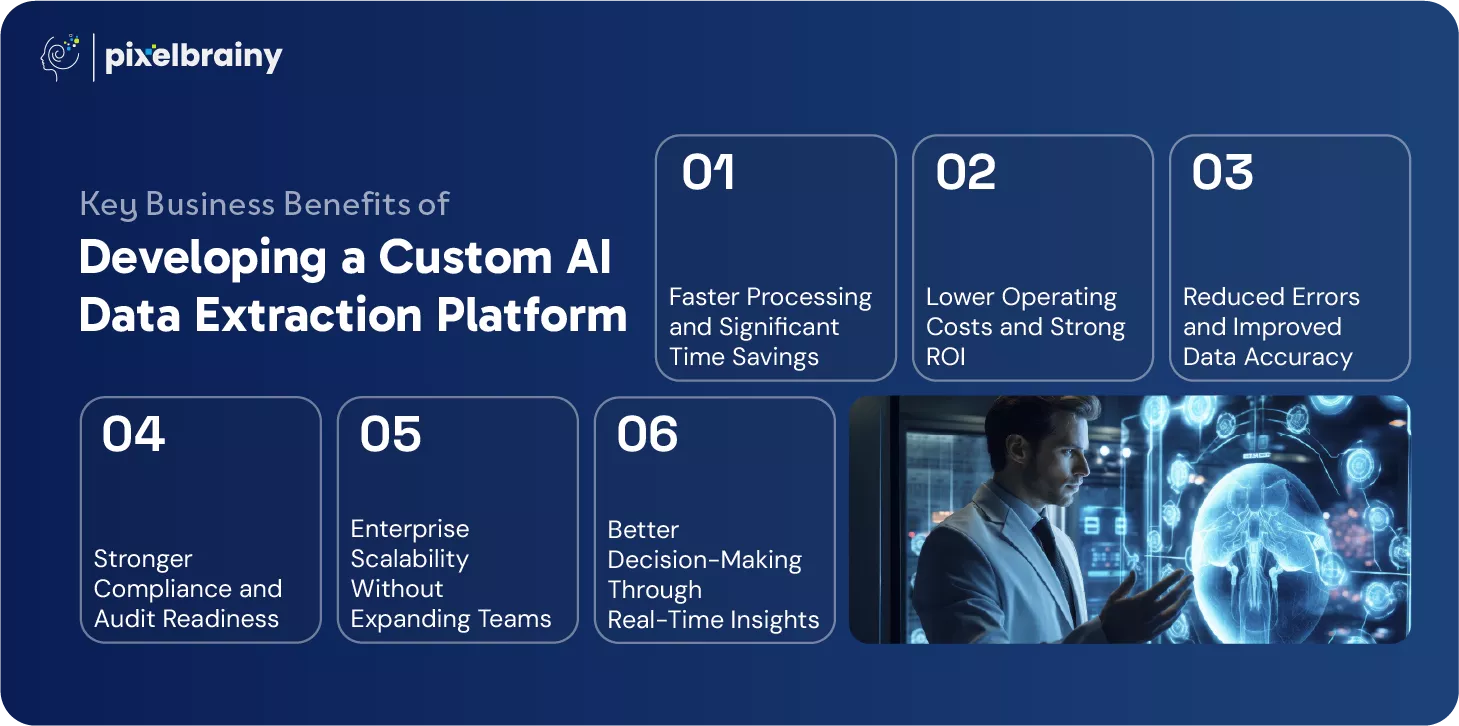
Manual document processing often creates operational bottlenecks. Employees spend hours locating information, entering data, and validating records across multiple systems.
With AI-driven data extraction platform development, enterprises can automate these repetitive tasks and process thousands of documents simultaneously.
Expected impact:
Even modest efficiency gains translate into thousands of productive hours recovered annually at enterprise scale.
One of the biggest advantages of enterprise AI data extraction platform development is its ability to reduce labor-intensive workloads.
Parseur, an intelligent document processing provider, reported a customer saving 152 hours per month and approximately $80,000 annually by automating document extraction workflows. For large enterprises handling substantially higher volumes, the savings potential can be significantly greater.
Expected impact:
This directly addresses concerns around the cost to develop an AI data extraction platform for US enterprises.
Manual data entry errors can lead to payment discrepancies, compliance issues, reporting inaccuracies, and poor customer experiences.
Organizations focused on building AI data extraction platform to reduce manual data entry errors can improve data quality through confidence scoring, validation rules, and exception workflows.
Expected impact:
For industries such as healthcare, finance, and legal services, compliance is non-negotiable.
Custom AI extraction platforms provide:
Expected impact:
Document volumes continue to grow, but headcount cannot increase at the same pace.
Custom platforms scale with demand by handling spikes in processing volumes without major operational disruption.
Expected impact:
Extracted information becomes immediately available for reporting, analytics, and business intelligence initiatives.
Expected impact:
| Stakeholder | Primary Benefit | What Success Looks Like |
|---|---|---|
| CFO | Cost savings and ROI | Reduced operating expenses and faster payback periods |
| CTO | Scalability and integration | Seamless automation across existing systems |
| Operations Director | Productivity and accuracy | Faster processing with fewer manual errors |
The value of custom AI data extraction platform development extends far beyond automation. It enables enterprises to lower costs, improve accuracy, strengthen compliance, and create a foundation for scalable growth. For organizations processing high volumes of business-critical documents, the question is no longer whether AI-powered extraction delivers ROI. The real question is how much value is being lost by delaying adoption.
Successful enterprise AI data extraction platform development goes far beyond extracting text from documents. Enterprise teams must design platforms that satisfy operational efficiency goals, security requirements, compliance mandates, and integration needs simultaneously.
If your team is planning to build AI data extraction platform capabilities that support HIPAA, SOC 2, and enterprise-scale automation, the right architecture decisions start with prioritizing the features that different stakeholders actually need. While operations teams focus on efficiency, compliance officers prioritize auditability, and engineering leaders demand scalability and security.
The following features should form the foundation of any enterprise-grade solution.
| Feature | Why It Matters? | Primary Stakeholder |
|---|---|---|
| Multi-Format Document Support | Enables extraction from invoices, contracts, emails, scanned PDFs, handwritten forms, images, spreadsheets, and legal records without requiring separate workflows for each document type. | Operations Teams |
| Intelligent OCR Engine | Extracts text accurately from low-quality scans, rotated documents, tables, and handwritten content to improve processing reliability. | Operations Teams |
| Context-Aware NLP Processing | Understands relationships between entities and document meaning instead of extracting isolated text fields. Essential when developing intelligent data extraction platform capabilities. | Engineering Teams |
| Automatic Document Classification | Categorizes incoming documents automatically before extraction, reducing manual sorting efforts and accelerating workflow execution. | Operations Teams |
| Key Field Extraction Engine | Identifies business-critical information such as invoice totals, customer details, policy numbers, and contract clauses with precision. | Business Users |
| Human-in-the-Loop Validation | Routes low-confidence outputs to reviewers, balancing automation efficiency with enterprise-grade accuracy and quality assurance. | Operations & Compliance Teams |
| Confidence Scoring with Source Tracing | Displays extraction confidence levels while linking outputs to original document locations for verification and transparency. | Compliance Officers |
| Audit Trails and Activity Logging | Records every extraction, correction, approval, and system action to support investigations, audits, and regulatory reviews. | Compliance Teams |
| Role-Based Access Control (RBAC) | Restricts access according to user responsibilities, ensuring sensitive information is only available to authorized personnel. | Security Teams |
| ERP and CRM Integration | Connects extracted data directly with systems such as SAP, Oracle, Salesforce, and Microsoft Dynamics to eliminate duplicate work. | CTOs and IT Teams |
| Real-Time Processing Capabilities | Processes incoming documents instantly, enabling faster approvals, customer onboarding, and operational decision-making. | Operations Leaders |
| Workflow Automation Engine | Triggers notifications, approvals, exception routing, and downstream actions to automate document processing workflows end-to-end. | Operations Teams |
| SOC 2 and HIPAA Compliance Readiness | Supports encryption, access controls, secure logging, and data protection practices required by regulated industries. Particularly critical when building AI data extraction platform for healthcare document processing. | Compliance and Legal Teams |
| API-First Architecture | Allows seamless integration with internal applications, third-party services, and future technologies without major redevelopment efforts. | Engineering Teams |
| Monitoring and Performance Dashboards | Provides visibility into processing volumes, extraction accuracy, exceptions, and operational KPIs for continuous optimization. | Executives and Operations Leaders |
For organizations seeking to develop AI data extraction platform to automate document processing workflows, these capabilities should be treated as foundational requirements rather than optional enhancements. They establish the security, accuracy, scalability, and governance standards expected from modern AI data extraction platform development services.
The strongest enterprise platforms are not defined by the number of features they offer, but by how effectively those features address the priorities of operations, engineering, security, and compliance teams from day one.
After implementing the core capabilities, enterprises should evaluate advanced features that can elevate their solution from a document processing system to an intelligent business enabler. These capabilities help organizations improve decision-making, automate increasingly complex workflows, and maximize the long-term value of their AI data extraction platform development initiatives.
As enterprises continue developing intelligent data extraction platform capabilities, advanced features are becoming important differentiators. They enable businesses to handle sophisticated use cases, enhance user experiences, and adapt to evolving operational demands without rebuilding the platform from scratch.
The following features are not mandatory for initial deployment, but they can significantly strengthen the effectiveness of enterprise-grade solutions over time.
| Advanced Feature | Why It Matters? | Primary Stakeholder |
|---|---|---|
| Multimodal AI Processing | Combines text, images, tables, signatures, and visual layouts to understand documents more comprehensively. This improves extraction accuracy for complex records containing mixed content types. | Engineering Teams |
| Generative AI Summarization | Automatically creates concise summaries of contracts, legal files, patient records, and lengthy reports, helping teams review information faster and make informed decisions. | Business Users |
| Conversational Document Search | Enables employees to ask natural language questions and retrieve answers directly from extracted documents without manually searching through records. | Operations Teams |
| Continuous Learning Models | Learns from user corrections and validation feedback to improve extraction quality continuously, reducing recurring errors and manual intervention over time. | AI and Engineering Teams |
| Multilingual Extraction Support | Processes documents in multiple languages while maintaining consistency and accuracy across international operations and geographically distributed teams. | Global Operations Teams |
| Knowledge Graph Integration | Connects entities, relationships, and extracted insights across documents to reveal hidden business patterns and dependencies that traditional systems often overlook. | Executives and Analysts |
| Predictive Analytics Capabilities | Uses extracted data to forecast trends, identify operational bottlenecks, anticipate risks, and support proactive business planning initiatives. | Leadership Teams |
| Fraud and Anomaly Detection | Identifies suspicious activities, duplicate submissions, unusual patterns, and inconsistencies within extracted datasets to strengthen fraud prevention efforts. | Risk and Compliance Teams |
| Intelligent Exception Resolution | Prioritizes exceptions based on confidence levels and recommends corrective actions, reducing delays in high-volume document processing workflows. | Operations Teams |
| Agentic AI Workflow Automation | Allows AI agents to execute follow-up actions such as updating systems, initiating approvals, assigning tasks, and completing routine processes autonomously. | CTOs and Operations Leaders |
Organizations investing in advanced AI data extraction platform development services often gain a competitive advantage because these capabilities extend beyond automation and contribute directly to efficiency, intelligence, and innovation. They are especially valuable for enterprises looking to develop AI data extraction platform solutions that can evolve alongside changing business requirements.
The strongest enterprise platforms are designed not only to automate today's document workflows but also to intelligently adapt to future operational challenges and opportunities.
The benefits of enterprise AI data extraction platform development become most apparent when applied to industry-specific challenges. While every organization deals with documents differently, the common objective is to eliminate manual effort, accelerate processing, improve accuracy, and uncover actionable insights from business-critical data.
The most successful enterprises do not attempt to automate every document workflow at once. Instead, they focus on high-volume use cases where inefficient processes directly impact revenue, compliance, customer experience, or operational efficiency.
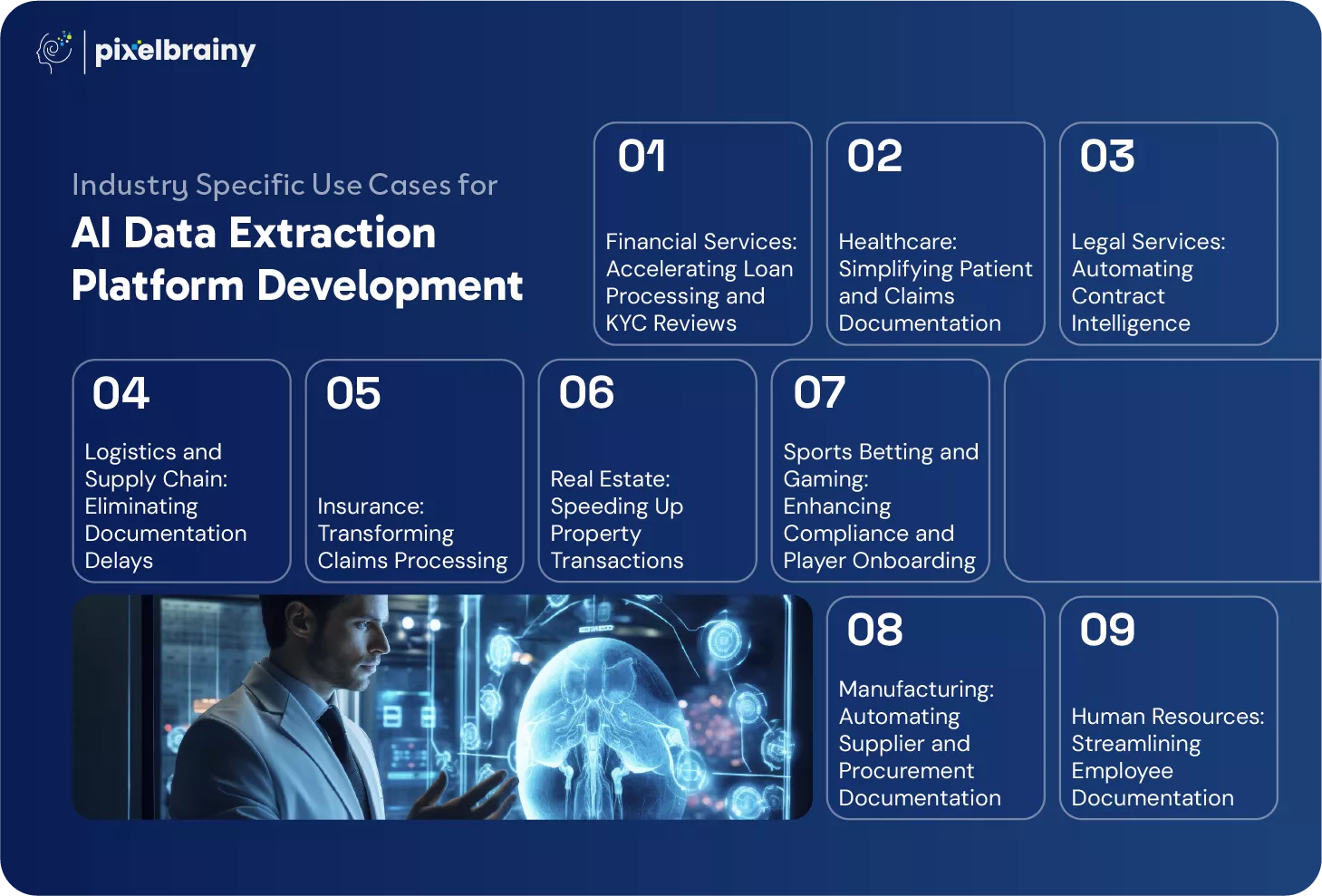
Pain: Banks and financial institutions process thousands of loan applications, KYC documents, tax returns, bank statements, and compliance forms. Manual verification slows approvals and increases regulatory risks.
Solution: Through AI data extraction platform development for financial services enterprises, organizations can automatically classify financial documents, extract customer information, validate identities, and populate lending systems.
Outcome: Financial institutions can reduce loan processing times by 50% to 70%, accelerate customer onboarding, and improve compliance accuracy.
Pain: Healthcare providers spend considerable time entering patient details from intake forms, insurance documents, referrals, and medical records.
Solution: Organizations can build AI data extraction platform for healthcare document processing to extract patient demographics, insurance details, diagnoses, and claims information directly into EHR systems.
Outcome: Providers can reduce administrative workloads by 40% to 60%, improve claim accuracy, and shorten reimbursement cycles.
Pain: Legal professionals manually review contracts, litigation files, and discovery documents to locate obligations, clauses, and deadlines.
Solution: Firms can develop AI data extraction platform for legal document automation to extract key clauses, summarize agreements, identify risks, and organize case records.
Outcome: Legal teams can reduce document review times by 50% or more, allowing attorneys to focus on strategic legal work.
Pain: Bills of lading, shipment manifests, customs declarations, and invoices often arrive in inconsistent formats, delaying operations.
Solution: Companies building AI data extraction platform for supply chain document automation can automate extraction from shipping documents and synchronize information across logistics systems.
Outcome: Businesses can improve document turnaround times by 60% to 80%, reducing fulfillment delays and increasing visibility.
Pain: Insurance carriers processing thousands of claims weekly face bottlenecks caused by manual reviews of claim forms, medical records, repair estimates, and policy documents.
Solution: Organizations creating AI data extraction platform for insurance claims processing can automate claims intake using intelligent OCR, classification models, confidence scoring, and human validation workflows.
Outcome: Insurers can reduce claims processing times by 40% to 70%, accelerate settlements, and improve customer satisfaction.
If you're asking, "We are a US based insurance company processing thousands of claims documents weekly and our manual review process is creating costly bottlenecks. Which AI data extraction platform development approach works best for insurance document automation?" the answer is to combine automated extraction with human-in-the-loop validation for exceptions while integrating directly with claims management systems.
Pain: Real estate firms handle large volumes of purchase agreements, lease contracts, mortgage applications, disclosure forms, title documents, and tenant records. Manual reviews slow closings and increase administrative costs.
Solution: Through enterprise AI data extraction platform development, agencies and property management companies can automatically extract buyer details, lease terms, payment schedules, and compliance information from transaction documents.
Outcome: Real estate organizations can reduce document processing efforts by 40% to 60%, accelerate transaction cycles, and improve record accuracy.
Pain: Sports betting operators process identity verification documents, payment records, tax forms, responsible gaming disclosures, and fraud investigations at high volumes. Manual reviews delay user onboarding and increase compliance burdens.
Solution: AI extraction platforms can automate KYC checks, extract information from identity documents, validate player records, and process regulatory reporting documentation.
Outcome: Operators can reduce onboarding times by 50% to 75%, improve fraud detection efficiency, and strengthen regulatory compliance without expanding review teams.
Pain: Procurement teams manage purchase orders, supplier contracts, invoices, quality certificates, and compliance documents from multiple vendors.
Solution: AI-powered extraction systems automate supplier document processing and synchronize extracted information with ERP and procurement platforms.
Outcome: Manufacturers can reduce processing delays by 50%, improve supplier visibility, and minimize costly procurement errors.
Pain: HR teams manually process resumes, onboarding forms, background verification reports, tax documents, and benefits paperwork.
Solution: AI extraction platforms can classify employment documents, extract candidate information, and populate HR systems automatically.
Outcome: Organizations can shorten onboarding cycles by 30% to 50%, improve data consistency, and reduce administrative workloads.
These examples demonstrate that the true value of enterprise AI data extraction platform development lies in solving industry-specific problems rather than applying generic automation. By focusing on high-impact workflows first, organizations can achieve measurable outcomes quickly and build momentum for broader enterprise adoption.
The enterprises generating the greatest ROI from AI-powered extraction are those that align platform capabilities with the unique document challenges of their industry and scale strategically from there.
Successful AI data extraction platform development is not just about choosing the right AI models. It requires a structured approach that balances business priorities, technical requirements, compliance obligations, and speed of execution.
If you've been tasked with eliminating manual data entry within a tight deadline, you may be wondering, "What is the fastest way to develop a reliable AI data extraction platform without compromising on accuracy or compliance?" The answer lies in focusing on high-impact use cases first, validating assumptions early, and building incrementally rather than attempting an enterprise-wide rollout from day one.
Below is a practical roadmap enterprises can follow to develop AI data extraction platform for enterprises efficiently and strategically.
Important: Skipping the requirements and discovery phase is one of the biggest reasons enterprise AI data extraction initiatives fail, exceed budgets, or deliver poor adoption. Defining clear objectives upfront prevents costly rework later.
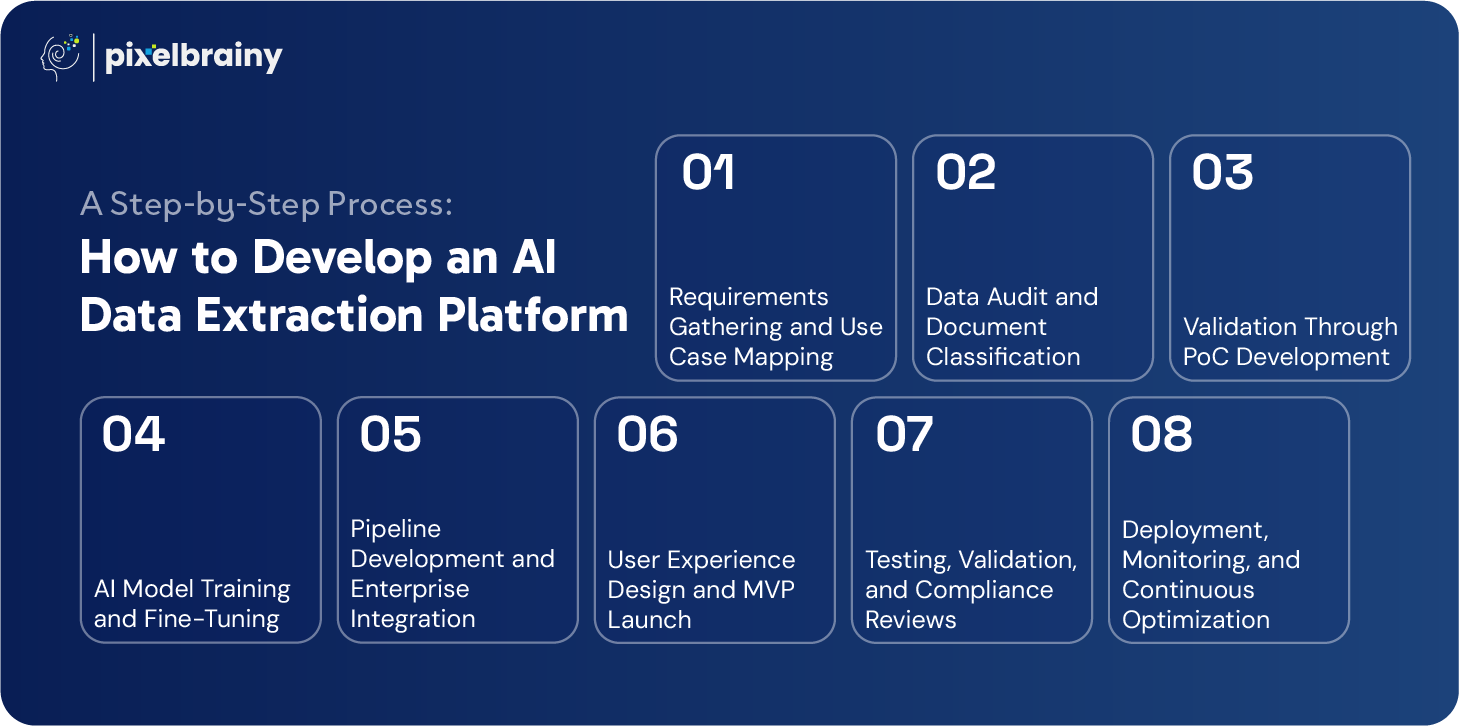
The first step is understanding what problems the platform is expected to solve.
Business leaders, operations teams, compliance officers, and IT stakeholders should work together to answer questions such as:
This phase often includes workshops and process mapping exercises to identify the highest-value automation opportunities.
Business decision: Prioritize use cases that deliver measurable ROI quickly instead of trying to automate every document workflow at once.
Before building models, enterprises must understand the data they already possess.
Teams should evaluate:
This stage determines whether historical documents can be used for training and highlights gaps that require additional preparation.
Business decision: Focus initial implementation on document categories with the highest processing volume and standardization potential.
Rather than committing significant resources immediately, many enterprises begin with PoC development to validate feasibility.
A proof of concept typically tests extraction capabilities using a limited set of documents and predefined success criteria.
The objective is to answer:
Business decision: Use early results to secure executive buy-in and reduce implementation risk.
This phase focuses on AI model development using representative enterprise datasets.
Teams train and optimize models to:
Human feedback loops are often incorporated to improve accuracy over time.
Business decision: Determine acceptable accuracy thresholds before moving into production.
Also Read: Top 12+ AI Model Development Companies in the USA
The extraction engine must function within the broader technology ecosystem.
Development teams create AI-powered data extraction platform workflows that connect with:
Organizations frequently rely on specialized AI integration services to accelerate deployment and reduce complexity.
Business decision: Prioritize integrations that eliminate duplicate data entry and produce immediate operational gains.
Even highly accurate platforms fail if employees struggle to use them.
Working with an experienced UI/UX design company, teams design intuitive interfaces for validation queues, dashboards, and exception management.
Many enterprises launch through MVP development, focusing only on essential capabilities needed to solve the primary business challenge.
Business decision: Release quickly with core functionality instead of delaying value delivery while pursuing perfection.
Also Read: Top 10 AI MVP Development Companies in USA
Before deployment, the platform must undergo extensive evaluation.
Testing should cover:
Business decision: Balance speed with risk mitigation by defining clear acceptance criteria for production readiness.
Once live, the focus shifts from implementation to improvement.
Teams should continuously monitor:
Corrections from human reviewers can be used to retrain models and improve future outcomes.
Organizations often partner with top AI product development companies in USA to support optimization, scaling initiatives, and evolving business requirements.
Business decision: Treat deployment as the beginning of the optimization journey rather than the final milestone.
For enterprises evaluating how to develop a custom AI data extraction platform from scratch, the fastest path to success is not rushing development. It is following a phased approach that validates assumptions early, prioritizes business impact, and continuously improves performance after launch.
The organizations that achieve the strongest outcomes build strategically, launch incrementally, and optimize continuously to deliver reliable automation without compromising accuracy, compliance, or user adoption.
One of the first questions enterprise leaders ask is, "How much does it cost to build an AI data extraction platform from scratch?" The answer depends on the platform's complexity, the number of document types it supports, integration requirements, compliance obligations, and the level of AI customization involved.
For organizations with more than 500 employees, the AI data extraction platform development cost for US enterprises typically ranges from $50,000 to $400,000+. Enterprises operating in highly regulated industries such as healthcare, financial services, and insurance may require larger investments due to advanced security controls, audit requirements, and custom AI capabilities.
If you're wondering, "We have been allocated a budget for digital transformation this year and want to invest in building an AI data extraction platform. How much does it typically cost to develop one from scratch for an enterprise with over 500 employees?" the following breakdown provides realistic expectations.
| Development Tier | Typical Scope | Estimated Cost |
|---|---|---|
| Basic MVP Platform | Limited document types, standard OCR, basic extraction workflows, single integration, simple dashboards | $50,000 to $100,000 |
| Mid-Tier Platform | Multi-format document support, validation workflows, confidence scoring, multiple integrations, role-based access controls | $100,000 to $250,000 |
| Enterprise-Grade Platform | Custom AI models, ERP and CRM integrations, audit trails, HIPAA and SOC 2 readiness, advanced security, high-volume processing | $250,000 to $400,000+ |
The cost to develop an AI data extraction platform is rarely determined by AI models alone. Several business and technical factors influence the final investment.
Processing invoices and standard forms is significantly easier than extracting information from legal contracts, handwritten records, or multi-page healthcare documents. More complex document variations require additional training and validation.
Pre-trained models can reduce initial costs. However, enterprises with specialized use cases often require custom model tuning, industry-specific datasets, and ongoing optimization to achieve higher accuracy.
Connecting the platform with ERP systems, CRM software, claims platforms, EHR systems, and internal databases increases development effort and testing complexity.
HIPAA, SOC 2, PCI DSS, and other regulatory requirements often necessitate encryption, role-based access controls, audit logging, secure infrastructure, and compliance testing.
Development costs also vary based on the specialists involved, including AI engineers, backend developers, QA specialists, solution architects, DevOps engineers, and UI/UX professionals.
Post-launch activities such as model retraining, performance monitoring, infrastructure scaling, bug fixes, and feature enhancements should be included in long-term budget planning. Enterprises typically allocate 15% to 25% of the initial development cost annually for maintenance and continuous improvement.
Beyond development costs, many CFOs evaluate projects using a cost-per-document metric.
For enterprises processing hundreds of thousands of documents annually, even small reductions in per-document costs can generate substantial savings and accelerate ROI.
Practical Warning: The two most common causes of budget overruns are unclear document scope during the discovery phase and changing compliance requirements midway through development. Clearly defining document types, integrations, and regulatory obligations upfront can prevent expensive rework later.
The answer to how much does it cost to build a custom AI data extraction platform ultimately depends on your enterprise goals. Organizations seeking a focused automation initiative can launch with an MVP, while businesses pursuing enterprise-wide transformation should plan for a more comprehensive investment.
The most successful enterprises treat AI data extraction as a long-term operational asset, balancing initial development costs with the substantial efficiency gains and cost savings it delivers over time.
When you plan to develop AI data extraction tool, choosing the right technology stack is one of the most critical decisions during AI data extraction platform development. The effectiveness of your platform depends not only on the AI models you use but also on how well each component works together to deliver accuracy, scalability, compliance, and operational efficiency.
Enterprises looking to build AI data extraction platform using NLP and machine learning often face a common challenge: selecting technologies that align with their document complexity, budget, security requirements, and long-term business goals. There is no universal stack that fits every use case. A healthcare organization processing patient records will have different requirements than a financial institution handling loan applications or a legal firm reviewing contracts.
If you're wondering, "I need to understand the difference between building an AI data extraction platform using RAG architecture versus a fine-tuned LLM approach. Which one is better suited for enterprise-scale document processing with high accuracy requirements?" the answer largely depends on how frequently your documents change, the availability of training data, and your tolerance for maintenance costs.
The following technologies form the foundation of modern platforms that developing AI data extraction platform with OCR and deep learning capabilities.
| Technology Category | Recommended Options | Best Fit Enterprise Scenario |
|---|---|---|
| Vision AI and OCR Engines | Tesseract, Google Document AI, Amazon Textract | Tesseract works well for cost-sensitive projects. Google Document AI suits complex document understanding. Textract is ideal for AWS-native enterprises. |
| NLP Frameworks | spaCy, Hugging Face Transformers | spaCy is effective for lightweight entity extraction. Hugging Face offers flexibility for advanced NLP and domain-specific customization. |
| Large Language Models (LLMs) | GPT-4, Claude, Llama 3 | GPT-4 excels in reasoning tasks, Claude performs strongly with lengthy documents, while Llama 3 supports greater deployment control. |
| RAG Architecture Components | LangChain, LlamaIndex | Best for enterprises requiring grounded responses from evolving document repositories without retraining models frequently. |
| Vector Databases | Pinecone, Weaviate | Pinecone simplifies managed deployments, while Weaviate offers open-source flexibility and hybrid search capabilities. |
| Workflow Orchestration Tools | Apache Airflow, Temporal | Airflow is suitable for scheduled pipelines. Temporal supports resilient, event-driven business workflows. |
| Backend Frameworks | FastAPI, Node.js | FastAPI accelerates AI service development, while Node.js supports real-time integrations and API-heavy architectures. |
| Databases and Search | PostgreSQL, MongoDB, Elasticsearch | PostgreSQL handles structured data, MongoDB supports flexible schemas, and Elasticsearch enables fast document search. |
| Containerization and Deployment | Docker, Kubernetes | Docker standardizes deployments, while Kubernetes ensures scalability and high availability. |
| Monitoring and Observability | Prometheus, Grafana | Helps teams track extraction accuracy, infrastructure health, and operational performance continuously. |
One of the biggest architectural decisions when you create AI-powered data extraction platform solutions is choosing between Retrieval-Augmented Generation (RAG) and fine-tuning LLMs.
| Criteria | RAG Architecture | Fine-Tuned LLM |
|---|---|---|
| Use Case Fit | Dynamic knowledge bases and frequently changing documents | Stable use cases with predictable document patterns |
| Training Data Needed | Minimal additional training data | Requires high-quality labeled datasets |
| Implementation Cost | Lower upfront investment | Higher due to training and experimentation |
| Maintenance Effort | Easier updates through document indexing | Requires retraining when information changes |
| Accuracy on New Document Types | Strong performance with evolving datasets | May decline if exposed to unseen document variations |
| Response Grounding | Uses enterprise documents as evidence | Relies primarily on learned patterns |
| Best Enterprise Scenario | Compliance-heavy environments with changing information | Specialized extraction tasks with fixed requirements |
For organizations evaluating how to build scalable AI data extraction platform with RAG architecture, RAG is often the preferred choice because it retrieves information directly from enterprise documents, improving transparency and reducing hallucinations. It is particularly effective in legal, healthcare, insurance, and financial environments where information changes regularly.
On the other hand, understanding the difference between building AI data extraction platform using RAG vs fine-tuned LLM is essential because fine-tuned models still provide value for highly specialized extraction scenarios where document structures remain relatively consistent over time.
Many enterprises ultimately adopt a hybrid approach, combining RAG for contextual grounding with fine-tuned models for domain-specific accuracy.
The best technology stack is not defined by the most advanced tools available, but by selecting the right combination of technologies that align with your enterprise's accuracy requirements, compliance obligations, and scalability goals.
Choosing between a custom-built platform and an off-the-shelf solution is often the most important strategic decision during AI data extraction platform development. The choice influences implementation speed, long-term costs, compliance readiness, scalability, and the level of control your organization maintains over its data and workflows.
For some businesses, SaaS tools provide a quick route to automation with minimal upfront investment. For others, particularly enterprises managing high document volumes and strict regulatory requirements, custom AI data extraction platform development offers greater flexibility and stronger long-term returns.
If you're asking, "I am comparing the cost of buying an off-the-shelf data extraction tool versus investing in custom AI data extraction platform development. Which option makes more financial sense for a US enterprise processing over 50,000 documents monthly?" the answer depends on your operational complexity, future growth plans, and strategic priorities.
Off-the-shelf platforms are often suitable for organizations that need fast deployment and have relatively straightforward requirements.
Buying is usually the better option when you:
The primary advantage of SaaS solutions is speed. Teams can often begin extracting data within weeks rather than spending months on development.
However, as document volumes increase and workflows become more specialized, organizations may encounter limitations around customization, integration flexibility, and rising subscription costs.
Enterprises should consider build AI data extraction platform initiatives when document processing becomes a strategic capability rather than a supporting function.
Building is often the right choice when organizations:
For organizations stating, "Our organization wants to build a proprietary AI data extraction platform for data privacy reasons," custom development provides greater control over deployment environments, governance policies, and security frameworks.
Although the initial investment is higher, the economics often become more favorable as processing volumes grow.
| Evaluation Criteria | Buy Off-the-Shelf | Build Custom Platform |
|---|---|---|
| Monthly Document Volume | Best for under 20,000 documents | Best for 50,000+ documents |
| Number of Document Formats | Limited document diversity | Complex and changing document types |
| Compliance Requirements | Standard regulatory needs | HIPAA, SOC 2, PCI DSS, industry-specific controls |
| Integration Complexity | Basic integrations | Deep ERP, CRM, EHR, and legacy integrations |
| Data Privacy Requirements | Vendor-managed environments | Full ownership and control of enterprise data |
| Customization Needs | Minimal workflow changes | Highly tailored business workflows |
| Budget Timeline | Lower upfront investment | Better long-term value |
| Time to Deploy | Faster implementation | Longer implementation period |
| Scalability Costs | Subscription fees increase with usage | More predictable costs at scale |
When comparing cost of buying off-the-shelf data extraction tool versus custom AI data extraction platform development, the answer often changes based on scale.
For organizations processing fewer than 20,000 documents per month, SaaS solutions typically provide the fastest return due to lower upfront costs and shorter deployment timelines.
For US enterprises processing more than 50,000 documents monthly, however, custom platforms frequently become more economical over time. Usage-based subscription fees, limitations on customization, and integration workarounds can significantly increase the total cost of ownership of packaged solutions. In contrast, custom-built systems provide predictable operating costs while adapting to evolving business requirements.
There is no universally correct choice. The right decision depends on whether your enterprise prioritizes speed, flexibility, compliance, data privacy, or long-term operational efficiency.
Buy when rapid implementation and simplicity are your primary goals. Build when scale, control, compliance, and strategic differentiation become essential to your business success.
Even the most promising AI initiatives encounter obstacles during implementation. While the benefits of automation are substantial, enterprise teams must address technical and operational complexities to ensure long-term success.
If your team is saying, "We have tried three different off-the-shelf data extraction tools and none of them can handle the variety of document formats our business receives daily. Is custom AI data extraction platform development the only real solution at this point?" the answer is often yes. Generic tools are designed for common scenarios, but enterprises dealing with high volumes, unique workflows, and regulatory requirements usually need solutions built around their specific needs.
The key is not avoiding challenges altogether. It is anticipating them early and implementing practical strategies to overcome them.
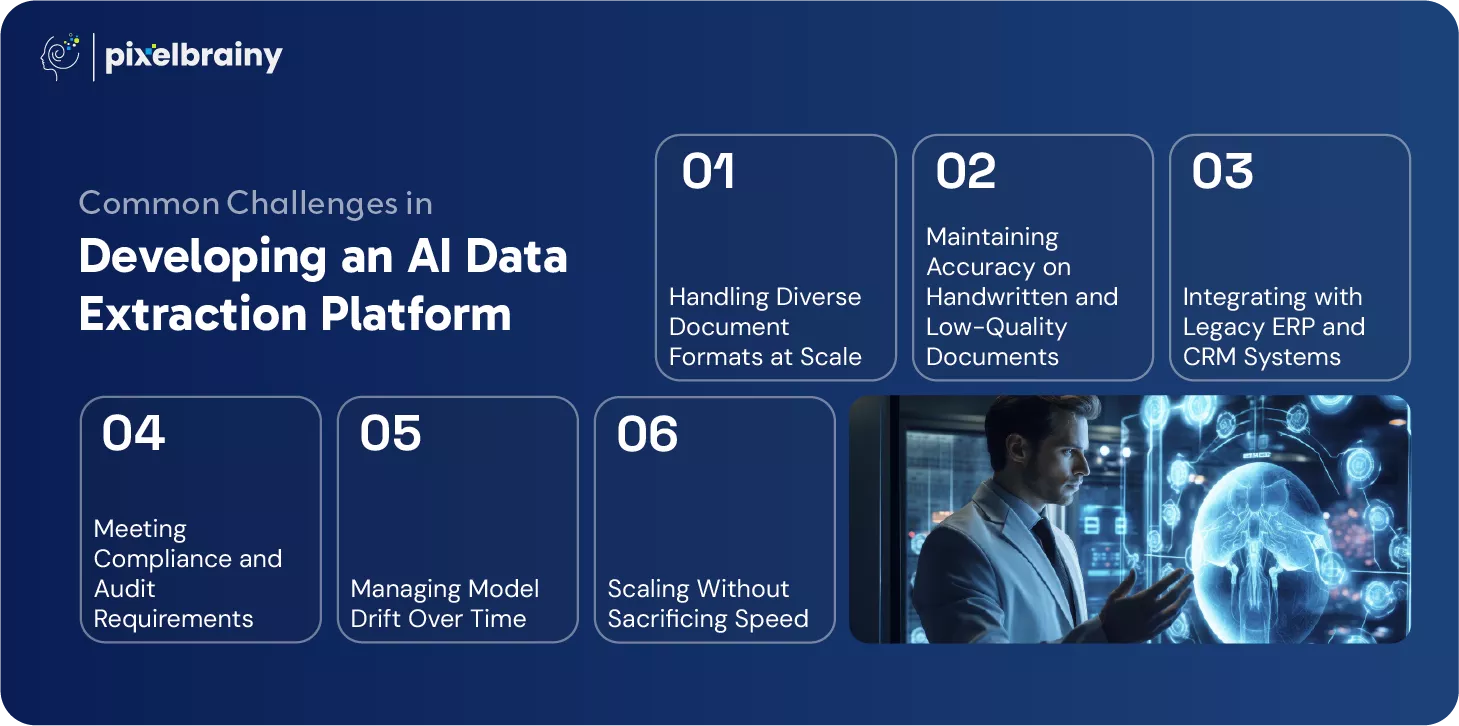
Challenge: Enterprises receive invoices, contracts, emails, scanned PDFs, handwritten forms, spreadsheets, and industry-specific documents in constantly changing formats. Rule-based systems and packaged solutions often fail when layouts vary.
Practical Solution: Organizations that develop AI data extraction platform for enterprises should use document classification models, layout-aware OCR engines, and adaptable extraction pipelines capable of handling structured, semi-structured, and unstructured content.
Cost of Ignoring It: Teams remain dependent on manual reviews, processing delays increase, and scaling operations requires additional headcount.
Challenge: Poor scan quality, handwritten notes, blurred images, and incomplete documents reduce extraction accuracy and increase exception rates.
Practical Solution: Combine advanced preprocessing techniques with intelligent OCR models trained on representative datasets. Human-in-the-loop validation should review low-confidence outputs before they enter business systems.
Cost of Ignoring It: Data quality issues lead to rework, customer dissatisfaction, payment errors, and unnecessary operational expenses.
Challenge: Many enterprises still rely on older systems that were never designed to support modern AI workflows.
Practical Solution: During AI-driven data extraction platform development, adopt an API-first architecture supported by middleware and integration connectors. This approach minimizes disruption while enabling gradual modernization.
Cost of Ignoring It: Employees continue performing duplicate data entry, reducing the efficiency gains automation is intended to deliver.
Challenge: Industries such as healthcare, financial services, and insurance must satisfy strict requirements related to data security, access control, and auditability.
Practical Solution: Incorporate encryption, role-based access controls, audit logs, confidence scoring, and approval workflows from the beginning rather than treating compliance as an afterthought.
Cost of Ignoring It: Regulatory penalties, failed audits, reputational damage, and increased legal exposure can outweigh any automation benefits.
Challenge: Document templates, business processes, and customer interactions evolve. Models that perform well today may become less accurate months later.
Practical Solution: Organizations focused on building AI data extraction platform capabilities should continuously monitor performance metrics, retrain models using validated corrections, and establish feedback loops with business users.
Cost of Ignoring It: Extraction accuracy gradually declines, causing hidden operational inefficiencies and eroding trust in the platform.
Challenge: As document volumes grow, enterprises must maintain performance without increasing processing delays or infrastructure costs.
Practical Solution: Design cloud-native architectures with containerization, auto-scaling capabilities, distributed processing, and workload prioritization to support peak demand efficiently.
Cost of Ignoring It: If our current data extraction process is causing us to miss SLA deadlines, customer experiences deteriorate, service commitments are missed, and revenue opportunities may be lost.
Many enterprises reach a point where they conclude, "We have tried three different off-the-shelf data extraction tools and none of them work." In these situations, the problem is rarely the concept of automation itself. More often, it is the mismatch between generic products and highly specific enterprise requirements.
The organizations that succeed with AI-powered extraction are not those that avoid challenges, but those that design for them from the beginning and treat adaptability as a core part of the platform strategy.
The pace of innovation in document intelligence is accelerating rapidly. Features considered advanced today may become standard expectations within the next few years. That is why enterprises investing in AI data extraction platform development must think beyond immediate requirements and evaluate how their architectural decisions will support future capabilities.
If your leadership team is asking, "We want to build a platform that will still be competitive and scalable in three years. What emerging trends should we factor into our AI data extraction platform development decisions today?" the answer is simple: design for adaptability. Building a platform that can evolve with changing technologies is far more cost-effective than rebuilding it from scratch 18 months later.
The following trends are shaping the future of developing AI data extraction platform solutions and should influence enterprise roadmaps today.
Traditional extraction systems identify fields and transfer data. Agentic AI goes several steps further by reasoning through complex tasks, making decisions, and executing follow-up actions autonomously.
For example, an AI agent could extract claim information, validate policy coverage, flag discrepancies, and initiate approval workflows without human intervention.
Development decision: Adopt modular architectures that can support autonomous agents and orchestration layers in the future.
Why it matters: Organizations that ignore this shift may struggle to automate increasingly sophisticated workflows.
Documents rarely consist of plain text alone. Contracts include signatures, invoices contain tables, and forms combine handwritten notes with structured fields.
Multimodal models process text, visual elements, tables, and images simultaneously, delivering more accurate understanding in a single pass.
Development decision: Choose OCR and AI components capable of supporting multimodal processing rather than isolated extraction engines.
Why it matters: Retrofitting multimodal capabilities later can significantly increase redevelopment costs.
Healthcare providers, financial institutions, and insurers increasingly need transparency around how extraction decisions are made.
Explainable AI provides confidence scores, source references, decision trails, and justifications for outputs generated by AI systems.
Development decision: Embed explainability features into the platform from the beginning rather than treating them as optional enhancements.
Why it matters: Future regulatory expectations will likely demand greater accountability from enterprise AI systems.
The future of building AI data extraction platform with RAG lies in combining retrieval systems with language models to improve reliability.
Rather than relying solely on model memory, Retrieval-Augmented Generation retrieves information directly from enterprise documents before generating responses or extracting insights.
Development decision: Evaluate RAG architectures early if your organization manages frequently changing policies, contracts, or knowledge repositories.
Why it matters: RAG improves accuracy, reduces hallucinations, and enables faster adaptation without expensive retraining efforts.
Many enterprises remain cautious about sending sensitive information to external cloud environments.
Edge deployments allow extraction models to run within on-premise infrastructure or private environments while maintaining compliance and control over critical data.
Development decision: Design deployment strategies that support both cloud and edge environments to maintain flexibility.
Why it matters: Organizations with strict privacy requirements may otherwise face costly migrations as regulatory expectations evolve.
These emerging trends in AI data extraction platform development for enterprise are not distant possibilities. They are already influencing how leading organizations design and prioritize their investments today.
The enterprises that remain competitive over the next three years will be those that build flexible, future-ready platforms capable of adapting to new AI capabilities without requiring a complete rebuild.
Enterprise teams rarely struggle because they lack access to OCR tools or AI models. The real challenge lies in building systems that can reliably process thousands of documents across inconsistent formats, integrate with existing enterprise applications, comply with regulatory standards, and continue performing accurately as business requirements evolve.
If you're asking, "Which companies in the United States specialize in AI data extraction platform development for large enterprises and have proven experience in financial document automation? What should we look for in a development partner?" the answer extends far beyond evaluating technical skills. Enterprise buyers need a partner that combines AI expertise with execution discipline, compliance awareness, and long-term operational support.
As an AI development company focused on enterprise innovation, PixelBrainy delivers AI data extraction platform development services designed to solve real-world document processing challenges rather than simply deploying pre-built automation tools.
US enterprises typically evaluate vendors based on five critical criteria:
PixelBrainy aligns with these requirements through a practical, engineering-led approach to enterprise AI data extraction platform development.
Enterprise document workflows are rarely predictable. Teams often deal with low-quality scans, shifting templates, handwritten inputs, fragmented systems, and evolving compliance obligations.
PixelBrainy addresses these challenges through custom AI data extraction platform development by building production-ready solutions that include:
This approach replaces fragile processing loops with resilient systems capable of scaling alongside the business.
| PixelBrainy Capability | Enterprise Impact |
|---|---|
| Advanced NLP, OCR, and LLM expertise | Higher extraction accuracy across diverse document types |
| HIPAA, SOC 2, and GDPR-ready development practices | Reduced compliance risks and stronger governance |
| SAP, Salesforce, Oracle, and Microsoft Dynamics integrations | Faster adoption without disrupting existing workflows |
| Custom extraction workflows and validation pipelines | Better alignment with industry-specific requirements |
| Human-in-the-loop review systems | Improved accuracy for high-risk processes |
| Post-launch monitoring and model retraining | Sustained performance as documents evolve |
| Transparent discovery and project scoping | Greater budget predictability and reduced delivery risks |
| Cloud, hybrid, and private deployment support | Flexibility based on enterprise security requirements |
Organizations seeking to build AI data extraction platform capabilities often benefit from partners that understand the operational nuances of different sectors.
PixelBrainy supports enterprises across industries such as:
This domain experience helps teams anticipate compliance considerations, identify relevant use cases faster, and reduce implementation friction.
Many vendors consider deployment the finish line. Enterprise buyers know it is only the beginning.
PixelBrainy's AI data extraction platform development services extend beyond implementation through:
For organizations saying, "We are looking to partner with a technology company that can build a custom AI data extraction platform," the evaluation criteria should focus on transparency, adaptability, and execution capability rather than marketing promises alone.
US enterprises choose PixelBrainy not because they need another software vendor, but because they need a strategic partner capable of transforming complex document workflows into secure, scalable, and measurable business outcomes.
Looking to upgrade your document pipelines with specialized AI infrastructure? Connect with the PixelBrainy AI team today.
AI data extraction has evolved into a business capability that helps enterprises process information faster, improve accuracy, strengthen compliance, and uncover insights hidden across vast volumes of documents. The success of these initiatives depends on making informed decisions around architecture, features, technology choices, implementation strategy, and long-term scalability.
Throughout this guide, we've explored the complete journey of AI data extraction platform development, including development steps, costs, industry use cases, essential features, emerging trends, and the build-versus-buy decision. Enterprises that approach these investments strategically can reduce manual workloads, accelerate operations, enhance customer experiences, and create a stronger foundation for data-driven growth.
The opportunity is not simply to automate document processing. It is to transform disconnected information into a reliable source of business intelligence that drives better decisions across the organization.
Ready to get started? Book an appointment with the PixelBrainy team to discuss your requirements and discover how a custom AI data extraction platform can deliver measurable efficiency, accuracy, and ROI for your enterprise.
The timeline depends on the platform's complexity, document types, integration requirements, and compliance needs. A basic MVP can typically be developed within 8 to 12 weeks, while a mid-tier enterprise solution may take 3 to 5 months. Large-scale platforms with custom AI models, multiple integrations, and regulatory controls often require 5 to 8 months. Starting with a focused use case and expanding incrementally is usually the fastest approach.
Traditional OCR converts printed or scanned text into machine-readable formats but lacks contextual understanding. AI-powered extraction goes several steps further by classifying documents, understanding relationships between entities, extracting relevant fields, assigning confidence scores, and validating outputs using business rules. In simple terms, OCR reads text, while AI understands and interprets the information within documents.
Yes. Modern platforms are designed with API-first architectures that support seamless integration with enterprise systems such as SAP, Salesforce, Oracle, Microsoft Dynamics, EHR systems, claims platforms, and legacy databases. These integrations eliminate duplicate data entry, improve workflow efficiency, and ensure extracted information flows directly into the systems your teams already use.
Compliance should be incorporated into the development process from the beginning. Enterprises typically implement role-based access controls, end-to-end encryption, audit trails and activity logging, data retention policies, secure authentication mechanisms, human review workflows for sensitive documents, and regular security testing and compliance assessments. Building these controls into the architecture helps organizations meet HIPAA and SOC 2 expectations while reducing regulatory risks.
The answer depends on your internal capabilities and business priorities. Building in-house can be effective if you have experienced AI engineers, domain specialists, and sufficient time to manage development and ongoing optimization. Partnering with an external development company is often more practical for enterprises seeking faster implementation, specialized expertise, and reduced execution risk. Many organizations choose a hybrid approach, combining internal stakeholders with an experienced technology partner to accelerate delivery.
Document formats evolve over time due to new vendors, regulatory updates, and changing business processes. Enterprise-grade platforms address this through continuous monitoring, confidence scoring, human-in-the-loop validation, and periodic model retraining. Rather than rebuilding the system from scratch, teams can update classification rules, retrain extraction models using new examples, and fine-tune workflows to maintain accuracy. A well-designed AI data extraction platform is built to adapt as your documents and business requirements evolve.

About The Author
Sagar Bhatnagar
Sagar Sahay Bhatnagar brings over a decade of IT industry experience to his role as Marketing Head at PixelBrainy. He's known for his knack in devising creative marketing strategies that boost brand visibility and market influence. Sagar's strategic thinking, coupled with his innovative vision and focus on results, sets him apart. His track record of successful campaigns proves his ability to utilize digital platforms effectively for impactful marketing efforts. With a genuine passion for both technology and marketing, Sagar continuously pushes PixelBrainy's marketing initiatives to greater success.


Transform your ideas into reality with us.
Working with the PixelBrainy team has been a highly positive experience. They understand the design requirements and create beautiful UX elements to meet the application needs. The dev team did an excellent job bringing my vision to life. We discussed usability and flow. Sagar worked with his team to design the database and begin coding. Working with Sagar was easy. He has the knowledge to create robust apps, including multi-language support, Google and Apple ID login options, Ad-enabled integrations, Stripe payment processing, and a Web Admin site for maintaining support data. I'm extremely satisfied with the services provided, the quality of the final product, and the professionalism of the entire process. I highly recommend them for Android and iOS Mobile Application Design and Development.

Great experience working with them. Had a lot of feedback and I found that unlike most contractors they were bugging me for updates instead of the other way around. They were extremely time conscience and great at communicating! All work was done extremely high quality and if not on time, early! They were always proactive when it comes to communication and the work is great/above par always. Very flexible and a great team to work with! Goes above and beyond to present us with multiple options and always provides quality. Amazing work per usual with Chitra. If you have UI/UX or branding design needs I recommend you go to them! Will likely work with them in the future as well, definitely recommended!

PixelBrainy is a joy to work with and is a great partner when thinking through branding, logo, and website layout. I appreciate that they spend time going into the "why" behind their decisions to help inform me and others about industry best practices and their expertise.

I hired them to design our software apps. Things I really like about them are excellent communication skills, they answer all project suggestions and collaborate right away, and their input on design and colors is amazing. This project was complex and needed patience and creativity. The team is amazing to do business with. I will be using them long-term. Glad to see there are some good people out there. I was afraid to try and outsource my project to someone but I am glad I met them! I really can't say enough. They went above and beyond on this project. I am very happy with everything they have done to make my business stand out from the competition.

It was great working with PixelBrainy and the team. They were very responsive and really owned the project. We'll definitely work with them again!

I recently worked with the PixelBrainy team on a project and I was blown away by their communication skills. They were prompt, clear, and articulate in all of our interactions. They listened and provided valuable feedback and suggestions to help make the project a success. They also kept me updated throughout the entire process, which made the experience stress-free and enjoyable.

PixelBrainy is very good at what it does. The team also presents themselves very professionally and takes care of their side of things very well. I could fully trust them taking up the design work in a timely and organised manner and their attention to detail saved us lots of effort and time. This particular project was quite intense and the team showed that they function very well under pressure. Very much looking forward to working with her again!

It's always an absolute pleasure working with them. They completed all of my requests quickly and followed every note I had for them to a T, which made our process go smoothly from start to finish. Everything was completed fast and following all of the guidelines. And I would recommend their services to anyone. If you need any design work done in the future, PixelBrainy should be your first call!

They took ownership of our requirements and designed and proposed multiple beautiful variants. The team is self-motivated, requires minimum supervision, committed to see-through designs with quality and delivering them on time. We would definitely love to work with PixelBrainy again when we have any requirements.

PixelBrainy was a big help with our SaaS application. We've been hard at work with a new UI/UX and they provided a lot of help with the designs. If you're looking for assistance with your website, software, or mobile application designs, PixelBrainy and the team is a great recommendation.

PixelBrainy designers are amazing. They are responsive, talented, and always willing to help craft the design until it matches your vision. I would recommend them and plan to continue them for my future projects and more!!!

They were awesome! Did a good job fast, and good communication. Will work with them again. Thank you

Creative, detail-oriented, and talented designers who take direction well and implement changes quickly and accurately. They consistently over-delivered for us.

PixelBrainy team is very talented and creative. Great designers and a pleasure to work with. PixelBrainy is an excellent communicator and I look forward to working with them again.

PixelBrainy has a very talented design team. Their work is excellent and they are very responsive. I enjoy working with them and hope to continue on all of our future projects.


