AI Summary Powered by PixelBrainy
What if your dating platform could help users create better profiles, generate engaging opening messages, recommend compatible matches, and provide personalized conversation guidance without human intervention?
This is exactly why businesses are investing in AI dating agent development. Instead of relying solely on traditional matching algorithms, founders are exploring intelligent AI agents that can understand user preferences, analyze conversation context, personalize recommendations, and continuously improve interactions based on real user behavior. These capabilities enable dating platforms to deliver a more engaging and personalized experience while increasing user satisfaction and retention.
The demand is also reflected in the types of questions founders are asking. A common example is: "I am a founder working on a new dating product and I need to integrate a conversational AI agent that helps users write better bios and opening messages. Who are the top AI development agencies in the USA that specialize in building AI agents for consumer platforms?" This growing interest shows that companies are actively searching for experienced partners offering AI-powered dating agent development and specialized dating AI agent development services to turn product ideas into intelligent, scalable solutions.
Market trends further support this shift. According to Precedence Research, the global AI agents market is projected to grow from USD 11.55 billion in 2026 to nearly USD 294.66 billion by 2035, expanding at a compound annual growth rate (CAGR) of 43.57%. This rapid growth indicates that AI agents are becoming a core technology for businesses seeking to automate personalized user experiences across industries, including online dating.
For startups, matchmaking businesses, and established dating platforms, the focus has shifted from simply adding AI features to developing an AI dating agent for a dating platform that can perform meaningful tasks independently. Whether the objective is to build an AI dating agent that improves profile quality, delivers smarter matchmaking, assists with conversations, or enhances long-term engagement, choosing the right development approach plays a significant role in creating a competitive and user-centric product.
This guide explains everything you need to know about AI dating agent development, including its architecture, business benefits, core features, development process, technology stack, best practices, and implementation challenges.
An AI dating agent is an intelligent software system that uses artificial intelligence to understand user preferences, analyze interactions, and perform personalized dating related tasks with minimal human input. Unlike a traditional chatbot that responds to predefined prompts, an AI dating agent can interpret context, learn from user behavior, and make intelligent recommendations based on individual goals and communication patterns.
Businesses investing in AI dating agent development use these agents to help users create compelling profiles, generate personalized bios, suggest conversation starters, recommend compatible matches, provide reply suggestions, and deliver tailored dating guidance. The agent continuously improves its recommendations by processing user feedback, preferences, and historical interactions, resulting in a more engaging and personalized experience.
As demand for intelligent matchmaking grows, organizations are choosing to build AI dating agents that enhance user engagement, increase retention, and differentiate their platforms through AI driven personalization. These capabilities make AI dating agents a valuable innovation for startups and enterprises looking to create smarter, user focused dating experiences.
An AI dating agent follows a structured workflow that transforms user input into intelligent, personalized actions. Instead of generating generic responses, it combines multiple AI components to understand context, retrieve relevant information, make decisions, and deliver recommendations that align with each user's preferences and behavior.
The process begins when a user interacts with the platform by creating a profile, asking for a better bio, requesting message suggestions, or searching for compatible matches. This input becomes the starting point for the AI agent's decision-making process.
The AI agent uses Natural Language Processing (NLP) to understand what the user is trying to achieve. It identifies intent, analyzes conversational context, detects sentiment, and extracts important details such as interests, relationship goals, communication style, and preferences.
Before generating a response, the AI agent gathers relevant information from multiple sources. This may include user profiles, previous conversations, compatibility data, platform guidelines, and stored preferences. Many organizations use Retrieval Augmented Generation (RAG) to provide the language model with real-time and personalized information, improving both relevance and accuracy.
The processed information is sent to a Large Language Model (LLM) such as GPT, Claude, Gemini, or Llama. The model evaluates the available context and generates personalized recommendations, conversation suggestions, profile improvements, or matchmaking insights based on the user's specific requirements.
An effective AI dating agent remembers previous interactions instead of treating every conversation as a new request. A dedicated memory layer stores user preferences, communication history, favorite interests, and behavioral patterns, allowing the AI to provide increasingly personalized experiences over time.
The recommendation engine analyzes compatibility scores, user activity, profile similarities, and engagement signals to identify meaningful matches. At the same time, the AI can suggest profile enhancements, generate personalized opening messages, recommend replies, or provide conversation guidance that reflects each user's communication style.
Every interaction helps improve the AI agent's performance. User feedback, engagement metrics, successful conversations, and behavioral insights are used to refine recommendations, optimize responses, and improve matchmaking quality while maintaining privacy and security standards.
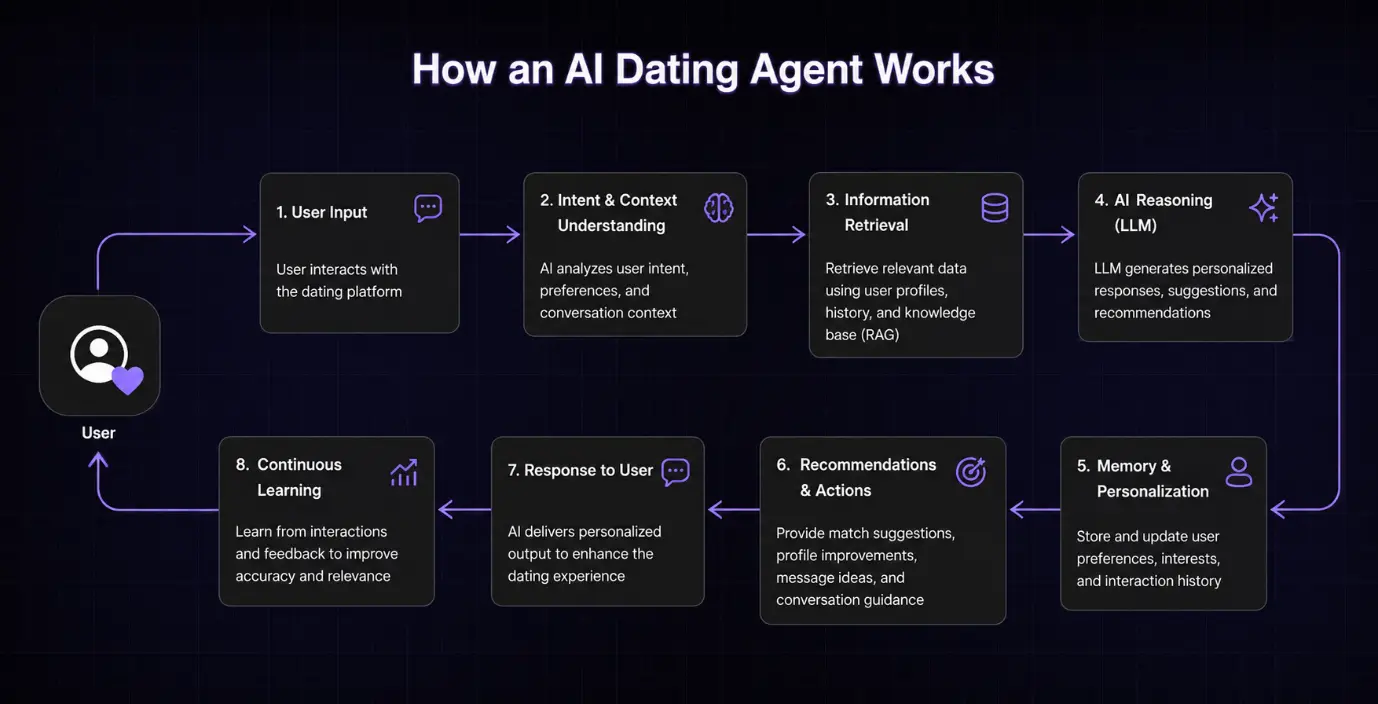
This architecture enables businesses to build AI dating agents that deliver intelligent matchmaking, personalized conversations, profile optimization, and context-aware recommendations while ensuring scalability, accuracy, and an engaging user experience.
Founders are approaching dating platforms differently than they did a few years ago. Instead of competing only on user acquisition, they are focusing on creating intelligent experiences that encourage users to stay engaged and return to the platform. Several market and technology trends are driving this shift.
People interact with AI across shopping, entertainment, banking, and productivity applications every day. The same expectation now extends to dating platforms. Users want assistance with creating better profiles, writing personalized opening messages, discovering compatible matches, and receiving recommendations that reflect their interests and communication style.
This growing demand is encouraging startups to invest in AI dating agent development for startups that can deliver personalized experiences throughout the customer journey.
The opportunity for AI powered dating products continues to grow alongside the online dating industry.
According to Statista, the global online dating market is expected to generate US$3.24 billion in revenue in 2026, highlighting sustained demand for digital matchmaking services worldwide.
For founders, this creates room for differentiated products that compete through intelligence rather than feature parity.
Building intelligent AI products has become significantly more practical because of advancements in Large Language Models, Retrieval Augmented Generation (RAG), vector databases, AI memory, and agent orchestration frameworks.
Instead of spending years building proprietary AI systems, businesses can develop AI dating agents using mature technologies that support contextual reasoning, personalized recommendations, and continuous learning.
The opportunity is not limited to startups.
Many established dating businesses are integrating AI capabilities into their existing platforms to improve user engagement without rebuilding their entire ecosystem.
Common areas of AI adoption include:
This allows businesses to introduce intelligent experiences while leveraging their existing infrastructure.
Founders launching a dating platform today are looking beyond basic profile matching.
Their objective is to build an AI dating agent for a new dating platform that actively helps users achieve better outcomes instead of acting as a passive recommendation system.
An intelligent AI agent can become one of the platform's strongest differentiators by assisting users at every stage, from onboarding and profile optimization to conversations, matchmaking, and long-term engagement.
As user expectations continue to evolve, AI is becoming a core component of product strategy rather than an optional enhancement. Businesses investing in AI dating agent development for startups today are building platforms designed around personalization, intelligent assistance, and continuous user engagement, positioning themselves for sustainable growth in an increasingly competitive market.
When founders begin planning an AI powered dating platform, one of the first questions they ask is:
"We're planning to launch a dating platform similar to Bumble and Hinge. We want an AI agent that improves profile quality, recommends compatible matches, and assists users during conversations. Which AI development company can build this solution, and what business value will an AI dating agent actually bring to our platform?"
The answer goes far beyond adding an AI feature. A well-designed AI dating agent becomes an intelligent layer that continuously assists users throughout their journey while helping businesses improve engagement, product adoption, and platform performance.
Whether you're planning to build a smart AI dating assistant for a new product or develop an AI dating agent with conversational AI for an existing platform, the investment creates measurable business value across multiple areas. Here are the most significant benefits founders should consider before starting their AI dating agent development journey.
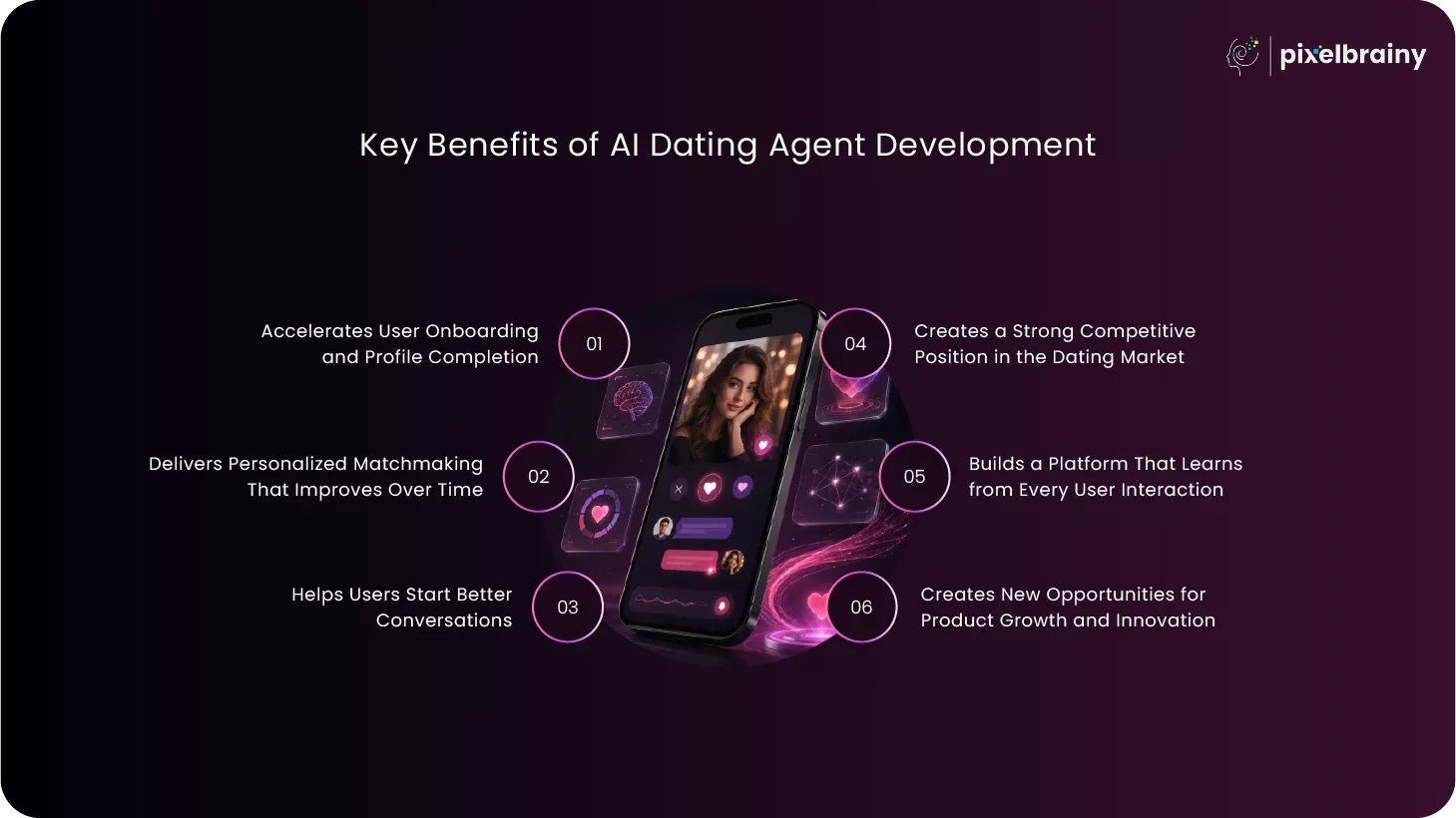
The first few minutes after a user-registers often determine whether they remain active or abandon the platform. Many users struggle to write an attractive bio, choose the right profile information, or decide how to introduce themselves.
An AI dating agent simplifies this process by suggesting personalized bios, improving profile descriptions, recommending interests to highlight, and generating engaging introductions. Instead of leaving users to complete every step manually, the platform actively guides them toward creating a stronger profile.
This creates a smoother onboarding experience, increases profile completion rates, and helps users reach their first meaningful interaction much faster.
Successful matchmaking depends on much more than age, location, or shared interests. Every user communicates differently, has unique relationship goals, and interacts with the platform in their own way.
Businesses developing an AI dating agent with conversational AI can analyze behavioral signals, engagement history, communication patterns, and user preferences to deliver increasingly personalized recommendations. As the AI learns from ongoing interactions, matchmaking becomes smarter and more relevant with every session.
The result is a platform that continuously improves the quality of recommendations instead of relying on static matching rules.
Many matches never turn into meaningful conversations because users struggle with writing the first message or keeping the conversation engaging. This often leads to inactive matches and lower platform engagement.
A smart AI dating agent can generate personalized opening messages, recommend context aware replies, suggest conversation topics, and even adapt its recommendations based on the personalities of both users.
For businesses looking to build a smart AI dating assistant, this capability encourages more active conversations, improves user confidence, and increases the chances of successful interactions across the platform.
Thousands of dating platforms offer similar experiences based on profile discovery, swiping, and messaging. Competing with the same feature set makes it difficult for new businesses to stand out.
Founders who create an AI dating agent for Bumble and Hinge style experiences can introduce intelligent profile coaching, AI assisted messaging, contextual matchmaking, and proactive user guidance that many traditional platforms still lack.
These capabilities help establish a stronger market position while giving users a compelling reason to choose one platform over another.
Unlike rule-based systems that follow predefined logic, AI agents continuously improve through user interactions. Every profile update, conversation, preference change, and engagement signal provides valuable data that helps refine future recommendations.
Over time, the platform becomes better at understanding user intent, predicting compatibility, and delivering personalized assistance without requiring constant manual optimization.
This creates a product that becomes more valuable as its user base continues to grow.
An AI dating agent serves as a foundation for introducing new AI powered capabilities without rebuilding the platform from scratch. Businesses can gradually expand into AI profile reviews, multilingual conversations, voice interactions, relationship coaching, premium AI assistants, safety monitoring, and intelligent recommendation services.
For startups investing in AI dating agent development for startups, this flexibility supports continuous product innovation while opening new opportunities for premium offerings, user engagement, and long-term platform growth.
AI dating agent development is more than implementing artificial intelligence. It is about building a smarter dating platform that continuously learns, personalizes every interaction, and creates lasting value for both users and the business.
Building a successful AI dating agent requires more than integrating a large language model into a dating platform. Every feature should solve a specific user challenge while contributing to higher engagement, better matchmaking, and long-term retention. Whether you're planning to build an AI dating agent, develop an AI dating assistant, or integrate conversational AI into an existing platform, selecting the right capabilities is critical for delivering a personalized user experience.
A common question founders ask is:
"We're developing a dating platform with AI capabilities. Which features should we prioritize to create an AI dating agent that delivers real value instead of acting like a basic chatbot?"
The following features form the foundation of a scalable and intelligent AI dating agent.
| Feature | Description |
| AI Profile Builder | Automatically creates engaging bios, headlines, and profile descriptions by analyzing user interests, personality, hobbies, and relationship goals. This helps users complete attractive profiles faster while improving profile quality and increasing the likelihood of receiving compatible matches. |
| Profile Optimization | Continuously reviews user profiles and recommends improvements based on engagement metrics, successful profile patterns, profile completeness, and behavioral insights. Regular optimization helps users remain competitive while increasing profile visibility and overall interaction rates. |
| Intelligent Matchmaking | Uses artificial intelligence to analyze user preferences, communication styles, interests, location, behavioral patterns, and compatibility signals instead of relying only on traditional filters. This enables more accurate match recommendations that improve user satisfaction and engagement. |
| AI Conversation Starters | Generates personalized opening messages by analyzing both user profiles, mutual interests, hobbies, and communication preferences. Context aware conversation starters reduce hesitation, encourage first interactions, and help users initiate more meaningful conversations confidently. |
| Smart Reply Suggestions | Suggests natural, context aware responses during conversations by understanding previous messages, emotional tone, and communication style. This helps users maintain engaging discussions while reducing awkward pauses and improving overall conversation quality. |
| Conversation Coaching | Acts as a real time communication assistant by recommending better phrasing, identifying conversation opportunities, and providing guidance to improve confidence throughout different stages of user interactions without replacing authentic communication. |
| User Preference Learning | Learns continuously from profile updates, likes, dislikes, swiping behavior, conversations, and engagement history. As more interactions occur, the AI delivers increasingly personalized recommendations that closely align with each user's evolving preferences. |
| Personalized Recommendations | Recommends compatible matches, conversation topics, profile improvements, and engagement suggestions based on user behavior, interests, relationship goals, and previous interactions. Every recommendation becomes more relevant as the AI gathers additional contextual information. |
| AI Memory Management | Stores long term preferences, previous conversations, favorite interests, and communication patterns to provide consistent interactions across multiple sessions. Memory enables the AI dating agent to personalize recommendations without repeatedly requesting the same information. |
| Sentiment Analysis | Evaluates the emotional tone of conversations to understand user sentiment, detect frustration or positive engagement, and recommend appropriate responses. This creates healthier conversations while supporting respectful communication across the dating platform. |
| Fake Profile Detection | Identifies suspicious accounts by analyzing unusual activity patterns, duplicate content, fake identities, automated behavior, and profile inconsistencies. AI driven fraud detection helps improve platform credibility while protecting genuine users from malicious interactions. |
| Content Moderation | Automatically detects abusive language, harassment, spam, explicit content, policy violations, and inappropriate behavior before messages reach other users. Intelligent moderation creates a safer environment while reducing manual moderation efforts for platform administrators. |
| Voice AI Assistance | Enables users to communicate with the AI agent using voice commands for profile creation, matchmaking assistance, conversation guidance, and dating recommendations. Voice interactions improve accessibility while creating a more natural user experience across devices. |
| Multilingual Support | Supports multiple languages by translating conversations, generating localized responses, and personalizing recommendations according to regional preferences. This allows dating platforms to expand internationally while providing seamless experiences for diverse global audiences. |
| Analytics & Performance Dashboard | Provides administrators with actionable insights into user engagement, AI performance, conversation quality, matchmaking accuracy, feature adoption, and platform activity. These analytics help businesses optimize AI strategies and continuously improve overall product performance. |
Selecting the right combination of AI features enables businesses to build an intelligent dating agent that delivers personalized experiences, strengthens user engagement, and creates a scalable foundation for future AI innovations.
Once the core capabilities are in place, the next step is to enhance the AI dating agent with advanced features that deliver deeper personalization, automation, and intelligence. These capabilities help businesses move beyond standard matchmaking by creating AI agents that can reason, adapt, remember user preferences, and proactively assist throughout the dating journey. For startups aiming to build AI first platforms, these advanced features can significantly improve user engagement while creating a stronger competitive advantage.
A common question founders ask is:
"We already have profile optimization, matchmaking, and messaging features. What advanced AI capabilities should we implement to build an intelligent dating agent that stands out from other dating platforms?"
The following advanced features are worth considering while developing an AI dating agent.
| Advanced Feature | Description |
| Multimodal AI Interaction | Enables the AI dating agent to understand and process text, voice, images, and videos together. This allows users to receive personalized recommendations, profile feedback, and conversation assistance using multiple forms of communication for a richer dating experience. |
| Agentic AI Decision Making | Allows the AI agent to autonomously perform tasks such as recommending matches, scheduling reminders, suggesting profile updates, and planning conversation strategies based on user goals without requiring constant user instructions or manual intervention. |
| Long Term Contextual Memory | Stores long term relationship preferences, previous conversations, communication patterns, successful interactions, and user feedback. This enables the AI to deliver highly personalized recommendations while maintaining continuity across weeks or months of platform usage. |
| Emotion & Behavioral Intelligence | Combines sentiment analysis with behavioral patterns to understand user emotions, communication preferences, confidence levels, and interaction styles. The AI adjusts recommendations dynamically to create more empathetic and personalized dating experiences for every user. |
| AI Compatibility Prediction Engine | Uses machine learning models to predict long term compatibility by analyzing shared interests, personality traits, communication habits, behavioral signals, and historical engagement instead of relying only on profile based matching algorithms. |
| AI Date Planning Assistant | Automatically recommends restaurants, cafes, events, travel destinations, and activities based on user interests, availability, location, weather conditions, and previous interactions, making it easier for users to plan meaningful real-world dates. |
| Explainable AI Recommendations | Provides transparent explanations for every recommendation, helping users understand why a particular match, conversation suggestion, or profile improvement was generated. This increases user trust while improving confidence in AI driven decision making. |
| Adaptive Recommendation Engine | Continuously updates matchmaking and conversation recommendations using real time behavioral data, profile modifications, user feedback, and engagement history. The AI adapts automatically as user preferences evolve over time without requiring manual configuration. |
| Safety Risk Detection System | Detects suspicious behaviors such as scams, harassment, fake identities, manipulation attempts, and unusual communication patterns using AI models. Early risk detection improves user safety while strengthening trust across the dating platform ecosystem. |
| Premium AI Relationship Coach | Provides personalized relationship advice, conversation improvement tips, communication coaching, confidence building suggestions, and post-date feedback through an intelligent AI assistant, creating additional premium services and long-term engagement opportunities. |
Implementing these advanced AI capabilities enables businesses to develop intelligent dating agents that deliver deeper personalization, stronger user engagement, and scalable innovation while preparing the platform for future AI driven experiences.
Building an AI dating agent involves much more than integrating a Large Language Model into a dating platform. It requires careful planning, data preparation, intelligent architecture, feature development, continuous testing, and ongoing optimization to deliver a personalized and scalable user experience. Whether you're exploring AI dating agent development for startups, planning to build an AI-powered dating agent from scratch, or wondering how to develop an AI dating agent for Tinder style platforms, following a structured development process significantly reduces risks and accelerates product delivery.
A common question founders ask is:
"We are planning to create a niche dating platform for professionals and want to build an AI dating agent that filters matches based on career, values, and lifestyle compatibility. Which AI development companies in the USA have experience building this kind of intelligent agent?"
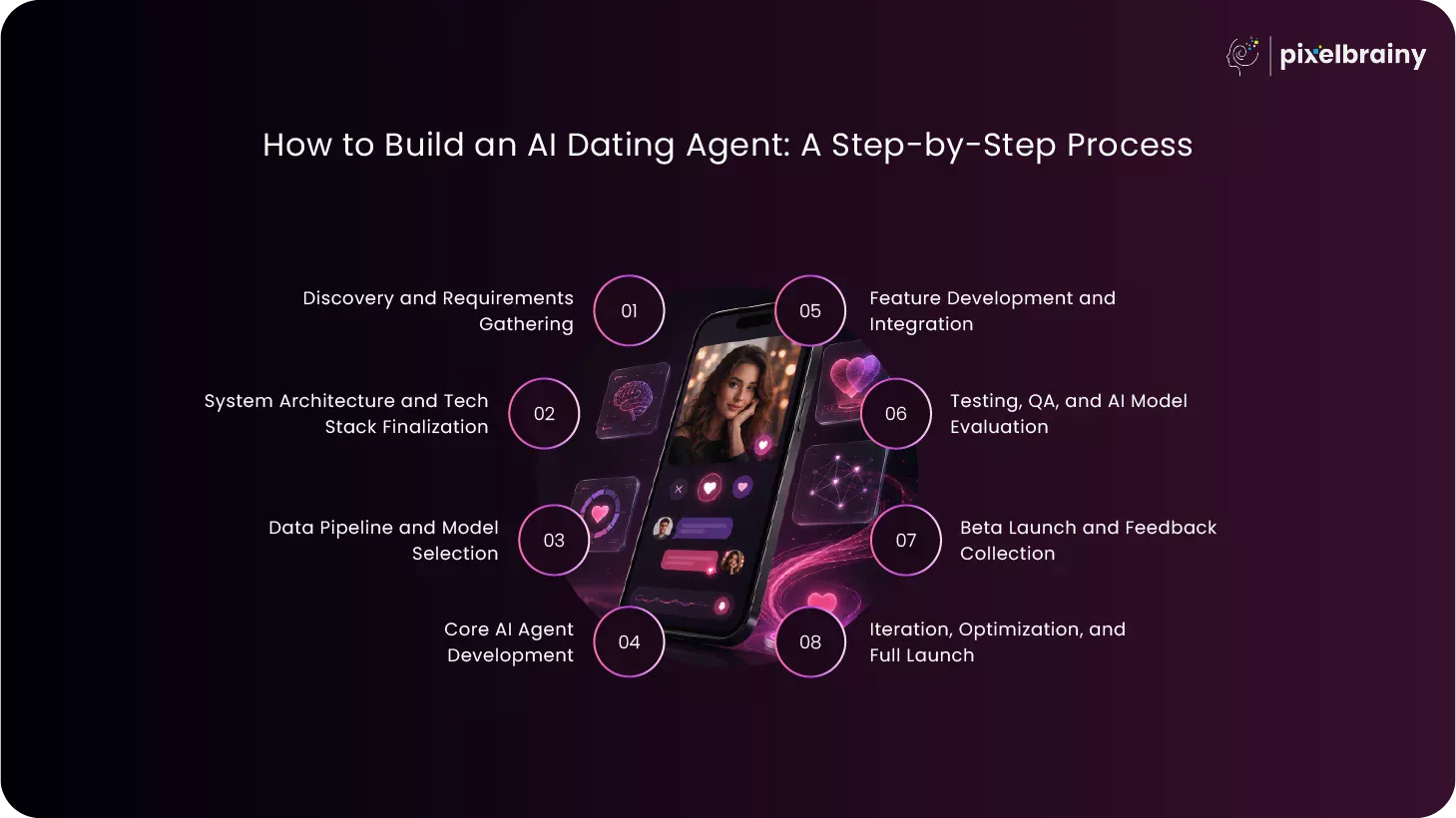
The following roadmap outlines the typical development lifecycle followed by experienced AI development developers/teams.
What Happens?
The project begins with understanding the business vision, target audience, user journeys, monetization strategy, AI objectives, and platform requirements. During this stage, the development team identifies which AI capabilities should be included in the first release and defines measurable project goals.
This is also the ideal phase to validate product assumptions through PoC development before committing to full scale implementation.
Who Is Involved?
Estimated Timeline
1 to 2 Weeks
What Happens?
Once the requirements are finalized, the technical foundation is designed. The team selects the overall architecture, cloud infrastructure, databases, APIs, authentication methods, security strategy, and AI frameworks that will support long term scalability.
At this stage, collaboration with an experienced AI consulting services provider helps define a future ready architecture, while a skilled UI/UX design company prepares user journeys and interface prototypes for both web and mobile experiences.
Who Is Involved?
Estimated Timeline
1 to 2 Weeks
What Happens?
This stage focuses on preparing high quality datasets and selecting the most suitable AI models. User profiles, conversation history, behavioral signals, and recommendation data are organized to support personalized matchmaking and conversational intelligence.
Businesses often partner with an experienced AI model development company to evaluate whether GPT, Claude, Gemini, Llama, or custom fine-tuned models best align with the platform's goals.
Who Is Involved?
Estimated Timeline
2 to 3 Weeks
What Happens?
This is where the intelligent agent is built. Developers implement conversational AI, memory management, reasoning capabilities, Retrieval Augmented Generation (RAG), recommendation logic, user preference learning, and agent workflows.
For founders researching how to make an AI dating agent, this phase forms the core intelligence that enables personalized matchmaking, profile coaching, and conversational assistance.
Who Is Involved?
Estimated Timeline
4 to 6 Weeks
What Happens?
After the AI engine is operational, business features are integrated into the platform. These may include profile optimization, intelligent matchmaking, AI generated conversation starters, reply suggestions, sentiment analysis, moderation, notifications, payment gateways, and analytics dashboards.
During this phase, seamless AI integration ensures the agent works efficiently with existing systems, third party services, and frontend applications.
Many startups also use this stage to launch an MVP development version that includes only the highest priority AI capabilities for early market validation.
Who Is Involved?
Estimated Timeline
4 to 5 Weeks
What Happens?
Before deployment, the complete platform undergoes rigorous testing. Functional testing, security testing, performance testing, AI response evaluation, hallucination testing, recommendation accuracy, and usability assessments ensure the AI agent performs reliably under different scenarios.
This phase helps identify issues before they affect real users while improving overall product quality.
Who Is Involved?
Estimated Timeline
2 to 3 Weeks
What Happens?
A limited group of users gains access to the platform to evaluate AI recommendations, matchmaking quality, profile suggestions, conversation assistance, and overall usability.
User feedback, behavioral analytics, and engagement metrics collected during this stage help prioritize improvements before the public release.
Who Is Involved?
Estimated Timeline
2 to 4 Weeks
What Happens?
The final stage focuses on refining AI performance using beta feedback, optimizing recommendation quality, improving conversational accuracy, enhancing platform scalability, and preparing production infrastructure for public launch.
Many founders also evaluate partnerships with top AI agent development companies during this stage to support future feature expansion, AI optimization, and continuous innovation after launch.
Who Is Involved?
Estimated Timeline
2 to 3 Weeks
| Development Phase | Estimated Duration |
| Discovery & Requirements | 1 to 2 Weeks |
| Architecture & Tech Stack | 1 to 2 Weeks |
| Data Pipeline & Model Selection | 2 to 3 Weeks |
| Core AI Agent Development | 4 to 6 Weeks |
| Feature Development & Integration | 4 to 5 Weeks |
| Testing & AI Evaluation | 2 to 3 Weeks |
| Beta Launch & Feedback | 2 to 4 Weeks |
| Optimization & Full Launch | 2 to 3 Weeks |
| Total Estimated Timeline | 18 to 28 Weeks |
Following a structured development roadmap helps founders reduce project risks, accelerate product delivery, and create an AI dating agent that is scalable, secure, and ready for real world users from day one.
One of the biggest decisions founders face after validating their product idea is determining which technologies can support an intelligent, scalable, and production ready AI dating agent. The answer depends on the type of experience you want to deliver, whether it is AI powered matchmaking, conversational assistance, profile optimization, or autonomous decision making.
This challenge is reflected in the questions businesses frequently ask:
"Our team is looking to build a next generation dating platform where an AI agent manages the entire user journey from profile creation and matchmaking to conversation assistance. Which AI development company has hands on experience building autonomous AI agents using LangChain, LangGraph, and modern LLMs?"
Another common request is:
"We're looking for an AI agent development company that can help us build an intelligent dating assistant with conversational AI, memory, and personalized recommendations using an enterprise grade technology stack."
If your objective is to build an AI dating agent using LLMs and vector search or you're developing an AI dating agent with conversational AI, the following technology stack provides a reliable foundation for building secure, scalable, and intelligent AI solutions.
| Technology Layer | Recommended Tools & Technologies | Why It Is Recommended |
| AI & LLM Layer | GPT-4.1, GPT-4o, Claude 4, Gemini 2.5, Llama 3, Mistral | Powers natural conversations, intelligent reasoning, profile generation, personalized recommendations, and contextual understanding, making it the core layer for conversational AI experiences. |
| Vector Database | Pinecone, Weaviate, pgvector, Milvus | Stores embeddings and enables semantic search, AI memory, Retrieval Augmented Generation (RAG), and highly personalized recommendations based on user interactions. |
| Agent Framework | LangChain, LangGraph, CrewAI, AutoGen | Builds autonomous AI workflows, multi step reasoning, tool execution, memory handling, and complex decision making required for intelligent AI agents. |
| Backend Framework | Python, FastAPI, Node.js, NestJS | Manages APIs, authentication, business logic, AI orchestration, and communication between frontend applications and AI services with high performance. |
| Database Layer | PostgreSQL, MongoDB, Redis | Stores user profiles, conversations, preferences, recommendations, analytics, and application data while supporting structured and unstructured information efficiently. |
| Real Time Communication | WebSockets, Firebase, Socket.IO | Enables instant messaging, live AI responses, typing indicators, notifications, and seamless real time communication between users and AI agents. |
| Cloud Infrastructure | AWS, Google Cloud Platform (GCP), Microsoft Azure | Provides scalable infrastructure, managed AI services, secure storage, monitoring, load balancing, and high availability for enterprise grade AI applications. |
| ML & Model Training | TensorFlow, PyTorch, Hugging Face Transformers, Scikit-learn | Supports recommendation models, compatibility prediction, sentiment analysis, fine tuning, experimentation, and continuous improvement of AI capabilities. |
| API Integration Layer | REST APIs, GraphQL, OpenAPI, OAuth 2.0 | Connects payment gateways, authentication providers, maps, calendars, notifications, external AI models, and third party services through secure integrations. |
| Security & Compliance Layer | GDPR, AES-256 Encryption, TLS/SSL, JWT Authentication, OAuth 2.0, RBAC | Protects user information, encrypts sensitive data, secures authentication, and ensures compliance with global privacy standards for dating platforms. |
A well-planned technology stack allows businesses to deliver reliable AI dating agent development services while creating intelligent, scalable, and secure platforms that can evolve as user expectations and AI capabilities continue to grow.
The fastest way to understand where the dating industry is heading is to study the products that are already introducing AI into the user experience. These examples validate that users are actively adopting AI powered dating assistance while giving founders practical ideas for AI dating agent development.
If you're planning to build an AI dating agent or expand an existing dating platform, these products demonstrate which AI capabilities are gaining traction today.
Overview
DatingAIAgent.com positions itself as a personal AI dating concierge rather than a dating platform. Instead of helping users find matches directly, it acts as an AI companion that supports every stage of the dating experience after users join a dating app.
Its focus is helping individuals become more confident during real dating interactions instead of replacing existing matchmaking platforms.
Key Features
Target Audience
Individual singles who want an AI assistant to improve their dating success across existing dating platforms.
Founder Takeaway
This is an excellent example of a consumer-focused AI product that proves users are willing to pay for intelligent dating assistance. However, its scope begins after users already have matches.
For founders investing in AI dating assistant development, this creates a larger opportunity. Your AI dating agent can support the complete user journey, including profile creation, intelligent matchmaking, conversation assistance, date planning, and post-date engagement instead of focusing only on coaching.
Overview
Hinge continues to invest heavily in artificial intelligence to improve compatibility recommendations and reduce friction during conversations. In 2025, the company enhanced its recommendation system using deep learning, contributing to a double digit increase in successful matches across the platform.
Alongside recommendation improvements, Hinge introduced AI powered conversation tools that help users initiate more engaging interactions and evaluate profile quality.
Key Features
Target Audience
Users seeking meaningful long-term relationships with personalized matchmaking support.
Founder Takeaway
Even an established platform with millions of users continues investing in AI instead of relying solely on traditional matching algorithms. This validates that AI agents can significantly improve engagement without requiring businesses to rebuild their entire platform.
A common founder question reflects this trend:
"We want to build a dating platform similar to Hinge but with an AI agent that learns user preferences and delivers smarter matchmaking. Which AI development company has experience building this type of solution?"
Overview
Fate introduces an agentic AI approach by replacing traditional profile questionnaires with an AI interview. Instead of asking users to complete static forms, the AI conducts an interactive conversation to understand personality, relationship goals, values, and lifestyle preferences before recommending matches.
The platform also limits users to five carefully selected matches rather than encouraging endless scrolling, while an AI conversation coach provides guidance during chats.
Key Features
Target Audience
People interested in meaningful relationships instead of high-volume swiping.
Founder Takeaway
Fate demonstrates that intelligent AI matchmaking does not require showing hundreds of profiles. Delivering fewer but highly compatible recommendations can become a strong product differentiator for founders planning to develop AI dating agents for relationship focused platforms.
Overview
Known takes a completely different approach by removing photos and swipe-based matching from the dating experience. Instead, compatibility begins through AI guided voice conversations that help users understand each other's personalities before visual appearance becomes part of the experience.
This model appeals to users who feel overwhelmed by appearance driven dating applications and prefer deeper human connections.
Key Features
Target Audience
Users seeking authentic conversations and deeper compatibility before making dating decisions.
Founder Takeaway
Known proves that founders do not have to replicate Tinder's interaction model. AI dating agents create opportunities to redesign the entire matching experience around conversations, voice, and behavioral compatibility rather than traditional swiping.
Overview
Winged represents one of the strongest examples of an end to end AI companion for dating. The platform uses voice based onboarding to understand each user's personality before deploying an AI companion that assists throughout onboarding, matchmaking, conversations, and real world date planning.
The platform offers both free and premium subscription plans while emphasizing authentic relationships instead of endless profile browsing.
Key Features
Target Audience
Users looking for an AI guided dating experience from registration through successful real-world meetings.
Founder Takeaway
Winged illustrates where the market is moving. Rather than offering isolated AI features, future platforms are likely to adopt a full journey AI agent that manages onboarding, matchmaking, conversations, and date coordination within a single intelligent ecosystem.
This trend aligns closely with another common founder request:
"Our startup is building a dating product targeting Gen Z users. We want an AI companion that understands personality, manages conversations, and helps users throughout their entire dating journey."
These products represent some of the earliest examples of how AI is reshaping online dating. Each takes a different approach, yet all validate one important trend: users are increasingly willing to rely on intelligent AI agents for guidance, matchmaking, and communication.
For founders planning AI dating agent development, the opportunity remains wide open to build differentiated products with capabilities that extend beyond today's market offerings.
Building an AI dating agent is not only about integrating advanced AI models. The real challenge lies in designing an intelligent system that users can trust, engage with, and rely on throughout their dating journey. Founders often ask:
"Can an AI development company build a dating agent that helps users write better messages, suggest replies, recommend matches, and continuously learn from user interactions?"
The answer is yes, but delivering that level of intelligence requires following proven development practices from the very beginning. The following recommendations can help businesses build AI dating agents that are accurate, scalable, secure, and user focused.
Every user has different expectations, relationship goals, interests, and communication styles. Your AI dating agent should adapt its recommendations based on individual behavior instead of providing identical responses to everyone.
This can be achieved by combining conversational AI, user preference learning, contextual memory, and behavioral analytics. The more relevant the recommendations become, the more valuable the AI agent feels to users, leading to stronger engagement and long-term retention.
Artificial intelligence should assist users, not make important relationship decisions on their behalf. Profile recommendations, compatibility suggestions, and conversation guidance should always support user choice instead of replacing it.
Introducing human oversight for moderation, safety reviews, and sensitive recommendations helps maintain trust while reducing the risk of inaccurate or inappropriate AI generated responses across the platform.
A successful AI dating agent should improve with every interaction. User feedback, profile updates, successful conversations, engagement history, and preference changes provide valuable signals that help refine recommendations over time.
Businesses investing in AI dating agent development should implement continuous learning pipelines that enable the AI to evolve alongside user behavior instead of relying on static recommendation models.
Dating platforms manage highly sensitive personal information, making security one of the most critical aspects of development. User profiles, conversations, preferences, and behavioral data should always be protected through strong encryption, secure authentication, and privacy compliant data handling practices.
Following regulations such as GDPR and implementing transparent AI policies also strengthens user confidence while supporting long term platform credibility.
User expectations and AI capabilities continue to evolve rapidly. Building a modular architecture allows businesses to introduce new AI features such as voice assistants, multilingual support, AI relationship coaching, or advanced recommendation engines without redesigning the entire platform.
This flexible approach also simplifies maintenance, feature expansion, and integration with future AI models as technology continues to improve.
The success of an AI dating agent should be measured using meaningful business and user metrics instead of only technical performance. Match acceptance rates, conversation completion, profile completion, user engagement, recommendation accuracy, and retention provide valuable insights into how well the AI is supporting users.
Regular monitoring and optimization help businesses identify improvement opportunities while ensuring the AI continues delivering measurable value as the platform grows.
Following these best practices helps businesses develop AI dating agents that are intelligent, trustworthy, scalable, and capable of delivering personalized dating experiences that evolve with every user interaction.
Every AI product faces implementation challenges, and AI dating agents are no exception. While intelligent matchmaking, conversational AI, and personalized recommendations create exciting opportunities, they also introduce technical, operational, and compliance considerations that founders should address before launch. Identifying these challenges early helps reduce development risks, improve user trust, and create a platform that performs reliably as it grows.
These concerns are reflected in the questions founders frequently ask:
"We are an existing dating platform with over 50,000 users and want to integrate an AI dating agent without disrupting our current recommendation system. What technical challenges should we prepare for?"
"Our startup is building a dating product targeting Gen Z users. How can we create an AI dating agent that delivers personalized experiences while protecting user privacy and ensuring fairness?"
The following challenges are commonly encountered during AI dating agent building, along with practical approaches to overcome them.
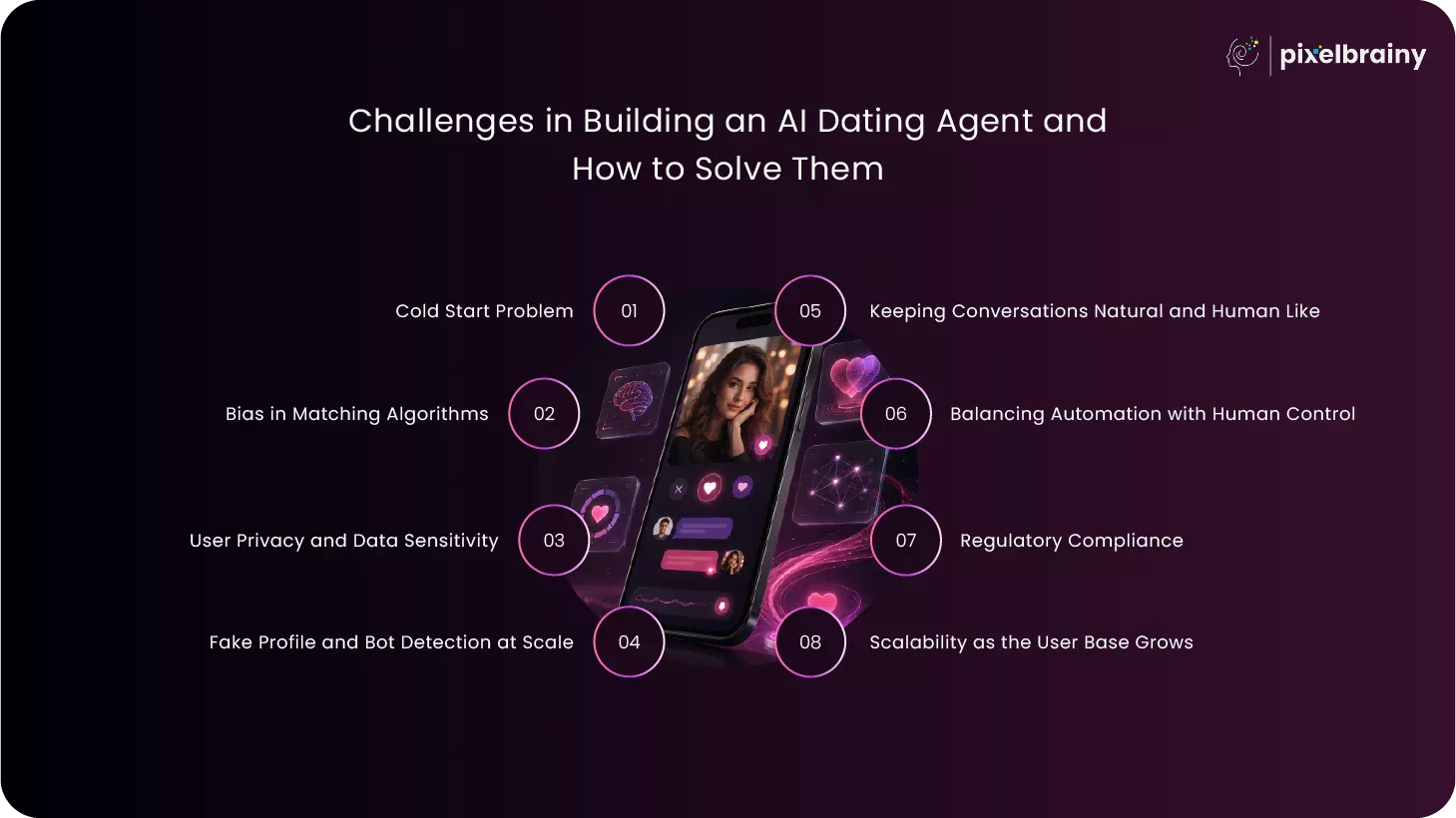
| Challenge | Why It Matters | Recommended Solution |
| Cold Start Problem | Newly launched platforms have little or no behavioral data, making it difficult for the AI to recommend compatible matches or personalize user experiences during the early stages. | Use onboarding questionnaires, personality assessments, interest selection, lifestyle preferences, and content-based recommendation models to generate relevant suggestions until sufficient interaction data becomes available. |
| Bias in Matching Algorithms | AI models trained on biased or limited datasets may unintentionally favor certain demographics, interests, or communication styles, reducing fairness and recommendation quality. | Train models using diverse datasets, conduct regular fairness evaluations, monitor recommendation outcomes, and continuously refine algorithms to reduce unintended bias and improve inclusivity. |
| User Privacy and Data Sensitivity | Dating platforms process highly personal information including conversations, preferences, locations, and relationship goals, making data protection essential for maintaining user trust. | Encrypt sensitive information, implement secure authentication, follow data minimization principles, and comply with privacy regulations to protect user information throughout the platform. |
| Fake Profile and Bot Detection at Scale | Fake accounts, spam, and automated bots reduce user confidence, negatively impact matchmaking quality, and create safety concerns as the platform grows. | Combine AI based fraud detection, behavioral analysis, identity verification, anomaly detection, and human moderation to identify suspicious activity before it affects genuine users. |
| Keeping Conversations Natural and Human Like | Repetitive or generic responses reduce engagement and make AI conversations feel scripted rather than helpful. This becomes even more important when developing an AI dating agent with conversational AI. | Build AI dating agents with NLP and machine learning, contextual memory, Retrieval Augmented Generation (RAG), and user preference learning to generate responses that remain personalized, relevant, and context aware. |
| Balancing Automation with Human Control | Users appreciate AI recommendations, but they still want to make their own relationship decisions instead of relying entirely on automation. | Position the AI as an intelligent assistant that recommends matches, messages, and profile improvements while allowing users to make every final decision independently. |
| Regulatory Compliance | Regulations such as GDPR and CCPA require businesses to collect, store, and process personal information responsibly while providing transparency and user control. | Integrate privacy by design, consent management, audit logging, secure storage, and data deletion workflows into the product architecture from the beginning. |
| Scalability as the User Base Grows | Growing user activity increases AI requests, recommendation workloads, database operations, and infrastructure demands, affecting performance if the architecture is not designed for scale. | Adopt cloud native infrastructure, distributed databases, vector search, containerized deployments, caching, load balancing, and monitoring tools to maintain performance as the platform expands. |
Successfully addressing these challenges enables businesses to develop AI dating agents that are secure, scalable, and capable of delivering consistent, personalized experiences as user expectations and platform adoption continue to grow.
By now, you have a clear understanding of what it takes to build a successful AI dating agent. From defining the right feature set and selecting an AI ready technology stack to addressing development challenges and learning from successful products already in the market, creating an intelligent dating agent requires much more than integrating a large language model. It requires the right strategy, technical expertise, and execution partner.
This is where PixelBrainy can help.
A common question we hear from founders is:
"We want to create an AI dating agent that works across web and mobile and can understand natural language inputs from users to suggest better matches and date ideas. Which AI agent development companies in the USA have the technical depth to build this end to end?"
If you're asking the same question, our team is ready to help.
At PixelBrainy, we provide comprehensive AI dating agent development services that cover every stage of the product lifecycle, from idea validation to production deployment. Whether you're planning to build an AI dating agent for a startup, modernize an existing dating platform, or launch an AI first matchmaking product, our team develops scalable solutions tailored to your business goals.
Our development approach combines product strategy, AI engineering, cloud architecture, and full stack application development to create AI agents that deliver personalized, secure, and engaging user experiences.
Our engineers specialize in modern AI frameworks and agent architectures that power enterprise grade intelligent applications.
Our expertise includes:
This enables us to develop AI dating agents capable of profile optimization, intelligent matchmaking, conversational assistance, recommendation generation, and autonomous task execution.
An AI dating agent is only as good as the platform that supports it. That's why PixelBrainy delivers complete product development instead of focusing only on the AI layer.
Our multidisciplinary team handles:
Working with one experienced team ensures faster delivery, simplified communication, and a consistent development process from start to finish.
As an AI agent development company USA businesses can rely on, we understand the technical and regulatory expectations associated with consumer applications.
Our development process incorporates:
This allows founders to launch AI powered products with confidence while preparing for future growth.
Every successful AI product begins with a clear roadmap.
During our discovery session, we'll discuss:
By the end of the discussion, you'll have a practical development strategy for creating an AI dating agent that aligns with your product vision and business objectives.
Whether you're validating a startup idea, expanding an existing dating platform, or launching an AI first matchmaking product, PixelBrainy provides the technical expertise needed to transform your vision into a scalable AI solution.
Book a discovery call with PixelBrainy today to discuss your AI dating agent project, explore the right technology approach, and start building an intelligent dating platform designed for long term growth.
The future of online dating will be shaped by platforms that can deliver personalized experiences instead of generic interactions. Businesses investing in AI dating agent development have an opportunity to create intelligent products that assist users throughout their entire journey, from profile creation and matchmaking to meaningful conversations and real-world date planning.
This guide has covered the complete roadmap for building an AI dating agent for platforms like tinder, bumble hinge and more, including its architecture, business benefits, essential and advanced features, development process, technology stack, implementation challenges, and real-world examples. Whether your goal is to develop an AI dating agent for a startup or enhance an existing dating platform, success depends on combining the right AI technologies with a well-planned product strategy and expert execution.
If you're ready to turn your vision into a production ready solution, connect with the AI experts at PixelBrainy. Our team specializes in AI dating agent development services, helping founders design, develop, and launch intelligent AI dating agents that are scalable, secure, and built for long term business growth.
A traditional dating algorithm primarily recommends matches based on predefined factors such as age, location, interests, or user preferences. An AI dating agent goes much further by understanding conversations, remembering user preferences, generating personalized responses, recommending profile improvements, and adapting its suggestions based on real time interactions. Instead of simply matching users, it actively assists them throughout the entire dating experience.
The development timeline depends on the project's complexity, feature set, and integration requirements. An MVP with core AI capabilities typically takes around 4 to 6 months, while a feature rich enterprise solution with advanced AI workflows, recommendation engines, and scalable infrastructure may require 6 to 9 months or more.
Yes. An AI dating agent can be integrated into an existing dating platform without rebuilding the entire application. Businesses often introduce AI powered profile coaching, intelligent matchmaking, conversation assistance, and recommendation engines through APIs and modular AI services, allowing the platform to evolve while preserving its current infrastructure.
AI dating agents continuously improve by analyzing user interactions, feedback, profile updates, engagement patterns, and conversation outcomes. Machine learning models and contextual memory help the system refine recommendations and generate increasingly personalized responses while adapting to changing user preferences.
Yes, provided security and privacy are integrated into the development process from the beginning. Sensitive information should be protected using encryption, secure authentication, role-based access controls, and compliance with regulations such as GDPR and CCPA to ensure responsible handling of user data.
An AI dating assistant typically performs specific tasks such as writing bios, suggesting replies, or answering user questions. An AI dating agent has broader capabilities because it can understand context, remember previous interactions, make intelligent decisions, coordinate multiple tasks, and proactively assist users throughout the entire dating journey.
Look for an AI agent development company USA businesses trust with proven expertise in Large Language Models, conversational AI, LangChain, LangGraph, vector databases, cloud infrastructure, and end to end product development. A reliable development partner should also understand AI architecture, security, compliance requirements, and scalable deployment to successfully build a production ready AI dating agent tailored to your business goals.

About The Author
Sagar Bhatnagar
Sagar Sahay Bhatnagar brings over a decade of IT industry experience to his role as Marketing Head at PixelBrainy. He's known for his knack in devising creative marketing strategies that boost brand visibility and market influence. Sagar's strategic thinking, coupled with his innovative vision and focus on results, sets him apart. His track record of successful campaigns proves his ability to utilize digital platforms effectively for impactful marketing efforts. With a genuine passion for both technology and marketing, Sagar continuously pushes PixelBrainy's marketing initiatives to greater success.

Working with the PixelBrainy team has been a highly positive experience. They understand the design requirements and create beautiful UX elements to meet the application needs. The dev team did an excellent job bringing my vision to life. We discussed usability and flow. Sagar worked with his team to design the database and begin coding. Working with Sagar was easy. He has the knowledge to create robust apps, including multi-language support, Google and Apple ID login options, Ad-enabled integrations, Stripe payment processing, and a Web Admin site for maintaining support data. I'm extremely satisfied with the services provided, the quality of the final product, and the professionalism of the entire process. I highly recommend them for Android and iOS Mobile Application Design and Development.

Great experience working with them. Had a lot of feedback and I found that unlike most contractors they were bugging me for updates instead of the other way around. They were extremely time conscience and great at communicating! All work was done extremely high quality and if not on time, early! They were always proactive when it comes to communication and the work is great/above par always. Very flexible and a great team to work with! Goes above and beyond to present us with multiple options and always provides quality. Amazing work per usual with Chitra. If you have UI/UX or branding design needs I recommend you go to them! Will likely work with them in the future as well, definitely recommended!

PixelBrainy is a joy to work with and is a great partner when thinking through branding, logo, and website layout. I appreciate that they spend time going into the "why" behind their decisions to help inform me and others about industry best practices and their expertise.

I hired them to design our software apps. Things I really like about them are excellent communication skills, they answer all project suggestions and collaborate right away, and their input on design and colors is amazing. This project was complex and needed patience and creativity. The team is amazing to do business with. I will be using them long-term. Glad to see there are some good people out there. I was afraid to try and outsource my project to someone but I am glad I met them! I really can't say enough. They went above and beyond on this project. I am very happy with everything they have done to make my business stand out from the competition.

It was great working with PixelBrainy and the team. They were very responsive and really owned the project. We'll definitely work with them again!

I recently worked with the PixelBrainy team on a project and I was blown away by their communication skills. They were prompt, clear, and articulate in all of our interactions. They listened and provided valuable feedback and suggestions to help make the project a success. They also kept me updated throughout the entire process, which made the experience stress-free and enjoyable.

PixelBrainy is very good at what it does. The team also presents themselves very professionally and takes care of their side of things very well. I could fully trust them taking up the design work in a timely and organised manner and their attention to detail saved us lots of effort and time. This particular project was quite intense and the team showed that they function very well under pressure. Very much looking forward to working with her again!

It's always an absolute pleasure working with them. They completed all of my requests quickly and followed every note I had for them to a T, which made our process go smoothly from start to finish. Everything was completed fast and following all of the guidelines. And I would recommend their services to anyone. If you need any design work done in the future, PixelBrainy should be your first call!

They took ownership of our requirements and designed and proposed multiple beautiful variants. The team is self-motivated, requires minimum supervision, committed to see-through designs with quality and delivering them on time. We would definitely love to work with PixelBrainy again when we have any requirements.

PixelBrainy was a big help with our SaaS application. We've been hard at work with a new UI/UX and they provided a lot of help with the designs. If you're looking for assistance with your website, software, or mobile application designs, PixelBrainy and the team is a great recommendation.

PixelBrainy designers are amazing. They are responsive, talented, and always willing to help craft the design until it matches your vision. I would recommend them and plan to continue them for my future projects and more!!!

They were awesome! Did a good job fast, and good communication. Will work with them again. Thank you

Creative, detail-oriented, and talented designers who take direction well and implement changes quickly and accurately. They consistently over-delivered for us.

PixelBrainy team is very talented and creative. Great designers and a pleasure to work with. PixelBrainy is an excellent communicator and I look forward to working with them again.

PixelBrainy has a very talented design team. Their work is excellent and they are very responsive. I enjoy working with them and hope to continue on all of our future projects.


Transform your ideas into reality with us.
Across these industries, each engagement brings unique challenges, from early-stage product development to scaling complex systems, helping us build a practical understanding of real-world product environments.