AI Summary Powered by PixelBrainy
What if your financial services company could process 40,000 documents every month without making your operations team manually inspect every page?
Imagine you are the CTO of a financial services company processing 40,000 documents every month, including loan applications, financial statements, tax returns, bank statements, KYC records, and identity documents. Your teams currently review these documents manually, creating processing bottlenecks, increasing operational costs, and introducing the possibility of data-entry and review errors. Before presenting an investment proposal to leadership, you need practical answers: How much does AI document intelligence platform development cost? What accuracy can modern AI document extraction systems achieve on financial documents? How quickly can they process documents? And which development companies have demonstrated measurable improvements in financial services workflows?
This is where AI document intelligence platform development becomes strategically important. Modern document intelligence platforms combine OCR, computer vision, natural language processing, machine learning, large language models, classification, extraction, validation, and workflow automation to convert unstructured documents into structured, actionable data.
For organizations evaluating AI document intelligence software development, the objective is not simply to scan documents faster. A production-grade platform should understand document types, identify relevant fields, validate extracted information, detect inconsistencies, route exceptions to human reviewers, and maintain an auditable record of every important action.
Real-world implementations demonstrate that results can vary significantly by document type, data quality, workflow design, and evaluation methodology. For example, Microsoft reports that National Bank of Greece processes documents at below 0.5 seconds per page and achieved approximately 90% accuracy across its implementation. Guidehouse reports approximately 98% AI-only extraction accuracy, more than 90% straight-through processing, and 10-second average processing time in a financial-services legal-order workflow.
This guide explains how to build a document intelligence platform, from use cases and essential features to architecture, technology choices, development costs, compliance requirements, business models, and implementation challenges.
Whether you are a CTO, CIO, product leader, fintech founder, bank, lender, insurer, or enterprise evaluating building an AI document intelligence platform, the following sections provide a practical framework for planning your investment.

An AI document intelligence platform is an intelligent software system designed to read, understand, classify, extract, validate, and process information from digital and scanned documents. Unlike conventional document processing tools that primarily convert images into machine-readable text, AI-powered document intelligence combines OCR, computer vision, natural language processing, machine learning, and generative AI to understand both the content and context of a document.
For example, a financial institution may receive a mortgage application containing application forms, pay stubs, bank statements, tax returns, identity documents, employment records, credit reports, and property documents. Instead of requiring employees to review each file manually, an AI document intelligence platform can automatically identify document types, extract relevant information, compare data across documents, detect missing or inconsistent information, and route exceptions to the appropriate employee.
This makes AI document intelligence platform development particularly valuable for organizations that process large document volumes and need faster, more consistent, and scalable workflows.
A typical platform follows a multi-stage workflow:
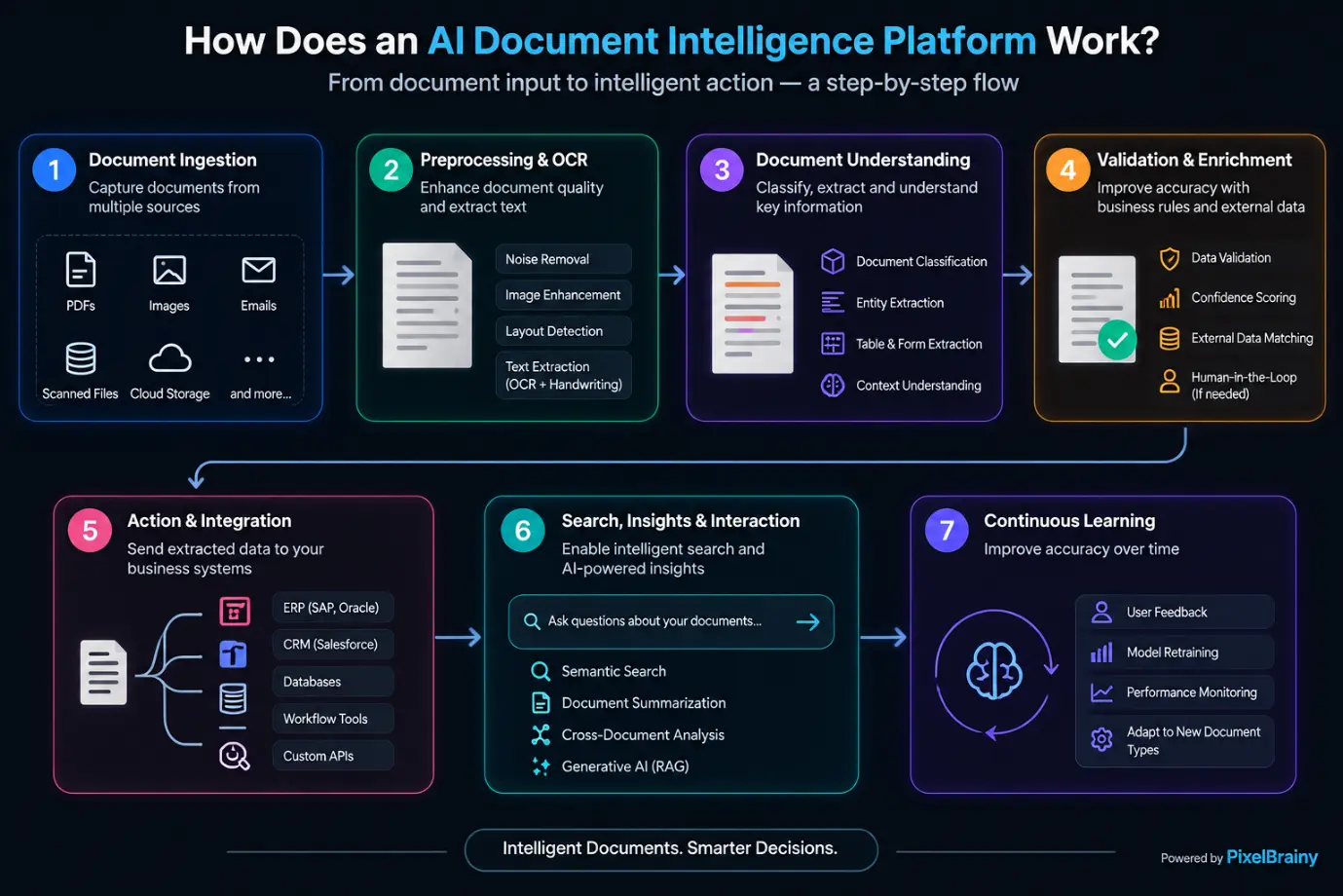
The process begins when documents enter the platform through multiple channels, including:
The platform assigns each document a unique identifier and securely stores the original file for processing and audit purposes.
Before extracting information, the system improves document quality. This can include:
Effective preprocessing can improve downstream OCR and extraction performance, particularly when organizations work with scanned or low-quality documents.
The AI model determines what type of document it has received. For example, it may classify a file as a:
Classification is important because different document types require different extraction schemas and validation rules.
OCR converts visible text into machine-readable information. Modern document intelligence systems can go beyond plain text recognition by identifying tables, document layout, checkboxes, signatures, headings, paragraphs, and relationships between visual elements.
This is particularly important for financial documents where the position of a number or its relationship to a label can change its meaning.
Once the document has been classified and analyzed, AI models extract predefined or contextually relevant information.
For example, from a bank statement, the platform may extract:
With more advanced AI capabilities, users can also define extraction requirements using natural language instead of creating a separate rigid template for every document layout.
Extracted information should not automatically be considered correct simply because an AI model produced it.
A robust platform validates extracted information against:
For example, the system could compare the income stated on a loan application with income reported on a tax return and bank statements. If the values do not align with defined rules or thresholds, the application can be flagged for additional review.
The platform can assign confidence scores to extracted fields or classifications. A high-confidence result may proceed automatically, while a low-confidence result can be routed to a human reviewer.
For example:
High confidence: Process automatically
Medium confidence: Apply additional validation
Low confidence: Send to human review
This approach creates a practical balance between AI automation and human oversight.
After extraction and validation, the platform can connect document intelligence with business workflows. Depending on the use case, it can:
This is where AI document intelligence software development moves beyond document reading and becomes an operational automation solution.
Not every document should be processed completely automatically. Complex, damaged, unusual, or low-confidence documents can be placed into an exception queue.
A reviewer can view the original document alongside the extracted information, correct inaccurate fields, and approve the result. These corrections can also provide valuable feedback for improving future model performance.
Enterprise platforms should maintain an audit trail covering important processing events, including:
Analytics dashboards can then measure document volumes, extraction performance, processing times, exception rates, and human-review workloads.
The difference can be summarized simply:
| Traditional OCR | AI Document Intelligence |
|---|---|
| Converts images into text | Understands documents and their context |
| Primarily text-focused | Text, tables, layout, and visual elements |
| Often template-dependent | Can handle varying layouts |
| Limited contextual understanding | Uses AI for semantic understanding |
| Manual validation is common | Automated validation can be added |
| Limited workflow automation | Integrates with end-to-end workflows |
| Basic text output | Structured, actionable business data |
Therefore, building an AI document intelligence platform involves much more than integrating an OCR engine. The goal is to create an intelligent pipeline that can transform unstructured documents into validated, structured, and actionable information.
For organizations exploring how to build a document intelligence platform, the most effective architecture typically combines AI extraction with deterministic business rules, enterprise integrations, human-in-the-loop review, security controls, and continuous performance monitoring. This combination allows businesses to automate high-volume document workflows while retaining appropriate control over important decisions.
Why should businesses invest in AI document intelligence platform development now instead of continuing to scale manual document-processing teams?
For organizations handling thousands or millions of documents every month, the investment case is increasingly about building a scalable digital processing infrastructure, not simply automating individual tasks. Financial institutions, insurers, lenders, healthcare organizations, and large enterprises generate significant amounts of information in PDFs, scanned forms, statements, applications, invoices, contracts, and identity documents. Much of this information remains difficult to use because it is stored in unstructured or semi-structured formats.
The market is also moving toward intelligent document processing. According to IBM, the intelligent document processing market was valued at $2.3 billion in 2024 and is projected to grow at a 33.1% CAGR through 2030.
Hiring additional employees can increase processing capacity, but it also creates a linear relationship between document volume and operational resources. An AI document intelligence platform provides an alternative architecture in which processing capacity can be scaled through software and cloud infrastructure.
McKinsey reports that 70% of surveyed executives said their organizations were at least piloting business-process automation in one or more functions, while intelligent document management and processing tools were among the most frequently deployed automation solutions beyond the pilot stage.
The purpose of AI document intelligence software development is not simply to digitize text. It is to turn information trapped inside documents into structured data that other business systems can consume.
For example, a financial services company can transform information from tax returns, bank statements, loan applications, and financial reports into structured records that can feed underwriting, compliance, analytics, and workflow systems.
This creates a foundation for broader digital transformation.
Deloitte's 2024 research surveyed 542 financial services leaders as part of its broader State of Generative AI in the Enterprise research. Among financial-services "pioneers," 43% reported providing access to generative AI tools and applications to more than 40% of their workforce, while many had progressed beyond experimentation into limited or scaled implementations.
This matters for companies considering building an AI document intelligence platform because document processing represents a practical entry point for applying AI to information-intensive operations.
Rather than creating separate automation for every document workflow, companies can develop a centralized platform that supports multiple document types and departments.
The same infrastructure can potentially support:
Deloitte specifically identifies AI-powered document processing across lending, claims, onboarding, compliance, and customer servicing as an emerging financial-services application area.
AI systems are only as useful as the data they can access. For banks and enterprises with large repositories of unstructured documents, developing a document intelligence platform can create a structured data layer that makes previously inaccessible information available to downstream AI, analytics, and automation systems.
Deloitte's 2024 banking and capital-markets survey found that 94% of respondents identified data accuracy and reliability as a priority, while 86% identified ease of data access and use as a top concern.
For a company processing 40,000 documents every month, the strategic question is not simply whether AI can replace manual data entry. The more important question is whether the organization needs a scalable document understanding infrastructure capable of handling increasing volumes, document formats, business rules, AI models, integrations, and regulatory requirements.
That is why how to build a document intelligence platform should be approached as a long-term technology and data strategy, with measurable requirements for document volume, processing latency, extraction accuracy, integration, security, governance, and total cost of ownership.
What can an AI document intelligence platform actually do for a business? The most common use cases include document classification, data extraction, invoice processing, KYC and identity verification, loan document processing, claims processing, contract analysis, financial statement extraction, compliance automation, and enterprise document search.
AI document intelligence combines OCR, computer vision, natural language processing, machine learning, and generative AI to convert unstructured and semi-structured documents into structured, usable information. Instead of simply reading text from a PDF or scanned page, an intelligent document processing system can identify document types, understand layouts and relationships, extract specific fields, validate information, summarize content, and send the results into business applications.
This makes AI document intelligence platform development relevant across industries that handle high volumes of forms, applications, financial records, contracts, invoices, claims, reports, and other documents.
| Industry | Common Documents | Key AI Document Intelligence Use Cases |
|---|---|---|
| Banking & Financial Services | Loan applications, bank statements, tax returns | Loan processing, KYC, underwriting support |
| Insurance | Claims, policies, repair estimates | Claims processing, policy analysis |
| Healthcare | Medical records, claims, lab reports | Data extraction, classification, summarization |
| Legal | Contracts, court filings, case files | Contract analysis, clause extraction |
| Accounting & Finance | Invoices, receipts, purchase orders | AP automation, invoice processing |
| Logistics | Bills of lading, invoices, customs forms | Shipment processing, data extraction |
| Manufacturing | Quality reports, purchase orders, certificates | Document classification, compliance |
| HR & Recruitment | Resumes, employee forms, certificates | Resume parsing, onboarding |
| Government | Applications, tax forms, benefit claims | Application processing, records management |
| Real Estate & Mortgage | Property records, mortgage forms | Mortgage processing, property data extraction |
| Retail & E-commerce | Supplier invoices, purchase orders, receipts | Procurement and invoice processing |
| Education | Transcripts, applications, certificates | Admissions and records processing |
| Telecom | Identity documents, service agreements | Customer onboarding, contract processing |
| Energy & Utilities | Inspection reports, service forms | Compliance and document processing |
| Travel & Hospitality | Invoices, identity documents, booking records | Customer processing and financial workflows |
How is AI document intelligence used in banking? Financial institutions can use document AI to process the large volumes of documents required for lending, onboarding, underwriting, compliance, and servicing.
Common use cases include:
For example, an AI document intelligence platform can process a loan package containing bank statements, tax returns, pay stubs, and identity documents. It can classify each file, extract relevant financial information, compare values across documents, identify missing information, and route exceptions to an underwriter.
Google Cloud identifies tax-form income extraction for loan approval and identity document authentication among Document AI use cases.
AI document intelligence for insurance can automate document-heavy workflows across underwriting, policy administration, and claims.
Key applications include:
For a property insurance claim, the system could identify the claim number, policy details, incident information, repair estimates, invoices, and supporting documents. It can then validate required information and send incomplete or unusual cases to claims specialists.
Intelligent document processing is increasingly applicable to insurance forms, claims, receipts, and other documents that require extraction and workflow automation.
Healthcare organizations generate substantial volumes of clinical and administrative documentation.
AI document processing in healthcare can support:
An intelligent document platform can classify incoming records, extract relevant information, organize documents, and prepare structured data for downstream healthcare applications.
Healthcare implementations require particular attention to privacy, access controls, data security, retention, and appropriate human oversight because documents can contain highly sensitive patient information.
Legal organizations can use AI document intelligence for legal documents to analyze large volumes of contracts, filings, case records, and supporting documentation.
Key use cases include:
For example, an AI system can identify contract parties, effective dates, payment terms, renewal conditions, termination clauses, and specific obligations. Lawyers can then review the extracted information instead of manually searching every document.
Finance departments process invoices, receipts, purchase orders, expense reports, and tax documents on a regular basis.
AI document processing for accounting can support:
The system can extract vendor names, invoice numbers, dates, line items, tax amounts, totals, and payment terms before sending structured data to an ERP or accounting system.
Invoice processing is a common intelligent document processing application because extracted information can be connected directly to downstream financial workflows.
Supply chain operations depend on documents exchanged among suppliers, manufacturers, carriers, warehouses, customs authorities, and customers.
AI document intelligence use cases in logistics include:
AI can extract shipment numbers, product quantities, addresses, dates, carrier details, and other relevant information and transfer it to transportation management, warehouse management, ERP, or supply chain systems.
Retail and e-commerce companies can use document intelligence to automate supplier, procurement, fulfillment, and financial documentation.
Common applications include:
For example, product and supplier information can be extracted from semi-structured documents and synchronized with procurement, inventory, ERP, and order management systems.
Manufacturing organizations manage documentation throughout procurement, production, quality control, maintenance, and compliance.
AI document processing for manufacturing can be applied to:
An AI platform can classify documents, extract technical information, identify required fields, and make information searchable across enterprise repositories.
HR departments process documents throughout recruitment, onboarding, payroll, benefits administration, and employee management.
AI document intelligence use cases in HR include:
For recruitment, AI can extract skills, education, certifications, employment history, and other structured information from resumes and applications.
Resume information extraction is also identified as an HR application of intelligent document processing.
Government organizations process applications, forms, financial records, licenses, permits, and supporting documentation at significant scale.
AI document processing for government can support:
An AI platform can classify incoming documents, extract required information, identify missing fields, and route applications to the appropriate department.
Government documents, tax records, benefit claims, licenses, and financial records are among the document-processing applications identified by AWS.
Real estate and mortgage workflows involve extensive financial and property documentation.
AI document intelligence for mortgage processing can handle:
AI can extract borrower information, property details, financial figures, dates, addresses, and contractual information while also checking whether required documents are present.
Educational institutions can apply document intelligence to admissions, enrollment, student records, and financial-aid workflows.
Common use cases include:
The platform can classify submissions, extract student information, verify required fields, and route applications through admissions workflows.
Telecom companies process customer, vendor, regulatory, and service documentation.
Potential applications include:
An AI document intelligence system can extract customer and contract information and connect the results with CRM, billing, provisioning, and service-management systems.
Energy and utility companies manage technical, commercial, customer, and regulatory documents.
AI document processing use cases in energy and utilities include:
Document AI can convert information from these documents into structured data for operational systems, compliance workflows, and analytics.
Hotels, airlines, travel companies, and hospitality businesses can use document intelligence across customer, financial, supplier, and operational processes.
Use cases include:
The platform can extract and validate information before connecting it to reservation, finance, CRM, and customer-service systems.
One of the broader applications of building an AI document intelligence platform is transforming internal document repositories into searchable enterprise knowledge.
Organizations can process:
After processing, extracted and semantically structured information can support enterprise search, RAG applications, AI assistants, analytics, and AI agents. Microsoft describes intelligent document processing pipelines that can prepare document data for search, analytics, RAG, and AI-agent workflows.
The best starting point for AI document intelligence implementation is usually a workflow with high document volume, repetitive extraction requirements, clearly defined data fields, measurable processing delays, and identifiable business rules.
Before developing the platform, organizations should evaluate document complexity, data sensitivity, required accuracy, processing volume, integration requirements, human-review requirements, and regulatory obligations.
From banking and insurance to healthcare, legal, logistics, manufacturing, government, and enterprise knowledge management, AI document intelligence can provide a common technology layer for converting unstructured documents into structured information and intelligent workflows. The most successful implementations begin with a clearly defined business process and expand as the organization validates accuracy, cost, and operational fit.
What measurable benefits can a business expect after investing in AI document intelligence platform development? For business owners, CTOs, and operations leaders, the answer goes beyond simply reducing paperwork. The real value comes from reducing repetitive processing costs, improving extraction quality, accelerating document-based workflows, scaling operations without continuously increasing headcount, and creating reliable data for business decisions.
For example, a financial services company processing 40,000 documents per month may use an AI document intelligence platform to extract information from loan applications, bank statements, tax returns, identity documents, and financial statements. Instead of asking only "How does AI document processing work?", business leaders increasingly ask "How much can AI document intelligence save my business?", "How accurate is AI document extraction?", and "Can AI process documents fast enough for real-time decisions?"
The following benefits explain why building an AI document intelligence platform can become a strategic investment for document-intensive businesses.
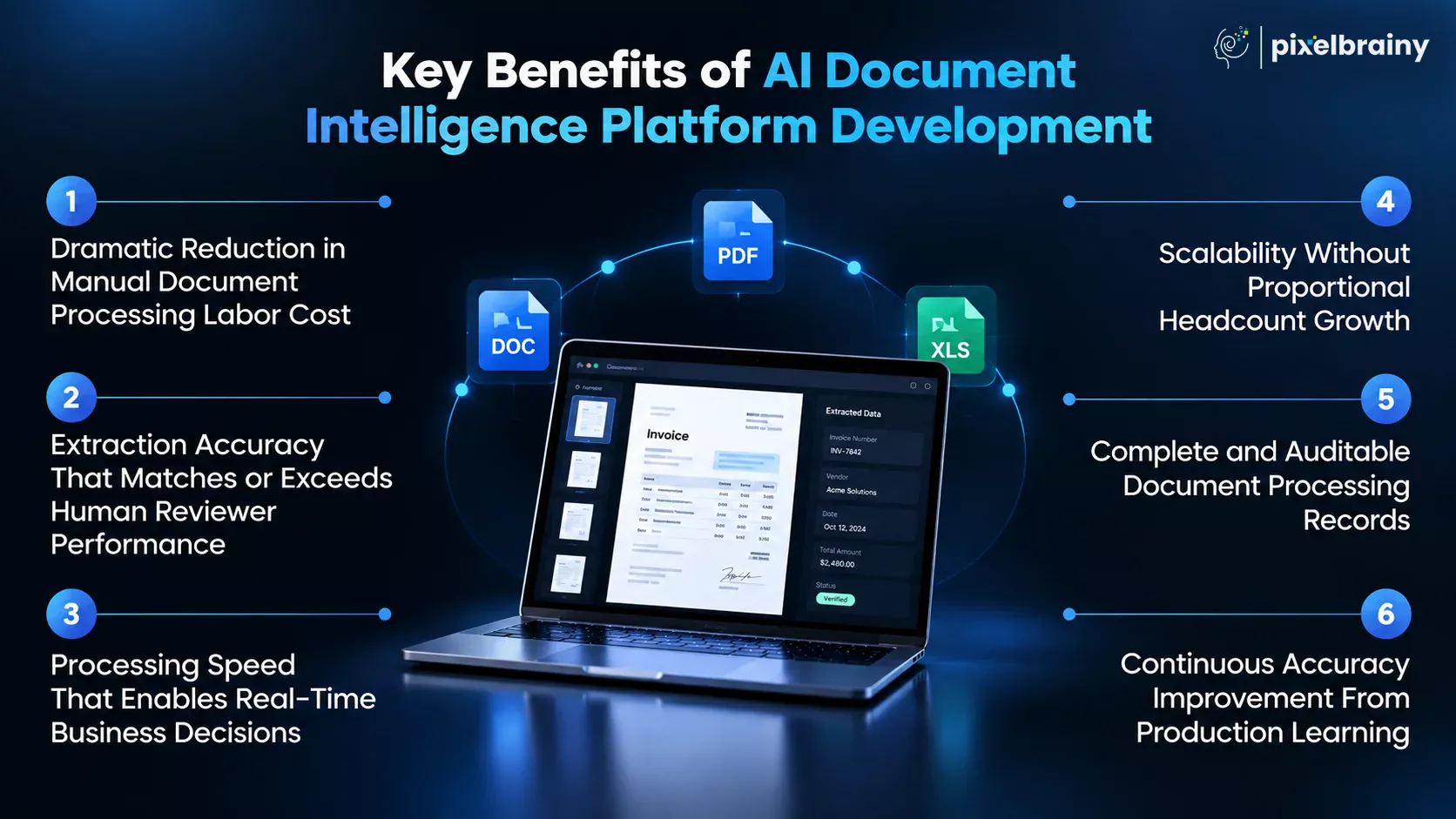
Manual document processing requires employees to open files, identify document types, locate information, enter data, verify fields, and move records between systems. At high volumes, these repetitive activities can represent a significant operational expense.
An AI document intelligence platform can automate classification, extraction, validation, and routing, allowing employees to focus primarily on exceptions and complex cases. For a company processing tens of thousands of documents monthly, this can change the economics of document operations by increasing automated processing without requiring the same proportional increase in staffing.
How accurate is AI document extraction compared with human document reviewers? Modern AI document intelligence systems can achieve high extraction accuracy for well-defined document types, but performance varies according to document quality, layouts, fields, and model configuration.
A production platform can improve reliability by combining AI extraction with confidence scoring, validation rules, cross-document checks, and human review. Instead of treating every AI prediction as correct, organizations can automatically process high-confidence fields while sending uncertain results to reviewers. This creates a controlled approach to AI-powered document processing where accuracy can be measured at the field and workflow levels.
Traditional document review can introduce delays between receiving information and making it available to employees or business systems. AI document processing can analyze documents immediately after ingestion and return structured information within seconds or minutes, depending on document complexity and architecture.
This faster processing can support time-sensitive workflows such as loan applications, insurance claims, customer onboarding, compliance checks, and invoice processing. AI document intelligence software development can therefore connect document data directly with operational systems, allowing businesses to make document-driven decisions without waiting for every file to complete a manual review cycle.
Can an AI document intelligence platform handle increasing document volumes without continuously increasing staff? Scalability is one of the most important advantages for businesses experiencing rapid growth or seasonal document peaks.
A cloud-based document intelligence architecture can increase processing capacity as workloads increase. Instead of adding employees for every additional volume increment, businesses can scale computing resources, queues, storage, and AI processing according to demand. Human employees can remain focused on exceptions and specialized reviews. This makes building an AI document intelligence platform particularly relevant for banks, insurers, lenders, healthcare providers, and enterprises processing large and fluctuating document volumes.
Business owners increasingly need to know not only what information was extracted, but also where it came from, how it was processed, and who reviewed it. A properly designed AI document intelligence platform can maintain an end-to-end record of document processing activities.
The audit trail can include the original document, extracted values, confidence scores, validation results, model versions, user corrections, timestamps, and workflow actions. This creates greater visibility into document operations and can support internal governance, compliance processes, quality assurance, and investigations. For regulated industries, auditable processing can be an important architectural requirement.
Document processing requirements change as businesses receive new templates, document formats, issuers, languages, and data patterns. A platform therefore needs a mechanism for continuous performance improvement rather than relying on a model trained once.
Human corrections and validation outcomes can provide feedback for model evaluation and improvement. Organizations can monitor extraction errors, identify frequently problematic fields, update prompts or models, and retrain selected components where appropriate. This feedback loop allows AI document intelligence development to evolve with real-world data while maintaining controlled model deployment and performance monitoring.
For business owners, the strongest value of AI document intelligence platform development lies in turning document-heavy operations into measurable, scalable, and data-driven workflows. The combination of automation, accuracy controls, speed, scalability, auditability, and continuous improvement can create a foundation for more efficient enterprise operations.

When businesses decide to build an AI document intelligence platform, one question quickly becomes critical: Which features are essential for turning high-volume document processing into a reliable business workflow? Choosing an OCR tool alone is not enough. A production-ready platform needs to capture documents from multiple sources, understand different layouts, extract the right information, validate AI-generated results, manage exceptions, and connect extracted data with existing business systems.
The right feature set also depends on the documents and workflows being automated. A financial institution processing loan applications may require bank statement and tax-form extraction, while an insurance company may prioritize claims and policy documents. Healthcare organizations may need structured extraction from medical records, whereas accounting teams may focus on invoices and purchase orders.
For this reason, AI document intelligence software development should begin with a strong core architecture that supports the complete document lifecycle. Features such as document ingestion, preprocessing, OCR, classification, data extraction, table recognition, validation, confidence scoring, human review, API integration, search, and audit logging form that essential foundation.
The table below outlines the must-have features of an AI document intelligence platform that businesses should consider before moving toward more advanced capabilities.
| Must-Have Feature | Explanation |
|---|---|
| Multi-Format Document Ingestion | The platform should accept commonly used formats such as PDF, JPG, PNG, TIFF, DOCX, and email attachments. It should also support uploads through APIs, web applications, cloud storage, scanners, and enterprise systems. |
| Document Preprocessing | This feature prepares documents for accurate AI analysis by correcting rotation, removing noise, improving image quality, detecting poor scans, cropping pages, and correcting alignment. Effective preprocessing can improve OCR and downstream extraction performance. |
| OCR and Text Recognition | OCR converts printed or scanned content into machine-readable text while preserving important location and layout information. The platform should support different document qualities, fonts, languages, and, where required, handwriting recognition. |
| Document Classification | AI automatically determines the type of document being processed, such as a bank statement, invoice, tax return, contract, passport, or loan application. Classification allows the platform to select the appropriate extraction and validation workflow. |
| Document Splitting | The platform should identify separate documents within a single uploaded file or document package. For example, it can separate a loan package into tax returns, bank statements, identity documents, and pay stubs before processing each document independently. |
| Key-Value Data Extraction | AI identifies specific fields and their corresponding values, such as customer name, invoice number, account number, income, policy number, or payment amount. Extracted information should be returned as structured data for downstream applications. |
| Table Extraction | The system should recognize tables, rows, columns, headers, and individual cells and convert them into structured information. This capability is essential for invoices, financial statements, bank statements, transaction records, purchase orders, and other table-heavy documents. |
| Form and Checkbox Recognition | The platform should recognize form fields, checkboxes, selection marks, labels, and other structured elements. This allows it to understand applications, questionnaires, insurance forms, compliance documents, and other forms that contain information beyond standard paragraphs. |
| Custom Extraction Schemas | Businesses should be able to define the exact fields they want the AI system to extract for each document type. A lender, for example, can configure fields for income, employer, loan amount, account balance, and other underwriting information. |
| Data Validation | Extracted information should be checked against business rules, required fields, calculations, databases, and other available information. Validation can identify missing, inconsistent, or potentially incorrect data before it reaches critical business systems. |
| Confidence Scoring | The platform should provide confidence indicators for document classifications and extracted fields. High-confidence results can proceed automatically, while uncertain results can be routed for additional validation or human review. |
| Human Review Interface | A review workspace should allow employees to inspect the original document alongside AI-extracted information, identify uncertain fields, correct errors, and approve results. This creates human oversight for complex or low-confidence documents. |
| Search and Document Retrieval | Users should be able to locate documents and extracted information using keywords, document types, customer details, dates, account numbers, metadata, or other fields. Search capabilities make large document repositories easier to access and manage. |
| Workflow and API Integration | The platform should connect with CRM, ERP, accounting, loan management, insurance, healthcare, and other enterprise applications through APIs and workflow integrations. This allows extracted information to move directly into existing business processes. |
| Audit Trail and Processing Logs | The system should record important processing activities, including document uploads, classifications, extracted values, validation results, corrections, timestamps, and workflow actions. These records provide traceability for monitoring, governance, quality control, and compliance requirements. |
These core features provide the foundation for reliable AI document intelligence platform development, enabling organizations to automate document-heavy workflows while maintaining accuracy, control, integration, and traceability.
What advanced features can take an AI document intelligence platform beyond basic extraction and make it capable of understanding, searching, reasoning over, and acting on complex business documents?
Once the core capabilities such as OCR, classification, extraction, validation, human review, and workflow integration are working reliably, businesses can introduce advanced AI capabilities to handle more complex document workflows. These features can help transform a conventional AI document processing platform into an intelligent document understanding and automation layer.
Modern document intelligence platforms are increasingly combining structured extraction with generative AI, semantic search, RAG, AI agents, custom models, and multimodal understanding. For example, Microsoft documents the use of intelligent document processing for RAG, knowledge extraction, analytics, and agent-driven workflows, while AWS describes generative AI-powered IDP for classification, extraction, validation, summarization, and actionable insights.
For organizations exploring how to build an advanced document intelligence platform, the following features can be considered after establishing a reliable core processing foundation.
| Advanced Feature | Explanation |
|---|---|
| Generative AI Document Understanding | Generative AI can interpret complex documents where predefined extraction fields are insufficient. It can understand context, identify relationships between sections, summarize information, and answer questions about document content. This is useful for contracts, financial reports, policies, research papers, and other less structured documents. |
| RAG-Based Document Search | Retrieval-augmented generation can connect document repositories with AI search and question-answering systems. Documents are parsed, converted into meaningful chunks, indexed, and retrieved when users ask questions. This allows employees to obtain answers grounded in enterprise documents rather than relying only on a language model's general knowledge. |
| AI-Powered Document Summarization | The platform can automatically generate concise summaries of lengthy contracts, reports, financial statements, claims, policies, and case files. Users can receive an executive summary, key findings, important dates, obligations, or risk-related information without manually reading every page. Generative AI-powered document processing can support summaries and insights from complex document collections. |
| Multimodal Document Understanding | Advanced document AI can analyze more than plain text by considering tables, figures, images, layout, signatures, and other visual elements. This is valuable for documents where meaning depends on the relationship between text and visual content, such as financial reports, technical manuals, invoices, and forms. Microsoft documents structured processing of text, tables, figures, and document layout for downstream AI applications. |
| Custom AI Model Fine-Tuning | Businesses with specialized documents can fine-tune foundation models or develop custom processors using representative organizational data. Fine-tuning can be useful when document layouts vary significantly or when generic models do not achieve the required extraction performance. Google Cloud provides custom extraction and fine-tuning capabilities for specialized document workflows. |
| Cross-Document Intelligence | Instead of analyzing documents individually, the platform can compare information across an entire document package. For example, a lending workflow can compare income reported in tax returns, pay stubs, bank statements, and loan applications. This enables relationship-based validation and identification of inconsistencies across multiple sources. |
| AI-Powered Anomaly and Risk Detection | Machine learning and generative AI can identify unusual values, missing information, inconsistent statements, unexpected document structures, or patterns that require additional investigation. In financial services, this capability can support document-level risk screening and exception management, while keeping final high-impact decisions subject to appropriate controls. |
| Agentic Document Workflows | AI agents can coordinate multiple document-processing steps instead of executing only one extraction task. An agent can identify the document type, select an appropriate processing workflow, extract information, validate it against business rules or enterprise data, and route unresolved exceptions for human review. AWS describes agent-based IDP architectures that orchestrate extraction, validation, troubleshooting, and human review. |
| Natural Language Document Querying | Users can interact with document repositories using conversational questions instead of manually searching files. For example, a finance manager could ask, "Which loan applications have inconsistent income information?" or "What are the renewal dates in these supplier contracts?" The system can retrieve relevant evidence and present the answer with document references. |
| Source Grounding and Explainable AI Outputs | Advanced platforms can connect extracted answers and AI-generated responses to their original document locations. Source grounding helps users verify where information came from and supports human review. Microsoft describes confidence and source grounding capabilities that can route low-confidence or insufficiently grounded results for human review. |
With the right advanced capabilities, AI document intelligence platform development can move beyond basic data extraction to deliver intelligent document understanding, contextual search, automated reasoning, and smarter workflows. These features help businesses unlock greater value from their document data while supporting scalable AI-driven operations.
After you have finalized the features, now it is time to turn the AI document intelligence platform concept into a technically viable product. The development process should begin with business requirements and continue through data preparation, AI model development, application engineering, testing, deployment, and performance monitoring.
This becomes especially important when comparing development proposals with dramatically different prices. If one vendor quotes $80,000 and another quotes $500,000 for seemingly similar document extraction and classification requirements, the difference may come from architecture, AI capabilities, data engineering, security, integrations, model customization, testing depth, scalability, and post-launch support.
So, what should you ask an AI document intelligence vendor before signing a development contract? You should understand exactly what is being built, which AI technologies are being used, how accuracy will be measured, what documents will be included in testing, how exceptions will be handled, and what infrastructure is included in the quoted price.
The following eight steps explain the development process of an AI document intelligence platform, from the initial concept through production launch.
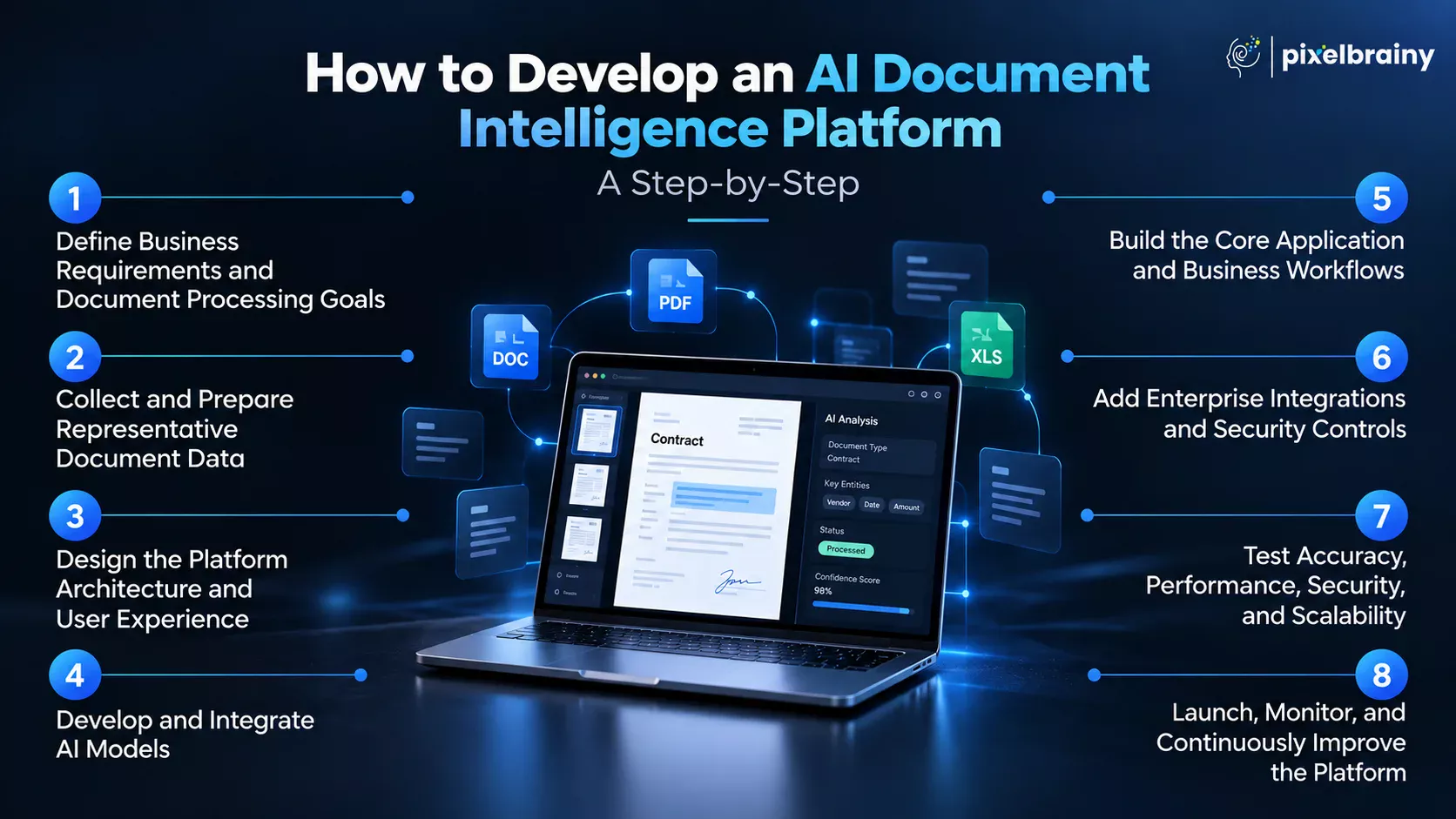
The first step in building an AI document intelligence platform is defining exactly what the business expects the system to accomplish. Start by identifying document types, monthly processing volume, data fields, document sources, users, workflows, integrations, accuracy requirements, and expected processing times.
For example, a financial services company may need to process loan applications, tax returns, bank statements, and identity documents. Each document should have a defined extraction schema and business purpose.
At this stage, an AI consultation can help identify the most suitable use cases, technical architecture, AI approach, and measurable success criteria. Clear requirements also make vendor proposals easier to compare because each company is estimating against the same scope.
Also Read: Top 10 AI Consulting Companies in USA
AI document processing performance depends heavily on the quality and diversity of the data used during development and evaluation. Collect representative samples covering different layouts, issuers, document qualities, languages, page counts, and real-world variations.
Create an annotated dataset showing exactly which fields should be extracted from each document. Include difficult examples such as rotated scans, handwritten entries, poor-quality images, unusual formats, and multi-document PDFs.
During PoC development, vendors should demonstrate how their proposed system performs against representative documents rather than relying only on generic demonstrations. A useful evaluation dataset should remain separate from training data so that performance can be tested objectively before production deployment.
The next step is defining the technical architecture that will support document ingestion, processing, storage, AI inference, validation, human review, APIs, security, and analytics.
The architecture should determine how documents move through the system, where files are stored, how processing queues operate, and how AI services communicate with application components. It should also account for scalability and future document types.
At the application layer, a specialized UI/UX design company can help create intuitive upload screens, document viewers, extraction review interfaces, exception queues, dashboards, and administrative controls. The interface should make it easy for reviewers to understand AI outputs and correct uncertain results.
Also Read: Top 10 AI Consulting Companies in USA
This is where vendors should clearly explain whether they are implementing genuine AI-based document understanding or primarily using template-based OCR and rules.
AI model development may involve OCR, layout-aware models, computer vision, NLP, transformer-based models, vision-language models, or specialized extraction models, depending on document requirements.
Ask vendors which models they propose, whether models are pre-trained or customized, how they handle unseen layouts, and how model confidence is calculated. Also ask whether the system can extract relationships between fields and understand document context rather than simply matching predefined coordinates.
This distinction can explain a significant portion of price differences between apparently similar proposals.
Also Read: Top 12+ AI Model Development Companies in the USA
Once the AI layer is defined, the application itself needs to be developed around the document-processing workflow. This includes ingestion, document classification, extraction, validation, review, search, workflow routing, notifications, user management, and reporting.
An MVP development approach can be useful when the organization wants to validate one or two high-value document workflows before committing to a larger platform.
For example, the initial release could process bank statements and tax returns before expanding into complete loan packages. The MVP should still use production-oriented architecture where appropriate so that successful workflows can be scaled without rebuilding the entire platform.
Also Read: Top 10 AI MVP Development Companies in USA
An AI document intelligence platform rarely operates independently. It may need to exchange information with CRM, ERP, loan origination, accounting, content management, identity verification, data warehouse, or compliance systems.
AI integration should therefore be designed around secure APIs, authentication, data synchronization, error handling, and reliable workflow triggers.
Security should cover encryption, access control, tenant isolation where applicable, secure storage, audit logs, secrets management, monitoring, and data retention policies. For regulated organizations, vendors should clearly identify which security and compliance controls are included in the development scope and which require additional implementation.
Testing should be much more rigorous than checking whether the platform can extract a few sample fields. Before launch, establish measurable benchmarks for document classification accuracy, field-level extraction accuracy, table extraction, processing time, failure rates, and human-review rates.
Ask every vendor to test against the same representative dataset and disclose the evaluation methodology. Also ask for separate results for critical fields because an overall accuracy percentage can hide serious errors in important information.
Security testing, load testing, integration testing, regression testing, and failure recovery testing should also be included. This step helps determine whether the proposed platform is genuinely production-ready.
The final stage is moving the system into production and establishing a process for ongoing monitoring and improvement. A production platform should track extraction accuracy, processing latency, document volumes, confidence scores, exceptions, API failures, and infrastructure costs.
Human corrections should be analyzed to identify recurring extraction problems and document variations. Models, prompts, rules, and processing pipelines can then be improved through controlled releases.
Organizations may choose to hire AI developers internally for continuous optimization or work with experienced AI product development companies for ongoing engineering and model management. Long-term AI product development should focus on measurable performance rather than simply adding new AI features.
A successful AI document intelligence platform development process combines the right AI technology, representative data, measurable accuracy benchmarks, scalable engineering, and continuous improvement from idea to production.
What is the realistic cost to develop an AI document intelligence platform when vendor estimates can range from $50,000 to $250,000 or more? The AI document intelligence platform development cost depends on much more than the number of screens or document types. AI model requirements, document volume, extraction complexity, integrations, security, cloud infrastructure, human review workflows, and compliance requirements can substantially change the development budget of an AI document intelligence platform.
For businesses asking what is the development pricing of an AI document intelligence platform, a practical planning range is $50,000 to $250,000+. A basic platform with standard document processing and limited integrations may fall near the lower end, while an advanced or enterprise-grade system with custom AI models, high-volume processing, complex integrations, advanced security, and regulatory requirements can exceed $250,000.
The cost estimation of AI document intelligence platform development should therefore be based on a clearly defined scope. For example, a company processing 40,000 financial documents every month will have different infrastructure, AI inference, testing, and integration requirements from a startup building a small document extraction SaaS product.
| Platform Type | Estimated Development Cost | Typical Scope |
|---|---|---|
| Basic AI Document Intelligence Platform | $50,000 to $90,000 | Core document upload, OCR, classification, predefined field extraction, basic validation, document search, user authentication, simple dashboard, and limited API integration. |
| Advanced AI Document Intelligence Platform | $90,000 to $160,000 | Multiple document types, intelligent extraction, table recognition, confidence scoring, human review, workflow automation, custom extraction models, advanced dashboards, multiple integrations, and stronger security controls. |
| Enterprise AI Document Intelligence Platform | $160,000 to $250,000+ | High-volume processing, custom AI models, complex document understanding, multi-system integrations, advanced security, role-based access, audit trails, scalable cloud infrastructure, multi-tenant architecture, compliance controls, monitoring, and enterprise support. |
Note: These are planning estimates, not fixed market prices. Actual pricing varies according to document complexity, development location, AI architecture, model customization, integrations, security requirements, processing volume, and ongoing infrastructure costs.
| Cost Factor | Estimated Cost Range | How It Affects Development Cost |
|---|---|---|
| Business Analysis and AI Strategy | $3,000 to $10,000 | Requirements discovery, document workflow analysis, use-case prioritization, technical planning, and AI strategy influence the architecture and overall project scope. |
| UI/UX Design | $5,000 to $15,000 | A simple upload interface costs less than a sophisticated document review workspace with side-by-side document viewing, extraction verification, dashboards, and role-specific interfaces. |
| Document Ingestion | $5,000 to $15,000 | Supporting uploads, email, APIs, scanners, cloud storage, and enterprise content repositories increases integration and engineering requirements. |
| OCR Implementation | $5,000 to $20,000 | OCR requirements vary according to document quality, languages, handwriting, scanned pages, layout complexity, and whether third-party or custom OCR technology is used. |
| AI Classification | $8,000 to $25,000 | Classifying a few standardized documents is relatively straightforward, while handling many document categories and highly variable layouts requires additional model development and evaluation. |
| AI Data Extraction | $15,000 to $50,000+ | Extraction complexity is one of the largest cost drivers. Key-value fields, tables, nested information, contextual relationships, and multiple document formats require different levels of AI engineering. |
| Custom AI Model Development | $20,000 to $70,000+ | Custom models, fine-tuning, dataset preparation, annotation, evaluation, model optimization, and deployment can substantially increase the development budget. |
| Human Review Workflow | $8,000 to $25,000 | Exception queues, confidence-based routing, document viewers, field correction, reviewer permissions, and feedback workflows add application complexity. |
| Validation and Business Rules | $5,000 to $20,000 | Automated calculations, field validation, cross-document checks, database verification, and workflow-specific rules require additional backend logic and testing. |
| Enterprise Integrations | $10,000 to $50,000+ | Integrating CRM, ERP, loan management, accounting, insurance, healthcare, data warehouses, or other enterprise systems can significantly increase development effort. |
| Security and Compliance | $10,000 to $40,000+ | Encryption, authentication, authorization, audit logging, tenant isolation, security testing, data retention, and compliance controls add engineering and testing requirements. |
| Cloud Infrastructure | $5,000 to $30,000+ | Storage, compute, databases, queues, networking, monitoring, backups, and scalable AI inference infrastructure affect both initial architecture and ongoing costs. |
| Testing and Quality Assurance | $8,000 to $30,000 | Large document datasets require accuracy testing, regression testing, integration testing, load testing, security testing, and edge-case validation. |
| Deployment and DevOps | $5,000 to $20,000 | CI/CD pipelines, containerization, cloud deployment, monitoring, logging, backup strategies, and production environments contribute to implementation costs. |
| Maintenance and AI Optimization | $2,000 to $15,000+ per month | Ongoing costs can include model evaluation, infrastructure monitoring, bug fixes, security updates, model improvements, new document formats, and technical support. |
Several factors can move a project from the $50,000 range toward $250,000+:
When calculating the AI document intelligence platform development cost, businesses should distinguish between the initial development budget and ongoing operating expenses.
For example, a platform may cost $120,000 to develop, but the business will continue paying for:
For a high-volume financial services platform, these recurring expenses can become an important part of the business case. Therefore, when comparing vendor proposals, ask for both the initial development cost and estimated monthly operating cost at your expected document volume.
Ultimately, the right AI document intelligence platform development budget depends on the required accuracy, document complexity, processing volume, integrations, security, and scalability rather than simply the number of features included.
What regulatory and compliance requirements should businesses address before deploying an AI document intelligence platform? This is one of the most important questions for organizations processing financial records, identity documents, healthcare information, contracts, employee records, or other sensitive data.
An AI document intelligence platform does not operate in a regulatory vacuum. The applicable requirements depend on the industry, type of information processed, geographic location of users and data, business purpose, and whether AI outputs influence decisions about customers, employees, borrowers, patients, or other individuals.
For companies developing an AI document intelligence platform, compliance should therefore be incorporated into the architecture from the beginning rather than added after development. Organizations should consider privacy, information security, data governance, AI risk management, auditability, human oversight, third-party AI services, and industry-specific requirements.
For example, NIST's AI Risk Management Framework (AI RMF) provides a voluntary framework for organizations designing, developing, deploying, or evaluating AI systems. It focuses on managing AI risks and promoting trustworthy characteristics such as validity, reliability, security, transparency, explainability, privacy, and fairness.
Document intelligence platforms frequently process sensitive information such as names, addresses, financial records, identification numbers, employment information, medical information, and account details.
The platform should establish clear controls for:
The applicable privacy laws depend on where the organization operates and where customers and data subjects are located. A global platform may need to account for multiple privacy regimes rather than assuming that one privacy framework applies everywhere.
Privacy requirements should also influence the technical architecture. Businesses should determine which documents need to be stored, how long they should be retained, which users can access them, and whether sensitive information should be masked or redacted.
How should an AI document intelligence platform protect sensitive business documents? Security needs to cover the entire document lifecycle, from upload through AI processing, storage, review, and deletion.
Important controls can include:
For enterprise platforms, access should be granular enough to restrict users based on organization, department, document type, role, or workflow where necessary.
AI introduces risks that traditional document-management systems may not have. An extraction model can produce incorrect information, a classification model can misclassify a document, and a generative AI system can produce unsupported content.
NIST's AI RMF organizes AI risk management around Govern, Map, Measure, and Manage and is designed to support AI risk management throughout the system lifecycle.
For an AI document intelligence platform, governance should address:
NIST's Generative AI Profile also provides additional risk-management considerations for systems using generative AI.
Regulated organizations should not assume that an AI-generated extraction is automatically correct.
The platform should establish measurable accuracy requirements for important fields and document categories. Testing should consider:
For high-impact workflows, low-confidence or contradictory results can be routed to qualified employees for review.
This is particularly relevant when extracted information could influence lending, insurance, employment, healthcare, compliance, or other consequential business processes.
An enterprise AI document intelligence platform should provide a detailed record of how information moved through the system.
An audit trail can capture:
This creates traceability when an organization needs to determine how a particular result was generated or modified.
Auditability is also useful for internal quality control, incident investigations, compliance reviews, and model-performance monitoring.
Users should be able to understand where important extracted information originated.
For example, if an AI system extracts an annual income value from a tax document, the reviewer should ideally be able to see the corresponding source location in the document.
Source grounding is particularly important when generative AI is used for document question answering or summarization. The platform should distinguish between information directly extracted from a source document and content generated or inferred by an AI model.
NIST identifies transparency, explainability, and interpretability as important characteristics of trustworthy AI systems.
Many document intelligence platforms use external services for:
Before sending sensitive documents to an external provider, businesses should evaluate:
These considerations should be documented during vendor selection and incorporated into contracts where appropriate.
The compliance requirements for an AI document platform can change substantially according to the industry.
Financial services: Consider applicable banking, consumer-protection, privacy, cybersecurity, recordkeeping, and AI governance requirements.
Healthcare: Platforms handling protected health information may need to address applicable healthcare privacy and security requirements.
Insurance: Requirements can include privacy, consumer protection, recordkeeping, and rules surrounding automated decision processes, depending on the workflow and jurisdiction.
Employment: If document AI is used to screen candidates or evaluate employees, additional requirements may apply. For example, New York City's Local Law 144 regulates certain automated employment decision tools and requires a bias audit and specified notices before use.
Government: Public-sector deployments can involve additional security, accessibility, records-management, procurement, and data-location requirements.
The exact requirements should be determined based on the specific use case and jurisdiction rather than applying a generic compliance checklist.
Document AI can become part of a decision-making workflow, even when its primary function is information extraction.
For example, extracted information could eventually be used in:
Organizations should therefore determine whether AI outputs could create or contribute to discriminatory outcomes.
Testing should consider relevant demographic and document variations where legally and operationally appropriate. If the system is used for employment decisions, specific local requirements may apply. New York City's AEDT requirements, for example, include bias-audit and notice obligations.
Businesses should establish clear retention policies for both documents and AI-generated information.
The retention strategy should define:
This becomes particularly important when the platform processes identity documents, financial records, healthcare information, or other sensitive content.
Advanced document intelligence platforms may use generative AI to summarize documents or answer questions.
This introduces additional considerations such as:
For important business information, the system should preferably provide evidence from the underlying documents rather than presenting unsupported AI-generated statements as facts.
For businesses building an AI document intelligence platform, regulatory compliance should be treated as an architectural requirement rather than a final-stage certification exercise.
A practical compliance architecture can include:
Secure ingestion → encrypted processing → controlled AI access → validation → human review → audit logging → governed storage → controlled deletion
Organizations can also use frameworks such as NIST AI RMF to structure their AI risk-management activities. NIST describes the framework as voluntary and intended to help organizations incorporate trustworthiness considerations throughout AI design, development, deployment, use, and evaluation.
Before launching the platform, businesses should be able to answer:
For AI document intelligence platform development, compliance is not simply a legal requirement to address before launch. It is a core product and architecture consideration that helps businesses build secure, auditable, transparent, and appropriately governed document-processing systems.
The technology stack forms the technical foundation of an AI document intelligence platform. It determines how efficiently the platform can ingest documents, recognize text, classify files, extract structured information, validate results, connect with enterprise systems, and scale across large document volumes.
A common business query is: “What technology stack is needed to build an AI document intelligence platform that can process complex documents accurately and at scale?”
For AI document intelligence platform development, the stack usually combines frontend and backend technologies, OCR and document AI services, machine learning frameworks, databases, cloud infrastructure, APIs, search technologies, security tools, and workflow orchestration. Services such as Microsoft Azure AI Document Intelligence, Google Cloud Document AI, and Amazon Textract provide capabilities for OCR, document layout analysis, forms, tables, and structured extraction.
The final architecture depends on document complexity, processing volume, required extraction accuracy, integrations, security requirements, data residency, and whether the platform uses prebuilt AI models or custom AI models.
| Technology Layer | Recommended Technologies | How It Supports the Platform |
|---|---|---|
| Frontend Development | React.js, Next.js, TypeScript | Creates document upload screens, processing dashboards, extraction review interfaces, search pages, analytics dashboards, user management, and human-in-the-loop workflows. |
| Backend Development | Python, FastAPI, Node.js | Handles business logic, document processing requests, APIs, authentication, workflow management, AI service communication, and enterprise integrations. Python is particularly useful for AI and machine learning workloads. |
| OCR and Text Recognition | Azure AI Document Intelligence, Google Cloud Document AI, Amazon Textract, Tesseract | Converts scanned documents, PDFs, and images into machine-readable text while modern document AI services can also identify tables, forms, layouts, and other document structures. |
| Document Classification | Transformer models, custom ML models, cloud document AI classifiers | Identifies whether a file is an invoice, contract, bank statement, tax return, loan application, identity document, or another document type before extraction begins. |
| AI and Machine Learning | PyTorch, TensorFlow, Hugging Face Transformers, scikit-learn | Supports custom classification, entity extraction, document understanding, anomaly detection, model training, fine-tuning, and industry-specific AI requirements. |
| Generative AI and LLMs | OpenAI models, Azure OpenAI, Google Gemini, open-source LLMs | Enables document summarization, natural language document queries, contextual question answering, reasoning, RAG workflows, and advanced document analysis. |
| Data Extraction | Azure Document Intelligence, Google Document AI, Amazon Textract, custom extraction models | Extracts key-value pairs, tables, entities, signatures, fields, and other structured information from business documents. Amazon Textract supports text, forms, tables, queries, signatures, and layout analysis. |
| Data Validation | Pydantic, Python validation services, business rule engines | Checks extracted information against required fields, formats, business rules, ranges, relationships, and external data before sending it to downstream systems. |
| Confidence Scoring | Model confidence scores, custom scoring logic | Identifies uncertain extraction results and helps route low-confidence fields to human reviewers instead of automatically approving unreliable information. |
| Database | PostgreSQL, MySQL, MongoDB | Stores users, document metadata, extracted information, workflow states, configurations, audit records, and other application data. |
| Object Storage | Amazon S3, Azure Blob Storage, Google Cloud Storage | Stores original documents, processed files, page images, extracted outputs, and other document assets using scalable cloud storage. |
| Vector Database | Pinecone, Weaviate, Milvus, pgvector | Enables semantic search, document similarity, RAG applications, contextual retrieval, and knowledge discovery across large document collections. |
| Search Engine | Elasticsearch, OpenSearch, Azure AI Search | Supports full-text search, metadata filtering, semantic search, document discovery, and retrieval across processed business documents. |
| API Layer | REST APIs, GraphQL, Webhooks | Connects the document intelligence platform with ERP, CRM, banking, accounting, insurance, healthcare, HR, and other enterprise applications. |
| Workflow Orchestration | Temporal, Apache Airflow, AWS Step Functions, Azure Logic Apps | Coordinates document ingestion, classification, extraction, validation, human review, approval, and downstream system updates. |
| Message Queue | Apache Kafka, RabbitMQ, Amazon SQS, Azure Service Bus | Supports asynchronous document processing, high-volume workloads, event-driven architecture, retries, and communication between platform services. |
| Authentication and Authorization | OAuth 2.0, OpenID Connect, JWT, RBAC | Controls access to documents, extracted information, APIs, administrative functions, and organization-level resources. |
| Cloud Infrastructure | AWS, Microsoft Azure, Google Cloud | Provides scalable computing, storage, networking, managed AI services, monitoring, security, and infrastructure for production document intelligence workloads. |
| Containerization | Docker, Kubernetes | Supports consistent application deployment, service isolation, horizontal scaling, and portability across cloud environments. |
| DevOps and CI/CD | GitHub Actions, GitLab CI/CD, Jenkins, Terraform | Automates application testing, infrastructure deployment, model deployment, releases, environment management, and rollback processes. |
| Monitoring and Observability | Prometheus, Grafana, OpenTelemetry, cloud monitoring tools | Tracks processing time, API performance, extraction failures, system health, document volumes, model performance, and infrastructure usage. |
| Security | IAM, KMS, Key Vault, encryption, secrets management | Protects documents and extracted data through identity management, encryption, key management, network controls, and secure credential handling. |
| Analytics and Reporting | Power BI, Tableau, Looker, custom dashboards | Measures document volumes, processing time, extraction accuracy, human review rates, confidence levels, workflow bottlenecks, and operational performance. |
The right technology architecture enables an AI document intelligence platform to combine intelligent extraction, scalable processing, secure integrations, semantic
Turning document processing into a scalable AI product requires a business model that matches how customers actually use the platform. How does an AI document intelligence platform make money, and which revenue model works for different business sizes and document volumes? The answer depends on factors such as processing frequency, number of users, document complexity, AI capabilities, integrations, and the level of customization required.
For startups, SaaS providers, and enterprises, AI document intelligence platform business models can range from recurring subscriptions and usage-based pricing to enterprise licensing and customized AI services. A platform processing a few thousand invoices each month may need a very different pricing structure from a financial institution processing millions of pages across multiple workflows.
The key is to create a monetization strategy that is simple for customers to understand while allowing revenue to grow as their document processing requirements increase. Below are the six major business models for an AI document intelligence platform.
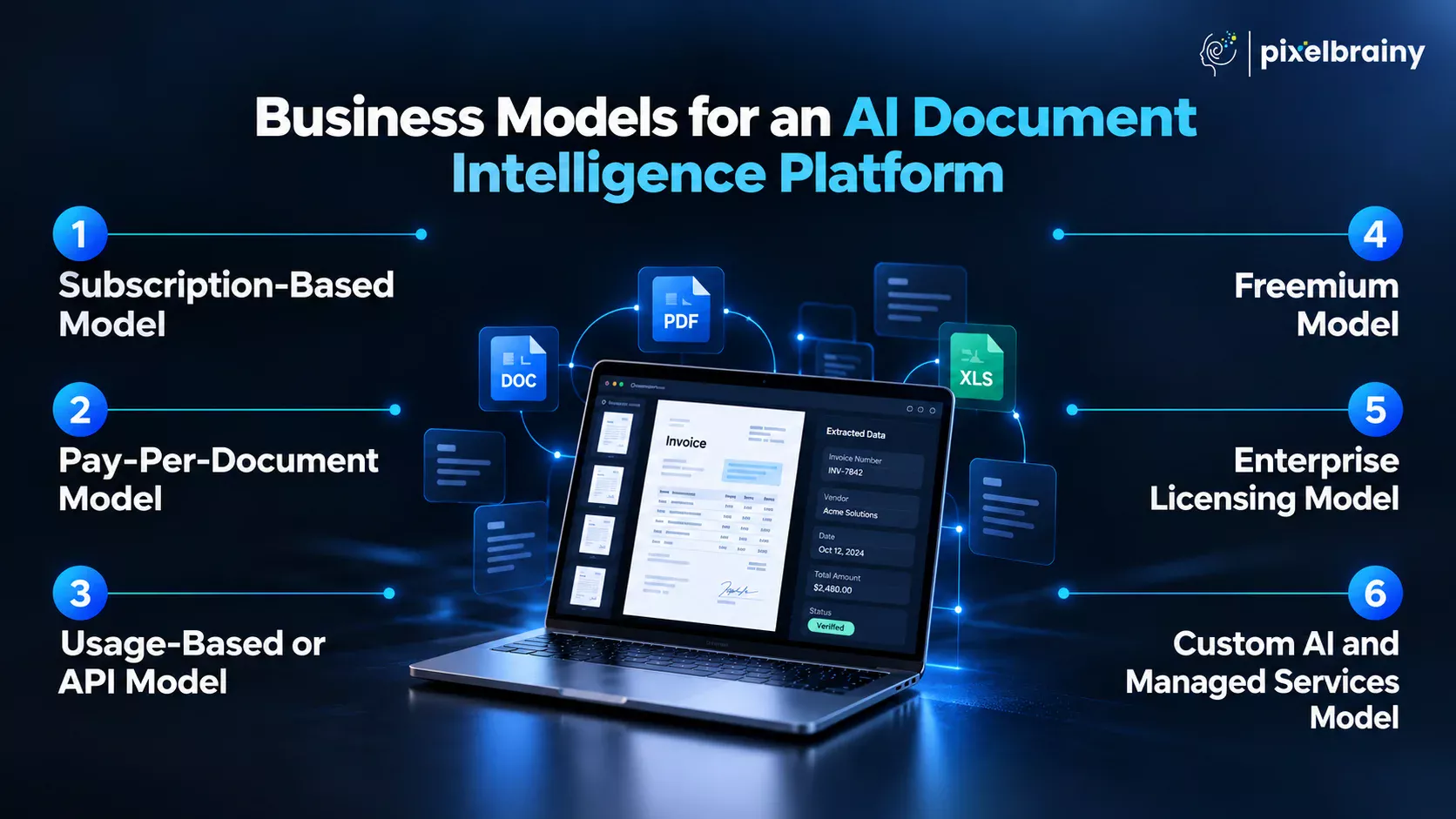
Customers pay a recurring monthly or annual fee to access the platform. Pricing can be divided into different plans based on document volume, users, storage, integrations, AI features, and processing limits.
This model provides predictable recurring revenue and works well for SaaS-based AI document intelligence platforms serving small businesses, growing companies, and enterprises.
Customers pay according to the number of documents or pages processed by the platform. For example, the platform can charge a specific amount for every document processed or create volume-based pricing tiers.
This approach works well for businesses where document processing requirements change throughout the year. Customers only pay for the processing capacity they actually use.
Businesses can integrate document intelligence capabilities into their existing applications through APIs. Revenue is generated based on API calls, pages processed, extraction requests, or other measurable usage metrics.
This model is particularly relevant for fintech, insurance, healthcare, logistics, accounting, and software companies that want to add AI document processing to their existing products without building the complete infrastructure internally.
The platform provides a free version with limited document processing, storage, users, or AI capabilities. Customers can upgrade to paid plans when they require higher processing limits, advanced extraction, integrations, collaboration, or enterprise features.
A freemium strategy can help startups attract users, demonstrate the value of AI document intelligence software, and create opportunities for paid upgrades.
Large organizations can purchase enterprise licenses that provide higher processing capacity, advanced security controls, dedicated environments, custom workflows, enterprise integrations, administrative controls, and premium support.
This model is suitable for organizations such as banks, insurance companies, healthcare providers, government departments, and large corporations that process significant volumes of sensitive documents.
Revenue can also come from customized AI model development, document workflow implementation, system integration, model optimization, data preparation, and managed document processing services.
This business model is valuable when customers have specialized documents or complex requirements that cannot be addressed effectively through standard platform features alone.
These above six business models allow an AI document intelligence platform to build revenue through subscriptions, usage, enterprise licensing, and customized AI services while supporting different customer needs and document processing volumes.
When business owners and CTOs plan to develop an AI document intelligence platform, the focus often starts with automation, faster processing, and reducing manual document work. However, moving from an AI concept to a reliable production platform brings several technical and operational challenges. What challenges should businesses expect when building an AI document intelligence platform, and what can be done to overcome them?
Document quality, extraction accuracy, training data, sensitive information, system scalability, enterprise integrations, model performance, and human review can all affect the success of an AI document intelligence platform development project. These challenges become more important when the platform needs to process high document volumes or support complex workflows across industries such as banking, insurance, healthcare, legal, and accounting.
Understanding these challenges before development begins helps business owners and technology leaders plan the right AI architecture, data strategy, security controls, validation processes, and ongoing model improvement framework. Below are the 8 major challenges in AI document intelligence platform development and practical ways to overcome them.
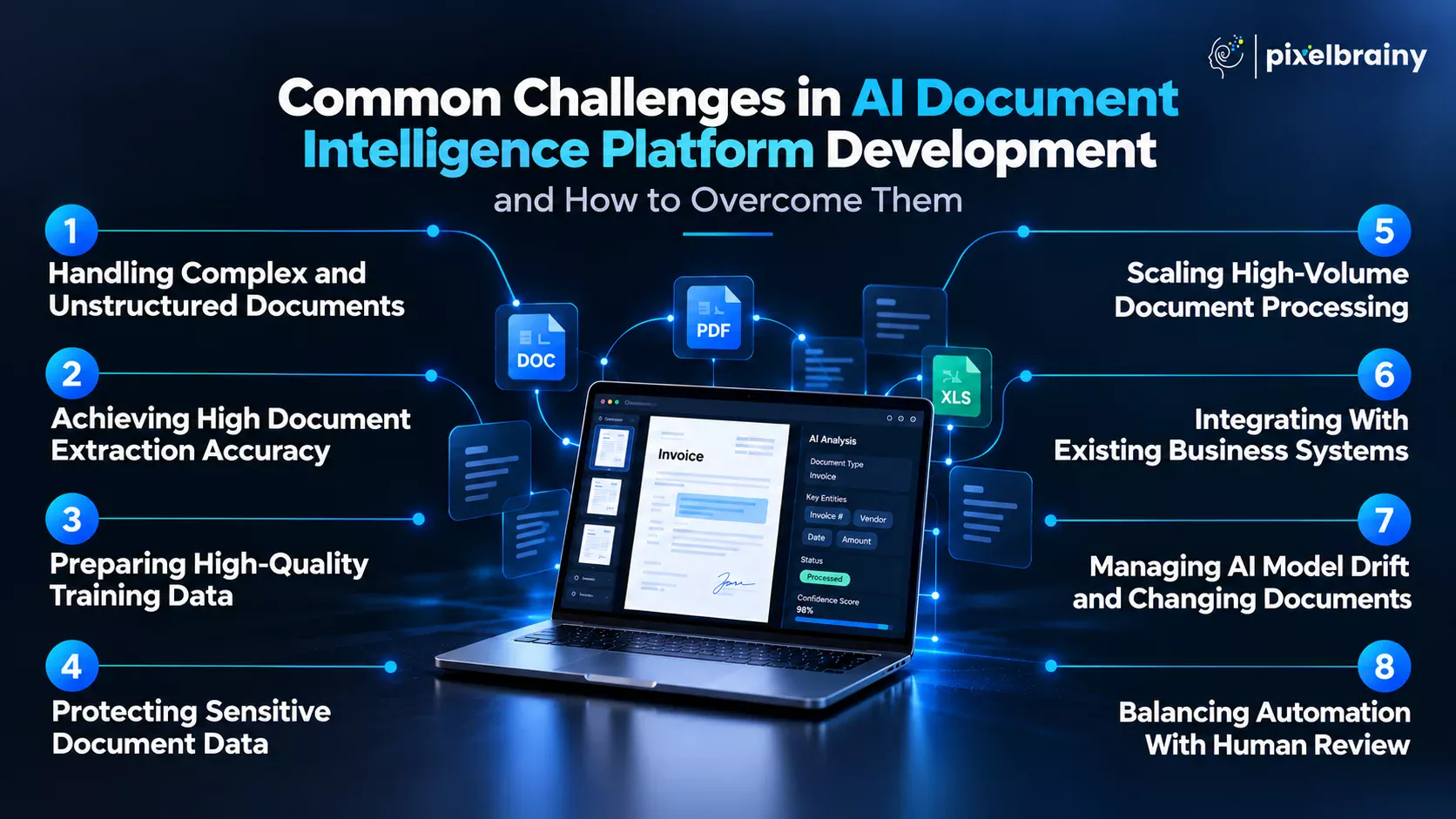
Business documents rarely follow one consistent format. PDFs, scanned files, handwritten information, tables, multi-column layouts, forms, images, and documents with poor image quality can make automated extraction difficult.
How to overcome it:
Use multimodal document processing, advanced OCR, layout analysis, document classification, preprocessing, and specialized extraction models. Maintain representative datasets covering different document formats and variations.
Extraction accuracy is one of the most important challenges in AI document intelligence software development. A model may correctly identify common fields but struggle with unusual layouts, missing information, low-quality scans, or complex tables.
How to overcome it:
Create domain-specific evaluation datasets, establish field-level accuracy benchmarks, use confidence scores, validate extracted values against business rules, and introduce human review for low-confidence results. Continuously evaluate performance using real production documents.
Custom AI model development depends heavily on the quality and diversity of training data. Poorly labeled, limited, or unrepresentative documents can result in unreliable classification and extraction.
How to overcome it:
Build structured annotation workflows, establish clear labeling guidelines, include document variations, perform quality checks, and continuously add representative production samples to the evaluation and training pipeline where legally permitted.
AI document platforms can process personally identifiable information, financial records, contracts, medical information, tax documents, and other confidential data. Unauthorized access, insecure storage, or improper data handling can create serious security and compliance risks.
How to overcome it:
Use encryption, role-based access control, secure APIs, identity management, audit logging, secrets management, data retention policies, and appropriate cloud security controls. Security requirements should be incorporated into the architecture from the beginning.
Processing thousands or millions of pages requires more than simply increasing server capacity. Large workloads can create bottlenecks in OCR, AI inference, storage, queues, databases, and downstream integrations.
How to overcome it:
Use asynchronous processing, message queues, containerized services, horizontal scaling, cloud infrastructure, caching where appropriate, and workload monitoring. Design the architecture so individual processing components can scale independently.
Businesses often need extracted information to flow into ERP, CRM, accounting, banking, insurance, healthcare, HR, or document management systems. Integration problems can reduce the practical value of an otherwise capable AI platform.
How to overcome it:
Build API-first architecture with REST APIs, webhooks, standardized data schemas, authentication controls, retry mechanisms, and integration monitoring. Create reusable connectors for commonly used enterprise systems where appropriate.
Document formats and business requirements can change over time. A model that performs well during initial deployment may encounter new layouts, templates, terminology, or document types later.
How to overcome it:
Monitor extraction accuracy, confidence scores, human correction rates, and document distribution. Establish model evaluation and retraining processes so the platform can adapt when document patterns or business requirements change.
Complete automation is not always appropriate, particularly when documents contain ambiguous information or decisions have financial, legal, or operational consequences.
How to overcome it:
Implement human-in-the-loop workflows that route low-confidence fields or exceptions to reviewers. Capture reviewer corrections, maintain audit trails, and use validated feedback to improve future processing while keeping appropriate human oversight.
Addressing these challenges early helps businesses build an AI document intelligence platform that is more accurate, secure, scalable, integration-ready, and capable of delivering reliable automation in real-world document workflows.
From the above features, technology requirements, development process, cost, and challenges, it is now time to identify a development partner that can translate a complex AI document workflow into a practical, scalable product. For startups, this means finding a partner that can turn an idea into an MVP and scale it as adoption grows. For enterprises, the focus may be on security, integrations, automation, governance, and handling large volumes of business documents.
A common query from CTOs and business owners is: “Which development company has experience delivering an AI document intelligence platform with advanced document processing, intelligent search, automation, and enterprise-grade security?”
PixelBrainy a leading AI development company, can be considered for projects where document intelligence needs to go beyond basic OCR and connect AI capabilities with real business workflows. Its published AI capabilities cover RAG, document processing, AI automation, custom AI solutions, and enterprise AI development.
Client Goal
A financial services organization was dealing with large volumes of financial reports, regulatory filings, and other business documents. The challenge was to make this information easier for teams to search, understand, and use without manually reviewing multiple sources.
PixelBrainy developed a RAG-powered document intelligence solution that brought financial documents and related information into an AI-powered retrieval environment. The system enabled users to ask questions in natural language and retrieve relevant information from the underlying document collection.
The solution combined document processing, intelligent retrieval, contextual AI responses, and source citations. This approach helped create a more practical way for financial teams to interact with large document repositories.
Key Results
The project demonstrates how AI document intelligence platform development services can combine document processing, RAG solutions, natural language interaction, and enterprise requirements into a single business-focused solution.
For startups and enterprises planning to build AI document intelligence platform capabilities or develop AI document intelligence software, PixelBrainy can help translate specific document workflows into a scalable AI product. Its experience also supports document intelligence tool development integrating AI with business applications and enterprise workflows.
Have an AI document intelligence project in mind? Connect with PixelBrainy to discuss your requirements and development roadmap.

AI document intelligence is becoming an important technology for businesses that handle large volumes of structured and unstructured documents. From banking and insurance to healthcare, legal, logistics, and enterprise operations, organizations can use intelligent document processing to automate extraction, classification, validation, search, and workflow management.
Successful AI document intelligence platform development requires more than implementing OCR. Businesses need a strong technology stack, reliable AI models, secure architecture, human review workflows, enterprise integrations, and continuous performance monitoring. The development cost can range from $50,000 to $250,000+, depending on document complexity, AI capabilities, integrations, security requirements, and scalability.
For organizations looking to build AI document intelligence platform solutions or develop AI document intelligence software, defining clear business requirements and measurable accuracy goals is essential before development begins. With the right architecture and experienced development partner, document-heavy processes can become faster, more scalable, and increasingly automated.
Ready to turn your document intelligence idea into a business-ready AI solution? Book an appointment with PixelBrainy to discuss your project.
Before starting AI document intelligence platform development, businesses should define document types, monthly processing volume, extraction fields, accuracy targets, integrations, security requirements, user roles, and automation goals. These requirements help determine the appropriate AI architecture, technology stack, development timeline, and budget.
To build an AI document intelligence platform for multiple industries, the architecture should support configurable document schemas, custom extraction models, industry-specific workflows, multilingual processing, APIs, role-based access, and tenant-level configurations. This allows the same core platform to support use cases across finance, healthcare, insurance, legal, logistics, and other sectors.
The cost to develop AI document intelligence software with custom models depends on the number and complexity of document types, training data requirements, extraction accuracy, integrations, security controls, processing volume, and deployment environment. A basic platform may require a smaller investment, while an enterprise-grade system with custom AI can reach $250,000 or more.
Yes. An AI document intelligence platform can integrate with SAP, Salesforce, CRMs, ERPs, accounting systems, databases, and internal applications through REST APIs, webhooks, middleware, or custom connectors. Integration allows extracted document information to automatically enter existing business workflows instead of remaining isolated within the AI platform.
The timeline for AI document intelligence software development depends on the platform's scope. An MVP with basic ingestion, OCR, classification, and extraction can require significantly less time than an enterprise platform with custom AI models, multilingual support, advanced search, human review, security controls, and multiple integrations. A detailed technical specification is needed for a reliable timeline estimate.
Document intelligence tool development goes beyond converting images into text. An intelligent platform can classify documents, understand layouts, extract business entities, analyze tables, validate information, assign confidence scores, search across document collections, and trigger automated workflows. This makes it suitable for complex business processes where basic OCR alone is insufficient.
Businesses can improve AI document processing accuracy through representative training data, document preprocessing, specialized extraction models, validation rules, confidence scoring, human review, and continuous model evaluation. During AI document intelligence platform development, accuracy should be measured at the field and document level rather than relying only on a general platform accuracy percentage.
Yes. Generative AI and RAG can extend an AI document intelligence platform beyond extraction by enabling natural language document queries, contextual answers, summarization, cross-document analysis, semantic search, and source-grounded responses. This can help users interact with large document repositories without manually searching through individual files.

About The Author
Sagar Bhatnagar
Sagar Sahay Bhatnagar brings over a decade of IT industry experience to his role as Marketing Head at PixelBrainy. He's known for his knack in devising creative marketing strategies that boost brand visibility and market influence. Sagar's strategic thinking, coupled with his innovative vision and focus on results, sets him apart. His track record of successful campaigns proves his ability to utilize digital platforms effectively for impactful marketing efforts. With a genuine passion for both technology and marketing, Sagar continuously pushes PixelBrainy's marketing initiatives to greater success.

Working with the PixelBrainy team has been a highly positive experience. They understand the design requirements and create beautiful UX elements to meet the application needs. The dev team did an excellent job bringing my vision to life. We discussed usability and flow. Sagar worked with his team to design the database and begin coding. Working with Sagar was easy. He has the knowledge to create robust apps, including multi-language support, Google and Apple ID login options, Ad-enabled integrations, Stripe payment processing, and a Web Admin site for maintaining support data. I'm extremely satisfied with the services provided, the quality of the final product, and the professionalism of the entire process. I highly recommend them for Android and iOS Mobile Application Design and Development.

Great experience working with them. Had a lot of feedback and I found that unlike most contractors they were bugging me for updates instead of the other way around. They were extremely time conscience and great at communicating! All work was done extremely high quality and if not on time, early! They were always proactive when it comes to communication and the work is great/above par always. Very flexible and a great team to work with! Goes above and beyond to present us with multiple options and always provides quality. Amazing work per usual with Chitra. If you have UI/UX or branding design needs I recommend you go to them! Will likely work with them in the future as well, definitely recommended!

PixelBrainy is a joy to work with and is a great partner when thinking through branding, logo, and website layout. I appreciate that they spend time going into the "why" behind their decisions to help inform me and others about industry best practices and their expertise.

I hired them to design our software apps. Things I really like about them are excellent communication skills, they answer all project suggestions and collaborate right away, and their input on design and colors is amazing. This project was complex and needed patience and creativity. The team is amazing to do business with. I will be using them long-term. Glad to see there are some good people out there. I was afraid to try and outsource my project to someone but I am glad I met them! I really can't say enough. They went above and beyond on this project. I am very happy with everything they have done to make my business stand out from the competition.

It was great working with PixelBrainy and the team. They were very responsive and really owned the project. We'll definitely work with them again!

I recently worked with the PixelBrainy team on a project and I was blown away by their communication skills. They were prompt, clear, and articulate in all of our interactions. They listened and provided valuable feedback and suggestions to help make the project a success. They also kept me updated throughout the entire process, which made the experience stress-free and enjoyable.

PixelBrainy is very good at what it does. The team also presents themselves very professionally and takes care of their side of things very well. I could fully trust them taking up the design work in a timely and organised manner and their attention to detail saved us lots of effort and time. This particular project was quite intense and the team showed that they function very well under pressure. Very much looking forward to working with her again!

It's always an absolute pleasure working with them. They completed all of my requests quickly and followed every note I had for them to a T, which made our process go smoothly from start to finish. Everything was completed fast and following all of the guidelines. And I would recommend their services to anyone. If you need any design work done in the future, PixelBrainy should be your first call!

They took ownership of our requirements and designed and proposed multiple beautiful variants. The team is self-motivated, requires minimum supervision, committed to see-through designs with quality and delivering them on time. We would definitely love to work with PixelBrainy again when we have any requirements.

PixelBrainy was a big help with our SaaS application. We've been hard at work with a new UI/UX and they provided a lot of help with the designs. If you're looking for assistance with your website, software, or mobile application designs, PixelBrainy and the team is a great recommendation.

PixelBrainy designers are amazing. They are responsive, talented, and always willing to help craft the design until it matches your vision. I would recommend them and plan to continue them for my future projects and more!!!

They were awesome! Did a good job fast, and good communication. Will work with them again. Thank you

Creative, detail-oriented, and talented designers who take direction well and implement changes quickly and accurately. They consistently over-delivered for us.

PixelBrainy team is very talented and creative. Great designers and a pleasure to work with. PixelBrainy is an excellent communicator and I look forward to working with them again.

PixelBrainy has a very talented design team. Their work is excellent and they are very responsive. I enjoy working with them and hope to continue on all of our future projects.


Transform your ideas into reality with us.
Across these industries, each engagement brings unique challenges, from early-stage product development to scaling complex systems, helping us build a practical understanding of real-world product environments.