AI Summary Powered by PixelBrainy
What if your investment team could spend less time searching for financial information and more time turning that information into investment decisions?
Imagine you are a portfolio manager at a mid-size asset management firm. Your research team spends a significant portion of its working time gathering information—reading earnings transcripts, extracting financial metrics, searching SEC filings, comparing historical results, monitoring management commentary, reviewing industry news, and consolidating data from multiple sources. By the time analysts have assembled everything they need, valuable time has already been spent before the actual investment analysis begins.
Your firm may already have access to Bloomberg Terminal, financial databases, market data, news, screening tools, and research resources. Yet a critical gap remains between accessing financial information and understanding what that information means in an investment context. Analysts still need to connect the dots themselves.
That is where AI financial research platform development becomes strategically valuable.
A modern platform can combine financial data APIs, SEC filings, earnings transcripts, market news, alternative datasets, retrieval-augmented generation (RAG), large language models (LLMs), quantitative analytics, and AI agents into a unified research environment. Instead of simply retrieving documents, the platform can answer questions, extract relevant evidence, calculate metrics, compare companies, summarize management commentary, identify changes, and provide source-backed insights.
The market is moving rapidly in this direction. KPMG's 2026 research indicates that 93% of U.S. companies expect to be deploying or scaling AI in their finance functions within the next 18 months, demonstrating the shift from AI experimentation toward broader financial workflow adoption.
The commercial opportunity is also significant. MarketsandMarkets projects the U.S. AI-in-finance market to grow from approximately $10.39 billion in 2024 to $44.01 billion by 2029, representing a 27.2% CAGR.
For portfolio managers, hedge funds, wealth managers, investment banks, equity research teams, fintech companies, and financial institutions, the question is increasingly practical: how do you build an AI financial research platform that is accurate, explainable, secure, scalable, and compliant?
This guide provides a step-by-step approach to developing an AI financial research platform, covering architecture, essential features, technology choices, development stages, costs, compliance requirements, key challenges, and the decision between buying an existing solution and pursuing custom AI financial research platform development.
Most importantly, it explains how to build a compliant AI financial research platform without treating compliance as an afterthought.
An AI financial research platform is an intelligent software system that combines financial data, SEC filings, earnings transcripts, market news, research documents, quantitative analytics, and AI technologies to help investment professionals find, analyze, compare, and interpret financial information faster.
Unlike traditional research tools that primarily provide databases, search functions, dashboards, or documents, an AI financial research platform adds an intelligent analysis layer that can understand questions, retrieve relevant information, perform calculations, identify trends, and generate source-backed insights.
| Capability | Traditional Research Tools | AI Financial Research Platform |
|---|---|---|
| Information Search | Analysts manually search databases and documents | AI understands natural-language research questions |
| Data Retrieval | Returns documents, reports, and datasets | Retrieves and ranks the most relevant evidence |
| Financial Analysis | Analysts calculate and interpret metrics manually | AI can calculate, compare, and explain financial metrics |
| Earnings Research | Analysts read transcripts and extract insights | AI summarizes earnings calls and identifies key management commentary |
| Company Comparison | Requires manual collection and spreadsheet analysis | Automatically compares companies, periods, and financial indicators |
| SEC Filing Analysis | Analysts search lengthy filings manually | AI identifies relevant sections, disclosures, and financial information |
| News Monitoring | Users monitor multiple news sources | AI can continuously identify relevant developments and signals |
| Research Questions | Primarily keyword-based search | Conversational, context-aware questions and follow-ups |
| Source Verification | Users validate information themselves | Answers can include citations and supporting evidence |
| Workflow | Information retrieval → manual analysis | Question → retrieval → analysis → evidence-backed insight |
| Primary Value | Access to financial information | Faster research and decision-support |
The fundamental difference is intelligence over information. Traditional tools help investment teams find data; AI financial research platforms help them understand and use that data.
Using technologies such as retrieval-augmented generation (RAG), large language models (LLMs), natural language processing, knowledge graphs, and AI agents, the platform can connect information across filings, earnings calls, market data, and news.
For example, an analyst could ask, “How has Company A's operating margin changed over the last five years, and what has management said about the key drivers?” Instead of manually searching multiple sources, the platform can retrieve the relevant financial data and commentary, perform the comparison, and present a concise, source-backed answer.
This makes AI financial research platforms a decision-support layer for investment teams-not simply another financial database or chatbot.
An AI financial research platform works by connecting financial data sources, AI models, retrieval systems, analytics engines, and research workflows into a single environment. Its purpose is to transform large volumes of financial information into accurate, contextual, and source-backed investment insights.
The typical workflow can be divided into the following stages:
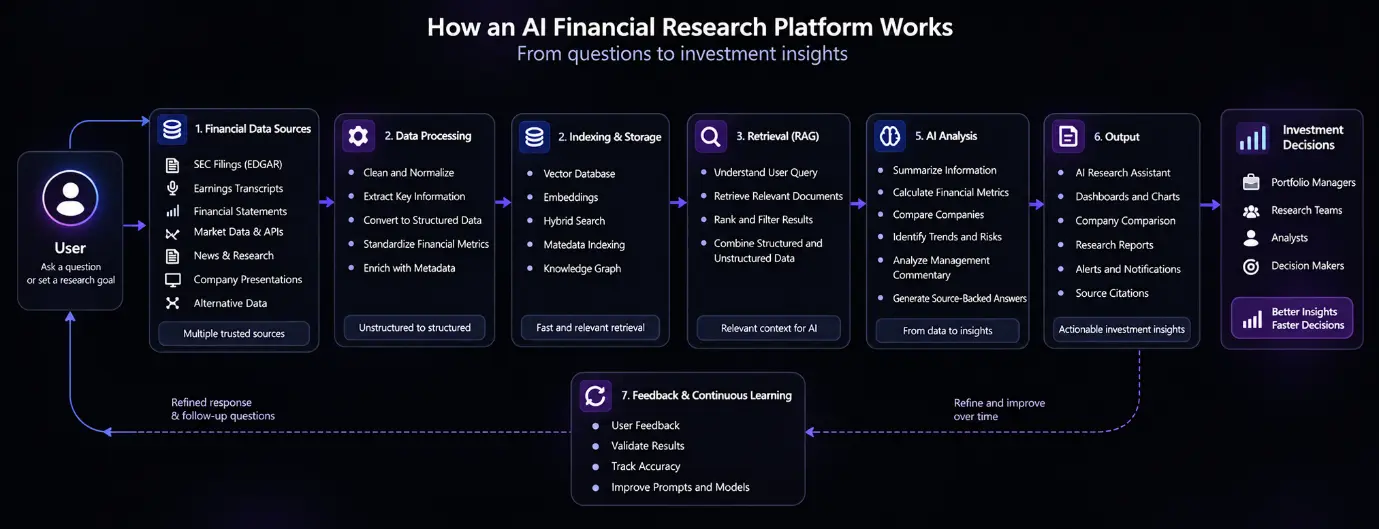
The platform first collects information from multiple sources, including SEC filings, annual reports, quarterly reports, earnings transcripts, market data, financial statements, company presentations, analyst research, and financial news. APIs and data connectors allow the system to continuously receive structured and unstructured financial information.
Raw financial information is cleaned, structured, normalized, and categorized. Documents can be converted into machine-readable formats, while financial metrics are mapped to standardized fields. This step helps the platform understand differences in company reporting formats, terminology, and reporting periods.
The platform indexes processed information so relevant content can be retrieved quickly. Modern systems commonly use vector databases, embeddings, metadata, keyword search, and hybrid search. This allows the platform to identify information based on both keywords and meaning.
When an analyst submits a question, the RAG system retrieves relevant financial documents, data points, and evidence before sending the context to an AI model. This helps the model generate answers based on current and relevant information rather than relying only on its pre-trained knowledge.
The large language model interprets the retrieved information and performs tasks such as financial analysis, earnings call summarization, company comparison, trend identification, management commentary analysis, and research question answering. For numerical calculations, the platform can connect the AI model to dedicated analytics or calculation engines.
A financial research platform should provide traceable sources for important claims. The system can link conclusions to SEC filings, earnings transcripts, financial statements, news articles, or other approved data sources. This improves transparency and allows analysts to verify AI-generated insights.
Finally, the platform presents the results through an AI research assistant, dashboard, report, comparison table, alert, or automated research workflow. Users can ask follow-up questions and refine their analysis without repeating the entire search process.
Financial Data Sources → Data Processing → Search and Retrieval → RAG → AI Analysis → Source Validation → Investment Research Output
This architecture enables investment teams to move from manual information gathering to AI-assisted financial research, while keeping human analysts responsible for interpretation, investment judgment, and final decisions.
An AI financial research platform is most valuable for organizations that manage large volumes of financial information and need faster, more scalable research workflows. In 2026, investment teams can use AI to automate repetitive research tasks such as SEC filing analysis, earnings transcript review, financial statement comparison, market news monitoring, and company screening.
A typical real-world query might be:
“Compare NVIDIA, AMD, and Broadcom based on their latest revenue growth, gross margins, free cash flow, forward guidance, and management commentary. Highlight the most significant changes from the previous quarter and cite the source for each conclusion.”
An AI financial research platform can retrieve the relevant filings, earnings transcripts, financial data, and news, perform the comparison, and return a source-backed research summary. This makes the technology particularly valuable for the following organizations.
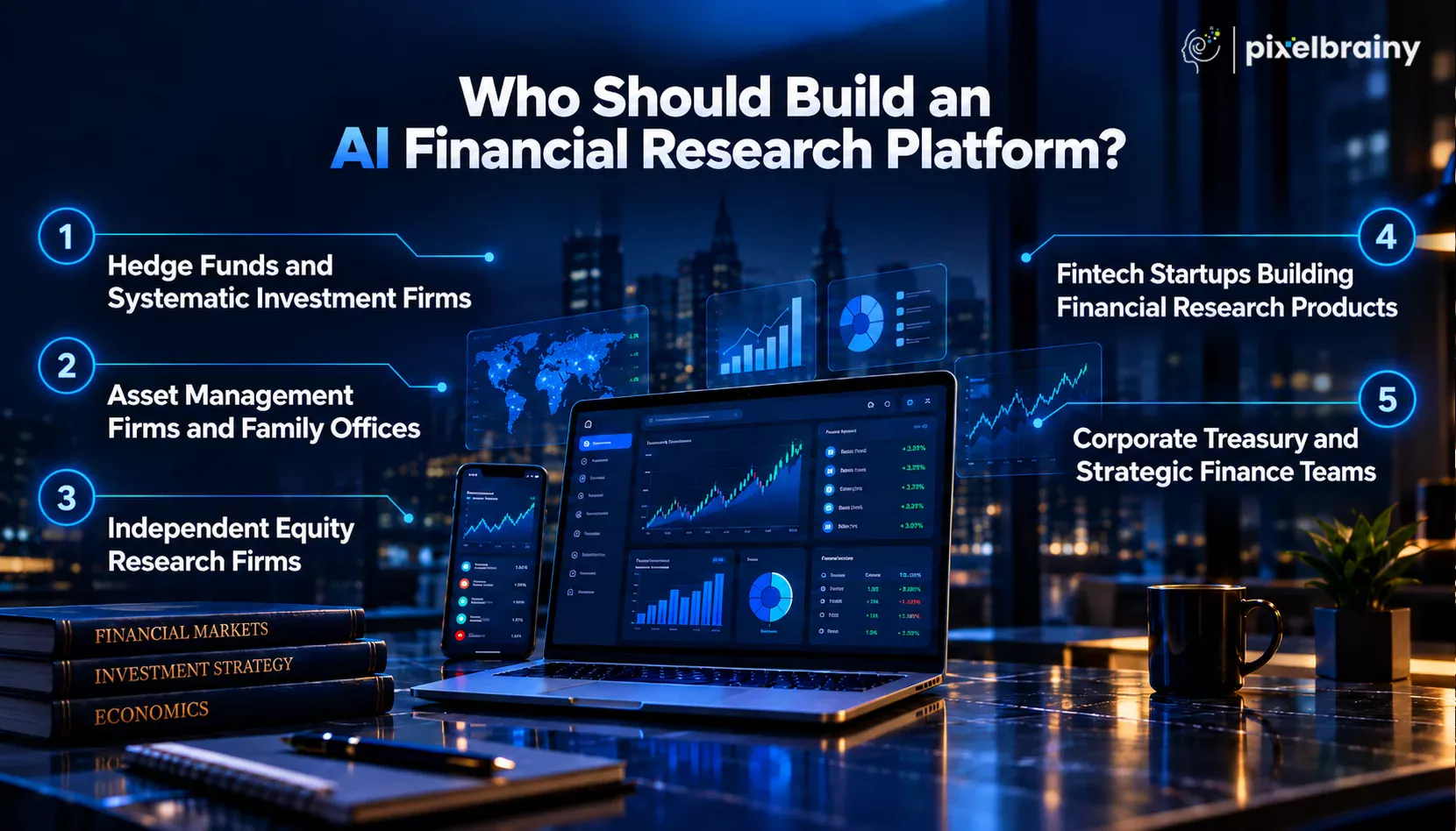
Hedge funds and systematic investment firms process information across hundreds or thousands of securities. An AI financial research platform development for hedge funds can expand research coverage by continuously analyzing earnings releases, SEC filings, alternative data, market news, and management commentary.
AI can also help identify unusual changes, emerging trends, and potential signals across large datasets that would be difficult for analysts to monitor manually.
Best suited for: High-volume research, investment screening, earnings intelligence, alternative data analysis, and automated monitoring.
Asset managers and family offices can use AI to automate information gathering and preliminary financial analysis. This allows portfolio managers and analysts to spend more time on investment thesis development, valuation, portfolio construction, and risk assessment.
An AI financial research platform for analysts can summarize companies, compare historical performance, extract financial metrics, and monitor management guidance without requiring analysts to manually search multiple sources.
Best suited for: Fundamental research, portfolio monitoring, SEC analysis, company comparisons, and research productivity.
Independent research firms can use AI equity research platform development to deliver deeper company analysis with smaller research teams. AI can support the complete research workflow, from data collection and financial modeling inputs to earnings analysis and report preparation.
Best suited for: Institutional-quality research, broader company coverage, automated report generation, and differentiated research products.
Fintech startups can build AI-native research platforms for investment professionals, independent advisors, sophisticated investors, or specialized asset classes. Custom development allows founders to create proprietary workflows rather than simply adding a chatbot to an existing financial product.
Best suited for: B2B SaaS products, research assistants, investment intelligence platforms, and specialized financial research solutions.
Corporate finance teams can apply AI financial research technology to competitor analysis, market intelligence, supplier research, acquisition screening, and financial planning.
Best suited for: Competitive intelligence, market monitoring, strategic analysis, and corporate financial research.
Ultimately, the best candidates are organizations where financial research volume is growing faster than human capacity. A well-designed platform turns AI financial research into a scalable capability while keeping investment professionals in control of final decisions.
The business case for financial research platform development with AI goes beyond simply adding an AI chatbot to an existing research workflow. A well-designed platform can reduce manual research, improve analyst productivity, expand investment coverage, and turn fragmented financial information into structured, actionable insights.
Consider a portfolio manager asking:
“Analyze the latest SEC filings and earnings transcript for Company A. Compare revenue, margins, cash flow, and guidance with the previous quarter, identify changes in management sentiment, and highlight anything that could affect our investment thesis.”
A platform built to handle this query can combine SEC filing analysis, financial analysis, sentiment analysis, document retrieval, and source-backed AI responses in one workflow.
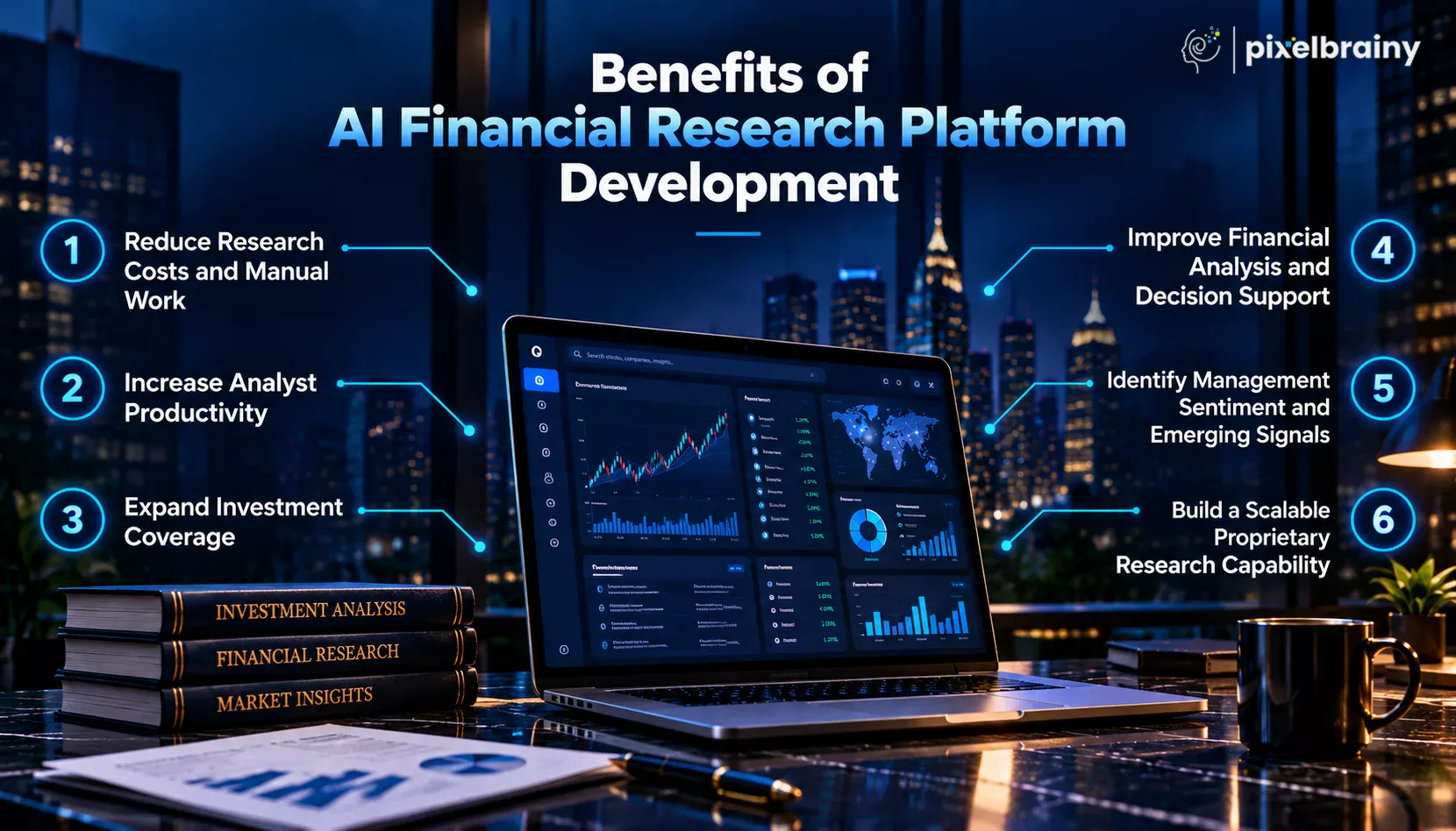
One of the strongest benefits of financial research platform development with AI is automating repetitive information-gathering activities. Analysts can spend significant time searching SEC filings, reading earnings transcripts, collecting financial metrics, monitoring news, and preparing research summaries.
When you create an AI financial research platform with SEC filing analysis, the system can automatically locate relevant filings, extract financial information, identify important disclosures, and organize findings for analysts. This reduces the amount of manual research required before deeper investment analysis begins.
For business owners, the result can be lower research operating costs, improved resource utilization, and greater productivity from existing investment teams.
When you develop AI financial analysis platform capabilities, analysts can move more quickly from information gathering to interpretation. The platform can answer financial questions, compare companies, summarize earnings, calculate selected metrics, and retrieve supporting evidence.
For example:
“What were the three biggest changes in Company A's financial performance over the past four quarters, and what reasons did management provide?”
Instead of manually searching multiple documents, analysts receive an organized starting point for validation and further research.
Business impact: More research completed per analyst, shorter research cycles, and improved productivity without immediately increasing headcount.
Human analysts have limited capacity to monitor every company, filing, earnings call, and market development. A custom AI financial research platform development strategy allows firms to automate continuous monitoring across larger security universes.
The platform can track companies and alert analysts when revenue guidance changes, margins decline, financial risks emerge, or significant disclosures appear. This is particularly valuable for hedge funds and asset managers managing broad investment coverage.
Business impact: More companies monitored, more potential opportunities identified, and greater research coverage using existing resources.
An AI platform can bring financial statements, market data, historical performance, earnings commentary, and company disclosures into one analytical workflow. When you develop AI financial analysis platform capabilities, users can ask questions using natural language rather than manually navigating multiple databases and spreadsheets.
For example:
“Compare the latest revenue growth, operating margin, free cash flow, and guidance for these five companies. Which company shows the strongest fundamental improvement?”
The platform can structure the comparison and provide evidence for analysts to review.
Business impact: Faster analysis, more consistent research workflows, and better-informed investment decisions.
To develop an AI financial research platform with sentiment analysis, firms can analyze language across earnings calls, investor presentations, management commentary, and financial news. The system can identify changes in tone, confidence, uncertainty, or discussion patterns over time.
For example, it could compare current and previous earnings calls to identify whether management has become more cautious about demand, margins, capital expenditure, or future guidance.
Sentiment analysis should complement financial metrics rather than replace fundamental analysis.
Business impact: Earlier identification of qualitative signals, stronger earnings research, and improved monitoring of management commentary.
Custom AI financial research platform development gives financial organizations greater control over their research workflows, data sources, AI models, permissions, and analytical features. Instead of relying entirely on generic research tools, firms can build capabilities around their specific investment strategies and information requirements.
A platform can later expand with additional SEC data, alternative datasets, financial models, research agents, alerts, portfolio monitoring, and specialized analytical workflows.
Business impact: Scalable research infrastructure, differentiated capabilities, stronger operational efficiency, and potential opportunities to commercialize the technology.
The strongest value of financial research platform development with AI is measurable business efficiency. It enables firms to process more information, expand research coverage, reduce repetitive work, and help investment professionals focus on the judgment that creates investment value.
The core purpose of an AI financial research platform is to help a small investment team process more financial information without proportionally increasing research headcount. This is especially valuable for family offices and asset managers covering multiple asset classes, where analysts cannot manually maintain the same research depth across every investment opportunity.
Consider this real-world requirement from a Chief Investment Officer at a family office:
“I am the Chief Investment Officer at a family office and our investment team is small relative to the breadth of our investment mandate, which covers public equities, private credit, real estate, and alternative investments. We cannot maintain the same depth of research across all asset classes with our current team size. I want to build an AI financial research platform that extends our team's effective research coverage by automating information processing so our analysts can focus on the judgment-intensive analysis that actually drives investment decisions.”
To address this requirement, custom AI financial research platform development should begin with core capabilities that automate information collection, organization, retrieval, and preliminary analysis across different investment workflows.
| Core Feature | What It Does |
|---|---|
| Financial Data Integration | Connects approved market data, company information, financial statements, economic indicators, and research sources into a centralized data layer. This helps an AI financial research platform give analysts consistent access to relevant information across multiple asset classes. |
| SEC Filing Integration | Enables an AI financial research platform with SEC filing analysis to collect and process 10-K, 10-Q, 8-K, proxy statements, and other regulatory filings. AI can extract important financial changes, disclosures, risks, and management commentary for faster research. |
| Earnings Transcript Analysis | Processes earnings call transcripts to identify changes in revenue, margins, guidance, strategy, risks, capital allocation, and management commentary. This supports AI financial research platform development focused on understanding both financial results and management communication. |
| Natural Language Search | Allows analysts to ask financial questions using everyday language instead of complex database queries. Users can search for specific companies, financial metrics, historical trends, filings, or investment themes and receive contextually relevant research results. |
| AI Research Assistant | Provides a conversational interface where analysts can ask follow-up questions, request summaries, compare financial information, and investigate investment topics. The assistant can combine retrieved evidence with AI reasoning to accelerate day-to-day financial research workflows. |
| Company Research Profiles | Creates centralized profiles containing company financials, SEC filings, earnings transcripts, news, business information, and relevant research documents. Analysts can quickly understand a company without manually collecting information from multiple systems. |
| Financial Statement Analysis | Analyzes income statements, balance sheets, and cash flow statements to identify changes in revenue, profitability, liquidity, leverage, and cash generation. This is essential when you develop an AI financial analysis platform for investment decision support. |
| Historical Financial Data | Stores and analyzes financial information across multiple quarters and years, allowing analysts to evaluate trends in revenue, earnings, margins, cash flow, debt, and other important metrics while maintaining historical context. |
| Company Comparison | Enables analysts to compare companies across financial performance, valuation metrics, profitability, growth, leverage, and other investment criteria. This can support equity screening, peer analysis, due diligence, and portfolio research across different investment strategies. |
| News Aggregation | Collects relevant company, industry, market, economic, and regulatory news from approved sources. AI can organize the information by relevance and summarize developments so analysts spend less time monitoring multiple financial news channels. |
| Document Search | Provides searchable access to filings, earnings transcripts, investor presentations, research documents, and other financial materials. AI-powered retrieval helps analysts locate specific information quickly instead of manually reviewing lengthy documents. |
| Financial Metric Extraction | Automatically identifies important metrics such as revenue, EPS, operating income, EBITDA, margins, free cash flow, debt, and guidance from financial documents. Structured extraction makes large volumes of financial information easier to analyze and compare. |
| Research Workspace | Gives analysts a dedicated environment to organize documents, notes, findings, saved searches, company research, and AI-generated insights. This helps turn individual research activities into a repeatable workflow that investment teams can share and revisit. |
| Source Citations | Links AI-generated findings back to the underlying filing, transcript, financial dataset, news source, or research document. Source-level citations improve transparency and allow analysts to verify important information before using it in investment decisions. |
| User Dashboard | Provides a personalized view of tracked companies, recent research, saved analysis, alerts, documents, and frequently used workflows. A customized dashboard helps different users access the information most relevant to their investment responsibilities and research priorities. |
These core capabilities provide the foundation for a scalable AI financial research platform, while advanced AI features can be added separately as the platform matures.
After implementing the core capabilities, businesses can add advanced features that make an AI financial research platform more proactive, analytical, and personalized. These features help investment teams move beyond financial information retrieval toward deeper analysis, investment signals, predictive insights, and automated research workflows.
For example, an investment professional looking for custom AI financial research platform development might ask:
“I want to develop an AI financial research platform with SEC filing analysis and sentiment analysis that monitors our portfolio companies, compares their latest financial results with historical performance, detects changes in management sentiment, identifies risks that could weaken our investment thesis, and alerts our analysts when a material development requires review.”
This type of query combines several advanced capabilities that can be incorporated while building an AI financial research platform.
| Advanced Feature | What It Does |
|---|---|
| AI Investment Thesis Analysis | Helps a custom AI financial research platform compare new filings, earnings results, guidance, news, and management commentary against an existing investment thesis. It can highlight supporting evidence, contradictions, changed assumptions, and developments that may require analyst review. |
| Predictive Financial Analytics | Supports businesses that want to develop an AI financial analysis platform capable of identifying potential trends in revenue, earnings, margins, cash flow, and other financial metrics. Historical data and quantitative models can help analysts evaluate possible future outcomes and scenarios. |
| AI Sentiment Analysis | Allows organizations to develop an AI financial research platform with sentiment analysis for earnings calls, SEC filings, management commentary, and financial news. The system can detect changes in confidence, uncertainty, risk language, and management tone that may warrant deeper research. |
| AI Investment Signal Detection | An advanced AI financial research platform can continuously analyze financial metrics, company disclosures, news, and other approved datasets to identify potentially important investment signals. Analysts can receive prioritized findings instead of manually reviewing every new information source. |
| Scenario and What-If Analysis | Enables an AI financial analysis platform to evaluate different investment scenarios by changing assumptions such as revenue growth, operating margins, interest rates, leverage, or valuation. Analysts can use these scenarios to understand how sensitive an investment thesis may be. |
| Portfolio Risk Intelligence | Supports AI financial research platform development for hedge funds, family offices, and asset managers by analyzing portfolio exposures and identifying concentration, company-specific, sector, geographic, and financial risks. AI can connect new developments with affected portfolio positions for faster risk assessment. |
| Automated Investment Research Reports | An AI financial research platform can automatically generate structured research reports using approved financial data, SEC filings, earnings transcripts, news, and internal research. Reports can summarize performance, risks, financial trends, management commentary, and supporting evidence for analyst validation. |
| Multi-Agent Financial Research | AI financial research platform development can incorporate specialized AI agents for SEC filing analysis, earnings research, financial modeling, news monitoring, sentiment analysis, and company comparison. These agents can coordinate complex research workflows while keeping human professionals responsible for final investment decisions. |
| Personalized Research Recommendations | A custom AI financial research platform can recommend relevant companies, filings, financial developments, research topics, and market events based on portfolio exposure, user interests, saved research, and previous activity. This helps analysts discover information relevant to their specific investment responsibilities. |
| Real-Time Financial Research Alerts | Enables an AI financial research platform to monitor selected companies, portfolios, SEC filings, earnings announcements, financial metrics, and approved news sources. The system can identify predefined or material developments and alert analysts when new information requires immediate research attention. |
By combining these advanced capabilities with core research features, businesses can develop an AI financial research platform that provides proactive investment intelligence, deeper financial analysis, and more efficient research workflows.
After you finalized the features, now it’s time to turn the product concept into a structured development plan. The steps to build an AI financial research platform should cover business requirements, financial data, AI capabilities, technical architecture, compliance, testing, and deployment.
For example, a fintech founder may ask:
“I am building an AI financial research platform for independent financial advisors who lack institutional-quality research infrastructure. How can I define the development scope, choose the right technical architecture, control development costs, and launch a platform that delivers institutional-grade research capabilities within an independent firm's budget?”
This scenario shows why building an AI financial research platform requires more than selecting an LLM. The development process of an AI financial research platform should connect the target users, financial data sources, AI workflows, user experience, security, and business model from the beginning.
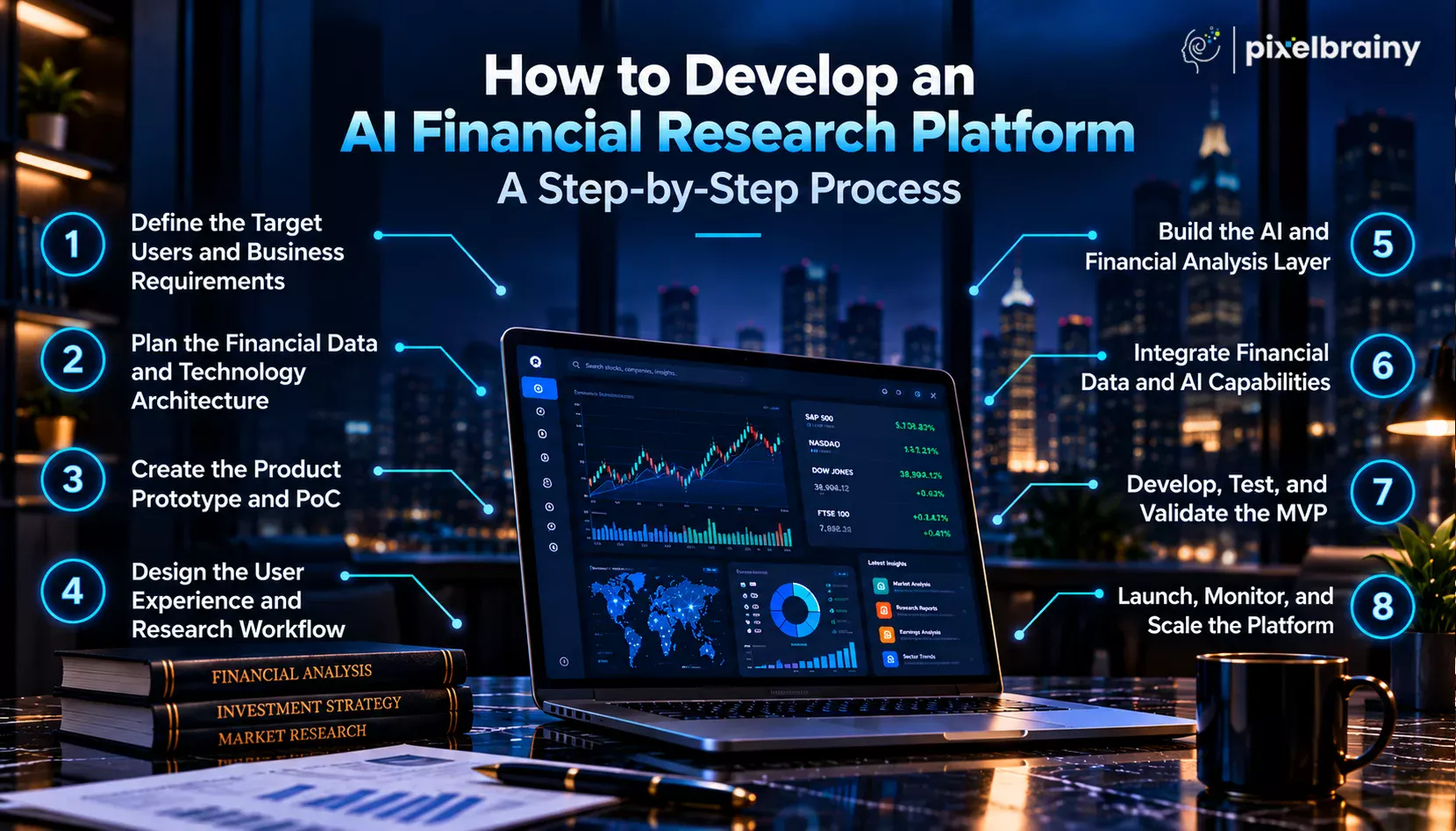
The first step in how to build an AI financial research platform from scratch is defining exactly who will use it and which research problems it must solve. For independent financial advisors, requirements may include company research, SEC filing analysis, earnings research, portfolio monitoring, financial comparisons, and investment report generation.
Document the user's current workflow, research bottlenecks, preferred data sources, compliance requirements, and expected outcomes. Prioritize features based on business value rather than attempting to build every capability immediately. This creates a clear product scope and helps determine the required data infrastructure, AI capabilities, integrations, and development resources before technical implementation begins.
A reliable data architecture is central to financial research platform development like using AI. Determine which market data APIs, SEC filings, earnings transcripts, financial statements, news sources, and internal research documents the platform will use.
The architecture should define data ingestion, processing, storage, indexing, retrieval, authentication, APIs, AI services, and application layers. For an advisor-focused platform, the architecture should also support multiple organizations and secure separation of customer data. A scalable cloud infrastructure can allow the platform to begin with a manageable dataset and expand as user demand, asset coverage, and research requirements increase.
Before full implementation, validate the most important research workflows with a focused prototype. PoC development can demonstrate whether the proposed AI workflow can retrieve reliable financial information, analyze documents, generate useful answers, and provide traceable sources.
For example, the prototype could focus on one workflow: analyzing a company's latest 10-K, comparing its financial performance with previous periods, and producing a cited research summary. Testing this workflow with target advisors can reveal gaps in data quality, retrieval accuracy, response quality, and usability. A successful proof of concept provides evidence for expanding the platform into a broader production product.
The platform should make institutional-quality research accessible without requiring users to understand complex AI systems. Working with a UI/UX design company can help translate advisor workflows into intuitive dashboards, search interfaces, company profiles, research workspaces, alerts, and report-generation experiences.
The design should support natural-language financial questions while making underlying evidence easy to inspect. Users should be able to move from an AI-generated answer to the relevant filing, transcript, financial metric, or news source. This creates a research workflow where AI accelerates information processing without removing the advisor's ability to review the underlying evidence.
The next stage is AI model development for the platform's specific research workflows. Instead of relying on a single general-purpose model, the system can combine LLMs, retrieval systems, financial data processing, quantitative models, and specialized prompts or agents.
The AI layer can support SEC filing analysis, financial metric extraction, earnings transcript analysis, company comparisons, sentiment analysis, research summarization, and natural-language financial queries. Retrieval-Augmented Generation can connect AI responses with approved financial sources, while structured financial data can support calculations that should not depend solely on generated text.
Also Read: Top 12+ AI Model Development Companies in the USA
Once the core AI architecture is established, AI integration connects the models with the platform's financial data, search infrastructure, document repositories, authentication systems, portfolio tools, and other required services.
This stage should include data validation, API handling, document ingestion, vector or semantic search, metadata management, source attribution, and response orchestration. The platform should also establish clear controls around which sources AI can use. For financial research, traceability is critical, so every material AI-generated insight should be connected to the underlying evidence whenever possible.
MVP development should focus on the smallest production-ready version that solves a meaningful research problem for independent advisors. Rather than launching with every advanced capability, the initial product might include financial search, SEC filing analysis, earnings research, company profiles, AI-generated summaries, source citations, and basic portfolio monitoring.
Testing should evaluate factual accuracy, retrieval quality, financial calculations, latency, security, usability, and consistency. Human reviewers should compare AI outputs against source documents and established research workflows. This stage helps identify technical and product issues before significant resources are committed to a larger production deployment.
Also Read: Top 10 AI MVP Development Companies in USA
The final stage in the steps to build AI financial research platform from idea to launch is controlled production deployment followed by continuous improvement. Before launch, complete security reviews, compliance checks, performance testing, access controls, logging, and operational monitoring.
After deployment, collect user feedback and monitor metrics such as research completion time, feature adoption, search success, AI response quality, and system reliability. As adoption grows, the platform can expand its asset coverage, data integrations, AI workflows, and advanced research capabilities. Working with top AI development companies or choosing to hire AI developers with financial technology experience can also support scaling when internal resources are limited.
Following these eight steps creates a structured path to create an AI financial research platform that combines reliable financial data, AI-powered research, strong security, and scalable product architecture.
The cost to develop an AI financial research platform typically ranges from $50,000 to $350,000+, depending on the platform's complexity, AI capabilities, financial data integrations, security requirements, and customization. A basic platform may require a smaller development budget for an AI financial research platform, while an enterprise-grade solution with proprietary data, advanced AI agents, portfolio intelligence, and complex workflows can require substantially more investment.
For example, a hedge fund evaluating AI financial research platform development may ask:
“We are a hedge fund evaluating whether to build a custom AI financial research platform or use existing AI research tools like AlphaSense, Kensho, or Sentieo. We have specific research workflows and proprietary data sources that none of the existing commercial tools fully support, but we are not sure whether the cost and time of custom development is justified compared to adapting our workflows to fit the best available commercial option. I want an honest comparison of building custom AI financial research infrastructure versus using existing AI research platforms for a hedge fund with specific proprietary data and workflow requirements.”
This is an important consideration when calculating the AI financial research platform development cost. Custom development generally requires a higher upfront investment, but it can provide greater control over proprietary data, workflows, AI models, integrations, and long-term product capabilities. Commercial platforms may reduce initial development costs and time to deployment, but organizations may need to adapt their workflows to the capabilities of the selected solution.
| Platform Type | Estimated Cost | Suitable For |
|---|---|---|
| Basic AI Financial Research Platform | $50,000 to $100,000 | Startups, boutique research firms, and smaller investment teams requiring AI financial search, SEC filing analysis, document search, company profiles, AI summaries, and source citations. |
| Advanced AI Financial Research Platform | $100,000 to $200,000 | Hedge funds, family offices, asset managers, and financial research firms requiring earnings analysis, sentiment analysis, financial comparisons, portfolio monitoring, automated reports, advanced RAG, and multiple data integrations. |
| Enterprise AI Financial Research Platform | $200,000 to $350,000+ | Large financial organizations requiring proprietary data integration, enterprise security, multi-tenant architecture, advanced AI agents, predictive analytics, portfolio intelligence, complex workflows, and scalable infrastructure. |
The best AI financial research platform investment is not always the cheapest to build, but the one that delivers the right balance of customization, research efficiency, data control, scalability, and long-term value.
A strong technology stack is the foundation of AI financial research platform development because the platform must bring together structured financial data, SEC filings, earnings transcripts, proprietary research, market information, AI models, and secure user workflows. The technology choices should support accuracy, scalability, source traceability, and fast financial research rather than simply adding AI to an existing application.
Consider this real-world query:
“We are building an AI financial research platform for a hedge fund with proprietary research data. We need to connect internal datasets with SEC filings, earnings transcripts, market information, and AI models. Which technologies should we use for RAG, financial document processing, vector search, structured financial analysis, security, and scalable deployment without making the architecture unnecessarily complex?”
For this type of AI financial research platform development, the ideal stack combines established software technologies with specialized AI infrastructure. The exact tools can vary based on data volume, security requirements, research workflows, and whether the platform is built for a small investment team or enterprise users.
| Technology Layer | Recommended Tools and Technologies | Role in the AI Financial Research Platform |
|---|---|---|
| Frontend Development | React, Next.js, TypeScript | Builds AI research dashboards, financial charts, company profiles, document viewers, portfolio screens, research workspaces, and conversational interfaces for investment professionals. |
| Backend Development | Python, FastAPI, Node.js | Handles APIs, authentication, financial workflows, AI orchestration, document processing, business logic, data operations, and communication between different platform components. |
| AI and LLMs | OpenAI, Anthropic Claude, Google Gemini | Supports financial question answering, document summarization, research assistance, financial reasoning, earnings analysis, sentiment analysis, and other AI-powered research workflows. |
| RAG Framework | LangChain, LlamaIndex, LangGraph | Connects LLMs with financial documents and structured data, allowing responses to be grounded in retrieved information rather than relying only on model knowledge. |
| Vector Database | Pinecone, Qdrant, Weaviate, pgvector | Stores document embeddings and enables semantic retrieval across SEC filings, earnings transcripts, research reports, presentations, and proprietary investment documents. |
| Primary Database | PostgreSQL | Stores structured financial records, companies, users, permissions, research projects, portfolio information, workflow configurations, and application metadata. |
| Financial Data APIs | SEC EDGAR APIs, market data APIs, financial data providers | Supplies regulatory filings, XBRL financial data, company information, market data, earnings information, and other financial datasets required by the platform. The SEC provides REST APIs for company submissions and extracted XBRL data. |
| Data Processing | Pandas, NumPy, Apache Spark | Cleans, transforms, validates, and analyzes financial datasets. These technologies support historical analysis, financial calculations, comparisons, and large-scale data processing. |
| Document Processing | PyMuPDF, Apache Tika, OCR technologies | Extracts text, tables, metadata, and other information from financial PDFs, filings, presentations, scanned documents, and research materials before indexing them for AI retrieval. |
| Search Infrastructure | Elasticsearch, OpenSearch | Supports keyword, filtering, and hybrid search across financial documents. Combining traditional search with semantic retrieval can improve results for specific financial terminology and company information. |
| AI Orchestration | Python services, LangGraph, workflow engines | Coordinates multi-step research workflows such as retrieving filings, extracting metrics, comparing companies, analyzing management commentary, and generating evidence-backed research summaries. |
| Authentication and Security | OAuth 2.0, OpenID Connect, Auth0, AWS Cognito | Provides secure authentication, identity management, organization-level access, role-based permissions, and controlled access to proprietary financial research. |
| Cloud Infrastructure | AWS, Microsoft Azure, Google Cloud | Provides scalable computing, databases, storage, networking, monitoring, backup, AI infrastructure, and production deployment environments. |
| Object Storage | Amazon S3, Azure Blob Storage, Google Cloud Storage | Stores SEC filings, earnings transcripts, research reports, presentations, datasets, and other large financial documents used by the AI research system. |
| Caching and Queues | Redis, RabbitMQ, Apache Kafka | Supports fast data retrieval and background processing for document ingestion, financial data updates, AI jobs, alerts, notifications, and high-volume workflows. |
| DevOps and Deployment | Docker, Kubernetes, GitHub Actions | Supports containerized applications, automated testing, continuous integration, deployment automation, scalable infrastructure, and controlled production releases. |
| Monitoring and Observability | OpenTelemetry, Grafana, cloud monitoring services | Tracks application performance, API errors, AI latency, infrastructure health, usage patterns, and operational problems across the financial research platform. |
| AI Evaluation and Testing | LangSmith, custom evaluation frameworks, human review | Evaluates retrieval accuracy, source grounding, citation quality, hallucinations, financial calculations, response consistency, and overall AI research performance. |
The SEC also provides financial statement datasets containing structured information extracted from corporate filings, which can be useful for building financial comparison and analysis workflows.
The right technology stack helps businesses develop an AI financial research platform that combines reliable financial data, secure infrastructure, AI-powered analysis, and source-grounded research in one scalable system.
The decision to build or buy an AI financial research platform depends on whether your research requirements are standard or strategically differentiated. For a hedge fund, the key question is not simply the development cost. It is whether custom infrastructure creates enough value through proprietary data, investment workflows, analytics, compliance, or product differentiation to justify the additional time and maintenance.
Consider this real-world query:
“We run a hedge fund with proprietary datasets and specialized research workflows. Existing platforms cover most of our basic research needs, but they cannot fully support our internal methodology and portfolio analytics. Should we build a custom platform, or would adapting our workflows to an existing solution provide better economics?”
Custom AI financial research platform development is generally justified when the technology itself contributes to the firm's competitive advantage. Proprietary datasets that commercial platforms cannot access, specialized investment methodologies, or unique analytical workflows can make customization strategically valuable.
Building also makes sense when the organization plans to commercialize the technology. A differentiated research product for other investment professionals requires greater control over the AI architecture, data layer, user experience, and intellectual property. Institutional compliance, auditability, data residency, or security requirements that existing platforms cannot adequately satisfy can also favor custom development.
For firms pursuing how to build an AI financial research platform with portfolio analytics, customization can provide deeper integration between research intelligence and internal portfolio decision processes.
Buying is often more practical when the firm's research workflow already fits established platforms such as AlphaSense or Kensho. If the primary requirements are financial search, document analysis, market intelligence, and research productivity, an existing solution may deliver value much faster.
Existing platforms can also make more financial sense for smaller teams that do not have the budget or technical resources to develop and maintain custom infrastructure. If the organization needs deployment within weeks or a few months rather than a six-to-nine-month development cycle, buying can reduce both upfront investment and execution risk.
| Decision Factor | Favor Custom Build | Favor Existing Platform |
|---|---|---|
| Proprietary data integration | Proprietary data is central to the research advantage | Standard financial data sources are sufficient |
| Analytical methodology | Proprietary investment framework cannot be replicated effectively | Standard fundamental or quantitative analysis is sufficient |
| Commercial intent | Platform will be sold to financial professionals | Tool is primarily for internal productivity |
| Compliance requirements | Specific institutional security, audit, or compliance requirements | Existing compliance capabilities meet requirements |
| Budget and timeline | Adequate funding and a 6 to 9 month development runway | Limited budget or immediate deployment requirement |
| Team size | Research organization is large enough to justify custom platform economics | Small team where per-seat SaaS costs are lower |
| Portfolio analytics | Deep integration with proprietary portfolio models is required | Standard portfolio analytics are sufficient |
| Workflow customization | Research workflows require significant customization | Existing workflows closely match available features |
| Maintenance capacity | Internal team can support ongoing AI and infrastructure development | Organization prefers vendor-managed updates and infrastructure |
For organizations where customization is strategically important, an experienced AI financial research platform development company can help evaluate architecture, data requirements, development scope, and long-term economics before committing to a build.
The right decision is the one that delivers the strongest research advantage at an acceptable total cost, not simply the option with the lowest upfront price.
Developing an AI financial research platform requires more than connecting financial data to an AI model. Investment research demands accurate information, reliable analysis, secure data handling, transparent sources, and consistent AI performance. Understanding the major challenges early helps businesses reduce development risks and build a platform that investment professionals can actually trust.
A real-world query could be:
“We want to develop an AI financial research platform for our investment team, but we are concerned about inaccurate AI answers, outdated financial information, proprietary research exposure, unreliable financial calculations, and compliance risks. How can we solve these challenges while keeping analysts in control of investment decisions?”
Below are the 8 major challenges and solutions to consider when building an AI financial research platform.
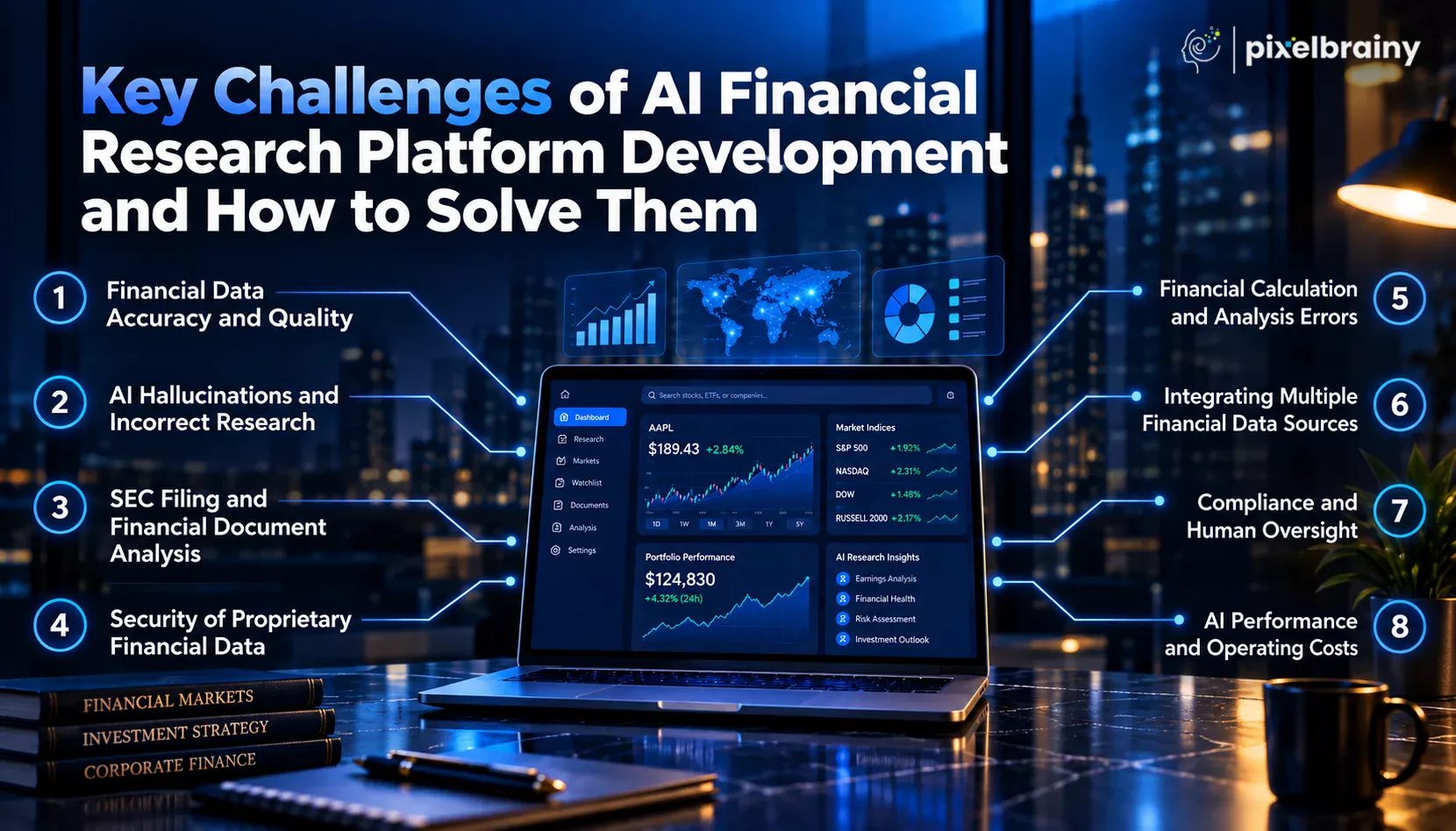
Financial AI is highly dependent on the quality of its underlying data. Outdated market information, duplicate records, missing financial values, incorrect company identifiers, or poorly structured documents can lead to unreliable research results.
Solution: Build a controlled financial data pipeline that validates, cleans, normalizes, and timestamps incoming information. Use reliable financial data providers and primary sources where appropriate. Automated quality checks should identify inconsistencies before information reaches the AI layer.
One of the biggest challenges in AI financial research platform development is preventing AI models from generating unsupported financial claims. An answer can appear professional while containing inaccurate numbers, conclusions, or interpretations.
Solution: Use Retrieval-Augmented Generation, source grounding, structured prompts, and financial-specific evaluation. AI responses should provide citations to the relevant SEC filing, earnings transcript, financial dataset, or approved document so analysts can verify important claims.
SEC filings, earnings reports, investor presentations, and research documents contain large amounts of complex information. Important details can appear in tables, footnotes, risk disclosures, or sections that require comparison with previous reporting periods.
Solution: Implement specialized document processing, metadata extraction, semantic search, and structured financial data extraction. The platform should preserve relationships between documents, reporting periods, financial metrics, and source sections to support more accurate AI analysis.
Investment organizations often have confidential research, internal investment theses, portfolio information, financial models, and proprietary datasets. Unauthorized access or poor AI data controls can create serious business and compliance risks.
Solution: Implement encryption, role-based access control, secure authentication, audit logging, tenant isolation, and granular data permissions. Clearly define which information AI models can access and ensure proprietary data is only available to authorized users and approved workflows.
AI models should not be relied upon for every financial calculation. Errors in growth rates, margins, ratios, valuation metrics, or financial comparisons can negatively affect investment research.
Solution: Separate deterministic calculations from language generation. Use reliable financial calculation services or Python-based quantitative systems to calculate metrics, then use the AI layer to explain verified results. This approach improves the reliability of an AI financial analysis platform.
An AI financial research platform may need to connect SEC filings, market data, earnings transcripts, financial statements, news, alternative datasets, and proprietary research. These sources can have different formats, APIs, identifiers, and update schedules.
Solution: Create a standardized data layer that normalizes company identifiers, financial metrics, timestamps, document types, and source metadata. An API abstraction layer can make it easier to add, replace, or update financial data providers as requirements evolve.
Financial research can involve sensitive information and regulated activities. Completely autonomous AI decision-making can create additional risks, particularly when outputs are interpreted as investment recommendations.
Solution: Design the system as an investment research and decision-support tool. AI can automate information retrieval, summarization, comparison, and signal identification, while qualified investment professionals remain responsible for interpretation and final decisions. Compliance requirements should be considered throughout development.
Large financial documents, frequent AI queries, real-time data processing, and multiple users can increase model and infrastructure costs. Poorly optimized systems may become expensive as the platform scales.
Solution: Use model routing, caching, optimized document retrieval, efficient chunking, batch processing, and smaller models for simpler tasks. Monitor AI usage, infrastructure consumption, response latency, and cost per research task to maintain predictable operating expenses.
Addressing these eight challenges early helps businesses build an AI financial research platform that delivers accurate, secure, explainable, and scalable investment research while keeping human professionals in control.
From the above challenges, features, technology stack, development process, and costs, now it’s time to identify the right development partner for your financial AI initiative. PixelBrainy as AI financial software development company combines AI engineering with an understanding of financial research workflows, helping fintech founders and financial institutions turn complex research requirements into practical, scalable software.
Finding an AI partner that understands both technology and financial markets can be challenging. A real query from a prospective financial organization highlights this problem:
“We have been searching for a development partner for five months. Companies that understand AI do not understand financial markets and propose architectures that would fail to deliver the accuracy required for institutional research. We need a partner that understands GAAP versus non-GAAP earnings, free cash flow yield, SEC filings, and why management tone during earnings calls can sometimes matter more than headline EPS. We need a team that understands financial analysis or is genuinely prepared to learn it.”
This illustrates why financial AI requires more than generic LLM integration. The platform needs appropriate financial data, domain-aware AI workflows, reliable retrieval, analytical logic, source verification, and interfaces designed around real investment research.
PixelBrainy approaches AI financial research platform development services with a focus on how investment professionals actually research companies and markets. Workflows can incorporate SEC filings, earnings transcripts, financial statements, company fundamentals, market information, proprietary research, and AI-powered analysis.
The goal is to automate information-intensive tasks while keeping analysts and investment professionals responsible for interpretation and final decisions.
Every financial organization has different data sources, investment methodologies, security requirements, and research workflows. PixelBrainy helps businesses build AI financial research platform solutions around their specific requirements rather than forcing them into a generic research product.
Depending on the project scope, the architecture can incorporate RAG, LLMs, financial APIs, document processing, vector search, structured analytics, AI agents, secure data infrastructure, and evidence-based responses.
For a confidential financial-sector engagement, PixelBrainy developed an AI-powered research solution designed to help investment professionals process and analyze large volumes of financial information more efficiently.
Key Challenges
Solution Delivered
Key Outcomes
Client identity, proprietary datasets, and commercially sensitive project information remain confidential.
From financial research platform development integrating AI through architecture, data integration, AI implementation, testing, security, deployment, and optimization, PixelBrainy can support the complete product lifecycle.
Whether the objective is to develop AI financial research platform capabilities for an internal investment team or launch a differentiated fintech product, the focus remains on domain-aware AI, reliable research workflows, and measurable business outcomes.
Have an AI financial research platform idea? Connect with PixelBrainy and discuss your requirements with our team.

An AI financial research platform can transform how investment teams discover, analyze, compare, and validate financial information. From SEC filing analysis and earnings transcript research to financial analytics, sentiment analysis, portfolio intelligence, and AI-powered research assistance, the right platform can reduce repetitive work while helping analysts focus on higher-value investment decisions.
However, successful AI financial research platform development requires more than integrating an LLM. Businesses need reliable financial data, secure architecture, accurate retrieval, domain-specific AI workflows, source citations, strong compliance controls, and a scalable technology foundation. The right approach to develop AI financial research platform solutions should also consider whether custom development or an existing platform provides better long-term value.
Whether you are a fintech founder, hedge fund, family office, asset manager, or financial institution, a carefully planned AI financial research platform development strategy can create a powerful research infrastructure aligned with your specific workflows and investment objectives.
Ready to turn your financial research idea into a scalable AI solution? Book an appointment with PixelBrainy today.
An AI financial research platform can bring SEC filings, earnings transcripts, financial data, market news, and internal research into one workflow. It can automate repetitive tasks such as document review, financial metric extraction, company comparisons, and research queries, allowing analysts to spend more time on investment judgment and strategy.
An AI financial research platform for hedge funds should support proprietary data integration, SEC filing analysis, portfolio analytics, financial modeling, natural-language search, source citations, risk monitoring, and secure research workspaces. The platform should also accommodate the fund's investment methodology and provide human review before AI-generated insights influence investment decisions.
The AI financial research platform development cost typically ranges from $50,000 to $350,000+, depending on the platform's complexity. Data integrations, AI models, RAG architecture, financial analytics, security, compliance, custom workflows, user management, and cloud infrastructure can significantly affect the final development budget.
Yes, businesses can build an AI financial research platform with SEC filing analysis to process filings such as 10-K, 10-Q, and 8-K reports. The platform can extract financial metrics, retrieve relevant filing sections, compare historical disclosures, identify material changes, and generate research answers with source references for analyst verification.
To develop an AI financial research platform for financial advisors, begin with specific research workflows that consume the most analyst time. Integrate reliable financial data and SEC filings, then build capabilities for company research, financial comparisons, document analysis, and AI-assisted research. Starting with an MVP can validate user demand before adding advanced portfolio intelligence.
Custom AI financial research platform development is generally more suitable when a financial institution requires proprietary data, specialized investment workflows, unique analytical models, or specific security and compliance controls. Existing platforms can be more practical when standard research requirements are sufficient and the organization prioritizes faster deployment and lower initial development costs.
An AI financial research platform with RAG retrieves relevant financial documents and approved data before generating an answer. This helps ground AI responses in actual filings, transcripts, research documents, and financial datasets rather than relying only on the model's internal knowledge. Source citations also allow analysts to verify the evidence behind an AI-generated response.
Yes. An AI financial research platform with portfolio analytics can combine portfolio holdings, company fundamentals, historical performance, financial metrics, risk indicators, and research data to support investment analysis. Advanced workflows can monitor portfolio companies, detect material developments, identify changes in investment assumptions, and surface research items that require analyst attention.

About The Author
Sagar Bhatnagar
Sagar Sahay Bhatnagar brings over a decade of IT industry experience to his role as Marketing Head at PixelBrainy. He's known for his knack in devising creative marketing strategies that boost brand visibility and market influence. Sagar's strategic thinking, coupled with his innovative vision and focus on results, sets him apart. His track record of successful campaigns proves his ability to utilize digital platforms effectively for impactful marketing efforts. With a genuine passion for both technology and marketing, Sagar continuously pushes PixelBrainy's marketing initiatives to greater success.

Working with the PixelBrainy team has been a highly positive experience. They understand the design requirements and create beautiful UX elements to meet the application needs. The dev team did an excellent job bringing my vision to life. We discussed usability and flow. Sagar worked with his team to design the database and begin coding. Working with Sagar was easy. He has the knowledge to create robust apps, including multi-language support, Google and Apple ID login options, Ad-enabled integrations, Stripe payment processing, and a Web Admin site for maintaining support data. I'm extremely satisfied with the services provided, the quality of the final product, and the professionalism of the entire process. I highly recommend them for Android and iOS Mobile Application Design and Development.

Great experience working with them. Had a lot of feedback and I found that unlike most contractors they were bugging me for updates instead of the other way around. They were extremely time conscience and great at communicating! All work was done extremely high quality and if not on time, early! They were always proactive when it comes to communication and the work is great/above par always. Very flexible and a great team to work with! Goes above and beyond to present us with multiple options and always provides quality. Amazing work per usual with Chitra. If you have UI/UX or branding design needs I recommend you go to them! Will likely work with them in the future as well, definitely recommended!

PixelBrainy is a joy to work with and is a great partner when thinking through branding, logo, and website layout. I appreciate that they spend time going into the "why" behind their decisions to help inform me and others about industry best practices and their expertise.

I hired them to design our software apps. Things I really like about them are excellent communication skills, they answer all project suggestions and collaborate right away, and their input on design and colors is amazing. This project was complex and needed patience and creativity. The team is amazing to do business with. I will be using them long-term. Glad to see there are some good people out there. I was afraid to try and outsource my project to someone but I am glad I met them! I really can't say enough. They went above and beyond on this project. I am very happy with everything they have done to make my business stand out from the competition.

It was great working with PixelBrainy and the team. They were very responsive and really owned the project. We'll definitely work with them again!

I recently worked with the PixelBrainy team on a project and I was blown away by their communication skills. They were prompt, clear, and articulate in all of our interactions. They listened and provided valuable feedback and suggestions to help make the project a success. They also kept me updated throughout the entire process, which made the experience stress-free and enjoyable.

PixelBrainy is very good at what it does. The team also presents themselves very professionally and takes care of their side of things very well. I could fully trust them taking up the design work in a timely and organised manner and their attention to detail saved us lots of effort and time. This particular project was quite intense and the team showed that they function very well under pressure. Very much looking forward to working with her again!

It's always an absolute pleasure working with them. They completed all of my requests quickly and followed every note I had for them to a T, which made our process go smoothly from start to finish. Everything was completed fast and following all of the guidelines. And I would recommend their services to anyone. If you need any design work done in the future, PixelBrainy should be your first call!

They took ownership of our requirements and designed and proposed multiple beautiful variants. The team is self-motivated, requires minimum supervision, committed to see-through designs with quality and delivering them on time. We would definitely love to work with PixelBrainy again when we have any requirements.

PixelBrainy was a big help with our SaaS application. We've been hard at work with a new UI/UX and they provided a lot of help with the designs. If you're looking for assistance with your website, software, or mobile application designs, PixelBrainy and the team is a great recommendation.

PixelBrainy designers are amazing. They are responsive, talented, and always willing to help craft the design until it matches your vision. I would recommend them and plan to continue them for my future projects and more!!!

They were awesome! Did a good job fast, and good communication. Will work with them again. Thank you

Creative, detail-oriented, and talented designers who take direction well and implement changes quickly and accurately. They consistently over-delivered for us.

PixelBrainy team is very talented and creative. Great designers and a pleasure to work with. PixelBrainy is an excellent communicator and I look forward to working with them again.

PixelBrainy has a very talented design team. Their work is excellent and they are very responsive. I enjoy working with them and hope to continue on all of our future projects.


Transform your ideas into reality with us.
Across these industries, each engagement brings unique challenges, from early-stage product development to scaling complex systems, helping us build a practical understanding of real-world product environments.