AI Summary Powered by PixelBrainy
Why do people abandon calorie tracking apps after just a few days, and what makes an AI food calorie tracker fundamentally different from a standard calorie counting app?
"I want to build a calorie tracking app but every existing app does the same thing. Users manually log food from a database and forget to use it after week one. I want to understand what an AI food calorie tracker app actually does differently, specifically around food photo recognition and automatic logging, so I can build something that solves the adherence problem that kills every manual calorie tracker on the market."
If this sounds like the challenge you're trying to solve, you're asking the right question before investing in AI food calorie tracker app development.
Most calorie tracking apps rely on manual food searches, portion selection, and repetitive meal logging. Although this approach helps users monitor their calorie intake, the experience often becomes time consuming, leading to lower engagement and poor long-term retention. The real challenge is not counting calories. It is making nutrition tracking effortless enough that users stay consistent with it every day.
This is where businesses are choosing to build an AI-powered calorie tracking app that delivers a smarter and more personalized experience. By combining computer vision, machine learning, and nutrition intelligence, AI can recognize meals from a single photo, identify ingredients, estimate portion sizes, calculate calories and macronutrients, and automatically create food logs within seconds. Instead of asking users to search through thousands of food items manually, the app performs most of the work, making nutrition tracking faster, easier, and far more engaging.
The market already validates this shift. AI-powered apps such as Cal AI and SnapCalorie demonstrate how food photo recognition and automatic calorie estimation can significantly improve user experience while increasing daily engagement. Their success reflects the growing demand for intelligent nutrition apps that simplify healthy living through automation.
For startups, healthcare providers, fitness brands, nutrition companies, wellness platforms, and entrepreneurs, AI calorie counter app development is an opportunity to build intelligent digital health products instead of another traditional calorie counter. However, developing an AI food calorie tracking app requires much more than adding an image recognition feature. The complete development process of food calorie tracker app integrating AI combines computer vision, nutrition databases, machine learning models, cloud infrastructure, wearable integrations, personalized recommendations, and secure healthcare data management into one seamless ecosystem. Partnering with a top AI healthcare software development companies can help transform these technologies into a scalable, user-friendly solution.
In this guide, you'll learn everything about AI food calorie tracker app development, including how AI food recognition works, the essential features, technology stack, development process, estimated costs for 2026, monetization strategies, and the best practices for building an intelligent nutrition platform that users continue using long after the first week.
An AI food calorie tracker app is a mobile health application that automatically identifies food, estimates portion sizes, calculates calories and nutrients, and logs meals using computer vision, machine learning, natural language processing (NLP), predictive AI, and generative AI. Unlike traditional calorie counting apps that depend on manual food searches and user input, an AI-powered food logging app automates most of the tracking process, making nutrition monitoring faster, more accurate, and easier to maintain over time.
A standard calorie counter follows a manual workflow. Users search a food database, choose the closest food item, estimate portion sizes, enter quantities, and save each meal individually. This process is repetitive and often leads to poor user engagement. In contrast, an AI food recognition calorie app allows users to simply photograph their meal or describe it using natural language. The AI recognizes visible foods, estimates serving sizes, calculates calories and macronutrients, and automatically generates a meal log within seconds.
The difference in the AI calorie tracker vs standard calorie counter comparison extends beyond convenience. AI genuinely improves the nutrition tracking experience by reducing manual effort, learning from user behavior, and continuously refining recommendations. While AI cannot identify every meal with perfect accuracy, especially complex dishes such as curries, salads, casseroles, or mixed bowls, modern AI models analyze multiple ingredients, compare them with nutrition databases, estimate portion sizes, and assign confidence scores. If confidence is low, the application asks users to confirm or edit ingredients before saving the meal, improving both immediate accuracy and future predictions.
A modern computer vision food calorie tracker is built around five intelligent capability layers that work together:
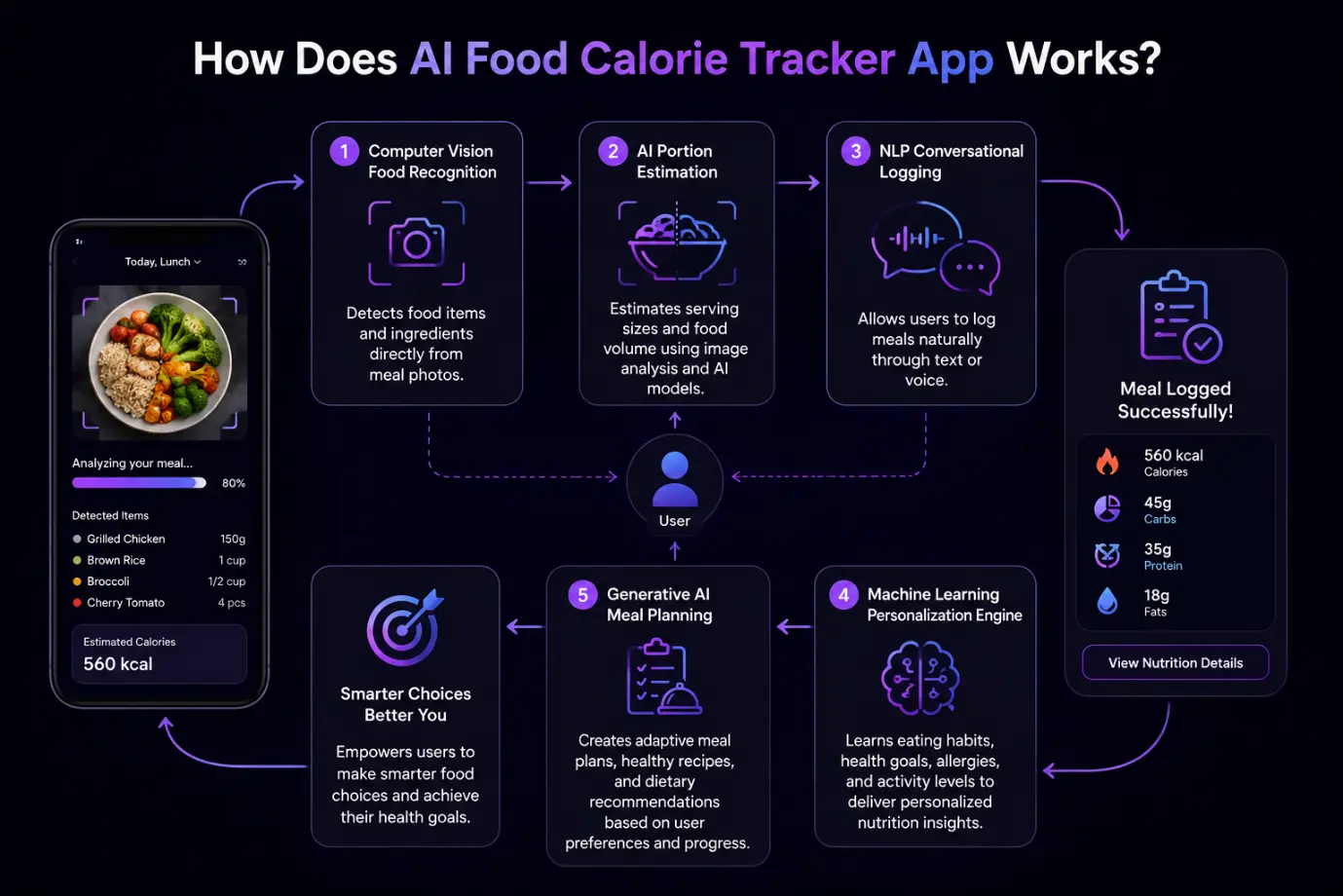
| Feature | Standard Calorie Counter | AI Food Calorie Tracker |
| Food logging method | Manual database search | Photo recognition, voice, or conversational AI |
| Portion estimation | User estimates serving size | AI automatically estimates portions |
| Accuracy | Depends on manual input | Improved through AI recognition and user confirmation |
| User effort | High | Minimal |
| Personalization | Fixed calorie goals | AI adapts recommendations based on user behavior |
| Meal planning | Generic diet plans | Dynamic AI-generated meal plans |
| Adherence rate | Lower because of repetitive logging | Higher due to automated and simplified tracking |
| Data richness & dietitian integration | Limited nutrition history | Rich nutrition insights, health trends, and seamless dietitian support |
Consider a simple lunch logging scenario. A user of a standard calorie counter spends several minutes searching for "grilled chicken," selecting vegetables, estimating rice portions, and manually entering every item before saving the meal. A user of an AI-powered food logging app simply takes a photo of the plate. Within seconds, the AI identifies the chicken, vegetables, and rice, estimates portion sizes, calculates calories and nutrients, and asks for confirmation only if any ingredient cannot be identified with high confidence. The entire experience takes less than half a minute while requiring significantly less effort.
For businesses investing in AI food calorie tracker app development, this shift represents far more than adding image recognition to a mobile application. Developing an AI food calorie tracking app means building an intelligent nutrition platform that understands meals, learns from user behavior, delivers personalized health guidance, and continuously improves the user experience. This complete development process of food calorie tracker app integrating AI helps healthcare providers, fitness brands, and wellness startups build products that improve user engagement, increase retention, and deliver measurable value beyond traditional calorie counting.
If you're wondering why build an AI calorie tracking app today instead of another fitness product, the answer lies in four powerful market trends that are reshaping digital health. Together, they create one of the strongest AI food tracker business case opportunities for startups, healthcare providers, and wellness companies heading into 2026.
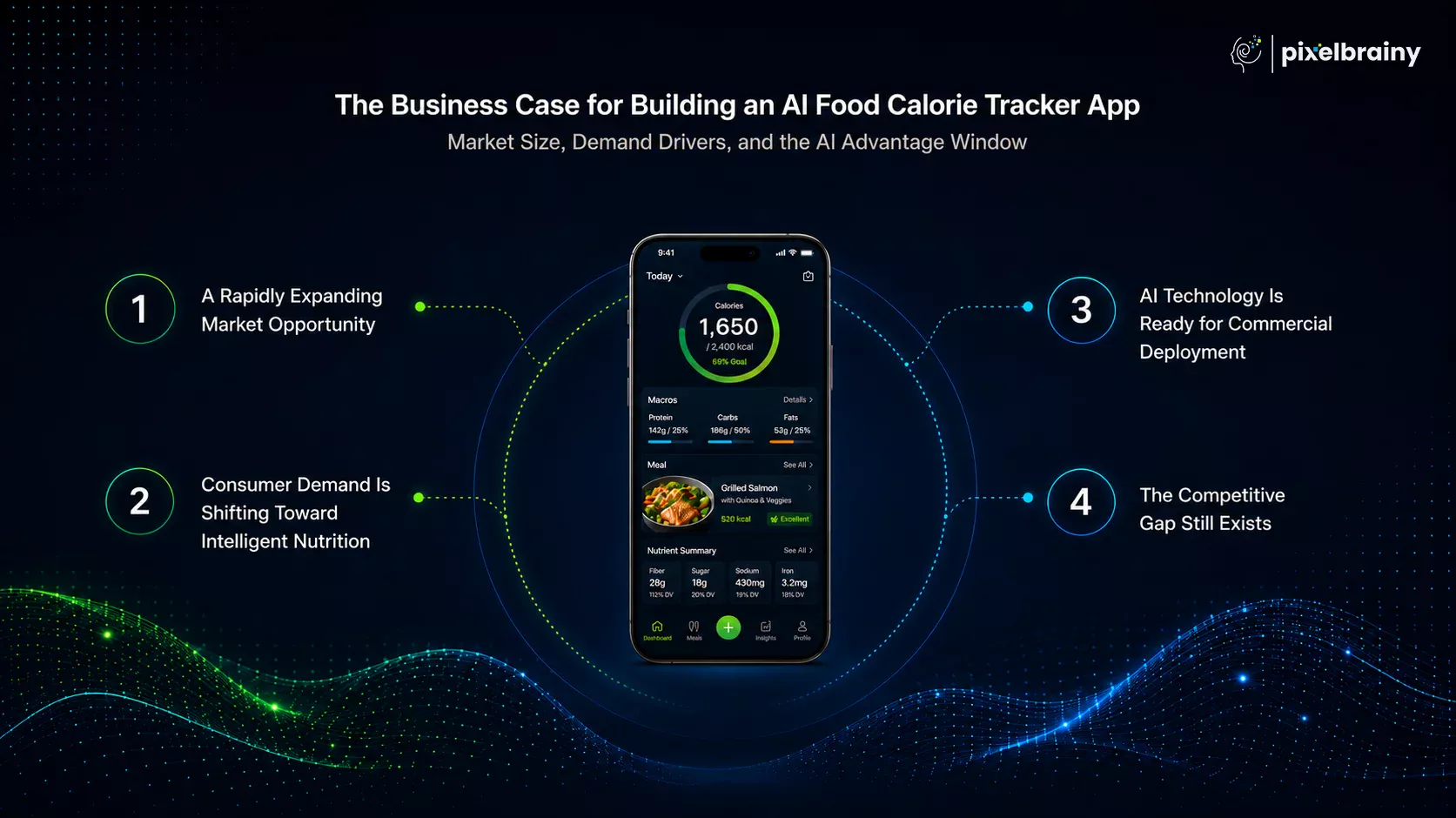
The global health and fitness app industry continues to grow at a remarkable pace. According to Statista, the market is expected to generate $29.55 billion in revenue in 2026 and reach approximately $42.89 billion by 2031, reflecting sustained long-term demand for digital health solutions.
Within this industry, calorie tracking represents one of the fastest-growing segments. Market Research Store estimates the global calorie counter software market will expand from $385.3 million in 2023 to $1.76 billion by 2032, representing nearly 4.5x market growth over the forecast period.
This makes AI food calorie tracker app market opportunity 2026 especially attractive for founders looking to enter a rapidly expanding niche rather than a saturated category.
People want healthier lifestyles, but they do not want complicated tracking. Millions of users download health and nutrition apps every year, yet manual food logging remains one of the biggest reasons for poor long-term engagement. At the same time, rising obesity rates, diabetes, and lifestyle-related diseases continue to increase demand for digital nutrition support, personalized coaching, and preventive healthcare solutions.
This growing demand creates a significant health and fitness AI app development opportunity for businesses that replace manual tracking with intelligent automation.
Only a few years ago, food recognition technology was still experimental. Today, production-ready computer vision solutions such as Google Cloud Vision, Amazon Rekognition, Passio AI, and Foodvisor's proprietary food recognition models enable developers to identify foods, estimate portions, and analyze nutrition with commercially viable accuracy. Combined with large language models, nutrition databases, and predictive machine learning, these technologies make modern AI nutrition app market size 2026 projections increasingly achievable for startups building scalable products.
Many popular calorie-counting apps were designed around manual food logging workflows introduced more than a decade ago. Their core experience still depends on searching food databases, selecting meals manually, and estimating serving sizes. AI-native calorie tracking changes that workflow completely through photo recognition, conversational logging, intelligent recommendations, and adaptive meal planning. That creates an opportunity for businesses to differentiate through user experience rather than competing only on pricing or food database size.
Suppose you have $150,000 in seed funding and want to launch your first AI nutrition product. That budget is realistic for building a strong Minimum Viable Product without exhausting your runway.
Your Version 1 can realistically include:
Version 2 can introduce advanced capabilities such as generative AI meal planning, conversational nutrition coaching, dietitian collaboration, and predictive health analytics. This phased approach typically allows founders to launch within 6 to 8 months, validate product-market fit, gather user feedback, and prioritize advanced AI features after initial traction.
This opportunity is particularly valuable for:
For founders evaluating the AI food tracker business case, the timing is favorable. Market demand is accelerating, AI technology has reached commercial maturity, and the shift from manual calorie logging to intelligent nutrition assistants is creating space for innovative products that deliver measurable value for both users and businesses.
As consumer expectations continue to evolve, simply counting calories is no longer enough to build a successful nutrition app. Users expect intelligent food recognition, personalized recommendations, seamless tracking, and real-time health insights with minimal effort. For businesses investing in AI food calorie tracker app development, selecting the right feature set directly impacts user engagement, retention, subscription revenue, and long-term scalability.
Whether you plan to build AI food calorie tracker app from scratch or enhance an existing fitness platform, understanding which capabilities are essential and which can be introduced in later releases helps optimize both development costs and product strategy.
Consider this common scenario:
"We are a fitness app company and we want to add an AI calorie tracking feature to our existing platform. I don't know whether to build the AI food recognition and nutrition engine ourselves or integrate a third-party food AI API like Foodvisor or Passio, and I need someone to explain the trade-offs, specifically for AI food recognition features in 2026."
The answer depends on your business goals. Integrating APIs like Passio AI or Foodvisor allows faster market entry with proven food recognition capabilities, making them ideal for MVPs and startups. Building your own AI recognition engine provides greater control, customization, and long-term competitive advantage but requires significantly higher investment in AI model training, food image datasets, infrastructure, and continuous optimization. Many successful startups begin with third-party AI services before gradually developing proprietary AI models as their user base and data grow.
The following AI food calorie tracker app features are divided into two categories: standard features required for every successful product and advanced AI capabilities that create meaningful differentiation in 2026 and beyond.
| Feature | Why It Matters |
| AI Food Photo Recognition | This is the foundation of every modern AI food photo recognition app feature. Users simply photograph their meals, and AI identifies foods automatically. It eliminates manual searching, speeds up food logging, and creates the effortless experience users now expect. Without it, the app feels similar to traditional calorie counters. |
| Automatic Calorie & Nutrition Calculation | After recognizing food, the app should instantly calculate calories, protein, carbohydrates, fats, fiber, and micronutrients. This removes manual calculations while providing actionable nutrition insights. Without automatic nutrition analysis, users must depend on external databases, reducing convenience and daily engagement. |
| AI Portion Size Estimation | Portion estimation helps determine serving sizes using image analysis and AI models instead of requiring users to guess measurements. Accurate portions significantly improve calorie calculations. Without this capability, nutrition tracking becomes less reliable and users lose confidence in the application's recommendations. |
| Manual Food Search & Barcode Scanner | AI cannot recognize every packaged food or homemade recipe perfectly. Manual search and barcode scanning provide reliable alternatives whenever photo recognition struggles. Without these backup options, users encounter unnecessary frustration and incomplete food logs. |
| Meal History & Daily Food Log | Every logged meal should be organized by breakfast, lunch, dinner, and snacks with searchable history. This helps users review eating patterns and monitor consistency. Without meal history, long-term nutrition tracking and behavioral analysis become almost impossible. |
| Personalized User Profiles | The application should collect age, gender, height, weight, activity level, allergies, dietary preferences, and health goals. This information personalizes calorie recommendations. Without user profiles, every recommendation becomes generic instead of tailored to individual needs. |
| Daily Calorie & Macronutrient Dashboard | A visual dashboard helps users understand daily calorie consumption alongside protein, carbohydrates, fats, hydration, and nutrition goals. Clear progress visualization encourages habit formation. Without dashboards, users struggle to interpret their overall nutritional performance. |
| Water Intake Tracking | Hydration directly affects metabolism, exercise performance, and overall wellness. Water tracking complements nutrition monitoring while encouraging healthier daily habits. Without hydration tracking, users must rely on separate applications, reducing platform engagement. |
| Weight Progress Tracker | Weight trends allow users to measure progress toward fitness or medical goals over weeks and months. Visual progress reinforces motivation. Without weight tracking, the application cannot effectively demonstrate health improvements or long-term outcomes. |
| Goal Setting & Progress Monitoring | Users should define objectives such as weight loss, muscle gain, diabetic nutrition, or healthy eating. AI adjusts recommendations accordingly. Without personalized goals, nutrition advice remains broad and less meaningful for different user segments. |
| Push Notifications & Smart Reminders | Intelligent reminders encourage meal logging, hydration, and goal completion without overwhelming users. Consistent reminders improve retention. Without notifications, users frequently forget to log meals, reducing app usage and engagement. |
| Wearable Device Integration | Integration with Apple Health, Google Fit, Fitbit, and Garmin synchronize calories burned, activity levels, and heart rate automatically. Without wearable connectivity, users lose valuable context between nutrition and physical activity. |
| Recipe & Nutrition Database | A comprehensive food database enables accurate recognition, nutrient analysis, and meal suggestions across different cuisines. Without a reliable nutrition database, AI predictions become less accurate and user trust declines significantly. |
| Secure Authentication & Data Privacy | Health data requires secure authentication, encrypted storage, and regulatory compliance. Strong privacy builds user trust and protects sensitive information. Without robust security, businesses face compliance risks and lower customer confidence. |
| Subscription & Payment Management | Premium subscriptions unlock advanced analytics, AI coaching, and personalized meal plans. Secure payment integration supports recurring revenue. Without monetization infrastructure, businesses struggle to generate sustainable long-term growth from their application. |
These standard capabilities form the foundation of successful AI food calorie tracker app development and establish a reliable nutrition experience before introducing more sophisticated AI functionality.
Once your MVP gains traction, advanced AI capabilities become the biggest differentiator in a competitive market. These features transform a calorie counter into an intelligent nutrition assistant that continuously learns, adapts, and delivers personalized health guidance.
For businesses focused on AI food calorie tracker app development, the following capabilities create stronger user retention, higher subscription value, and a clear competitive advantage.
| Advanced AI Feature | Why It Matters |
| NLP Conversational Food Logging | One of the most valuable NLP food logging app features allows users to log meals naturally by typing or speaking sentences like, "I had grilled salmon with brown rice and broccoli." AI extracts foods, estimates nutrition, and records meals automatically. Without conversational logging, users remain dependent on repetitive manual searches. |
| AI Personalized Nutrition Coach | Instead of displaying generic calorie numbers, AI analyzes eating habits, activity levels, health goals, and previous meals to deliver personalized coaching and actionable nutrition advice. Without intelligent coaching, the application provides information but fails to actively guide healthier behavior. |
| Generative AI Meal Planning | A powerful AI meal planning calorie tracker creates personalized meal plans based on calorie goals, allergies, dietary preferences, available ingredients, and user progress. Meal plans automatically evolve as goals change. Without this feature, recommendations remain static and quickly become repetitive. |
| Predictive Health & Nutrition Insights | Machine learning identifies unhealthy eating trends before they become long-term habits. The system predicts nutritional deficiencies, excessive calorie intake, or inconsistent meal patterns and recommends corrective actions. Without predictive analytics, users only review past behavior instead of preventing future health issues. |
| AI Grocery List Generator | Based on meal plans and nutritional goals, AI automatically creates categorized shopping lists with estimated quantities for the upcoming week. This simplifies healthy eating and improves adherence. Without grocery automation, users spend additional time planning meals independently. |
| Multi-Food & Mixed Dish Recognition | Advanced computer vision calorie counting app features recognize several foods on one plate while separating ingredients within complex dishes such as curries, salads, sandwiches, or pasta bowls. Without multi-object recognition, users frequently correct AI predictions manually, reducing convenience. |
| Dietitian & Telehealth Integration | Users can securely share nutrition history, meal logs, and health reports with registered dietitians, nutritionists, or healthcare providers for remote consultations. Without professional integration, the application becomes isolated from broader healthcare and wellness ecosystems. |
| AI Health Risk Alerts | AI continuously monitors nutrition patterns and detects excessive sugar intake, sodium consumption, calorie deficits, or nutritional imbalances. Timely alerts encourage healthier decisions before problems escalate. Without proactive monitoring, users receive feedback only after unhealthy habits have already developed. |
| Smart Recipe Recommendation Engine | AI recommends recipes based on calorie goals, available ingredients, cooking preferences, allergies, seasonal foods, and previous eating behavior. Every recommendation becomes increasingly personalized over time. Without adaptive recipes, users often leave the app to search for meal ideas elsewhere. |
| Continuous Machine Learning Optimization | Every confirmed meal, correction, and food photo helps improve recognition accuracy and personalization models. The application becomes smarter as more users interact with it. Without continuous learning, AI performance remains static and gradually loses its competitive advantage. |
These advanced AI capabilities transform a nutrition tracker into a comprehensive digital health assistant that continuously learns, adapts, and delivers personalized experiences beyond traditional calorie counting.
One of the most common questions businesses ask while creating an AI food calorie tracker app is whether they should build their own food recognition engine or integrate an established AI platform.
| Approach | Best For | Advantages | Limitations |
| Integrate Passio AI, Foodvisor, or Similar APIs | Startups, MVPs, fitness apps adding AI features | Faster development, lower upfront investment, production-ready AI, continuous model updates, quicker market launch | Monthly API costs, limited customization, dependency on third-party providers |
| Build a Custom AI Recognition Engine | Enterprises, healthcare platforms, high-scale nutrition products | Full ownership of AI models, customized food recognition, proprietary datasets, greater competitive advantage, no vendor dependency | Higher development costs, larger AI team, longer development timeline, continuous model training and maintenance |
For most startups and fitness platforms, integrating a proven food AI API is the fastest path to market. Once the product achieves strong user adoption and accumulates sufficient food image data, businesses can gradually replace third-party services with proprietary AI models to improve accuracy, reduce long-term costs, and strengthen intellectual property.
Choosing the right approach depends on your budget, timeline, technical expertise, and long-term product vision rather than simply selecting the most advanced AI technology.
The most successful businesses treat feature development as a phased journey. They launch with essential capabilities that solve immediate user problems, then gradually introduce advanced AI experiences that strengthen retention, increase subscription value, and establish a lasting competitive advantage in the evolving digital nutrition market.
Building an AI-powered nutrition application involves much more than adding food photo recognition to a mobile app. A successful product combines artificial intelligence, nutrition science, mobile engineering, cloud infrastructure, and user-centric design into one seamless experience. Whether you're a startup, healthcare provider, fitness brand, or enterprise, following a structured AI calorie tracker app development process helps reduce development risks, control costs, and accelerate time to market.
Consider this common scenario:
"Our fitness wearable company wants to add an AI food calorie tracker app to our product ecosystem. We already have hardware that tracks steps, heart rate, and sleep, and we want an AI nutrition app that makes sense of calorie intake alongside all this biometric data. What does building an AI food tracker that genuinely integrates with our wearable data pipeline cost and how long would it take to launch?"
The answer depends on the AI capabilities you include, whether you build or integrate food recognition, and the complexity of wearable synchronization. Most businesses begin with an MVP that integrates proven AI services and wearable APIs, then gradually introduce proprietary AI capabilities as the platform grows.
Below is the complete how to develop an AI food calorie tracker app step by step roadmap.
Every successful project starts by identifying exactly who the application is being built for. Your primary audience may include fitness enthusiasts, healthcare providers, dietitians, hospitals, athletes, or corporate wellness programs. During this phase, the product team researches competitors, user pain points, monetization opportunities, and decides which AI capabilities belong in Version 1 versus future releases. Businesses also evaluate whether food recognition should rely on third-party APIs or proprietary AI models.
Who is involved?
AI-specific decision: Define the MVP AI features instead of attempting to build every AI capability at launch.
What breaks if skipped?
Without clear product positioning, development costs increase, feature priorities become unclear, and the final application often solves too many problems without excelling at any.
Artificial intelligence can recognize food, but it still requires accurate nutritional data to calculate calories and macronutrients. During this stage, developers evaluate trusted nutrition databases based on regional coverage, API availability, licensing, and update frequency.
Popular choices include:
Many businesses also design a custom food database that stores user-created meals and improves recognition over time.
Who is involved?
AI-specific decision: Choose between combining multiple nutrition databases or relying on a single provider.
What breaks if skipped?
Even the most accurate AI food recognition model becomes unreliable if calorie and nutrition data are incomplete or outdated.
One of the most important decisions during build AI food tracking app from scratch planning is choosing between integrating an existing AI food recognition API or developing a custom computer vision model.
Third-party platforms such as Passio AI provide faster deployment, lower initial investment, and proven recognition accuracy, making them ideal for MVP development. A custom AI model offers greater control, higher accuracy for specific cuisines, and long-term intellectual property but requires dedicated AI model development, extensive food image datasets, and continuous model training.
Most successful startups follow an API-first strategy before transitioning to proprietary AI as their dataset grows.
Who is involved?
AI-specific decision: API integration versus custom computer vision model.
What breaks if skipped?
Choosing the wrong AI strategy early can significantly increase costs or create technical limitations that become expensive to replace later.
Also Read: Top 12+ AI Model Development Companies in the USA
Once the AI strategy is finalized, engineers design the complete system architecture. Mobile development may use React Native or Flutter for cross-platform deployment, while Swift and Kotlin remain strong choices for native applications. Backend services commonly use Node.js or Python FastAPI, with AWS or Google Cloud providing scalable infrastructure and optional HIPAA-compliant environments for healthcare solutions.
This phase also defines how the AI pipeline receives food images, performs inference, retrieves nutrition data, and returns personalized recommendations.
Who is involved?
AI-specific decision: Determine whether AI inference runs through external APIs or an internal model-serving infrastructure.
What breaks if skipped?
Poor architecture creates scalability issues, slower AI response times, higher infrastructure costs, and difficult future integrations.
Unlike traditional calorie counters, an AI nutrition app should reduce user effort at every interaction. During this stage, the UI/UX design company focuses on creating a one-tap food logging experience where users simply capture a meal photo instead of navigating multiple screens. Designers also create confidence indicators that allow users to adjust AI-estimated portion sizes, intuitive nutrition dashboards for calories and macronutrients, and personalized meal recommendation cards generated through AI.
The objective is to make AI feel transparent and trustworthy while minimizing the number of actions required to log a meal.
Who is involved?
AI-specific decision: Decide how users review and correct AI predictions without increasing friction.
What breaks if skipped?
Even highly accurate AI loses value if users find the interface confusing, slow, or difficult to trust.
With the architecture finalized, developers begin building the application's core functionality before integrating AI. This phase includes user registration, secure authentication, profile creation, nutrition goal selection, manual food logging, food database connectivity, meal history, calorie dashboards, hydration tracking, notifications, subscription management, and admin controls. Establishing these foundational features first ensures the platform remains functional even when AI services are temporarily unavailable.
At this stage, many businesses also begin MVP development, focusing only on features required to validate the product with early users instead of building a fully featured platform.
Who is involved?
AI-specific decision: Ensure every manually logged meal can later be enhanced with AI recognition and personalization.
What breaks if skipped?
Without a stable application foundation, AI features have no reliable platform to operate on, resulting in inconsistent user experiences and difficult future maintenance.
Also Read: Top 10 AI MVP Development Companies in USA
This is the stage where the application becomes truly intelligent. Developers integrate the complete AI pipeline, beginning with photo capture, image preprocessing, food classification, nutrition database matching, calorie estimation, and portion analysis. NLP enables users to log meals through natural conversations, while machine learning gradually personalizes recommendations based on eating behavior, activity levels, allergies, and health goals. Generative AI produces adaptive meal plans that evolve as user preferences change.
Businesses choosing third-party AI integration services typically connect APIs during this phase, while organizations building proprietary models begin deploying custom inference pipelines.
A typical AI workflow follows this sequence:
Photo Capture → Image Processing → Food Recognition → Portion Estimation → Nutrition Database Matching → Calorie Calculation → User Confirmation → Personalized Recommendation
Who is involved?
AI-specific decision: Decide how much confidence is required before AI logs food automatically versus requesting user confirmation.
What breaks if skipped?
Without a well-designed AI layer, the application becomes another manual calorie tracker instead of an intelligent nutrition assistant.
Modern nutrition tracking extends beyond food consumption. Businesses increasingly connect calorie intake with physical activity, heart rate, sleep quality, and exercise performance to deliver a complete health ecosystem.
Integration with Apple HealthKit, Google Fit, Fitbit, and Garmin allows the application to automatically synchronize calories burned, daily activity, exercise sessions, and biometric information. AI then adjusts remaining calorie budgets and nutrition recommendations based on actual energy expenditure rather than static calculations.
For companies already manufacturing fitness wearables, this integration creates significantly more value because nutrition insights become directly connected with existing biometric data.
Who is involved?
AI-specific decision: Determine how wearable data influences personalized calorie recommendations and meal suggestions.
What breaks if skipped?
Users receive isolated nutrition insights instead of holistic health recommendations, reducing the value of both the wearable ecosystem and the nutrition platform.
Testing an AI application goes far beyond traditional software quality assurance. The development team evaluates food recognition accuracy using datasets containing hundreds or thousands of food images representing different cuisines, lighting conditions, and serving styles. Portion estimation accuracy, NLP meal parsing, AI response times, concurrent inference performance, mobile compatibility, and cloud scalability are all measured before launch.
Many organizations also conduct PoC Development before large-scale deployment to validate AI accuracy using real customer data and production environments.
Typical AI validation includes:
Who is involved?
AI-specific decision: Establish acceptable confidence thresholds for AI predictions before production deployment.
What breaks if skipped?
Poor AI accuracy quickly reduces user trust, increases manual corrections, and lowers long-term engagement.
Step 10: Launch a Beta Version and Continuously Improve AI
Instead of releasing the application globally, successful companies launch a controlled beta involving approximately 500 to 1,000 users. During this period, every corrected food prediction becomes valuable training data. User feedback helps identify recognition errors, missing foods, inaccurate portion estimates, and personalization opportunities.
The machine learning system continuously improves as users confirm or modify AI predictions, gradually increasing recognition accuracy across different cuisines and eating habits.
Important product metrics include:
Who is involved?
AI-specific decision: Determine which user corrections should automatically improve future AI models.
What breaks if skipped?
Without real-world learning, AI accuracy plateaus quickly and struggles to adapt to changing food trends and regional cuisines.
After validating product-market fit, the application is released on the Apple App Store and Google Play Store. The product team optimizes store listings using AI-focused keywords, monitors user reviews, expands food datasets, retrains machine learning models, and introduces new capabilities based on customer feedback.
As the platform grows, many businesses transition from third-party AI providers to proprietary recognition models, improving accuracy while reducing long-term operational costs. At this stage, some companies also partner with top AI development companies to scale AI infrastructure and accelerate innovation across new healthcare and wellness products.
Successful AI applications treat launch as the beginning of continuous improvement rather than the end of development.
Who is involved?
AI-specific decision: Prioritize future AI features using real user behavior instead of assumptions.
What breaks if skipped?
Without continuous optimization, recognition accuracy stagnates, competitors innovate faster, and user retention gradually declines.
| Project Scope | Estimated Timeline |
| MVP AI Food Calorie Tracker | 3 to 5 months |
| Mid-Tier Application with Custom Computer Vision Model | 6 to 9 months |
| Enterprise AI Nutrition Platform with Advanced Personalization | 9 to 14 months |
Following a structured AI calorie tracker app development process helps businesses launch faster, control development costs, reduce technical risks, and build an intelligent nutrition platform that continues improving as more users interact with it.
One of the first questions founders, healthcare providers, fitness brands, and digital health startups ask is, "How much does it cost to develop an AI calorie counter app with food photo recognition?" The answer depends on two major factors: the complexity of the mobile application itself and the level of artificial intelligence you want to include. While a standard calorie tracker mainly involves mobile and backend development, an AI-powered solution requires additional investment in computer vision, machine learning, NLP, generative AI, cloud infrastructure, and continuous model improvement.
The following AI nutrition app development cost breakdown separates standard application development from AI-specific investments, helping businesses estimate a realistic AI food calorie tracker app development cost for 2026.
| Development Scope | Estimated Cost |
| Basic MVP for AI Food Calorie Tracker App (manual logging, barcode scanner, food database, macro dashboard) | $30,000 to $70,000 |
| Mid-Tier Application for AI Food Calorie Tracker App (+ recipe database, wearable integration, social features) | $70,000 to $130,000 |
| Enterprise Platform for AI Food Calorie Tracker App (+ dietitian portal, clinical features, enterprise backend) | $130,000 to $250,000 |
These costs cover the core application but exclude AI functionality.
| AI Component | Estimated Cost |
| Computer vision food recognition integration (third-party API) | $15,000 to $35,000 |
| Custom food recognition model development and training | $60,000 to $180,000 |
| AI portion estimation module | $20,000 to $50,000 |
| NLP conversational food logging | $25,000 to $60,000 |
| Machine learning personalization engine | $30,000 to $80,000 |
| Generative AI meal planning integration | $15,000 to $35,000 |
| On-device AI deployment (Core ML / TensorFlow Lite) | $20,000 to $50,000 |
These AI modules are added on top of the standard mobile application budget. The final cost to build AI calorie tracking app 2026 depends on which AI capabilities are included in the first release and which are planned for future versions.
Launching the application is only part of the investment. AI services continue generating operational costs as user activity grows.
| Food recognition API | $0.015 to $0.05 per food photo |
| LLM API for AI meal planning | $0.002 to $0.008 per generated meal plan |
| Cloud AI inference | $500 to $5,000+ |
| AI model retraining | $5,000 to $25,000 per quarter |
For example, if your platform has 100,000 daily active users, each uploading 2 meal photos per day, and your AI provider charges $0.02 per image, your monthly food recognition cost would be approximately $120,000 (100,000 × 2 × $0.02 × 30 days). This demonstrates why API expenses become a significant consideration as user growth accelerates.
| Budget | What You Can Build |
| $100K | Cross-platform MVP with AI food recognition through a third-party API, calorie estimation, manual food logging, nutrition dashboard, authentication, subscriptions, and basic wearable integration. |
| $250K | Advanced AI food tracker with a custom food recognition model, NLP conversational logging, ML personalization engine, wearable synchronization, and scalable cloud infrastructure. |
| $500K+ | Enterprise-grade AI nutrition ecosystem featuring proprietary computer vision, on-device AI, generative meal planning, dietitian and clinician portals, HIPAA-compliant architecture, analytics dashboards, and enterprise integrations. |
| Development Region | Average Hourly Rate |
| United States / United Kingdom | $120 to $200/hour |
| Eastern Europe | $50 to $90/hour |
| India | $30 to $60/hour |
Many startups reduce overall AI food recognition app development budget by 40 to 60 percent by partnering with experienced offshore AI development teams while maintaining the same project scope.
A third-party food recognition API is the best choice for most MVPs because it minimizes development time, lowers initial investment, and provides production-ready accuracy. However, as daily food recognition requests increase, recurring API fees can eventually exceed the cost of owning a proprietary AI model.
As a practical guideline:
For businesses asking, "What is the all-in cost to develop an AI food calorie tracker app with photo recognition, and how do AI API costs scale as our user base grows?", the answer depends on your growth strategy. An API-first approach allows faster market validation with lower upfront investment, while a custom AI model delivers greater control, lower long-term operating costs, and stronger competitive differentiation once the platform reaches significant scale.
Also Read: AI App Development Cost: From MVPs to Full-Scale AI App
The AI food calorie tracker app tech stack determines far more than how the application is built. It directly impacts AI recognition accuracy, development speed, scalability, infrastructure costs, and the ability to introduce advanced capabilities such as personalized nutrition recommendations, conversational food logging, and generative meal planning. Businesses planning AI food calorie tracker app development should evaluate every technology layer separately, from the mobile framework and backend architecture to computer vision models, nutrition databases, cloud infrastructure, and AI deployment strategy.
If you're asking, "What is the best tech stack for building an AI food calorie tracker app in 2026, and should we use React Native or build native iOS and Android separately?", the answer depends on your product goals. Startups typically benefit from React Native and third-party AI APIs for faster market entry, while enterprise healthcare platforms often invest in native development and proprietary AI models for maximum performance, security, and long-term flexibility.
| Component | Recommended Technology | Best For | Alternative Options | Cost Implication |
| Mobile Frontend | React Native | Fast cross-platform MVP development with excellent camera support | Flutter, Swift, Kotlin | Lowest development cost because one codebase supports both iOS and Android |
| iOS Native Development | Swift | Camera-intensive AI experiences and highest iPhone performance | React Native | Higher development cost but best camera and Core ML optimization |
| Android Native Development | Kotlin | High-performance Android applications | Flutter | Higher cost due to separate Android development |
| Backend Framework | Python FastAPI | AI applications requiring machine learning integration | Node.js (Express/NestJS) | Similar development cost with better AI ecosystem support |
| Primary Database | PostgreSQL | User profiles, meal logs, nutrition records | MySQL, MongoDB | Open source and highly scalable |
| Caching Layer | Redis | Session management and faster API responses | Memcached | Low infrastructure cost with significant performance gains |
| Cloud Storage | AWS S3 | Secure food photo storage before AI processing | Google Cloud Storage | Pay only for storage and usage |
| Background Processing | Celery + Redis | AI image processing and asynchronous tasks | RabbitMQ | Improves application responsiveness |
One of the biggest decisions in food AI API vs custom model calorie tracker development is choosing how your application recognizes food.
| Option | Technology | Best For | Advantages | Limitations |
| Option A: Third-Party Food AI API | Foodvisor API, Passio Nutrition AI, LogMeal API | MVPs and startups | Fast implementation, production-ready AI, minimal training required | Monthly API costs and limited customization |
| Option B: Custom Computer Vision Model | EfficientNetV2 or Vision Transformer (ViT) with PyTorch | Enterprise platforms | Full ownership, higher accuracy, proprietary intellectual property | High development cost and 3 to 6 months of AI training |
| Option C: Hybrid Approach ⭐ Recommended | API first, custom AI later | Growing businesses | Fast launch with gradual migration to proprietary AI | Requires future model migration strategy |
Recommendation: For most startups building an MVP, begin with Passio AI or Foodvisor, collect user correction data, then train a custom model after reaching approximately 10,000+ daily active users.
| Food AI Platform | Best For | Key Features | Considerations |
| Passio Nutrition AI | Mobile AI nutrition apps | Food recognition, barcode scanning, nutrition database, on-device AI support | Excellent for scalable AI calorie tracking applications |
| Foodvisor API | Consumer nutrition platforms | Portion estimation, restaurant meals, extensive food recognition | API pricing increases with high usage volume |
| LogMeal API | European food applications | Supports 1,200+ food categories and mixed dish recognition | Strong regional food coverage |
| Google Vision AI + Custom Nutrition Database | Businesses building custom AI pipelines | General image recognition with custom food mapping | Requires additional food classification development |
| Component | Recommended Technology | Purpose |
| Named Entity Recognition | Fine-tuned RoBERTa or BERT | Detect food names, ingredients, quantities, and meal descriptions |
| Conversational AI | GPT-4o Mini | Cost-efficient conversational meal logging |
| Alternative LLM | Claude Haiku | Faster response generation with lower latency |
| Quantity Extraction | Custom NLP Model | Understand phrases like "two bowls of rice" or "half grilled chicken" |
This NLP layer enables users to log meals naturally instead of manually searching food databases.
| Component | Recommended Technology | Purpose |
| Recommendation Engine | PyTorch or Scikit-learn | Personalized calorie and nutrition recommendations |
| Feature Store | Feast | Stores nutrition history and user behavior |
| Real-Time Cache | Redis | Delivers personalized recommendations instantly |
Machine learning continuously improves recommendations based on eating habits, fitness activity, allergies, and long-term health goals.
| Component | Recommended Technology | Best Use Case |
| GPT-4o | Personalized meal planning and nutrition coaching | Cloud-based AI applications |
| Claude 3.5 Sonnet | Fast meal recommendations | Low-latency conversational experiences |
| Llama 3 8B | On-premise healthcare deployments | Privacy-sensitive organizations |
| LangChain | Prompt orchestration | Dynamic meal planning workflows |
| Nutrition Database | Best For | Advantages |
| USDA FoodData Central | General nutrition database | Free access with over 400,000 food items |
| Nutritionix API | Restaurant and branded foods | Excellent commercial food coverage |
| Edamam Recipe Analysis API | Recipe nutrition analysis | Converts recipes into nutritional information |
| Open Food Facts | Packaged products | Global open-source food database |
| Infrastructure Component | Recommended Technology | Purpose |
| Cloud Platform | AWS or Google Cloud Platform | Scalable cloud infrastructure |
| Serverless Computing | AWS Lambda | Cost-efficient AI inference |
| Content Delivery | CloudFront CDN | Faster global image delivery |
| Container Orchestration | Kubernetes | Enterprise scalability |
| AI Deployment | Docker + Kubernetes | Model serving and scaling |
| Platform | Integration Purpose |
| Apple HealthKit | Calories burned, activity, heart rate, sleep tracking |
| Google Fit | Android fitness and health synchronization |
| Fitbit API | Exercise, heart rate, and wellness tracking |
| Garmin Connect IQ | Athlete performance and calorie burn data |
| Samsung Health SDK | Android health ecosystem integration |
| Component | Recommended Technology |
| Cloud Infrastructure | HIPAA-Eligible AWS Services |
| Authentication | Amazon Cognito with Multi-Factor Authentication |
| Data Encryption | AES-256 Encryption at Rest and TLS 1.2+ in Transit |
| Database | Amazon RDS PostgreSQL with Encryption |
| Audit Logging | AWS CloudTrail |
| Medical File Storage | Encrypted Amazon S3 |
| AI Deployment | Private VPC with secured inference endpoints |
| Development Stage | Recommended Stack |
| Startup MVP | React Native + Python FastAPI + PostgreSQL + Passio AI + USDA FoodData Central + AWS |
| Growth Stage | React Native + Custom Computer Vision + PyTorch + Redis + Kubernetes + GPT-4o |
| Enterprise Healthcare Platform | Swift + Kotlin + Custom AI Models + Llama 3 + HIPAA-Eligible AWS Infrastructure + Apple HealthKit + Fitbit + Garmin |
For businesses evaluating the best technology for building AI calorie tracking app in 2026, an API-first approach using React Native, FastAPI, PostgreSQL, AWS, and Passio AI provides the fastest path to market. As the platform scales and food image data grows, migrating to a custom computer vision model delivers better accuracy, lower long-term operational costs, and stronger product differentiation.

Developing an AI-powered nutrition platform is a significant investment, but long-term success depends on how effectively the product generates recurring revenue. Unlike traditional calorie counters, AI applications offer substantially greater monetization potential because they automate food logging, deliver personalized nutrition insights, and create measurable health outcomes that both consumers and businesses are willing to pay for.
If you're asking, "What revenue model works best for an AI food calorie tracker app, and what realistic ARPU should we expect from a freemium model?", there isn't a single answer. The highest-performing companies combine multiple revenue streams instead of relying solely on subscriptions. Consumer subscriptions drive predictable monthly recurring revenue, while enterprise licensing, corporate wellness partnerships, coaching marketplaces, and AI-powered commerce create additional growth channels.
The following AI food calorie tracker app monetization models represent the most profitable strategies for digital health businesses in 2026.
| Revenue Model | How It Works | Typical Revenue | Why AI Makes It More Profitable |
| Freemium with AI Feature Gating | Offer manual calorie tracking, barcode scanning, and nutrition dashboards for free. Premium users unlock AI food recognition, automatic calorie estimation, personalized recommendations, and generative meal planning. | $9.99 to $14.99/month | AI becomes the upgrade trigger because users immediately experience the convenience of photo-based food logging, resulting in significantly higher conversion rates than traditional feature restrictions. |
| Subscription Plans | Create multiple subscription tiers such as Basic, Pro, and Elite. Reserve advanced AI capabilities including conversational food logging, predictive nutrition insights, and AI coaching for higher-value plans. | Basic: $4.99/month | AI personalization increases user engagement and retention, allowing businesses to sustain higher ARPU while reducing subscription cancellations. |
| Pro: $9.99/month | |||
| Elite: $19.99/month | |||
| B2B Dietitian & Clinic Licensing | License the platform to dietitians, nutrition clinics, hospitals, and wellness centers as a white-label solution with patient dashboards and reporting tools. | $500 to $5,000/month per organization | AI automates meal analysis, patient progress reports, and nutrition recommendations, allowing healthcare professionals to manage more patients with less administrative effort. |
| Corporate Wellness Programs | Sell enterprise licenses to employers that provide AI nutrition tracking as an employee wellness benefit. Pricing is generally based on the number of enrolled employees. | $5 to $15 per employee/month | AI-generated health insights, adherence tracking, and wellness analytics produce measurable ROI for employers, supporting premium pricing. |
| AI Coaching Marketplace | Connect users requiring personalized guidance with registered dietitians or certified nutrition coaches. The platform earns a commission on every consultation. | 15% to 25% commission per session | AI identifies users most likely to benefit from professional coaching, improving lead quality and increasing consultation bookings. |
| Affiliate Partnerships | Recommend healthy meal kits, grocery delivery services, supplements, fitness products, and wellness brands using affiliate links integrated into AI recommendations. | 5% to 20% commission | AI recommends products based on dietary habits, allergies, and nutrition goals, producing much higher conversion rates than generic advertisements. |
| B2B Research Data Licensing | Provide anonymized and aggregated nutrition insights to research institutions, food manufacturers, healthcare organizations, and public health agencies while maintaining GDPR and HIPAA compliance. | $20,000+ annually per enterprise contract | AI-verified food recognition produces cleaner, more reliable nutrition datasets than manually entered food logs, making the data considerably more valuable for research. |
| Revenue Model | Estimated ARPU | AI Impact | Time to Revenue | Scalability |
| Freemium + Premium AI | $8 to $15/month | ⭐⭐⭐⭐⭐ | Fast | Very High |
| Subscription Plans | $10 to $20/month | ⭐⭐⭐⭐⭐ | Fast | Very High |
| Dietitian Licensing | $500 to $5,000/month | ⭐⭐⭐⭐⭐ | Medium | High |
| Corporate Wellness | $5 to $15 per employee/month | ⭐⭐⭐⭐ | Medium | Very High |
| AI Coaching Marketplace | $15 to $80 per active customer | ⭐⭐⭐⭐ | Medium | High |
| Affiliate Partnerships | $2 to $15 per purchasing user | ⭐⭐⭐ | Fast | High |
| Research Data Licensing | Enterprise Contracts | ⭐⭐⭐⭐⭐ | Slow | Medium |
The following example assumes:
| Daily Active Users (DAU) | Premium Users | Estimated Annual Subscription Revenue |
| 5,000 | 250 | ~$30,000 |
| 20,000 | 1,000 | ~$120,000 |
| 50,000 | 2,500 | ~$300,000 |
| 1,00,000 | 5,000 | ~$600,000 |
As your platform matures, adding enterprise licensing, corporate wellness contracts, AI coaching commissions, and affiliate partnerships can multiply annual revenue well beyond subscription income alone.
| Business Type | Recommended Revenue Strategy |
| Startup MVP | Freemium model with AI-powered premium subscription |
| Fitness & Wellness App | Subscription plans combined with affiliate partnerships |
| Dietitian Platform | White-label licensing with monthly practice subscriptions |
| Hospital or Healthcare Provider | Annual enterprise licensing with HIPAA-compliant deployment |
| Corporate Wellness Company | Per-employee subscription contracts with analytics dashboards |
| Sports Nutrition Platform | Elite AI subscriptions plus one-to-one coaching marketplace |
"We want to build the AI calorie tracker as a B2B platform for dietitian practices. What does that licensing model look like, and what should the AI provide to justify a $500 per month subscription?"
To justify a recurring $500 or higher monthly license, the platform must deliver measurable operational value instead of functioning as a simple calorie counter. AI should automatically recognize meals from food photos, estimate portion sizes, generate patient nutrition reports, monitor dietary adherence, identify unhealthy eating patterns, recommend personalized meal plans, and provide a centralized dashboard where dietitians can review every patient's progress before consultations.
These capabilities reduce manual analysis, improve patient engagement, and enable healthcare professionals to manage more clients without increasing administrative workload.
The strongest AI nutrition businesses do not rely on a single revenue stream. They combine consumer subscriptions with B2B licensing, enterprise wellness programs, AI-powered coaching, and strategic partnerships to build a scalable business with predictable recurring revenue and long-term growth.
The AI nutrition app market has evolved rapidly over the past few years. Instead of relying only on manual food searches and calorie databases, today's leading applications use computer vision, machine learning, and generative AI to automate meal tracking and deliver personalized nutrition guidance. If you're planning AI food calorie tracker app development, analyzing the strengths and limitations of existing products can help you identify opportunities to build a more differentiated solution.
Cal AI has gained significant popularity by simplifying calorie tracking through AI-powered food recognition. Users simply capture a photo of their meal, and the app identifies the food, estimates portion sizes, and calculates calories within seconds. Its biggest advantage is speed and ease of use, making it appealing to users who dislike manual logging.
However, like many AI-powered calorie trackers, its recognition accuracy can vary when processing mixed dishes, homemade recipes, or foods with hidden ingredients. Adding deeper personalization and predictive nutrition insights could make the experience even stronger.
Foodvisor combines AI food recognition with personalized nutrition coaching, meal tracking, barcode scanning, and customized health programs. Beyond calorie counting, the platform encourages healthier eating habits through tailored recommendations based on individual goals.
Foodvisor demonstrates how combining AI with nutrition coaching increases long-term engagement. Expanding support for regional cuisines and improving recognition accuracy for homemade meals would further strengthen its global appeal.
SnapCalorie focuses on instant calorie estimation using food photographs. Its computer vision models analyze meal images, estimate serving sizes, and calculate nutritional values with minimal user interaction.
The platform excels at reducing the friction associated with calorie tracking. Future improvements could include more advanced meal planning, behavioral analytics, and personalized nutrition recommendations that extend beyond simple calorie estimation.
MyFitnessPal remains one of the world's most recognized calorie tracking applications because of its extensive food database and comprehensive nutrition tracking capabilities. The platform has gradually introduced AI-powered meal scanning while continuing to support barcode scanning, wearable integrations, and detailed health reporting.
Despite these enhancements, much of the user experience still depends on manual food selection. This creates an opportunity for newer AI-first platforms to differentiate themselves through fully automated food recognition and conversational meal logging.
HealthifyMe combines calorie tracking with AI-powered virtual coaching, fitness guidance, and personalized diet recommendations. Its AI assistant helps users make informed nutrition decisions while integrating health and fitness tracking into a single platform.
The platform has successfully demonstrated how AI can improve user engagement through personalized coaching. Expanding its food recognition capabilities and enhancing support for international cuisines would make it even more competitive in global markets.
Although these applications dominate today's AI nutrition market, they also reveal significant opportunities for innovation. Most platforms still struggle with accurately recognizing complex meals, regional cuisines, and homemade recipes. Others rely heavily on manual confirmation after AI recognition, reducing the convenience users expect from intelligent nutrition apps.
For businesses investing in AI food calorie tracker app development, the goal should not be to replicate existing products. Instead, focus on delivering a more intelligent experience through accurate food photo recognition, AI-powered portion estimation, conversational food logging, adaptive meal planning, predictive nutrition insights, wearable integration, and personalized health recommendations. These capabilities will define the next generation of AI food calorie tracker apps and create a meaningful competitive advantage in 2026 and beyond.
When businesses invest in AI food calorie tracker app development, the expectation is often straightforward. Integrate AI food recognition, calculate calories automatically, and deliver personalized nutrition recommendations. In reality, developing an intelligent calorie tracking platform is considerably more complex. Unlike traditional fitness applications, AI nutrition platforms must accurately recognize thousands of food items, estimate portion sizes from a single image, understand regional cuisines, generate reliable meal recommendations, and protect sensitive health data while maintaining user trust.
Many of the biggest obstacles appear only after real users begin uploading meals. Food recognition models that perform exceptionally well during testing can struggle with mixed dishes, homemade recipes, restaurant meals, and culturally diverse cuisines. Similarly, AI-powered recommendations require sufficient user data before they become truly personalized, while generative AI models must be carefully controlled to prevent inaccurate nutritional advice. These are some of the most common AI food calorie tracker app development challenges businesses encounter when moving from a prototype to a production-ready application.
The following challenges explain why building an AI nutrition platform is more difficult than developing a standard calorie counter, along with practical strategies that leading product teams use to improve AI accuracy, reduce technical risks, and deliver a reliable user experience in 2026.
One of the biggest food recognition AI accuracy challenges occurs when users photograph meals containing multiple ingredients, such as curries, pasta, burritos, sandwiches, or salads. While AI models often achieve 85% to 94% accuracy on single-item foods, recognition accuracy decreases significantly when ingredients overlap or are partially hidden.
Why is it difficult?
Computer vision identifies visible objects, but complex meals require understanding ingredients that may not be fully visible in the image.
How to solve it:
Implement multi-label image classification, ingredient decomposition models, and confidence scoring. When AI confidence is low, the application should ask conversational follow-up questions such as "Does this curry contain chicken, paneer, or vegetables?" before finalizing calorie estimates.
Among all AI portion estimation app problems, estimating serving size from a single image remains one of the hardest. Without depth information, portion estimation may vary by approximately 15% to 25%, directly affecting calorie calculations.
Why is it difficult?
Two meals may appear identical in photographs while containing significantly different quantities.
How to solve it:
Combine reference object detection, such as plate diameter or hand size, with historical user eating patterns. Provide simple adjustment controls like +10%, +20%, or +30% instead of requiring manual weight entry, preserving the low-friction user experience.
The calorie tracker app cold start AI problem affects every new user. Machine learning cannot deliver highly personalized nutrition recommendations until enough behavioral data has been collected.
Why is it difficult?
Without meal history, AI has limited information about dietary habits, allergies, calorie goals, or cuisine preferences.
How to solve it:
Design a detailed onboarding experience that collects health goals, dietary restrictions, preferred cuisines, activity levels, and lifestyle information. This data creates meaningful recommendations immediately while the personalization engine continues learning from user behavior.
Restaurant meals are considerably harder to analyze than home-cooked food because many restaurants do not publicly share complete nutritional information.
Why is it difficult?
AI must estimate calories using visually similar dishes, reducing overall accuracy.
How to solve it:
Integrate commercial nutrition databases such as Nutritionix, implement user correction workflows, and continuously improve prediction accuracy using verified restaurant meal data collected from users.
Many computer vision models perform well with Western cuisine but struggle to identify South Asian, East Asian, Middle Eastern, African, or Latin American dishes accurately.
Why is it difficult?
Public food datasets contain far fewer examples of regional cuisines than globally popular Western foods.
How to solve it:
Fine-tune AI models using region-specific datasets, integrate localized nutrition databases, and develop market-specific recognition models for countries where the application operates.
Generative AI can recommend recipes and meal plans, but large language models occasionally produce inaccurate nutritional information.
Why is it difficult?
Language models generate text based on probability rather than verified nutrition science.
How to solve it:
Use LLMs only for meal recommendations and natural language generation. Every calorie, macronutrient, and nutrition value should be validated against a trusted nutrition database before being presented to users.
Healthcare organizations require significantly higher privacy standards than consumer fitness applications. Food photographs may accidentally include prescription labels, patient records, or other sensitive information.
Why is it difficult?
Health-related food images may become regulated data depending on the deployment environment.
How to solve it:
Process food photographs immediately after upload, delete images following AI inference, encrypt all health records, and deploy the application on HIPAA-eligible cloud infrastructure with appropriate Business Associate Agreements (BAAs).
For businesses asking, "What's the legal or liability situation if our AI calorie tracker provides inaccurate nutritional information to a user with diabetes?", leading AI nutrition platforms follow a consistent approach. They clearly state that calorie estimates are informational rather than medical advice, validate nutrition values using trusted food databases, allow users to review and edit AI predictions before saving meals, and encourage users with chronic health conditions to consult qualified healthcare professionals before making dietary decisions based on AI recommendations.
Addressing these challenges during AI food calorie tracker app development results in a more accurate, trustworthy, and scalable nutrition platform that users, healthcare providers, and enterprise customers can confidently rely on.
After exploring every stage of AI food calorie tracker app development, from defining your product vision and selecting the right AI technologies to estimating development costs, choosing a monetization strategy, and overcoming technical challenges, one final decision has the greatest impact on your project's success:
The answer is important because developing an AI-powered nutrition platform involves much more than writing code. Every architectural decision, from AI food recognition and personalization to cloud infrastructure and healthcare compliance, influences your product's accuracy, scalability, user retention, and long-term operating costs. Choosing the right technology partner early helps you avoid expensive redesigns, delayed launches, and AI limitations that become difficult to fix after your product reaches the market.
At PixelBrainy, we don't just build mobile applications. As an AI healthcare software development company, we design intelligent nutrition platforms that combine computer vision, machine learning, natural language processing, cloud infrastructure, and healthcare expertise into products that users trust and continue using.
Many founders ask the same question:
"Should we integrate a food AI API or invest in our own computer vision model?"
Instead of giving a generic answer, PixelBrainy starts every project with a structured AI strategy workshop. During the first week, our solution architects evaluate your target audience, business model, food recognition accuracy requirements, expected user growth, launch timeline, and development budget.
Based on this assessment, we recommend the most suitable AI architecture and provide a clear migration roadmap, explaining exactly when it makes business and technical sense to move from third-party AI services to a custom-trained food recognition model. Every recommendation is supported by measurable criteria, not assumptions.
One of the biggest limitations of many food recognition systems is their inability to accurately identify regional cuisines. Models trained primarily on Western datasets often struggle with Indian curries, Middle Eastern platters, Asian noodle dishes, African cuisine, or local homemade meals.
PixelBrainy addresses this challenge by building AI pipelines that support culturally targeted model fine-tuning, regional food datasets, and localized nutrition databases. Instead of applying a generic computer vision model to every market, we optimize recognition accuracy for the countries and audiences your business serves.
Many calorie tracking apps experience a sharp decline in engagement because personalization is treated as a feature added after launch rather than a core product capability.
When businesses build AI calorie tracker with PixelBrainy, retention strategy is incorporated from the first sprint. We solve the cold-start personalization challenge through intelligent onboarding questionnaires, gradually introduce AI-driven recommendations based on user behavior, and develop adaptive meal planning that evolves alongside individual health goals. This creates a personalized experience that encourages users to continue engaging with the platform instead of abandoning it after the first week.
If your AI nutrition platform serves dietitians, hospitals, or digital healthcare providers, security and compliance cannot be added later.
PixelBrainy designs HIPAA-ready cloud infrastructure, secure food photo processing workflows, encrypted health data storage, BAA-ready environments, and clinical-grade nutrition architecture from the very beginning. Images are processed securely, deleted after AI inference when required, and handled using industry best practices for healthcare applications. Building compliance into the architecture early reduces future risks and simplifies enterprise adoption.
Modern AI nutrition platforms rarely operate independently. Users expect nutrition tracking to work alongside activity monitoring, heart rate, sleep analysis, and telehealth services.
Our development team has experience integrating Apple HealthKit, Google Fit, Fitbit Web API, Garmin Connect, and FHIR-compatible healthcare systems into unified digital health ecosystems. Every integration is thoroughly tested across supported devices to ensure accurate synchronization between calorie intake, calorie expenditure, biometric data, and personalized nutrition recommendations.
Many development agencies advertise AI capabilities while simply connecting existing APIs. That approach may work for simple prototypes, but it often limits scalability and customization as products grow.
PixelBrainy's AI engineers build computer vision pipelines, NLP food parsing systems, machine learning personalization engines, and generative AI meal planning workflows that support real-world healthcare and nutrition applications. This technical expertise allows us to create AI solutions that remain scalable, cost-efficient, and adaptable as your business evolves.
Successful AI development solutions for AI food calorie tracking app require expertise across artificial intelligence, healthcare software, mobile engineering, backend systems, cloud infrastructure, and post-launch optimization.
When you hire PixelBrainy for AI food calorie tracking app development, we support every stage of your product journey, including:
Whether you're building a consumer fitness application, a dietitian platform, a corporate wellness solution, or a clinical nutrition system, our goal is the same: to create an AI-powered product that delivers measurable business results while providing users with an intuitive, intelligent, and engaging nutrition experience.
If you're looking for a trusted partner in AI food calorie tracker app development, PixelBrainy combines AI innovation, healthcare expertise, and product engineering to build intelligent nutrition platforms that drive user engagement, accelerate business growth, and create long-term competitive advantage.
The future of calorie tracking isn't about helping users log food faster. It's about eliminating manual logging altogether.
Throughout this guide, you've seen that successful AI food calorie tracker app development depends on much more than integrating food photo recognition. Businesses that succeed are the ones that make the right decisions early, from choosing between a third-party AI API and a custom computer vision model to selecting a reliable nutrition database, building an AI personalization engine that improves over time, and partnering with a development team that understands both artificial intelligence and digital healthcare.
The timing is equally important. Traditional calorie tracking apps built around manual food logging continue to struggle with high user churn because repetitive logging quickly becomes a habit users abandon. AI-native nutrition platforms are changing that experience by recognizing meals automatically, personalizing recommendations, and reducing the effort required to maintain healthy eating habits. With the global calorie tracking app market projected to reach $1.75 billion by 2032, there is still significant opportunity for businesses to build products that stand out in a rapidly growing yet relatively uncrowded market.
If you're planning to build an AI food calorie tracker app, focus on creating a solution that users enjoy returning to every day, not one they download and forget after a week.
At PixelBrainy, we help startups, healthcare organizations, fitness brands, and wellness companies transform innovative ideas into scalable AI-powered nutrition platforms. From product strategy and AI architecture to mobile development, healthcare integrations, and continuous AI optimization, our team supports every stage of your product journey.
Ready to turn your idea into an AI-powered calorie tracking app? Schedule a free strategy call with the PixelBrainy team to discuss your vision, validate your product roadmap, and receive expert guidance on building a scalable AI nutrition platform tailored to your business goals.
Yes, but it depends on the AI architecture. If your app uses cloud-based AI APIs for food recognition, users need an internet connection to process meal images. However, applications that deploy on-device AI models using technologies like Core ML for iOS or TensorFlow Lite for Android can recognize many food items without internet access. A hybrid approach often delivers the best balance between speed, accuracy, and offline functionality.
The amount of data depends on your target market and desired accuracy. A production-ready food recognition model typically requires tens of thousands of labeled food images covering different cuisines, lighting conditions, serving styles, and portion sizes. Many startups launch with third-party food AI APIs first and gradually build proprietary datasets using user-confirmed food images before training their own models.
Yes, but the application should be designed as a nutrition support tool rather than a medical diagnostic system. Features such as personalized meal recommendations, carbohydrate tracking, sodium monitoring, and integration with healthcare providers can support users managing chronic conditions. If the platform targets clinical use cases, it should also follow applicable healthcare regulations and data privacy standards.
AI generally improves the speed and consistency of meal logging, but accuracy varies depending on the type of food. Single-item foods such as fruits, vegetables, or packaged meals are usually identified more accurately than mixed dishes like curries or casseroles. The most reliable applications combine AI recognition with user confirmation and trusted nutrition databases to improve results over time.
For most startups, launching both platforms simultaneously using a cross-platform framework like React Native provides the fastest route to market while reducing development costs. Businesses targeting premium iPhone users or healthcare providers may choose an iOS-first strategy, whereas enterprise products often launch on both platforms to maximize user adoption.
Beyond downloads, businesses should monitor AI food recognition accuracy, daily and monthly active users, meal logging completion rate, user retention, premium subscription conversion, AI correction frequency, feature adoption, and customer lifetime value. These metrics provide a clearer picture of product performance and help prioritize future AI improvements.
The strongest competitive advantage comes from solving problems that existing apps still struggle with. This includes highly accurate recognition of regional cuisines, intelligent portion estimation, adaptive meal planning, conversational food logging, wearable integration, healthcare interoperability, and continuous AI personalization. Building an experience that minimizes user effort while delivering meaningful nutrition insights is far more valuable than simply adding more features.
Yes. Whether you're building a fitness app, dietitian platform, corporate wellness solution, or healthcare product, PixelBrainy develops custom AI food calorie tracker apps tailored to your business goals, target audience, and budget.

About The Author
Sagar Bhatnagar
Sagar Sahay Bhatnagar brings over a decade of IT industry experience to his role as Marketing Head at PixelBrainy. He's known for his knack in devising creative marketing strategies that boost brand visibility and market influence. Sagar's strategic thinking, coupled with his innovative vision and focus on results, sets him apart. His track record of successful campaigns proves his ability to utilize digital platforms effectively for impactful marketing efforts. With a genuine passion for both technology and marketing, Sagar continuously pushes PixelBrainy's marketing initiatives to greater success.

Working with the PixelBrainy team has been a highly positive experience. They understand the design requirements and create beautiful UX elements to meet the application needs. The dev team did an excellent job bringing my vision to life. We discussed usability and flow. Sagar worked with his team to design the database and begin coding. Working with Sagar was easy. He has the knowledge to create robust apps, including multi-language support, Google and Apple ID login options, Ad-enabled integrations, Stripe payment processing, and a Web Admin site for maintaining support data. I'm extremely satisfied with the services provided, the quality of the final product, and the professionalism of the entire process. I highly recommend them for Android and iOS Mobile Application Design and Development.

Great experience working with them. Had a lot of feedback and I found that unlike most contractors they were bugging me for updates instead of the other way around. They were extremely time conscience and great at communicating! All work was done extremely high quality and if not on time, early! They were always proactive when it comes to communication and the work is great/above par always. Very flexible and a great team to work with! Goes above and beyond to present us with multiple options and always provides quality. Amazing work per usual with Chitra. If you have UI/UX or branding design needs I recommend you go to them! Will likely work with them in the future as well, definitely recommended!

PixelBrainy is a joy to work with and is a great partner when thinking through branding, logo, and website layout. I appreciate that they spend time going into the "why" behind their decisions to help inform me and others about industry best practices and their expertise.

I hired them to design our software apps. Things I really like about them are excellent communication skills, they answer all project suggestions and collaborate right away, and their input on design and colors is amazing. This project was complex and needed patience and creativity. The team is amazing to do business with. I will be using them long-term. Glad to see there are some good people out there. I was afraid to try and outsource my project to someone but I am glad I met them! I really can't say enough. They went above and beyond on this project. I am very happy with everything they have done to make my business stand out from the competition.

It was great working with PixelBrainy and the team. They were very responsive and really owned the project. We'll definitely work with them again!

I recently worked with the PixelBrainy team on a project and I was blown away by their communication skills. They were prompt, clear, and articulate in all of our interactions. They listened and provided valuable feedback and suggestions to help make the project a success. They also kept me updated throughout the entire process, which made the experience stress-free and enjoyable.

PixelBrainy is very good at what it does. The team also presents themselves very professionally and takes care of their side of things very well. I could fully trust them taking up the design work in a timely and organised manner and their attention to detail saved us lots of effort and time. This particular project was quite intense and the team showed that they function very well under pressure. Very much looking forward to working with her again!

It's always an absolute pleasure working with them. They completed all of my requests quickly and followed every note I had for them to a T, which made our process go smoothly from start to finish. Everything was completed fast and following all of the guidelines. And I would recommend their services to anyone. If you need any design work done in the future, PixelBrainy should be your first call!

They took ownership of our requirements and designed and proposed multiple beautiful variants. The team is self-motivated, requires minimum supervision, committed to see-through designs with quality and delivering them on time. We would definitely love to work with PixelBrainy again when we have any requirements.

PixelBrainy was a big help with our SaaS application. We've been hard at work with a new UI/UX and they provided a lot of help with the designs. If you're looking for assistance with your website, software, or mobile application designs, PixelBrainy and the team is a great recommendation.

PixelBrainy designers are amazing. They are responsive, talented, and always willing to help craft the design until it matches your vision. I would recommend them and plan to continue them for my future projects and more!!!

They were awesome! Did a good job fast, and good communication. Will work with them again. Thank you

Creative, detail-oriented, and talented designers who take direction well and implement changes quickly and accurately. They consistently over-delivered for us.

PixelBrainy team is very talented and creative. Great designers and a pleasure to work with. PixelBrainy is an excellent communicator and I look forward to working with them again.

PixelBrainy has a very talented design team. Their work is excellent and they are very responsive. I enjoy working with them and hope to continue on all of our future projects.


Transform your ideas into reality with us.
Across these industries, each engagement brings unique challenges, from early-stage product development to scaling complex systems, helping us build a practical understanding of real-world product environments.