 AI Summary Powered by PixelBrainy
Can a last-mile delivery company handling 3,500 deliveries every day remain efficient when static routes cannot respond to traffic, customer availability, or failed delivery attempts in real time?
An AI GPS tracking app combines real-time GPS tracking, traffic intelligence, machine learning, predictive ETA, geofencing, and dynamic route optimization to help fleet operators make faster operational decisions. Unlike conventional GPS software that primarily shows vehicle locations, AI-powered tracking systems can analyze changing conditions, identify exceptions, recalculate routes, reassign deliveries, and update ETAs while drivers are already on the road.
This is particularly valuable for high-volume last-mile operations. Consider this real-world query:
“We are a last mile delivery company handling 3,500 daily deliveries and our biggest operational challenge is dynamic route optimization when real-time conditions including traffic, customer availability, and failed delivery attempts require constant route adjustment that our current static routing software cannot handle without dispatcher manual intervention on every exception. Which development companies have built AI GPS tracking apps for last mile delivery operations with dynamic real-time route adjustment and exception handling at our delivery volume?”
For this use case, an AI GPS tracking app development company needs capabilities beyond mobile GPS tracking. The development partner should understand dynamic route optimization, vehicle routing problems, delivery time windows, driver assignment, predictive ETA, failed-delivery recovery, automated dispatch, geofencing, logistics integrations, and scalable cloud architecture.
Technology providers such as NextBillion.ai, Onfleet, and Bringg publicly demonstrate capabilities related to route optimization, delivery orchestration, dispatch, and last-mile logistics.
The market opportunity is also growing. The Business Research Company projects the AI fleet optimization market to reach $3.05 billion in 2026 and $5.12 billion by 2030, growing at a 13.9% CAGR.
Therefore, AI GPS tracking app development is becoming an operational intelligence initiative rather than simply a GPS software project. Businesses looking to build a scalable AI GPS tracking app for enterprise fleet and logistics operations need systems that continuously convert live location and delivery data into actionable routing and dispatch decisions.
This guide explains how to create an AI GPS tracking app with real time location and route optimization features, including its features, benefits, development process, technology stack, development cost, monetization models, production challenges, and the role of AI GPS tracking app development services.

An AI GPS tracking app is a software platform that uses GPS, artificial intelligence, machine learning, mapping data, real-time traffic information, and business rules to monitor moving assets and make intelligent location-based decisions. Unlike traditional GPS tracking software, which primarily displays a vehicle’s current position, an AI GPS tracking app can predict, analyze, optimize, and automate fleet operations.
In simple terms, traditional GPS answers “Where is the vehicle?” An AI GPS tracking system goes further by answering “Where should the vehicle go next, which route should it take, and what should happen if conditions change?”
An AI GPS tracking application generally works through five connected layers:
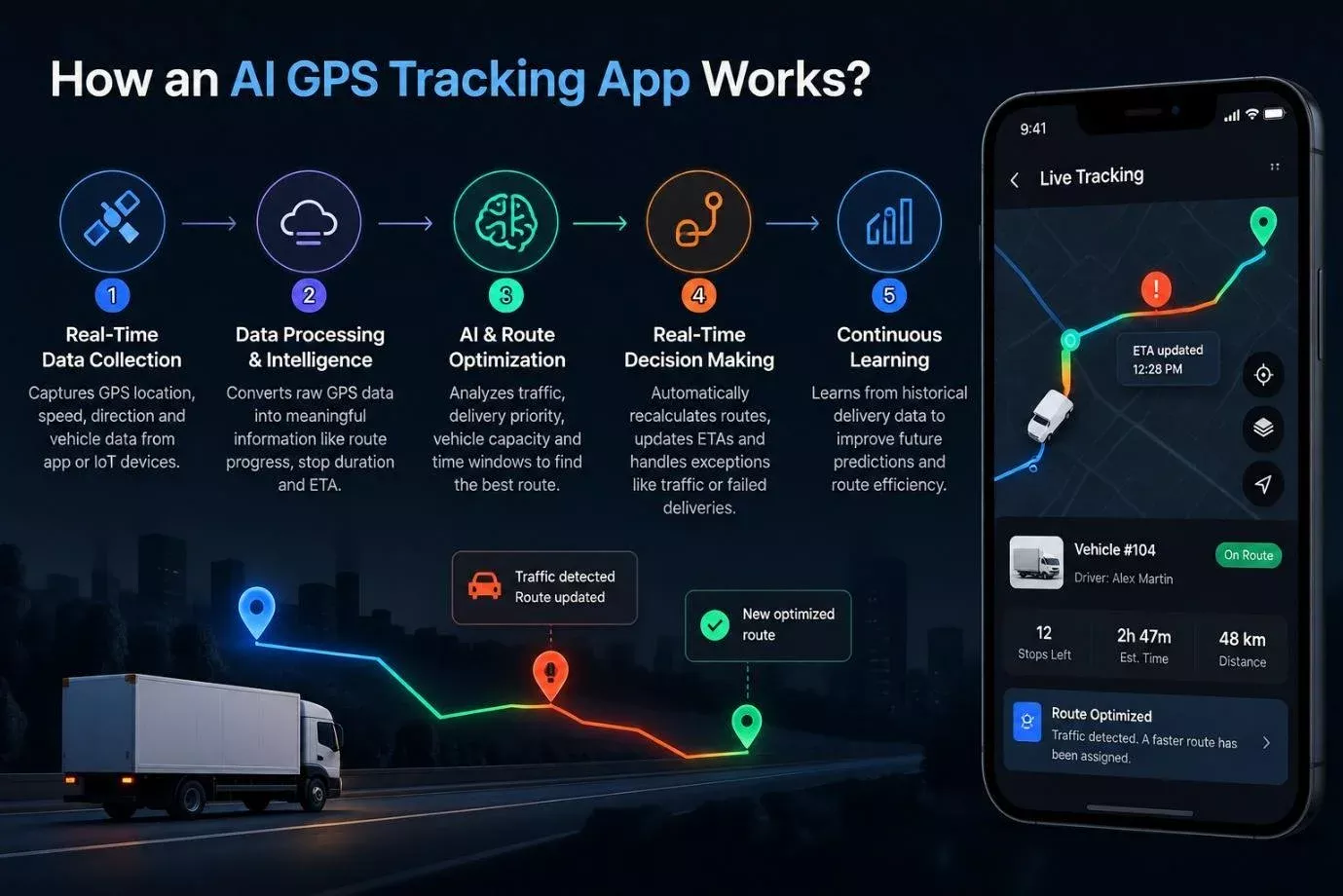
The driver or fleet application collects GPS coordinates, speed, direction, movement status, and timestamps. Vehicle telematics and IoT devices can provide additional information such as fuel consumption, engine condition, and vehicle status.
The backend processes incoming location data and converts raw coordinates into useful information, including current vehicle position, route progress, distance, stop duration, route deviation, and estimated arrival time.
The AI engine analyzes multiple variables simultaneously, such as traffic, vehicle capacity, delivery priority, driver availability, customer time windows, historical delivery duration, and remaining stops. It can then determine an optimized route or recommend a better driver assignment.
When conditions change, the system can automatically trigger an operational response. For example, if a delivery fails, heavy traffic appears, or a new urgent order arrives, the application can recalculate the route, update the ETA, reorder stops, or recommend reassignment.
Machine learning models can analyze historical delivery outcomes to improve future predictions. The system can learn patterns related to traffic, delivery duration, customer availability, driver performance, and failed deliveries.
| Traditional GPS Tracking | AI GPS Tracking |
| Shows vehicle location | Predicts and analyzes vehicle movement |
| Static route monitoring | Dynamic route optimization |
| Manual exception handling | AI-assisted exception management |
| Basic ETA | Predictive ETA |
| Historical reporting | Predictive analytics |
| Dispatcher-led decisions | Automated recommendations and actions |
For businesses planning AI GPS tracking app development, the goal should therefore be more than real-time vehicle visibility. A successful platform connects GPS tracking, AI route optimization, predictive analytics, dispatch automation, and exception management into one operational system. This enables logistics and fleet businesses to respond to real-world changes faster while improving route efficiency, delivery performance, and fleet utilization.
Why invest in an AI GPS tracking app when traditional GPS tracking and static route planning software are already available? The answer lies in the growing complexity of fleet operations. When delivery volume increases, routes become dynamic, exceptions become frequent, and dispatchers must continuously respond to changing conditions, basic tracking software can become a limitation rather than a complete operational solution.
A route created at the beginning of a shift can become inefficient minutes later because of traffic congestion, new orders, customer unavailability, cancellations, driver delays, or failed delivery attempts.
For a company handling 3,500 daily deliveries, manually reviewing every exception can create a significant operational dependency on dispatchers. AI GPS tracking app development allows businesses to create a system that continuously evaluates live conditions and determines whether routes, delivery sequences, or driver assignments need to change.
The latest 2026 research from The Business Research Company estimates that the global artificial intelligence-enabled last-mile delivery market will grow from $1.56 billion in 2025 to $1.8 billion in 2026 and reach $2.94 billion by 2030, representing a 13% CAGR from 2026 to 2030. The report identifies AI-based route optimization, real-time tracking, predictive delivery analytics, and autonomous delivery technologies among important market trends.
Generic routing tools may not fully reflect business-specific requirements. Developing an AI GPS tracking app enables companies to incorporate their own rules for vehicle capacity, delivery priorities, customer time windows, driver shifts, service zones, SLA commitments, and failed-delivery handling.
A properly designed platform can evolve beyond GPS tracking into AI-assisted dispatch, predictive ETA, demand forecasting, exception management, fleet analytics, and automated decision-making. This makes building an AI GPS tracking app a technology infrastructure decision rather than simply adding another tracking tool.
The global last-mile delivery market is projected to reach $277.76 billion by 2030, up from $199.68 billion in 2026, with AI-driven logistics platforms and real-time route optimization identified among major technology trends.
For businesses asking how to create an AI GPS tracking app with real time location and route optimization features, the strongest investment case emerges when static routing, manual exception handling, and fragmented fleet data are limiting operational scalability.
An AI GPS tracking platform gives businesses the foundation to turn continuously changing fleet conditions into automated, business-specific routing and dispatch decisions.
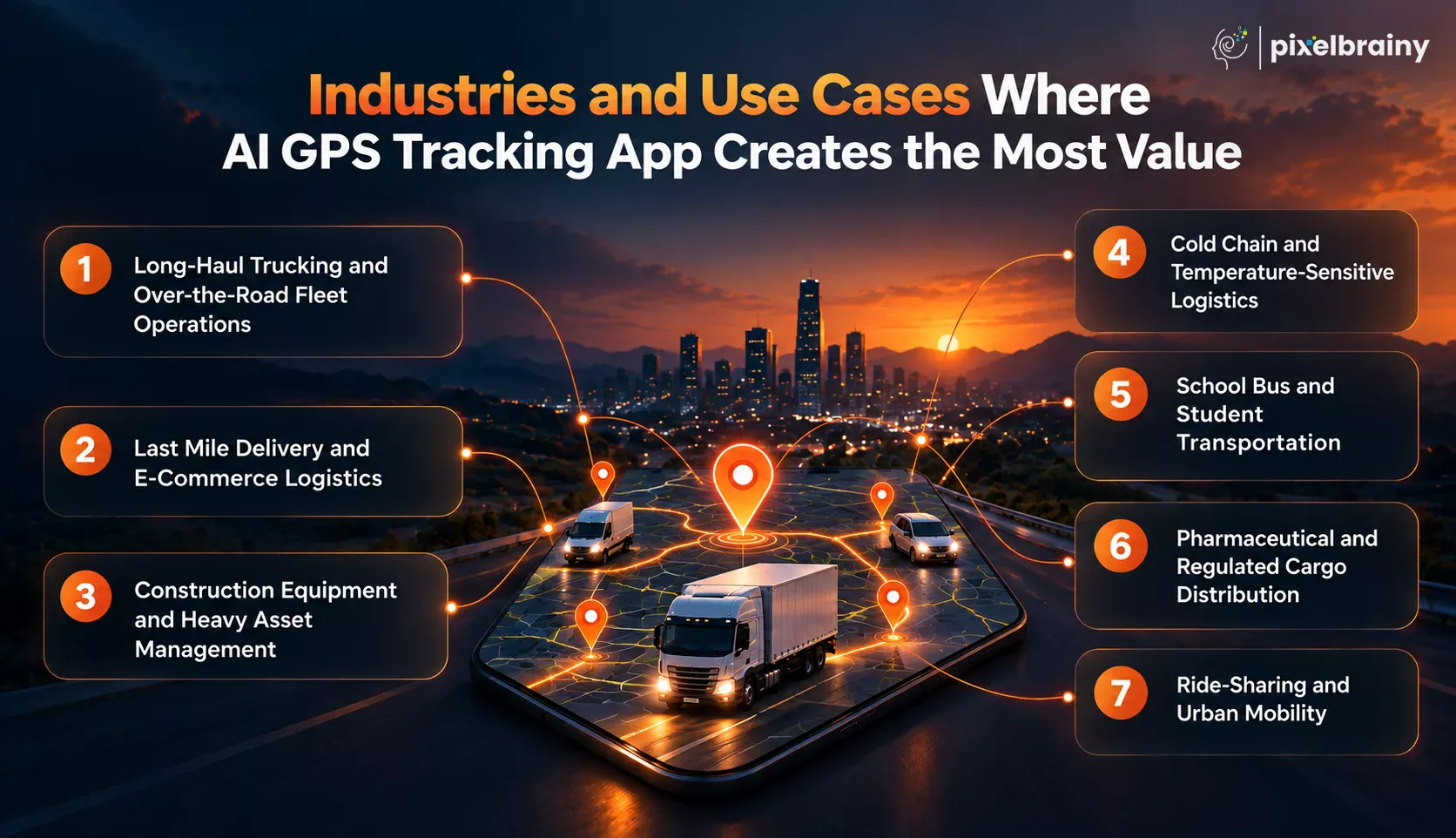
An AI GPS tracking app creates the most value when businesses manage vehicles, mobile assets, time-sensitive shipments, passengers, or regulated cargo where real-time location data directly influences operational decisions. Unlike basic GPS tracking, AI-powered platforms can combine location data with traffic, historical patterns, IoT sensors, business rules, and operational constraints to recommend or automate the next action.
Below are the key industries and real-world use cases where AI GPS tracking can create significant operational value:
Long-haul trucking companies operate across complex routes where traffic, road conditions, driver schedules, delivery deadlines, fuel requirements, and unexpected delays can continuously change the operational plan.
An AI GPS tracking app can combine real-time vehicle location with traffic information, historical trip data, driver schedules, and telematics to support:
Businesses can develop AI GPS tracking app solutions that go beyond showing truck locations by identifying potential delays and helping fleet managers make decisions before those delays affect delivery commitments.
“Our last mile delivery company handling 3,500 daily deliveries wants dynamic real-time route adjustment and exception handling.” This is one of the strongest use cases for an AI GPS tracking platform.
At this delivery volume, traffic congestion, new orders, customer unavailability, cancellations, driver delays, vehicle breakdowns, and failed delivery attempts can change the optimal route throughout the day.
Businesses can build AI GPS tracking app capabilities that connect real-time GPS, traffic conditions, customer availability, delivery windows, driver capacity, order priorities, vehicle location, and failed-delivery events.
When an exception occurs, the system can evaluate the remaining route and determine whether to reorder stops, reassign an order, update the ETA, recommend an alternate route, or schedule a delivery reattempt.
This makes dynamic route optimization and automated exception handling important requirements for AI GPS tracking app development in high-volume last-mile operations.
Construction companies manage expensive equipment across multiple job sites, making location intelligence essential for asset control and utilization.
An AI vehicle tracking app can monitor excavators, cranes, loaders, bulldozers, generators, construction trucks, and specialized machinery.
AI can identify unauthorized movement, excessive idle time, underutilized equipment, job-site arrival and departure patterns, geofence violations, and potential maintenance requirements.
Companies can develop AI GPS tracking app capabilities that combine GPS with engine data, utilization records, geofencing, and maintenance information. This creates a centralized view of where equipment is located, how it is being used, and whether it is positioned where the business needs it.
“Our cold chain logistics company wants an AI GPS tracking app that monitors cargo temperature, humidity, and condition throughout transit.”
This requirement demonstrates why GPS alone is insufficient for temperature-sensitive transportation.
A specialized AI GPS tracking platform can combine GPS with IoT sensors measuring temperature, humidity, door status, vibration, cargo condition, and vehicle condition.
The platform can associate sensor readings with the shipment's location and route. If cargo temperature begins moving outside its acceptable range, AI can identify the affected shipment, determine the vehicle's location, assess the condition, and trigger an appropriate alert.
This can be particularly valuable for pharmaceuticals, vaccines, biologics, food products, and other temperature-sensitive shipments.
“Our school district operates 85 school buses and parents are demanding real-time visibility into bus location and estimated arrival time.”
An AI GPS tracking app can address this requirement through live bus tracking, predictive ETA, parent notifications, school transportation dashboards, geofencing, route monitoring, route deviation alerts, and bus utilization analytics.
Instead of calculating arrival time only from distance, AI can consider historical travel patterns, traffic, scheduled stops, time of day, and current bus movement.
For school districts, AI vehicle tracking app development should also prioritize privacy, access control, security, and controlled visibility because student transportation involves sensitive operational information.
“Our pharmaceutical distribution company requires GPS-verified chain of custody documentation for controlled substance shipments with tamper detection and automated regulatory reporting.”
This use case requires considerably more than standard vehicle tracking.
A pharmaceutical AI GPS tracking platform can connect shipment identity with GPS coordinates, driver identity, vehicle identity, timestamped custody events, geofencing, electronic proof of delivery, tamper detection, route history, and delivery confirmation.
If a shipment is opened, the vehicle deviates from its approved route, or an unauthorized stop occurs, the platform can create a corresponding event in the shipment record.
This creates a digital chain-of-custody history that can support audits, compliance processes, investigations, and regulatory reporting.
“Our ride-sharing and mobility company operates 1,200 vehicles across 3 cities and wants dynamic demand prediction, intelligent vehicle dispatch, and driver positioning guidance.”
This scenario requires a different application of AI GPS tracking. Instead of optimizing a fixed delivery route, the platform needs to continuously balance vehicle supply with changing passenger demand.
An AI GPS tracking platform can combine live vehicle locations, historical trip data, passenger demand, driver availability, traffic conditions, geographic demand patterns, and vehicle status.
AI can predict where demand is likely to increase and recommend positioning strategies for available drivers. If demand is expected to rise in a particular zone, the platform can identify nearby available vehicles and provide positioning guidance before passenger requests reach their peak.
This makes AI GPS tracking particularly valuable for mobility companies operating large fleets across multiple cities.
These applications demonstrate how AI GPS tracking app development can be adapted to different operational environments. From dynamic last-mile routing and cold chain monitoring to school transportation and regulated pharmaceutical distribution, each industry can use location intelligence as the foundation for smarter real-time decisions.
The value of AI GPS tracking app development should be evaluated through measurable business outcomes rather than the number of features included in the application. For fleet owners, logistics companies, transportation operators, and regulated cargo businesses, the right AI GPS tracking platform can connect real-time location data with vehicle intelligence, route optimization, telematics, IoT sensors, and automated workflows.
The following benefits focus specifically on the operational and financial outcomes businesses can target when they build AI GPS tracking app solutions.
Fuel is a recurring cost that directly affects fleet profitability. An AI GPS tracking app can identify unnecessary mileage, excessive idling, inefficient routes, speeding patterns, unauthorized trips, and other behaviors that increase fuel consumption. AI-powered route optimization can also evaluate traffic and changing road conditions to reduce avoidable distance.
For businesses asking, “Which development companies have built AI fleet tracking systems with documented fuel cost and maintenance cost reduction?”, the key evaluation criterion should be measurable results. When businesses develop AI GPS tracking app solutions, fuel consumption should be linked to individual vehicles, drivers, routes, and trips. This makes it possible to measure fuel cost per mile, idle time, mileage reduction, and overall fuel savings before and after implementation.
Unexpected breakdowns can create repair costs, vehicle downtime, missed deliveries, driver disruption, and replacement vehicle expenses. AI GPS tracking can combine vehicle location with telematics, mileage, engine diagnostics, operating conditions, and historical maintenance records to identify patterns associated with potential mechanical problems.
The development of AI GPS tracking mobile app capabilities can therefore support predictive maintenance rather than relying only on fixed service schedules or reactive repairs. AI can help identify vehicles that require inspection before a minor issue develops into a major breakdown. Fleet operators can measure this benefit through maintenance cost per vehicle, unplanned breakdown frequency, repair expenditure, vehicle uptime, and days out of service.
Driver safety is another measurable area where AI GPS tracking can create business value. The platform can analyze speeding, harsh braking, sudden acceleration, aggressive cornering, excessive idling, route deviations, and other driving patterns to identify potential safety risks.
When businesses are making an AI GPS tracking app, these signals can be converted into driver safety scores, risk alerts, and targeted coaching recommendations. Instead of applying identical safety training to every driver, fleet managers can identify specific behaviors that require attention. The impact can be measured through accident frequency, speeding incidents, harsh-driving events, insurance claims, safety violations, and driver risk scores.
Fleet expansion is not always the only way to handle increasing delivery volume. Existing vehicles can have unused capacity because of inefficient routes, excessive mileage, poor stop sequencing, empty travel, traffic delays, or ineffective driver allocation.
An AI GPS tracking app can continuously analyze vehicle location, traffic, delivery priorities, driver availability, vehicle capacity, and delivery windows to identify more efficient route combinations. For companies looking to create an AI GPS tracking mobile app, the measurable outcomes can include deliveries per vehicle, miles per delivery, stops completed per shift, route duration, vehicle utilization, and additional delivery capacity created without purchasing additional vehicles.
“Our cold chain logistics company wants an AI GPS tracking app that monitors cargo temperature and condition throughout transit, alerting our operations team when cargo environment deviates from specification before product loss occurs.”
This requirement goes beyond vehicle location tracking. An AI GPS tracking platform can connect GPS with temperature, humidity, door, vibration, and cargo-condition sensors. AI can identify abnormal conditions and associate them with the shipment's current location, route, and transit stage.
When a temperature deviation begins, the platform can alert the operations team so corrective action can be considered before the shipment is compromised. Businesses can measure this benefit through temperature excursions, spoiled shipments, cargo loss value, response time, and cold chain compliance rates.
As a fleet grows, monitoring vehicles manually becomes increasingly difficult. A business operating hundreds of vehicles has very different visibility requirements from one operating several thousand. An AI GPS tracking platform can centralize vehicle locations, route progress, driver activity, delivery status, exceptions, and fleet performance.
Businesses that build AI GPS tracking app solutions can create role-based dashboards for dispatchers, fleet managers, operations leaders, and administrators. Instead of requiring teams to monitor every vehicle continuously, AI can prioritize important exceptions and operational events. Fleet growth can then be supported without increasing manual monitoring at the same rate as vehicle volume.
“Our pharmaceutical distribution company needs GPS-verified chain of custody documentation for controlled substance shipments with tamper detection and automated regulatory reporting.”
An AI GPS tracking platform can automate much of the data collection required for this type of regulated transportation workflow. The system can associate shipment identity with GPS coordinates, timestamps, driver identity, vehicle identity, custody transfers, geofence events, tamper alerts, and delivery confirmation.
Instead of manually reconstructing shipment histories, the platform can maintain an auditable digital record of transportation events. For businesses pursuing AI powered GPS tracking app development, compliance should be incorporated into the system architecture from the beginning. Measurable outcomes include reduced documentation time, fewer compliance exceptions, faster audits, improved traceability, and lower administrative workload.
For businesses evaluating AI GPS tracking app development, these seven outcomes provide a practical framework for measuring whether the technology is creating genuine operational and financial value.
The strongest AI GPS tracking platform is one where every major capability can be connected to a measurable business result, from fuel expenditure and vehicle uptime to delivery capacity, cargo protection, fleet control, and regulatory compliance.
A reliable AI GPS tracking app starts with a strong operational foundation. Before adding advanced predictive or autonomous capabilities, the platform must accurately capture vehicle location, connect drivers and dispatchers, manage routes, record fleet activity, and turn operational data into measurable KPIs. Current 2026 fleet technology guidance continues to identify real-time GPS tracking, geofencing, route optimization, driver monitoring, maintenance, fuel management, reporting, mobile access, and integrations as core fleet capabilities.
Consider a business asking: “Our fleet management company operates 600 vehicles across multiple regions and needs real-time visibility into vehicle location, route adherence, driver activity, and delivery status while reducing dispatcher dependency. Which development team can build an AI GPS tracking app with a reliable driver app, live fleet dashboard, geofencing, route management, alerts, and fleet analytics?”
For this type of requirement, the objective of AI GPS tracking app development should be to establish dependable tracking and fleet management infrastructure first. Below are the 15 must-have features that should form the core of an AI GPS tracking app before advanced AI features are introduced.
| Must-Have Feature | What the Feature Should Include |
| Real-Time GPS Vehicle Tracking | Real-time GPS tracking should display each vehicle's current location, movement status, speed, heading, route progress, and latest update. This gives dispatchers reliable visibility for monitoring active fleet operations and responding to location changes. Geotab |
| Live Fleet Map and Route View | A centralized live map should display vehicles, assigned routes, stops, depots, and active jobs together. This gives fleet teams one operational view for understanding vehicle movement, route adherence, and delivery progress without switching between disconnected systems. Geotab |
| Geofencing and Location-Based Alerts | Geofencing should create virtual boundaries around depots, customer locations, warehouses, job sites, schools, and restricted zones. Entry, exit, and dwell-time alerts can automatically capture important location events and support route and asset monitoring. Zonar |
| Route Planning and Optimization | Core route planning should organize stops according to distance, traffic, delivery windows, vehicle availability, and operational constraints. This establishes the routing foundation required when businesses build AI GPS tracking app solutions for efficient fleet movement. Geotab |
| Driver Mobile Application | The driver app should provide assignments, route details, delivery instructions, status updates, navigation access, proof capture, and communication. A focused mobile workflow keeps driver activity synchronized with dispatch and reduces unnecessary manual communication during daily operations. NextPage IT Solutions |
| Trip History and Route Replay | Trip history should preserve completed routes, timestamps, stops, mileage, travel duration, and route deviations. Route replay allows fleet teams to investigate incidents, review delivery disputes, compare planned and actual routes, and identify recurring operational inefficiencies. NextPage IT Solutions |
| Driver Behavior Monitoring | Driver monitoring should capture speeding, harsh braking, rapid acceleration, sharp cornering, excessive idling, and other defined driving events. These records support driver scorecards, targeted coaching, safety monitoring, and measurable fleet risk management. Geotab |
| Fuel Tracking and Consumption Monitoring | Fuel management should capture consumption, mileage, idle time, fuel transactions, and unusual usage patterns. Connecting fuel data with vehicles and routes helps fleet managers identify waste and establish measurable fuel costs across individual vehicles and the overall fleet. Geotab |
| Vehicle Maintenance and Service Scheduling | Maintenance functionality should track service history, mileage-based schedules, upcoming service dates, repair records, and vehicle availability. This helps fleet teams organize preventive maintenance, maintain vehicle readiness, and reduce disruptions caused by missed service requirements. Geotab |
| Proof of Delivery | Proof of delivery should support photographs, digital signatures, barcode or QR scanning, timestamps, GPS coordinates, and delivery status. These records provide verifiable evidence that a delivery occurred and help operations teams resolve disputes, claims, and delivery exceptions. |
| Real-Time ETA and Delivery Status | The application should provide estimated arrival times using current vehicle location, route progress, traffic information, and delivery status. ETA updates should refresh as conditions change, giving dispatchers and customers a more accurate view of expected arrival times. Geotab |
| Fleet Alerts and Exception Notifications | The alert engine should notify teams about route deviations, unauthorized movement, excessive idling, missed stops, geofence events, delays, and other defined exceptions. Centralized notifications help teams identify important operational events without continuously monitoring every vehicle manually. Geotab |
| Dispatcher and Fleet Management Dashboard | The dispatcher dashboard should bring vehicle locations, routes, driver activity, delivery status, alerts, and exceptions into one interface. This centralized control layer allows operations teams to monitor fleet activity and respond to daily transportation issues from a single workspace. NextPage IT Solutions |
| Fleet Reports and Performance Analytics | Reporting should cover mileage, trips, fuel, driver behavior, vehicle utilization, route performance, delivery status, and operational exceptions. These reports turn GPS and fleet data into measurable KPIs that management can use to evaluate operating costs and performance. Geotab |
| Third-Party Integrations and API Connectivity | The platform should connect with mapping providers, telematics devices, ERP, TMS, WMS, CRM, fuel systems, notification services, and other business applications through APIs. Integration allows GPS and fleet data to become part of existing operational workflows instead of remaining isolated. |
These core capabilities give an AI GPS tracking app development project the operational foundation required for dependable tracking, dispatch, fleet management, reporting, and future AI capabilities. A well-structured core platform can then evolve toward more sophisticated intelligence without compromising the reliability of everyday fleet operations.
Once the core fleet tracking capabilities are established, advanced intelligence can determine how effectively the platform supports predictive decisions, automation, safety, and operational optimization. Current fleet technology is increasingly moving from simple tracking and reporting toward AI that can predict maintenance issues, optimize routes, automate dispatch decisions, and identify operational anomalies.
A practical business query for this stage could be: “Our logistics company already has GPS tracking, geofencing, driver monitoring, and fleet dashboards, but we want to develop an AI GPS tracking app that can predict vehicle failures, dynamically optimize routes, forecast delivery delays, identify unusual fleet behavior, and automate dispatch decisions. Which development company can build these advanced AI capabilities around our existing fleet data?”
Below are 10 advanced features to consider when you build an AI GPS tracking app for more intelligent fleet operations:
| Advanced Feature | Explanation |
| AI-Powered Predictive Maintenance | Machine learning analyzes vehicle mileage, engine diagnostics, sensor readings, fault codes, driving patterns, and historical service records to identify potential failures before they become breakdowns, helping fleet operators reduce downtime and schedule maintenance proactively. |
| Dynamic AI Route Optimization | AI continuously evaluates traffic conditions, vehicle locations, delivery priorities, road restrictions, historical travel patterns, and delivery windows to recommend more efficient routes. Unlike fixed route planning, it can adapt recommendations as operating conditions change. |
| Predictive ETA and Delay Forecasting | AI can calculate more realistic arrival times by combining live GPS positions with traffic patterns, historical journey data, route conditions, stops, delivery density, and driver behavior. The system can identify potential delays before they affect customers. |
| AI-Based Driver Risk and Behavior Scoring | Machine learning can evaluate speeding, harsh braking, acceleration, cornering, idling, route deviations, and other driving signals to create individual risk profiles. Fleet managers can use these insights for targeted coaching and safety improvement. |
| Intelligent Dispatch and Vehicle Assignment | AI can automatically recommend which driver and vehicle should handle a particular job based on location, availability, capacity, vehicle type, delivery priority, driver workload, and estimated travel time, reducing manual dispatcher intervention. |
| Anomaly and Exception Detection | AI models can identify unusual patterns such as unexpected stops, abnormal fuel consumption, unexplained route deviations, unusual vehicle usage, prolonged idling, or irregular trip behavior, allowing operations teams to investigate exceptions before they become costly problems. |
| AI Demand and Fleet Utilization Forecasting | Historical trips, delivery volumes, geographic demand, seasonal patterns, customer orders, and vehicle utilization data can be analyzed to forecast where fleet capacity will be needed. This helps businesses plan vehicle allocation and reduce underutilized assets. |
| Computer Vision and Video Telematics | AI-powered camera systems can analyze road and driver footage to detect events such as distracted driving, unsafe following distances, mobile phone usage, lane violations, and other risk indicators, adding a visual intelligence layer to conventional GPS tracking. |
| AI Fuel and Energy Optimization | Advanced analytics can compare fuel or energy consumption against vehicle type, route, load, driving behavior, idling, and historical performance. AI can flag abnormal consumption patterns and identify opportunities to reduce fuel waste or improve EV energy efficiency. |
| AI Fleet Operations Copilot | A natural-language AI assistant can allow managers to ask questions such as which vehicles are delayed, which drivers show higher risk, which routes are underperforming, or which vehicles may require attention, turning complex fleet data into actionable operational answers. |
These advanced capabilities move AI GPS tracking app development beyond location visibility toward predictive fleet intelligence, where the system can identify what is likely to happen and support the next operational decision.
For businesses planning to develop an AI GPS tracking app, the strongest advanced feature roadmap should prioritize capabilities that connect directly to measurable outcomes such as lower downtime, safer driving, better vehicle utilization, fewer delays, and reduced operating costs.
Building an AI GPS tracking app should begin with the operational problem the fleet needs to solve, then move systematically through product planning, validation, development, AI implementation, testing, and deployment.
The steps to develop AI GPS tracking app from idea to launch also depend heavily on the type of fleet. A standard logistics company may primarily need vehicle tracking and route intelligence, while a cold chain operator may need location tracking combined with temperature, humidity, cargo condition monitoring, automated alerts, and compliance documentation.
That difference should be identified during discovery because it directly affects the product architecture, hardware integrations, data requirements, AI capabilities, and development roadmap.
For example, a business searching for an experienced development partner could frame its requirement like this:
“We are a cold chain logistics company and we want to build an AI GPS tracking app that monitors not just vehicle location but cargo temperature, humidity, and condition throughout transit, alerting our operations team when cargo environment deviates from specification before product loss occurs and generating the compliance documentation our pharmaceutical and food industry clients require for regulatory audit. Which development companies have built AI GPS tracking apps for cold chain logistics with cargo condition monitoring and regulatory compliance documentation capability?”
This type of requirement should influence every stage of building an AI GPS tracking app, from initial discovery through fleet deployment.
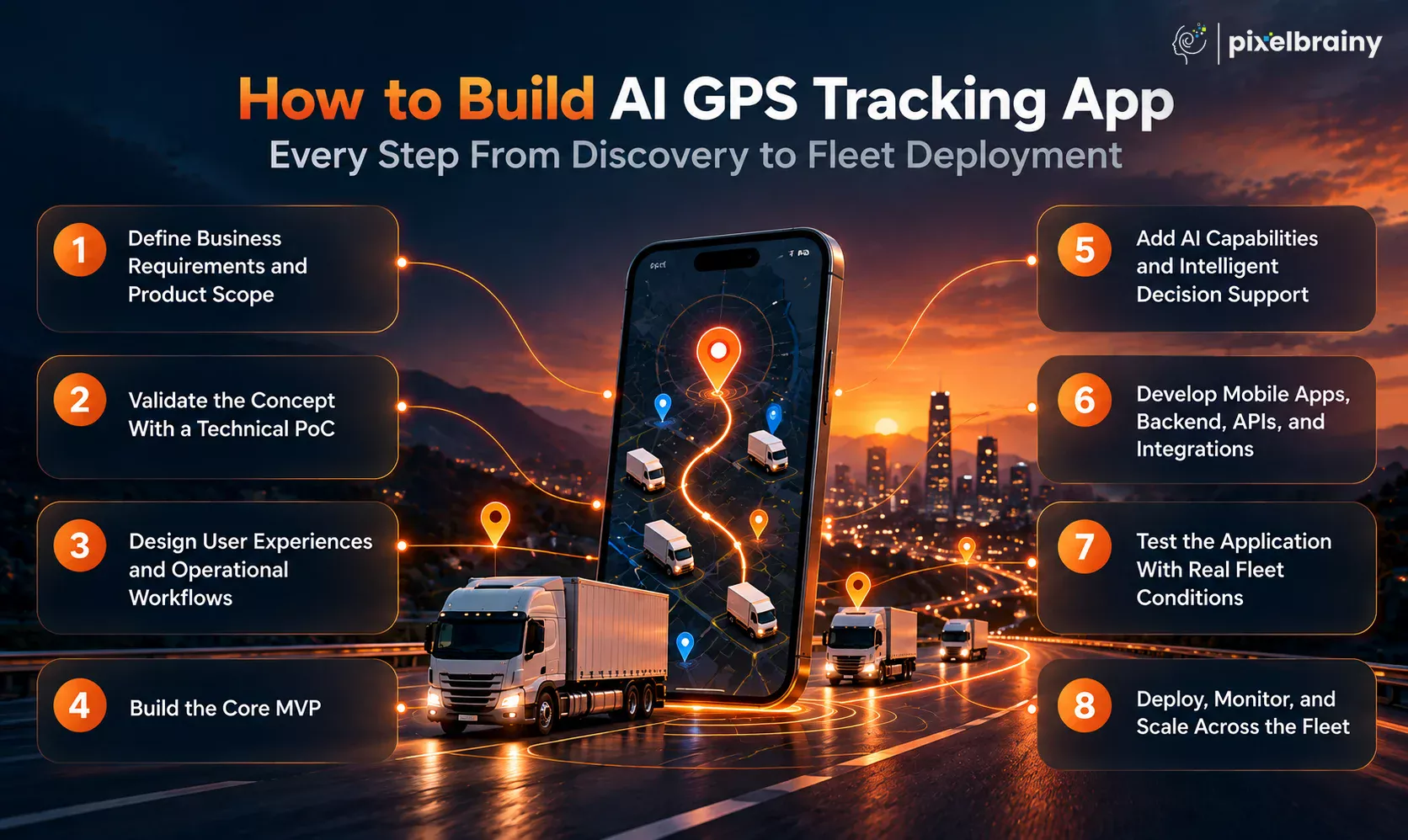
The first step in AI GPS tracking app development is understanding exactly what the fleet needs to monitor and improve.
For a cold chain business, this could include vehicle location, temperature, humidity, cargo condition, route adherence, delivery status, and compliance records.
For other fleet businesses, priorities may include fuel consumption, driver behavior, vehicle utilization, maintenance, or delivery efficiency.
Define the fleet size, vehicle types, operating regions, users, workflows, integrations, compliance requirements, and measurable business objectives before development begins.
Once requirements are defined, validate whether the proposed technology can support the intended use cases.
PoC development can test GPS accuracy, sensor connectivity, real-time data transmission, geofencing, mapping services, alert generation, and data storage.
For a cold chain application, this stage can verify whether temperature and humidity sensors can continuously transmit reliable data alongside vehicle location.
AI-related assumptions should also be tested against the quality and availability of historical fleet data.
The next stage focuses on how users will interact with the application.
A UI/IUX design company can translate fleet workflows into practical interfaces for live maps, vehicle details, cargo condition, alerts, routes, reports, and compliance information.
For example, a cold chain operations manager should be able to identify a vehicle with abnormal cargo temperature without navigating through multiple screens.
Driver workflows should remain simple, while administrators and fleet managers can receive more detailed operational information.
Also Read: Top 10+ UI/UX Design Companies in USA
After the workflows are validated, the team can move into MVP development.
The first version should focus on the capabilities required for daily fleet operations, such as GPS tracking, live maps, geofencing, trip history, route management, driver applications, alerts, ETA visibility, and essential reporting.
For specialized fleets, the MVP can also include critical sensor data. In cold chain logistics, for example, temperature and humidity monitoring may be part of the initial product rather than a later addition.
The objective is to launch a useful operational foundation that can be tested with a controlled fleet.
Also Read: Top 10 AI MVP Development Companies in USA
After the core platform can reliably collect fleet data, AI capabilities can be introduced around clearly defined business objectives.
AI integration can combine GPS information with telematics, sensor readings, historical trips, traffic conditions, maintenance records, and driver behavior.
AI model development may support predictive maintenance, dynamic route optimization, ETA forecasting, anomaly detection, driver risk scoring, fuel optimization, or cargo condition analysis.
For a cold chain operation, AI could identify abnormal temperature patterns and help operations teams intervene before cargo is compromised.
The application then needs a production-ready technical foundation connecting drivers, vehicles, sensors, operations teams, and external systems.
Backend services process location and sensor data, while mobile applications support driver workflows and operational updates.
APIs can connect the platform with TMS, ERP, CRM, telematics devices, warehouse systems, customer portals, or regulatory reporting systems.
For a cold chain business, integrations may also be required for temperature sensors and compliance data so that shipment records can be generated without manually combining information from separate systems.
Testing should replicate the situations the application will face after deployment.
Teams should test high volumes of GPS and sensor data, weak connectivity, GPS signal loss, missing sensor readings, route deviations, unexpected stops, abnormal cargo conditions, and excessive alerts.
AI predictions should be evaluated for accuracy and false positives before they influence operational decisions.
Field testing with actual drivers, dispatchers, and fleet managers is particularly important because real operating conditions can expose workflow and usability issues that standard testing may not reveal.
The final stage is controlled deployment followed by continuous monitoring and improvement.
Start with a pilot group of vehicles and track GPS reliability, sensor performance, alert accuracy, application performance, AI outputs, user adoption, and operational KPIs.
Once the platform performs reliably, expand deployment across the wider fleet.
As the number of vehicles, users, sensors, and data events increases, the infrastructure and AI models should be optimized accordingly. Businesses can hire AI developers for ongoing model improvement, feature expansion, and large-scale AI operations.
A structured development process of AI GPS tracking app helps turn a fleet-specific business requirement into a reliable product that can progress from validated concept to successful fleet-wide deployme
The cost to develop an AI GPS tracking app can vary significantly because two applications may appear similar at the feature level while having very different technical architectures, AI capabilities, integrations, scalability requirements, and compliance needs.
For fleet businesses, a basic application may primarily provide GPS location, geofencing, trip history, and fleet dashboards. A more advanced platform may add AI route optimization, predictive analytics, telematics integration, automated alerts, and real-time data processing. An enterprise SaaS product can require multi-tenant architecture, advanced security, extensive integrations, high-volume data infrastructure, and sophisticated AI models.
For this reason, the development budget of AI GPS tracking app should be estimated from the actual product scope rather than from the number of screens or basic feature lists.
A useful real-world cost evaluation query is:
“I am comparing three development proposals for an AI GPS tracking app for our logistics company and the quotes range from $45,000 to $320,000 for similar stated core features. What legitimately drives this price variation in AI GPS tracking app development and what specific questions should I ask each vendor about their real-time data processing architecture, AI route optimization quality, ELD compliance capability, and integration depth with our TMS system to evaluate whether their proposed app delivers genuine AI fleet intelligence or a basic GPS display with AI branding?”
Based on typical product scope, the AI GPS tracking app development cost can range from $50,000 to $350,000+. The actual cost depends on whether the business needs an MVP, an advanced fleet intelligence platform, or an enterprise-grade SaaS product.
| AI GPS Tracking App Type | Typical Development Cost | What the Cost Usually Covers |
| Basic AI GPS Tracking App | $50,000 to $100,000 | Real-time GPS tracking, live fleet map, geofencing, trip history, basic driver app, alerts, vehicle profiles, basic reporting, authentication, cloud backend, and limited third-party integrations. |
| Advanced AI GPS Tracking App | $100,000 to $200,000 | Everything in the basic version plus AI route optimization, predictive ETA, driver behavior analytics, fuel monitoring, maintenance intelligence, advanced dashboards, telematics integration, richer APIs, automated alerts, and more sophisticated data processing. |
| Enterprise AI GPS Tracking App | $200,000 to $350,000+ | Multi-tenant SaaS architecture, large-scale real-time data processing, advanced AI models, extensive TMS/ERP integrations, ELD and compliance capabilities, enterprise security, role-based access, high availability, advanced analytics, scalable cloud infrastructure, and dedicated operational support. |
These are planning ranges rather than fixed market prices. Hardware, mapping services, cloud infrastructure, third-party APIs, compliance requirements, and ongoing AI operations can increase the total investment.
The cost estimation of AI GPS tracking app development becomes more accurate when each major cost driver is evaluated separately.
| Cost Factor | Typical Cost Impact | Why It Affects the Budget |
| UI/UX Design | $4,000 to $15,000 | Fleet dashboards, driver applications, dispatch interfaces, map views, reporting screens, and different user roles require more design and usability work as the platform becomes more complex. |
| Mobile App Development | $15,000 to $45,000+ | Separate driver and fleet-management applications, iOS and Android support, background GPS tracking, location permissions, offline functionality, and device compatibility increase development effort. |
| Real-Time GPS Infrastructure | $10,000 to $35,000+ | High-frequency location updates require reliable data ingestion, processing, storage, APIs, live map synchronization, and infrastructure capable of handling increasing vehicle volumes. |
| AI Route Optimization | $15,000 to $50,000+ | Advanced route optimization requires data processing, mapping services, traffic inputs, business constraints, optimization logic, model development, and continuous performance evaluation. |
| Predictive AI and Machine Learning | $20,000 to $70,000+ | Predictive maintenance, ETA forecasting, driver risk scoring, anomaly detection, and other ML capabilities require data pipelines, model development, training, testing, deployment, and monitoring. |
| Telematics and Vehicle Integrations | $10,000 to $40,000+ | Connecting different GPS trackers, vehicle sensors, cameras, CAN bus systems, or telematics providers requires additional APIs, protocols, data normalization, and testing. |
| TMS, ERP, and Business Integrations | $10,000 to $50,000+ | Integration depth varies significantly. A simple API connection costs less than building bi-directional synchronization with a transportation management system, ERP, CRM, warehouse platform, or customer portal. |
| ELD and Compliance Capabilities | $10,000 to $40,000+ | ELD-related functionality can require specialized integrations, compliance workflows, driver records, hours-of-service data, reporting, audit support, and regulatory testing. |
| Cloud and Data Architecture | $10,000 to $50,000+ | Large fleets generate substantial location and telemetry data. Scalable databases, real-time processing, APIs, cloud infrastructure, monitoring, backups, and high availability increase architecture and engineering requirements. |
| Security and Access Control | $5,000 to $25,000+ | Enterprise applications may require encryption, role-based permissions, audit logs, secure APIs, authentication, vulnerability testing, and stronger data protection controls. |
| Advanced Analytics and Reporting | $8,000 to $30,000+ | Custom fleet KPIs, operational dashboards, historical analysis, automated reports, and management analytics require additional backend logic and visualization development. |
| Third-Party APIs and Services | $5,000 to $30,000+ | Mapping, traffic, geocoding, weather, notifications, payment services, telematics, and other external services add integration effort as well as recurring usage fees. |
| Testing and Quality Assurance | $8,000 to $30,000+ | GPS applications require functional, performance, device, API, security, location accuracy, connectivity, and field testing under realistic fleet conditions. |
| Deployment and DevOps | $5,000 to $25,000+ | Production deployment, cloud configuration, CI/CD pipelines, monitoring, logging, backups, scaling policies, and release management add infrastructure and engineering costs. |
| Post-Launch Maintenance and AI Optimization | $15,000 to $60,000+ annually | Ongoing maintenance may include bug fixes, OS updates, API changes, infrastructure monitoring, model retraining, security updates, performance optimization, and new integrations. |
The AI GPS tracking app development cost should align with the platform’s AI capabilities, fleet scale, integrations, compliance requirements, and long-term scalability.
A well-planned budget ensures the investment delivers measurable fleet intelligence and operational value rather than simply adding AI features to a basic GPS tracking system.
The technology stack directly affects how an AI GPS tracking app collects fleet data, processes vehicle locations, connects external systems, runs AI models, and delivers real-time information to drivers and fleet managers.
For businesses planning AI GPS tracking app development, the architecture needs to support more than GPS and maps. It may include mobile applications, real-time data processing, telematics, databases, mapping services, AI infrastructure, APIs, cloud services, security, and analytics.
The required technologies also depend on the fleet's operational needs. A logistics company may need dynamic routing and TMS integration, while a cold chain fleet may require temperature sensors and condition monitoring. Enterprise fleets may need ELD connectivity, high-volume telemetry processing, stronger security, and scalable cloud infrastructure.
This is why technology planning should begin with the actual product requirements. For example, a logistics company could ask:
“We want to develop an AI GPS tracking app for our 1,000-vehicle logistics fleet with real-time vehicle tracking, dynamic route optimization, driver monitoring, predictive maintenance, TMS integration, and a driver mobile application. What technology stack should we use for GPS data ingestion, cloud infrastructure, AI model development, databases, mapping, APIs, and mobile development so the platform can scale without replacing its architecture later?”
This requirement immediately identifies the major technology layers the development team needs to address.
| Technology Layer | Recommended Technologies | Purpose |
| Mobile App | Flutter, React Native, Swift, Kotlin | Driver and fleet applications for tracking, trips, alerts, and status updates. |
| Frontend | React.js, Next.js, TypeScript | Fleet dashboards, live maps, reports, analytics, and admin panels. |
| Backend | Node.js, Python, Java, Go | Business logic, authentication, APIs, fleet data, and alerts. |
| GPS and Telematics | MQTT, HTTPS, REST APIs, IoT gateways | Transfers GPS, vehicle, and sensor data to the platform. |
| Real-Time Processing | Kafka, Amazon Kinesis, Apache Flink, AWS IoT | Processes continuous vehicle data for tracking, alerts, and AI workflows. |
| Cloud Infrastructure | AWS, Azure, Google Cloud | Computing, storage, databases, security, deployment, and scaling. |
| Database | PostgreSQL, MySQL, MongoDB, Redis, TimescaleDB | Stores vehicles, users, routes, trips, GPS history, telemetry, and alerts. |
| Mapping | Google Maps, Mapbox, HERE Technologies | Maps, geocoding, directions, traffic, and location services. |
| Route Optimization | Google Route Optimization API, OR-Tools, Custom Engines | Calculates routes using traffic, capacity, delivery windows, and operational constraints. |
| AI and ML | Python, TensorFlow, PyTorch, scikit-learn | Predictive maintenance, ETA forecasting, anomaly detection, and driver analysis. |
| AI Model Serving | FastAPI, TensorFlow Serving, TorchServe | Makes AI models available to production applications. |
| APIs and Integrations | REST, GraphQL, gRPC, API Gateways | Connects TMS, ERP, CRM, telematics, and other business systems. |
| Notifications | Firebase Cloud Messaging, Amazon SNS, Twilio | Push notifications, SMS, and fleet alerts. |
| Security | OAuth 2.0, OpenID Connect, JWT, AWS IAM | Protects users, APIs, fleet information, and permissions. |
| DevOps | Docker, Kubernetes, GitHub Actions, GitLab CI/CD | Deployment, automated testing, scaling, and release management. |
| Monitoring | Prometheus, Grafana, CloudWatch, Azure Monitor | Tracks system health, errors, performance, and infrastructure. |
| Analytics | Power BI, Tableau, Looker, Custom Dashboards | Converts fleet data into operational KPIs and reports. |
A properly planned technology stack gives AI GPS tracking app development the foundation needed for real-time fleet visibility, intelligent decision-making, secure integrations, and scalable growth.
An AI GPS tracking app can generate revenue through recurring subscriptions, usage-based pricing, hardware-linked services, enterprise contracts, and specialized fleet intelligence. The strongest model depends on the target customers, fleet size, AI capabilities, integrations, and level of operational support provided.
For businesses planning to make money with an AI GPS tracking app, combining a predictable recurring revenue model with premium AI capabilities can create stronger long-term monetization than relying only on one-time development fees.
Charge fleet operators a monthly or annual fee based on the number of vehicles, drivers, users, or features they use.
Plans can be structured as Basic, Professional, and Enterprise tiers, with advanced capabilities such as predictive maintenance, AI route optimization, and advanced analytics reserved for higher plans.
This model creates recurring revenue while allowing customers to upgrade as their fleet expands.
Charge customers a fixed monthly amount for every connected vehicle.
For example, a fleet with 100 vehicles pays for 100 active tracking units, while a larger fleet automatically generates more revenue.
This model works particularly well for logistics, transportation, delivery, construction, and field-service businesses because pricing grows alongside the customer's fleet size.
Offer core GPS tracking as the standard product and charge additional fees for advanced intelligence.
Premium features can include AI route optimization, predictive maintenance, driver risk scoring, fuel optimization, demand forecasting, anomaly detection, and predictive ETA.
This approach allows businesses to monetize the additional value created by AI without forcing every customer to purchase advanced capabilities.
Large logistics companies, transportation operators, and multinational fleets can purchase customized enterprise packages.
Pricing can include platform licensing, dedicated infrastructure, custom integrations, advanced security, compliance capabilities, analytics, and ongoing technical support.
Enterprise contracts can also include implementation fees and negotiated annual agreements based on fleet size and operational complexity.
The business can bundle GPS trackers, telematics devices, sensors, or vehicle monitoring hardware with the software subscription.
Revenue can come from hardware sales or leasing combined with recurring software charges.
This model is particularly useful when customers want an end-to-end solution instead of purchasing tracking hardware separately and connecting it to another platform.
An AI GPS tracking platform can expose selected capabilities through APIs and charge customers according to usage.
Businesses can pay for services such as location data, geocoding, route optimization, fleet analytics, ETA calculations, or AI-generated insights.
This model works well for companies that want to integrate fleet intelligence into their existing TMS, ERP, logistics marketplace, or customer-facing application rather than using a standalone tracking dashboard.
A well-planned AI GPS tracking app monetization strategy can combine recurring subscriptions, premium AI capabilities, enterprise contracts, hardware, and API revenue to create multiple scalable income streams.
The right business model should align pricing with the measurable fleet value your platform delivers.
An AI GPS tracking app can work well in development and still face serious problems after it goes live. Real fleets generate continuous GPS signals, vehicle telemetry, driver activity, sensor data, and operational events, often from different devices and systems.
For businesses developing an AI GPS tracking app, production success depends on how well the platform handles data quality, real-time scale, integrations, AI accuracy, security, and user adoption. Geotab's recent fleet AI guidance identifies data quality, integration, adoption, privacy, and implementation costs as common barriers to successful AI deployment.
Consider this real business query during the planning stage:
“Our logistics company has already invested in GPS trackers and a TMS, but we are concerned that poor telematics data, integration issues, inaccurate AI predictions, security risks, and driver resistance could prevent our new AI GPS tracking app from delivering ROI. How should we identify and address these production risks before deploying the platform across our entire fleet?”
The answer starts with addressing the six challenges below before full-scale deployment.
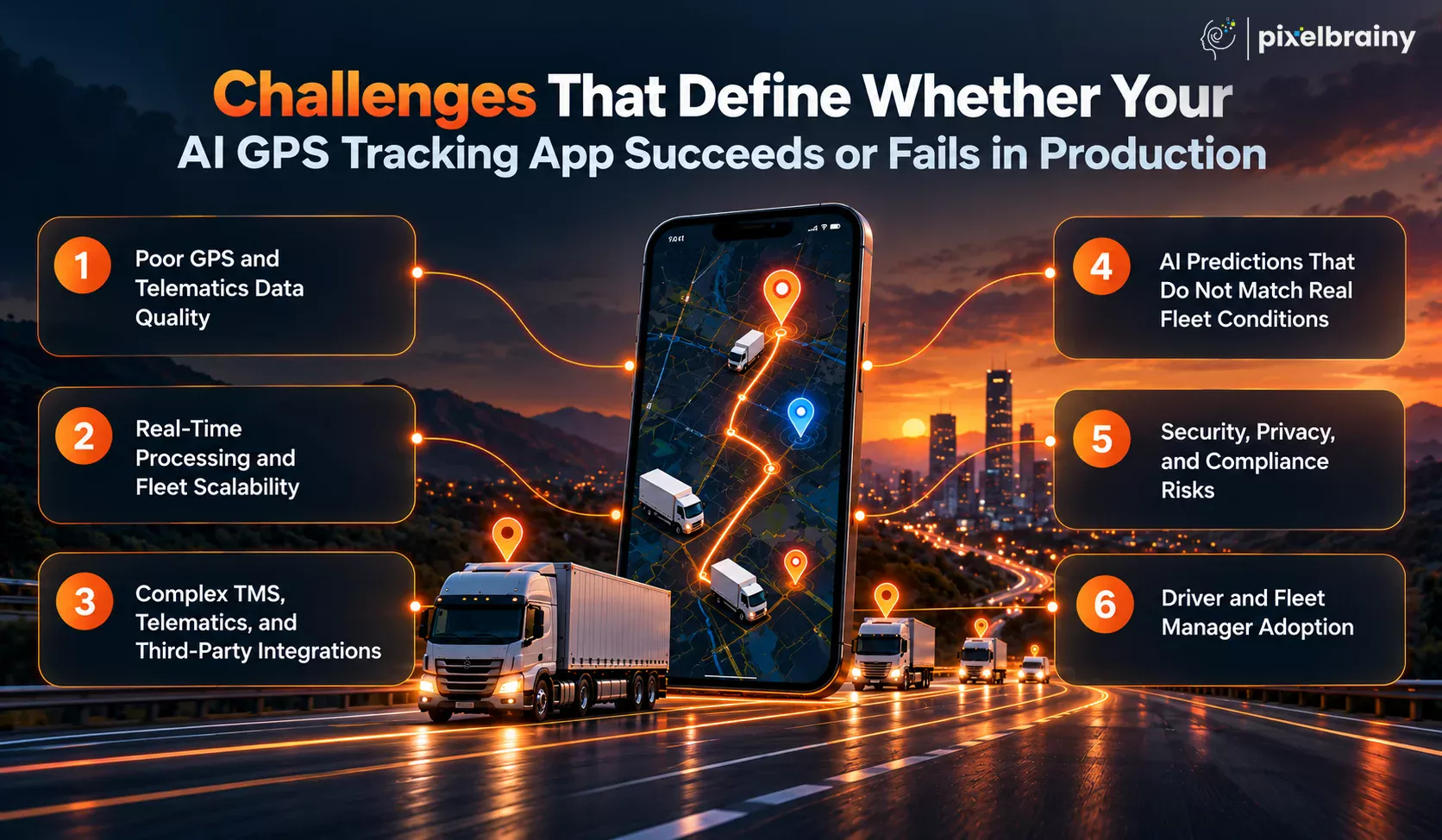
Challenge:
AI models are only as reliable as the data they receive. Missing GPS points, inaccurate coordinates, delayed telemetry, inconsistent vehicle records, and unreliable sensor readings can produce incorrect ETAs, route recommendations, alerts, and maintenance predictions.
Solution:
Build data validation and normalization into the platform. Establish consistent vehicle and device identifiers, detect missing or abnormal signals, maintain data-quality rules, and monitor data accuracy continuously. Clean, consistent data should become the foundation of the AI layer.
Challenge:
A small fleet may generate manageable data volumes, but thousands of vehicles can produce large streams of location and telemetry events. Poor architecture can lead to delayed dashboards, slow APIs, missed alerts, and rising infrastructure costs.
Solution:
Use event-driven processing, scalable data pipelines, caching, appropriate databases, and cloud infrastructure designed for variable workloads. Production architectures for connected vehicles commonly separate telemetry ingestion, real-time processing, storage, and application services to handle high-volume fleet data.
Challenge:
Fleet businesses rarely operate with one technology system. GPS devices, TMS platforms, ERP software, ELD systems, maintenance platforms, and customer applications may use different APIs, formats, identifiers, and update schedules.
This creates fragmented data and expensive point-to-point integrations.
Solution:
Create a standardized integration layer that normalizes data from multiple sources before it reaches the application and AI models. Use well-defined APIs, common data models, integration monitoring, and automated error handling to keep systems synchronized. Bosch's 2026 vehicle tracking architecture highlights incompatible data formats and multiple telematics providers as major integration challenges in real-world logistics environments.
Challenge:
An AI GPS tracking app can contain sophisticated models and still provide poor operational recommendations. Incorrect route suggestions, inaccurate ETAs, excessive alerts, or unreliable predictive maintenance warnings can quickly reduce user trust.
Solution:
Train and validate models using relevant fleet data and measure predictions against actual operational outcomes. Start with controlled use cases, monitor model performance, investigate false positives, and retrain models as fleet behavior and operating conditions change. Production fleet AI implementations emphasize connecting telemetry data with appropriate ML pipelines and continuously tuning models to the fleet environment.
Challenge:
Fleet platforms can contain sensitive vehicle locations, driver information, trip histories, customer information, cargo data, and operational records. Weak authentication, exposed APIs, excessive permissions, or poor tenant isolation can create significant security risks.
Solution:
Implement encryption, role-based access, secure APIs, strong authentication, audit logging, tenant isolation, monitoring, and appropriate data retention policies. Security and privacy should be designed into the architecture rather than added after the platform reaches production. Geotab's 2026 research also identifies cybersecurity and data privacy as major barriers to AI adoption.
Challenge:
Even technically capable software can fail to deliver ROI when drivers, dispatchers, or fleet managers do not trust or use it properly. Complicated workflows, excessive notifications, unclear AI recommendations, and poor mobile experiences can reduce adoption.
Solution:
Involve actual users during product design and pilot deployment. Keep driver workflows simple, explain important AI recommendations, reduce unnecessary alerts, provide training, and measure adoption after launch. Geotab specifically recommends ensuring users understand how AI recommendations are generated and how they should act on them.
A successful AI GPS tracking app development project must solve production challenges as carefully as it builds AI capabilities, ensuring reliable data, scalable infrastructure, accurate intelligence, secure integrations, and strong user adoption.
From this point, it is time to identify the right development partner for turning an AI GPS tracking concept into a production-ready fleet platform. The real question is not simply who can create a GPS tracking application, but who can understand fleet operations, AI requirements, real-time data, integrations, UX, and scalability as one connected product.
For example, a logistics company evaluating a development partner may ask:
“We operate a growing logistics fleet and want to develop an AI GPS tracking mobile application with real-time GPS, dynamic route optimization, predictive maintenance, driver analytics, TMS integration, and scalable cloud infrastructure. Can PixelBrainy help us validate the AI use cases, design the architecture, develop the product, and deploy it for real fleet operations?”
That requirement reflects the type of product challenge PixelBrainy is positioned to address. As a leading AI development company, PixelBrainy combines AI product development, AI consulting, AI integration, UX strategy, and product engineering rather than treating each capability as a separate service.
PixelBrainy begins by understanding the business problem, users, workflows, data, and operational objectives before defining the solution.
This approach helps determine where AI can deliver measurable value, whether through route optimization, predictive maintenance, driver intelligence, fleet analytics, or automated decision support.
Businesses seeking AI GPS tracker app development services can access capabilities spanning product strategy, UX, mobile development, backend engineering, AI, integrations, and cloud architecture.
This makes it possible to build AI GPS tracking mobile app solutions around actual fleet workflows instead of adding generic AI features to an existing GPS interface.
PixelBrainy's published logistics case study covers a confidential US-based logistics and distribution company operating across multiple states. The business faced inefficient routing, limited fleet visibility, manual decision-making, demand forecasting issues, and seasonal scalability challenges.
PixelBrainy delivered a solution featuring:
The published results included reduced transportation costs, improved on-time delivery, better operational decision-making, improved inventory utilization, and smoother scaling during peak periods.
Businesses looking to create AI GPS tracking mobile app solutions need technology that fleet managers and drivers can actually understand and use.
PixelBrainy's product philosophy combines UX strategy with AI and system design, with a focus on making intelligent systems clear, reliable, and practical in real-world environments.
Whether the requirement is an MVP, an AI-powered fleet platform, or an enterprise solution, PixelBrainy provides capabilities covering consultation, product development, AI integration, model development, deployment, and ongoing optimization.
Ready to turn your fleet intelligence idea into a production-ready product? Connect with PixelBrainy today.
An AI GPS tracking app is no longer limited to showing where vehicles are located. For modern fleet businesses, it can connect real-time GPS data, route optimization, driver intelligence, predictive maintenance, fleet analytics, sensor data, and operational systems into one intelligent platform.
This guide covered the complete AI GPS tracking app development journey, from understanding core features and advanced capabilities to defining the technology stack, development process, monetization models, production challenges, and development costs. The cost to develop an AI GPS tracking app can range from approximately $50,000 to $350,000+, depending on AI complexity, integrations, fleet scale, compliance requirements, and infrastructure.
For businesses planning to build an AI GPS tracking app, the priority should be creating measurable operational value rather than simply adding AI features. The right architecture, development partner, and product strategy can turn fleet data into better decisions, lower costs, improved safety, and scalable operations.
Ready to turn your AI GPS tracking idea into a production-ready fleet platform? Book an appointment with PixelBrainy and discuss your project with our team.
You can connect the new platform with your existing TMS, ERP, telematics, ELD, or maintenance software through APIs. During AI GPS tracking app development, the integration architecture should define what data is exchanged, how frequently it is synchronized, and which system remains the source of truth.
For an initial product, prioritize AI capabilities tied to measurable fleet outcomes. Dynamic route optimization, predictive ETA, anomaly detection, driver risk analysis, and predictive maintenance are practical starting points. The right features depend on available fleet data and the specific operational problems you want to solve.
The cost to develop an AI GPS tracking app for 500 vehicles can vary significantly based on tracking frequency, AI complexity, mobile requirements, integrations, cloud architecture, and compliance needs. A basic product may require around $50,000 to $100,000, while an advanced platform can move considerably higher.
Yes. A platform can combine GPS tracking with IoT temperature, humidity, door, and other cargo sensors. This enables the development of an AI GPS tracking mobile application that monitors both vehicle movement and cargo conditions, generates alerts for abnormal readings, and maintains historical shipment records.
Ask about their experience with real-time location processing, AI model development, telematics integrations, TMS connectivity, cloud scalability, security, mobile applications, testing, and post-launch support. Also request examples of comparable fleet or logistics projects rather than evaluating a proposal only by its feature list.
Yes. MVP development can establish core tracking, fleet dashboards, driver workflows, geofencing, alerts, and reporting first. Once sufficient operational data is collected, advanced capabilities such as predictive maintenance, intelligent routing, demand forecasting, and anomaly detection can be added without overloading the initial product scope.
Traditional GPS software primarily provides location and historical information. An AI GPS tracking app can analyze location, traffic, vehicle, driver, and operational data to predict delays, recommend routes, identify unusual behavior, forecast maintenance needs, and support faster fleet decisions.
The timeline depends on product complexity. A focused MVP may take several months, while an enterprise platform with AI models, telematics, TMS integrations, compliance functionality, and large-scale infrastructure can require substantially longer. Discovery and technical validation should be completed before committing to a final development timeline.

About The Author
Sagar Bhatnagar
Sagar Sahay Bhatnagar brings over a decade of IT industry experience to his role as Marketing Head at PixelBrainy. He's known for his knack in devising creative marketing strategies that boost brand visibility and market influence. Sagar's strategic thinking, coupled with his innovative vision and focus on results, sets him apart. His track record of successful campaigns proves his ability to utilize digital platforms effectively for impactful marketing efforts. With a genuine passion for both technology and marketing, Sagar continuously pushes PixelBrainy's marketing initiatives to greater success.

Working with PixelBrainy has been a great experience. They took our vision for an AI-powered platform and turned it into a fully functional product. What impressed me most was their strong understanding of both design and development, and their ability to handle complex requirements with ease. The team was responsive, cooperative, and always open to feedback. They kept things organized, communicated clearly, and delivered quality work on time. I highly recommend PixelBrainy to anyone looking for a skilled and reliable development partner.

Working with the PixelBrainy team has been a highly positive experience. They understand the design requirements and create beautiful UX elements to meet the application needs. The dev team did an excellent job bringing my vision to life. We discussed usability and flow. Sagar worked with his team to design the database and begin coding. Working with Sagar was easy. He has the knowledge to create robust apps, including multi-language support, Google and Apple ID login options, Ad-enabled integrations, Stripe payment processing, and a Web Admin site for maintaining support data. I'm extremely satisfied with the services provided, the quality of the final product, and the professionalism of the entire process. I highly recommend them for Android and iOS Mobile Application Design and Development.

Great experience working with them. Had a lot of feedback and I found that unlike most contractors they were bugging me for updates instead of the other way around. They were extremely time conscience and great at communicating! All work was done extremely high quality and if not on time, early! They were always proactive when it comes to communication and the work is great/above par always. Very flexible and a great team to work with! Goes above and beyond to present us with multiple options and always provides quality. Amazing work per usual with Chitra. If you have UI/UX or branding design needs I recommend you go to them! Will likely work with them in the future as well, definitely recommended!

PixelBrainy is a joy to work with and is a great partner when thinking through branding, logo, and website layout. I appreciate that they spend time going into the "why" behind their decisions to help inform me and others about industry best practices and their expertise.

I hired them to design our software apps. Things I really like about them are excellent communication skills, they answer all project suggestions and collaborate right away, and their input on design and colors is amazing. This project was complex and needed patience and creativity. The team is amazing to do business with. I will be using them long-term. Glad to see there are some good people out there. I was afraid to try and outsource my project to someone but I am glad I met them! I really can't say enough. They went above and beyond on this project. I am very happy with everything they have done to make my business stand out from the competition.

It was great working with PixelBrainy and the team. They were very responsive and really owned the project. We'll definitely work with them again!

I recently worked with the PixelBrainy team on a project and I was blown away by their communication skills. They were prompt, clear, and articulate in all of our interactions. They listened and provided valuable feedback and suggestions to help make the project a success. They also kept me updated throughout the entire process, which made the experience stress-free and enjoyable.

PixelBrainy is very good at what it does. The team also presents themselves very professionally and takes care of their side of things very well. I could fully trust them taking up the design work in a timely and organised manner and their attention to detail saved us lots of effort and time. This particular project was quite intense and the team showed that they function very well under pressure. Very much looking forward to working with her again!

It's always an absolute pleasure working with them. They completed all of my requests quickly and followed every note I had for them to a T, which made our process go smoothly from start to finish. Everything was completed fast and following all of the guidelines. And I would recommend their services to anyone. If you need any design work done in the future, PixelBrainy should be your first call!

They took ownership of our requirements and designed and proposed multiple beautiful variants. The team is self-motivated, requires minimum supervision, committed to see-through designs with quality and delivering them on time. We would definitely love to work with PixelBrainy again when we have any requirements.

PixelBrainy was a big help with our SaaS application. We've been hard at work with a new UI/UX and they provided a lot of help with the designs. If you're looking for assistance with your website, software, or mobile application designs, PixelBrainy and the team is a great recommendation.

PixelBrainy designers are amazing. They are responsive, talented, and always willing to help craft the design until it matches your vision. I would recommend them and plan to continue them for my future projects and more!!!

They were awesome! Did a good job fast, and good communication. Will work with them again. Thank you

Creative, detail-oriented, and talented designers who take direction well and implement changes quickly and accurately. They consistently over-delivered for us.

PixelBrainy team is very talented and creative. Great designers and a pleasure to work with. PixelBrainy is an excellent communicator and I look forward to working with them again.

PixelBrainy has a very talented design team. Their work is excellent and they are very responsive. I enjoy working with them and hope to continue on all of our future projects.


Transform your ideas into reality with us.
Across these industries, each engagement brings unique challenges, from early-stage product development to scaling complex systems, helping us build a practical understanding of real-world product environments.