AI Summary Powered by PixelBrainy
Can an AI hairstyle app help salons eliminate consultation guesswork while giving customers complete confidence in their next haircut before they even book an appointment?
Artificial intelligence, augmented reality, and computer vision are transforming the beauty industry by introducing a new generation of personalized digital experiences. In 2026, AI hairstyle app development is gaining significant momentum as consumers increasingly expect beauty recommendations tailored to their unique facial features, hair texture, and personal style. Instead of relying on imagination or celebrity reference photos, users can virtually try different hairstyles, haircuts, and hair colors on their own face before making a decision. This creates a more confident customer journey while helping businesses deliver a smarter consultation experience.
This growing demand is fueled by real business challenges. Consider this scenario: "We operate a chain of 45 hair salons across the US and our biggest challenge is that clients walk in with vague descriptions of what they want. Our stylists spend 20 to 30 minutes per client on consultations before a single cut is made. We want to build an AI hairstyle app that clients can use before their appointment to explore hairstyles, simulate different cuts and colors on their own face, and arrive with a clear visual brief for their stylist. Which AI development companies in the USA have experience delivering salon focused AI hairstyle apps integrated with appointment booking systems?" This is one of the many reasons businesses are actively investing in AI hairstyle app development services.
An AI hairstyle app bridges the gap between imagination and reality. It combines virtual hair try on, face shape analysis, AI powered hairstyle recommendations, and realistic simulations to help users visualize their look before committing to a haircut or hair color. This reduces uncertainty for customers while enabling salons to shorten consultations, improve client satisfaction, and increase operational efficiency.
Whether you are a startup building a beauty AI platform, a salon chain enhancing customer experience, a beauty brand launching a digital product, a cosmetology expert monetizing professional knowledge, or a hair care company developing an intelligent recommendation engine, understanding how to create an AI hairstyle app with virtual hair try on and face shape analysis is becoming a competitive advantage.
In this guide, you will learn the process to make AI hairstyle app, explore its different types, discover essential and advanced features, understand the development process, technology stack, cost factors, implementation challenges, and proven strategies to build a scalable, market ready AI hairstyle solution.
An AI hairstyle app is an intelligent beauty application that uses artificial intelligence, computer vision, and augmented reality to analyze a user's facial features, hair characteristics, and personal preferences before recommending hairstyles that genuinely suit them. Unlike traditional beauty apps, it does not simply overlay random hairstyles on a photo. Instead, it evaluates whether a particular haircut, hairstyle, or hair color complements the user's unique appearance and lifestyle.
This distinction is what makes AI hairstyle app development significantly different from creating a standard photo editing or AR beauty application. A basic hairstyle app focuses on visualization, while an AI powered solution combines facial analysis, hair assessment, realistic rendering, and personalized consultation to deliver recommendations that are practical, achievable, and professionally relevant.
A modern AI hairstyle app works through four intelligent capability layers that transform a simple virtual try on experience into a digital hairstyling assistant.
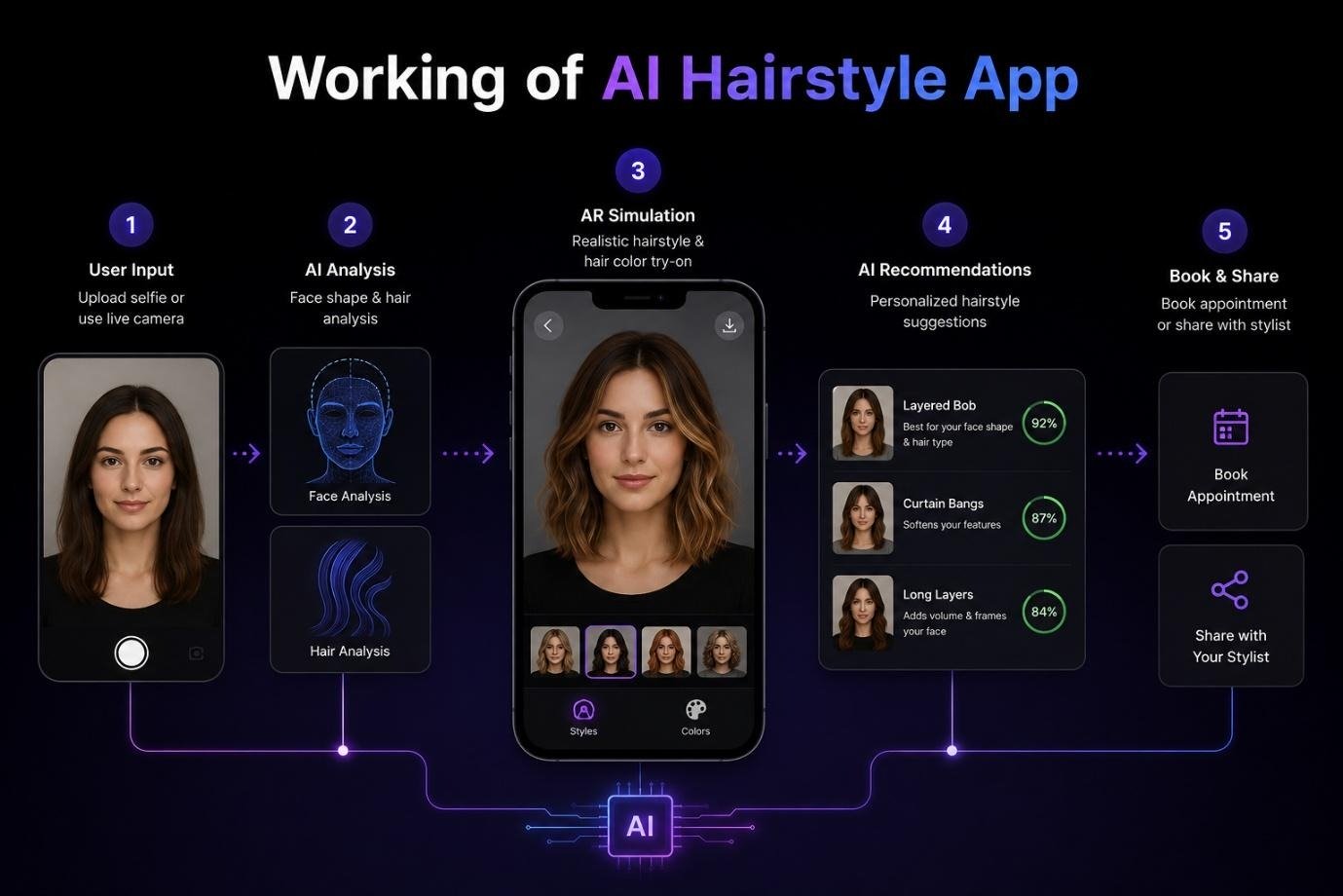
The first layer begins with computer vision technology analyzing a user's selfie or live camera feed. The AI identifies important facial attributes such as face shape, jawline, cheekbones, forehead width, facial proportions, skin tone, and undertones.
This analysis serves as the foundation of every recommendation. Rather than displaying every available hairstyle, the system determines which styles naturally complement the user's facial structure. For example, a hairstyle that enhances an oval face may not create the same balanced appearance on someone with a square or heart shaped face. This intelligence directly addresses a common industry challenge where users ask, "Will this hairstyle actually suit my face?" instead of simply wanting to preview random styles.
After understanding facial features, the AI evaluates the user's existing hair. It identifies hair type, whether straight, wavy, curly, or coily, along with texture, density, volume, thickness, porosity indicators, and visible hair health conditions.
This layer prevents unrealistic recommendations. Instead of suggesting styles that require extensive chemical treatments or impossible transformations, the AI filters recommendations based on what can realistically be achieved with the user's current hair characteristics. Businesses that develop AI hairstyle app solutions with this capability create a far more trustworthy consultation experience because recommendations align with real world styling possibilities.
The third layer combines artificial intelligence with augmented reality to generate realistic hairstyle previews. This is where AI virtual hair try on app development becomes much more sophisticated than traditional AR filters.
A high-quality simulation considers multiple variables, including natural hair undertones, skin tone, lighting conditions, facial contours, and existing hair texture. These factors help create photorealistic hairstyle and color previews that appear naturally blended instead of looking like a digital sticker placed on top of a photograph.
This capability directly solves a common problem faced by beauty apps where users quickly abandon virtual try on experiences because hair colors appear artificial or hairstyles fail to blend naturally with their appearance.
The final layer transforms the application into an intelligent styling consultant rather than a visualization tool.
The AI combines face analysis, hair profile data, user preferences, maintenance expectations, lifestyle, styling habits, previous color history, and professional hairstyling principles to recommend hairstyles ranked by suitability. Instead of presenting a random gallery, the application explains why a particular haircut complements the user's facial proportions, daily routine, or hair texture.
This approach is especially valuable when developing AI hairstyle app with NLP and personalized hair consultation features, where conversational AI can ask questions such as preferred maintenance level, professional dress requirements, styling experience, or desired aesthetic before generating personalized recommendations.
| Feature | Basic Photo Filter App | True AI Hairstyle App |
|---|---|---|
| Face Analysis | Displays hairstyles without facial assessment | Analyzes face shape, proportions, jawline, and skin tone |
| Hair Type Recognition | No understanding of existing hair | Detects hair texture, density, thickness, and hair type |
| Style Realism | Static overlays with limited realism | Photorealistic rendering based on lighting, undertones, and texture |
| Recommendation Quality | Random hairstyle suggestions | AI ranked recommendations based on facial and hair analysis |
| Personalization Depth | Minimal customization | Considers lifestyle, maintenance preference, color history, and styling goals |
| Professional Value | Entertainment focused | Functions as an intelligent digital hairstyling consultation tool |
Businesses looking to build AI powered hairstyle app solutions should view artificial intelligence as more than a visual enhancement feature. Its real value lies in combining computer vision, realistic AR simulation, and personalized consultation into a single intelligent experience that helps users make confident styling decisions while enabling salons and beauty brands to deliver faster, more personalized, and more satisfying customer consultations.
The beauty industry is entering a phase where artificial intelligence is becoming a practical business tool rather than an experimental technology. Consumer expectations, advances in AI, and the rapid digital transformation of salon operations are creating the ideal environment for businesses to invest in AI hairstyle app development for beauty startups and established salon brands alike.
From reducing consultation time to improving customer satisfaction, AI hairstyle applications are addressing challenges that have existed in the salon industry for decades.
Choosing a new hairstyle is one of the most stressful decisions consumers make in the beauty industry. Unlike clothing or makeup, a haircut cannot simply be returned or replaced if the result falls short of expectations. Most clients struggle to explain exactly what they want, while stylists interpret descriptions differently based on experience and communication.
This disconnect creates a costly expectation gap. Customers lose confidence when the final look differs from what they imagined, while salons spend valuable appointment time clarifying requirements instead of delivering services.
An AI hairstyle app solves this problem by allowing customers to visualize hairstyles, compare different cuts and colors, and arrive with a realistic preview that both the client and stylist can confidently discuss before the appointment begins.
The commercial opportunity behind AI powered beauty applications continues to expand rapidly.
According to Grand View Research, the global Beauty Tech market is expected to reach USD 87.1 billion in 2026 and is projected to exceed USD 172.9 billion by 2030, growing at a CAGR of 17.9%.
At the same time, consumers have become comfortable using augmented reality through social media platforms and beauty applications. Their expectations have also evolved. Instead of playful face filters, they now expect personalized recommendations, realistic simulations, and AI experiences that genuinely help them make better decisions.
This shift creates an ideal environment to build AI hairstyle app in 2026 that delivers measurable business value rather than short term novelty.
Salon owners are looking beyond online appointment booking and digital payments. Their focus has shifted toward technologies that improve customer experience while increasing operational efficiency.
A modern AI hairstyle app can help salons:
For businesses planning to develop AI hairstyle app, these operational improvements translate into higher appointment capacity, better customer retention, and stronger lifetime value.
Several technologies have matured simultaneously, making 2026 the right time to launch intelligent beauty applications.
Today's AI solutions combine:
These advancements allow businesses to move beyond entertainment focused beauty apps and create intelligent consultation platforms that deliver genuine value to both customers and salon professionals.
Although hundreds of hairstyle apps are available across app stores, only a small number provide truly intelligent experiences.
Most existing applications:
For founders and enterprises creating AI hairstyle app solutions, this represents a major opportunity to differentiate through personalization, realism, and salon grade consultation intelligence rather than competing solely on visual effects.
Whether you are a salon chain, beauty startup, or hair care brand, investing in AI today means solving a genuine customer problem while building a technology advantage that competitors will find increasingly difficult to replicate.
AI hairstyle applications are not built with a one-size-fits-all approach. The features, AI models, integrations, and user experience vary depending on who the application is designed for and the business problem it aims to solve. Before investing in AI hairstyle app development, founders and enterprises should first identify the type of solution that aligns with their audience, revenue model, and long-term product strategy.
For example, a beauty influencer may have completely different requirements than a salon chain or a hair care brand. Consider this real business scenario: "I am a beauty influencer and I want to build AI hairstyle app that reflects my editorial point of view and serves my audience with AI powered hairstyle recommendations, personalized hair care routines, and product suggestions specifically curated for natural and textured hair." Unlike a salon consultation platform, this application focuses on creator driven personalization and community engagement, demonstrating how product goals directly influence the app's architecture and AI capabilities.
Below are the most common types of AI hairstyle applications businesses are building in 2026.
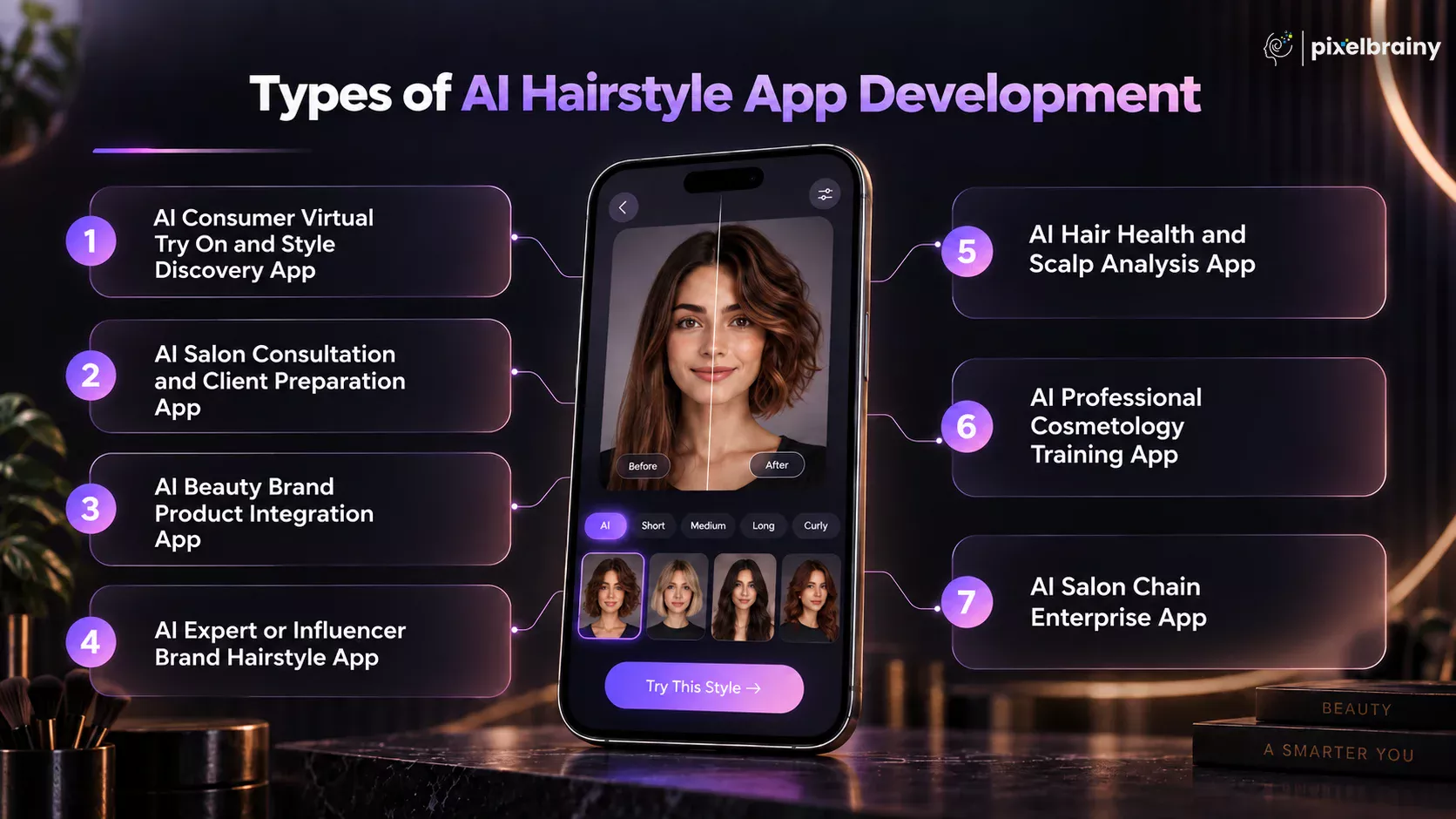
This is the most popular category of AI hairstyle application built for everyday consumers. Users can upload a selfie or use a live camera to virtually try different hairstyles, compare hair colors, receive personalized recommendations based on face shape and hair texture, and discover looks that suit their appearance.
Although this market has the largest user base, it is also the most competitive. Success depends on recommendation quality, photorealistic rendering, and intelligent personalization rather than simply displaying hairstyle overlays.
Best For: Beauty startups, consumer apps, AI beauty platforms
Product Design Implication: Prioritize realistic virtual try on, personalized recommendations, engaging content, and AI driven style discovery.
This type of application is designed specifically for salons and hairstylists to improve the consultation experience before an appointment begins. Clients explore hairstyles at home, save their preferred styles, and share them with their stylist through an integrated appointment booking system.
By reducing consultation time and improving communication, this solution helps salons increase appointment efficiency while delivering more consistent styling outcomes.
Best For: Independent salons, salon chains, beauty franchises
Product Design Implication: Focus on appointment scheduling, client profile management, consultation history, and stylist dashboards.
Instead of functioning as a standalone beauty application, this model connects hairstyle recommendations with a brand's hair care product catalog. After suggesting a hairstyle, the AI recommends shampoos, conditioners, styling products, treatments, and maintenance routines needed to recreate the look, with direct purchasing available inside the application.
This approach transforms the app into both a personalized consultation platform and a digital commerce channel.
Best For: Hair care brands, cosmetic companies, beauty retailers
Product Design Implication: Integrate AI recommendations with product catalogs, loyalty programs, and in-app shopping experiences.
Professional hairstylists, celebrity stylists, cosmetologists, and beauty influencers can use AI to deliver their unique styling philosophy to thousands of users simultaneously. Instead of generic recommendations, the application reflects the expert's consultation methodology, preferred styling techniques, and product recommendations.
This creates a highly personalized experience that strengthens audience engagement while expanding the creator's digital brand.
Best For: Celebrity stylists, beauty influencers, professional educators
Product Design Implication: Train the AI using the creator's consultation process, styling expertise, and educational content.
This category combines hairstyle recommendations with hair wellness analysis. Using computer vision, the AI evaluates scalp condition, hair density, thinning patterns, visible damage, and hair health before suggesting suitable hairstyles and treatment recommendations.
This solution is particularly valuable for businesses serving customers experiencing hair loss or scalp related concerns.
Best For: Hair restoration clinics, trichology platforms, wellness startups, dermatology practices
Product Design Implication: Include scalp assessment, progress tracking, treatment recommendations, and health focused consultation workflows alongside hairstyle suggestions.
Designed for cosmetology students and licensed hairstylists, this application provides AI powered virtual client simulations, hairstyle outcome previews, digital portfolio creation, and practical consultation training.
Students can improve their technical skills and decision making before working with real clients, making learning more interactive and industry focused.
Best For: Beauty schools, cosmetology institutes, professional associations
Product Design Implication: Include virtual practice environments, AI coaching, skill assessments, certification tracking, and portfolio management.
Large salon brands often require a fully customized white label platform rather than a public consumer application. This enterprise solution integrates AI consultations with appointment booking, CRM systems, loyalty programs, customer analytics, and stylist performance dashboards across multiple salon locations.
The result is a consistent branded experience for every customer while giving salon operators valuable business insights.
Best For: Enterprise salon chains, beauty franchises, national salon brands
Product Design Implication: Develop scalable architecture with enterprise security, multi-location support, CRM integration, analytics, and centralized administration.
That’s why the type of AI hairstyle app you choose determines your AI training data requirements, photorealism standards, third-party integration complexity, and monetization model before the development process begins.
The value of AI hairstyle app development extends far beyond virtual hairstyle previews. For beauty startups, salon chains, hair care brands, and enterprise businesses, an AI hairstyle app delivers measurable business outcomes by improving customer confidence, streamlining operations, generating valuable data, and creating new revenue opportunities.
Consider this business requirement: "Our beauty retail company wants to build AI hairstyle app as a value-added service for our loyalty program members. The app needs to work across all hair types, including straight, wavy, curly, and coily, while serving a diverse customer base with personalized hairstyle and product recommendations." This reflects how organizations are increasingly viewing AI hairstyle apps as long-term customer engagement platforms rather than standalone beauty tools.
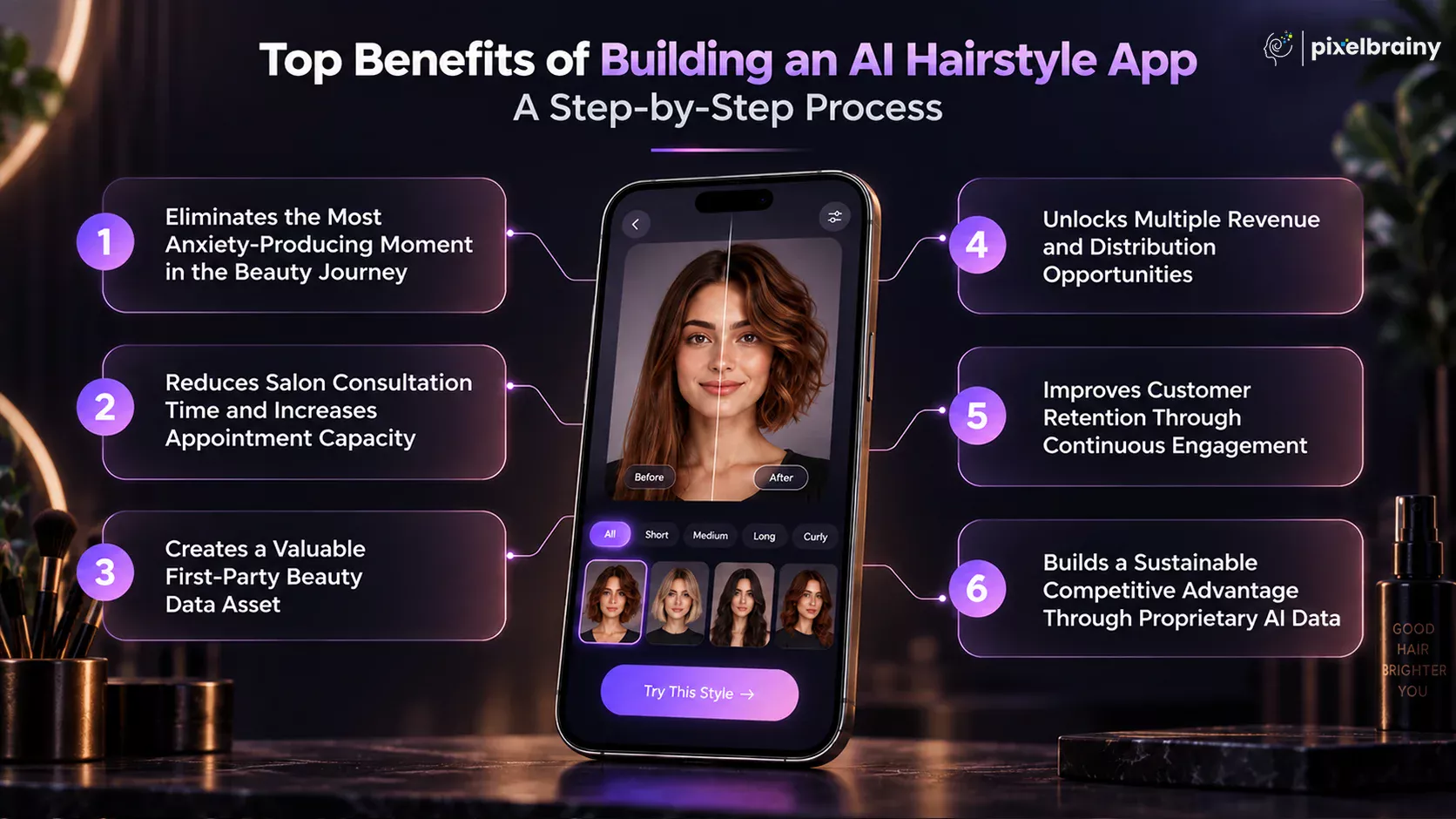
Getting a new haircut or trying a different hair color is one of the most uncertain decisions consumers make because the outcome is immediately visible and difficult to reverse. Many people avoid experimenting with new styles simply because they cannot confidently visualize the final result.
A well-designed AI hairstyle app removes this hesitation by allowing users to preview realistic hairstyles on their own face before making a commitment. This builds confidence, encourages style exploration, and ultimately increases salon visits, color services, and spending on hair care products.
One of the biggest operational challenges for salons is lengthy consultations caused by unclear client expectations. Stylists often spend a significant portion of each appointment interpreting reference photos, discussing haircut options, and aligning on the desired outcome before beginning the actual service.
Businesses that develop AI hairstyle app solutions enable customers to complete this consultation digitally before arriving at the salon. Clients can save preferred hairstyles, compare different looks, and share their selections with the stylist in advance, allowing appointments to begin with execution instead of discussion. This improves scheduling efficiency while creating opportunities to serve more clients each day.
Every interaction inside an AI hairstyle application generates meaningful customer insights. Face analysis results, hairstyle preferences, virtual color trials, saved inspirations, and consultation history help businesses understand what customers truly want instead of relying solely on purchase history.
As this dataset grows, businesses can improve personalization, identify emerging hairstyle trends, optimize product development, and deliver highly targeted marketing campaigns. For companies investing in AI powered hairstyle app development, this first-party beauty data becomes one of the platform's most valuable long-term assets.
An AI hairstyle app creates far more monetization opportunities than a traditional subscription model. Personalized hairstyle recommendations naturally connect users to complementary products and services throughout their beauty journey.
Businesses can generate revenue through premium subscriptions, in-app product purchases, salon appointment bookings, affiliate partnerships, sponsored beauty brand recommendations, advertising opportunities, and white label licensing for salons or beauty retailers. These diversified revenue streams create a stronger and more sustainable business model.
Unlike applications that users open only once, hairstyle decisions continue evolving throughout the year. Customers regularly explore seasonal hair colors, trending hairstyles, maintenance routines, and inspiration before future salon visits.
This creates multiple reasons for users to return frequently. Features such as personalized hairstyle recommendations, saved inspiration collections, hair health tracking, trend notifications, and appointment reminders encourage long-term engagement. Businesses investing in AI hairstyle app development services can therefore build stronger customer relationships while improving user retention and lifetime value.
One of the greatest long-term benefits of creating AI hairstyle app solutions is the ability to continuously improve recommendation quality using proprietary data. Every successful consultation, hairstyle selection, and user interaction strengthens the AI's understanding of customer preferences across different demographics, face shapes, hair textures, and styling goals.
Unlike competitors that rely on publicly available datasets, businesses with large volumes of real customer interactions develop recommendation engines that become increasingly accurate over time. This creates a powerful competitive advantage that is difficult to replicate and strengthens the platform's market position as user adoption grows.
Building an AI hairstyle app is not just about offering virtual hairstyle previews. It is about creating a scalable beauty intelligence platform that improves customer experiences, increases operational efficiency, unlocks new revenue streams, and builds long-term competitive value through AI driven personalization.
The success of an AI hairstyle application depends on much more than realistic hairstyle previews. Businesses investing in AI hairstyle app development need a carefully planned feature set that delivers value to users while supporting long-term business growth. The right combination of AI capabilities, user experience, and operational functionality determines whether an application becomes a daily beauty companion or just another photo editing tool.
For example, one beauty retailer shared this requirement: "Our beauty retail company wants to build AI powered hairstyle app as a value-added service for our loyalty program members. The application should support all hair types including straight, wavy, curly, and coily while providing personalized hairstyle recommendations and helping customers discover products that match their selected look." Delivering this kind of experience requires more than virtual try on technology. It requires an intelligent set of features that work together to create a personalized consultation journey.
The following are the essential features every business should consider while planning AI hairstyle app development services.
| Feature | Description |
|---|---|
| User Registration & Profile Management | Allow users to register using email, phone number, or social accounts while creating personalized profiles containing age, gender, hairstyle preferences, hair history, and consultation records. This foundation enables customized recommendations and a seamless experience across multiple sessions. |
| Selfie Upload & Live Camera Support | Users should be able to upload high-quality photos or access their device camera for real-time analysis. Supporting both options improves accessibility while enabling accurate face detection and personalized hairstyle visualization across different usage scenarios. |
| Face Shape Detection | Computer vision analyzes facial proportions to identify face shapes such as oval, round, square, diamond, heart, or oblong. This analysis helps the application recommend hairstyles that naturally complement individual facial structures instead of displaying random options. |
| Hair Type Identification | The application should recognize whether a user's hair is straight, wavy, curly, or coily while estimating texture, thickness, and density. This allows the AI to recommend hairstyles that are realistically achievable for the user's existing hair characteristics. |
| Virtual Hairstyle Try On | Users can instantly preview different haircuts, hairstyles, and lengths on their own face before making a decision. This feature builds confidence by replacing imagination with realistic visualizations during the hairstyle selection process. |
| Hair Color Preview | Enable users to experiment with natural and fashion hair colors before committing to salon services. Accurate color rendering helps customers compare multiple shades and select colors that complement their skin tone and personal style preferences. |
| Personalized Hairstyle Recommendations | Based on face analysis, hair characteristics, and user preferences, the application should recommend hairstyles most suitable for each individual. Personalized recommendations increase user confidence while improving engagement and overall customer satisfaction. |
| Hairstyle Search & Category Filters | Organize hairstyles using categories such as short, medium, long, curly, layered, fade, bob, bridal, professional, or trending styles. Smart filters help users quickly discover hairstyles matching their lifestyle, occasion, or styling goals. |
| Save Favorite Hairstyles | Users should be able to bookmark preferred hairstyles, organize inspiration collections, and revisit saved looks whenever needed. This feature supports future salon visits while encouraging repeated engagement with the application. |
| Salon Appointment Booking Integration | Connect the application with salon scheduling systems so users can book appointments immediately after selecting a hairstyle. Sharing saved hairstyle preferences with stylists before appointments also improves consultation quality and service efficiency. |
| Product Recommendation Engine | Recommend suitable shampoos, conditioners, styling products, serums, and maintenance kits based on selected hairstyles and hair type. This feature supports cross-selling opportunities while helping users maintain their chosen look after salon visits. |
| Consultation History & Style Timeline | Maintain a complete record of previous hairstyle simulations, selected colors, booked appointments, and consultation history. This enables users and stylists to track styling preferences and maintain consistency across future visits. |
| Push Notifications & Style Updates | Send personalized notifications about hairstyle trends, seasonal color collections, appointment reminders, saved inspirations, and product recommendations. Timely communication encourages users to revisit the application regularly. |
| Ratings & User Reviews | Allow users to rate hairstyles, provide feedback, and review salon experiences. User-generated insights help improve recommendation quality while assisting new users in making informed styling decisions. |
| Admin Dashboard & Analytics | A centralized dashboard allows administrators to manage users, hairstyle catalogs, salon partners, bookings, content, and performance analytics. These insights help businesses optimize user engagement, operational efficiency, and future product improvements. |
These core features form the foundation of every successful AI hairstyle app, while advanced AI capabilities further enhance personalization, realism, and user engagement, which we will explore in the next section.
As user expectations continue to evolve, offering only basic virtual hairstyle previews is no longer enough to differentiate a product in the beauty technology market. Businesses investing in AI hairstyle app development are increasingly integrating advanced AI capabilities that deliver hyper-personalized consultations, realistic visual experiences, intelligent automation, and deeper customer engagement. These innovations not only improve the user experience but also create long-term competitive advantages for beauty startups, salon chains, and hair care brands.
Consider this business requirement: "Our team has built a prototype AI hairstyle app that gets good engagement on the virtual try on feature, but we are seeing poor user retention after the first few days. We want to develop AI hairstyle app capabilities that provide personalized consultations, smarter recommendations, and ongoing reasons for users to return instead of simply trying hairstyles once." This highlights why advanced AI features have become essential for building products that retain users instead of delivering only short-term engagement.
The following advanced capabilities can significantly strengthen your AI powered hairstyle app development strategy while creating a premium user experience that stands out in a competitive market.
| Advanced Feature | Description |
|---|---|
| Conversational AI Hairstyle Consultant | Integrate a Large Language Model powered virtual hairstylist that interacts naturally with users, asks questions about lifestyle, maintenance preferences, profession, styling habits, and desired appearance before providing highly personalized hairstyle recommendations with detailed explanations. |
| Real Time AI Consultation During Live Camera Mode | Enable users to receive live hairstyle recommendations while viewing themselves through the device camera. The AI continuously analyzes facial movements, camera angles, and lighting conditions to provide an interactive consultation experience similar to speaking with a professional stylist. |
| Generative AI Hairstyle Creation | Allow users to generate completely new hairstyles by describing their preferences using natural language prompts such as modern business haircut, textured curly bob, or low maintenance shoulder length hairstyle. The AI creates unique hairstyle concepts instead of selecting only from predefined templates. |
| Predictive Hair Growth and Style Evolution | Simulate how a selected hairstyle will appear after weeks or months of natural hair growth. This helps users understand maintenance requirements, trimming schedules, and how different hairstyles gradually evolve over time. |
| AI Hair Health Monitoring | Continuously analyze uploaded images to identify visible signs of hair thinning, dryness, split ends, breakage, scalp concerns, or reduced hair density. The application can recommend preventive care routines while tracking improvements across multiple sessions. |
| Personalized Hair Care Routine Generator | Based on hair type, lifestyle, weather conditions, styling frequency, and previous consultation history, the AI automatically generates customized weekly or monthly hair care routines along with recommended products and maintenance schedules. |
| Smart Trend Prediction Engine | Analyze fashion trends, celebrity hairstyles, regional preferences, seasonal demand, and user behavior to recommend emerging hairstyles before they become mainstream. This keeps users engaged through continuously refreshed content and personalized inspiration. |
| AI Powered Stylist Matching | Recommend the most suitable hairstylist based on the user's preferred hairstyle, previous appointments, stylist expertise, customer ratings, specialization, and geographic location, helping businesses improve booking quality and customer satisfaction. |
| Voice Based AI Beauty Assistant | Enable hands-free interaction through voice commands, allowing users to search hairstyles, request styling advice, compare hair colors, schedule appointments, and receive maintenance guidance without navigating multiple application screens. |
| Predictive Business Analytics Dashboard | For salon chains and beauty enterprises, AI analyzes customer behavior, appointment trends, hairstyle popularity, retention metrics, product demand, and stylist performance to generate actionable business insights that support smarter operational decisions and future growth planning. |
These advanced AI capabilities transform a standard hairstyle application into an intelligent beauty ecosystem that delivers deeper personalization, stronger user retention, and lasting competitive differentiation in the rapidly evolving beauty technology industry.
Building a successful AI hairstyle application involves much more than integrating artificial intelligence into a mobile app. From validating the business idea to training AI models, designing intuitive user experiences, and launching a scalable product, every stage plays a crucial role in determining long-term success. Whether you want to develop AI hairstyle app solutions for consumers, beauty brands, or salon businesses, following a structured development roadmap minimizes risks while improving product quality.
Consider this real business scenario: "We are a professional hair care product brand and we want to build AI hairstyle app that serves as both a consumer facing style exploration platform and a product recommendation engine. The application should recommend hairstyles, suggest suitable hair care products, and integrate seamlessly with our online store." Achieving this vision requires a carefully planned development process of AI hairstyle app that aligns business goals with the right technology decisions.
Below is a proven roadmap covering the essential steps to build AI hairstyle app from idea to launch.
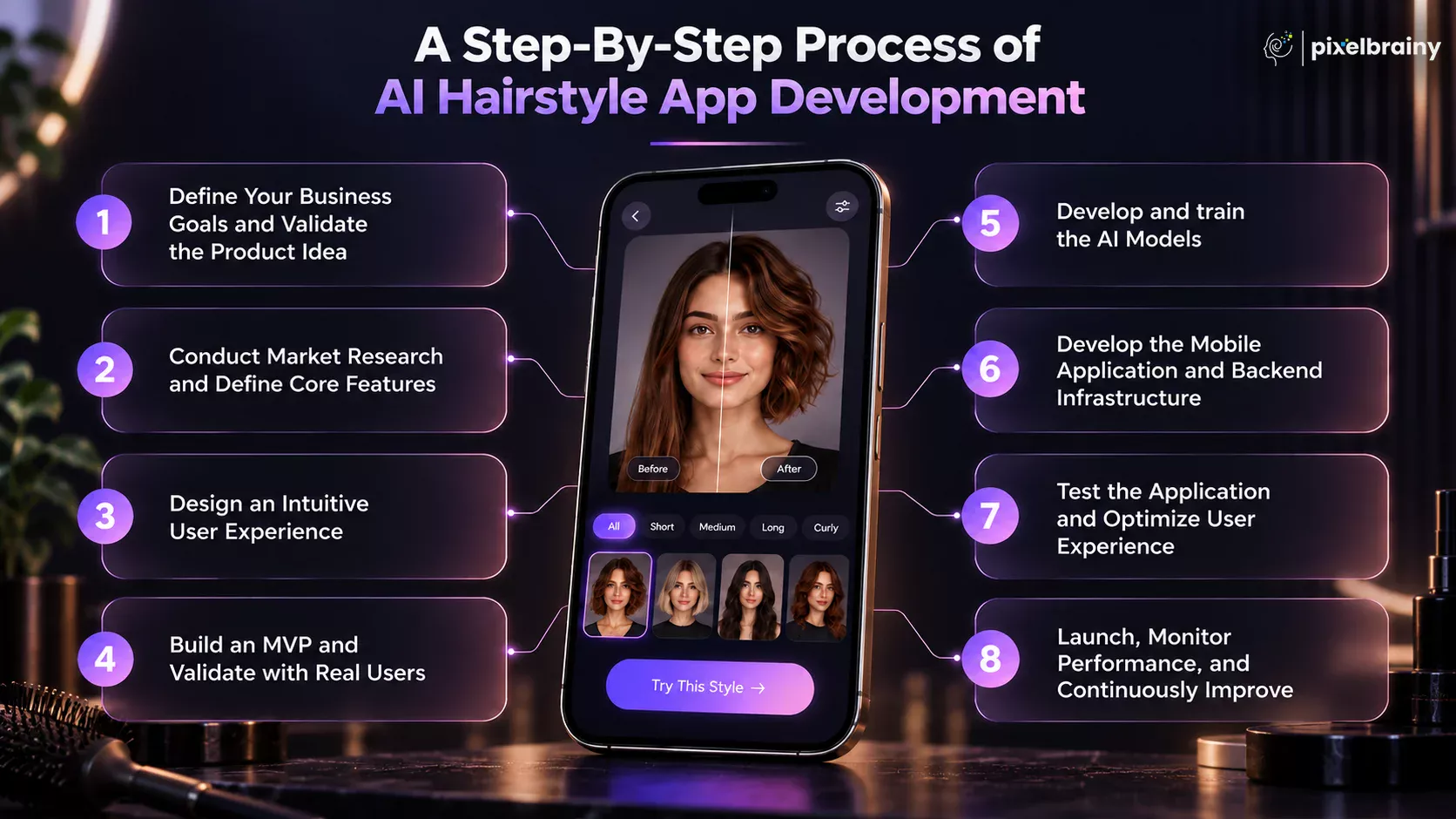
Every successful AI application begins with a clearly defined business objective. Before writing a single line of code, identify your target audience, primary use cases, monetization strategy, and competitive positioning. Decide whether your application is intended for consumers, salon chains, beauty retailers, influencers, or professional cosmetology training.
This is also the ideal stage for PoC development, where the feasibility of critical AI capabilities such as face analysis, hairstyle recommendation, or virtual try on can be validated before making a significant investment. A strong proof of concept reduces technical uncertainty and ensures the product solves a genuine market problem instead of simply following a technology trend.
After validating the concept, perform detailed market research to understand customer expectations, competitor offerings, and feature gaps. Analyze existing hairstyle applications to identify what users appreciate and where current solutions fail, particularly in recommendation quality, realism, and personalization.
Based on these insights, define the minimum feature set required for launch. Prioritize capabilities such as face shape detection, hairstyle simulation, personalized recommendations, appointment booking, and user profile management before expanding into advanced AI functionality. A well-defined product roadmap helps control development costs while maintaining focus on business objectives.
Even the most advanced AI technology cannot compensate for poor usability. Users expect a simple and engaging experience that guides them naturally from uploading a selfie to discovering hairstyles and booking appointments.
Partnering with an experienced UI/UX design company helps create user journeys that reduce friction while improving engagement and retention. Wireframes, interactive prototypes, accessibility testing, and intuitive navigation should all be finalized before development begins to ensure the application delivers a seamless beauty consultation experience across different devices.
Instead of developing every planned feature at once, launch a focused product that solves one core problem exceptionally well. An MVP development approach allows businesses to validate assumptions, gather user feedback, measure engagement, and refine AI recommendations before investing in a larger product roadmap.
For an AI hairstyle application, the first release typically includes selfie upload, face shape detection, virtual hairstyle try on, basic recommendations, and user account management. Early customer feedback collected during this stage provides valuable insights that guide future improvements while reducing unnecessary development effort.
Also Read: Top 10 AI MVP Development Companies in USA
Once the product foundation is ready, the next step is building the intelligence that powers the application. This involves training computer vision models to detect face shape, facial landmarks, skin tone, hair texture, density, and other visual characteristics required for accurate hairstyle recommendations. The quality of the training dataset directly influences recommendation accuracy, so it should represent diverse age groups, ethnicities, hairstyles, and hair types.
At this stage, businesses also implement AI integration to connect facial analysis, hairstyle recommendation engines, image processing pipelines, and virtual try on technologies into a unified workflow. Well-trained AI models ensure users receive recommendations that are both visually realistic and practically achievable.
After the AI models are ready, developers begin building the mobile application and backend ecosystem. The frontend focuses on creating a responsive experience for selfie uploads, hairstyle exploration, personalized recommendations, booking workflows, and user account management. Meanwhile, the backend manages authentication, cloud storage, recommendation logic, analytics, notifications, and third-party integrations.
For businesses planning hairstyle app development using AI, scalability should be considered from the beginning. A cloud-native architecture with secure APIs and modular services allows the platform to handle increasing user traffic while making future feature enhancements much easier.
Comprehensive testing ensures the application performs reliably across different devices, lighting conditions, camera qualities, and user demographics. AI models should be evaluated for recommendation accuracy, facial recognition performance, hairstyle rendering quality, and overall response time before launch.
Beyond technical testing, businesses should conduct usability sessions where real users interact with the application and provide feedback on navigation, personalization, and the overall AI consultation experience. These insights help identify usability issues, improve engagement, and refine AI recommendations before releasing the product to a wider audience.
Launching the application is the beginning of an ongoing product evolution rather than the final milestone. After deployment, continuously monitor user behavior, engagement metrics, consultation completion rates, hairstyle popularity, booking conversions, and customer feedback to identify improvement opportunities.
Regular AI model retraining, feature enhancements, and performance optimization ensure the application continues delivering accurate recommendations as user expectations evolve. Many top AI app development companies in USA and leading AI product development companies follow an iterative product strategy where data collected after launch drives future AI improvements, new feature releases, and long-term business growth.
A successful AI hairstyle app is built through continuous innovation, where every development stage, from strategy and design to AI optimization and post-launch improvements, contributes to delivering a smarter, more personalized beauty experience.
Also Read: AI Mobile App Development for Startups and Enterprises: Benefits, Steps and Challenges
The cost of AI hairstyle app development depends on multiple factors, including the application's complexity, AI capabilities, platform selection, third-party integrations, and the level of personalization you want to deliver. While a basic application with virtual hairstyle previews requires a smaller investment, enterprise-grade platforms that combine AI consultation, photorealistic rendering, salon management, and advanced analytics require significantly larger development budgets. Therefore, there is no universal pricing model, as every project is built around unique business goals and technical requirements.
A common question business ask is: "We want to build AI hairstyle app for our salon chain, but how much should we realistically budget for a production-ready solution with virtual hairstyle try on, personalized recommendations, appointment booking, and AI powered consultation?" The answer depends on the product scope, AI sophistication, and scalability requirements. In general, the cost to create an AI hairstyle app range from $25,000 to $200,000+, with enterprise solutions exceeding this range when custom AI models and large-scale integrations are involved.
| App Type | Ideal For | Estimated Development Cost |
|---|---|---|
| Basic AI Hairstyle App | Startups, MVPs, small salons | $25,000 to $50,000 |
| Advanced AI Hairstyle App | Beauty startups, hair care brands, growing salon businesses | $50,000 to $120,000 |
| Enterprise AI Hairstyle App | Large salon chains, beauty enterprises, white label platforms | $120,000 to $200,000+ |
A basic application typically includes user registration, selfie upload, face shape detection, virtual hairstyle previews, basic hair color simulation, user profiles, and personalized hairstyle recommendations. This option is ideal for startups validating their product idea or salons launching their first digital consultation experience.
An advanced solution introduces richer AI capabilities such as intelligent hairstyle recommendations, improved photorealistic rendering, personalized consultation workflows, appointment booking integration, product recommendations, customer analytics, and cloud-based scalability. This level is well suited for businesses planning long-term growth.
Enterprise platforms are designed for organizations managing large customer bases across multiple locations. They typically include custom AI model development, white label deployment, CRM integration, loyalty programs, advanced analytics dashboards, multi-location management, enterprise security, multilingual support, and highly scalable cloud infrastructure.
The final development budget varies depending on several technical and business requirements.
The cost of building an AI hairstyle app ultimately depends on how intelligently you balance AI capabilities, user experience, scalability, and long-term business goals rather than simply the number of features included.

Also Read: AI App Development Cost: From MVPs to Full-Scale AI App
Studying successful products is one of the best ways to reduce product risk before investing in AI hairstyle app development. Every leading platform demonstrates what users expect, which AI capabilities create the most engagement, and where existing products still leave room for innovation.
One of the most common questions founders ask is:
"Before deciding whether to build a custom AI hairstyle app or license an existing solution, we want an honest comparison of the leading products already available in the market. Which applications have set the benchmark for AI powered hairstyle visualization and consultation?"
The following AI powered hairstyle applications provide valuable lessons for businesses planning to develop AI hairstyle app solutions.
What it does
YouCam Makeup is one of the most established AI beauty platforms, offering virtual makeup, skincare analysis, hair color simulation, and hairstyle exploration within a single mobile application.
AI technologies behind it
The platform combines AI facial recognition, computer vision, AR rendering, and real-time facial landmark tracking to generate highly realistic beauty experiences.
Why it stands out
Its biggest strength is photorealistic rendering. Hair colors blend naturally with different lighting conditions and facial features, creating one of the most convincing virtual beauty experiences available today.
Founder takeaway
If you're planning how to develop AI hairstyle app like YouCam or Hairstyle Magic, invest heavily in rendering quality because users quickly abandon experiences that look artificial.
What it does
Hairstyle Magic focuses on helping users discover hairstyles that complement their face shape instead of simply displaying random haircut templates.
AI technologies behind it
It uses AI face analysis, hairstyle matching algorithms, and personalized recommendation logic.
Why it stands out
Rather than overwhelming users with thousands of hairstyle choices, it prioritizes relevance through intelligent recommendations.
Founder takeaway
Recommendation quality often creates more business value than offering the largest hairstyle catalog.
What it does
Developed by Garnier, this application enables customers to virtually preview hair colors before purchasing products.
AI technologies behind it
AR visualization, facial tracking, realistic color rendering, and product recommendation integration.
Why it stands out
The application connects product discovery with direct purchasing, making AI an effective commerce channel.
Founder takeaway
Every hairstyle recommendation should naturally lead users toward products, services, or appointments rather than ending with the visualization itself.
What it does
Style My Hair allows users to experiment with hairstyles and professional hair colors before visiting a salon.
AI technologies behind it
Augmented reality, AI face mapping, professional color simulation, and salon consultation workflows.
Why it stands out
It successfully bridges digital exploration with professional salon services.
Founder takeaway
The best AI hairstyle apps strengthen the relationship between customers and salon professionals rather than replacing stylists.
What it does
Hair AI represents the next generation of AI-first hairstyle applications built around personalization instead of traditional AR filters.
AI technologies behind it
Generative AI, face shape analysis, hairstyle recommendation models, and AI image generation.
Why it stands out
The application focuses on creating individualized hairstyle recommendations rather than offering the same experience to every user.
Founder takeaway
Future market leaders will combine computer vision, generative AI, personalized consultation, and salon integrations into a single intelligent beauty platform instead of treating them as separate features.
Although these applications validate strong demand for AI powered beauty experiences, they also expose significant opportunities for innovation. Very few platforms successfully combine photorealistic rendering, inclusive hair type recognition, conversational AI consultation, salon workflow integration, and long-term personalization within one ecosystem.
The biggest opportunity in AI hairstyle app development lies in building an intelligent consultation platform that helps users make confident styling decisions, rather than simply offering another virtual hairstyle try on experience.
The performance, scalability, and user experience of an AI hairstyle application depend heavily on the technologies used throughout the development lifecycle. From computer vision and artificial intelligence to augmented reality, cloud infrastructure, and mobile frameworks, every technology layer contributes to delivering realistic hairstyle simulations, intelligent recommendations, and seamless application performance. Businesses planning AI hairstyle app development should build a technology stack that not only supports current business requirements but also allows future feature expansion and AI model improvements.
A common business query: "Which technologies should we use to develop AI hairstyle app with realistic virtual hairstyle try on, face shape detection, personalized recommendations, and salon booking integration without compromising scalability?" The answer lies in combining proven AI frameworks, modern development tools, cloud platforms, and secure backend technologies that work together to create a reliable and future-ready beauty application.
| Technology Layer | Recommended Technologies | Purpose |
|---|---|---|
| Mobile App Development | Flutter, React Native, Swift, Kotlin | Build high-performance native or cross-platform mobile applications for Android and iOS users. |
| Frontend Development | React.js, Next.js, Vue.js | Develop responsive web interfaces for beauty brands, salon dashboards, and customer portals. |
| Backend Development | Node.js, Python, Java, .NET | Manage business logic, authentication, APIs, user profiles, appointments, and application workflows. |
| Artificial Intelligence & Machine Learning | TensorFlow, PyTorch, Scikit-learn, OpenCV | Train AI models for face analysis, hairstyle recommendations, hair type recognition, and personalized styling intelligence. |
| Computer Vision | MediaPipe, Dlib, OpenCV, Google ML Kit | Detect facial landmarks, face shape, skin tone, and hair characteristics required for accurate recommendations. |
| Augmented Reality | ARKit, ARCore, Unity AR Foundation | Deliver realistic virtual hairstyle previews and real-time hair color simulations across supported devices. |
| Generative AI & LLMs | OpenAI GPT, Google Gemini, Claude API | Power conversational beauty assistants, AI consultations, personalized styling guidance, and recommendation explanations. |
| Database | PostgreSQL, MySQL, MongoDB, Firebase Firestore | Securely store user profiles, hairstyle catalogs, consultation history, bookings, and recommendation data. |
| Cloud Infrastructure | AWS, Microsoft Azure, Google Cloud Platform | Host AI models, backend services, cloud storage, media processing, and scalable application infrastructure. |
| Authentication & Security | Firebase Authentication, Auth0, OAuth 2.0, JWT | Secure user authentication, account management, session handling, and data privacy. |
| Storage & Media Management | Amazon S3, Cloudinary, Firebase Storage | Store selfies, hairstyle assets, generated images, and user-uploaded media efficiently. |
| Notification Services | Firebase Cloud Messaging, OneSignal | Deliver appointment reminders, hairstyle updates, promotional campaigns, and personalized notifications. |
| Payment Gateway | Stripe, PayPal, Razorpay | Support premium subscriptions, in-app purchases, salon bookings, and product payments securely. |
| Analytics & Performance Monitoring | Firebase Analytics, Mixpanel, Google Analytics, Crashlytics | Measure user engagement, monitor application performance, identify issues, and optimize product decisions. |
| Third Party Integrations | Google Calendar API, Twilio, SendGrid, Salon Management APIs | Enable appointment scheduling, SMS alerts, email communication, CRM connectivity, and salon workflow automation. |
A robust technology stack provides the technical foundation required to build an AI hairstyle app that delivers realistic experiences, scalable performance, and continuous innovation in the rapidly evolving beauty technology landscape.
Building an AI hairstyle application involves much more than integrating computer vision and virtual hairstyle simulation into a mobile app. Delivering accurate recommendations, realistic visualizations, and a seamless user experience requires overcoming several technical, operational, and business challenges. Businesses investing in AI hairstyle app development should identify these challenges early and establish practical solutions before development begins to reduce project risks, improve user satisfaction, and accelerate product success.
One of the most common concerns businesses share is: "Our team has built a prototype AI hairstyle app that receives good engagement during the virtual try on experience, but user retention drops significantly after the first few days. How can we improve personalization, realism, and long-term engagement without rebuilding the entire platform?" Addressing challenges like these requires balancing AI accuracy, user experience, scalability, and continuous product improvement.
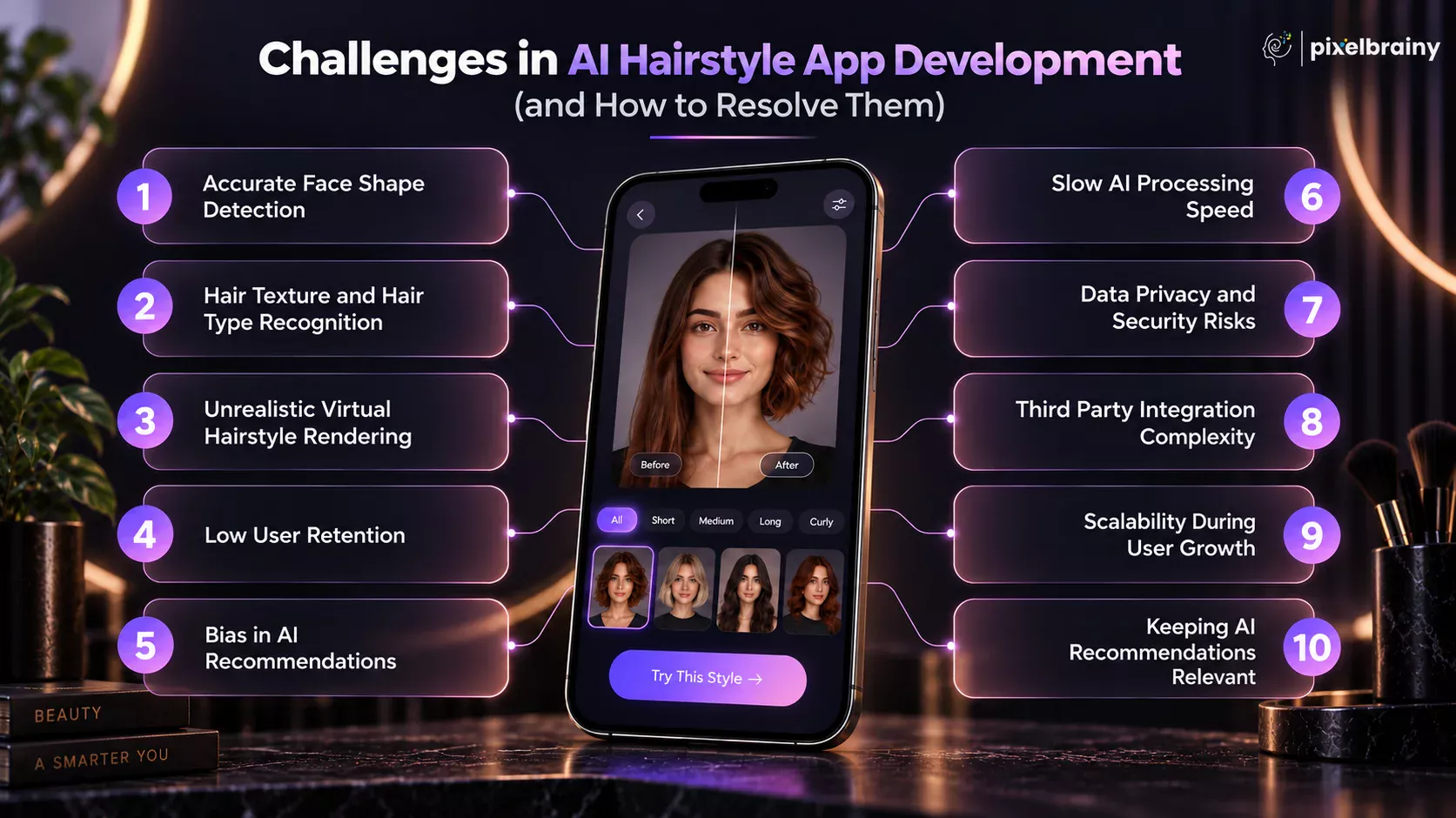
| Challenge | Why It Happens | How to Resolve It |
|---|---|---|
| Accurate Face Shape Detection | Poor lighting, unusual camera angles, facial accessories, and low-quality images can reduce computer vision accuracy. | Train AI models using diverse facial datasets, implement facial landmark detection, and guide users to capture high-quality selfies through real-time camera instructions. |
| Hair Texture and Hair Type Recognition | Hair varies significantly across different ethnicities, densities, curl patterns, and lengths, making classification difficult. | Use large, diverse datasets representing all hair types and continuously retrain AI models using real-world user data to improve recognition accuracy. |
| Unrealistic Virtual Hairstyle Rendering | Hairstyles and colors may appear artificial when lighting, facial contours, skin tone, and natural hair texture are ignored. | Combine advanced computer vision with high-quality AR rendering that considers lighting conditions, facial geometry, hair undertones, and texture for photorealistic results. |
| Low User Retention | Many users explore hairstyles once and never return because the application offers limited ongoing value. | Introduce personalized recommendations, hairstyle trend updates, hair care routines, appointment reminders, loyalty rewards, and AI-powered consultation features that encourage continuous engagement. |
| Bias in AI Recommendations | AI models trained on limited datasets often perform inconsistently across diverse face shapes, skin tones, and hair types. | Build inclusive training datasets covering diverse demographics and regularly evaluate model performance to eliminate recommendation bias. |
| Slow AI Processing Speed | High-resolution image processing and multiple AI models can increase response times, negatively affecting user experience. | Optimize AI models, compress image processing pipelines, leverage edge computing where possible, and use scalable cloud infrastructure for intensive workloads. |
| Data Privacy and Security Risks | Facial images and personal beauty preferences represent sensitive user data that requires strong protection. | Encrypt user data, implement secure authentication, comply with GDPR, CCPA, and other privacy regulations, and provide transparent consent management. |
| Third Party Integration Complexity | Connecting salon booking systems, payment gateways, CRM platforms, and product catalogs can become technically challenging. | Design modular APIs, adopt standardized integration frameworks, and thoroughly test every external service before deployment. |
| Scalability During User Growth | Rapid user adoption can overload AI inference services, databases, and backend infrastructure. | Build cloud-native architecture with auto-scaling, load balancing, caching, and microservices to maintain consistent performance under increasing traffic. |
| Keeping AI Recommendations Relevant | Hairstyle trends, consumer preferences, and fashion styles constantly evolve, making static recommendation models less effective over time. | Continuously retrain AI models using fresh behavioral data, update hairstyle libraries, analyze emerging beauty trends, and refine recommendation algorithms through user feedback. |
Beyond addressing technical challenges, businesses should also adopt strategic development practices that improve long-term product success.
The most successful AI hairstyle apps are built by continuously improving AI accuracy, personalization, and user experience rather than treating product launch as the final stage of development.
Transforming an AI hairstyle idea into a successful digital product requires much more than technical expertise. It demands a deep understanding of artificial intelligence, computer vision, augmented reality, mobile application engineering, and the evolving needs of the beauty industry. At PixelBrainy LLC, we combine these capabilities to help startups, salon chains, beauty brands, and enterprises develop scalable AI solutions that deliver measurable business outcomes.
One of the most common questions we receive is: "Which AI app development company can help us build an enterprise-grade AI hairstyle platform with realistic virtual try on, intelligent face analysis, appointment booking integration, and room for future AI innovation?" Our approach focuses on creating products that solve real business challenges while remaining scalable, secure, and future ready.
A North American beauty business approached us with an idea to build AI hairstyle app that would reduce salon consultation time while increasing customer confidence before appointments. The client wanted an application capable of analyzing face shape, recommending personalized hairstyles, supporting realistic virtual hair color previews, and integrating with its existing appointment booking system.
Our team designed and developed a scalable platform featuring AI powered facial analysis, personalized hairstyle recommendations, virtual hairstyle visualization, customer profile management, and seamless booking integration. Following deployment, the business reported significantly improved consultation efficiency, stronger customer engagement, and increased adoption of digital pre-appointment consultations across multiple salon locations. Client identity remains confidential under our non-disclosure agreement.
Every business has unique objectives, target audiences, and operational workflows. Instead of offering one-size-fits-all solutions, we develop AI hairstyle app platforms tailored to each client's vision, whether the goal is launching a consumer beauty application, creating an enterprise salon ecosystem, or delivering an AI hairstyle app integrating AI powered consultation and personalized product recommendations.
Ready to turn your AI hairstyle app idea into a market-ready product? Connect with PixelBrainy LLC and let's build something exceptional together.
The future of the beauty industry is being shaped by intelligent, personalized, and immersive digital experiences, and AI hairstyle applications are at the center of this transformation. Consumers no longer want to guess how a haircut or hair color might look on them. They expect personalized recommendations, realistic virtual previews, and the confidence to make styling decisions before visiting a salon. This shift presents a significant opportunity for startups, salon chains, beauty brands, and hair care companies ready to invest in AI hairstyle app development.
However, building a successful product requires much more than integrating artificial intelligence into a mobile application. It demands a clear business strategy, high-quality AI models, realistic virtual hairstyle rendering, scalable architecture, and a user experience that encourages long-term engagement. Whether you plan to build AI hairstyle app for consumer beauty, salon operations, product recommendations, or enterprise solutions, focusing on personalization, accuracy, and continuous innovation will be the key to creating a product that delivers lasting business value.
Businesses that begin develop AI hairstyle app initiatives today will be well positioned to meet the growing demand for AI powered beauty experiences while establishing a strong competitive advantage in an evolving digital market.
Ready to build the next generation AI hairstyle app? Book an appointment with our experts today and let's discuss your project.
The cost to build AI hairstyle app solutions typically ranges between $25,000 and $200,000+, depending on the feature set, AI model complexity, supported platforms, third-party integrations, and business requirements. A basic MVP costs significantly less than an enterprise-grade application with custom AI models, salon management integrations, and advanced personalization capabilities.
The timeline for AI hairstyle app development generally varies from 3 to 9 months. A basic application with virtual hairstyle try on and face shape analysis can be completed in approximately 3 to 4 months, while an advanced or enterprise solution with AI consultation, product recommendations, booking integrations, and analytics requires a longer development cycle.
Modern AI hairstyle applications use computer vision and machine learning to analyze facial proportions, face shape, skin tone, hair texture, density, and user preferences. Based on this analysis, the AI recommends hairstyles that are realistically achievable and visually flattering instead of displaying random hairstyle overlays.
Yes. Businesses can develop AI hairstyle app solutions that integrate with salon appointment software, CRM platforms, loyalty programs, payment gateways, and customer management systems. This allows users to save preferred hairstyles, schedule appointments, and share their selected looks with stylists before arriving at the salon, making consultations faster and more efficient.
A modern AI hairstyle application typically combines technologies such as TensorFlow, PyTorch, OpenCV, ARKit, ARCore, Flutter, React Native, AWS, and Google Cloud. Together, these technologies support face analysis, virtual hairstyle simulation, personalized recommendations, cloud infrastructure, and scalable mobile application development.
Absolutely. A well-designed AI hairstyle application is trained using diverse datasets that include straight, wavy, curly, and coily hair, along with different face shapes, skin tones, age groups, and ethnic backgrounds. This ensures accurate recommendations and inclusive user experiences across a broad customer base.
Some of the most common challenges include achieving accurate face analysis, realistic hairstyle rendering, hair texture recognition, AI recommendation accuracy, data privacy, and long-term user retention. Overcoming these challenges requires high-quality AI training data, robust computer vision models, scalable cloud infrastructure, and continuous AI optimization after launch.
When selecting a development partner, evaluate their expertise in artificial intelligence, computer vision, augmented reality, mobile application development, and cloud technologies. The right company should also have experience delivering scalable beauty technology solutions, understand industry-specific business challenges, and provide end-to-end AI hairstyle app development services from strategy and design to deployment and ongoing support.

About The Author
Sagar Bhatnagar
Sagar Sahay Bhatnagar brings over a decade of IT industry experience to his role as Marketing Head at PixelBrainy. He's known for his knack in devising creative marketing strategies that boost brand visibility and market influence. Sagar's strategic thinking, coupled with his innovative vision and focus on results, sets him apart. His track record of successful campaigns proves his ability to utilize digital platforms effectively for impactful marketing efforts. With a genuine passion for both technology and marketing, Sagar continuously pushes PixelBrainy's marketing initiatives to greater success.
Working with the PixelBrainy team has been a highly positive experience. They understand the design requirements and create beautiful UX elements to meet the application needs. The dev team did an excellent job bringing my vision to life. We discussed usability and flow. Sagar worked with his team to design the database and begin coding. Working with Sagar was easy. He has the knowledge to create robust apps, including multi-language support, Google and Apple ID login options, Ad-enabled integrations, Stripe payment processing, and a Web Admin site for maintaining support data. I'm extremely satisfied with the services provided, the quality of the final product, and the professionalism of the entire process. I highly recommend them for Android and iOS Mobile Application Design and Development.

Great experience working with them. Had a lot of feedback and I found that unlike most contractors they were bugging me for updates instead of the other way around. They were extremely time conscience and great at communicating! All work was done extremely high quality and if not on time, early! They were always proactive when it comes to communication and the work is great/above par always. Very flexible and a great team to work with! Goes above and beyond to present us with multiple options and always provides quality. Amazing work per usual with Chitra. If you have UI/UX or branding design needs I recommend you go to them! Will likely work with them in the future as well, definitely recommended!

PixelBrainy is a joy to work with and is a great partner when thinking through branding, logo, and website layout. I appreciate that they spend time going into the "why" behind their decisions to help inform me and others about industry best practices and their expertise.

I hired them to design our software apps. Things I really like about them are excellent communication skills, they answer all project suggestions and collaborate right away, and their input on design and colors is amazing. This project was complex and needed patience and creativity. The team is amazing to do business with. I will be using them long-term. Glad to see there are some good people out there. I was afraid to try and outsource my project to someone but I am glad I met them! I really can't say enough. They went above and beyond on this project. I am very happy with everything they have done to make my business stand out from the competition.

It was great working with PixelBrainy and the team. They were very responsive and really owned the project. We'll definitely work with them again!

I recently worked with the PixelBrainy team on a project and I was blown away by their communication skills. They were prompt, clear, and articulate in all of our interactions. They listened and provided valuable feedback and suggestions to help make the project a success. They also kept me updated throughout the entire process, which made the experience stress-free and enjoyable.

PixelBrainy is very good at what it does. The team also presents themselves very professionally and takes care of their side of things very well. I could fully trust them taking up the design work in a timely and organised manner and their attention to detail saved us lots of effort and time. This particular project was quite intense and the team showed that they function very well under pressure. Very much looking forward to working with her again!

It's always an absolute pleasure working with them. They completed all of my requests quickly and followed every note I had for them to a T, which made our process go smoothly from start to finish. Everything was completed fast and following all of the guidelines. And I would recommend their services to anyone. If you need any design work done in the future, PixelBrainy should be your first call!

They took ownership of our requirements and designed and proposed multiple beautiful variants. The team is self-motivated, requires minimum supervision, committed to see-through designs with quality and delivering them on time. We would definitely love to work with PixelBrainy again when we have any requirements.

PixelBrainy was a big help with our SaaS application. We've been hard at work with a new UI/UX and they provided a lot of help with the designs. If you're looking for assistance with your website, software, or mobile application designs, PixelBrainy and the team is a great recommendation.

PixelBrainy designers are amazing. They are responsive, talented, and always willing to help craft the design until it matches your vision. I would recommend them and plan to continue them for my future projects and more!!!

They were awesome! Did a good job fast, and good communication. Will work with them again. Thank you

Creative, detail-oriented, and talented designers who take direction well and implement changes quickly and accurately. They consistently over-delivered for us.

PixelBrainy team is very talented and creative. Great designers and a pleasure to work with. PixelBrainy is an excellent communicator and I look forward to working with them again.

PixelBrainy has a very talented design team. Their work is excellent and they are very responsive. I enjoy working with them and hope to continue on all of our future projects.

Transform your ideas into reality with us.
Across these industries, each engagement brings unique challenges, from early-stage product development to scaling complex systems, helping us build a practical understanding of real-world product environments.