AI Summary Powered by PixelBrainy
Why do customers still wait hours or even days to book a plumber, electrician, or cleaner when AI can recommend the best provider in seconds? More importantly, why do service professionals continue losing revenue because of poor scheduling, inaccurate pricing, and last-minute cancellations?
This is the exact challenge many startups face today.
Imagine your team is planning to build an AI home services app. Your biggest question is not whether AI should be part of the platform. Instead, it is deciding which business model offers the highest chance of success with limited funding. Should you launch a multi service marketplace for plumbing, cleaning, electrical repairs, appliance servicing, and painting? Or is it smarter to dominate one category first before expanding? Choosing the wrong model can significantly increase customer acquisition costs, operational complexity, and provider management efforts long before the business reaches profitability.
The market opportunity has never been stronger. According to Grand View Research, the global online on demand home services market is projected to grow from USD 4.3 billion in 2022 to nearly USD 14.8 billion by 2030, expanding at a 16.7% CAGR, with mobile applications remaining the fastest growing booking channel. This means that by 2026, the industry is expected to be worth approximately USD 7 billion, driven by increasing consumer demand for instant digital booking, AI powered recommendations, and automated service fulfillment.
However, there is one major problem. Most existing home services platforms are not actually intelligent. They simply digitize appointment booking. They rarely use AI to match customers with the most suitable professionals, predict cancellations before they happen, optimize technician routes, estimate dynamic pricing, detect fraudulent bookings, or personalize recommendations. In other words, many apps are digital directories rather than AI powered marketplaces.
This is where AI home services app development creates a significant competitive advantage. Businesses investing in home services app development with AI are building platforms that continuously improve with every booking, every customer interaction, and every completed service. AI transforms scheduling, provider allocation, pricing, customer support, demand forecasting, and operational efficiency into self-improving systems instead of manual workflows.
In this comprehensive guide, you will learn everything you need to know about how to create an AI home services app, including the different marketplace models, how to choose the right one for your startup, the core and advanced AI features to include, the complete development process of AI home services app, estimated development costs, recommended technology stack, monetization strategies, real world development challenges, and practical solutions.
Whether your goal is to build AI home services app for a single service category or invest in custom AI home services app development for a large-scale marketplace, this guide will help you make informed product and business decisions from day one.
The home services industry is rapidly moving beyond simple online bookings. Today, customers expect instant responses, accurate pricing, and reliable professionals, while service providers want more qualified leads and optimized schedules. This is where AI home services app development stands apart.
An AI home services app is an intelligent marketplace that uses artificial intelligence to automate and improve decisions across the customer journey. Instead of only helping users book a plumber, electrician, cleaner, or handyman, the platform analyzes real-time and historical data to recommend the best provider, estimate service costs, optimize schedules, predict cancellations, and personalize future bookings.
Unlike a traditional booking app, AI continuously learns from every completed service, making the platform smarter and more efficient over time.
A traditional home services app mainly focuses on completing a booking. An AI-powered platform focuses on improving the entire marketplace.
A basic booking app can:
The biggest strength of home services app development with AI is that it benefits every participant in the marketplace.
Whether you are planning on demand home services app development for a niche service like plumbing or building a multi-service marketplace, AI transforms the platform from a booking application into a self-learning business ecosystem.
| Factor | Basic Booking App | AI Home Services App |
| Provider Matching | Availability and location only | AI matches providers based on skills, ratings, job type, location, and efficiency |
| Pricing | Fixed or provider-set quotes | AI generates instant estimates using job details, demand, and historical pricing |
| Scheduling | Manual calendar selection | AI optimizes schedules and provider routes automatically |
| Cancellation Management | Reacts after cancellation | AI predicts cancellation risks before they occur |
| Customer Retention | Generic email campaigns | AI sends personalized reminders and rebooking recommendations |
| Review Management | Displays ratings only | AI identifies fake reviews and suspicious patterns |
| Demand Forecasting | No demand visibility | AI predicts demand by service type, location, and season |
| Provider Quality Monitoring | Based on customer complaints | AI continuously tracks provider performance and service quality |
An AI home services app does more than connect customers with service providers. It continuously learns, predicts, and optimizes every interaction, creating a marketplace that becomes smarter, more efficient, and harder for competitors to replicate.
Not every home services app is built for the same audience or business goal. Before investing in building an AI home services app, founders need to decide what type of marketplace they want to create. This decision affects everything from your target customers and revenue model to the AI capabilities, development timeline, and long-term scalability.
For example, if you are an early-stage startup with limited capital, launching a platform for every home service may not be the smartest move. A single-category app can help you validate the market faster and build a loyal customer base before expanding. On the other hand, businesses with larger budgets and operational resources may benefit from developing a multi-service marketplace that serves multiple customer needs through one platform.
Whether you are planning on demand AI home services application development for homeowners or AI home services marketplace app development for commercial clients, selecting the right business model is the foundation of a successful product.
Below are the types of AI home services apps you can build in 2026, along with their ideal use cases, revenue models, and AI applications.
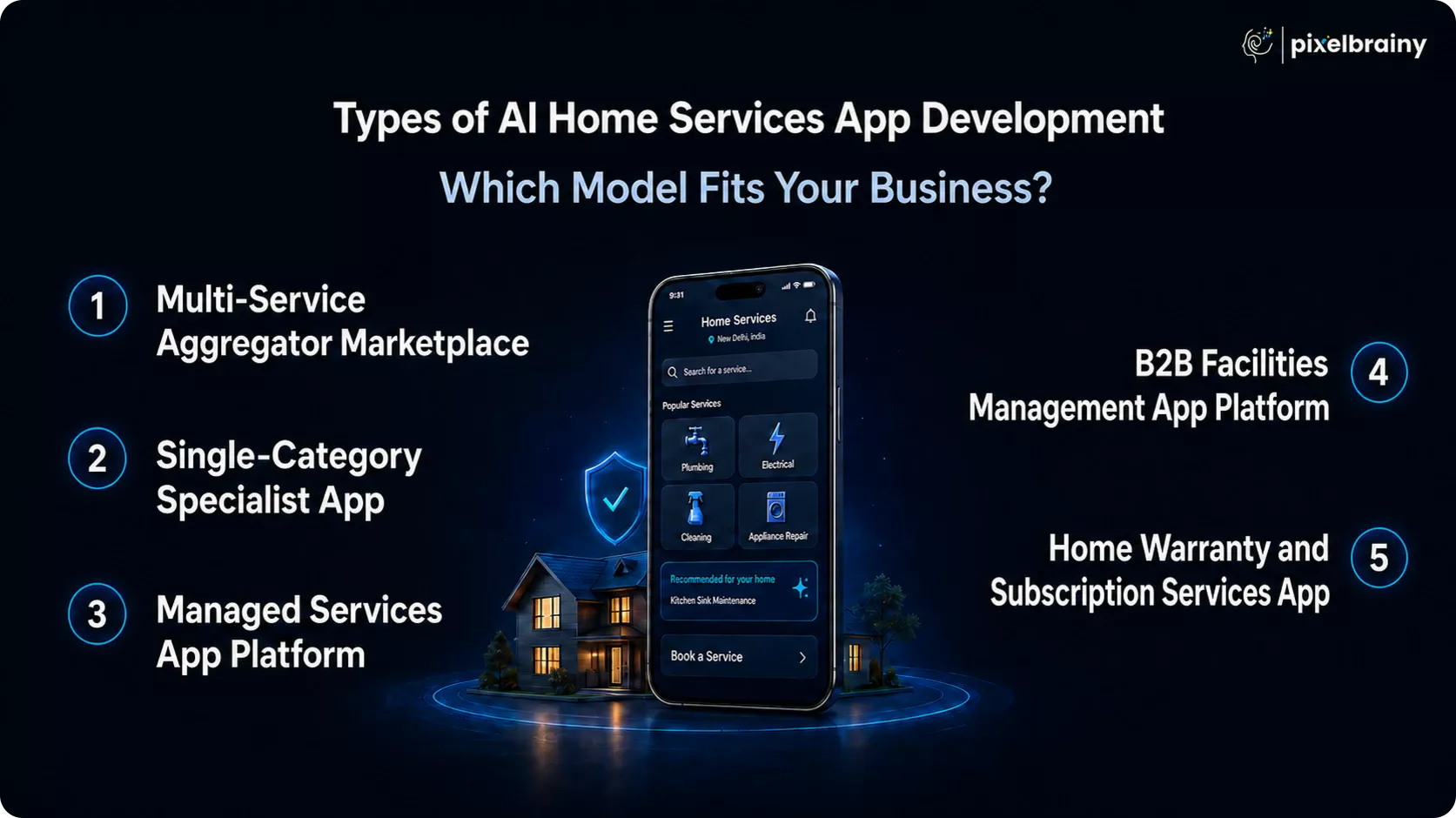
A multi-service aggregator brings together customers and independent service providers across multiple categories such as plumbing, electrical, cleaning, painting, carpentry, pest control, landscaping, and appliance repair within a single platform. This model offers customers the convenience of booking different services from one application while helping businesses build a large-scale marketplace.
Best for: Well-funded startups and businesses building a comprehensive home services ecosystem.
Popular examples: TaskRabbit, Thumbtack, Handy
Key AI applications
Revenue model: Commission on every completed booking.
A single-category platform focuses on one specific service instead of offering multiple categories. It could be dedicated to home cleaning, plumbing, HVAC, electrical repairs, or landscaping. By concentrating on one niche, businesses can deliver better service quality, build brand authority, and expand into additional services after validating the market.
Best for: Early-stage startups with limited budgets looking to dominate a niche market.
Popular examples: AI-powered cleaning app, specialist plumbing platform, smart landscaping service app.
Key AI applications
Revenue model: Commission on each completed service.
Unlike an open marketplace, a managed services platform directly employs or exclusively partners with service professionals. The business controls pricing, service standards, workforce management, and customer experience from end to end. This model delivers greater consistency but also requires higher operational investment.
Best for: Businesses that prioritize quality control and premium customer experiences.
Key AI applications
Revenue model: Fixed pricing with service markup.
This model is designed for businesses rather than homeowners. It helps property managers, commercial buildings, residential communities, and real estate companies manage maintenance across multiple properties through one centralized platform.
Best for: Companies serving commercial properties, enterprises, and facility management firms.
Key AI applications
Revenue model: SaaS subscriptions and enterprise contracts.
Instead of charging customers for individual bookings, this model offers monthly or annual maintenance plans. Subscribers receive scheduled inspections, preventive maintenance, and priority service across different home service categories, creating predictable recurring revenue for the business.
Best for: Businesses focused on customer retention and recurring subscription income.
Key AI applications
Revenue model: Monthly or annual subscription plans.
| App Type | Target User | Core AI Application | Revenue Model | Development Complexity |
| Multi-Service Aggregator | General homeowners | Cross-category matching and demand forecasting | Commission per job | High |
| Single-Category Specialist | Homeowners with a specific need | Deep category-specific matching | Commission per job | Medium |
| Managed Services Platform | Quality-focused homeowners | Workforce scheduling and quality monitoring | Fixed pricing markup | Very High |
| B2B Facilities Management | Property managers and businesses | Multi-property coordination and budget forecasting | SaaS subscription | High |
| Home Warranty & Subscription | Homeowners seeking ongoing maintenance | Predictive maintenance and renewal scoring | Monthly subscription | Medium to High |
The best AI home services app is not the one with the most services, but the one built around the right business model for your target market and growth stage.
If you are planning AI home services app development, one question will inevitably arise during product planning:
"Will AI actually improve our marketplace, or is it just another feature that increases development costs?"
The answer depends on how AI is implemented. When used strategically, AI does much more than automate bookings. It improves provider matching, pricing, scheduling, customer retention, and marketplace operations simultaneously. This creates measurable business outcomes for founders while delivering a faster and more reliable experience for customers and service professionals.
The following benefits explain why more businesses are choosing to build AI home services apps instead of traditional booking platforms.
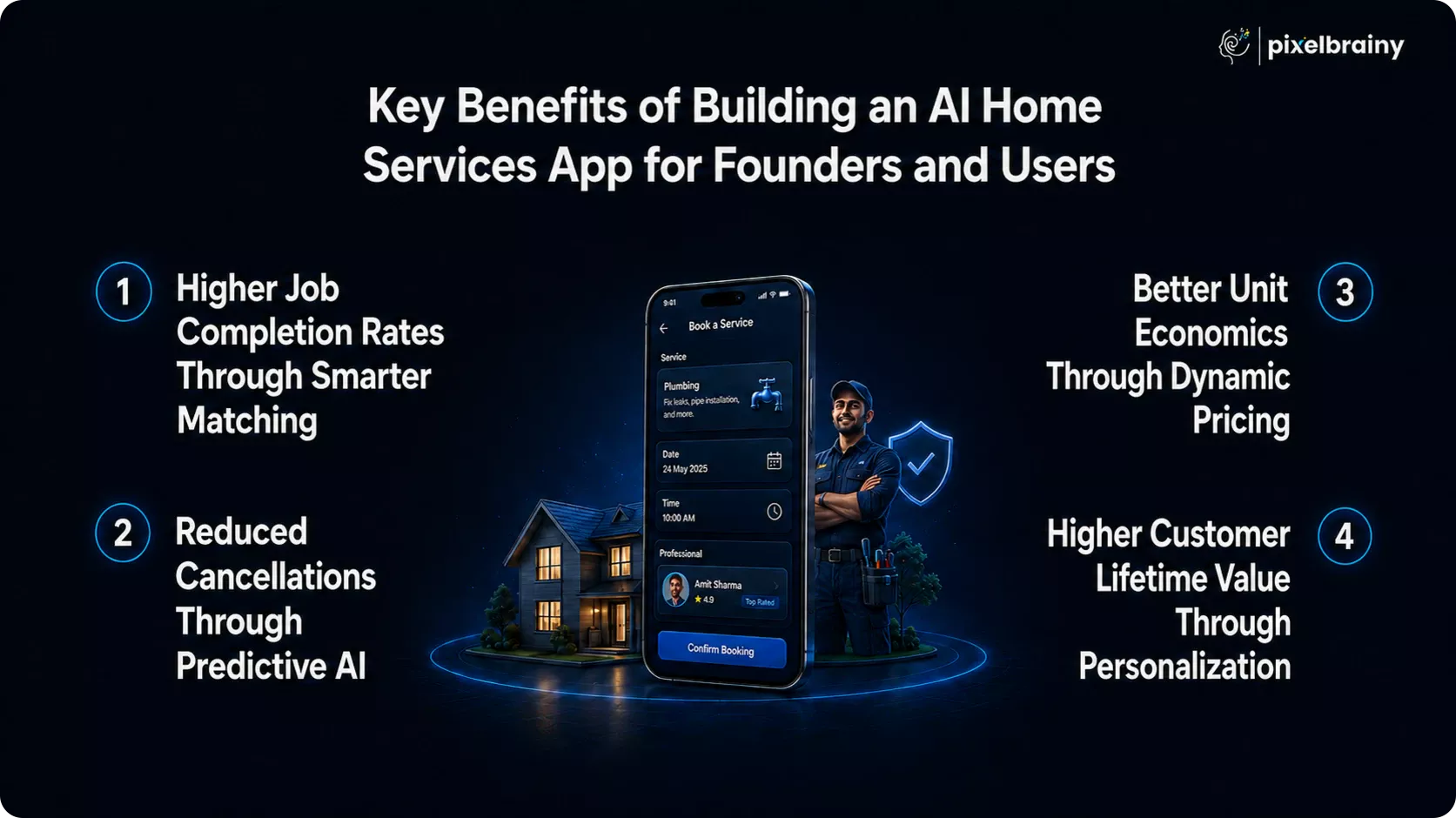
One of the biggest reasons customers have a poor experience is being matched with the wrong service provider. Traditional booking platforms usually recommend professionals based only on availability and location. However, AI service provider matching app development goes much further by evaluating provider seconds.
How it benefits founders
How it benefits users
Last-minute cancellations affect every participant in a marketplace. Customers experience delays, providers lose income, and businesses lose trust. AI solves this problem by identifying bookings with a high probability of cancellation before they happen. It analyzes customer behavior, provider history, booking patterns, weather conditions, and service types to predict potential risks.
How it benefits founders
How it benefits users
One of the main reasons startups choose to build AI home services app solutions is to improve profitability without increasing customer acquisition costs. AI-driven dynamic pricing automatically calculates service estimates based on demand, location, provider availability, job complexity, seasonal trends, and historical pricing instead of relying on manual quotations.
How it benefits founders
How it benefits users
Acquiring new customers is expensive, making repeat bookings essential for long-term growth. During AI home services app development, personalization features help businesses understand customer behavior and recommend services before users actively search for them. AI analyzes booking history, home type, seasonal requirements, and maintenance cycles to deliver relevant recommendations.
How it benefits founders
How it benefits users
As your marketplace expands, manually onboarding hundreds of professionals becomes increasingly difficult. This is why AI home services app development often includes intelligent onboarding workflows. AI can automatically extract information from uploaded documents, verify identities, recommend suitable service categories, and highlight incomplete applications before submission.
| Benefit | AI Capability Behind It | Business Impact |
| Higher Job Completion Rates | Skill and job-fit matching | Fewer complaints and lower support costs |
| Reduced Cancellations | Predictive cancellation risk model | Higher customer trust and better provider earnings |
| Better Unit Economics | Dynamic pricing and instant quotes | Higher conversion and revenue per lead |
| Higher Customer Lifetime Value | Personalized rebooking suggestions | Lower customer acquisition cost and higher retention |
| Faster Provider Network Growth | AI-assisted onboarding | Expanded coverage without proportional operational cost |
| Stronger Trust and Safety | AI fraud detection and fake review analysis | Better platform reputation and lower churn |
The real ROI of AI home services app development comes from combining intelligent matching, predictive automation, and personalized experiences to build a marketplace that becomes more efficient, profitable, and valuable with every completed booking.

A successful AI home services application platform is built on much more than online booking. Customers expect accurate provider recommendations, transparent pricing, real-time updates, and a seamless booking journey. Service providers want quality leads, optimized schedules, and hassle-free payments. Meanwhile, founders need a platform that can scale efficiently while improving operational performance. This is where AI home services app development creates a competitive advantage.
A common question we hear from startups is:
"We have been researching platforms like TaskRabbit, Thumbtack, and Handy for months. We want to build an AI-powered platform that improves provider matching, predicts job duration and pricing, and personalizes every customer experience. What features should be included in the first version of the product?"
The answer is to start with the right foundation. Before adding advanced AI capabilities, every home services app development with AI project should include a set of core features that support customers, service providers, and administrators. These features create the data ecosystem required for machine learning while ensuring a smooth and scalable user experience. Whether you are planning custom AI home services app development or looking to build an AI home services app, the following features should be part of your product roadmap.
| Feature | Why It Is Essential |
| Customer Registration & Login | A secure authentication system allows users to register through email, phone number, social accounts, or biometrics. It simplifies onboarding, protects user data, reduces login friction, and provides a secure foundation for personalized experiences throughout the platform. |
| Service Discovery & Search | Customers should easily browse service categories, search by keywords, filter providers using ratings, pricing, availability, and location, and compare options. A well-designed discovery experience improves booking conversions and helps users find suitable professionals quickly. |
| AI Provider Matching | This is one of the most important components of AI home services app development. Machine learning recommends providers by analyzing skills, experience, ratings, location, availability, job complexity, and previous performance, resulting in better service quality and higher job completion rates. |
| Service Booking & Scheduling | Customers should be able to select services, choose preferred dates and time slots, reschedule appointments, and receive instant confirmations. A seamless scheduling system improves user convenience while helping providers manage their daily workload efficiently. |
| AI-Based Price Estimation | Instead of waiting for manual quotations, AI instantly estimates service costs using property details, job complexity, historical pricing, location, and market demand. Faster estimates improve transparency, reduce booking abandonment, and increase customer confidence. |
| Secure Payment Integration | Multiple payment options including cards, UPI, digital wallets, and online banking provide convenience for customers. Secure payment gateways, automated invoices, refunds, and payment tracking create a reliable financial experience for every transaction. |
| Real-Time Job Tracking | Live tracking enables customers to monitor provider location, arrival time, job progress, and estimated completion time directly within the app. This improves transparency, reduces uncertainty, and minimizes customer support requests. |
| Provider Profile Management | Service providers should manage certifications, experience, pricing, availability, completed jobs, service areas, and customer ratings through a dedicated dashboard. Complete provider profiles increase customer trust and improve booking decisions. |
| Ratings & Reviews | Verified customer reviews build trust across the marketplace. Allowing feedback only after completed bookings improves review authenticity, helps customers compare providers, and encourages professionals to maintain consistent service quality. |
| Push Notifications | Automated notifications keep customers and providers informed about booking confirmations, appointment reminders, provider arrival, payment updates, promotional offers, and completed services, ensuring timely communication throughout every booking. |
| In-App Chat & Calling | Secure messaging and calling allow customers and providers to discuss service requirements, clarify booking details, and resolve issues without sharing personal contact information, improving privacy and communication efficiency. |
| Booking History & Easy Rebooking | Customers should access previous bookings, invoices, favorite providers, and service records in one place. One-click rebooking simplifies recurring home maintenance and increases long-term customer retention. |
| Admin Dashboard | A centralized admin panel allows businesses to manage users, providers, bookings, payments, commissions, customer disputes, reports, and marketplace performance, making day-to-day platform operations more efficient and data-driven. |
| Provider Availability Management | Providers should update working hours, vacation schedules, service locations, and appointment availability in real time. Accurate availability prevents scheduling conflicts, improves booking accuracy, and enhances customer satisfaction. |
| Analytics & Reporting | Comprehensive dashboards track bookings, revenue, customer behavior, provider performance, service demand, and operational KPIs. These insights help founders make informed decisions and continuously optimize business performance. |
The strength of an AI home services app platform is not measured by how many features it offers, but by how effectively its core features work together to deliver smarter bookings, better provider experiences, and sustainable business growth.
Once the core AI home service app platform is ready, the next step is adding intelligent capabilities that differentiate your product from traditional home services marketplaces. While basic features help customers book services, advanced AI features improve decision-making, automate operations, and create highly personalized experiences for every user.
Many founders ask:
"We already understand the essential features, but what AI capabilities will actually help us compete with platforms like TaskRabbit, Thumbtack, and Handy?"
The answer lies in adopting AI features that solve real marketplace challenges instead of adding technology for the sake of innovation. During AI home services app development, advanced capabilities such as predictive analytics, machine learning, computer vision, and generative AI help improve provider matching, estimate job duration more accurately, automate customer support, detect fraud, and optimize marketplace performance.
If your goal is custom AI home services app development that stands out in a competitive market, the following advanced features can create a significant long-term advantage.
| Advanced Feature | Why It Adds Competitive Value |
| Predictive Provider Matching | Instead of recommending providers based only on current availability, machine learning predicts which professional is most likely to complete the job successfully by analyzing historical performance, customer preferences, response time, cancellation history, expertise, and similar completed projects. |
| AI Job Duration Prediction | AI estimates how long a service will take by evaluating job type, property size, previous service records, technician experience, and historical completion times. More accurate time estimates improve scheduling efficiency and reduce appointment delays. |
| Dynamic AI Pricing Engine | Advanced pricing models continuously adjust service estimates according to location, demand, provider availability, seasonal trends, job complexity, and historical marketplace data. This creates fair pricing for customers while maximizing provider earnings and business revenue. |
| Generative AI Customer Assistant | An AI-powered virtual assistant answers customer questions, recommends suitable services, collects booking information, explains pricing, and provides support throughout the booking journey. It improves customer engagement while reducing support team workload. |
| Computer Vision for Job Assessment | Customers can upload images of damaged appliances, plumbing issues, wall cracks, or electrical problems. Computer vision analyzes these images to estimate job complexity, recommend required services, and improve quotation accuracy before provider visits. |
| Predictive Maintenance Recommendations | AI analyzes booking history, appliance age, home type, seasonal trends, and maintenance cycles to recommend preventive services before issues become expensive repairs. This increases customer retention and creates recurring business opportunities. |
| AI Fraud Detection & Trust Scoring | Machine learning continuously monitors fake accounts, suspicious payments, duplicate bookings, fraudulent reviews, and unusual provider behavior. Early fraud detection protects customers, service providers, and the marketplace from financial losses. |
| Smart Route Optimization | AI automatically creates the most efficient travel routes for service professionals by considering traffic conditions, appointment schedules, provider locations, and estimated service duration. Better route planning reduces travel time and increases daily job capacity. |
| Customer Personalization Engine | AI builds personalized experiences by analyzing service history, home type, spending behavior, preferred providers, booking frequency, and customer preferences. Personalized recommendations improve engagement, repeat bookings, and overall customer satisfaction. |
| AI Business Intelligence Dashboard | Advanced analytics provide predictive insights into customer demand, provider performance, revenue trends, regional growth opportunities, seasonal fluctuations, and operational efficiency. These insights help founders make faster, data-driven business decisions. |
Advanced AI features transform a home services marketplace app from a booking platform into an intelligent ecosystem that continuously learns, predicts, and optimizes every customer interaction, provider decision, and business operation.
After finalizing the features for your AI home services platform, the next question is how those features actually come together into a scalable product. This is the stage where your idea transforms into a working application through careful planning, design, development, AI integration, testing, and launch.
Many founders ask:
We have finalized our feature list, but we do not have a technical background. What does the actual development process look like? What decisions should we make first, and how long does it realistically take to build an AI-powered home services marketplace?
The answer lies in following a structured development roadmap. Rather than building everything at once, successful teams divide the project into clearly defined phases, where each stage supports the next. From selecting the right architecture and designing a two-sided marketplace to integrating AI capabilities and launching the first version, every decision directly impacts the scalability, performance, and future success of your platform.
Whether your goal is how to develop an AI home services app from scratch, to create an AI home services app, or how to build a home services app like TaskRabbit with AI features, the following development process provides a practical roadmap for transforming your product vision into a market-ready solution.
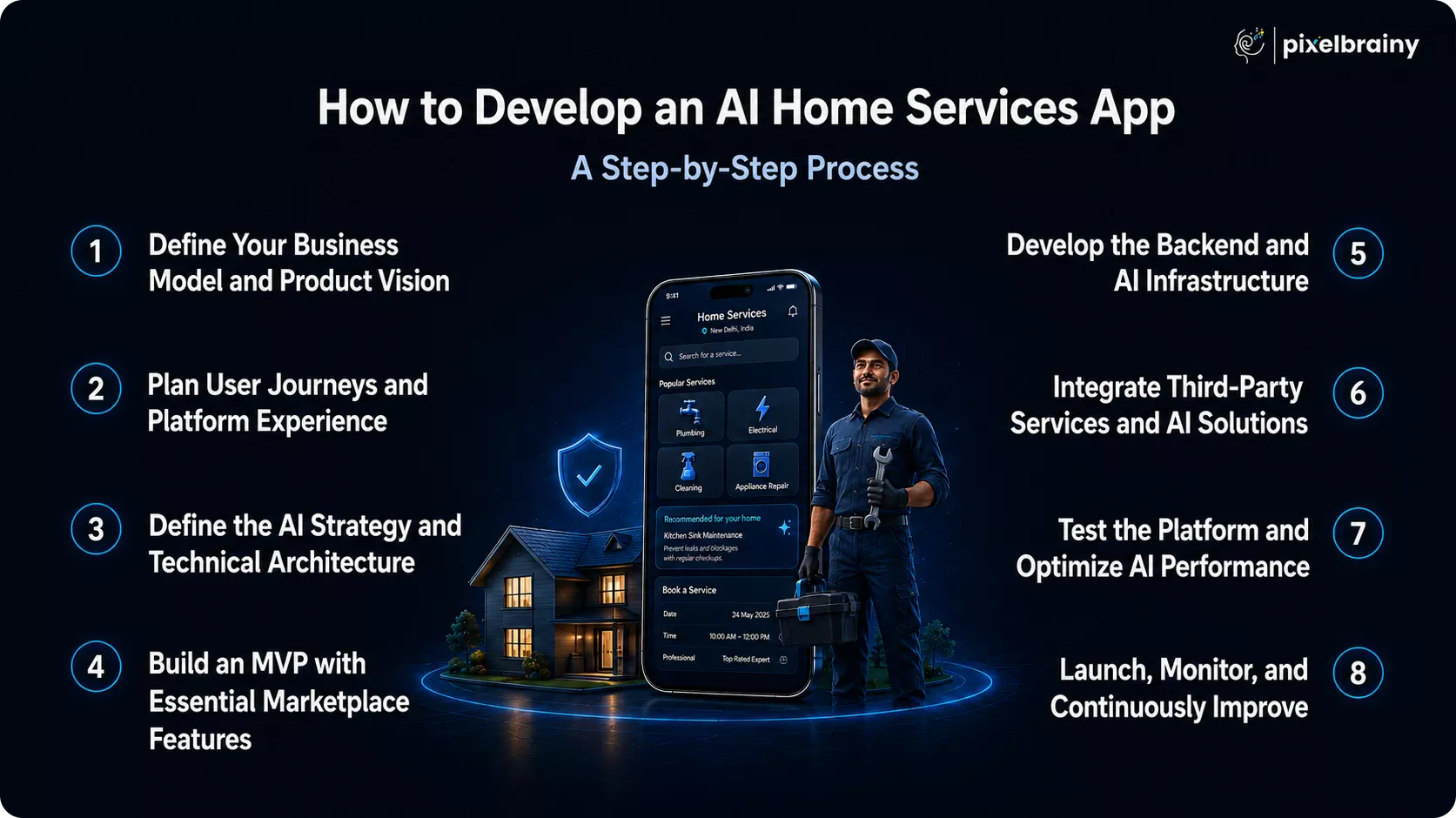
Aim: Build a strong business foundation before writing a single line of code.
Every successful AI home services app development project starts with business planning instead of software development. Begin by selecting the right marketplace model, whether it is a multi-service platform, single-category specialist app, managed services solution, or subscription-based business.
Next, define your target customers, service providers, revenue model, launch city, and competitive positioning. Documenting these decisions early helps avoid expensive product changes later.
Many startups also begin with PoC development to validate technical feasibility, AI use cases, and market demand before investing in complete application development. This significantly reduces business and technical risks while providing greater confidence for future investment.
Aim: Create seamless experiences for customers, service providers, and administrators.
Before development begins, map every interaction across the platform. Customer journeys should include registration, service discovery, booking, payments, job tracking, reviews, and customer support. Provider journeys should cover onboarding, verification, job acceptance, navigation, earnings, and payouts.
Designing these workflows early helps identify where AI can improve provider matching, scheduling, pricing, and personalized recommendations.
Working with an experienced mobile app UI/UX design company ensures every screen is intuitive, reduces user friction, and increases booking conversion rates across the entire marketplace.
Aim: Identify where artificial intelligence creates the highest business value.
AI should solve practical marketplace challenges rather than becoming a marketing feature. During this phase, determine which intelligent capabilities are required, such as provider matching, instant pricing, job duration prediction, cancellation forecasting, demand prediction, and fraud detection.
Businesses should also decide which AI capabilities require custom development and which can be accelerated using existing technologies.
Many organizations rely on AI consulting services to define the right architecture, data requirements, and implementation strategy before development begins, ensuring AI investments deliver measurable business outcomes.
Aim: Launch a functional product quickly and validate real customer demand.
Instead of building every planned feature, focus on creating a Minimum Viable Product that includes customer registration, provider onboarding, service discovery, booking management, payments, notifications, reviews, and an admin dashboard.
Essential AI capabilities such as provider matching and AI-powered pricing can also be included to differentiate the platform from traditional booking applications.
Following an MVP development approach allows founders to collect user feedback, validate assumptions, improve product-market fit, and reduce development costs before investing in advanced functionality.
Aim: Build a scalable technology foundation capable of supporting future growth.
The backend manages customer accounts, provider profiles, bookings, payments, notifications, messaging, and administrative operations. At the same time, developers establish secure APIs, databases, and cloud infrastructure capable of handling thousands of simultaneous users.
This phase also includes AI model development for intelligent provider matching, dynamic pricing, job duration prediction, cancellation forecasting, and recommendation systems. Building scalable infrastructure early makes future feature expansion faster and more cost-effective.
Aim: Accelerate development while reducing engineering complexity.
A modern home services marketplace depends on multiple external services. Payment gateways, identity verification, maps, notifications, cloud storage, analytics, and communication APIs should all be integrated during this phase.
Businesses also use reliable AI integration services to implement recommendation engines, natural language processing, computer vision, or predictive analytics without building every AI component from scratch.
This approach shortens development time while ensuring the platform remains scalable and secure.
Aim: Ensure every feature works reliably before the public launch.
Testing goes beyond identifying software bugs. Teams should validate booking workflows, payment security, provider onboarding, application performance, AI prediction accuracy, and user experience across different devices.
Beta testing with real customers and verified service providers provides valuable feedback for improving recommendations and operational workflows.
Even many top AI app development companies in USA consider continuous AI validation essential because machine learning models improve only when tested with real-world marketplace data.
Aim: Launch strategically and improve the platform using real user data.
Instead of expanding immediately, launch in one city with a carefully selected network of verified service providers. Monitor important business metrics such as booking conversion rate, provider acceptance rate, cancellation rate, customer retention, job completion rate, and AI recommendation accuracy.
Use these insights to improve matching algorithms, optimize pricing, enhance user experience, and expand into additional locations or service categories. Continuous improvement ensures the platform becomes more intelligent and competitive after every completed booking.
| Development Phase | Key Activities | Estimated Duration |
| Business Discovery & Planning | Market research, platform selection, requirement analysis | 1 Week |
| Product Design & User Journey Mapping | Wireframes, UI/UX design, workflow planning | 2 Weeks |
| MVP & Backend Development | Core marketplace, APIs, database, booking engine | 3 Weeks |
| AI Development & Integrations | Provider matching, pricing engine, AI integrations | 2 Weeks |
| Mobile App Development | Customer app, provider app, admin dashboard | 3 Weeks |
| Testing & Performance Optimization | QA, security testing, AI validation, bug fixing | 1 Week |
| Beta Launch & Improvements | Pilot launch, analytics, AI optimization | 1 to 2 Weeks |
| Total Development Timeline | Complete AI Home Services App Development | 10 to 14 Weeks |
Successful AI home services app platforms are not built by adding AI at the end of development. They are built by embedding intelligence into every stage of the product lifecycle, from business planning and user experience to deployment, optimization, and continuous learning.
Also Read: AI Mobile App Development for Startups and Enterprises
After understanding the development process, the next question most founders ask is, "How much does AI home services app development actually cost?" The answer depends on your product scope, AI capabilities, infrastructure, and long-term scalability.
On average, the cost of developing an AI home services app in 2026 ranges from $30,000 to $300,000+. A lean MVP designed for a single service category can be built on a startup budget, while a full-scale AI marketplace with multiple service categories, advanced automation, and enterprise-grade infrastructure requires a significantly higher investment.
The biggest cost drivers are not just mobile app development. A modern AI home services platform typically includes separate customer and provider applications, a web-based admin dashboard, real-time backend infrastructure, AI-powered recommendation and prediction models, payment processing with escrow support, identity verification, maps, notifications, analytics, and cloud services. Each component contributes to the overall AI home services app development cost.
For founders wondering how to build an AI home services app on a startup budget, the most practical approach is to launch with a focused MVP, validate market demand, and expand AI capabilities over time. This reduces upfront investment while allowing real customer data to guide future development.
The table below provides a realistic development budget of AI home services app projects, including both one-time development expenses and estimated monthly operational costs.
| Component | Development Cost Range | Monthly Operating Cost |
| Customer app (iOS & Android) | $15,000 to $30,000 | None |
| Provider app (iOS & Android) | $12,000 to $25,000 | None |
| Admin dashboard (Web) | $8,000 to $18,000 | None |
| Backend & real-time infrastructure | $15,000 to $32,000 | $400 to $2,500 |
| AI provider matching engine | $10,000 to $25,000 | $200 to $1,000 |
| Instant AI pricing model | $8,000 to $18,000 | $200 to $800 |
| Cancellation prediction model | $6,000 to $14,000 | $100 to $500 |
| AI schedule optimization | $6,000 to $15,000 | $100 to $500 |
| Review fraud detection model | $5,000 to $12,000 | $100 to $400 |
| Background check & identity verification integration | $5,000 to $12,000 | $5 to $15 per verification |
| Maps & location integration | $4,000 to $10,000 | $200 to $1,500 API fees |
| Payment architecture & escrow | $7,000 to $16,000 | $200 to $800 |
| In-app messaging system | $4,000 to $10,000 | $100 to $400 |
| UI & UX design (All interfaces) | $8,000 to $18,000 | None |
| QA & performance testing | $6,000 to $14,000 | None |
| Project management | $5,000 to $12,000 | None |
| Total Development Cost Range | $124,000 to $281,000 | $1,600 to $8,900 per month |
Note: These estimates represent a production-ready AI marketplace. Startup MVPs with limited functionality can often be launched for substantially less.
| Scope Tier | What Is Included | Development Cost | Best For |
| Single Category MVP | One service type, core AI matching, basic AI pricing | $35,000 to $75,000 | Bootstrapped single-category startup |
| Multi-Category Local Platform | Five or more service categories, two mobile apps, admin dashboard, complete AI features | $80,000 to $160,000 | Seed-funded local marketplace startup |
| Full AI Home Services Platform | Complete feature set, multiple AI models, enterprise infrastructure, scalable architecture | $160,000 to $280,000+ | Well-funded marketplace startup |
| Team Location | Average Hourly Rate | Full Platform Cost Estimate |
| United States | $150 to $250 | $320,000 to $650,000 |
| Western Europe | $100 to $150 | $200,000 to $420,000 |
| Eastern Europe | $50 to $100 | $130,000 to $290,000 |
| India & South Asia | $25 to $60 | $75,000 to $170,000 |
| PixelBrainy | Competitive | Custom quote available |
The cost to make AI home services app should be viewed as a strategic investment rather than a one-time expense. Choosing the right feature set, prioritizing high-impact AI capabilities, and launching with a scalable MVP can significantly reduce upfront costs while creating a strong foundation for long-term growth.
The most successful platforms invest where it matters most, then use real marketplace data to continuously enhance their AI models, user experience, and operational efficiency.

Also Read: AI App Development Cost: From MVPs to Full-Scale AI App
After deciding on the features, development process, and budget, the next important question is which technologies should you use to build an AI home services app? The answer depends on your scalability goals, AI requirements, security standards, and expected user traffic.
Many founders ask, "What is the best technology stack for AI home services app development, and which tools are required to build a secure, scalable, and future-ready marketplace?" A well-planned technology stack directly impacts application performance, development speed, maintenance costs, and your ability to introduce new AI capabilities in the future.
The ideal stack for AI home services app development combines modern mobile frameworks, scalable backend technologies, cloud infrastructure, AI and machine learning frameworks, secure payment systems, mapping services, and analytics platforms. Instead of selecting technologies based on trends, businesses should choose tools that support real-time bookings, intelligent provider matching, AI-powered recommendations, secure transactions, and seamless communication between customers and service providers.
The following technology stack is commonly used to build an AI home services app that can scale efficiently while delivering a reliable and intelligent user experience.
| Technology Layer | Recommended Tools & Technologies | Why It Is Used |
| Mobile App Development | Flutter, React Native | Build high-performance iOS and Android apps from a single codebase, reducing development time and cost. |
| Frontend Web Development | React.js, Next.js | Create responsive admin dashboards with fast performance and excellent user experience. |
| Backend Development | Node.js, NestJS, Python (FastAPI) | Handle bookings, authentication, payments, notifications, APIs, and real-time marketplace operations. |
| AI & Machine Learning | TensorFlow, PyTorch, Scikit-learn | Develop intelligent provider matching, pricing prediction, recommendation engines, and forecasting models. |
| Generative AI | OpenAI API, Google Gemini API, Anthropic Claude API | Power AI chat assistants, automated customer support, booking assistance, and natural language interactions. |
| Database | PostgreSQL, MongoDB, Redis | Store structured marketplace data, user profiles, booking history, and improve application performance with caching. |
| Cloud Infrastructure | AWS, Google Cloud Platform, Microsoft Azure | Provide scalable hosting, AI services, storage, networking, and high availability. |
| Real-Time Communication | Socket.io, Firebase Cloud Messaging | Enable live booking updates, instant messaging, notifications, and real-time status tracking. |
| Maps & Location Services | Google Maps Platform, Mapbox | Support address search, live tracking, route optimization, and distance calculations. |
| Payment Gateway | Stripe, Razorpay, PayPal | Process secure online payments, subscriptions, refunds, and escrow transactions. |
| Identity Verification | Persona, Onfido, Stripe Identity | Verify customer and provider identities while reducing fraud and improving trust. |
| Authentication | Firebase Authentication, Auth0, JWT | Secure user login, social authentication, and role-based access control. |
| Cloud Storage | Amazon S3, Google Cloud Storage | Store profile images, verification documents, invoices, and service-related media securely. |
| Search Engine | Elasticsearch, Algolia | Deliver fast and intelligent service searches with filtering and autocomplete. |
| Analytics & Monitoring | Google Analytics 4, Firebase Analytics, Mixpanel | Track user behavior, bookings, conversions, retention, and business performance. |
| DevOps & CI/CD | Docker, Kubernetes, GitHub Actions | Automate deployment, scaling, testing, and infrastructure management. |
| Security | SSL, OAuth 2.0, Cloudflare, AWS WAF | Protect user data, APIs, payments, and applications against security threats. |
| Testing | Postman, Cypress, Selenium, JMeter | Validate APIs, application functionality, automation workflows, and performance under heavy traffic. |
The right technology stack does more than power your AI home services app. It creates a scalable, secure, and intelligent foundation that supports future growth, advanced AI capabilities, and an exceptional customer experience.
Building a successful AI home services platform is not just about acquiring customers and service providers. Long-term profitability depends on choosing the right home services app monetization model. While many marketplaces begin with a simple commission-based approach, relying on a single revenue stream can limit growth and make the business vulnerable to seasonal demand or pricing competition.
A smarter strategy is to build multiple monetization channels into the platform from the beginning. This creates predictable recurring revenue, improves cash flow, and reduces dependence on completed bookings alone. As your platform grows, additional revenue streams such as subscriptions, memberships, premium visibility, and B2B services can contribute as much as, or even more than, transaction commissions.
For businesses investing in on demand home services app development, selecting the right monetization strategy also plays a major role in recovering the AI home services app development cost faster. The most successful marketplaces combine transactional income with recurring subscription revenue to build a sustainable and scalable business model.
| Monetization Model | Revenue Type | How It Works | Revenue Potential |
| Job Commission | Per job percentage | The platform charges a commission of 15% to 25% on every successfully completed service booking. This is the primary revenue source for most marketplaces and scales with booking volume. | High volume dependent |
| Provider Subscription | Monthly recurring fee | Service providers pay a monthly subscription for platform access, advanced analytics, premium tools, or increased visibility in search results. | $30 to $150 per provider per month |
| Customer Membership | Monthly recurring subscription | Customers subscribe for benefits such as priority booking, exclusive discounts, reduced service fees, and free cancellations, increasing retention and recurring revenue. | $10 to $25 per customer per month |
| Featured Provider Placement | Monthly promotional fee | Providers pay to appear in premium positions within AI-powered search results and recommendation lists, helping them generate more bookings. | $50 to $300 per provider per month |
| Lead Generation Fee | Per qualified lead | Instead of charging only after completed jobs, providers pay for verified service requests or qualified customer leads generated through the platform. | $5 to $25 per lead |
| B2B Facilities Management SaaS | Annual or recurring contract | Property managers, housing communities, and commercial businesses subscribe to centralized maintenance management, reporting, and multi-property coordination tools. | $500 to $5,000 per property manager per month |
Among these models, job commissions generate immediate transaction-based income, while provider subscriptions and customer memberships create predictable recurring revenue. Premium provider placements increase advertising income, lead generation diversifies monetization, and B2B SaaS contracts deliver high-value recurring revenue with lower customer acquisition costs.
The most profitable AI home services application platforms combine multiple monetization models from day one, creating a balanced revenue ecosystem that supports long-term scalability, predictable cash flow, and sustainable business growth.
Every AI-powered home services app looks promising during the planning stage. The real test begins when customers start booking services, providers join the marketplace, and day-to-day operations begin to scale. At this point, challenges such as provider availability, pricing disputes, cancellations, inconsistent service quality, and customer trust can quickly impact user experience and business growth.
Many founders ask, "What are the biggest challenges of developing an AI home services app, and how can we solve them before they become operational problems?" Whether you're exploring how to develop an AI home services app with real time booking or how to make an AI home services app that retains customers, identifying these challenges early allows you to design smarter workflows, implement AI where it delivers the most value, and build a marketplace that scales with confidence.
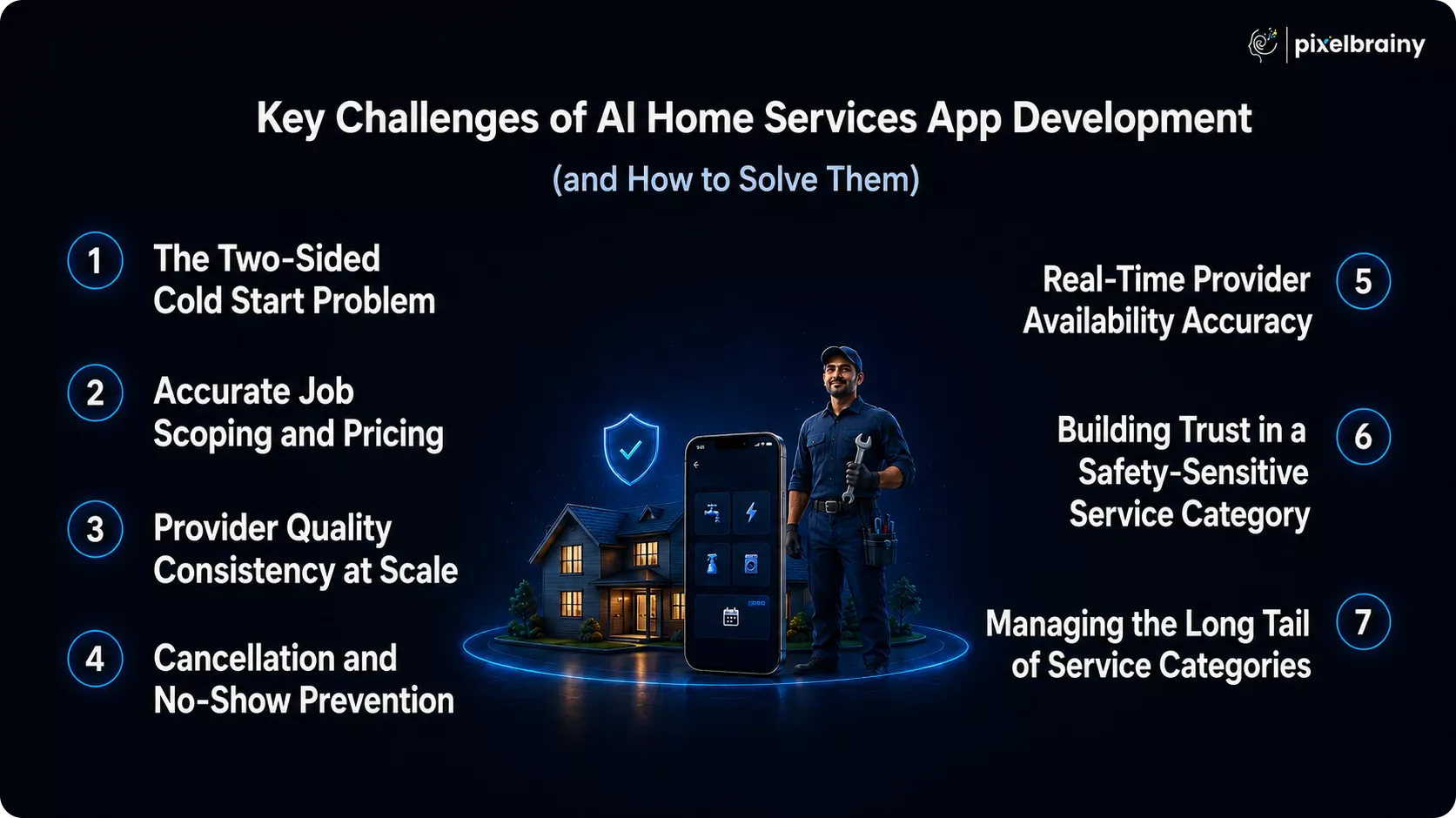
Every two-sided marketplace faces the same challenge. Customers hesitate to use a platform with too few service providers, while providers are reluctant to join a marketplace with limited customer demand. Without balancing both sides, growth becomes difficult.
How to solve it:
Customers often underestimate the size or complexity of a job, leading to inaccurate quotes, pricing disputes, and provider frustration after arriving on-site.
How to solve it:
As the provider network expands, maintaining consistent service quality across different professionals becomes increasingly difficult. Poor service experiences can quickly damage customer trust and increase churn.
How to solve it:
Last-minute cancellations and provider no-shows are among the most common reasons customers stop using home services platforms.
How to solve it:
Many professionals accept jobs from multiple platforms while managing their own schedules. Without accurate availability updates, double bookings and scheduling conflicts become inevitable.
How to solve it:
Unlike food delivery or ride-sharing platforms, home services require customers to invite professionals into their homes. Trust becomes a deciding factor before every booking.
How to solve it:
Expanding into too many service categories too quickly often creates inconsistent provider coverage, operational complexity, and varying customer experiences.
How to solve it:
| Challenge | Severity | Mitigation Strategy |
| Two-sided cold start problem | Very High | Launch in a single city with proactive provider recruitment before opening the platform to customers. |
| Accurate job scoping and pricing | High | Use a structured AI intake flow supported by historical booking data for accurate estimates. |
| Provider quality consistency at scale | High | Continuously monitor provider performance and automatically adjust job allocation based on AI insights. |
| Cancellation and no-show prevention | High | Implement AI cancellation risk scoring with automated reminders and backup provider assignment. |
| Real-time provider availability accuracy | Medium to High | Synchronize provider calendars and apply intelligent buffer time logic to prevent double bookings. |
| Trust barrier in a safety-sensitive category | High | Display verification badges, background checks, certifications, and transparent provider history. |
| Managing the long tail of service categories | Medium | Expand gradually using AI-driven demand insights after establishing strong performance in core categories. |
The biggest challenges in AI home services app development are not solved by adding more features. They are solved by combining intelligent automation, operational planning, and AI-driven decision-making to create a marketplace that customers trust and providers choose to grow with.
Launching an AI-powered home services marketplace requires much more than developing a mobile application. Success depends on combining marketplace strategy, scalable architecture, intelligent automation, and operational workflows into one platform. That's why founders searching for companies that develop AI home services apps for startups look for a technology partner that understands both software engineering and marketplace operations.
At PixelBrainy, we build AI-powered home services platforms with long-term scalability in mind. Whether you're planning how to develop an AI home services app for multiple service categories or launching a niche service marketplace, our focus is on creating products that are secure, scalable, and built for real business growth.
As an AI app development company, our expertise includes:
Beyond technology, our development approach is built around solving marketplace challenges before they become business problems. Every project includes:
Our team works with home services startups, managed services operators, B2B facilities management companies, franchise businesses, and funded marketplace founders who want to build reliable AI-powered platforms instead of generic booking applications.
A recent engagement involved developing an AI-powered multi-category home services marketplace for a fast-growing startup. Due to a client confidentiality agreement, we cannot disclose the client's identity.
Project Objective: The client wanted to replace manual service booking with an intelligent marketplace that could automate provider matching, improve booking efficiency, and support expansion into multiple cities and service categories without rebuilding the platform.
Solution Delivered: We developed a complete AI-powered marketplace featuring intelligent provider matching, dynamic pricing, real-time booking, background verification, escrow-based payments, live service tracking, and a centralized admin dashboard. The platform was built on a scalable cloud architecture capable of supporting future AI enhancements and business growth.
Business Outcome: After launch, the client was able to onboard service providers more efficiently, streamline booking operations, and expand into new locations using the same platform architecture. The modular system also made it easier to introduce additional service categories, optimize AI models with real marketplace data, and support long-term business growth without major redevelopment.
| Evaluation Factor | Generic App Development Agency | PixelBrainy |
| Two-sided marketplace experience | Rarely built at this complexity | Core platform development capability |
| AI provider matching system | Not understood as a complete operational system | Built as intelligent marketplace infrastructure |
| Cold-start launch strategy | Usually not included | Built into launch planning from day one |
| Background check API integration | Limited implementation experience | Experience integrating Checkr and Persona |
| Escrow-based payment architecture | Basic payment gateway integration | Split payments, escrow workflows, commissions, and payouts |
| AI cancellation prediction | Not typically offered | Behavioral risk prediction model development |
| Real-time tracking at scale | Basic Maps SDK implementation | Real-time booking, live tracking, and status synchronization |
| Post-launch AI model improvement | Limited support after launch | Continuous optimization of AI matching, pricing, and recommendation models |
| Cost transparency | Broad project estimates | Detailed feature-wise scope with itemized cost estimation |
We at PixelBrainy helps founders build AI-powered home services platforms that are designed to launch faster, scale confidently, and continuously improve through intelligent automation and real marketplace data.
So, whether you're validating an idea, planning an MVP, or developing a full-scale AI home services marketplace, our team is ready to help.
Let's connect to discuss your vision, estimate your project, and build an AI-powered platform that is ready for long-term growth.

The future of the home services industry belongs to businesses that embrace intelligent technology to deliver faster, smarter, and more reliable customer experiences. AI home services app development is no longer just about adding automation. It is about creating a scalable marketplace that improves provider matching, optimizes pricing, streamlines operations, and strengthens customer retention through data-driven decision making.
If you're planning to build an AI home services app, success starts with the right strategy rather than the longest feature list. Validating your idea, choosing the right business model, launching with an MVP, and continuously improving the platform using real marketplace data will help you create a sustainable competitive advantage and maximize long-term growth.
Ready to Build Your AI Home Services App?
Whether you're at the idea stage or preparing for development, PixelBrainy can help you turn your vision into a scalable AI-powered marketplace. Schedule a strategy call with our experts to discuss your requirements, receive a transparent project estimate, and build an AI home services app that's designed for long-term business success.
The first version should focus on AI features that directly improve marketplace efficiency instead of trying to automate everything. Intelligent provider matching, AI-based price estimation, smart scheduling, and cancellation prediction deliver the highest business value while helping you validate your product faster and reduce initial development costs.
Yes. If your current application has a scalable architecture, AI capabilities such as provider matching, dynamic pricing, customer support chatbots, demand forecasting, and personalized recommendations can often be integrated without rebuilding the entire platform. A technical assessment helps determine the most cost-effective modernization approach.
AI performs best when trained using real marketplace data such as booking history, provider availability, customer preferences, ratings, cancellations, job duration, pricing patterns, and service locations. The more high-quality operational data your platform collects, the more accurate and valuable your AI models become.
Start by validating your business model and operational workflows in a single market. Once booking volume, provider quality, and customer retention become stable, expand into additional cities using the same platform infrastructure. AI demand forecasting and marketplace analytics can help identify the best locations for future expansion.
The cost of AI home services app development typically ranges from $30,000 to $300,000+, depending on the number of service categories, AI capabilities, platform complexity, integrations, and infrastructure requirements. A startup MVP costs significantly less than a fully featured enterprise marketplace with advanced AI automation.
The timeline depends on the project scope and feature set. A basic MVP generally takes 10 to 14 weeks, while a full-featured AI-powered marketplace with multiple mobile apps, an admin dashboard, advanced AI models, and third-party integrations may require several additional months for development and testing.
PixelBrainy focuses on building intelligent marketplace platforms instead of generic booking applications. Our team combines two-sided marketplace architecture, AI-powered automation, real-time infrastructure, transparent project planning, and post-launch optimization to help founders build scalable products designed for long-term business growth.
Yes. Every project begins with detailed discovery sessions, feature prioritization, milestone planning, and transparent cost estimation. This structured approach helps define a realistic budget and timeline before development begins, reducing scope changes while ensuring the project aligns with your business goals.
Absolutely. The best approach is to build an AI home services app with only the core features required for launch, such as provider onboarding, booking, payments, AI-powered matching, and an admin dashboard. Once the MVP gains traction, advanced AI capabilities and additional service categories can be introduced incrementally based on real customer feedback and business performance.

About The Author
Sagar Bhatnagar
Sagar Sahay Bhatnagar brings over a decade of IT industry experience to his role as Marketing Head at PixelBrainy. He's known for his knack in devising creative marketing strategies that boost brand visibility and market influence. Sagar's strategic thinking, coupled with his innovative vision and focus on results, sets him apart. His track record of successful campaigns proves his ability to utilize digital platforms effectively for impactful marketing efforts. With a genuine passion for both technology and marketing, Sagar continuously pushes PixelBrainy's marketing initiatives to greater success.

Working with the PixelBrainy team has been a highly positive experience. They understand the design requirements and create beautiful UX elements to meet the application needs. The dev team did an excellent job bringing my vision to life. We discussed usability and flow. Sagar worked with his team to design the database and begin coding. Working with Sagar was easy. He has the knowledge to create robust apps, including multi-language support, Google and Apple ID login options, Ad-enabled integrations, Stripe payment processing, and a Web Admin site for maintaining support data. I'm extremely satisfied with the services provided, the quality of the final product, and the professionalism of the entire process. I highly recommend them for Android and iOS Mobile Application Design and Development.

Great experience working with them. Had a lot of feedback and I found that unlike most contractors they were bugging me for updates instead of the other way around. They were extremely time conscience and great at communicating! All work was done extremely high quality and if not on time, early! They were always proactive when it comes to communication and the work is great/above par always. Very flexible and a great team to work with! Goes above and beyond to present us with multiple options and always provides quality. Amazing work per usual with Chitra. If you have UI/UX or branding design needs I recommend you go to them! Will likely work with them in the future as well, definitely recommended!

PixelBrainy is a joy to work with and is a great partner when thinking through branding, logo, and website layout. I appreciate that they spend time going into the "why" behind their decisions to help inform me and others about industry best practices and their expertise.

I hired them to design our software apps. Things I really like about them are excellent communication skills, they answer all project suggestions and collaborate right away, and their input on design and colors is amazing. This project was complex and needed patience and creativity. The team is amazing to do business with. I will be using them long-term. Glad to see there are some good people out there. I was afraid to try and outsource my project to someone but I am glad I met them! I really can't say enough. They went above and beyond on this project. I am very happy with everything they have done to make my business stand out from the competition.

It was great working with PixelBrainy and the team. They were very responsive and really owned the project. We'll definitely work with them again!

I recently worked with the PixelBrainy team on a project and I was blown away by their communication skills. They were prompt, clear, and articulate in all of our interactions. They listened and provided valuable feedback and suggestions to help make the project a success. They also kept me updated throughout the entire process, which made the experience stress-free and enjoyable.

PixelBrainy is very good at what it does. The team also presents themselves very professionally and takes care of their side of things very well. I could fully trust them taking up the design work in a timely and organised manner and their attention to detail saved us lots of effort and time. This particular project was quite intense and the team showed that they function very well under pressure. Very much looking forward to working with her again!

It's always an absolute pleasure working with them. They completed all of my requests quickly and followed every note I had for them to a T, which made our process go smoothly from start to finish. Everything was completed fast and following all of the guidelines. And I would recommend their services to anyone. If you need any design work done in the future, PixelBrainy should be your first call!

They took ownership of our requirements and designed and proposed multiple beautiful variants. The team is self-motivated, requires minimum supervision, committed to see-through designs with quality and delivering them on time. We would definitely love to work with PixelBrainy again when we have any requirements.

PixelBrainy was a big help with our SaaS application. We've been hard at work with a new UI/UX and they provided a lot of help with the designs. If you're looking for assistance with your website, software, or mobile application designs, PixelBrainy and the team is a great recommendation.

PixelBrainy designers are amazing. They are responsive, talented, and always willing to help craft the design until it matches your vision. I would recommend them and plan to continue them for my future projects and more!!!

They were awesome! Did a good job fast, and good communication. Will work with them again. Thank you

Creative, detail-oriented, and talented designers who take direction well and implement changes quickly and accurately. They consistently over-delivered for us.

PixelBrainy team is very talented and creative. Great designers and a pleasure to work with. PixelBrainy is an excellent communicator and I look forward to working with them again.

PixelBrainy has a very talented design team. Their work is excellent and they are very responsive. I enjoy working with them and hope to continue on all of our future projects.


Transform your ideas into reality with us.
Across these industries, each engagement brings unique challenges, from early-stage product development to scaling complex systems, helping us build a practical understanding of real-world product environments.