AI Summary Powered by PixelBrainy
What happens when thousands of shoppers watch a product live, engage with the host, show purchase intent, but disappear before completing the transaction?
For a growing fashion, beauty, electronics, or retail brand, the problem is often not attracting viewers. It is closing the gap between live engagement and completed purchase. Social platforms can generate enormous reach through live selling, but brands may lose valuable customer intent when shoppers have to leave the live experience, search for products again, log into another storefront, or complete checkout through a disconnected journey.
Consider a mid-size fashion brand with 800,000 social media followers running live selling sessions on Instagram and TikTok. If its drop-off rate between viewing and completed purchase is 68%, the business has a significant conversion problem. Before investing in AI live ecommerce platform development, the leadership team needs answers: What conversion improvements can realistically be expected? Which AI capabilities can reduce shopping friction? How can a brand build AI live ecommerce platform technology without creating unnecessary complexity? And which development partner can develop AI powered live ecommerce platform infrastructure at enterprise scale?
The opportunity is expanding quickly. Grand View Research estimates that the global live commerce market will reach $230.3 billion in 2026 and is projected to reach $2.5465 trillion by 2033, growing at a 41.0% CAGR. Fashion and apparel accounted for the largest product share in 2025, while social media platforms represented the largest platform type.
That growth makes the decision to build a scalable AI live ecommerce platform for enterprise brands and retail chains increasingly strategic. The right platform can connect livestreaming, product discovery, personalization, recommendations, payments, analytics, and customer data into one commerce journey.
This guide explains the development process of AI live ecommerce platform, including its working model, benefits, features, advanced capabilities, architecture, technology stack, development cost, challenges, and how to select the right development company.
An AI live eCommerce platform is a commerce solution that combines livestream shopping, ecommerce transactions, real-time customer engagement, and AI-powered personalization in a single shopping environment. It allows businesses to showcase products through live video while enabling customers to discover products, interact with sellers, receive personalized recommendations, and make purchases through a connected commerce experience.
Traditional ecommerce primarily depends on product catalogs, search, filters, product pages, and conventional checkout journeys. Customers generally discover a product, review its information, add it to their cart, and complete the purchase through a structured storefront experience.
An AI live ecommerce platform adds interactive content and intelligent personalization to this conventional model.
| Traditional eCommerce | AI Live eCommerce |
|---|---|
| Catalog and product-page focused | Live content and catalog focused |
| Primarily static product discovery | Interactive product discovery |
| Standardized recommendations | AI-powered personalized recommendations |
| Limited real-time interaction | Live chat, Q&A, reactions, and engagement |
| Customers manually search for products | AI can assist product discovery |
| Content and commerce can be separate | Content and commerce are connected |
| Primarily transaction-focused analytics | Engagement, behavior, and transaction analytics |
| Conventional customer support | AI-powered shopping assistance |
The primary difference is how customers discover and evaluate products. Traditional ecommerce expects customers to navigate the storefront and make purchasing decisions largely through product information. AI live ecommerce adds live demonstrations, conversations, personalized recommendations, and contextual product discovery to that journey.
AI can enhance the shopping experience through capabilities such as:
For example, a fashion retailer can use AI to recommend complementary clothing, accessories, or similar products to customers participating in a live shopping event.
No. An AI live ecommerce platform can work alongside an existing ecommerce ecosystem. Businesses can integrate live shopping capabilities with their current ecommerce, inventory, CRM, ERP, payment, loyalty, shipping, and customer data systems.
This approach allows established brands to retain their existing commerce infrastructure while adding live shopping and AI capabilities.
For businesses selling visually demonstrable products such as fashion, beauty, electronics, home decor, and lifestyle products, the model can connect product discovery, live engagement, personalization, and purchasing more closely.
In simple terms, traditional ecommerce focuses primarily on catalog-based shopping, while AI live ecommerce combines live content, interaction, personalization, and commerce in one connected experience.
Below are the key stages involved in how an AI live eCommerce platform works, from launching a live shopping session to delivering personalized recommendations and completing a purchase. Each stage connects live content, ecommerce data, customer behavior, and AI capabilities to create a more responsive shopping experience.
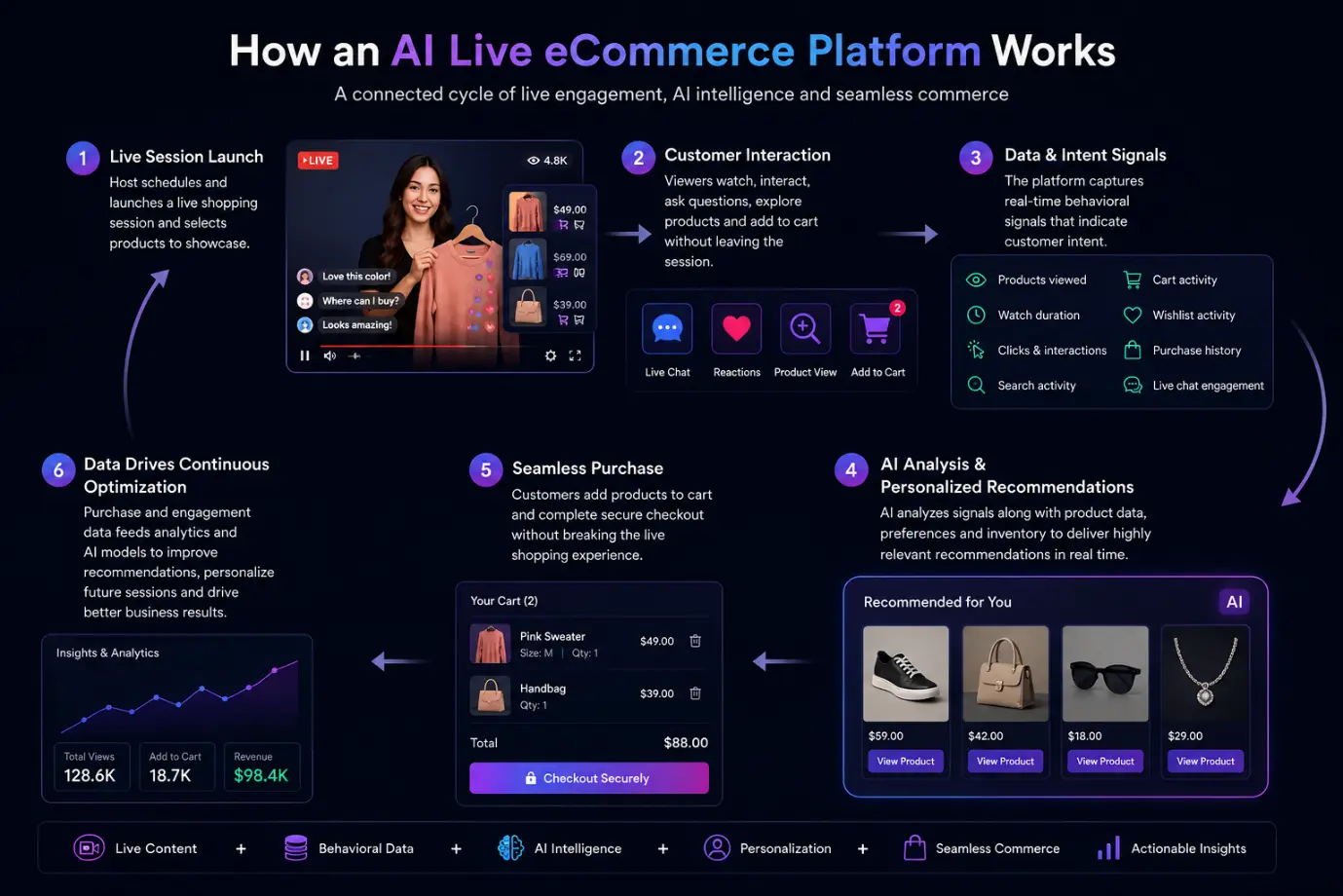
The process starts when a brand, seller, influencer, or sales representative schedules and launches a live shopping session. The host can select products from the ecommerce catalog and feature them during the broadcast.
The platform connects each featured product with relevant information such as:
Viewers can watch the live session while exploring featured products within the same commerce environment. They can open product cards, view details, ask questions, react to the content, and add products to their cart.
Customer interactions generate valuable behavioral signals, including:
These signals help the platform identify customer interests and purchasing intent.
The AI recommendation engine processes customer behavior along with product information, purchase history, inventory, and live-session context.
It can recommend:
For example, a customer repeatedly viewing a particular dress could receive recommendations for matching shoes, handbags, or accessories.
Featured and recommended products can be added directly to the cart. An integrated checkout experience allows customers to complete purchases without unnecessarily leaving the live shopping environment.
After the transaction, purchase and engagement data can be used for analytics and future personalization. Businesses can identify high-performing products, customer preferences, conversion patterns, and opportunities to improve upcoming live shopping sessions.
This creates a connected cycle where live content generates engagement, engagement produces behavioral data, AI converts that data into personalized recommendations, and commerce data supports continuous optimization.
Is your business still treating live shopping as a promotional activity when live video is increasingly becoming part of how customers discover, evaluate, and purchase products?
For brands already investing in social commerce, influencer marketing, video content, and digital retail, the next question is not simply whether to host more livestreams. It is whether the business needs a dedicated commerce infrastructure that can connect live content, customer intent, product discovery, AI personalization, and transactions within one controlled ecosystem.
The market is moving in that direction. The Business Research Company projects the global live commerce market to grow from $25.63 billion in 2025 to $31.79 billion in 2026, reaching $74.52 billion by 2030.
For businesses evaluating AI live ecommerce platform development, the following are the key reasons to consider making the investment.
Live shopping is moving beyond occasional product launches and promotional livestreams. Businesses are increasingly considering it as a structured part of their digital commerce strategy.
When live sessions become frequent and generate meaningful customer engagement, relying entirely on social platforms may limit how much control a brand has over the shopping experience.
A dedicated platform allows businesses to build live commerce into their broader digital infrastructure rather than treating every livestream as an isolated campaign.
Social platforms are effective for reaching audiences, but the customer journey can become fragmented when discovery happens on one platform and purchasing happens somewhere else.
For brands with substantial social audiences, this can create unnecessary movement between:
social content → live session → product discovery → external website → checkout
Investing in a dedicated platform allows businesses to design a more controlled journey around their own products, customers, data, and commerce infrastructure.
AI is becoming increasingly relevant to ecommerce discovery. Customers can use AI-powered tools to find products, compare options, ask questions, and receive personalized suggestions.
This creates a strategic reason for ecommerce businesses to develop infrastructure that can support:
Businesses investing in live commerce today can therefore consider AI capabilities as part of their long-term commerce architecture rather than adding them later as disconnected features.
Most conventional ecommerce platforms are built around catalogs, product pages, search, cart, checkout, inventory, and order management.
Live commerce introduces additional technical requirements, including:
As live selling becomes a significant part of a company's sales strategy, businesses may need infrastructure specifically designed to support these requirements.
A small live shopping event and an enterprise-scale product launch have very different technical requirements.
Large fashion brands, retail chains, beauty companies, and consumer electronics businesses may need to support:
This makes scalability an important consideration before businesses build AI live ecommerce platform technology.
Businesses increasingly need greater ownership of their customer relationships and digital commerce experiences.
A dedicated platform can connect live shopping with existing:
This creates an owned commerce layer that can continue evolving as the business expands its digital strategy.
Live commerce does not have to operate separately from websites, mobile applications, physical stores, or social channels.
A customer might discover a product through social media, join a live session, interact with the brand, purchase through the company's commerce platform, and later engage through its mobile app or physical store.
This makes live commerce relevant for businesses building a connected omnichannel experience rather than another isolated sales channel.
The decision to invest today should also consider the technologies businesses may need tomorrow.
Future live commerce experiences can incorporate:
Designing the platform architecture with these capabilities in mind can reduce the need for major technological restructuring as the business adopts more advanced AI solutions.
Not every business needs to build its own platform immediately.
However, developing a dedicated solution becomes more relevant when a business has:
At that stage, continuing to depend entirely on third-party live commerce infrastructure may limit the company's control over its product roadmap and customer experience.
For businesses treating live commerce as a long-term revenue channel rather than a short-term marketing experiment, AI live ecommerce platform development can provide the technology foundation needed to build a more controlled, intelligent, and scalable commerce ecosystem.
For businesses planning to develop AI live stream shopping platform technology, the opportunity goes beyond adding livestreaming to an existing online store. The combination of live video, real-time interaction, ecommerce, and AI can create a more responsive shopping environment where customers discover products while they are already engaged with the brand.
A common question from businesses is: “We already have an ecommerce website and social media audience, so what would we gain by building our own AI-powered live commerce platform?” The answer lies in how effectively the platform can connect customer engagement with product discovery, personalization, and purchasing decisions.
Current ecommerce research also shows that AI is becoming increasingly important across the customer journey. Shopify reports that AI-powered shopping referrals to Shopify stores grew more than eight times year over year by Q1 2026, with those visitors converting at nearly 50% higher rates and spending 14% more.
For businesses considering AI live selling platform development, the following six benefits make the investment particularly relevant.
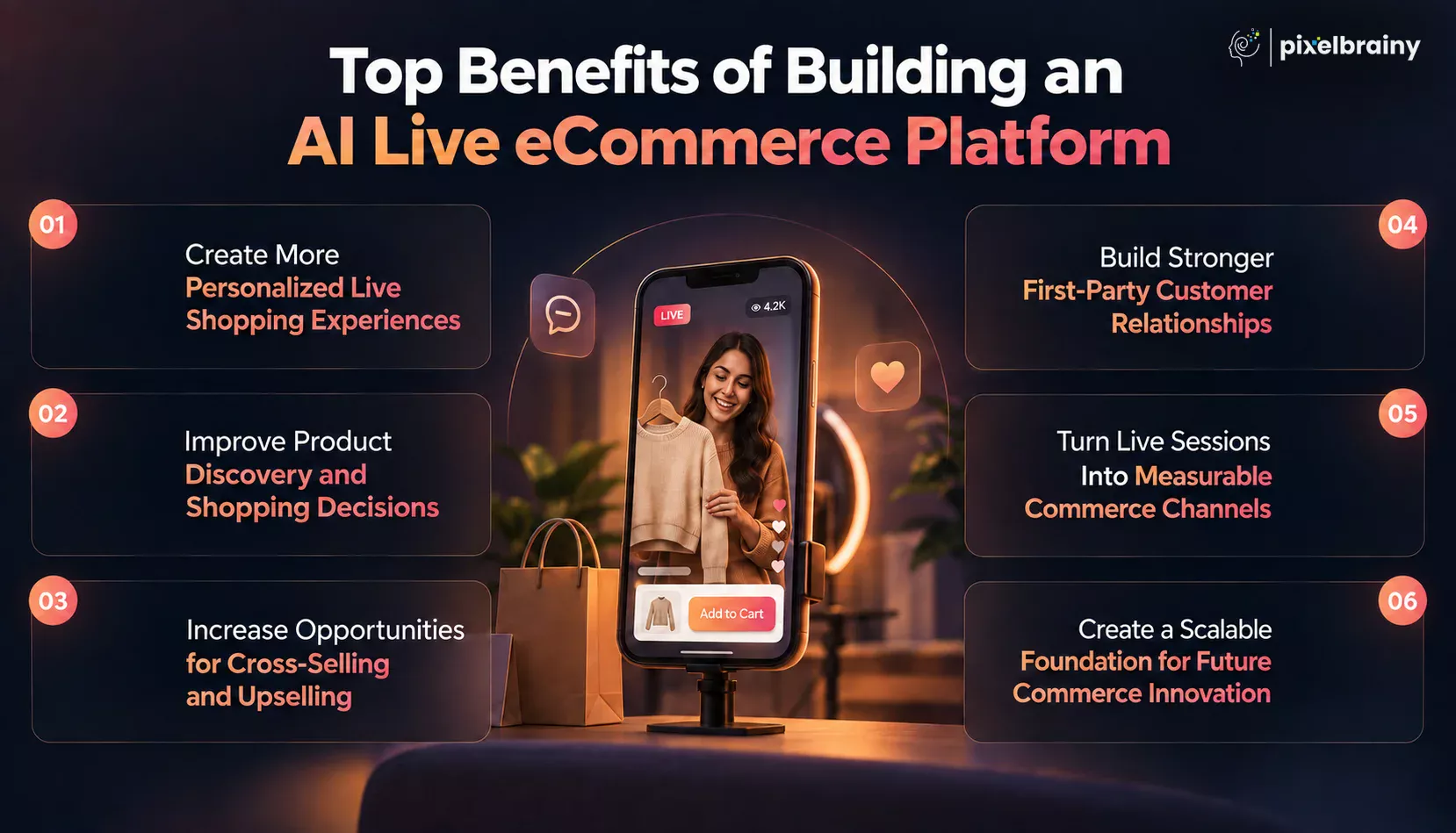
One of the biggest advantages of building an AI live ecommerce platform is the ability to personalize what each customer sees during a live shopping session. Instead of showing identical product suggestions to every viewer, AI can use available customer signals such as browsing activity, purchase history, product interactions, preferences, and current session behavior to generate more relevant recommendations.
For example, a customer watching a fashion livestream may receive recommendations for products that match their preferred styles, sizes, colors, or previously purchased items. This makes the live session feel more relevant to individual shoppers rather than functioning as a one-size-fits-all broadcast.
Live video can demonstrate how a product looks, works, or fits, while AI can help customers discover products that match their specific requirements. This combination can be particularly valuable for fashion, beauty, electronics, home decor, and lifestyle products where customers often need additional context before purchasing.
An AI live video commerce platform can allow shoppers to ask questions, explore featured products, compare alternatives, and receive contextual recommendations during the session. Instead of manually searching through a large catalog, customers can discover relevant products based on their interests and interactions.
An AI-powered live commerce platform can identify relationships between products and use those relationships to present relevant cross-selling and upselling opportunities. A customer viewing a dress, for example, could receive recommendations for matching footwear, handbags, jewelry, or other accessories.
The important distinction is context. Recommendations can be connected to what the customer is currently watching or interacting with rather than appearing as generic product suggestions. For businesses looking to make an AI live ecommerce platform like TikTok Shop or Amazon Live, this contextual product discovery can become an important part of the commerce experience.
Businesses that to create an AI live ecommerce platform can gain greater control over the customer experience and the data generated through live shopping interactions. Instead of depending entirely on third-party social platforms for discovery and engagement, brands can build a dedicated environment connected to their ecommerce ecosystem.
The platform can connect customer interactions with existing CRM, ecommerce, loyalty, inventory, and analytics systems. This creates a more unified view of the customer journey and gives businesses greater flexibility to develop personalized experiences, loyalty strategies, and future commerce features.
A dedicated live commerce platform can provide businesses with deeper visibility into what happens during each shopping session. Instead of measuring only views or likes, businesses can evaluate the complete journey from engagement to purchase.
Key metrics can include:
These insights can help businesses identify which products, hosts, content formats, and recommendations generate stronger commercial outcomes. This makes the development of AI live stream shopping platform technology more measurable than treating live video solely as a marketing activity.
Building an AI live ecommerce platform can give businesses a technology foundation that can evolve as customer expectations change. Once live video, ecommerce, customer data, and AI capabilities are connected, businesses can progressively introduce more advanced experiences.
Future capabilities can include AI shopping assistants, conversational commerce, virtual try-on, predictive recommendations, AI-powered search, intelligent host assistance, automated content generation, and advanced customer analytics.
This makes AI live stream shopping platform development more than a one-time feature investment. With the right architecture, the platform can become an extensible commerce environment that supports new AI capabilities, customer touchpoints, and revenue models as the business grows.
The real value of an AI live ecommerce platform lies in connecting live engagement with personalized discovery, measurable commerce, customer relationships, and a foundation for future digital retail innovation.
Not every business needs the same type of AI live ecommerce platform. A fashion brand converting its Instagram audience into direct customers will have very different requirements from a grocery chain running live cooking sessions, a marketplace connecting thousands of sellers, or an enterprise retailer serving hundreds of thousands of viewers.
Before businesses build AI live ecommerce platform technology, they need to decide what the platform is actually designed to achieve. The business model, target users, monetization strategy, customer acquisition channel, AI capabilities, integrations, and expected traffic all influence the right product structure.
Below are seven major types of AI live commerce platforms businesses can consider developing.
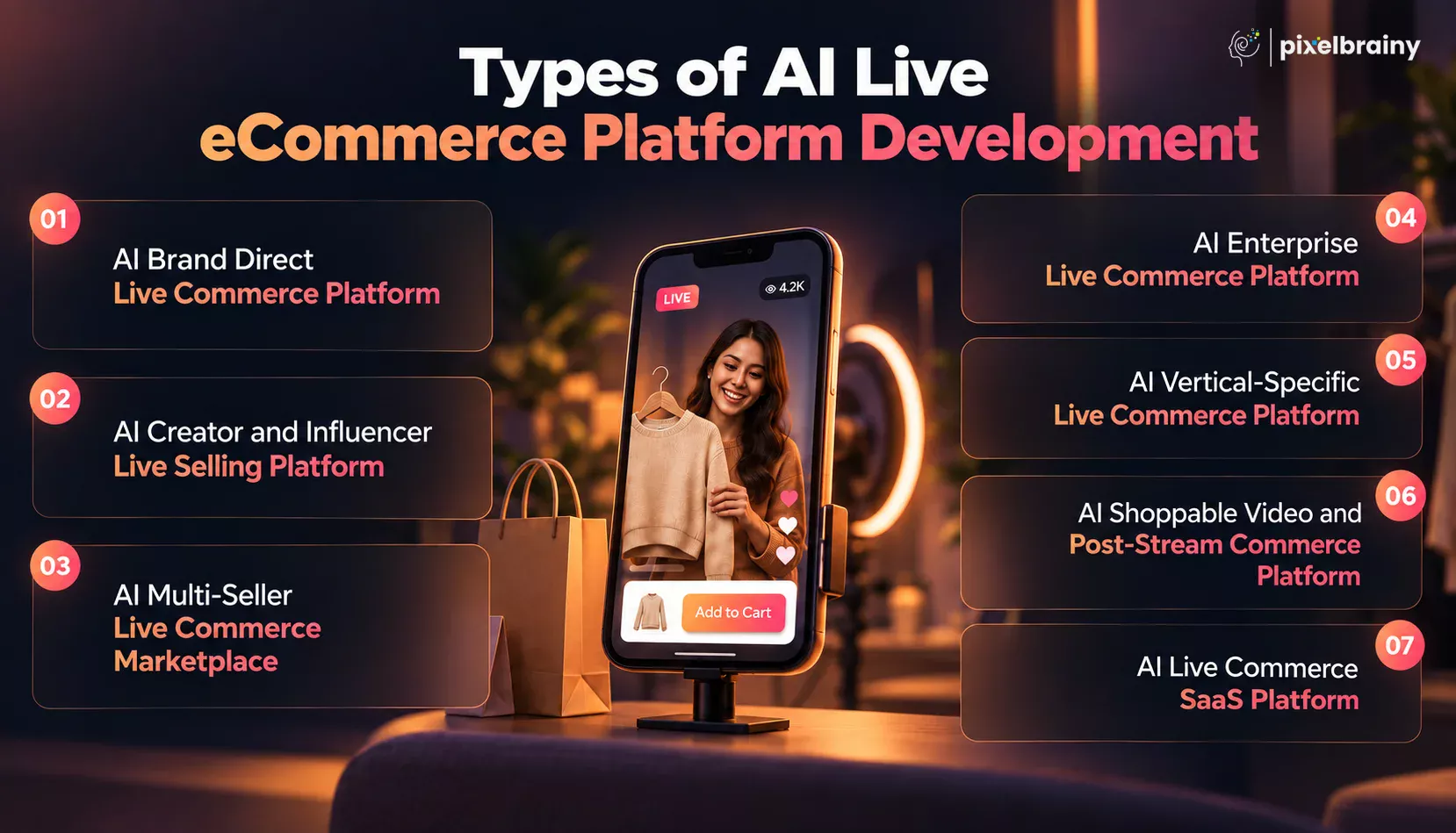
An AI brand direct live commerce platform is a proprietary live shopping environment built for a specific brand or retailer. Instead of sending viewers from social media to a separate ecommerce website, the brand can create its own branded environment for live selling, customer engagement, product discovery, and checkout.
This model is ideal for established brands that already have a significant audience and want greater ownership of customer relationships, commerce data, and the overall purchasing journey. It can integrate with existing ecommerce, CRM, inventory, loyalty, and payment systems.
Product design implication: Prioritize branded UX, first-party customer data, seamless checkout, AI personalization, CRM integration, and direct connections with the existing ecommerce infrastructure.
For example, we want to build an AI live ecommerce platform that brings our proven TV home shopping format into a genuinely interactive digital experience with real-time viewer questions, AI host assistance for product information retrieval, dynamic pricing during countdown sales, and seamless mobile checkout. The platform therefore needs to combine the entertainment format of live television commerce with the personalization and transaction capabilities of modern digital commerce.
An AI creator and influencer live selling platform is designed for content creators, influencers, and independent sellers who want to monetize their audiences through live video commerce. It can provide creator onboarding, product catalog management, commission tracking, payment management, live-session scheduling, and AI assistance for product recommendations and customer questions.
Product design implication: The platform should make live selling simple enough for an individual creator to manage without a production team while providing automated product information, AI recommendations, engagement insights, and creator revenue tracking.
This model is particularly suitable for businesses building products around the creator economy, where the platform itself needs to attract and retain a large network of creators.
An AI multi-seller live commerce marketplace brings multiple independent sellers and brands into one live shopping destination. Each seller can host live sessions, showcase products, interact with customers, and manage transactions while the platform uses AI to personalize which sellers, products, and live sessions individual shoppers see.
Product design implication: The architecture must support seller onboarding, multi-vendor catalogs, marketplace payments, commissions, moderation, seller analytics, product discovery, and AI-powered session recommendations.
This model works well for founders who want to develop AI live ecommerce platform technology as a marketplace rather than building a live commerce tool for one individual brand.
An AI enterprise live commerce platform is designed for major retailers, large consumer brands, retail chains, and media organizations operating live commerce at significant scale. It can support multiple hosts, simultaneous live sessions, regional storefronts, enterprise analytics, CRM integration, and large concurrent audiences.
Product design implication: Enterprise-grade architecture should prioritize scalability, high availability, security, multi-region infrastructure, advanced analytics, disaster recovery, and integrations with existing commerce and marketing technology.
For an organization researching how to build scalable AI live ecommerce platform for enterprise brands and retail chains in 2026, infrastructure planning must happen before feature development because concurrent audience requirements can significantly influence the architecture and operating cost.
An AI vertical-specific live commerce platform is purpose-built around the purchasing behavior, workflows, and regulatory requirements of one industry. Instead of creating a general-purpose platform, businesses can design specialized experiences for categories such as grocery, luxury retail, health and wellness, fashion, beauty, or home furnishings.
Product design implication: The platform should prioritize industry-specific AI capabilities, workflows, integrations, and compliance requirements.
For example, we are a grocery chain and we want to build an AI live ecommerce platform that allows our in-store chefs and nutrition specialists to host weekly live cooking demonstrations where viewers can add all the ingredients being used in the recipe directly to their grocery cart in real time. That requirement calls for recipe-to-cart mapping, real-time product availability, ingredient recommendations, inventory integration, and a shopping experience designed specifically around grocery purchasing.
The same principle applies to specialized industries. Our luxury goods company wants to build an AI live ecommerce platform that allows our in-store stylists to host intimate live shopping sessions for our top-tier clients, combining the personal service experience of our physical stores with the convenience of remote attendance. Such a platform would require private sessions, customer authentication, stylist profiles, personalized recommendations, clienteling capabilities, and premium service workflows.
An AI shoppable video platform extends the value of live commerce beyond the original broadcast. AI can identify products and important moments within recorded sessions, create shoppable clips, organize searchable product content, and recommend previous live-session videos to customers who missed the original event.
Product design implication: Video indexing, product-content mapping, AI-generated clips, searchable recordings, recommendation engines, and evergreen content discovery should be central to the architecture.
This model allows businesses to turn one live session into an ongoing library of commerce content instead of allowing its commercial value to end when the livestream finishes.
An AI live commerce SaaS platform is developed by a technology company and licensed to multiple brands, retailers, agencies, or media companies. Customers can use the platform as a white-label or co-branded live commerce solution, while the technology provider generates revenue through subscriptions, platform fees, transaction revenue sharing, usage-based pricing, or a combination of these models.
Product design implication: The platform requires multi-tenant architecture, self-service onboarding, configurable branding, billing, APIs, analytics, customer management, security isolation, technical support, and infrastructure capable of meeting commercial SLA requirements.
This model is particularly relevant for founders planning to develop AI live commerce platform technology as a scalable software business rather than as a solution for one organization.
For example, our pharmaceutical retail company wants to build an AI live ecommerce platform where our licensed pharmacists can host live health and wellness product education sessions with strict content compliance controls. In this scenario, the platform would need role-based access, approved content workflows, AI moderation, compliance monitoring, audit trails, secure customer data handling, and controlled product recommendations.
The right platform model establishes the foundation for the AI features, product architecture, monetization strategy, user experience, and infrastructure required for successful AI live ecommerce platform development.
A successful AI live ecommerce platform needs more than live video and an online checkout. The core product should connect livestreaming, product discovery, customer interaction, ecommerce operations, payments, analytics, and essential AI capabilities within one reliable shopping environment.
For businesses planning to develop AI live ecommerce platform technology, the priority should be building a strong core feature set before moving toward advanced capabilities such as predictive AI, virtual try-on, or sophisticated automation. This approach helps create an MVP that is commercially useful while providing a foundation for future expansion.
A common requirement from businesses is: “We are planning to build an AI live ecommerce platform where customers can watch live product demonstrations, interact with hosts, receive relevant product recommendations, and purchase products without leaving the shopping experience. Which core features should we include in the first version?”
The following 15 features provide the essential foundation for AI live commerce platform development.
| Feature | Explanation |
|---|---|
| Live video streaming | Live video streaming forms the foundation of an AI live stream shopping platform, allowing brands, creators, and sellers to showcase products in real time. It should support high-quality broadcasting, adaptive streaming, low latency, stream recording, and reliable delivery across different viewer volumes. |
| Shoppable product catalog | A shoppable product catalog connects products directly with live content. Customers can view product images, descriptions, prices, sizes, colors, reviews, availability, and purchase options while watching a session, reducing the need to leave the live shopping environment. |
| Real-time product tagging | Real-time product tagging allows hosts to feature specific products during a live broadcast. Customers can select a product tag to access its details, check available variants, view pricing, and add the product to their cart while continuing to follow the session. |
| Live chat and customer interaction | Live chat enables customers to communicate with hosts, sellers, and other shoppers during a broadcast. Core capabilities should include comments, questions, reactions, message moderation, and interaction management to create an engaging live ecommerce platform development experience. |
| AI product recommendations | AI product recommendations personalize product discovery using available customer signals such as browsing activity, product interactions, purchase history, preferences, and live-session behavior. The recommendation engine can suggest relevant products while customers are actively engaged with the live shopping experience. |
| AI shopping assistant | An AI shopping assistant can provide instant answers about product specifications, sizes, availability, pricing, shipping, returns, and other common questions. This feature supports customers during live sessions while allowing hosts to concentrate on demonstrations and direct audience engagement. |
| Cart and checkout | Integrated cart and checkout functionality allows customers to purchase featured or recommended products without unnecessarily leaving the live shopping experience. The checkout should provide a fast, mobile-friendly journey covering product selection, address details, payment, order confirmation, and relevant purchase information. |
| Multiple payment options | A live commerce platform should support payment methods appropriate for its target markets, such as cards, digital wallets, bank-based payments, and other local options. Secure and reliable payment processing is essential for minimizing transaction friction and maintaining customer confidence. |
| Host and seller dashboard | A host and seller dashboard gives merchants and presenters control over their live shopping activities. They should be able to schedule sessions, select products, feature items, monitor viewers, respond to interactions, manage promotions, and review sales generated during broadcasts. |
| Customer profiles | Customer profiles organize important information such as account details, preferences, purchase history, wishlist activity, product interactions, and engagement behavior. These profiles provide the data foundation required for personalized shopping experiences and relevant AI-powered product recommendations. |
| Inventory synchronization | Inventory synchronization keeps product availability consistent between the live commerce platform and existing ecommerce or inventory systems. Real-time stock updates can help prevent purchases of unavailable products and allow hosts to respond when inventory levels change during a live session. |
| Order management | Order management connects live shopping transactions with fulfillment operations. Businesses should be able to view orders, update statuses, process cancellations and refunds, monitor fulfillment, and connect transactions with existing ecommerce, ERP, warehouse, and shipping systems. |
| Promotions and discount management | Promotion management allows businesses to create live shopping offers such as coupon codes, limited-time discounts, flash sales, bundle pricing, and promotional campaigns. Hosts can introduce relevant offers during broadcasts while customers can apply eligible discounts during checkout. |
| Analytics and reporting | Analytics and reporting help businesses measure the commercial performance of live shopping sessions. Core metrics should include viewers, watch duration, product clicks, engagement, add-to-cart activity, checkout progression, conversions, revenue, and product-level performance. |
| Admin panel | The admin panel provides centralized control over users, sellers, hosts, products, live sessions, orders, payments, promotions, content, and platform settings. Administrators can manage permissions, moderation, reports, configurations, and operational activities from a centralized interface. |
These core capabilities provide the foundation businesses need to build AI live ecommerce platform solutions that connect live engagement with product discovery, personalization, transactions, and measurable commerce outcomes.
A well-designed core feature set gives an AI live ecommerce platform the foundation to convert live audience engagement into a connected and scalable shopping experience.
Once the core live commerce functionality is established, businesses can introduce advanced AI and automation capabilities to make the platform more intelligent, personalized, and commercially responsive. These features are particularly relevant for businesses looking to develop AI live ecommerce platform solutions that can scale beyond basic livestreaming and product transactions.
For brands planning to build AI live ecommerce platform technology for large audiences, advanced features should be selected according to customer behavior, product category, business objectives, available data, and expected return on investment.
| Advanced Feature | Explanation |
|---|---|
| Real-time AI recommendation engine | A real-time AI recommendation engine analyzes viewer behavior, product interactions, purchase history, session context, and product relationships to recommend relevant products during a live session. Unlike basic recommendations, it can continuously update suggestions as customer intent changes throughout the broadcast. |
| Conversational AI shopping assistant | A conversational AI shopping assistant allows customers to ask natural-language questions such as “Which dress would work for a summer wedding?” or “Show me something similar under $100.” The system can understand intent, search the catalog, compare products, and provide personalized suggestions. |
| AI-powered predictive analytics | Predictive analytics can analyze historical purchases, live-session behavior, inventory patterns, and customer activity to identify potential purchasing behavior. Businesses can use these insights for demand forecasting, customer segmentation, campaign planning, inventory decisions, and live-session optimization. |
| AI-powered virtual try-on | AI and augmented reality can allow customers to visualize products before purchasing. Fashion businesses can offer virtual clothing or accessory experiences, while beauty, eyewear, furniture, and home decor brands can use visualization capabilities to help customers understand how products may look in different contexts. |
| AI-powered personalized offers | AI can determine which promotions may be most relevant to individual customers based on their shopping behavior, purchase history, product interests, and engagement. The platform can deliver personalized discounts, bundles, loyalty offers, or limited-time promotions without applying identical offers to every viewer. |
| AI host assistant | An AI host assistant can support presenters during live sessions by providing product information, answering internal product questions, identifying popular products, suggesting talking points, and highlighting customer questions that require attention. This can help hosts manage large audiences without needing a large support team. |
| AI content generation and repurposing | AI can analyze recorded live sessions and automatically generate product clips, short-form videos, product highlights, summaries, captions, and promotional content. Businesses can reuse live commerce content across product pages, social channels, marketing campaigns, and post-stream shopping experiences. |
| AI-powered visual product search | Visual search allows customers to upload or select an image and find visually similar products from the catalog. This can be particularly valuable for fashion, furniture, beauty, accessories, and lifestyle ecommerce businesses where customers often discover products visually rather than through text-based searches. |
| AI fraud and risk detection | AI can analyze transaction behavior, account activity, payment patterns, and unusual interactions to identify potentially suspicious activity. Advanced risk detection can help businesses reduce fraudulent transactions, fake accounts, payment abuse, and other threats while maintaining a smooth customer experience. |
| AI-powered live-session intelligence | AI can evaluate a completed live session and identify important commercial insights such as high-engagement moments, frequently discussed products, customer questions, viewer drop-off points, product conversion patterns, and host performance. These insights can help businesses improve future livestream strategies and content planning. |
These advanced capabilities can turn an AI live commerce platform from a basic livestream selling solution into a more intelligent commerce ecosystem that continuously adapts to customer behavior and business requirements.
The right advanced AI features should be selected according to measurable business objectives, available customer data, platform scale, and the expected commercial value rather than adding AI capabilities simply for technological novelty.
Building an AI live ecommerce platform from idea to launch requires more than combining livestreaming with an online store. Businesses need to define the commercial model, validate the concept, design the customer journey, establish the right architecture, develop core ecommerce and streaming capabilities, integrate AI, test real-world performance, and prepare the platform for scale.
For founders researching the steps to build AI live ecommerce platform from idea to launch, a phased approach can reduce unnecessary development costs and make it easier to validate the product before investing in advanced capabilities.
A relevant business scenario is: “We have validated demand for live shopping through manual livestreams, but our current process depends on spreadsheets, external checkout links, and separate customer tools. We want to create an AI live ecommerce platform that can automate the experience while giving us a clear path from MVP to enterprise scale.”
Therefore, a practical development process of AI live ecommerce platform can be divided into eight stages, starting with business discovery and ending with deployment, optimization, and scaling.
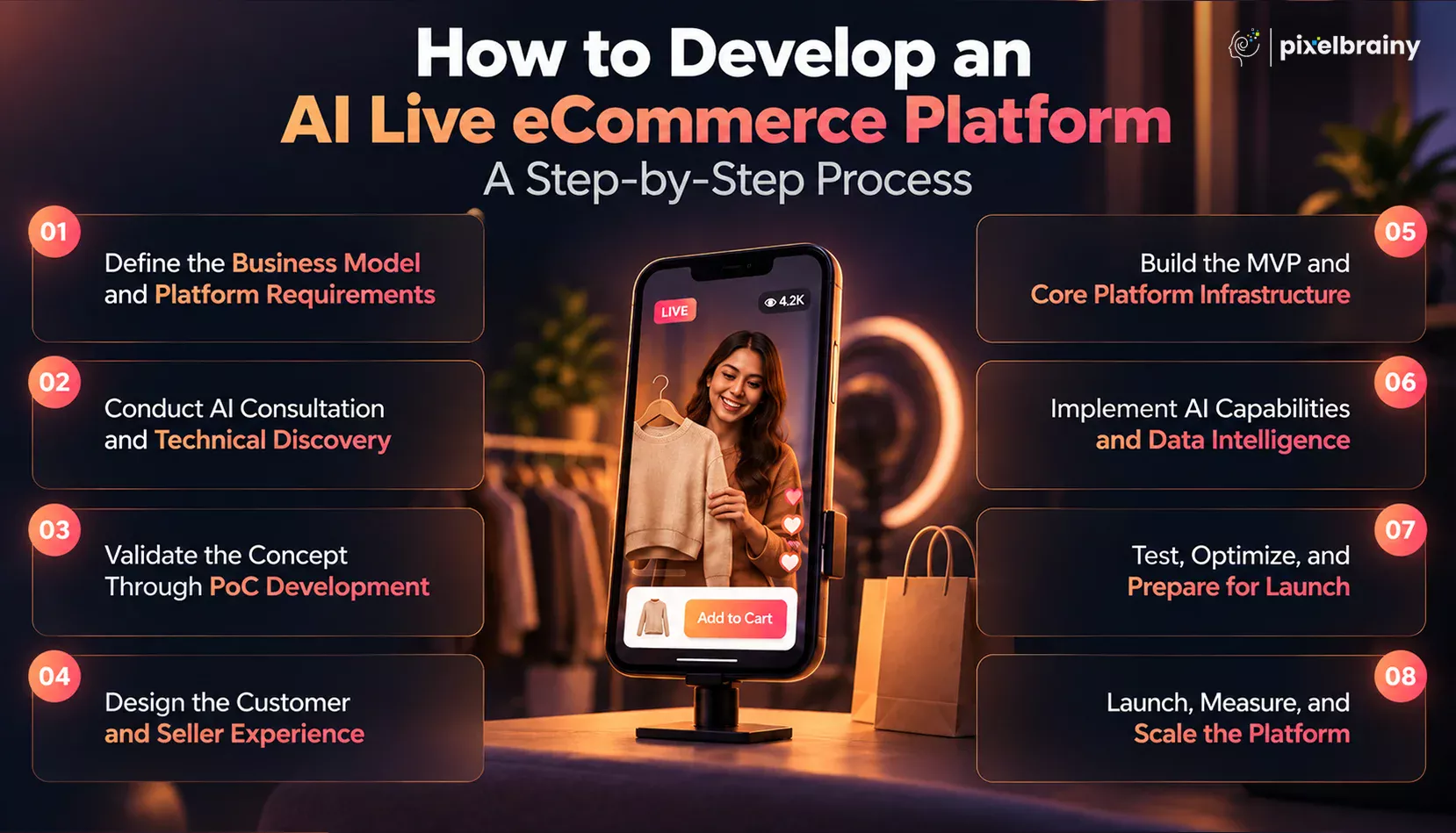
The first step in how to build AI live ecommerce platform from scratch is defining what the platform needs to accomplish commercially. Businesses should identify the target audience, product categories, revenue model, live selling format, geographic markets, expected users, and customer acquisition channels before discussing technical implementation.
The product scope should also distinguish between essential and optional capabilities. For example, an ecommerce startup may initially require live streaming, product tagging, AI recommendations, cart, checkout, payments, and analytics, while advanced personalization can be introduced later.
Businesses should document user roles such as customers, hosts, sellers, administrators, and support teams. This creates a clear product foundation for AI live ecommerce platform for ecommerce startups and established retailers.
Once the business requirements are defined, technical discovery determines whether the proposed platform can deliver the intended experience within the available budget, timeline, and infrastructure constraints. An AI consultation can help identify where AI can create measurable value and where conventional software logic may be more appropriate.
The discovery stage should examine recommendation requirements, customer data availability, product catalog quality, live video requirements, integrations, security, scalability, and expected concurrent users.
The team should also determine whether existing ecommerce infrastructure can be extended or whether a separate commerce layer is required. A technical feasibility review can identify integration dependencies and potential risks before development begins.
Before committing to full-scale live ecommerce platform development using AI, businesses can validate technically complex concepts through a proof of concept. PoC development is particularly useful when the platform depends on capabilities such as low-latency streaming, real-time recommendations, conversational shopping, or integrations with complex enterprise systems.
The objective is not to build the complete product. Instead, the team tests whether the critical technology can work as expected.
For example, a PoC could demonstrate whether customer behavior during a live session can be processed quickly enough to generate relevant product recommendations. It can also validate streaming quality, API connectivity, AI response times, or checkout integration before larger development resources are committed.
The next stage focuses on designing how customers, hosts, sellers, and administrators interact with the platform. A specialist UI/UX design company can translate the business requirements into user flows, wireframes, prototypes, and final interface designs.
The customer journey should make the primary actions obvious: joining a live session, discovering products, asking questions, viewing recommendations, adding products to the cart, and completing checkout.
The host experience should be equally straightforward, covering session scheduling, product selection, product tagging, audience interaction, and live performance monitoring.
The design should also consider mobile-first usage, accessibility, responsive layouts, page performance, and consistent brand identity across the entire shopping journey.
After validating the concept and approving the product design, the development team can begin MVP development. The MVP should contain the smallest practical feature set required to launch the live commerce business and measure customer behavior.
Core functionality may include user accounts, product catalogs, live streaming, product tagging, live chat, cart, checkout, payments, order management, inventory synchronization, and basic analytics.
The backend should be structured to support future integrations and scaling rather than creating a temporary architecture that must be rebuilt after launch. Businesses should also establish authentication, authorization, database structures, APIs, cloud infrastructure, monitoring, and security controls during this phase.
Also Read: Top 10 AI MVP Development Companies in USA
Once the core platform is functional, the team can introduce AI integration based on the priorities established during discovery. The first AI capabilities should address measurable customer or operational problems rather than simply adding multiple AI features.
A recommendation system can use product attributes, browsing behavior, purchase history, and live-session interactions to personalize product discovery. A conversational assistant can answer product questions, while AI analytics can identify engagement and conversion patterns.
For businesses requiring proprietary recommendation or prediction capabilities, AI model development may involve data preparation, model selection, training, evaluation, deployment, monitoring, and continuous optimization.
The AI layer should remain connected to the ecommerce catalog, customer data, inventory, and analytics infrastructure.
Before launching the platform, businesses need comprehensive functional, performance, security, usability, and AI testing. Live commerce introduces additional testing requirements because streaming, real-time interactions, ecommerce transactions, and AI services must operate together without creating noticeable delays or failures.
The team should test different traffic levels, concurrent viewers, payment scenarios, product availability changes, recommendation responses, live chat activity, and unexpected infrastructure failures.
Businesses should also validate AI outputs for relevance, accuracy, consistency, and appropriate handling of customer requests.
For organizations evaluating AI product development companies, the ability to conduct structured testing and provide measurable quality benchmarks should be an important selection criterion.
The final stage is not simply releasing the application to the public. A successful launch should begin with controlled traffic, clear performance monitoring, and defined business metrics.
Businesses should track viewer engagement, watch duration, product clicks, recommendation interactions, add-to-cart activity, checkout completion, conversion rate, revenue per session, and customer retention.
The initial results can reveal where the customer journey needs improvement and which AI capabilities deserve further investment. As demand increases, the infrastructure can be expanded to support additional regions, languages, hosts, products, and concurrent viewers.
Companies can also evaluate top AI development companies for ongoing optimization, maintenance, infrastructure scaling, and new AI product capabilities.
Following a phased development process allows businesses to validate the live commerce concept, control initial investment, and progressively build an AI-powered platform that can scale with customer demand.
The cost to develop an AI live ecommerce platform typically ranges from $50,000 to $300,000+, depending on the platform's complexity, AI capabilities, live streaming infrastructure, integrations, number of applications, security requirements, and expected audience size.
For businesses preparing the development budget of AI live ecommerce platform, the biggest challenge is usually determining what should be included in the initial investment and which capabilities can be introduced later. A basic MVP with live streaming, product tagging, checkout, and essential AI recommendations will require a very different budget from an enterprise platform supporting hundreds of thousands of concurrent viewers, multiple regions, advanced AI personalization, and complex enterprise integrations.
A common question from businesses planning their investment is: “We are planning to build an AI live ecommerce platform for our retail business, but we have a limited initial budget. How much should we allocate for the MVP, which features will increase the development cost, and how much additional investment should we expect when we scale the platform?”
The cost estimation of AI live ecommerce platform should therefore begin with the business model and product scope rather than a fixed development price. Businesses asking “what is the development pricing of AI live ecommerce platform?” should evaluate the platform type, target audience, core features, AI requirements, integrations, technology stack, and expected traffic before setting the final budget.
| Platform Type | Typical Scope | Estimated Development Cost |
|---|---|---|
| Basic AI Live eCommerce Platform | MVP with live streaming, product catalog, product tagging, live chat, basic AI recommendations, cart, checkout, payments, customer accounts, order management, and basic analytics | $50,000 to $90,000 |
| Advanced AI Live eCommerce Platform | Scalable streaming, personalized AI recommendations, AI shopping assistant, advanced analytics, seller and host dashboards, promotions, inventory synchronization, multiple integrations, mobile apps, and enhanced security | $90,000 to $180,000 |
| Enterprise AI Live eCommerce Platform | High-concurrency streaming, advanced AI personalization, proprietary AI models, multi-region infrastructure, multiple applications, CRM and ERP integration, advanced security, high availability, analytics, automation, and extensive customization | $180,000 to $300,000+ |
These are indicative development ranges. The final AI live ecommerce platform development cost depends on the exact product requirements, development team, technology choices, integrations, and infrastructure.
| Cost-Affecting Factor | What Increases the Cost | Indicative Cost Impact |
|---|---|---|
| UI/UX design | Custom customer, host, seller, and admin interfaces, prototypes, design systems, animations, and usability testing | $5,000 to $20,000 |
| Live video streaming | Low-latency streaming, HD video, recording, CDN, adaptive bitrate, multiple hosts, and high concurrent viewers | $10,000 to $50,000+ |
| AI recommendation engine | Personalized recommendations based on customer behavior, product relationships, purchase history, and contextual signals | $10,000 to $40,000+ |
| AI shopping assistant | Conversational product discovery, product Q&A, catalog integration, contextual responses, and AI guardrails | $8,000 to $30,000+ |
| AI model development | Custom model training, proprietary recommendation models, data preparation, evaluation, deployment, and monitoring | $20,000 to $80,000+ |
| Mobile applications | Separate iOS and Android applications or advanced cross-platform mobile experiences | $15,000 to $60,000+ |
| Ecommerce functionality | Product catalog, cart, checkout, order management, inventory, promotions, customer accounts, and returns | $10,000 to $35,000+ |
| Payment integration | Multiple payment gateways, wallets, transaction verification, refunds, fraud controls, and regional payment methods | $3,000 to $15,000+ |
| CRM and ERP integration | Connecting CRM, ERP, inventory, loyalty, marketing, and customer data systems | $5,000 to $30,000+ |
| Analytics and reporting | Live-session analytics, customer behavior tracking, conversion funnels, revenue dashboards, and AI insights | $5,000 to $20,000+ |
| Security and compliance | Encryption, authentication, role-based access, audit logs, data protection, payment security, and compliance controls | $5,000 to $30,000+ |
| Cloud infrastructure | Hosting, databases, storage, CDN, load balancing, monitoring, auto-scaling, and disaster recovery | $5,000 to $30,000+ initially |
| Admin and seller dashboards | Multi-role dashboards, seller management, host controls, moderation, reporting, and platform configuration | $8,000 to $30,000+ |
| Third-party integrations | Shipping, social platforms, analytics, communication, authentication, marketing, logistics, and external APIs | $3,000 to $25,000+ |
| Testing and quality assurance | Functional, security, performance, streaming, payment, mobile, usability, and AI accuracy testing | $5,000 to $20,000+ |
| Post-launch maintenance | Bug fixes, security updates, infrastructure monitoring, AI optimization, feature improvements, and technical support | $2,000 to $15,000+ per month |
A basic AI live ecommerce platform can focus on validating the business model with essential capabilities such as live streaming, product tagging, basic recommendations, checkout, and analytics.
An advanced AI live ecommerce platform requires greater investment when businesses add personalized recommendation engines, AI shopping assistants, multiple applications, sophisticated analytics, enterprise integrations, and higher streaming capacity.
An enterprise AI live ecommerce platform requires a substantially larger budget when it needs to support large concurrent audiences, multiple live sessions, multi-region operations, proprietary AI models, advanced security, high availability, and extensive integrations.
Development rates can vary considerably based on the location and structure of the development team.
| Development Team Model | Indicative Development Rate |
|---|---|
| India and South Asia | $25 to $60/hour |
| Eastern Europe | $40 to $80/hour |
| Latin America | $40 to $90/hour |
| Western Europe | $70 to $130/hour |
| United States and Canada | $100 to $200+/hour |
These are indicative ranges and can vary based on developer expertise, AI specialization, project complexity, engagement model, and company size.
Businesses do not necessarily need to build every capability in the first release. A phased strategy can help control the initial development budget of AI live ecommerce platform.
A practical MVP could prioritize:
After validating customer demand, businesses can progressively introduce advanced AI, proprietary recommendation models, virtual try-on, predictive analytics, automated content generation, multi-region infrastructure, and enterprise integrations.
A realistic AI live ecommerce platform development budget should prioritize high-value features today while leaving room for scalable AI capabilities and infrastructure tomorrow.

The technology stack determines how effectively an AI live ecommerce platform can handle live video, real-time customer interactions, product recommendations, transactions, customer data, and future growth. For businesses planning live ecommerce platform development using AI, the stack should support low-latency experiences while remaining flexible enough to integrate AI services, ecommerce systems, payment providers, analytics tools, and enterprise infrastructure.
A common technical concern is: “We are planning to build an AI live ecommerce platform for thousands of concurrent shoppers, and we need a technology stack that can support low-latency live streaming, real-time recommendations, secure payments, and integrations with our existing ecommerce systems without creating scalability problems later.”
The right architecture therefore depends on the platform's expected audience, live streaming requirements, AI workload, application platforms, existing business systems, and geographic reach. The following technology stack provides a practical foundation for businesses looking to develop AI live ecommerce platform solutions.
| Technology Layer | Recommended Tools and Technologies | Purpose in an AI Live eCommerce Platform |
|---|---|---|
| Web frontend | React, Next.js, TypeScript | Builds responsive customer, seller, host, and administrative interfaces with reusable components and fast web experiences. |
| Mobile application | Flutter, React Native, Swift, Kotlin | Supports iOS and Android live shopping experiences, allowing customers to watch streams, interact with products, and complete purchases from mobile devices. |
| Backend development | Node.js, Python, Java, Go, .NET | Handles business logic, APIs, authentication, product management, orders, payments, customer data, live-session management, and integrations. |
| API architecture | REST APIs, GraphQL, WebSockets | REST and GraphQL can handle standard commerce operations, while WebSockets support real-time interactions such as chat, notifications, viewer updates, and live engagement. |
| Live video streaming | WebRTC, HLS, RTMP, cloud video services | Provides video ingestion, encoding, playback, and real-time communication. WebRTC can support low-latency interactions, while HLS can support scalable video delivery. |
| Content delivery | CloudFront, Cloud CDN, Cloudflare | Delivers video and static content efficiently across geographic regions while reducing latency and improving platform performance. |
| AI and machine learning | Python, PyTorch, TensorFlow, AI APIs | Supports recommendation systems, customer segmentation, predictive analytics, conversational assistants, personalization, and other AI capabilities. |
| Generative AI and LLMs | Large language model APIs, open-source models, model-serving infrastructure | Powers conversational shopping assistants, product Q&A, content generation, product summarization, and natural-language product discovery. |
| Recommendation engine | Python, machine learning frameworks, vector databases, recommendation algorithms | Analyzes customer behavior, product attributes, purchase history, and contextual signals to deliver personalized product recommendations. |
| Primary database | PostgreSQL, MySQL | Stores structured information such as users, products, orders, inventory, payments, transactions, and platform configurations. |
| NoSQL database | MongoDB, DynamoDB, Firestore | Handles flexible, high-volume data such as activity records, session information, event data, and certain real-time application workloads. |
| Caching and real-time data | Redis | Improves response times and supports frequently accessed information, session management, caching, queues, and real-time application requirements. |
| Search and product discovery | Elasticsearch, OpenSearch | Enables fast product search, filtering, autocomplete, semantic discovery, and large-scale catalog exploration. |
| Cloud infrastructure | AWS, Microsoft Azure, Google Cloud | Provides scalable computing, storage, databases, networking, security, monitoring, and infrastructure services required for growing live commerce platforms. |
| Containerization and orchestration | Docker, Kubernetes | Helps package services consistently and manage scalable deployments across development, testing, and production environments. |
| Payment infrastructure | Stripe, Adyen, PayPal, regional payment gateways | Handles secure transactions, payment authorization, refunds, subscriptions, wallets, and other checkout requirements based on the target market. |
| Authentication and security | OAuth 2.0, OpenID Connect, JWT, identity platforms | Protects customer and administrator accounts while supporting secure authentication, authorization, role management, and access control. |
| Analytics and event tracking | Google Analytics, Mixpanel, Amplitude, custom event pipelines | Tracks viewer engagement, product interactions, shopping behavior, conversion funnels, revenue, and live-session performance. |
| Data warehouse | Snowflake, BigQuery, Amazon Redshift | Consolidates large volumes of customer, transaction, product, and behavioral data for advanced reporting, business intelligence, and AI workloads. |
| Message and event processing | Apache Kafka, Amazon SQS, RabbitMQ | Processes high volumes of events such as product interactions, orders, notifications, recommendation events, and live-session activity. |
| Monitoring and observability | Prometheus, Grafana, Datadog, CloudWatch | Monitors application health, infrastructure performance, streaming quality, API response times, errors, resource utilization, and system availability. |
| CI/CD and development operations | GitHub Actions, GitLab CI/CD, Jenkins | Automates testing, code integration, deployment, infrastructure updates, and release management across development and production environments. |
Therefore, a well-planned technology stack gives an AI live ecommerce platform the technical foundation required to deliver reliable live shopping today and support increasingly intelligent commerce experiences tomorrow.
Developing an AI live ecommerce platform requires multiple technologies to operate together in real time. Live video, AI recommendations, ecommerce transactions, customer interactions, inventory, payments, and analytics all need to remain reliable while customers are actively watching and purchasing products.
For businesses planning to develop AI live ecommerce platform technology, the major challenge is building an experience that remains fast, accurate, secure, and scalable as viewer numbers and transactions increase. A platform that works well for a small pilot may face completely different technical demands during a large product launch or influencer-led live shopping event.
A common concern is: “We are planning to launch live shopping for a large customer base, but how can we make sure our platform can handle high concurrent traffic while keeping recommendations accurate and checkout reliable?”
The following are the eight major challenges businesses should address during development.
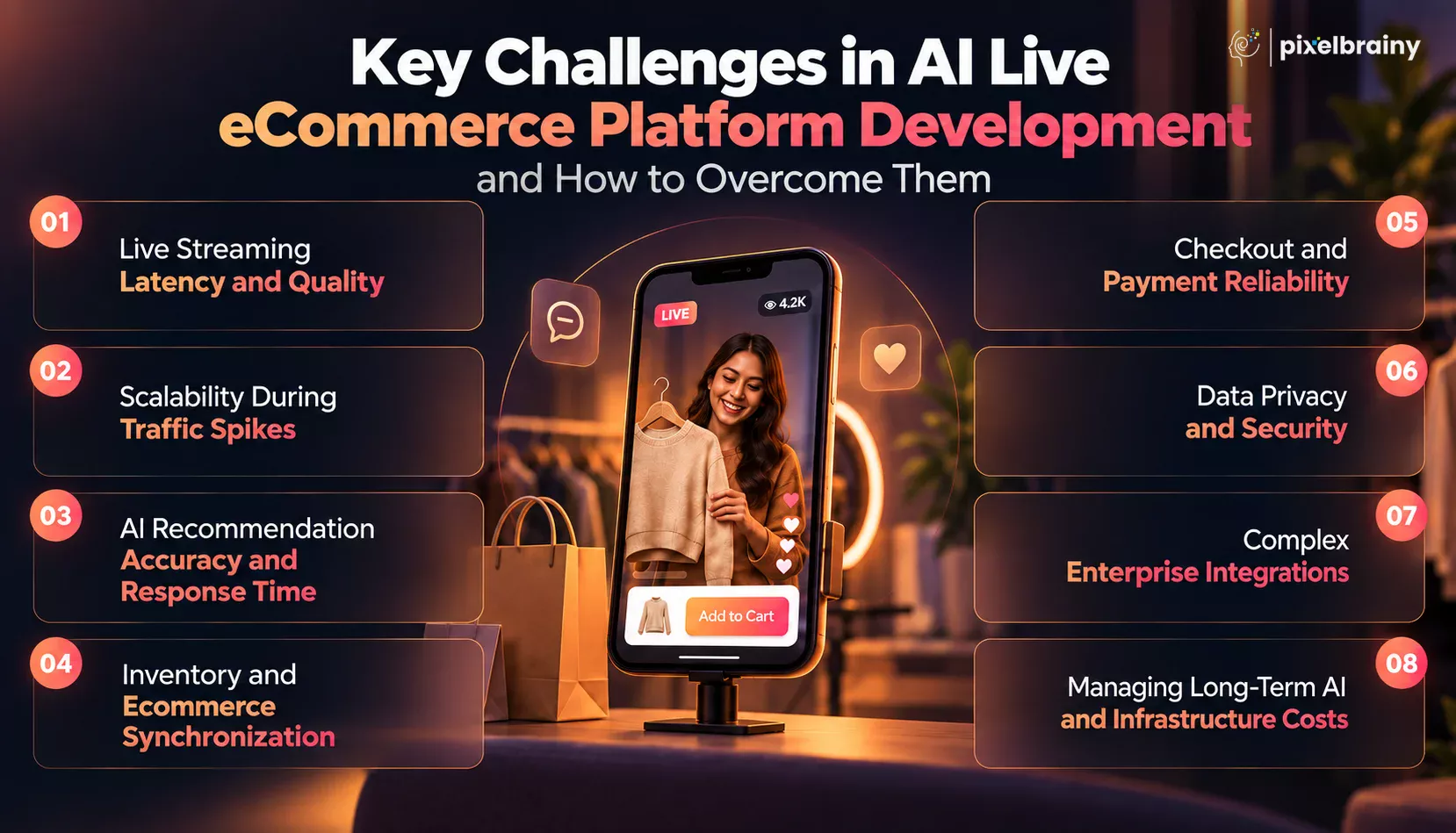
Live commerce depends on real-time interaction between hosts and customers. Significant video delays can affect product demonstrations, customer questions, flash sales, and purchasing decisions.
The platform should use suitable low-latency streaming technologies, CDN infrastructure, adaptive bitrate delivery, and geographically distributed media infrastructure. Performance should also be tested across different devices, network conditions, and audience sizes before launch.
A successful live shopping event can bring thousands or even hundreds of thousands of viewers onto the platform within a short period. This sudden increase can put significant pressure on application servers, databases, APIs, streaming infrastructure, and payment systems.
Cloud auto-scaling, load balancing, caching, CDN distribution, event-driven architecture, and proper capacity planning can help the platform accommodate sudden demand. Stress testing should simulate the expected peak audience before major commercial events.
AI recommendations need to be both relevant and fast. Customers watching a live session expect product suggestions to reflect their current interests rather than generic recommendations based only on historical purchases.
The recommendation engine should use reliable product data, customer behavior, purchase history, product relationships, and live-session context. Model optimization, caching, efficient APIs, and appropriate model selection can help deliver recommendations quickly without creating unnecessary AI infrastructure costs.
Live commerce can generate rapid changes in product demand. A product may become unavailable within minutes of being featured by a popular host.
The live platform should maintain reliable synchronization with ecommerce and inventory systems. Product availability, pricing, variants, and promotions should be updated quickly, while stock should be validated before completing a transaction. This prevents customers from purchasing products that are no longer available.
A customer may decide to purchase immediately after watching a live product demonstration. If checkout requires too many steps or a payment fails repeatedly, the business can lose a highly engaged buyer.
The platform should provide a fast, mobile-friendly checkout with trusted payment methods, secure transaction processing, reliable error handling, and appropriate fraud controls. Featured products should move from the live session to the cart with minimal friction.
An AI live ecommerce platform can process sensitive information including customer accounts, purchase history, behavioral data, payment-related information, and personalization signals.
Businesses should implement secure authentication, encryption, role-based access, audit logging, data protection controls, and appropriate data retention policies. The platform should also account for applicable privacy, ecommerce, payment, and industry-specific compliance requirements in its target markets.
Large retailers rarely operate with a single technology system. Their ecosystem may include ecommerce platforms, ERP, CRM, inventory, loyalty, payment, shipping, marketing, and analytics systems.
The live commerce platform should therefore have a well-designed API and integration layer. Standardized data structures, event-driven communication, synchronization mechanisms, and integration monitoring can help connect these systems without creating unnecessary dependencies or data inconsistencies.
The operating cost of an AI live ecommerce platform can increase as the number of viewers, AI requests, live sessions, transactions, and stored videos grows. Live streaming and AI processing can become significant recurring expenses.
Businesses should control costs through an MVP-first approach, efficient AI model selection, caching, managed cloud services, usage monitoring, scalable infrastructure, and phased implementation of advanced AI capabilities.
Overcoming these eight challenges early helps businesses create an AI live ecommerce platform that remains responsive, secure, accurate, and scalable as live commerce operations grow.
When you plan to create an AI live eCommerce platform the choosing the right AI development company for live ecommerce platform development can directly influence the platform's architecture, development cost, scalability, AI capabilities, and long-term performance. A company may have strong ecommerce experience but limited expertise in AI, real-time video, or high-concurrency systems, so businesses should evaluate the complete technical capability rather than relying on a general software development portfolio.
For founders and enterprise retailers planning to develop AI live ecommerce platform technology, the right development partner should understand how ecommerce, livestreaming, AI, real-time communication, payments, customer data, and cloud infrastructure work together.
A practical question to ask is: “We already understand our live commerce business model, but we need an AI development partner that can build the platform, integrate it with our existing ecommerce systems, support large concurrent audiences, and continue improving the AI capabilities after launch. What should we evaluate before signing a development contract?”
Start by checking whether the company has experience in both AI development and ecommerce software development.
The team should understand:
A company that only builds generic AI applications may not understand the operational complexity of ecommerce, while a traditional ecommerce agency may lack the AI expertise required for intelligent personalization.
Live commerce introduces technical requirements that conventional ecommerce applications may not have.
Ask whether the development company has experience with:
Ask for specific examples rather than accepting a general claim that the company can "build a live platform."
Look for projects that demonstrate experience in areas similar to your planned platform.
The strongest evidence may include previous work involving:
Pay particular attention to the business problem, technical solution, platform scale, and measurable outcome rather than focusing only on screenshots.
The development partner should be able to explain how the platform will handle increasing traffic and data volumes.
Ask how they would architect:
A good partner should also explain how the architecture can evolve from an MVP to a larger platform without requiring a complete rebuild.
AI should solve specific business problems rather than being added simply because the platform is marketed as AI-powered.
Ask the development company:
Their answers should connect AI capabilities with measurable business objectives such as product discovery, conversion, engagement, or customer retention.
If your business already uses ecommerce, CRM, ERP, inventory, payment, loyalty, or marketing systems, integration expertise becomes critical.
The company should be capable of designing APIs and integration layers that allow the new live commerce platform to communicate reliably with existing infrastructure.
Ask specifically how they will handle:
Ask how the company will move the project from concept to launch.
A strong process should generally include:
Discovery → architecture → UI/UX → MVP → AI implementation → testing → launch → optimization → scaling
The development team should clearly define deliverables, milestones, testing procedures, responsibilities, communication channels, and approval processes.
The lowest quotation is not automatically the best option for an AI live commerce project.
Compare development companies based on:
A cheaper initial development price can become expensive if the platform requires major architectural changes after launch.
Before signing an agreement, establish who owns:
Also clarify how customer data will be stored, protected, accessed, and handled after the development contract ends.
An AI live ecommerce platform requires continuous improvement after launch.
The development partner should be capable of providing:
This is especially important because recommendation quality, customer behavior, infrastructure requirements, and AI technologies can change as the platform grows.
Before making a final decision, businesses should ask:
Therfore, the ideal partner should demonstrate AI expertise, ecommerce knowledge, live streaming capabilities, scalable architecture, integration experience, security awareness, and long-term product development capabilities.
The right AI development company should not simply build the requested features, but help create a scalable live commerce product that connects AI intelligence with measurable ecommerce outcomes.
The future of AI live ecommerce platform development is moving beyond simply adding products to livestreams. The next generation of live commerce platforms will increasingly combine AI, real-time interaction, predictive intelligence, conversational shopping, immersive experiences, and automated content to create more personalized and responsive digital shopping journeys.
For businesses planning to build AI live ecommerce platform technology, future readiness should be considered from the architecture stage. Modular services, reliable APIs, structured product data, scalable cloud infrastructure, real-time event processing, and strong customer data foundations can make it easier to introduce new AI capabilities as customer expectations evolve.
The businesses best positioned for the next phase of live commerce will not necessarily be those that add the most AI features. They will be those that create a flexible commerce foundation where AI, live content, customer data, and transactions can continuously work together.
The following trends are likely to shape the future of AI live ecommerce platform development.
AI shopping assistants are expected to move beyond answering basic product questions. They can increasingly help customers discover products, compare alternatives, understand specifications, build product combinations, and make purchasing decisions.
A customer could ask:
"I need an outfit for a summer wedding under $300."
The platform could identify suitable products, create a combination, explain why the products match, and make the selected items available for purchase.
This can turn AI from a support feature into an active component of product discovery.
Future recommendation systems can consider more than browsing history and previous purchases.
They can potentially combine:
This could allow the platform to change recommendations dynamically as customer intent develops during a live session.
Customers will increasingly interact with ecommerce platforms using natural language instead of navigating complex menus and filters.
During a live session, shoppers may ask:
"Show me something similar in black."
"Do you have this in a larger size?"
"Which one is better for outdoor use?"
AI can interpret these requests and connect them with the product catalog, inventory, specifications, and customer preferences.
This creates a more conversational form of live ecommerce platform development using AI.
The future live shopping experience will not only use AI for customers. Hosts can also receive AI assistance during broadcasts.
An AI host assistant could provide:
This can help hosts manage larger audiences while maintaining a personalized selling experience.
The value of a live session will increasingly extend beyond its original broadcast window.
AI can analyze recordings and identify:
These moments can become searchable and shoppable video content that continues generating product discovery and sales after the original session ends.
Fashion, beauty, eyewear, furniture, and home decor businesses can increasingly use AI, augmented reality, and computer vision to help customers visualize products.
A shopper could potentially see how a product looks on them or how furniture fits within their environment while participating in a live shopping experience.
These capabilities can make product visualization more interactive and reduce uncertainty around purchases.
AI can increasingly help businesses anticipate customer and product behavior.
Predictive systems can support:
For example, a platform could identify products likely to generate strong engagement before a livestream and help the host prioritize those products.
As AI capabilities mature, some parts of the shopping journey may require less manual intervention.
AI systems could eventually identify customer needs, search product catalogs, compare alternatives, recommend suitable products, apply relevant offers, and prepare carts based on customer instructions.
Human hosts and brand teams would still play an important role, particularly for storytelling, trust, product demonstrations, and relationship building.
Large retailers are likely to connect live commerce more deeply with their existing digital ecosystem.
Future platforms can integrate:
This can turn live commerce into an integrated omnichannel capability rather than an independent sales channel.
Future businesses will increasingly evaluate live commerce based on commercial performance rather than viewer numbers alone.
Important metrics can include:
AI can help connect these metrics with customer behavior and identify where the platform can improve.
The future of AI live ecommerce belongs to platforms that move beyond livestream selling and become intelligent, conversational, personalized, and increasingly adaptive commerce ecosystems.
From the above considerations, it is now time to identify the right development partner that can turn a live commerce concept into a scalable, intelligent, and commercially focused product.
As an PixelBrainy as eCommerce software development company, PixelBrainy combines ecommerce engineering, AI, product design, integrations, and scalable application development to support businesses building next-generation commerce products.
PixelBrainy combines AI engineering with custom ecommerce development, covering areas such as AI product development, AI consulting, ecommerce applications, mobile apps, and AI integrations.
This combination is important because a live commerce platform needs more than AI. Product catalogs, inventory, payments, customer data, live interactions, analytics, and AI services must operate as one connected ecosystem.
PixelBrainy focuses on understanding business requirements and user needs before deciding which technologies and AI capabilities should be implemented. This helps businesses prioritize features based on actual use cases rather than adding AI simply for the sake of technology.
A relevant query from businesses planning this type of product is: “We have already validated demand for live shopping, but we need a partner who can help us decide which AI capabilities belong in our MVP, integrate them with our ecommerce infrastructure, and prepare the platform for future growth.”
Live commerce requires real-time capabilities alongside conventional ecommerce infrastructure. PixelBrainy works across custom APIs, scalable applications, cloud technologies, ecommerce systems, and AI integrations, including OpenAI, Gemini, AWS, and Azure AI.
This allows businesses to extend existing commerce ecosystems instead of replacing every system from scratch.
PixelBrainy works with AI capabilities such as recommendation systems, personalization, inventory intelligence, virtual try-on, and conversational experiences. These capabilities can provide a strong foundation for creating more intelligent live shopping journeys.
The focus remains on making AI useful to customers rather than making the interface unnecessarily complicated.
In one confidential engagement, PixelBrainy worked with a US-based fashion retailer facing product discoverability and high return-rate challenges. The team developed an AI recommendation engine, smart inventory capabilities, and an AR-based virtual try-on experience.
According to PixelBrainy's published case study, the solution contributed to a 27% reduction in returns, 2.5x growth in customer engagement, and a 35% increase in sales conversion within three months.
Although the project was not a live commerce platform, its combination of AI recommendations, inventory intelligence, and interactive shopping technology is highly relevant to AI-powered live commerce.
PixelBrainy supports the product lifecycle from strategy and design through development, deployment, and ongoing optimization. Its experience across AI, ecommerce, mobile, web applications, and enterprise solutions allows businesses to work with one development partner across multiple stages of the product journey.
For businesses seeking AI live eCommerce platform development services, this can simplify coordination between product strategy, AI engineering, ecommerce development, UX, and integrations.
Whether you want to build a brand-owned live shopping platform, creator commerce solution, marketplace, or enterprise live commerce ecosystem, the development partner needs to understand both the business model and technical architecture.
PixelBrainy's combination of AI, ecommerce, product design, and engineering capabilities can help businesses turn their live commerce vision into a scalable digital product.
For companies considering live eCommerce platform development integrating AI, the right starting point is a clear roadmap covering business objectives, target users, AI use cases, architecture, MVP scope, and future scalability.
Ready to turn your live commerce idea into an intelligent product? Connect with PixelBrainy today.

An AI live eCommerce platform brings live video, interactive product discovery, AI-powered personalization, and ecommerce transactions into one connected shopping experience. For brands, retailers, creators, and ecommerce startups, it can create a more direct path between customer engagement and purchase while providing greater control over the digital commerce journey.
Successful AI live eCommerce platform development starts with a clear business model and continues through platform selection, core feature planning, AI integration, scalable architecture, security, testing, and continuous optimization. Businesses should prioritize the capabilities that support their immediate objectives while designing the infrastructure to accommodate future growth.
The cost to develop an AI live eCommerce platform can range from $50,000 to $300,000+, depending on features, AI complexity, integrations, streaming requirements, development resources, and platform scale. With the right strategy and technology partner, businesses can build AI live eCommerce platform solutions that are reliable, personalized, and commercially scalable.
Ready to turn your live commerce idea into a market-ready product? Book an appointment with PixelBrainy today.
The cost to develop an AI live eCommerce platform typically ranges from $50,000 to $300,000+. A basic MVP may cost around $50,000 to $90,000, while advanced and enterprise platforms can require $90,000 to $300,000 or more depending on AI capabilities, live streaming infrastructure, integrations, mobile apps, security, and expected audience scale.
Development can take approximately 4 to 12+ months, depending on the platform's complexity. A basic MVP with core live streaming, product catalog, chat, AI recommendations, checkout, payments, and analytics may take less time than an enterprise platform requiring advanced AI, multiple integrations, high-concurrency streaming, and multi-region infrastructure.
A dedicated platform can give your business greater control over the customer journey, first-party customer data, branding, product experience, checkout, analytics, and monetization. Social platforms can continue serving as acquisition channels while the owned platform becomes the destination for live shopping and customer relationships.
Yes. A properly architected platform can integrate with existing ecommerce platforms, CRM, ERP, inventory, payment, loyalty, shipping, and marketing systems through APIs and event-based integrations. This allows businesses to add live commerce without necessarily replacing their existing technology infrastructure.
Yes. An AI recommendation engine can analyze available signals such as product interactions, browsing behavior, purchase history, preferences, and live-session activity to recommend relevant products. For example, a customer viewing a dress could receive recommendations for matching shoes, handbags, or accessories.
Yes, but the platform should be designed around your specific business model rather than simply copying another company's product. Core capabilities can include live streaming, shoppable product catalogs, live chat, AI recommendations, checkout, payments, host dashboards, analytics, inventory synchronization, and customer profiles.
Yes, provided scalability is considered from the architecture stage. Large-scale platforms may require cloud auto-scaling, CDN-based video delivery, low-latency streaming, load balancing, distributed databases, caching, event-driven architecture, monitoring, and extensive load testing to support high concurrent audiences.
For an MVP, businesses can prioritize AI product recommendations and an AI shopping assistant alongside essential live commerce functionality. More advanced capabilities such as virtual try-on, predictive analytics, AI-generated shoppable clips, visual search, and proprietary AI models can be introduced after validating customer demand and collecting sufficient platform data.

About The Author
Sagar Bhatnagar
Sagar Sahay Bhatnagar brings over a decade of IT industry experience to his role as Marketing Head at PixelBrainy. He's known for his knack in devising creative marketing strategies that boost brand visibility and market influence. Sagar's strategic thinking, coupled with his innovative vision and focus on results, sets him apart. His track record of successful campaigns proves his ability to utilize digital platforms effectively for impactful marketing efforts. With a genuine passion for both technology and marketing, Sagar continuously pushes PixelBrainy's marketing initiatives to greater success.

Working with the PixelBrainy team has been a highly positive experience. They understand the design requirements and create beautiful UX elements to meet the application needs. The dev team did an excellent job bringing my vision to life. We discussed usability and flow. Sagar worked with his team to design the database and begin coding. Working with Sagar was easy. He has the knowledge to create robust apps, including multi-language support, Google and Apple ID login options, Ad-enabled integrations, Stripe payment processing, and a Web Admin site for maintaining support data. I'm extremely satisfied with the services provided, the quality of the final product, and the professionalism of the entire process. I highly recommend them for Android and iOS Mobile Application Design and Development.

Great experience working with them. Had a lot of feedback and I found that unlike most contractors they were bugging me for updates instead of the other way around. They were extremely time conscience and great at communicating! All work was done extremely high quality and if not on time, early! They were always proactive when it comes to communication and the work is great/above par always. Very flexible and a great team to work with! Goes above and beyond to present us with multiple options and always provides quality. Amazing work per usual with Chitra. If you have UI/UX or branding design needs I recommend you go to them! Will likely work with them in the future as well, definitely recommended!

PixelBrainy is a joy to work with and is a great partner when thinking through branding, logo, and website layout. I appreciate that they spend time going into the "why" behind their decisions to help inform me and others about industry best practices and their expertise.

I hired them to design our software apps. Things I really like about them are excellent communication skills, they answer all project suggestions and collaborate right away, and their input on design and colors is amazing. This project was complex and needed patience and creativity. The team is amazing to do business with. I will be using them long-term. Glad to see there are some good people out there. I was afraid to try and outsource my project to someone but I am glad I met them! I really can't say enough. They went above and beyond on this project. I am very happy with everything they have done to make my business stand out from the competition.

It was great working with PixelBrainy and the team. They were very responsive and really owned the project. We'll definitely work with them again!

I recently worked with the PixelBrainy team on a project and I was blown away by their communication skills. They were prompt, clear, and articulate in all of our interactions. They listened and provided valuable feedback and suggestions to help make the project a success. They also kept me updated throughout the entire process, which made the experience stress-free and enjoyable.

PixelBrainy is very good at what it does. The team also presents themselves very professionally and takes care of their side of things very well. I could fully trust them taking up the design work in a timely and organised manner and their attention to detail saved us lots of effort and time. This particular project was quite intense and the team showed that they function very well under pressure. Very much looking forward to working with her again!

It's always an absolute pleasure working with them. They completed all of my requests quickly and followed every note I had for them to a T, which made our process go smoothly from start to finish. Everything was completed fast and following all of the guidelines. And I would recommend their services to anyone. If you need any design work done in the future, PixelBrainy should be your first call!

They took ownership of our requirements and designed and proposed multiple beautiful variants. The team is self-motivated, requires minimum supervision, committed to see-through designs with quality and delivering them on time. We would definitely love to work with PixelBrainy again when we have any requirements.

PixelBrainy was a big help with our SaaS application. We've been hard at work with a new UI/UX and they provided a lot of help with the designs. If you're looking for assistance with your website, software, or mobile application designs, PixelBrainy and the team is a great recommendation.

PixelBrainy designers are amazing. They are responsive, talented, and always willing to help craft the design until it matches your vision. I would recommend them and plan to continue them for my future projects and more!!!

They were awesome! Did a good job fast, and good communication. Will work with them again. Thank you

Creative, detail-oriented, and talented designers who take direction well and implement changes quickly and accurately. They consistently over-delivered for us.

PixelBrainy team is very talented and creative. Great designers and a pleasure to work with. PixelBrainy is an excellent communicator and I look forward to working with them again.

PixelBrainy has a very talented design team. Their work is excellent and they are very responsive. I enjoy working with them and hope to continue on all of our future projects.


Transform your ideas into reality with us.
Across these industries, each engagement brings unique challenges, from early-stage product development to scaling complex systems, helping us build a practical understanding of real-world product environments.