AI Summary Powered by PixelBrainy
What if your social networking platform could move beyond posts, likes, and comments to deliver real-time video interaction powered by intelligent AI?
Live video has become an important way for social platforms to connect users, creators, communities, and businesses in real time. Adding AI can take this experience further by enabling personalized content recommendations, automated moderation, audience insights, smart notifications, real-time captions, and other intelligent capabilities. As a result, businesses are increasingly exploring AI live streaming social networking application development to create more engaging and scalable digital platforms.
However, building such an application requires more than adding a live video feature to an existing social networking app. The development process involves real-time video infrastructure, low-latency communication, scalable backend architecture, cloud services, data security, AI integration, content moderation, analytics, and an intuitive user experience. Businesses also need to select technologies and development partners that can support both social networking functionality and high-performance live streaming.
If you are researching live streaming social networking app development using AI, it is important to understand the complete development lifecycle before starting. Whether your goal is to build a live streaming social networking app integrating AI from scratch or add live streaming capabilities to an existing platform, the right architecture and development strategy can directly affect performance, scalability, development cost, and user retention.
For example, a business may ask: “We are running a social media company and looking for an AI development company to add live streaming capabilities to our platform. What technical expertise and experience should we look for before selecting a development partner?” The answer starts with evaluating expertise in live video streaming, AI and machine learning, scalable cloud infrastructure, real-time communication, security, content moderation, mobile and web development, and post-launch optimization.
This guide explains how to develop an AI live streaming social networking app, including its essential features, advanced capabilities, monetization strategies, development steps, technology stack, cost factors, timeline, and major challenges involved in creating a scalable live AI streaming social networking app development process.
An AI live streaming social networking application is a digital platform that combines real-time video streaming, social networking, and artificial intelligence in a single ecosystem. Unlike conventional social networking apps that primarily focus on text posts, images, recorded videos, likes, shares, and comments, an AI-powered live streaming platform enables users to broadcast and interact through live video while AI continuously improves discovery, personalization, moderation, and engagement.
In simple terms, AI live streaming social networking application development involves building a platform where users can create or watch live streams, communicate through real-time chats and reactions, follow creators, share content, and receive personalized recommendations based on their interests and behavior.
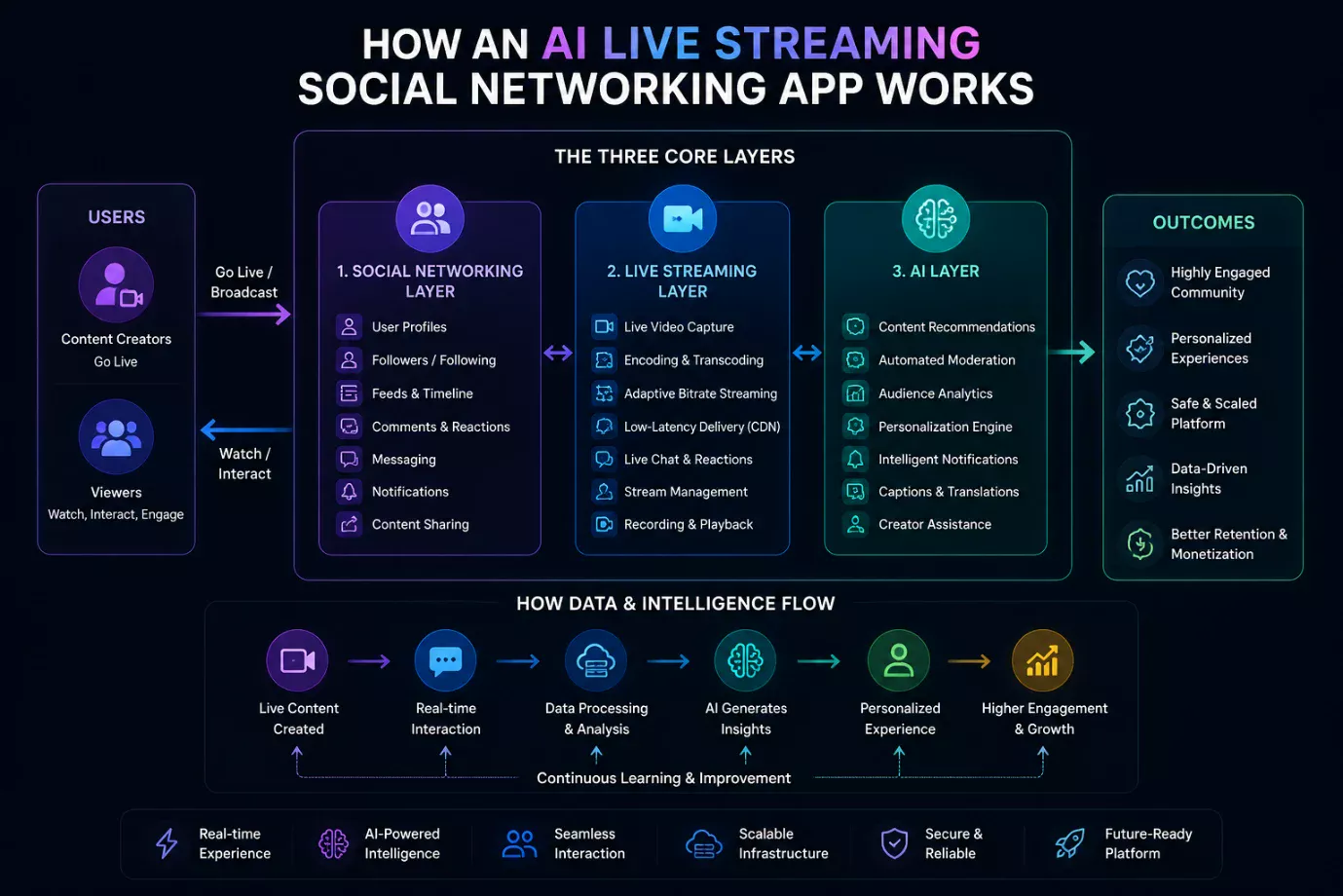
The application typically combines three core layers:
| Aspect | Standard Social Networking App | AI Live Streaming Social Networking App |
|---|---|---|
| Content | Posts, images, recorded videos | Live video plus social content |
| Interaction | Likes, comments, shares | Real-time comments, reactions, chat, and interaction |
| Personalization | Basic recommendations | AI-driven recommendations and personalized feeds |
| Moderation | Manual or rule-based | AI-assisted real-time moderation |
| User engagement | Mostly asynchronous | Continuous real-time engagement |
| Creator tools | Basic publishing tools | Live analytics, AI assistance, and audience insights |
| Accessibility | Standard content formats | Captions, translations, and AI-powered accessibility |
The key difference is real-time intelligence combined with real-time interaction. AI does not replace the social networking or streaming components. Instead, it enhances them by helping users discover relevant content, helping creators understand audiences, and helping businesses manage large-scale platforms more efficiently.
The Social Networking Landscape Is Moving Toward Real-Time Experiences
Traditional social networking has largely been built around feeds, posts, images, short-form videos, and messaging. However, live video introduces a different product model where users do not simply consume content. They participate in an experience as it happens.
For businesses, this creates an opportunity to develop a social networking platform around real-time video, creator communities, interactive content, and AI-driven experiences. Instead of treating live streaming as an additional feature, businesses can make it a core part of their product strategy.
This is particularly relevant for companies planning live streaming social networking app development using AI, because AI can become the intelligence layer that helps the platform manage and personalize increasingly large volumes of live content.
The market direction also indicates substantial room for expansion. Grand View Research estimates that the global live streaming market will reach $137.1 billion in 2026 and is projected to reach $345.1 billion by 2030, growing at a CAGR of 23.0% from 2024 to 2030.
Live streaming is developing into a major digital content category across entertainment, gaming, education, shopping, professional events, fitness, news, and creator communities.
For businesses, this creates an opportunity to enter or expand within a market where real-time content is becoming an important part of users' digital experiences.
The opportunity is also supported by the broader video streaming market. Grand View Research estimates that the global video streaming market will reach $191.1 billion in 2026 and projects it to reach $416.8 billion by 2030.
Businesses do not necessarily need to replicate conventional social media models. Live streaming provides an opportunity to design a platform where real-time participation is the central product experience.
A new platform could combine:
This makes AI live streaming social networking application development particularly relevant for startups and established businesses looking to create a differentiated social product.
The social networking market is highly competitive. Building another application based only on profiles, feeds, likes, comments, and messaging can make differentiation difficult.
An AI-powered live streaming model gives businesses another direction.
Instead of competing solely on the volume of static content, a platform can compete through real-time experiences, intelligent content discovery, creator interaction, and AI-powered personalization.
This can be especially valuable for businesses targeting specific communities or verticals such as gaming, sports, education, entertainment, fitness, professional networking, or live commerce.
Creators increasingly need platforms where they can interact directly with their audiences rather than depending entirely on pre-recorded content.
Live streaming creates a direct creator-to-audience environment. Businesses can therefore build their platform around creators from the beginning, providing infrastructure for live broadcasts, audience interaction, subscriptions, digital gifts, paid events, and other creator-focused experiences.
For a company considering how to build a live streaming social networking app integrating AI, the creator should therefore be treated as a core participant in the platform ecosystem, not simply as a content publisher.
AI should not be considered only an optional chatbot or standalone feature.
In a modern live streaming social platform, AI can become part of the underlying architecture for:
This makes AI particularly important as the platform begins handling larger numbers of users, creators, and live streams.
A major challenge with live platforms is the amount of content generated in real time. As more creators start broadcasting, businesses need systems capable of processing, organizing, recommending, and moderating large volumes of content.
This is where an AI live streaming social networking app has a strategic advantage over a basic live broadcasting application.
AI can be incorporated into the platform architecture from the beginning instead of being retrofitted after the user base and content volume have already grown.
Businesses investing in this category are not limited to one revenue model.
A live social platform can potentially support different business models as it grows, including creator subscriptions, virtual gifting, advertising, premium events, paid communities, social commerce, brand partnerships, and other digital experiences.
The important point is that businesses can build the platform infrastructure first and expand monetization models as user behavior and market demand become clearer.
If you are thinking, “We are running a social media company and want to add live streaming, but should we build a conventional live streaming feature or develop an AI-powered experience?”, the answer depends on your long-term product strategy.
If live streaming is expected to become a major part of your platform, integrating AI at the architecture and product-planning stage can provide more room for intelligent discovery, moderation, personalization, analytics, and future expansion.
In short, businesses should invest in AI live streaming social networking app development when they want to build a differentiated, real-time social platform that can evolve with the growing live content and AI ecosystem.
Are you planning to create an AI live social networking app but wondering whether AI can deliver meaningful value beyond conventional live streaming? For businesses, the answer lies in how intelligently the platform can connect users, creators, and content in real time.
The benefits of AI live streaming app development extend beyond video broadcasting because AI can support personalization, content discovery, moderation, creator tools, analytics, and user interaction. A 2026 study of AI livestream communities found that viewers were motivated by AI interaction, human prompting, personalized content creation, and community participation, highlighting the distinctive engagement possibilities created when AI becomes part of the livestream experience.
For companies investing in the development of AI live social networking app, these capabilities can turn a basic live video product into a more intelligent and adaptive social ecosystem. Here are the key advantages businesses should consider when planning to build AI live social networking application.
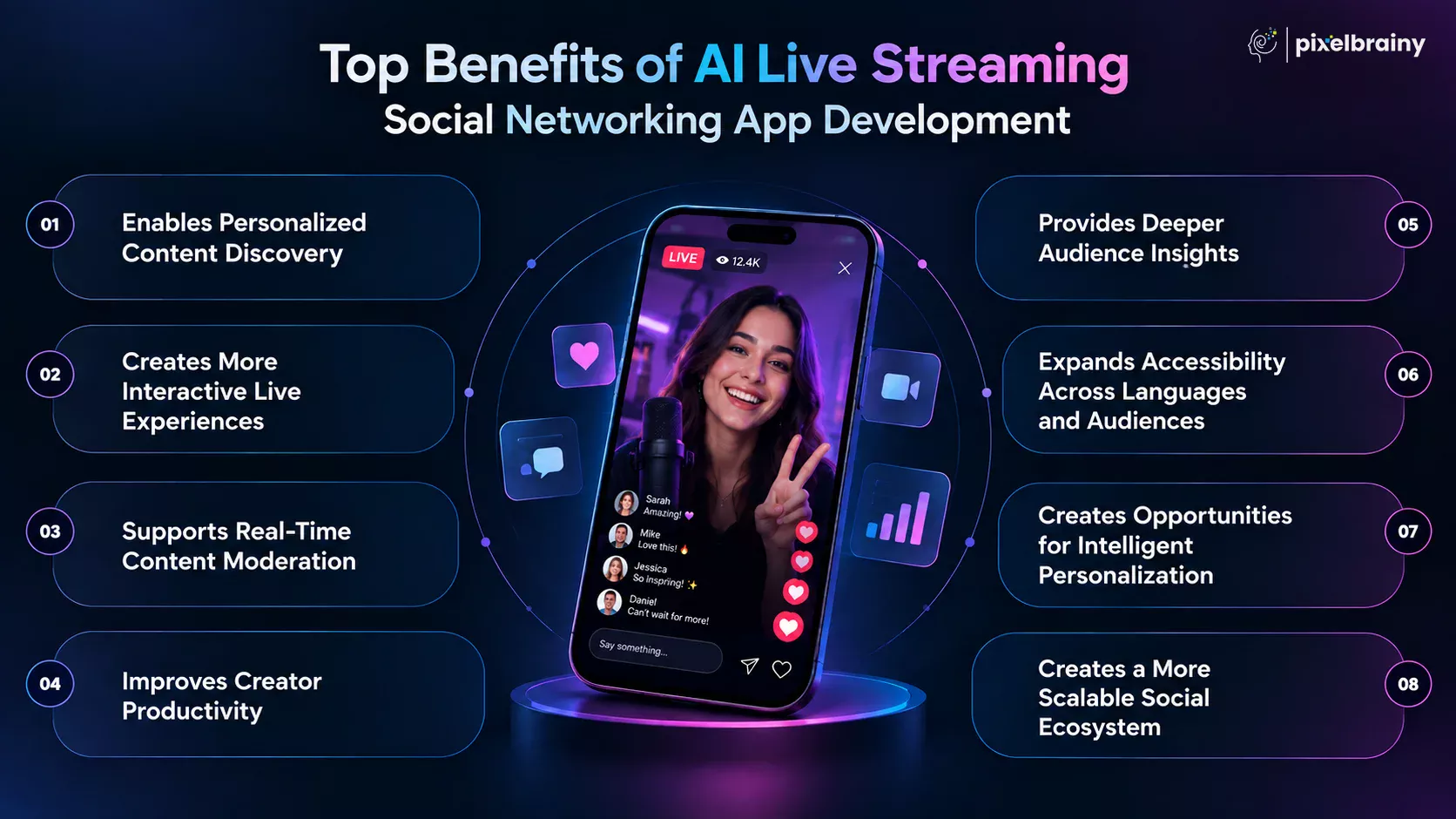
One of the most important AI social networking app benefits is personalized content discovery. AI can analyze signals such as viewing history, watch duration, followed creators, searches, comments, reactions, and content preferences to understand what individual users are interested in.
Based on these signals, the platform can recommend relevant live streams instead of presenting identical content to every user. For example, a user who regularly watches gaming broadcasts can receive recommendations for gaming creators, tournaments, and related communities. As the system learns from new interactions, recommendations can become increasingly relevant. This creates a more intelligent discovery experience and helps users find live content that matches their interests.
AI can make live streaming more interactive by becoming part of the communication and content experience. Instead of users simply watching a broadcast and posting comments, AI can support real-time Q&A, conversational interactions, audience prompts, automated responses, polls, and other engagement mechanisms.
Research published in 2026 found that viewers in studied AI livestream communities were particularly interested in interacting with AI and using prompts to influence content. The study also identified collaborative creation and socializing as important motivations for participation.
For businesses creating an AI live social networking app, this opens the possibility of designing experiences where viewers can actively participate in shaping or interacting with live content.
Live streaming creates a continuous flow of video, audio, comments, and user interactions, making moderation more difficult than it is for static content. AI can assist by analyzing content in real time and identifying potentially harmful, abusive, spam, or policy-violating activity for automated action or human review.
This can help moderation teams respond faster as the platform scales. However, AI should not necessarily replace human moderation. The 2026 research on AI livestream communities identified toxicity and moderation as important challenges and highlighted the need for appropriate moderation strategies and community oversight.
For an AI-powered social networking platform, combining automated detection with human review can create a more practical moderation framework.
AI can provide creators with tools that reduce repetitive work before, during, and after a livestream. These capabilities can include automated captions, stream summaries, content tagging, title suggestions, audience insights, translation, highlight identification, and recommendations for future content.
Creators can therefore spend more time focusing on their audiences and less time handling routine content-management activities. AI can also analyze previous streams to identify engagement patterns and help creators understand which topics or moments generated stronger audience interest.
For businesses looking to build AI live social networking application, creator-focused AI tools can become an important part of the platform's overall ecosystem.
A live streaming platform generates extensive behavioral data during every broadcast. Businesses can potentially analyze viewing duration, peak concurrent viewers, comments, reactions, follower growth, audience drop-off, engagement patterns, and creator performance.
AI can process these signals to identify patterns that may be difficult to detect through conventional reporting. Businesses can use these insights to understand what content attracts specific audience segments and when users are most likely to interact.
This makes analytics another important live streaming app benefit, particularly for platforms that need data-driven decisions around content, creators, campaigns, and monetization.
AI can help live streaming platforms make content accessible to a broader audience through automatic captions, speech recognition, translation, and multilingual content support.
For example, a creator can broadcast in one language while AI-generated captions or translations help viewers from other regions understand the conversation. This can reduce language barriers and make live content more accessible to international communities.
For businesses developing an AI live social networking app, these capabilities can support expansion into multiple markets without requiring every creator to produce separate versions of the same live content.
Personalization can extend beyond recommending streams. AI can customize notifications, creator suggestions, content categories, community recommendations, and other parts of the user journey based on individual behavior.
For example, instead of sending every follower the same notification when a creator goes live, the platform can determine which users are most likely to be interested in that particular stream. Similarly, the home feed can prioritize communities and creators that align with a user's recent interests.
This creates a more adaptive experience and is one of the important advantages of making an AI live social networking app rather than developing a conventional live streaming application alone.
As a platform grows, the number of users, creators, streams, comments, and interactions can increase rapidly. Managing every recommendation, moderation task, content classification process, and analytics requirement manually becomes increasingly difficult.
AI can assist with these high-volume processes while scalable cloud and streaming infrastructure handles the underlying workload. This allows businesses to design a platform that can evolve from an initial MVP into a larger social ecosystem.
For companies focused on the development of AI live social networking app, integrating AI into the product architecture from the beginning can make it easier to introduce additional intelligent capabilities as the platform and its user base grow.
Overall, the biggest advantage of AI live streaming social networking app development is the ability to combine real-time human interaction with intelligent personalization, automation, moderation, analytics, and creator experiences at scale.
What features should you include when planning to build an AI live streaming social networking application without making the initial product unnecessarily complicated? The right approach is to establish a strong foundation covering the essential needs of viewers, creators, and administrators. These core capabilities should support account management, live broadcasting, social interaction, content discovery, creator management, notifications, safety, and platform administration.
For businesses investing in AI live streaming app development, these features create the basic infrastructure required for a functional and engaging social video platform. Advanced AI capabilities can be addressed separately, while the core version should focus on delivering a smooth live streaming and social networking experience.
If you are thinking, “I want to build an AI live streaming social networking app but do not know which features should be included in the first version,” the following features provide a practical foundation for the initial application.
| Must-Have Feature | Explanation |
|---|---|
| User Registration and Login | Users should be able to register through email, phone number, or supported social accounts and securely access their profiles. The feature should include authentication, verification, password recovery, session management, and account security to create a smooth and trustworthy onboarding experience. |
| User Profiles | User profiles should allow members and creators to add usernames, profile pictures, bios, interests, follower information, and other relevant details. A well-designed profile establishes user identity, helps people discover creators, and provides the foundation for building social relationships within the platform. |
| Live Video Streaming | Live video streaming is the core functionality of the application. Creators should be able to start, manage, and end broadcasts while viewers receive stable, high-quality video with minimal latency. The infrastructure should support different devices, network conditions, and streaming requirements. |
| Live Stream Discovery | A dedicated discovery interface should help users find active broadcasts, upcoming streams, popular creators, categories, and relevant content. Organizing live content through categories, hashtags, trending sections, and recommendations makes it easier for users to discover streams beyond the accounts they already follow. |
| Real-Time Chat and Comments | Real-time chat allows viewers to communicate with creators and other audience members during broadcasts. Users should be able to post comments, ask questions, and participate in conversations with minimal delay. Moderation controls should also be available to manage inappropriate or disruptive interactions. |
| Reactions and Engagement | Likes, emojis, stickers, and other lightweight reactions allow viewers to respond instantly without interrupting the live conversation. These interactions make broadcasts more dynamic while giving creators immediate signals about audience interest, participation, and overall engagement during a live session. |
| Follow and Social Connections | Users should be able to follow creators, friends, and relevant accounts and manage their social connections. A follow system creates an ongoing relationship between users and content creators, making it easier for audiences to return to preferred content and receive relevant updates. |
| Search and Content Discovery | Search functionality should enable users to find creators, profiles, live streams, categories, hashtags, and other relevant content. As the application grows, efficient search becomes increasingly important because users need a convenient way to locate specific content instead of relying only on the primary discovery feed. |
| Push Notifications | Push notifications can inform users when followed creators start streaming, scheduled broadcasts are approaching, or important account activity occurs. Users should have control over notification preferences so alerts remain useful and relevant without creating unnecessary interruptions or notification fatigue. |
| Creator Dashboard | A dedicated creator dashboard should provide broadcasters with tools to manage their live activities from one place. It can include stream controls, audience information, follower activity, broadcast history, basic engagement data, and account settings, giving creators greater control over their streaming experience. |
| Stream Scheduling | Stream scheduling allows creators to announce upcoming broadcasts before they begin. Users can discover planned sessions and receive reminders, making the feature useful for interviews, gaming sessions, educational content, product demonstrations, events, and other broadcasts that benefit from advance audience awareness. |
| Reporting and Blocking | Users should have simple options to report inappropriate content, accounts, or interactions and block unwanted users. Reports can be routed to moderators for investigation, while blocking gives users greater control over their interactions and helps maintain a safer and more comfortable social environment. |
| Basic Content Moderation | Content moderation should be considered during the initial application architecture. Core capabilities can include prohibited-word filtering, user reporting, moderation queues, account restrictions, and administrator review. These mechanisms provide a foundation for maintaining community standards as the number of users and live streams increases. |
| Admin Dashboard | An admin dashboard gives platform owners centralized control over users, creators, streams, reports, categories, accounts, and platform activity. Administrators should be able to review reported content, manage accounts, enforce community guidelines, monitor platform activity, and oversee important operational functions. |
| Analytics and Performance Tracking | Analytics should provide visibility into active users, viewers, watch duration, stream performance, engagement, creator activity, and retention. These insights help businesses understand how users interact with the platform, evaluate content performance, identify operational issues, and make informed product decisions. |
These core capabilities provide the essential foundation for a functional and engaging live social networking platform while leaving room for advanced AI capabilities as the application evolves.
Core features can make a live streaming social networking application functional, but advanced AI capabilities can determine how intelligent and differentiated the platform becomes. Businesses that want to build an AI live social networking application can use these technologies to move beyond basic broadcasting and introduce smarter content discovery, real-time assistance, automated moderation, creator support, accessibility, and audience intelligence.
The right advanced features should be selected based on the platform's audience, content category, business objectives, and expected scale. Instead of adding every AI capability at once, businesses can prioritize features that solve specific user or creator problems and introduce additional functionality as the platform grows.
| AI-Powered Content Recommendations | AI can analyze viewing history, watch duration, follows, searches, reactions, and other behavioral signals to recommend relevant live streams and creators. Personalized recommendations can make content discovery more intelligent and help users find broadcasts that closely match their interests and preferences. |
| Real-Time AI Content Moderation | AI can analyze live video, audio, and comments to identify potentially harmful, abusive, explicit, or policy-violating content. The system can automatically flag suspicious activity, apply predefined actions, or send cases to human moderators for further review, helping platforms manage large volumes of live content. |
| AI-Powered Virtual Assistant | An AI virtual assistant can help viewers navigate the platform, discover streams, answer common questions, and provide contextual assistance. For creators, it can support routine tasks such as managing information, understanding analytics, or accessing platform tools without requiring manual navigation through multiple screens. |
| Real-Time AI Captions and Subtitles | AI-powered speech recognition can convert spoken content into captions during live broadcasts. This can improve accessibility for users with hearing difficulties and make streams easier to follow in noisy environments. Businesses can also support multiple languages through automated subtitle generation and translation capabilities. |
| Real-Time Language Translation | AI translation can help creators communicate with audiences who speak different languages. Spoken dialogue or chat messages can be translated in near real time, allowing businesses to expand their live streaming social networking application across geographic and linguistic markets while creating more inclusive communication experiences. |
| AI-Powered Creator Assistant | An AI creator assistant can help broadcasters prepare stream titles, descriptions, topics, hashtags, announcements, and other supporting content. It can also analyze previous broadcasts and provide suggestions about audience engagement, content performance, and potential topics for future live sessions. |
| Intelligent Audience Matching | AI can identify similarities between viewers, creators, interests, and communities to suggest relevant connections. The system can recommend creators to viewers, audiences to creators, or communities to users based on behavioral patterns, interests, interaction history, and content preferences. |
| Predictive Engagement Analytics | Machine learning models can analyze historical viewing and interaction patterns to identify potential engagement trends. Businesses and creators can use these insights to understand likely peak viewing periods, content preferences, audience behavior, and engagement patterns when planning future live broadcasts. |
| AI-Based Personalized Notifications | Instead of sending identical notifications to every follower, AI can determine which users are more likely to engage with a particular broadcast. Notifications can be personalized according to interests, previous viewing behavior, preferred creators, activity patterns, and timing preferences to make alerts more relevant. |
| AI-Generated Live Stream Highlights | AI can analyze live broadcasts to identify important moments, highly engaging interactions, or notable segments and generate short highlights after or during a stream. These highlights can help creators repurpose long broadcasts into shorter content for discovery, promotion, and social sharing. |
These advanced capabilities can help turn a standard live streaming application into a more intelligent and adaptive AI-powered social networking platform, giving businesses greater scope to personalize experiences and build differentiated user journeys.
How can an AI live streaming social networking application generate revenue while keeping users and creators engaged? Monetization should be considered during the early stages of product planning rather than treated as an afterthought. Businesses developing an AI-powered live social platform can create revenue opportunities through virtual interactions, recurring memberships, advertising, premium experiences, creator transactions, and brand collaborations.
For companies investing in AI live streaming social networking app development, the right monetization strategy depends on the target audience, content category, creator ecosystem, geographic market, and user behavior. A diversified approach can also give the platform multiple revenue channels while allowing creators and businesses to participate in the platform economy.
Virtual gifts and digital coins are well suited to interactive live streaming environments. Users can purchase digital currency and use it to send gifts, stickers, badges, or other virtual items to creators during live broadcasts. The platform can retain a percentage of each transaction and distribute the remaining amount to eligible creators.
This model can work particularly well when creators have highly engaged communities and viewers want a direct way to show appreciation. During AI live streaming app development, businesses should also consider secure payment processing,
Subscriptions allow users to make recurring payments to access exclusive creator content, communities, or platform experiences. Creators can offer subscriber-only live streams, private chats, exclusive content, special badges, early access, or members-only events.
For platform owners, recurring subscriptions can create a more predictable revenue stream while giving creators an additional way to monetize loyal audiences. Different membership tiers can also be introduced based on the exclusivity and value of the content offered.
Advertising can provide another important revenue channel by connecting brands with the platform's audience. Depending on the application model, businesses can introduce display advertisements, sponsored streams, video advertisements, branded content, or native promotional placements.
AI can support advertising operations by helping analyze audience interests and content context, subject to applicable privacy requirements. However, advertisements should be placed carefully so they do not unnecessarily interrupt live broadcasts or negatively affect the user experience.
Paid live events allow creators, organizations, educators, entertainers, and brands to charge users for access to specific broadcasts. Examples can include concerts, workshops, conferences, gaming tournaments, educational sessions, product launches, expert discussions, and exclusive community events.
The platform can earn through ticketing fees or a percentage of event revenue. Event registration, digital tickets, reminders, payment processing, and replay access can further strengthen this monetization model.
Premium content allows creators or businesses to place selected live streams, recordings, communities, or other experiences behind a paywall. Users can either purchase individual content or subscribe to access a wider premium library.
This model can be particularly useful for specialized content where audiences are willing to pay for exclusive entertainment, education, professional knowledge, expert sessions, or niche communities. Businesses should clearly communicate what additional value users receive through premium access.
A creator commission model allows users to generate revenue through subscriptions, virtual gifts, paid events, premium content, and other transactions while the platform retains a predefined percentage.
This creates an ecosystem where platform revenue is connected to creator success. When creators attract audiences and generate transactions, both the creator and platform can benefit. Before launch, businesses should establish transparent commission rates, payout schedules, eligibility requirements, transaction rules, and creator agreements.
Brand partnerships can create higher-value commercial opportunities by connecting businesses with creators and highly targeted communities. Brands can sponsor live sessions, collaborate with creators, launch products, organize interactive events, or support branded content campaigns.
For an AI-powered social networking platform, audience analytics can help identify relevant creators and communities for specific campaigns. Businesses can use these insights to create partnerships based on audience interests, content categories, engagement patterns, and campaign objectives while maintaining appropriate disclosure of sponsored content.
A well-planned monetization strategy can turn an AI live streaming social networking application into a sustainable digital business while creating meaningful revenue opportunities for both the platform and its creators.
How do you turn a live streaming social networking idea into a scalable application that supports real-time video, social interaction, and AI-powered capabilities?
The development process involves much more than creating a mobile interface and connecting a video streaming service. Businesses need to define the product vision, validate the concept, design the experience, build the core application, implement streaming infrastructure, integrate AI, test the platform, and prepare it for launch.
For companies planning AI live streaming social networking app development for social media companies, following a structured development process can reduce technical risks and prevent expensive changes later.
Whether you want to build AI live streaming social networking app from scratch or add live streaming to an existing social platform, the following eight steps provide a practical roadmap.
A common business concern is: “We already operate a social platform and want to introduce live video with AI, but we are unsure how to move from the initial idea to a production-ready application without wasting development resources.” A phased approach can help address this challenge.
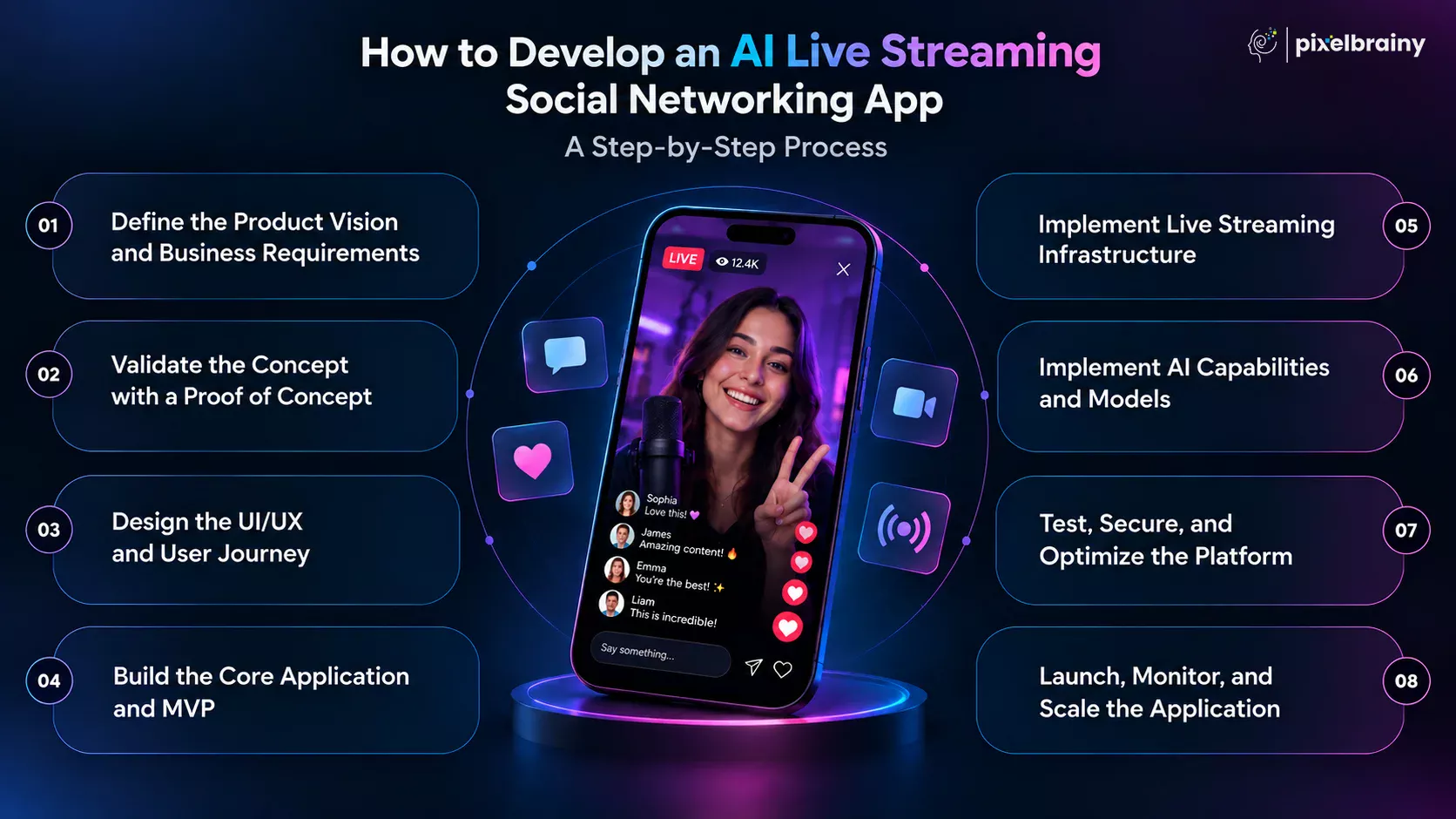
The first step in the development process of AI live streaming social networking app is defining what the platform should achieve.
Businesses should identify their target audience, content categories, geographic markets, creator requirements, revenue model, supported platforms, and primary use cases.
The team should also determine whether live streaming will become the platform's central experience or an additional capability within an existing social network.
At this stage, businesses can seek AI consultation to identify practical AI use cases and technical requirements.
Clearly documenting functional and non-functional requirements creates a development roadmap and helps prevent unnecessary features from increasing the initial scope, budget, and timeline.
Before making a major investment in building an AI live streaming social networking app, businesses should validate technically challenging components.
A PoC development phase can test real-time video delivery, streaming latency, AI moderation, recommendation logic, concurrent-user handling, and third-party integrations.
The objective is to determine whether the proposed architecture can meet expected requirements before full development begins.
Teams should establish measurable criteria for video quality, latency, AI accuracy, scalability, and infrastructure performance.
This early validation can reveal technical limitations and help businesses make better decisions about technologies, APIs, cloud infrastructure, and AI capabilities.
Once product requirements are established, the next step is creating an intuitive experience for viewers, creators, and administrators.
A specialized UI/UX design company can map important journeys such as registration, content discovery, joining a live stream, interacting through chat, following creators, starting broadcasts, and managing creator settings.
The design should prioritize fast navigation because users need to discover and access live content quickly.
Wireframes and interactive prototypes can be tested before development to identify usability issues.
The interface should also account for different screen sizes, accessibility requirements, notification preferences, creator workflows, moderators, and administrators.
The next stage is MVP development, where the team converts validated requirements and approved designs into a functional product.
The initial version should focus on essential capabilities such as registration, profiles, live streaming, discovery, following, comments, reactions, notifications, creator controls, reporting, moderation, and administration.
The backend should support authentication, user management, content management, APIs, databases, and real-time interactions.
Businesses should avoid adding every advanced capability during the first release.
A focused MVP allows the product to reach users faster, collect real-world feedback, validate assumptions, and identify which features deserve further investment.
Also Read: Top 10 AI MVP Development Companies in USA
Live video requires specialized infrastructure capable of delivering reliable streams with minimal latency.
During this stage, developers configure video capture, encoding, transcoding, delivery, storage, content distribution, and real-time communication according to application requirements.
The architecture should account for different network conditions, device capabilities, concurrent viewers, stream quality, and traffic spikes.
Cloud infrastructure and content delivery networks can be configured to support scaling as demand increases.
Developers should also monitor latency, buffering, stream failures, bandwidth consumption, and infrastructure health.
A strong streaming foundation is essential because poor video quality or frequent interruptions can negatively affect user trust and creator retention.
Once the core streaming architecture is functioning, businesses can begin AI integration based on their defined use cases.
Depending on the platform, AI may support recommendations, content moderation, audience analysis, captions, translation, creator assistance, personalization, or intelligent notifications.
The development team needs to select appropriate models, APIs, datasets, inference infrastructure, and evaluation methods.
For specialized requirements, AI model development may be necessary instead of relying entirely on third-party AI services.
Models should be evaluated for accuracy, latency, scalability, privacy, and operating costs.
AI features should also include appropriate human oversight, particularly for moderation and other decisions where inaccurate automated outputs could affect users or creators.
Also Read: Top AI Model Development Companies in the USA
Before launch, the application should undergo comprehensive testing covering functionality, performance, security, streaming quality, AI behavior, and usability.
Load and stress testing should determine whether the infrastructure can handle expected concurrent users and sudden traffic increases.
Security testing should examine authentication, APIs, user data, payments, account protection, and access controls.
AI features should be evaluated for accuracy, response time, inappropriate outputs, and edge cases.
Testing should cover different devices, operating systems, network conditions, and real-world user scenarios.
Beta testing can also reveal practical issues that conventional technical testing may not identify.
The final stage is launching the application and continuously improving it based on real user behavior.
Businesses should monitor application performance, stream quality, infrastructure utilization, AI performance, engagement, retention, and security events.
A reliable support process should also be available for users and creators after launch.
As adoption increases, the platform can introduce additional AI capabilities, creator tools, monetization options, and community features.
Experienced AI app development companies can help continuously optimize the application's models, infrastructure, and features as requirements evolve.
The long-term objective is not simply to launch an application. It is to create a scalable product that improves through user feedback, analytics, experimentation, and ongoing technical development.
A phased development approach helps businesses transform an idea into a scalable AI live streaming social networking application while managing technical complexity, development risks, and long-term costs.
Also Read: AI Mobile App Development for Startups and Enterprises
How much should a business budget to develop an AI live streaming social networking app with real-time video, social networking features, and intelligent AI capabilities? The answer depends heavily on the application's complexity, number of platforms, streaming infrastructure, AI requirements, integrations, security needs, and development team.
For a realistic AI live streaming social networking app development cost, businesses should generally consider a starting range of $25,000 to $200,000+. The lower end can cover a focused MVP with essential live streaming and social features, while a sophisticated enterprise platform with advanced AI, high-scale streaming infrastructure, complex integrations, and extensive security can exceed $200,000.
Therefore, the development budget of an AI live streaming social networking app should not be determined by features alone. Infrastructure and AI processing requirements can significantly influence the overall investment.
If you are asking, “I am planning to launch an AI live streaming social networking app, but I need to know how much budget I should keep aside before approaching a development company,” the best approach is to estimate costs according to the product stage and technical complexity.
| App Type | Typical Development Cost | What It Can Include |
|---|---|---|
| Basic AI Live Streaming Social Networking App | $25,000 to $60,000 | User registration, profiles, live video streaming, basic discovery, follow/unfollow, live chat, reactions, notifications, creator dashboard, basic moderation, admin panel, and limited AI functionality using third-party APIs. |
| Advanced AI Live Streaming Social Networking App | $60,000 to $120,000 | Everything in the basic version plus advanced streaming capabilities, stronger social features, AI recommendations, AI-assisted moderation, analytics, creator tools, subscriptions, virtual gifts, payment integration, multilingual support, and scalable cloud infrastructure. |
| Enterprise AI Live Streaming Social Networking App | $120,000 to $200,000+ | High-scale architecture, advanced AI and ML capabilities, custom AI models, sophisticated personalization, real-time analytics, advanced moderation, enterprise security, multi-region infrastructure, multiple platforms, extensive integrations, high concurrent-user support, and custom administrative systems. |
Note: These are indicative development ranges rather than fixed quotes. Actual pricing depends on the product scope, development location, technology choices, streaming requirements, AI complexity, integrations, and expected scale.
The development budget of AI live streaming social networking app should account for the following factors. The figures below indicate potential cost ranges for each area and should not be added together directly because many components overlap within an overall development project.
| Cost-Affecting Factor | Estimated Cost Impact | What Influences the Cost |
|---|---|---|
| Mobile App UI/UX Design | $3,000 to $10,000 | Number of screens, user journeys, creator interfaces, live-streaming rooms, admin panels, prototypes, custom design, and accessibility requirements. |
| Mobile App Development | $10,000 to $40,000+ | iOS, Android, cross-platform development, device compatibility, real-time features, performance optimization, and application complexity. |
| Backend Development | $8,000 to $30,000+ | APIs, authentication, databases, user management, social features, real-time communication, payments, notifications, and backend architecture. |
| Live Streaming Infrastructure | $8,000 to $35,000+ | Video encoding, transcoding, CDN, low-latency delivery, stream management, bandwidth requirements, storage, concurrent viewers, and third-party streaming services. |
| AI Integration | $5,000 to $30,000+ | AI recommendations, moderation, personalization, captions, translation, analytics, AI assistants, third-party APIs, model inference, and processing requirements. |
| Custom AI Model Development | $15,000 to $60,000+ | Dataset requirements, model training, fine-tuning, machine learning infrastructure, evaluation, deployment, and ongoing optimization. |
| Social Networking Features | $5,000 to $20,000+ | Profiles, followers, feeds, comments, reactions, messaging, communities, sharing, search, and social interactions. |
| Creator Monetization | $4,000 to $15,000+ | Virtual gifts, digital coins, subscriptions, creator payouts, payment gateways, transaction management, and revenue-sharing mechanisms. |
| Admin and Moderation System | $4,000 to $15,000+ | User management, content review, reports, moderation workflows, analytics, account controls, dashboards, and platform management. |
| Security and Privacy | $4,000 to $20,000+ | Authentication, encryption, access control, payment security, data protection, vulnerability testing, privacy requirements, and security monitoring. |
| Third-Party Integrations | $2,000 to $15,000+ | Payment gateways, cloud services, streaming APIs, authentication providers, analytics tools, communication services, maps, and other external APIs. |
| Testing and Quality Assurance | $4,000 to $15,000+ | Functional testing, streaming quality, performance, load testing, security testing, AI testing, device compatibility, and usability testing. |
| Cloud and Infrastructure Setup | $3,000 to $15,000+ | Cloud configuration, databases, storage, CDN, auto-scaling, monitoring, deployment pipelines, and production infrastructure. |
| Maintenance and Support | 15% to 25% of development cost annually | Bug fixes, infrastructure monitoring, security updates, OS compatibility, AI model optimization, feature improvements, and technical support. |
The development pricing of an AI live streaming social networking app depends on factors such as feature complexity, AI capabilities, streaming infrastructure, number of platforms, integrations, security requirements, and expected user scale.
A basic MVP using third-party AI and streaming services will generally cost less than an enterprise platform requiring custom AI models, advanced infrastructure, and support for thousands or millions of concurrent users.
Defining the MVP scope clearly and planning infrastructure and AI requirements early can help businesses control development costs while preparing for future scalability.
Also Read: AI App Development Cost: From MVPs to Full-Scale AI App
How long does it take to develop an AI live streaming social networking application and get it ready for market launch? Having a realistic timeline helps businesses plan budgets, allocate development resources, coordinate marketing activities, and set achievable launch targets.
The development timeline for an AI live streaming social networking app depends on the application's feature scope, number of platforms, live streaming infrastructure, AI requirements, integrations, testing, and scalability expectations. A focused MVP can reach the market faster, while an advanced or enterprise-grade platform requires additional development and testing.
| Development Stage | Estimated Time |
|---|---|
| Business analysis and planning | 1 to 2 weeks |
| UI/UX design | 2 to 4 weeks |
| Backend and API development | 4 to 8 weeks |
| Core mobile/web application | 6 to 10 weeks |
| Live streaming infrastructure | 3 to 6 weeks |
| AI integration | 3 to 8 weeks |
| Payment and third-party integrations | 1 to 3 weeks |
| Testing and optimization | 3 to 5 weeks |
| Deployment and launch preparation | 1 to 2 weeks |
| Overall MVP timeline | 4 to 6 months |
| Advanced application | 6 to 9+ months |
These stages can overlap, so the overall timeline should not be calculated by simply adding every individual estimate.
For example, UI/UX design, backend development, and parts of application development can progress simultaneously once the initial requirements are approved. AI integration may also begin while the core platform is being developed when the architecture and AI requirements are clearly defined.
For businesses asking, “We are planning to launch an AI live streaming social networking app, but how long will it take to develop a market-ready version?”, an MVP approach is generally more practical than attempting to build every advanced capability from the beginning.
The timeline can increase when the application requires custom AI model development, complex live streaming infrastructure, multiple platforms, extensive third-party integrations, high concurrent-user support, or advanced security requirements.
A clearly defined scope, experienced development team, and phased approach can help businesses achieve a faster and more predictable launch for their AI live streaming social networking application.
Building an AI live streaming social networking application requires a technology foundation capable of handling three demanding areas at the same time: real-time video streaming, social networking interactions, and AI-powered functionality. Each layer has different technical requirements, so the development team needs to connect the right tools, frameworks, APIs, databases, cloud services, and AI technologies into a scalable architecture.
For businesses planning AI live streaming social networking app development, the technology stack can directly influence video quality, application speed, security, scalability, development cost, and future feature expansion. A startup building an MVP may use managed streaming and AI services, while a large social media company may require a more customized architecture for high traffic and advanced AI workloads.
A common question from businesses is: “We want to build an AI live streaming social networking platform, but how can we create a technology architecture that supports real-time video today and remains scalable as our users and AI requirements grow?”
There is no single technology stack suitable for every application. The right combination depends on the target platforms, expected concurrent users, streaming latency, AI use cases, data requirements, security standards, integrations, and business goals.
Recommended Technology Stack for an AI Live Streaming Social Networking Application:
| Technology Area | Recommended Tools and Technologies | Purpose |
|---|---|---|
| Mobile App Development | Flutter, React Native, Swift, Kotlin | Used to develop iOS and Android applications. Cross-platform frameworks can accelerate development, while native technologies can provide deeper platform-specific control when required. |
| Web Application | React.js, Next.js, TypeScript | Used for web-based user interfaces, creator dashboards, administration panels, and responsive social networking experiences. |
| Backend Development | Node.js, Python, Java, Go | Supports APIs, authentication, user management, social interactions, business logic, real-time services, and communication between application components. |
| Database | PostgreSQL, MySQL, MongoDB | Stores user accounts, profiles, social connections, stream information, transactions, content metadata, and other application data according to data structure requirements. |
| Caching and Real-Time Data | Redis, WebSockets, Socket.IO | Supports fast data access and real-time interactions such as live comments, reactions, presence indicators, notifications, and other low-latency application events. |
| Live Streaming | WebRTC, RTMP, HLS, WebSocket-based services | Supports video capture, broadcasting, low-latency communication, stream delivery, and real-time interaction. The appropriate protocol depends on the streaming use case and latency requirements. |
| Video Processing | FFmpeg, cloud video processing services | Handles video encoding, transcoding, compression, format conversion, thumbnails, and other media-processing requirements. |
| Content Delivery | AWS CloudFront, Cloudflare, other CDN solutions | Delivers video and other content efficiently across geographic locations while helping reduce latency and improve availability. |
| Cloud Infrastructure | AWS, Microsoft Azure, Google Cloud | Provides computing, storage, databases, networking, auto-scaling, monitoring, and other infrastructure required for a scalable application. |
| AI and Machine Learning | Python, TensorFlow, PyTorch, machine learning APIs | Supports AI-powered recommendations, content moderation, personalization, analytics, computer vision, natural language processing, and other intelligent capabilities. |
| AI Model and API Integration | OpenAI APIs, Google AI services, Azure AI services, custom ML models | Enables integration of AI capabilities such as conversational assistance, content analysis, language processing, recommendations, and other application-specific intelligence. |
| Search and Discovery | Elasticsearch, OpenSearch, Algolia | Helps users discover creators, live streams, profiles, categories, hashtags, and other content efficiently as the platform grows. |
| Authentication and Security | OAuth 2.0, OpenID Connect, JWT, HTTPS, encryption | Protects user accounts, authentication sessions, APIs, communication, and sensitive information while supporting secure access management. |
| Payments and Monetization | Stripe, PayPal, Apple Pay, Google Pay, regional payment gateways | Supports subscriptions, virtual gifts, digital purchases, paid events, creator payouts, and other monetization requirements depending on the target market. |
| Analytics and Monitoring | Google Analytics, Firebase Analytics, AWS CloudWatch, Sentry | Tracks application behavior, user engagement, crashes, infrastructure performance, errors, and other operational metrics required for continuous optimization. |
| DevOps and Deployment | Docker, Kubernetes, GitHub Actions, Jenkins | Supports application deployment, containerization, continuous integration, automated delivery, infrastructure management, and scalable production environments. |
For businesses focused on AI live streaming social networking app development, technologies should ultimately be selected according to functional requirements, expected concurrent users, latency targets, AI workloads, security requirements, and long-term scaling plans.
Therefore, a properly planned technology architecture provides the foundation for reliable live video, real-time social interaction, intelligent AI capabilities, and sustainable platform growth.
An AI live streaming social networking application brings together real-time video, social interactions, AI processing, user-generated content, and large-scale infrastructure. This combination creates technical and operational challenges that businesses need to address before launching the platform.
A common concern from businesses is: “We are planning to launch an AI live streaming social networking app, but we are worried about video latency, server scalability, AI moderation, and increasing infrastructure costs. What challenges should we prepare for before development begins?”
Another practical question is: “I am a founder looking to build a live streaming social networking platform with AI, but I do not want performance or security problems after launch. How can the development team handle scalability, real-time interactions, and AI reliability?”
For companies investing in AI live streaming social networking app development, identifying these challenges early can help establish a reliable architecture, realistic development budget, and scalable product roadmap. The key is to anticipate potential issues and implement solutions during the development lifecycle rather than after they affect users.
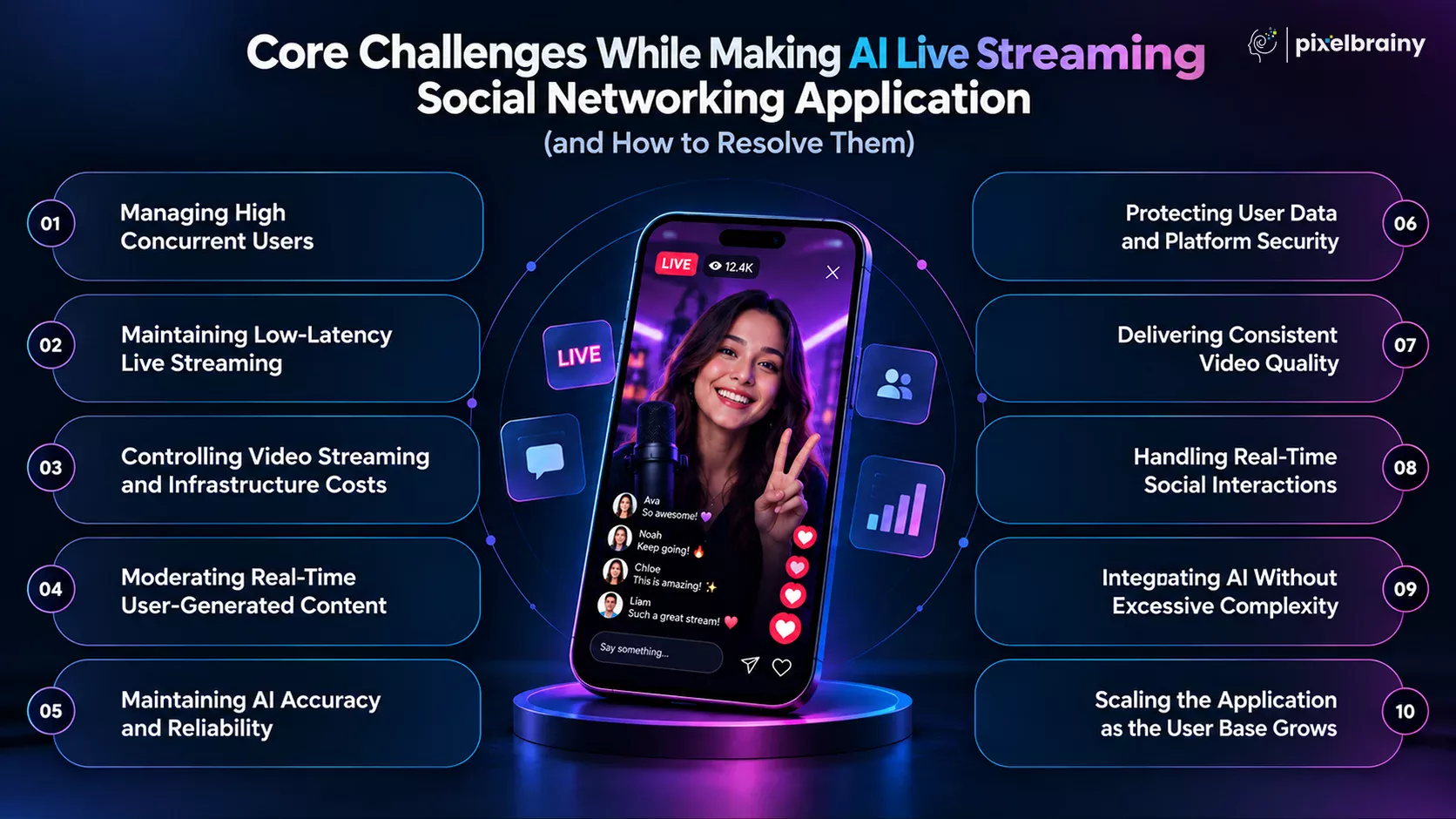
Challenge:
A popular creator can attract thousands of viewers within seconds. At the same time, users may watch streams, post comments, send reactions, follow creators, and interact with other users, creating substantial pressure on backend and streaming infrastructure.
How to resolve it:
Use cloud infrastructure with auto-scaling, load balancing, caching, distributed services, and CDN delivery. Separating video delivery from core application services can also prevent heavy streaming traffic from affecting essential social networking functionality.
Challenge:
Real-time interaction depends on keeping the delay between the broadcaster and audience as low as possible. Excessive latency can negatively affect conversations, gaming, auctions, interviews, and other interactive experiences.
How to resolve it:
Select streaming technologies based on the required latency and use case. WebRTC can support highly interactive experiences, while HLS can support large-scale video delivery. Efficient encoding, adaptive bitrate streaming, CDN configuration, and network optimization can further improve performance.
Challenge:
Bandwidth, video storage, transcoding, cloud computing, and AI processing can create significant operating expenses as the number of users and streaming hours increases.
How to resolve it:
Monitor bandwidth, storage, transcoding, and AI consumption from the beginning. Businesses can optimize video quality, apply appropriate storage policies, use scalable infrastructure, and compare managed streaming services with custom solutions according to expected platform usage.
Challenge:
Live content cannot always be reviewed before publication. Inappropriate video, abusive comments, spam, or harmful behavior can appear instantly and potentially reach large audiences.
How to resolve it:
Combine AI-assisted detection with keyword filtering, reporting tools, moderation queues, account controls, and human review. Clear community guidelines and escalation procedures should also be established to handle complex moderation cases.
Challenge:
AI recommendations, moderation systems, personalization engines, and analytics can produce inaccurate results. False positives may restrict legitimate content, while false negatives may allow inappropriate content or irrelevant recommendations.
How to resolve it:
Evaluate AI systems using representative datasets and measurable performance criteria. Continuously monitor results, test edge cases, collect feedback, and retrain or optimize models when necessary. Human oversight can provide additional quality control for sensitive decisions.
Challenge:
The platform may process account information, payment details, private communications, behavioral data, and video or audio content. Security vulnerabilities can expose users and create serious operational and reputational risks.
How to resolve it:
Implement secure authentication, encryption, access controls, API protection, secure payment processing, vulnerability testing, monitoring, and appropriate data retention policies. Security should be incorporated into the architecture from the beginning.
Challenge:
Users access live streams through different devices and network conditions. Poor connectivity can cause buffering, dropped frames, resolution changes, or interrupted broadcasts.
How to resolve it:
Use adaptive bitrate streaming, efficient video encoding, CDN delivery, network monitoring, and appropriate video profiles. The application should dynamically adjust quality according to available bandwidth and device capabilities.
Challenge:
Comments, reactions, notifications, follows, and messages can generate thousands of real-time events during a popular broadcast. Inefficient processing can cause delays and place excessive pressure on backend systems.
How to resolve it:
Use WebSockets or other suitable real-time technologies along with caching, event-driven architecture, message queues, and scalable backend services. High-volume events should be processed efficiently without affecting core application performance.
Challenge:
Businesses may want recommendations, moderation, translation, captions, virtual assistants, analytics, and other AI capabilities simultaneously. Adding everything at once can increase development complexity, testing requirements, infrastructure usage, and operating costs.
How to resolve it:
Prioritize AI capabilities according to user needs and business objectives. Introduce high-value features first, measure their performance, and gradually expand the AI layer as the platform grows.
Challenge:
An architecture that works well for an MVP may encounter performance issues when the platform gains more users, creators, streams, and interactions. Delaying scalability planning can also result in expensive architectural changes later.
How to resolve it:
Use modular architecture, cloud infrastructure, auto-scaling, database optimization, caching, CDN distribution, monitoring, and regular load testing. Establish performance benchmarks early and continuously evaluate the platform as traffic increases.
Addressing these challenges early can help businesses create a secure, scalable, and reliable AI live streaming social networking application that is prepared for long-term growth.
Have a live streaming social networking idea but need the right technology partner to turn it into a scalable, AI-powered product? PixelBrainy helps businesses transform these ideas into real-world applications by combining AI, live video streaming, social networking, and scalable cloud technologies under one development strategy.
As an AI app development company, PixelBrainy focuses on the actual business objective, target audience, and expected user scale instead of simply adding AI features to an application.
PixelBrainy provides AI live streaming social networking app development services covering the complete product lifecycle, including:
This end-to-end approach helps businesses manage the complexity of a platform where users can watch live content, interact with creators, comment, follow accounts, and participate in real-time experiences.
Businesses looking to build AI live streaming social networking application can use AI to create experiences that go beyond conventional live broadcasting.
PixelBrainy can integrate capabilities such as:
Each capability can be planned according to the platform's users and business model, helping avoid unnecessary complexity and development costs.
Live video requires more than standard application infrastructure. High concurrent users, bandwidth consumption, video processing, latency, and real-time interactions need to be considered from the architecture stage.
PixelBrainy can help businesses develop AI live streaming social networking app solutions with scalable backend architecture, cloud infrastructure, CDN-based content delivery, real-time communication, databases, APIs, monitoring, and security.
The architecture can also separate streaming workloads from core social networking services, helping maintain application performance as traffic increases.
Project: AI-Powered Live Social Networking Platform
Client: Confidential
PixelBrainy worked on a confidential project for a client looking to create a social platform centered around live video interaction and intelligent content experiences.
The solution included:
The architecture was designed with future expansion in mind, allowing additional AI capabilities and platform features to be introduced as the user base grows.
For companies considering AI live streaming social networking application development integrating AI, the development partner should understand the complete technology ecosystem, not just AI.
PixelBrainy brings expertise across:
AI + Live Streaming + Social Networking + Cloud + Mobile + Backend + Scalability
Businesses can work with one technology partner across ideation, development, AI implementation, testing, deployment, and ongoing optimization.
A common requirement is:
“We already run a social media platform and want to add AI-powered live streaming, but we need a development partner that understands real-time video, scalability, AI moderation, and future growth.”
That requires more than a standard mobile app development team. It requires an understanding of how AI models, streaming infrastructure, social features, backend systems, and cloud architecture work together.
PixelBrainy helps businesses turn AI live streaming social networking concepts into scalable, engaging, and commercially focused digital platforms.
Have an AI live streaming idea? Connect with PixelBrainy to discuss your project today.
The growing demand for real-time digital experiences is creating new opportunities for businesses to combine social networking, live video, and artificial intelligence. AI live streaming social networking application development enables businesses to create platforms where users can broadcast, interact, discover content, and build communities in real time.
However, successful live streaming social networking app development using AI requires careful planning across features, streaming infrastructure, AI capabilities, security, scalability, monetization, and user experience. Businesses should begin with a focused MVP, validate their concept, and gradually introduce advanced AI capabilities based on actual user needs.
From defining the product strategy and selecting the right technology stack to integrating AI, managing live video, addressing scalability challenges, and preparing for future growth, every development decision can influence the platform's success.
If you are planning to develop an AI live streaming social networking app, partnering with an experienced development team can help turn your concept into a reliable and scalable digital product.
Ready to transform your idea into an AI-powered live social platform? Book an appointment with PixelBrainy today.
The AI live streaming social networking app development cost can start at around $25,000 for a focused MVP and exceed $200,000 for an enterprise-level platform. The final cost depends on features, AI capabilities, live streaming infrastructure, number of platforms, integrations, security requirements, and expected user scale.
To build an AI live streaming social networking app from scratch, businesses typically begin with product planning and market research, followed by UI/UX design, MVP development, backend and live streaming infrastructure, AI integration, testing, deployment, and ongoing optimization. A phased approach can help control development complexity and costs.
Yes. Businesses can extend an existing platform through AI live streaming social networking app development by integrating live video infrastructure, real-time communication, creator tools, social features, and AI capabilities. The existing backend and architecture should first be evaluated to determine the best integration and scalability strategy.
Core AI live streaming app features can include user registration, profiles, live video streaming, stream discovery, real-time chat, reactions, social connections, search, notifications, creator dashboards, stream scheduling, reporting, moderation, admin controls, and analytics. Advanced AI capabilities can be added separately as the platform evolves.
Live streaming social networking app development using AI can support personalized content recommendations, AI-assisted moderation, creator analytics, intelligent notifications, automated captions, content classification, and other intelligent experiences. AI can help make live content more relevant and manageable as the platform grows.
When searching for an AI live streaming social networking app development company, check its experience in AI/ML, real-time video streaming, social networking applications, cloud infrastructure, backend development, security, and scalable architecture. Relevant case studies and experience handling concurrent users can also help evaluate a potential development partner.
The AI live streaming social networking app development timeline can range from approximately 4 to 6 months for an MVP to 6 to 9 months or longer for an advanced platform. The timeline depends on feature complexity, AI requirements, streaming infrastructure, integrations, supported platforms, testing, and scalability requirements.
The major challenges in AI live streaming social networking app development include maintaining low-latency video, handling high concurrent users, controlling bandwidth and cloud costs, moderating live content, maintaining AI accuracy, protecting user data, ensuring consistent video quality, and scaling the platform as the user base grows.

About The Author
Sagar Bhatnagar
Sagar Sahay Bhatnagar brings over a decade of IT industry experience to his role as Marketing Head at PixelBrainy. He's known for his knack in devising creative marketing strategies that boost brand visibility and market influence. Sagar's strategic thinking, coupled with his innovative vision and focus on results, sets him apart. His track record of successful campaigns proves his ability to utilize digital platforms effectively for impactful marketing efforts. With a genuine passion for both technology and marketing, Sagar continuously pushes PixelBrainy's marketing initiatives to greater success.

Working with the PixelBrainy team has been a highly positive experience. They understand the design requirements and create beautiful UX elements to meet the application needs. The dev team did an excellent job bringing my vision to life. We discussed usability and flow. Sagar worked with his team to design the database and begin coding. Working with Sagar was easy. He has the knowledge to create robust apps, including multi-language support, Google and Apple ID login options, Ad-enabled integrations, Stripe payment processing, and a Web Admin site for maintaining support data. I'm extremely satisfied with the services provided, the quality of the final product, and the professionalism of the entire process. I highly recommend them for Android and iOS Mobile Application Design and Development.

Great experience working with them. Had a lot of feedback and I found that unlike most contractors they were bugging me for updates instead of the other way around. They were extremely time conscience and great at communicating! All work was done extremely high quality and if not on time, early! They were always proactive when it comes to communication and the work is great/above par always. Very flexible and a great team to work with! Goes above and beyond to present us with multiple options and always provides quality. Amazing work per usual with Chitra. If you have UI/UX or branding design needs I recommend you go to them! Will likely work with them in the future as well, definitely recommended!

PixelBrainy is a joy to work with and is a great partner when thinking through branding, logo, and website layout. I appreciate that they spend time going into the "why" behind their decisions to help inform me and others about industry best practices and their expertise.

I hired them to design our software apps. Things I really like about them are excellent communication skills, they answer all project suggestions and collaborate right away, and their input on design and colors is amazing. This project was complex and needed patience and creativity. The team is amazing to do business with. I will be using them long-term. Glad to see there are some good people out there. I was afraid to try and outsource my project to someone but I am glad I met them! I really can't say enough. They went above and beyond on this project. I am very happy with everything they have done to make my business stand out from the competition.

It was great working with PixelBrainy and the team. They were very responsive and really owned the project. We'll definitely work with them again!

I recently worked with the PixelBrainy team on a project and I was blown away by their communication skills. They were prompt, clear, and articulate in all of our interactions. They listened and provided valuable feedback and suggestions to help make the project a success. They also kept me updated throughout the entire process, which made the experience stress-free and enjoyable.

PixelBrainy is very good at what it does. The team also presents themselves very professionally and takes care of their side of things very well. I could fully trust them taking up the design work in a timely and organised manner and their attention to detail saved us lots of effort and time. This particular project was quite intense and the team showed that they function very well under pressure. Very much looking forward to working with her again!

It's always an absolute pleasure working with them. They completed all of my requests quickly and followed every note I had for them to a T, which made our process go smoothly from start to finish. Everything was completed fast and following all of the guidelines. And I would recommend their services to anyone. If you need any design work done in the future, PixelBrainy should be your first call!

They took ownership of our requirements and designed and proposed multiple beautiful variants. The team is self-motivated, requires minimum supervision, committed to see-through designs with quality and delivering them on time. We would definitely love to work with PixelBrainy again when we have any requirements.

PixelBrainy was a big help with our SaaS application. We've been hard at work with a new UI/UX and they provided a lot of help with the designs. If you're looking for assistance with your website, software, or mobile application designs, PixelBrainy and the team is a great recommendation.

PixelBrainy designers are amazing. They are responsive, talented, and always willing to help craft the design until it matches your vision. I would recommend them and plan to continue them for my future projects and more!!!

They were awesome! Did a good job fast, and good communication. Will work with them again. Thank you

Creative, detail-oriented, and talented designers who take direction well and implement changes quickly and accurately. They consistently over-delivered for us.

PixelBrainy team is very talented and creative. Great designers and a pleasure to work with. PixelBrainy is an excellent communicator and I look forward to working with them again.

PixelBrainy has a very talented design team. Their work is excellent and they are very responsive. I enjoy working with them and hope to continue on all of our future projects.


Transform your ideas into reality with us.
Across these industries, each engagement brings unique challenges, from early-stage product development to scaling complex systems, helping us build a practical understanding of real-world product environments.