AI Summary Powered by PixelBrainy
What if your logistics operations could think, predict, and adapt faster than the market itself?
In an era where speed, accuracy, and transparency define success, traditional logistics systems are no longer enough. Businesses across manufacturing, retail, eCommerce, healthcare, automotive, and third-party logistics are now turning toward AI Logistics Softwares to keep pace with growing customer expectations and operational complexity.
From managing unpredictable demand to optimizing last-mile delivery, logistics leaders are actively exploring bespoke AI Logistics Software Solutions that align with their unique workflows. AI Logistics Software Development is no longer a futuristic concept. It is a strategic investment that helps organizations streamline supply chains, reduce costs, and make smarter decisions in real time.
For decision-makers wondering how to develop an AI Logistics Software, the journey involves more than just technology. It requires deep industry understanding, quality data, and a clear vision for scalability. Whether you are planning the building of AI Logistics Software from scratch or modernizing existing systems, AI enables logistics platforms that deliver measurable business outcomes.
Modern enterprises now expect solutions that deliver scalable and intelligent AI logistics solutions, offering flexibility across regions, fleets, and warehouses. From startups aiming to build an AI Logistics Software MVP to enterprises rolling out large-scale platforms, AI-driven logistics is shaping the future of movement, storage, and distribution.
This blog explores everything you need to know, from benefits and development steps to cost, challenges, and future trends, helping you make informed decisions for your logistics transformation.
AI logistics software refers to intelligent digital systems that use artificial intelligence, machine learning, and data analytics to manage and optimize logistics operations. These platforms analyze historical and real-time data to automate planning, forecasting, routing, inventory control, and performance monitoring.
Unlike traditional logistics software that relies on static rules, AI-powered systems continuously learn from patterns and outcomes. This allows logistics teams to predict disruptions, adjust routes dynamically, and improve operational accuracy across transportation, warehousing, and supply chain activities.
Artificial intelligence is reshaping the logistics industry by shifting operations from reactive execution to intelligent, predictive decision making. As global supply chains become more complex and customer expectations for speed, transparency, and reliability continue to rise, AI is helping logistics organizations operate with greater accuracy and confidence. Companies are no longer relying solely on historical reports. Instead, they are using AI-driven insights to forecast demand, prevent disruptions, and optimize every movement across the supply chain.
The market momentum behind this shift is significant. According to a 2025 industry outlook, more than 80 percent of supply chain leaders plan to deploy AI-driven solutions this year to strengthen forecasting, inventory planning, and network intelligence.
On a global scale, the AI in logistics market is expected to grow from approximately 26.3 billion USD in 2025 to nearly 708 billion USD by 2034, reflecting a strong compound annual growth rate of 44.4 percent.
As management thinker Peter Drucker famously stated, “There is nothing so useless as doing efficiently that which should not be done at all.” This insight perfectly captures the role of AI in logistics. The goal is not just faster operations, but smarter ones driven by intelligence rather than effort alone.
Below are the core AI components that are redefining modern logistics operations.
Predictive analytics enables logistics companies to anticipate future demand, delivery delays, and capacity requirements by analyzing historical and real-time data. AI models help businesses plan inventory more accurately, optimize routes in advance, and reduce costly disruptions before they occur.
Computer vision allows logistics systems to visually interpret warehouse and transit environments. This technology supports automated package inspection, barcode recognition, damage detection, and real-time inventory tracking. As a result, companies reduce manual errors, speed up processing, and improve overall accuracy.
AI-powered autonomous vehicles are transforming transportation and last-mile delivery. Self-driving trucks and delivery drones use real-time data to navigate routes, avoid obstacles, and maintain delivery schedules with minimal human involvement. These systems help reduce fuel costs, improve safety, and shorten delivery timelines.
Logistics operations generate massive volumes of data from GPS systems, IoT sensors, fleet telematics, and customer interactions. AI-driven big data analytics converts this information into actionable insights that improve routing efficiency, reduce idle time, and enhance service reliability.
Generative AI is emerging as a powerful tool for strategic planning in logistics. It can simulate multiple supply chain scenarios, evaluate risks, and recommend optimal decisions. According to Forbes, “Supply chains of the future will be guided by human creativity and powered by AI-driven intelligence.”
Together, these AI components work in harmony to create logistics systems that are adaptive, resilient, and future-ready. They provide a clear answer to the question of how artificial intelligence is used in the logistics industry by enabling smarter planning, stronger visibility, and sustainable competitive advantage.
Logistics is no longer just about moving goods from point A to point B. It is about making the right decisions at the right time while maintaining efficiency, visibility, and customer trust. AI Logistics Software Development empowers businesses to transform logistics operations into intelligent, responsive systems that support both operational excellence and long-term growth.
Below are the key benefits that clearly demonstrate why AI has become essential in modern logistics.
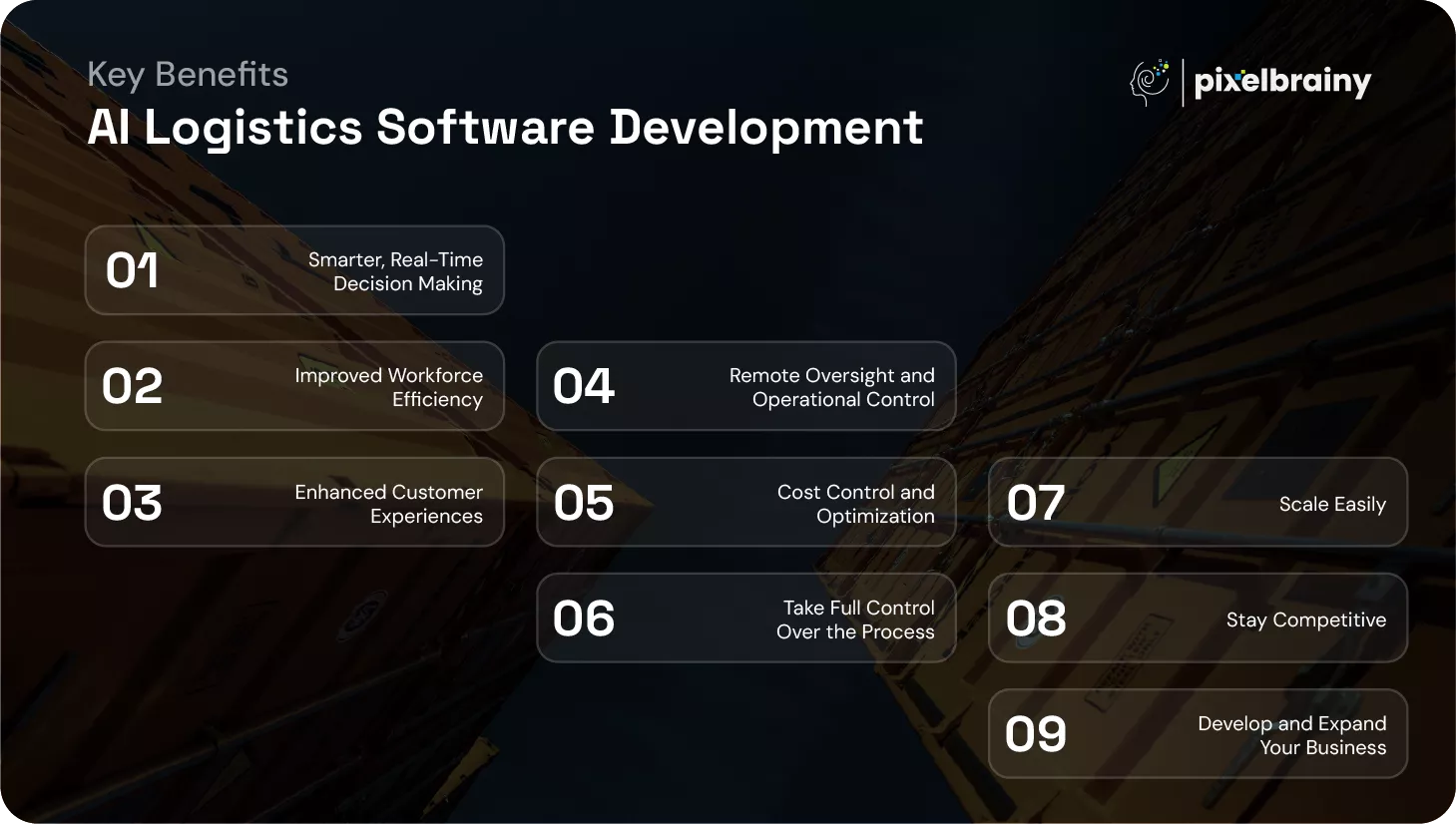
AI enables logistics teams to make faster and more accurate decisions by continuously analyzing live and historical data. Traffic conditions, weather patterns, delivery constraints, and demand fluctuations are processed in real time, allowing operations to adjust instantly.
Instead of reacting to issues after they occur, AI-driven insights help businesses anticipate delays, reroute shipments, and optimize delivery schedules proactively. This level of intelligence reduces uncertainty and ensures decisions are based on data rather than assumptions, resulting in smoother operations and improved reliability across the supply chain.
Automation powered by AI reduces the dependency on manual processes that often slow down logistics operations. When developing an AI Logistics Software, routine tasks such as dispatching, scheduling, reporting, and exception handling can be automated with high accuracy.
This allows teams to focus on strategic planning, problem-solving, and customer engagement instead of repetitive coordination work. AI also helps optimize workforce allocation by forecasting workload demand, ensuring the right resources are deployed at the right time, ultimately improving productivity and employee satisfaction.
Customer satisfaction is directly tied to delivery accuracy, transparency, and communication. One of the strongest advantages of AI Logistics Software is its ability to provide real-time tracking, accurate delivery predictions, and proactive issue notifications.
AI systems anticipate potential delays and trigger alerts before customers are affected, enabling timely communication. This builds trust and improves service consistency. Over time, reliable and transparent delivery experiences strengthen brand loyalty and increase customer retention in competitive logistics-driven industries.
Modern logistics operations often span multiple locations and regions, making centralized control challenging. AI-powered systems provide real-time dashboards that offer complete visibility into fleet movements, warehouse activity, and delivery performance.
For businesses planning to build an AI Logistics Software, this means decision-makers can monitor and manage operations remotely without compromising control. AI-generated alerts and insights allow leadership teams to identify risks early and respond quickly, ensuring operational stability even across distributed networks.
AI plays a critical role in identifying cost inefficiencies that are difficult to detect manually. By analyzing route performance, fuel consumption, inventory turnover, and asset utilization, AI helps logistics teams optimize spending without impacting service quality.
These insights lead to smarter routing, reduced idle time, lower fuel usage, and optimized inventory levels. Over time, continuous optimization significantly reduces operational expenses and improves profitability, making cost control a sustainable, data-driven process.
AI-driven platforms provide end-to-end visibility across logistics workflows, from order placement to final delivery. With unified AI Logistics Software Solutions, businesses eliminate data silos and gain a single source of truth for all logistics activities.
AI monitors processes in real time, flags deviations, and recommends corrective actions, ensuring consistency and accountability. This level of control improves coordination between teams, enhances compliance, and enables smoother execution across complex supply chain operations.
As businesses grow, logistics operations must adapt quickly to increased volumes, new delivery zones, and evolving customer expectations. AI systems are designed to scale seamlessly by adjusting planning models, resource allocation, and routing strategies automatically.
With AI in logistics Software, organizations can handle seasonal spikes and geographic expansion without overhauling infrastructure. This flexibility ensures that growth does not compromise efficiency or service quality, making scalability a built-in advantage rather than a challenge.
In fast-moving markets, logistics performance can be a key differentiator. AI-powered logistics systems enable businesses to operate faster, respond to disruptions efficiently, and continuously optimize performance.
Competitors relying on traditional systems often struggle to match this level of agility. AI-driven insights also support innovation, allowing companies to experiment with new delivery models, optimize pricing strategies, and adapt quickly to market changes, keeping them ahead of industry shifts.
AI-driven logistics supports long-term business growth by transforming operations into a strategic asset. When creating an AI Logistics Software aligned with business objectives, organizations gain the insights needed to identify expansion opportunities and improve network design.
Improved efficiency, cost savings, and customer satisfaction free up resources that can be reinvested into new markets, services, and innovations. This makes logistics a growth enabler rather than an operational constraint.
Ultimately, AI-powered logistics equips businesses with the intelligence, control, and flexibility needed to grow confidently in an increasingly competitive and dynamic global market.
Logistics operations are diverse, and no single system can address every operational challenge. The development of AI Logistics Software has therefore evolved into multiple specialized solutions, each designed to optimize a specific area of logistics. Understanding these types helps businesses choose the right AI-driven system based on their operational priorities, scale, and growth plans.
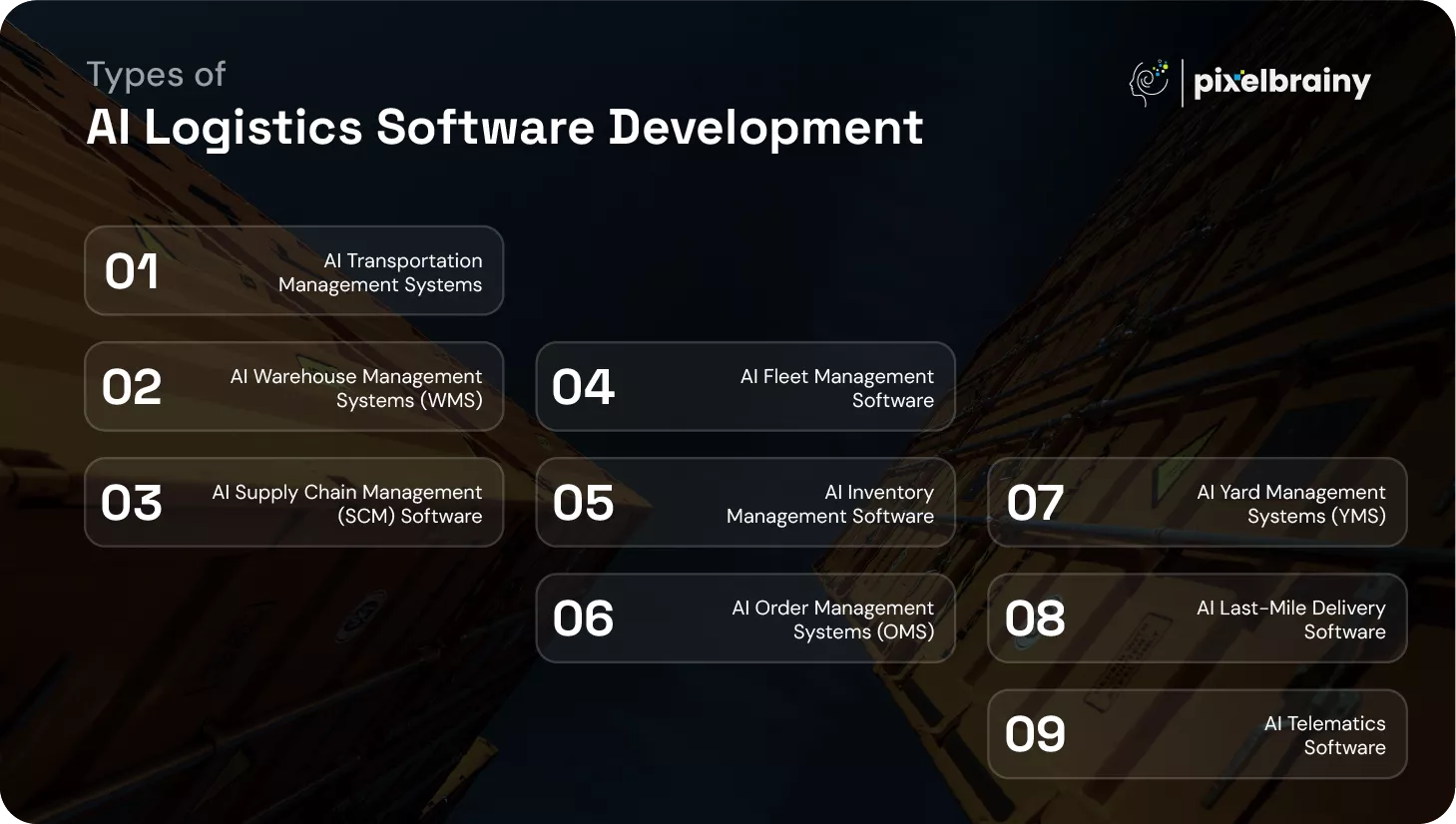
AI Transportation Management Systems focus on optimizing the movement of goods across complex transportation networks. These systems analyze traffic conditions, weather data, delivery constraints, and historical performance to recommend the most efficient routes in real time.
By automating carrier selection, load planning, and delivery scheduling, AI-driven TMS platforms reduce delays and transportation costs. Businesses looking to make an AI Logistics Software for transportation gain better visibility into shipments, improved on-time delivery rates, and the ability to quickly respond to disruptions across regional and global routes.
AI-powered Warehouse Management Systems bring intelligence to inventory handling, picking, packing, and storage optimization. These systems use machine learning to predict order volumes, optimize warehouse layouts, and guide workers or robots through the most efficient picking paths.
AI WMS platforms also help reduce errors through automated quality checks and real-time inventory updates. As warehouses grow more complex, AI-driven solutions ensure faster order fulfillment, reduced labor dependency, and better space utilization while maintaining accuracy at scale.
AI Supply Chain Management software provides end-to-end visibility and control across procurement, production, distribution, and delivery. By analyzing demand signals, supplier performance, and market trends, AI helps organizations plan proactively rather than reactively.
Within AI Logistics Software Development, SCM platforms play a strategic role by enabling scenario planning, risk forecasting, and supply chain optimization. These systems help businesses mitigate disruptions, balance supply with demand, and improve coordination across multiple stakeholders and partners.
AI Fleet Management Software focuses on optimizing vehicle performance, driver behavior, and asset utilization. These systems monitor fuel consumption, maintenance needs, driving patterns, and route efficiency using real-time telematics data.
AI-driven insights help logistics companies reduce downtime through predictive maintenance and improve safety by identifying risky driving behaviors. For organizations building an AI Logistics Software centered on fleet operations, this type of solution ensures better asset longevity, lower operating costs, and improved compliance with safety standards.
AI Inventory Management Software enables businesses to maintain optimal stock levels by forecasting demand with high accuracy. These systems analyze sales trends, seasonality, and market signals to prevent overstocking and stockouts.
AI continuously adjusts reorder points and inventory allocation across warehouses or stores, ensuring products are available where they are needed most. This leads to improved cash flow, reduced storage costs, and better service levels across supply chains of all sizes.
AI-powered Order Management Systems streamline the entire order lifecycle from placement to fulfillment. These platforms intelligently route orders based on inventory availability, delivery timelines, and customer preferences.
AI OMS solutions improve order accuracy and reduce fulfillment delays by dynamically adjusting workflows in real time. They also support omnichannel operations, ensuring consistent service across online, in-store, and third-party sales channels while maintaining operational efficiency.
AI Yard Management Systems optimize the movement and scheduling of vehicles within logistics yards. These systems provide real-time visibility into trailer locations, dock availability, and gate operations.
By using AI to coordinate arrivals, departures, and dock assignments, YMS platforms reduce congestion and idle time. This improves yard efficiency, enhances coordination between warehouse and transportation teams, and ensures smoother inbound and outbound logistics operations.
Last-mile delivery is one of the most complex and cost-intensive logistics stages. AI-powered last-mile delivery software optimizes routes, delivery sequences, and time windows based on real-time conditions.
These systems adapt dynamically to traffic changes, customer availability, and delivery priorities. AI-driven last-mile solutions improve delivery speed, reduce costs, and enhance customer satisfaction by ensuring accurate and predictable delivery experiences, even in dense urban environments.
AI Telematics Software collects and analyzes data from vehicles, sensors, and connected devices to provide deep insights into logistics operations. This includes location tracking, fuel usage, vehicle health, and driver performance.
By combining telematics with AI analytics, businesses gain actionable insights that support smarter routing, predictive maintenance, and operational transparency. These systems form the backbone of intelligent fleet and transportation management strategies.
Together, these AI-driven logistics software types enable businesses to build focused, scalable, and intelligent systems that optimize every layer of modern logistics operations.
To build a reliable and future-ready logistics platform, functionality matters as much as intelligence. The success of AI Logistics Software Development depends on integrating core features that ensure accuracy, visibility, automation, and control across logistics operations.
These essential features form the foundation of any scalable and intelligent logistics system.
| Feature | Description |
| Real-Time Tracking & Visibility | Real-time tracking enables businesses to monitor shipments, vehicles, and inventory continuously. AI enhances this visibility by predicting delays and identifying route deviations before they impact delivery. This ensures better coordination, faster responses, and increased transparency across the supply chain. |
| AI-Powered Route Optimization | This feature analyzes traffic, weather, delivery windows, and vehicle capacity to determine optimal routes. AI continuously recalculates routes in real time to avoid disruptions. As a result, delivery times are reduced while fuel costs and delays are minimized. |
| Predictive Demand Forecasting | AI uses historical data, seasonal trends, and market signals to predict future demand accurately. This allows logistics teams to plan inventory and transportation proactively. Predictive forecasting reduces stockouts and overstock situations significantly. |
| Inventory Management Automation | AI automates inventory tracking by maintaining real-time stock visibility across locations. It dynamically adjusts reorder points based on demand patterns. This improves inventory accuracy while reducing holding and operational costs. |
| Automated Order Processing | AI streamlines order validation, routing, and fulfillment by eliminating manual interventions. Orders are automatically assigned to the most efficient fulfillment centers. This ensures faster processing and fewer fulfillment errors. |
| Fleet Performance Monitoring | This feature tracks vehicle health, driver behavior, and fuel usage using AI analytics. Predictive insights help identify maintenance needs before breakdowns occur. It improves fleet reliability and reduces downtime. |
| Smart Alerts & Notifications | AI-generated alerts notify teams about delays, inventory shortages, or operational anomalies. These alerts are prioritized based on business impact. This ensures quick action and prevents escalation of issues. |
| Data Analytics & Reporting Dashboard | AI dashboards provide actionable insights through visual reports and performance metrics. Decision-makers gain clarity on KPIs, trends, and bottlenecks. This supports informed and faster decision-making. |
| System Integration Capabilities | AI logistics software must integrate seamlessly with ERP, CRM, WMS, and third-party systems. Smooth data flow ensures consistency and eliminates data silos. Integration also improves cross-department collaboration. |
| Scalability & Cloud Support | Cloud-based AI systems scale automatically as logistics volumes grow. Businesses can expand operations without rebuilding infrastructure. This ensures consistent performance during peak demand periods. |
| Role-Based Access Control | AI software provides controlled access based on user roles and responsibilities. This improves security while ensuring employees access only relevant information. It also enhances accountability across teams. |
| AI-Driven Exception Handling | This feature detects unusual patterns such as delivery delays or inventory mismatches. AI suggests corrective actions instantly. It reduces manual intervention and improves operational stability. |
| Compliance & Audit Management | AI ensures adherence to regulatory standards by monitoring documentation and process compliance. Automated audit trails simplify reporting and reduce legal risks. This is critical for regulated industries. |
| Customer Communication Tools | AI-powered communication tools provide customers with real-time updates and accurate ETAs. Automated notifications improve transparency. This strengthens customer trust and satisfaction. |
| Multi-Location Management | AI supports centralized control over multiple warehouses, fleets, and delivery zones. It ensures operational consistency across regions. This feature is essential for enterprises with distributed logistics networks. |
Incorporating these must-have features ensures AI logistics software delivers reliability, efficiency, and long-term operational control.
Once the foundation is in place, advanced capabilities help logistics platforms move from efficiency to intelligence. While developing an AI Logistics Software, advanced features allow businesses to gain predictive power, automate complex decisions, and future-proof operations against uncertainty and scale.
| Advanced Feature | Description |
| Predictive Maintenance Intelligence | AI analyzes vehicle and equipment data to predict failures before they occur. This reduces downtime and avoids costly emergency repairs. Predictive maintenance also extends asset lifespan significantly. |
| Digital Twin Simulation | Digital twins create virtual replicas of logistics networks to simulate scenarios. AI tests different strategies without real-world risk. This supports better planning and risk management decisions. |
| AI-Powered Scenario Planning | AI evaluates multiple supply chain scenarios such as demand spikes or disruptions. It recommends optimal responses based on projected outcomes. This improves resilience and preparedness. |
| Dynamic Pricing Optimization | AI adjusts pricing based on demand, delivery distance, and capacity availability. This ensures profitability while remaining competitive. Dynamic pricing also improves resource utilization. |
| Autonomous Dispatching | AI assigns shipments to vehicles automatically using real-time data. Dispatch decisions adapt dynamically to operational changes. This eliminates manual scheduling inefficiencies. |
| Computer Vision for Warehousing | AI-powered cameras monitor warehouse activity for accuracy and safety. Computer vision automates inspections and error detection. This improves productivity and reduces loss. |
| AI-Based Fraud Detection | AI identifies unusual transaction patterns or delivery discrepancies. Early detection prevents financial losses and security breaches. This feature is vital for large-scale logistics operations. |
| Voice & NLP-Based Interfaces | Natural language interfaces allow users to interact with systems using voice or text. This improves accessibility and reduces training time. AI-driven assistants speed up operations. |
| Self-Learning Optimization Models | AI models continuously improve based on outcomes and feedback. Performance becomes better over time without manual retraining. This ensures continuous operational improvement. |
| Sustainability & Carbon Optimization | AI tracks emissions and recommends eco-friendly routes and practices. This supports sustainability goals and regulatory compliance. It also enhances brand responsibility initiatives. |
Advanced AI features transform logistics platforms into intelligent ecosystems that adapt, learn, and scale with business growth.
Building an intelligent logistics platform requires a structured, goal-oriented approach that aligns technology with real operational demands. Understanding what is the process of developing an AI Logistics Software helps businesses minimize risk, ensure scalability, and achieve long-term value.
Below is a detailed, step-by-step process, with a clear aim for each stage, to guide organizations through successful AI-driven logistics implementation.
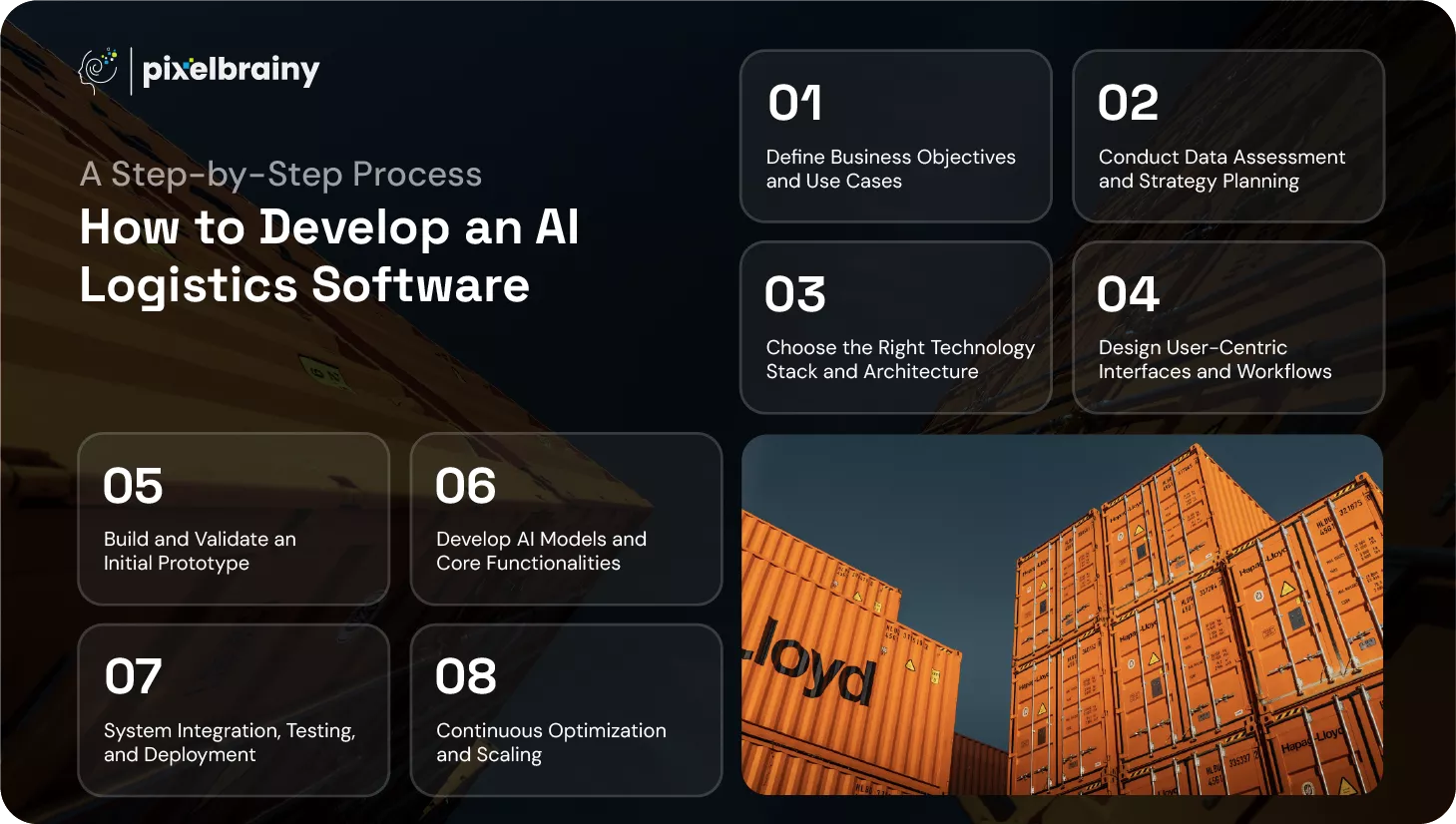
The foundation of successful development of AI Logistics Software begins with clearly defining business objectives. Organizations must identify operational pain points such as inefficient routing, lack of shipment visibility, inventory imbalances, or high transportation costs. These challenges are then translated into practical AI-driven use cases.
This step also involves setting measurable KPIs like delivery accuracy, cost reduction, or turnaround time improvement. Establishing these metrics early ensures the software is designed with clear success benchmarks rather than abstract innovation.
Aim of this step: To align AI capabilities with real business problems and ensure the solution delivers measurable operational and financial outcomes.
AI systems are only as effective as the data they are built on. In this phase, businesses assess the quality, availability, and structure of existing data sources such as GPS data, IoT sensors, warehouse records, order histories, and fleet telematics.
A robust data strategy is essential for Logistics Software Development Integrating AI, as it ensures consistency, accuracy, and reliability across AI models. This step includes data cleaning, normalization, and planning data governance policies to prevent future inaccuracies.
Aim of this step: To create a reliable data foundation that supports accurate predictions, automation, and long-term scalability of AI systems.
Selecting the appropriate technology stack determines how scalable, secure, and flexible the system will be. This includes decisions around cloud infrastructure, AI frameworks, databases, APIs, and microservices architecture.
For organizations focused on AI Software Development for Logistics, this step ensures the system can process real-time data, integrate with third-party platforms, and adapt to growing operational complexity. A modular architecture also simplifies future enhancements.
Aim of this step: To build a scalable and resilient technical foundation that supports performance, integration, and future growth.
Advanced AI insights must be accessible and easy to interpret. Designing intuitive dashboards and workflows often involves collaboration with a specialized UI/UX design company to ensure smooth adoption by logistics teams.
User-centric design focuses on role-based dashboards, clear visualizations, and streamlined workflows that allow users to act on AI recommendations quickly. This step bridges the gap between complex analytics and daily operational decision-making.
Aim of this step: To ensure high user adoption by making AI insights practical, intuitive, and actionable for all stakeholders.
Before committing to full-scale development, teams create early versions of the system to validate assumptions. This often includes PoC development to test AI feasibility or MVP development to validate core features with real users.
These prototypes help uncover technical limitations, refine AI models, and gather operational feedback. Early validation significantly reduces development risk and ensures resources are invested wisely.
Aim of this step: To test feasibility, reduce uncertainty, and validate the AI concept before full investment and scaling.
Once validation is complete, the focus shifts to full-scale building an AI Logistics Software solution. This step includes developing and training machine learning models for demand forecasting, route optimization, predictive maintenance, and anomaly detection.
Core logistics modules such as transportation management, inventory control, and order processing are implemented and integrated with AI intelligence. Continuous testing ensures accuracy, reliability, and consistency across real-world scenarios.
Aim of this step: To transform validated concepts into a fully functional, intelligent logistics system that delivers operational efficiency.
AI logistics software must operate seamlessly within existing digital ecosystems. This phase focuses on integrating the solution with ERP, CRM, WMS, and third-party platforms, followed by extensive testing.
Organizations partnering with top AI development companies in usa often emphasize security testing, performance benchmarking, and compliance validation before deployment. This ensures the system is stable, secure, and ready for production use.
Aim of this step: To ensure smooth deployment, data consistency, system security, and reliable performance across live operations.
Deployment is not the end of the journey. To truly to develop an AI Logistics Software that delivers sustained value, continuous monitoring and optimization are required. AI models must be retrained with new data, workflows refined, and performance scaled as operations grow.
This phase enables Bespoke AI Logistics Software Development Solutions that evolve with business needs and market conditions. Continuous improvement ensures long-term ROI through adaptive AI Solutions for Logistics Software.
Aim of this step: To maintain long-term effectiveness, scalability, and competitive advantage through continuous AI evolution.
By following this structured and goal-driven process, businesses can confidently design, deploy, and scale intelligent logistics platforms that deliver lasting operational impact and strategic value.
One of the most common questions businesses ask before investing in AI-driven logistics is cost. What is the cost of developing an AI Logistics Software depends on multiple factors, including feature complexity, data requirements, system integrations, and scalability goals.
In general, the investment ranges from $40,000 to $300,000+, depending on the type of solution being built and the business objectives it serves.
| Software Type | Timeline | Estimated Cost | What You Get |
| Basic AI Logistics Software (MVP / Pilot) | 2 to 4 months | $40,000 – $80,000 | Core AI features such as basic route optimization, shipment tracking, limited analytics dashboards, and proof of AI feasibility. Ideal for testing ideas, validating use cases, and early-stage deployments. |
| Advanced AI Logistics Software | 4 to 7 months | $80,000 – $180,000 | Advanced AI models, real-time data processing, predictive analytics, inventory optimization, system integrations, and enhanced reporting. Suitable for growing businesses seeking operational efficiency and scalability. |
| Enterprise AI Logistics Software | 7 to 12+ months | $180,000 – $300,000+ | End-to-end AI-powered logistics platform with custom workflows, advanced security, multi-location support, predictive maintenance, digital dashboards, and enterprise-grade scalability. Designed for large organizations with complex logistics networks. |
Understanding the development budget of AI Logistics Software requires evaluating the following cost-driving factors. Each of these directly impacts the overall investment.
The number and sophistication of features play a major role in pricing. Basic AI automation and tracking require lower investment, while advanced capabilities such as predictive analytics, digital twins, and autonomous decision-making significantly increase cost.
Estimated impact: $15,000 – $70,000+
AI systems require clean, structured, and reliable data. If historical data is limited or unorganized, additional effort is needed for data collection, cleansing, and labeling. This directly influences the cost to make an AI Logistics Software.
Estimated impact: $10,000 – $50,000+
Custom machine learning models tailored to logistics use cases require time, expertise, and testing. More complex models for forecasting, anomaly detection, or optimization increase the AI Logistics Software development cost.
Estimated impact: $20,000 – $80,000+
Integrating the AI solution with ERP, WMS, CRM, IoT devices, GPS systems, and third-party APIs adds to development effort. The number of integrations affects both time and budget significantly.
Estimated impact: $10,000 – $40,000+
User-friendly dashboards and workflows improve adoption but require additional design effort. Custom interfaces tailored to different user roles increase the cost estimation of AI Logistics Software development.
Estimated impact: $8,000 – $25,000+
Cloud architecture, data storage, and real-time processing capabilities are essential for scalable AI systems. Higher scalability and performance requirements directly influence infrastructure expenses.
Estimated impact: $10,000 – $35,000+
Enterprise-grade security, compliance with industry regulations, and extensive testing add necessary cost. These measures protect sensitive logistics data and ensure system reliability.
Estimated impact: $10,000 – $30,000+
Post-launch costs include system maintenance, AI model retraining, performance monitoring, and feature upgrades. This ongoing investment determines the long-term price of building an AI Logistics Software.
Estimated impact: $15,000 – $50,000 annually
In summary, the cost of AI logistics software varies widely based on scope, intelligence level, and scalability requirements. A well-planned investment ensures long-term efficiency, measurable ROI, and a competitive edge in logistics operations.

Also Read: AI Software Development Cost
Building an intelligent logistics platform requires a carefully selected technology stack that supports data processing, automation, scalability, and security. The development of AI Logistics Software relies on advanced tools and technologies that work together to power real-time decision-making, predictive analytics, and seamless system integration.
Below is a detailed overview of the key tools and technologies essential for creating a robust AI-driven logistics solution.
| Technology Category | Tools & Technologies | Explanation |
| Programming Languages | Python, Java, JavaScript | Python is widely used for AI model development due to its rich libraries. Java supports scalable backend systems, while JavaScript enables responsive web interfaces and real-time dashboards. |
| Machine Learning Frameworks | TensorFlow, PyTorch, Scikit-learn | These frameworks are used to build, train, and deploy AI models for demand forecasting, route optimization, and anomaly detection. They support high-performance model training and continuous learning. |
| Big Data Processing Tools | Apache Spark, Hadoop | Big data tools process massive volumes of logistics data efficiently. They enable real-time analytics and batch processing for route planning, inventory optimization, and operational insights. |
| Cloud Platforms | AWS, Microsoft Azure, Google Cloud | Cloud platforms provide scalable infrastructure, data storage, and AI services. They allow logistics systems to handle fluctuating workloads while ensuring high availability and performance. |
| Databases & Data Storage | PostgreSQL, MongoDB, Amazon S3 | These databases support structured and unstructured logistics data. They enable fast data retrieval, real-time updates, and long-term storage for AI model training and reporting. |
| IoT & Telematics Integration | GPS devices, IoT sensors, RFID | IoT technologies collect real-time data from vehicles, warehouses, and assets. This data feeds AI models for tracking, monitoring, and predictive maintenance. |
| API & Integration Frameworks | REST APIs, GraphQL, Apache Kafka | Integration frameworks enable seamless communication between AI logistics software and external systems such as ERP, WMS, and CRM platforms. They ensure smooth data flow and interoperability. |
| Computer Vision Tools | OpenCV, YOLO | Computer vision tools support image recognition, barcode scanning, damage detection, and warehouse automation. They enhance accuracy and reduce manual inspection efforts. |
| DevOps & CI/CD Tools | Docker, Kubernetes, Jenkins | DevOps tools streamline deployment, scaling, and updates. They ensure faster releases, system stability, and efficient management of AI-driven applications. |
| Security & Compliance Tools | OAuth, SSL, IAM systems | Security tools protect sensitive logistics data through encryption, authentication, and access control. Compliance tools ensure adherence to industry and regional regulations. |
| Analytics & Visualization Tools | Power BI, Tableau, Grafana | These tools convert complex AI insights into clear dashboards and reports. They help stakeholders monitor KPIs, performance trends, and operational health. |
| Monitoring & Performance Tools | Prometheus, ELK Stack | Monitoring tools track system performance, detect anomalies, and ensure uptim |
By leveraging the right combination of advanced tools and technologies, businesses can build AI logistics software that is intelligent, scalable, secure, and capable of adapting to the evolving demands of modern supply chain operations.
Building AI-driven logistics software is not just a technical initiative but a strategic transformation. Success depends on how well technology, data, people, and processes come together.
Following these best practices helps organizations reduce implementation risks, improve adoption, and maximize returns from AI Logistics Software Development initiatives.
Starting with a pilot or MVP allows businesses to validate ideas before scaling. It helps teams test how AI performs with real operational data and identify potential gaps early. This approach also makes it easier to control budgets and timelines while setting a clear roadmap for expansion.
Key focus points:
AI systems rely heavily on data accuracy and consistency. Logistics data often comes from multiple systems, and without proper governance, insights can become unreliable. A strong data governance framework ensures data quality, security, and long-term sustainability.
Key focus points:
The expertise of your development partner directly impacts project success. A skilled partner brings both technical knowledge and logistics domain experience. The right team understands how to align AI capabilities with real business needs instead of overengineering solutions.
Key focus points:
Logistics operations grow and evolve rapidly. Systems must be designed to scale without disrupting operations. Cloud-ready architecture ensures flexibility, high availability, and cost efficiency while supporting future expansion.
Key focus points:
AI adoption depends on people as much as technology. Teams need to understand how AI supports their roles and trust the system’s recommendations. Effective change management and training ensure smoother adoption and long-term success.
Key focus points:
By combining strong planning, data discipline, the right expertise, and user-focused adoption strategies, businesses can turn AI-powered logistics software into a sustainable competitive advantage.
The business model you choose for AI logistics software plays a crucial role in determining how customers adopt the solution and how sustainably the platform grows. An effective model balances flexibility, scalability, and profitability while meeting the diverse needs of logistics companies, manufacturers, retailers, and service providers. Below are the most widely used business models for AI-driven logistics software, each offering distinct advantages depending on target users and market strategy.
The SaaS model allows customers to access AI logistics software through a subscription, usually on a monthly or annual basis. This model removes the burden of heavy upfront costs and enables faster implementation. Continuous updates and AI model improvements are included, making it attractive for businesses seeking long-term value without managing infrastructure.
This model charges customers based on actual software usage, such as the number of shipments processed, vehicles tracked, or data volume analyzed. It offers flexibility and cost efficiency, especially for businesses with seasonal or variable logistics needs. As operations grow, costs scale proportionally, making this model predictable and fair.
Enterprise licensing is designed for large organizations with complex logistics operations. Customers pay for a company-wide license, often customized to specific requirements. This model supports deep system integration, high security standards, and extensive customization, making it suitable for enterprises seeking long-term, stable deployments.
In this approach, customers pay for only the features they need. Core logistics functionalities are included in a base package, while advanced AI capabilities such as predictive analytics or automation modules are offered as add-ons. This model supports gradual adoption and allows businesses to scale functionality as their needs evolve.
A hybrid model combines multiple pricing strategies, such as a base SaaS subscription with usage-based charges or premium feature add-ons. This approach offers flexibility for both providers and customers, enabling tailored pricing structures that align with operational complexity and growth patterns.
This model involves building fully customized or white-label AI logistics software that clients can brand and deploy as their own solution. Pricing is typically project-based, with ongoing maintenance and enhancement costs. It is ideal for logistics service providers and technology companies looking for complete control and differentiation.
| Business Model | Pricing Structure | Best Suited For | Key Benefits |
| SaaS Model | Monthly or annual subscription | Startups, SMBs, growing logistics firms | Low upfront cost, continuous updates, quick deployment |
| Usage-Based Model | Pay per shipment, vehicle, or data usage | Seasonal or fluctuating operations | Cost flexibility, scalable pricing |
| Enterprise Licensing | One-time or long-term license fee | Large enterprises | Customization, high security, full system control |
| Modular Pricing | Base package plus paid add-ons | Businesses with evolving needs | Flexible feature adoption, cost control |
| Hybrid Model | Combination of subscription and usage fees | Diverse customer segments | Balanced pricing, scalability |
| White-Label Model | Project-based + maintenance fees | Logistics providers, SaaS vendors | Full customization, brand ownership |
Choosing the right business model ensures AI logistics software delivers value at every stage of growth while supporting scalability, customer satisfaction, and long-term profitability.
While AI brings powerful advantages to logistics, implementing it is not without challenges. Many organizations underestimate the complexity involved in building, integrating, and scaling intelligent logistics systems. Understanding these challenges early and knowing how to address them helps businesses avoid costly setbacks and ensures successful AI adoption.
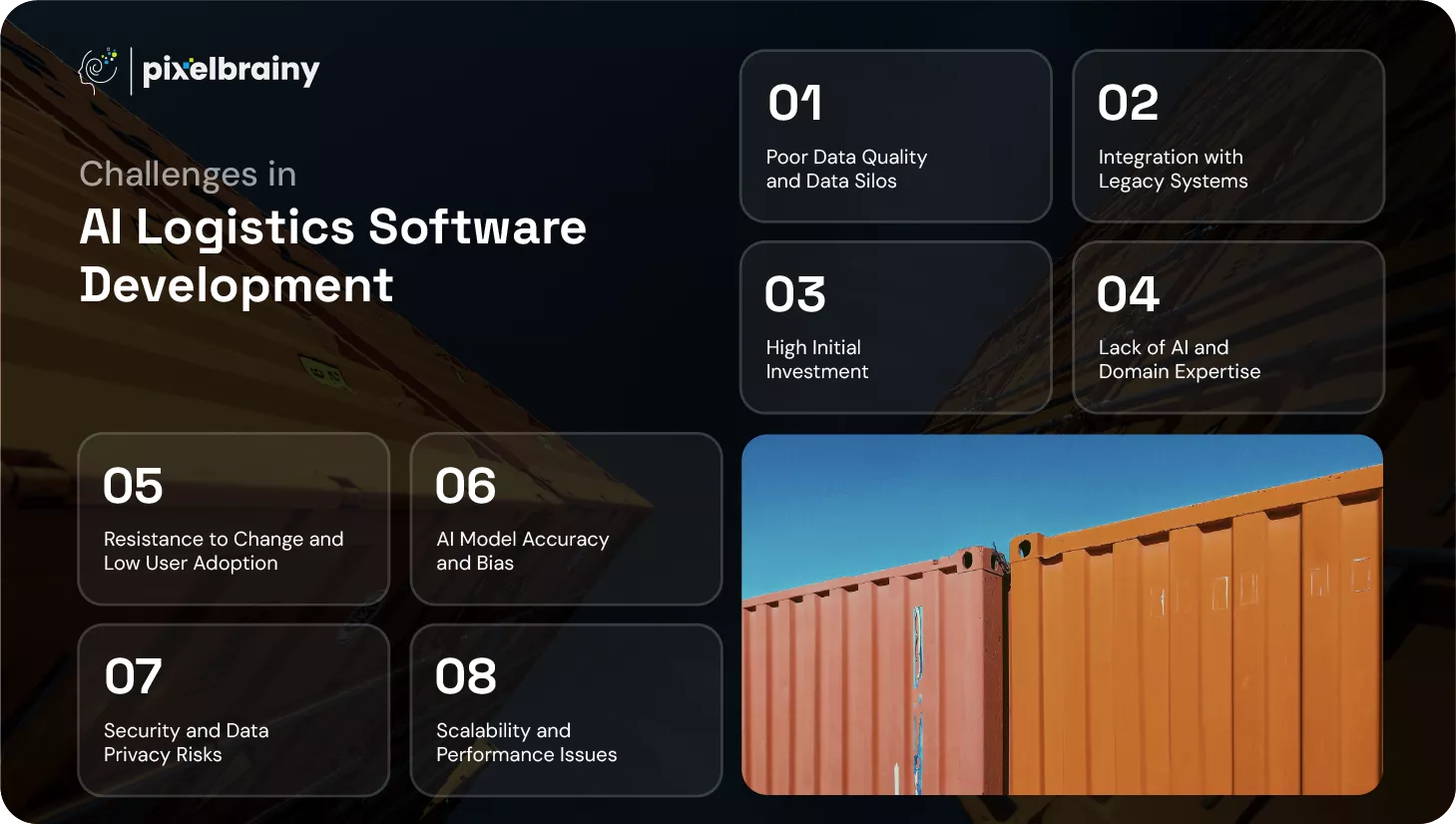
One of the biggest challenges in AI logistics software development is inconsistent or fragmented data. Logistics data often comes from multiple systems such as ERP, WMS, GPS devices, and third-party partners. When this data is incomplete, outdated, or siloed, AI models produce unreliable results.
How to overcome it: Establish a strong data governance framework from the beginning. Standardize data formats, define ownership, and implement automated data validation processes. Integrating all data sources into a unified data pipeline ensures AI models receive accurate and consistent inputs.
Many logistics companies rely on legacy systems that were not designed to support AI or real-time data processing. Integrating modern AI solutions with these systems can be complex and time-consuming, often leading to delays and technical limitations.
How to overcome it: Adopt a modular and API-driven architecture that allows AI components to communicate with existing systems without full replacement. Using middleware and microservices helps bridge gaps between old and new technologies while minimizing disruption.
The upfront cost of AI logistics software development can be a barrier, especially for small and mid-sized businesses. Expenses related to data preparation, AI model training, infrastructure, and skilled talent add to the perceived risk.
How to overcome it: Start with a pilot or MVP focused on high-impact use cases. This phased approach demonstrates value early, helps secure stakeholder buy-in, and spreads investment over time while delivering measurable ROI.
AI logistics projects require both technical AI expertise and deep logistics domain knowledge. A lack of either can lead to poorly designed systems that fail to address real operational challenges.
How to overcome it: Work with experienced AI development teams that understand logistics workflows. Cross-functional collaboration between data scientists, logistics experts, and business stakeholders ensures solutions are practical, accurate, and aligned with operational realities.
Employees may resist AI-driven systems due to fear of job displacement or lack of trust in automated decisions. Low adoption can limit the effectiveness of even the most advanced AI solutions.
How to overcome it: Invest in change management and training programs. Clearly communicate how AI supports rather than replaces human roles. Involve users early in the development process and provide intuitive interfaces that build trust and confidence.
AI models can produce biased or inaccurate results if trained on limited or unbalanced data. In logistics, this can lead to poor demand forecasts, inefficient routing, or unfair decision-making.
How to overcome it: Continuously monitor AI performance and retrain models with diverse, updated datasets. Implement feedback loops and human oversight to validate AI recommendations and correct errors early.
Logistics systems handle sensitive business and customer data, making them attractive targets for cyber threats. AI systems increase complexity, which can introduce new security vulnerabilities if not managed properly.
How to overcome it: Implement strong security measures such as encryption, role-based access control, and regular security audits. Ensure compliance with regional data protection regulations and adopt secure cloud infrastructure practices.
AI systems that perform well at a small scale may struggle as data volume, users, and operational complexity increase. Poor scalability can result in slow response times and system instability.
How to overcome it: Design cloud-native, scalable architectures from the outset. Use elastic infrastructure and performance monitoring tools to ensure the system adapts smoothly as business demands grow.
By proactively addressing these challenges with the right strategy, technology, and expertise, businesses can unlock the full potential of AI logistics software and build resilient, future-ready supply chain operations.
The future of logistics is being shaped by intelligent systems that can operate with minimal human intervention while continuously learning and adapting. As technology advances, AI is moving beyond optimization toward autonomy, resilience, and predictive intelligence. These emerging trends highlight how AI will redefine logistics software and transform global supply chains in the years ahead.
Autonomous vehicles and delivery drones are set to revolutionize transportation and last-mile delivery. AI-powered navigation systems enable vehicles to analyze road conditions, traffic patterns, and environmental factors in real time. This allows goods to be transported with greater speed, precision, and safety while reducing dependence on human drivers.
In logistics software, AI-driven autonomy supports dynamic route planning, automated dispatching, and real-time monitoring of unmanned deliveries. As regulations mature and technology advances, autonomous logistics will reduce delivery costs, improve reliability, and expand access to hard-to-reach or high-density urban areas.
The convergence of AI and the Internet of Things is creating highly connected logistics ecosystems. IoT devices collect real-time data from vehicles, warehouses, containers, and equipment, while AI processes this data to generate actionable insights. Together, they enable continuous monitoring and intelligent decision-making across logistics operations.
This integration supports predictive maintenance, real-time asset tracking, and automated alerts for anomalies. AI-powered logistics software uses IoT data to adapt instantly to operational changes, improving efficiency, visibility, and responsiveness across the entire supply chain.
Digital twins are virtual replicas of physical logistics networks that allow businesses to simulate real-world operations in a digital environment. Powered by AI, these models analyze scenarios such as demand spikes, route disruptions, or supplier delays without affecting actual operations.
In logistics software, digital twins support advanced planning, risk management, and optimization strategies. They help organizations test decisions before execution, improve resilience, and design more efficient supply chain structures. As adoption grows, digital twins will become essential tools for strategic logistics planning.
Hyperautomation combines AI, machine learning, robotic process automation, and analytics to automate complex logistics workflows end to end. These systems go beyond task automation by continuously learning from outcomes and improving performance without manual intervention.
Self-learning logistics platforms optimize routing, inventory allocation, and workforce scheduling in real time. Over time, they adapt to changing market conditions and operational patterns, enabling logistics operations that are faster, more accurate, and highly scalable. This shift positions AI-driven logistics software as a core driver of long-term efficiency and competitive advantage.
As these trends continue to evolve, AI logistics software will move closer to fully autonomous, intelligent ecosystems that reshape how goods are moved, managed, and delivered worldwide.
Choosing the right AI Development company is one of the most critical decisions when modernizing logistics operations. PixelBrainy LLC works at the intersection of advanced AI engineering and deep logistics domain expertise, helping businesses move from fragmented operations to intelligent, data-driven logistics ecosystems. Our approach is not about generic automation but about building solutions that solve real operational problems across transportation, warehousing, supply chain, and last-mile delivery.
With a strong presence in the US market, PixelBrainy LLC specializes in AI Logistics Software Development for industries such as retail, eCommerce, manufacturing, third-party logistics (3PL), healthcare distribution, and automotive supply chains. We focus on scalability, security, and measurable ROI while ensuring smooth adoption across teams.
A mid-to-large US-based logistics and distribution company operating across multiple states, serving retail and manufacturing clients. The organization managed a growing fleet, multiple warehouses, and time-sensitive deliveries but struggled with rising operational costs and limited visibility.
Business Challenges:
PixelBrainy LLC Solution Approach: PixelBrainy LLC partnered with the client to design and deliver a bespoke AI-driven logistics platform focused on intelligence, control, and scalability.
The solution included:
The platform was designed for creating an AI Logistics Software that could adapt to fluctuating demand while maintaining consistent service quality across regions.
Results Achieved:
This project demonstrated how AI for Logistics Software Development can turn logistics operations into a strategic advantage rather than a cost burden.
PixelBrainy LLC does more than build software. We collaborate closely with stakeholders to understand business goals, operational constraints, and future growth plans. Our solutions are engineered to deliver long-term value, not just short-term automation wins.
Whether you are a logistics provider, enterprise shipper, or fast-growing retailer, PixelBrainy LLC delivers intelligent logistics platforms that are secure, scalable, and built to perform in real-world environments.

From the sections above, it is clear that AI is no longer an optional upgrade for logistics businesses but a strategic necessity. From smarter decision-making and operational efficiency to scalability and customer satisfaction, AI-driven systems are redefining how logistics networks operate in a highly competitive and time-sensitive environment.
Investing in AI Logistics Software Development enables organizations to move beyond manual processes and fragmented systems. Whether the goal is building an AI Logistics Software from the ground up or modernizing existing platforms, the right AI strategy delivers measurable cost savings, improved visibility, and long-term growth. Understanding the development process, costs, challenges, and future trends helps businesses make confident, informed decisions.
With the right approach and technology partner, AI-powered logistics becomes a powerful growth engine rather than a complexity burden.
Ready to transform your logistics operations? Book an appointment today to discuss how tailored AI logistics solutions can accelerate your business success.
Yes. AI logistics software is no longer limited to large enterprises. Many solutions can be developed in modular phases, allowing small and mid-sized businesses to start with essential features and expand over time as operations grow.
Initial improvements such as better visibility and route efficiency can often be seen within weeks of deployment. More advanced outcomes like predictive optimization and cost reduction typically become measurable after AI models learn from operational data over a few months.
Most modern AI logistics platforms are designed to integrate with existing ERP, WMS, CRM, and fleet management systems. With proper planning and APIs, businesses can enhance current infrastructure without replacing it entirely.
AI logistics systems rely on data such as shipment records, delivery timelines, inventory levels, GPS data, and operational metrics. The quality and consistency of data matter more than volume, especially during early implementation stages.
AI logistics software can be highly secure when built with proper encryption, access controls, and compliance standards. Security is typically integrated into the architecture from the beginning to protect sensitive operational and customer data.
Yes. One of the key strengths of AI is its ability to learn from historical and real-time patterns. This allows logistics systems to adjust capacity, routing, and inventory strategies automatically during seasonal spikes or unexpected demand shifts.

About The Author
Sagar Bhatnagar
Sagar Sahay Bhatnagar brings over a decade of IT industry experience to his role as Marketing Head at PixelBrainy. He's known for his knack in devising creative marketing strategies that boost brand visibility and market influence. Sagar's strategic thinking, coupled with his innovative vision and focus on results, sets him apart. His track record of successful campaigns proves his ability to utilize digital platforms effectively for impactful marketing efforts. With a genuine passion for both technology and marketing, Sagar continuously pushes PixelBrainy's marketing initiatives to greater success.

Working with the PixelBrainy team has been a highly positive experience. They understand the design requirements and create beautiful UX elements to meet the application needs. The dev team did an excellent job bringing my vision to life. We discussed usability and flow. Sagar worked with his team to design the database and begin coding. Working with Sagar was easy. He has the knowledge to create robust apps, including multi-language support, Google and Apple ID login options, Ad-enabled integrations, Stripe payment processing, and a Web Admin site for maintaining support data. I'm extremely satisfied with the services provided, the quality of the final product, and the professionalism of the entire process. I highly recommend them for Android and iOS Mobile Application Design and Development.

Great experience working with them. Had a lot of feedback and I found that unlike most contractors they were bugging me for updates instead of the other way around. They were extremely time conscience and great at communicating! All work was done extremely high quality and if not on time, early! They were always proactive when it comes to communication and the work is great/above par always. Very flexible and a great team to work with! Goes above and beyond to present us with multiple options and always provides quality. Amazing work per usual with Chitra. If you have UI/UX or branding design needs I recommend you go to them! Will likely work with them in the future as well, definitely recommended!

PixelBrainy is a joy to work with and is a great partner when thinking through branding, logo, and website layout. I appreciate that they spend time going into the "why" behind their decisions to help inform me and others about industry best practices and their expertise.

I hired them to design our software apps. Things I really like about them are excellent communication skills, they answer all project suggestions and collaborate right away, and their input on design and colors is amazing. This project was complex and needed patience and creativity. The team is amazing to do business with. I will be using them long-term. Glad to see there are some good people out there. I was afraid to try and outsource my project to someone but I am glad I met them! I really can't say enough. They went above and beyond on this project. I am very happy with everything they have done to make my business stand out from the competition.

It was great working with PixelBrainy and the team. They were very responsive and really owned the project. We'll definitely work with them again!

I recently worked with the PixelBrainy team on a project and I was blown away by their communication skills. They were prompt, clear, and articulate in all of our interactions. They listened and provided valuable feedback and suggestions to help make the project a success. They also kept me updated throughout the entire process, which made the experience stress-free and enjoyable.

PixelBrainy is very good at what it does. The team also presents themselves very professionally and takes care of their side of things very well. I could fully trust them taking up the design work in a timely and organised manner and their attention to detail saved us lots of effort and time. This particular project was quite intense and the team showed that they function very well under pressure. Very much looking forward to working with her again!

It's always an absolute pleasure working with them. They completed all of my requests quickly and followed every note I had for them to a T, which made our process go smoothly from start to finish. Everything was completed fast and following all of the guidelines. And I would recommend their services to anyone. If you need any design work done in the future, PixelBrainy should be your first call!

They took ownership of our requirements and designed and proposed multiple beautiful variants. The team is self-motivated, requires minimum supervision, committed to see-through designs with quality and delivering them on time. We would definitely love to work with PixelBrainy again when we have any requirements.

PixelBrainy was a big help with our SaaS application. We've been hard at work with a new UI/UX and they provided a lot of help with the designs. If you're looking for assistance with your website, software, or mobile application designs, PixelBrainy and the team is a great recommendation.

PixelBrainy designers are amazing. They are responsive, talented, and always willing to help craft the design until it matches your vision. I would recommend them and plan to continue them for my future projects and more!!!

They were awesome! Did a good job fast, and good communication. Will work with them again. Thank you

Creative, detail-oriented, and talented designers who take direction well and implement changes quickly and accurately. They consistently over-delivered for us.

PixelBrainy team is very talented and creative. Great designers and a pleasure to work with. PixelBrainy is an excellent communicator and I look forward to working with them again.

PixelBrainy has a very talented design team. Their work is excellent and they are very responsive. I enjoy working with them and hope to continue on all of our future projects.


Transform your ideas into reality with us.
Across these industries, each engagement brings unique challenges, from early-stage product development to scaling complex systems, helping us build a practical understanding of real-world product environments.