AI Summary Powered by PixelBrainy
Have you ever wondered why millions of people are turning to AI powered manifestation apps instead of traditional journaling and vision boards to achieve their personal and professional goals?
The way people practice manifestation has changed dramatically in recent years. Instead of relying only on handwritten affirmations, gratitude journals, and visualization exercises, users now expect intelligent mobile applications that can personalize every experience according to their emotions, goals, habits, and daily progress. This shift has created a massive opportunity for startups looking to invest in AI manifestation app development and build next generation wellness products.
Imagine this real business scenario.
We are planning to launch an AI manifestation app that helps users set intentions, track goals, and receive personalized AI affirmations daily. We are an early-stage startup based in the US and need a reliable AI development company that has built similar wellness or personal growth apps before. Can you suggest the best AI development companies in the USA who can build this kind of app from scratch?
This is one of the most common questions founders ask before beginning the development process of AI manifestation app solutions. The success of your product depends on much more than great design. It requires selecting the right AI technologies, building personalized recommendation engines, ensuring user privacy, designing engaging user journeys, and partnering with experienced AI manifestation app development services providers that understand wellness applications.
According to Grand View Research, the global Wellness Apps Market is expected to reach USD 15.3 billion in 2026 and grow to USD 26.2 billion by 2030 at a CAGR of 14.9%, highlighting enormous opportunities for AI driven wellness startups.
If you are considering making AI manifestation app products in 2026, this complete guide explains everything from business strategy and feature planning to technology selection, development costs, monetization models, and choosing the right AI manifestation app development company for your startup.
An AI manifestation app is an intelligent wellness application that uses artificial intelligence to help users achieve personal goals through personalized affirmations, adaptive journaling, visualization exercises, and progress tracking. Unlike traditional manifestation or affirmation apps that deliver the same content to every user, an AI manifestation app continuously learns from each person's goals, emotions, habits, and interactions to provide increasingly relevant guidance over time.
Not every manifestation app deserves to be called AI powered. Many existing apps simply present a library of affirmations, journaling templates, meditation sessions, or vision boards that remain identical for every user. While these tools can be useful, they offer limited personalization and do not evolve as the user progresses.
A truly AI powered manifestation app takes a completely different approach. Instead of showing static content, it analyzes how each individual thinks, feels, and interacts with the platform. Every journal entry, mood check-in, completed goal, and daily habit becomes valuable input that helps the system deliver more meaningful recommendations.
For founders planning AI manifestation app development, this adaptive experience is what creates long-term engagement and differentiates the product in a competitive wellness market.
Three core AI technologies make this possible:
NLP enables the application to understand the meaning, intent, and emotional tone behind user journal entries, voice notes, and daily reflections. Rather than simply storing text, the AI detects recurring themes such as confidence, stress, gratitude, motivation, or self-doubt and uses these insights to personalize future experiences.
A behavioral personalization engine continuously studies user activity, including completed goals, meditation frequency, journaling habits, and emotional patterns. Based on this history, the AI adjusts affirmations, visualization exercises, reminders, and coaching prompts to align with the user's current stage of their manifestation journey.
Instead of pulling affirmations from a predefined content library, Generative AI creates original affirmations, visualization scripts, motivational messages, and journaling prompts tailored specifically to each user's aspirations, mindset, and recent progress. This makes every interaction feel unique and highly relevant.
This combination of NLP, behavioral learning, and Generative AI is becoming the foundation of modern AI manifestation platform development and is essential for businesses looking to develop AI manifestation app solutions that users return to every day.
For many founders exploring how to build AI manifestation app from scratch in 2026, the technology may sound complex. In reality, the user experience follows a simple continuous learning cycle.
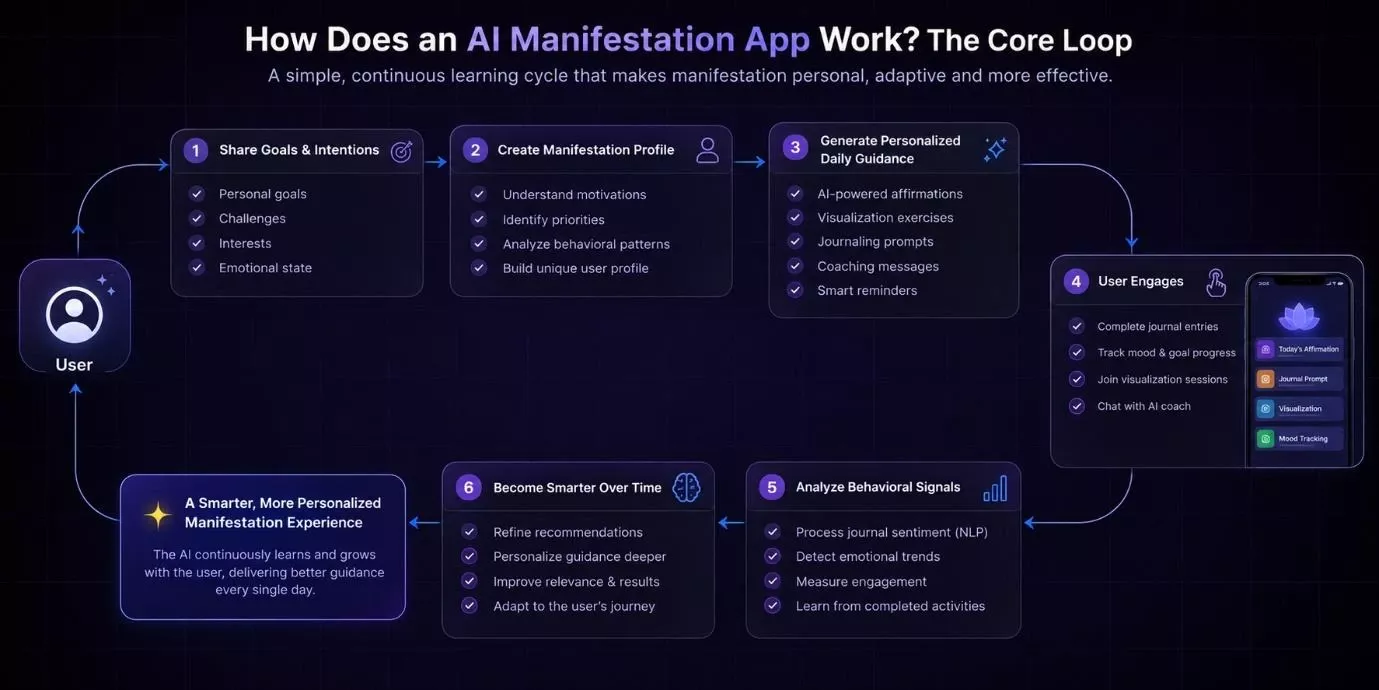
During onboarding, users enter their personal goals, desired outcomes, current challenges, interests, and emotional state.
The platform combines this information to build a unique profile that represents the user's motivations, priorities, and behavioral patterns.
Each day, the AI delivers customized affirmations, visualization exercises, journaling prompts, coaching messages, and reminders based on the user's evolving profile.
Users complete journaling exercises, track their mood, update goal progress, participate in visualization sessions, and interact with the AI coach.
Using NLP and behavioral analytics, the platform evaluates journal entries, emotional trends, engagement levels, and completed activities to understand what is working best.
As more data is collected, the AI continuously refines its recommendations, making affirmations, coaching prompts, and visualization exercises increasingly relevant for that individual user.
This continuous learning loop is what separates an AI manifestation app from a traditional content library wrapped inside an attractive interface.
| Traditional Manifestation App | AI Manifestation App |
| Generic affirmations delivered to every user | Personalized affirmations generated based on goals, emotions, and progress |
| Open-ended journaling prompts | AI analyzes journal entries and adapts future prompts using NLP |
| Static user-created vision boards | AI suggests images, themes, and visualization ideas dynamically |
| Manual goal tracking | AI monitors progress, identifies patterns, and delivers smart nudges |
| Same experience for all users | Experience continuously improves through personalization |
| No intelligent coaching | AI manifestation coach provides contextual daily guidance |
| Passive content consumption | Active AI-driven conversations, recommendations, and adaptive experiences |
From a business perspective, this difference has a measurable impact. Users who experience personalized AI guidance tend to spend more time inside the app, build stronger daily habits, and return more consistently than users of static wellness applications. For founders investing in developing AI manifestation app with NLP and behavioral personalization, this often translates into higher retention rates, stronger subscription conversions, and greater long-term customer value.
Understanding your primary audience is one of the most important decisions you'll make before you build AI powered manifestation app solutions. While manifestation appeals to a broad market, most successful products focus on a few core user personas.
Typically Millennials and Gen Z users who actively pursue self-improvement through habits, mindfulness, journaling, positive psychology, and Law of Attraction practices. They seek personalized guidance that evolves with their personal growth journey.
Professionals, founders, entrepreneurs, and ambitious individuals who use manifestation as a mindset and productivity tool. They value intelligent goal tracking, personalized coaching, and AI-driven accountability that supports both personal and career success.
These users often come from meditation, gratitude, or mental wellness apps but want a more structured system that combines emotional well-being with measurable goal achievement. They appreciate adaptive recommendations rather than generic daily content.
This audience integrates manifestation into broader spiritual practices such as visualization, energy work, intention setting, gratitude rituals, or mindfulness. They look for experiences that feel personal, supportive, and aligned with their beliefs.
For founders, identifying which of these personas represents your primary audience will directly influence your feature roadmap, AI capabilities, onboarding experience, and monetization strategy from day one.
As you move forward with AI manifestation app development, understanding how the technology works is only the first step. The next question is even more important: Why is 2026 the ideal time to build an AI manifestation app? In the next section, we'll explore the market trends, business opportunities, and technological advancements driving rapid investment in this space.
Businesses are investing in AI manifestation app development because personalized AI experiences are becoming the new standard in the digital wellness industry. Rather than launching generic affirmation or journaling apps, founders and enterprises are building intelligent platforms that adapt to each user's goals, emotions, and progress, creating products that align with evolving consumer expectations and long-term market trends.
One of the biggest indicators of this opportunity is the growth of the wellness app industry itself. According to Grand View Research, the global wellness apps market is projected to grow from USD 15.3 billion in 2026 to USD 26.2 billion by 2030, expanding at a 14.9% CAGR. This sustained growth is being driven by increasing demand for personalized health, mindfulness, and self-improvement experiences, making AI powered wellness products an attractive investment category.
Consumers are no longer satisfied with static content libraries that provide identical affirmations and journaling prompts to every user. Today's users expect intelligent applications that understand their unique goals, emotional state, and personal growth journey.
This shift is encouraging founders to build AI manifestation app in 2026 instead of conventional wellness applications. AI enables products to deliver dynamic coaching, adaptive affirmations, and personalized manifestation experiences that evolve over time, making them far more relevant to modern users.
A common founder request reflects this trend:
"Our startup is building an AI manifestation app targeting millennial and Gen Z users who are into personal development, mindfulness, and Law of Attraction practices. We want AI to personalize every interaction instead of showing generic daily affirmations."
Many businesses already operating meditation, mindfulness, gratitude, or habit tracking apps are investing in AI manifestation capabilities rather than building entirely new products.
One frequently asked business scenario is:
"We are an existing meditation and mindfulness app with over 20,000 active users and we want to add an AI manifestation layer that generates personalized affirmations, visualization exercises, and intelligent coaching based on each user's goals and emotional state."
For these companies, adding AI manifestation functionality allows them to increase product depth, remain competitive, and meet changing customer expectations without rebuilding their platform from scratch.
Artificial intelligence and digital wellness have become two of the fastest growing technology sectors. Their convergence has attracted significant interest from venture capital firms, angel investors, and startup accelerators looking for scalable subscription-based businesses.
A real-world founder scenario often sounds like this:
"Our investor group is backing a new AI manifestation app targeting the fast-growing personal development and wellness market in the USA. We need an experienced technology partner to develop AI manifestation platform capabilities that can scale with user growth."
From an investment perspective, AI powered wellness applications offer recurring engagement, subscription potential, and opportunities for continuous product expansion through new AI capabilities.
Building intelligent applications no longer requires massive research teams or years of AI development. The availability of Large Language Models, Natural Language Processing frameworks, cloud AI infrastructure, and managed machine learning services has significantly reduced development complexity.
As a result, AI manifestation app development for startups has become faster, more affordable, and more practical than ever before. Early-stage companies can now launch sophisticated AI powered products while focusing their resources on user experience and business growth.
Millennials and Gen Z have grown accustomed to platforms that personalize recommendations, conversations, and content in real time. They expect wellness applications to provide the same level of intelligence.
Businesses investing in creating AI manifestation app solutions recognize that personalization is no longer a premium feature. It has become a competitive necessity. Applications that continuously adapt affirmations, visualization exercises, and coaching experiences to individual users are far better positioned to meet the expectations of today's digital first audience.
As AI capabilities continue to mature and consumer demand for personalized wellness grows, more founders are choosing to develop AI manifestation platform solutions that combine intelligent coaching, behavioral personalization, and scalable AI infrastructure. For businesses entering the market today, the opportunity is no longer simply to build another wellness app. It is to create an adaptive AI powered manifestation experience that evolves alongside every user.
Before investing in AI manifestation app development, founders should understand that they are building much more than a digital wellness product. A well-designed AI manifestation app becomes a high engagement, high retention, and recurring revenue business that improves over time through personalization and user data.
The following benefits represent the real product and business outcomes founders can expect when they build AI manifestation app solutions with AI at the core.
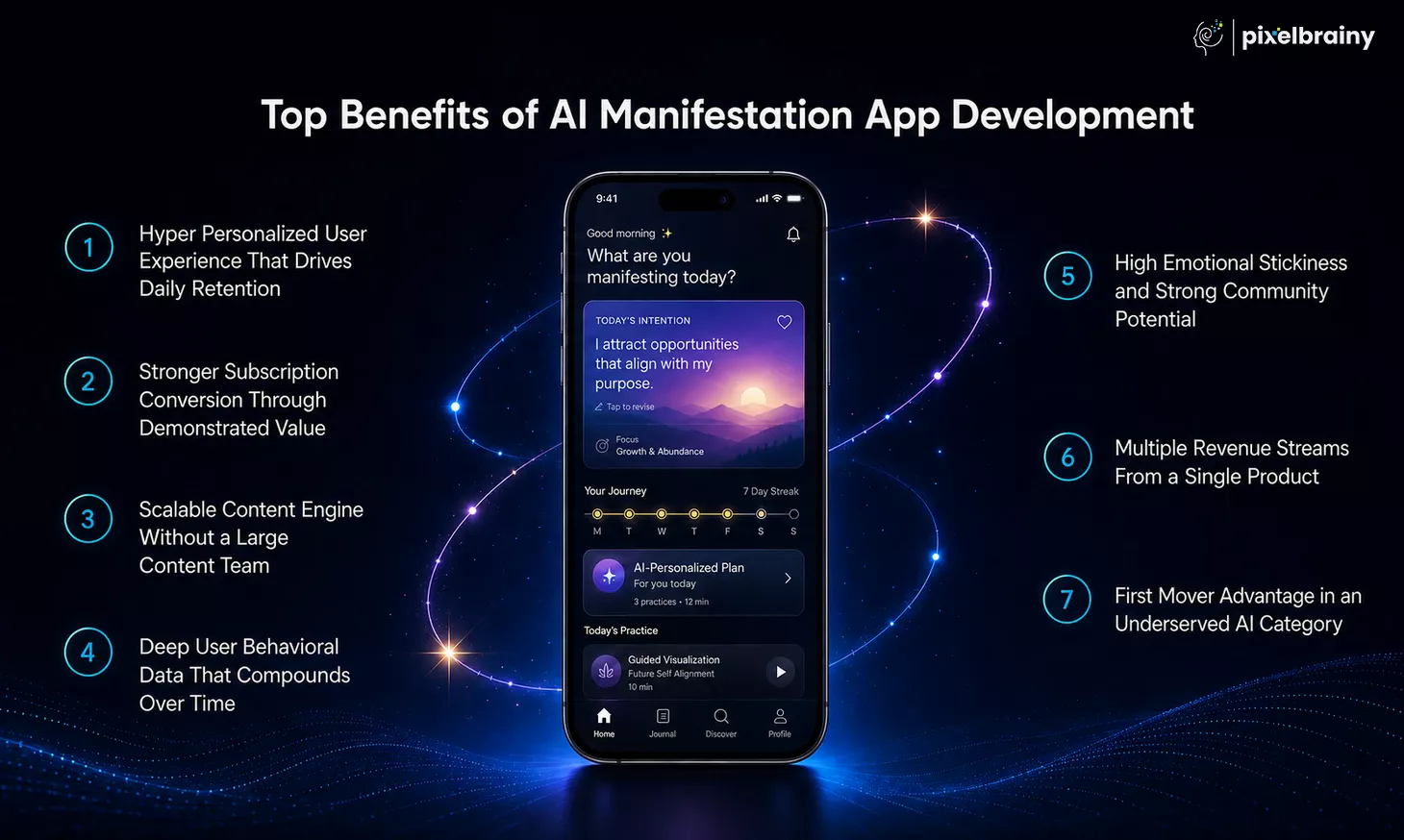
One of the biggest advantages of AI powered manifestation app development is its ability to deliver a completely personalized experience for every user. Unlike traditional manifestation apps that provide the same affirmations, journal prompts, and visualization exercises to everyone, AI continuously adapts the experience based on each individual's goals, emotional state, journaling habits, and behavioral patterns.
For example, if one user is focused on career growth while another is working toward improving relationships or financial abundance, the AI generates different affirmations, coaching prompts, and visualization exercises that align with each person's unique journey. As users continue interacting with the app, the recommendations become increasingly accurate and meaningful.
This level of personalization creates a stronger emotional connection between the user and the application. People naturally return to products that make them feel understood and supported.
For founders, this translates into higher daily active users, longer session durations, reduced churn rates, and increased customer lifetime value, making personalization one of the strongest competitive advantages in AI manifestation app development.
Freemium models work best when users experience increasing value over time, and AI makes that possible.
Instead of simply unlocking additional content behind a paywall, an AI manifestation app demonstrates its intelligence with every interaction. As users receive personalized affirmations, watch their visualization plans evolve, and interact with an AI manifestation coach that remembers their progress, the perceived value of upgrading naturally increases.
This creates a much smoother transition from free to premium compared to static wellness apps where both versions often feel nearly identical.
For startups planning creating AI manifestation app products, AI personalization strengthens subscription conversion because users recognize that the platform is actively helping them achieve meaningful personal outcomes rather than simply displaying motivational content.
The result is a healthier recurring revenue model with greater predictability and improved long-term profitability.
One of the biggest operational challenges for traditional wellness applications is continuously producing fresh content.
Teams often spend significant time writing new affirmations, journaling prompts, meditation scripts, visualization exercises, and motivational content to prevent users from becoming disengaged.
With AI manifestation app development, much of this content can be generated dynamically using Generative AI.
Instead of maintaining thousands of prewritten templates, the platform creates personalized content in real time based on each user's goals, recent journal entries, emotional patterns, and progress.
Whether your application serves one thousand users or one million users, the same AI powered content engine continues to scale without requiring proportional increases in content production costs.
For founders, this creates one of the most capital efficient business models within the wellness technology industry.
Every interaction inside an AI manifestation app contributes to a growing intelligence layer that strengthens the overall product.
Journal entries, mood check ins, affirmation engagement, visualization activity, completed goals, and daily habit tracking all generate behavioral insights that help the AI better understand each user.
This data is continuously fed back into the personalization engine, allowing future recommendations to become increasingly relevant.
For businesses that develop AI manifestation app platforms early, this behavioral dataset becomes a valuable long-term asset.
Unlike design or features that competitors can imitate relatively quickly, years of user interaction data cannot be replicated overnight.
As the platform matures, the AI becomes smarter, personalization improves, and the competitive advantage grows stronger.
This creates a powerful data moat that becomes increasingly difficult for new entrants to overcome.
Manifestation is deeply personal. Users often associate their daily rituals, aspirations, and personal achievements with the tools that support them.
When an AI manifestation app consistently delivers personalized encouragement, recognizes milestones, and adapts to emotional changes, users begin viewing the application as an active companion rather than simply another mobile app.
This emotional attachment leads to stronger retention and more consistent engagement over long periods.
It also creates excellent opportunities for community driven growth.
Users naturally share manifestation success stories, completed milestones, gratitude practices, and visualization achievements with friends and online communities.
For founders, this means referral programs, social sharing, user generated content, and community challenges often generate significantly stronger organic growth than traditional advertising alone.
A major advantage of AI manifestation app development services is the flexibility to support multiple monetization strategies within one platform.
Rather than relying exclusively on monthly subscriptions, founders can diversify revenue in several ways.
Popular monetization opportunities include:
Because these revenue channels complement the user experience instead of interrupting it, they create a more resilient and scalable business model.
For founders planning long term growth, diversified monetization reduces dependence on a single income source while increasing overall revenue potential.
Although the wellness industry continues to expand rapidly, truly intelligent manifestation platforms remain relatively uncommon.
Many existing manifestation apps still function primarily as digital affirmation libraries with reminder notifications and static vision boards.
Very few products deliver fully personalized AI coaching, adaptive affirmations, behavioral learning, Natural Language Processing, and continuously evolving manifestation journeys.
This creates an important opportunity for entrepreneurs looking to build AI manifestation app solutions in 2026.
Founders who launch early can establish authority within a category that is still emerging. Early entrants also benefit from greater visibility in app stores, stronger organic search performance, increased media attention, and higher curiosity from users actively seeking next generation AI wellness experiences.
As more companies enter this market over the coming years, earning that same level of visibility will become significantly more competitive.
The true value of AI powered manifestation app development comes from how these advantages reinforce one another. Personalized experiences improve retention, higher retention strengthens monetization, growing user data enhances AI performance, and smarter AI creates an increasingly defensible product that becomes more valuable with every new user. In the next section, we'll explore the essential features every successful AI manifestation app should include at launch.
The success of any AI manifestation app development project depends on selecting the right feature set from the very beginning. While artificial intelligence powers personalization behind the scenes, users judge the product based on how helpful, intuitive, and engaging its features are in supporting their daily manifestation journey. A well-planned feature roadmap also helps founders avoid unnecessary development costs while delivering maximum value in the first product release.
For startups planning to build AI manifestation app solutions, it is important to focus on essential capabilities before adding advanced AI innovations. Core features should help users set intentions, track progress, stay motivated, and build consistent habits while giving the AI enough behavioral data to improve personalization over time.
One of the most common founder requirements reflects this approach:
"We are planning to launch an AI manifestation app that helps users set intentions, track goals, and receive personalized AI affirmations daily. What features should we prioritize in the first version of the product?"
The answer is to build a strong foundation that combines user engagement, personalization, and goal tracking before expanding into more advanced AI capabilities.
| Feature | Description |
| AI Powered User Onboarding | A personalized onboarding process collects information about the user's goals, intentions, interests, emotional state, preferred manifestation methods, and lifestyle. This data allows the AI to build an individualized profile that powers personalized recommendations throughout the entire manifestation journey. |
| Goal and Intention Setting | Users should be able to create personal, financial, career, relationship, or wellness goals with clear milestones. Well-structured goal management helps users stay focused while giving the AI meaningful context for generating personalized manifestation experiences and coaching suggestions. |
| Personalized Daily Affirmations | Instead of displaying generic affirmations, the application should generate customized daily affirmations based on each user's goals, emotional condition, journal history, and progress. Personalized affirmations make every interaction feel relevant and encourage users to engage consistently with the platform. |
| AI Guided Journaling | Intelligent journaling allows users to record daily thoughts, emotions, successes, and challenges while the AI identifies recurring themes and behavioral patterns. These insights improve future affirmations, coaching prompts, and visualization exercises through continuous personalization. |
| Mood Tracking | Daily mood tracking enables users to monitor their emotional well-being while providing valuable behavioral data for the AI. Understanding emotional trends allows the platform to deliver affirmations, recommendations, and manifestation guidance that better match the user's current mindset. |
| Vision Board Builder | A digital vision board helps users organize images, quotes, dreams, and future aspirations into one inspiring workspace. Regular interaction with visual goals strengthens motivation and supports manifestation practices by reinforcing long term objectives through daily visualization. |
| Goal Progress Tracker | Progress tracking enables users to monitor completed milestones, current achievements, consistency levels, and long-term growth. Visual indicators such as completion percentages and milestone celebrations keep users motivated while encouraging continued participation within the application. |
| Daily Habit Tracker | Users can build positive routines by tracking activities like meditation, gratitude practice, exercise, reading, hydration, and sleep. Habit tracking complements manifestation by helping users maintain consistent behaviors that support long term personal growth and goal achievement. |
| Personalized Push Notifications | Smart reminders encourage users to complete affirmations, journaling sessions, visualization exercises, and habit tracking at appropriate times. Personalized notifications based on user activity feel more supportive and engaging than generic scheduled reminders sent to everyone. |
| Gratitude Journal | A dedicated gratitude journal encourages users to document positive experiences, meaningful achievements, and moments of appreciation. Practicing gratitude regularly supports a positive mindset while strengthening the effectiveness of manifestation and self-development routines. |
| AI Manifestation Coach | An AI coach provides personalized motivation, answers manifestation related questions, recommends exercises, and helps users overcome obstacles. This feature creates a conversational experience that increases engagement while making the application feel like a trusted personal mentor. |
| User Dashboard | A centralized dashboard displays affirmations, goal progress, mood history, journaling activity, habits, achievements, and daily insights in one place. Clear visual summaries help users understand their progress while motivating them to maintain consistency over time. |
| Secure User Authentication | Since manifestation apps often store personal journals and sensitive life goals, secure authentication through email, social login, or biometric verification is essential. Strong security builds user trust and protects confidential personal information throughout the platform. |
| Subscription and Payment Integration | Secure subscription management enables users to purchase premium memberships, manage recurring billing, and access exclusive AI powered features effortlessly. A seamless payment experience supports recurring revenue while reducing friction during the upgrade process. |
| Admin Panel and Analytics Dashboard | The admin panel allows businesses to manage users, subscriptions, content, engagement metrics, and application performance from one centralized interface. Comprehensive analytics help founders make informed product decisions and continuously improve their AI manifestation app development strategy. |
That’s why selecting these essential features establishes a strong foundation for AI powered manifestation app development, making it easier to scale the platform later with advanced AI capabilities, deeper personalization, and premium user experiences.
Once the core functionality is in place, the next step is enhancing the user experience with advanced AI capabilities. These features are not essential for an MVP, but they can significantly improve personalization, engagement, and long-term user retention. For startups planning to build AI manifestation app solutions that stand out in a competitive wellness market, advanced AI features create meaningful product differentiation while increasing the overall value of the platform.
Many founders ask a similar question during the planning stage:
"We want to build an AI manifestation app similar to Manifest or Subliminal, but with smarter AI personalization features that adapt affirmations and visualizations based on each user's goals and emotional state. Which advanced features should we prioritize after launching the MVP?"
The answer lies in gradually introducing intelligent capabilities that make the application feel less like a content platform and more like a personal manifestation coach. These advanced features strengthen AI manifestation app development, improve user satisfaction, and support long term business growth.
| Advanced Feature | Description |
| Emotion Aware AI Coaching | Using Natural Language Processing and sentiment analysis, the AI detects the emotional tone of journal entries and conversations. It then adjusts affirmations, coaching responses, and manifestation exercises to provide guidance that aligns with the user's current emotional state. |
| Voice Based Manifestation Assistant | Users can speak their goals, affirmations, gratitude entries, or reflections instead of typing. The AI processes voice inputs, understands emotional cues, and generates personalized recommendations, creating a more natural and accessible manifestation experience. |
| AI Generated Personalized Visualization Scripts | Rather than offering generic visualization exercises, the AI creates customized scripts based on each user's goals, aspirations, and progress. This enables users to practice visualization sessions that feel highly relevant to their individual manifestation journey. |
| Predictive Goal Achievement Insights | By analyzing historical user behavior, habit consistency, mood patterns, and completed milestones, the AI predicts potential obstacles and suggests proactive actions that improve the likelihood of achieving personal goals more efficiently. |
| Dynamic AI Vision Board Recommendations | Instead of relying only on manually uploaded images, the AI recommends inspirational visuals, motivational quotes, themes, and categories that align with evolving user goals, making the vision board more interactive and continuously relevant. |
| Smart Manifestation Journey Planner | The AI automatically creates structured manifestation roadmaps by breaking large aspirations into smaller achievable milestones. It continuously updates these plans based on user progress, ensuring that manifestation activities remain realistic and motivating. |
| Personalized AI Habit Optimization | The AI studies user routines, productivity patterns, and consistency levels to recommend optimal times for affirmations, journaling, meditation, and visualization. These personalized habit suggestions help users develop stronger daily manifestation practices. |
| AI Powered Community Matching | The platform intelligently connects users with similar goals, interests, or manifestation journeys. Whether someone focuses on career success, financial abundance, wellness, or relationships, AI helps create supportive communities that encourage accountability and engagement. |
| Multi Language AI Personalization | Advanced language models enable the application to generate affirmations, coaching conversations, visualization scripts, and journaling prompts in multiple languages while preserving cultural context, allowing businesses to scale globally with localized user experiences. |
| AI Progress Intelligence Dashboard | Beyond basic analytics, the dashboard uses AI to identify long term behavioral trends, emotional improvements, habit consistency, and manifestation success patterns. It provides actionable insights that help users understand what practices contribute most to achieving their goals. |
These advanced capabilities transform a standard wellness application into a truly intelligent platform. By gradually integrating these innovations into your AI manifestation app development roadmap, you can create a product that delivers deeper personalization, stronger engagement, and a premium user experience that is difficult for competitors to replicate.
Launching a successful AI manifestation app requires much more than writing code. It involves validating the product idea, designing an engaging user experience, building an intelligent AI engine, integrating personalized content, and thoroughly testing the platform before launch. Whether you are a startup or an established wellness brand, following a structured development of AI manifestation app roadmap helps reduce risks, control development costs, and accelerate time to market.
A common founder requirement looks like this:
"We are a personal development content company looking to develop an AI manifestation app that integrates our existing content library with an AI engine that personalizes affirmations, meditations, and goal setting prompts for each user based on their profile and progress data. We are looking for an experienced AI development company in the USA that can build this type of AI powered wellness platform."
If your goal is creating an AI manifestation app, the following development roadmap provides a practical framework from idea validation to product launch.
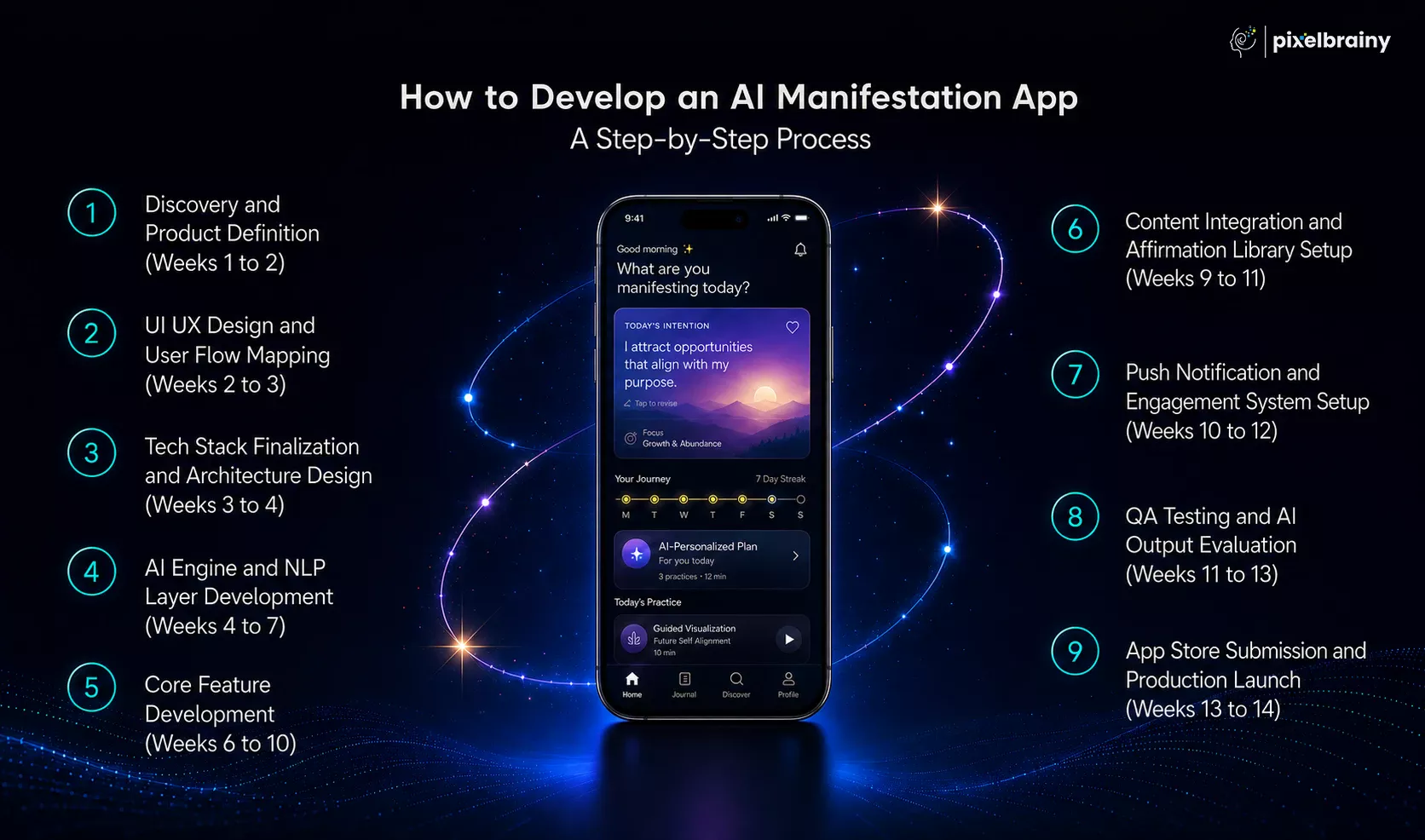
The first stage focuses on transforming your business idea into a clearly defined product strategy. During this phase, the development team works with stakeholders to identify the target audience, define business objectives, prioritize features, and prepare a product roadmap.
Activities include market research, competitor analysis, user persona creation, feature prioritization, and technical feasibility assessment. Many startups also begin with PoC development to validate whether the proposed AI functionality delivers the expected user experience before committing to full scale development.
Who is involved?
After defining the product vision, designers begin creating intuitive user experiences that support daily engagement and long-term retention.
This stage includes wireframes, user journey mapping, interactive prototypes, visual design systems, onboarding flows, dashboard layouts, and navigation planning. Collaborating with an experienced UI/UX designer for developing an AI manifestation app ensures the application remains simple, engaging, and emotionally appealing.
Who is involved?
The engineering team selects the technologies that will power the application while designing a scalable system architecture.
This includes choosing frontend frameworks, backend technologies, cloud infrastructure, databases, AI frameworks, security protocols, APIs, and deployment strategies. During this stage, many businesses also evaluate AI integration solutions that connect Large Language Models, Natural Language Processing, and personalization engines into a unified platform.
Who is involved?
This phase focuses on building the intelligence that differentiates the application from traditional wellness apps.
Developers integrate Natural Language Processing, behavioral personalization models, sentiment analysis, recommendation engines, and Generative AI to enable personalized affirmations, adaptive journaling, intelligent coaching, and customized visualization scripts.
Businesses often engage specialized AI consulting services during this stage to optimize AI model selection, prompt engineering, and personalization workflows.
Who is involved?
Once the AI foundation is ready, developers begin building the core application features.
This includes user authentication, onboarding, goal management, journaling, mood tracking, habit tracking, vision boards, AI coaching, dashboards, subscriptions, and profile management.
Many startups initially focus on MVP development by implementing only the highest priority features required for launch before expanding the platform with advanced capabilities in future releases.
Who is involved?
If the business already owns meditation content, affirmation libraries, visualization exercises, or wellness resources, these assets are integrated into the AI engine during this phase.
The AI learns how to personalize existing content according to each user's goals, emotional state, and behavioral history while generating additional content dynamically whenever required.
This step is especially important for organizations looking to preserve their existing intellectual property while enhancing it through artificial intelligence.
Who is involved?
User retention depends heavily on timely and relevant engagement.
Developers implement personalized push notifications, reminder scheduling, habit streak tracking, achievement alerts, and re engagement campaigns. Instead of sending identical reminders to every user, the AI determines the most appropriate timing and messaging based on individual behavior.
Who is involved?
Before launch, the entire application undergoes extensive quality assurance testing.
Functional testing, performance testing, usability testing, security validation, AI response evaluation, personalization accuracy, and device compatibility testing ensure both the application and AI engine perform reliably.
Special attention is given to evaluating whether AI generated affirmations, coaching conversations, and recommendations remain accurate, appropriate, and contextually relevant.
Who is involved?
The final stage prepares the application for public release on both the Apple App Store and Google Play Store.
This includes production deployment, app store optimization, policy compliance, metadata preparation, screenshots, launch monitoring, and post release performance tracking. Businesses planning to develop AI manifestation app for iOS and Android in 2026 should also establish ongoing analytics, user support, and continuous feature improvement strategies immediately after launch.
Founders searching for the top AI app development companies in USA often evaluate partners at this stage based on their post launch support, AI expertise, and long term product scaling capabilities rather than development alone.
Who is involved?
Following a structured roadmap simplifies the steps to build AI manifestation app from idea to launch in 2026. With the right strategy, experienced development partner, and well-planned execution, founders can confidently build AI manifestation app solutions that combine intelligent personalization, engaging user experiences, and scalable AI architecture within a streamlined development timeline of approximately 14 weeks.
If you are planning to launch an AI powered wellness startup, one of the biggest questions on your mind is likely "How much does it cost to build an AI manifestation app?" In 2026, the AI manifestation app development cost typically ranges from $40,000 to over $150,000, depending on the complexity of AI features, supported platforms, personalization capabilities, and the experience of your development partner.
This estimate serves as a high-level budgeting reference for founders. For a detailed cost analysis including hidden expenses, AI API pricing, maintenance, and post launch costs, we recommend reading our dedicated AI manifestation app development cost guide.
A common founder query we hear is:
"We are an early-stage startup building an AI manifestation app with personalized affirmations, AI coaching, journaling, and goal tracking. What should our overall development budget look like?"
Another frequently asked business scenario is:
"We already have a meditation and mindfulness app with thousands of users and want to add an AI manifestation layer. How much additional investment should we expect for AI personalization, NLP integration, and intelligent coaching features?"
The answer depends on several technical and business factors.
The final cost to build AI manifestation app varies based on the following considerations:
| Development Component | Estimated Cost Range (USD) | Notes |
| AI Engine and NLP Layer | $15,000 to $40,000 | Covers AI personalization, Large Language Model integration, Natural Language Processing, sentiment analysis, recommendation engine, and prompt engineering. |
| Core Feature Development | $20,000 to $45,000 | Includes onboarding, goal tracking, AI affirmations, journaling, mood tracking, dashboards, subscriptions, authentication, and profile management. |
| UI UX Design | $5,000 to $15,000 | Covers user research, wireframes, prototypes, branding, responsive interfaces, and complete user journey design. |
| Content and Media Integration | $3,000 to $12,000 | Includes affirmation libraries, meditation content, visualization assets, audio files, and content management integration. |
| Push Notification System | $2,000 to $6,000 | Covers personalized reminders, engagement campaigns, habit notifications, and scheduling logic. |
| QA and Testing | $5,000 to $12,000 | Includes functional testing, AI output validation, performance testing, security testing, and device compatibility. |
| App Store Submission and Setup | $1,000 to $3,000 | Covers App Store and Google Play deployment, optimization, compliance checks, and launch support. |
| Cloud Infrastructure Setup | $3,000 to $10,000 | Includes cloud hosting, AI APIs, databases, storage, monitoring, backups, and security configuration. |
| Total Estimated Cost | $54,000 to $143,000+ | The final investment depends on feature complexity, AI sophistication, supported platforms, integrations, and development partner expertise. |
| Development Team | Estimated Project Cost (USD) | Best Suited For |
| US Based AI Development Agency | $120,000 to $250,000+ | Enterprises and funded startups looking for end to end product strategy, AI expertise, compliance, and long-term support. |
| Eastern Europe Based Team | $70,000 to $150,000 | Businesses seeking experienced AI engineers with competitive pricing and strong technical capabilities. |
| South Asia Based Team | $40,000 to $100,000 | Startups looking for affordable AI manifestation app development while maintaining quality through an experienced development company. |
| Freelancer Team | $20,000 to $60,000 | Suitable for prototypes or simple MVPs, but may present challenges in scalability, project management, and ongoing maintenance. |
While the exact AI manifestation app development budget varies from project to project, investing in a scalable architecture and experienced AI development team delivers significantly greater long-term value than optimizing only for the lowest initial cost.
A thoughtfully planned investment today can lay the foundation for a highly personalized, subscription driven wellness platform that grows alongside your user base.
A robust technology stack lays the foundation for a scalable, secure, and intelligent AI manifestation app. Every technology plays a specific role, from generating personalized affirmations and analyzing journal entries to managing subscriptions, delivering push notifications, and ensuring seamless performance across devices. For founders exploring how to build AI manifestation app from scratch, understanding the purpose of each technology makes it easier to make informed product and development decisions.
A common founder query is:
"I am a non-technical founder planning to launch an AI manifestation app and I need a development partner who can guide me through the full process, including selecting the right tech stack for AI personalization, journaling, subscriptions, and mobile development."
Another frequently asked scenario is:
"Our team has completed the wireframes and product design for an AI manifestation app. We are now looking for a US based AI development company that can build the application using a modern technology stack with AI, push notifications, in app purchases, and behavioral personalization."
The following technology stack is recommended for businesses planning to build AI manifestation app with NLP and behavioral personalization while ensuring future scalability and efficient maintenance.
| Technology Category | Recommended Tools & Technologies | Why It Is Recommended for an AI Manifestation App |
| AI and LLM Layer | OpenAI GPT 4, Claude, Google Gemini | These advanced Large Language Models generate personalized affirmations, visualization scripts, AI coaching conversations, and journaling prompts that adapt to every user's goals, progress, and emotional state. |
| NLP and Sentiment Analysis | Hugging Face Transformers, VADER Sentiment Analysis, AWS Comprehend | These technologies understand journal entries, identify emotional patterns, detect user intent, and power intelligent personalization based on mood and behavioral insights. |
| Backend Development | Node.js, Python, FastAPI | Node.js handles high performance APIs, while Python and FastAPI efficiently support AI models, Natural Language Processing, and scalable backend services for modern wellness applications. |
| Database | PostgreSQL, MongoDB | PostgreSQL securely stores structured data such as user profiles, subscriptions, and goals, while MongoDB manages flexible journal entries, AI conversations, and other unstructured manifestation content. |
| Real Time Personalization | Redis | Redis provides high speed caching for user profiles, personalized affirmation queues, AI recommendations, and frequently accessed data, enabling faster and more responsive user experiences. |
| Push Notification System | Firebase Cloud Messaging, OneSignal | These services deliver personalized reminders for affirmations, journaling, meditation sessions, goal tracking, and habit building while supporting automated engagement campaigns. |
| Media and Content Delivery | Amazon S3, Amazon CloudFront | Amazon S3 securely stores affirmation audio, meditation recordings, and vision board assets, while CloudFront delivers media quickly across global locations with low latency. |
| Mobile App Development | React Native | React Native enables businesses to develop AI manifestation app for iOS and Android in 2026 using one shared codebase, reducing development time, costs, and long term maintenance efforts. |
| Cloud Infrastructure | Amazon Web Services (AWS), Google Cloud Platform (GCP) | AWS and GCP provide secure cloud hosting, scalable AI infrastructure, storage, monitoring, backups, and enterprise grade security to support growing user bases. |
| Analytics and Behavioral Tracking | Mixpanel, Amplitude | These analytics platforms track user engagement, retention, manifestation progress, affirmation interactions, and behavioral trends, helping businesses continuously improve AI personalization. |
| Payment and Subscription Management | RevenueCat | RevenueCat simplifies recurring subscriptions, premium upgrades, payment validation, and in app purchase management across both Apple App Store and Google Play Store. |
A well-planned technology stack supports every stage of AI manifestation app development services, enabling businesses to create intelligent, secure, and scalable applications that deliver personalized manifestation experiences while simplifying future feature expansion and long-term product maintenance.
The fastest way to build a successful product is to study the companies that have already validated the market. Before investing in AI manifestation app development, founders should analyze the leading manifestation and wellness apps to understand what users love, where existing products fall short, and how AI can create a better experience.
A common founder query is:
"We want to build an AI manifestation app similar to Manifest or Subliminal, but with smarter AI personalization that adapts affirmations and visualization exercises based on each user's goals and emotional state. Which apps should we learn from before starting development?"
Although most current manifestation apps rely on curated content instead of advanced AI, they have proven that users are willing to pay for tools that support personal growth, mindfulness, and manifestation. The opportunity in 2026 is to combine these proven product ideas with intelligent AI personalization.
What the App Does
Manifest is one of the highest grossing manifestation apps worldwide. It helps users practice affirmations, visualization, scripting, gratitude, and manifestation routines through guided daily exercises and motivational content.
AI and Personalization
The app personalizes the experience by allowing users to choose manifestation categories, daily routines, and reminder preferences. However, most content is still curated rather than dynamically generated by AI.
Why It Stands Out
Manifest has built a highly engaging user experience through clean design, daily habit formation, attractive visual content, and consistent user engagement. It demonstrates that manifestation has become a mainstream consumer category rather than a niche wellness trend.
Founder Takeaway
If your goal is to develop AI manifestation app like Manifest, focus on making personalization truly intelligent. Instead of showing prewritten affirmations, use AI to generate affirmations, visualization exercises, and coaching conversations that evolve according to every user's goals, emotions, and behavioral history.
What the App Does
Subliminal focuses on helping users improve different aspects of their lives through subliminal affirmations delivered as background audio. Users commonly listen during meditation, work, exercise, or sleep.
AI and Personalization
Personalization mainly comes from allowing users to select affirmation themes, audio tracks, and listening schedules. The application does not currently use advanced behavioral AI or adaptive coaching.
Why It Stands Out
Its audio first experience creates a unique value proposition. Many users prefer passive listening over reading affirmations or completing journaling exercises, making the app highly accessible for busy lifestyles.
Founder Takeaway
Founders planning to build AI manifestation app products can combine AI generated affirmation scripts with personalized voice narration, adaptive audio sessions, and intelligent listening recommendations to deliver a far richer experience.
What the App Does
ThinkUp enables users to record affirmations in their own voice and combine them with relaxing background music. The goal is to strengthen emotional connection and increase the effectiveness of daily affirmations.
AI and Personalization
Personalization is based primarily on user generated voice recordings, custom affirmation playlists, and scheduling preferences rather than machine learning or AI generated content.
Why It Stands Out
The emotional impact of hearing affirmations in your own voice makes the experience highly personal and memorable. This simple concept has helped ThinkUp build a loyal user base.
Founder Takeaway
A modern AI manifestation app development strategy could take this concept further by using AI voice synthesis, personalized affirmation generation, emotional analysis, and conversational coaching to create an even deeper user experience.
What the App Does
Grateful is a digital gratitude journal that encourages users to reflect on positive experiences, document meaningful moments, and build long term mindfulness habits through structured journaling.
AI and Personalization
Although not a fully AI powered application, it offers intelligent writing prompts, mood tracking, reminders, and personalized journaling experiences that encourage consistent daily reflection.
Why It Stands Out
Its simplicity is one of its greatest strengths. Users can begin journaling immediately without navigating a complicated interface, making habit formation much easier.
Founder Takeaway
Businesses looking to develop AI manifestation app solutions can improve this model by integrating Natural Language Processing, emotional trend detection, AI generated gratitude prompts, and personalized manifestation coaching based on journal analysis.
What the App Does
Rosebud AI Journal is one of the emerging AI native wellness platforms that combines conversational AI with journaling, emotional reflection, and personal development coaching.
AI and Personalization
The platform uses Large Language Models, Natural Language Processing, contextual memory, and behavioral learning to provide highly personalized journaling prompts, emotional insights, and coaching conversations that improve over time.
Why It Stands Out
Unlike traditional journaling apps, Rosebud behaves like an intelligent wellness companion. Every conversation builds upon previous interactions, creating a much more natural and engaging user experience.
Founder Takeaway
For founders wondering how to develop AI manifestation app like Manifest or Subliminal, Rosebud provides a glimpse into the future. AI should become an active manifestation coach that remembers user goals, understands emotional patterns, and continuously adapts its guidance rather than simply delivering static content.
| App | Primary Strength | Opportunity for Your AI Manifestation App |
| Manifest | Daily manifestation routines | AI generated adaptive affirmations and coaching |
| Subliminal | Audio based affirmations | Personalized AI voice guidance and adaptive audio sessions |
| ThinkUp | Voice recorded affirmations | AI voice cloning and dynamic affirmation generation |
| Grateful | Gratitude journaling | NLP powered emotional analysis and intelligent journaling |
| Rosebud AI Journal | Conversational AI coaching | AI manifestation coach with behavioral personalization and long-term memory |
Studying these successful products reveals a clear market trend. Users already value manifestation, journaling, gratitude, and affirmation apps, but very few platforms offer truly intelligent personalization.
That gap creates a significant opportunity for founders investing in AI manifestation app development to build a next generation product that combines proven wellness concepts with AI driven coaching, behavioral personalization, and adaptive user experiences.
Many founders think about monetization after launching their app. In reality, the revenue strategy should be planned before development begins. The monetization model determines how users move through the product, which features remain free, where payment gateways are integrated, and how premium experiences are delivered. For businesses investing in AI manifestation app development, these decisions directly influence both product architecture and long-term profitability.
If your goal is to build AI manifestation app solutions for the US or UK market, the ideal approach is to combine a monetization strategy that maximizes user adoption while creating sustainable recurring revenue.
This is the most successful monetization model across today's wellness and meditation apps.
Users receive access to essential features such as goal setting, limited affirmations, and basic journaling for free. Premium subscribers unlock AI generated affirmations, unlimited AI coaching, personalized manifestation plans, advanced analytics, and exclusive content libraries.
Why it works
Best suited for: AI wellness startups and subscription-based consumer applications.
Under this model, users pay once to unlock the complete application.
There are no recurring subscription fees, making the pricing simple and transparent. However, revenue depends entirely on acquiring new customers because existing users are not billed again.
Pros
Cons
Best suited for: Small premium wellness apps with minimal ongoing updates.
Instead of offering a single premium plan, businesses create multiple pricing levels such as Basic, Pro, and Premium.
Each tier unlocks additional AI capabilities, coaching sessions, visualization programs, multilingual support, advanced analytics, and premium content.
Advantages
Ideal for: Businesses planning long term AI manifestation platform development with expanding feature sets.
Many users eventually seek guidance beyond AI.
A coaching marketplace allows certified manifestation coaches, mindset mentors, and wellness experts to offer one to one consultation through the platform. The business earns revenue by charging commission on every completed session.
Benefits
Best suited for: Mature wellness platforms with an established user base.
Instead of selling directly to consumers, businesses can license their AI manifestation platform to wellness brands, meditation companies, therapists, corporate wellness providers, and life coaches.
Partners receive the same AI technology under their own branding while paying licensing or subscription fees.
Advantages
Best suited for: Companies focused on enterprise expansion and SaaS opportunities.
Manifestation users frequently purchase products that complement their wellness journey, including meditation courses, crystals, journals, yoga accessories, supplements, books, and wellness retreats.
Partnering with trusted brands allows the platform to earn commissions whenever users purchase recommended products.
Benefits
Best suited for: Apps with high user engagement and active wellness communities.
Not every user wants a monthly subscription. Many prefer purchasing specific digital experiences when needed.
Popular purchases include:
This model allows users to personalize their experience while generating additional revenue alongside subscriptions.
Best suited for: Businesses that regularly release fresh premium content.
For most startups entering the market, a Freemium + Premium Subscription model delivers the strongest balance between user growth and recurring revenue. Users can experience the value of AI personalization before committing to a paid plan, which naturally improves conversion rates.
As the product matures, combining subscriptions with In App Purchases, Affiliate Partnerships, and eventually a Coaching Marketplace creates a diversified revenue ecosystem that reduces business risk and increases customer lifetime value.
For first time founders planning to develop AI manifestation app products, starting with a freemium subscription model and gradually introducing additional revenue streams is the most scalable and investor friendly approach.
For founders building a manifestation app, downloads are only the beginning. The metric that determines long term success is retention. If users stop opening the app after a few days, even the best marketing campaign or acquisition strategy will struggle to deliver sustainable growth.
When planning how to make a manifestation app that retains daily users, retention should be treated as a product decision, not a marketing initiative. The most successful wellness apps encourage users to return because every session feels personal, rewarding, and valuable. This is especially important for startups launching an MVP, where better engagement and retention in MVP often matter more than rapid user acquisition.
Instead of relying solely on push notifications or promotional campaigns, founders should design retention directly into the user experience. AI can play a major role by continuously adapting content, recognizing behavioral patterns, and making every interaction feel unique. Over time, the app should become more useful as it learns about the user's goals, habits, and manifestation journey. This type of personalization creates a strong reason for users to keep coming back.
The table below highlights some of the most effective product features that improve user retention in wellness apps.
| Retention Mechanism | How It Works | Impact on Retention |
| Adaptive AI affirmations | AI generates fresh affirmations and manifestation exercises based on user goals, emotions, and previous activity so the experience never feels repetitive. | High |
| Streak tracking | A visual streak counter rewards users for maintaining daily manifestation, journaling, or meditation habits. | High |
| Weekly AI insight reports | AI analyzes journal entries, habits, and progress to deliver personalized weekly summaries that highlight growth and achievements. | High |
| Smart re-engagement notifications | AI identifies inactive users and sends personalized reminders based on their goals, habits, and previous engagement instead of generic notifications. | Medium to High |
| Goal milestone celebrations | The app celebrates completed manifestation goals, habit milestones, and personal achievements with encouraging messages and rewards. | Medium |
| Community accountability features | Optional challenges, group activities, and progress sharing encourage users to stay committed through social motivation. | Medium |
| Personalization that deepens over time | The AI continuously learns from user behavior, making recommendations, coaching, and affirmations increasingly relevant with continued use. | Very High |
Founders who prioritize retention from the beginning are more likely to build products that users integrate into their daily routines.
Rather than treating engagement as an afterthought, embedding these mechanisms into the product from day one creates a stronger foundation for sustainable growth, higher customer lifetime value, and a more successful AI manifestation app.
Building an AI manifestation app is about far more than integrating a Large Language Model into a mobile application. It requires balancing AI capabilities, human psychology, wellness best practices, and intuitive product design. Founders who understand these challenges before development begins are better equipped to build a product that users trust, enjoy, and return to every day.
Below are the most common obstacles in AI manifestation app development and practical ways to overcome them.
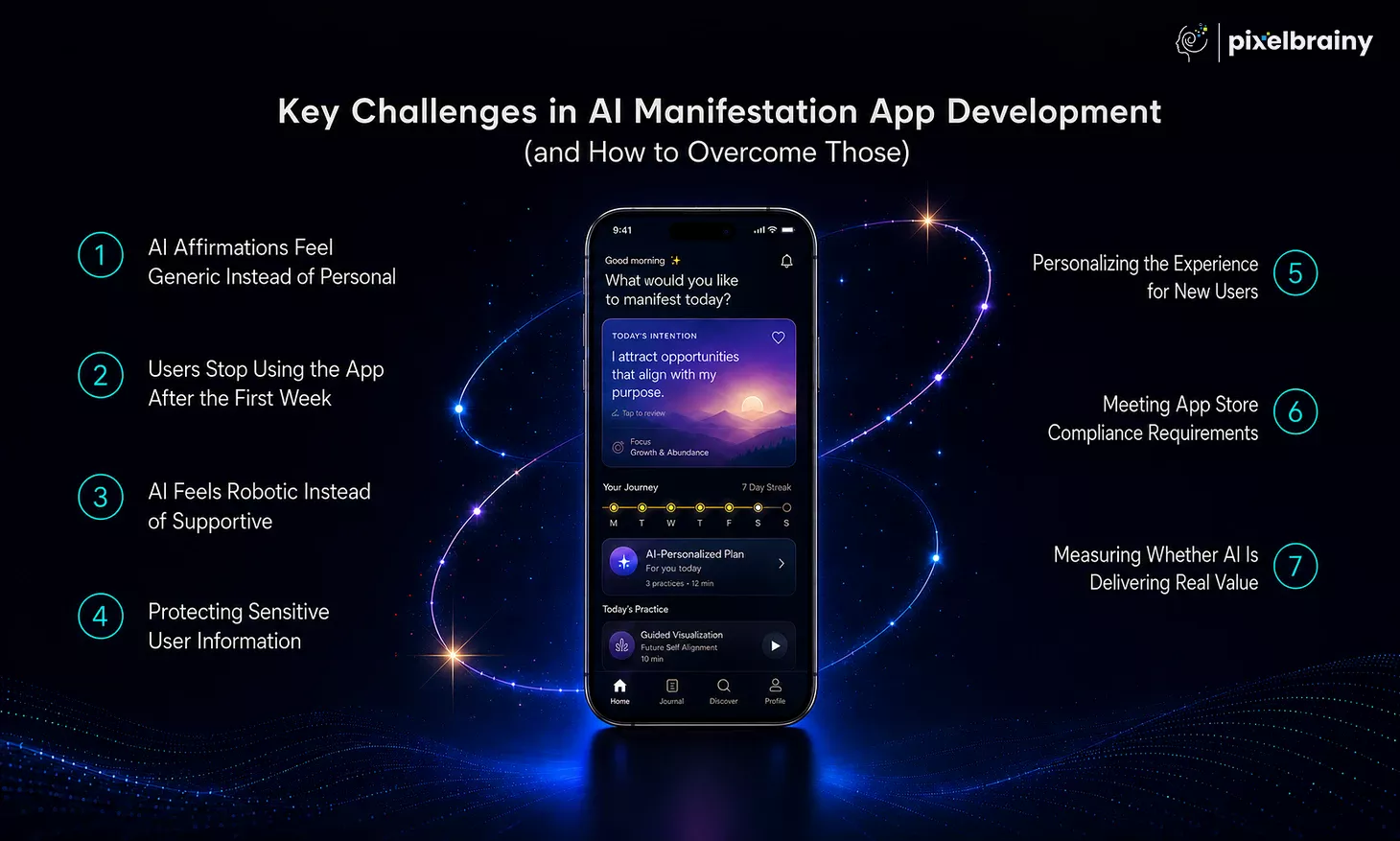
One of the biggest reasons users abandon manifestation apps is that the affirmations feel repetitive and could apply to anyone. If every user receives similar motivational messages, the app quickly loses its perceived value.
How to Overcome It
Instead of relying on a static affirmation library, build a contextual personalization layer. Feed the AI with data such as the user's goals, journal entries, mood history, completed milestones, and previous interactions before generating every affirmation. During developing AI manifestation app with NLP and behavioral personalization, combining dynamic prompts with high quality coaching datasets helps the AI produce affirmations that feel relevant, specific, and authentic.
Early churn is one of the biggest challenges for consumer wellness apps. Many users are enthusiastic during the first few days but gradually lose motivation once the experience becomes predictable.
How to Overcome It
Design the product around continuous progress rather than daily content consumption. Use AI to generate weekly insights, celebrate milestones, recommend new manifestation exercises, and personalize notification timing based on user behavior. Features like streak tracking, adaptive affirmations, and progress summaries encourage users to keep returning, allowing the AI to learn and improve over time.
Manifestation is deeply personal. Users often share sensitive goals, fears, and aspirations, expecting empathy rather than generic chatbot responses. If AI interactions feel mechanical, emotional trust disappears.
How to Overcome It
Invest in prompt engineering, response evaluation, and human quality review. Every affirmation, coaching message, and journaling prompt should be assessed for warmth, relevance, and emotional appropriateness before reaching the user. Human written manifestation content should serve as the benchmark for all AI generated responses during AI powered manifestation app development.
A manifestation app collects deeply personal information, including journal entries, emotional reflections, personal ambitions, and life challenges. Protecting this data is essential for maintaining user trust.
How to Overcome It
Security should be part of the platform architecture from the beginning. Encrypt sensitive user data, provide transparent privacy controls, and allow users to delete their information whenever they choose. Clearly explain how AI uses personal information for personalization, avoiding overly complex legal language that users struggle to understand.
AI systems become more accurate as they learn from user behavior. The challenge is delivering meaningful personalization before enough behavioral data has been collected.
How to Overcome It
Create a conversational onboarding experience that asks thoughtful questions about the user's goals, emotional state, manifestation experience, and preferred areas of personal growth. This initial context gives the AI enough information to generate personalized affirmations and journaling prompts from the very first session instead of relying on generic recommendations.
Wellness applications that use AI generated content must comply with increasingly strict policies from both Apple and Google. Claims related to mental health improvement or guaranteed life outcomes can delay approval or result in app rejection.
How to Overcome It
Establish clear content guidelines before development begins. Position the application around personal growth, mindfulness, productivity, and habit building rather than medical or therapeutic outcomes. Implement an AI content filtering layer that reviews generated responses and removes language that could violate app store policies before it reaches users.
Unlike finance or productivity apps, success in manifestation is difficult to quantify. Without clear metrics, it becomes challenging to determine whether AI personalization is genuinely improving the user experience.
How to Overcome It
Define measurable success indicators early in the product strategy. Track affirmation engagement, journal completion rates, user reported progress toward personal goals, subscription retention, and daily active usage. Allow users to rate AI generated affirmations and coaching responses so the system continuously learns which outputs are most valuable. These insights help teams build AI manifestation app solutions that improve through real user feedback instead of assumptions.
Successfully delivering AI manifestation app development services requires more than advanced AI models. It demands thoughtful architecture, strong privacy practices, human centered design, and continuous optimization. Founders who address these challenges before they create AI manifestation app solutions avoid costly product redesigns later and build a stronger foundation for long term success.
Building a successful AI manifestation app requires more than technical expertise. It demands an understanding of user psychology, personalization, engagement, and the unique expectations of the digital wellness market. If you're looking for a company to develop a custom AI manifestation app, your development partner should know how to combine AI with meaningful user experiences that keep people engaged long after the first download.
One of the most common conversations we have with founders is:
"We're building an AI manifestation app that uses NLP to analyze user journal entries, generate personalized affirmations, track long-term progress, and deliver smart coaching. We're looking for an AI app development company with real experience in AI personalization rather than a traditional mobile app agency."
At PixelBrainy, we specialize in building intelligent consumer applications that combine AI, Natural Language Processing, behavioral personalization, and scalable cloud infrastructure. As businesses increasingly look for companies that develop AI manifestation apps for wellness startups, they need a partner that understands both the technology and the unique dynamics of the wellness industry.
Our expertise includes conversational AI, NLP powered journal analysis, AI generated affirmations, voice integration, personalized recommendation engines, subscription infrastructure, multilingual experiences, and scalable backend systems. The same AI engineering capabilities we bring to products such as an AI astrology app development company, AI coaching platforms, and other intelligent wellness applications are applied to every manifestation app we build.
What sets our approach apart is that we think beyond development. Every product is designed with user retention, monetization, scalability, and long-term growth in mind from the very beginning. Instead of treating these as post-launch improvements, we incorporate them into the product architecture, ensuring your application is technically prepared for future expansion.
Whether you're an independent wellness coach with an engaged audience, a startup launching its first AI product, an established wellness brand expanding into digital experiences, or a corporate wellness provider developing an employee wellbeing platform, our team adapts the development process to your business goals and growth stage.
| Factor | Generic App Development Agency | PixelBrainy |
| AI personalization experience | Limited AI implementation with minimal personalization | AI driven personalization is a core capability across every project |
| Wellness app sensitivity | Often focuses only on technical delivery | Product strategy considers user psychology, trust, and long-term engagement |
| NLP and voice AI capability | Frequently relies on third-party vendors | In-house expertise in NLP, conversational AI, and voice enabled experiences |
| Retention-focused development | Usually addressed after launch | Designed into the product from day one through AI and behavioral features |
| Monetization architecture | Standard payment integration | Optimized for subscriptions, freemium models, and digital content purchases |
| Founder communication | Communication varies by project | Structured discovery, sprint planning, regular updates, and transparent collaboration |
| Post-launch support | Limited maintenance after release | Ongoing optimization, feature enhancements, and AI performance improvements |
| Who we build for | Businesses across all industries | Wellness founders, AI startups, |
Whether you're starting with an idea or refining an existing concept, PixelBrainy is ready to help you build the next generation of AI-powered wellness experiences. Get in touch with our team to discuss your vision, explore the right technology roadmap, and launch an AI manifestation app that's built to scale from day one.
The demand for AI-powered wellness applications is growing rapidly, and manifestation apps are becoming an important part of this evolution. As users look for more personalized experiences, there is a clear opportunity for businesses to move beyond static affirmation libraries and create intelligent platforms that deliver AI-generated affirmations, personalized coaching, adaptive journaling, and meaningful progress tracking. This is why AI manifestation app development is expected to become one of the fastest-growing segments in the digital wellness industry over the next few years.
Building a successful manifestation app requires more than integrating AI features. Long-term success depends on creating an experience that keeps users engaged, earns their trust, and delivers value every day. The right technology strategy, product architecture, and development expertise can make the difference between an app users subscribe to for months and one they uninstall within days.
Get a Free AI Manifestation App Development Quote
If you're planning to build manifestation app with PixelBrainy, we're ready to help you turn your vision into a scalable, market-ready product. From product discovery and AI manifestation app development to AI integration, UI/UX design, MVP development, and post-launch support, our team works with you at every stage of the journey.
Connect with PixelBrainy today to discuss your idea and receive a free AI manifestation app development quote tailored to your business goals, feature requirements, and launch timeline.
An AI manifestation app uses technologies such as Large Language Models (LLMs), Natural Language Processing (NLP), and behavioral personalization to generate affirmations, visualization exercises, journaling prompts, and coaching based on each user's goals, emotions, and progress. In contrast, a basic affirmation app typically delivers the same prewritten content to every user with limited personalization.
The cost of AI manifestation app development depends on the product scope, AI capabilities, platform support, and integrations. An MVP typically starts around $40,000, while a fully featured AI manifestation app with advanced personalization, NLP, subscriptions, multilingual support, and analytics can range from $100,000 to $150,000+.
Development timelines vary based on the complexity of the application. A feature-rich MVP can generally be built in 4 to 8 weeks, while a production-ready platform with advanced AI personalization, voice features, coaching modules, and enterprise integrations may require 9 to 14 weeks.
Yes. A white label solution allows wellness coaches, therapists, life coaches, and wellness brands to launch their own manifestation app with custom branding, colors, content, subscription plans, and domain while using the same underlying AI platform. This is a popular business model for founders looking to scale through B2B partnerships.
Launching your app is only the beginning. After release, you should monitor user engagement, retention, subscription conversions, AI performance, and feature adoption. User feedback, analytics, and AI interaction data help prioritize Version 2 improvements, such as smarter personalization, new coaching experiences, wearable integrations, multilingual support, or community features.
The most valuable AI features include personalized affirmation generation, AI-powered journaling with NLP, mood and sentiment analysis, adaptive visualization scripts, conversational AI coaching, smart habit tracking, personalized push notifications, and behavioral recommendations. These features create a more engaging experience and improve long-term user retention.
Look for a development partner like PixelBrainy with proven experience in AI manifestation app development, consumer wellness platforms, NLP, conversational AI, mobile app development, subscription infrastructure, and scalable cloud architecture. The ideal partner should also understand user retention, monetization strategies, privacy, and long-term product growth, ensuring your app is built for both market success and future scalability.

About The Author
Sagar Bhatnagar
Sagar Sahay Bhatnagar brings over a decade of IT industry experience to his role as Marketing Head at PixelBrainy. He's known for his knack in devising creative marketing strategies that boost brand visibility and market influence. Sagar's strategic thinking, coupled with his innovative vision and focus on results, sets him apart. His track record of successful campaigns proves his ability to utilize digital platforms effectively for impactful marketing efforts. With a genuine passion for both technology and marketing, Sagar continuously pushes PixelBrainy's marketing initiatives to greater success.
Working with the PixelBrainy team has been a highly positive experience. They understand the design requirements and create beautiful UX elements to meet the application needs. The dev team did an excellent job bringing my vision to life. We discussed usability and flow. Sagar worked with his team to design the database and begin coding. Working with Sagar was easy. He has the knowledge to create robust apps, including multi-language support, Google and Apple ID login options, Ad-enabled integrations, Stripe payment processing, and a Web Admin site for maintaining support data. I'm extremely satisfied with the services provided, the quality of the final product, and the professionalism of the entire process. I highly recommend them for Android and iOS Mobile Application Design and Development.

Great experience working with them. Had a lot of feedback and I found that unlike most contractors they were bugging me for updates instead of the other way around. They were extremely time conscience and great at communicating! All work was done extremely high quality and if not on time, early! They were always proactive when it comes to communication and the work is great/above par always. Very flexible and a great team to work with! Goes above and beyond to present us with multiple options and always provides quality. Amazing work per usual with Chitra. If you have UI/UX or branding design needs I recommend you go to them! Will likely work with them in the future as well, definitely recommended!

PixelBrainy is a joy to work with and is a great partner when thinking through branding, logo, and website layout. I appreciate that they spend time going into the "why" behind their decisions to help inform me and others about industry best practices and their expertise.

I hired them to design our software apps. Things I really like about them are excellent communication skills, they answer all project suggestions and collaborate right away, and their input on design and colors is amazing. This project was complex and needed patience and creativity. The team is amazing to do business with. I will be using them long-term. Glad to see there are some good people out there. I was afraid to try and outsource my project to someone but I am glad I met them! I really can't say enough. They went above and beyond on this project. I am very happy with everything they have done to make my business stand out from the competition.

It was great working with PixelBrainy and the team. They were very responsive and really owned the project. We'll definitely work with them again!

I recently worked with the PixelBrainy team on a project and I was blown away by their communication skills. They were prompt, clear, and articulate in all of our interactions. They listened and provided valuable feedback and suggestions to help make the project a success. They also kept me updated throughout the entire process, which made the experience stress-free and enjoyable.

PixelBrainy is very good at what it does. The team also presents themselves very professionally and takes care of their side of things very well. I could fully trust them taking up the design work in a timely and organised manner and their attention to detail saved us lots of effort and time. This particular project was quite intense and the team showed that they function very well under pressure. Very much looking forward to working with her again!

It's always an absolute pleasure working with them. They completed all of my requests quickly and followed every note I had for them to a T, which made our process go smoothly from start to finish. Everything was completed fast and following all of the guidelines. And I would recommend their services to anyone. If you need any design work done in the future, PixelBrainy should be your first call!

They took ownership of our requirements and designed and proposed multiple beautiful variants. The team is self-motivated, requires minimum supervision, committed to see-through designs with quality and delivering them on time. We would definitely love to work with PixelBrainy again when we have any requirements.

PixelBrainy was a big help with our SaaS application. We've been hard at work with a new UI/UX and they provided a lot of help with the designs. If you're looking for assistance with your website, software, or mobile application designs, PixelBrainy and the team is a great recommendation.

PixelBrainy designers are amazing. They are responsive, talented, and always willing to help craft the design until it matches your vision. I would recommend them and plan to continue them for my future projects and more!!!

They were awesome! Did a good job fast, and good communication. Will work with them again. Thank you

Creative, detail-oriented, and talented designers who take direction well and implement changes quickly and accurately. They consistently over-delivered for us.

PixelBrainy team is very talented and creative. Great designers and a pleasure to work with. PixelBrainy is an excellent communicator and I look forward to working with them again.

PixelBrainy has a very talented design team. Their work is excellent and they are very responsive. I enjoy working with them and hope to continue on all of our future projects.

Transform your ideas into reality with us.
Across these industries, each engagement brings unique challenges, from early-stage product development to scaling complex systems, helping us build a practical understanding of real-world product environments.