AI Summary Powered by PixelBrainy
What if the 15-minute migraine appointment could begin with three months of organized evidence instead of a patient trying to remember what happened?
For a board-certified headache specialist seeing 40 migraine patients each week, this is not theoretical. Patients may remember their worst attacks, forget milder headache days, misidentify possible triggers, or struggle to connect medication use with outcomes. A basic symptom diary can capture dates, pain scores, symptoms, medications, sleep, food, stress, and triggers. A genuine AI migraine tracker app should go further: it should convert longitudinal patient-generated data into interpretable patterns, risk signals, trend summaries, and clinician-ready insights without pretending that correlation is causation.
That distinction matters when deciding how to develop an AI powered migraine tracker app for chronic migraine patients and neurologists. If the goal is simply to record attacks, a conventional diary may be enough. If the goal is to build an AI migraine tracker app that supports better conversations and treatment decisions, the product needs a clinical data model, intelligent analytics, transparent reasoning, privacy controls, and a workflow that fits the neurologist's appointment.
The market direction also supports exploration. Grand View Research estimates that the global migraine drugs market will reach $8.9 billion in 2026 and $16.6 billion by 2033, representing a 9.2% CAGR from 2026 to 2033. Its June 2026 analysis identifies rising migraine prevalence, targeted CGRP therapies, preventive treatment adoption, and research investment as major growth factors.
For digital health founders, the opportunity is not to add an AI label to a symptom diary. It is to design a trusted clinical intelligence layer around migraine data. This guide explains the AI migraine tracker app development process, from strategy and app types to features, AI architecture, compliance, monetization, development costs, validation, and launch.
It also outlines the steps to build an AI migraine tracker app from idea to launch while keeping patient safety, clinician usefulness, and measurable healthcare outcomes at the center.
An AI migraine tracker app is a healthcare application that does more than record headache episodes. It combines migraine tracking, longitudinal health data, artificial intelligence, and personalized analytics to help patients understand their migraine patterns while giving neurologists a clearer picture of what has happened between clinical appointments.
The simplest way to understand the difference is this:
A traditional migraine diary records data. An AI migraine tracker analyzes that data and turns it into meaningful insights.
A conventional diary may ask a patient to record when a migraine occurred, how severe it was, how long it lasted, what symptoms appeared, which medication was taken, and whether factors such as stress, poor sleep, food, dehydration, or weather were present.
That information becomes much more valuable when an intelligent system can analyze it across weeks or months.
The AI migraine tracker app development process generally follows a continuous data-to-insight cycle.
Patient logs migraine information → App organizes the data → AI analyzes historical patterns → System generates personalized insights → Patient reviews trends → Neurologist receives a clinical summary
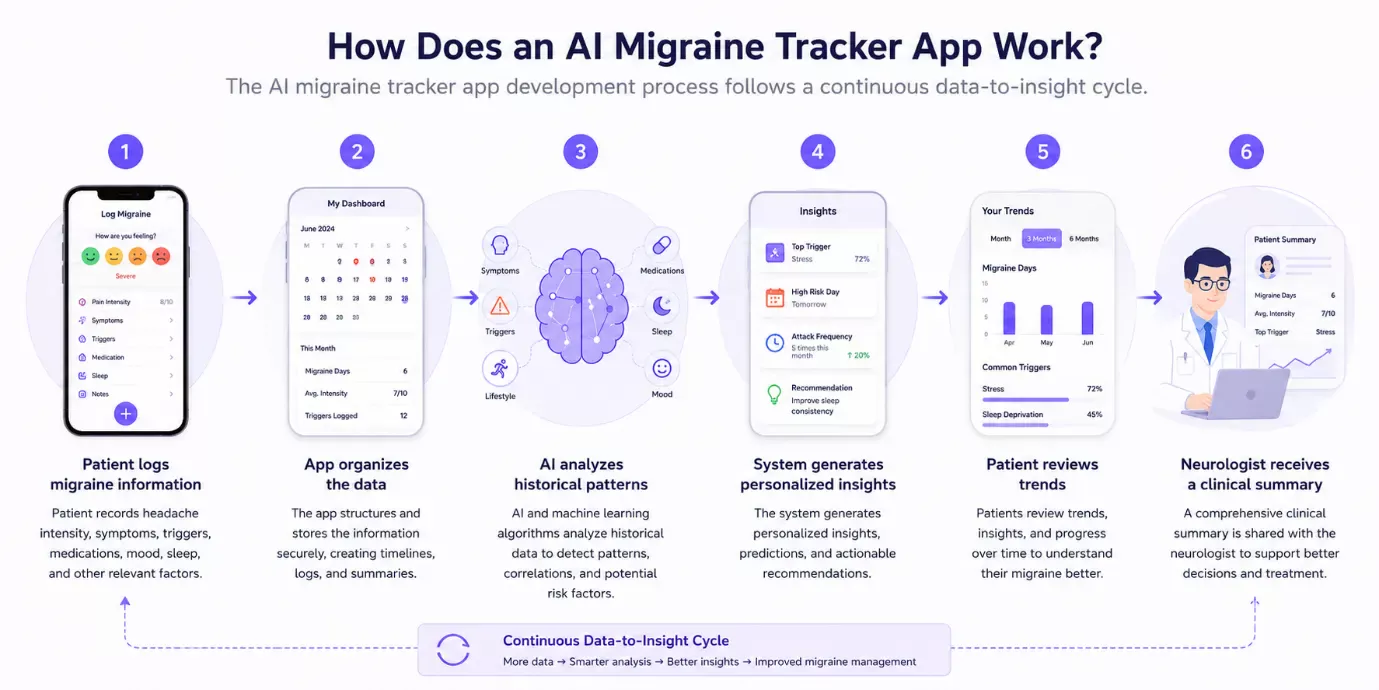
For example, imagine a chronic migraine patient track symptom for 12 weeks. During this period, the patient records migraine severity, sleep duration, stress levels, medication use, hydration, and attack duration.
Instead of simply displaying 25 individual migraine entries, an AI-enabled system can analyze the complete dataset and identify potentially meaningful patterns.
It might show that:
The patient experienced more migraine days during periods of reduced sleep compared with their recent baseline.
It could also compare migraine frequency before and after a preventive treatment began, identify changes in average severity, or highlight incomplete medication data that limits the reliability of treatment-response analysis.
The system should not automatically state that poor sleep caused the migraine. A clinically responsible AI migraine tracker should distinguish between correlation, association, prediction, and causation.
Depending on the product's scope, the application can combine several categories of information:
Migraine data: frequency, duration, severity, symptoms, aura, and functional impact.
Medication data: acute medications, preventive treatments, timing, dosage, response, and side effects.
Lifestyle data: sleep, hydration, meals, caffeine, exercise, stress, and daily activity.
Environmental data: weather and other relevant external variables.
Health-device data: sleep, activity, heart rate, and other available measurements from compatible devices.
The application can then create a personalized migraine profile rather than relying only on generalized migraine trigger information.
For a headache specialist managing dozens of patients every week, reviewing three months of migraine history manually can be difficult within a short appointment.
An AI migraine tracker can organize that information into a concise clinical snapshot:
Migraine days: 12 → 8
Average severity: 7.4 → 5.9
Acute medication days: 10 → 7
Treatment period: 8 weeks
Observed pattern: Lower sleep was associated with increased migraine frequency
Data quality: 86% tracking completeness
This does not replace the neurologist. Instead, it gives the neurologist a better starting point for clinical discussion.
| Basic Migraine Diary | AI Migraine Tracker |
|---|---|
| Records symptoms | Analyzes longitudinal patterns |
| Stores individual attacks | Identifies patient-specific trends |
| Requires manual interpretation | Provides automated analysis |
| Shows historical entries | Creates summarized insights |
| Limited personalization | Personalized pattern analysis |
| Primarily patient-focused | Can support patients and clinicians |
| Static reporting | Dynamic trend and treatment analysis |
For digital health founders, this distinction is critical. Building an AI migraine tracker app is not about adding a chatbot to a diary. It is about creating a reliable intelligence layer that transforms fragmented migraine data into understandable, evidence-aware, and clinically useful information.
The strongest products will make migraine tracking easier for patients, reduce information gaps for neurologists, and help both sides enter the appointment with a clearer understanding of the patient's longitudinal migraine experience.
The decision to invest in AI migraine tracker app development should begin with a business and market question: Why does the healthcare organization need an intelligent migraine tracking platform in the first place? The answer is not simply to give patients another way to record headaches. The stronger investment case comes from the growing demand for specialized digital healthcare solutions, the expansion of AI-enabled care, the need for condition-specific platforms, and the opportunity to build a scalable product around a clearly defined clinical problem.
For healthcare businesses, an AI migraine tracker can become a specialized digital health product that connects patient-generated data, migraine management workflows, artificial intelligence, and healthcare delivery.
According to The Business Research Company, the global digital therapeutics migraine market is projected to grow from $1.69 billion in 2025 to $2.09 billion in 2026, reaching $4.81 billion by 2030, with a projected CAGR of 23.2% from 2026 to 2030. The report identifies AI-driven symptom prediction, personalized migraine management, wearable integration, and remote patient management among the key market trends.
Based on this market direction, here are the seven major reasons healthcare businesses should consider investing in an AI migraine tracker app.
The migraine digital therapeutics market is moving toward specialized technology designed specifically around migraine management rather than generic health tracking.
This creates an opportunity for healthcare companies to establish a presence in a focused digital health category where specialized products can address specific patient and provider workflows.
For startups, hospitals, neurology organizations, and healthcare technology companies, entering the market early can create an opportunity to develop a recognizable position before AI-powered migraine management becomes more crowded.
A strong healthcare technology investment should solve a specific problem.
Migraine tracking is a particularly suitable area for digital intervention because migraine episodes occur over time, while clinical decisions are often made during periodic appointments.
Patients generate large amounts of potentially relevant information about:
The business opportunity is to create a structured technology layer that can collect and process this information rather than leaving it scattered across memory, notes, spreadsheets, or disconnected applications.
Generic symptom trackers compete across dozens of health conditions. An AI migraine tracker can be designed specifically around the needs of migraine patients, headache specialists, neurologists, and headache clinics.
This allows businesses to develop specialized workflows such as:
A focused product strategy can create clearer positioning than a general-purpose health application.
AI is becoming increasingly relevant across healthcare software, particularly in areas involving large amounts of patient-generated information.
An AI migraine tracker provides a defined environment in which businesses can explore:
The important consideration is to define the intended clinical function before selecting the AI technology.
For example, summarizing patient-entered information is fundamentally different from predicting migraine risk or recommending treatment. Each capability can introduce different validation, safety, privacy, and regulatory requirements.
Migraine is a condition where information accumulated over weeks and months can be highly relevant to understanding the patient's experience.
This makes longitudinal data a central product opportunity.
A healthcare business that builds the right data architecture from the beginning can potentially support multiple layers of the product, including:
Data collection → structured migraine history → analytics → personalized insights → clinician reporting → advanced AI
The strategic value comes from creating a purpose-built system for collecting high-quality migraine data rather than simply adding an AI feature to an existing generic application.
An AI migraine tracker does not necessarily need to remain a single-purpose patient application.
Once the core platform is established, healthcare businesses can potentially expand its use across different stakeholders and commercial environments.
Potential target customers include:
The same underlying technology can potentially support different interfaces and workflows for patients, clinicians, administrators, and research teams.
This makes the investment relevant not only as an app project but also as a potential healthcare technology platform.
The first version of an AI migraine tracker does not need to contain every advanced AI capability.
A healthcare business can begin with a focused product and progressively develop more sophisticated technology as clinical evidence, user data, and product maturity increase.
Future development could explore:
This creates a long-term product roadmap instead of treating the application as a one-time app development project.
For healthcare businesses considering how to build an AI migraine tracker app, the strategic priority should therefore be to establish a strong clinical and technical foundation first, then expand AI capabilities according to validated use cases, regulatory requirements, and market demand.
These above are the strongest reason to invest in AI migraine tracker app development is the opportunity to build a specialized, scalable healthcare technology platform around a clearly defined clinical need and a rapidly developing digital migraine market.
The decision to build an AI migraine tracker app depends on who will use it, what healthcare problem it will solve, and where the collected migraine data will be used. In 2026, several healthcare organizations and founder profiles have a strong business or clinical reason to develop specialized migraine technology.
The right development strategy is different for a startup, headache clinic, pharmaceutical company, research institution, wearable company, CRO, telehealth provider, or health insurer. The product should be designed around the organization's actual workflow rather than using one generic AI migraine app model for every stakeholder.
Digital health founders and health technology companies can develop an AI migraine tracker app as a direct-to-consumer product, B2B healthcare platform, or specialized chronic migraine management solution.
The commercial opportunity is supported by the large migraine population. The American Migraine Foundation states that more than 39 million Americans live with migraine, while migraine remains significantly underdiagnosed and undertreated.
This makes migraine a strong category for founders who want to solve a clearly defined healthcare problem rather than launch another general wellness application.
A startup-focused product should combine simple consumer UX with clinically appropriate data collection, AI analytics, privacy controls, and a business model that can scale beyond an individual clinic.
Neurologists and headache specialists can build an AI migraine tracker app specifically around their clinical workflow.
The objective is to capture migraine information between appointments so that patients do not have to rely entirely on memory when discussing several months of migraine activity.
For example, patients can continuously record migraine frequency, severity, symptoms, medication use, treatment changes, and relevant lifestyle information. The system can then organize those entries into a structured pre-consultation summary.
For clinicians asking how to build a migraine tracking app for a headache clinic, the product design should prioritize extremely fast patient logging and a clinician dashboard that surfaces the most relevant information without creating additional administrative work.
Pharmaceutical companies with migraine therapies can develop an AI migraine management app as part of an appropriate patient-support ecosystem.
The application could be designed around treatment tracking, patient education, medication experience documentation, adherence-related workflows, and communication with healthcare professionals where appropriate.
For a pharmaceutical company asking how to develop an AI migraine app for patients using migraine medication, the product architecture should establish clear boundaries between patient support, medical information, analytics, and promotional content.
Legal, regulatory, medical, privacy, and compliance teams should participate in product planning before development begins because the intended use and content can significantly affect the application's requirements.
Academic neurology departments and research institutions can build an AI migraine tracker app to support longitudinal migraine research and structured patient data collection.
A research-oriented platform can collect standardized patient-reported information across extended periods while supporting study recruitment, participant management, and research-specific data workflows.
When asking how to build an AI migraine tracker for migraine research, institutions need to plan for informed consent, research permissions, data governance, institutional review requirements, and clear separation between clinical-care data and research data.
The application should be designed so that participants understand how their information will be collected, used, stored, and potentially shared for approved research purposes.
Wearable and biosensor companies can develop an AI migraine tracker app as a companion platform that combines device-generated data with patient-reported migraine information.
A wearable may provide information related to sleep, activity, heart rate, or other measurable signals, while the patient reports migraine onset, severity, symptoms, and medication use.
This creates an opportunity to investigate whether combinations of passive and active data can support personalized migraine monitoring or prediction.
For companies asking how to build an AI migraine prediction app using wearable data, the key requirement is a reliable data pipeline connecting the wearable, mobile application, analytics engine, and AI models. Any clinical interpretation of sensor-derived signals should also be appropriately validated.
Clinical research organizations can commission AI migraine tracker app development for clinical trials, electronic patient-reported outcomes, and electronic diary collection.
A trial-focused application needs controlled data capture, protocol-specific workflows, auditability, reliable electronic records, and appropriate documentation.
For a CRO asking how to develop an AI migraine diary for clinical trials, development should be handled by teams familiar with regulated clinical research technology rather than a general consumer-app development process.
The FDA provides guidance covering computerized systems used in clinical trials, including systems involved in collecting and managing clinical investigation data. FDA: Computerized Systems Used in Clinical Trials
Telehealth platforms and multi-site neurology groups can develop AI migraine tracking modules that connect directly with their existing consultation and patient-engagement infrastructure.
Patients can record migraine information between appointments, while clinicians can review structured summaries before a virtual or in-person consultation.
Organizations exploring how to build a scalable AI migraine tracker app for neurology clinics and headache centers in 2026 should therefore consider interoperability from the beginning.
The architecture may need secure APIs, EHR integration, role-based access, multiple clinician accounts, patient-provider communication, and organization-level administration.
Health insurance companies and managed care organizations can build AI migraine tracker apps as member-facing tools within broader chronic-care and care-management programs.
The application can be designed around structured migraine monitoring, member engagement, care-management workflows, and appropriate pathways for connecting members with healthcare services.
For insurers exploring how to develop an AI migraine tracker for chronic migraine care management, privacy, consent, secure data exchange, member-level controls, and population-level reporting should be established as core architectural requirements.
The product should also clearly define what information is visible to members, care-management teams, providers, and organizational administrators.
The most appropriate organization to invest in AI migraine tracker app development is therefore one that has a clearly defined migraine use case, access to the right user population or healthcare workflow, and the clinical, regulatory, and technical resources required to turn migraine data into a purpose-built digital health product.
How to build scalable AI migraine tracker app for neurology clinics and headache centers in 2026 depends largely on the type of application being developed, its intended users, the clinical purpose, the data it needs to process, and the regulatory environment in which it will operate. A consumer migraine application, for example, has very different requirements from an AI clinical trial eCOA platform.
For founders and healthcare organizations planning to build an AI migraine tracker app, selecting the right product type should happen before technology architecture, AI models, integrations, and monetization are finalized. The following eight models represent the major directions available for AI migraine tracker app development in 2026.
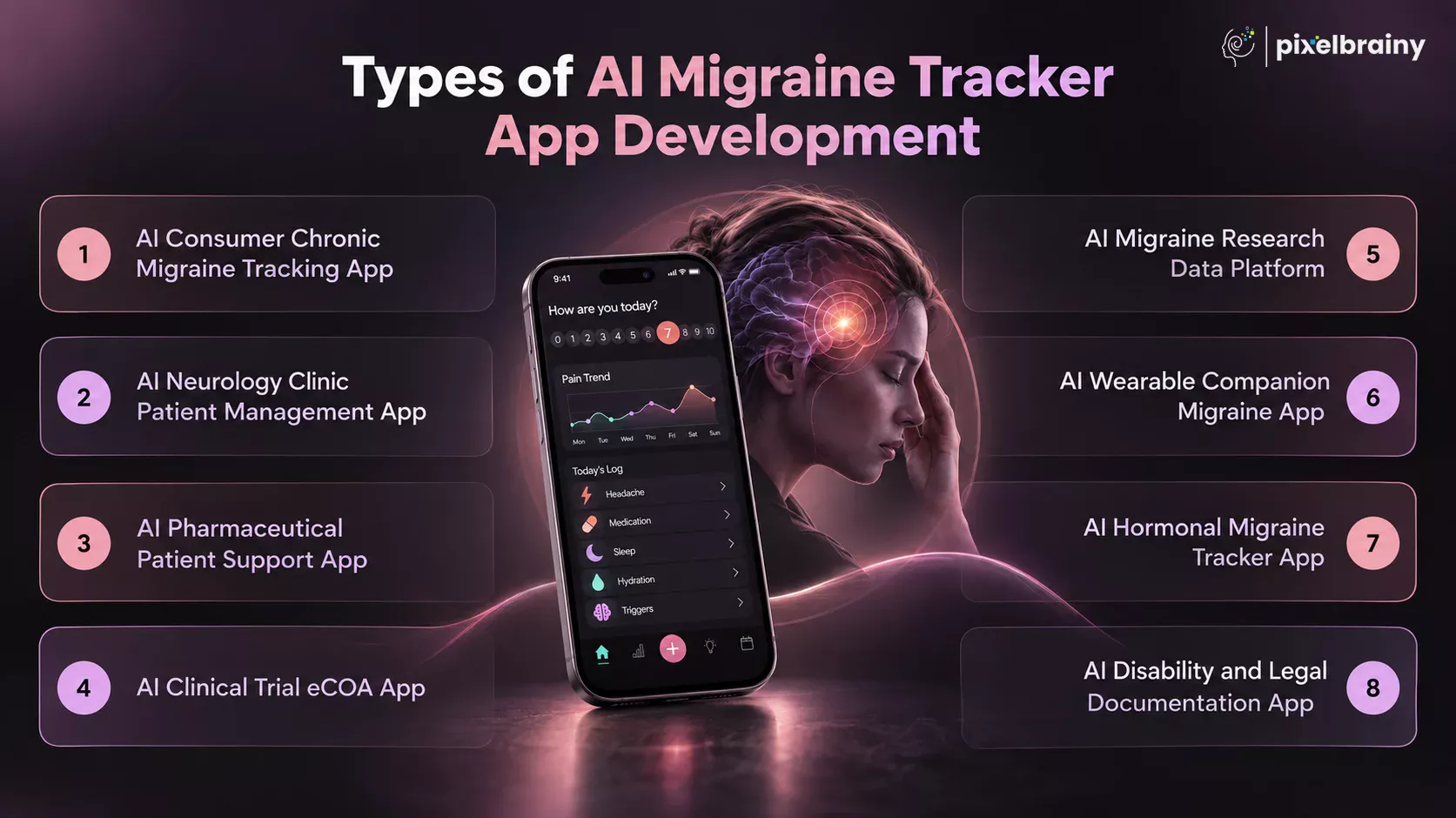
An AI consumer migraine tracker is designed for individual patients who want to record attacks, identify personal patterns, monitor medications, receive personalized insights, and create reports for healthcare providers.
Unlike a conventional migraine diary, the application can analyze longitudinal information to identify patient-specific associations and, where clinically validated, provide predictive alerts.
Key product design implication: Differentiation should come from genuine AI-powered personalization and clinically meaningful analysis rather than simply presenting basic diary data through sophisticated charts.
An AI neurology clinic app is designed specifically for neurologists, headache specialists, and their patients. Patients track migraine information between appointments, while clinicians receive structured dashboards, treatment timelines, patient-reported outcomes, and pre-consultation reports.
The system can also incorporate validated disability measures and medication-management documentation where appropriate.
Key product design implication: The application should fit the existing headache-clinic workflow, with rapid patient logging and appointment reports that present the information specialists actually need during consultations.
A pharmaceutical AI migraine application is developed as part of an appropriate patient-support program associated with a migraine medication or portfolio.
It can support treatment tracking, medication-related information, patient education, symptom documentation, and appropriate patient engagement throughout the treatment journey.
Key product design implication: The architecture must clearly separate patient-support content from promotional content and establish governance for AI-generated coaching, medical information, disclosures, data handling, and content approval.
An AI clinical trial migraine app is purpose-built for participants in migraine clinical trials who need to submit electronic patient-reported outcomes and diary information.
Its priorities are fundamentally different from a consumer application. Data integrity, traceability, protocol compliance, auditability, validation, and regulatory requirements must guide the system architecture. Depending on the trial and system configuration, requirements such as 21 CFR Part 11 and relevant CDISC standards may apply.
Key product design implication: The platform should support timestamped entries, audit trails, controlled data changes, missing-entry detection, site alerts, validation procedures, secure storage, and appropriate regulatory data outputs.
An AI migraine research platform is designed to collect longitudinal migraine information from large patient populations for approved research programs, natural-history studies, epidemiological research, and other scientific investigations.
It can combine patient-reported migraine information with permitted clinical, lifestyle, and other health datasets to create structured research cohorts.
Key product design implication: Research-focused AI migraine tracker app development requires granular informed consent, research-specific permissions, appropriate de-identification, data-quality standards, participant governance, and IRB-aligned processes where applicable.
An AI wearable companion app connects a specific wearable or biosensor with migraine tracking functionality. It can combine passive information such as sleep and activity with patient-reported migraine onset, severity, symptoms, medication, and other relevant information.
The goal is to determine whether combining device signals with patient-reported information can produce more useful personalized insights or prediction capabilities.
Key product design implication: AI migraine prediction app development for wearable ecosystems requires deep device integration, reliable timestamp synchronization, signal processing, appropriate model validation, and transparent communication of prediction uncertainty.
An AI hormonal migraine tracker focuses on patients whose migraine patterns may be associated with menstrual cycles, hormonal fluctuations, contraception, or perimenopause.
The application can analyze cycle information alongside migraine timing, severity, symptoms, medication use, and other patient-reported variables to identify individual patterns and generate structured reports that can support collaboration between neurologists and gynecologists.
Key product design implication: The data model must connect reproductive-health timelines with migraine events while providing strong privacy, consent, and sensitive-health-data protections.
An AI disability documentation application is designed to create structured, chronological records of migraine frequency, severity, duration, treatment history, functional limitations, missed work, and other patient-reported impacts.
Patients may use these records when organizing information for workplace accommodation requests, disability applications, insurance matters, or legal proceedings. The application should clearly distinguish patient-generated records from information verified by healthcare professionals.
Key product design implication: Documentation credibility should influence the architecture from day one, including reliable timestamps, source attribution, editing history, secure exports, and transparent records of how information was generated or modified.
For founders deciding which type of AI migraine tracker app to develop, the intended use should determine the product strategy from the beginning. A consumer application requires strong engagement and personalization, a neurology platform requires clinical workflow integration, a pharmaceutical application requires content governance, and a clinical trial solution requires regulatory-grade data management.
The selected model ultimately determines the regulatory requirements, clinical validation standards, data architecture, AI capabilities, development complexity, and monetization approach that should be established before development begins.
An AI migraine tracker app can do much more than record headache symptoms. When designed around longitudinal patient data, personalized pattern analysis, medication tracking, and clinician-ready reporting, it can support better conversations between patients and healthcare professionals while creating valuable opportunities for digital health companies.
For founders asking, “What can an AI migraine tracker actually do that a basic symptom diary cannot?”, the difference comes from turning daily patient inputs into structured, personalized insights rather than simply storing entries. Research on digital migraine tools has also explored trigger analysis, medication-use monitoring, attack classification, and physician reports as practical features.
An AI-powered migraine tracker app can give patients and clinicians a longitudinal view of migraine activity instead of relying primarily on memory during appointments.
Attack frequency, symptoms, potential triggers, medication use, treatment response, and disability measures can be organized into structured reports that help clinicians identify changes and discuss treatment options more efficiently.
This makes clinical consultations more focused on patterns and treatment planning rather than reconstructing months of migraine history from memory.
Migraine triggers can vary substantially between individuals, making generic trigger lists less useful for personalized management.
AI can analyze a patient's own tracking history across factors such as sleep, stress, hydration, meals, weather, activity, and other logged variables to identify patterns associated with their attacks. Research using prospective smartphone tracking has demonstrated that statistically associated triggers can differ considerably between individual patients.
This makes personalized trigger intelligence a valuable differentiator when you develop an AI migraine tracker app rather than creating another basic diary.
An advanced migraine tracker can analyze patient-reported symptoms and previously identified patterns to recognize changes that may indicate an emerging attack.
For example, the platform could detect a combination of recurring premonitory symptoms and historical patterns and provide a personalized notification suggesting that the patient review their established treatment plan.
Importantly, an AI app should not promise a fixed 30 to 60 minute warning for every patient. Prediction accuracy depends on the individual, available data, model performance, and clinical validation.
Patients often need organized records showing attack frequency, duration, medication use, symptoms, and functional impact.
An AI migraine tracker can generate timestamped records and structured reports that patients can share with healthcare professionals. For disability claims, the U.S. Social Security Administration evaluates primary headache disorders under its disability framework, including whether the impairment meets applicable duration and functional requirements.
This can make documentation more consistent and reduce the burden of reconstructing a long history from memory or scattered notes.
Frequent use of acute migraine medications can contribute to medication-overuse headache. The relevant thresholds vary by medication type, with ICHD-3 criteria generally involving headache on at least 15 days per month and regular medication overuse for more than three months.
An AI migraine tracker can monitor medication-use patterns and provide appropriate reminders when a patient's usage approaches clinically relevant thresholds.
The app should frame these notifications as risk signals for discussion with a healthcare professional, not as an automated diagnosis.
Longitudinal tracking can help reveal when migraine frequency is increasing and may warrant clinical review.
For example, chronic migraine is defined by ICHD-3 as headache occurring on at least 15 days per month for more than three months, with migraine features on at least 8 days per month.
An AI tracker can monitor these trends and notify patients or authorized care teams when documented patterns appear to be approaching clinically important thresholds, supporting earlier evaluation rather than waiting for the pattern to become obvious retrospectively.
With appropriate consent, privacy protections, and governance, aggregated longitudinal migraine data can become valuable for academic and pharmaceutical research.
An AI migraine tracker app can capture information about attack patterns, potential triggers, treatment response, medication use, disability, and patient-reported outcomes across large populations.
For companies focused on AI migraine tracker app development services, this creates an opportunity to design research-ready data infrastructure while keeping patient privacy, consent, and appropriate data-use controls central to the product.
A basic diary primarily records information. AI migraine tracker app development can add personalization, pattern analysis, clinical reporting, medication monitoring, and intelligent insights that create greater value for patients and healthcare organizations.
For founders looking to build AI migraine tracker app products, this differentiation can support partnerships with neurology practices, digital health providers, pharmaceutical companies, employers, or research organizations.
The strongest value of creating an AI migraine tracker app is turning continuous patient-reported data into personalized, clinically useful insights while keeping patients and healthcare professionals at the center of decision-making.

What features should founders prioritize when they develop an AI migraine tracker app for chronic migraine patients and neurologists? The answer is not to fill the application with every possible healthcare function. A successful AI migraine tracker app development strategy should begin with the essential features that make migraine tracking simple, consistent, secure, and clinically useful.
For a basic but production-ready AI headache tracker app, the core experience should allow patients to record migraine episodes quickly, understand their history, monitor medications and symptoms, and share structured information with healthcare professionals. For clinics, the platform should provide a reliable view of longitudinal patient data without overwhelming clinicians with unnecessary information.
The following 15 must-have features for an AI migraine tracker app create the foundation. Advanced capabilities such as sophisticated predictive modeling, wearable intelligence, advanced AI coaching, and complex research functionality should be treated separately after the core tracking experience has been validated.
A practical real-world query founders should answer before development is: What are the must-have features to build an AI migraine tracker app that chronic migraine patients will actually use every day and neurologists can review during appointments?
| Feature | What It Should Do | Why It Matters for AI Migraine Tracker App Development |
|---|---|---|
| Quick Migraine Logging | The app should let patients record a migraine episode within a few taps, including onset time, severity, duration, symptoms, and current status without navigating through lengthy forms. | Fast logging reduces friction and makes consistent tracking more realistic, particularly when patients are experiencing pain, nausea, light sensitivity, fatigue, or difficulty concentrating during an active migraine episode. |
| Migraine Calendar | A dedicated calendar should display migraine days, headache days, attack duration, severity, medication entries, and other important events using an easily understandable monthly or weekly timeline. | A visual calendar helps patients recognize changes over time while giving clinicians a quick way to understand the frequency and distribution of migraine episodes before reviewing more detailed information. |
| Pain Severity Tracking | Patients should be able to record pain intensity using a consistent scale, while optionally documenting how severity changes throughout an individual migraine episode. | Consistent severity measurements create structured longitudinal data that the AI analytics layer can use when identifying trends and comparing different tracking periods or treatment phases. |
| Symptom Tracking | The application should provide structured options for common migraine symptoms such as nausea, vomiting, aura, dizziness, light sensitivity, sound sensitivity, fatigue, and cognitive difficulties. | Standardized symptom data helps distinguish individual migraine experiences and gives the AI system consistent information for generating patient-specific summaries and clinically relevant longitudinal reports. |
| Migraine Duration Tracking | Users should be able to record when an attack begins and ends, with the application automatically calculating the total duration and preserving the information within the patient's migraine history. | Automatic duration calculations reduce manual work and provide a standardized measurement that can be compared across individual attacks, months, treatment periods, and patient-reported outcomes. |
| Trigger Tracking | Patients should be able to record potential factors associated with attacks, including sleep disruption, stress, hydration, meals, caffeine, weather, physical activity, and personally defined factors. | Structured trigger information provides essential input for personalized pattern analysis while allowing the AI system to identify recurring associations instead of relying on generic migraine trigger assumptions. |
| Medication Tracking | The app should allow patients to record acute and preventive medications, dosage information where appropriate, timing, reason for use, and perceived response after taking medication. | Medication data provides important context for understanding treatment patterns and allows clinicians to compare reported migraine activity with medication use across different periods. |
| Treatment History | Patients or authorized healthcare professionals should be able to document preventive treatments, treatment start dates, changes, discontinuations, and relevant treatment periods within the patient's longitudinal record. | A treatment timeline allows the AI migraine tracker to organize migraine data around important clinical events and makes comparisons between pre-treatment and post-treatment periods easier. |
| Sleep and Lifestyle Tracking | The application should provide simple tracking for sleep duration, sleep quality, hydration, meals, caffeine, stress, exercise, and other lifestyle factors relevant to the patient's migraine history. | Lifestyle information creates additional context for longitudinal analysis and helps the application connect migraine events with patient-reported daily circumstances without requiring users to complete excessively complicated questionnaires. |
| Personalized Patient Profile | Each user should have a structured profile containing relevant migraine characteristics, symptoms, medications, treatment history, preferences, and other information needed to personalize the tracking experience. | A structured patient profile enables the AI migraine tracker app development process to move beyond generic tracking and provide analysis based on each individual's documented migraine history. |
| AI-Generated Migraine Summary | The application should automatically convert recorded information into understandable summaries covering migraine frequency, severity, duration, symptoms, medication use, and meaningful changes during selected periods. | AI-generated summaries reduce the effort required to interpret large amounts of patient-entered information while giving users a clearer understanding of their documented migraine history. |
| Trend Analysis Dashboard | Patients should have access to simple charts and summaries showing changes in migraine frequency, severity, duration, symptoms, and medication use across weekly, monthly, and longer tracking periods. | Trend visualization helps users understand longitudinal changes and provides clinicians with an organized starting point for evaluating how the patient's migraine experience has changed. |
| Clinical Report Generation | The application should generate structured reports that summarize relevant migraine information for patients to securely share with neurologists, headache specialists, or other authorized healthcare professionals. | A clinician-ready report transforms patient tracking into a practical healthcare communication tool and helps providers review longitudinal information without manually interpreting every individual diary entry. |
| Secure Patient and Clinician Data Sharing | Patients should be able to securely share selected migraine reports or relevant health information with authorized healthcare professionals while retaining appropriate control over their personal data. | Secure information sharing is essential for an AI headache tracker app intended to connect patients with healthcare providers and requires appropriate authentication, authorization, privacy controls, and secure data transmission. |
These foundational capabilities establish the core workflow of an AI migraine tracker app:
Capture migraine data → Structure the information → Analyze longitudinal records → Present understandable insights → Generate clinically useful reports
The objective at this stage is not to make the application technologically complicated. It is to ensure that patients can consistently provide high-quality information and that healthcare professionals can understand that information without unnecessary complexity.
A strong AI migraine tracker app development process should therefore validate these core features before adding advanced capabilities such as predictive migraine forecasting, wearable-driven analysis, sophisticated AI coaching, or other specialized intelligence.
When the core tracking experience is fast, reliable, secure, and clinically organized, the AI migraine tracker has the foundation required to become genuinely useful for both patients and healthcare professionals.
Once the essential tracking, medication, symptom, reporting, and patient management features are established, founders can differentiate an AI migraine tracker app with more specialized capabilities. These non-ordinary features should not simply make the application look more advanced. Each feature should solve a specific problem that patients, neurologists, headache specialists, or healthcare organizations may encounter during long-term migraine management.
For companies planning AI migraine tracker app development, the most valuable advanced features are those that use AI, longitudinal data, personalization, automation, and clinical workflow intelligence to create capabilities that a conventional migraine diary cannot provide.
A practical product question is: How can I build an AI migraine tracker app that does more than record headaches and actually turns longitudinal patient data into personalized migraine intelligence?
| Advanced Feature | What It Should Do | Why It Matters for AI Migraine Tracker App Development |
|---|---|---|
| Personalized Migraine Risk Prediction | The application can analyze a patient's historical migraine patterns and selected contextual data to estimate the likelihood of an upcoming migraine episode when sufficient validated data is available. | Personalized prediction can turn passive tracking into proactive monitoring, but models must be clinically validated and communicate uncertainty clearly rather than presenting predictions as guaranteed outcomes. |
| AI Trigger Relationship Engine | Instead of displaying generic trigger lists, the system can examine individual patient data and identify recurring associations between migraine episodes and factors such as sleep, stress, meals, hydration, or other tracked variables. | This creates meaningful personalization and can differentiate an AI migraine tracker from conventional diary applications that primarily store information without analyzing patient-specific relationships. |
| AI Migraine Appointment Briefing | Before an appointment, the system can automatically prepare a concise summary highlighting recent migraine frequency, severity, medication patterns, treatment changes, symptom trends, and important changes from the patient's previous baseline. | A structured briefing can help neurologists review months of information quickly and focus the consultation on clinical interpretation rather than reconstructing the patient's history manually. |
| Personal Baseline Detection | The AI can establish an individual's normal migraine pattern over time and identify meaningful deviations in frequency, severity, duration, symptoms, or medication use compared with that personal baseline. | Personal baselines can provide more relevant context than generic population comparisons because migraine patterns vary substantially between individual patients. |
| Natural Language Migraine Journal | Patients can describe an episode using everyday language, while natural language processing converts relevant information into structured fields such as symptoms, duration, severity, medication, and possible contextual factors. | Natural language input can reduce the burden of structured forms and allow patients to document migraine experiences naturally while still producing usable data for analytics. |
| Voice-Based Migraine Logging | The application can allow patients to verbally record symptoms, medication use, attack severity, or other information without requiring extensive typing or screen interaction. | Voice interaction can be particularly useful during severe migraine episodes when light sensitivity, nausea, fatigue, or cognitive difficulties make conventional mobile interaction uncomfortable. |
| Treatment Response Intelligence | The system can compare migraine patterns across defined treatment periods and summarize changes in frequency, severity, duration, symptoms, and other tracked outcomes following a treatment change. | Treatment-period analysis can help patients and clinicians review longitudinal information more systematically while avoiding unsupported claims that a treatment directly caused an observed change. |
| AI Data Quality Monitoring | The application can identify incomplete tracking, inconsistent entries, missing medication information, unusual values, or gaps that may affect the reliability of personalized analysis. | High-quality input is essential for AI migraine analytics, and identifying data limitations prevents the system from presenting potentially misleading conclusions based on incomplete information. |
| Multimodal Migraine Intelligence | The platform can combine patient-reported symptoms with permitted wearable, sleep, activity, environmental, medication, and other health information to create a broader longitudinal migraine dataset. | Combining multiple data sources can provide richer context for advanced analytics, although every additional data source requires careful privacy, interoperability, validation, and data-quality planning. |
| AI-Generated Clinical Question Prompts | The system can identify notable changes or information gaps and generate neutral questions that patients or clinicians may consider discussing during an appointment. | This feature can improve the usefulness of the tracking data without attempting to diagnose the patient or independently prescribe treatment, keeping clinical decision-making with the healthcare professional. |
Advanced AI features should solve a specific patient or clinical problem rather than exist simply to make the app appear more sophisticated. Predictive models, AI summaries, and multimodal analytics require reliable data, validation, privacy safeguards, and transparent communication of uncertainty.
For founders developing an AI migraine tracker app, the best approach is to establish reliable data collection first, validate core analytics, and then introduce advanced AI capabilities progressively.
The goal is to turn quality migraine data into personalized, explainable, and clinically useful intelligence.
How can healthcare founders build AI migraine tracker app products that generate recurring revenue while keeping the core experience affordable and clinically valuable for migraine patients? The answer depends on who receives the greatest value from the platform and who is willing to pay for that value.
An AI migraine tracker app development strategy can support several monetization models, ranging from consumer subscriptions to healthcare SaaS, pharmaceutical licensing, clinical trial platforms, insurance partnerships, and research data licensing.
For founders planning to create AI migraine tracker app products in 2026, monetization should be considered alongside product design, regulatory planning, clinical validation, and target-market strategy. The business model should determine which features are free, which capabilities are premium, who owns the commercial relationship, and how the application can scale.
A freemium model gives patients access to essential migraine tracking at no cost while placing advanced AI capabilities behind a paid subscription.
The free version can include migraine logging, symptom tracking, basic calendars, and simple trend charts. Premium subscribers can access AI trigger identification, personalized insights, predictive alerts where appropriately validated, unlimited clinical reports, wearable integrations, and neurologist-ready exports.
This approach works well for direct-to-consumer migraine applications because the free tier reduces acquisition friction while the premium tier gives highly engaged users a reason to upgrade.
Best suited for: Consumer-focused migraine apps targeting individual chronic migraine patients.
A B2B SaaS model allows neurology practices and headache centers to pay for access to the migraine platform instead of relying on individual patient subscriptions.
The practice can pay based on its patient panel, active patients, clinicians, or organizational subscription level. Patients use the application as part of their care, while neurologists access clinical dashboards, longitudinal patient information, and pre-consultation reports.
This model connects payment directly with the clinical workflow and can make patient acquisition easier because providers can introduce the application to appropriate patients.
Best suited for: Neurology clinics, headache centers, hospitals, and multi-location neurology groups.
Pharmaceutical companies can license an AI migraine platform as infrastructure for an appropriate patient-support program associated with migraine medications.
The pharmaceutical company pays a licensing or platform fee while eligible patients receive the application as a supported service. Features may include treatment tracking, patient education, medication-related information, symptom documentation, and appropriate engagement workflows.
The commercial opportunity can be significant because revenue comes from B2B licensing rather than individual subscriptions, but the platform requires careful medical, legal, privacy, regulatory, and promotional-content governance.
Best suited for: Pharmaceutical companies with migraine-focused products and patient-support programs.
An AI migraine tracker can also be developed as a specialized electronic clinical outcome assessment platform for migraine clinical trials.
Pharmaceutical sponsors and CROs can pay licensing fees based on individual studies, participants, trial duration, or platform usage. The premium value comes from validated technology, secure data collection, auditability, regulatory documentation, and trial-specific workflows.
This model requires substantial investment in validation and compliance, including applicable requirements for electronic records and clinical-trial systems.
Best suited for: CROs, pharmaceutical companies, and clinical research organizations.
Health insurers and managed-care organizations can provide an AI migraine tracking platform as a digital benefit for members managing chronic migraine.
The insurer can pay a recurring licensing fee based on enrolled or active members. To support the commercial case, the application should be capable of measuring relevant outcomes such as member engagement, care-management participation, and appropriate healthcare utilization.
This creates an institutional distribution channel while positioning the application within a broader chronic-care strategy.
Best suited for: Health insurers, managed-care organizations, employer health programs, and population-health providers.
A migraine platform can create a valuable longitudinal dataset that may support approved research collaborations when appropriate consent, privacy safeguards, governance, and applicable research requirements are in place.
Potential customers can include pharmaceutical companies, academic researchers, healthcare organizations, and institutions interested in real-world migraine evidence.
The commercial value of this model can increase as the platform develops a larger, higher-quality, longitudinal dataset.
Best suited for: Research-oriented digital health companies, academic partnerships, pharmaceutical research programs, and real-world evidence organizations.
The commercial model should be incorporated into AI migraine tracker app development from the beginning rather than added after the application is complete.
For a consumer product, the free experience should demonstrate enough value to encourage adoption, while premium AI capabilities create a logical upgrade path. For a neurology SaaS platform, the product must demonstrate clear clinical workflow value to justify recurring practice-level payments.
For founders looking to develop AI migraine tracker app products with subscription functionality, even supporting elements such as an artwork library should remain secondary to the healthcare proposition. Subscription conversion should primarily come from meaningful migraine intelligence, personalized analytics, reporting, and clinically useful functionality.
Once a consumer product demonstrates strong engagement and measurable clinical value, founders can expand into B2B neurology practice SaaS and pharmaceutical partnership models to create additional recurring revenue channels and broader distribution.
A sustainable AI migraine tracker business model ultimately connects the party receiving measurable value with the party paying for that value, while keeping patient trust, clinical integrity, and responsible health-data use at the center.
What does it take to move from a migraine app idea to a secure, scalable, and clinically useful AI product? The answer involves much more than mobile app coding. AI migraine tracker app development for healthcare startups requires clinical workflow research, patient-focused product design, secure health-data architecture, AI validation, regulatory planning, and continuous testing.
For founders researching the steps to build an AI migraine tracker app from idea to launch, the development journey should begin with the healthcare problem and end with measurable product validation. Whether the objective is to build an AI migraine tracker tool for consumers, neurology clinics, or healthcare organizations, every stage should connect the intended use case with the right technology and compliance strategy.
A practical real-world query to address during planning is: How can a healthcare startup develop an AI migraine tracker app from scratch that is simple for patients to use and clinically useful for neurologists?
Here is a structured development process of AI migraine tracker app that takes the product from initial concept to launch.
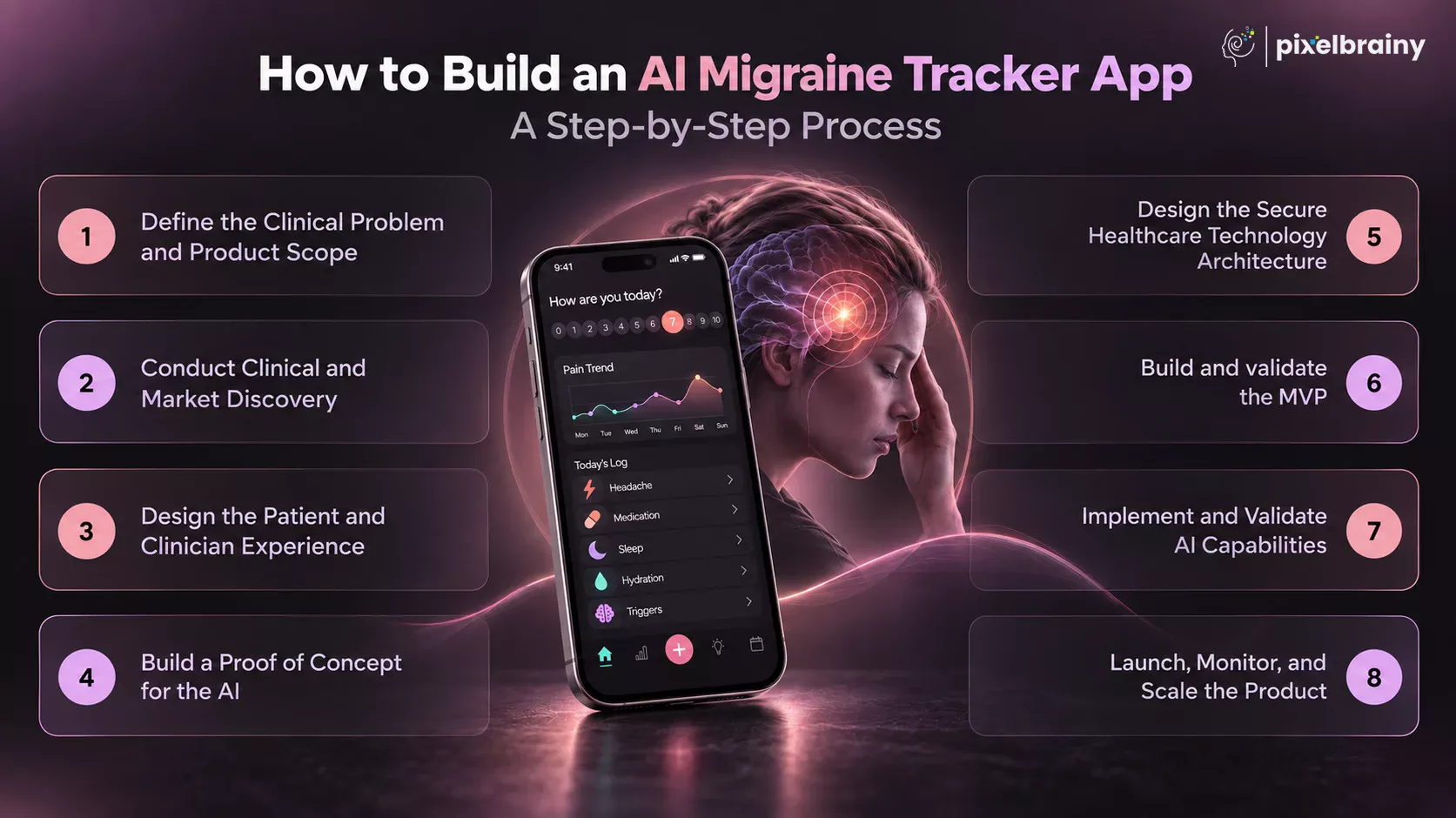
The first step is to clearly define why the application needs to exist. Instead of starting with "we want an AI migraine app," identify the specific healthcare problem, such as incomplete migraine histories, inconsistent symptom tracking, poor treatment documentation, or limited information between appointments.
Define the primary users, including patients, neurologists, headache specialists, caregivers, or healthcare organizations. Then determine whether the application is intended for wellness, patient support, clinical workflow, research, or decision support.
The product scope should also establish the core outcomes, data requirements, AI functions, regulatory considerations, and business model.
This foundation prevents unnecessary features and creates a clear roadmap for how to build an AI migraine tracker app from scratch.
Before development begins, conduct structured discovery with patients, neurologists, headache specialists, and other relevant stakeholders.
Study how migraine information is currently collected, what patients find difficult about tracking, which information clinicians actually review, and where existing applications fail to solve the problem.
At this stage, founders can work with an AI consultation specialist to determine where artificial intelligence genuinely adds value and where conventional software is sufficient.
The research should also examine competing migraine applications, pricing models, clinical workflows, data standards, privacy requirements, and potential integrations.
The result should be a validated product requirements document that defines the target market, user journeys, essential features, AI opportunities, technical requirements, and measurable success criteria.
The UX should be designed around the realities of migraine. Patients may attempt to use the application while experiencing severe pain, nausea, light sensitivity, fatigue, or cognitive difficulties, so logging must require minimal effort.
Create separate experiences for patients and healthcare professionals. Patients need rapid migraine entry, symptom tracking, medication documentation, and understandable insights. Clinicians need concise summaries, treatment timelines, longitudinal trends, and relevant patient information.
A specialized UI/UX design company can help transform clinical requirements into accessible interfaces, prototypes, and usability-tested workflows.
Accessibility, typography, navigation, touch targets, error prevention, and data visualization should all be considered before engineering begins.
Before investing heavily in the complete application, validate whether the proposed AI capabilities can actually work with the available data.
This is where PoC development becomes valuable. The team can test concepts such as personalized trigger analysis, natural-language migraine journaling, automated summaries, pattern detection, or risk prediction using representative data.
The PoC should answer practical questions:
A successful proof of concept does not automatically make the feature clinically ready. It provides evidence for deciding which AI capabilities deserve further development and validation.
The technical architecture should be designed around the application's intended use and sensitivity of health information.
A typical architecture may include a mobile application, secure API layer, healthcare database, analytics engine, AI services, authentication system, clinician dashboard, and administrative platform.
Security should be incorporated from the beginning through encryption, access controls, authentication, audit logging, secure APIs, backup systems, and appropriate data-retention policies.
The architecture should also anticipate interoperability requirements if the product will connect with EHR systems, wearable platforms, health-data frameworks, or other healthcare applications.
A scalable architecture makes it easier to create an AI migraine tracker app that can support increasing users, data volumes, organizations, and AI workloads without requiring a complete technical rebuild.
The next stage is MVP development, where the team builds the smallest production-ready version capable of testing the core product hypothesis.
A migraine MVP may include:
Avoid adding every advanced AI feature at this stage. The MVP should determine whether patients consistently track migraine information and whether clinicians find the resulting information useful.
User testing should measure completion rates, retention, data quality, usability, clinician satisfaction, and technical reliability before broader deployment.
Also Read: Top 10 AI MVP Development Companies in USA
After the core product works reliably, the development team can introduce AI integration according to the validated product roadmap.
Potential capabilities include personalized pattern detection, natural-language processing, treatment-period analysis, anomaly detection, and predictive modeling.
AI model development should include appropriate training data, evaluation datasets, performance metrics, bias assessment, uncertainty measurement, and monitoring procedures.
For clinical applications, the team must also determine whether a particular AI function changes the regulatory position of the product. AI outputs should be transparent, appropriately constrained, and designed so that unsupported conclusions are not presented as medical facts.
Clinical experts should participate in testing to determine whether the outputs are understandable, relevant, and safe within the intended workflow.
Also Read: Top 12+ AI Model Development Companies in the USA
Launching the application is not the final stage of migraine tracker app development using AI. Once deployed, the product should be continuously monitored for technical performance, user behavior, data quality, AI performance, security events, and clinical feedback.
Begin with a controlled pilot involving a defined patient population or healthcare organization. Collect evidence about whether users continue tracking, whether clinicians use the reports, and whether the AI outputs are actually useful.
After validation, expand infrastructure, integrations, user acquisition, and commercial partnerships gradually.
Organizations can also evaluate experienced top AI app development companies or specialized AI product development companies when internal teams lack the expertise required for healthcare architecture, AI engineering, security, or regulated product development.
The long-term roadmap can then introduce advanced capabilities such as wearable intelligence, personalized prediction, multimodal analysis, and expanded clinical integrations based on validated user needs.
A successful AI migraine tracker moves from a clearly defined clinical problem to validated technology, secure MVP development, responsible AI implementation, clinical testing, and evidence-driven scaling.
What is the development pricing of an AI migraine tracker app in 2026, and how much should a healthcare startup realistically budget for a secure, scalable, and clinically useful product? The cost to develop an AI migraine tracker app can range from approximately $30,000 to $250,000+, depending on the application's complexity, AI capabilities, healthcare integrations, security requirements, regulatory scope, and development team.
For founders calculating the development budget of an AI migraine tracker app, there is no single fixed price. A basic patient-facing tracker with essential AI functionality requires significantly less investment than an enterprise healthcare platform with clinician dashboards, EHR integrations, predictive AI, wearable connectivity, advanced security, and regulatory validation.
A useful real-world query for founders is: How much does it cost to develop an AI migraine tracker app with patient tracking, AI insights, and a neurologist dashboard?
The AI migraine tracker app development cost should therefore be estimated according to the product's intended scope rather than simply the number of screens or features. The following ranges provide a practical starting point for planning the cost estimation of an AI migraine tracker app.
| AI Migraine Tracker App Type | Estimated Development Cost | Typical Development Scope |
|---|---|---|
| Basic AI Migraine Tracker App | $30,000 to $70,000 | Patient registration, migraine logging, symptom and trigger tracking, medication tracking, calendar, basic AI summaries, simple analytics, secure backend, and basic reporting. |
| Advanced AI Migraine Tracker App | $70,000 to $150,000 | Everything in the basic version plus personalized AI insights, advanced pattern analysis, clinician dashboard, treatment tracking, clinical reports, wearable integrations, advanced analytics, and stronger healthcare infrastructure. |
| Enterprise AI Migraine Tracker App | $150,000 to $250,000+ | Multi-organization architecture, advanced AI models, predictive capabilities, EHR or FHIR integrations, wearable ecosystems, enterprise security, advanced clinician workflows, compliance support, analytics, scalability, and extensive validation. |
These figures are planning estimates, not fixed development quotes. A regulated clinical product, clinical-trial platform, or application requiring extensive validation can exceed the $250,000 range.
Several factors can significantly change the final AI migraine tracker app development cost.
Healthcare applications require more than visually attractive interfaces. The design needs to make migraine logging fast, accessible, and easy to understand while providing separate experiences for patients and clinicians.
Advanced prototyping, usability testing, accessibility work, and clinician workflow design can increase the overall cost.
Developing native iOS and Android applications can require a larger budget than using a cross-platform framework.
The final price depends on the number of screens, authentication flows, tracking workflows, offline functionality, notifications, accessibility requirements, and device integrations.
The backend manages patient profiles, migraine records, medications, symptoms, reports, authentication, APIs, analytics, and secure data storage.
Healthcare applications may also require scalable cloud infrastructure, backups, monitoring, audit logs, and appropriate access controls.
AI is one of the largest variables in the cost to develop an AI migraine tracker app.
A basic AI summary feature may require relatively limited investment, while personalized pattern analysis, natural language processing, predictive modeling, model evaluation, monitoring, and custom machine learning can substantially increase the budget.
Integrations can include:
Each integration introduces development, testing, authentication, maintenance, and potentially licensing costs.
A clinician-facing platform can include patient lists, longitudinal migraine trends, medication history, treatment timelines, AI summaries, reports, alerts, and administrative tools.
The complexity increases when the dashboard supports multiple clinicians, locations, organizations, and permission levels.
Healthcare applications require stronger security planning than typical consumer applications.
Costs can include encryption, authentication, role-based access, audit logging, vulnerability testing, privacy engineering, security assessments, compliance consulting, and documentation.
The actual requirements depend on the target market, jurisdiction, intended use, and type of health information being processed.
AI features intended for healthcare use may require more extensive testing than ordinary software features.
The budget may include clinical expert involvement, dataset preparation, model evaluation, usability studies, performance testing, bias assessment, documentation, and pilot programs.
Testing can cover functional QA, mobile-device compatibility, API testing, security testing, performance testing, usability testing, AI-output evaluation, and regression testing.
Healthcare applications should also test scenarios involving incomplete, inconsistent, or incorrect patient data.
The development budget should not end at launch.
Ongoing expenses may include cloud infrastructure, bug fixes, operating-system updates, third-party API changes, security patches, AI model monitoring, model improvements, compliance updates, and customer support.
The development pricing of an AI migraine tracker app is primarily influenced by five variables:
Product complexity + AI sophistication + healthcare integrations + compliance requirements + development team location and expertise
For example, a startup creating a simple consumer migraine tracker can potentially launch within the lower $30,000 to $70,000 range. A healthcare company building a clinician-connected application with advanced AI may require $70,000 to $150,000. An enterprise-grade platform with multiple healthcare integrations, predictive capabilities, extensive security, and organizational workflows can move beyond $150,000 to $250,000+.
For startups, the most practical approach is usually to validate the core product with a focused MVP before investing heavily in complex predictive AI and enterprise integrations.
A realistic AI migraine tracker app budget should prioritize clinical usefulness, secure architecture, validated AI, and scalable foundations rather than simply maximizing the number of features at launch.

What technology stack is required to develop an AI migraine tracking app that can securely collect patient data, analyze migraine patterns, support personalized insights, and provide useful information to neurologists? The answer depends on the app's intended use, AI complexity, healthcare integrations, security requirements, and expected scale.
For founders planning AI migraine tracker app development, the technology stack should support the complete journey from patient data collection to AI analysis and clinician reporting. A consumer application may require a relatively lightweight architecture, while a healthcare enterprise product may need EHR interoperability, advanced security, scalable cloud infrastructure, and more sophisticated AI capabilities.
A practical real-world query for healthcare founders is: What technology stack should I use to build an AI migraine tracker app with secure patient data, AI pattern analysis, and a neurologist dashboard?
The following tools and technologies provide a practical foundation for migraine tracker app development using AI.
| Technology Area | Recommended Tools & Technologies | Purpose in AI Migraine Tracker App Development |
|---|---|---|
| Mobile App Development | Flutter, React Native, Swift, Kotlin | Build patient-facing iOS and Android applications for migraine logging, symptom tracking, medication records, notifications, and personalized insights. |
| Web Application | React, Next.js, TypeScript | Develop responsive clinician dashboards, administrative portals, analytics interfaces, and healthcare management screens. |
| Backend Development | Node.js, Python, FastAPI, Django | Build APIs and backend services responsible for authentication, patient records, migraine data processing, reporting, integrations, and application logic. |
| Database | PostgreSQL, MySQL, MongoDB | Store structured patient profiles, migraine episodes, symptoms, medications, treatment history, reports, and application metadata. PostgreSQL is particularly suitable for structured healthcare data. |
| AI and Machine Learning | Python, PyTorch, TensorFlow, scikit-learn | Develop pattern analysis, classification, forecasting, personalization, anomaly detection, and other machine learning capabilities according to the validated product requirements. |
| Generative AI | OpenAI APIs, Azure OpenAI, other approved LLM platforms | Support controlled natural-language summaries, patient journal processing, conversational interfaces, and clinician report generation where appropriate. |
| Natural Language Processing | Python NLP libraries, transformer models, LLM APIs | Convert patient-written or voice-based migraine descriptions into structured information such as symptoms, severity, triggers, medication details, and episode characteristics. |
| Cloud Infrastructure | AWS, Microsoft Azure, Google Cloud | Provide scalable computing, databases, storage, networking, monitoring, backup, and deployment infrastructure for healthcare applications. |
| Healthcare Interoperability | HL7 FHIR, SMART on FHIR, secure REST APIs | Connect the migraine application with EHRs and other healthcare systems when interoperability is part of the product scope. |
| Wearable and Health Data Integration | Apple HealthKit, Android Health Connect, device APIs | Import permitted health and activity information such as sleep, activity, and other available measurements for applications that require multimodal migraine analysis. |
| Authentication and Security | OAuth 2.0, OpenID Connect, MFA, JWT | Protect patient accounts, clinician access, APIs, and sensitive healthcare information through secure identity and access management. |
| Data Encryption | TLS, AES-256, cloud-native encryption | Protect health information during transmission and storage while supporting the security architecture required for sensitive healthcare applications. |
| Analytics and Visualization | Chart.js, D3.js, Apache ECharts | Present migraine frequency, severity, duration, medication patterns, treatment timelines, and longitudinal trends through understandable visualizations. |
| Notifications | Firebase Cloud Messaging, Apple Push Notification Service | Deliver tracking reminders, appointment preparation prompts, relevant application notifications, and other user-authorized communications. |
| DevOps and Monitoring | Docker, Kubernetes, GitHub Actions, AWS CloudWatch | Support automated deployment, scalable infrastructure, application monitoring, logging, performance management, and reliable software releases. |
The right technology stack should make the AI migraine tracker secure, scalable, interoperable, clinically useful, and flexible enough to evolve as validated product requirements grow.
Before founders build an AI migraine tracker app, studying existing products can reveal what patients already expect, where competitors have created genuine differentiation, and where opportunities remain underserved. The most useful competitive analysis is not about copying features. It is about understanding the product decisions, data strategies, engagement models, and AI capabilities that have already been tested in the market.
For founders researching how to develop AI migraine tracker app like Migraine Buddy or Curelator with AI prediction, the following five products provide useful market validation and product-development lessons.
Migraine Buddy is one of the strongest examples of large-scale migraine tracking adoption. Its platform supports attack recording, symptoms, triggers, medications, reports for healthcare providers, community participation, and premium AI capabilities including personalized suggestions and attack end-time prediction. The company currently describes a community of around 4 million users.
Primary user: Individual migraine patients, with additional value for healthcare professionals.
AI and data advantage: Its large longitudinal dataset supports pattern analysis, personalized recommendations, weather-related information, and prediction-oriented features.
Founder lesson: Scale validates demand, but a successful AI migraine tracker app development strategy needs to go beyond recording and reporting by creating intelligence that patients can actually use.
Curelator N1-Headache demonstrates a different approach to migraine intelligence. The application asks users to track headaches, medications, and optional factors such as mood, weather, and diet, then analyzes the data to produce Trigger, Protector, and No Association maps after sufficient tracking.
Primary user: Migraine patients working with clinicians to understand individualized patterns.
AI and data advantage: Its competitive proposition is personalized factor analysis rather than simply displaying a headache diary.
Founder lesson: If you want to develop an AI migraine tracker app, personalized trigger intelligence can create a much stronger value proposition than adding more charts to conventional tracking data.
Bezzy Migraine represents the community-driven side of chronic-condition technology. Bezzy provides moderated condition-specific communities, discussions, expert and community guides, personal stories, matching, and one-to-one messaging, with a dedicated migraine community.
Primary user: People living with chronic conditions who want peer connection, information, and community support.
AI and data advantage: Its competitive advantage is less about sophisticated migraine prediction and more about community intelligence, user-generated experiences, personalization through interactions, and sustained engagement.
Founder lesson: An AI migraine tracker app does not have to compete only through algorithms. Community, trust, peer support, and condition-specific content can become powerful engagement layers around the tracking experience.
DarioHealth is not migraine-specific, but it provides an important model for chronic-condition digital health businesses. Its platform combines behavioral science, AI-driven personalization, connected health tools, coaching, and data analytics across multiple chronic conditions, while selling solutions to employers and health plans.
Primary user: Consumers managing chronic conditions, with employers, health plans, and other organizations serving as commercial customers.
AI and data advantage: Dario says its clinically intelligent platform uses large-scale engagement data to personalize interventions and adapt experiences over time.
Founder lesson: A migraine platform can potentially move beyond consumer subscriptions toward B2B healthcare partnerships when it can demonstrate measurable engagement, clinical value, and economic outcomes.
Migraine Insight is an emerging AI-focused migraine application that is particularly relevant for founders studying the 2025 and 2026 market. Its current product combines migraine tracking with automated information such as weather and activity data, then uses a pattern-finding engine to identify individualized relationships within the user's migraine history. The app was updated in February 2026.
Primary user: Migraine and headache patients seeking personalized trigger insights and better information for their care teams.
AI and data advantage: Its differentiation centers on AI-based pattern finding rather than treating tracking as the final product.
Founder lesson: The emerging opportunity is to make AI the intelligence layer behind migraine tracking, while keeping data collection simple enough that patients can maintain a reliable longitudinal record.
Together, these products show five different paths for founders who want to build AI migraine tracker app products: large-scale consumer tracking, individualized trigger intelligence, community engagement, B2B chronic-care commercialization, and AI-native migraine pattern analysis.
The key opportunity is not to reproduce an existing diary. It is to combine high-quality longitudinal data, meaningful AI analysis, clinical usability, and a sustainable business model into a product with a clearly differentiated reason to exist.
What are the biggest challenges a healthcare startup should solve before launching an AI migraine tracker app that patients can trust and neurologists can use confidently? The difficult part is not simply developing the mobile application or connecting an AI model. The real challenge is creating a product that can collect reliable migraine data, generate responsible AI insights, protect sensitive health information, satisfy applicable regulatory requirements, and maintain patient engagement over months or years.
For founders planning to develop an AI migraine tracker app, identifying these challenges during product planning can prevent expensive technical changes and clinical risks later. A strong development strategy should address the following six challenges from the beginning.
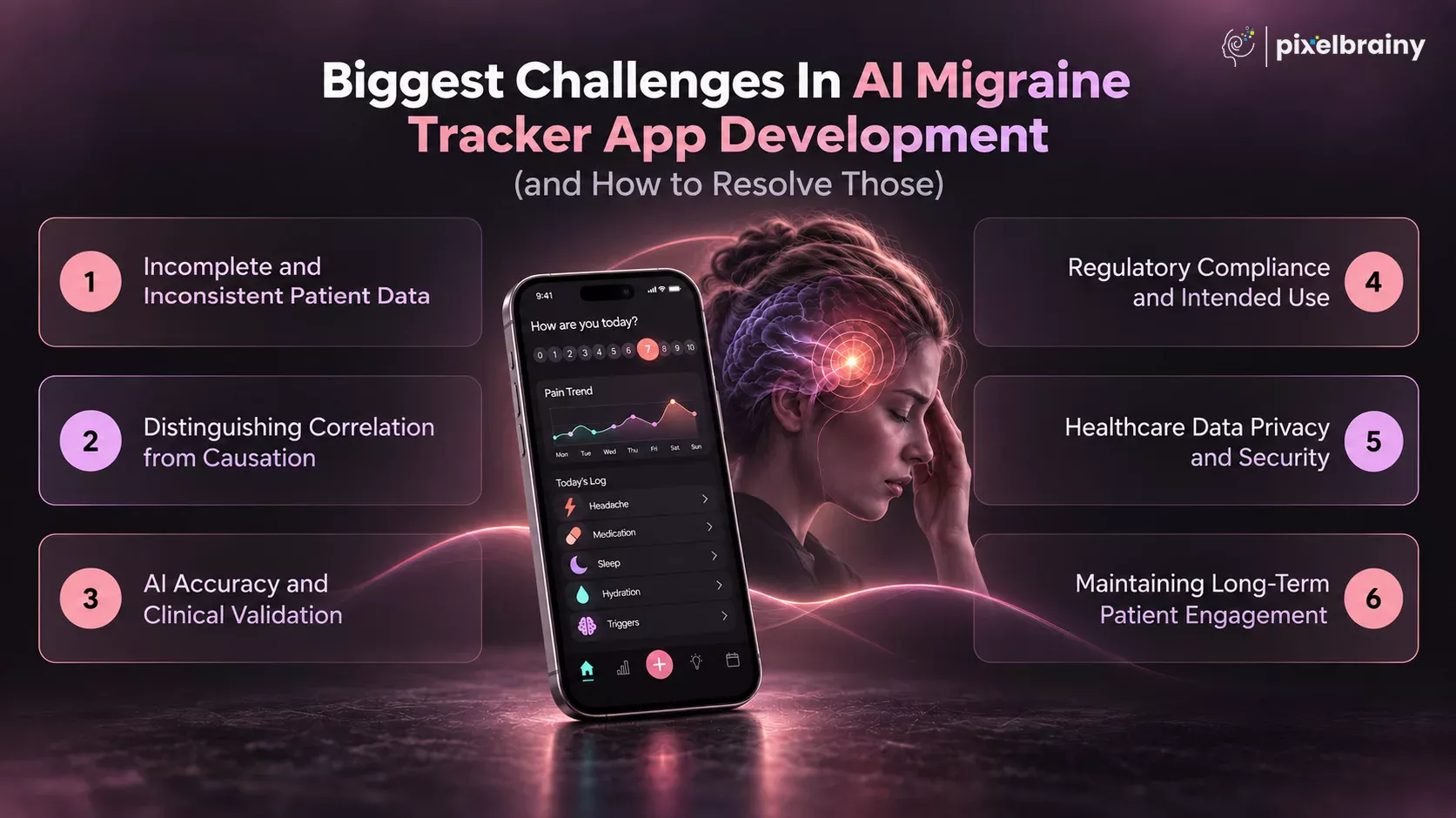
An AI migraine tracker depends on continuous patient-generated information, but patients may forget to record attacks, skip symptoms, enter incomplete medication details, or stop tracking after several weeks. Poor-quality data can reduce the reliability of personalized analysis and make longitudinal migraine comparisons less meaningful.
How to resolve it: Make migraine logging extremely fast with quick-entry actions, smart defaults, reminders, optional voice input, and progressive questions. The application should also measure data completeness and avoid generating strong insights when insufficient information is available.
AI may identify that migraine attacks frequently occurred alongside poor sleep, stress, dehydration, weather changes, or another tracked factor. However, an observed relationship does not automatically prove that the factor caused the migraine.
How to resolve it: The AI should communicate findings using careful language such as "associated with" or "observed during" rather than making unsupported causal claims. Insights should show the relevant tracking period and available data so patients and clinicians can interpret the information appropriately.
A migraine AI model can perform well during development testing but behave differently when exposed to real-world patients with diverse migraine patterns, incomplete records, and different demographic characteristics.
How to resolve it: Establish clinical validation requirements before deploying advanced AI. Test models using appropriate performance metrics, evaluate false positives and false negatives, assess performance across relevant patient groups, and continuously monitor model performance after launch.
The regulatory requirements for an AI migraine tracker app depend heavily on what the software is intended to do. A basic tracking application can have different requirements from software that predicts clinical risk, provides treatment recommendations, or supports clinical decision-making.
The FDA's 2026 Clinical Decision Support Software guidance explains that regulatory considerations depend on the specific software function and intended use.
How to resolve it: Define the intended use before developing advanced AI capabilities. Conduct regulatory assessment early and document the application's users, functions, outputs, limitations, and role within the healthcare workflow.
An AI migraine tracker may process highly sensitive information such as migraine symptoms, medication history, treatment details, reproductive-health information, and potentially clinical records. A security weakness can create privacy risks while significantly damaging patient and provider trust.
When HIPAA applies, HHS states that the HIPAA Security Rule requires appropriate administrative, physical, and technical safeguards for electronic protected health information.
How to resolve it: Build security into the architecture from the beginning using encryption, strong authentication, role-based permissions, secure APIs, audit logging, data minimization, vulnerability testing, appropriate cloud controls, and documented data-retention policies.
Even a technically advanced migraine application cannot generate useful longitudinal insights if patients stop using it. Complicated questionnaires, excessive notifications, and repetitive data entry can create tracking fatigue.
How to resolve it: Keep daily tracking simple and give patients meaningful feedback from the information they provide. Personalized summaries, progress trends, relevant reminders, and clear explanations of how tracking supports clinical appointments can encourage continued participation.
Addressing these six challenges early can help create an AI migraine tracker that is clinically responsible, secure, reliable, engaging, and sustainable for long-term healthcare use.
From the above discussion, it is now time to identify the right technology partner who can turn a migraine healthcare concept into a secure, scalable, and clinically focused product. The right partner should understand healthcare workflows, AI, patient data security, UX, integrations, and the practical challenges of launching digital health products.
A key founder question is: How do I find the right development partner for an AI migraine tracker that combines patient tracking, personalized AI insights, and clinician workflows?
PixelBrainy, an AI healthcare software development company, works across AI product development, healthcare technology, AI integration, UX/UI, and scalable digital solutions. Its published capabilities include AI consulting, AI model development, AI integration, and healthcare-focused product engineering.
This experience can support healthcare founders who want to build AI migraine tracker app products for patients, neurologists, clinics, or healthcare organizations.
Migraine applications require simple patient experiences because users may need to log symptoms during an active migraine. PixelBrainy's healthcare-focused approach includes UX design, secure architecture, healthcare integrations, and privacy-conscious product engineering.
For AI migraine tracker app development services, this means the product can be planned around quick tracking, personalized insights, clinician dashboards, secure data management, and future scalability.
PixelBrainy has published a healthcare AI case study for a confidential U.S.-based digital health organization. According to the published case study, the AI-powered health companion reached 50,000+ active users within six months, increased patient engagement by 65%, and reduced operational costs by 40%. The client identity remains confidential.
While the project was not migraine-specific, the underlying experience with AI-powered healthcare workflows, personalization, scalability, and patient engagement is relevant to migraine technology.
Whether the objective is to develop AI migraine tracker tool functionality as a new application or add intelligent capabilities to an existing healthcare platform, PixelBrainy can approach the product through staged development, starting with the core use case and expanding AI capabilities as the product matures.
For migraine tracker app development integrating AI, this approach helps keep the technology aligned with patient needs, clinical workflows, security requirements, and business objectives.
Ready to turn your migraine technology idea into a scalable AI healthcare product? Connect with PixelBrainy.

The opportunity to create an AI migraine tracker app goes beyond digitizing a traditional headache diary. For healthcare startups, neurologists, headache specialists, pharmaceutical companies, and digital health organizations, the real opportunity is to turn longitudinal migraine data into personalized, understandable, and clinically useful intelligence.
Successful AI migraine tracker app development starts with a clearly defined healthcare problem, followed by patient-centered UX, secure data architecture, reliable tracking, appropriate AI capabilities, clinical validation, and regulatory planning. Whether the goal is to develop an AI migraine tracker app for consumers, neurology clinics, research programs, or healthcare enterprises, the product strategy should align with its intended users and clinical purpose.
The strongest platforms will use AI responsibly to identify meaningful patterns, organize patient histories, support clinical conversations, and create a more informed migraine management experience. With the right technology, clinical expertise, and development partner, founders can turn a migraine tracking concept into a scalable digital health solution.
Ready to turn your AI migraine tracker idea into a healthcare-ready product? Book an appointment with PixelBrainy to discuss your project.
The AI migraine tracker app development cost can range from approximately $30,000 to $250,000+. A basic tracking application may cost $30,000 to $70,000, while advanced AI, clinician dashboards, healthcare integrations, predictive capabilities, and enterprise security can push the budget significantly higher.
A basic migraine diary primarily records attacks, symptoms, medications, and potential triggers. An AI migraine tracker app can analyze longitudinal information to identify patient-specific patterns, generate summaries, compare treatment periods, and provide personalized insights, subject to appropriate validation.
Start by defining the clinical workflow and information neurologists need during consultations. The product should combine fast patient logging with a clinician dashboard, migraine history, medication tracking, treatment timelines, relevant patient-reported outcomes, longitudinal analytics, and secure report generation.
Potentially, but prediction should not be treated as guaranteed. An AI migraine prediction app can analyze historical patient data and other permitted signals to estimate migraine risk when sufficient validated data is available. Predictive outputs should clearly communicate uncertainty and undergo appropriate clinical validation before being used for healthcare purposes.
Useful AI capabilities can include personalized trigger analysis, longitudinal pattern detection, automated migraine summaries, treatment-period comparisons, natural-language journal processing, data-quality analysis, and predictive modeling where appropriately validated. AI should solve a specific patient or clinical problem rather than simply increase the feature count.
A basic MVP may take approximately 3 to 5 months, while an advanced healthcare platform can require 6 to 12 months or longer. The timeline depends on the number of platforms, AI complexity, integrations, clinician workflows, security requirements, regulatory scope, testing, and clinical validation.
It depends on the application's intended use and specific software functions. A simple tracking or wellness application may have different regulatory considerations from software that performs clinical decision support, diagnosis, risk prediction, or treatment recommendations. Regulatory assessment should therefore happen before advanced clinical functionality is developed.
Evaluate the partner's experience with healthcare AI, patient-facing applications, secure health-data architecture, AI model validation, healthcare integrations, regulatory considerations, UX design, and scalable product engineering. Ask for relevant healthcare case studies and confirm that the team can support the product from discovery and MVP through deployment and post-launch AI monitoring.

About The Author
Sagar Bhatnagar
Sagar Sahay Bhatnagar brings over a decade of IT industry experience to his role as Marketing Head at PixelBrainy. He's known for his knack in devising creative marketing strategies that boost brand visibility and market influence. Sagar's strategic thinking, coupled with his innovative vision and focus on results, sets him apart. His track record of successful campaigns proves his ability to utilize digital platforms effectively for impactful marketing efforts. With a genuine passion for both technology and marketing, Sagar continuously pushes PixelBrainy's marketing initiatives to greater success.

Working with the PixelBrainy team has been a highly positive experience. They understand the design requirements and create beautiful UX elements to meet the application needs. The dev team did an excellent job bringing my vision to life. We discussed usability and flow. Sagar worked with his team to design the database and begin coding. Working with Sagar was easy. He has the knowledge to create robust apps, including multi-language support, Google and Apple ID login options, Ad-enabled integrations, Stripe payment processing, and a Web Admin site for maintaining support data. I'm extremely satisfied with the services provided, the quality of the final product, and the professionalism of the entire process. I highly recommend them for Android and iOS Mobile Application Design and Development.

Great experience working with them. Had a lot of feedback and I found that unlike most contractors they were bugging me for updates instead of the other way around. They were extremely time conscience and great at communicating! All work was done extremely high quality and if not on time, early! They were always proactive when it comes to communication and the work is great/above par always. Very flexible and a great team to work with! Goes above and beyond to present us with multiple options and always provides quality. Amazing work per usual with Chitra. If you have UI/UX or branding design needs I recommend you go to them! Will likely work with them in the future as well, definitely recommended!

PixelBrainy is a joy to work with and is a great partner when thinking through branding, logo, and website layout. I appreciate that they spend time going into the "why" behind their decisions to help inform me and others about industry best practices and their expertise.

I hired them to design our software apps. Things I really like about them are excellent communication skills, they answer all project suggestions and collaborate right away, and their input on design and colors is amazing. This project was complex and needed patience and creativity. The team is amazing to do business with. I will be using them long-term. Glad to see there are some good people out there. I was afraid to try and outsource my project to someone but I am glad I met them! I really can't say enough. They went above and beyond on this project. I am very happy with everything they have done to make my business stand out from the competition.

It was great working with PixelBrainy and the team. They were very responsive and really owned the project. We'll definitely work with them again!

I recently worked with the PixelBrainy team on a project and I was blown away by their communication skills. They were prompt, clear, and articulate in all of our interactions. They listened and provided valuable feedback and suggestions to help make the project a success. They also kept me updated throughout the entire process, which made the experience stress-free and enjoyable.

PixelBrainy is very good at what it does. The team also presents themselves very professionally and takes care of their side of things very well. I could fully trust them taking up the design work in a timely and organised manner and their attention to detail saved us lots of effort and time. This particular project was quite intense and the team showed that they function very well under pressure. Very much looking forward to working with her again!

It's always an absolute pleasure working with them. They completed all of my requests quickly and followed every note I had for them to a T, which made our process go smoothly from start to finish. Everything was completed fast and following all of the guidelines. And I would recommend their services to anyone. If you need any design work done in the future, PixelBrainy should be your first call!

They took ownership of our requirements and designed and proposed multiple beautiful variants. The team is self-motivated, requires minimum supervision, committed to see-through designs with quality and delivering them on time. We would definitely love to work with PixelBrainy again when we have any requirements.

PixelBrainy was a big help with our SaaS application. We've been hard at work with a new UI/UX and they provided a lot of help with the designs. If you're looking for assistance with your website, software, or mobile application designs, PixelBrainy and the team is a great recommendation.

PixelBrainy designers are amazing. They are responsive, talented, and always willing to help craft the design until it matches your vision. I would recommend them and plan to continue them for my future projects and more!!!

They were awesome! Did a good job fast, and good communication. Will work with them again. Thank you

Creative, detail-oriented, and talented designers who take direction well and implement changes quickly and accurately. They consistently over-delivered for us.

PixelBrainy team is very talented and creative. Great designers and a pleasure to work with. PixelBrainy is an excellent communicator and I look forward to working with them again.

PixelBrainy has a very talented design team. Their work is excellent and they are very responsive. I enjoy working with them and hope to continue on all of our future projects.


Transform your ideas into reality with us.
Across these industries, each engagement brings unique challenges, from early-stage product development to scaling complex systems, helping us build a practical understanding of real-world product environments.