AI Summary Powered by PixelBrainy
Can an AI powered personal finance assistant become the smartest financial advisor that millions of users can access anytime from their smartphones?
Managing personal finances has become increasingly complex as people handle multiple bank accounts, digital wallets, credit cards, investments, subscriptions, loans, and recurring expenses. Traditional budgeting methods often require manual data entry and provide limited financial insights, making it difficult for users to understand spending habits or plan for long term financial goals. This growing demand for intelligent money management solutions has accelerated AI Personal finance app development, enabling businesses to deliver personalized, data driven financial experiences.
Today, organizations looking to build AI Personal finance application solutions are integrating advanced technologies such as machine learning, natural language processing, predictive analytics, Open Banking APIs, and conversational AI. These technologies allow users to automate budgeting, track expenses in real time, receive personalized saving recommendations, detect unusual transactions, and interact with AI powered financial assistants through natural conversations. As a result, developing an AI Personal finance app has become a strategic investment for fintech startups, banks, credit unions, financial advisors, insurance providers, and digital payment companies.
Many businesses also ask, which AI app development companies in the USA specialize in building custom AI personal finance assistant apps with budgeting, expense tracking, Open Banking integrations, and conversational AI features? The answer depends on several factors, including technical expertise, AI capabilities, compliance knowledge, cloud infrastructure, security standards, and experience in developing scalable fintech platforms that comply with regulations such as GDPR, PCI DSS, PSD2, and CCPA.
Whether you are exploring how to create an AI Personal finance mobile app for consumers or understanding the complete development process of AI Personal finance app, this comprehensive guide covers everything you need to know, including benefits, essential features, development stages, technology stack, estimated costs, monetization models, future trends, implementation challenges, and best practices for building a secure, intelligent, and user centric financial assistant.

An AI Personal Finance Assistant App is an intelligent financial management solution that leverages artificial intelligence, machine learning, natural language processing (NLP), and predictive analytics to help users manage their finances more efficiently. Unlike conventional budgeting applications that primarily record income and expenses, AI powered personal finance apps analyze financial data in real time, identify spending patterns, predict future expenses, and provide personalized recommendations to improve users' financial well-being.
The primary objective of an AI personal finance assistant is to simplify money management by automating repetitive financial tasks while offering proactive insights. Users can connect their bank accounts, digital wallets, credit cards, and investment portfolios through secure Open Banking APIs, enabling the app to automatically categorize transactions, monitor cash flow, detect unusual spending, and generate customized budgeting plans. Many modern AI finance apps also include conversational AI assistants, allowing users to ask questions like "How much did I spend on dining this month?" or "How can I save more money?" and receive instant, data driven responses.
Traditional budgeting apps, on the other hand, mainly function as digital expense trackers. They often require users to manually enter transactions, create budgets themselves, and review static reports. While these apps help organize financial information, they generally lack the intelligence to interpret financial behavior or provide predictive guidance.
AI personal finance apps go beyond tracking expenses by continuously learning from user activities and adapting recommendations over time. They can forecast upcoming bills, recommend saving opportunities, alert users about unusual transactions, optimize monthly budgets, identify recurring subscriptions, and even suggest investment or debt repayment strategies based on individual financial goals.
The table below highlights the key differences between AI powered personal finance assistant apps and traditional budgeting applications.
| Feature | AI Personal Finance Assistant Apps | Traditional Budgeting Apps |
| Expense Tracking | Automatic transaction categorization | Mostly manual expense entry |
| Budget Creation | AI generated personalized budgets | User created budgets |
| Financial Insights | Real time predictive analytics | Historical reports only |
| Savings Recommendations | Personalized AI suggestions | Limited or unavailable |
| Spending Forecast | Future expense predictions | Not supported |
| Conversational Support | AI chatbot with natural language interactions | Not available |
| Fraud Detection | AI based anomaly detection | Basic transaction alerts |
| Investment Guidance | Personalized investment insights | Rarely available |
| Learning Capability | Continuously improves through machine learning | No adaptive learning |
| Automation | High level automation for financial management | Limited automation |
As consumer expectations continue to evolve, businesses are increasingly investing in AI Personal finance app development to deliver intelligent, personalized, and secure financial experiences. Whether you plan to build AI Personal finance application solutions for fintech startups, banks, or digital payment providers, integrating AI capabilities creates significantly greater value than traditional budgeting tools.
Understanding these differences is the first step toward developing an AI Personal finance app that meets modern user expectations and supports long term business growth.
AI personal finance assistant apps are redefining digital money management by transforming static budgeting tools into intelligent financial advisors that empower users to make smarter financial decisions every day.
The financial services industry is rapidly embracing artificial intelligence to meet the growing demand for smarter, faster, and more personalized financial experiences. Consumers now expect finance apps to do more than simply track expenses. They want intelligent budgeting, automated financial insights, real time spending analysis, and personalized recommendations that help them make better financial decisions.
This rising demand is also driving remarkable market growth. According to the Personal Finance Apps Market Report 2026 by The Business Research Company, the global personal finance apps market is expected to grow from USD 207.69 billion in 2026 to USD 507.64 billion by 2030, at a 25% CAGR, fueled by the rapid adoption of AI driven budgeting tools, Open Banking integrations, and personalized financial management solutions.
As a result, AI Personal finance app development has become a strategic investment for banks, fintech startups, investment firms, insurance providers, and digital payment companies looking to deliver next generation financial services. Businesses aiming to build AI Personal finance application solutions are leveraging artificial intelligence to automate financial management, improve customer engagement, strengthen fraud detection, and gain a competitive advantage in an increasingly digital financial ecosystem.
A common question business leaders ask is, "Why are businesses investing in developing an AI Personal finance app instead of relying on traditional budgeting solutions?" The answer lies in AI's ability to automate complex financial tasks, provide predictive insights, deliver highly personalized user experiences, and create scalable revenue opportunities that traditional finance apps cannot offer.
Digital financial services are expanding worldwide as consumers increasingly prefer mobile first banking and self-service financial management. Businesses are investing in AI powered finance applications to capitalize on this growing market and strengthen their digital offerings.
Modern users no longer want generic budgeting tools. They expect finance apps to understand their spending behavior, financial goals, and lifestyle preferences. This shift in customer expectations is encouraging organizations to invest in intelligent financial platforms.
The widespread adoption of Open Banking regulations and APIs has made it easier for financial applications to securely access banking data across multiple institutions. Businesses are investing in AI finance apps to leverage these integrations and deliver connected financial experiences.
Artificial intelligence is becoming a core technology for banks, fintech companies, insurers, and wealth management firms. Investing in AI powered personal finance assistants enables businesses to stay aligned with industry wide digital transformation initiatives.
The fintech ecosystem is becoming increasingly competitive, with new startups and digital financial platforms entering the market every year. Businesses are investing in AI Personal finance app development to differentiate themselves through intelligent and innovative financial experiences.
Consumers are becoming more focused on achieving long term financial stability rather than simply tracking expenses. This has increased demand for applications that support budgeting, saving, investing, debt management, and financial planning within a single platform.
Recent innovations in machine learning, conversational AI, predictive analytics, and large language models have made AI powered financial assistants more accurate, scalable, and cost effective. Businesses are investing now to take advantage of these rapidly evolving technologies.
Financial institutions generate enormous amounts of customer and transaction data. AI enables organizations to transform this data into meaningful insights, making investment in intelligent finance platforms a strategic business priority.
As financial regulations continue to evolve, businesses are investing in AI enabled finance applications that can support secure data management, fraud monitoring, risk assessment, and compliance with standards such as PCI DSS, PSD2, GDPR, and CCPA.
Many organizations view developing an AI Personal finance app as part of their broader digital transformation roadmap. Investing today enables businesses to build scalable platforms that can easily integrate future technologies such as autonomous finance, voice AI, hyper personalization, and predictive wealth management.
Businesses are investing in AI Personal finance app development because it aligns with evolving consumer expectations, accelerating fintech innovation, expanding Open Banking ecosystems, and the long-term transformation of digital financial services.
Also Read: AI Fintech App Development Cost: Factors and Examples
As the demand for intelligent financial solutions continues to grow, businesses are recognizing the long-term value of investing in AI Personal finance app development. Unlike conventional budgeting applications, AI powered personal finance assistants provide advanced capabilities that enhance user experiences, automate financial processes, strengthen security, and improve decision making. Whether you are planning to build AI Personal finance application for a fintech startup, bank, or digital wallet platform, integrating artificial intelligence creates measurable value for both businesses and end users.
One of the most frequently asked questions is, "What are the benefits of developing an AI Personal finance app for businesses and customers?" The answer lies in AI's ability to deliver personalized financial guidance, streamline money management, reduce manual effort, and create scalable digital finance solutions. Below are the key benefits that make developing an AI Personal finance app a worthwhile investment.
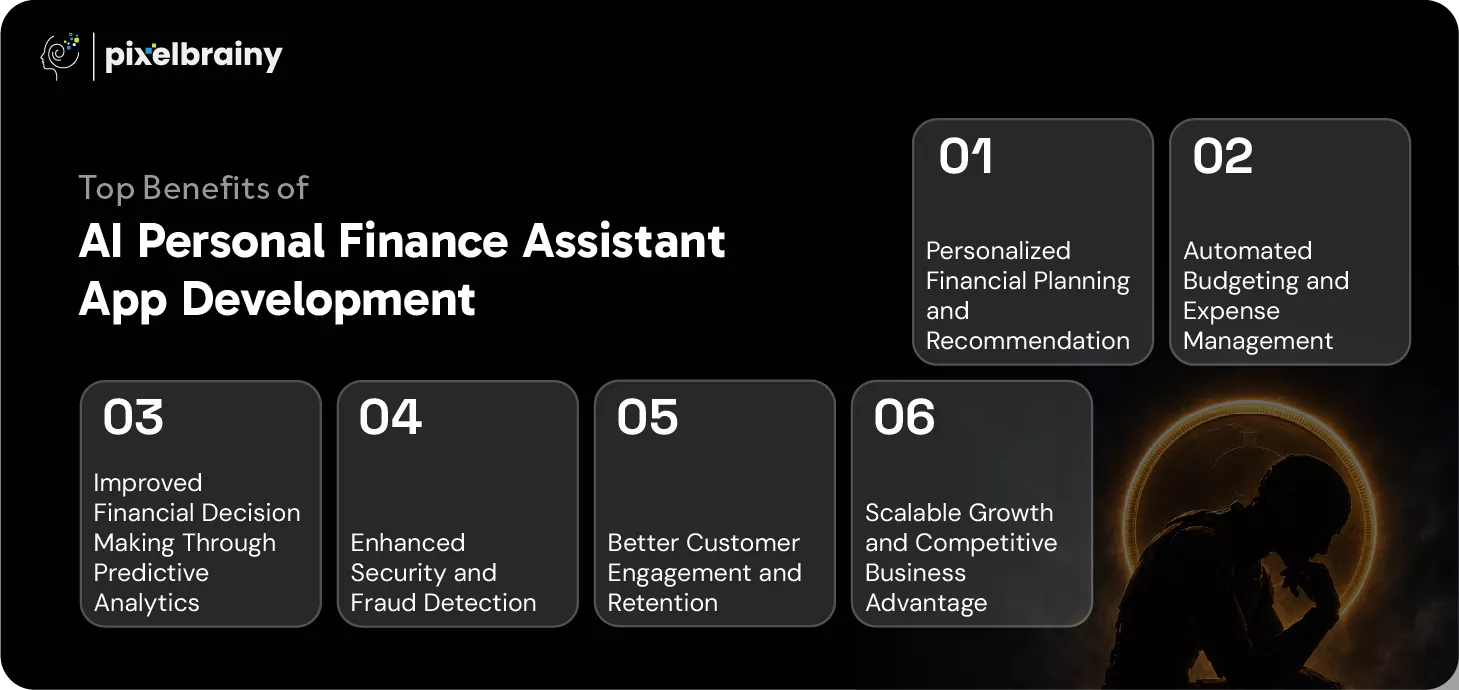
One of the biggest advantages of AI Personal finance app development is the ability to deliver highly personalized financial guidance. AI analyzes user income, spending habits, financial goals, recurring expenses, and transaction history to generate recommendations tailored to individual needs.
Instead of providing generic budgeting advice, the application continuously adapts its suggestions based on changing financial behavior. This enables users to improve savings, manage debt effectively, and make informed financial decisions while creating a more engaging and personalized user experience.
Manual budgeting can be time consuming and prone to errors. AI automates expense tracking by categorizing transactions, monitoring spending patterns, and updating budgets without requiring user intervention. This significantly reduces administrative effort while improving financial accuracy.
Businesses looking to build AI Personal finance application solutions can offer users a seamless money management experience through automatic bill reminders, recurring payment tracking, subscription monitoring, and real time spending alerts that encourage better financial discipline.
Artificial intelligence transforms raw financial data into meaningful insights using predictive analytics and machine learning algorithms. By analyzing historical spending behavior and future cash flow trends, AI helps users anticipate upcoming expenses and make smarter financial decisions.
This capability enables individuals to prepare for emergencies, achieve savings goals, optimize investments, and manage monthly budgets more efficiently. Predictive financial intelligence also increases the overall value and usefulness of the application.
Security is one of the most valuable benefits of developing an AI Personal finance app. AI continuously monitors transaction activities and identifies suspicious behavior that may indicate fraudulent activity or unauthorized account access before financial losses occur.
Advanced fraud detection models analyze transaction patterns, user behavior, device information, and risk indicators in real time. This proactive approach strengthens customer trust, protects sensitive financial information, and helps businesses comply with evolving financial security standards.
AI powered conversational assistants make financial management more interactive by allowing users to communicate naturally with the application. Instead of searching through dashboards, users can simply ask financial questions and receive instant, personalized responses.
Features such as proactive financial alerts, smart notifications, savings recommendations, and goal tracking encourage users to engage with the app more frequently. Higher engagement ultimately leads to stronger customer satisfaction, improved retention rates, and increased customer lifetime value.
Organizations investing in the development process of AI Personal finance app gain a scalable platform that can evolve with changing customer expectations and technological advancements. AI driven applications can easily integrate future innovations such as voice assistants, generative AI, predictive wealth management, and autonomous financial planning.
This scalability enables businesses to expand their services, enter new markets, and differentiate themselves in the increasingly competitive fintech landscape. A future ready AI finance application also creates new monetization opportunities while supporting sustainable long term business growth.
The benefits of AI Personal finance app development extend far beyond intelligent budgeting, empowering businesses to deliver personalized, secure, scalable, and data driven financial experiences that drive lasting customer value and competitive success.
Building a successful AI powered finance application requires much more than a simple budgeting dashboard. Modern users expect intelligent tools that automate financial management, deliver personalized insights, and simplify everyday money decisions. Therefore, businesses investing in AI Personal finance app development should focus on implementing features that improve usability, engagement, security, and overall financial wellness.
Whether you plan to build Personal finance app with AI for a fintech startup, digital bank, or wealth management platform, the right feature set directly impacts user satisfaction and long-term retention. Integrating essential Personal finance app features using AI helps automate expense tracking, budgeting, savings planning, and financial analysis while providing users with a seamless experience.
One of the most frequently searched questions is, "I want to build a custom AI personal finance assistant app that helps users automatically track expenses, create personalized budgets, analyze spending habits, and provide AI powered financial advice in real time. What features should the app include, what technologies are required, and how much will it cost to develop in 2026?" The first step is understanding the essential features every modern AI finance application should include. The technologies and development costs will be covered in the following sections.
| Feature | Description (30 Words) |
| User Registration and Authentication | Provide secure user onboarding through email, mobile number, social login, and biometric authentication. This protects sensitive financial information while delivering a fast, secure, and seamless login experience across multiple devices. |
| User Profile Management | Allow users to manage personal details, financial goals, income information, preferred currency, notification settings, and account preferences, enabling personalized experiences throughout the AI powered finance application. |
| Expense Tracking | Automatically record daily transactions, monitor expenses across multiple categories, and organize spending data into meaningful summaries that help users understand financial habits without manual record keeping. |
| Income Management | Enable users to add salaries, freelance income, rental earnings, bonuses, investments, and recurring income sources, creating a complete financial overview for accurate budgeting and financial planning. |
| Smart Budget Creation | Allow users to create customized monthly or category based budgets according to income, spending patterns, and financial goals, encouraging responsible spending and improved financial discipline over time. |
| Transaction Categorization | Automatically classify transactions into categories such as groceries, transportation, shopping, healthcare, utilities, entertainment, and travel, making expense tracking more organized and financial reports easier to understand. |
| Spending Analytics Dashboard | Present spending behavior through interactive charts, monthly comparisons, category wise reports, and financial summaries, helping users identify trends and make informed money management decisions more effectively. |
| AI Financial Recommendations | Deliver personalized budgeting suggestions, saving opportunities, and spending improvement tips by analyzing financial behavior, making this one of the most valuable features of Personal finance app integrating AI. |
| Savings Goal Management | Allow users to define financial goals such as emergency funds, vacations, education, or home purchases while tracking progress with reminders, milestones, and achievement indicators for better motivation. |
| Bill and Payment Reminders | Send timely notifications for utility bills, subscriptions, loan installments, credit card payments, and recurring expenses to help users avoid late fees and maintain healthy financial habits consistently. |
| Financial Reports | Generate detailed weekly, monthly, quarterly, and annual reports summarizing income, expenses, savings, and cash flow, enabling users to evaluate their financial performance and spending patterns efficiently. |
| Notifications and Alerts | Notify users about unusual transactions, budget limits, savings progress, upcoming payments, and important financial activities in real time to improve financial awareness and proactive money management. |
| Multi Account Management | Support multiple bank accounts, digital wallets, and credit cards within one application, allowing users to monitor all financial activities from a centralized and unified dashboard effortlessly. |
| Search and Transaction Filters | Enable users to search transactions using keywords, categories, merchants, payment methods, dates, and amounts, making financial records easier to locate, review, and organize whenever required. |
| Customer Support | Integrate live chat, help center, FAQs, and ticket-based support to quickly resolve user concerns, improve customer satisfaction, and ensure a smooth experience throughout the application lifecycle. |
Integrating these essential Personal finance app features using AI establishes a strong foundation to create an AI Personal finance app that delivers seamless financial management, exceptional user experiences, and long-term business success.
Developing a next generation AI powered finance application requires more than implementing standard features. To deliver intelligent financial recommendations, automate complex workflows, strengthen security, and provide highly personalized user experiences, businesses must integrate advanced AI technologies and a modern technology stack. These tools form the backbone of successful AI Personal finance app development by ensuring scalability, performance, and real time financial intelligence.
Whether you plan to create an AI Personal finance app for a fintech startup, digital bank, or financial advisory platform, selecting the right technologies is essential for long term success. From machine learning models to cloud infrastructure and Open Banking APIs, every component contributes to building a secure and intelligent financial ecosystem. Below are the advanced tools and technologies commonly used to build Personal finance app with AI in 2026.
| Technology / Tool | Purpose (30 Words) |
| Machine Learning Frameworks (TensorFlow, PyTorch, Scikit Learn) | Train AI models to analyze spending behavior, predict financial trends, personalize recommendations, detect anomalies, and continuously improve decision making using historical financial data and user interactions. |
| Natural Language Processing (NLP) | Enable the application to understand user queries, interpret financial requests, and power conversational assistants that provide human like responses and personalized financial guidance in real time. |
| Generative AI and Large Language Models (GPT, Claude, Gemini, Llama) | Power intelligent financial assistants capable of answering complex finance questions, summarizing spending reports, generating budgeting advice, and delivering contextual financial recommendations through natural conversations. |
| Open Banking APIs (Plaid, TrueLayer, Tink, Yodlee) | Securely connect bank accounts, synchronize transactions, verify financial data, and provide users with a unified financial dashboard supporting multiple banks and financial institutions. |
| Predictive Analytics Engines | Analyze historical financial information to forecast expenses, estimate future cash flow, identify savings opportunities, and recommend proactive financial actions based on changing user behavior and trends. |
| Cloud Computing Platforms (AWS, Microsoft Azure, Google Cloud) | Deliver scalable infrastructure for storing financial data, running AI workloads, supporting high application availability, and ensuring secure access with automatic resource scaling and backup capabilities. |
| Big Data Processing Technologies (Apache Spark, Hadoop) | Process massive volumes of structured and unstructured financial data efficiently, enabling faster analytics, transaction processing, personalized recommendations, and real time financial intelligence for growing user bases. |
| Blockchain Technology | Strengthen transaction transparency, improve financial record integrity, secure sensitive financial information, and support tamper resistant audit trails for highly secure digital financial applications. |
| Data Visualization Tools (Power BI, Tableau, Chart.js) | Transform complex financial information into intuitive dashboards, interactive charts, and visual reports that help users understand spending behavior, budgeting performance, and financial progress more effectively. |
| Cybersecurity and Identity Management Tools (OAuth 2.0, JWT, MFA, Encryption) | Protect sensitive financial data through secure authentication, authorization, encryption, multi factor authentication, and compliance with modern financial security standards and privacy regulations worldwide. |
Integrating these advanced tools and technologies enables businesses to build Personal finance app with AI that delivers intelligent automation, enterprise grade security, and scalable financial experiences ready for the future of digital finance.

Building an AI powered personal finance application involves much more than integrating artificial intelligence into a mobile app. A successful solution combines financial planning, secure banking integrations, machine learning, cloud infrastructure, regulatory compliance, and an intuitive user experience into a single ecosystem. Whether you want to create AI personal finance mobile app for consumers, banks, fintech startups, or wealth management firms, following a structured AI personal finance app development process minimizes development risks, improves AI performance, and accelerates product launch.
A common business requirement is: "We are planning to develop an AI powered personal finance management app for consumers that securely connects with their bank accounts, categorizes transactions automatically, predicts future expenses, and offers personalized saving recommendations. What does the complete app development process look like from planning to launch?"
The answer depends on your business goals, AI capabilities, compliance requirements, and application complexity. However, every successful project follows a proven roadmap that begins with business planning and continues through design, development, testing, deployment, and continuous AI improvement.
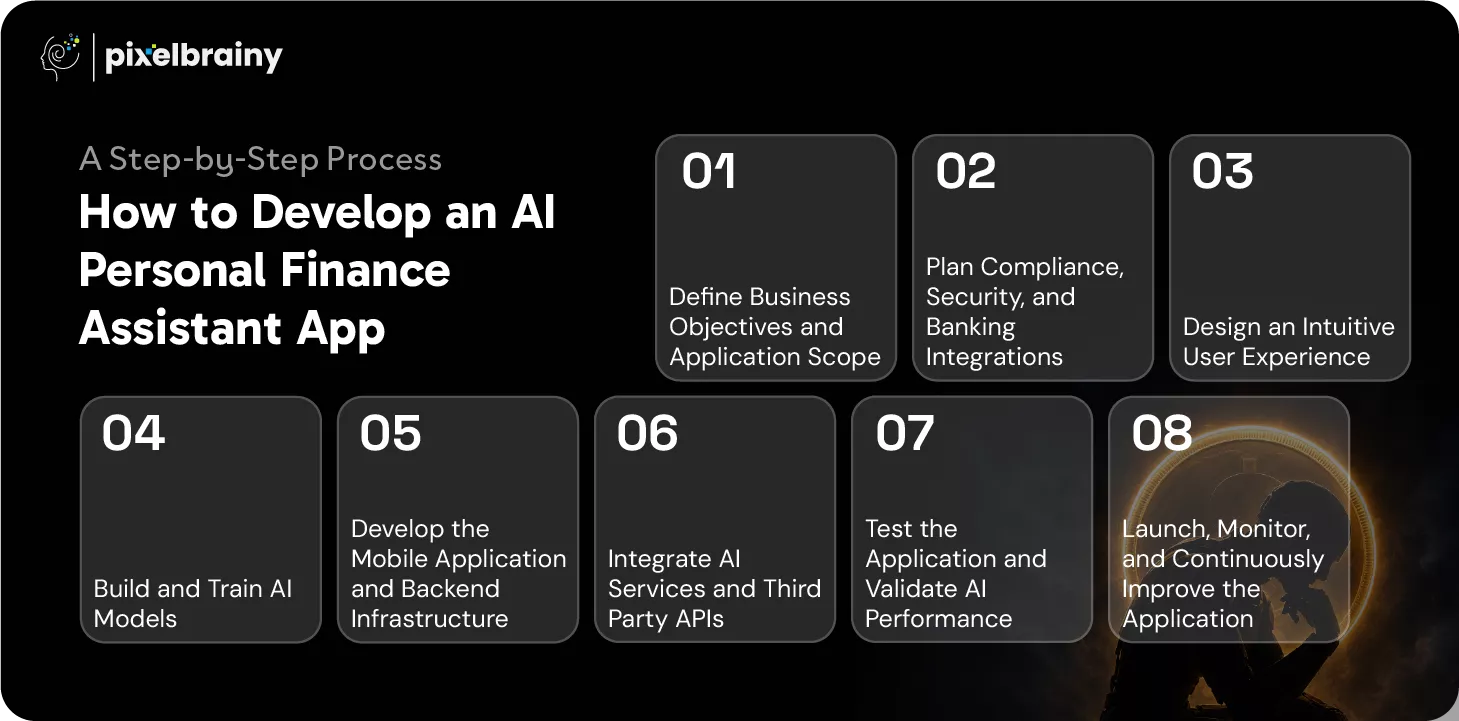
The first step in the AI personal finance app development process is identifying exactly what your application should accomplish. Determine whether the app will focus on budgeting, expense tracking, investment management, debt reduction, savings planning, or complete financial wellness. You should also define your target audience, business model, supported regions, monetization strategy, and key performance indicators before starting development.
Many organizations also validate their product vision through PoC development to evaluate technical feasibility and business potential before investing in full scale implementation.
Estimated Timeline: 1 to 2 Weeks
Common Mistake to Avoid: Attempting to launch every finance feature in the first version instead of prioritizing a focused and scalable product roadmap.
Financial applications manage highly sensitive user information, making regulatory compliance an essential part of development. Businesses should identify applicable regulations such as GDPR, PCI DSS, PSD2, CCPA, and Open Banking requirements based on their target markets. Security planning should include encryption, secure authentication, consent management, and data privacy policies from the beginning.
Proper compliance planning reduces future legal risks while increasing customer trust in the application.
Estimated Timeline: 2 Weeks
Common Mistake to Avoid: Treating compliance as a post development activity instead of incorporating it into the product architecture from the beginning.
A finance application should simplify complex financial activities rather than overwhelm users with excessive information. The user journey should include simple onboarding, account linking, budgeting dashboards, spending insights, financial reports, and AI recommendations that are easy to understand.
Partnering with an experienced UI/UX designer for AI personal finance assistant app helps create intuitive workflows that improve usability, increase engagement, and encourage long term customer retention.
Estimated Timeline: 2 to 3 Weeks
Common Mistake to Avoid: Designing interfaces around technology instead of focusing on user goals and financial decision making.
Artificial intelligence forms the intelligence layer of the application. Data scientists train machine learning models using anonymized financial datasets to automate transaction categorization, spending analysis, personalized budgeting, fraud detection, and predictive financial forecasting.
Businesses seeking greater competitive differentiation often invest in AI model development solutions to build proprietary AI models tailored to their customers and business objectives.
Estimated Timeline: 4 to 8 Weeks
Common Mistake to Avoid: Training AI models using insufficient, biased, or low-quality financial datasets that reduce prediction accuracy.
This stage focuses on building the mobile application for Android and iOS while simultaneously developing the backend infrastructure. Core modules include user authentication, account management, budgeting, expense tracking, AI recommendations, notifications, reporting dashboards, payment processing, and administrative controls.
Many startups begin with MVP development to validate user demand before expanding into advanced capabilities and enterprise scale features.
Estimated Timeline: 6 to 10 Weeks
Common Mistake to Avoid: Building unnecessary features before validating the application's core value proposition.
Also Read: Top AI MVP Development Companies in USA
Once the application architecture is complete, developers integrate Open Banking APIs, payment gateways, notification services, cloud platforms, analytics tools, and AI engines. These integrations enable secure bank connectivity, transaction synchronization, personalized financial insights, and intelligent automation.
Professional AI integration services ensure seamless communication between AI models, financial institutions, and backend systems while maintaining security and scalability.
Estimated Timeline: 2 to 4 Weeks
Common Mistake to Avoid: Integrating third party services without evaluating API reliability, scalability, or security standards.
Before launch, every feature should undergo extensive testing to verify functionality, usability, security, and AI accuracy. Developers should evaluate budgeting algorithms, recommendation engines, fraud detection models, banking integrations, and financial reports using diverse testing scenarios and real-world datasets.
Many businesses collaborate with top AI product development companies to perform comprehensive AI validation, security assessments, and performance optimization before production deployment.
Estimated Timeline: 3 to 4 Weeks
Common Mistake to Avoid: Measuring only application performance while overlooking AI prediction accuracy and recommendation quality.
Publishing the application on the App Store and Google Play Store marks the beginning rather than the end of the development journey. Businesses should continuously monitor application performance, AI recommendation accuracy, customer feedback, and financial behavior to improve the product over time.
Many organizations also leverage AI consulting solutions to refine AI strategies, introduce new financial capabilities, optimize model performance, and support long term product innovation.
Estimated Timeline: Ongoing After Launch
Common Mistake to Avoid: Treating AI implementation as a one-time project instead of continuously retraining models using new financial data and customer behavior.
Following a structured AI personal finance app development process enables businesses to build AI personal finance app from scratch with greater confidence, ensuring security, scalability, regulatory compliance, and intelligent financial experiences that continue evolving after launch.
The AI Personal finance app development cost can vary significantly because every project has unique business objectives, feature requirements, AI capabilities, and compliance needs. The final budget depends on multiple factors, including whether you develop a simple budgeting application or a comprehensive AI powered financial assistant with Open Banking integrations, conversational AI, predictive analytics, fraud detection, and personalized financial planning. Other important considerations include platform selection, AI model complexity, third party integrations, cloud infrastructure, cybersecurity requirements, and regulatory compliance.
One of the most common questions businesses ask is, "How much does it cost to build an AI personal finance assistant app in 2026? We have received estimates ranging from $25,000 to over $250,000. Why is there such a huge price difference?" The answer is straightforward. A basic AI budgeting application with expense tracking and simple financial insights requires far less engineering effort than an enterprise grade financial platform featuring custom AI models, Open Banking APIs, investment tracking, fraud detection, voice enabled financial assistants, and enterprise security architecture.
Another frequently searched query is, "I have a budget of $60,000. What type of AI personal finance application can I build?" With this budget, businesses can typically develop a mid-level custom AI personal finance assistant that includes automated expense tracking, personalized budgeting, AI powered financial recommendations, savings goal management, Open Banking integration, and intuitive dashboards. Advanced capabilities such as proprietary AI models, investment advisory engines, voice assistants, and enterprise analytics can be introduced in future development phases as the product grows.
Understanding the different cost categories helps businesses make informed investment decisions and choose the most suitable development approach based on their objectives, target audience, and long-term product roadmap.
| App Type | Features Included | Estimated Cost | Timeline |
| Basic AI Budgeting MVP | Expense tracking, budgeting, user profiles, financial reports, basic AI recommendations | $20,000 to $45,000 | 1 to 2 Months |
| Mid-Level AI Personal Finance App | Open Banking integration, AI budgeting, spending analytics, savings goals, notifications, conversational assistant | $45,000 to $100,000 | 2 to 3 Months |
| Advanced AI Financial Assistant | Predictive analytics, fraud detection, investment tracking, AI chatbot, multi bank management, cloud infrastructure | $100,000 to $200,000 | 4 to 5 Months |
| Enterprise AI Wealth Management Platform | Financial planning, advisor dashboard, compliance, advanced analytics, portfolio management, enterprise integrations | $180,000 to $350,000 | 5 to 7 Months |
| White Label AI Personal Finance Platform | Multi-tenant architecture, custom branding, APIs, admin portal, SaaS platform, enterprise security | $250,000 to $500,000+ | 8 to 9 Months |
| Development Component | Estimated Cost Range |
| Business analysis and product strategy | $3,000 to $10,000 |
| UI/UX design | $5,000 to $20,000 |
| AI model development and training | $15,000 to $70,000 |
| Open Banking API integration | $5,000 to $25,000 |
| Expense tracking and budgeting engine | $8,000 to $25,000 |
| AI recommendation engine | $10,000 to $35,000 |
| Mobile app development (iOS & Android) | $20,000 to $60,000 |
| Backend infrastructure and APIs | $15,000 to $50,000 |
| Cloud infrastructure setup | $5,000 to $20,000 |
| Security, authentication, and encryption | $5,000 to $25,000 |
| Testing and quality assurance | $5,000 to $20,000 |
| App deployment and post launch support | $3,000 to $15,000 |
Businesses planning the cost to build AI personal finance app often face an important decision during the planning stage: Should they integrate existing AI and Open Banking services or invest in developing a proprietary AI model? The right approach depends on the available budget, expected launch timeline, long term business goals, and level of customization required.
While third party AI platforms and Open Banking providers accelerate development and reduce upfront investment, custom AI models offer greater flexibility, ownership, and competitive differentiation over time.
| Factor | Third Party AI & Open Banking Integration | Custom AI Model Development |
| Upfront Cost | $10,000 to $40,000 | $50,000 to $250,000+ |
| Ongoing Cost | Monthly API and licensing fees | Cloud infrastructure and maintenance costs |
| Time to Market | Faster implementation | Longer development cycle |
| Customization | Limited to provider capabilities | Fully customizable AI algorithms and workflows |
| AI Accuracy | Depends on third party platform | Optimized for your users and proprietary datasets |
| Ownership | Vendor controlled technology | Complete ownership of intellectual property |
| Scalability | Limited by API capabilities | Highly scalable according to business requirements |
| Long Term Cost | Higher because of recurring licensing fees | Lower after initial development investment |
| Best For | MVPs, startups, rapid product launch | Enterprise platforms and long-term fintech products |
Several technical, business, and compliance decisions directly influence the AI Personal finance app development cost. Understanding these factors helps businesses estimate realistic budgets and avoid unexpected expenses during development.
Simple AI models for budgeting and expense categorization cost significantly less than advanced AI capable of predictive financial planning, conversational assistance, fraud detection, and personalized investment recommendations.
Applications offering only budgeting and expense tracking require fewer development hours than platforms supporting Open Banking, AI financial coaching, investment tracking, subscription management, and wealth management features.
Connecting multiple financial institutions through Open Banking APIs increases development complexity due to authentication, transaction synchronization, consent management, and regulatory compliance requirements.
Developing only an Android or iOS application is generally less expensive than simultaneously building native applications for Android, iOS, web, and tablet platforms.
Building intelligent recommendation engines capable of generating personalized budgeting advice, savings plans, and financial forecasts requires additional AI engineering, training, testing, and optimization.
Compliance with PCI DSS, PSD2, GDPR, CCPA, SOC 2, and financial cybersecurity standards requires implementing advanced encryption, authentication, audit logging, and secure infrastructure, increasing overall development costs.
Payment gateways, banking APIs, analytics platforms, notification services, CRM software, and cloud storage integrations all contribute to project complexity and development effort.
Hourly development rates vary considerably across regions. Development companies in North America generally charge higher rates than experienced offshore teams located in Asia or Eastern Europe.
Highly interactive dashboards, financial visualizations, personalized user journeys, and responsive interfaces require additional design and frontend development resources compared to template-based applications.
Launching the application is only the beginning. Businesses should budget for continuous AI model optimization, security updates, feature enhancements, cloud hosting, bug fixes, compliance updates, and ongoing technical support.
Many organizations successfully reduce the custom AI personal finance app development cost by adopting a phased development strategy. Instead of launching a feature rich enterprise platform, businesses often begin with a Minimum Viable Product (MVP) that includes core functionalities such as budgeting, expense tracking, bank account integration, and AI powered financial recommendations. Once the product gains market validation and user feedback, additional capabilities such as predictive analytics, investment management, conversational AI, and advanced wealth planning can be introduced through future releases.
Other cost optimization strategies include leveraging cloud-based AI services, integrating trusted Open Banking APIs, using cross platform development frameworks, and prioritizing high impact features during the initial release. This approach minimizes upfront investment while accelerating time to market and reducing development risks.
The AI Personal finance app development cost should be viewed as a strategic investment rather than an expense, because the most successful applications are those that balance intelligent AI capabilities, scalability, security, and user experience to deliver long term business value and sustainable growth.
Also Read: AI App Development Cost: From MVPs to Full-Scale AI App
Developing an intelligent finance application is only one part of building a successful fintech business. Equally important is implementing a sustainable monetization strategy that generates recurring revenue while continuously delivering value to users. As the adoption of AI Personal finance app development continues to grow, businesses are exploring innovative revenue models that go beyond traditional subscription plans. The most successful AI personal finance assistant apps combine multiple monetization strategies to maximize profitability without compromising the user experience.
Whether you build AI Personal finance application for consumers, banks, fintech startups, or financial advisors, selecting the right revenue model depends on your target audience, feature offerings, and long-term business objectives. Many organizations begin with a freemium approach before expanding into premium services, financial partnerships, and AI powered advisory solutions.
A frequently asked business question is, "What is the best monetization strategy for an AI personal finance assistant app in 2026? Should we rely on subscriptions, affiliate commissions, premium AI services, or multiple revenue streams?" The answer is a hybrid monetization model that combines recurring subscriptions with value driven financial services and strategic partnerships.
| Monetization Strategy | How It Works |
| Freemium Model | Offer basic budgeting, expense tracking, and financial reports for free while unlocking advanced AI insights, premium budgeting tools, personalized financial coaching, and additional features through paid subscriptions. |
| Subscription Plans | Generate recurring monthly or annual revenue by offering premium features such as unlimited bank connections, AI financial advisor, predictive expense forecasting, investment tracking, and advanced analytics dashboards. |
| Affiliate Marketing | Earn referral commissions by recommending relevant financial products including credit cards, savings accounts, investment platforms, insurance policies, and personal loans based on user financial profiles. |
| Financial Advisory Services | Offer one on one consultations with certified financial advisors or AI assisted financial planning services through paid sessions, helping users make informed investment and wealth management decisions. |
| In App Purchases | Sell premium budgeting templates, customized financial plans, debt payoff calculators, tax planning tools, investment reports, and exclusive AI powered financial insights directly within the application. |
| Banking and Fintech Partnerships | Partner with banks, digital wallets, lending companies, and fintech providers to generate revenue through account openings, loan applications, investment products, and co-branded financial services. |
| AI Powered Investment Recommendations | Offer premium investment analysis, portfolio optimization, retirement planning, and personalized wealth management recommendations through subscription-based AI advisory services where regulations permit. |
| Advertising Model | Display carefully targeted, non-intrusive advertisements for trusted financial products and services while maintaining user privacy and ensuring advertisements remain relevant to users' financial interests. |
| White Label Licensing | License the AI personal finance platform to banks, financial institutions, employers, and fintech companies under their own brand, generating recurring B2B licensing and Software as a Service revenue. |
| API and SaaS Services | Provide AI budgeting APIs, financial analytics engines, transaction categorization services, or recommendation engines to third party fintech applications through subscription-based API access and enterprise licensing. |
To build a profitable AI personal finance platform, businesses should focus on long term customer value rather than short term revenue generation. Combining multiple monetization models creates diversified income streams while improving customer retention and business scalability.
Some proven strategies include:
Businesses that successfully combine these approaches can significantly improve customer lifetime value while creating sustainable recurring revenue.
The most successful AI Personal finance app development projects leverage multiple monetization strategies that balance user value, recurring revenue, and strategic financial partnerships, creating a scalable and profitable digital finance ecosystem.
The rapid evolution of artificial intelligence has transformed personal finance applications from simple budgeting tools into intelligent financial assistants. Today's leading AI finance apps help users automatically categorize expenses, create personalized budgets, monitor subscriptions, predict future spending, manage investments, and receive real time financial guidance. These applications have set new industry standards for innovation and user experience, making them valuable benchmarks for businesses planning AI Personal finance app development.
If you are planning to build AI Personal finance application, analyzing successful products can help you understand what users expect, identify feature gaps in the market, and discover opportunities to create a differentiated solution. The following AI powered personal finance assistant apps are among the most recognized platforms currently shaping the digital finance landscape.
Cleo is one of the most popular AI powered personal finance assistants that combines budgeting with conversational AI. Users can interact with the AI chatbot to receive spending insights, budgeting advice, savings recommendations, and personalized financial coaching through natural language conversations.
Key highlights include:
Cleo stands out for making personal finance engaging and easy to understand through conversational AI.
Rocket Money focuses on helping users gain better control over their monthly expenses by automatically identifying subscriptions, tracking spending, and optimizing recurring bills. The application uses intelligent automation to simplify everyday financial management.
Key highlights include:
Rocket Money is particularly popular among users looking to reduce unnecessary spending.
Monarch Money is an all in one financial management platform designed for budgeting, investment tracking, and long term financial planning. Its intelligent analytics provide users with a complete overview of their financial health while supporting collaborative financial planning for families.
Key highlights include:
The platform offers comprehensive financial management within a clean and intuitive interface.
Copilot Money leverages artificial intelligence to automatically categorize transactions, monitor spending behavior, and generate highly personalized financial insights. Its automation capabilities significantly reduce manual financial management while improving budgeting accuracy.
Key highlights include:
Its elegant user experience makes it one of the leading AI personal finance apps for Apple ecosystem users.
YNAB follows a proactive budgeting methodology that encourages users to assign every dollar a specific purpose. While its core philosophy focuses on financial discipline, AI powered insights and intelligent reporting help users optimize spending habits and achieve long term financial goals.
Key highlights include:
YNAB remains one of the most trusted budgeting platforms for users focused on long term financial wellness.
Studying the market's leading AI personal finance assistant apps provides valuable insights that can help businesses create an AI Personal finance app with innovative features, superior user experiences, and a strong competitive advantage in the evolving fintech ecosystem.
Artificial intelligence is transforming personal finance from reactive money management into proactive financial intelligence. As AI models become more advanced and Open Banking ecosystems continue to expand, the next generation of personal finance assistant apps will deliver deeper personalization, greater automation, and smarter financial decision making. Businesses investing in AI Personal finance app development should stay ahead of these emerging trends to build future ready solutions that meet evolving customer expectations.
Whether you plan to build AI Personal finance application for consumers, financial institutions, or fintech startups, understanding upcoming innovations helps prioritize the right technologies and maintain a competitive advantage. A common business question is, "What are the future trends shaping AI personal finance assistant app development beyond 2026?" The answer lies in the growing convergence of generative AI, predictive analytics, hyper personalization, embedded finance, and autonomous financial management.
Future AI assistants will move beyond generic budgeting advice by analyzing spending habits, income patterns, investment behavior, financial goals, and life events to deliver highly personalized financial coaching. Every recommendation will adapt dynamically based on each user's changing financial situation.
Generative AI will become the foundation of intelligent financial assistants. Instead of providing predefined responses, AI will explain financial concepts, answer complex money related questions, summarize spending reports, compare financial products, and generate personalized financial action plans using natural language conversations.
Predictive analytics will enable finance applications to forecast future expenses, identify potential cash flow shortages, estimate savings growth, and recommend financial actions before problems occur. This proactive approach will help users prepare for unexpected expenses and achieve long term financial stability.
AI powered finance assistants will gradually automate routine financial activities such as bill payments, subscription optimization, savings transfers, debt repayments, and investment allocations based on user approved financial rules, reducing manual financial management.
Voice AI will make financial management more accessible by allowing users to check account balances, review expenses, create budgets, and receive financial advice through simple voice conversations across smartphones, smart speakers, wearable devices, and connected vehicles.
Future fraud detection systems will continuously analyze behavioral patterns such as transaction habits, login behavior, device usage, and spending anomalies. This behavioral intelligence will improve fraud prevention while reducing false security alerts and enhancing customer trust.
Personal finance assistants will increasingly integrate banking, insurance, investments, lending, tax planning, digital payments, and wealth management into unified ecosystems. Users will be able to access multiple financial services from a single intelligent application.
AI will provide increasingly sophisticated investment recommendations by analyzing market conditions, portfolio performance, risk tolerance, and financial objectives. Personalized wealth management will become accessible to everyday users rather than only high net worth individuals.
As AI becomes more involved in financial decision making, users and regulators will demand greater transparency. Explainable AI will clearly communicate why recommendations are made, increasing trust, regulatory compliance, and confidence in AI generated financial advice.
Future personal finance applications will place even greater emphasis on data privacy, encrypted financial transactions, responsible AI governance, consent management, and regulatory compliance. Businesses that prioritize ethical AI and robust cybersecurity will gain stronger customer confidence and long-term competitive advantages.
The future of AI Personal finance app development lies in intelligent automation, hyper personalization, and responsible AI, enabling businesses to deliver smarter financial experiences that continuously evolve alongside user needs and technological innovation.
Building an AI powered personal finance assistant app requires more than integrating advanced technologies. Since these applications handle sensitive financial information and influence users' financial decisions, businesses must prioritize security, compliance, AI accuracy, and user experience throughout the development lifecycle. Following proven best practices helps organizations build AI Personal finance application solutions that are secure, scalable, and trusted by users.
Whether you want to create an AI Personal finance app for a fintech startup, bank, or digital wallet provider, implementing the right development strategies from the beginning reduces project risks and improves long term success. A common business question is, "What are the best practices for building a secure, scalable, and AI powered personal finance assistant app that users can trust?" Below are the most important practices every business should follow.
Every successful AI Personal finance app development project begins with a clear understanding of business objectives, user expectations, and financial problems the application aims to solve. Defining the target audience, monetization strategy, and feature roadmap early helps reduce unnecessary development costs and ensures the final product delivers real value.
Best Practices:
Users trust personal finance apps with highly sensitive financial information. Strong security measures should be implemented from the beginning to protect user accounts, banking credentials, and financial transactions while complying with industry regulations.
Best Practices:
Compliance is essential for building trustworthy financial applications. Businesses should design their applications to comply with financial regulations and privacy standards applicable to their target markets before development begins.
Best Practices:
The effectiveness of AI recommendations depends directly on the quality of training data. Accurate, diverse, and regularly updated financial datasets improve budgeting suggestions, transaction categorization, fraud detection, and predictive analytics.
Best Practices:
Financial applications should simplify money management instead of making it more complicated. A clean interface, intuitive navigation, and personalized dashboards improve user engagement and encourage long term app usage.
Best Practices:
Secure API integrations provide users with real time access to bank accounts, transactions, payments, and financial insights. Choosing trusted API providers ensures better reliability and long-term scalability.
Best Practices:
As your user base grows, the application should handle increasing transactions, AI workloads, and financial data without compromising performance. Scalable architecture supports future expansion while reducing infrastructure bottlenecks.
Best Practices:
Launching the application is only the beginning. AI models should evolve continuously by learning from new financial data, customer feedback, and changing market trends to deliver increasingly accurate recommendations.
Best Practices:
Following these best practices enables businesses to build AI Personal finance application solutions that combine intelligent automation, enterprise grade security, exceptional user experiences, and long-term scalability, ensuring sustained success in the rapidly evolving fintech landscape.
Developing an AI powered personal finance assistant app offers tremendous opportunities, but it also presents several technical, regulatory, and operational challenges. Since these applications process sensitive financial information and generate AI driven recommendations, businesses must address issues related to security, compliance, data quality, AI accuracy, and scalability throughout the development lifecycle. Overcoming these challenges early helps organizations build secure, reliable, and future ready financial applications.
When business owners are thinking to build AI Personal finance application for consumers, banks, or fintech startups, understanding these challenges can significantly reduce project risks and improve long term success. One of the most common business questions is, "What are the biggest challenges in AI Personal finance app development, and how can businesses overcome them while building a secure and scalable AI powered financial assistant?" Below are the key challenges along with practical solutions.
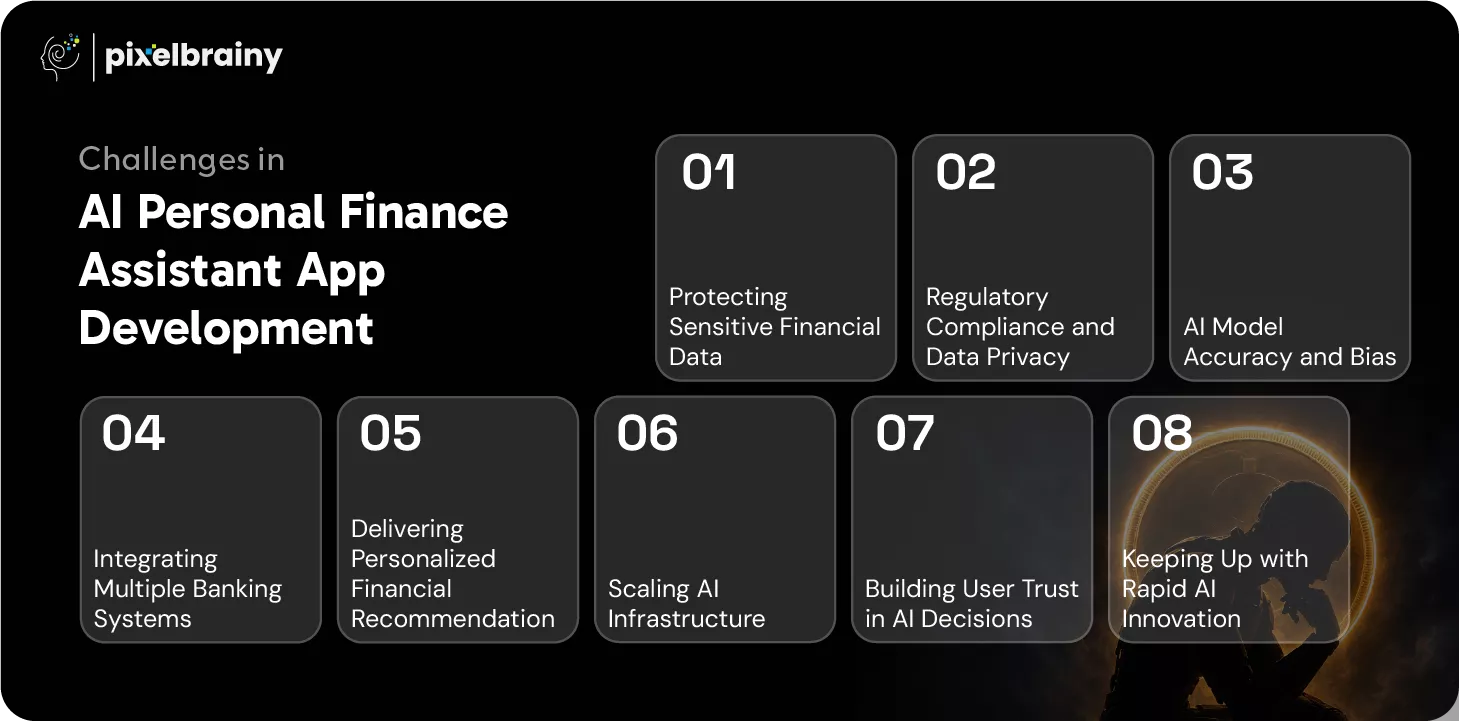
Personal finance applications store banking credentials, transaction history, and financial records, making them attractive targets for cyberattacks. Even a small security vulnerability can damage customer trust and lead to regulatory penalties.
How to Resolve It
Financial applications must comply with regulations such as GDPR, PCI DSS, PSD2, CCPA, and Open Banking standards. Meeting these requirements can be challenging, especially when operating across multiple countries.
How to Resolve It
Poor quality datasets or biased training data can reduce AI accuracy, resulting in incorrect budgeting suggestions, financial recommendations, or fraud detection outcomes. This directly impacts user confidence and decision making.
How to Resolve It
Connecting with different banks, payment gateways, and financial institutions through Open Banking APIs can be technically complex due to varying API standards, authentication methods, and data formats.
How to Resolve It
Users expect AI recommendations that accurately reflect their financial goals and spending behavior. Generic recommendations often reduce user engagement and overall application value.
How to Resolve It
As the number of users and financial transactions grows, AI models require additional computing resources to maintain performance. Poor infrastructure planning can lead to slower response times and increased operational costs.
How to Resolve It
Many users remain hesitant to rely entirely on AI generated financial advice. Lack of transparency can reduce user adoption and long-term engagement.
How to Resolve It
Artificial intelligence technologies evolve rapidly, making it difficult for businesses to keep applications competitive over time. Failing to adopt new innovations may result in outdated products and reduced customer satisfaction.
How to Resolve It
Successfully addressing these AI Personal finance app development challenges enables businesses to create intelligent, secure, compliant, and future ready financial assistant applications that inspire user confidence and achieve sustainable long-term growth.
PixelBrainy, a leading AI app development company, our AI experts are specialized in AI Personal finance app development, delivering secure, scalable, and intelligent financial applications for fintech startups, banks, and enterprises. Our team combines expertise in artificial intelligence, machine learning, Open Banking integrations, cloud architecture, cybersecurity, and mobile app development to build AI powered personal finance assistants that automate budgeting, expense tracking, spending analysis, fraud detection, and personalized financial planning.
Many businesses ask us, "I want to build a custom AI personal finance assistant app that connects to users' bank accounts, tracks expenses automatically, creates personalized budgets, and provides AI powered financial advice on both iOS and Android. Which AI app development company in the USA can build this, and what will it cost?"
Projects like these require more than mobile app development. They demand expertise in AI model development, Open Banking APIs, conversational AI, predictive analytics, fintech compliance, and secure cloud infrastructure. At PixelBrainy, we transform innovative finance ideas into production ready AI applications tailored to your business goals.
| Industry | How We Help |
| Fintech Startups | Build AI powered budgeting, expense tracking, savings, and financial coaching applications with scalable architecture. |
| Banks and Financial Institutions | Develop intelligent digital banking solutions with Open Banking, fraud detection, and personalized financial insights. |
| Digital Wallet Providers | Create AI enabled money management platforms that combine payments, budgeting, and spending analytics. |
| Investment and Wealth Management Firms | Build AI driven portfolio management, financial planning, and investment recommendation platforms. |
| Insurance and Lending Companies | Develop financial wellness solutions with AI powered credit insights, loan recommendations, and customer analytics. |
| Enterprise Businesses | Deliver white label AI personal finance platforms with custom branding, APIs, and enterprise dashboards. |
| Our Capability | Business Value |
| Custom AI Development | Build proprietary AI models tailored to your business instead of relying only on third party AI platforms. |
| Open Banking Expertise | Securely integrate banking APIs for reliable account aggregation and real time transaction synchronization. |
| Advanced Financial AI | Develop intelligent budgeting, expense categorization, forecasting, and recommendation engines. |
| Enterprise Security | Implement encryption, secure authentication, fraud detection, and compliance focused architecture. |
| Cross Platform Development | Build high performance AI finance apps for iOS, Android, and web using modern technologies. |
| End to End Development | Manage everything from AI consulting and UI/UX design to development, deployment, and ongoing support. |
Objective
A fintech startup wanted to launch an AI personal finance assistant that could automatically connect bank accounts, categorize transactions, generate personalized budgets, and provide AI powered financial guidance through a conversational chatbot.
Our Approach
We developed a scalable cloud-based platform with Open Banking integrations, AI powered transaction categorization, budgeting recommendations, conversational AI, interactive financial dashboards, and enterprise grade security for Android and iOS.
Result
The solution automated financial management, improved user engagement through personalized AI recommendations, and established a scalable foundation for future capabilities such as investment tracking, predictive analytics, and wealth management services.
Whether you want to build AI Personal finance application for consumers, banks, fintech startups, or enterprises, PixelBrainy a well-known AI financial software solutions provider, combines AI expertise, fintech knowledge, and product engineering excellence to deliver secure, scalable, and future ready financial solutions.
Partner with PixelBrainy to transform your idea into an intelligent, secure, and scalable AI powered personal finance assistant that delivers exceptional user experiences and long-term business growth. Let's build your next fintech innovation together.
The future of digital finance is being shaped by artificial intelligence, making AI Personal finance app development one of the most promising investment opportunities for businesses in 2026 and beyond. From automated expense tracking and intelligent budgeting to predictive financial planning, conversational AI, and Open Banking integrations, AI powered personal finance assistant apps are transforming how users manage their money. However, building a successful solution requires more than advanced technology. It demands a clear product strategy, user centric design, enterprise grade security, regulatory compliance, and a scalable architecture that can adapt to evolving customer needs.
Whether you are a fintech startup, bank, investment firm, or enterprise, understanding the complete journey to build AI Personal finance application is essential for long term success. By focusing on the right features, technologies, development process, monetization strategies, and industry best practices, businesses can create intelligent financial solutions that enhance user experiences while driving sustainable growth and competitive advantage.
Ready to build your AI Personal Finance Assistant App? Schedule a free consultation with the PixelBrainy experts today and turn your fintech vision into a secure, scalable, and AI powered reality.
The AI Personal finance app development cost typically ranges from $20,000 to over $350,000, depending on app complexity, AI capabilities, Open Banking integrations, supported platforms, compliance requirements, and custom feature development. Building an MVP first is often the most cost-effective approach for startups.
The development timeline generally ranges from 1 to 9 months. A basic AI budgeting app can be developed within 1 to 2 months, while enterprise grade solutions with custom AI models, fraud detection, Open Banking, and investment management require significantly more development time.
Modern AI personal finance applications commonly use Machine Learning, Natural Language Processing (NLP), Generative AI, Predictive Analytics, Open Banking APIs, Cloud Computing, and Data Analytics. Together, these technologies enable intelligent budgeting, personalized recommendations, automated expense tracking, and conversational financial assistance.
A successful app should include secure authentication, expense tracking, personalized budgeting, transaction categorization, AI financial recommendations, spending analytics, savings goal management, bill reminders, financial reports, notifications, multi account management, and customer support to deliver a seamless user experience.
Yes. Open Banking APIs allow secure access to users' bank accounts, enabling automatic transaction synchronization, account aggregation, real time expense tracking, and personalized financial insights. These integrations significantly improve user convenience and overall application functionality while supporting modern digital banking experiences.
Absolutely. AI continuously analyzes transaction patterns, user behavior, device activity, and spending habits to identify suspicious activities in real time. This enables faster fraud detection, reduces financial risks, strengthens account security, and helps businesses build greater customer trust.
Fintech startups, banks, credit unions, digital wallet providers, investment firms, insurance companies, lending platforms, wealth management firms, and enterprise organizations can all benefit from AI Personal finance app development by delivering smarter, more personalized financial services and improving customer engagement.
Choose a development partner with proven expertise in AI, fintech, Open Banking, cloud architecture, cybersecurity, regulatory compliance, and cross platform development. An experienced company like PixelBrainy can build a secure, scalable, and future ready AI personal finance assistant tailored to your business goals and market requirements.

About The Author
Sagar Bhatnagar
Sagar Sahay Bhatnagar brings over a decade of IT industry experience to his role as Marketing Head at PixelBrainy. He's known for his knack in devising creative marketing strategies that boost brand visibility and market influence. Sagar's strategic thinking, coupled with his innovative vision and focus on results, sets him apart. His track record of successful campaigns proves his ability to utilize digital platforms effectively for impactful marketing efforts. With a genuine passion for both technology and marketing, Sagar continuously pushes PixelBrainy's marketing initiatives to greater success.

Working with the PixelBrainy team has been a highly positive experience. They understand the design requirements and create beautiful UX elements to meet the application needs. The dev team did an excellent job bringing my vision to life. We discussed usability and flow. Sagar worked with his team to design the database and begin coding. Working with Sagar was easy. He has the knowledge to create robust apps, including multi-language support, Google and Apple ID login options, Ad-enabled integrations, Stripe payment processing, and a Web Admin site for maintaining support data. I'm extremely satisfied with the services provided, the quality of the final product, and the professionalism of the entire process. I highly recommend them for Android and iOS Mobile Application Design and Development.

Great experience working with them. Had a lot of feedback and I found that unlike most contractors they were bugging me for updates instead of the other way around. They were extremely time conscience and great at communicating! All work was done extremely high quality and if not on time, early! They were always proactive when it comes to communication and the work is great/above par always. Very flexible and a great team to work with! Goes above and beyond to present us with multiple options and always provides quality. Amazing work per usual with Chitra. If you have UI/UX or branding design needs I recommend you go to them! Will likely work with them in the future as well, definitely recommended!

PixelBrainy is a joy to work with and is a great partner when thinking through branding, logo, and website layout. I appreciate that they spend time going into the "why" behind their decisions to help inform me and others about industry best practices and their expertise.

I hired them to design our software apps. Things I really like about them are excellent communication skills, they answer all project suggestions and collaborate right away, and their input on design and colors is amazing. This project was complex and needed patience and creativity. The team is amazing to do business with. I will be using them long-term. Glad to see there are some good people out there. I was afraid to try and outsource my project to someone but I am glad I met them! I really can't say enough. They went above and beyond on this project. I am very happy with everything they have done to make my business stand out from the competition.

It was great working with PixelBrainy and the team. They were very responsive and really owned the project. We'll definitely work with them again!

I recently worked with the PixelBrainy team on a project and I was blown away by their communication skills. They were prompt, clear, and articulate in all of our interactions. They listened and provided valuable feedback and suggestions to help make the project a success. They also kept me updated throughout the entire process, which made the experience stress-free and enjoyable.

PixelBrainy is very good at what it does. The team also presents themselves very professionally and takes care of their side of things very well. I could fully trust them taking up the design work in a timely and organised manner and their attention to detail saved us lots of effort and time. This particular project was quite intense and the team showed that they function very well under pressure. Very much looking forward to working with her again!

It's always an absolute pleasure working with them. They completed all of my requests quickly and followed every note I had for them to a T, which made our process go smoothly from start to finish. Everything was completed fast and following all of the guidelines. And I would recommend their services to anyone. If you need any design work done in the future, PixelBrainy should be your first call!

They took ownership of our requirements and designed and proposed multiple beautiful variants. The team is self-motivated, requires minimum supervision, committed to see-through designs with quality and delivering them on time. We would definitely love to work with PixelBrainy again when we have any requirements.

PixelBrainy was a big help with our SaaS application. We've been hard at work with a new UI/UX and they provided a lot of help with the designs. If you're looking for assistance with your website, software, or mobile application designs, PixelBrainy and the team is a great recommendation.

PixelBrainy designers are amazing. They are responsive, talented, and always willing to help craft the design until it matches your vision. I would recommend them and plan to continue them for my future projects and more!!!

They were awesome! Did a good job fast, and good communication. Will work with them again. Thank you

Creative, detail-oriented, and talented designers who take direction well and implement changes quickly and accurately. They consistently over-delivered for us.

PixelBrainy team is very talented and creative. Great designers and a pleasure to work with. PixelBrainy is an excellent communicator and I look forward to working with them again.

PixelBrainy has a very talented design team. Their work is excellent and they are very responsive. I enjoy working with them and hope to continue on all of our future projects.


Transform your ideas into reality with us.
Across these industries, each engagement brings unique challenges, from early-stage product development to scaling complex systems, helping us build a practical understanding of real-world product environments.