
 AI Summary Powered by PixelBrainy
Looking for a reliable company in the USA to develop an AI real estate contractor finder app?
Finding the right contractor for a property renovation should not take days or lead to inconsistent results. Yet most property owners, real estate investors, and agents in the USA still rely on referrals, scattered reviews, and manual bid comparisons that consume time and often result in mismatched hires. Platforms like Angi, Thumbtack, and HomeAdvisor were built as general directories. They do not understand property types, renovation ROI goals, or investor timelines.
This is where AI makes a measurable difference. An AI real estate contractor finder app uses machine learning and property intelligence to automatically match the right contractor to the right project based on verified performance data, not paid listings or generic filters.
According to Market.us, the global AI in real estate market is projected to grow from USD 2.9 billion in 2024 to USD 41.5 billion by 2033 at a CAGR of 30.5%. Morgan Stanley Research estimates AI could generate USD 34 billion in efficiency gains for the real estate industry by 2030, with contractor discovery and coordination among the highest-friction areas left to improve.
This guide is designed for PropTech founders, real estate technology product managers, and CTOs in the USA who want to understand how AI can transform contractor discovery and matching and searching for the best company to develop an AI real estate contractor finder app or planning to build a contractor finder app with AI that performs reliably in real-world scenarios, the insights ahead will help you make informed decisions.
An AI real estate contractor finder app is a platform that uses machine learning, NLP, and property data to intelligently match users with verified contractors based on project type, location, budget, timeline, and past performance, delivering more relevant results than keyword-based directory searches.
An AI real estate contractor finder app is a digital platform that connects property owners, real estate investors, agents, and property managers with qualified contractors for renovation, repair, maintenance, and improvement projects.
The core difference from a traditional contractor directory lies in how matches are made.
A standard directory search typically returns contractors who paid for placement or have the highest number of reviews. In contrast, an AI contractor finder app analyzes detailed project inputs such as scope, property type, location, timeline, budget range, and historical contractor performance data to generate a ranked, personalized shortlist. These recommendations improve continuously as the system learns from project outcomes, user behavior, and contractor ratings.
These apps are designed to serve multiple user types with different needs. Homeowners preparing a property for sale require quick access to pre-vetted renovation contractors. Real estate investors running fix-and-flip projects need contractors with proven experience in similar scope work and budget ranges. Property management companies depend on consistent access to reliable service contractors across multiple locations. An AI-driven system adapts its matching logic to each of these use cases.
While some platforms have introduced elements of AI-driven contractor matching, most still operate as generalized marketplaces. A purpose-built AI real estate contractor finder app goes further by combining intelligent matching with real estate-specific workflows, property data, and performance-driven insights.
How much time do real estate professionals actually lose to contractor discovery and coordination every year?
The answer is significant. A survey by Realtor.com found that 82% of Americans are already using AI tools to navigate the housing market. However, when it comes to renovation and repair workflows that directly impact property value and sale readiness, most processes are still manual, fragmented, and inefficient.
This gap is one of the key reasons why AI Real Estate Contractor Finder App Development is accelerating across the USA. For many PropTech companies and startups, the question is no longer whether the problem exists, but whether it is worth building an AI real estate contractor app that can solve it at scale.
The global AI in real estate market is growing at a CAGR of 30.5%, projected to reach USD 41.5 billion by 2033. This expansion reflects a broader shift toward automation and data-driven decision-making across property transactions, management, and improvement workflows. Contractor discovery remains one of the most inefficient areas, making it a high-impact opportunity for AI-driven innovation.
The US home improvement market surpassed USD 600 billion in 2024. Despite this scale, contractor discovery is still largely dependent on referrals and generic listing platforms. These approaches are not designed for real estate-specific needs such as ROI-focused renovations, strict timelines, or property-type specialization, creating a clear gap that AI-powered platforms can address.
Global PropTech funding reached USD 16.7 billion in 2025, with a 67.9% year-on-year increase. A growing share of this investment is directed toward AI-enabled platforms that solve real operational inefficiencies. Contractor finder apps align directly with this trend, as they improve both decision-making and execution within real estate workflows.
Contractor fraud and inconsistent work quality remain major concerns. Homeowners in the US lose billions annually to unlicensed contractors and renovation scams. Traditional platforms provide limited verification, leaving users to assess credibility on their own.
AI-driven platforms address this by automating license verification, validating insurance coverage, and ranking contractors based on verified performance data. This significantly reduces risk and builds trust within the platform ecosystem.
Real estate projects operate under tight deadlines. Pre-sale renovations, fix-and-flip investments, and tenant-ready repairs all depend on speed and reliability. Delays directly affect profitability and market readiness.
An AI contractor finder app reduces contractor discovery time from days to minutes, enabling faster decision-making and more predictable project timelines.
AI-powered valuation tools are becoming standard across real estate platforms. Companies like Zillow, Redfin, and Compass now incorporate renovation impact analysis into property valuations.
This creates a natural extension for contractor matching. An AI contractor finder app integrated into this ecosystem allows users to move seamlessly from identifying renovation opportunities to executing them, positioning the platform as a core part of the real estate lifecycle rather than a standalone tool.
These trends make it clear that developing an AI real estate contractor finder app is not just relevant but strategically important for future-ready PropTech platforms.
What goes on inside an AI contractor finder app that makes it more intelligent than a standard search and filter system?
The answer lies in a layered architecture where each component feeds data into the next, and the AI matching engine continuously improves based on real-world outcomes. Understanding the architecture of an AI Real Estate Contractor Finder App is critical before starting development, as early architectural decisions directly impact scalability, recommendation accuracy, and long-term platform performance.
For businesses planning the development of an AI Real Estate Contractor Finder App or looking to build a real estate contractor finder app integrating AI, this layered approach forms the foundation of a reliable and scalable system.
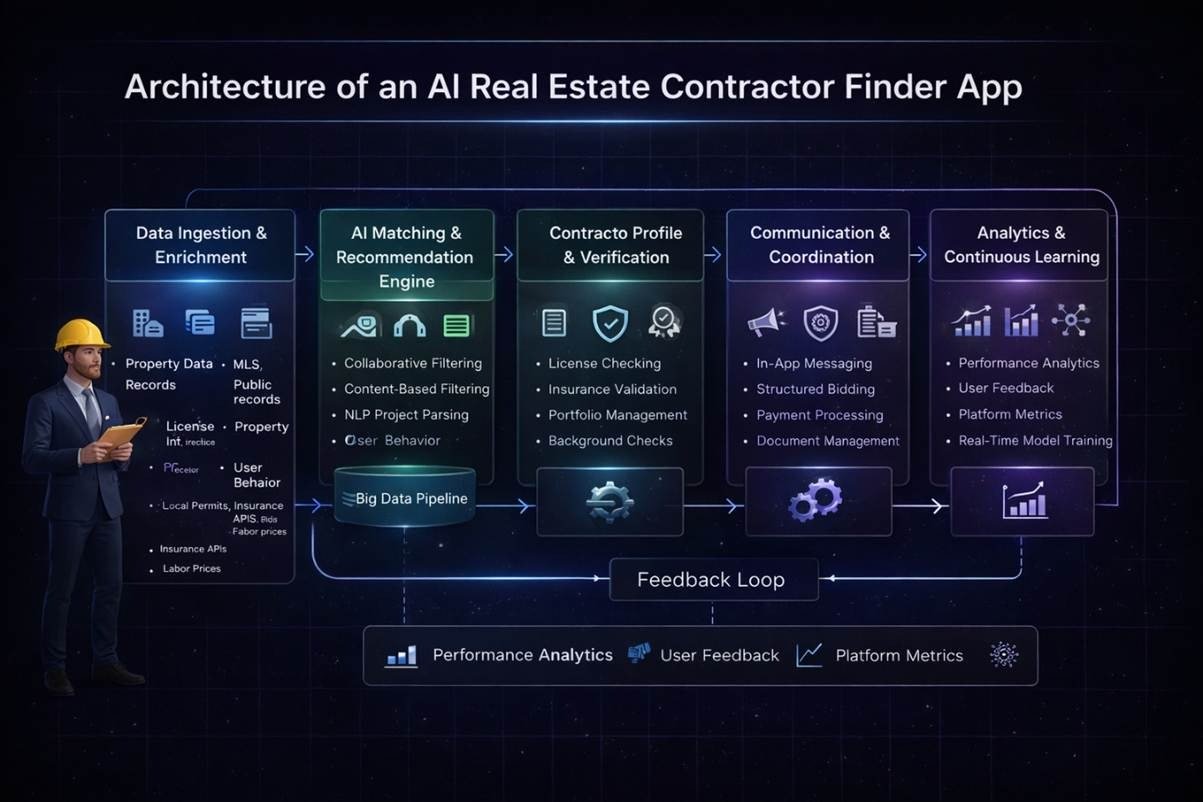
This layer collects and processes all the raw inputs required for the AI system to function effectively.
It aggregates data from multiple sources simultaneously:
All incoming data is cleaned, normalized, and structured into a unified format before being passed to the AI engine. Poor data quality at this stage is one of the primary reasons for inaccurate recommendations.
This is the intelligence core of the platform. It processes structured data from the ingestion layer and generates ranked contractor recommendations tailored to each project.
The matching engine typically combines multiple techniques:
The result is a ranked shortlist of contractors with confidence scores that continuously improve as more data is collected.
This layer ensures that recommendations are not only relevant but also trustworthy. It manages contractor credibility and real-time eligibility.
Key components include:
This layer plays a critical role in building trust, which is essential for platform adoption.
Once a match is made, this layer manages all interactions and workflows between users and contractors.
It includes:
This layer transforms the platform from a discovery tool into a complete project execution system.
This layer ensures the platform evolves and improves over time by feeding performance insights back into the AI system.
It tracks:
These insights continuously refine the recommendation engine, making each future match more accurate than the last.
These five layers work together to create a system that becomes more intelligent with every completed project. In any successful effort to build a real estate contractor finder app integrating AI, both the architecture and early data strategy play an equally important role in determining long-term platform success.
Building an AI real estate contractor finder app creates measurable value across every stakeholder in the property renovation ecosystem. From faster decision-making to improved project outcomes, the benefits go far beyond basic contractor discovery.
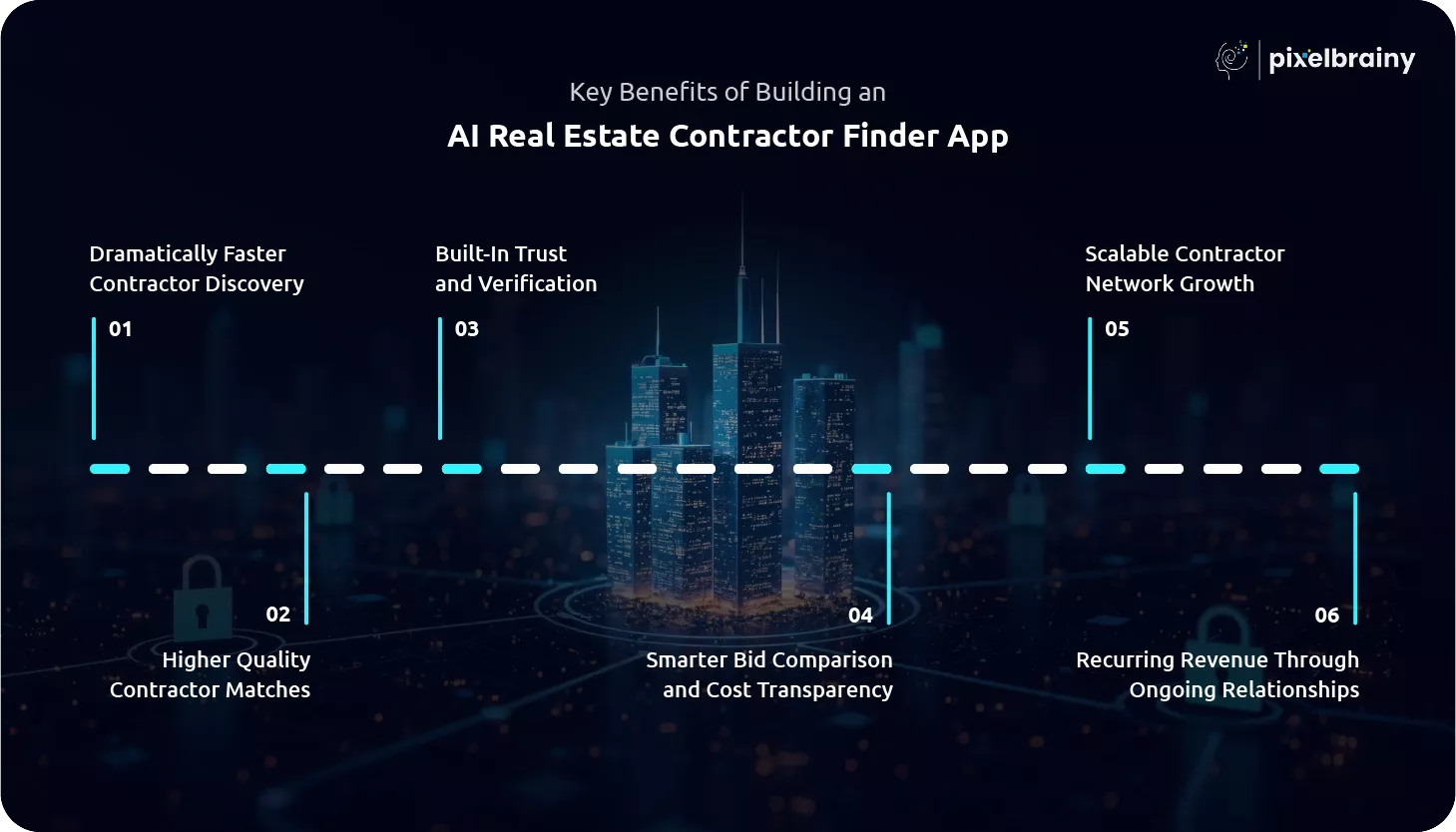
The average homeowner or investor spends 5 to 10 hours researching, shortlisting, and contacting contractors for a single project. An AI-powered matching system reduces this process to minutes.
Platforms like Thumbtack have reported over a 60% reduction in time to first contractor contact using machine learning. This efficiency improves further when the system is tailored specifically for real estate workflows.
Traditional platforms rely on keywords and location filters. In contrast, an AI real estate contractor finder app matches based on factors that directly influence project success.
This level of precision leads to better outcomes, reducing the likelihood of rework, delays, and cost overruns.
Verifying contractor credentials manually is time-consuming and often unreliable. AI automates this process, making trust a built-in feature rather than an afterthought.
For investors and property managers handling multiple projects, this automated verification significantly reduces operational risk.
Comparing contractor bids is often confusing due to inconsistent formats, missing details, and unclear scope definitions. AI brings structure and clarity to this process.
Solutions like GreatBuildz have demonstrated strong adoption of AI-driven bid comparison, highlighting the demand for transparency in contractor selection.
AI enables platforms to grow their contractor network efficiently without increasing operational complexity.
This scalability is essential for platforms aiming to operate across multiple cities or regions.
A contractor finder app is not limited to one-time transactions. It supports ongoing relationships that generate repeat usage and predictable revenue.
Platforms like Angi have successfully leveraged recurring usage, and AI-driven matching adds an additional layer of value that strengthens long-term user retention.
These benefits demonstrate how an AI real estate contractor finder app transforms contractor discovery from a manual, time-consuming process into a data-driven, scalable, and revenue-generating system.

Who actually uses an AI contractor finder app in real estate, and for what? The use cases are broader than most people initially assume, spanning agents, investors, property managers, and developers. These real-world applications highlight the top use cases of developing an AI real estate contractor finder app and where it delivers the most value.
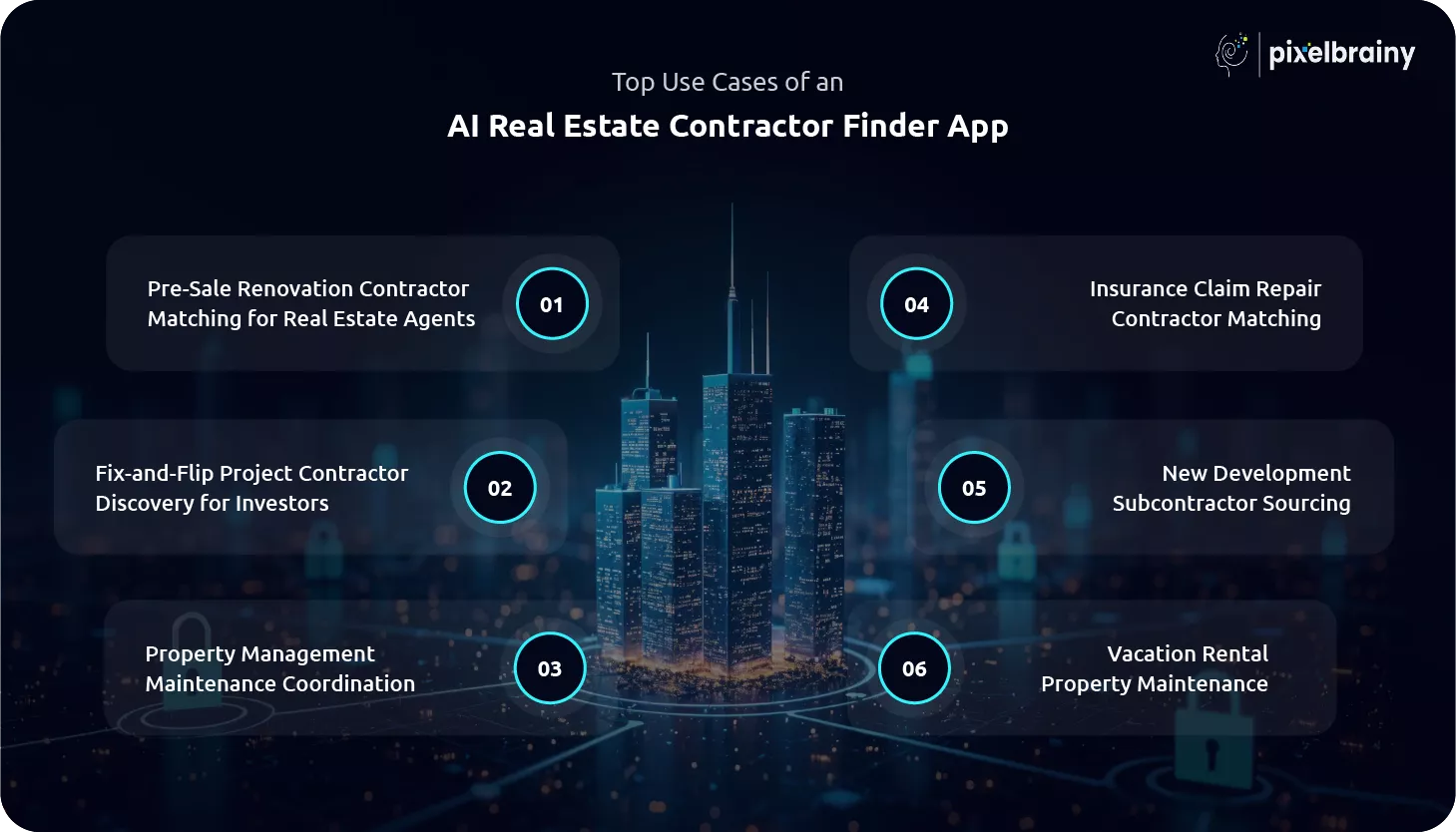
Real estate agents managing pre-sale renovations need contractors who understand tight market timelines and can deliver high-quality results that maximize property value.
Example: An agent preparing a home for listing can instantly find contractors who specialize in quick-turn cosmetic renovations that increase sale price within weeks, not months.
Real estate investors operating in fix-and-flip models depend heavily on speed, cost control, and contractor reliability. A poor contractor decision can directly impact profit margins.
Example: An investor flipping multiple properties can quickly identify contractors who have successfully completed similar renovations within a defined budget range.
Property managers handling multiple units need consistent, fast access to reliable contractors across different service categories.
Example: A property manager overseeing 100+ units can automatically assign a verified plumber within minutes when a maintenance issue is reported.
After property damage events, finding trustworthy contractors quickly is critical. Fraud and unlicensed activity are common in these situations.
Example: A homeowner dealing with water damage can instantly connect with certified restoration contractors who meet insurance compliance requirements.
Developers and general contractors often require specialized subcontractors for complex, multi-phase projects.
Example: A developer working on a multi-unit residential project can source specialized subcontractors such as electricians or HVAC experts with proven project experience.
Short-term rental operators need rapid-response contractors to maintain guest satisfaction and avoid revenue loss.
Example: A vacation rental host can quickly resolve urgent repair issues between guest check-ins without disrupting bookings.
These diverse use cases shows why businesses are increasingly investing in AI Real Estate Contractor Finder App development. Whether the goal is to streamline operations, improve contractor quality, or scale across multiple markets, these use cases provide a clear roadmap for companies planning to build an AI real estate contractor finder app that delivers real-world value.
Every feature in an AI-powered platform directly supports a specific workflow within contractor discovery, selection, and project execution. While it is not necessary to build everything at launch, these features quickly become essential as users scale usage. Any successful AI real estate contractor finder app development strategy should prioritize these capabilities early.
| Feature | Description |
| AI-Powered Contractor Matching Engine | Uses machine learning to intelligently match contractors based on project type, location, budget, timeline, and past performance instead of paid listings or basic filters. Continuously improves with user behavior and project outcomes. |
| Verified Contractor Profiles | Maintains detailed contractor profiles including license status, insurance, certifications, portfolio, and references. Real-time verification ensures credibility and trust. |
| Smart Search and Filter System | Enables users to filter contractors by trade, location, budget, timeline, specialization, and availability, with AI-driven personalization based on past interactions. |
| Project Requirement Input Interface (NLP-Based) | Allows users to describe projects in natural language. NLP converts this input into structured data including scope, budget, and timeline for accurate matching. |
| Bid Request and Management System | Sends project details to matched contractors, collects structured bids, and organizes them for easy side-by-side comparison. |
| AI Bid Comparison and Analysis Tool | Standardizes and analyzes bids by breaking them into comparable components, highlighting missing scope items, and identifying pricing inconsistencies. |
| In-App Messaging and Communication | Provides real-time communication between users and contractors with chat history, file sharing, and notifications in one centralized platform. |
| Real-Time Project Tracking Dashboard | Tracks project progress with milestones, updates, images, and alerts, ensuring transparency and better project management. |
| Review and Rating System | Collects verified post-project reviews based on quality, timeline, communication, and value, improving platform trust and recommendation accuracy. |
| Payment Processing and Escrow Integration | Supports secure, milestone-based payments with escrow protection, automated invoicing, and controlled fund release. |
| Contractor Availability Calendar | Displays real-time availability of contractors, helping users choose professionals who align with their project timelines. |
| License and Insurance Verification Engine | Integrates with external APIs to validate contractor licenses and insurance continuously, ensuring compliance and reducing risk. |
| Push Notification System | Sends real-time alerts for bids, messages, project updates, and milestones to keep users engaged and responsive. |
| Admin Dashboard and Quality Control Panel | Allows platform administrators to monitor performance, manage disputes, track activity, and maintain quality standards. |
| Analytics and Reporting | Provides insights into project history, spending patterns, contractor performance, and platform metrics for better decision-making. |
These features collectively define the foundation of a high-performing AI contractor finder platform, ensuring efficiency, trust, and scalability from day one.
These advanced capabilities are not required for an initial launch, but they are essential for platforms aiming to scale, differentiate, and deliver deeper intelligence. They represent the next phase of innovation for businesses planning to develop a real estate contractor matching platform powered by AI.
| Feature | What It Does | Value Impact |
| Renovation ROI Prediction Engine | Analyzes property data, comparable sales, and renovation costs to estimate potential return before work begins. | Helps users prioritize high-impact renovations and maximize property value. |
| Computer Vision Property Assessment | Uses image recognition to evaluate property condition, identify issues, and estimate renovation scope from uploaded photos. | Reduces dependency on site visits and speeds up project planning. |
| Predictive Timeline Modeling | Combines contractor workload, project complexity, and permit timelines to forecast realistic completion dates. | Improves planning accuracy and reduces delays. |
| Automated Contract Generation (AI-Based) | Creates structured agreements based on approved bids, timelines, and milestones. | Minimizes legal overhead and accelerates project initiation. |
| Voice-Based Project Input | Converts spoken project descriptions into structured requirements using NLP. | Enhances user experience and simplifies onboarding. |
| Multi-Property Management Dashboard | Centralizes tracking of multiple properties, contractors, and ongoing projects in one interface. | Ideal for investors and property managers handling large portfolios. |
| Dynamic Market Pricing Insights | Monitors local labor and material cost trends to evaluate bid competitiveness in real time. | Prevents overpaying and improves budget decision-making. |
| Contractor Performance Benchmarking | Compares contractor metrics against platform-wide standards within specific trades. | Enables more informed contractor selection based on data. |
| MLS and Property Data Integration | Connects with listing databases to initiate contractor searches directly from property insights. | Bridges the gap between property analysis and execution. |
| AI-Assisted Dispute Resolution System | Provides structured workflows and intelligent recommendations for resolving project conflicts. | Enhances trust and ensures smoother conflict management. |
These advanced features elevate a contractor matching platform from a functional tool to a data-driven ecosystem that supports smarter decisions, better outcomes, and long-term scalability.
Building an AI contractor finder app for real estate is both a product and engineering challenge. It requires aligning user experience, data strategy, and AI capabilities to solve real-world inefficiencies in contractor discovery and project execution.
If you are exploring what is the process of creating an AI real estate contractor finder app, the steps below provide a practical roadmap used by successful PropTech platforms and top real estate AI software development companies in USA.
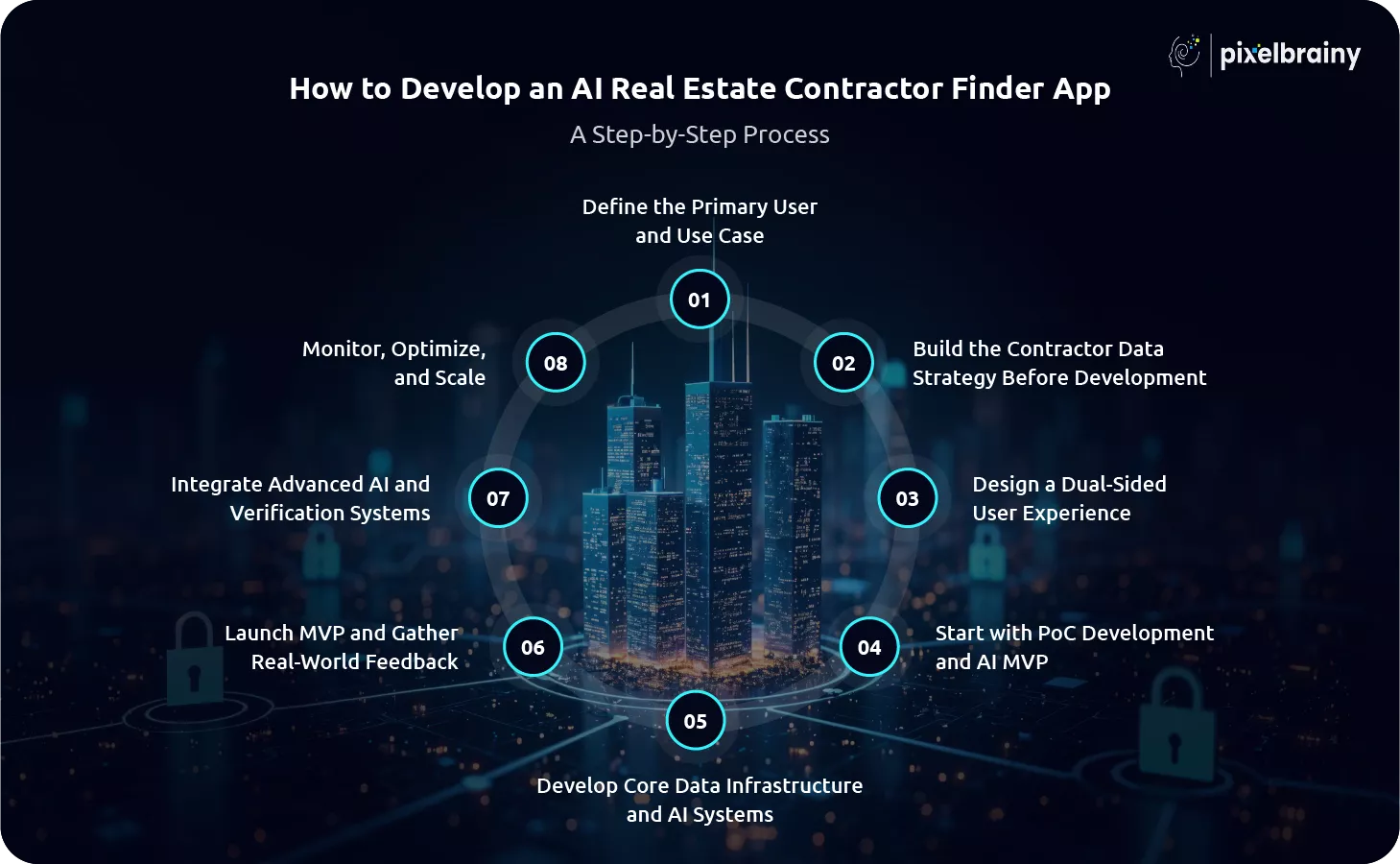
Aim: Identify the initial target audience such as homeowners, real estate investors, or property managers.
Why it matters: Each segment has different workflows and expectations. A focused approach ensures better product-market fit.
Focus on:
Aim: Establish how contractor data will be collected, verified, and maintained.
Why it matters: Data quality directly impacts AI performance. Strong data foundations are essential before any AI integration begins.
Focus on:
Aim: Create seamless experiences for both property owners and contractors.
Why it matters: A marketplace succeeds only when both sides find it easy and valuable to use. Collaborating with an experienced UI/UX design company can significantly improve usability and engagement.
Focus on:
Aim: Validate the concept with a Proof of Concept before building a full-scale product, followed by MVP development.
Why it matters: PoC development helps test feasibility, while MVP Development allows early market validation with minimal investment.
Focus on:
Aim: Build scalable data pipelines and integrate AI models into the platform.
Why it matters: Effective AI integration ensures that the system learns and improves continuously based on real-world usage.
Focus on:
Aim: Release the product in a controlled environment and collect user insights.
Why it matters: Real usage reveals behavioral patterns and gaps that cannot be predicted during development.
Focus on:
Also Read: Top 10 AI MVP Development Companies in USA
Aim: Enhance the platform with advanced capabilities and trust mechanisms.
Why it matters: This stage differentiates the platform from generic marketplaces and improves long-term value.
Focus on:
Aim: Continuously improve performance and expand into new markets.
Why it matters: Long-term success depends on continuous learning and data-driven expansion.
Focus on:
When you plan to develop an AI real estate contractor finder app, following this structured approach ensures that both product strategy and AI capabilities evolve together. Businesses focused on building a scalable and intelligent platform prioritize user experience, strong data foundations, and continuous AI improvement from the beginning.

The cost of building an AI real estate contractor finder app typically ranges from $25,000 to $150,000+, depending on the platform’s complexity, features, and scale. Factors such as the sophistication of the AI matching system, depth of contractor verification integrations, number of user roles, and whether the solution is built for web, mobile, or both all play a significant role in determining the final investment.
Below is a realistic cost breakdown across three development tiers.
| Development Tier | Cost Range | What It Includes |
| Basic AI Contractor Finder MVP | $25,000 to $60,000 | A focused MVP designed for a single user type such as homeowners or investors in one market. Includes basic AI matching (rule-based or simple ML), contractor profiles with manual verification, project input forms, bid request and response system, in-app messaging, basic reviews, push notifications, and an admin dashboard. Ideal for validating the concept quickly with minimal investment. |
| Mid-Level AI Contractor Finder Platform | $60,000 to $100,000 | A production-ready platform supporting multiple user types and markets. Includes a trained machine learning matching engine, automated license and insurance verification APIs, AI bid comparison, milestone tracking, payment integration, contractor performance monitoring, multi-location support, and advanced analytics dashboards. Suitable for businesses launching a scalable commercial product. |
| Advanced Enterprise-Grade Platform | $100,000 to $150,000+ | A full-scale, enterprise solution with deep real estate integration. Includes ROI prediction, computer vision for property analysis, predictive timelines, MLS integrations, portfolio management, AI contract generation, dynamic pricing intelligence, voice-enabled input, multilingual support, advanced dispute resolution, and subscription systems. Designed for large-scale platforms or enterprise use cases. |
The final cost can vary significantly depending on the following variables:
Beyond initial development, maintaining and scaling the platform requires continuous investment:
The real value lies not just in the initial development cost of AI real estate contractor finder app, but in building a scalable and intelligent platform that continues to improve and generate long-term returns.
Building a scalable and high-performing AI contractor finder platform requires a well-planned technology stack that supports data processing, intelligent matching, real-time communication, and seamless user experience. The right combination of tools ensures efficient AI integration, faster development cycles, and long-term scalability.
For businesses investing in the development of an AI real estate contractor finder app, selecting the right technologies is critical to delivering accuracy, performance, and reliability across all system layers.
| Category | Tools & Technologies | Explanation |
| Programming Languages | Python, TypeScript, Swift, Kotlin, Node.js | Python is used for AI model development and data processing. TypeScript powers frontend and API layers. Swift and Kotlin are used for native mobile apps, while Node.js handles backend services. |
| AI & Machine Learning | TensorFlow, PyTorch, scikit-learn, Surprise | These frameworks are used to build recommendation engines, predictive models, and bid analysis systems that drive intelligent contractor matching. |
| Natural Language Processing (NLP) | OpenAI GPT, Anthropic Claude, spaCy, Hugging Face | Enable conversational project input, bid analysis, sentiment detection, and automated summaries. |
| Computer Vision | Google Vision AI, AWS Rekognition, TensorFlow Vision | Used for analyzing property images, detecting renovation needs, and evaluating contractor portfolio quality. |
| Database & Storage | PostgreSQL, MongoDB, Redis, Amazon S3 | PostgreSQL handles structured data, MongoDB supports flexible schemas, Redis enables fast caching, and S3 stores images and documents. |
| Search & Discovery | Elasticsearch, Algolia | Power fast, real-time contractor search with relevance-based filtering and ranking. |
| Verification APIs | CSLB API, LicenseSuite, Ntropy, Insurify | Used for contractor license checks, insurance validation, and compliance verification. |
| Payment Processing | Stripe, Plaid | Enable secure transactions, escrow management, and contractor payouts. |
| Maps & Geolocation | Google Maps API, Mapbox | Support location-based search, contractor service areas, and geographic filtering. |
| Push Notifications | Firebase Cloud Messaging, OneSignal | Deliver real-time alerts for bids, messages, and project updates. |
| Cloud Infrastructure | AWS, Google Cloud, Microsoft Azure | Provide scalable hosting, AI model deployment, and data storage capabilities. |
| DevOps & CI/CD | GitHub Actions, Docker, Kubernetes, Terraform | Enable automated deployments, containerization, and infrastructure management for reliable operations. |
| Analytics & Monitoring | Mixpanel, Amplitude, Datadog, Grafana | Track user behavior, system performance, and AI accuracy for continuous improvement. |
| Frontend Frameworks | React, Next.js, Tailwind CSS | Build fast, responsive, and scalable user interfaces for web applications. |
A well-chosen technology stack is the foundation of a successful AI contractor finder app, enabling seamless integration of intelligence, scalability, and user experience into a single powerful platform.
Every AI contractor finder platform encounters a set of predictable challenges as it evolves from concept to scale. The teams that succeed are the ones that anticipate these issues early and design solutions into the product from the beginning, rather than reacting after problems arise.
For businesses aiming to create a smart contractor finder app integrating AI for real estate services, addressing these challenges proactively is essential for building a reliable and scalable platform. This becomes even more critical when you plan to develop an AI real estate contractor finder app from scratch, where early decisions directly impact long-term performance.
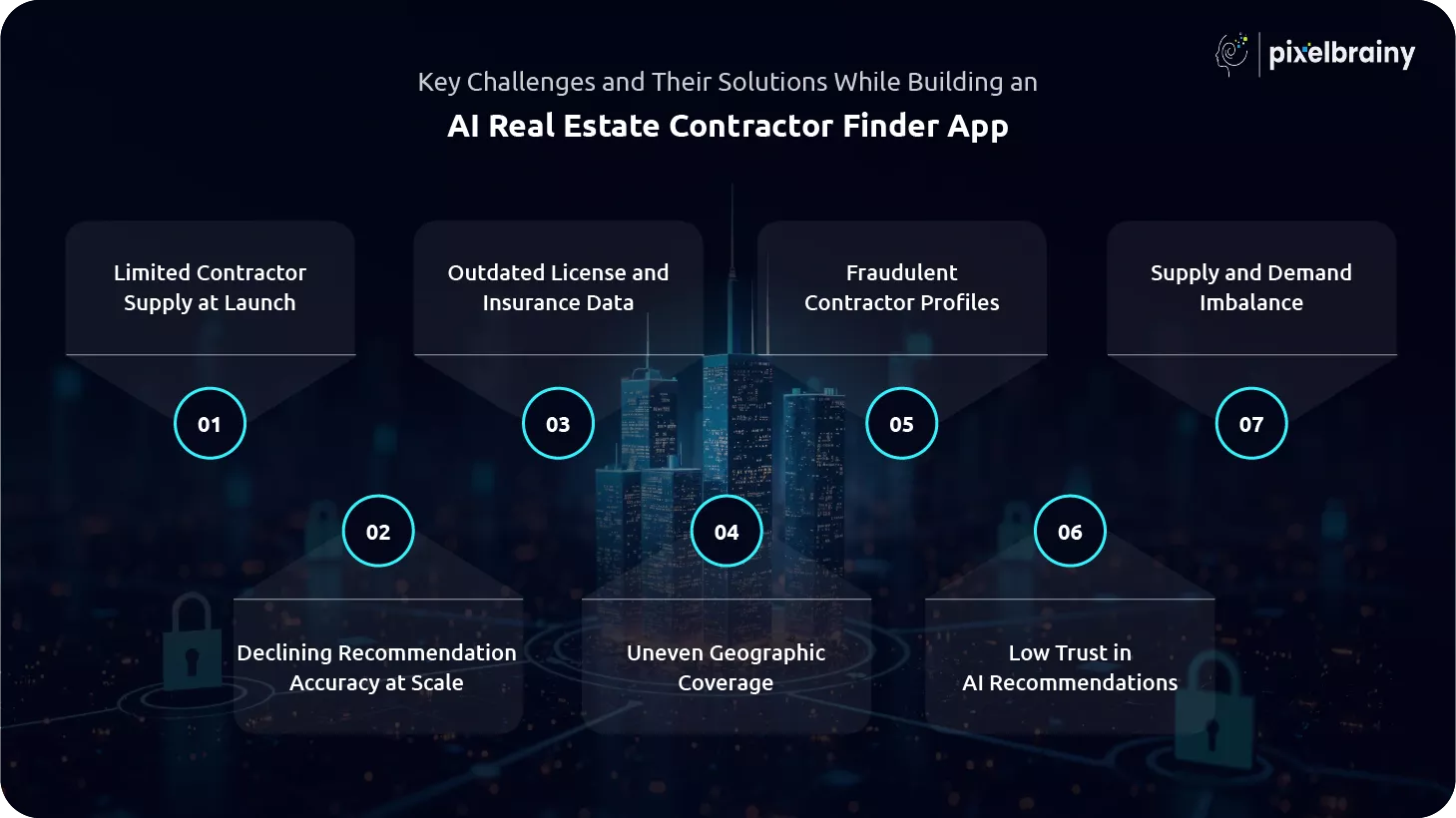
Launching with too few contractors leads to weak recommendations and low user trust. An AI system cannot deliver accurate results without sufficient high-quality data.
Solution:
As the platform expands across regions, maintaining recommendation quality becomes more complex due to limited data in new markets.
Solution:
Contractor credentials can expire over time, and outdated information can reduce trust and create compliance risks.
Solution:
Strong performance in urban areas but weak contractor availability in smaller markets creates inconsistent user experiences.
Solution:
As the platform grows, the risk of fake profiles, misleading credentials, and unreliable contractors increases.
Solution:
Many users still rely on personal referrals, making it challenging to build trust in AI-driven suggestions.
Solution:
An imbalance between contractors and users can affect platform efficiency. Too many contractors reduce engagement, while too few reduce match quality.
Solution:
Overcoming these challenges early ensures that the platform not only functions effectively at launch but continues to scale with accuracy, trust, and long-term sustainability.
Choosing the right technology partner can determine whether your platform becomes a scalable PropTech solution or just another marketplace with limited traction. Success in this space requires more than coding expertise. It demands a deep understanding of real estate workflows, AI-driven recommendation systems, and data architectures that improve over time.
PixelBrainy LLC brings this combination together. Recognized among the top real estate AI software development companies in USA, we specialize in building intelligent platforms where accuracy, trust, and performance directly impact user adoption and business growth.
Our approach goes beyond standard development. We focus on delivering platforms that are not only technically sound but also practical, scalable, and aligned with real-world usage patterns.
Even the most advanced AI system fails if users cannot understand or trust its recommendations. That is why we prioritize user experience from the very beginning.
Our team collaborates closely with experienced UI/UX design specialists to ensure:
This ensures that AI features are not just built, but actively used.
We provide complete support across every stage of the product lifecycle, whether you are validating an idea or scaling a full platform.
Our capabilities include:
This makes us a strong partner for businesses looking to build an AI real estate contractor finder app that performs reliably in real-world conditions.
We partnered with a US-based PropTech company to develop an AI-powered contractor matching platform for real estate investors across multiple cities.
Key features included:
Results achieved:
Building a successful AI contractor finder platform requires the right combination of technology, data, and user experience. PixelBrainy LLC focuses on delivering all three in a way that drives real adoption and long-term value.
If you are planning to create or scale an AI-powered contractor finder platform, our team is ready to help you move from idea to execution with clarity and confidence. Contact us today to discuss your project.
Finding the right contractor for a real estate project should not take days. It should not require spreadsheets, endless phone calls, or manual license lookups. And it should not depend on which contractor happened to spend the most on ad placement.
An AI real estate contractor finder app solves this by building intelligence into the discovery process itself. The right contractor recommendation, at the right time, with verified credentials and a track record that matches the specific project scope, is now achievable. The technology exists. The market is ready. The demand from property owners, investors, and real estate professionals is clear.
The platforms that get built now, with thoughtful AI architecture, strong data strategies, and user experiences designed for real estate workflows rather than generic contractor searches, will define how this category works for the next decade.
If you are ready to build an AI contractor finder app that actually delivers on the promise of intelligent matching, book an appointment with PixelBrainy today and start your journey.
An AI real estate contractor finder app uses machine learning to match users with contractors based on project scope, budget, timeline, and verified performance. In contrast, platforms like Angi or HomeAdvisor function mainly as directories where visibility is often influenced by paid placements rather than actual project fit.
An AI contractor finder app verifies contractors through API integrations with state licensing boards and insurance providers. Credentials are validated at onboarding and rechecked periodically to ensure they remain current and compliant.
AI contractor matching relies on contractor data such as specialization, location, past project performance, and availability, along with user inputs like project type, budget, timeline, and location. More completed project data improves accuracy over time.
The timeline to develop an AI real estate contractor finder app typically ranges from 12–16 weeks for an MVP to 8–12 months for a full-scale platform, depending on features, AI complexity, and integrations.
A contractor finder platform attracts early contractors by offering free onboarding, early access benefits, partnerships with industry groups, and focusing on a single market to build initial traction before scaling.
An AI contractor finder app can be tailored for niches such as fix-and-flip projects, vacation rentals, or property management, enabling better product-market fit and faster adoption by focusing on specific user workflows.

About The Author
Sagar Bhatnagar
Sagar Sahay Bhatnagar brings over a decade of IT industry experience to his role as Marketing Head at PixelBrainy. He's known for his knack in devising creative marketing strategies that boost brand visibility and market influence. Sagar's strategic thinking, coupled with his innovative vision and focus on results, sets him apart. His track record of successful campaigns proves his ability to utilize digital platforms effectively for impactful marketing efforts. With a genuine passion for both technology and marketing, Sagar continuously pushes PixelBrainy's marketing initiatives to greater success.


Transform your ideas into reality with us.
Working with the PixelBrainy team has been a highly positive experience. They understand the design requirements and create beautiful UX elements to meet the application needs. The dev team did an excellent job bringing my vision to life. We discussed usability and flow. Sagar worked with his team to design the database and begin coding. Working with Sagar was easy. He has the knowledge to create robust apps, including multi-language support, Google and Apple ID login options, Ad-enabled integrations, Stripe payment processing, and a Web Admin site for maintaining support data. I'm extremely satisfied with the services provided, the quality of the final product, and the professionalism of the entire process. I highly recommend them for Android and iOS Mobile Application Design and Development.

Great experience working with them. Had a lot of feedback and I found that unlike most contractors they were bugging me for updates instead of the other way around. They were extremely time conscience and great at communicating! All work was done extremely high quality and if not on time, early! They were always proactive when it comes to communication and the work is great/above par always. Very flexible and a great team to work with! Goes above and beyond to present us with multiple options and always provides quality. Amazing work per usual with Chitra. If you have UI/UX or branding design needs I recommend you go to them! Will likely work with them in the future as well, definitely recommended!

PixelBrainy is a joy to work with and is a great partner when thinking through branding, logo, and website layout. I appreciate that they spend time going into the "why" behind their decisions to help inform me and others about industry best practices and their expertise.

I hired them to design our software apps. Things I really like about them are excellent communication skills, they answer all project suggestions and collaborate right away, and their input on design and colors is amazing. This project was complex and needed patience and creativity. The team is amazing to do business with. I will be using them long-term. Glad to see there are some good people out there. I was afraid to try and outsource my project to someone but I am glad I met them! I really can't say enough. They went above and beyond on this project. I am very happy with everything they have done to make my business stand out from the competition.

It was great working with PixelBrainy and the team. They were very responsive and really owned the project. We'll definitely work with them again!

I recently worked with the PixelBrainy team on a project and I was blown away by their communication skills. They were prompt, clear, and articulate in all of our interactions. They listened and provided valuable feedback and suggestions to help make the project a success. They also kept me updated throughout the entire process, which made the experience stress-free and enjoyable.

PixelBrainy is very good at what it does. The team also presents themselves very professionally and takes care of their side of things very well. I could fully trust them taking up the design work in a timely and organised manner and their attention to detail saved us lots of effort and time. This particular project was quite intense and the team showed that they function very well under pressure. Very much looking forward to working with her again!

It's always an absolute pleasure working with them. They completed all of my requests quickly and followed every note I had for them to a T, which made our process go smoothly from start to finish. Everything was completed fast and following all of the guidelines. And I would recommend their services to anyone. If you need any design work done in the future, PixelBrainy should be your first call!

They took ownership of our requirements and designed and proposed multiple beautiful variants. The team is self-motivated, requires minimum supervision, committed to see-through designs with quality and delivering them on time. We would definitely love to work with PixelBrainy again when we have any requirements.

PixelBrainy was a big help with our SaaS application. We've been hard at work with a new UI/UX and they provided a lot of help with the designs. If you're looking for assistance with your website, software, or mobile application designs, PixelBrainy and the team is a great recommendation.

PixelBrainy designers are amazing. They are responsive, talented, and always willing to help craft the design until it matches your vision. I would recommend them and plan to continue them for my future projects and more!!!

They were awesome! Did a good job fast, and good communication. Will work with them again. Thank you

Creative, detail-oriented, and talented designers who take direction well and implement changes quickly and accurately. They consistently over-delivered for us.

PixelBrainy team is very talented and creative. Great designers and a pleasure to work with. PixelBrainy is an excellent communicator and I look forward to working with them again.

PixelBrainy has a very talented design team. Their work is excellent and they are very responsive. I enjoy working with them and hope to continue on all of our future projects.


