AI Summary Powered by PixelBrainy
What if your rent collection system could predict which tenants are likely to pay late, automatically send personalized reminders, reconcile incoming payments, calculate applicable late fees, and alert your property team before a payment becomes overdue?
Consider this real-world scenario: “I manage 340 residential units across fourteen properties and my current rent management process involves a combination of a basic property management software, individual bank transfers, and manually maintained spreadsheets to track payment status, send reminders, and calculate late fees. I spend approximately twelve hours per week just on rent collection administration tasks that should be automated. I want to build or commission an AI rent management platform that handles all of these tasks automatically and uses AI to predict which tenants are likely to pay late so I can reach out proactively before payments are due rather than chasing overdue payments after the fact.”
This scenario highlights a growing need for AI rent management platform development among property managers, multifamily operators, landlords, and PropTech businesses. Conventional property management software can record rent payments and tenant information, but an AI-powered platform can go further by predicting payment risks, automating collection workflows, analyzing tenant payment patterns, and providing actionable financial insights.
The market opportunity is also expanding. According to Grand View Research, the global real estate software market is estimated at USD 14.3 billion in 2026 and is projected to reach USD 32.0 billion by 2033, growing at a 12.2% CAGR from 2026 to 2033. The report identifies cloud computing and Artificial Intelligence as technologies contributing to market growth.
For property managers, this creates a strong business case for rent management platform development with AI. The goal is not simply to add AI to an existing payment application. It is to create an intelligent operational system that connects tenants, leases, properties, payments, communication, accounting, analytics, and predictive models.
Whether you want to develop an AI rent collection platform for internal operations or launch a commercial SaaS product, understanding the features, development process, technology requirements, costs, monetization models, and implementation challenges is essential.
This guide provides a step-by-step guide to make an AI rent management software designed for modern property-management operations.
An AI rent management platform is a specialized software solution that uses artificial intelligence, automation, machine learning, and data analytics to manage rental payment operations from a single system. It helps property managers handle rent collection, payment tracking, tenant communication, late-fee calculations, payment reconciliation, and financial reporting while using AI to identify patterns and support proactive decisions.
For property managers handling hundreds or thousands of rental units, the biggest value of an AI rent management platform is its ability to move beyond basic record keeping. Instead of waiting for a tenant to miss a payment, the system can analyze historical payment behavior and identify accounts that may require attention before the rent becomes overdue.
For example, a standard property management system may display that a tenant's rent is due on the fifth of the month. An AI rent management platform can analyze previous payment dates, failed transactions, outstanding balances, and other relevant operational data to identify a potential payment delay and recommend an early reminder.
The primary difference is the level of automation, prediction, and intelligence offered by each system.
Standard property management software typically focuses on managing property records, tenants, leases, rent schedules, maintenance requests, payments, and reports. It acts primarily as a centralized system for storing and retrieving operational information.
An AI rent management platform adds intelligent capabilities to these workflows. It can analyze large volumes of rental data, automate repetitive actions, generate personalized communications, detect unusual payment activity, forecast rental cash flow, and provide recommendations to property managers.
| Capability | Standard Property Management Software | AI Rent Management Platform |
|---|---|---|
| Tenant management | Yes | Yes |
| Lease management | Yes | Yes |
| Rent tracking | Yes | Yes |
| Online payments | Usually | Yes |
| Automated reminders | Basic | Intelligent and personalized |
| Payment reconciliation | Rules based | Automated and intelligent |
| Late payment prediction | Limited | AI powered |
| Cash flow forecasting | Basic | Predictive |
| Payment anomaly detection | Limited | AI supported |
| AI assistant | Rare | Available |
| Collection prioritization | Manual | AI assisted |
| Portfolio insights | Standard reports | Predictive analytics |
The distinction can be summarized simply: standard property management software tells managers what has happened, while an AI rent management platform can help determine what may happen next and what action should be considered.
This makes AI rent management platform development particularly relevant for property managers, multifamily operators, landlords, real estate companies, and PropTech founders seeking to reduce manual rent administration, improve collection visibility, and build scalable rental operations.
An AI rent management platform works by connecting property, tenant, lease, payment, and communication data in one system. It uses automation and artificial intelligence to collect rent, monitor payment activity, identify potential late-payment risks, send personalized reminders, reconcile transactions, and provide actionable insights to property managers.
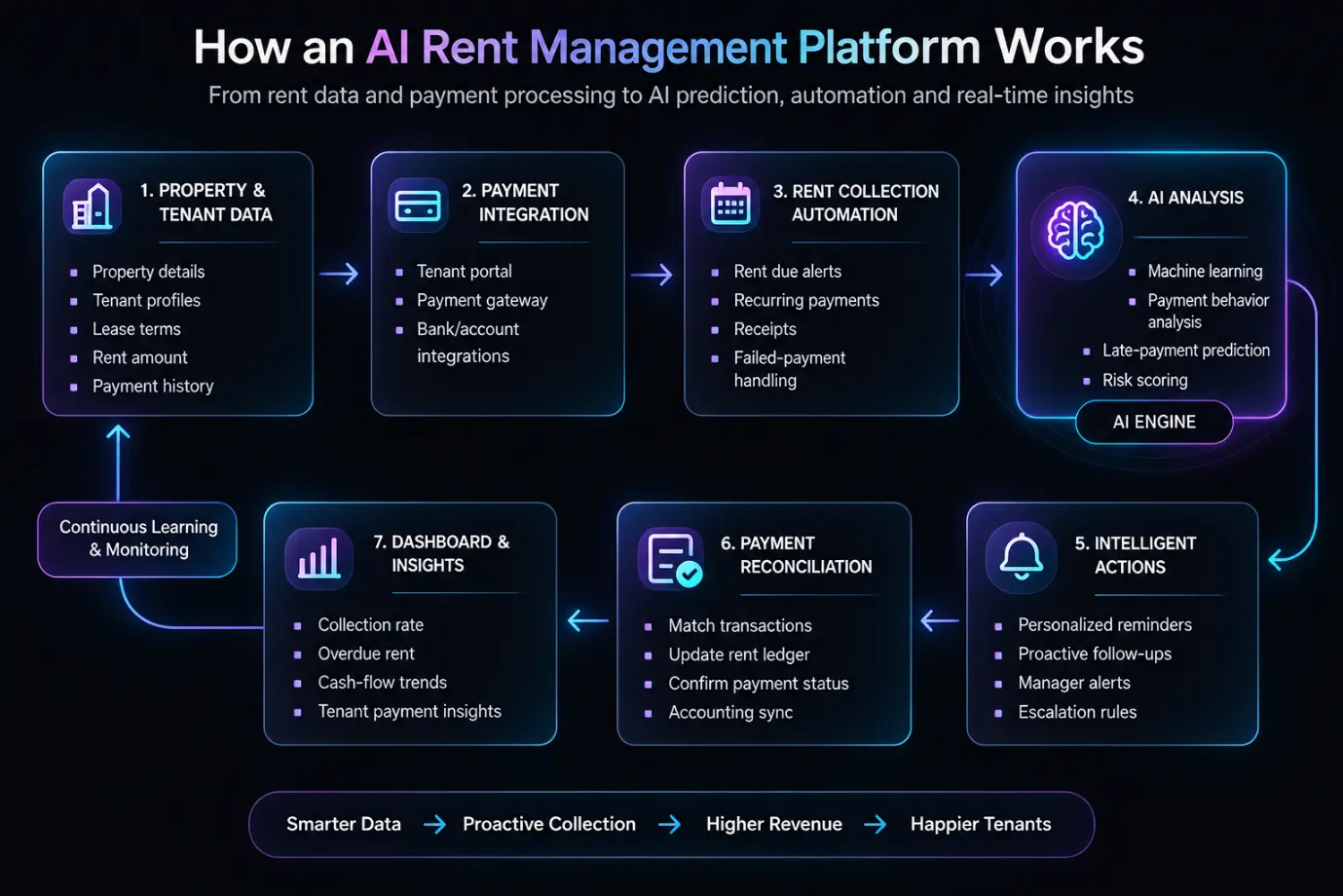
The platform first connects information such as tenant profiles, lease agreements, rent amounts, due dates, payment history, property details, and communication records. APIs can connect the platform with existing property management systems, accounting software, banking services, and payment gateways.
Tenants can pay through a secure tenant portal using supported payment methods. Once a transaction is initiated, the platform receives payment status data and connects it with the correct tenant, lease, property, and rent obligation.
The system automatically manages recurring rent workflows, payment reminders, failed-payment notifications, receipts, and collection follow-ups. This reduces repetitive administrative work for property managers.
This is where rent management platform development with AI becomes different from basic automation. Machine learning models can analyze historical payment behavior, missed payments, payment timing, lease information, and other relevant signals to identify tenants who may have a higher risk of paying late.
For example, if a tenant regularly pays several days after the due date, the platform can flag the account before the next rent deadline and recommend an earlier reminder.
Based on predefined rules and AI-generated risk signals, the platform can send personalized reminders, recommend follow-up actions, or escalate specific accounts for human review. AI predictions should support property-manager decisions rather than automatically make sensitive decisions about tenants.
After payment processing, the platform updates rent ledgers, matches transactions, records outstanding balances, and generates dashboards showing rent collection rates, overdue payments, payment trends, and cash-flow insights.
In simple terms:
Property Data → Payment Integration → Rent Collection → AI Risk Analysis → Automated Actions → Payment Reconciliation → Real-Time Insights
This workflow forms the foundation of an AI rent collection platform that helps property managers move from reactive payment chasing to proactive rent management.
Who needs an AI rent management platform? It is most valuable when rent collection involves a growing number of tenants, properties, payment transactions, or compliance rules. Property managers, landlords, real estate investors, PropTech founders, multifamily operators, and affordable housing providers can use AI to reduce manual collection work and make payment management more proactive.
If you are searching “how to build an AI rent management platform,” “how to create AI rent collection software,” or “is AI rent management software worth it for property managers?”, the answer depends largely on your portfolio size and operational challenges.
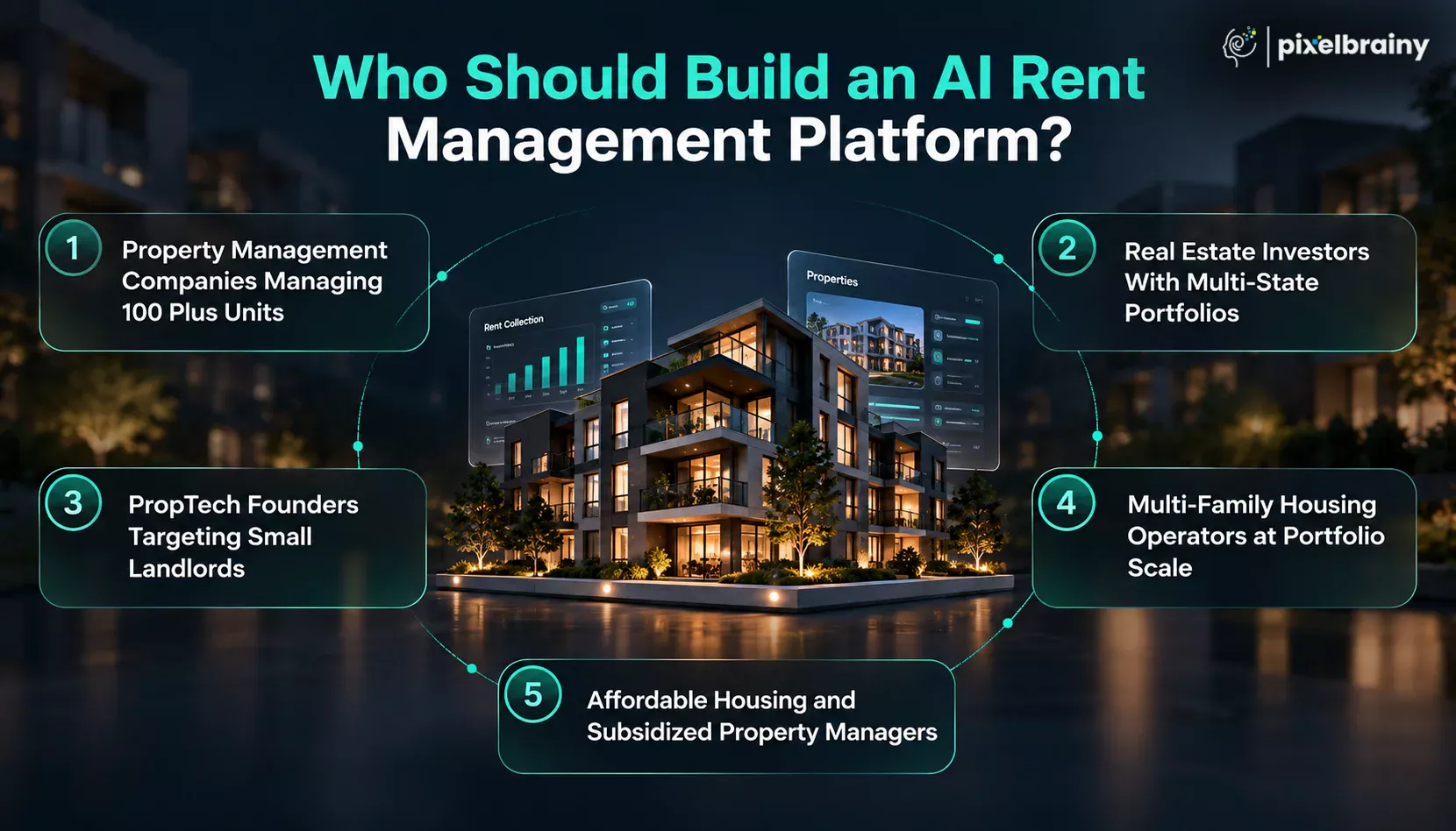
How can property managers automate rent collection? For companies managing 100+ units, manual reminders, payment tracking, late-fee calculations, and delinquency follow-ups can become difficult to manage consistently.
An AI rent management platform for property managers can standardize these workflows across properties and teams. AI can identify potential late-payment risks, while automation manages reminders, receipts, payment updates, and escalation workflows.
Best fit: Property management companies looking to develop AI rent management software for portfolio-wide collection and delinquency management.
How do real estate investors manage rent across multiple states? A centralized platform can bring property, tenant, lease, payment, and compliance data into one system.
When investors create an AI rent management platform, features can include multi-state payment integrations, compliance workflows, rent forecasting, and AI-powered rental market analysis.
Best fit: Investors managing multiple properties who need consolidated visibility and automated workflows.
Can small landlords use AI for rent collection? Yes. Founders targeting owners with 5 to 50 units can build affordable solutions for landlords still using spreadsheets, banking apps, or basic property software.
To make AI rent management software for landlords, core features can include automated reminders, payment tracking, late-payment prediction, tenant communication, and cash-flow insights.
Best fit: PropTech startups targeting underserved small-landlord workflows.
How can multifamily operators reduce rent delinquency with AI? Enterprise platforms can combine property management integrations with AI-powered delinquency analytics, payment forecasting, automated escalation, and renewal rent optimization.
Best fit: Operators managing hundreds or thousands of units.
How can AI simplify Section 8 rent management? Specialized platforms can support HAP payment reconciliation, income recertification tracking, compliance alerts, tenant payments, and automated collection workflows.
Best fit: Section 8 and LIHTC property managers requiring both rent automation and compliance management.
| Builder Type | Portfolio Scale | Primary AI Need | Key Integration |
|---|---|---|---|
| Property management company | 100 to 5,000+ | Late-payment prediction | Accounting/ERP |
| Real estate investor | 10 to 500 | Multi-state visibility | Banking/payment APIs |
| PropTech founder | 5 to 50 | Affordable AI automation | Payment gateway APIs |
| Multifamily operator | 500 to 10,000+ | Delinquency analytics | Enterprise PMS |
| Affordable housing manager | 50 to 2,000 | HAP/compliance tracking | Housing authority APIs |
Therefore, choosing to develop an AI rent management platform makes the most sense when payment volume, portfolio complexity, or compliance requirements have outgrown manual processes. The next decision is determining which AI features, integrations, and automation workflows your target users actually need.
A property manager handling hundreds of rental units may ask: “How can I collect rent automatically, identify tenants who may pay late, and reduce the hours my team spends chasing payments?” This is where an AI rent management platform can deliver measurable operational value.
Unlike basic rent collection software that mainly records transactions and sends scheduled reminders, AI-powered rent management software can analyze payment behavior, identify patterns, automate repetitive workflows, and provide predictive insights. For property managers, landlords, investors, and PropTech companies, developing an AI rent management platform can improve collection efficiency while creating a centralized system for payment intelligence and portfolio management.
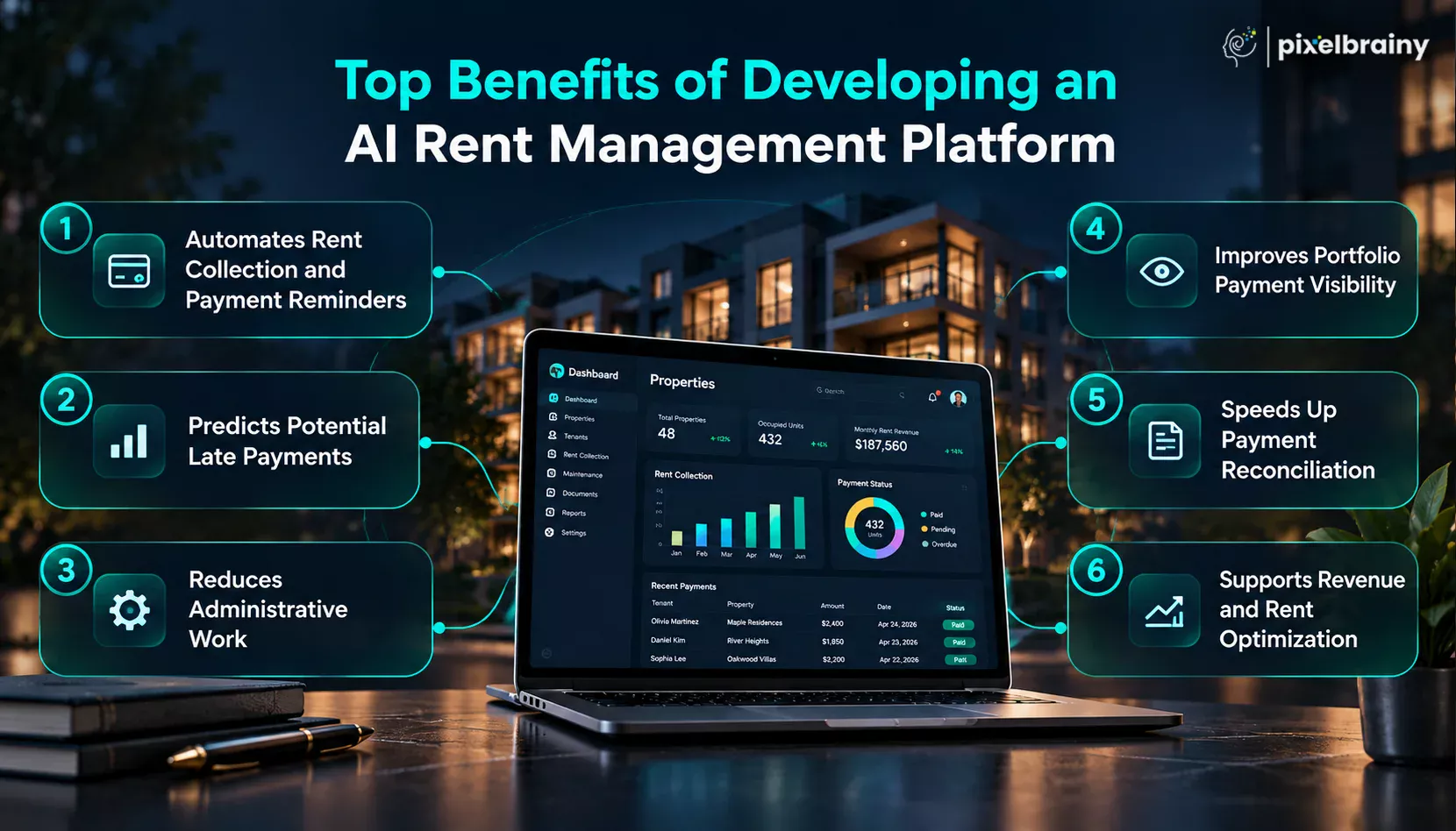
Can AI automate rent collection for property managers? Yes. An AI rent management platform can automate due-date reminders, recurring payment workflows, receipts, failed-payment notifications, and follow-ups.
This reduces repetitive collection work and gives every property a consistent payment workflow. Landlords can also use tenant portals and payment gateways to make digital rent payments easier.
How can AI predict which tenants may pay rent late? Machine learning models can analyze relevant historical payment patterns, payment timing, missed payments, and other permitted signals to identify accounts with a higher likelihood of late payment.
Instead of waiting for an account to become overdue, managers can receive an early risk signal and decide whether proactive communication is appropriate.
Property teams often spend time checking payment status, sending reminders, updating ledgers, and following up on outstanding balances.
With AI rent management software development, these repetitive tasks can be automated. Managers can focus more on tenant service, maintenance, leasing, and other activities that require human attention.
How do I track rent payments across multiple properties from one dashboard? A centralized AI rent management platform can combine payment, tenant, lease, and property data into a unified view.
Managers can monitor collected rent, outstanding balances, overdue accounts, payment trends, and collection performance without switching between spreadsheets or separate property records.
Manual reconciliation can result in unmatched transactions, duplicate records, and outdated rent ledgers. AI-powered software can connect payment gateways with property management and accounting systems to match transactions with the relevant tenant, lease, and rent obligation.
This helps managers maintain more accurate payment records and identify failed, pending, or outstanding transactions faster.
Can AI help property managers increase rental revenue? AI can analyze historical rent, occupancy, payment, and property data to identify useful trends and support forecasting.
Depending on the platform, predictive analytics can assist with rent forecasting, renewal analysis, collection trends, and revenue optimization. Final pricing and tenant-related decisions should remain subject to appropriate human review.
The strongest reason to develop AI rent management software is its ability to combine rent collection automation with prediction, reconciliation, and portfolio intelligence. This helps rental businesses move from reactive payment administration toward proactive rent management.
A real estate investor managing 85 residential units across three states might say: “I have grown my portfolio from 10 to 85 units, but my rent management process has not grown with it. I am still tracking payments across different property managers, states, and systems. I want to develop an AI rent management platform that gives me one view of my portfolio, automates routine rent collection, and helps me identify where rent performance is falling behind.”
This type of requirement shows why AI rent management platform development needs to cover the complete rent collection workflow, not just online payments. The platform should connect tenant data, properties, leases, payment processing, accounting, communication, and reporting in one place. Below is the core features required to build a scalable AI rent management platform:
| Core Feature | Explanation |
|---|---|
| Tenant Management | Centralizes tenant profiles, contact information, payment details, lease records, account status, and relevant rental information. This gives the platform a consistent tenant data layer for rent collection, communication, and account administration. |
| Property and Unit Management | Organizes properties, buildings, units, occupancy status, rent amounts, and property-level records. Investors and property managers can manage multiple locations from one platform instead of maintaining separate spreadsheets and disconnected property records. |
| Lease Management | Stores lease terms, rental amounts, payment due dates, lease periods, security deposits, renewal dates, and applicable payment conditions. These records support automated rent schedules and accurate tenant payment obligations. |
| Online Rent Payments | Allows tenants to submit rent payments through supported digital payment methods. Each transaction can be connected to the appropriate tenant, lease, unit, property, and outstanding balance for accurate payment tracking. |
| Recurring Payment Setup | Enables tenants to schedule recurring rent payments according to their lease obligations. This reduces manual payment activity and creates a predictable monthly rent collection workflow for landlords and property managers. |
| Automated Rent Reminders | Sends configurable reminders before or after rent due dates through supported communication channels. Property managers can establish consistent notification workflows without manually contacting every tenant about upcoming or overdue payments. |
| Late Payment Tracking | Tracks overdue rent, outstanding balances, payment status, and collection activity. Managers can quickly identify accounts requiring attention and maintain visibility into delinquent payments across individual properties or an entire rental portfolio. |
| Late Fee Management | Calculates and records applicable late fees based on configured lease terms and property rules. This reduces manual calculations and helps maintain consistent records when tenants make payments after applicable deadlines. |
| Payment Processing Integration | Connects the platform with payment gateways and financial services to process rent transactions and receive payment-status information. Reliable integrations are essential when businesses build an AI rent management platform for growing portfolios. |
| Payment Reconciliation | Matches incoming payments with the correct tenant, lease, property, and outstanding rent obligation. This reduces manual reconciliation work and helps keep rent ledgers and connected financial records accurately updated. |
| Tenant Payment History | Maintains historical records of successful payments, failed transactions, late payments, refunds, and outstanding balances. Property managers can review account activity and maintain complete payment records for each tenant. |
| Accounting Integration | Connects rent collection data with accounting platforms, property management systems, or ERP software. This reduces duplicate data entry and helps synchronize financial information between rent collection and broader property operations. |
| Notifications and Alerts | Delivers payment confirmations, failed-payment alerts, overdue notices, and other relevant notifications. Configurable alerts help managers respond to important payment events without continuously checking individual tenant accounts. |
| Property Manager Dashboard | Provides one centralized view of collected rent, outstanding balances, overdue accounts, payment activity, and property performance. This is particularly useful for investors managing multiple properties, states, or third-party property managers. |
| Reporting and Analytics | Generates reports covering collection rates, overdue balances, payment activity, transaction history, and property-level performance. These reports create the data foundation needed for future AI analytics, forecasting, and rent optimization. |
These core capabilities provide the foundation to create AI rent management software that can support landlords, investors, property managers, and large rental portfolios, while advanced AI capabilities can be introduced as a separate intelligence layer.
A standard rent management platform can collect payments, send reminders, and maintain tenant records. But what advanced features can make an AI rent management platform more intelligent and competitive? Property managers and PropTech founders increasingly need capabilities that can interpret rental data, anticipate problems, personalize tenant interactions, and support better financial decisions.
For example, a multifamily operator managing 2,000 units might ask: “Can I build an AI rent management platform that does more than collect rent and can actually predict delinquency, understand tenant payment behavior, recommend collection actions, and identify revenue opportunities across my portfolio?” These non-ordinary features can help turn a conventional rent collection system into an intelligent property finance platform.
Below are 10 advanced features to consider when developing an AI rent management platform:
| Non-Ordinary Feature | Explanation |
|---|---|
| AI Late-Payment Risk Scoring | Machine learning can evaluate relevant historical payment patterns and account signals to assign a late-payment risk score. Property managers can use these signals to prioritize proactive communication before rent becomes overdue. |
| AI-Powered Collection Recommendations | Instead of simply flagging overdue accounts, AI can analyze account context and recommend appropriate next actions, such as sending a reminder, requesting follow-up, or escalating an exception for manager review. |
| Personalized Tenant Communication | AI can help generate context-aware payment reminders based on payment history, communication preferences, and account status. This creates more relevant tenant interactions instead of sending identical messages to every resident. |
| AI Rent Forecasting | Predictive models can analyze historical collections, occupancy patterns, payment trends, and relevant property data to forecast expected rental income. Managers can use these forecasts for cash-flow planning and portfolio management. |
| Portfolio Revenue Opportunity Detection | AI can analyze rent collection and property-level performance to identify units, properties, or markets showing unusual collection gaps or revenue patterns that may require further investigation by management teams. |
| Intelligent Tenant Payment Assistant | An AI-powered conversational assistant can answer common questions about rent due dates, payment status, accepted payment methods, receipts, and account information while routing complex issues to human staff. |
| Anomaly Detection for Rent Transactions | AI can identify unusual payment activity, unexpected transaction patterns, duplicate records, or reconciliation exceptions. This gives finance teams an additional layer of monitoring beyond conventional rules-based validation. |
| AI-Powered Renewal Insights | The platform can analyze lease history, payment behavior, property performance, and relevant rental data to help managers identify renewal patterns and support informed lease-renewal planning. |
| What-If Revenue Simulation | Managers can evaluate potential scenarios, such as changes in collection rates, vacancy levels, or renewal assumptions. AI-supported simulations can show how different operational scenarios may affect projected rental revenue. |
| AI Executive Rent Intelligence | An AI intelligence layer can summarize portfolio performance and surface important changes across collections, delinquency, payments, and revenue trends. Executives can ask natural-language questions instead of manually reviewing multiple reports. |
These advanced capabilities can differentiate an AI rent management platform from conventional rent collection software by adding prediction, personalization, anomaly detection, and decision-support intelligence to everyday rental operations.
After you finalized the features, now it’s time to turn the product concept into a practical development roadmap. What are the steps to build an AI rental management platform from idea to launch? The process typically moves through market validation, requirements, UX planning, technical architecture, AI strategy, development, testing, and deployment.
Consider a PropTech founder who says:
“I am a proptech founder and I want to build an AI rent management platform specifically for the small landlord market, meaning landlords managing between five and fifty units who currently have no good software option. The enterprise platforms like Yardi and AppFolio are too complex and expensive for small landlords and the basic apps lack genuine AI capability. I want to build a platform that gives small landlords the kind of AI-powered rent management intelligence that enterprise operators have access to at a price point and complexity level that works for a landlord managing fifteen units. I want to understand what the development scope, cost, and timeline looks like for this product.”
For this type of product, the development process of an AI rent management platform should begin with a focused MVP rather than attempting to build every enterprise feature at once.
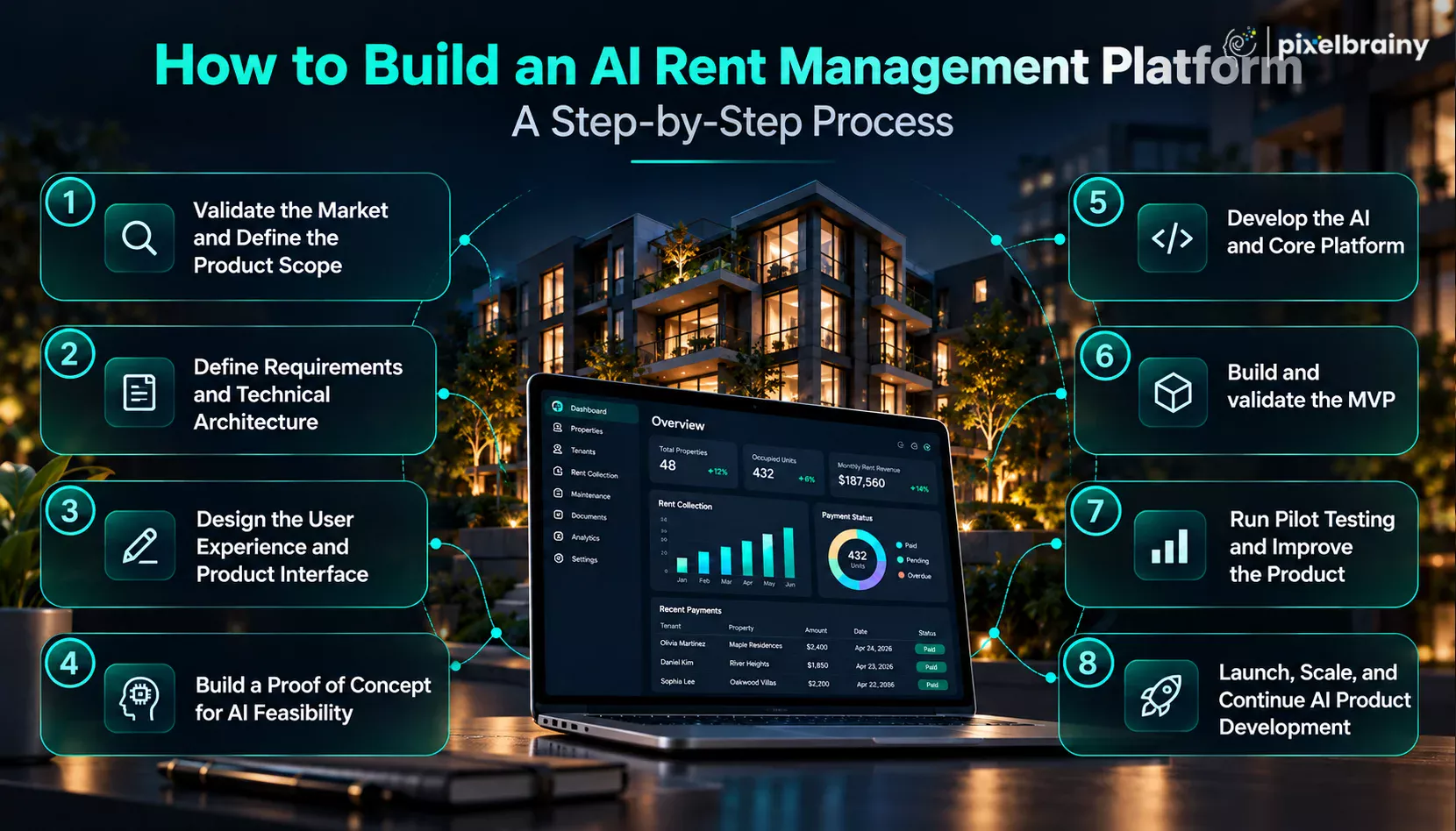
Start by identifying the exact landlord segment, payment problems, existing alternatives, willingness to pay, and AI capabilities customers actually need. Define whether the product will target landlords managing 5 to 50 units, property managers, or both.
For founders exploring how to build AI rent management software from scratch, this stage should establish the core problem, target personas, value proposition, business model, and measurable product goals. A focused AI consultation can help evaluate the technical and commercial feasibility before development begins.
Convert the validated concept into detailed functional and technical requirements. Define tenant management, property management, lease tracking, payment processing, automated reminders, dashboards, reporting, user roles, integrations, and security requirements.
For building an AI rent management software, architecture decisions should cover the frontend, backend, database, APIs, payment infrastructure, cloud environment, analytics layer, and AI services. The architecture should also allow additional properties, tenants, integrations, and AI capabilities to be added as the platform grows.
The goal is to make complex rent management feel simple for a landlord managing 15 units. Map user journeys for onboarding, adding properties, connecting payments, collecting rent, reviewing overdue accounts, and understanding AI recommendations.
A specialized UI/UX design company can create wireframes, interactive prototypes, dashboards, tenant workflows, and responsive interfaces before engineering starts. At this stage, usability should remain a priority because small landlords may not have dedicated property management staff.
Before investing heavily in full development, validate the most important AI use case. For example, test whether available payment data can support useful late-payment risk predictions or collection recommendations.
PoC development can help evaluate data availability, model feasibility, prediction quality, integration complexity, and expected business value. The objective is not to build the complete platform but to prove that the proposed AI capability can work with realistic data and workflows.
Once feasibility is established, engineering can begin across the core product and intelligence layer. Backend developers build tenant, property, lease, payment, notification, reconciliation, and reporting services while AI specialists work on the selected models.
This stage of AI model development may include data preparation, feature engineering, model training, evaluation, and monitoring. During AI integration, the models are connected to application workflows so their outputs can support practical actions rather than remaining isolated analytics.
Also Read: Top 12+ AI Model Development Companies in the USA
The next step is MVP development, focusing on the smallest version that solves the target customer's primary problem. For a small-landlord platform, this could include property and tenant management, online rent payments, automated reminders, payment tracking, dashboards, and one carefully selected AI capability.
Testing should cover payment workflows, account permissions, data accuracy, notifications, integrations, security, usability, and AI outputs. The MVP should be stable enough for controlled real-world usage before expanding the feature set.
Also Read: Top 10 AI MVP Development Companies in USA
Launch the MVP with a limited group of real landlords and collect structured feedback. Monitor payment completion, reminder engagement, onboarding friction, dashboard usage, AI recommendation usefulness, support requests, and other relevant product metrics.
Feedback from pilot users helps determine which features should be improved, removed, or prioritized next. Hire AI developers with experience in production AI systems when additional model refinement, data pipelines, or intelligent automation becomes necessary during this stage.
After successful pilot validation, prepare the platform for a broader launch. Set up production infrastructure, monitoring, customer support, analytics, security controls, backup procedures, and release processes.
Whether you work with AI product development companies, internal engineers, or one of the top AI real estate software development companies, post-launch development should focus on measurable customer needs. New integrations, improved AI models, additional automation, and portfolio analytics can then be introduced based on actual usage data.
Following these steps to build an AI rental management platform helps move the product from a validated idea to a scalable real estate technology solution without overbuilding the first release.
The cost to develop an AI rent management platform typically ranges from $30,000 to $250,000+, depending on the product scope, AI capabilities, integrations, security requirements, and development complexity. A basic platform with automated rent collection can stay closer to the lower end, while an enterprise solution with predictive AI, accounting integrations, multi-property support, and advanced analytics can exceed $250,000.
A real estate founder might ask: “I want to build an AI rent management platform for landlords managing 15 to 50 units. I need online rent payments, automated reminders, payment tracking, and AI-based late-payment prediction, but I do not need enterprise-level features. What development budget should I plan for?”
For this type of product, the AI rent management platform development cost can be controlled by starting with an MVP and expanding AI capabilities after validating the market. The following estimates provide a practical starting point for the cost estimation of an AI rent management platform.
| Platform Type | Estimated Development Cost | Typical Scope |
|---|---|---|
| Basic AI Rent Management Platform | $30,000 to $70,000 | Tenant and property management, lease tracking, online rent payments, recurring payments, automated reminders, basic dashboard, payment history, notifications, reporting, and basic AI functionality. |
| Advanced AI Rent Management Platform | $70,000 to $150,000 | Everything in the basic version plus AI late-payment prediction, intelligent collection recommendations, advanced analytics, payment reconciliation, accounting integrations, AI-powered insights, role-based access, and broader automation. |
| Enterprise AI Rent Management Platform | $150,000 to $250,000+ | Enterprise property management integrations, multi-property and multi-state support, advanced AI models, large-scale analytics, sophisticated security, custom workflows, extensive APIs, compliance capabilities, and scalable cloud infrastructure. |
The development budget of an AI rent management platform is influenced by several technical and business factors. Each can significantly change the final development pricing.
The final AI rent management platform development cost depends on what you are trying to build rather than simply the number of screens or features. A focused platform for small landlords can start around $30,000, while a sophisticated enterprise solution can require $250,000 or more.
For an MVP, prioritizing rent collection, tenant management, payment processing, automated reminders, dashboards, and one high-value AI capability is usually a more practical approach than developing every advanced feature from the beginning.
A clear feature scope, suitable AI strategy, and phased development plan can help control the cost to develop an AI rent management platform while leaving room for future scaling.
A real estate founder planning to develop an AI rent management platform might ask: “What technology stack should I use to build a secure rent management platform that supports online payments, tenant portals, property management, AI-powered late-payment prediction, accounting integrations, and real-time dashboards?”
The right technology foundation needs to support more than standard property management features. AI rent management platform development requires a combination of frontend technologies, scalable backend infrastructure, databases, payment APIs, cloud services, AI and machine learning frameworks, security tools, and third-party integrations.
Below is a practical tech stack for AI rent management software development, covering the major components required from development through production deployment.
| Technology Layer | Recommended Technologies | Purpose in AI Rent Management Software |
|---|---|---|
| Frontend | React.js, Next.js, TypeScript | Builds responsive property manager dashboards, tenant portals, payment screens, reporting interfaces, and administrative panels. |
| Mobile Application | React Native, Flutter | Supports cross-platform mobile applications for landlords, property managers, and tenants. |
| Backend | Node.js, Python, FastAPI, Django | Handles business logic, rent collection workflows, user accounts, APIs, notifications, payment processing, and AI services. |
| Database | PostgreSQL, MySQL | Stores tenant profiles, properties, leases, payment records, transaction history, and platform data. |
| Caching | Redis | Improves application performance by caching frequently accessed data, sessions, queues, and temporary processing information. |
| AI and Machine Learning | Python, TensorFlow, PyTorch, Scikit-learn | Supports late-payment prediction, payment behavior analysis, forecasting, classification, recommendation systems, and other AI capabilities. |
| Generative AI | OpenAI APIs, Anthropic APIs, other LLM APIs | Powers conversational assistants, natural-language reporting, tenant support workflows, and AI-generated communication where appropriate. |
| Payment Processing | Stripe, Adyen, Plaid | Supports digital rent payments, payment verification, financial connections, transaction data, and payment-related workflows. |
| API and Integration Layer | REST APIs, GraphQL, Webhooks | Connects the platform with payment gateways, accounting software, property management systems, banking services, and external applications. |
| Cloud Infrastructure | AWS, Microsoft Azure, Google Cloud | Provides scalable computing, storage, databases, networking, AI infrastructure, backups, and production deployment capabilities. |
| Authentication and Security | OAuth 2.0, OpenID Connect, JWT, MFA | Protects tenant, landlord, property manager, financial, and administrative accounts through secure authentication and access control. |
| Notifications | Twilio, SendGrid, Firebase Cloud Messaging | Sends SMS, email, push notifications, payment reminders, failed-payment alerts, and other collection-related communications. |
| Analytics and Reporting | Power BI, Tableau, Metabase | Provides portfolio dashboards, rent collection analytics, payment trends, delinquency reports, and operational insights. |
| DevOps and Deployment | Docker, Kubernetes, GitHub Actions | Supports containerization, continuous integration, automated deployment, environment management, and scalable application operations. |
| Monitoring | AWS CloudWatch, Datadog, Sentry | Tracks application performance, errors, infrastructure health, API failures, and production issues. |
A scalable tech stack allows an AI rent management platform to connect secure payments, property operations, AI intelligence, and real-time reporting into one reliable system.
How can you make money from an AI rent management platform? A strong monetization model should align pricing with the value the platform provides to landlords, property managers, investors, and multifamily operators. Instead of relying on one revenue stream, an AI rent management platform can combine subscriptions, transaction fees, premium AI features, enterprise plans, and integration-based revenue.
For example, a PropTech founder targeting landlords with 5 to 50 units may ask: “If I build an affordable AI rent management platform for small landlords, should I charge a monthly subscription, take a fee from rent payments, or offer premium AI features as paid upgrades?” The answer depends on the target portfolio size, payment volume, customer acquisition strategy, and operating costs.
A subscription model provides predictable recurring revenue. Landlords and property managers can pay monthly or annually based on the number of units, properties, tenants, or users managed through the platform.
You can create multiple plans such as Starter, Professional, and Business, with higher tiers providing additional automation, analytics, integrations, and AI capabilities.
Per-unit pricing works particularly well for property management software because customers pay according to the size of their portfolio. For example, the platform could charge a fixed amount per active unit every month.
This approach allows small landlords to enter at a lower price while larger property managers automatically contribute more revenue as their portfolios expand.
An AI rent collection platform can generate revenue by charging a small processing or platform fee on rent transactions. The fee can be structured as a percentage, fixed amount, or combination depending on the payment method.
This model connects platform revenue with transaction volume, making it particularly attractive when customers process substantial monthly rent payments through the platform.
Basic rent management capabilities can be included in the subscription, while advanced intelligence can become a premium tier. Features could include late-payment risk scoring, AI rent forecasting, intelligent collection recommendations, and natural-language portfolio analysis.
This creates an additional revenue stream while allowing customers to pay specifically for AI capabilities that provide measurable operational value.
Large multifamily operators and property management companies may require customized workflows, higher usage limits, dedicated infrastructure, advanced security, and enterprise integrations.
An enterprise licensing model can combine annual contracts, implementation fees, premium support, and customized functionality. Pricing can be negotiated according to portfolio size and technical requirements.
PropTech companies, property management firms, and real estate service providers can license a white-label version of the platform under their own brand.
Revenue can come from setup charges, recurring licensing fees, usage-based pricing, or a combination of these models. This approach can help reach multiple customer segments without requiring every organization to build its own AI rent management system.
If your platform provides APIs for payments, tenant management, rent analytics, or AI services, you can offer premium API access to third-party PropTech companies and property management businesses.
Revenue can be generated through API usage tiers, integration fees, or enterprise access plans. This model becomes more valuable as the platform develops a broader technology ecosystem.
Customers with complex portfolios may require data migration, custom workflows, integrations, configuration, or onboarding support.
You can charge one-time implementation fees for these services while maintaining recurring subscription revenue after deployment. This is particularly relevant for enterprise customers migrating from legacy property management systems.
| Revenue Model | Best Target Customer | Revenue Potential |
|---|---|---|
| Monthly subscription | Small landlords | Recurring |
| Per-unit pricing | Property managers | Recurring |
| Transaction fees | High payment-volume customers | Usage-based |
| Premium AI features | AI-focused users | Recurring |
| Enterprise licensing | Multifamily operators | High-value recurring |
| White-label licensing | PropTech companies | Recurring + setup |
| API access | Technology partners | Usage-based |
| Implementation fees | Enterprise customers | One-time |
For most AI rent management startups, a combination of subscription or per-unit pricing with premium AI features and transaction-based revenue can create a balanced model that supports both predictable income and portfolio growth.
A property management company managing more than 600 rental units might describe the challenge this way: “We want to develop an AI rent management platform that can automate rent collection, predict late payments, reconcile transactions, and give our team real-time portfolio insights. However, our payment data comes from multiple systems, tenant records are inconsistent, and we cannot afford inaccurate AI recommendations or security issues. How can we build the platform so it remains reliable as our portfolio grows?”
This is the type of situation development teams need to address before launching an AI-powered rent management solution. Unlike basic rent collection software, an AI platform must combine payment processing, property and tenant data, automation, predictive analytics, integrations, security, and human decision-making.
Below are 8 major challenges of AI rent management platform development and practical ways to solve them.
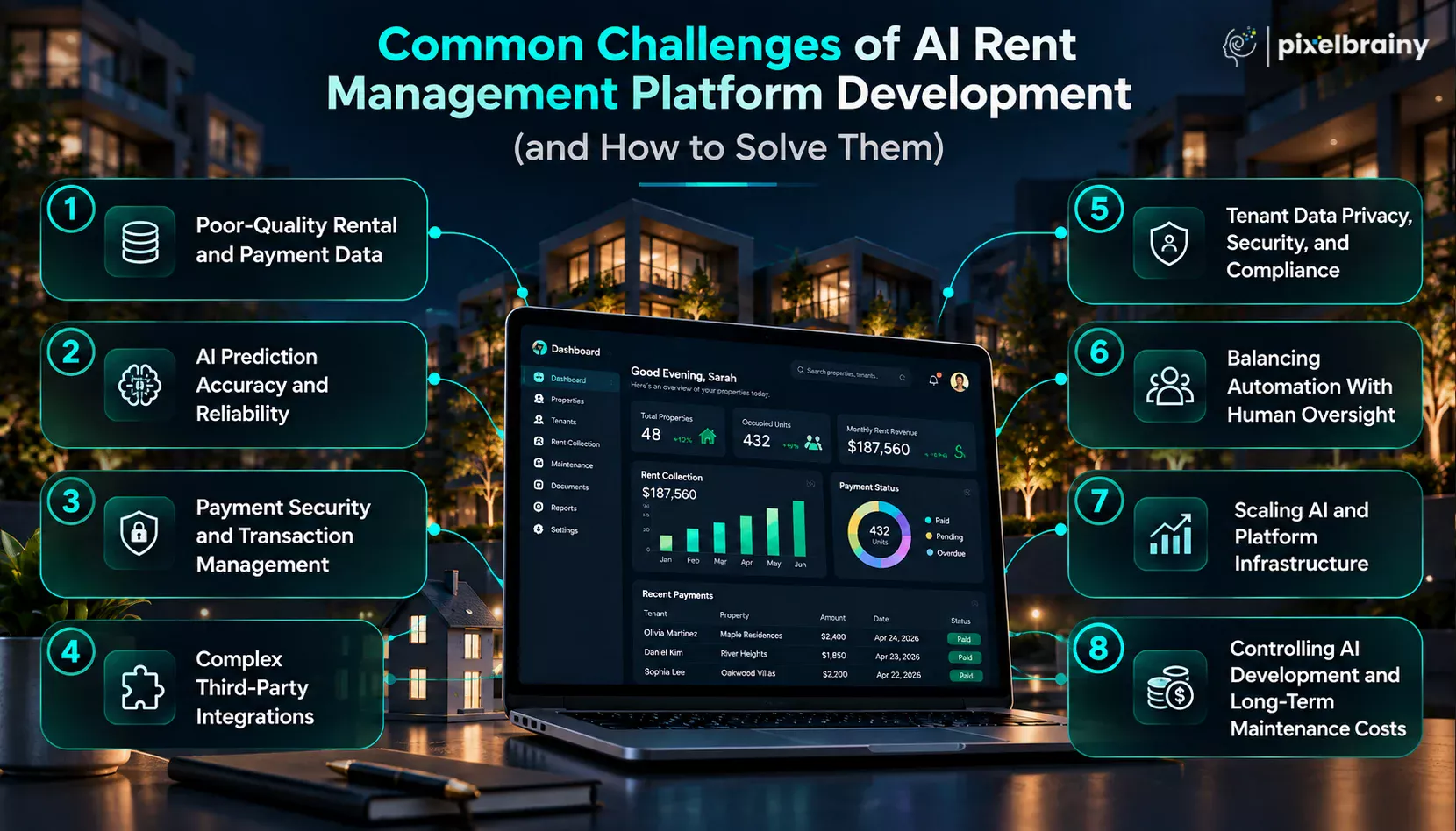
Challenge:
AI models require reliable historical data to identify payment patterns and generate useful predictions. In a real-world rental business, tenant records, lease information, payment histories, late fees, failed transactions, and property data may be stored across spreadsheets, accounting software, banking systems, and property management platforms.
If this data is incomplete, duplicated, outdated, or inconsistent, the AI layer may produce unreliable risk scores and recommendations. Poor data quality can also affect payment reconciliation and portfolio reporting.
Solution:
Build a centralized data architecture before implementing advanced AI capabilities. Standardize tenant, property, lease, and transaction records, establish validation rules, remove duplicate records, and create automated data-quality checks.
The development team should also define which data can be used for each AI model. This creates a cleaner foundation for AI model development and makes future predictions more consistent.
Challenge:
AI late-payment prediction is a valuable feature, but payment behavior is not always predictable. A tenant who consistently paid on time may experience a temporary financial issue, while a tenant with previous late payments may make future payments on time.
Therefore, an AI rent management platform should not present predictions as guaranteed outcomes. An inaccurate prediction could lead to unnecessary reminders, inappropriate collection actions, or poor customer experiences.
Solution:
Start with a clearly defined prediction objective, such as identifying accounts with a higher probability of late payment within a specific period. Use relevant signals such as historical payment timing, failed transactions, outstanding balances, and lease information.
Display risk levels and supporting factors rather than presenting AI decisions as absolute facts. Continuously evaluate model performance and maintain human oversight for high-impact collection decisions.
Challenge:
Rent management platforms can process recurring payments, ACH transactions, card payments, refunds, failed payments, and payment reversals. This creates significant requirements around security, transaction reliability, and financial data protection.
A payment that is duplicated, incorrectly recorded, or not properly reconciled can create accounting problems and tenant disputes.
Solution:
Use established payment providers and secure payment APIs instead of building sensitive payment-processing infrastructure unnecessarily from scratch. Implement encryption, tokenization, secure authentication, role-based access controls, audit logs, and reliable webhook processing.
The platform should also use idempotent transaction handling and clear payment states so every transaction can be tracked from initiation to successful collection, failure, refund, or reconciliation.
Challenge:
Property managers may already use property management software, accounting platforms, banking systems, payment gateways, tenant portals, and communication tools. Connecting these systems can become one of the most difficult parts of AI rent management platform development.
Different systems may use different APIs, data structures, authentication methods, and synchronization schedules. A poorly designed integration can create duplicate records or outdated payment information.
Solution:
Create a dedicated integration layer that separates external systems from the platform's core business logic. Use APIs, webhooks, standardized data models, and reusable connectors wherever possible.
This approach makes it easier to add new payment providers, accounting platforms, or property management systems later without rebuilding the entire application.
Challenge:
An AI rent management platform may store tenant identities, contact information, lease records, payment histories, financial information, and communication records. This makes privacy and security essential from the earliest development stage.
The challenge becomes greater when the platform serves multiple states or different property categories with varying operational and regulatory requirements.
Solution:
Apply security-by-design principles throughout development. Use encryption, multi-factor authentication, role-based access control, secure API authentication, audit trails, data minimization, and regular security testing.
For compliance-sensitive workflows, create configurable business rules instead of hard-coding every requirement into the application. Legal and compliance professionals should review requirements for the markets and property types the platform will serve.
Challenge:
One of the primary reasons companies build AI rent management software is to reduce manual work. However, fully automating every rent collection decision can create operational risks.
For example, automatically sending a collection notice based on an incorrect payment status could frustrate a tenant. Similarly, an AI-generated recommendation may not account for a payment arrangement or special circumstance known by the property manager.
Solution:
Divide platform workflows into different levels of automation. Routine activities such as payment reminders, status updates, and standard notifications can be automated.
AI recommendations involving higher-impact decisions can require property manager approval. This creates a human-in-the-loop system where AI handles repetitive analysis while people retain control over sensitive decisions.
Challenge:
A platform that works well for 100 units may encounter performance issues when it grows to thousands of properties and tenants. More users generate more payment transactions, notifications, API requests, reports, and AI predictions.
AI workloads can also consume significant computing resources, particularly when the platform introduces advanced forecasting, anomaly detection, generative AI, or AI agents.
Solution:
Design the architecture for scalability from the beginning without overengineering the initial product. Cloud infrastructure, optimized databases, caching, asynchronous processing, scalable APIs, containerization, and monitoring can support increasing workloads.
Critical payment and account services should remain isolated from resource-intensive AI workloads. This helps ensure that AI processing does not interfere with essential rent collection operations.
Challenge:
The cost of developing an AI rent management platform extends beyond the initial application build. AI models may require continuous evaluation, data updates, infrastructure resources, API maintenance, security improvements, and model optimization.
Building too many advanced capabilities into the first release can also increase development time and make it difficult to determine which features actually create business value.
Solution:
Use a phased development strategy. Begin with core capabilities such as tenant management, lease management, online rent payments, automated reminders, payment tracking, reconciliation, and essential reporting.
Once the foundation is validated, introduce high-value AI capabilities such as late-payment risk scoring, rent forecasting, anomaly detection, and intelligent collection recommendations. This approach helps control the AI rent management platform development cost while creating a clear path for future expansion.
Addressing these eight challenges during AI rent management platform development can help create a secure, scalable, and practical solution that improves rent collection without compromising financial accuracy or property management control.
From the challenges discussed above, it is clear that successful AI rent management requires more than conventional software engineering. The right technology partner should understand rental workflows, payment systems, property operations, AI implementation, integrations, security, and the business objectives behind the product.
This is where PixelBrainy as AI real estate software development company can help property managers, real estate companies, and PropTech founders turn a validated idea into a practical AI-powered product.
A PropTech founder might ask: “I have identified a gap in the market for landlords managing 5 to 50 units. I want a platform that combines rent collection, tenant communication, payment tracking, and AI-powered insights without the complexity of enterprise property management software. How can I take this concept from product strategy to MVP and eventually launch it at scale?”
PixelBrainy provides AI rental management software development services across product strategy, UI/UX, application engineering, AI implementation, third-party integrations, testing, deployment, and ongoing support. Teams can develop AI rental management software around specific users, portfolio sizes, workflows, and business models instead of forcing every customer into the same architecture.
Project Objective: Centralize rental operations and introduce intelligent payment insights.
For a confidential PropTech client, PixelBrainy delivered a rental management solution designed to bring properties, tenants, leases, payments, and operational data into one centralized platform. The objective was to reduce fragmented administrative processes while giving property teams better visibility into rental activity and payment behavior.
Key Capabilities Included:
Development Approach:
The project was delivered through a structured product lifecycle, beginning with requirements discovery and solution architecture. PixelBrainy then moved through UI/UX design, core platform development, integrations, AI implementation, testing, and deployment.
This phased approach allowed the product team to prioritize essential functionality first, validate the solution with real operational requirements, and create an architecture capable of supporting future rental management platform development integrating AI.
For businesses looking to build AI rental management platform, PixelBrainy brings product strategy, AI expertise, engineering capabilities, and ongoing technical support under one development partnership.
Ready to turn your rental management concept into a market-ready AI product? Connect with PixelBrainy today.

AI is making rent management more proactive, automated, and data-driven. From automated rent collection and payment reconciliation to late-payment prediction, tenant communication, and portfolio insights, an AI-powered platform can help property managers reduce manual work while gaining better control over rental operations.
The journey of AI rent management platform development starts with identifying a clear business problem and defining the right core features, integrations, technology stack, and AI capabilities. Development cost also depends on factors such as platform complexity, payment integrations, AI model requirements, security, and scalability. A phased approach with a focused MVP can help businesses validate their concept before expanding into advanced capabilities.
For companies ready to develop AI rent management software, the right technology partner can turn a rental operations challenge into a scalable PropTech product built around real user requirements and measurable business value.
Ready to turn your AI rent management idea into a scalable product? Schedule a call with PixelBrainy today.
The cost to develop an AI rent management platform depends on the feature scope, AI capabilities, payment integrations, accounting connections, security requirements, and platforms involved. A basic MVP with rent collection, reminders, tenant management, payment tracking, and one AI feature will cost less than an enterprise platform with advanced predictive analytics, mobile apps, multiple integrations, and AI agents.
To build an AI rental management platform for small landlords, start with the workflows they use most frequently. The initial product can include tenant and lease management, online rent payments, recurring payments, automated reminders, payment history, reconciliation, dashboards, and AI-based late-payment risk analysis. After validating the MVP, you can expand into forecasting, anomaly detection, intelligent tenant communication, and portfolio analytics.
Yes. Businesses can develop AI rental management software with machine learning models that analyze historical payment timing, failed transactions, outstanding balances, payment frequency, and other relevant data. The model can identify accounts with a higher probability of late payment and provide property managers with early risk indicators so they can review the situation and respond appropriately.
Rental management platform development integrating AI can use APIs and webhooks to connect existing property management, accounting, banking, and payment systems. Instead of replacing every existing tool, the AI platform can synchronize relevant data and add capabilities such as predictive payment insights, automated workflows, anomaly detection, and intelligent reporting.
For an initial product, prioritize AI capabilities that solve measurable operational problems. Late-payment risk scoring, intelligent collection recommendations, payment anomaly detection, rent forecasting, personalized tenant communication, and portfolio revenue insights are potential starting points. The right features depend on the target customers, available data, and business model.
The timeline depends on the complexity of the product and the number of integrations required. A focused MVP can be developed faster than an enterprise platform supporting thousands of units, multiple payment providers, advanced AI models, accounting systems, mobile applications, and complex reporting. Defining the MVP and technical architecture first provides a more reliable development timeline.
A typical solution may use React or Next.js for the frontend, Node.js or Python for backend services, PostgreSQL for structured rental data, Redis for caching, cloud infrastructure such as AWS or Azure, and Python-based machine learning frameworks for predictive models. Payment APIs, banking integrations, authentication, monitoring, and notification services are also important parts of the architecture.
Scalability should be considered from the architecture stage. Cloud infrastructure, modular APIs, optimized databases, asynchronous processing, caching, containerization, monitoring, and separated AI workloads can help the platform handle increasing users and transactions. A phased AI rent management platform development strategy also allows advanced AI capabilities and integrations to be introduced as portfolio volume and business requirements grow.

About The Author
Sagar Bhatnagar
Sagar Sahay Bhatnagar brings over a decade of IT industry experience to his role as Marketing Head at PixelBrainy. He's known for his knack in devising creative marketing strategies that boost brand visibility and market influence. Sagar's strategic thinking, coupled with his innovative vision and focus on results, sets him apart. His track record of successful campaigns proves his ability to utilize digital platforms effectively for impactful marketing efforts. With a genuine passion for both technology and marketing, Sagar continuously pushes PixelBrainy's marketing initiatives to greater success.

Working with the PixelBrainy team has been a highly positive experience. They understand the design requirements and create beautiful UX elements to meet the application needs. The dev team did an excellent job bringing my vision to life. We discussed usability and flow. Sagar worked with his team to design the database and begin coding. Working with Sagar was easy. He has the knowledge to create robust apps, including multi-language support, Google and Apple ID login options, Ad-enabled integrations, Stripe payment processing, and a Web Admin site for maintaining support data. I'm extremely satisfied with the services provided, the quality of the final product, and the professionalism of the entire process. I highly recommend them for Android and iOS Mobile Application Design and Development.

Great experience working with them. Had a lot of feedback and I found that unlike most contractors they were bugging me for updates instead of the other way around. They were extremely time conscience and great at communicating! All work was done extremely high quality and if not on time, early! They were always proactive when it comes to communication and the work is great/above par always. Very flexible and a great team to work with! Goes above and beyond to present us with multiple options and always provides quality. Amazing work per usual with Chitra. If you have UI/UX or branding design needs I recommend you go to them! Will likely work with them in the future as well, definitely recommended!

PixelBrainy is a joy to work with and is a great partner when thinking through branding, logo, and website layout. I appreciate that they spend time going into the "why" behind their decisions to help inform me and others about industry best practices and their expertise.

I hired them to design our software apps. Things I really like about them are excellent communication skills, they answer all project suggestions and collaborate right away, and their input on design and colors is amazing. This project was complex and needed patience and creativity. The team is amazing to do business with. I will be using them long-term. Glad to see there are some good people out there. I was afraid to try and outsource my project to someone but I am glad I met them! I really can't say enough. They went above and beyond on this project. I am very happy with everything they have done to make my business stand out from the competition.

It was great working with PixelBrainy and the team. They were very responsive and really owned the project. We'll definitely work with them again!

I recently worked with the PixelBrainy team on a project and I was blown away by their communication skills. They were prompt, clear, and articulate in all of our interactions. They listened and provided valuable feedback and suggestions to help make the project a success. They also kept me updated throughout the entire process, which made the experience stress-free and enjoyable.

PixelBrainy is very good at what it does. The team also presents themselves very professionally and takes care of their side of things very well. I could fully trust them taking up the design work in a timely and organised manner and their attention to detail saved us lots of effort and time. This particular project was quite intense and the team showed that they function very well under pressure. Very much looking forward to working with her again!

It's always an absolute pleasure working with them. They completed all of my requests quickly and followed every note I had for them to a T, which made our process go smoothly from start to finish. Everything was completed fast and following all of the guidelines. And I would recommend their services to anyone. If you need any design work done in the future, PixelBrainy should be your first call!

They took ownership of our requirements and designed and proposed multiple beautiful variants. The team is self-motivated, requires minimum supervision, committed to see-through designs with quality and delivering them on time. We would definitely love to work with PixelBrainy again when we have any requirements.

PixelBrainy was a big help with our SaaS application. We've been hard at work with a new UI/UX and they provided a lot of help with the designs. If you're looking for assistance with your website, software, or mobile application designs, PixelBrainy and the team is a great recommendation.

PixelBrainy designers are amazing. They are responsive, talented, and always willing to help craft the design until it matches your vision. I would recommend them and plan to continue them for my future projects and more!!!

They were awesome! Did a good job fast, and good communication. Will work with them again. Thank you

Creative, detail-oriented, and talented designers who take direction well and implement changes quickly and accurately. They consistently over-delivered for us.

PixelBrainy team is very talented and creative. Great designers and a pleasure to work with. PixelBrainy is an excellent communicator and I look forward to working with them again.

PixelBrainy has a very talented design team. Their work is excellent and they are very responsive. I enjoy working with them and hope to continue on all of our future projects.


Transform your ideas into reality with us.
Across these industries, each engagement brings unique challenges, from early-stage product development to scaling complex systems, helping us build a practical understanding of real-world product environments.