AI Summary Powered by PixelBrainy
What happens when a driver on a U.S. interstate highway receives warning signs of a vehicle failure, but an AI-powered roadside assistance app can identify the risk and arrange help before the vehicle becomes completely stranded?
Consider a driver traveling on I-95 when the vehicle starts showing a battery warning and struggles to start. Instead of searching for a nearby towing company, making multiple calls, and explaining the problem repeatedly, the driver opens an AI-powered roadside assistance app. The platform identifies the vehicle's location, analyzes the reported symptoms, determines the likely assistance category, evaluates nearby service providers, and dispatches the most suitable technician. This scenario illustrates the growing opportunity behind AI roadside assistance app development in the United States.
For U.S. roadside assistance companies, insurers, automotive manufacturers, dealerships, fleet operators, mobility businesses, and technology startups, roadside assistance app development with AI can transform a traditionally reactive service into an intelligent, data-driven ecosystem. AI can support automated incident classification, intelligent technician matching, ETA prediction, conversational assistance, fraud detection, demand forecasting, and predictive vehicle breakdown detection.
The U.S. market presents a significant commercial opportunity. Grand View Research estimates that the United States vehicle roadside assistance market will reach approximately $6.47 billion in 2026 and is projected to reach $9.30 billion by 2033, growing at a 5.3% CAGR.
For businesses exploring the custom AI roadside assistance app development process, the goal is not simply to digitize roadside service booking. It is to connect motorists, towing companies, technicians, insurers, vehicle data, GPS systems, payment platforms, and AI technologies through one scalable platform.
This step-by-step guide to building an AI roadside assistance app covers the core technology, benefits, must-have features, advanced AI capabilities, development process, estimated cost, technology stack, business models, and challenges. It also explains how to develop an AI roadside assistance app with predictive breakdown detection for the evolving U.S. automotive and mobility market.
An AI roadside assistance app is a technology-driven platform designed to make vehicle emergency assistance more intelligent, responsive, and personalized. It combines artificial intelligence with GPS, vehicle data, automation, cloud technology, and digital service management to help motorists get the right roadside support with less friction.
For the U.S. market, such an app can connect drivers, towing companies, roadside technicians, insurers, automotive brands, dealerships, fleet operators, and mobility businesses within a single digital ecosystem.
The biggest difference is not simply the presence of artificial intelligence. It is how the entire assistance process is managed.
| Traditional Roadside Assistance | AI-Powered Roadside Assistance |
|---|---|
| Primarily reactive | Reactive and potentially proactive |
| Heavy dependence on phone calls and manual coordination | Automated digital request and coordination |
| Driver explains the problem manually | AI can classify reported symptoms |
| Basic provider assignment | Intelligent provider matching |
| Limited use of vehicle data | Can incorporate authorized vehicle and diagnostic data |
| Standardized assistance experience | Context-aware and personalized experience |
| Manual operational decisions | AI-assisted decision-making |
| Historical data mainly used for reporting | Historical data can support predictions and optimization |
| Limited predictive capabilities | Can support predictive breakdown detection |
| Static operational insights | Real-time analytics and demand intelligence |
AI can analyze information provided by the motorist and categorize the situation, such as a flat tire, battery problem, lockout, overheating, accident, towing requirement, or EV charging need.
The platform can consider factors such as vehicle type, location, reported symptoms, service history, provider availability, and urgency to create a more relevant assistance experience.
Instead of treating every service request independently, businesses can analyze historical and real-time data to identify demand patterns, service bottlenecks, frequently occurring problems, and provider performance.
With suitable vehicle and telematics data, AI can identify patterns that may indicate a potential component problem and support preventive maintenance recommendations.
An AI-powered platform can support multiple stakeholders, including motorists, technicians, insurers, fleets, OEMs, and roadside operators, while creating a centralized source of operational intelligence.
Ultimately, AI roadside assistance app development represents a shift from simply responding to breakdowns toward building a smarter, connected, and data-driven roadside mobility ecosystem. For U.S. businesses, this creates opportunities to improve customer experience, operational efficiency, service personalization, and long-term revenue potential.
How does an AI roadside assistance app turn a sudden vehicle problem into a faster, more coordinated service experience? The answer lies in the combination of artificial intelligence, real-time location technology, automation, connected vehicle data, and a network of roadside service providers.
Unlike a conventional roadside assistance platform that mainly records a service request and forwards it to an available provider, an AI-powered platform can interpret the incident, understand the context, prioritize the request, and support smarter service coordination.
Here is how the process typically works:
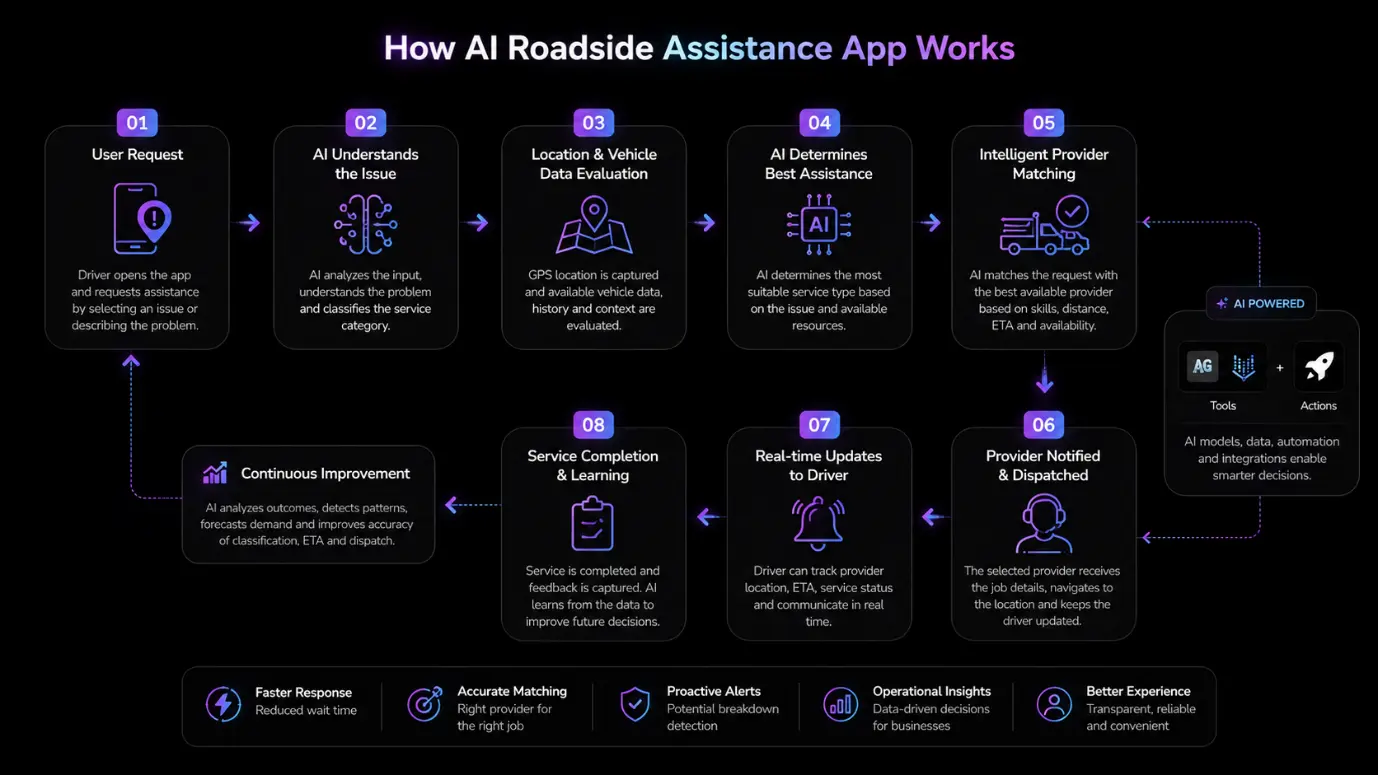
A driver opens the app and reports the problem by selecting a service category or describing the issue through text or voice. Common requests include a dead battery, flat tire, vehicle lockout, overheating, fuel delivery, towing, accident assistance, or EV charging.
The AI engine analyzes the information provided by the motorist and identifies the likely assistance category. Natural language processing can help convert an unstructured description such as “My car won't start and I hear clicking” into a structured roadside service request.
With appropriate user authorization and integrations, the platform can consider available vehicle information, diagnostic signals, service history, and GPS location. This additional context can help improve incident classification and service selection.
The platform evaluates the incident against available roadside services and determines whether the motorist may require a towing provider, mobile mechanic, battery service, tire technician, fuel delivery, or EV charging support.
Instead of relying only on geographic proximity, the system can evaluate provider availability, location, skills, equipment, service capabilities, workload, and estimated arrival time to identify a suitable provider.
The selected technician or towing provider receives the relevant service information through the provider application, including the customer's location, vehicle details, reported issue, and navigation information.
The customer can receive real-time updates about provider assignment, arrival status, estimated time of arrival, service progress, and payment.
Once the service is completed, operational data can contribute to analytics and future optimization. Businesses can use this information to improve dispatch decisions, demand forecasting, provider performance, customer experience, and predictive breakdown detection.
Therefore, the AI roadside assistance app workflow creates a connected journey from problem identification to service completion, helping U.S. roadside assistance businesses reduce manual coordination while delivering a faster, more intelligent, and more transparent experience to motorists.
For U.S. roadside assistance businesses, the investment case for AI is becoming stronger as vehicle technology, customer expectations, and service operations evolve simultaneously. The question is no longer whether roadside services should become digital, but how intelligently they can use technology to improve response, vehicle support, and operational efficiency.
A major factor is the changing vehicle landscape. The International Energy Agency's Global EV Outlook 2026 projects that global electric car sales will reach approximately 23 million in 2026, representing around 28% of total global car sales. The report also notes that the number of available electric car models could exceed 1,100 in 2026, with around 150 new electric models announced for release during the year.
This evolution creates new requirements and opportunities for businesses considering AI roadside assistance app development.
Roadside assistance involves numerous decisions that can become difficult to manage at scale. AI can help analyze service requests, provider availability, locations, traffic conditions, vehicle information, and service requirements.
For an operator managing a large U.S. roadside network, this intelligence can support faster decisions and more efficient resource allocation.
The objective is not simply to automate human teams, but to give them better information for making operational decisions.
Traditional roadside assistance generally begins after a vehicle has already experienced a problem.
AI roadside assistance app development creates an opportunity to introduce a more proactive model.
With appropriate access to vehicle diagnostics, telematics, maintenance records, mileage, and other relevant signals, AI models can identify unusual patterns that may indicate a potential vehicle issue.
This can support services such as:
For businesses, predictive capabilities can create new recurring-service opportunities rather than depending entirely on emergency transactions.
The increasing number of EV models means roadside companies will need to support a wider range of vehicle technologies.
The IEA reports that electric car sales in the United States were around 1.5 million in 2025, with EVs accounting for around 10% of U.S. car sales for the full year. Its 2026 analysis also shows continued expansion in global EV model availability.
This creates opportunities for AI-powered roadside platforms to recognize vehicle types and support appropriate services such as mobile EV charging, EV-compatible towing, battery assistance, and specialized technician dispatch.
A stranded motorist wants clarity as much as speed. They need to know whether help has been assigned, where the provider is, when they will arrive, and what service they are receiving.
An AI-powered roadside assistance app can bring these interactions into one digital experience through:
This reduces unnecessary communication and gives customers greater visibility during stressful roadside situations.
For roadside assistance operators, technician and towing-provider utilization directly affects service capacity and operating costs.
AI can evaluate multiple factors before recommending a provider, including distance, current location, availability, expertise, equipment, workload, traffic, and expected arrival time.
This creates a more intelligent alternative to simply assigning the closest available provider.
As service volume grows, such optimization can help businesses handle more requests without relying exclusively on proportional increases in manual coordination.
The biggest commercial opportunity may come from expanding the role of the roadside assistance application.
Instead of generating revenue only when a driver requests emergency assistance, businesses can introduce:
The platform can also turn accumulated service data into business intelligence, helping companies understand demand patterns, recurring vehicle issues, geographic service gaps, provider performance, and customer behavior.
AI roadside assistance app development in 2026 gives U.S. businesses an opportunity to build more predictive, efficient, connected, and revenue-diverse roadside service ecosystems as vehicle technology continues to evolve.
A roadside emergency demands quick action from motorists, while operators must simultaneously manage service requests, technicians, towing partners, locations, and response times. This is where AI roadside assistance app development can create measurable value for both sides. By combining artificial intelligence, automation, GPS, vehicle data, predictive analytics, and real-time communication, an AI-powered platform can make roadside support more responsive and operationally efficient.
For motorists, the focus is on faster assistance, greater transparency, convenience, and safer roadside experiences. For operators, AI can support smarter dispatching, better resource utilization, predictive services, and new revenue opportunities.
The major benefits of developing an AI-powered roadside assistance app include:
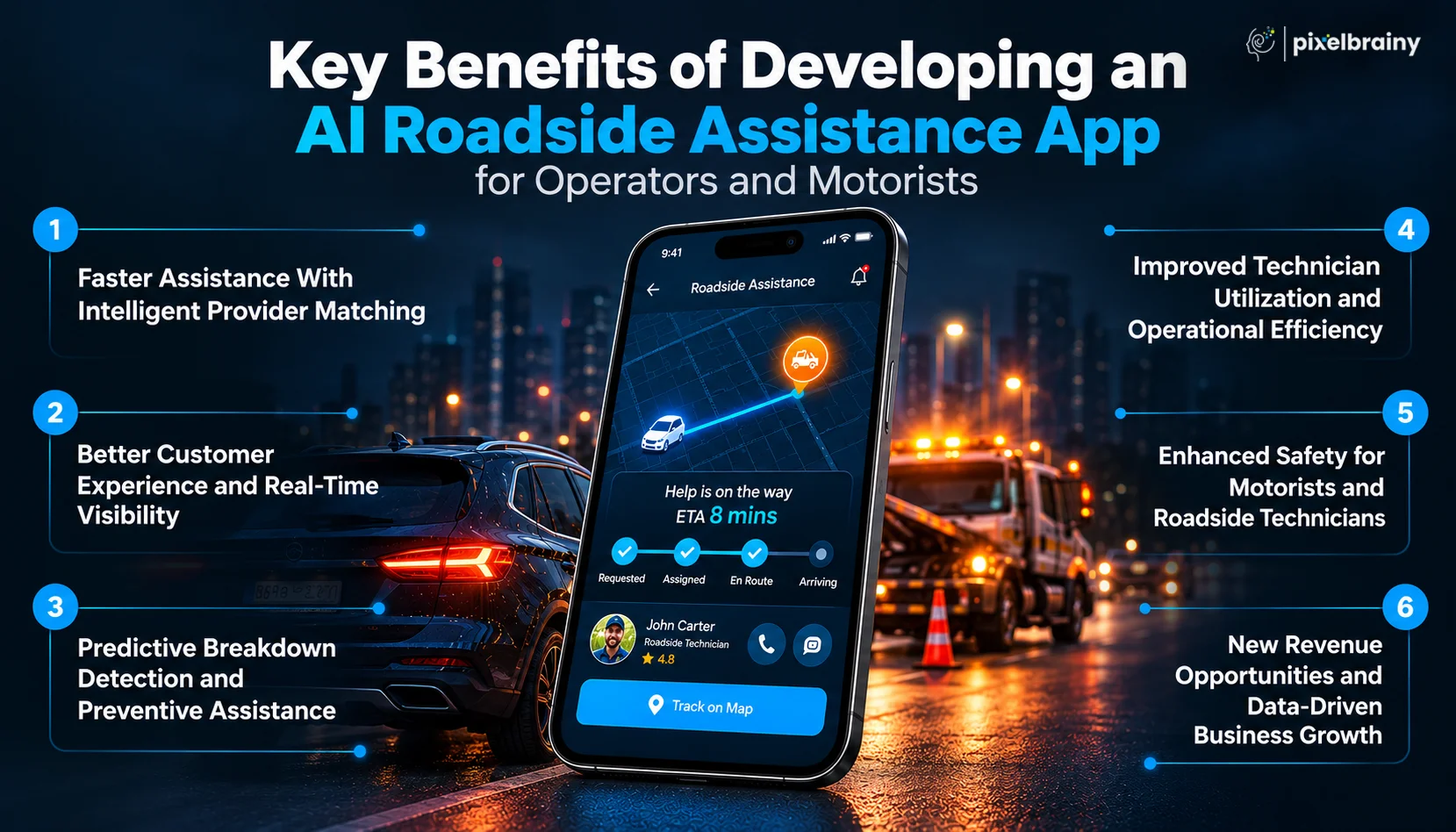
One of the strongest benefits of roadside assistance app development with AI is intelligent service matching. When a motorist submits a request, AI can evaluate the reported problem along with location, provider availability, technician expertise, equipment, workload, traffic conditions, and estimated arrival time.
Rather than simply assigning the nearest available provider, the platform can identify a professional whose capabilities best match the incident. A flat tire may require a tire-service professional, while an EV with a depleted battery may require mobile charging or specialized towing. This approach can improve dispatch decisions, reduce unnecessary coordination, and help operators use their roadside service network more effectively.
For a motorist experiencing a breakdown, uncertainty can make an already difficult situation more stressful. Customers want to know whether assistance has been assigned, where the technician is located, and when help is expected to arrive.
An AI-powered roadside assistance application can bring these interactions into one digital experience. Customers can request assistance, share their location, receive automated updates, track the assigned provider, communicate with the technician, and complete digital payments through the application.
AI-powered conversational support can also help motorists explain their problems naturally instead of navigating complicated service categories. This can create a more convenient, transparent, and personalized roadside assistance experience.
A major opportunity in AI roadside assistance app development is moving from reactive emergency support toward proactive vehicle assistance.
With appropriate authorization and access to relevant vehicle information, AI can analyze diagnostic signals, telematics, mileage, maintenance history, and previous service records to identify patterns that may indicate a potential problem.
This creates the foundation for predictive breakdown detection, allowing motorists to potentially receive an alert about a developing vehicle issue and a recommendation to schedule inspection or maintenance before a breakdown occurs.
For fleet operators, insurers, automotive businesses, and roadside providers, predictive capabilities can support preventive maintenance programs, reduce unexpected downtime, and create opportunities for recurring vehicle-support services.
Managing technicians and towing providers can become increasingly complex as roadside service requests grow across multiple locations. Manual dispatching may result in unnecessary travel, uneven workloads, and inefficient resource allocation.
An AI roadside assistance platform can evaluate technician location, availability, expertise, equipment, workload, traffic, and service requirements when supporting dispatch decisions.
The platform can also analyze historical service data to identify demand patterns, recurring incidents, peak periods, and operational bottlenecks. Operators can use these insights to position resources more effectively and improve overall service capacity.
AI can therefore support both real-time dispatch optimization and long-term roadside operations management.
Roadside assistance can involve serious safety risks, particularly when vehicles become disabled on busy highways. Better information and communication can help technicians understand the service environment before reaching the incident location.
An AI-powered platform can support safer workflows through accurate GPS location sharing, incident prioritization, real-time provider tracking, automated notifications, and contextual safety information.
For example, the application can provide the assigned technician with precise location details and incident information before arrival. Operators can also analyze service data to identify locations and incident types that may require additional safety considerations.
These capabilities cannot eliminate roadside hazards, but they can improve situational awareness, communication, and coordination for motorists and service professionals.
An AI roadside assistance application can create business value beyond individual emergency service requests. Operators can introduce membership programs, subscription plans, predictive maintenance services, fleet contracts, insurance partnerships, automotive programs, premium assistance packages, and white-label solutions.
The application can also transform accumulated service information into actionable business intelligence. Operators can analyze service categories, response times, provider performance, repeat incidents, customer behavior, geographic demand, and seasonal patterns.
These insights can help businesses identify service gaps, improve provider allocation, develop new offerings, and strengthen customer retention. AI therefore becomes more than an application feature. It can serve as a foundation for operational optimization, predictive services, customer engagement, and long-term revenue growth.
AI-powered roadside assistance can help businesses deliver faster support, improve operational efficiency, strengthen roadside safety, enable proactive vehicle assistance, and unlock new avenues for sustainable growth.

What makes a roadside assistance application genuinely useful is not the number of features it contains, but how effectively its core features solve the immediate needs of motorists, service providers, and operators. A well-planned AI roadside assistance app should make requesting help simple for customers while giving providers the tools they need to accept, manage, and complete roadside service requests efficiently.
For businesses asking, “What features should an AI roadside assistance app have?”, the foundation should cover service discovery, emergency requests, location sharing, provider coordination, payments, communication, and account management. AI should support these core functions without making the application complicated to use.
The following 15 features represent the essential foundation of a reliable roadside assistance app development project. Advanced capabilities such as predictive breakdown detection, computer vision, sophisticated AI forecasting, and other next-generation technologies should be planned separately as part of the advanced feature layer.
| Must-Have Feature | Detailed Explanation |
|---|---|
| User Registration and Profiles | A secure registration system allows motorists to create accounts and manage contact details, communication preferences, and basic personal information. Saved profiles make future roadside assistance requests faster and reduce repetitive data entry. |
| Vehicle Profile Management | Customers can add vehicle information such as make, model, year, fuel type, and registration details. Keeping vehicle profiles within the application helps providers understand the vehicle before arriving and supports more accurate service coordination. |
| One-Tap Emergency Assistance | A one-tap assistance option lets motorists request help quickly during stressful breakdown situations. The feature can automatically capture the user's location, selected vehicle, and basic request information to minimize unnecessary steps during an emergency. |
| Roadside Service Selection | The application should provide clearly defined services such as towing, battery assistance, flat-tire support, fuel delivery, lockout assistance, and other common roadside needs. Simple categories help customers communicate their requirements accurately. |
| GPS Location Sharing | GPS automatically identifies the motorist's current roadside location and shares relevant coordinates with the assigned provider. This is particularly useful when customers are stranded on highways, unfamiliar roads, parking areas, or locations without a recognizable street address. |
| Service Provider Discovery | Customers can discover available roadside service providers based on service category, location, availability, and coverage area. This feature connects motorists with the appropriate service network while giving operators better control over provider availability and service distribution. |
| AI-Assisted Issue Classification | AI can interpret basic customer descriptions submitted through text or voice and categorize the reported issue. For example, a description such as "the car clicks but will not start" can help identify a likely battery-related assistance category and guide the customer toward the appropriate service. |
| Real-Time Provider Tracking | After a technician or towing provider accepts a request, customers can track their progress through the application. Live location visibility gives motorists greater confidence and allows them to understand where the assigned provider is during the journey. |
| Estimated Arrival Time | The application can display an estimated arrival time based on provider location, route information, traffic conditions, and other relevant data. Accurate ETA communication helps customers plan their waiting period and reduces uncertainty during roadside emergencies. |
| In-App Communication | Customers and roadside professionals can communicate through integrated messaging or calling features. This allows them to exchange information about vehicle conditions, exact roadside locations, access instructions, or other service details without relying on separate communication applications. |
| Digital Service Booking | Customers can request immediate assistance or schedule eligible roadside services directly through the application. Booking information can include the selected service, vehicle, location, appointment details, and request status, creating a centralized service-management experience. |
| Secure Online Payments | Integrated payment functionality allows customers to review applicable charges, select supported payment methods, complete transactions, and receive digital receipts. Secure payment processing simplifies transactions for motorists while helping operators maintain organized service and billing records. |
| Service History | A dedicated history section stores previous assistance requests, completed services, invoices, payment records, and relevant vehicle service information. Customers can review past assistance whenever needed, while businesses can use historical information to support better customer service. |
| Push Notifications | Push notifications keep customers and providers informed throughout the service journey. Notifications can communicate request confirmation, provider assignment, ETA changes, technician arrival, booking updates, payment status, and service completion without requiring users to continuously open the application. |
| Ratings and Reviews | Customers can rate completed roadside services and provide feedback about their experience. Ratings help motorists evaluate providers while giving operators valuable insight into service quality, customer satisfaction, recurring complaints, and high-performing roadside professionals. |
These core features provide the functional foundation for an AI roadside assistance app, combining convenience for motorists with efficient service coordination for operators and roadside providers.
Once the core functionality is established, businesses can introduce advanced AI capabilities to make the platform more predictive, personalized, and operationally intelligent. These features can help an AI roadside assistance app move beyond basic service booking and become a connected roadside mobility platform.
Advanced functionality is particularly valuable for businesses managing large provider networks, connected vehicles, fleets, insurers, automotive brands, and high-volume roadside operations. However, these capabilities should be selected according to the business model, available data, target users, and integration requirements.
For companies exploring how to build an AI roadside assistance app with advanced capabilities, the following 10 features can provide a strong technology roadmap.
| Advanced Feature | Detailed Explanation |
|---|---|
| Predictive Breakdown Detection | Machine learning models can analyze authorized vehicle diagnostics, telematics, maintenance history, mileage, and other relevant signals to identify patterns associated with potential failures. The platform can then generate early alerts and recommend preventive maintenance before a vehicle becomes stranded. |
| AI-Powered Predictive Maintenance | AI can evaluate historical service records and vehicle behavior to estimate when maintenance may be required. Instead of waiting for a breakdown, the platform can recommend inspections, battery checks, tire services, or other preventive actions based on detected risk patterns. |
| Computer Vision for Vehicle Damage Assessment | Customers can upload photographs of a damaged vehicle, allowing computer vision models to analyze visible damage and help categorize the incident. This information can assist operators in understanding the service requirement and determining whether towing or specialized roadside support may be necessary. |
| Intelligent Dispatch Optimization | Advanced AI can evaluate provider location, skills, equipment, availability, workload, traffic, service priority, and historical performance when recommending assignments. This creates a more sophisticated dispatch process than simply selecting the closest available technician. |
| AI-Powered Voice Assistant | A conversational voice assistant can allow motorists to request assistance, describe vehicle problems, receive status information, and obtain basic guidance through natural speech. This can be particularly useful when customers are stressed or unable to navigate multiple application screens. |
| Real-Time Demand Forecasting | AI can analyze historical requests, location patterns, weather conditions, traffic trends, seasonal behavior, and other relevant data to forecast roadside assistance demand. Operators can use these predictions to position technicians and towing providers closer to areas where demand is likely to increase. |
| Dynamic ETA Prediction | Machine learning can improve arrival-time estimates by considering live traffic, provider location, road conditions, historical travel patterns, and service characteristics. More accurate ETAs can improve customer communication while helping operators monitor response performance. |
| Fraud and Anomaly Detection | AI can identify unusual request patterns, repeated claims, suspicious transaction behavior, inconsistent locations, or abnormal service activity. Flagging potential anomalies can help roadside operators and insurance partners investigate questionable activity before it creates significant financial losses. |
| Personalized Assistance Recommendations | AI can use authorized customer, vehicle, and service-history information to personalize recommendations. For example, the platform may recommend relevant maintenance services, roadside plans, or assistance options based on previous incidents and the customer's vehicle profile. |
| Fleet Risk Intelligence Dashboard | A dedicated AI dashboard can combine vehicle health indicators, roadside incidents, service history, predictive risk scores, and fleet activity into one operational view. Fleet managers can use these insights to identify higher-risk vehicles, plan maintenance, and reduce unexpected downtime. |
These advanced capabilities can turn a conventional roadside assistance application into an intelligent platform capable of predicting risks, optimizing operations, personalizing support, and creating greater value for motorists and service businesses.
What does it take to turn a roadside assistance concept into a reliable AI-powered product that motorists can actually use during an emergency? The answer involves much more than building a mobile application. A successful AI roadside assistance app development project requires careful planning around users, roadside operations, AI capabilities, service-provider networks, vehicle data, security, and scalability.
For businesses researching how to build an AI roadside assistance app from scratch, the development process should begin with a clearly defined problem and gradually progress toward validation, design, development, AI implementation, testing, deployment, and continuous improvement. Taking a structured approach helps control development complexity while ensuring that every technology decision supports the intended business model.
Whether the objective is to develop an AI roadside assistance app for motorists, fleets, insurers, automotive brands, or roadside operators, these eight stages provide a practical roadmap.
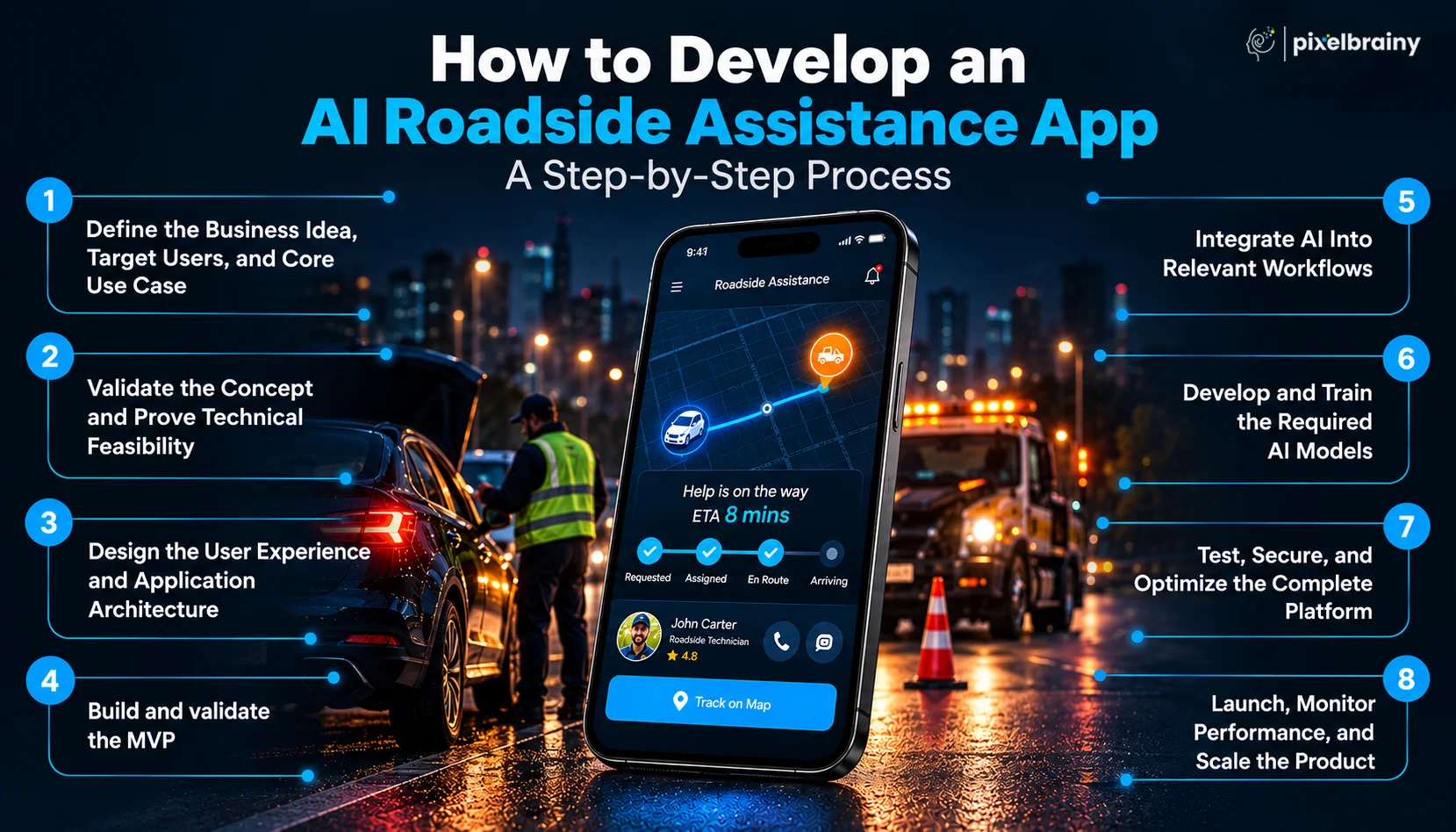
Every successful roadside assistance platform begins with a clearly defined problem. Before development starts, identify who the application will serve and what specific roadside challenge it will solve. The target audience may include individual motorists, fleet managers, insurance customers, automotive manufacturers, dealerships, rental companies, or roadside service operators.
Define the primary use cases, such as towing requests, battery assistance, tire support, vehicle lockouts, fuel delivery, EV charging, or predictive maintenance. Research competitors, customer expectations, service-provider requirements, pricing models, and geographic coverage. At this stage, determine which AI capabilities genuinely add business value rather than adding AI simply for differentiation.
A detailed product scope creates a foundation for the entire development process of AI roadside assistance app.
Once the concept is defined, validate whether the proposed solution is technically and commercially achievable. This stage should examine the availability of vehicle data, mapping services, payment infrastructure, roadside provider integrations, cloud services, AI technologies, and third-party APIs required by the platform.
A PoC development approach can be used to validate high-risk concepts before significant resources are committed to the complete application. For example, businesses can test whether AI can accurately classify roadside incidents from customer descriptions or whether available vehicle data can support a proposed predictive feature.
The objective is to identify technical limitations, integration dependencies, data requirements, and potential risks early in the AI roadside assistance app development journey.
The next stage is to translate validated requirements into a simple, intuitive product experience. Roadside assistance applications require especially clear interfaces because users may be stressed, distracted, or located in unfamiliar environments when requesting help.
Map the complete customer journey from opening the application and reporting a problem to provider assignment, tracking, service completion, and payment. At the same time, define separate workflows for technicians, dispatch teams, and administrators.
Working with a specialized UI/UX design company can help create intuitive navigation, emergency-focused interfaces, accessible controls, and consistent experiences across customer and provider applications. The technical architecture should also be planned for scalability, security, API connectivity, real-time communication, and future AI expansion.
After the product experience and architecture are established, development can begin with the most important functionality. The initial MVP development phase should focus on essential capabilities such as registration, vehicle profiles, roadside service requests, GPS location, provider management, dispatch, tracking, notifications, payments, and service history.
Avoid attempting to build every advanced capability during the first release. A focused MVP allows businesses to test whether motorists can easily request assistance and whether providers can efficiently accept and complete jobs.
The MVP should also include the necessary backend infrastructure, databases, APIs, authentication, administrative tools, and provider workflows. User feedback from the initial release can then guide improvements before expanding the platform with more sophisticated AI capabilities.
Also Read: Top 10 AI MVP Development Companies in USA
Once the core platform is functional, AI can be introduced into areas where it provides measurable value. AI integration may include natural language processing for incident classification, intelligent provider recommendations, automated customer support, demand forecasting, ETA optimization, or predictive vehicle assistance.
The integration strategy should be based on available data and clearly defined business outcomes. For example, an operator may prioritize AI-assisted dispatch before introducing predictive breakdown detection because dispatch optimization can use operational data already generated by the platform.
AI should complement the existing application rather than operate as an isolated feature. Its outputs should connect directly with customer workflows, provider operations, dashboards, and decision-making processes.
Advanced roadside intelligence depends on reliable data and carefully designed models. During AI model development, teams determine which machine learning or AI approaches are appropriate for each use case, prepare relevant datasets, establish training and validation processes, and define performance metrics.
Different use cases may require different approaches. Natural language models can classify customer-reported incidents, machine learning models can support demand forecasting, and predictive models can analyze vehicle signals for potential failure patterns.
Data quality is particularly important. Incorrect classifications or unreliable predictions can negatively affect roadside service decisions. Models should therefore be tested against representative scenarios and continuously evaluated as more operational data becomes available.
Also Read: Top 12+ AI Model Development Companies in the USA
Before launch, the application should undergo comprehensive testing across customer, provider, administrator, backend, payment, location, and AI workflows. Functional testing verifies that core features work correctly, while performance testing evaluates how the platform behaves under high request volumes.
Security testing is equally important because the application may handle personal information, vehicle information, payment details, location data, and potentially sensitive telematics information. AI functionality should also be tested for accuracy, reliability, unexpected outputs, and failure scenarios.
Businesses working with experienced top AI app development companies should establish clear testing benchmarks for both conventional software functionality and AI performance. The objective is to ensure the platform remains reliable when real motorists depend on it during roadside emergencies.
The final stage is taking the application into the market and establishing a continuous improvement cycle. Launch should begin with a controlled geographic area or selected provider network when appropriate, allowing the business to monitor customer adoption, service completion rates, provider performance, response times, AI accuracy, and technical stability.
Post-launch analytics can reveal which services customers request most frequently and where operational bottlenecks occur. These insights can guide future releases, additional provider integrations, and advanced AI capabilities.
Businesses can also work with experienced AI consultation specialists and AI product development companies to refine the technology roadmap, improve AI models, introduce new integrations, and scale the platform as demand increases.
The goal is not simply to release an application. It is to establish an evolving roadside technology platform that becomes more capable as customer, vehicle, and operational data grows.
Following these structured steps can help businesses move from an initial roadside assistance concept to a scalable AI-powered platform designed for real-world motorists, service providers, and roadside operations.
So, what is the development pricing of an AI roadside assistance app, and how much should a business realistically budget to build one? The answer depends on the application's complexity, AI capabilities, number of platforms, integrations, security requirements, and the size of the roadside service network.
The estimated cost to develop an AI roadside assistance app typically ranges from $30,000 to $250,000+. A basic application with essential roadside booking and AI-assisted functionality can remain toward the lower end, while an enterprise-grade platform with advanced AI, telematics, predictive breakdown detection, multiple user applications, extensive integrations, and scalable infrastructure can move well beyond $250,000.
For businesses preparing a development budget for an AI roadside assistance app, it is important to consider more than the initial development quotation. AI model development, cloud infrastructure, third-party APIs, security, maintenance, testing, and post-launch improvements can significantly influence the overall investment.
| AI Roadside Assistance App Type | Estimated Development Cost | Typical Scope |
|---|---|---|
| Basic AI Roadside Assistance App | $30,000 to $70,000 | Customer registration, vehicle profiles, roadside service requests, GPS, basic provider management, booking, notifications, payments, service history, and basic AI-assisted issue classification. |
| Advanced AI Roadside Assistance App | $70,000 to $150,000 | Everything in the basic version plus intelligent dispatch, AI chatbot, real-time tracking, advanced provider management, analytics, multiple integrations, AI-powered recommendations, and enhanced automation. |
| Enterprise AI Roadside Assistance App | $150,000 to $250,000+ | Multi-platform ecosystem with advanced AI, predictive breakdown detection, telematics integrations, fleet management, enterprise dashboards, sophisticated dispatch optimization, multiple APIs, advanced security, scalable cloud infrastructure, and extensive customization. |
The final AI roadside assistance app development cost depends heavily on the features and technical requirements selected. The following factors can significantly change the overall cost estimation.
AI is one of the biggest variables in the cost estimation of an AI roadside assistance app. Basic natural language processing for understanding roadside requests generally costs less than developing custom predictive models.
For example, an AI chatbot or basic incident classification system may require $5,000 to $20,000, while predictive breakdown detection can require $15,000 to $50,000+ because it may involve data preparation, model training, validation, vehicle-data integrations, monitoring, and continuous optimization.
Building only a customer-facing mobile application is considerably different from developing a complete roadside ecosystem.
A full solution may require:
Adding multiple platforms can increase development time and cost because every interface requires its own workflows, testing, security controls, and integrations.
The application may require integrations with mapping platforms, payment gateways, communication services, vehicle data providers, insurance systems, CRM platforms, towing networks, and other roadside technology providers.
Depending on the number and complexity of integrations, businesses should allocate approximately $3,000 to $20,000+ for integration development, excluding recurring third-party subscription or API usage charges.
If the goal is to develop an AI roadside assistance app with predictive breakdown detection, vehicle data becomes an important cost component.
Connecting the platform with telematics providers, diagnostic systems, connected-car platforms, or authorized vehicle data sources can require approximately $10,000 to $40,000+, depending on the number of integrations, data formats, security requirements, and predictive capabilities involved.
A roadside assistance application needs a reliable backend capable of handling user accounts, service requests, GPS data, provider availability, payments, notifications, AI processing, and real-time tracking.
Backend and cloud infrastructure development can require approximately $8,000 to $30,000+ depending on architecture, expected traffic, data requirements, scalability, and real-time functionality.
Because the application can handle personal information, location data, vehicle information, payment details, and potentially telematics data, security should be included from the beginning rather than added after development.
Security implementation and testing can add approximately $5,000 to $20,000+, depending on the platform's data sensitivity, authentication requirements, encryption, access controls, monitoring, and compliance needs.
The development team's composition and location can also influence the AI roadside assistance app development cost. A project may require product managers, UI/UX designers, mobile developers, backend developers, AI/ML engineers, QA specialists, DevOps engineers, and security professionals.
Development rates vary considerably by region and expertise. Consequently, two companies can provide significantly different quotations for seemingly similar roadside assistance applications.
Launching the application does not end the technology investment. Businesses should budget approximately 15% to 25% of the original development cost annually for maintenance, security updates, bug fixes, infrastructure management, API changes, AI model improvements, operating-system compatibility, and new feature releases.
The actual AI roadside assistance app development cost should therefore be calculated as a combination of initial development, AI implementation, integrations, infrastructure, security, and ongoing product improvement rather than as a single upfront figure.
A realistic development budget of $30,000 to $250,000+ allows businesses to select an AI roadside assistance app scope that matches their target market, operational requirements, AI ambitions, and long-term growth strategy.
An AI roadside assistance app needs more than a mobile interface and a basic backend. It must support real-time GPS tracking, service requests, provider dispatch, digital payments, notifications, AI capabilities, secure data processing, and potentially connected vehicle or telematics integrations. The technology stack should therefore be capable of handling real-time interactions while remaining flexible enough to support future AI and roadside service requirements.
So, what tech stack is best for developing an AI roadside assistance app? There is no single technology combination that fits every project. The right stack depends on the application's scale, target platforms, AI requirements, expected traffic, integration requirements, security needs, and future expansion plans.
For businesses planning roadside assistance app development using AI, the following technology stack provides a practical foundation for building a scalable, secure, and intelligent platform.
| Technology Layer | Recommended Technologies | Role in the AI Roadside Assistance App |
|---|---|---|
| Mobile App Development | Flutter, React Native, Swift, Kotlin | Used to build customer and service-provider applications for iOS and Android while supporting responsive roadside assistance workflows. |
| Frontend Development | React.js, Next.js, TypeScript | Builds responsive web interfaces for administrators, dispatch teams, fleet managers, and enterprise users. |
| Backend Development | Node.js, Python, Java | Handles user accounts, service requests, provider management, business logic, APIs, notifications, payments, and application workflows. |
| AI and Machine Learning | Python, PyTorch, TensorFlow, Scikit-learn | Supports AI capabilities such as issue classification, predictive maintenance, demand forecasting, intelligent recommendations, and predictive breakdown detection. |
| Generative AI and NLP | OpenAI APIs, Google Gemini APIs, Hugging Face | Enables conversational assistance, natural-language service requests, AI-powered customer support, and interpretation of user-reported vehicle problems. |
| Database | PostgreSQL, MySQL, MongoDB, Redis | Stores customer profiles, vehicle information, service requests, provider data, transaction records, AI-related data, and real-time application information. |
| Real-Time Communication | WebSockets, Socket.IO, Firebase | Supports live provider tracking, real-time status updates, messaging, dispatch notifications, and customer-provider communication. |
| Maps and Location Services | Google Maps Platform, Mapbox | Provides GPS location, geocoding, route planning, distance calculation, navigation, and roadside provider tracking. |
| Cloud Infrastructure | AWS, Microsoft Azure, Google Cloud | Provides scalable computing, storage, databases, AI infrastructure, monitoring, backups, and deployment environments. |
| Authentication and Security | OAuth 2.0, OpenID Connect, JWT, biometric authentication | Protects customer and provider accounts while supporting secure authentication, authorization, and access management. |
| Payment Processing | Stripe, Braintree, Adyen | Enables secure digital payments, saved payment methods, refunds, invoices, and transaction management for roadside services. |
| Push Notifications | Firebase Cloud Messaging, Apple Push Notification Service | Sends service-request confirmations, provider assignments, ETA updates, booking changes, payment notifications, and emergency-related updates. |
| API and Integration Layer | REST APIs, GraphQL, API gateways | Connects the roadside platform with payment providers, mapping services, vehicle data platforms, insurance systems, CRM tools, and other external services. |
| DevOps and Deployment | Docker, Kubernetes, GitHub Actions, Terraform | Supports automated deployment, containerization, scalability, infrastructure management, continuous integration, and continuous delivery. |
| Analytics and Monitoring | Google Analytics, Firebase Analytics, AWS CloudWatch, Datadog | Helps businesses monitor application performance, user behavior, service activity, errors, system health, and operational performance. |
A scalable technology stack combining mobile development, cloud infrastructure, real-time communication, AI, location services, secure APIs, and analytics can provide the technical foundation required for a reliable and future-ready AI roadside assistance app.
Developing an AI roadside assistance app requires careful attention to more than features and technology. The platform must remain dependable when a motorist needs immediate help, while simultaneously handling location data, service requests, provider availability, vehicle information, payments, and AI-driven decisions.
For businesses planning AI roadside assistance app development, challenges can arise at every stage, from collecting reliable data and integrating AI to maintaining security, real-time performance, and customer trust. Understanding these challenges early makes it easier to design the right architecture, development strategy, and operational safeguards.
Here are the major challenges and practical ways to address them.
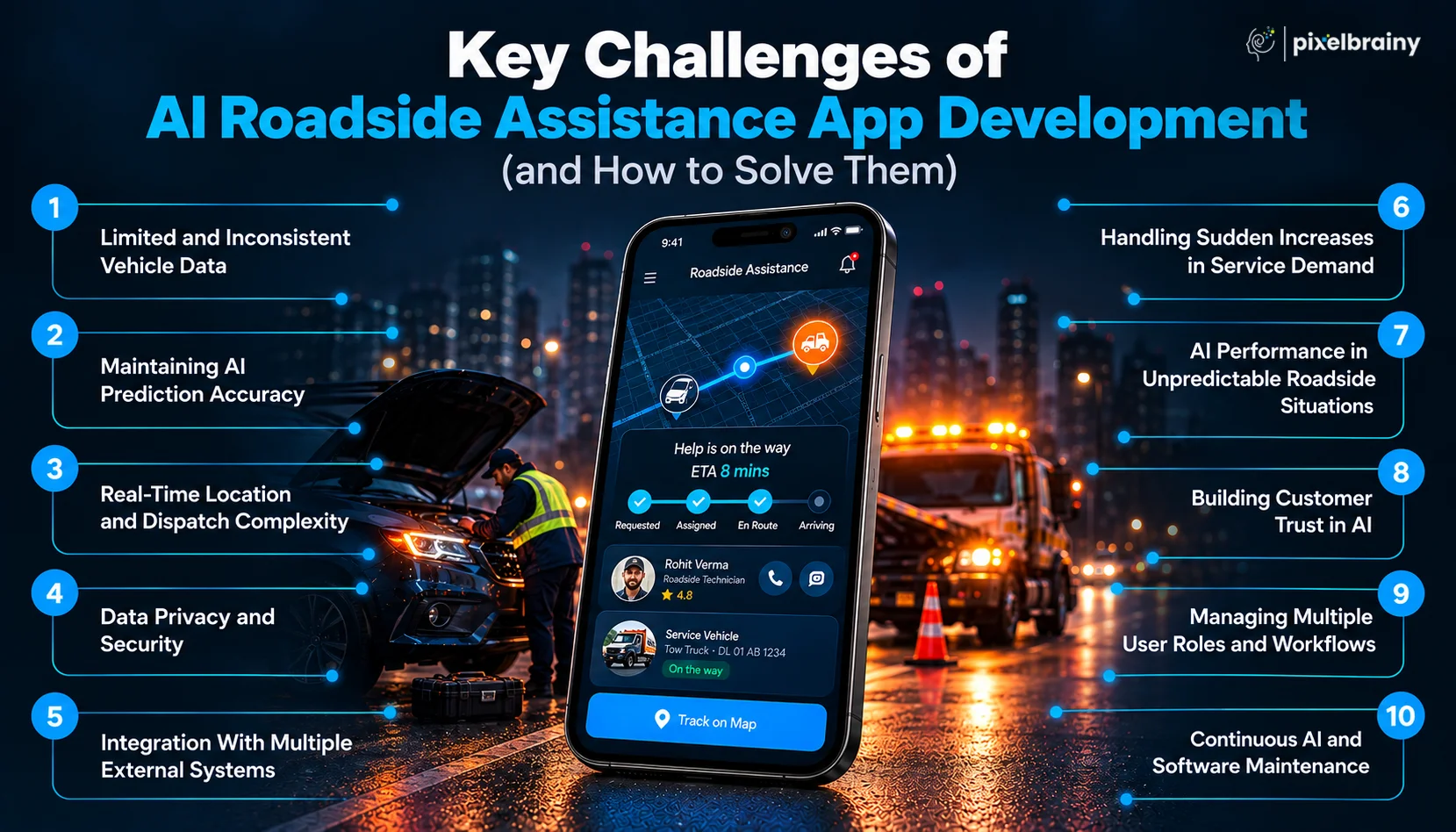
AI-powered roadside services depend on quality data. Vehicle diagnostics, telematics, maintenance records, mileage, and service histories may come from different sources and formats. Missing, outdated, or inconsistent information can affect the reliability of AI predictions and recommendations.
How to solve it: Establish a structured data strategy from the beginning. Normalize incoming information, validate datasets, use reliable data sources, and continuously monitor data quality. AI models should only use data that meets clearly defined quality standards.
An AI model may identify a potential vehicle problem or recommend a roadside service, but inaccurate predictions can result in unnecessary alerts or inappropriate assistance. This can negatively affect both customer confidence and operational efficiency.
How to solve it: Train models using relevant and representative datasets, establish measurable accuracy benchmarks, perform continuous validation, and monitor model performance after deployment. For important decisions, introduce confidence thresholds and human escalation rather than relying entirely on automated predictions.
Roadside assistance depends heavily on constantly changing information. A provider may become unavailable, traffic conditions may change, or a customer may move from the original location. Delayed location or availability updates can affect dispatch efficiency.
How to solve it: Use reliable GPS and mapping technologies alongside real-time communication infrastructure. The backend should be capable of processing changing provider availability, customer locations, traffic conditions, and service priorities so dispatch decisions can be updated when necessary.
An AI roadside assistance application may handle personal information, payment details, precise location data, vehicle information, and potentially connected-vehicle data. Any security weakness can expose sensitive information and damage customer trust.
How to solve it: Apply security from the architecture stage rather than adding it after development. Use encryption, secure authentication, role-based access controls, API security, monitoring, access logs, regular security testing, and data-minimization practices. Privacy requirements should also be considered when designing AI data pipelines.
A comprehensive roadside platform may need to connect with mapping services, payment providers, telematics platforms, insurance systems, CRM software, towing networks, fleet-management systems, and communication services.
Each external system can have different APIs, authentication requirements, data formats, limitations, and update schedules.
How to solve it: Build a modular API architecture that separates third-party integrations from the core application. Use standardized interfaces, API gateways, monitoring, documentation, and integration testing. This makes it easier to replace or update external services without disrupting the entire application.
Roadside assistance demand can increase rapidly during severe weather, major traffic incidents, holidays, or other unexpected events. An application that performs well under normal conditions may struggle when thousands of requests arrive within a short period.
How to solve it: Build the platform using scalable cloud infrastructure with auto-scaling, load balancing, caching, optimized databases, queue management, and real-time monitoring. Capacity planning should account for peak demand rather than average traffic alone.
Every breakdown is different. Customers may describe the same problem using completely different language, while environmental conditions and vehicle circumstances can vary significantly.
An AI model trained on limited scenarios may perform well during testing but struggle with unfamiliar situations after launch.
How to solve it: Continuously collect relevant feedback, evaluate model performance, retrain models with new data, and establish fallback workflows. AI should also be combined with predefined business rules and human intervention when confidence is low.
Motorists may be hesitant to follow an AI-generated recommendation when they are stranded, particularly if the system provides an unexpected service suggestion or diagnosis.
How to solve it: Keep AI recommendations transparent and easy to understand. Explain why a particular service may be relevant when appropriate, provide access to human support, and allow customers to confirm important actions before proceeding. AI should simplify the roadside experience rather than make it feel more complicated.
A roadside assistance ecosystem can involve motorists, technicians, towing providers, dispatchers, administrators, fleet managers, insurers, and enterprise partners. Each user group has different responsibilities and requires different functionality.
How to solve it: Define user roles and permissions during the planning stage. Create role-specific workflows and dashboards while maintaining a centralized backend. Strong access controls should ensure that every user can access only the information and functionality relevant to their responsibilities.
Launching the application is only the beginning. Mobile operating systems, third-party APIs, cloud services, AI models, security requirements, and vehicle technologies continue to evolve.
An AI roadside assistance platform that is not maintained can gradually experience compatibility, security, performance, and accuracy issues.
How to solve it: Establish a long-term maintenance strategy covering application updates, security patches, API changes, infrastructure optimization, AI model monitoring, retraining, performance testing, and new feature development. Regular improvements can keep the platform reliable as customer expectations and technology evolve.
Solving these challenges from the beginning can help businesses develop an AI roadside assistance app that is secure, scalable, accurate, operationally reliable, and practical for real-world roadside emergencies.
An AI roadside assistance app can generate revenue in several ways, depending on its target audience, service network, and operational model. A platform serving individual motorists may rely on memberships and service fees, while a larger roadside technology provider can generate revenue through fleet contracts, insurance partnerships, provider commissions, or white-label solutions.
For businesses planning AI roadside assistance app development, selecting the right monetization strategy is as important as building the technology itself. The business model should align with customer expectations while creating predictable revenue and allowing the platform to scale across different roadside service categories.
Here are the top business models to consider when building an AI-powered roadside assistance platform.
A subscription model allows motorists to pay a recurring monthly or annual fee in exchange for defined roadside assistance benefits. Plans can include a specific number of service requests, towing coverage, battery assistance, tire support, lockout assistance, or priority service.
Businesses can create multiple membership tiers, such as Basic, Plus, and Premium, with different service limits and benefits. AI can further personalize plan recommendations based on vehicle information, service history, driving patterns, or customer preferences where appropriate.
This model creates predictable recurring revenue while encouraging customers to maintain a long-term relationship with the roadside assistance platform.
Under this model, customers pay only when they request roadside assistance. The application can display the estimated service cost before the request is confirmed, depending on the service type, location, distance, and provider.
Common chargeable services include:
This model is particularly suitable for customers who do not want a recurring membership but still want the convenience of requesting assistance through a digital platform.
An AI roadside assistance app can operate as a marketplace connecting motorists with independent towing companies, mechanics, mobile technicians, and other roadside professionals.
The platform collects a percentage or fixed commission from each successfully completed service. For example, if a provider completes a roadside service through the platform, the business can retain an agreed commission while transferring the remaining amount to the service provider.
AI can support this model through intelligent provider matching, demand analysis, service recommendations, and automated dispatch, helping create a more efficient marketplace for both sides.
Fleet operators have recurring roadside assistance requirements and may manage hundreds or thousands of vehicles. A dedicated B2B model can provide businesses with centralized fleet assistance, service management, vehicle monitoring, reporting, and maintenance-related capabilities.
Revenue can be generated through monthly or annual contracts based on:
This model can create higher-value contracts and predictable recurring revenue while allowing the roadside platform to expand into fleet management and preventive vehicle services.
Insurance companies can integrate AI-powered roadside assistance into their policy offerings or customer applications. The roadside platform can provide assistance services on behalf of the insurer while the insurer incorporates the service into selected coverage plans.
Revenue can come through contractual arrangements, per-service charges, membership fees, or technology licensing.
This model can also create a broader digital ecosystem where insurance customers can request roadside assistance directly through a connected experience without searching for a separate provider during an emergency.
Automotive manufacturers, dealerships, and mobility brands can use an AI roadside assistance platform as part of their vehicle ownership ecosystem.
The service can be offered alongside vehicle warranties, maintenance packages, connected-car services, leasing programs, or premium ownership plans.
AI capabilities such as vehicle issue classification, predictive maintenance recommendations, and connected vehicle assistance can make the platform particularly valuable for automotive partners.
Revenue can be generated through licensing agreements, per-vehicle contracts, service fees, or long-term technology partnerships.
A technology company can develop a complete AI roadside assistance platform and license it to insurance companies, automotive brands, roadside networks, fleet businesses, or other organizations under their own branding.
The client receives a customized application and backend platform without having to build the complete technology infrastructure internally.
Revenue can come from:
This model can be especially attractive for organizations that want to launch digital roadside assistance services quickly without developing the entire technology stack from scratch.
Businesses can offer basic roadside services at standard pricing while charging additional fees for AI-powered premium capabilities.
Premium features could include:
This creates an opportunity to monetize advanced AI capabilities separately instead of including every intelligent feature within the basic roadside assistance package.
A roadside assistance platform with a substantial customer base can generate additional revenue through carefully selected automotive partnerships.
Relevant businesses could promote services such as vehicle maintenance, tires, batteries, repair services, car accessories, insurance products, or vehicle care programs.
However, advertising should remain highly relevant and non-intrusive. During an emergency, the priority should always be helping the motorist rather than overwhelming them with promotional content.
For a scalable AI roadside assistance app development strategy, combining multiple revenue streams can provide greater flexibility than relying on a single model.
For example, a platform could combine:
Membership + Pay-per-service + Fleet contracts + Provider commissions + Insurance partnerships
A consumer may subscribe to a roadside plan, while fleet operators pay through annual contracts and independent providers contribute through marketplace commissions.
This diversified approach allows the business to serve different customer segments while creating multiple sources of revenue from the same technology ecosystem.
There is no universal monetization model that works for every roadside assistance platform. The right approach depends on whether the application targets individual motorists, roadside providers, fleets, insurers, automotive companies, or a combination of these audiences.
For many businesses, a hybrid model offers the strongest long-term potential because it combines recurring membership revenue with transaction fees, B2B contracts, partnerships, and premium AI services.
A well-designed business model can turn an AI roadside assistance app from a service-request platform into a scalable roadside technology business with multiple recurring and transaction-based revenue streams.
From understanding the market opportunity to defining the right technology roadmap, the next step is identifying a development partner that can turn the concept into a reliable, scalable product. For businesses exploring AI roadside assistance app development services, PixelBrainy brings together product strategy, mobile development, AI engineering, backend architecture, and cloud technologies under one development ecosystem.
As an AI app development company, PixelBrainy focuses on creating AI-powered applications around real business requirements rather than adding artificial intelligence simply as a technology feature. The team can help businesses build AI roadside assistance apps with customer applications, provider interfaces, administrative dashboards, intelligent workflows, real-time tracking, secure payments, and scalable backend infrastructure.
Business-Focused Product Strategy: Every project begins with understanding the target audience, roadside service model, operational requirements, revenue strategy, and long-term product vision.
AI-First Engineering Approach: From intelligent service classification and conversational assistance to predictive analytics and automated decision support, AI capabilities are planned around practical use cases.
End-to-End Development: Businesses can work with one technology partner across product discovery, UI/UX, mobile applications, backend development, AI engineering, API integrations, testing, deployment, and post-launch improvements.
Scalable Architecture: The technology foundation can be designed to support expansion from an initial product into a larger roadside ecosystem serving motorists, technicians, fleets, insurers, and automotive businesses.
For a confidential client, PixelBrainy worked on a roadside mobility platform designed to connect motorists with nearby service professionals. The solution included location-based service requests, provider assignment, real-time tracking, service status updates, digital communication, and an administrative management layer. The architecture was also structured to support future AI capabilities and operational automation without requiring a complete platform rebuild.
This experience provides a practical foundation for businesses looking to develop AI roadside assistance apps or explore roadside assistance app development integrating AI into existing service operations.
Ready to turn your roadside assistance concept into an intelligent digital product? Connect with PixelBrainy to discuss your idea and development roadmap.
From these above insights, it is clear that AI roadside assistance app development is becoming a strategic opportunity for businesses looking to modernize roadside support and create more connected customer experiences. An AI-powered platform can bring together motorists, roadside professionals, fleet operators, insurers, and automotive businesses through a single digital ecosystem.
The journey covers everything from defining the right use cases and essential features to integrating AI, GPS, real-time tracking, intelligent dispatch, predictive breakdown detection, secure payments, and advanced analytics. At the same time, factors such as data quality, security, scalability, third-party integrations, and development cost need to be considered before moving toward implementation.
Whether you plan to build an AI roadside assistance app from scratch, upgrade an existing roadside platform, or introduce AI-powered capabilities into your current service model, the right strategy can turn the idea into a scalable business solution.
With a clear roadmap and experienced technology partner, AI roadside assistance app development can deliver meaningful value for both motorists and roadside service operators.
Ready to turn your roadside assistance idea into an AI-powered product? Book an appointment with PixelBrainy today.
Yes. Businesses can upgrade an existing platform through roadside assistance app development with AI without necessarily rebuilding the entire product. AI can be integrated for intelligent service classification, automated customer support, provider matching, dispatch optimization, predictive maintenance, and demand forecasting, depending on the existing architecture and available data.
An AI roadside assistance app can analyze the customer's description of the problem and classify it into a likely assistance category. If the AI model has insufficient confidence, the request can be transferred to a human dispatcher or roadside professional. This combination of AI and human support can make roadside assistance app development using AI more reliable for complex incidents.
Yes. AI can enhance provider matching by considering location, availability, service expertise, equipment, traffic conditions, workload, and estimated arrival time. This capability can make an AI roadside assistance app more effective at connecting motorists with suitable towing companies, mechanics, battery technicians, tire professionals, and other roadside providers.
Yes. Businesses can build AI roadside assistance apps that bring towing, fuel delivery, battery assistance, tire support, vehicle lockout services, mobile mechanics, and EV charging into one platform. AI can help categorize customer requests and route each incident toward the appropriate service provider.
AI can support faster response by analyzing provider availability, location, traffic, service type, and historical dispatch information. During AI roadside assistance app development, intelligent dispatch algorithms can be incorporated to recommend suitable providers and continuously update assignments when circumstances change.
Yes. Roadside assistance app development integrating AI can connect authorized telematics and vehicle-data sources with AI models. This can enable capabilities such as vehicle health analysis, predictive maintenance recommendations, risk scoring, and predictive breakdown detection, provided suitable data is available and used with appropriate authorization.
Businesses can incorporate offline and fallback capabilities into AI roadside assistance app development for motorists traveling through rural areas or locations with limited network coverage. Features such as cached location information, lightweight emergency workflows, and alternative communication methods can help maintain access to essential assistance services when connectivity is unreliable.
An AI roadside assistance app can generate revenue through subscriptions, pay-per-service charges, provider commissions, fleet contracts, insurance partnerships, automotive partnerships, premium AI services, and white-label licensing. The most suitable model depends on whether the platform targets individual motorists, roadside providers, fleets, insurers, automotive businesses, or multiple customer segments.

About The Author
Sagar Bhatnagar
Sagar Sahay Bhatnagar brings over a decade of IT industry experience to his role as Marketing Head at PixelBrainy. He's known for his knack in devising creative marketing strategies that boost brand visibility and market influence. Sagar's strategic thinking, coupled with his innovative vision and focus on results, sets him apart. His track record of successful campaigns proves his ability to utilize digital platforms effectively for impactful marketing efforts. With a genuine passion for both technology and marketing, Sagar continuously pushes PixelBrainy's marketing initiatives to greater success.

Working with the PixelBrainy team has been a highly positive experience. They understand the design requirements and create beautiful UX elements to meet the application needs. The dev team did an excellent job bringing my vision to life. We discussed usability and flow. Sagar worked with his team to design the database and begin coding. Working with Sagar was easy. He has the knowledge to create robust apps, including multi-language support, Google and Apple ID login options, Ad-enabled integrations, Stripe payment processing, and a Web Admin site for maintaining support data. I'm extremely satisfied with the services provided, the quality of the final product, and the professionalism of the entire process. I highly recommend them for Android and iOS Mobile Application Design and Development.

Great experience working with them. Had a lot of feedback and I found that unlike most contractors they were bugging me for updates instead of the other way around. They were extremely time conscience and great at communicating! All work was done extremely high quality and if not on time, early! They were always proactive when it comes to communication and the work is great/above par always. Very flexible and a great team to work with! Goes above and beyond to present us with multiple options and always provides quality. Amazing work per usual with Chitra. If you have UI/UX or branding design needs I recommend you go to them! Will likely work with them in the future as well, definitely recommended!

PixelBrainy is a joy to work with and is a great partner when thinking through branding, logo, and website layout. I appreciate that they spend time going into the "why" behind their decisions to help inform me and others about industry best practices and their expertise.

I hired them to design our software apps. Things I really like about them are excellent communication skills, they answer all project suggestions and collaborate right away, and their input on design and colors is amazing. This project was complex and needed patience and creativity. The team is amazing to do business with. I will be using them long-term. Glad to see there are some good people out there. I was afraid to try and outsource my project to someone but I am glad I met them! I really can't say enough. They went above and beyond on this project. I am very happy with everything they have done to make my business stand out from the competition.

It was great working with PixelBrainy and the team. They were very responsive and really owned the project. We'll definitely work with them again!

I recently worked with the PixelBrainy team on a project and I was blown away by their communication skills. They were prompt, clear, and articulate in all of our interactions. They listened and provided valuable feedback and suggestions to help make the project a success. They also kept me updated throughout the entire process, which made the experience stress-free and enjoyable.

PixelBrainy is very good at what it does. The team also presents themselves very professionally and takes care of their side of things very well. I could fully trust them taking up the design work in a timely and organised manner and their attention to detail saved us lots of effort and time. This particular project was quite intense and the team showed that they function very well under pressure. Very much looking forward to working with her again!

It's always an absolute pleasure working with them. They completed all of my requests quickly and followed every note I had for them to a T, which made our process go smoothly from start to finish. Everything was completed fast and following all of the guidelines. And I would recommend their services to anyone. If you need any design work done in the future, PixelBrainy should be your first call!

They took ownership of our requirements and designed and proposed multiple beautiful variants. The team is self-motivated, requires minimum supervision, committed to see-through designs with quality and delivering them on time. We would definitely love to work with PixelBrainy again when we have any requirements.

PixelBrainy was a big help with our SaaS application. We've been hard at work with a new UI/UX and they provided a lot of help with the designs. If you're looking for assistance with your website, software, or mobile application designs, PixelBrainy and the team is a great recommendation.

PixelBrainy designers are amazing. They are responsive, talented, and always willing to help craft the design until it matches your vision. I would recommend them and plan to continue them for my future projects and more!!!

They were awesome! Did a good job fast, and good communication. Will work with them again. Thank you

Creative, detail-oriented, and talented designers who take direction well and implement changes quickly and accurately. They consistently over-delivered for us.

PixelBrainy team is very talented and creative. Great designers and a pleasure to work with. PixelBrainy is an excellent communicator and I look forward to working with them again.

PixelBrainy has a very talented design team. Their work is excellent and they are very responsive. I enjoy working with them and hope to continue on all of our future projects.


Transform your ideas into reality with us.
Across these industries, each engagement brings unique challenges, from early-stage product development to scaling complex systems, helping us build a practical understanding of real-world product environments.