 AI Summary Powered by PixelBrainy
What happens when your SaaS pricing becomes more sophisticated than the billing system supporting it?
A SaaS company can begin with one simple monthly subscription and gradually evolve into a complex monetization model involving recurring subscriptions, usage-based API charges, AI credit packs, overage fees, discounts, enterprise contracts, add-ons, and customer-specific pricing. When that happens, billing stops being a simple payment function and becomes critical product infrastructure.
This is where AI SaaS billing software development becomes strategically important. The goal is not simply to replace Stripe or another payment processor. The real objective is to create an intelligent billing layer that can understand pricing rules, customer usage, AI consumption, credits, contracts, revenue policies, and billing exceptions while maintaining financial accuracy.
The opportunity is growing alongside the SaaS market. According to the latest 2026 forecast from Statista, worldwide SaaS revenue is projected to reach US$488.53 billion in 2026 and is expected to grow at a 11.86% CAGR from 2026 to 2031, reaching approximately US$855.63 billion by 2031.
For SaaS founders, CTOs, CFOs, product leaders, and engineering teams, the important question is whether to keep patching a conventional billing platform or build AI SaaS billing software around the company's actual monetization model.
This becomes particularly relevant when an engineering team spends a significant portion of its time fixing billing edge cases instead of developing the core product. A custom platform can centralize pricing logic, usage metering, credit accounting, invoice generation, reconciliation, and payment workflows.
More importantly, AI can add an intelligence layer on top of deterministic billing rules. It can identify unusual usage, detect possible revenue leakage, forecast consumption, explain invoices, identify customer billing patterns, and support pricing decisions.
In this guide, we explain developing an AI SaaS billing software, its highest-value use cases, essential features, advanced capabilities, development process, technology stack, challenges, and realistic development costs. We will also explain how to create an AI SaaS billing software that combines reliable financial rules with AI-powered intelligence and how businesses can build a SaaS billing platform with AI without turning financial calculations over to unpredictable AI models.
AI SaaS billing software is a specialized billing and revenue management system built for SaaS companies that use complex pricing models such as subscriptions, usage-based billing, AI credits, API consumption, overages, and enterprise contracts.
Unlike conventional billing software, it combines a reliable billing rules engine with AI-powered intelligence. This allows businesses to calculate charges accurately while also gaining insights from customer usage and billing data.
An AI SaaS billing platform typically follows this process:
Customer Activity → Usage Collection → Pricing Calculation → AI Analysis → Invoice Generation → Payment Processing
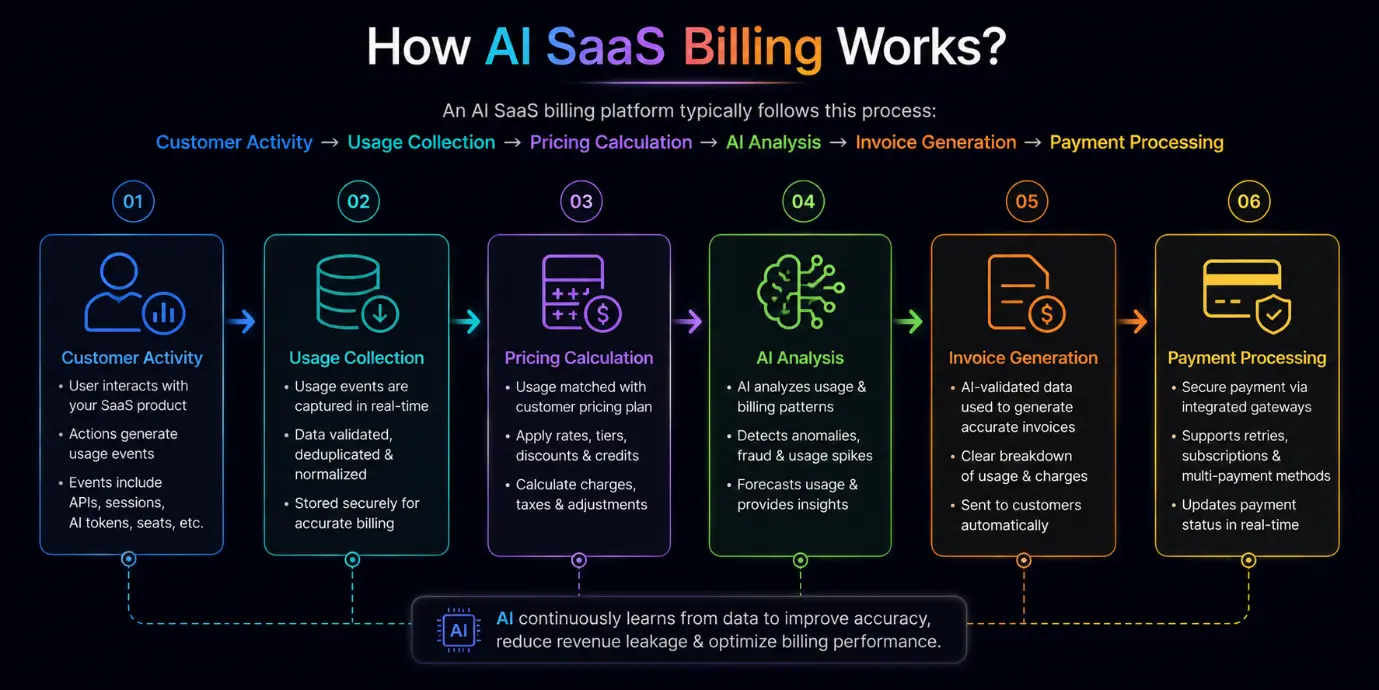
The billing engine handles deterministic calculations, while the AI layer analyzes billing information and identifies patterns, anomalies, and opportunities.
For example, if an AI SaaS customer suddenly consumes three times more API credits than usual, the system can flag the unusual activity, identify the likely reason, and notify the finance or customer success team.
| Standard Billing Platform | AI SaaS Billing Software |
|---|---|
| Manages subscriptions | Manages subscriptions and hybrid pricing |
| Uses predefined billing rules | Uses billing rules plus AI intelligence |
| Generates invoices | Generates and explains invoices |
| Basic usage tracking | Advanced usage and consumption analysis |
| Limited anomaly detection | AI-powered anomaly detection |
| Basic reporting | Predictive billing and revenue insights |
| Manual investigation | AI-assisted investigation |
| Fixed pricing structures | Flexible pricing and monetization models |
Why Is the Difference Important?
Traditional billing platforms are primarily designed to answer:
"How much does this customer owe?"
An AI SaaS billing platform can answer additional questions:
"Why does the customer owe this amount?"
"Is this invoice unusual?"
"Will this customer exceed their usage limit?"
"Are we losing revenue because of billing errors?"
"Which customers are becoming more expensive to serve?"
This makes AI SaaS billing software development especially valuable for growing SaaS businesses where billing complexity, usage volume, and AI infrastructure costs are increasing simultaneously.
The most effective architecture does not allow AI to control financial calculations directly. Instead, it combines deterministic billing rules for accuracy with AI for analysis, prediction, anomaly detection, and intelligent automation.
As SaaS products become more AI-driven, billing is becoming closely connected to product usage, customer behavior, infrastructure consumption, and monetization strategy. A company that starts with a simple subscription can quickly move into API-based pricing, AI credits, usage tiers, overages, enterprise contracts, and hybrid pricing. At that stage, billing is no longer just a payment function. It becomes a core system that needs to evolve alongside the product.
The market trajectory reinforces this shift. According to Statista's latest 2026 forecast, the global Software as a Service market is projected to generate US$512.27 billion in revenue in 2026. Other 2026 market research forecasts point to continued expansion through the next decade, with Fortune Business Insights projecting the global SaaS market to grow from US$375.57 billion in 2026 to US$1.48 trillion by 2034, representing an 18.7% CAGR.
This growth creates a strong reason for AI SaaS companies to treat billing infrastructure as a strategic technology investment.
If your SaaS product has moved beyond a simple monthly subscription, conventional billing infrastructure may struggle to represent your actual monetization model.
Common complexity includes:
Investing in custom AI SaaS billing software gives the company an architecture designed around these pricing requirements rather than forcing the business model into rigid billing structures.
For AI SaaS companies, billing is directly connected to product functionality.
A customer's access to an AI model, API, workflow, agent, or premium feature may depend on their subscription, credit balance, usage allowance, or contract.
That means billing decisions can influence:
What the customer can use → How much they can consume → What they are charged → When access changes
When billing becomes this closely integrated with the product, investing in dedicated billing architecture becomes an engineering decision rather than simply a finance decision.
AI products can generate thousands or millions of usage events involving:
A billing system designed for traditional subscriptions may not provide the flexibility required to accurately capture, aggregate, classify, and price these events.
AI SaaS companies need to understand not only what customers pay, but also what it costs to serve them.
For example:
Customer revenue → AI usage → Model cost → Infrastructure cost → Account economics
As AI usage grows, the ability to connect billing data with consumption and cost data becomes increasingly important for monetization decisions.
The future of SaaS monetization is unlikely to be limited to fixed subscriptions.
Companies are increasingly experimenting with combinations of:
Subscription + usage + credits + seats + overages + AI consumption
A billing architecture designed for hybrid monetization gives SaaS companies the technical foundation needed to support these evolving pricing strategies.
Modern AI billing infrastructure can be designed to support capabilities such as:
These capabilities require billing data to be structured, centralized, and available for intelligent analysis.
The decision to invest becomes particularly important when a company is experiencing rapid growth in customers, transactions, usage events, pricing variations, or AI consumption.
Building the billing foundation before complexity becomes unmanageable can prevent the company from repeatedly rebuilding its monetization infrastructure as it scales.
Therefore, investing in AI SaaS billing software is about building billing infrastructure that can keep pace with increasingly complex AI-powered products, pricing models, usage patterns, and revenue operations.
For an AI SaaS company, billing is no longer limited to calculating subscription charges and generating invoices. When revenue depends on API consumption, AI credits, tokens, model usage, seats, overages, or prepaid balances, billing becomes a continuous data stream that can reveal what customers are using, how they are paying, where revenue is being lost, and how much each customer costs to serve.
This is where AI SaaS billing software development creates value beyond conventional billing automation. A well-designed AI SaaS billing system can combine payment data, usage data, customer behavior, pricing rules, contract information, and financial records to identify patterns that traditional rule-based billing systems may miss.
For SaaS founders, CTOs, CFOs, finance teams, and product leaders, the highest-value use cases are those that directly address revenue leakage, customer retention, billing accuracy, AI usage costs, and forecasting.
Customer churn does not always begin with a cancellation request. In many SaaS businesses, warning signals appear much earlier in billing and payment data.
An AI-powered SaaS billing platform can analyze payment behavior alongside product usage to identify accounts that may be moving toward churn.
The system can evaluate signals such as:
For example, a customer may have historically consumed $8,000 worth of AI credits every month. Over the last three months, usage drops to $5,000, then $3,500, while the customer also experiences multiple failed payments.
A traditional billing system may simply record the failed transactions.
An AI billing system can identify the combination of signals and classify the account as a potential churn risk.
This allows customer success teams to intervene before the customer actually cancels.
The important point is that AI SaaS billing software can turn billing behavior into an early-warning system for customer retention.
Failed payments are one of the most common sources of preventable SaaS revenue loss.
A basic billing system generally follows predefined retry rules:
Payment fails → Retry → Send reminder → Retry again → Suspend account
The problem is that every customer does not respond to payment failures in the same way.
An AI-powered intelligent dunning system can evaluate:
Based on these signals, AI can help determine which accounts require immediate attention and which can continue through automated recovery.
For example, an enterprise customer with a strong five-year payment history and a temporary payment-method failure should not necessarily receive the same treatment as a low-value account with repeated failed payments.
AI can help prioritize recovery workflows while deterministic billing rules continue to control the actual payment process.
This makes intelligent dunning an important use case when building AI SaaS billing software for businesses with substantial recurring or usage-based revenue.
For AI SaaS companies, accurate usage metering is often the foundation of accurate billing.
Traditional subscription billing can calculate a predictable monthly amount. AI and API products are different because the customer's bill may depend on millions of individual consumption events.
Depending on the product, the system may need to measure:
A robust AI SaaS billing system development architecture should collect these events in real time, validate them, prevent duplicate processing, aggregate them, and apply the correct pricing rules.
Real-time metering also enables proactive controls.
For example, the system can identify that a customer has already consumed 90% of its monthly AI credits and automatically trigger:
Usage alert → Spending notification → Upgrade recommendation → Additional credit purchase
This is particularly valuable for AI SaaS products where consumption can increase rapidly and unexpectedly.
The billing platform therefore becomes both a financial measurement system and a real-time usage control layer.
Pricing is one of the most important areas where AI can provide intelligence beyond traditional billing automation.
A conventional billing platform executes pricing rules.
An AI-enabled billing platform can analyze whether those pricing rules are producing the desired business outcomes.
It can compare:
Price → Usage → Conversion → Retention → Expansion → Revenue → Cost to serve
This allows SaaS companies to evaluate questions such as:
For example, an AI SaaS company may discover that customers consistently exceed the included API allowance of a particular plan.
Rather than immediately increasing the subscription price, the company could test an additional usage tier, credit pack, or overage model.
AI can model potential outcomes before the pricing change is implemented.
This makes AI-powered pricing optimization particularly useful for SaaS businesses experimenting with hybrid and usage-based monetization.
As SaaS pricing becomes more complex, revenue recognition can become significantly more difficult for finance teams.
The challenge becomes greater when contracts contain:
An AI SaaS billing platform can connect contract data, pricing rules, usage events, invoices, and revenue schedules within a single workflow.
The architecture can follow:
Customer Contract → Billing Rules → Usage → Invoice → Revenue Schedule → Accounting System
For example, a customer may purchase $50,000 of AI credits upfront. The billing system records the payment, while the revenue recognition workflow tracks how those credits are subsequently consumed and determines the appropriate accounting treatment according to the applicable contract terms and accounting policies.
Automation can help finance teams manage:
However, AI should support accounting workflows rather than independently determine accounting treatment. ASC 606 compliance requires appropriate accounting judgment and validation by qualified professionals.
Billing disputes can become expensive when finance and customer support teams have to manually reconstruct how an invoice was generated.
An AI-powered billing platform can investigate disputes by connecting the invoice with its underlying billing data.
It can analyze:
Suppose a customer asks:
"Why did our invoice increase from $4,200 to $7,850?"
Instead of sending the issue to an engineer, the billing system can identify that:
The platform can then generate a customer-friendly explanation based on verified billing records.
This reduces the amount of manual investigation required from finance, support, and engineering teams.
The AI does not decide what the customer owes. It explains how the existing billing calculation was produced.
Billing errors can occur even when the underlying system appears to be functioning correctly.
An event pipeline might accidentally send duplicate usage data. A pricing configuration might be applied to the wrong customer segment. A customer could experience an unexpected usage spike. A discount could remain active after its expiration date.
A traditional system may process these events according to its rules without understanding that the resulting invoice looks abnormal.
AI billing anomaly detection adds another layer of protection.
The system can compare current billing activity against:
Potential anomalies can include:
For AI products, anomaly detection can be particularly important because an automated process or AI agent can generate extremely high consumption within a short period.
Early detection can prevent both revenue leakage and unexpected customer bills.
The final high-value use case is turning billing data into forward-looking revenue intelligence.
Traditional billing reports generally tell you what has already happened.
AI revenue intelligence can help answer what is likely to happen next.
The system can analyze:
For example, the system may identify that a group of enterprise customers is increasing AI consumption at a predictable rate.
It can use that information to forecast:
This creates a connection between billing and financial planning.
Instead of using billing software only to answer "What did we charge?", an AI SaaS revenue platform can help answer:
"What is likely to happen to our revenue, usage, and customer economics next?"
The highest-value AI SaaS billing use cases turn billing from a transactional back-office system into an intelligent revenue, usage, customer retention, and financial forecasting engine.
The benefits of AI SaaS billing software development become most visible when billing complexity starts affecting revenue, engineering capacity, finance operations, and pricing flexibility. For a growing SaaS company, the business case is not simply about replacing another billing tool. It is about determining whether owning the billing intelligence layer can produce measurable financial and operational value.
This is particularly relevant for leaders asking, "What is the measurable business case for building custom AI SaaS billing software versus paying for Chargebee and accepting its limitations, and can I quantify this in terms of ARR impact?" The answer should be evaluated through revenue leakage prevented, net revenue retention, pricing uplift, payment recovery, finance automation, and engineering capacity reclaimed.
Similarly, when evaluating why build a custom AI billing platform for SaaS, CTOs and CFOs should measure how much engineering time is currently spent maintaining integrations, handling billing exceptions, reconciling usage, and fixing invoice issues. This provides a clearer framework for answering, "How much engineering time does building custom AI billing software free up, and how do I frame the ROI of this investment for my board?"
Here are six high-impact AI billing software revenue benefits that can support that ROI case.
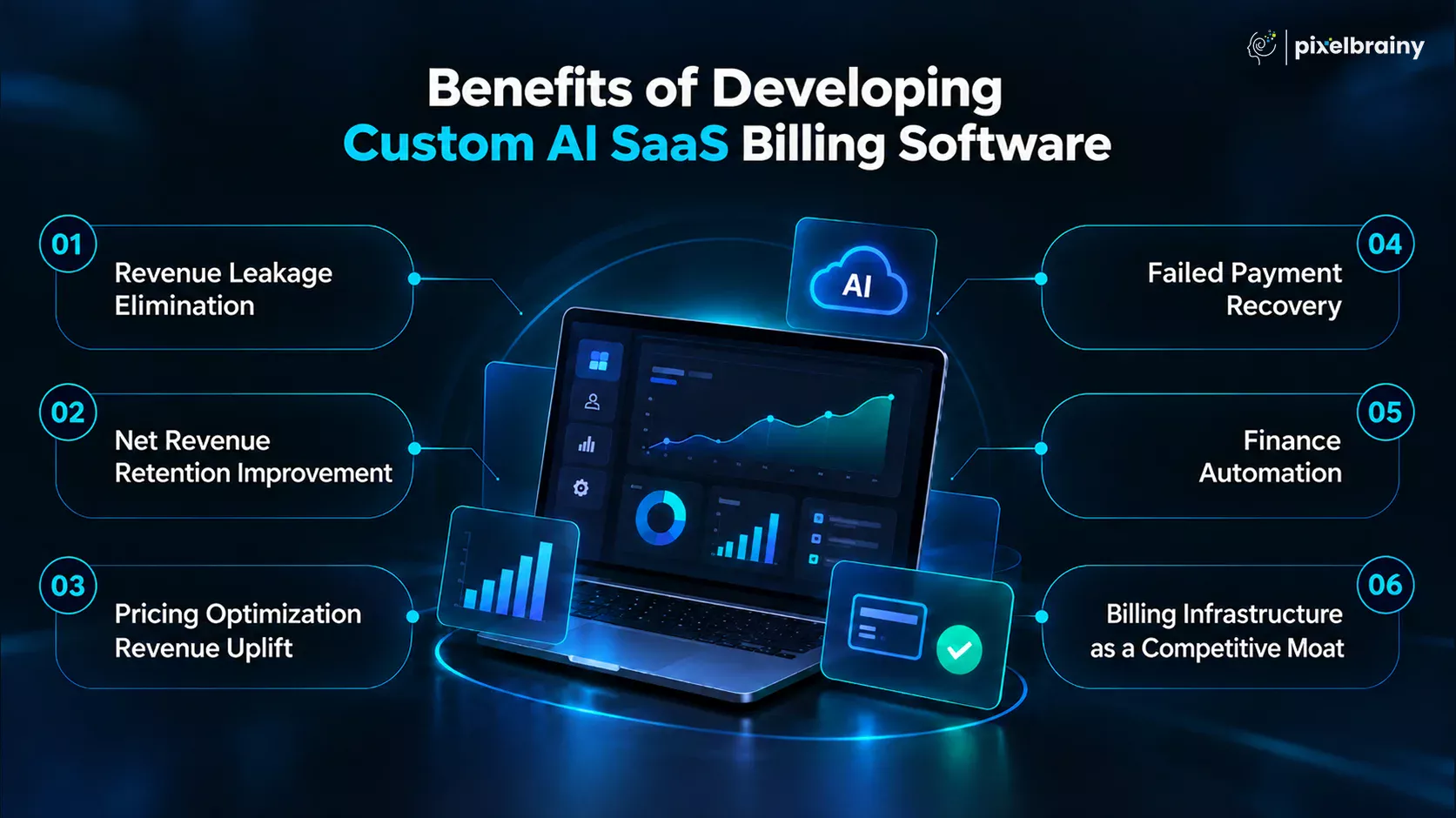
Revenue leakage occurs when customers consume services without being billed correctly because of missing usage events, incorrect pricing rules, expired discounts, credit errors, failed integrations, or manual billing mistakes.
The development of an AI SaaS billing system creates a centralized environment where usage, pricing, credits, contracts, and invoices can be continuously reconciled. AI can identify unusual gaps between consumption and billed revenue and prioritize suspicious accounts for investigation.
For SaaS companies processing large volumes of API or AI usage, even a small percentage of recovered leakage can translate into meaningful additional ARR.
Custom AI billing can support stronger net revenue retention by connecting billing behavior with product consumption, account expansion, and churn indicators.
AI can identify customers approaching usage limits, repeatedly purchasing additional credits, increasing API consumption, or showing signals associated with contraction. These insights can be passed to sales and customer success teams at the appropriate time.
One of the key SaaS billing automation benefits AI provides is turning billing data into actionable account intelligence. Instead of discovering expansion or contraction after renewal, teams can identify revenue opportunities and risks earlier in the customer lifecycle.
A custom billing platform gives SaaS companies access to granular information about how customers respond to pricing, allowances, credits, overages, and consumption thresholds.
AI can analyze relationships between price, usage, conversion, expansion, retention, and cost to serve. This helps product and finance teams identify potentially underpriced customer segments, ineffective discounts, better usage tiers, or opportunities for hybrid pricing.
Companies looking to create AI SaaS billing software can also build pricing simulations that estimate the revenue impact of proposed changes before rollout, helping decision-makers pursue pricing improvements using actual customer and consumption data.
Failed payments can silently reduce recurring revenue when recovery workflows rely on fixed retry schedules and generic customer communication.
Custom AI billing software can analyze payment history, failure type, account value, customer tenure, previous recovery attempts, and subscription activity to help determine appropriate recovery workflows. High-value accounts can be prioritized for human intervention while other cases continue through automated dunning.
These AI billing software revenue benefits make failed-payment recovery measurable. Teams can track involuntary churn, recovery rates, recovered ARR, payment retry performance, and revenue retained through intelligent dunning rather than treating failed payments as routine administrative events.
Complex SaaS billing can force finance teams to manually reconcile usage, investigate invoice discrepancies, process adjustments, validate credits, prepare reports, and coordinate with engineering teams.
Custom billing software can automate much of this operational workflow by centralizing usage records, invoices, payment events, pricing rules, credits, and reconciliation data. AI can further assist with anomaly investigation, invoice explanations, forecasting, and exception prioritization.
The resulting SaaS billing automation benefits AI can be measured through fewer manual billing hours, shorter month-end processes, fewer support escalations, reduced reconciliation workload, and less engineering involvement in routine finance operations.
Billing infrastructure can become a competitive advantage when monetization itself is part of the product strategy.
Owning the billing layer allows a SaaS company to introduce new credit systems, usage meters, pricing experiments, enterprise agreements, product bundles, and AI monetization models without waiting for a third-party platform to support them.
This is a strategic reason why build a custom AI billing platform for SaaS rather than evaluating the investment only through software subscription savings. Flexible billing can increase the speed at which a company launches, tests, and scales new revenue models.
Ultimately, the benefits of AI SaaS billing software development should be measured through ARR protected or created, revenue retained, finance hours automated, engineering capacity reclaimed, and the speed at which new monetization strategies can reach customers.

A reliable AI SaaS billing software development project should begin with the core billing capabilities required to calculate, collect, track, and reconcile SaaS revenue accurately. AI should enhance these capabilities rather than replace the underlying financial logic. This distinction is important when businesses evaluate AI SaaS billing software features for subscriptions, usage-based pricing, AI credits, API consumption, overages, and enterprise contracts.
A common question among SaaS founders and CTOs is: “What features should an AI SaaS billing platform have before it is ready for production, and which capabilities are essential versus optional?”
For companies planning AI SaaS billing system development, the essential feature set should establish a dependable foundation for customer management, pricing, usage metering, invoicing, payments, credits, security, reporting, and reconciliation. Advanced capabilities such as predictive pricing and sophisticated AI forecasting can be added later after this foundation is stable.
| Feature | What It Should Do |
|---|---|
| Multi-Tenant Customer Management | Manage organizations, accounts, billing contacts, customer profiles, and tenant-specific billing configurations while keeping customer data and financial records properly isolated. |
| Product and Plan Catalog | Define products, subscription plans, features, add-ons, usage meters, credit packages, and pricing versions from a centralized billing catalog. |
| Flexible Pricing Engine | Support flat-rate, per-seat, tiered, volume-based, usage-based, and hybrid pricing models without requiring billing logic to be scattered across multiple application services. |
| Subscription Management | Handle subscription creation, activation, upgrades, downgrades, renewals, cancellations, pauses, and plan changes while maintaining accurate billing states throughout the customer lifecycle. |
| Usage Metering | Capture and aggregate API requests, tokens, AI consumption, storage, processing, and other measurable usage events for accurate usage-based billing calculations. |
| Usage Event Processing | Process high-volume billing events reliably with validation, timestamps, unique event identifiers, retries, and idempotency controls to prevent duplicate or missing charges. |
| AI Credit Management | Manage purchased, promotional, consumed, refunded, transferred, and expired AI credits through a transparent ledger that provides accurate customer balances and transaction history. |
| Invoice Generation | Automatically generate accurate draft and finalized invoices containing subscriptions, usage charges, credits, discounts, taxes, adjustments, and other applicable billing components. |
| Payment Gateway Integration | Connect the billing platform with payment providers for card payments, bank payments, refunds, payment status updates, and secure payment event processing. |
| Discount and Promotion Management | Create and manage coupons, promotional credits, percentage discounts, fixed discounts, introductory offers, usage incentives, and customer-specific pricing rules. |
| Tax Management | Calculate and apply applicable taxes according to customer location, product classification, transaction type, and configured tax rules while maintaining appropriate tax information. |
| Billing Cycle Management | Support monthly, quarterly, annual, prepaid, usage-based, and customized billing cycles while accurately handling billing dates, renewals, proration, and invoice periods. |
| Reconciliation | Compare usage records, invoices, payments, credits, and accounting records to identify discrepancies and maintain consistency across the complete billing workflow. |
| Role-Based Access Control | Control access for finance teams, administrators, support users, engineers, and customers through permission-based access to sensitive billing information and operations. |
| Billing Analytics and Reporting | Provide dashboards and reports covering revenue, invoices, usage, credits, payments, subscriptions, failed transactions, customer spending, and billing performance. |
These foundational capabilities form the core of a custom AI SaaS billing platform. Without them, adding AI can create intelligence around unreliable financial data, which ultimately increases rather than reduces billing risk.
For example, an AI model can detect an unusual invoice only when the platform has reliable historical invoices, usage records, customer information, and pricing data. Similarly, AI-powered billing explanations are only trustworthy when the underlying invoice calculation is deterministic and auditable.
Therefore, businesses looking to build AI SaaS billing software should prioritize financial accuracy, usage reliability, flexible pricing, data integrity, and operational control before introducing more sophisticated capabilities.
The right foundation allows AI to operate as an intelligence layer while the core billing engine remains responsible for calculating exactly what customers owe.
In short, the essential features of AI SaaS billing software should create a reliable financial foundation first, giving advanced AI capabilities accurate and trustworthy data to work with later.
Once the core billing infrastructure is stable, businesses can introduce advanced capabilities that make the platform more intelligent, predictive, and commercially valuable. These capabilities are especially relevant when building an AI SaaS billing software for companies managing large volumes of usage data, complex customer behavior, AI infrastructure costs, and rapidly changing monetization models.
Advanced features should not replace foundational billing functions. Instead, they should sit on top of a reliable billing engine and use trusted financial and usage data to generate predictions, recommendations, alerts, and automation.
For SaaS founders, CTOs, CFOs, and product leaders evaluating AI SaaS billing software development, the following features can help transform a conventional billing platform into an intelligent revenue management system.
| Advanced Feature | Detailed Explanation |
|---|---|
| Predictive Usage Forecasting | Uses historical consumption, current usage velocity, customer behavior, and billing cycles to predict future API calls, token usage, AI credits, or other consumption. It can identify customers likely to exceed limits and support proactive alerts, upgrade recommendations, and infrastructure planning. |
| AI Revenue Forecasting | Analyzes MRR, ARR, usage revenue, expansion, contraction, payment behavior, churn indicators, and customer activity to forecast future revenue. Finance teams can use these predictions to identify potential revenue risks, estimate upcoming usage revenue, and improve financial planning. |
| Intelligent Pricing Optimization | Evaluates pricing, customer usage, conversion, retention, expansion, discounts, and cost-to-serve data to identify potential monetization opportunities. AI can recommend new pricing tiers, credit packages, usage thresholds, or overage structures while allowing business teams to approve final pricing decisions. |
| AI Revenue Leakage Detection | Continuously compares usage events, pricing rules, contracts, credits, entitlements, and invoices to identify potential unbilled consumption or incorrect charges. It can detect missing usage, expired discounts, incorrect pricing configurations, duplicate credits, and other situations that may cause preventable revenue loss. |
| AI Billing Anomaly Detection | Identifies billing behavior that differs significantly from expected customer or system patterns. The feature can detect sudden invoice increases, unusual AI consumption, duplicate charges, abnormal credit usage, unexpected discounts, and other suspicious billing activity before it becomes a financial or customer support issue. |
| Intelligent Dunning Optimization | Uses payment history, failure reasons, customer value, account activity, subscription status, and previous recovery results to prioritize failed-payment recovery. The system can help determine which accounts require immediate attention and which can continue through automated recovery workflows. |
| AI Invoice Explanation Engine | Analyzes verified invoice line items, usage records, pricing rules, credits, discounts, and contract information to generate understandable explanations for customers. It can answer questions about why an invoice increased while keeping explanations grounded in authoritative billing data. |
| Natural-Language Billing Analytics | Allows finance, operations, and leadership teams to ask billing questions using everyday language. Users can query revenue, customer usage, invoices, credits, payment behavior, and account trends without manually building complex reports or database queries. |
| AI Contract-to-Billing Intelligence | Extracts relevant billing terms from approved customer contracts, including pricing, usage allowances, discounts, minimum commitments, overage rates, renewal conditions, and payment terms. It can help teams translate contract requirements into billing configurations while maintaining human review for important financial decisions. |
| Billing Scenario Simulation | Allows product and finance teams to model potential pricing and monetization changes using historical customer and usage data. Teams can evaluate the potential impact of new plans, credit limits, overage rates, discounts, or pricing structures on revenue, usage, adoption, and customer economics before implementation. |
These advanced AI SaaS billing features can transform billing from a transaction-processing system into an intelligent revenue infrastructure layer capable of predicting usage, identifying financial risks, optimizing monetization, and supporting smarter SaaS growth.
AI SaaS companies do not all use the same monetization model. A product charging a fixed monthly subscription has very different billing requirements from an AI API platform charging per token, an enterprise platform managing negotiated contracts, or a marketplace distributing revenue among multiple participants.
Choosing the right type of AI SaaS billing software development is therefore important before architecture and development begin. The billing model determines how the platform should manage subscriptions, usage, credits, contracts, invoices, payments, revenue sharing, and customer accounts.
A common question for SaaS founders and CTOs is: "Which AI SaaS billing platform model is right for our pricing structure today, and will it still support our monetization strategy as the business scales?"
Here are the major types of AI SaaS billing software to consider.
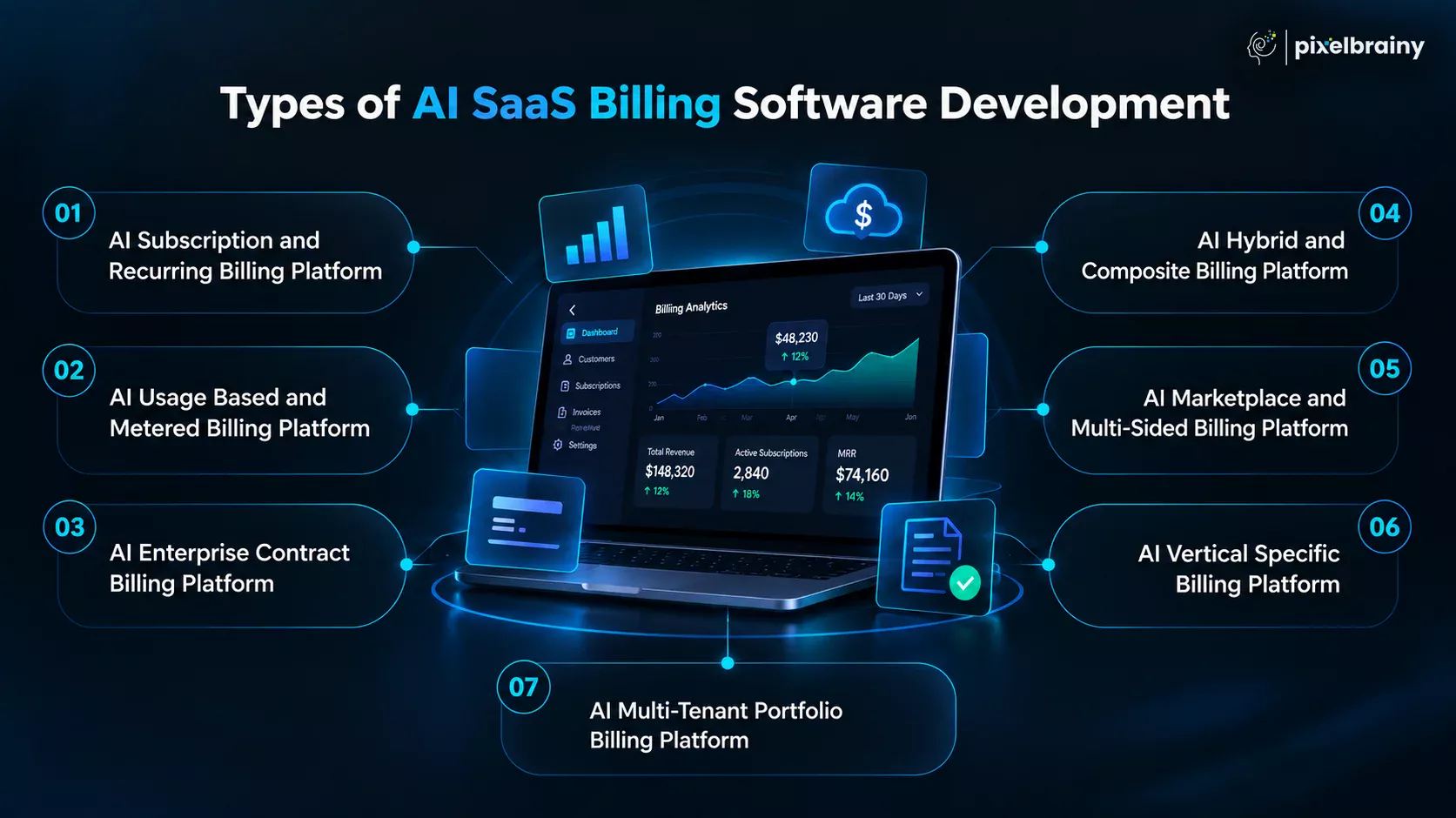
An AI subscription and recurring billing platform is designed for SaaS products that primarily generate revenue through monthly, quarterly, or annual subscriptions.
It manages recurring plans, renewals, upgrades, downgrades, cancellations, trials, prorated charges, discounts, and recurring invoices.
AI can analyze subscription behavior to identify renewal risks, unusual account activity, plan changes, and potential expansion opportunities.
This model works well for AI productivity tools, marketing platforms, collaboration products, and business applications where customers pay a predictable recurring fee.
An AI usage-based and metered billing platform is designed for products where customers pay according to actual consumption.
This model is particularly suitable for AI APIs, developer platforms, AI infrastructure, and applications charging according to tokens, requests, processing time, generated content, or AI credits.
The platform collects usage events, validates them, aggregates consumption, and applies the appropriate pricing rules.
AI can additionally forecast consumption, detect unusual usage, and identify customers approaching spending or usage limits.
An AI enterprise contract billing platform is designed for SaaS businesses serving large organizations with customized commercial agreements.
Enterprise contracts may include negotiated pricing, annual commitments, minimum spending requirements, volume discounts, custom usage allowances, and specific payment terms.
The platform connects contracts with subscriptions, usage, invoices, and revenue workflows.
AI can help identify important billing terms, monitor contract compliance, detect unusual consumption, and highlight situations where actual usage differs from contractual expectations.
An AI hybrid and composite billing platform supports multiple monetization models within the same customer account.
This can include subscriptions, seats, API usage, AI credits, overages, add-ons, prepaid balances, and usage-based charges.
The platform combines these different components into a unified billing workflow and invoice.
AI can analyze how customers use each component, forecast future consumption, detect billing anomalies, and identify potential pricing opportunities.
This model is particularly suitable for mature AI SaaS companies whose pricing has evolved beyond a simple subscription model.
An AI marketplace and multi-sided billing platform is designed for businesses where multiple parties participate in a transaction.
Examples include AI marketplaces, model marketplaces, agent marketplaces, and platforms connecting customers with AI service providers.
The billing system may need to calculate customer charges, platform commissions, provider payouts, refunds, taxes, credits, and revenue shares.
AI can analyze transaction patterns, detect suspicious billing activity, forecast marketplace revenue, and provide insights into buyer and seller behavior.
An AI vertical-specific billing platform is designed around the billing requirements of a particular industry.
Examples include healthcare AI, legal AI, fintech AI, education technology, insurance technology, and professional services platforms.
These businesses may require specialized pricing rules, usage measurements, contracts, compliance workflows, and billing processes.
A customized AI SaaS billing system development approach allows the platform to address those industry-specific requirements instead of forcing them into a generic billing structure.
An AI multi-tenant portfolio billing platform is designed for organizations managing multiple SaaS products, brands, applications, subsidiaries, or customer environments through centralized billing infrastructure.
Each tenant can maintain its own customers, subscriptions, pricing, usage meters, invoices, and billing configurations.
At the portfolio level, AI can compare revenue, usage, profitability, customer behavior, and billing anomalies across different products or business units.
This approach is valuable for SaaS groups and technology companies operating multiple AI products that require centralized financial visibility while maintaining separate monetization models.
The right AI SaaS billing model should match your current monetization structure while providing enough flexibility to support future pricing, usage, customer, and revenue complexity.
Building an AI SaaS billing platform requires much more than connecting a payment gateway and adding an AI API. The development process of AI SaaS billing software involves understanding the company's monetization model, defining billing rules, designing usage architecture, establishing financial data integrity, integrating AI capabilities, testing complex billing scenarios, and safely deploying the platform into production.
For SaaS founders, CTOs, product leaders, and finance teams, the key question is often: "What are the practical steps to build AI SaaS billing software from scratch without creating another billing system that becomes difficult to maintain as pricing and usage complexity increase?"
The answer is to approach building an AI SaaS billing software as a product and financial infrastructure project, not simply a payment integration project.
Below are the eight essential steps to build AI SaaS billing software from idea to launch.
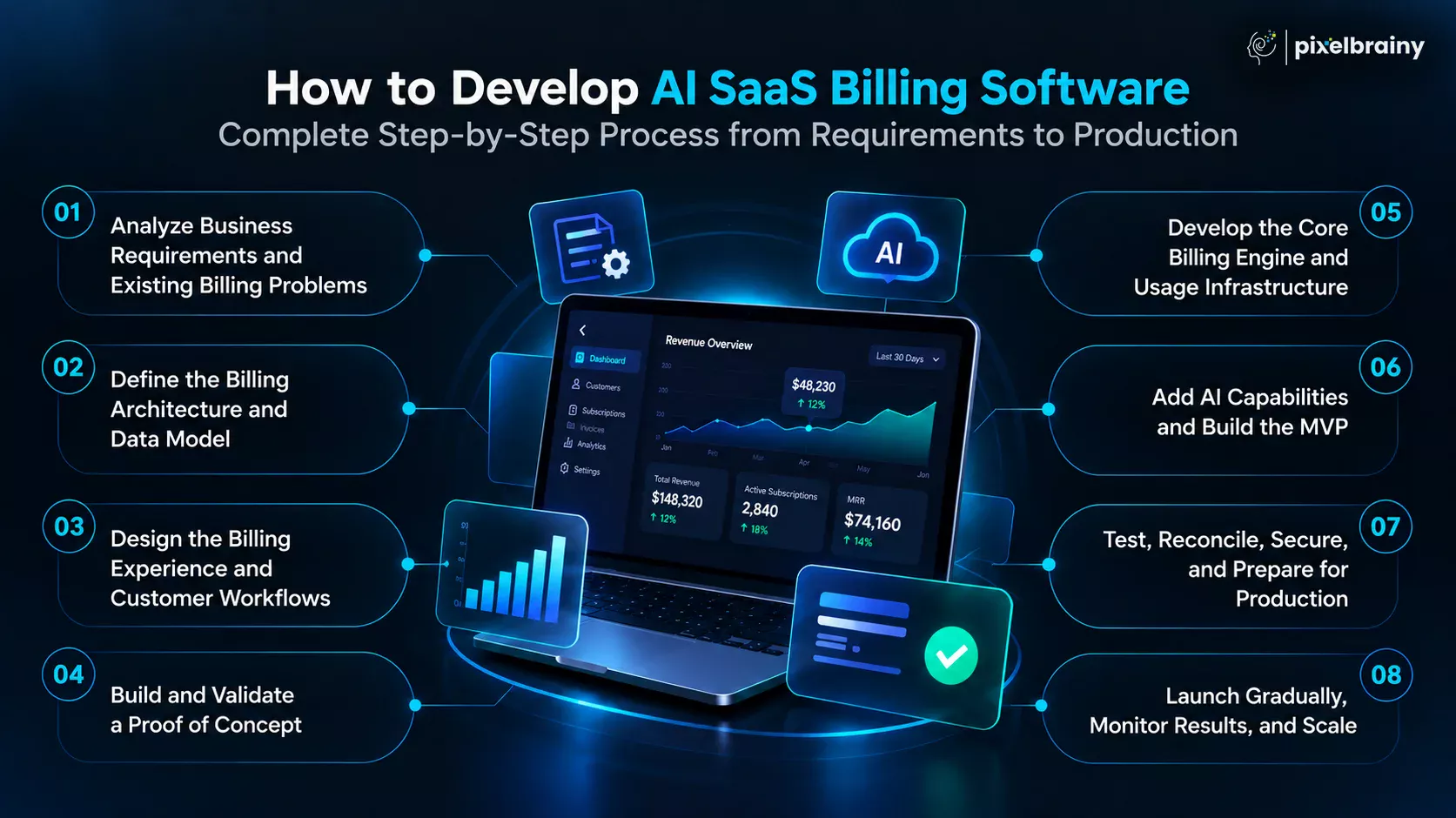
The first step in AI SaaS billing software development for businesses is understanding exactly what the platform needs to solve.
Start by documenting the current monetization structure, including subscriptions, usage-based pricing, AI credits, API consumption, overages, discounts, contracts, taxes, refunds, and payment workflows.
Review existing billing problems such as duplicate charges, missing usage, manual reconciliation, pricing exceptions, invoice disputes, and engineering dependencies.
Interview finance, engineering, product, sales, and customer success teams to understand their requirements.
At this stage, an AI consultation can help determine where AI is genuinely useful and where deterministic billing rules should remain responsible for financial calculations.
Once requirements are clear, define the architecture required to develop an AI SaaS billing system reliably.
Identify core entities such as customers, organizations, products, plans, subscriptions, pricing rules, usage meters, usage events, credits, invoices, payments, refunds, contracts, and discounts.
Design how information moves between your application, usage infrastructure, billing engine, payment provider, accounting system, and AI layer.
The architecture should support multi-tenancy, auditability, versioned pricing, idempotent events, secure access, and reliable reconciliation.
The objective is to create a foundation that can support current pricing while allowing new monetization models to be introduced without repeatedly rebuilding the billing core.
The next stage focuses on how customers and internal teams interact with the billing platform.
Map customer journeys for subscription selection, checkout, plan changes, usage monitoring, credit purchases, invoices, payment methods, refunds, and account cancellation.
Finance teams may require dashboards for invoices, reconciliation, credits, payments, adjustments, and revenue reporting.
A specialized UI/UX design company can help create clear billing experiences where complex usage and pricing information remains understandable.
The design should also account for different user roles, including customers, finance administrators, support teams, account managers, and system administrators.
Good billing UX reduces confusion and makes complex invoices easier to understand.
Before developing the complete platform, validate the most technically difficult billing workflows.
A focused PoC development phase can test critical requirements such as high-volume usage ingestion, AI credit accounting, hybrid pricing calculations, invoice generation, payment events, and reconciliation.
For example, if your business charges customers for subscriptions, API requests, and AI credits, create a small working flow that proves all three can be calculated correctly.
This stage should answer important technical questions before significant development resources are committed.
The goal is not to build a production system. It is to reduce architectural uncertainty and prove that the proposed approach can handle the company's most complicated billing scenarios.
After validating the architecture, development can move into the core platform.
Build the pricing engine, subscription management, usage metering, credit ledger, invoice engine, payment integrations, customer management, and reconciliation workflows.
For usage-based AI products, event processing must be designed for accuracy. Every usage event should have reliable identifiers, timestamps, validation, retry handling, and idempotency controls.
The billing engine should calculate charges using deterministic rules rather than relying on an AI model to determine financial amounts.
This stage represents the core SaaS billing software development using AI architecture, where AI operates alongside reliable billing infrastructure instead of replacing financial controls.
Once the core billing engine works reliably, introduce AI capabilities based on the highest-value business requirements.
Potential capabilities include:
At this point, MVP development should focus on the smallest production-ready feature set capable of solving the company's most expensive billing problems.
The AI layer should use trusted billing and usage data.
If specialized predictive models are required, AI model development can be introduced for use cases such as forecasting or anomaly classification.
The objective is to validate measurable business value before expanding the platform.
Also Read: Top 10 AI MVP Development Companies in USA
Billing systems require more rigorous testing than many standard SaaS applications because errors can directly affect revenue and customer trust.
Test normal and unusual scenarios, including upgrades, downgrades, cancellations, prorations, refunds, failed payments, duplicate events, late usage events, missing events, expired credits, discounts, tax rules, and enterprise pricing.
Run the new billing system alongside the existing platform and compare invoice results.
Security testing should cover access control, encryption, API security, audit logs, secrets, and sensitive financial data.
Teams should also establish monitoring and reconciliation processes before production deployment.
This stage ensures the system is accurate, secure, observable, and operationally ready.
The final stage is the transition from development to production.
Do not immediately move every customer to the new billing platform. Begin with internal accounts or a controlled customer segment.
Monitor invoice accuracy, usage processing, payment events, reconciliation differences, system performance, AI predictions, customer support tickets, and billing exceptions.
Once the system performs reliably, gradually migrate additional customers.
After launch, continuous AI integration can expand capabilities based on actual usage and business requirements.
Companies evaluating top AI development companies should also assess whether their partner can provide long-term optimization, monitoring, infrastructure scaling, and feature evolution rather than treating production launch as the end of the project.
This iterative approach is central to AI product development companies building reliable financial platforms for growing SaaS businesses.
A disciplined development process turns the journey from billing complexity to an intelligent SaaS revenue platform into a controlled sequence of requirements, architecture, validation, development, AI implementation, testing, and production scaling.
The cost to develop an AI SaaS billing software typically ranges from $40,000 to $200,000+, depending on billing complexity, AI capabilities, integrations, security requirements, development team location, and expected transaction volume. A basic platform with subscriptions, invoices, payments, and limited AI functionality requires considerably less investment than an enterprise-grade platform supporting usage-based billing, AI credits, complex contracts, predictive analytics, multi-tenancy, and advanced financial automation.
When preparing the development budget of AI SaaS billing software, businesses should avoid looking only at the initial development quotation. The cost estimation of AI SaaS billing software should also consider third-party integrations, cloud infrastructure, AI model usage, security, testing, maintenance, and future pricing requirements.
A common question from SaaS founders and CTOs is: "What is the development pricing of AI SaaS billing software, and how much should we realistically budget if we need subscriptions, usage-based API billing, AI credits, payment recovery, and AI-powered revenue intelligence?"
The answer depends primarily on the scope of the billing platform. A focused MVP can fall near the lower end of the range, while a highly customized enterprise platform can exceed $200,000.
| Type of AI SaaS Billing Software | Estimated Development Cost | Typical Scope |
|---|---|---|
| Basic AI SaaS Billing Software | $40,000 to $70,000 | Subscription billing, customer management, basic usage metering, invoices, payment gateway integration, AI-assisted billing insights, admin dashboard, basic reporting, and essential security. |
| Advanced AI SaaS Billing Software | $70,000 to $130,000 | Hybrid pricing, AI credits, usage-based billing, advanced metering, automated invoicing, payment recovery, reconciliation, anomaly detection, AI invoice explanations, analytics, multiple integrations, and stronger security. |
| Enterprise AI SaaS Billing Software | $130,000 to $200,000+ | Complex enterprise contracts, multi-tenant architecture, advanced usage billing, multiple currencies, revenue recognition workflows, AI forecasting, revenue intelligence, advanced security, extensive integrations, high-volume infrastructure, and customized enterprise workflows. |
These are 2026 planning estimates, not fixed quotations. The final AI SaaS billing software development cost depends on the exact product requirements, team composition, geographic development rates, technology choices, and integration complexity.
The following factors can significantly influence the final development budget.
| Cost-Affecting Factor | Estimated Cost Impact | Why It Affects Cost |
|---|---|---|
| Business Requirements and Discovery | $3,000 to $10,000 | Detailed requirements analysis, billing workflow mapping, pricing analysis, technical architecture, and product specifications determine the complexity of the overall project. |
| UI/UX and Billing Dashboard Design | $5,000 to $15,000 | Customer billing portals, finance dashboards, invoice views, usage dashboards, payment interfaces, and admin workflows require specialized product design. |
| Subscription Billing | $5,000 to $15,000 | Recurring plans, renewals, upgrades, downgrades, cancellations, trials, proration, and subscription lifecycle management increase development complexity. |
| Usage-Based and Metered Billing | $10,000 to $30,000 | Real-time usage ingestion, event processing, metering, aggregation, pricing calculations, retries, idempotency, and reconciliation require substantial backend engineering. |
| AI Credit Management | $5,000 to $15,000 | Credit purchasing, consumption, expiration, refunds, promotional credits, balances, and transaction ledgers require additional billing logic and accounting controls. |
| AI Features and Models | $10,000 to $40,000+ | Anomaly detection, forecasting, invoice explanations, intelligent dunning, revenue intelligence, and predictive models require additional AI engineering and data infrastructure. |
| Payment Gateway Integrations | $3,000 to $12,000+ | Each payment provider can require separate APIs, webhooks, payment states, refunds, failure handling, reconciliation, and security workflows. |
| Accounting and ERP Integrations | $5,000 to $20,000+ | Connecting billing with accounting, ERP, CRM, tax, and financial systems adds integration and data synchronization requirements. |
| Enterprise Contract Billing | $10,000 to $30,000+ | Negotiated pricing, minimum commitments, custom discounts, contract-specific usage allowances, purchase orders, and customer-specific rules increase billing complexity. |
| Tax and Compliance Requirements | $5,000 to $20,000+ | Tax calculation, audit requirements, data controls, access management, compliance workflows, and region-specific billing requirements add development and testing effort. |
| Security and Access Control | $5,000 to $20,000+ | Encryption, role-based permissions, audit logs, secrets management, secure APIs, monitoring, and financial data protection are essential for production billing systems. |
| Multi-Tenant Architecture | $8,000 to $25,000+ | Tenant isolation, organization-level configurations, tenant-specific pricing, permissions, reporting, and scalable data architecture increase development requirements. |
| Analytics and Reporting | $5,000 to $15,000 | Revenue dashboards, usage analytics, invoice reporting, customer-level metrics, payment reporting, and financial intelligence require additional data architecture and frontend work. |
| Testing and Quality Assurance | $6,000 to $20,000+ | Billing requires extensive testing for pricing calculations, usage events, refunds, credits, payment failures, duplicate events, invoices, reconciliation, and edge cases. |
| Cloud Infrastructure and DevOps | $5,000 to $20,000+ | Deployment architecture, databases, event processing, monitoring, backups, CI/CD, security infrastructure, and production scalability affect development costs. |
A company requiring only subscription management and basic AI analytics may be able to develop an initial platform for approximately $40,000 to $70,000.
A SaaS business that combines subscriptions, API usage, AI credits, overages, payment recovery, multiple integrations, and AI-powered anomaly detection should generally plan closer to $70,000 to $130,000.
An enterprise platform with sophisticated contract billing, multi-tenancy, advanced AI models, accounting integrations, high-volume usage processing, compliance requirements, and predictive revenue intelligence can move beyond $130,000 to $200,000+.
The initial development budget is only one part of the total cost of ownership.
Businesses should also plan for:
For businesses evaluating the cost to develop an AI SaaS billing software, the most practical approach is to calculate the investment against measurable outcomes such as engineering hours saved, revenue leakage recovered, failed payments recovered, finance automation, and additional revenue generated through better pricing.
Ultimately, a $40,000 to $200,000+ investment in AI SaaS billing software should be evaluated against the recurring revenue, engineering capacity, operational efficiency, and monetization flexibility the platform can create or protect.

An AI SaaS billing software requires a technology stack capable of handling financial transactions, high-volume usage events, subscription logic, AI workloads, customer data, payment processing, analytics, and enterprise security within one reliable architecture. Unlike a basic SaaS application, billing software must prioritize accuracy, traceability, data consistency, and fault tolerance because even a small technical error can result in incorrect invoices or revenue leakage.
For companies planning the development of AI SaaS billing software, the technology stack should support both deterministic billing operations and AI-powered intelligence. The core billing engine should calculate charges through predictable business rules, while the AI layer can handle forecasting, anomaly detection, invoice explanations, revenue intelligence, and other analytical workloads.
A practical question for CTOs and technical decision-makers is: "What technology stack should we use to build an AI SaaS billing platform that can process real-time usage, support hybrid pricing, integrate with payment providers, and scale without rebuilding the architecture later?"
The answer depends on transaction volume, pricing complexity, existing infrastructure, AI requirements, compliance needs, and expected customer growth. The following stack provides a practical foundation for AI SaaS billing system development.
| Technology Layer | Recommended Tools and Technologies | Role in AI SaaS Billing Software |
|---|---|---|
| Frontend Development | React, Next.js, TypeScript | Builds customer billing portals, finance dashboards, admin panels, usage dashboards, invoice screens, payment interfaces, and account management experiences. |
| Backend Development | Node.js, Python, Java, Go | Powers pricing logic, subscription management, usage processing, invoice generation, payment workflows, APIs, customer management, and billing services. |
| API Architecture | REST API, GraphQL, Webhooks | Connects the billing platform with SaaS applications, payment providers, accounting platforms, CRM systems, usage services, and external integrations. |
| Primary Database | PostgreSQL, MySQL | Stores customers, subscriptions, pricing rules, invoices, payments, credits, contracts, billing configurations, and other transactional billing information. |
| Analytics Database | ClickHouse, BigQuery, Snowflake | Handles large-scale usage analytics, revenue reporting, customer behavior analysis, forecasting datasets, and business intelligence workloads. |
| Event Streaming | Apache Kafka, Amazon Kinesis, Google Pub/Sub | Processes high volumes of API, token, AI, and product usage events for real-time metering and usage-based billing. |
| Caching Layer | Redis | Provides fast access to frequently requested billing information such as customer entitlements, pricing configurations, credit balances, usage limits, and session data. |
| AI and Machine Learning | Python, PyTorch, Scikit-learn, MLflow | Supports anomaly detection, revenue forecasting, usage prediction, classification, customer billing intelligence, and other machine learning workflows. |
| LLM Integration | OpenAI API, Anthropic API, Google Gemini API | Supports invoice explanations, natural-language billing analytics, customer support automation, contract information extraction, and AI-assisted billing operations. |
| Payment Integration | Stripe, Adyen, Braintree, Regional Payment Gateways | Handles payment collection, payment methods, refunds, payment status updates, failed transactions, and payment-related webhooks. |
| Authentication and Authorization | OAuth 2.0, OpenID Connect, JWT, RBAC | Protects customer accounts and provides role-based access for customers, finance teams, administrators, support users, and internal operators. |
| Cloud Infrastructure | AWS, Microsoft Azure, Google Cloud | Provides scalable compute, databases, storage, networking, security infrastructure, monitoring, backups, and production deployment capabilities. |
| Containerization and Deployment | Docker, Kubernetes | Packages billing services consistently and supports scalable deployment when the platform requires multiple services or high availability. |
| CI/CD | GitHub Actions, GitLab CI/CD, Jenkins | Automates testing, builds, deployments, infrastructure changes, and controlled releases across development, staging, and production environments. |
| Monitoring and Observability | Datadog, Grafana, Prometheus, OpenTelemetry | Monitors billing services, API performance, event processing, infrastructure health, payment workflows, errors, and system reliability. |
| Logging and Error Tracking | ELK Stack, OpenSearch, Sentry | Captures application events and errors to help engineering teams investigate billing failures, payment issues, usage-processing problems, and production incidents. |
| Security and Secrets Management | AWS KMS, AWS Secrets Manager, HashiCorp Vault | Protects encryption keys, API credentials, payment-related secrets, database credentials, and other sensitive billing infrastructure information. |
| Infrastructure as Code | Terraform, AWS CloudFormation | Creates repeatable and controlled cloud infrastructure for databases, services, networking, security policies, and production environments. |
| Testing Frameworks | Jest, PyTest, Playwright, Cypress | Tests billing calculations, APIs, payment workflows, user interfaces, usage events, pricing scenarios, and complex customer billing journeys. |
| Data Warehouse and BI | Snowflake, BigQuery, Power BI, Tableau | Combines billing, usage, customer, and revenue data for financial reporting, business intelligence, forecasting, and executive decision-making. |
The right technology stack gives AI SaaS billing software the reliability of financial infrastructure, the scalability of modern SaaS architecture, and the intelligence required for next-generation usage-based monetization.
Building an AI SaaS billing platform is significantly more complex than connecting a payment gateway to a SaaS application. The system must accurately translate subscriptions, usage events, AI credits, contracts, discounts, taxes, and payment activity into financial records that customers and finance teams can trust. At the same time, AI introduces additional complexity because usage can be unpredictable, model costs can change, and intelligent features must operate without compromising billing accuracy.
For companies investing in AI SaaS billing software development, the biggest risks usually come from architecture decisions made too early, inconsistent usage data, fragmented pricing logic, weak reconciliation, and uncontrolled AI automation.
A practical question for CTOs and SaaS founders is: "What are the biggest technical and financial risks when building an AI SaaS billing platform, and how can we prevent billing errors from becoming a revenue or customer trust problem?"
Experienced teams approach these challenges by treating billing as financial infrastructure first and an AI application second. The following six challenges are among the most important to address.
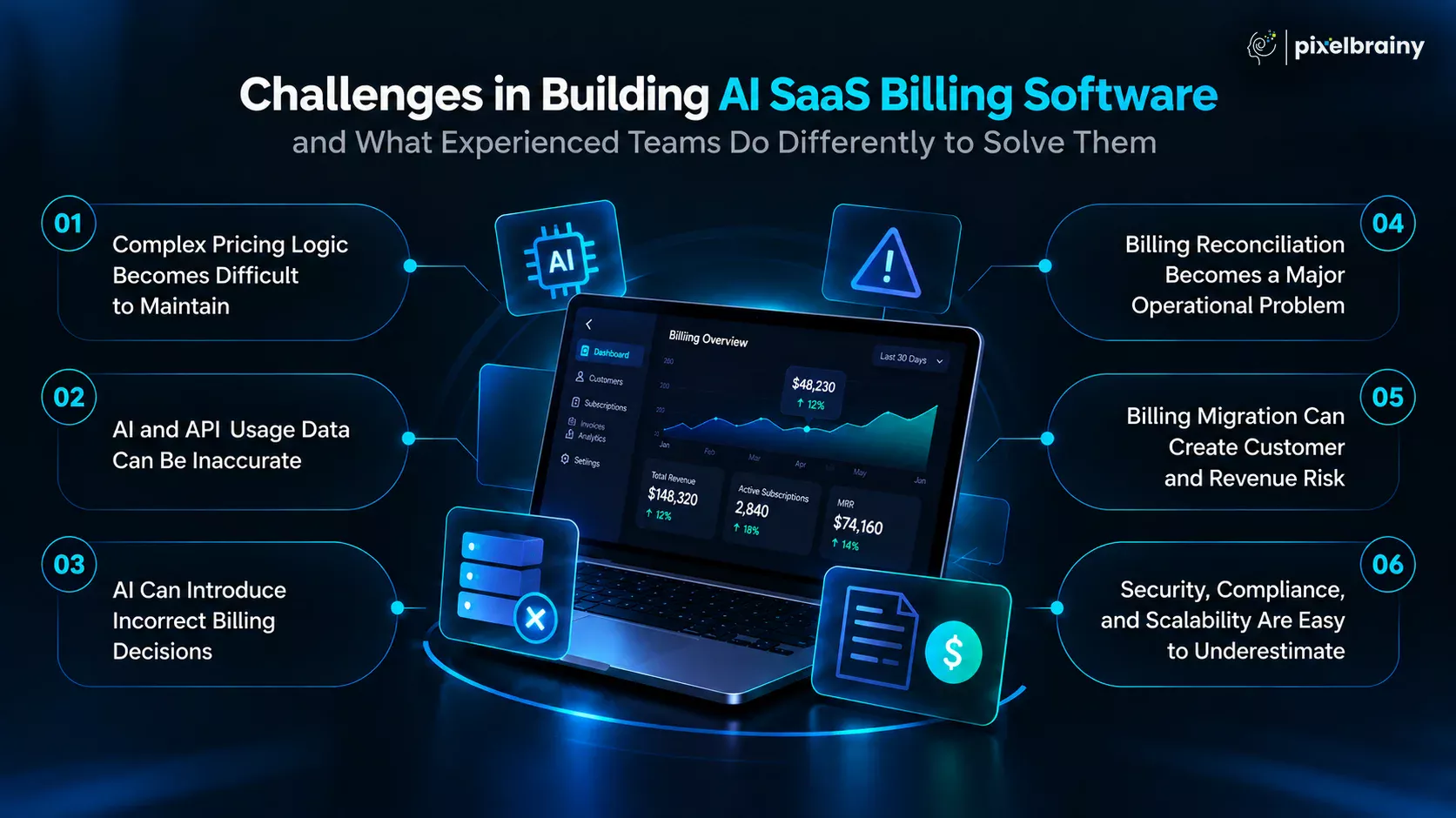
AI SaaS pricing can combine subscriptions, seats, API usage, AI credits, overages, discounts, minimum commitments, and customer-specific contracts. When these rules are implemented across multiple application services, even a small pricing change can create unexpected billing behavior.
What experienced teams do differently:
They create a centralized, version-controlled pricing engine that separates pricing configuration from application logic. Every pricing rule has a clear effective date, customer scope, calculation method, and audit history.
This approach makes AI SaaS billing system development easier to maintain because new pricing models can be introduced without rewriting unrelated product services.
Usage-based billing depends on accurate event collection. AI applications can generate huge numbers of events, and those events may arrive late, arrive more than once, or fail to arrive completely.
A duplicate usage event can overcharge a customer, while a missing event can create revenue leakage.
What experienced teams do differently:
They implement unique event identifiers, idempotency, validation, timestamps, retry mechanisms, immutable usage records, and reconciliation workflows.
They also maintain a clear distinction between raw usage events and finalized billable usage.
This creates a reliable foundation for building AI SaaS billing software where invoices can be traced back to the underlying customer activity.
AI can be extremely useful for anomaly detection, forecasting, invoice explanations, and revenue intelligence. However, allowing an AI model to independently calculate customer charges creates unnecessary financial risk.
A language model can produce a plausible response that is factually incorrect. That is unacceptable when the output determines how much a customer pays.
What experienced teams do differently:
They use a hybrid architecture.
The deterministic billing engine calculates the financial amount, while AI analyzes trusted billing information.
For example:
Usage Data → Billing Rules → Verified Invoice → AI Analysis → Explanation or Recommendation
This allows businesses to benefit from SaaS billing automation using AI without sacrificing financial accuracy.
As billing complexity increases, finance teams may need to reconcile data between the application, usage system, billing engine, payment gateway, and accounting platform.
Small differences can create difficult investigations.
For example:
Application Usage: 2,450,000 units
Billable Usage: 2,430,000 units
Invoice: 2,500,000 units
Without a strong reconciliation architecture, identifying the source of the difference can require significant engineering and finance effort.
What experienced teams do differently:
They build reconciliation into the architecture from the beginning.
The platform should compare usage, pricing calculations, invoices, payments, credits, refunds, and accounting records automatically and flag discrepancies for investigation.
Companies often decide to build custom AI SaaS billing software after years of using multiple billing tools, custom scripts, spreadsheets, and application-level workarounds.
Migrating this data is difficult because historical billing information may contain inconsistent pricing rules, customer-specific exceptions, legacy plans, and old subscription states.
What experienced teams do differently:
They avoid an immediate full migration.
Instead, they perform data mapping, historical validation, invoice reconciliation, and parallel billing.
The new system can calculate invoices alongside the existing platform until both systems consistently produce matching results.
Only then should customer migration happen progressively.
Billing platforms manage sensitive customer, payment, contractual, and financial information. As transaction volume increases, infrastructure also needs to handle larger numbers of usage events, invoices, payments, and analytics operations.
A platform that works for 500 customers may not automatically work for 500,000 customers.
What experienced teams do differently:
They build security and scalability into the architecture from the beginning.
Important controls include:
Experienced teams also test high-volume usage scenarios before production rather than waiting for real customers to expose performance limitations.
The strongest AI SaaS billing platforms succeed by combining deterministic financial architecture, reliable usage data, controlled AI capabilities, continuous reconciliation, secure infrastructure, and disciplined migration practices from the beginning.
From the above discussion, it is clear that choosing the right development partner is just as important as defining the billing architecture itself. An AI SaaS billing platform sits at the intersection of SaaS product engineering, financial workflows, usage metering, payment infrastructure, data engineering, and artificial intelligence.
That makes partner selection especially important for companies asking a practical question: "How do we find an AI development partner that can understand our complicated SaaS pricing model, build reliable billing infrastructure, and add AI intelligence without making financial calculations dependent on unpredictable AI outputs?"
This is where PixelBrainy as AI development company can bring value to an AI SaaS billing initiative.
PixelBrainy works across AI product development, SaaS platforms, B2B applications, AI integration, and custom software engineering. According to its published company information, PixelBrainy has delivered 500+ digital products, worked with 400+ teams, and brings 10+ years of product design and engineering experience.
PixelBrainy first understands your pricing, usage, credits, contracts, billing exceptions, and revenue workflows. This ensures the billing architecture is aligned with your actual SaaS business model.
Billing is connected to subscriptions, product access, usage, customer accounts, contracts, and payments. PixelBrainy's SaaS and B2B experience helps create billing workflows that fit naturally into the broader product ecosystem.
AI can support anomaly detection, revenue leakage analysis, usage forecasting, invoice explanations, and revenue intelligence. Deterministic billing rules remain responsible for actual financial calculations, ensuring accuracy and auditability.
PixelBrainy can support the complete product ecosystem, including billing portals, dashboards, pricing management, usage tracking, invoices, payment integrations, APIs, analytics, security, and cloud infrastructure.
Whether your model is subscription + AI credits, API usage + overages, or enterprise contracts + negotiated pricing, PixelBrainy can create an architecture around your specific requirements. This makes its AI SaaS billing system development services suitable for businesses that have outgrown conventional billing platforms.
A useful example of PixelBrainy's AI and SaaS-oriented engineering capabilities comes from a confidential US-based SaaS engagement.
The client managed more than 1,500 enterprise accounts and wanted to improve retention, scale customer success operations, and identify expansion opportunities using AI.
PixelBrainy developed an AI client success solution incorporating:
According to PixelBrainy's published case study, the solution achieved a 23% reduction in annual churn, 81% accuracy in 60-day churn prediction, 2.4x greater account manager coverage, 34% reduction in time-to-value, and an 18% increase in expansion revenue.
The client name and commercially sensitive details are not disclosed.
Although this was not a billing product, the underlying approach is highly relevant to intelligent billing infrastructure.
Billing systems contain valuable behavioral signals such as:
Payment behavior + Usage + Subscription changes + Credit consumption + Account activity
These signals can similarly support churn prediction, revenue intelligence, expansion identification, anomaly detection, and forecasting.
That is the broader opportunity behind SaaS billing software development integrating AI. The billing system can become a source of actionable business intelligence rather than remaining limited to invoices and payment processing.
The strongest reason to work with PixelBrainy is not simply its ability to implement individual billing features.
It is the combination of:
Business understanding + Product strategy + UX + SaaS engineering + AI + Integrations + Scalable architecture
PixelBrainy also describes its AI development approach as vendor-neutral, security-focused, and end-to-end, with engagement models that can support different stages from validation through full product development.
For a SaaS company whose billing has become difficult to maintain, this broader perspective can help turn fragmented billing workflows into a structured platform.
The goal is not to recreate every feature available in an existing billing provider.
The goal is to create the billing capabilities your business actually needs, integrate payment infrastructure where appropriate, introduce AI where it creates measurable value, and establish an architecture that can support your next stage of growth.
Ready to Build Your AI SaaS Billing Platform?
Talk to PixelBrainy today and turn complex SaaS billing requirements into a scalable, intelligent revenue platform.

AI SaaS billing is becoming a strategic requirement for companies moving beyond simple subscriptions into usage-based pricing, AI credits, API consumption, overages, hybrid plans, and enterprise contracts. The AI SaaS billing software development process should therefore focus on creating a reliable financial foundation that can evolve with changing monetization models.
A well-designed platform can centralize pricing, usage metering, subscriptions, credits, invoicing, payments, reconciliation, and revenue data while using AI for anomaly detection, forecasting, revenue leakage identification, invoice explanations, and billing intelligence.
For businesses evaluating whether to build AI SaaS billing software, the decision should be based on measurable factors such as billing complexity, engineering effort, revenue leakage, payment recovery, pricing flexibility, and long-term scalability. Custom AI SaaS billing software development becomes especially valuable when existing billing tools require excessive customization or prevent the company from implementing its desired pricing strategy.
The right architecture combines deterministic financial calculations with AI-powered intelligence, creating billing infrastructure that is accurate, scalable, and adaptable.
Book an appointment with PixelBrainy today to discuss your AI SaaS billing software requirements and explore the right development approach for your business.
Custom AI SaaS billing software can be worthwhile when your pricing includes subscriptions, API usage, AI credits, overages, enterprise contracts, or complex usage rules that require extensive customization. The business case should be evaluated against engineering hours spent maintaining billing, revenue leakage, payment recovery, pricing limitations, and future monetization requirements. Payment providers can still handle payment collection while the custom billing layer manages your company's pricing and usage logic.
The cost to develop AI SaaS billing software generally ranges from $40,000 to $200,000+. A basic platform may cost around $40,000 to $70,000, an advanced platform around $70,000 to $130,000, and an enterprise-grade solution can reach $130,000 to $200,000 or more. The final cost depends on usage metering, AI capabilities, integrations, security, multi-tenancy, enterprise contracts, and compliance requirements.
Yes. A properly architected AI SaaS billing platform can support hybrid monetization that combines recurring subscriptions, seats, API consumption, AI credits, overages, add-ons, and customer-specific pricing. The billing engine should calculate each component using deterministic rules and combine them into a unified invoice. AI can then analyze usage, detect anomalies, forecast consumption, and explain complex charges.
Traditional billing systems primarily execute predefined rules. AI can analyze billing and usage data to identify patterns that are difficult to manage through static rules alone. Examples include predicting churn from payment behavior, detecting unusual usage, identifying revenue leakage, forecasting customer consumption, prioritizing failed-payment recovery, explaining invoices, and analyzing pricing performance. AI should support billing intelligence while deterministic rules remain responsible for financial calculations.
There is no universal percentage because the outcome depends on the existing architecture and billing complexity. However, companies can measure the opportunity by tracking engineering hours spent on invoice bugs, usage reconciliation, payment issues, pricing exceptions, billing integrations, and customer disputes. If billing currently consumes a significant portion of engineering capacity, centralizing the billing domain can potentially return substantial development capacity to the core product.
A strong architecture separates financial calculations from AI intelligence. A typical flow is usage collection → usage validation → billing rules engine → invoice calculation → payment processing → reconciliation, with an AI layer operating across trusted billing and usage data. AI can handle forecasting, anomaly detection, revenue intelligence, and invoice explanations, while deterministic services calculate the actual amount owed.
A basic AI SaaS billing MVP can take approximately 3 to 4 months. An advanced platform supporting hybrid pricing, AI credits, usage-based billing, multiple integrations, and AI analytics may require 6 to 9 months. Enterprise billing systems with complex contracts, advanced AI, extensive integrations, compliance requirements, and high transaction volumes can require 9 to 15 months or longer.
Before development begins, document your current pricing models, usage sources, customer segments, billing exceptions, payment workflows, contracts, credits, accounting requirements, and existing billing problems. Then determine which capabilities genuinely require AI. Starting with a focused architecture and measurable business objectives helps prevent unnecessary complexity and makes it easier to calculate the expected ROI of the AI SaaS billing software development investment.

About The Author
Sagar Bhatnagar
Sagar Sahay Bhatnagar brings over a decade of IT industry experience to his role as Marketing Head at PixelBrainy. He's known for his knack in devising creative marketing strategies that boost brand visibility and market influence. Sagar's strategic thinking, coupled with his innovative vision and focus on results, sets him apart. His track record of successful campaigns proves his ability to utilize digital platforms effectively for impactful marketing efforts. With a genuine passion for both technology and marketing, Sagar continuously pushes PixelBrainy's marketing initiatives to greater success.

Working with the PixelBrainy team has been a highly positive experience. They understand the design requirements and create beautiful UX elements to meet the application needs. The dev team did an excellent job bringing my vision to life. We discussed usability and flow. Sagar worked with his team to design the database and begin coding. Working with Sagar was easy. He has the knowledge to create robust apps, including multi-language support, Google and Apple ID login options, Ad-enabled integrations, Stripe payment processing, and a Web Admin site for maintaining support data. I'm extremely satisfied with the services provided, the quality of the final product, and the professionalism of the entire process. I highly recommend them for Android and iOS Mobile Application Design and Development.

Great experience working with them. Had a lot of feedback and I found that unlike most contractors they were bugging me for updates instead of the other way around. They were extremely time conscience and great at communicating! All work was done extremely high quality and if not on time, early! They were always proactive when it comes to communication and the work is great/above par always. Very flexible and a great team to work with! Goes above and beyond to present us with multiple options and always provides quality. Amazing work per usual with Chitra. If you have UI/UX or branding design needs I recommend you go to them! Will likely work with them in the future as well, definitely recommended!

PixelBrainy is a joy to work with and is a great partner when thinking through branding, logo, and website layout. I appreciate that they spend time going into the "why" behind their decisions to help inform me and others about industry best practices and their expertise.

I hired them to design our software apps. Things I really like about them are excellent communication skills, they answer all project suggestions and collaborate right away, and their input on design and colors is amazing. This project was complex and needed patience and creativity. The team is amazing to do business with. I will be using them long-term. Glad to see there are some good people out there. I was afraid to try and outsource my project to someone but I am glad I met them! I really can't say enough. They went above and beyond on this project. I am very happy with everything they have done to make my business stand out from the competition.

It was great working with PixelBrainy and the team. They were very responsive and really owned the project. We'll definitely work with them again!

I recently worked with the PixelBrainy team on a project and I was blown away by their communication skills. They were prompt, clear, and articulate in all of our interactions. They listened and provided valuable feedback and suggestions to help make the project a success. They also kept me updated throughout the entire process, which made the experience stress-free and enjoyable.

PixelBrainy is very good at what it does. The team also presents themselves very professionally and takes care of their side of things very well. I could fully trust them taking up the design work in a timely and organised manner and their attention to detail saved us lots of effort and time. This particular project was quite intense and the team showed that they function very well under pressure. Very much looking forward to working with her again!

It's always an absolute pleasure working with them. They completed all of my requests quickly and followed every note I had for them to a T, which made our process go smoothly from start to finish. Everything was completed fast and following all of the guidelines. And I would recommend their services to anyone. If you need any design work done in the future, PixelBrainy should be your first call!

They took ownership of our requirements and designed and proposed multiple beautiful variants. The team is self-motivated, requires minimum supervision, committed to see-through designs with quality and delivering them on time. We would definitely love to work with PixelBrainy again when we have any requirements.

PixelBrainy was a big help with our SaaS application. We've been hard at work with a new UI/UX and they provided a lot of help with the designs. If you're looking for assistance with your website, software, or mobile application designs, PixelBrainy and the team is a great recommendation.

PixelBrainy designers are amazing. They are responsive, talented, and always willing to help craft the design until it matches your vision. I would recommend them and plan to continue them for my future projects and more!!!

They were awesome! Did a good job fast, and good communication. Will work with them again. Thank you

Creative, detail-oriented, and talented designers who take direction well and implement changes quickly and accurately. They consistently over-delivered for us.

PixelBrainy team is very talented and creative. Great designers and a pleasure to work with. PixelBrainy is an excellent communicator and I look forward to working with them again.

PixelBrainy has a very talented design team. Their work is excellent and they are very responsive. I enjoy working with them and hope to continue on all of our future projects.


Transform your ideas into reality with us.
Across these industries, each engagement brings unique challenges, from early-stage product development to scaling complex systems, helping us build a practical understanding of real-world product environments.