AI Summary Powered by PixelBrainy
Can your business afford to ignore AI powered phone scams when fraudsters are now using cloned voices, deepfake audio, and intelligent robocalls that sound almost impossible to distinguish from real people?
Phone scams have evolved into one of the fastest growing cybersecurity threats worldwide. Traditional spam filters and number blacklisting techniques are no longer enough because scammers constantly rotate spoofed numbers, exploit VoIP infrastructure, and increasingly leverage generative AI to create convincing voice conversations. From fake bank representatives to AI generated family emergency calls, modern fraud campaigns can deceive even security conscious users. This is exactly why AI scam call blocker app development has become one of the most promising opportunities in the telecom security industry.
If you are a founder planning to build an AI scam call blocker app, the market opportunity has never been stronger. In the United States alone, the FTC reported $3.5 billion in losses from imposter scams during 2025, with phone-based impersonation remaining one of the most damaging attack vectors. At the same time, the FTC continues to receive millions of unwanted call complaints while encouraging innovation in AI driven call filtering technologies.
Imagine this scenario.
"We are planning to build an AI scam call blocker app that uses machine learning and voice pattern recognition to detect and block scam calls, robocalls, and spoofed numbers in real time before the user even picks up. We are an early-stage startup based in the US and need a reliable AI development company who has built similar security or telecom apps before. Can you suggest the best AI development companies in the USA who can build this kind of app from scratch in 2026?"
If this sounds like your startup, this guide is written specifically for you.
In this comprehensive founder focused guide, you will learn the complete development process of AI scam call blocker app, understand the technical architecture behind real time AI call detection, explore essential and advanced features, estimate development costs, review compliance requirements, discover monetization strategies, and evaluate what separates experienced AI development partners from ordinary software vendors.
Whether you are making AI scam call blocker app for consumers, telecom operators, or enterprise security, you will finish this guide with a practical roadmap for launching a scalable, AI powered product in 2026.
An AI scam call blocker app is an intelligent mobile application that uses artificial intelligence, machine learning, and voice analysis to detect, classify, and block fraudulent phone calls in real time before they can harm the user. Unlike traditional spam filters that depend on static databases of known spam numbers, an AI powered solution continuously analyzes caller behavior, voice characteristics, and call context to identify scams, even when the caller uses a brand new or spoofed phone number.
As AI scam call blocker app development continues to evolve, founders are no longer building simple caller ID applications. They are creating adaptive cybersecurity platforms capable of identifying sophisticated robocalls, AI generated voice scams, impersonation attacks, and social engineering attempts that conventional call blockers simply cannot detect.
To understand why AI has become the next generation of telecom security, it helps to look at how call blocking technology has evolved over the years.
The first generation of call blocking relied entirely on manually maintained blacklists. Mobile carriers and users created lists of phone numbers that had already been identified as spam or fraudulent. Whenever a matching number called again, the system blocked or flagged it.
While this approach worked for repeat offenders, it had one major weakness. Modern scammers rarely reuse the same number. Using VoIP infrastructure and caller ID spoofing, they can generate thousands of new numbers every day, making static blacklists largely ineffective. These systems had no intelligence and no ability to detect previously unseen threats.
The second generation improved upon manual blacklists by introducing community driven reporting. Applications such as Truecaller and Hiya collect spam reports from millions of users, building a shared database of suspicious phone numbers.
This significantly increased coverage and helped identify common robocall campaigns. However, the approach remains reactive rather than proactive. A scam number must first target enough users to receive reports before it is recognized as dangerous. Fresh spoofed numbers, rapidly changing scam campaigns, and AI generated calls often bypass these systems because they have no historical reputation.
The latest evolution uses artificial intelligence to analyze calls as they happen instead of relying solely on historical databases. This is the foundation of modern AI phone scam blocker app development.
Rather than asking, "Has this number been reported before?", AI asks a much more powerful question:
"Does this call behave like a scam?"
Machine learning and deep learning models evaluate multiple signals simultaneously, including:
This enables the system to identify scam calls originating from numbers that have never appeared in any blacklist.
For startups looking to develop AI scam call blocker app solutions that outperform existing products, this intelligence layer is what creates a sustainable competitive advantage.
The real time detection process can be broken down into five simple steps:
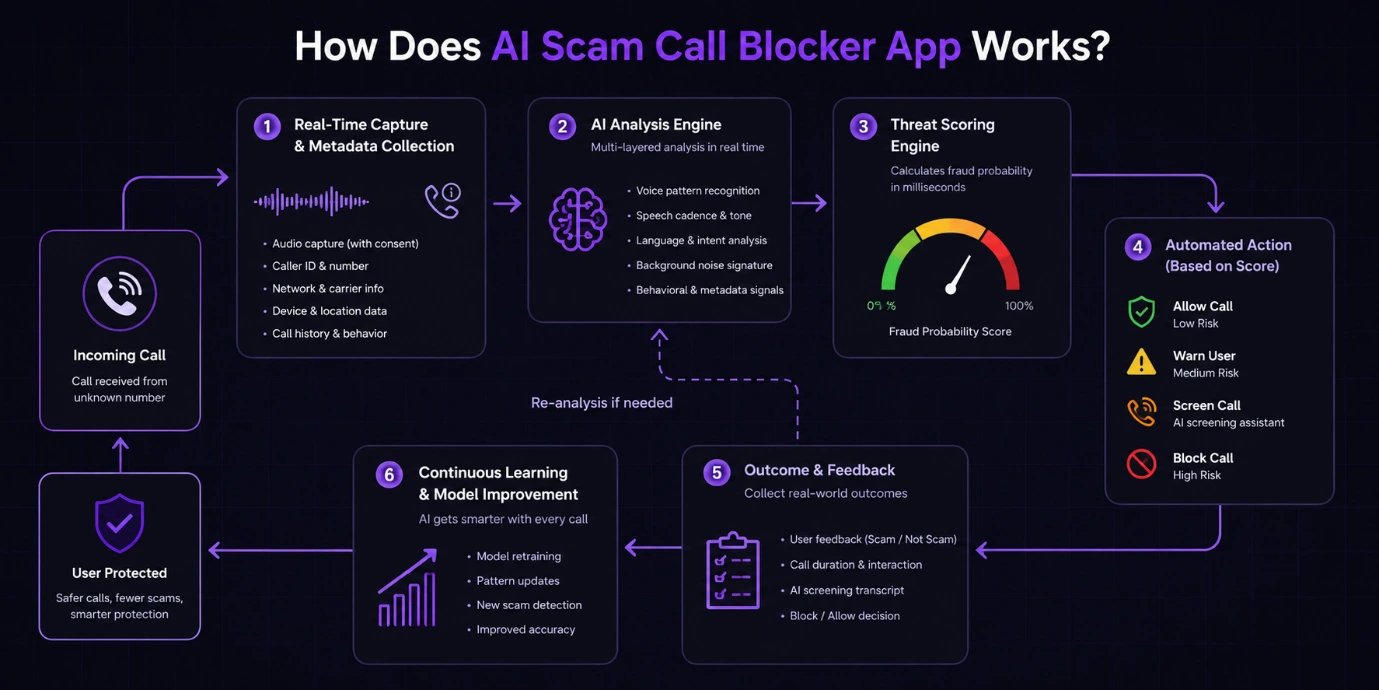
When an incoming call is received, the application immediately captures available metadata such as caller ID, network information, carrier details, geographic signals, and other contextual information. If permitted by the operating system and user, audio analysis begins as soon as the conversation starts.
The AI engine simultaneously evaluates voice characteristics, speech cadence, pronunciation, pauses, emotional tone, background audio signatures, and call metadata. Advanced deep learning models compare these signals against millions of previously learned scam patterns.
This capability is particularly valuable when developing AI scam call blocker app with deep learning and voice pattern recognition, where identifying subtle behavioral differences often matters more than recognizing a specific phone number.
Within milliseconds, the AI generates a fraud probability score by combining multiple risk indicators. Instead of making decisions based on a single signal, the model weighs hundreds of features to estimate how likely the call is to be fraudulent.
Based on the calculated threat score, the application automatically determines the most appropriate action. Depending on user preferences and risk thresholds, it can:
This architecture also supports advanced scenarios such as:
"We want to build an AI scam call blocker app similar to Hiya or Truecaller but with a more advanced AI detection layer that uses deep learning to identify new and emerging scam patterns in real time."
It can even enable intelligent call screening where:
"I want to create an AI scam call blocker app where the AI answers suspicious calls automatically, engages the potential scammer in a scripted conversation to identify whether the call is fraudulent."
After each interaction, verified outcomes are fed back into the machine learning pipeline. Confirmed scam calls, false positives, and user feedback help retrain the models, enabling continuous improvement in detection accuracy. Over time, the platform becomes increasingly effective at identifying emerging fraud techniques before they become widespread.
This feedback loop is especially valuable for organizations that build AI powered scam call blocker app platforms trained on millions of scam call recordings, allowing the AI to recognize evolving voice patterns, speech cadence, and language cues associated with new fraud campaigns.
Unlike static blacklists that become outdated as scammers change tactics, an AI scam call blocker app becomes more intelligent with every call it analyzes, making it a highly defensible product that continuously strengthens its ability to protect users over time.
An AI scam call blocker app is not designed for a single type of user. Its success depends on how well it addresses the unique needs of different customer segments, each with distinct expectations, security concerns, and usage patterns. During AI scam call blocker app development, identifying your primary target audience early helps define everything from the user experience and AI models to infrastructure requirements and monetization strategies.
Whether you plan to launch a consumer mobile app, a telecom security platform, or an enterprise fraud prevention solution, understanding your buyer personas is essential before you build AI scam call blocker app products for the market.
The general consumer is an everyday smartphone user who wants reliable protection against scam calls without constantly managing spam lists, adjusting settings, or manually reporting suspicious numbers. They expect the app to work quietly in the background while allowing genuine calls to come through without interruption.
What they need:
Product implication for founders:
For consumer-focused AI call blocking app development, simplicity should be a priority. The interface should require minimal user interaction while AI continuously learns and protects users in the background. A frictionless onboarding experience and high detection accuracy are often more valuable than offering dozens of configurable settings.
Adults aged 65 and older remain one of the most frequently targeted groups for phone scams, including impersonation fraud, fake government calls, healthcare scams, and financial deception. This audience values trust, clarity, and protection over customization.
For startups asking:
"Our startup is building an AI scam call blocker app targeting seniors and vulnerable adults in the US market."
this persona should influence nearly every product decision.
What they need:
Product implication for founders:
When you develop AI powered scam call blocker app solutions for seniors, accessibility becomes a competitive advantage. Features such as simplified navigation, family dashboards, caregiver notifications, and conservative blocking policies significantly improve user trust and safety.
Small businesses depend heavily on incoming phone calls for sales, customer support, and service requests. Unlike consumers, they cannot afford to block legitimate customers simply because a number appears suspicious. At the same time, they face constant robocalls, fake vendor requests, and business impersonation scams.
What they need:
Product implication for founders:
For business focused AI scam call blocker app development, balancing security with availability is critical. AI should prioritize smart call screening and contextual warnings over aggressive blocking to minimize false positives and protect customer relationships.
Enterprise organizations, banks, insurance providers, and financial institutions face growing threats from voice phishing and brand impersonation attacks. Rather than purchasing a consumer application, these buyers look for scalable platforms that integrate directly into existing security infrastructure.
This aligns with organizations asking:
"We are a financial services company looking to develop an AI scam call blocker app for our customers who are frequently targeted by phone scams impersonating our brand."
What they need:
Product implication for founders:
Enterprise buyers prioritize reliability, compliance, scalability, and reporting capabilities over consumer-friendly features. Building modular APIs, detailed audit trails, and enterprise grade security should be a core part of the product roadmap.
Telecom providers are uniquely positioned to stop fraudulent calls before they reach subscribers. Instead of protecting a single user, they require network level intelligence capable of analyzing millions of calls while integrating with carrier infrastructure.
This reflects the growing demand from operators asking:
"We are an existing telecom operator looking to develop an AI scam call blocker app as a value-added service for our subscribers."
What they need:
Product implication for founders:
Building for telecom operators requires an architecture that supports massive concurrent traffic, cloud native scalability, and seamless integration with carrier systems. White label capabilities, multi-tenant deployment, and centralized AI model management become essential for long term success.
That’s why the audience you prioritize first will shape every decision in your AI scam call blocker app development journey, from architecture and AI models to features, compliance, and long-term scalability. Building for the right users is the foundation of a successful and future ready product.
2026 is the ideal time to build an AI scam call blocker app because phone scam losses are reaching record highs, AI generated voice fraud is rapidly evolving, telecom regulations are becoming stricter, and advances in real time AI have made intelligent scam detection commercially viable for startups. For founders, this creates a rare opportunity to enter a high growth market before AI native competitors become mainstream.
If you are considering AI scam call blocker app development for startups, the biggest question is no longer whether there is demand. The real question is whether the technology has matured enough to outperform traditional spam call blockers while remaining affordable to build and scale. The answer in 2026 is yes.
Phone scams remain one of the fastest-growing forms of financial fraud worldwide. According to the U.S. Federal Trade Commission (FTC), consumers reported losing $3.5 billion to imposter scams in 2025, while total reported fraud losses across all scam categories reached $16 billion, highlighting the enormous economic impact of fraud and the growing need for intelligent prevention technologies.
For startups planning AI scam call blocker app development, these numbers validate a rapidly expanding market where businesses and consumers are actively seeking more effective alternatives to traditional spam filters.
While telecom providers have made progress in reducing illegal robocalls, unwanted and fraudulent calls continue to affect millions of Americans every year. The FTC's latest National Do Not Call Registry Report states that more than 258 million phone numbers are now registered, while consumers submitted over 2.6 million Do Not Call complaints during FY 2025, with robocalls accounting for the majority of reported violations.
The problem is that most existing call blockers rely on previously reported numbers. Scammers can simply generate new spoofed numbers, making traditional blacklist-based protection increasingly ineffective.
The emergence of generative AI has fundamentally changed the threat landscape. Fraudsters are now using AI generated voice cloning, deepfake audio, and conversational AI to impersonate family members, bank representatives, healthcare providers, government officials, and business executives with remarkable accuracy.
Recent AI security research shows that modern voice models can generate highly convincing conversations capable of bypassing traditional caller identification systems, making voice cloning one of the fastest growing fraud vectors.
This shift creates an enormous opportunity for founders looking to develop AI scam call blocker app solutions that analyze live conversations instead of relying solely on historical phone number databases.
Government agencies are also strengthening their efforts against caller ID spoofing and AI enabled fraud. The Federal Communications Commission (FCC) continues expanding STIR/SHAKEN implementation, encouraging telecom carriers to authenticate caller identities and reduce spoofed calls across communication networks.
Although STIR/SHAKEN significantly improves caller verification, it cannot identify every scam call. Fraudsters can still use legitimate numbers, compromised accounts, or AI generated conversations to deceive victims. This creates strong demand for AI powered behavioral detection that works alongside regulatory protections rather than replacing them.
For startups, this regulatory momentum provides an ideal environment to build AI scam call blocker app in 2026, as telecom providers, enterprises, and consumers increasingly recognize the need for more intelligent fraud prevention.
Adults aged 65 and older remain among the most frequently targeted victims of phone scams because criminals often exploit trust, urgency, and unfamiliarity with rapidly evolving technology. As the senior population continues to grow across the United States, demand for intelligent phone protection is expected to increase significantly.
Many founders are already asking:
"Our startup is building an AI scam call blocker app targeting seniors and vulnerable adults in the US market who are disproportionately affected by phone scams and robocalls. Is this the right market to enter?"
The answer is increasingly yes. Products designed specifically for seniors can differentiate themselves through simplified interfaces, aggressive scam detection, caregiver dashboards, emergency contact alerts, and AI powered voice warnings that reduce the risk of successful fraud attempts.
Consumer protection is only one part of the opportunity. Financial institutions, healthcare providers, government agencies, and enterprise organizations are investing heavily in technologies that protect employees and customers from voice phishing, executive impersonation, and financial fraud.
A common enterprise inquiry today is:
"We are a financial services company looking to develop an AI scam call blocker app for our customers who are frequently targeted by phone scams impersonating our brand."
For these organizations, AI driven call protection has become an important extension of cybersecurity strategy. Features such as enterprise dashboards, fraud analytics, API integration, audit logging, and compliance reporting are becoming key differentiators in commercial deployments.
Just a few years ago, building a sophisticated AI based call blocker required expensive infrastructure, proprietary speech recognition systems, and advanced machine learning expertise. Today, the landscape has changed dramatically.
Real time voice AI, deep learning models for audio analysis, cloud-based machine learning platforms, speech recognition engines, large language models, and mobile telephony APIs have matured enough to make creating AI scam call blocker app solutions technically feasible for early-stage startups without enterprise sized engineering budgets.
This has also led many cybersecurity founders to ask:
"I am a cybersecurity professional and I want to build an AI scam call blocker app that combines real time AI voice analysis with a continuously updated threat intelligence database."
In 2026, this architecture is entirely achievable by combining speech intelligence, behavioral analytics, deep learning, and continuously updated fraud intelligence feeds into a unified detection platform.
Despite growing awareness of AI powered fraud, most popular call blocking applications continue to depend primarily on crowdsourced spam reports and historical phone number databases. Very few products use genuine AI native detection capable of analyzing live voice characteristics, speech cadence, behavioral signals, and evolving scam techniques in real time.
For founders and investors, this represents a valuable first mover opportunity. Launching an AI native scam call blocker in 2026 allows startups to establish proprietary fraud datasets, continuously improve machine learning models, and build a defensible competitive advantage before the market becomes crowded with AI first solutions.
For founders, 2026 represents the perfect intersection of market demand, mature AI technology, regulatory support, and limited AI native competition, making it one of the strongest opportunities to build the next generation of AI powered scam call protection.
Building an AI scam call blocker is about much more than stopping unwanted phone calls. Before investing in AI scam call blocker app development, founders should understand that this is a high trust, high retention, and recurring revenue product capable of solving one of today's most urgent consumer safety challenges.
Beyond protecting users from financial fraud, it creates long term business value through subscriptions, partnerships, and continuously improving AI.
Below are the key product, business, and social benefits you can achieve when you build AI scam call blocker app solutions the right way.
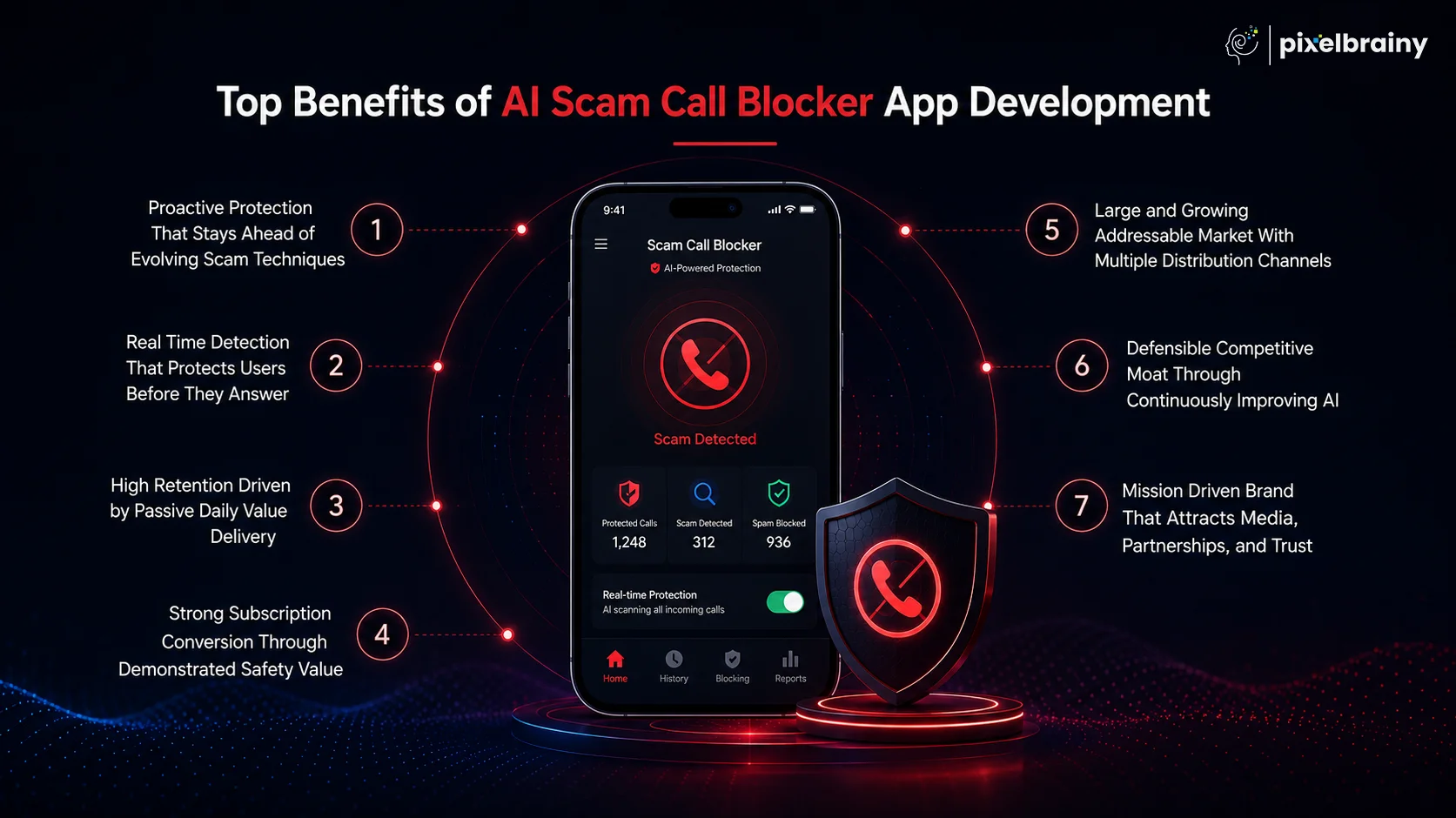
Traditional call blocking apps are fundamentally reactive. They rely on numbers that have already been reported by other users, meaning someone has to become a victim before the system learns to recognize a new scam. As fraudsters frequently change phone numbers and use caller ID spoofing, static databases struggle to keep pace with modern attacks.
An AI powered solution completely changes this approach. Instead of asking whether a phone number has been reported before, the AI analyzes behavioral signals, voice characteristics, speech content, and calling patterns to determine whether the incoming call is likely to be fraudulent. This enables the app to identify brand new scam numbers, spoofed callers, robocalls, and even AI generated voice cloning attacks that have never appeared in any blacklist.
For founders investing in AI powered scam call blocker app development, proactive detection becomes the strongest competitive advantage over traditional spam call filters and crowdsourced databases.
The few seconds between a phone ringing and a user answering represent the most important opportunity to stop a scam. If an application can evaluate an incoming call, generate a fraud score, and automatically decide whether to allow, warn, screen, or block the call within milliseconds, users receive protection before any conversation begins.
This seamless experience creates a level of convenience that users rarely notice until it prevents a potentially costly scam. Unlike security tools that require constant interaction, real time protection operates silently in the background while delivering immediate value whenever suspicious calls occur.
Many founders ask:
"We want to build an AI scam call blocker app that can analyze incoming calls in real time and stop scams before users even answer. Is this technically possible in 2026?"
The answer is yes. Modern speech AI, deep learning models, and real time telephony APIs have matured enough to make sub 500 millisecond threat detection achievable for startups with the right architecture.
For founders, achieving this low latency performance is both the biggest technical challenge and the primary reason users choose one app over another.
Many consumer applications struggle to retain users because they require continuous engagement before customers experience value. An AI scam call blocker works differently. It protects users automatically every day without requiring them to open the app, update settings, or manually report suspicious calls.
Every blocked scam call reinforces the product's usefulness, even if the user never realizes how much financial loss or personal risk was avoided. This passive value delivery creates an experience where protection happens continuously in the background.
From a business perspective, this leads to stronger retention rates than many traditional consumer applications. Users are less likely to uninstall software that consistently protects them without demanding their attention.
One of the biggest challenges for subscription-based applications is convincing users that premium features are worth paying for. An AI scam call blocker solves this challenge naturally because it demonstrates its value through real world protection.
When users receive a notification showing that the application has successfully blocked a fraudulent call or detected a suspicious impersonation attempt, they experience an immediate sense of security. That moment of visible protection creates a powerful emotional connection between the user and the product.
Unlike many productivity or entertainment applications where premium benefits may feel optional, upgrading for stronger scam protection feels personal, practical, and urgent. This significantly improves freemium to premium conversion rates while creating predictable recurring revenue for businesses offering AI scam call blocker app development services.
The market opportunity for AI scam call blocker app development extends far beyond individual smartphone users. Every mobile phone owner is a potential customer, while older adults, one of the fastest growing smartphone demographics, remain among the most frequent targets of phone fraud.
In addition to direct consumer distribution, founders can scale through institutional partnerships. Telecom operators can bundle AI scam protection into subscriber plans as a premium service. Financial institutions can provide it as an added security benefit for customers vulnerable to brand impersonation scams. Healthcare providers, insurance companies, and senior care organizations can also integrate AI call protection into broader fraud prevention initiatives.
These distribution channels reduce customer acquisition costs while creating enterprise revenue opportunities that many consumer applications cannot access.
Unlike traditional spam databases that remain largely static, artificial intelligence improves through experience. Every incoming call, successful scam detection, false positive report, and user confirmation contributes valuable training data that strengthens future detection models.
Over time, this creates a powerful data flywheel. As the user base grows, the AI receives more labeled data. Better training data improves detection accuracy. Higher accuracy attracts additional users, generating even more training data and reinforcing the cycle.
For founders creating AI scam call blocker app platforms, this self-improving intelligence becomes one of the strongest long term competitive advantages. The accumulated fraud intelligence and proprietary machine learning models become increasingly difficult for new competitors to replicate.
Phone scams affect millions of people every year, making fraud prevention a topic that consistently receives attention from national media, consumer advocacy groups, cybersecurity organizations, and government agencies.
An AI scam call blocker that can demonstrate measurable impact through blocked scam attempts, prevented fraud losses, or protection for vulnerable users naturally attracts press coverage and partnership opportunities. Unlike many consumer apps competing primarily on convenience, this product category is built around public safety and trust.
For founders, this mission driven positioning creates opportunities to collaborate with telecom providers, financial institutions, senior advocacy organizations, consumer protection agencies, and nonprofit organizations. These partnerships can significantly accelerate growth while reducing reliance on expensive paid advertising.
When these benefits work together, they create a powerful business model where passive user retention, recurring subscription revenue, enterprise partnerships, and continuously improving AI reinforce one another, making AI scam call blocker app development a highly scalable, defensible, and future-ready investment.

Creating a successful AI scam call blocker goes far beyond blocking unknown phone numbers. During AI scam call blocker app development, the core feature set determines how accurately the application identifies fraudulent calls, protects users in real time, and delivers a seamless user experience. A well-designed feature foundation not only improves scam detection but also increases user trust, retention, and long-term subscription value.
Many founders ask:
"We want to build an AI scam call blocker app similar to Hiya or Truecaller, but with a smarter AI detection engine. What core features should every MVP include before adding advanced AI capabilities?"
The answer lies in building a reliable feature set that combines intelligent call analysis, real time protection, and user-friendly controls. The following are the essential features every startup should prioritize before expanding into advanced capabilities such as voice cloning detection, AI call assistants, or conversational AI screening.
| Core Feature | Why It Matters |
| Real Time Incoming Call Detection | Captures every incoming call instantly and begins analyzing available caller information before the user answers. This forms the foundation of AI call blocking app development, ensuring suspicious calls can be identified with minimal delay while maintaining a smooth calling experience. |
| AI Based Scam Risk Analysis | Uses machine learning models to evaluate caller behavior, metadata, reputation signals, and historical fraud intelligence. Instead of relying only on blacklists, the AI predicts whether a call is likely to be fraudulent, improving protection against new scam campaigns. |
| Automatic Scam Call Blocking | Automatically blocks calls that exceed predefined fraud thresholds, preventing users from interacting with dangerous callers. Intelligent blocking reduces manual intervention while allowing users to customize protection levels according to their individual preferences. |
| Spam Call Warning Alerts | Displays clear on screen warnings when incoming calls appear suspicious but do not meet the blocking threshold. This feature allows users to make informed decisions while reducing the likelihood of false positives affecting legitimate callers. |
| Caller Identity Verification | Cross checks available caller information against trusted databases and network signals to help validate identities. Verified caller information improves confidence when receiving unknown calls and supports more accurate AI decision making during analysis. |
| Call History and Risk Logs | Maintains a detailed history of blocked, flagged, and verified calls along with corresponding AI risk scores. These logs help users understand why actions were taken while providing transparency and valuable feedback for continuous product improvement. |
| User Scam Reporting | Enables users to report missed scam calls or incorrectly flagged numbers with a single tap. These reports create high quality training data that improves future machine learning accuracy while strengthening community driven fraud intelligence. |
| Custom Blocking Preferences | Allows users to personalize blocking rules based on unknown numbers, international calls, hidden caller IDs, or specific risk thresholds. Flexible settings ensure the application adapts to different user needs without compromising overall security. |
| Contact Whitelist Management | Lets users create trusted contact lists that always bypass AI blocking rules. This feature minimizes false positives by ensuring important family members, business contacts, and emergency numbers remain reachable under all circumstances. |
| Caller Reputation Lookup | Retrieves reputation data from trusted spam intelligence sources to complement AI predictions. Combining historical reputation with machine learning enables more balanced and accurate decisions than relying on either approach independently. |
| Secure User Authentication | Protects sensitive user settings and account information through secure authentication methods such as biometric login or multi factor authentication. Strong account security builds user trust and safeguards personal data within the application. |
| Push Notifications for Threats | Sends immediate notifications whenever the application blocks or flags suspicious calls. Real time alerts reassure users that the system is actively protecting them while reinforcing the value delivered by the application every day. |
| Privacy and Permission Controls | Gives users full control over microphone, contacts, call logs, and notification permissions. Transparent privacy settings increase trust, simplify regulatory compliance, and encourage higher adoption among privacy conscious users. |
| AI Model Updates | Supports regular delivery of improved machine learning models without requiring users to reinstall the application. Continuous model updates help maintain detection accuracy as scammers introduce new tactics and evolving fraud techniques. |
| Analytics Dashboard | Provides users with visual insights into blocked calls, scam trends, protection history, and overall security performance. An intuitive dashboard demonstrates the application's effectiveness while encouraging long term engagement and premium subscription upgrades. |
A strong foundation of essential features is the first step toward successful AI scam call blocker app development, ensuring your product delivers accurate detection, seamless user experiences, and a scalable platform ready for advanced AI capabilities in the next stage of development.
Once your MVP includes the essential functionality, the next step is to differentiate your product with advanced AI capabilities. During development of AI scam call blocker app, these features transform a standard call blocking application into an intelligent fraud prevention platform capable of identifying sophisticated scams, improving detection accuracy over time, and delivering a premium user experience. While these capabilities require additional AI models, cloud infrastructure, and development effort, they also create a strong competitive advantage and justify higher subscription pricing.
Many founders ask:
"We are building an AI scam call blocker app that uses deep learning models trained on millions of scam call recordings to identify voice patterns, speech cadence, and language cues. Which advanced features should we prioritize after launching our MVP?"
The answer is to focus on AI driven capabilities that improve fraud detection, enhance user safety, and create long term product differentiation. Below are the advanced features that can take your AI powered scam call blocker app development to the next level.
| Advanced Feature | Why It Matters |
| AI Voice Pattern Recognition | Deep learning models analyze voice characteristics, speech cadence, tone, and pronunciation to identify suspicious behavior associated with scam calls. This enables the application to detect fraudulent callers even when they use previously unseen or spoofed phone numbers. |
| Real Time Speech to Text Analysis | Converts live conversations into text while Natural Language Processing evaluates the dialogue for scam related keywords, urgency, impersonation attempts, and financial requests. This allows the AI to assess fraud risks during active conversations instead of relying only on caller metadata. |
| AI Voice Cloning Detection | Advanced speech analysis identifies synthetic voices and cloned speech generated by artificial intelligence. As voice cloning scams continue to increase, this feature helps users recognize fraudulent impersonation attempts involving family members, executives, or trusted organizations. |
| AI Call Screening Assistant | An intelligent virtual assistant automatically answers suspicious calls, engages callers with predefined conversational prompts, and evaluates their responses before deciding whether to connect the call to the user. This significantly reduces interruptions while improving fraud detection accuracy. |
| Behavioral Fraud Detection Engine | Machine learning continuously analyzes caller behavior, call frequency, geographic inconsistencies, network patterns, and historical activity to identify evolving scam campaigns. Behavioral intelligence strengthens fraud detection even when voice analysis alone is inconclusive. |
| Personalized AI Risk Scoring | Instead of applying identical protection rules to every user, the AI adapts risk thresholds based on calling habits, trusted contacts, frequently answered numbers, and previous user interactions. Personalized scoring reduces false positives while maintaining strong protection levels. |
| Federated Machine Learning | Federated learning enables AI models to improve using decentralized user data without transferring sensitive personal information to central servers. This approach enhances privacy, supports regulatory compliance, and continuously improves detection accuracy across the entire user network. |
| Threat Intelligence Integration | Connects the application with continuously updated cybersecurity and telecom threat intelligence feeds to identify emerging scam campaigns, compromised numbers, and newly discovered fraud techniques before they become widespread across the user base. |
| Predictive Scam Trend Analytics | Artificial intelligence analyzes historical fraud patterns and telecom intelligence to forecast emerging scam campaigns before they reach large numbers of victims. These predictive insights help the platform update detection models proactively instead of reacting after attacks occur. |
| Multi Device Protection Dashboard | Provides centralized protection across multiple smartphones linked to a family or business account. Administrators can monitor scam activity, review protection reports, manage trusted contacts, and configure security settings from a single unified dashboard. |
Integrating these advanced capabilities into your AI scam call blocker app development roadmap transforms your product from a traditional spam blocker into an intelligent, AI first fraud prevention platform that continuously evolves alongside emerging scam techniques.
Turning an AI scam call blocker idea into a market ready product requires far more than building a caller ID application or integrating a spam number database. Founders need to combine artificial intelligence, telecom infrastructure, real time voice analysis, mobile platform capabilities, and cloud architecture to create a solution that can accurately identify and stop evolving phone scams before users become victims.
If you're wondering how to build an AI scam call blocker app from scratch, the development process should begin with a clear strategy rather than writing code. Every decision, from selecting AI models and sourcing training data to integrating carrier networks and optimizing on device performance, directly impacts detection accuracy, user trust, scalability, and long-term business success.
The following step by step roadmap outlines how to develop an AI app that detects scam calls in real time, helping founders build a robust, AI first solution that is technically scalable, commercially viable, and ready to compete in the rapidly growing phone fraud prevention market.
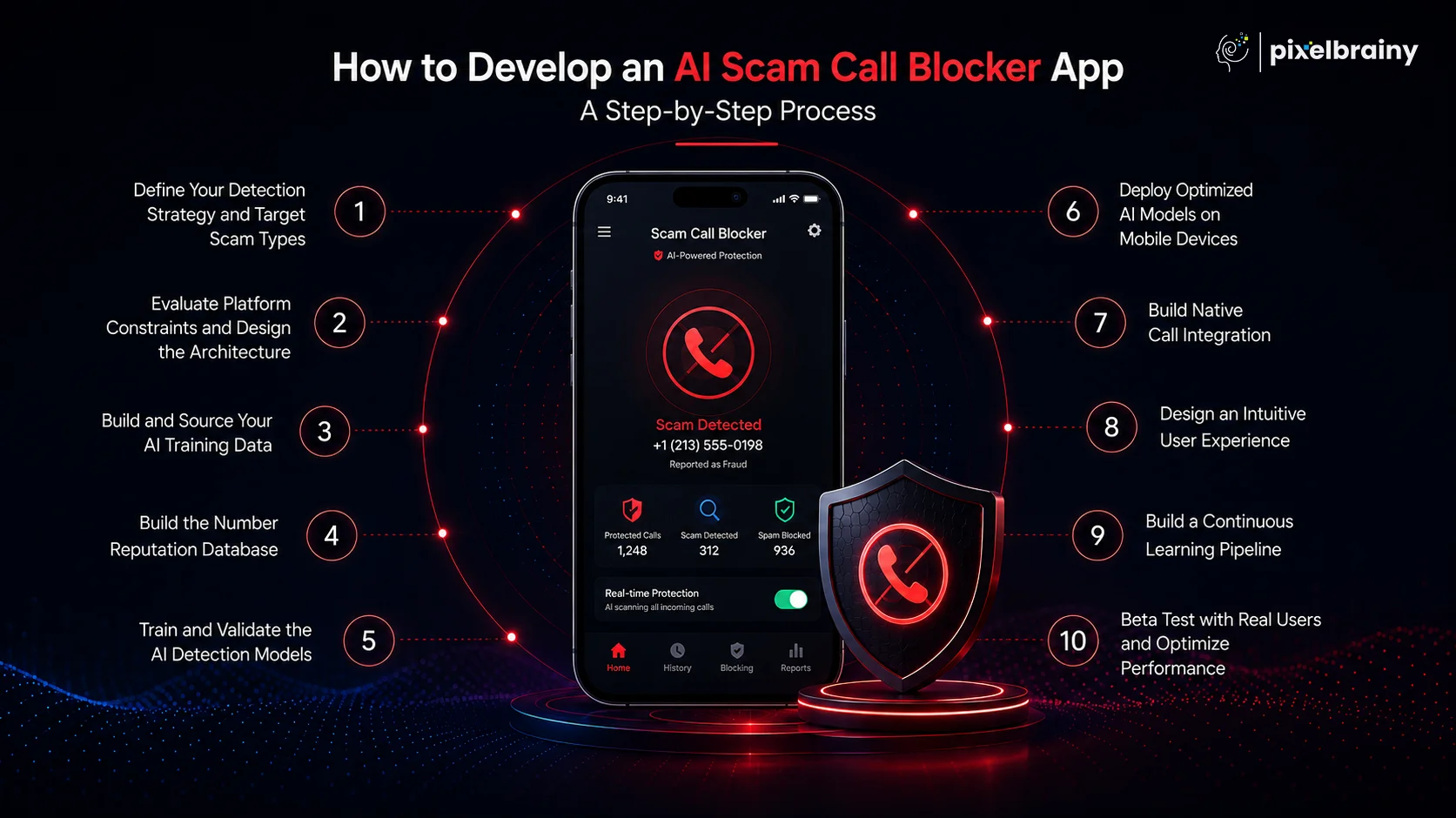
The first step is deciding which fraud scenarios your application will detect. Your AI may focus on robocalls, IRS impersonation scams, fake technical support calls, AI generated voice cloning attacks, grandparent scams, or a combination of multiple fraud categories.
At this stage, you should also determine whether your detection engine will rely on number reputation, voice analysis, Natural Language Processing, or a hybrid AI approach that combines multiple detection signals. Finally, clearly define your primary audience, whether it is general consumers, senior citizens, enterprise customers, or telecom operators, as this decision influences the entire product architecture.
Before writing code, understand what Apple CallKit and Android CallScreeningService allow third party applications to access. Both operating systems have different permissions and privacy restrictions that directly affect how incoming calls can be analyzed.
Your architecture should work within these platform limitations instead of attempting to bypass them. Decide which AI processing will run on the user's device for speed and privacy, and which workloads will execute on secure cloud infrastructure for deeper analysis. This architectural planning also forms the foundation for future PoC development and scalable production deployment.
Artificial intelligence is only as effective as the quality of its training data. Begin by collecting or licensing verified scam call recordings, call transcripts, and fraud datasets from trusted sources. Organize this information into categories based on scam types, language patterns, voice characteristics, and behavioral indicators.
A continuous data labeling workflow should also be established so user reports and newly identified scam calls can improve future model accuracy. High quality datasets are essential for successful AI model development and long-term detection performance.
While AI should be your primary detection engine, a robust reputation database remains an important supporting layer. Integrate trusted spam number feeds, ingest community reports, and synchronize carrier supplied caller reputation data whenever available.
Many founders ask:
"I am developing a scam call blocker app and I want to integrate with telecom carriers to access STIR SHAKEN attestation data and caller reputation scores before a call even reaches the user's device. We are looking to develop carrier level integrations that give our AI model access to authentication signals that are not available to apps operating purely at the device level. We need a development team that has experience with telecom API integrations and understands how to navigate carrier partnerships for a consumer scam detection product."
Carrier integrations significantly improve detection accuracy by providing trusted authentication signals before the AI evaluates voice or behavioral data. Implementing Redis for low latency lookups alongside PostgreSQL for persistent storage ensures fast and scalable reputation management.
The next stage focuses on how to develop an AI app that detects scam calls in real time. Build separate machine learning models for voice pattern recognition, speech classification, and Natural Language Processing before combining them into a unified fraud scoring engine.
During validation, prioritize minimizing false positives because incorrectly blocking legitimate calls damages user trust far more than allowing occasional suspicious calls to pass through. Regular model evaluation and performance testing should remain part of your ongoing AI integration solutions strategy.
Convert trained machine learning models into Core ML for iOS and TensorFlow Lite for Android. Optimize memory usage, inference speed, and battery consumption so scam detection operates efficiently across both flagship and mid-range smartphones.
Testing should include multiple device generations to verify that on device inference remains fast enough to analyze calls before users answer them.
Integrate Apple CallKit for iOS and Android CallScreeningService for Android to enable real time caller identification and automated blocking. These integrations allow your AI engine to classify incoming calls while respecting operating system security guidelines.
If your roadmap includes how to create an AI call screening app with voice analysis, this is also the stage where intelligent call screening workflows and AI assisted call routing are introduced into the application.
An intelligent AI engine requires an equally intuitive interface. Design a clean call alert screen that displays scam risk scores, caller reputation, and recommended actions without overwhelming users.
The application should also include a call history dashboard, customizable blocking preferences, community reporting, and educational explanations that help users understand why a particular call was flagged. Working with an experienced UI/UX designer for developing an AI spam call blocker app significantly improves usability and long-term retention.
AI models should improve continuously after launch. Implement a federated learning framework that enables the application to learn from user feedback while preserving privacy. New scam reports, confirmed detections, and false positive corrections should automatically feed into model retraining workflows.
Combining continuous learning with expert AI consulting services helps ensure your fraud detection models evolve alongside rapidly changing scam techniques without compromising user trust.
Before launching publicly, conduct extensive beta testing across different carriers, devices, and geographic regions. Measure detection latency, false positive rates, false negative rates, battery usage, and overall user satisfaction.
This stage is also ideal for refining your MVP development, validating subscription models, and gathering real world feedback before scaling the platform. Partnering with one of the top AI app development companies in USA can further accelerate production readiness while reducing deployment risks.
| Development Phase | Key Activities | Estimated Duration |
| Discovery and Architecture Design | Detection strategy, platform analysis, architecture planning, technology selection | 1 Week |
| AI Training Data Collection | Scam call dataset preparation, labeling, taxonomy creation | 1 Week |
| Number Reputation Database | Spam data integration, Redis infrastructure, STIR SHAKEN planning | 1 Week |
| AI Model Development | Voice analysis, NLP, scam classification model training and validation | 3 Weeks |
| On Device Model Deployment | Core ML and TensorFlow Lite optimization, inference testing | 1 Week |
| iOS and Android Integration | CallKit, CallScreeningService, AI call workflow implementation | 2 Weeks |
| UI and User Experience Development | Call alerts, dashboard, reporting, settings, user onboarding | 2 Weeks |
| Continuous Learning Pipeline | Federated learning, model retraining, A/B testing setup | 1 Week |
| QA, Performance Testing, and Beta Launch | Detection accuracy, latency optimization, cross device testing | 2 Weeks |
| Total Estimated Development Timeline | End to end AI scam call blocker app development | 12 to 14 Weeks |
Following this structured process helps you build an AI scam call blocker app from scratch with a strong technical foundation, faster time to market, and an AI architecture designed to evolve alongside increasingly sophisticated phone fraud techniques.
One of the most common questions founders ask before starting development is, "How much does it cost to develop an AI scam call blocker app?" The answer depends on several technical and business factors, including the complexity of the AI models, platform compatibility, telecom integrations, compliance requirements, and the expertise of your development team. Unlike a traditional spam call blocker, an AI powered solution requires advanced machine learning, real time audio processing, and scalable cloud infrastructure, making it a significantly more sophisticated product to build.
If your goal is to launch an MVP with essential AI capabilities, your investment will be very different from building an enterprise ready platform with voice analysis, AI call screening, and telecom carrier integrations. Understanding these cost drivers helps founders define a realistic AI scam call blocker app development budget while prioritizing features for each development phase.
Many founders ask:
"We are planning to build an AI scam call blocker app that uses machine learning and voice pattern recognition to detect and block scam calls, robocalls, and spoofed numbers in real time before the user even picks up. We are an early stage startup based in the US and need a reliable AI development company that can build this product within our budget. How much should we expect to invest?"
For most startups, the answer ranges from $25,000 for a lean MVP to $250,000+ for a production grade AI platform with advanced fraud detection, enterprise integrations, and carrier level capabilities.
The AI engine is the most expensive part of the application. A simple machine learning model that classifies spam calls based on number reputation costs considerably less than an advanced system combining voice pattern recognition, Natural Language Processing, behavioral analytics, and ensemble AI models. The more intelligent your detection engine becomes, the greater the investment required for model development and training.
Running AI models directly on mobile devices improves privacy and reduces latency but requires significant optimization using technologies such as Core ML and TensorFlow Lite. Cloud based inference offers greater flexibility but increases infrastructure and API costs. Many successful products combine both approaches through a hybrid architecture.
Supporting only English requires significantly less training data than building multilingual detection models. Every additional language increase dataset collection, speech recognition training, Natural Language Processing complexity, testing effort, and long-term maintenance costs.
Developing for Android alone generally costs less than supporting both Android and iOS simultaneously. Building cross platform applications while maintaining native call integration through Apple CallKit and Android CallScreeningService requires additional engineering effort and testing.
Consumer applications typically require fewer administrative capabilities than enterprise solutions. Features such as multi-tenant architecture, organization dashboards, white label deployments, role-based access controls, audit logs, and API integrations increase both development time and overall project cost.
Integrating STIR SHAKEN caller authentication, telecom APIs, privacy frameworks, and regulatory compliance standards introduces additional engineering complexity. These integrations are particularly important for enterprise deployments and carrier partnerships.
The location and experience of your development partner directly influence project pricing. While offshore teams generally offer lower hourly rates, experienced AI product development companies with expertise in telecom security, speech AI, and cybersecurity often deliver higher quality solutions with faster time to market.
| Development Component | Estimated Cost Range | Complexity Level | MVP or Phase |
| AI Scam Detection Model Development and Training | $8,000 to $40,000 | High | MVP |
| Real Time Audio Processing Pipeline | $5,000 to $25,000 | High | MVP |
| Telephony API Integration (CallKit and Android CallScreeningService) | $4,000 to $18,000 | Medium to High | MVP |
| STIR SHAKEN Integration | $5,000 to $20,000 | High | Phase 2 |
| Core Feature Development | $8,000 to $30,000 | Medium | MVP |
| Community Reporting and Crowdsourced Database | $3,000 to $12,000 | Medium | Phase 2 |
| Live AI Call Screening Assistant | $10,000 to $45,000 | High | Phase 2 |
| UI and UX Design | $4,000 to $15,000 | Medium | MVP |
| Backend and Cloud Infrastructure Setup | $6,000 to $25,000 | High | MVP |
| QA, Performance, and Security Testing | $4,000 to $15,000 | Medium | MVP |
| App Store Submission and Compliance Review | $2,000 to $8,000 | Low | MVP |
| Total Estimated Development Cost | $25,000 to $250,000+ | Varies | Complete Solution |
| Development Team | Estimated Total Cost Range |
| US Based AI Development Agency | $120,000 to $250,000+ |
| Eastern Europe Based AI Development Team | $70,000 to $160,000 |
| South Asia Based AI Development Team | $25,000 to $90,000 |
| Freelancer Team | $20,000 to $70,000 (Higher project management and delivery risk) |
Building the application is only part of the total investment. Long term success requires budgeting for operational expenses that support AI performance, security, and continuous improvement.
If your application performs server-side scam detection or speech analysis, cloud infrastructure and inference APIs generate recurring monthly costs that scale with active users and call volume.
Many applications license commercial fraud intelligence feeds and spam number databases to strengthen AI predictions. These subscriptions improve detection accuracy but should be included in your long-term operating budget.
Fraud techniques evolve constantly, requiring regular model retraining, performance monitoring, dataset updates, and machine learning optimization. Ongoing maintenance is essential for maintaining detection accuracy over time.
Carrier authentication services and telecom API partnerships may involve implementation fees or recurring charges depending on your integration model and traffic volume.
Apple App Store and Google Play Store developer programs, subscription revenue sharing, payment gateway fees, analytics platforms, and monitoring services should also be considered when forecasting operating expenses.
Because of its real time audio processing, machine learning inference, telecom integrations, and continuously evolving AI models, the AI scam call blocker app development cost is naturally higher than that of a typical consumer security application, but the long-term market opportunity and recurring revenue potential can make it a highly rewarding investment.
Also Read: AI App Development Cost: From MVPs to Full-Scale AI App
A high performing AI scam call blocker depends on a technology stack that can process incoming calls in real time, run machine learning models with minimal latency, integrate seamlessly with mobile operating systems, and scale securely as user adoption grows.
To build AI scam call blocker app with machine learning and NLP, founders need technologies that support voice intelligence, telecom integrations, cloud infrastructure, and continuous AI model improvement without compromising performance or user privacy.
The following technology stack is recommended for startups planning to develop AI scam call blocker app for iOS and Android in 2026. It combines industry proven AI frameworks, speech processing libraries, scalable backend technologies, and cloud services to accelerate development while building a reliable and future ready fraud detection platform.
| Technology Layer | Recommended Tools & Technologies | Why It's the Right Choice |
| AI & Machine Learning Layer | TensorFlow, PyTorch | TensorFlow and PyTorch are industry leading machine learning frameworks for developing, training, and deploying deep learning models that accurately identify scam patterns, classify fraudulent calls, and continuously improve detection accuracy. |
| NLP & Speech Processing | OpenAI Whisper, Librosa, VADER Sentiment Analysis, Custom NLP Models | Whisper provides highly accurate real time speech transcription, Librosa extracts audio features, while VADER and custom NLP models analyze conversation content to identify scam related language, urgency, threats, and impersonation attempts. |
| Voice AI & Audio Analysis | MFCC Feature Extraction, Spectral Analysis, Prosodic Feature Extraction | These audio processing techniques capture voice signatures, speaking rhythm, pitch variation, and speech characteristics that help AI distinguish legitimate callers from robocalls, AI generated voices, and fraudsters. |
| Telephony API Integration | Apple CallKit, Android Call Screening API, Twilio Voice APIs | CallKit and Android Call Screening enable native real time call identification and blocking, while Twilio extends telephony functionality for AI call routing, call management, and communication workflows. |
| STIR SHAKEN Integration | TransNexus, Neustar | These platforms provide caller authentication verification and trusted identity signals, helping AI validate incoming calls and reduce spoofing related fraud before additional analysis takes place. |
| Real Time Processing Infrastructure | On Device AI Inference, Cloud Based AI Processing | Running lightweight AI models on the device ensures low latency and better privacy, while cloud infrastructure handles complex fraud analysis, model updates, and computationally intensive detection tasks. |
| Backend Development | Python, FastAPI, Node.js | Python and FastAPI efficiently serve machine learning models through high performance APIs, while Node.js manages authentication, business logic, notifications, and application workflows at scale. |
| Database Layer | PostgreSQL, Redis, MongoDB | PostgreSQL stores structured call logs and user data, Redis enables ultra fast threat score caching for real time performance, and MongoDB efficiently manages flexible community reports and scam intelligence datasets. |
| Crowdsourced Intelligence Layer | Custom Data Aggregation Pipeline, Third Party Threat Intelligence APIs | Combining user submitted reports with commercial threat intelligence continuously strengthens AI detection models and improves the application's ability to identify emerging scam campaigns. |
| Mobile App Development | React Native with Native CallKit and Android Module Bridges | React Native accelerates cross platform development while native bridges provide full access to platform specific telephony capabilities, reducing development time without sacrificing performance. |
| Cloud Infrastructure | AWS Lambda, AWS S3, Amazon API Gateway | AWS Lambda supports serverless AI inference, API Gateway manages secure communication, and Amazon S3 provides scalable storage for logs, datasets, model assets, and application backups. |
| Push Notification System | Firebase Cloud Messaging (FCM), OneSignal | These services deliver real time scam alerts, security notifications, subscription reminders, and fraud warnings across Android and iOS with high reliability and minimal latency. |
| Analytics & Behavioral Tracking | Mixpanel, Amplitude | These analytics platforms help monitor user engagement, scam detection accuracy, subscription conversions, feature adoption, and overall application performance for continuous optimization. |
| Payment & Subscription Management | RevenueCat | RevenueCat simplifies subscription management across Apple App Store and Google Play, making it easier to implement recurring billing, premium plans, and in app purchases with minimal engineering effort. |
That’s why a well-planned technology stack is the backbone of successful AI scam call blocker app development, enabling faster innovation, accurate real time scam detection, and a scalable platform ready for future AI advancements.
When you plan to build an AI scam call blocker is not only a technical challenge but also a regulatory one. Since the application interacts with phone calls, caller information, and potentially voice data, compliance must be considered from the earliest stages of AI scam call blocker app development. Whether you plan to launch in the United States, Europe, or other global markets, your product architecture should be designed around privacy, telecom regulations, and platform specific policies to avoid legal risks and improve user trust.
Many founders ask:
"Looking for a US based AI development company that has built similar consumer security or telecom apps before and can handle everything end to end including STIR SHAKEN compliance setup."
This is an important consideration because compliance is not a feature that can simply be added after development. It should be built into the application's architecture from day one.
STIR SHAKEN is a caller authentication framework developed to combat caller ID spoofing by verifying whether a phone number has been legitimately authenticated by the originating telecom provider. Although it does not identify every scam call, it significantly improves trust by helping distinguish authenticated callers from potentially spoofed ones.
When building AI scam call blocker app with STIR SHAKEN compliance, founders should design their backend to integrate carrier authentication signals into the AI risk scoring engine. Combining STIR SHAKEN verification with voice analysis and behavioral detection provides a much stronger fraud detection system than relying on authentication alone.
The Federal Communications Commission (FCC) requires voice service providers to implement robocall mitigation programs and register in the FCC Robocall Mitigation Database. While consumer applications are generally not required to register, startups working directly with telecom operators or providing carrier level fraud prevention services should understand these requirements.
Designing your platform to integrate with carrier fraud prevention initiatives can simplify future enterprise partnerships and strengthen regulatory alignment.
The Telephone Consumer Protection Act (TCPA) regulates telemarketing calls, automated dialing systems, prerecorded voice messages, and consumer privacy in the United States. Although AI scam call blocker apps are designed to protect users rather than conduct outbound marketing, developers should ensure that automated call handling, blocking logic, and notification workflows remain compliant with applicable TCPA requirements.
Carefully documenting user preferences and providing transparent call management settings helps reduce compliance risks.
If your application serves users within the European Union, compliance with the General Data Protection Regulation (GDPR) becomes mandatory. Call logs, caller metadata, voice recordings, and AI generated transcripts may all qualify as personal data under GDPR.
To develop AI scam call blocker app for global markets, founders should implement privacy by design principles including explicit consent, data minimization, encryption, secure storage, and mechanisms that allow users to access, export, or permanently delete their personal information.
For users residing in California, the California Consumer Privacy Act (CCPA) grants individuals’ greater control over how businesses collect, process, and share personal information.
Applications should provide clear privacy notices, explain how call related data is processed, and offer users the ability to request deletion or restrict data sharing where applicable. Transparent privacy practices not only improve compliance but also strengthen customer confidence.
Both Apple and Google enforce strict policies for applications that request access to call logs, caller information, microphones, or other sensitive permissions. Developers must clearly justify why each permission is required and ensure that data collection aligns with platform guidelines.
Applications involving call recording or voice analysis are subject to additional scrutiny during the review process. Failing to meet App Store privacy requirements may result in delayed approvals or application rejection.
Where AI processing occurs has significant privacy implications. Running speech analysis directly on the user's device minimizes data transmission, reduces privacy concerns, and simplifies regulatory compliance because sensitive voice data remains under user control.
Cloud based processing, while offering greater computational power, requires secure transmission, encrypted storage, strict access controls, and well-defined data governance policies. Many successful applications adopt a hybrid architecture that performs lightweight inference on device while reserving cloud processing for more advanced analysis.
User consent is one of the most important legal considerations when analyzing live conversations. Depending on jurisdiction, recording or processing call audio may require one party consent or all-party consent before any audio can be captured.
Applications should present clear consent requests, explain how voice data will be used, and provide users with straightforward options to enable or disable audio-based analysis at any time.
AI scam call blocker applications often collect call logs, scam reports, risk scores, and user feedback to improve detection accuracy. Founders should establish well defined retention policies that specify what information is stored, how long it is retained, and when it is permanently deleted.
Implementing encryption, role-based access controls, regular security audits, and automatic data deletion schedules help reduce regulatory risk while supporting long term compliance objectives.
Compliance is a core foundation of AI scam call blocker app development, and building privacy, telecom regulations, and security requirements into the architecture from day one is essential for creating a trusted, scalable, and legally compliant product.
An AI scam call blocker must identify fraudulent calls within seconds while balancing detection accuracy, user privacy, platform restrictions, telecom regulations, and continuously evolving scam tactics. Even a small improvement in detection can significantly enhance user trust, whereas excessive false positives or missed scam calls can quickly reduce adoption and retention. Understanding these challenges early helps founders make better architectural decisions, allocate development resources wisely, and launch a more reliable product.
One of the most common questions founders ask is:
"We want to build an AI scam call blocker app that can detect AI generated voices, stop spoofed calls in real time, and scale to millions of users. What are the biggest technical challenges we should prepare for?"
The following table highlights the most common challenges in AI scam call blocker app development and the practical strategies to overcome them.
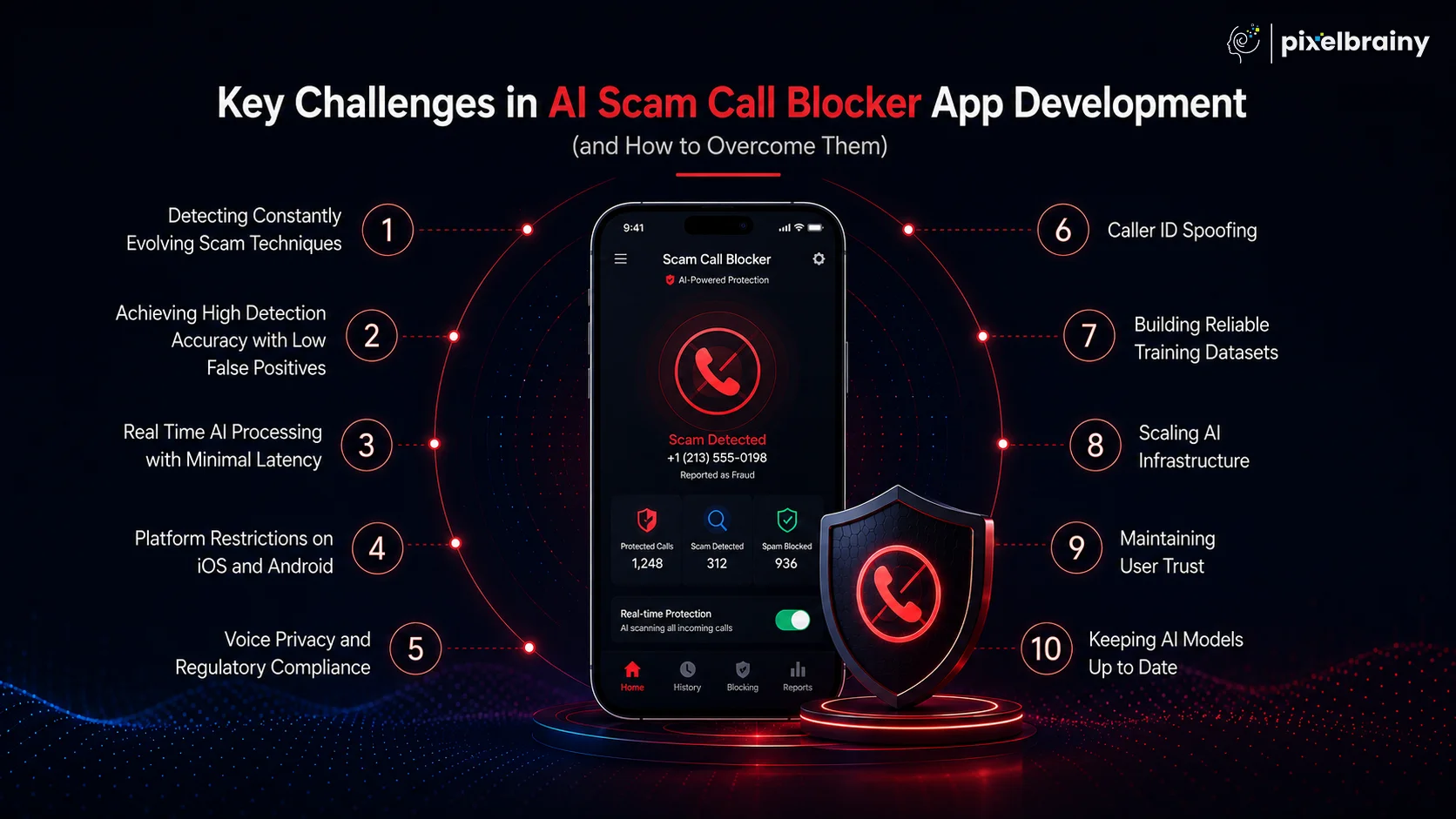
| Challenge | Why It's Difficult | How to Overcome It |
| Detecting Constantly Evolving Scam Techniques | Fraudsters frequently change scripts, phone numbers, caller identities, and increasingly use AI generated voices to bypass traditional detection methods. | Continuously retrain machine learning models using fresh datasets, user reports, and threat intelligence feeds to improve detection accuracy over time. |
| Achieving High Detection Accuracy with Low False Positives | Incorrectly blocking legitimate calls damages user trust, while missed scam calls reduce the application's effectiveness. | Combine multiple detection methods such as voice analysis, caller reputation, behavioral analytics, STIR SHAKEN verification, and NLP based risk scoring instead of relying on a single signal. |
| Real Time AI Processing with Minimal Latency | Scam detection decisions must be completed within seconds before users answer incoming calls. | Deploy lightweight AI models on the device using Core ML or TensorFlow Lite while using cloud infrastructure only for advanced analysis when necessary. |
| Platform Restrictions on iOS and Android | Mobile operating systems impose strict limitations on call screening, background processing, and microphone access. | Design the application around native APIs such as Apple CallKit and Android Call Screening API while following platform specific development guidelines. |
| Voice Privacy and Regulatory Compliance | Processing live call audio introduces legal obligations related to privacy, user consent, and data protection regulations. | Implement privacy by design, obtain explicit user consent, encrypt sensitive information, and minimize cloud transmission through on device inference wherever possible. |
| Caller ID Spoofing | Fraudsters often impersonate trusted organizations by falsifying caller identification information. | Integrate STIR SHAKEN verification with AI based fraud detection and caller reputation systems to improve authentication and reduce spoofing attacks. |
| Building Reliable Training Datasets | High quality, accurately labeled scam call datasets are difficult to obtain and quickly become outdated. | Combine publicly available datasets, synthetic training data, crowdsourced reports, and commercial threat intelligence to maintain comprehensive and current training data. |
| Scaling AI Infrastructure | As user adoption increases, cloud inference, storage, and model serving costs can grow rapidly. | Build scalable cloud architecture using auto scaling infrastructure, caching, efficient APIs, and optimized AI models to control operational costs. |
| Maintaining User Trust | Users expect transparency when an app blocks calls or analyzes conversations using artificial intelligence. | Clearly explain detection decisions, provide customizable blocking preferences, publish transparent privacy policies, and allow users to review blocked calls before taking permanent action. |
| Keeping AI Models Up to Date | New fraud tactics emerge daily, making static AI models less effective over time. | Establish continuous model monitoring, automated retraining pipelines, A/B testing, and regular deployment cycles to maintain long term detection performance. |
Successfully build AI scam call blocker app solutions by treating artificial intelligence as an evolving system rather than a one-time implementation. Combining machine learning, voice intelligence, telecom authentication, crowdsourced reporting, and continuous model updates creates a layered defense that is far more resilient against modern phone scams than any single detection technique.
Investing in scalable architecture, privacy first design, and regulatory compliance from the beginning also reduces technical debt and prepares the platform for enterprise partnerships, international expansion, and future AI advancements.
Overcoming these challenges requires a combination of advanced AI, secure architecture, telecom expertise, and continuous innovation, making experienced AI scam call blocker app development partners invaluable for building a reliable and scalable fraud prevention platform.
An innovative product alone does not guarantee long term success. A sustainable monetization strategy ensures that your AI scam call blocker can continuously improve its detection models, expand its threat intelligence network, and deliver new security features while generating predictable revenue. Since phone scams continue to evolve, users and businesses are increasingly willing to pay for intelligent protection that saves time, prevents financial loss, and provides peace of mind.
One of the most common founder questions is:
"We want to build an AI scam call blocker app with a subscription model instead of relying on ads. What are the best ways to generate recurring revenue while keeping the product valuable for consumers and businesses?"
Fortunately, AI powered security applications offer multiple monetization opportunities beyond traditional advertising.
The freemium model is the most effective starting point for most startups. Users can access essential features such as caller identification, basic spam detection, and manual call blocking at no cost, allowing them to experience the product before committing to a paid plan.
Premium subscriptions can unlock advanced capabilities such as AI voice cloning detection, live call screening, unlimited scam protection, multilingual detection, personalized risk scoring, and enhanced fraud intelligence. This approach lowers the barrier to adoption while creating a steady stream of recurring revenue.
Many users are willing to pay for stronger protection, especially those who frequently receive scam calls or belong to high-risk groups such as seniors and business professionals.
Monthly or annual subscription plans can include real time AI call analysis, automatic scam blocking, priority AI model updates, cloud-based fraud detection, family protection, and advanced analytics. Subscription based pricing also provides predictable revenue that supports continuous AI model improvement.
Phone scams rarely affect just one individual. Families often want to protect parents, grandparents, spouses, and children under a single subscription.
Offering multi device or family plans increases customer lifetime value while making the application more attractive to households looking for comprehensive protection across multiple users.
Businesses lose millions of dollars every year to phishing calls, impersonation attacks, and social engineering scams. Enterprise plans can provide centralized management dashboards, organization wide protection, employee risk monitoring, reporting tools, and administrative controls.
Recurring enterprise contracts generally generate significantly higher revenue than consumer subscriptions while opening opportunities for long term customer relationships.
Telecom operators are continually investing in technologies that reduce robocalls and fraudulent communications. Licensing your AI detection engine or integrating directly with carrier infrastructure allows operators to offer enhanced scam protection to millions of subscribers.
Although these partnerships often require longer sales cycles, they can become one of the largest revenue sources for a mature platform.
Banks, insurance providers, cybersecurity companies, and telecom providers may prefer launching a branded scam protection solution rather than building one from scratch.
White label licensing enables these organizations to use your technology under their own brand while generating recurring licensing fees with relatively low customer acquisition costs.
Your fraud detection engine can also become a standalone product. By exposing caller reputation data, scam detection models, and fraud intelligence through secure APIs, you can serve fintech companies, cybersecurity platforms, telecom providers, and other developers.
API based pricing creates an additional recurring revenue stream that scales with customer usage.
Collaborating with identity protection services, password managers, antivirus companies, cyber insurance providers, and digital privacy platforms creates opportunities for referral commissions and bundled security offerings. These partnerships add value for users while diversifying revenue beyond subscriptions alone.
For most startups, a combination of freemium access and premium subscriptions offers the fastest path to market. Once the application gains traction, enterprise licensing, telecom partnerships, white label solutions, and AI APIs can gradually expand revenue while reducing dependence on a single business model.
Diversifying revenue streams also provides greater financial stability and enables continuous investment in AI research, fraud intelligence, infrastructure, and customer support.
A balanced monetization strategy built around subscriptions, enterprise licensing, telecom partnerships, and AI powered services creates sustainable recurring revenue while maximizing the long-term value of your AI scam call blocker app development investment.
Throughout this guide, you've explored everything required to launch a successful AI scam call blocker, including market opportunities, AI architecture, core and advanced features, development costs, technology stack, compliance requirements, technical challenges, and sustainable monetization strategies. The next step is turning that strategy into a secure, scalable, and production ready product. Working with a leading AI app development company ensures you have the technical expertise, AI capabilities, and product experience needed to bring your vision to market faster and with less risk.
One of the most common founder questions we hear is:
"We're looking for a leading AI app development company that can build an AI scam call blocker app from scratch, including AI model development, iOS and Android apps, STIR SHAKEN integration, cloud infrastructure, and post-launch support. Can one team handle the entire project?"
The answer is yes. At PixelBrainy, we provide end-to-end AI scam call blocker app development services, helping startups and enterprises transform innovative ideas into intelligent, scalable, and commercially successful AI products.
Our team manages the complete product lifecycle, allowing founders to work with a single experienced technology partner instead of coordinating multiple vendors.
The engagement begins with product discovery, market validation, feature prioritization, and technical architecture planning. From there, our AI engineers develop intelligent fraud detection models using machine learning, voice analysis, and Natural Language Processing, while our mobile developers build high performance iOS and Android applications with native telephony integrations. We also implement secure cloud infrastructure, scalable APIs, analytics, subscription systems, and continuous AI model optimization to ensure your application improves over time.
Whether you want to build AI scam call blocker app as a Minimum Viable Product or launch an enterprise ready platform with advanced fraud intelligence, our development process is designed to support every stage of growth.
Unlike traditional app development agencies, our expertise lies in building AI powered products that solve complex real-world problems. As a leading AI app development company, we develop intelligent systems capable of identifying evolving scam patterns, analyzing voice signals in real time, integrating telecom authentication frameworks such as STIR SHAKEN, and delivering low latency AI inference through scalable cloud and on-device architectures.
Every solution is designed with privacy, security, performance, and long-term scalability at its core, ensuring your application remains reliable as user adoption and fraud techniques continue to evolve.
Successful AI products require more than writing code. They require strategic planning, continuous collaboration, and iterative improvement.
Our delivery process includes product discovery, UI/UX design, AI model development, backend engineering, mobile application development, quality assurance, security testing, cloud deployment, and post launch optimization. Regular sprint reviews and transparent communication keep founders informed throughout every phase of development while ensuring business goals remain aligned with technical execution.
Our team recently partnered with a startup to develop an AI powered consumer security platform focused on detecting high risk digital interactions in real time. The solution combined machine learning models, cloud-based analytics, mobile applications, and intelligent risk scoring to provide users with proactive security recommendations.
Following deployment, the platform successfully supported thousands of active users, delivered high detection accuracy, and was architected to scale through continuous AI model updates and expanding threat intelligence. While the client's identity remains confidential, the project reflects our ability to deliver secure, production ready AI solutions for complex security challenges.
Founders choose PixelBrainy because we combine AI expertise with practical product development experience. Beyond AI scam call blocker app development, we help define product strategy, design scalable architectures, build intelligent AI models, navigate compliance requirements, optimize user experiences, and create sustainable technology foundations for long term business growth.
From validating an MVP to launching a feature rich enterprise platform, our team works as an extension of your business, helping you reduce development risks while accelerating your journey from idea to market.
So, Have an idea to develop AI scam call blocker app or another AI powered product? Let's connect and discuss how PixelBrainy can help transform your vision into a secure, scalable, and market ready solution.
AI powered scam call protection is rapidly becoming an essential part of modern mobile security as phone scams grow more sophisticated through AI generated voices, caller ID spoofing, and social engineering attacks. For founders, this presents a significant opportunity to build solutions that deliver real value while addressing a global and continuously expanding problem.
As you've seen throughout this guide, successful AI scam call blocker app development requires much more than integrating a spam database. It involves combining machine learning, voice analysis, Natural Language Processing, real time telephony integrations, scalable cloud infrastructure, regulatory compliance, and a sustainable monetization strategy into a single intelligent platform. With the right product roadmap and technology partner, it's possible to launch an MVP quickly and evolve it into an enterprise grade solution as your user base grows.
If you're ready to turn your idea into a production ready AI scam call blocker, partnering with an experienced team can significantly reduce development risks and accelerate your time to market.
Ready to Build Your AI Scam Call Blocker?
Schedule a call with the PixelBrainy team to discuss your vision, validate your product strategy, and receive a tailored roadmap for building a secure, scalable, and future ready AI application.
The cost to build an AI scam call blocker app typically ranges from $25,000 for a feature limited MVP to $250,000+ for an enterprise grade platform. The final investment depends on factors such as AI model complexity, real time voice analysis, STIR SHAKEN integration, supported platforms (iOS and Android), multilingual capabilities, cloud infrastructure, and compliance requirements. Starting with an MVP allows founders to validate the product before investing in advanced AI features.
For most startups, AI scam call blocker app development takes approximately 12 to 14 weeks for a production ready MVP. This timeline includes product discovery, AI model development, telephony integration, backend development, UI/UX design, testing, and deployment. More advanced features such as AI voice cloning detection, multilingual support, and enterprise dashboards may require additional development time.
Yes. Modern AI scam call blocker applications can detect many AI generated voice scams by combining voice biometrics, speech pattern analysis, Natural Language Processing (NLP), caller reputation, behavioral analytics, and telecom authentication signals. While no solution guarantees 100% accuracy, combining multiple AI models significantly improves detection rates compared to traditional spam call blockers.
STIR SHAKEN is not mandatory for every consumer application, but it is highly recommended if your product verifies caller identities or integrates with telecom providers. It helps identify caller ID spoofing by validating authenticated phone numbers and strengthens the overall fraud detection system when combined with AI based scam analysis.
Absolutely. Many successful startups begin with an MVP that includes caller identification, AI based spam detection, call blocking, and user reporting. Once product market fit is achieved, additional capabilities such as live AI call screening, multilingual support, AI voice cloning detection, enterprise dashboards, and predictive fraud analytics can be introduced through future releases.
Although individual consumers represent the largest market, AI scam call blocker solutions are also valuable for banks, fintech companies, healthcare providers, insurance companies, telecom operators, customer support centers, government organizations, and enterprises that want to protect employees and customers from phone-based fraud and social engineering attacks.
Developing an AI scam call blocker requires expertise across machine learning, speech recognition, mobile development, telecom APIs, cloud infrastructure, cybersecurity, and regulatory compliance. An experienced AI app development company like PixelBrainy brings together specialists across these domains, reducing technical risks, accelerating development, and ensuring your product is scalable, secure, and ready for long term growth.

About The Author
Sagar Bhatnagar
Sagar Sahay Bhatnagar brings over a decade of IT industry experience to his role as Marketing Head at PixelBrainy. He's known for his knack in devising creative marketing strategies that boost brand visibility and market influence. Sagar's strategic thinking, coupled with his innovative vision and focus on results, sets him apart. His track record of successful campaigns proves his ability to utilize digital platforms effectively for impactful marketing efforts. With a genuine passion for both technology and marketing, Sagar continuously pushes PixelBrainy's marketing initiatives to greater success.

Working with the PixelBrainy team has been a highly positive experience. They understand the design requirements and create beautiful UX elements to meet the application needs. The dev team did an excellent job bringing my vision to life. We discussed usability and flow. Sagar worked with his team to design the database and begin coding. Working with Sagar was easy. He has the knowledge to create robust apps, including multi-language support, Google and Apple ID login options, Ad-enabled integrations, Stripe payment processing, and a Web Admin site for maintaining support data. I'm extremely satisfied with the services provided, the quality of the final product, and the professionalism of the entire process. I highly recommend them for Android and iOS Mobile Application Design and Development.

Great experience working with them. Had a lot of feedback and I found that unlike most contractors they were bugging me for updates instead of the other way around. They were extremely time conscience and great at communicating! All work was done extremely high quality and if not on time, early! They were always proactive when it comes to communication and the work is great/above par always. Very flexible and a great team to work with! Goes above and beyond to present us with multiple options and always provides quality. Amazing work per usual with Chitra. If you have UI/UX or branding design needs I recommend you go to them! Will likely work with them in the future as well, definitely recommended!

PixelBrainy is a joy to work with and is a great partner when thinking through branding, logo, and website layout. I appreciate that they spend time going into the "why" behind their decisions to help inform me and others about industry best practices and their expertise.

I hired them to design our software apps. Things I really like about them are excellent communication skills, they answer all project suggestions and collaborate right away, and their input on design and colors is amazing. This project was complex and needed patience and creativity. The team is amazing to do business with. I will be using them long-term. Glad to see there are some good people out there. I was afraid to try and outsource my project to someone but I am glad I met them! I really can't say enough. They went above and beyond on this project. I am very happy with everything they have done to make my business stand out from the competition.

It was great working with PixelBrainy and the team. They were very responsive and really owned the project. We'll definitely work with them again!

I recently worked with the PixelBrainy team on a project and I was blown away by their communication skills. They were prompt, clear, and articulate in all of our interactions. They listened and provided valuable feedback and suggestions to help make the project a success. They also kept me updated throughout the entire process, which made the experience stress-free and enjoyable.

PixelBrainy is very good at what it does. The team also presents themselves very professionally and takes care of their side of things very well. I could fully trust them taking up the design work in a timely and organised manner and their attention to detail saved us lots of effort and time. This particular project was quite intense and the team showed that they function very well under pressure. Very much looking forward to working with her again!

It's always an absolute pleasure working with them. They completed all of my requests quickly and followed every note I had for them to a T, which made our process go smoothly from start to finish. Everything was completed fast and following all of the guidelines. And I would recommend their services to anyone. If you need any design work done in the future, PixelBrainy should be your first call!

They took ownership of our requirements and designed and proposed multiple beautiful variants. The team is self-motivated, requires minimum supervision, committed to see-through designs with quality and delivering them on time. We would definitely love to work with PixelBrainy again when we have any requirements.

PixelBrainy was a big help with our SaaS application. We've been hard at work with a new UI/UX and they provided a lot of help with the designs. If you're looking for assistance with your website, software, or mobile application designs, PixelBrainy and the team is a great recommendation.

PixelBrainy designers are amazing. They are responsive, talented, and always willing to help craft the design until it matches your vision. I would recommend them and plan to continue them for my future projects and more!!!

They were awesome! Did a good job fast, and good communication. Will work with them again. Thank you

Creative, detail-oriented, and talented designers who take direction well and implement changes quickly and accurately. They consistently over-delivered for us.

PixelBrainy team is very talented and creative. Great designers and a pleasure to work with. PixelBrainy is an excellent communicator and I look forward to working with them again.

PixelBrainy has a very talented design team. Their work is excellent and they are very responsive. I enjoy working with them and hope to continue on all of our future projects.


Transform your ideas into reality with us.
Across these industries, each engagement brings unique challenges, from early-stage product development to scaling complex systems, helping us build a practical understanding of real-world product environments.