AI Summary Powered by PixelBrainy
Have you ever wondered why two people using the same skincare product achieve completely different results?
The answer lies in one simple fact. Every person's skin is unique. Factors such as skin type, hydration level, acne severity, pigmentation, pores, wrinkles, sensitivity, age, lifestyle, and environmental exposure create completely different skincare needs. This is exactly why AI skin analysis app development has become one of the fastest growing innovations in the beauty technology industry. Instead of relying on generic skincare advice, businesses can now build AI skin analysis apps that use computer vision, facial image processing, and machine learning to analyze skin conditions in real time and deliver personalized skincare recommendations.
A common question beauty entrepreneurs ask today is: "I am a beauty brand founder and I want to build a custom AI skincare app that analyzes a user's skin in real time and recommends specific products from our own product line based on their exact skin conditions and skin type. Which development companies in USA specialize in building this type of app?" The answer is to partner with an AI app development company experienced in computer vision, medical grade AI models, beauty technology, cloud infrastructure, personalized recommendation engines, and eCommerce integrations. Such companies can develop AI skincare apps that not only identify facial skin concerns accurately but also recommend products exclusively from your own skincare catalog.
The market opportunity is growing rapidly. According to Coherent Market Insights, the global AI Skin Analysis Market is estimated to reach USD 2.13 billion in 2026 and is projected to grow to USD 6.30 billion by 2033 at a CAGR of 16.8%, driven by increasing demand for AI powered personalized skincare and mobile health technologies.
Whether you want to understand how to create an AI skin analysis app, explore the complete AI skin condition diagnosis app development lifecycle, or learn the entire development process of AI skin analysis app, this guide covers everything businesses need to know in 2026.
An AI skin analysis app is an intelligent mobile application that uses artificial intelligence, machine learning, and computer vision skin analysis to evaluate a person's facial skin through a smartphone selfie. Instead of depending on user assumptions or questionnaire responses, the app visually examines the skin and identifies visible concerns such as acne, pigmentation, wrinkles, enlarged pores, redness, fine lines, dark spots, dehydration, and uneven skin tone. This is why AI skin analysis app development is becoming the preferred approach for beauty brands, dermatology clinics, and skincare companies looking to deliver personalized skincare experiences.
One of the most common questions is, "What is an AI skin analysis app and how does it actually detect skin conditions from a smartphone selfie?" The answer lies in advanced computer vision technology. After a user captures a selfie under proper lighting, the AI system first enhances the image by correcting lighting, aligning facial landmarks, and verifying image quality. It then divides the face into multiple facial zones and analyzes each region independently. Deep learning models examine skin texture, pigmentation variation, pore size, inflammation markers, lesion morphology, and other visible characteristics at the pixel level to detect potential skin conditions with greater accuracy.
The intelligence behind an AI powered skin analysis app comes from convolutional neural networks (CNNs) and Vision Transformer (ViT) models trained on hundreds of thousands of labeled facial skin images. The performance of these models depends on the size, diversity, and quality of the training dataset, particularly across different Fitzpatrick skin tones, age groups, and environmental conditions.
Another common question is, "How is an AI skin analysis app different from a basic skin quiz or a simple beauty recommendation engine?" A skincare quiz only interprets what users say about their skin, while a recommendation engine follows predefined rules. When you build an AI skin diagnosis app, recommendations are generated from actual visual analysis, making them significantly more personalized, accurate, and data driven.
| Step | What Happens? |
| 1. Selfie Capture | The user captures a clear facial selfie using the smartphone camera under recommended lighting conditions to ensure accurate analysis. |
| 2. Image Preprocessing | The AI checks image quality, detects facial landmarks, aligns the face, removes background noise, and normalizes lighting before analysis begins. |
| 3. Facial Zone Analysis | Computer vision divides the face into 10 to 20 individual zones and examines each area separately for texture, pores, pigmentation, redness, wrinkles, acne, and other visible skin indicators. |
| 4. AI Condition Detection | Deep learning models compare detected patterns against trained datasets and classify 30 to more than 80 different skin conditions while assigning severity scores. |
| 5. Personalized Results | The app generates a detailed skin report, recommends customized skincare routines and products, and may also provide before and after simulations and long-term progress tracking. |
In simple terms, AI skin analysis transforms a single smartphone selfie into a comprehensive skin health assessment, enabling businesses to deliver highly personalized skincare recommendations with speed, accuracy, and scalability.
The ability of an AI skin analysis app to detect skin conditions depends on the sophistication of its computer vision models, the quality of its training data, and the number of skin conditions it has been trained to recognize. Modern AI skin condition diagnosis app development goes far beyond identifying acne or wrinkles. With advanced deep learning models, businesses can build AI skin analysis apps capable of analyzing dozens of cosmetic and dermatological skin conditions from a single smartphone selfie.
A common misconception is that every AI skin analysis solution offers the same capabilities. In reality, most third-party SDKs support only 10 to 15 predefined skin conditions, limiting the user experience. Custom AI models, however, can be trained on proprietary datasets to recognize more than 50 visible skin conditions, making them ideal for beauty brands, dermatology clinics, and skincare companies that want to deliver comprehensive skin assessments and personalized product recommendations.
For cosmetic skin concerns such as acne, wrinkles, pigmentation, pores, redness, dehydration, and uneven skin tone, skin condition detection AI can achieve high accuracy when trained on large and diverse datasets. While AI delivers rapid and consistent image analysis, it should be viewed as a decision support technology rather than a replacement for dermatologist diagnosis, particularly for complex medical skin disorders.
| Condition | What AI Detects | Severity Levels |
| Acne and blemishes | Detects blackheads, whiteheads, papules, pustules, cysts, and maps affected facial zones | Mild, Moderate, Severe |
| Wrinkles and fine lines | Measures wrinkle depth, length, density, and facial distribution | Early, Moderate, Advanced |
| Dark spots and hyperpigmentation | Identifies pigmentation intensity, spot size, density, and color variation | Low, Medium, High |
| Uneven skin tone | Analyzes tone inconsistency across different facial regions | Mild, Moderate, Significant |
| Enlarged pores | Evaluates pore size, visibility, and concentration | Normal, Enlarged, Severely Enlarged |
| Oiliness and shine | Estimates sebum levels across the forehead, nose, cheeks, and chin | Dry, Normal, Oily, Combination |
| Dullness and dehydration | Examines skin brightness, texture, and hydration related indicators | Mild, Moderate, Severe |
| Dark circles and eye puffiness | Detects under eye pigmentation, swelling, and shadow intensity | Mild, Moderate, Severe |
| Redness and flushing | Identifies inflammation and vascular redness patterns | Localized, Widespread |
| Texture irregularities | Measures roughness, smoothness, and uneven skin texture | Smooth, Slightly Rough, Rough |
| Condition | Detection Capability | Clinical Use |
| Rosacea | Detects facial redness and vascular distribution patterns | Referral trigger |
| Eczema and dermatitis | Identifies inflammation, dry patches, and texture abnormalities | Monitoring tool |
| Psoriasis | Recognizes scaling and plaque formation | Progress tracking |
| Melasma | Detects deep pigmentation patterns and facial distribution | Treatment planning |
| Seborrheic dermatitis | Identifies flaky skin and scaling around affected areas | Monitoring |
| Perioral dermatitis | Detects inflammation around the mouth and chin region | Referral trigger |
| Mole and lesion screening | Screens lesion characteristics using ABCDE pattern analysis | Early detection flag |
| Skin cancer risk indicators | Detects asymmetry, border irregularity, color variation, and diameter changes | Urgent referral trigger |
Important: AI can identify visual indicators of suspicious lesions but should not be used as a standalone diagnostic tool for skin cancer. Clinical confirmation by a qualified dermatologist remains essential.
The accuracy of an AI acne detection app, AI wrinkle detection system, or any skin analysis model is directly influenced by the diversity of its training dataset. Leading AI platforms in 2026 are trained to support Fitzpatrick Skin Types I through VI, enabling reliable performance across different skin tones and ethnicities. Models trained primarily on lighter skin often show significantly higher error rates for Fitzpatrick IV, V, and VI skin types. For this reason, businesses developing a custom AI skin analysis solution should ensure skin tone diversity is incorporated into the dataset from the very beginning.
A truly intelligent AI skin analysis app is defined not by how many conditions it detects, but by how accurately it detects them across every skin type.
Consumer expectations have shifted from generic skincare recommendations to highly personalized experiences backed by real data. Instead of relying on questionnaires, businesses are investing in AI skin analysis app development to analyze customers' actual skin conditions and deliver product recommendations that improve conversions, reduce returns, and strengthen customer loyalty.
Whether you want to build an AI skin analysis app for an ecommerce brand, beauty startup, or dermatology clinic, the business value extends far beyond personalization.
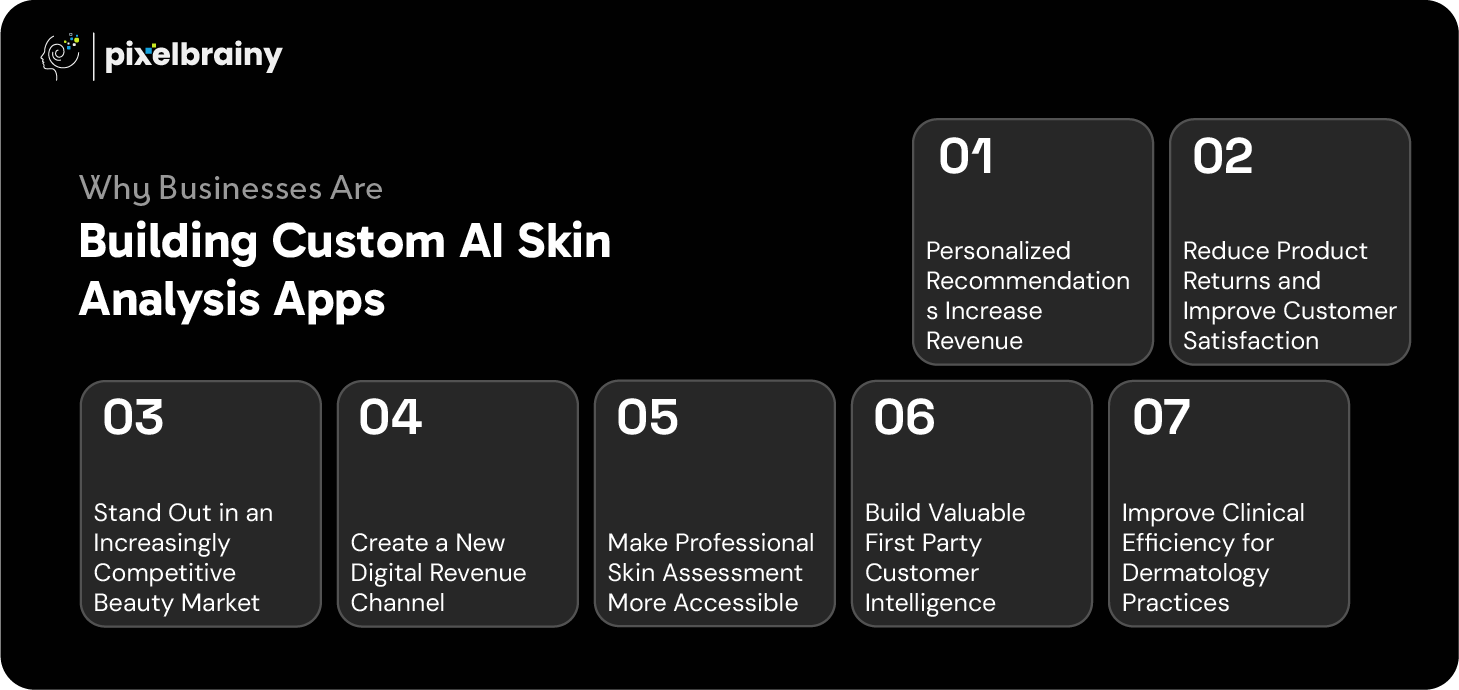
Personalization has become one of the biggest growth drivers in the beauty industry. According to Accenture, 91% of consumers are more likely to shop with brands that provide relevant offers and recommendations. McKinsey also reports that companies implementing personalization can increase revenue by 5% to 15%, while faster growing companies generate 40% more revenue from personalization than their competitors.
Unlike traditional skincare quizzes, an AI skin analysis app recommends products based on the customer's actual skin condition, resulting in more accurate product matching and higher purchase confidence.
Product returns remain a costly challenge for skincare ecommerce businesses because customers often purchase products that are unsuitable for their skin type. When businesses develop AI skincare apps for business, recommendations are generated from real skin analysis instead of user assumptions.
This helps customers select products that better match their skin needs, reducing return rates, increasing customer satisfaction, and improving customer lifetime value.
Many skincare brands still rely on static quizzes and rule based recommendation engines. An AI powered skin assessment experience positions your business as an innovation leader while creating a premium customer experience that competitors cannot easily replicate.
Early adopters are building stronger customer trust by offering precision skincare supported by advanced AI technology.
An AI skin analysis app extends customer engagement beyond the initial purchase. Users can perform regular skin scans, receive updated skincare routines, and discover personalized product recommendations directly within the app.
This continuous engagement increases repeat purchases, strengthens subscription opportunities, and reduces dependence on paid advertising for customer retention.
Professional dermatology consultations are not always affordable or easily accessible for every consumer. An AI powered skin assessment provides users with an instant preliminary evaluation from their smartphone, helping them understand visible skin concerns before deciding whether professional care is needed.
For businesses investing in AI dermatology app development, this creates a scalable way to educate users while expanding access to personalized skincare guidance.
Every completed skin scan generates valuable first party data about skin conditions, skincare preferences, treatment progress, and purchasing behavior. When anonymized and managed responsibly, these insights help businesses improve product development, optimize marketing campaigns, identify emerging skincare trends, and deliver increasingly personalized customer experiences.
As third-party cookies continue to decline, first party skin data is becoming one of the most valuable digital assets for beauty brands.
Dermatology clinics can use AI skin assessment tools as a pre consultation screening system. Patients upload facial images before their appointment, allowing clinicians to review baseline assessments in advance instead of collecting routine information during consultation.
This streamlines clinical workflows, supports remote follow ups for chronic skin conditions, improves patient engagement, and allows dermatologists to focus more time on diagnosis and treatment planning rather than initial assessments. Studies also show AI assisted pre assessment can reduce consultation time by 30% to 40% in suitable clinical workflows.
Ultimately, businesses investing in AI skin analysis today are not simply adopting a new technology. They are building a smarter, more personalized, and data driven skincare ecosystem that delivers measurable value for both customers and the business.
There is no single approach to AI skin analysis app development because every business has different goals, users, and revenue models. A direct-to-consumer skincare brand requires a completely different solution than a dermatology clinic or a SaaS company selling AI technology to other businesses. Before you build an AI skin diagnosis mobile app, it is important to understand which type best aligns with your target audience, feature requirements, compliance needs, and long-term growth strategy.
A consumer AI skincare app is designed for everyday users who want instant skin analysis from their smartphone. After taking a selfie, the app evaluates visible skin conditions and recommends personalized skincare routines, lifestyle tips, and products based on the user's skin type and concerns. These apps often include progress tracking, loyalty programs, daily reminders, and AI powered beauty coaching to increase customer engagement.
Primary Use Case: Personalized skincare recommendations and product discovery.
Key Differentiators: Selfie based skin analysis, customized skincare routines, product recommendations, progress tracking, beauty coaching.
Best For: Beauty brands, skincare startups, direct to consumer cosmetic companies.
Estimated Cost: $30,000 to $100,000
Unlike consumer-focused apps, clinical grade solutions are built to assist dermatologists and healthcare professionals during patient assessment. The AI analyzes skin images, generates clinical observations, documents findings, and supports treatment planning while allowing physicians to make the final diagnosis. These platforms usually include electronic medical records, patient history, referral management, and regulatory compliance features.
Primary Use Case: Clinical decision support and skin condition assessment.
Key Differentiators: High diagnostic accuracy, clinical documentation, patient records, referral workflows, dermatologist review tools.
Best For: Dermatology clinics, hospitals, healthcare providers, telemedicine companies.
Estimated Cost: $80,000 to $300,000
A teledermatology platform combines teledermatology app development with AI to simplify remote consultations. Patients upload selfies before their appointment, allowing AI to generate an initial skin assessment that dermatologists can review before the consultation begins. This shortens consultation time, improves workflow efficiency, and enables remote monitoring without requiring unnecessary clinic visits.
Primary Use Case: Remote dermatology consultations and AI assisted pre assessment.
Key Differentiators: AI pre-screening, virtual consultations, secure messaging, appointment scheduling, dermatologist review workflow.
Best For: Telehealth companies, dermatology networks, health insurance providers.
Estimated Cost: $80,000 to $250,000
An in-clinic kiosk application is typically installed on an iPad or tablet used by aestheticians, dermatologists, or medical spa consultants during patient intake. Before the consultation begins, the AI generates a comprehensive facial skin report, helping practitioners explain treatment plans more effectively while creating a professional and technology driven consultation experience.
Primary Use Case: AI assisted consultation support inside clinics and aesthetic centers.
Key Differentiators: Facial mapping, consultation reports, CRM integration, treatment planning, digital patient records.
Best For: Medical spas, salon chains, aesthetic clinics, dermatology practices.
Estimated Cost: $40,000 to $120,000
This type of application is integrated directly into an ecommerce website or shopping app to help customers choose the right skincare products. Rather than answering lengthy questionnaires, shoppers simply upload a selfie and receive AI generated product recommendations that match their detected skin conditions. This improves purchase confidence, increases conversion rates, and significantly reduces product returns.
Primary Use Case: AI powered online skincare shopping.
Key Differentiators: Real time skin analysis, personalized product recommendations, ecommerce integration, conversion optimization.
Best For: Skincare ecommerce retailers, beauty marketplaces, cosmetic brands.
Estimated Cost: $30,000 to $100,000
A white label platform allows multiple beauty brands to integrate AI skin analysis into their own mobile applications without building AI models from scratch. The platform provides APIs, SDKs, customizable branding, configurable recommendation engines, and tenant specific dashboards, making it suitable for companies building scalable B2B AI skincare solutions.
Primary Use Case: AI infrastructure for multiple beauty brands.
Key Differentiators: Multi-tenant architecture, API and SDK access, custom branding, configurable condition libraries, enterprise scalability.
Best For: AI technology startups, SaaS companies, enterprise beauty technology providers.
Estimated Cost: $100,000 to $400,000
These applications focus on patients living with long term skin disorders such as eczema, psoriasis, rosacea, or dermatitis. Users upload photos on a scheduled basis, allowing AI to monitor disease progression, compare previous scans, detect flare ups, and notify healthcare providers when significant changes occur. Secure patient records and HIPAA compliant data management are essential components of this solution.
Primary Use Case: Long term monitoring of chronic skin conditions.
Key Differentiators: Progress tracking, treatment history, clinician dashboards, automated alerts, secure medical image storage.
Best For: Healthcare organizations, pharmaceutical companies, research institutions, patient advocacy groups.
Estimated Cost: $60,000 to $200,000
| App Type | Primary User | Accuracy Required | Compliance | Estimated Cost |
| Consumer Beauty App | End consumer | Moderate | GDPR | $30K to $100K |
| Clinical Dermatology Tool | Clinician | High | FDA, HIPAA | $80K to $300K |
| Teledermatology Platform | Patient and clinician | High | HIPAA, FDA | $80K to $250K |
| In Clinic Kiosk App | Aesthetician | High | GDPR, HIPAA | $40K to $120K |
| Ecommerce Skin Concierge | Shopper | Moderate | GDPR | $30K to $100K |
| White Label SDK or API | Brand and developer | High | Varies | $100K to $400K |
| Chronic Condition Monitor | Patient and doctor | Very High | HIPAA | $60K to $200K |
The success of AI skin analysis app development depends on more than just an accurate AI model. An exceptional user experience is created by combining intelligent skin analysis, personalized recommendations, seamless navigation, and efficient business management features into one platform. Whether you are a skincare brand, beauty retailer, dermatology clinic, or wellness startup, every feature should contribute to improving user engagement, delivering personalized skincare experiences, and supporting long term business growth.
Many businesses ask, "I want to build a custom AI skin analysis app for my skincare brand that allows users to take a selfie and instantly get a detailed diagnosis of their skin conditions like acne, dark spots, wrinkles, and uneven tone along with personalized product recommendations. What are all the features I need to build?" The answer depends on your business objectives, but every successful application starts with a strong set of core features before expanding into advanced AI capabilities and enterprise integrations.
The following table highlights the essential features of skin analysis app development integrating AI that every business should consider when planning to build a skin analysis app with AI or create an AI skin analysis app.
| Core Feature | Description |
| Secure User Registration | Allow users to register using email, phone number, Apple ID, Google, or social accounts while securely managing user profiles, authentication, consent records, and personalized skincare preferences for a seamless onboarding experience. |
| AI Selfie Capture | Enable users to capture or upload facial selfies with built in guidance for lighting, camera angle, face positioning, and image quality to ensure consistent inputs and improve AI analysis accuracy. |
| AI Skin Condition Detection | Analyze facial images using computer vision and deep learning to identify visible concerns including acne, wrinkles, pigmentation, enlarged pores, redness, fine lines, dark spots, dehydration, and uneven skin tone. |
| Skin Type Identification | Automatically determine whether the user's skin is dry, oily, combination, normal, or sensitive by evaluating multiple skin characteristics before generating personalized skincare recommendations and routines. |
| Facial Zone Mapping | Divide the face into multiple regions such as the forehead, cheeks, nose, chin, and under eye area to detect localized skin conditions with greater precision and visual clarity. |
| Skin Health Report | Generate a comprehensive report summarizing detected skin conditions, severity levels, overall skin health score, facial analysis results, and personalized insights in an easy to understand visual format. |
| Personalized Product Recommendations | Recommend the most suitable skincare products based on detected skin conditions, skin type, ingredient compatibility, and user goals while prioritizing products from your own skincare product portfolio. |
| Personalized Skincare Routine | Create customized morning and evening skincare routines that guide users on product usage order, application frequency, and daily skincare habits tailored to their unique skin analysis results. |
| Scan History and Progress Tracking | Store previous skin scans, reports, and analysis results so users can compare changes over time, monitor skincare progress, and evaluate the effectiveness of recommended products and routines. |
| Product Catalog Integration | Connect the AI recommendation engine with your ecommerce product catalog to display recommended products, ingredient information, availability, customer reviews, and direct purchasing options within the application. |
| Push Notifications and Reminders | Send personalized reminders for skincare routines, scheduled skin scans, product replenishment, hydration goals, and educational tips to improve user engagement and encourage consistent skincare habits. |
| User Dashboard | Provide a centralized dashboard where users can access skin reports, health scores, skincare routines, product recommendations, progress history, account settings, and personalized insights from one location. |
| Reviews and Feedback System | Allow users to review recommended products, rate their experience, submit feedback on AI recommendations, and share treatment outcomes to improve personalization and strengthen customer engagement. |
| Admin Dashboard | Enable administrators to manage users, skincare products, recommendation logic, content updates, promotional campaigns, customer support, platform settings, and overall application performance through a centralized interface. |
| Analytics and Reporting | Track user behavior, scan frequency, common skin concerns, recommendation performance, product engagement, customer retention, and business insights through comprehensive reporting dashboards for better decision making. |
These core features establish the functional foundation of a scalable AI skin analysis app, creating a seamless experience for users while supporting long term business growth and future AI enhancements.
As user expectations continue to evolve, basic functionality is no longer enough to differentiate an AI skincare application. While core features enable users to analyze their skin and receive personalized recommendations, advanced capabilities transform the app into a comprehensive skincare intelligence platform. These features leverage artificial intelligence, predictive analytics, augmented reality, and automation to deliver deeper insights, improve user engagement, and create long term competitive advantages.
Businesses planning enterprise level AI skin analysis app development often look beyond standard skin scanning and recommendation engines. Advanced features help improve diagnostic accuracy, personalize skincare journeys, strengthen customer retention, and support data driven decision making. Although not essential for a minimum viable product, they can significantly enhance the overall value of the application as it scales.
The table below highlights the most valuable advanced features to consider when you build a skin analysis app with AI or create an AI skin analysis app for long term business success.
| Advanced Feature | Description |
| AI Skin Age Prediction | Estimate a user's biological skin age by analyzing wrinkles, elasticity, pigmentation, texture, and other facial characteristics. Compare skin age with chronological age and provide recommendations to improve overall skin health over time. |
| Predictive Skin Health Analytics | Use historical scan data and machine learning models to predict future skin concerns such as acne breakouts, pigmentation progression, dehydration, or wrinkle development before they become more severe. |
| AR Before and After Simulation | Allow users to visualize potential skincare outcomes using augmented reality by simulating improvements in wrinkles, acne, pigmentation, skin tone, or overall facial appearance after following recommended routines. |
| AI Ingredient Compatibility Engine | Analyze skincare ingredients against detected skin conditions, allergies, sensitivities, and user preferences to recommend products containing suitable ingredients while identifying ingredients that should be avoided. |
| Personalized AI Beauty Assistant | Integrate an AI powered chatbot that answers skincare questions, explains analysis reports, recommends routines, provides product education, and offers personalized skincare guidance through natural conversations. |
| Voice Enabled AI Consultation | Enable users to interact with the application using voice commands for navigating reports, asking skincare questions, receiving recommendations, and improving accessibility across different user groups. |
| Environmental Skin Impact Analysis | Combine weather, UV index, humidity, air quality, and pollution data with skin analysis results to recommend location specific skincare routines and preventive measures for changing environmental conditions. |
| Smart Wearable Integration | Connect with smartwatches, fitness trackers, or health devices to incorporate lifestyle metrics such as sleep quality, hydration, stress levels, and physical activity into personalized skincare recommendations. |
| Multi User and Family Profiles | Support multiple user profiles within a single application, allowing families or clinics to manage individual skin reports, personalized routines, progress tracking, and product recommendations separately. |
| AI Powered Business Intelligence Dashboard | Provide brands with advanced analytics on customer skin trends, product performance, recommendation effectiveness, regional skin concerns, customer retention, and purchasing behavior to support strategic business decisions. |
Advanced AI features transform a skin analysis app from a simple diagnostic tool into a personalized, data driven skincare ecosystem that continuously delivers value to both users and businesses.
Building an AI powered skincare application is much more than integrating a computer vision model into a mobile app. A successful product combines artificial intelligence, dermatology expertise, mobile engineering, cloud infrastructure, regulatory compliance, and user centered design into a single ecosystem. Whether you want to create an AI skin analysis mobile app for a skincare brand or develop a clinical platform for dermatologists, following a structured AI skin analysis app development process significantly reduces project risks, improves AI accuracy, and shortens the path to launch.
A common business requirement is: "We are planning to develop an AI skin condition diagnosis mobile app for our dermatology clinic that can help patients get an initial skin assessment before their consultation appointment. What does the full development process look like and how long will it take from concept to App Store launch?"
The answer depends on your application type, AI model complexity, regulatory requirements, and feature scope. However, every successful project follows the same proven roadmap, beginning with business strategy and ending with continuous AI improvement after launch.
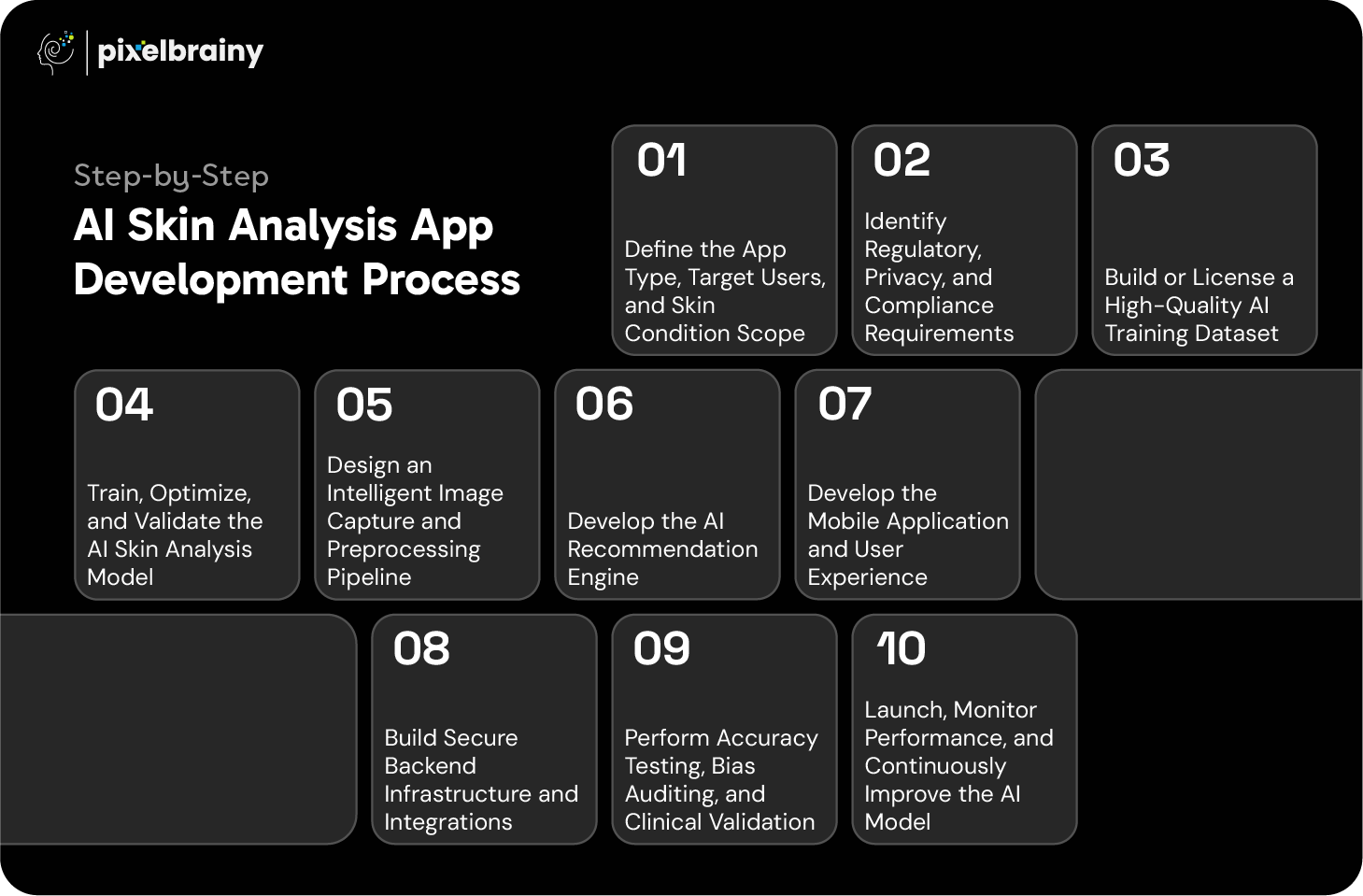
The first step in how to build an AI skin analysis app from scratch is defining exactly what you want to build. Your application could be a consumer skincare app, a clinical diagnosis platform, a teledermatology solution, an ecommerce skin concierge, or a white label AI platform for multiple brands.
Next, identify your target users and prioritize the skin conditions your AI will support. For an initial release, focusing on 10 to 15 high demand conditions such as acne, wrinkles, pigmentation, enlarged pores, redness, and dehydration is more practical than attempting 80 plus conditions. You should also define your monetization strategy, whether it is ecommerce sales, subscriptions, B2B licensing, consultation bookings, or SaaS revenue.
Estimated Timeline: 1 week
Common Mistake to Avoid: Trying to build both a consumer beauty app and a clinical diagnosis platform within the first version.
Compliance planning should begin before writing the first line of code. Consumer skincare applications generally need to comply with privacy regulations such as GDPR and applicable data protection laws. Applications intended to diagnose medical conditions or support clinical decisions may fall under FDA Software as a Medical Device requirement in the United States.
If your application stores identifiable patient photos or shares them with healthcare providers, HIPAA compliance becomes essential. Addressing these requirements early prevents expensive architectural changes later in the project.
Many businesses also begin this stage with PoC development to validate technical feasibility, AI accuracy, and business assumptions before investing in full scale development.
Estimated Timeline: 1 to 2 weeks, with compliance continuing throughout development.
Common Mistake to Avoid: Treating compliance as a final checklist instead of incorporating it into the product architecture from day one.
The dataset is the foundation of every successful AI skin analysis application. Even the most advanced AI algorithm cannot deliver accurate predictions without high quality training data. Businesses can create proprietary datasets, license commercial datasets, collaborate with dermatology clinics, or combine multiple verified sources.
A consumer grade model supporting around 15 skin conditions generally requires approximately 50,000 to 100,000 labeled facial images, while clinical grade systems supporting more than 60 conditions may require 500,000 or more dermatologist verified images.
Equally important is ensuring representation across Fitzpatrick Skin Types I through VI, different age groups, genders, ethnicities, lighting environments, and image qualities to minimize algorithmic bias.
Estimated Timeline: 4 to 12 weeks
Common Mistake to Avoid: Using publicly available datasets without validating image quality, annotation consistency, or skin tone diversity.
Once the dataset is ready, machine learning engineers train convolutional neural networks, Vision Transformer models, or hybrid architectures to recognize skin conditions, estimate severity levels, and classify skin types.
The model is then validated using independent test datasets that were never seen during training. Besides measuring overall accuracy, teams evaluate precision, recall, sensitivity, specificity, false positive rates, and performance across different skin tones. Clinical applications should also include dermatologist review before deployment.
Organizations requiring proprietary intelligence often invest in custom AI model development solutions to achieve higher accuracy and better business differentiation.
Estimated Timeline: 4 to 8 weeks
Common Mistake to Avoid: Optimizing only for average accuracy while ignoring underperformance across darker skin tones or less common skin conditions.
AI accuracy begins before the image reaches the model. A well-designed camera experience guides users to capture clear selfies through lighting validation, face positioning assistance, distance estimation, and image quality scoring.
Before analysis, preprocessing algorithms perform facial landmark detection, background removal, illumination correction, normalization, facial zone segmentation, and image enhancement. These steps significantly improve prediction consistency under real world conditions.
Estimated Timeline: 2 to 3 weeks
Common Mistake to Avoid: Accepting blurry, poorly lit, or partially visible facial images that reduce AI prediction accuracy.
Also Read: Top AI Computer Vision Software Development Companies in USA
Detecting skin conditions is only half the solution. The real business value comes from translating AI insights into personalized recommendations. The recommendation engine maps detected skin concerns, severity levels, skin type, ingredient compatibility, lifestyle preferences, and treatment goals into actionable skincare advice.
For skincare brands, the engine should connect directly with the product catalog to recommend specific products while also identifying ingredients or product categories users should avoid based on their detected conditions.
A flexible recommendation engine allows new products, ingredients, and treatment rules to be added without rebuilding the application.
Estimated Timeline: 2 to 4 weeks
Common Mistake to Avoid: Building rigid recommendation logic that becomes difficult to maintain as product catalogs evolve.
At this stage, designers and developers transform AI capabilities into an intuitive mobile experience for iOS and Android users. Core screens typically include onboarding, selfie capture, AI analysis progress, detailed skin reports, personalized skincare routines, product recommendations, scan history, and user dashboards.
Results should be presented using clear visualizations, severity indicators, and actionable recommendations rather than technical AI metrics that ordinary users cannot interpret.
Collaborating with an experienced UI/UX design company helps simplify complex AI workflows into an engaging customer experience. Many businesses also begin with MVP development to validate market demand before expanding into advanced capabilities.
Estimated Timeline: 4 to 6 weeks
Common Mistake to Avoid: Designing interfaces around AI technology instead of user needs and decision making.
The backend serves as the operational backbone of the application. It manages authentication, encrypted image storage, AI inference requests, recommendation engines, user profiles, analytics, notifications, and administrative dashboards.
Businesses also integrate ecommerce platforms, CRM systems, payment gateways, teledermatology scheduling software, and cloud services during this stage using modern AI integration services.
Security features including encryption, role-based access control, consent management, audit logs, and configurable data retention policies should be implemented before production deployment.
Estimated Timeline: 3 to 5 weeks
Common Mistake to Avoid: Storing biometric images without encryption, access controls, or clearly defined retention policies.
Before launch, the complete platform should undergo extensive real-world testing. The application should be evaluated using users across different age groups, ethnicities, skin tones, devices, lighting conditions, and geographic regions.
Bias audits help identify systematic performance gaps, while board certified dermatologists should validate a representative sample of AI generated reports to confirm that recommendations remain clinically reasonable and consistent.
This stage ensures the application performs reliably outside controlled testing environments.
Estimated Timeline: 2 to 3 weeks
Common Mistake to Avoid: Testing only with internal employees instead of representative real-world users.
After successful testing, the application is published on the Apple App Store and Google Play Store with complete disclosures regarding biometric image collection, privacy practices, and AI generated recommendations.
Launch is not the end of the AI skin analysis app development process. Continuous monitoring of AI performance, anonymized user feedback, product recommendation effectiveness, and model accuracy enables regular improvements. Retraining the AI model with newly collected data ensures the application continues learning and maintains high performance as user behavior and datasets evolve.
Businesses seeking long term scalability often complement this stage with AI consulting solutions to optimize AI strategy, product evolution, and future feature planning.
Estimated Timeline: Ongoing after launch
Common Mistake to Avoid: Treating AI as a one-time implementation instead of a continuously improving intelligent system.
A successful AI skin analysis app is built through a disciplined development process where strategy, data quality, AI accuracy, user experience, and continuous improvement work together to deliver reliable and scalable results.
Not every business needs the same type of AI solution. The requirements for a beauty brand are very different from those of a dermatology clinic, medical spa, ecommerce retailer, or pharmaceutical company. Before planning to create an AI skin analysis app, businesses should first identify their target audience, customer journey, regulatory obligations, and long-term business goals. This ensures the application solves real business challenges instead of becoming a generic skin scanning tool.
A question many decision makers evaluate before investing is: "We are a luxury skincare brand. What AI skin analysis features will give us the best ROI for our customer base? We are also considering expanding into dermatology clinics and medical spas in the future. Should we build one platform or separate industry specific solutions?" The answer depends on the users you are serving. Building an AI skin analysis app for consumers is fundamentally different from developing one for healthcare professionals or aesthetic practitioners because each industry requires unique workflows, compliance standards, and AI capabilities.
The following industry wise breakdown explains the most common use cases, essential AI features, compliance requirements, business benefits, and estimated development scope for each industry.
An AI skin analysis app for beauty brands is designed to personalize the customer shopping journey and increase product sales. Users capture a selfie, receive an AI powered skin report, and get skincare recommendations based on their detected skin conditions instead of answering generic questionnaires.
Primary Use Cases
Key AI Features
Compliance Requirements
Business Impact
AI driven personalization can improve conversion rates by up to three times compared to quiz-based recommendation systems while increasing customer retention and repeat purchases.
Estimated Development Scope: $30,000 to $100,000
Healthcare providers that build an AI dermatology app use AI as a clinical support tool to improve consultation efficiency without replacing dermatologist expertise. Patients complete a skin assessment before their appointment, allowing clinicians to review results and prioritize patient care more effectively.
Primary Use Cases
Key AI Features
Compliance Requirements
Business Impact
AI assisted pre assessment can reduce consultation time by 30 to 40 percent while improving workflow efficiency and patient experience.
Estimated Development Scope: $80,000 to $300,000
An AI skin analysis app for medical spas helps aestheticians perform objective skin assessments before recommending treatments or skincare products. AI generated reports improve consultation quality, support treatment planning, and help clients better understand their skin conditions.
Primary Use Cases
Key AI Features
Compliance Requirements
Business Impact
Medical spas using AI consultation tools often achieve higher treatment acceptance rates, stronger client retention, and increased skincare product sales.
Estimated Development Scope: $40,000 to $120,000
Companies that develop AI skincare apps for ecommerce replace traditional skincare quizzes with intelligent image-based recommendations. Customers receive personalized product suggestions based on their actual skin conditions, creating a more engaging shopping experience while reducing purchase uncertainty.
Primary Use Cases
Key AI Features
Compliance Requirements
Business Impact
AI skin matching improves online conversions, reduces product return rates, and increases customer lifetime value by recommending products that better match each customer's skin profile.
Estimated Development Scope: $30,000 to $100,000
Salon groups are increasingly investing in AI consultation tools to standardize skincare assessments across multiple locations. Tablet based applications help beauty professionals analyze skin conditions, recommend suitable treatments, maintain client histories, and increase retail product sales through personalized consultations.
Primary Use Cases
Key AI Features
Compliance Requirements
Business Impact
Salons using AI powered consultation systems have reported 25 to 40 percent higher retail product sales per client through more personalized skincare recommendations.
Estimated Development Scope: $25,000 to $80,000
Organizations that make an AI skin analysis app for research focus on standardized skin assessments during clinical trials and product development. AI enables researchers to monitor treatment effectiveness objectively while reducing manual evaluation across multiple research sites.
Primary Use Cases
Key AI Features
Compliance Requirements
Business Impact
AI based skin monitoring can reduce manual assessment time by up to 60 percent while improving consistency, data quality, and operational efficiency across clinical research programs.
Estimated Development Scope: $100,000 to $400,000
An industry focused AI skin analysis solution delivers far greater business value because every feature, workflow, and AI capability is designed around the specific needs of its users and use cases.
The AI skin analysis app development cost can vary significantly because no two projects have the same requirements. The final budget depends on factors such as the number of skin conditions the AI model detects, whether you use an existing AI SDK or build a custom model, platform selection, regulatory compliance, third party integrations, and overall feature complexity.
One of the most common query businesses ask in chatgpt is, "How much does it cost to develop a custom AI skin analysis mobile app in 2026? I have received quotes ranging from $30,000 to $250,000. Why is there such a wide price difference?" The answer is simple. A basic consumer skincare app with limited AI capabilities requires significantly less engineering effort than a clinical grade platform with custom AI models, dermatologist workflows, HIPAA compliance, and enterprise integrations.
If your question is "I have a budget of $50,000. What kind of AI skin analysis app can I build?", a mid-level custom application with AI powered skin analysis, personalized skincare recommendations, progress tracking, and ecommerce integration is typically achievable within that budget, depending on the overall project scope and customization requirements.
| App Type | Features Included | Estimated Cost | Timeline |
| Basic MVP Consumer Skin App | 10 to 15 skin conditions, product recommendations, user profiles, basic UI | $15,000 to $40,000 | 3 to 5 months |
| Mid -Level Custom Skin Analysis App | 30 plus skin conditions, progress tracking, ecommerce integration, personalized routines | $40,000 to $100,000 | 4 to 7 months |
| Advanced Clinical Skin Diagnosis Tool | 60 plus conditions, dermatologist dashboard, HIPAA architecture, clinical workflows | $100,000 to $250,000 | 6 to 10 months |
| Teledermatology AI Platform | AI pre assessment, appointment booking, async review, EHR integration | $100,000 to $250,000 | 6 to 10 months |
| White Label B2B Skin Analysis SDK | Multi-tenant platform, custom branding, APIs, developer portal | $150,000 to $400,000+ | 8 to 14 months |
| Development Component | Estimated Cost Range |
| Dataset licensing or acquisition | $5,000 to $50,000 |
| AI model training and validation | $10,000 to $60,000 |
| Image capture and preprocessing pipeline | $5,000 to $20,000 |
| Recommendation engine development | $5,000 to $20,000 |
| Mobile app frontend for iOS and Android | $15,000 to $50,000 |
| AR virtual try on feature | $10,000 to $40,000 |
| Backend infrastructure and APIs | $10,000 to $35,000 |
| Ingredient analysis engine | $5,000 to $20,000 |
| Teledermatology integration | $10,000 to $30,000 |
| HIPAA and FDA compliance architecture | $10,000 to $50,000 |
| Bias audit and dermatologist validation | $5,000 to $20,000 |
| Post launch AI model retraining | $3,000 to $15,000 per cycle |
Many businesses evaluating the cost to develop an AI skincare app also ask whether they should integrate an existing SDK or build a proprietary AI model. The right approach depends on your budget, business goals, and long-term product strategy.
| Factor | SDK Integration (Haut.AI, Perfect Corp) | Custom AI Model Development |
| Upfront Cost | $5,000 to $20,000 integration cost | $40,000 to $250,000 |
| Ongoing Licensing | $1,000 to $10,000 per month | Minimal infrastructure cost only |
| Condition Coverage | Limited to vendor supported conditions | Fully customizable |
| Accuracy | Generalized AI model | Optimized for your users and datasets |
| Brand Differentiation | Shared technology used by multiple brands | Proprietary intellectual property |
| Fitzpatrick Skin Tone Control | Vendor dependent | Full control over training data |
| Estimated 3 Year Cost | $36,000 to $380,000 | $50,000 to $300,000 |
Several technical and business decisions directly influence the AI skin diagnosis app development cost breakdown:
Many businesses also reduce initial investment by starting with an MVP, validating market demand, and then scaling through flexible engagement models and phased feature development instead of building a full enterprise platform in the first release.
The most cost-effective AI skin analysis app is not the one with the lowest price, but the one that delivers the highest long term business value for your specific goals and users.

Also Read: AI App Development Cost: From MVPs to Full-Scale AI App
Regulatory compliance is one of the most important considerations before launching an AI powered skincare or dermatology application. While many businesses focus on AI accuracy and user experience, overlooking legal and privacy requirements can delay product launches, increase development costs, and create significant regulatory risks. Whether you are building a consumer wellness application or a clinical diagnosis platform, compliance should be integrated into the product from the very beginning.
A question frequently raised by healthcare providers and founders is: "What FDA regulatory requirements apply to an AI skin analysis app that detects skin conditions? How do we build a HIPAA compliant AI skin analysis app for our dermatology practice, and what approval is required for an AI skin cancer detection app in the USA?" The answer depends on the intended use of the application and the claims it makes to users.
The FDA evaluates software based on its intended purpose rather than the technology itself. Consumer wellness applications that provide general skincare insights without making diagnostic or treatment claims generally do not require FDA clearance. However, the regulatory pathway changes when an application claims to diagnose medical conditions or assist clinical decision making.
An AI skin diagnosis app that claims to detect skin cancer, diagnose eczema, identify melanoma, or recommend medical treatment may be classified as Software as a Medical Device (SaMD). In these situations, developers typically need to pursue FDA 510(k) clearance or De Novo authorization, depending on the device classification and risk profile.
For businesses planning to build a compliant AI dermatology app, engaging with the FDA during the early stages of product development can help determine the most appropriate regulatory pathway and reduce approval delays.
Any AI skin analysis app with HIPAA compliance requirements must protect identifiable patient information throughout its lifecycle. If the application is developed for hospitals, dermatology clinics, or telehealth providers and stores patient photos or medical records, HIPAA compliance becomes mandatory.
Key HIPAA requirements include:
Many healthcare organizations also prefer on device AI processing because facial images remain on the user's device, reducing the need to transmit sensitive medical data to external servers.
A GDPR compliant AI skin analysis app must treat facial analysis data as sensitive biometric information. Under GDPR, biometric data belongs to a special category of personal data and requires explicit user consent before collection or processing.
Privacy by design principles recommend collecting only the information necessary to perform the skin analysis while giving users the ability to access, update, download, or permanently delete their data whenever requested.
Developers should also consider biometric privacy regulations in several United States jurisdictions, including Illinois, Texas, and Washington, where facial image collection and biometric processing are governed by state specific privacy laws.
| App Type | FDA Review Required | HIPAA Required | Biometric Consent Required | Regulatory Complexity |
| Consumer beauty app (wellness only) | No | No | Yes (GDPR and applicable state laws) | Low |
| Ecommerce skin recommendation app | No | No | Yes | Low |
| In clinic professional skin assessment tool | Depends on clinical claims | Yes | Yes | Medium |
| Teledermatology app with AI pre assessment | Likely Yes | Yes | Yes | High |
| AI skin cancer screening app | Yes, FDA 510(k) or De Novo | Yes | Yes | Very High |
| Clinical trial skin monitoring platform | Yes, IDE or SaMD requirements | Yes | Yes | Very High |
Building a compliant AI skin analysis app requires balancing innovation with regulatory responsibility, ensuring that privacy, security, and clinical compliance are embedded into the product from the very first stage of development.
The technology stack determines how accurately, securely, and efficiently an AI skin analysis application performs in real world scenarios. From computer vision and deep learning frameworks to mobile development technologies, cloud infrastructure, and security architecture, every technology choice directly impacts model performance, scalability, and long-term maintenance. Whether your goal is AI skin analysis app development for a beauty brand or a clinical dermatology platform, selecting the right technologies from the beginning helps avoid unnecessary redevelopment later.
Businesses planning enterprise AI products often evaluate questions such as "What technology stack should I use to build a custom AI skin analysis app in 2026?" and "How do I build an AI skin analysis model using Python, and which deep learning frameworks are used by leading AI development companies?" The answer depends on your application architecture, deployment strategy, compliance requirements, and AI model complexity. The following technology stack represents the most widely adopted technologies to develop AI skincare apps and modern tech stacks for AI skin diagnosis apps in 2026.
| Technology Category | Recommended Technologies |
| Programming Languages | Python, Swift (iOS), Kotlin (Android), TypeScript |
| AI and Deep Learning | TensorFlow, PyTorch, Keras, JAX |
| Computer Vision | OpenCV, MediaPipe, Dlib, scikit-image |
| Facial Landmark Detection | MediaPipe Face Mesh, Dlib 68 Point Landmark Detector, OpenCV Haar Cascades |
| Pre Trained AI Models | EfficientNet, ResNet, Vision Transformer (ViT), MobileNet |
| AR and Virtual Try On | ARKit, ARCore, Banuba AR SDK, Unity AR |
| OCR for Ingredient Scanning | Google ML Kit, AWS Textract, Tesseract OCR |
| Mobile AI Inference | Core ML, TensorFlow Lite, ONNX Runtime, Google ML Kit |
| Backend Frameworks | FastAPI, Django, Flask, Node.js |
| Cloud Infrastructure | AWS SageMaker, Google Cloud Vertex AI, Microsoft Azure Machine Learning |
| Secure Image Storage | AWS S3 with Encryption, Google Cloud Storage, Azure Blob Storage |
| Databases | PostgreSQL, MongoDB, Redis, Firebase |
| Compliance and Security | HIPAA compliant infrastructure, GDPR consent management, AES 256 encryption, OAuth 2.0 |
| Regulatory and Audit Tools | FDA SaMD documentation frameworks, de identification tools, audit logging systems |
A modern technology stack combines powerful AI frameworks, optimized mobile inference, secure cloud infrastructure, and compliance ready architecture to build an AI skin analysis app that is accurate, scalable, and future ready.
Developing an AI powered skin analysis application is a multidisciplinary process that combines artificial intelligence, computer vision, dermatology expertise, mobile engineering, cloud infrastructure, and data privacy. While the technology has advanced significantly, building a reliable and commercially successful solution still presents several technical, operational, and regulatory challenges. Understanding these challenges before development begins helps businesses reduce project risks, improve AI performance, and deliver a better user experience.
While planning an AI skin analysis app, businesses often evaluate questions such as: "What are the biggest challenges we are likely to face during AI skin analysis app development, and how can we address them before they impact our budget, development timeline, or product quality?" The key is to identify these challenges during the planning phase itself so they can be addressed proactively through the right technology choices, development strategy, and AI architecture.
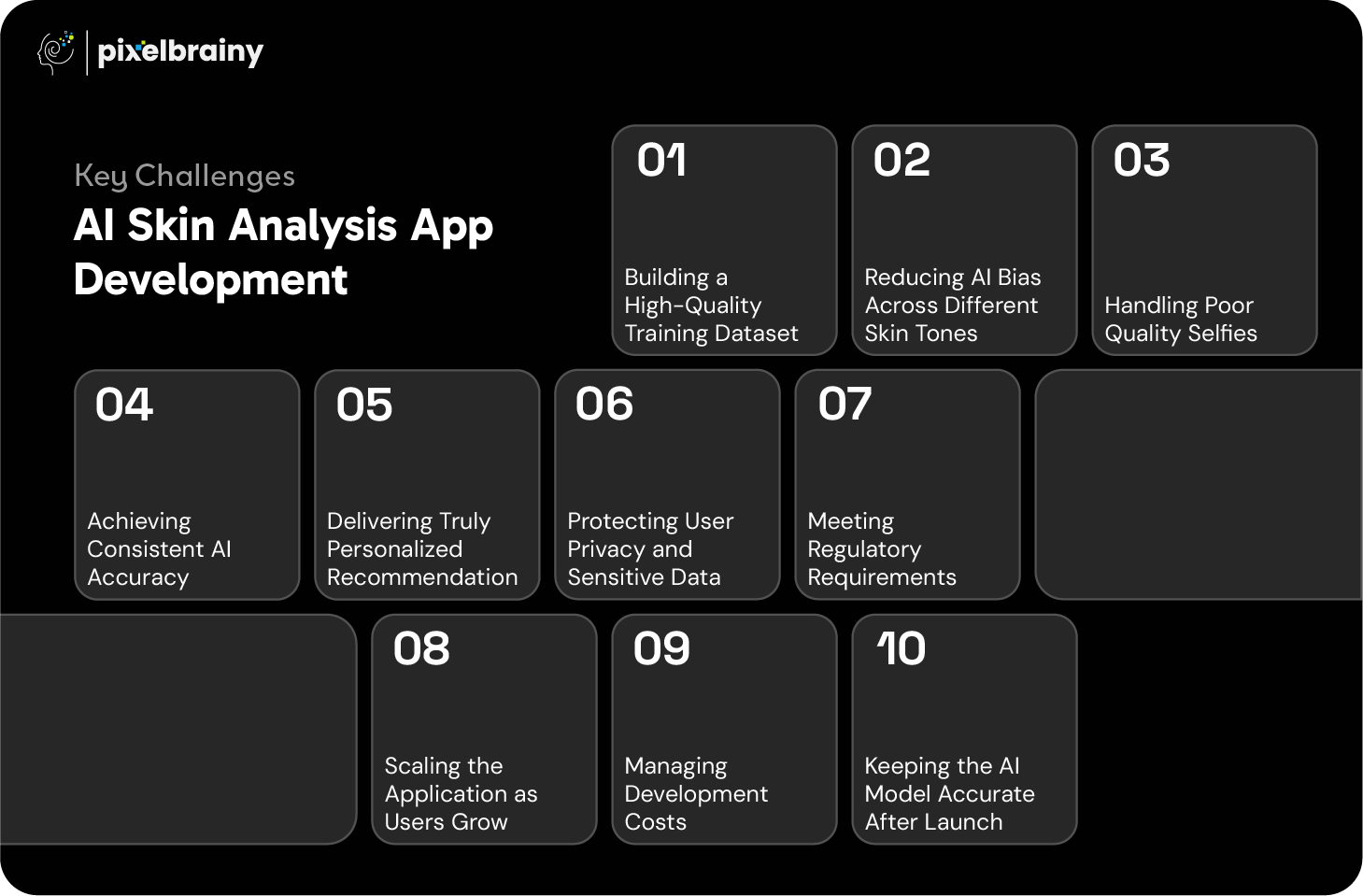
The accuracy of any AI skin analysis app depends on the quality of the data used to train it. Small, outdated, or poorly labeled datasets often result in unreliable predictions and inconsistent performance.
How to overcome it: Use dermatologist verified datasets with diverse images covering multiple skin conditions, age groups, lighting environments, and Fitzpatrick Skin Types I through VI to improve model accuracy and inclusivity.
Many AI models perform well on lighter skin tones but struggle with darker complexions because of imbalanced training data. This can reduce user trust and create inaccurate skin assessments.
How to overcome it: Build balanced datasets, perform regular bias audits, and validate AI performance separately across every Fitzpatrick skin type before deployment.
Blurry images, improper lighting, incorrect camera angles, and partially visible faces significantly affect computer vision performance, resulting in inaccurate skin condition detection.
How to overcome it: Implement AI guided selfie capture with lighting checks, face alignment, distance estimation, and automatic image quality validation before analysis begins.
Detecting acne, pigmentation, wrinkles, and pores accurately across different smartphones, cameras, and environmental conditions is one of the biggest technical challenges in AI skin analysis app development.
How to overcome it: Continuously test AI models using real world datasets, multiple devices, and dermatologist reviewed benchmark evaluations to improve consistency.
Detecting skin conditions alone is not enough. Users expect skincare routines and product recommendations that match their unique skin profile and goals.
How to overcome it: Build a flexible recommendation engine that considers skin type, detected conditions, severity, ingredient compatibility, allergies, and your product catalog instead of relying on fixed recommendation rules.
Facial images, skin reports, and health related information are highly sensitive. Any security weakness can damage user trust and expose businesses to legal risks.
How to overcome it: Apply end to end encryption, secure cloud storage, role-based access control, biometric consent management, and privacy by design principles throughout the application.
The compliance requirements for a consumer skincare app are very different from those of a clinical dermatology platform. Ignoring these differences can delay product launches and increase redevelopment costs.
How to overcome it: Define the regulatory pathway early and design the application around GDPR, HIPAA, FDA, and other applicable compliance requirements from the beginning.
As more users upload selfies and request AI analysis, application performance can decline without the right infrastructure.
How to overcome it: Use scalable cloud architecture, optimize AI inference, implement caching, load balancing, and monitor system performance continuously to support future growth.
Custom AI models, large datasets, regulatory compliance, and third-party integrations can significantly increase development costs if everything is built in the first release.
How to overcome it: Start with a focused MVP that solves the core business problem, validate market demand, and expand the platform through phased development.
AI models are not static. User behavior, skincare trends, camera technology, and available datasets continue to evolve over time.
How to overcome it: Monitor production performance, collect anonymized feedback, retrain AI models regularly, and release continuous improvements to maintain long term accuracy and reliability.
Successfully overcoming these challenges ensures your AI skin analysis app delivers accurate results, protects user data, adapts to changing technologies, and continues creating value long after its initial launch.
At Pixelbrainy, we build AI skin analysis applications that are accurate, scalable, and compliant from the very beginning. Our team combines expertise in computer vision, artificial intelligence, mobile engineering, cloud architecture, and healthcare compliance to deliver custom AI skin diagnosis app development solutions that perform reliably in real world environments. Instead of building generic AI applications, we focus on developing intelligent skincare platforms that analyze facial skin accurately across diverse skin tones, lighting conditions, and device types while supporting long term product scalability.
Many founders approach us with questions like: "I am a dermatologist and I want to build an AI skin analysis app as a side business that allows people to get an initial assessment of their skin conditions from their smartphone without needing to book a clinic appointment. I want the app to be available on iOS and Android and to generate a detailed report that users can optionally share with a real dermatologist for review. What will this cost to build and which development companies in USA specialize in this type of app?"
Projects like these require much more than mobile app development. They demand expertise in AI model training, computer vision, secure healthcare architecture, recommendation engines, HIPAA readiness, and user experience design. As an experienced AI app development company, Pixelbrainy helps businesses transform these ideas into production ready AI solutions tailored to their business goals.
| Industry | How We Help |
| Beauty and Skincare Brands | Build D2C AI skincare applications that analyze skin conditions and recommend products from your own product catalog. |
| Dermatology Clinics and Telehealth Platforms | Develop AI powered pre assessment tools that streamline consultations while supporting secure patient workflows. |
| Medical Spas and Salon Chains | Create AI consultation platforms that help aestheticians perform personalized skin assessments and treatment planning. |
| Skincare Startups | Build scalable white label AI skin analysis platforms with custom branding, APIs, and multi-tenant architecture. |
| Beauty Ecommerce Businesses | Replace traditional skincare quizzes with AI powered skin analysis and intelligent product recommendation engines. |
| Healthcare Organizations | Develop HIPAA compliant skin condition monitoring platforms for remote patient care and chronic disease management. |
| Our Capability | Business Value |
| Custom AI Model Development | We develop proprietary AI models instead of relying solely on third party SDKs, giving you greater flexibility, accuracy, and ownership. |
| Bias Aware AI Development | Our development approach emphasizes diverse training datasets and Fitzpatrick Skin Types I through VI to improve performance across all skin tones. |
| Computer Vision Expertise | We build advanced facial analysis models capable of detecting acne, wrinkles, pigmentation, pores, redness, dehydration, and many other skin conditions. |
| Healthcare Ready Architecture | Our solutions are designed with HIPAA, GDPR, and security best practices in mind whenever regulatory compliance is required. |
| Cross Platform Development | We build native and cross platform applications for iOS, Android, and web while maintaining consistent AI performance across devices. |
| End to End Product Development | From AI strategy and dataset preparation to deployment, optimization, and ongoing support, we manage the complete product lifecycle. |
Objective
A healthcare entrepreneur wanted to launch a consumer mobile application that could perform AI based skin assessments from smartphone selfies and allow users to share their reports with licensed dermatologists for optional professional review.
Our Approach
Our team developed a custom computer vision pipeline, trained an AI model using dermatologist validated datasets, implemented facial zone analysis, integrated personalized skin reports, and built secure sharing functionality for both iOS and Android applications.
Result
The platform successfully delivered accurate skin assessments within seconds, improved user engagement through personalized skincare recommendations, and established a scalable foundation for future teledermatology services while maintaining strong privacy and security standards.
Whether you are planning to build a consumer skincare platform, a clinical AI solution, or a white label skin analysis product, Pixelbrainy combines AI expertise, healthcare knowledge, and product engineering experience to help turn your vision into a scalable, market ready application. So let’s connect!
The future of personalized skincare is being shaped by artificial intelligence. As the AI skin analysis market continues to grow at a 17.2% CAGR, beauty brands, dermatology clinics, medical spas, and ecommerce businesses have a unique opportunity to differentiate themselves through intelligent, data driven skincare experiences. Investing in AI skin analysis app development today is no longer just an innovation strategy. It is becoming a competitive necessity.
Whether you want to build an AI skin analysis app for personalized product recommendations, develop an AI skincare app for ecommerce, or create an AI skin diagnosis app for clinical pre assessment, long term success depends on getting the fundamentals right. High quality training datasets, support for Fitzpatrick Skin Types I through VI, robust AI models, regulatory compliance, and intuitive user experiences should all be planned from the very beginning.
Development costs can range from $15,000 for a basic MVP to $400,000 or more for an enterprise grade white label platform, making it essential to define the right product roadmap before development begins. More importantly, partnering with a team that understands both computer vision and skincare can significantly improve AI accuracy, scalability, and business outcomes.
At Pixelbrainy, we help businesses transform innovative skincare ideas into production ready AI applications through end-to-end strategy, design, development, AI engineering, and long-term product support.
Whether you are just validating an idea or planning a full-scale product launch, our team can help you at every stage of the journey.
Schedule a free discovery consultation to discuss your project requirements.
Get a customized cost estimate and development roadmap tailored to your business.
Build an AI powered skin analysis app with experts in computer vision, mobile app development, and healthcare compliant AI solutions.
The cost of developing a custom AI skin analysis app typically ranges from $15,000 for a basic MVP to $400,000 or more for an enterprise grade platform. Pricing depends on AI model complexity, supported skin conditions, integrations, compliance requirements, platform selection, and whether you build a custom AI model or integrate an existing SDK.
Most AI skin analysis applications require 2 to 3 months from planning to launch. Development timelines vary based on AI model training, dataset preparation, regulatory requirements, mobile app features, third party integrations, testing, and deployment across iOS, Android, and web platforms.
Modern AI skin analysis apps can identify 10 to more than 80 skin conditions, depending on the AI model and training dataset. Consumer applications usually focus on common cosmetic concerns, while custom clinical models support significantly broader condition detection with dermatologist validated datasets.
Not every AI skin analysis app requires FDA approval. Consumer wellness applications providing general skincare insights typically do not require FDA clearance. However, apps claiming to diagnose medical conditions, detect skin cancer, or guide treatment decisions may require FDA Software as a Medical Device authorization.
Model performance depends primarily on the diversity of the training dataset. Use dermatologist verified images representing Fitzpatrick Skin Types I through VI, perform regular bias audits, validate accuracy across different skin tones, and continuously retrain AI models using diverse real-world datasets.
Third party SDKs reduce development time but limit customization, supported skin conditions, and AI ownership. Custom AI models require higher initial investment but provide greater accuracy, proprietary intellectual property, better product differentiation, flexible recommendations, and complete control over future AI improvements.
No. AI skin analysis applications are designed to support skincare assessments and clinical workflows, not replace licensed dermatologists. They provide preliminary skin evaluations, personalized skincare recommendations, and monitoring tools, while medical diagnosis and treatment decisions should always remain with qualified healthcare professionals.
HIPAA compliance requires encrypted patient photo storage, secure authentication, rol- based access controls, audit logging, Business Associate Agreements with service providers, breach notification procedures, and secure data transmission. Many healthcare applications also use on device AI processing to reduce privacy risks.
Post launch expenses typically include cloud infrastructure, AI model retraining, maintenance, security monitoring, compliance updates, third party API subscriptions, customer support, performance optimization, analytics, and regular feature enhancements. Planning these recurring costs helps maintain long term application performance and scalability.
AI performs very well for identifying common visible skin conditions when trained on high quality datasets, but it should not replace clinical expertise. Accuracy varies by model, dataset diversity, supported conditions, and validation methods. Dermatologists remain essential for medical diagnosis and treatment planning.
Yes, but AI skin cancer detection applications face significantly higher regulatory requirements than consumer skincare apps. They may require FDA Software as a Medical Device clearance, clinical validation, dermatologist reviewed datasets, HIPAA compliance, and comprehensive risk management before commercial deployment in the United States.
Look for a company with expertise in computer vision, AI model development, mobile engineering, healthcare compliance, and dermatology workflows. Evaluate their experience with custom AI solutions, bias aware model development, security practices, scalability, and ability to deliver end to end product development rather than only app development.

About The Author
Sagar Bhatnagar
Sagar Sahay Bhatnagar brings over a decade of IT industry experience to his role as Marketing Head at PixelBrainy. He's known for his knack in devising creative marketing strategies that boost brand visibility and market influence. Sagar's strategic thinking, coupled with his innovative vision and focus on results, sets him apart. His track record of successful campaigns proves his ability to utilize digital platforms effectively for impactful marketing efforts. With a genuine passion for both technology and marketing, Sagar continuously pushes PixelBrainy's marketing initiatives to greater success.

Working with the PixelBrainy team has been a highly positive experience. They understand the design requirements and create beautiful UX elements to meet the application needs. The dev team did an excellent job bringing my vision to life. We discussed usability and flow. Sagar worked with his team to design the database and begin coding. Working with Sagar was easy. He has the knowledge to create robust apps, including multi-language support, Google and Apple ID login options, Ad-enabled integrations, Stripe payment processing, and a Web Admin site for maintaining support data. I'm extremely satisfied with the services provided, the quality of the final product, and the professionalism of the entire process. I highly recommend them for Android and iOS Mobile Application Design and Development.

Great experience working with them. Had a lot of feedback and I found that unlike most contractors they were bugging me for updates instead of the other way around. They were extremely time conscience and great at communicating! All work was done extremely high quality and if not on time, early! They were always proactive when it comes to communication and the work is great/above par always. Very flexible and a great team to work with! Goes above and beyond to present us with multiple options and always provides quality. Amazing work per usual with Chitra. If you have UI/UX or branding design needs I recommend you go to them! Will likely work with them in the future as well, definitely recommended!

PixelBrainy is a joy to work with and is a great partner when thinking through branding, logo, and website layout. I appreciate that they spend time going into the "why" behind their decisions to help inform me and others about industry best practices and their expertise.

I hired them to design our software apps. Things I really like about them are excellent communication skills, they answer all project suggestions and collaborate right away, and their input on design and colors is amazing. This project was complex and needed patience and creativity. The team is amazing to do business with. I will be using them long-term. Glad to see there are some good people out there. I was afraid to try and outsource my project to someone but I am glad I met them! I really can't say enough. They went above and beyond on this project. I am very happy with everything they have done to make my business stand out from the competition.

It was great working with PixelBrainy and the team. They were very responsive and really owned the project. We'll definitely work with them again!

I recently worked with the PixelBrainy team on a project and I was blown away by their communication skills. They were prompt, clear, and articulate in all of our interactions. They listened and provided valuable feedback and suggestions to help make the project a success. They also kept me updated throughout the entire process, which made the experience stress-free and enjoyable.

PixelBrainy is very good at what it does. The team also presents themselves very professionally and takes care of their side of things very well. I could fully trust them taking up the design work in a timely and organised manner and their attention to detail saved us lots of effort and time. This particular project was quite intense and the team showed that they function very well under pressure. Very much looking forward to working with her again!

It's always an absolute pleasure working with them. They completed all of my requests quickly and followed every note I had for them to a T, which made our process go smoothly from start to finish. Everything was completed fast and following all of the guidelines. And I would recommend their services to anyone. If you need any design work done in the future, PixelBrainy should be your first call!

They took ownership of our requirements and designed and proposed multiple beautiful variants. The team is self-motivated, requires minimum supervision, committed to see-through designs with quality and delivering them on time. We would definitely love to work with PixelBrainy again when we have any requirements.

PixelBrainy was a big help with our SaaS application. We've been hard at work with a new UI/UX and they provided a lot of help with the designs. If you're looking for assistance with your website, software, or mobile application designs, PixelBrainy and the team is a great recommendation.

PixelBrainy designers are amazing. They are responsive, talented, and always willing to help craft the design until it matches your vision. I would recommend them and plan to continue them for my future projects and more!!!

They were awesome! Did a good job fast, and good communication. Will work with them again. Thank you

Creative, detail-oriented, and talented designers who take direction well and implement changes quickly and accurately. They consistently over-delivered for us.

PixelBrainy team is very talented and creative. Great designers and a pleasure to work with. PixelBrainy is an excellent communicator and I look forward to working with them again.

PixelBrainy has a very talented design team. Their work is excellent and they are very responsive. I enjoy working with them and hope to continue on all of our future projects.


Transform your ideas into reality with us.
Across these industries, each engagement brings unique challenges, from early-stage product development to scaling complex systems, helping us build a practical understanding of real-world product environments.