AI Summary Powered by PixelBrainy
How can betting platforms use artificial intelligence to predict sports outcomes and automate betting strategies? This question is becoming increasingly important as the global sports betting industry grows rapidly and data driven technologies reshape the way betting decisions are made. Today, AI sports betting agent development is emerging as one of the most powerful solutions for sportsbooks and sports analytics companies that want to improve prediction accuracy and gain a competitive advantage.
Artificial intelligence enables betting platforms to analyze massive volumes of sports data, including historical match statistics, player performance metrics, and real time betting odds. By building an AI sports betting agent, organizations can identify hidden patterns in sports data and generate probability-based predictions for upcoming matches. These intelligent systems allow companies to automate betting insights, improve risk management, and deliver more accurate predictions to users.
The rapid growth of the sports betting market is accelerating the adoption of AI powered solutions. According to Grand View Research, the global sports betting market was valued at approximately $100.9 billion in 2024 and is projected to reach $187.39 billion by 2030.
In addition, Mordor Intelligence reports that the online sports betting market is expected to reach $49.74 billion in 2026 and grow to nearly $92.49 billion by 2031, driven by mobile betting adoption and digital sportsbook platforms.
The demand for data driven insights is also fueling the growth of sports analytics technologies. Fortune Business Insights estimates that the global sports analytics market could exceed $31 billion by 2034 as teams, betting companies, and analytics platforms increasingly rely on AI and machine learning.
These industry trends explain why companies are actively exploring how to build an AI sports betting agent. The development of AI sports betting agents involves integrating sports data APIs, machine learning models, predictive analytics algorithms, and automated decision engines. Businesses that successfully create an AI sports betting agent can analyze sports data faster, predict outcomes more accurately, and provide real time betting insights.
Across the modern sports betting ecosystem including sportsbooks, betting exchanges, fantasy sports platforms, and sports analytics companies, organizations are investing heavily in sports betting AI agent development to build intelligent betting systems. These AI agents help analyze odds, predict match outcomes, automate betting strategies, and deliver valuable insights to bettors.
In this guide, we explain the complete process for developing an AI sports betting agent, including architecture design, key features, development tools, technology stack, costs, and future industry trends. Whether you are a betting platform operator, sports analytics provider, or technology leader developing an AI sports betting agent, this guide will help you understand how to build scalable AI powered betting solutions.
AI Sports Betting Agent Development refers to the process of designing and building intelligent software systems that use artificial intelligence, machine learning, and predictive analytics to analyze sports data and generate betting insights.
An AI sports betting agent is a software program capable of automatically analyzing historical sports statistics, real-time match data, player performance metrics, and betting odds to predict potential outcomes and recommend betting strategies.
Unlike traditional betting models that rely on manual analysis, AI betting agents continuously learn from new data and adjust their predictions accordingly.
These systems can evaluate multiple variables simultaneously, including:
The goal of creating an AI sports betting agent development is to create intelligent systems that help betting platforms and sports analytics companies make data-driven decisions and improve prediction accuracy.
Understanding the architecture of an AI betting system is essential for organizations that want to build scalable and accurate predictive platforms. The architecture of an AI sports betting agent is designed to collect large volumes of sports data, process it using advanced analytics, apply machine learning models, and generate automated betting insights.
For betting platforms and sports analytics companies, AI sports betting agent development requires a structured system that can analyze real time sports data, evaluate betting odds, and continuously improve predictions using machine learning. A well-designed architecture ensures that the AI system can handle high data volumes, produce accurate forecasts, and support automated betting strategies.
The core architecture of a modern AI sports betting agent typically consists of six major layers, each responsible for a specific part of the prediction and decision-making process.
The data collection layer is the foundation of any AI sports betting platform. This layer gathers large amounts of sports related data from multiple sources and feeds it into the prediction system.
To build an effective AI sports betting agent, organizations must collect both historical and real time sports data. High quality data is critical for training machine learning models and improving prediction accuracy.
Common data sources include:
By integrating reliable data sources, betting platforms can create a robust dataset that enables the development of AI sports betting agents capable of generating accurate predictions.
After data collection, the next step in sports betting AI agent development is processing and preparing the data for machine learning models.
Raw sports data often contains inconsistencies, missing values, or irrelevant information. Data processing ensures that the dataset becomes structured, clean, and usable for predictive analysis.
Key processes include:
Feature engineering is particularly important when building an AI sports betting agent. This step extracts meaningful indicators from raw data such as team form, average goals scored, win probability, or player impact metrics.
These engineered features help machine learning algorithms identify patterns that influence match outcomes.
Machine learning models form the intelligence layer of an AI sports betting prediction system. These models analyze historical sports data and learn patterns that can be used to predict future outcomes.
Different types of models can be used in AI sports betting agent development, depending on the type of predictions required.
Common models include:
By training these models on large datasets, developers can create an AI sports betting agent capable of estimating match probabilities and predicting betting outcomes.
The prediction engine is responsible for generating insights based on machine learning outputs. It converts model predictions into actionable forecasts that betting platforms can use.
The prediction engine can estimate several types of outcomes, including:
A powerful prediction engine allows betting platforms to transform raw analytics into meaningful insights for users. This component is critical when developing an AI sports betting agent that provides real time betting intelligence.
Once predictions are generated, the decision engine determines the optimal betting strategy based on the predicted probabilities.
The decision engine evaluates several factors, including:
This layer helps betting platforms automate strategic decision making and identify value betting opportunities. When organizations build an AI sports betting agent, the decision engine plays a crucial role in converting predictions into actionable strategies.
The final layer of the architecture is the automation layer, which enables the AI system to execute betting strategies and deliver insights automatically.
Automation capabilities may include:
Automation improves operational efficiency and allows betting platforms to scale their systems without manual intervention.
For companies investing in AI sports betting agent development, automation enables real time analysis of sports events and instant execution of betting strategies.
A well-designed architecture that integrates data collection, machine learning models, prediction systems, and automation tools is essential for developing an AI sports betting agent capable of delivering accurate insights and scalable betting solutions.
Why are sportsbooks and betting platforms investing heavily in artificial intelligence today? The answer lies in the growing demand for accurate predictions, automated betting strategies, and real time data driven insights. AI sports betting agent development allows betting companies to analyze massive sports datasets, identify hidden patterns, and predict match outcomes with greater precision than traditional statistical methods.
As the sports betting industry becomes more competitive, organizations are increasingly investing in AI sports betting agent development to gain technological advantages. AI powered betting systems help companies optimize betting strategies, improve risk management, and deliver personalized betting experiences for users. Below are the key reasons why sportsbooks, betting platforms, and sports analytics companies are actively investing in the development of AI sports betting agents.
One of the primary reasons companies invest in AI sports betting agent development is to improve prediction accuracy. Traditional betting analysis relies heavily on manual research and basic statistical models. However, AI powered betting agents can analyze millions of data points including historical match results, player statistics, team performance trends, and betting odds.
By building an AI sports betting agent, platforms can generate probability-based predictions that are more accurate and data driven. Machine learning models continuously learn from new match data, which allows betting platforms to refine predictions over time and improve betting performance.
Modern sports betting platforms rely on enormous datasets that include historical match records, live match statistics, player performance metrics, and betting odds from multiple sportsbooks. Processing this data manually is almost impossible.
Companies investing in sports betting AI agent development can automate the analysis of these large datasets. AI systems are capable of processing sports data in real time and identifying patterns that influence match outcomes. This capability helps betting platforms generate faster and more reliable predictions.
Live betting has become one of the fastest growing segments in the sports betting industry. During live matches, betting odds change constantly based on game events such as goals, fouls, injuries, and substitutions.
By developing an AI sports betting agent, betting companies can analyze live sports data streams and generate real time betting insights. AI agents can evaluate match conditions instantly and update predictions as the game progresses. This enables sportsbooks to offer dynamic betting markets and better decision support for bettors.
Automation is another major reason why companies invest in AI sports betting agent development. AI powered betting agents can automatically evaluate betting opportunities, calculate expected value, and execute betting strategies without manual intervention.
Automation helps sportsbooks and analytics companies scale their operations and reduce the need for manual analysis. When organizations create an AI sports betting agent, they can implement automated betting rules, value betting strategies, and portfolio management systems that operate continuously.
The sports betting industry is becoming increasingly competitive as more platforms enter the market. Companies that invest in AI sports betting agent development gain a significant advantage by leveraging advanced predictive technologies.
AI powered systems allow sportsbooks to offer better prediction models, smarter analytics tools, and improved betting recommendations. These capabilities attract professional bettors, sports analysts, and data driven users who rely on predictive insights when placing bets.
Risk management is a critical challenge for sportsbooks and betting platforms. Incorrect odds pricing or poor betting strategies can result in large financial losses.
By building AI sports betting agents, companies can evaluate risk factors more effectively. AI models calculate probability distributions, expected returns, and betting volatility. This helps platforms optimize betting strategies and reduce exposure to high-risk betting scenarios.
Another important reason organizations are investing in AI sports betting agent development is to improve customer experience. AI systems can analyze user behavior, betting patterns, and preferences to deliver personalized betting insights.
Personalized features may include:
These capabilities enhance user engagement and encourage bettors to interact more frequently with betting platforms.
Sports analytics companies are also investing in sports betting AI agent development to provide advanced predictive insights to teams, media companies, and bettors. AI powered analytics platforms generate detailed performance metrics, probability forecasts, and statistical insights.
By integrating AI betting agents into analytics platforms, companies can deliver deeper insights that go beyond traditional sports statistics.
For many organizations, AI sports betting agent development represents a long term strategic investment. Artificial intelligence is transforming multiple industries including finance, healthcare, and sports analytics. Betting companies that invest early in AI technologies are better positioned to innovate and adapt to future market trends.
Companies that successfully develop AI sports betting agents can build scalable prediction platforms that evolve as new data sources, algorithms, and betting markets emerge.
Overall, the increasing demand for accurate predictions, real time data processing, automated strategies, and personalized betting experiences explains why sportsbooks and analytics companies are actively investing in AI sports betting agent development. These intelligent systems enable organizations to build smarter betting platforms and remain competitive in the rapidly evolving sports betting industry.
Artificial intelligence is transforming how sportsbooks and analytics companies analyze sports data and predict betting outcomes. Through AI sports betting agent development, organizations can build intelligent systems that process real time match data, evaluate betting odds, and generate predictive insights automatically. These AI agents help betting platforms improve prediction accuracy, automate betting strategies, and deliver advanced analytics to users.
The top use cases of AI sports betting agents highlight how betting platforms and sports analytics companies are leveraging artificial intelligence to create smarter betting ecosystems. Below are the most important applications of AI sports betting agent development across the sports betting industry.
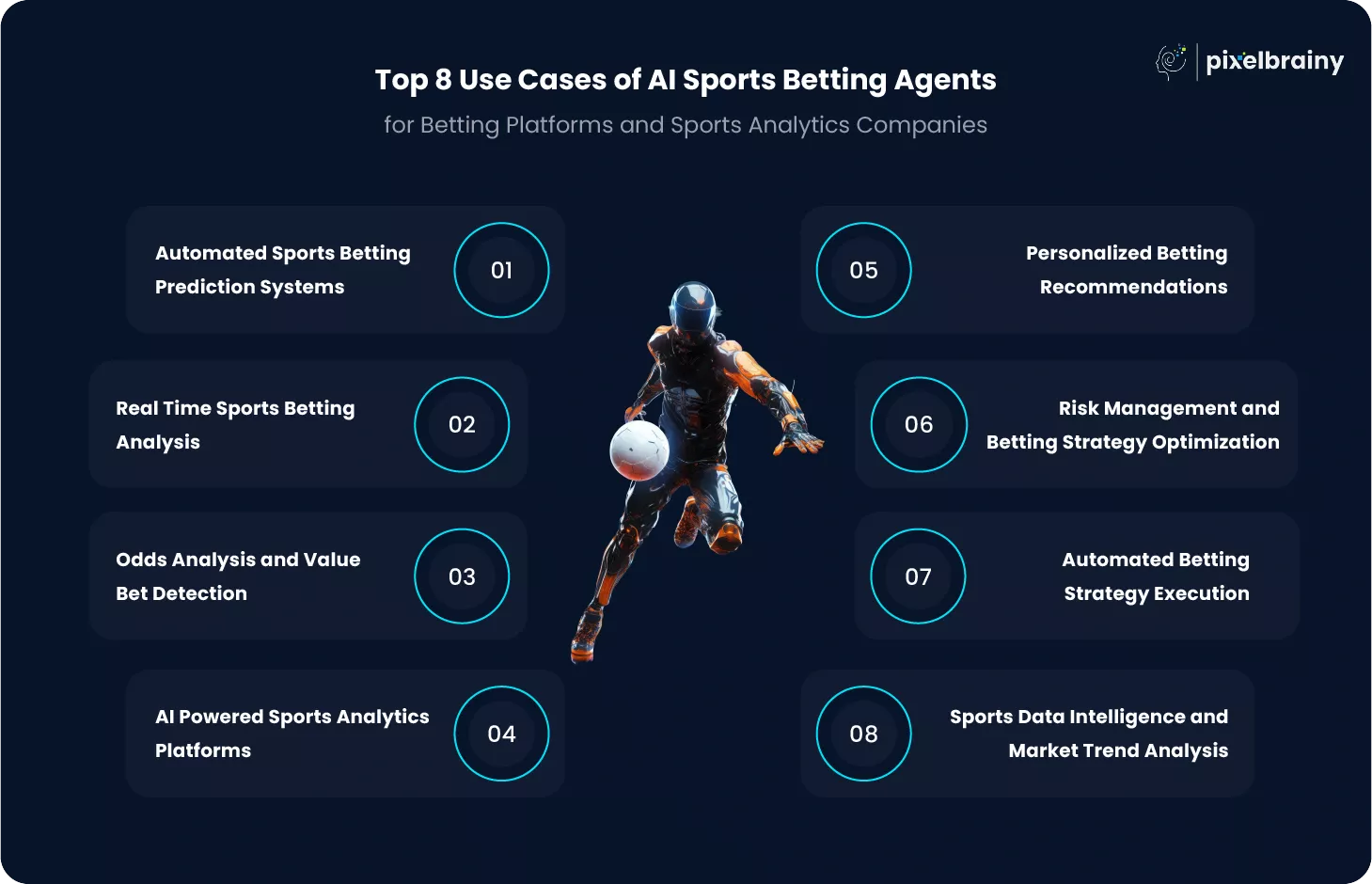
One of the most common use cases of AI sports betting agents is building automated prediction systems that forecast match outcomes. These systems analyze historical match data, team performance statistics, player metrics, and betting odds to generate probability-based predictions.
By building an AI sports betting agent, betting platforms can predict outcomes such as:
These prediction systems allow sportsbooks and analytics companies to provide more accurate betting insights to users.
Live betting is becoming increasingly popular in the sports betting industry. During live matches, betting odds change rapidly as the game progresses.
Through AI sports betting agent development, betting platforms can analyze real time sports data streams and update predictions instantly. AI agents evaluate match events such as goals, fouls, substitutions, and injuries to adjust probability models.
This use case enables sportsbooks to deliver real time betting insights, allowing bettors to make informed decisions during live matches.
AI sports betting agents are widely used to analyze betting odds across multiple sportsbooks. These systems can identify inconsistencies in odds and detect value betting opportunities.
When organizations create an AI sports betting agent, they can implement algorithms that compare betting odds with predicted probabilities. If the probability of an event is higher than the odds implied probability, the system can identify a potential value bet.
This capability helps betting platforms and professional bettors optimize their betting strategies.
Sports analytics companies use AI sports betting agents to build advanced analytics platforms that provide predictive insights and performance analysis.
These platforms combine sports statistics, historical data, and machine learning models to generate analytics such as:
Through sports betting AI agent development, analytics platforms can provide deeper insights that help users understand complex sports data.
Another major use case of AI sports betting agents is delivering personalized betting recommendations for users.
AI systems can analyze user behavior, betting history, and preferences to generate customized betting suggestions. For example, an AI agent may recommend matches or betting markets that align with a user’s historical betting patterns.
By developing an AI sports betting agent, platforms can provide personalized experiences that improve user engagement and retention.
Risk management is critical for sportsbooks and betting platforms. AI sports betting agents can analyze betting patterns and market conditions to identify high risk scenarios.
Machine learning models evaluate probability distributions and expected value calculations to optimize betting strategies. This allows betting companies to minimize losses and maintain balanced betting markets.
Organizations that invest in AI sports betting agent development can use these systems to automate risk management processes and improve overall betting performance.
Advanced betting platforms use AI sports betting agents to automate betting strategies. These agents can automatically evaluate betting opportunities and execute bets based on predefined strategies.
Automation features may include:
When companies build an AI sports betting agent, they can deploy automated systems that continuously analyze sports data and execute betting strategies without manual intervention.
Another important use case of AI sports betting agent development is analyzing betting market trends and sports data intelligence.
AI agents can track betting activity, monitor market fluctuations, and identify emerging patterns in betting markets. These insights help sportsbooks adjust odds, manage risk exposure, and improve market efficiency.
For sports analytics companies, these insights can be used to create advanced sports intelligence platforms that deliver predictive insights to analysts, bettors, and sports organizations.
Overall, the use cases of AI sports betting agents demonstrate how artificial intelligence is transforming sports betting platforms and analytics companies. From automated predictions and real time betting analysis to personalized recommendations and market intelligence, AI sports betting agent development enables organizations to build smarter, data driven betting systems.

Building a successful AI powered betting system requires more than just machine learning models. To ensure reliable predictions and scalable performance, companies must implement several foundational capabilities during AI sports betting agent development. These features enable the system to collect sports data, analyze betting odds, generate predictions, and automate betting strategies.
Organizations that want to understand how to build an AI sports betting agent must focus on the core technical and functional components that power modern AI betting platforms. The development of AI sports betting agents typically includes real time data processing, predictive analytics models, risk management systems, and automation tools that support betting decision making.
For betting platforms and sports analytics companies, building an AI sports betting agent with the right core features ensures the system can process sports statistics efficiently, generate accurate match predictions, and deliver intelligent betting insights to users.
The following table outlines the core features required to create an AI sports betting agent that can operate effectively within the modern sports betting ecosystem.
| Core Feature | Description |
| Real Time Sports Data Integration | Real time sports data integration is essential when developing an AI sports betting agent. The system must collect live match statistics, player performance metrics, and betting odds from reliable sports data APIs. Continuous data feeds allow the AI model to update predictions dynamically during matches and improve decision making. |
| Historical Sports Data Analysis | Historical match data is critical for training machine learning models used in AI sports betting agent development. By analyzing past games, team performance trends, and player statistics, the system can identify patterns that influence match outcomes. This helps the AI agent generate more accurate predictions for future events. |
| Machine Learning Prediction Models | Machine learning models form the intelligence layer of an AI sports betting agent. Algorithms such as logistic regression, gradient boosting, and neural networks analyze sports data to predict match outcomes and probabilities. These models continuously improve as new sports data becomes available. |
| Odds Comparison Engine | An odds comparison engine allows the AI system to analyze betting odds across multiple sportsbooks. This feature helps identify discrepancies between predicted probabilities and bookmaker odds. Betting platforms use this capability to detect value betting opportunities and optimize betting strategies. |
| Probability Calculation System | A probability engine calculates the likelihood of different match outcomes based on model predictions. This feature transforms raw prediction outputs into probability distributions that bettors and sportsbooks can interpret. Accurate probability estimation is fundamental for sports betting AI agent development. |
| Risk Management System | Risk management tools help betting platforms control exposure and reduce potential losses. The AI system analyzes betting patterns, odds movements, and prediction confidence levels. By incorporating risk analysis models, companies can make safer betting decisions and maintain balanced betting markets. |
| Automated Betting Strategy Engine | Automation is a key feature when building an AI sports betting agent. The system can evaluate predicted probabilities and automatically execute predefined betting strategies. Automated strategies reduce manual effort and allow betting platforms to scale their operations efficiently. |
| Real Time Prediction Engine | A real time prediction engine enables the AI agent to update predictions continuously as new match events occur. For example, goals, red cards, injuries, or substitutions can significantly change match probabilities. Real time predictions help bettors and platforms respond quickly to game developments. |
| User Behavior Analytics | User analytics tools analyze betting behavior, historical betting patterns, and user preferences. This feature helps betting platforms personalize betting recommendations and improve user engagement. Personalized betting insights are increasingly important in sports betting AI agent development. |
| Sports Analytics Dashboard | A sports analytics dashboard allows users and administrators to visualize AI predictions, betting trends, and statistical insights. Dashboards make complex sports data easier to understand and help analysts monitor system performance. They also support decision making for betting operators. |
| API Integration Framework | API integration enables the AI betting system to connect with sports data providers, betting platforms, and analytics tools. This feature is necessary when organizations create an AI sports betting agent that interacts with multiple external systems. Seamless integration improves scalability and platform interoperability. |
| Performance Monitoring System | Monitoring tools track the accuracy of machine learning models and betting strategies over time. These systems evaluate prediction performance, identify model drift, and trigger retraining processes. Continuous monitoring ensures the AI agent remains reliable and accurate. |
| Data Processing and Feature Engineering Tools | Data preprocessing tools clean, transform, and structure sports datasets before they are used by machine learning models. Feature engineering techniques extract meaningful insights such as team form indicators and player performance metrics. This process improves the predictive accuracy of AI betting models. |
| Security and Compliance Management | Security is a critical feature for betting platforms handling sensitive data and financial transactions. AI systems must include secure authentication mechanisms, encryption protocols, and compliance monitoring tools. These safeguards ensure the platform operates within regulatory frameworks. |
| Scalable Cloud Infrastructure | AI betting platforms require scalable infrastructure to process large datasets and handle high traffic during live sporting events. Cloud based environments allow systems to scale automatically as demand increases. This ensures consistent performance for real time sports analytics and betting predictions. |
Implementing these core features for AI sports betting agent development ensures that betting platforms and sports analytics companies can build reliable prediction systems capable of processing sports data, generating insights, and supporting automated betting strategies.
Once the foundational capabilities are implemented, organizations can enhance their systems by adding advanced technologies. These advanced capabilities significantly improve prediction accuracy, automation, and betting intelligence.
Companies investing in advanced AI sports betting agent development often integrate sophisticated machine learning models, predictive simulations, and AI driven analytics tools. These technologies help betting platforms gain deeper insights into sports data and optimize betting strategies more effectively.
For organizations developing an AI sports betting agent, incorporating advanced features can create a competitive advantage by delivering more powerful analytics and automation capabilities.
Below are the advanced features to consider while building an AI sports betting agent.
| Advanced Feature | Description |
| Reinforcement Learning Betting Models | Reinforcement learning models allow AI systems to improve betting strategies through continuous feedback. The AI agent learns which betting decisions produce the best outcomes and adjusts its strategies accordingly. This adaptive learning approach is valuable in AI sports betting agent development. |
| Predictive Match Simulation | Predictive simulation models run thousands of simulated match scenarios using historical sports data. These simulations estimate possible outcomes and generate probability distributions. Betting platforms use this feature to evaluate betting strategies before applying them in real markets. |
| Advanced Odds Prediction Models | Advanced AI models can predict future betting odds movements based on historical odds patterns and market activity. This feature helps betting platforms anticipate market shifts and identify profitable betting opportunities earlier. |
| Natural Language Processing for Sports News Analysis | NLP algorithms analyze sports news, social media posts, and injury reports to identify factors that may influence match outcomes. Integrating news analysis helps AI betting agents capture contextual insights that traditional statistics might miss. |
| AI Driven Player Performance Forecasting | Advanced AI models can forecast individual player performance metrics such as goals, assists, or scoring probability. These insights are particularly useful for prop betting markets and fantasy sports analytics platforms. |
| Anomaly Detection in Betting Markets | Anomaly detection algorithms monitor betting markets to identify unusual betting patterns or suspicious activity. This feature helps sportsbooks detect irregular market behavior and maintain fair betting environments. |
| Cross Market Betting Intelligence | AI agents can analyze multiple betting markets simultaneously, including match outcomes, totals, player props, and handicaps. Cross market analysis allows betting platforms to discover correlations between markets and identify hidden betting opportunities. |
| Real Time Model Retraining Systems | Advanced AI systems can retrain machine learning models automatically as new sports data becomes available. Continuous model retraining ensures predictions remain accurate even as team performance trends change. |
| Multi Sport Prediction Models | Advanced AI platforms can analyze multiple sports simultaneously including football, basketball, baseball, and tennis. Multi sport capabilities allow betting platforms to expand their prediction services and reach broader audiences. |
| AI Powered Betting Recommendation Engine | Recommendation engines analyze user behavior, betting history, and prediction models to generate personalized betting suggestions. These AI driven recommendations improve user engagement and help bettors make more informed decisions. |
Integrating these advanced capabilities into AI sports betting agent development enables betting platforms and sports analytics companies to create sophisticated prediction systems that provide deeper insights, improved automation, and stronger competitive advantages in the sports betting industry.
Many betting platforms and sports analytics companies want to understand what is the process to build an AI Sports Betting Agent that can analyze sports data, generate accurate predictions, and automate betting strategies. A structured development process helps organizations successfully complete AI sports betting agent development and build scalable AI powered betting platforms.
An effective AI sports betting agent development process typically includes strategy planning, sports data integration, machine learning model training, platform development, and continuous optimization. Following a step-by-step framework allows companies to build intelligent systems that process sports statistics, evaluate betting odds, and generate predictive insights.
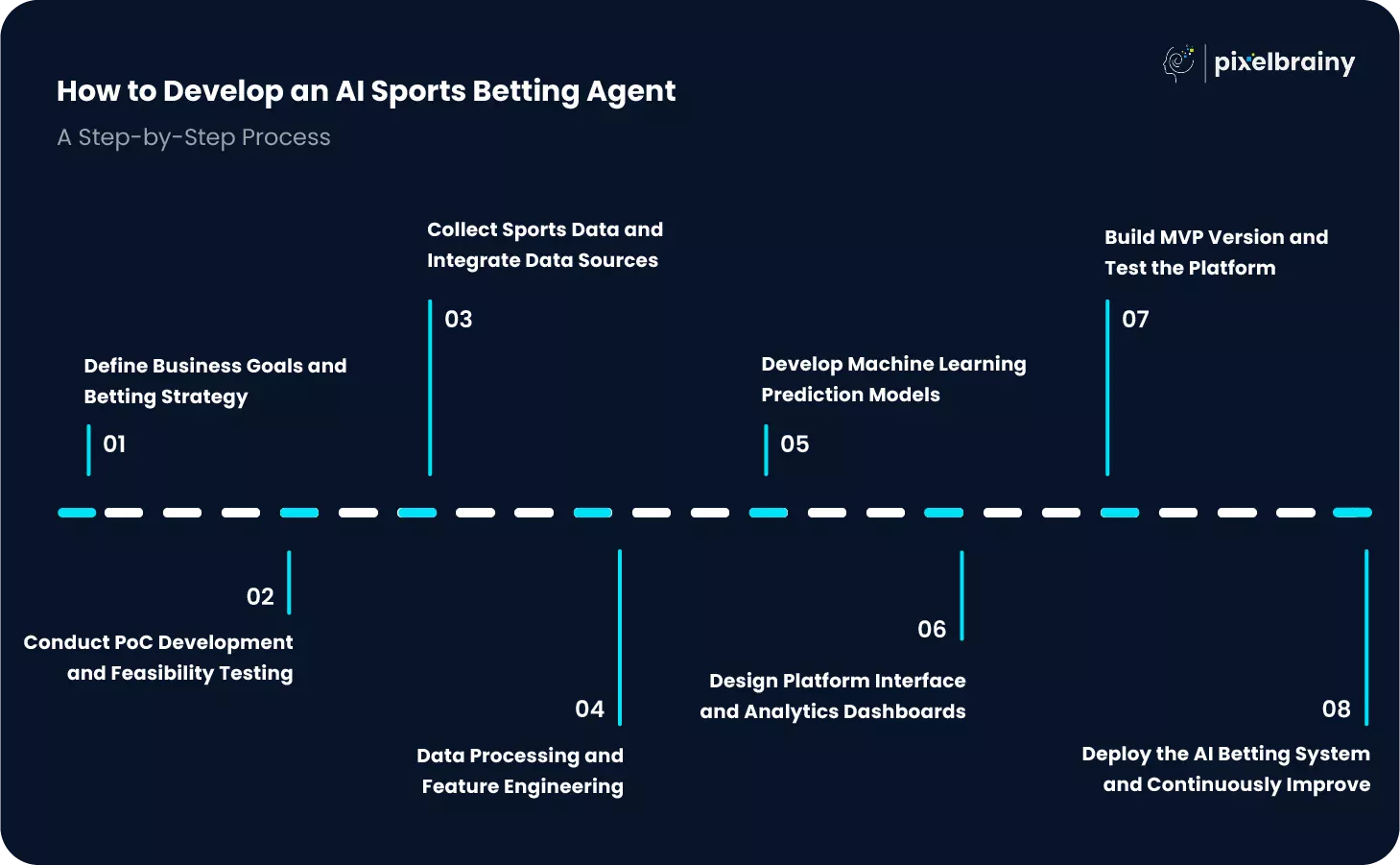
The process to build an AI Sports Betting Agent involves defining betting strategies, collecting sports data, developing machine learning prediction models, designing the betting platform interface, testing the system through prototype versions, and deploying automated betting analytics systems. This structured approach enables betting platforms to analyze sports data and generate reliable predictions.
The first step in AI sports betting agent development is defining the business goals of the system. Betting platforms must determine whether the AI agent will predict match winners, analyze betting odds, forecast player performance, or generate automated betting recommendations.
Organizations also identify their target users such as sportsbook operators, professional bettors, or sports analytics companies. A clear strategy ensures the development of AI Sports Betting Agent aligns with market needs and platform objectives.
Before building a complete AI platform, organizations typically perform PoC development to test the feasibility of the system. A proof of concept validates whether machine learning models can accurately predict sports outcomes using available datasets.
During this stage, developers analyze prediction accuracy, data quality, and algorithm performance. Successful proof of concept validation confirms that the project is ready to move forward to full sports betting AI agent development.
Data is the foundation of any AI sports betting prediction system. Developers must collect historical match data, team statistics, player performance metrics, and betting odds information.
Sports data is usually obtained from sports analytics platforms, betting odds providers, and sports data APIs. Integrating reliable data sources ensures the AI system has sufficient training data to generate accurate predictions when building an AI Sports Betting Agent.
Raw sports datasets often contain inconsistencies and missing values. Data preprocessing ensures that the dataset is structured and suitable for machine learning models.
Feature engineering involves extracting meaningful variables such as team form indicators, scoring averages, player efficiency metrics, and historical win probabilities. These features improve prediction accuracy during the development of AI Sports Betting Agent systems.
Machine learning algorithms power the intelligence behind an AI sports betting agent. These models analyze historical sports data to detect patterns that influence match outcomes.
Common algorithms used in AI sports betting agent development include logistic regression models, gradient boosting algorithms, random forest classifiers, and neural networks. These models generate probability predictions that help evaluate betting opportunities.
A user-friendly interface is essential for betting platforms that deliver AI powered insights. During this stage, companies may collaborate with a specialized UI/UX design company to build intuitive dashboards for prediction visualization and betting analytics.
Effective platform design ensures that bettors, analysts, and sportsbook operators can easily interpret predictions and access sports analytics insights generated by the AI system.
Once the core architecture is ready, companies typically launch a prototype version through MVP development. The minimum viable product includes essential features such as prediction models, sports data integration, and analytics dashboards.
Testing the MVP allows developers to evaluate prediction accuracy, system stability, and user experience. Feedback from early users helps refine the platform before launching the full AI betting system.
Also Read: Top 10 AI MVP Development Companies in USA
The final stage of AI sports betting agent development involves deploying the system on scalable cloud infrastructure and integrating it with betting platforms. After deployment, developers monitor system performance, prediction accuracy, and user engagement.
Machine learning models must be retrained regularly using updated sports datasets. Continuous optimization ensures that the AI sports betting agent adapts to new sports trends and maintains high prediction accuracy.
That’s why AI sports betting agent development follows a structured process that includes data collection, machine learning model training, platform development, and continuous optimization. By following these steps, betting platforms and sports analytics companies can build intelligent AI systems that generate accurate betting predictions and automate sports betting analytics.
Also Read: Top 12 AI Sports Betting Software Development Companies in USA
Many betting platforms and sports analytics companies often ask how much does it cost to create an AI sports betting agent. The total cost of AI sports betting agent development depends on several factors including system complexity, machine learning model requirements, sports data integration, automation features, and cloud infrastructure.
On average, the cost to build an AI sports betting agent typically ranges between $30,000 and $300,000+ depending on the scale of the platform and the number of features included. A basic AI betting prediction system may require a smaller investment, while enterprise level platforms with advanced machine learning models, real time data processing, and automated betting strategies can significantly increase the development cost.
Organizations planning AI sports betting software development should also consider additional expenses such as sports data API subscriptions, cloud computing infrastructure, ongoing model training, and system maintenance. Understanding these cost factors helps betting companies estimate the overall AI sports betting agent development cost and plan their technology investment effectively.
| Development Stage | Estimated Cost Range | Description |
| Basic AI Betting Prediction System | $30,000 – $60,000 | A basic AI sports betting agent focuses on core features such as historical sports data analysis, basic machine learning prediction models, and simple betting analytics dashboards. This level is suitable for startups or small sports analytics platforms exploring AI driven betting insights. |
| Standard AI Sports Betting Platform | $60,000 – $150,000 | A mid level AI betting platform includes advanced prediction models, real time sports data integration, odds comparison engines, and user analytics dashboards. This stage represents a common investment for companies serious about AI sports betting agent development. |
| Advanced AI Betting Intelligence Platform | $150,000 – $300,000 | Advanced platforms include multiple machine learning algorithms, predictive simulation models, automated betting strategy engines, and real time analytics infrastructure. These systems provide deeper insights and automation capabilities for betting platforms and analytics companies. |
| Enterprise AI Sports Betting Ecosystem | $300,000+ | Enterprise scale AI sports betting platforms include multi sport prediction models, large scale data processing infrastructure, advanced AI analytics engines, and automated betting intelligence systems. These platforms are designed for large sportsbooks and global sports analytics providers. |
Several technical and business factors determine the total cost to develop an AI sports betting agent.
AI betting systems rely on large datasets such as historical match statistics, player performance metrics, and betting odds feeds. Subscription fees for sports data APIs can significantly affect the AI sports betting agent development cost.
The complexity of machine learning algorithms used in sports betting AI agent development influences development expenses. Advanced models such as neural networks, reinforcement learning systems, and predictive simulation engines require more time and resources to build.
Real time sports analytics platforms require scalable data processing pipelines that can handle live match data streams. Building these systems increases the cost to build an AI sports betting agent.
Adding advanced features such as automated betting strategies, predictive dashboards, personalized betting recommendations, and risk management systems can increase the AI sports betting software development cost.
AI betting platforms require cloud based infrastructure to process large volumes of sports data. Cloud hosting, storage, and computing resources contribute to the overall AI sports betting agent development cost.
Beyond the initial development investment, companies must also consider long term operational costs.
Common ongoing expenses include:
These costs are essential for maintaining the accuracy and reliability of an AI sports betting agent.
For most organizations, the AI sports betting agent development process typically takes between 4 to 9 weeks, depending on platform complexity and feature requirements. Companies that invest strategically in scalable architecture and high-quality sports data sources can maximize the long-term value of their AI betting platform.
So, the cost to create an AI sports betting agent generally ranges from $30,000 to $300,000+, depending on the system architecture, machine learning capabilities, and platform features. Businesses planning AI sports betting agent development should evaluate project requirements, data infrastructure needs, and long term scalability to estimate an accurate budget for their AI betting platform.

Selecting the right technology stack is a critical step in AI sports betting agent development. The tools and technologies used to build an AI betting system determine how efficiently the platform can collect sports data, train machine learning models, generate predictions, and automate betting insights.
Organizations planning to build an AI sports betting agent must integrate technologies for data processing, machine learning model training, sports data API integration, and scalable cloud infrastructure. A well-designed technology stack ensures that the AI system can process large sports datasets, analyze betting odds in real time, and deliver predictive analytics to betting platforms and sports analytics companies.
The following table highlights the tools and technology stack required for the development of AI sports betting agent platforms, including programming languages, AI frameworks, data processing tools, cloud infrastructure, and sports data providers.
| Technology Category | Tools and Technologies | Role in AI Sports Betting Agent Development |
| Programming Languages | Python, R, JavaScript | Programming languages form the foundation of AI sports betting software development. Python is widely used for machine learning model development and sports data analysis, while R is useful for statistical modeling. JavaScript helps build interactive dashboards and front end components for betting analytics platforms. |
| Machine Learning Frameworks | TensorFlow, PyTorch, Scikit-learn | Machine learning frameworks are used to build predictive models for sports betting analysis. These tools allow developers to train algorithms that analyze historical sports data, identify patterns, and generate probability based predictions during AI sports betting agent development. |
| Data Processing and Analytics Tools | Pandas, NumPy, Apache Spark | Data processing tools help clean, transform, and analyze large sports datasets. Pandas and NumPy are commonly used for sports data manipulation and statistical calculations. Apache Spark is used for processing large volumes of sports data efficiently in distributed computing environments. |
| Sports Data APIs | Sportradar, The Odds API, Stats Perform | Sports data APIs provide real time match statistics, player performance metrics, and betting odds information. Integrating reliable sports data providers is essential when building an AI sports betting agent because accurate predictions depend on high quality sports data sources. |
| Database Technologies | PostgreSQL, MongoDB, MySQL | Databases store historical sports data, prediction results, and betting analytics information. Structured databases such as PostgreSQL are useful for relational data, while MongoDB supports flexible storage for large sports datasets used in sports betting AI agent development. |
| Cloud Infrastructure | AWS, Google Cloud Platform, Microsoft Azure | Cloud platforms provide scalable computing resources required for AI model training and real time sports data processing. Cloud infrastructure allows betting platforms to handle large traffic volumes and process sports analytics data efficiently. |
| Data Visualization Tools | Tableau, Power BI, Plotly | Data visualization tools help display AI predictions, betting trends, and sports analytics insights through dashboards. Visualization platforms allow users to understand complex sports data and interact with prediction models easily. |
| Real Time Data Streaming Tools | Apache Kafka, RabbitMQ | Real time streaming technologies enable AI betting systems to process live match events and betting odds updates. These tools ensure that prediction engines receive continuous data streams during live sports events. |
| Model Deployment and MLOps Tools | Docker, Kubernetes, MLflow | Model deployment tools help developers package machine learning models and deploy them in production environments. MLOps platforms manage model monitoring, version control, and automated retraining for AI sports betting agent systems. |
| Security and Authentication Tools | OAuth, JWT, SSL Encryption | Security technologies protect user data, betting transactions, and platform access. Implementing strong authentication and encryption systems ensures that the AI betting platform remains secure and compliant with industry regulations. |
Each component of the technology stack plays an important role in building a reliable AI sports betting agent.
Programming languages and machine learning frameworks power the predictive models that analyze sports statistics and betting probabilities. Data processing tools transform raw sports data into meaningful insights that machine learning algorithms can use.
Cloud infrastructure ensures the system can scale during high traffic periods such as major sports events. Real time streaming technologies allow the AI platform to analyze live match data and update predictions instantly.
Together, these technologies enable organizations to create an AI sports betting agent capable of delivering predictive analytics, automated betting insights, and scalable sports betting intelligence platforms.
Businesses investing in AI sports betting agent development often ask how these intelligent systems generate revenue. AI powered betting platforms can monetize predictive analytics, betting insights, and automated betting tools through multiple business models. By leveraging machine learning predictions and sports data analytics, betting platforms and sports analytics companies can create sustainable revenue streams from their AI sports betting agents.
In simple terms, AI sports betting agents generate revenue by offering predictive analytics services, betting signals, analytics dashboards, API based prediction services, and enterprise AI solutions for sportsbooks.
Organizations that successfully build an AI sports betting agent can monetize their platform through both B2C betting insights services and B2B AI betting solutions. Below are the most effective monetization strategies used in modern AI sports betting software development platforms.
Subscription based prediction services are one of the most common monetization strategies for AI sports betting agents. In this model, users pay a monthly or annual subscription to access AI generated match predictions, betting probabilities, and sports analytics insights.
Platforms may offer different subscription tiers that include basic predictions, advanced analytics dashboards, and personalized betting recommendations. This model provides a recurring revenue stream while delivering consistent value to users who rely on AI sports betting prediction systems.
Another popular monetization strategy is providing premium betting signals generated by machine learning algorithms. These signals identify betting opportunities where the predicted probability is higher than the bookmaker odds.
Through AI sports betting agent development, platforms can analyze large sports datasets and betting odds to detect value bets. Subscribers receive alerts through dashboards, mobile apps, or notifications whenever the AI system detects profitable betting opportunities.
Many technology providers monetize their platforms by offering white label AI betting solutions to sportsbooks and betting companies. In this model, the provider supplies the AI prediction engine and analytics infrastructure while partner companies launch the platform under their own brand.
White label platforms are particularly attractive for sportsbooks that want to integrate AI sports betting prediction models without investing heavily in in house development.
Sports analytics companies can monetize AI sports betting agents by offering advanced analytics platforms that provide deep insights into sports performance and betting probabilities.
These platforms analyze historical sports statistics, player performance metrics, and team trends to generate predictive insights. Professional bettors, analysts, and media companies often subscribe to these analytics platforms to access AI driven sports betting insights.
Another scalable revenue model is offering AI predictions through APIs. In this approach, betting platforms and analytics companies integrate AI prediction services directly into their systems using application programming interfaces.
Companies providing AI sports betting prediction APIs typically charge based on usage, number of API requests, or subscription tiers. This approach allows multiple betting platforms to access AI predictions through a single prediction engine.
AI betting platforms can also generate revenue through affiliate partnerships with sportsbooks. When users place bets through partner betting operators using links or integrations provided by the platform, the platform receives a commission.
This model allows companies to monetize their AI sports betting prediction platform without directly operating a sportsbook.
Some advanced betting platforms offer automated betting tools powered by AI sports betting agents. These tools help bettors apply algorithm based betting strategies that analyze sports statistics and betting probabilities.
Users can subscribe to automated betting strategies that continuously analyze sports events and identify betting opportunities. This feature attracts professional bettors who prefer data driven strategies rather than manual betting analysis.
Artificial intelligence enables platforms to analyze user betting behavior, historical bets, and preferences. Based on this data, AI systems can generate personalized betting insights tailored to each user.
Betting platforms can monetize these insights by offering premium analytics dashboards that provide customized betting recommendations, probability forecasts, and personalized betting strategies.
Many companies monetize their technology by providing enterprise AI solutions to sportsbooks and betting operators. These solutions include prediction engines, betting analytics dashboards, and risk management systems.
Sportsbooks use these tools to optimize odds pricing, analyze betting markets, and improve operational efficiency through AI sports betting analytics systems.
Companies developing advanced AI analytics platforms can also generate revenue through data licensing and sports intelligence reports. These reports provide predictive insights, betting trend analysis, and AI generated match forecasts.
Sports media organizations, betting operators, and analytics firms often purchase these insights to support decision making in sports betting and analytics markets.
Modern AI sports betting agent development enables betting platforms and sports analytics companies to generate revenue through multiple monetization strategies. These include subscription-based prediction services, premium betting signals, AI prediction APIs, affiliate sportsbook partnerships, automated betting tools, and enterprise AI solutions.
By combining several monetization models, organizations can maximize the return on investment from their AI sports betting agent platform while delivering valuable data driven insights to users.
Organizations planning AI sports betting agent development must follow a set of best practices to ensure the platform delivers accurate predictions, scalable performance, and reliable analytics. Building an AI betting system requires careful planning, high quality sports data, well trained machine learning models, and a robust infrastructure that can process real time sports events.
Companies that want to understand how to build an AI sports betting agent successfully must focus on data quality, prediction accuracy, model optimization, and continuous improvement. Following proven development practices helps betting platforms and sports analytics companies create reliable AI systems capable of analyzing sports statistics and generating predictive insights.
In simple terms, successful AI sports betting agent development depends on high quality data, advanced machine learning models, continuous model training, scalable infrastructure, and strong risk management strategies.
Below are the most important best practices for developing an AI sports betting agent that can deliver consistent performance and accurate sports predictions.
Data quality is one of the most important factors in AI sports betting prediction systems. Machine learning models rely heavily on historical sports data, player statistics, team performance metrics, and betting odds.
Organizations should integrate reliable sports data providers and verified sports APIs. Clean and structured datasets allow machine learning algorithms to identify meaningful patterns and improve prediction accuracy during AI sports betting agent development.
Sports data often comes from multiple sources and may contain inconsistencies or missing values. Implementing strong data processing pipelines ensures that raw sports datasets are cleaned, normalized, and structured properly.
Data preprocessing and feature engineering help transform raw sports statistics into meaningful variables that improve model performance. This step plays a crucial role when building an AI sports betting agent capable of generating accurate predictions.
Relying on a single prediction model can limit the accuracy of an AI betting system. Developers should experiment with multiple machine learning algorithms such as logistic regression, gradient boosting, neural networks, and ensemble models.
Combining multiple models often improves prediction accuracy because different algorithms capture different patterns within sports datasets. This approach strengthens the reliability of AI sports betting agent development.
Sports performance trends change frequently due to player transfers, injuries, team strategies, and other external factors. Machine learning models must be retrained regularly using updated sports datasets.
Continuous training allows the AI system to adapt to new sports trends and maintain high prediction accuracy. Ongoing model optimization is essential for maintaining the performance of an AI sports betting agent.
Live betting markets require AI systems to process real time sports data such as match events, player statistics, and betting odds updates.
Integrating real time data pipelines allows the AI system to update predictions instantly as new match events occur. Real time analytics significantly improves the effectiveness of AI sports betting prediction platforms.
Sports betting platforms often experience large spikes in traffic during major sports events. AI systems must be able to handle high data volumes and real time processing demands.
Using scalable cloud infrastructure ensures that the AI sports betting agent can process large sports datasets, support multiple users, and maintain stable performance during peak activity.
Risk management is critical for betting platforms and sportsbooks. AI models should not only predict match outcomes but also evaluate betting probabilities, expected values, and risk exposure.
Implementing risk management systems helps betting platforms avoid large losses and maintain balanced betting strategies when deploying AI sports betting agents.
Betting platforms must follow strict regulations and security standards. AI systems should implement strong authentication systems, encryption protocols, and secure data storage.
Ensuring regulatory compliance protects user data and financial transactions while maintaining trust in the betting platform.
Monitoring tools should track prediction accuracy, betting performance, and system reliability over time. Continuous monitoring allows developers to detect performance issues and retrain models when necessary.
Analytics dashboards can provide insights into prediction accuracy, user engagement, and betting trends generated by the AI sports betting agent.
A successful AI betting platform must present predictions and analytics insights in an easy-to-understand format. Clear dashboards and intuitive interfaces help users interpret predictions and betting probabilities effectively.
Well-designed platforms improve user engagement and increase the value delivered by AI sports betting analytics systems.
Following the right best practices is essential for successful AI sports betting agent development. Companies that prioritize high quality sports data, advanced machine learning models, real time analytics, and scalable infrastructure can build reliable AI betting systems.
By applying these best practices, betting platforms and sports analytics companies can develop intelligent systems that generate accurate predictions, automate betting insights, and support data driven betting strategies.
Developing intelligent betting systems powered by artificial intelligence offers significant advantages, but it also presents several technical and operational challenges. Organizations investing in AI sports betting agent development often face difficulties related to data quality, prediction accuracy, real time processing, and regulatory compliance.
To successfully build an AI sports betting agent, betting platforms and sports analytics companies must understand these challenges and implement effective solutions. Addressing these obstacles early in the development process ensures that the AI system delivers reliable predictions, scalable performance, and long-term business value.
In simple terms, the biggest challenges in AI sports betting agent development include data quality issues, complex machine learning models, real time data processing, regulatory compliance, and maintaining prediction accuracy.
Below are the most common challenges in AI sports betting agent development and practical ways to overcome them.
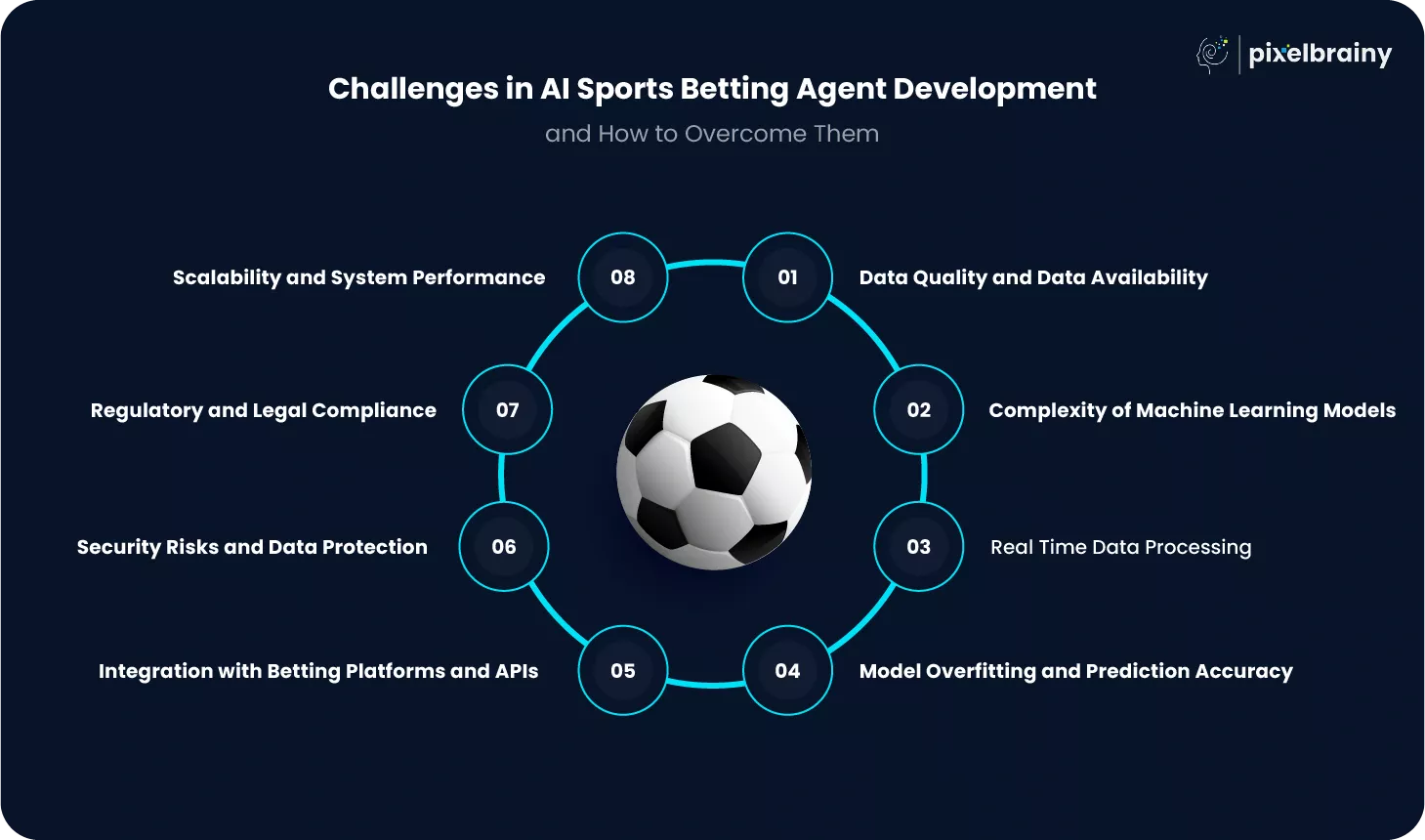
High quality data is the foundation of any AI sports betting prediction system. However, sports data often comes from multiple sources and may contain missing values, inconsistencies, or inaccurate records.
Poor data quality can significantly reduce prediction accuracy and affect the reliability of the AI betting agent.
How to overcome this challenge: Organizations should integrate trusted sports data providers and implement strong data validation pipelines. Automated data cleaning, normalization, and feature engineering processes ensure that machine learning models receive structured and reliable datasets.
Developing predictive models for sports outcomes is a complex task. Sports events involve many variables such as team performance, player injuries, match conditions, and betting market trends.
Designing accurate machine learning models that capture these variables is one of the biggest challenges in sports betting AI agent development.
How to overcome this challenge: Developers should experiment with multiple machine learning algorithms including gradient boosting models, neural networks, and ensemble methods. Combining different models often improves prediction performance and reduces model bias.
Modern sports betting platforms rely heavily on live betting markets where odds change rapidly during matches. AI systems must process large volumes of real time sports data and update predictions instantly.
Handling live match data streams and betting odds updates can be technically challenging during AI sports betting agent development.
How to overcome this challenge: Implementing real time data streaming technologies and scalable cloud infrastructure allows AI systems to process live match data efficiently. Technologies such as distributed data processing frameworks and streaming pipelines enable faster prediction updates.
Machine learning models sometimes perform well during training but fail to generate accurate predictions in real world scenarios. This issue is known as model overfitting.
Overfitting occurs when the AI system learns patterns that only exist in the training dataset rather than general patterns in sports performance data.
How to overcome this challenge: Developers should apply cross validation techniques, use diverse training datasets, and regularly retrain models using updated sports data. Continuous model evaluation ensures that the AI sports betting agent maintains high prediction accuracy.
Another challenge in AI sports betting agent development is integrating the AI system with existing betting platforms, sports data APIs, and analytics dashboards.
Compatibility issues between different systems can delay development and affect platform performance.
How to overcome this challenge: Using standardized APIs and modular system architecture simplifies integration. A well-designed API layer allows the AI prediction engine to communicate efficiently with betting platforms and external data sources.
AI betting platforms handle sensitive information including user data, betting transactions, and analytics insights. Cybersecurity threats can compromise system integrity and damage platform credibility.
Ensuring strong security measures is essential for organizations developing AI betting systems.
How to overcome this challenge: Implementing encryption protocols, secure authentication systems, and regular security audits can protect the platform from cyber threats. Compliance with industry security standards also strengthens platform trust.
Sports betting regulations vary widely across different countries and regions. Betting platforms must comply with local laws and regulatory frameworks when deploying AI powered betting systems.
Failure to meet regulatory requirements can result in legal penalties or operational restrictions.
How to overcome this challenge: Organizations should conduct legal research before launching AI betting platforms in specific markets. Working with regulatory experts helps ensure compliance with betting laws, licensing requirements, and responsible gaming policies.
Sports betting platforms experience heavy traffic during major sporting events. AI systems must be capable of handling large volumes of data requests and prediction calculations simultaneously.
Poor system scalability can lead to slow performance and poor user experience.
How to overcome this challenge: Cloud based infrastructure and distributed computing systems enable AI betting platforms to scale dynamically during peak demand periods. Scalable architecture ensures consistent performance even during high traffic events.
While AI sports betting agent development offers powerful opportunities for predictive analytics and automated betting strategies, developers must overcome several technical and operational challenges. Issues related to data quality, machine learning complexity, real time data processing, security, and regulatory compliance can affect the success of an AI betting platform.
By implementing strong data pipelines, scalable infrastructure, advanced machine learning models, and secure system architecture, betting platforms and sports analytics companies can successfully overcome these challenges and build reliable AI sports betting agents.
As sports data becomes more abundant and machine learning technologies become more sophisticated, the future of AI sports betting agent development will focus on building intelligent systems that can analyze massive datasets, deliver real time insights, and support automated betting strategies.
For betting platforms and sports analytics companies, the next phase of AI sports betting software development will revolve around improving prediction accuracy, enhancing data processing capabilities, and creating smarter betting intelligence systems. AI driven platforms will increasingly rely on advanced algorithms, automation technologies, and predictive analytics to reshape how betting decisions are made.
In simple terms, the future of AI sports betting agents will involve deeper integration of artificial intelligence, large scale sports data analytics, automated decision making, and highly personalized betting experiences.
Below are some of the major developments expected to shape the future of AI sports betting agent development.
Future AI betting systems will rely heavily on predictive intelligence. Instead of simply analyzing historical sports statistics, next generation AI sports betting agents will identify complex patterns across multiple data variables to improve prediction accuracy.
Key developments in predictive intelligence include:
The expansion of live betting markets will increase the demand for real time sports analytics. Future AI sports betting prediction systems will be capable of processing live match events and instantly updating predictions.
Important developments in real time analytics include:
Automation will become a core component of future betting platforms. Intelligent systems will evaluate betting opportunities, analyze odds movements, and recommend betting strategies automatically.
Key automation trends include:
Future AI sports betting agents will rely on a wider range of data sources to improve prediction accuracy. AI systems will combine traditional sports statistics with additional contextual information.
Examples of expanded data analysis include:
Personalized betting experiences will become a major trend in AI powered sports betting platforms. AI systems will analyze user behavior and betting history to deliver customized insights.
Personalization features may include:
AI betting agents will increasingly integrate with broader sports analytics ecosystems that provide deeper insights into sports performance and betting probabilities.
Key developments in analytics integration include:
Risk management will remain an important focus area for sportsbooks using AI technology. Future AI systems will help betting operators analyze betting patterns and manage market exposure.
Key improvements in risk management include:
Several emerging technologies will support the growth of AI sports betting agent development. These technologies will improve data processing capabilities and enable scalable betting platforms.
Important supporting technologies include:
The future of AI sports betting agent development will be driven by advancements in predictive analytics, real time sports data processing, automated betting intelligence, and personalized betting experiences. Betting platforms and sports analytics companies that adopt these technologies will be able to build smarter prediction systems and deliver more powerful sports analytics insights.
As artificial intelligence continues to evolve, AI powered betting platforms will become more sophisticated, enabling organizations to transform sports data into actionable betting intelligence and predictive insights.
When you plan to build an intelligent betting platform powered by artificial intelligence, selecting the right technology partner becomes one of the most important decisions. Once you define the strategy for AI sports betting agent development, the next step is choosing a development team that understands machine learning, sports analytics, and real time data systems. The right partner can help transform complex sports datasets into predictive insights, automated betting intelligence, and scalable betting platforms.
This is where PixelBrainy LLC stands out. Businesses that want to understand how to build an AI sports betting agent often require deep expertise in predictive analytics, sports data integration, and intelligent automation systems. As an experienced AI sports betting software development company, PixelBrainy LLC helps betting platforms and sports analytics companies design advanced AI driven solutions that analyze sports statistics, evaluate betting odds, and generate highly accurate predictions.
PixelBrainy LLC brings strong expertise in AI sports betting agent development, enabling betting platforms to build intelligent systems that analyze historical sports data, player performance metrics, and betting probabilities. These AI driven platforms help organizations generate accurate predictions and data driven betting insights.
Developing reliable prediction systems requires seamless access to sports datasets and betting odds feeds. PixelBrainy LLC provides advanced AI integration services that connect AI prediction engines with sports data APIs, analytics platforms, and betting systems. This integration ensures that AI models receive real time sports data for accurate prediction analysis.
The company offers specialized experience in AI agent development, helping organizations create intelligent systems capable of analyzing sports performance data and predicting match outcomes. These AI agents continuously learn from new datasets, enabling betting platforms to improve prediction accuracy over time.
PixelBrainy LLC designs AI betting platforms that can process large sports datasets and handle high user traffic during major sporting events. The architecture focuses on scalability and performance, allowing betting platforms to deliver reliable sports analytics and predictive insights.
Accurate prediction models are essential for successful sports betting platforms. PixelBrainy LLC develops advanced machine learning models that analyze team performance trends, player statistics, and betting market data to generate probability-based predictions.
From system planning to deployment and optimization, PixelBrainy LLC provides end to end support throughout the development lifecycle. This ensures that betting platforms can successfully implement sports betting AI agent development solutions and launch scalable AI driven betting platforms.
The company continuously explores new AI technologies and predictive analytics methods to enhance the performance of betting platforms. This innovation focused approach helps businesses stay competitive in the rapidly evolving sports betting and sports analytics industry.
By combining strong technical expertise with deep knowledge of sports analytics ecosystems, PixelBrainy LLC helps betting platforms build intelligent AI powered systems that convert sports data into actionable betting insights and predictive intelligence.

AI is reshaping the sports betting industry by enabling platforms to analyze large sports datasets, predict match outcomes, and automate betting insights. Through AI sports betting agent development, betting platforms and sports analytics companies can build intelligent systems that evaluate betting odds, process real time sports data, and generate probability based predictions.
Organizations exploring how to build an AI sports betting agent can benefit from integrating machine learning models, sports data APIs, predictive analytics tools, and scalable infrastructure. These technologies allow betting platforms to improve prediction accuracy, enhance sports analytics capabilities, and deliver smarter betting experiences to users.
As the sports betting ecosystem continues to evolve, businesses that invest in sports betting AI agent development will be better positioned to build innovative platforms powered by data driven insights and automated betting intelligence.
Looking to build an AI powered sports betting platform? Book an appointment with PixelBrainy LLC to discuss your AI sports betting agent development project and explore how intelligent AI solutions can transform your betting platform.
To build an AI sports betting agent, companies typically follow a structured development process that includes collecting historical sports data, training machine learning prediction models, integrating sports data APIs, and deploying a prediction engine that analyzes match statistics and betting odds. This process allows betting platforms to generate automated betting insights and predictive analytics.
AI sports betting agents require several types of sports datasets, including historical match results, player performance statistics, team performance metrics, betting odds data, and real time match events. High quality sports data helps machine learning models identify patterns and generate more accurate betting predictions.
AI sports betting agents can analyze multiple sports depending on the available datasets and prediction models. Common sports analyzed by AI betting systems include football, basketball, baseball, tennis, cricket, and esports. Multi sport prediction capabilities allow betting platforms to provide broader analytics and betting insights.
The development timeline for an AI sports betting agent typically ranges from 4 to 9 weeks, depending on the complexity of the platform, the number of machine learning models required, and the integration of sports data APIs and analytics features. Advanced platforms with automation and real time analytics may require longer development cycles.
An AI sports betting agent usually includes several core components such as a sports data collection system, data processing pipelines, machine learning prediction models, probability calculation engines, and betting analytics dashboards. These components work together to analyze sports statistics and generate predictive insights.
Betting platforms are adopting AI sports betting agents to improve prediction accuracy, analyze large sports datasets faster, and automate betting insights. AI driven systems allow sportsbooks and analytics companies to generate data driven predictions, optimize betting strategies, and deliver advanced sports analytics to users.

About The Author
Sagar Bhatnagar
Sagar Sahay Bhatnagar brings over a decade of IT industry experience to his role as Marketing Head at PixelBrainy. He's known for his knack in devising creative marketing strategies that boost brand visibility and market influence. Sagar's strategic thinking, coupled with his innovative vision and focus on results, sets him apart. His track record of successful campaigns proves his ability to utilize digital platforms effectively for impactful marketing efforts. With a genuine passion for both technology and marketing, Sagar continuously pushes PixelBrainy's marketing initiatives to greater success.

Working with the PixelBrainy team has been a highly positive experience. They understand the design requirements and create beautiful UX elements to meet the application needs. The dev team did an excellent job bringing my vision to life. We discussed usability and flow. Sagar worked with his team to design the database and begin coding. Working with Sagar was easy. He has the knowledge to create robust apps, including multi-language support, Google and Apple ID login options, Ad-enabled integrations, Stripe payment processing, and a Web Admin site for maintaining support data. I'm extremely satisfied with the services provided, the quality of the final product, and the professionalism of the entire process. I highly recommend them for Android and iOS Mobile Application Design and Development.

Great experience working with them. Had a lot of feedback and I found that unlike most contractors they were bugging me for updates instead of the other way around. They were extremely time conscience and great at communicating! All work was done extremely high quality and if not on time, early! They were always proactive when it comes to communication and the work is great/above par always. Very flexible and a great team to work with! Goes above and beyond to present us with multiple options and always provides quality. Amazing work per usual with Chitra. If you have UI/UX or branding design needs I recommend you go to them! Will likely work with them in the future as well, definitely recommended!

PixelBrainy is a joy to work with and is a great partner when thinking through branding, logo, and website layout. I appreciate that they spend time going into the "why" behind their decisions to help inform me and others about industry best practices and their expertise.

I hired them to design our software apps. Things I really like about them are excellent communication skills, they answer all project suggestions and collaborate right away, and their input on design and colors is amazing. This project was complex and needed patience and creativity. The team is amazing to do business with. I will be using them long-term. Glad to see there are some good people out there. I was afraid to try and outsource my project to someone but I am glad I met them! I really can't say enough. They went above and beyond on this project. I am very happy with everything they have done to make my business stand out from the competition.

It was great working with PixelBrainy and the team. They were very responsive and really owned the project. We'll definitely work with them again!

I recently worked with the PixelBrainy team on a project and I was blown away by their communication skills. They were prompt, clear, and articulate in all of our interactions. They listened and provided valuable feedback and suggestions to help make the project a success. They also kept me updated throughout the entire process, which made the experience stress-free and enjoyable.

PixelBrainy is very good at what it does. The team also presents themselves very professionally and takes care of their side of things very well. I could fully trust them taking up the design work in a timely and organised manner and their attention to detail saved us lots of effort and time. This particular project was quite intense and the team showed that they function very well under pressure. Very much looking forward to working with her again!

It's always an absolute pleasure working with them. They completed all of my requests quickly and followed every note I had for them to a T, which made our process go smoothly from start to finish. Everything was completed fast and following all of the guidelines. And I would recommend their services to anyone. If you need any design work done in the future, PixelBrainy should be your first call!

They took ownership of our requirements and designed and proposed multiple beautiful variants. The team is self-motivated, requires minimum supervision, committed to see-through designs with quality and delivering them on time. We would definitely love to work with PixelBrainy again when we have any requirements.

PixelBrainy was a big help with our SaaS application. We've been hard at work with a new UI/UX and they provided a lot of help with the designs. If you're looking for assistance with your website, software, or mobile application designs, PixelBrainy and the team is a great recommendation.

PixelBrainy designers are amazing. They are responsive, talented, and always willing to help craft the design until it matches your vision. I would recommend them and plan to continue them for my future projects and more!!!

They were awesome! Did a good job fast, and good communication. Will work with them again. Thank you

Creative, detail-oriented, and talented designers who take direction well and implement changes quickly and accurately. They consistently over-delivered for us.

PixelBrainy team is very talented and creative. Great designers and a pleasure to work with. PixelBrainy is an excellent communicator and I look forward to working with them again.

PixelBrainy has a very talented design team. Their work is excellent and they are very responsive. I enjoy working with them and hope to continue on all of our future projects.


Transform your ideas into reality with us.
Across these industries, each engagement brings unique challenges, from early-stage product development to scaling complex systems, helping us build a practical understanding of real-world product environments.