AI Summary Powered by PixelBrainy
What if you could validate your AI sports betting platform, impress investors, and launch a market ready MVP in just 30 days instead of spending months building a product that users may never adopt?
For many founders, the first challenge is not developing the product. It is finding the right technology partner to build it. If you're exploring AI sports betting app MVP development, you're likely looking for more than a software development company. You need an experienced AI development company in the USA that understands the complexities of regulated sports betting, real money gaming, and AI driven decision making.
A common requirement from startup founders reflects this need:
"We are building an AI sports betting app MVP and the first step we want is a paid discovery and architecture session before any development begins. We need an AI development company in the USA that has already shipped real sports betting or real money gaming products, not just theoretical experience. If your team has built odds integration, user wallets, real time updates, and responsible gaming features before, we want to hear from you with specific examples of what you have delivered."
This is exactly why businesses invest in AI sports betting app MVP development services before committing to a full scale sportsbook. A structured discovery phase helps validate business goals, define the technical architecture, identify regulatory requirements, evaluate third party integrations, and create a realistic roadmap before development starts. It also reduces technical risks and prevents expensive changes later in the product lifecycle.
The market opportunity further reinforces this approach. According to Grand View Research, the global sports betting market is projected to grow from USD 123.4 billion in 2026 to USD 236.0 billion by 2033, driven by AI powered personalization, live betting experiences, and increasing mobile adoption.
Whether your goal is to build an AI sports betting app MVP for market validation, investor demonstrations, or commercial launch, understanding how to create an AI sports betting app MVP is the foundation of success. In this guide, you'll explore the complete development process of AI sports betting app MVP, the essential features, technology stack, development costs, legal considerations, and the best practices to develop a sports betting app MVP integrating AI within a 30-day timeline.
An AI sports betting app MVP is the earliest production-ready version of a sports betting application that combines essential betting features with artificial intelligence to validate a business idea before investing in a full-scale platform. In simple terms, AI sports betting app MVP development is about launching a functional product that solves a real user problem, gathers market feedback, and proves commercial viability with minimal development time and investment.
Think of it as building the foundation of a sportsbook rather than the entire stadium.
Instead of spending months developing hundreds of betting markets, promotional campaigns, loyalty programs, and advanced analytics, founders focus on delivering the features users actually need during the first release. This approach allows businesses to understand user behavior, validate AI performance, and make informed product decisions using real data instead of assumptions.
One of the biggest misconceptions among founders is assuming an MVP is simply an incomplete version of the final product. In reality, an MVP is a focused product with a clear business objective.
| AI Sports Betting App MVP | Full Sports Betting Platform |
| Core betting experience | Complete sportsbook ecosystem |
| AI powered predictions | Hundreds of betting markets |
| Limited but valuable features | Advanced promotions and loyalty systems |
| Faster launch timeline | Longer development cycle |
| Built for validation | Built for large-scale operations |
The purpose of an MVP is not to include every feature. Its purpose is to answer one important question:
Will users trust and engage with this AI-powered betting experience?
What Does AI Actually Add to a Sports Betting App?
Artificial intelligence transforms a betting platform from a place where users simply place wagers into a platform that helps them make better decisions.
Instead of asking users to manually compare team statistics, injury reports, historical performance, and betting trends, AI performs that analysis within seconds.
Depending on the business model, an AI-powered sportsbook MVP can provide:
These capabilities create a personalized experience that traditional betting platforms cannot easily deliver.
A traditional sportsbook is primarily transactional. It displays matches, betting odds, and available markets while leaving all research and decision-making to the bettor.
An AI-powered MVP introduces an intelligent decision support layer.
For example, a founder looking to develop AI sports betting app MVP often requests features such as real time odds integration, AI powered match predictions, and personalized bet recommendations. Instead of only showing available bets, the application analyzes historical data, current team form, player injuries, betting patterns, and live statistics to recommend wagers that align with each user's interests and betting history.
Another common scenario comes from non-technical entrepreneurs who want to build AI sports betting app MVP from scratch but need guidance throughout the product journey. These founders typically begin with a discovery and architecture workshop where the development partner defines the product vision, identifies AI use cases, selects the right technology stack, plans sportsbook API integrations, and creates a scalable roadmap before development begins.
The minimum viable version should not attempt to compete with established sportsbooks on the number of features. Instead, it should prove that users find value in the AI experience.
At a minimum, an AI sports betting MVP should enable users to create accounts, access real time sports events and betting odds, receive AI powered match predictions and personalized betting recommendations, place bets through a secure wallet, follow live match updates, and generate behavioral insights that continuously improve the AI models.
When these core capabilities work seamlessly together, the MVP provides enough value to validate the business idea while creating a scalable foundation for future product expansion.
Building an AI sports betting platform is not just about developing a mobile application with betting screens. Behind every prediction, odds update, wallet transaction, and live notification is a well-designed technical architecture that ensures the platform is secure, scalable, and capable of processing real time data within seconds.
For founders, understanding the technical architecture helps define product scope, estimate development costs, and choose the right technology partner. For engineering teams, it serves as the blueprint for building a scalable and compliant platform.
A common requirement from enterprise clients illustrates this perfectly:
"We need an AI development company that specializes in building sports betting MVPs with ML based prediction engines and real time data pipelines. The engagement starts with a paid discovery and architecture session covering the technology stack, compliance considerations, key features, third party integrations, and a phased development roadmap before implementation begins."
This is why every successful AI sports betting platform MVP development project begins with architecture planning before development starts.
Below is the typical end to end technical flow of an AI sports betting app MVP.
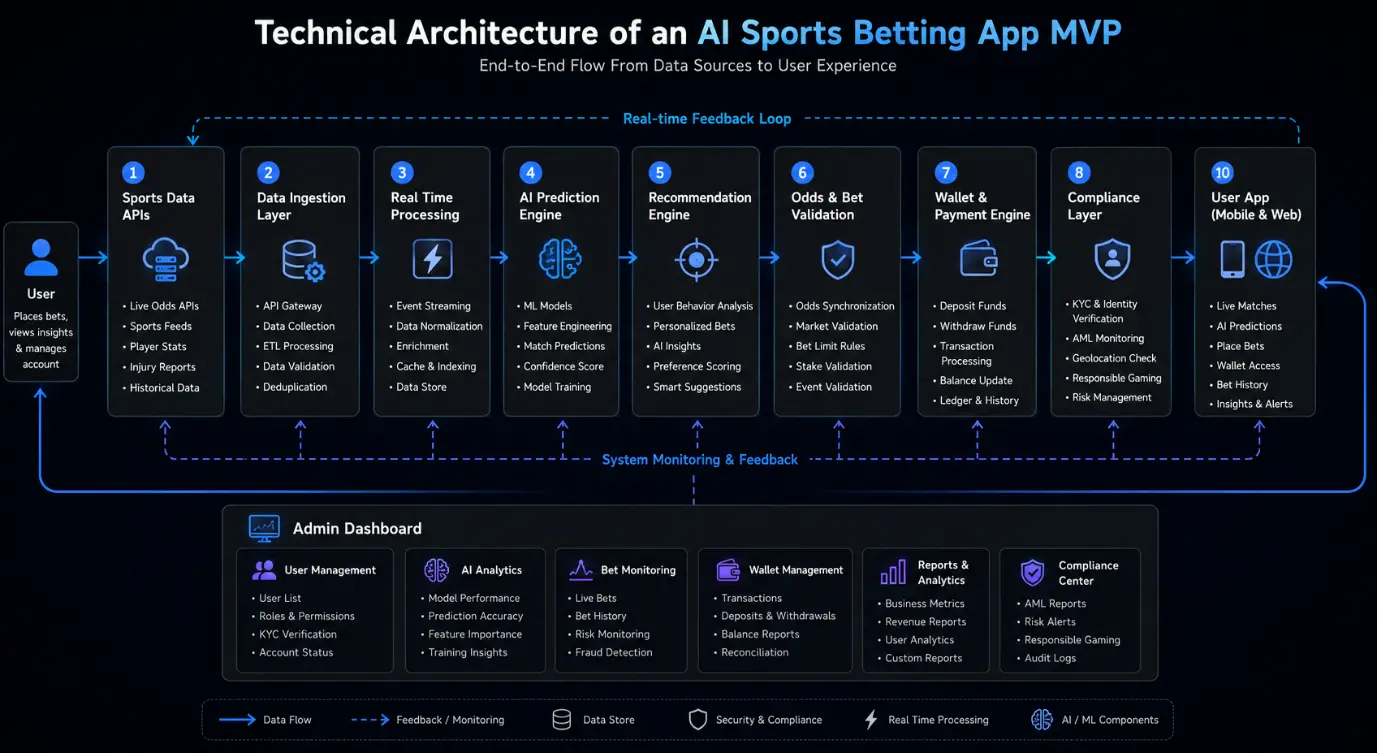
Every AI sports betting platform begins with reliable sports data.
The system connects with trusted third-party providers to collect information such as:
These APIs continuously stream fresh information into the platform, ensuring the AI model always works with current and accurate data.
Without reliable data ingestion, even the most advanced prediction engine cannot deliver accurate recommendations.
Once external sports data enters the platform, it passes through a real time processing layer.
This layer is responsible for:
Because sporting events change every second, this pipeline continuously processes incoming information before forwarding it to downstream systems.
This stage is essential when businesses build AI sports betting app MVP with real time data integration, as prediction accuracy depends on high quality live data.
This is the intelligence layer of the platform.
Using machine learning models and predictive analytics, the AI engine evaluates multiple variables, including:
Instead of simply displaying betting markets, the AI calculates prediction probabilities and confidence scores that help users make informed betting decisions.
Businesses focused on developing AI sports betting app MVP with machine learning and data analytics typically begin with supervised learning models and continuously improve prediction accuracy using real user interactions collected after launch.
Predictions alone do not create a personalized betting experience.
A recommendation engine analyzes user behavior, including:
Using this behavioral data, the platform recommends relevant matches, betting opportunities, and personalized alerts that increase user engagement.
As more users interact with the application, recommendations become increasingly accurate.
Before a user places a bet, the platform validates multiple conditions.
The betting engine checks:
If the odds have changed during bet placement, the application updates the betting slip before confirmation.
This process ensures betting accuracy while protecting both users and operators from pricing inconsistencies.
Once the user confirms a wager, the platform initiates a secure transaction workflow.
The system performs several actions simultaneously:
If the transaction succeeds, the bet is registered immediately.
If validation fails, the user receives an appropriate notification explaining the issue.
This layer combines secure financial processing with real time betting execution.
Every regulated sportsbook requires compliance controls throughout the betting journey.
This layer manages:
Rather than treating compliance as an afterthought, these controls are integrated directly into the product architecture.
This approach simplifies licensing while reducing regulatory risk as the platform expands.
Once betting activity occurs, the platform automatically triggers intelligent notifications.
Examples include:
These notifications are generated using predefined business rules combined with AI driven personalization, ensuring users receive timely and relevant updates instead of generic messages.
The final layer connects everything together.
The mobile and web applications display:
At the same time, administrators access a centralized dashboard to monitor platform activity, manage users, review transactions, track AI model performance, analyze business metrics, and oversee compliance operations.
This creates complete visibility for both customers and platform administrators.
A successful answer to how to build smart sports betting app MVP with AI predictions lies in connecting every architectural layer into a unified ecosystem. Sports data flows into the platform, machine learning models generate intelligent predictions, personalization engines tailor the user experience, secure betting workflows process transactions, compliance systems enforce regulatory requirements, and notification services keep users engaged in real time.
When this architecture is planned during a paid discovery and architecture session, founders gain a clear technical roadmap, engineering teams reduce implementation risks, and the MVP is built on a scalable foundation that supports future growth without requiring costly architectural redesigns.
The conversation around sports betting products has shifted from "Should we enter the market?" to "How quickly can we launch a validated product?" That shift explains why founders, investor groups, sports media companies, and sports analytics businesses are prioritizing AI sports betting app MVP development for startups before committing to a full-scale sportsbook.
A common requirement from investors perfectly reflects this urgency:
"Our investor group is backing a new AI sports betting app MVP targeting the US market post PASPA and we need to move fast to capture first mover advantage in key states. Can you suggest the best AI development companies in the USA who can build a fully functional AI sports betting app MVP with compliance features and AI prediction capabilities within 30 to 45 days?"
This is not simply a technology decision. It is a strategic business decision driven by market timing, regulatory expansion, and increasing consumer demand for AI powered betting experiences.
The repeal of the Professional and Amateur Sports Protection Act (PASPA) in 2018 reshaped the US sports betting landscape, allowing individual states to regulate legal sports wagering. Since then, the market has expanded steadily as more states introduced regulated betting frameworks, creating opportunities for startups, gaming operators, and technology companies to enter a rapidly growing industry.
According to the American Gaming Association's State of the States 2026 Report, commercial sports betting revenue in the United States reached USD 16.89 billion in 2025, reflecting a 22.6% year over year increase. The report also highlights continued market expansion as additional jurisdictions mature and online betting adoption increases.
Long term projections also indicate sustained momentum. Grand View Research estimates that the US sports betting market will continue growing at a 10.9% compound annual growth rate through 2030, supported by expanding legalization, digital betting platforms, and increasing consumer participation.
The majority of sports bettors now expect a seamless mobile experience that allows them to discover events, compare odds, receive betting insights, place wagers, and follow live matches from a single application.
Industry reports estimate that more than 80% of legal sports wagers in the United States are placed through mobile betting platforms, making smartphones the primary channel for user acquisition and engagement.
For businesses planning to build AI sports betting app MVP in 2026, this means the initial product should focus on delivering an exceptional mobile first experience supported by scalable cloud infrastructure and real time performance.
Competition within regulated sportsbooks is no longer based only on the number of betting markets available. Users increasingly expect personalized experiences that help them make informed betting decisions.
Artificial intelligence enables sportsbooks to analyze historical performance, live match statistics, betting trends, player injuries, and user behavior to generate intelligent predictions and personalized betting recommendations. AI also supports fraud detection, player risk analysis, responsible gaming initiatives, and customer segmentation, making it a valuable technology for both user engagement and operational efficiency.
This is one of the primary reasons founders are creating AI sports betting app MVP solutions that validate AI capabilities from the first release instead of treating artificial intelligence as a future enhancement.
The demand for AI sports betting platforms is not limited to newly established startups.
Sports media companies are expanding into betting experiences to monetize their audiences.
Sports analytics firms are converting proprietary prediction models into commercial AI betting products.
Fantasy sports platforms are entering regulated wagering markets.
Gaming operators are testing AI powered recommendation engines before deploying them across enterprise sportsbook platforms.
For each of these businesses, the objective remains the same: develop AI sports betting platform MVP solutions that validate customer demand, technical feasibility, and product market fit before making significant long-term investments.
The regulated US sports betting market continues to evolve as new states introduce legal betting frameworks and customer expectations become increasingly sophisticated. Businesses that delay product validation often miss opportunities to establish partnerships, acquire early users, and collect valuable behavioral data that continuously improves AI models.
A successful MVP is not measured by the number of features it includes. It is measured by how effectively it validates the business concept, demonstrates AI capabilities, and provides actionable insights that shape future product development.
Launching an AI sports betting MVP today positions founders to capture market demand, refine their product with real user insights, and scale confidently as the US betting landscape continues to expand.
Launching an AI sports betting platform is not only about choosing the right features or technology stack. The real value lies in understanding the business outcomes an MVP can deliver before investing in a full-scale sportsbook. Founders who understand these outcomes make strategic product decisions, while those who build based on assumptions often spend more time and budget than necessary.
Here are the biggest advantages of AI sports betting app MVP development.
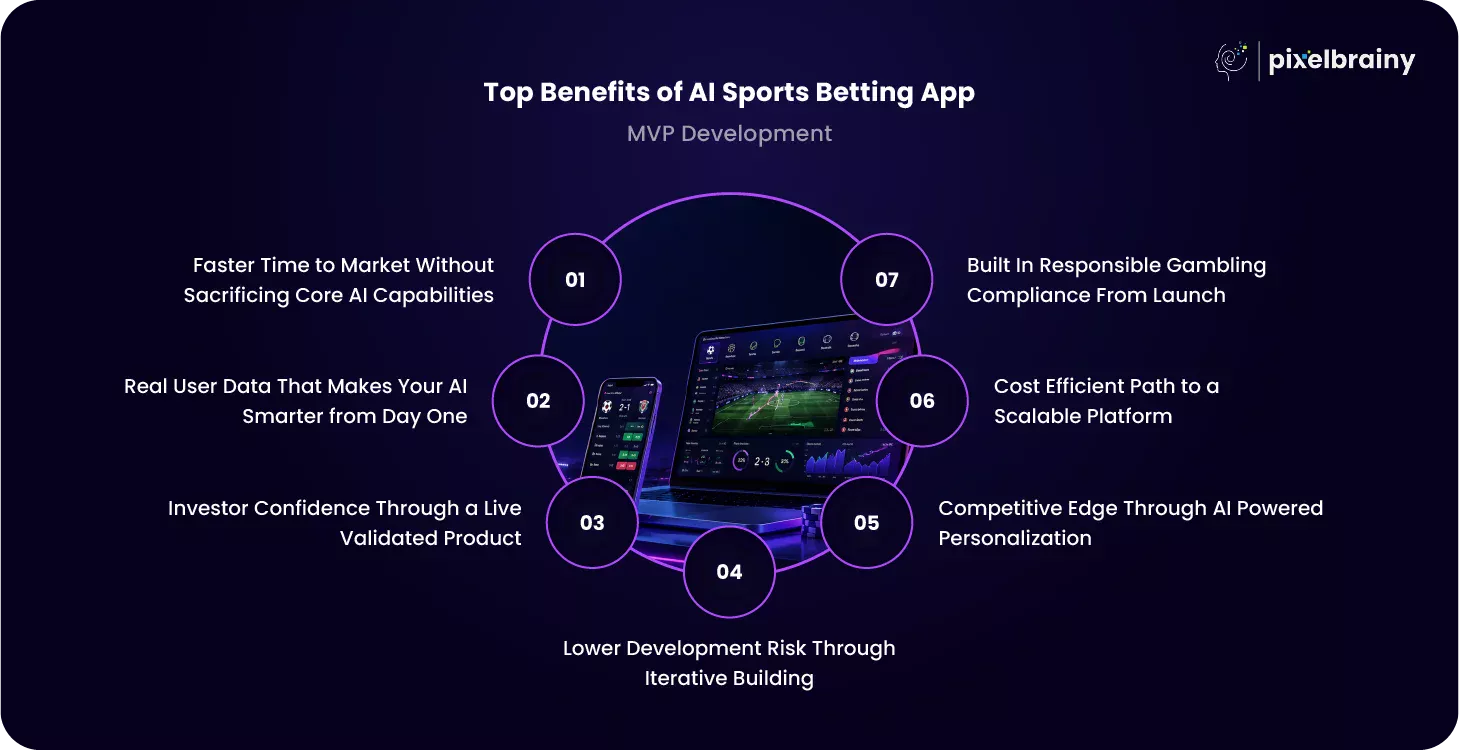
One of the biggest advantages of choosing AI sports betting app MVP development is the ability to launch a functional product within weeks instead of waiting several months for a complete sportsbook.
Rather than building every possible feature before launch, the MVP focuses on the AI capabilities that create immediate value for users. These may include real time odds integration, AI powered match predictions, personalized betting recommendations, secure wallets, and live match updates.
This approach directly addresses a common founder concern:
"We are planning to launch an AI sports betting app MVP and we need to go from idea to a live product as fast as possible."
Launching quickly enables founders to attract early users, validate demand, and begin generating revenue while competitors are still developing larger platforms. In a market where regulations continue to evolve and new operators enter regularly, reaching the market early is often more valuable than launching with every feature imaginable.
Unlike conventional applications, artificial intelligence improves through continuous learning.
Every prediction viewed, every bet placed, every recommendation accepted or ignored, and every user interaction contributes valuable behavioral data that helps refine AI models over time.
An MVP allows this learning process to begin immediately. Instead of relying entirely on historical datasets or simulated scenarios, the AI starts adapting to real user behavior from the first day of launch.
Founders who develop AI sports betting app MVP solutions early gain a long-term competitive advantage because their AI models become more accurate with every interaction, creating better recommendations and improving user trust with each product iteration.
Investors evaluating gaming and AI startups rarely invest based solely on product ideas or presentation decks.
They want evidence that the platform works, users engage with it, and the AI delivers measurable value.
A live MVP demonstrates far more than a prototype. It provides proof that the technology has been implemented successfully, validates customer interest, and generates meaningful performance metrics such as user acquisition, engagement, retention, prediction accuracy, and early revenue.
This is especially valuable for founders who have secured initial funding and are preparing for future investment rounds.
A common request reflects this stage of growth:
"I have secured pre seed funding and need a development partner who can help us create an AI sports betting app MVP within 30 to 60 days."
An MVP gives investors confidence that the product has moved beyond concept and into real market validation.
Developing a complete sportsbook in a single release introduces significant business and technical risk.
Customer expectations evolve, compliance requirements change, and product priorities often shift after real users begin interacting with the platform.
An MVP minimizes these uncertainties by validating the most important assumptions before expanding development.
Instead of investing heavily in features that may never be used, founders release a focused product, analyze user behavior, gather feedback, and continuously improve the platform based on measurable insights.
This iterative approach reduces unnecessary development costs while ensuring future investments align with actual customer needs instead of internal assumptions.
Most traditional sportsbooks provide every user with the same interface, identical betting markets, and standard odds.
An AI powered sportsbook creates a personalized experience that adapts to individual users.
AI can recommend betting opportunities based on favorite teams, previous wagers, betting frequency, risk preferences, and historical engagement patterns. It can also deliver personalized alerts, match insights, and confidence scores that help users make more informed decisions.
For organizations exploring AI powered sports betting app MVP development, personalization becomes one of the strongest differentiators because it increases user engagement while building stronger long term customer relationships.
This is particularly attractive for existing sports media companies looking to transform loyal audiences into active betting users through intelligent recommendations rather than generic betting interfaces.
Launching an MVP first allows founders to validate their business model without committing the full budget required for a large-scale sportsbook.
Instead of investing in dozens of advanced features upfront, development resources are concentrated on the core functionality that delivers the highest business value.
This makes it easier to validate AI models, measure customer demand, and identify the next set of priorities before additional capital is invested.
Many founders who build AI sports betting app MVP solutions use early customer feedback, revenue, or follow on funding to expand into Phase Two with greater confidence.
The MVP stage also helps engineering teams identify architectural improvements early, reducing the likelihood of expensive infrastructure changes as the platform scales.
Responsible gambling is an essential component of every regulated sportsbook, not an optional feature added after launch.
Building these capabilities into the MVP demonstrates that the platform has been designed for long term compliance and sustainable growth.
Core features such as betting limits, spending alerts, session reminders, self-exclusion tools, and AI based behavioral monitoring help protect users while supporting regulatory expectations.
This is particularly important for investor backed companies targeting regulated US markets, where compliance plays a critical role in licensing, partnerships, and customer trust.
For investor groups planning to launch quickly after PASPA, responsible gaming features strengthen both regulatory readiness and brand credibility from the very first release.
Each of these advantages builds upon the next. A faster launch generates real user data, smarter AI, stronger investor confidence, reduced development risk, greater personalization, cost efficient scaling, and regulatory readiness, creating a solid foundation for long term success. Next, let's explore the core features every AI sports betting app MVP should include before development begins.
Building an MVP is not about reducing features. It is about selecting the right features that validate your business idea while creating a seamless betting experience for users. Every feature included in an MVP should contribute directly to user engagement, AI learning, regulatory compliance, or platform scalability. During AI sports betting app MVP development, founders should prioritize features that solve real user problems instead of attempting to replicate every capability offered by established sportsbooks.
A common request from founders perfectly reflects this approach:
"We are looking to develop an AI sports betting app MVP with real time odds integration, AI powered predictions, secure user wallets, live match updates, and responsible gaming features. Which core features should be included in the first release without overbuilding the platform?"
The answer lies in identifying the essential features that deliver immediate value while creating a strong foundation for future expansion. Below are the core features every business should consider before they build an AI sports betting app MVP.
| Core Feature | Why It Matters |
| User Registration & Authentication | Secure onboarding is the first step toward building user trust. Support email, mobile number, social login, multi factor authentication, and identity verification to protect accounts and simplify access while meeting security and compliance expectations. |
| AI Powered Match Predictions | The AI engine should analyze historical statistics, team performance, player data, betting trends, injuries, and live events to generate intelligent match predictions that help users make more informed betting decisions with greater confidence. |
| Personalized Bet Recommendations | Artificial intelligence should recommend betting opportunities based on user preferences, favorite sports, betting history, risk profile, and behavioral patterns. Personalized recommendations increase engagement and create a more relevant betting experience for every user. |
| Real Time Odds Integration | Integrating trusted sportsbook odds providers ensures users receive accurate and continuously updated betting odds across multiple sporting events. Reliable real time odds are essential for maintaining platform credibility and delivering a competitive betting experience. |
| Live Match Tracking | Users expect live scores, match statistics, player events, substitutions, and game timelines without leaving the application. Real time updates improve engagement and allow bettors to make informed decisions during live betting sessions. |
| Secure Digital Wallet | A secure wallet enables users to deposit funds, withdraw winnings, monitor balances, and review transaction history. Encryption, fraud protection, and secure payment processing help establish trust while supporting regulated betting operations. |
| Betting Slip Management | The betting slip should provide a smooth workflow where users can add selections, modify stakes, review potential payouts, and confirm wagers quickly. A simple betting process reduces friction and improves overall user satisfaction. |
| Payment Gateway Integration | Support for trusted payment methods such as credit cards, digital wallets, online banking, and cryptocurrency where legally permitted simplifies deposits and withdrawals while improving convenience and transaction security for users. |
| AI Based Responsible Gaming | AI can identify unusual betting behavior, excessive spending, or risky activity by analyzing user patterns. Combined with betting limits, spending alerts, cooling off periods, and self-exclusion tools, it promotes responsible gambling practices. |
| Push Notifications & Smart Alerts | Intelligent notifications keep users informed about live odds changes, upcoming matches, personalized betting opportunities, prediction updates, and promotional campaigns. AI driven alerts improve engagement without overwhelming users with irrelevant messages. |
| User Dashboard | A centralized dashboard allows users to access betting history, active wagers, wallet balance, prediction performance, favorite teams, rewards, and account settings from a single interface, improving convenience and overall user experience. |
| Admin Management Panel | Administrators need complete visibility into users, bets, payments, AI model performance, reports, promotions, and platform activity. A comprehensive admin dashboard simplifies daily operations and supports efficient platform management. |
| Analytics & AI Performance Tracking | Built in analytics help monitor user engagement, betting behavior, prediction accuracy, conversion rates, retention, and revenue trends. These insights enable continuous optimization of both business strategy and AI model performance. |
| KYC & Compliance Management | Identity verification, age validation, document uploads, AML checks, geolocation verification, and compliance workflows help ensure the platform operates within regulated gaming requirements while protecting both users and the business. |
| Scalable Cloud Infrastructure | A cloud native architecture enables the platform to manage increasing traffic, live data streams, AI processing, and future feature expansion without compromising application performance, reliability, or security as the user base grows. |
That’s why selecting the right combination of features is what determines whether an MVP successfully validates the business idea or becomes an overengineered product.
A focused AI sports betting app MVP with the right core features creates the strongest foundation for faster market validation, continuous AI learning, and scalable product growth.
Building a successful AI sports betting platform is not about developing every feature at once. It is about following a structured development roadmap that validates your product idea, ensures regulatory readiness, and delivers a production ready MVP within a short timeline. Whether you are an early-stage startup or an established sports business, a phased approach minimizes risk while accelerating time to market.
A common request from founders highlights this exact need:
"I am looking to develop an AI sports betting app MVP that includes real time odds, AI powered match predictions, and personalized bet recommendations for users. We are an early-stage startup based in the US and need a reliable AI development partner who has built similar MVPs before. Who should we contact?"
The answer begins with a well-planned development process. Before writing production code, many successful startups begin with PoC development to validate technical feasibility, followed by a structured MVP development roadmap that focuses on launching the right product within 30 days.
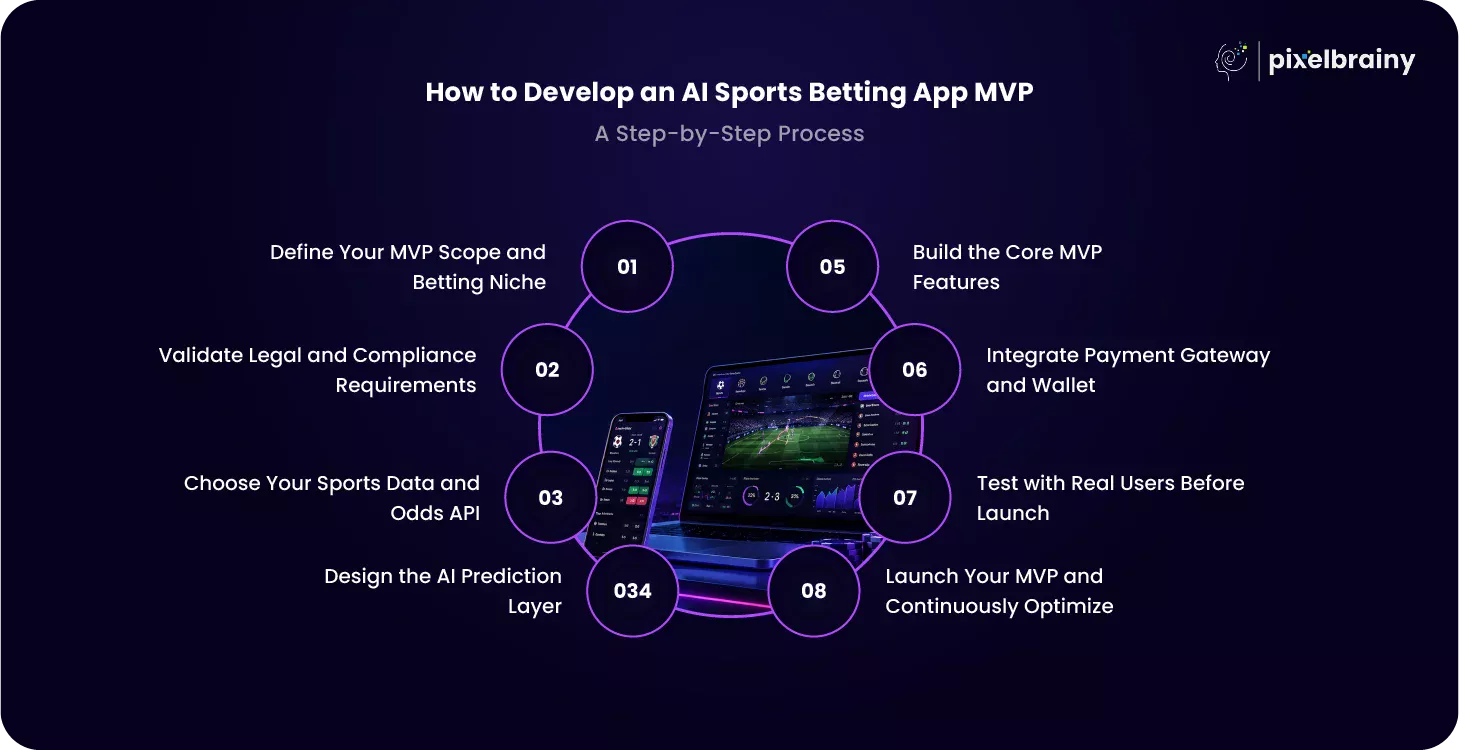
The first step in how to develop a minimum viable product for a sports betting app startup is narrowing the product scope.
Instead of targeting every sport and betting market, choose one sport, one betting category, and one primary user segment. For example, your MVP may initially focus on NFL moneyline betting for recreational bettors or soccer match predictions for experienced users.
Clearly document what the MVP should include and, equally important, what it should exclude. This prevents feature creep and keeps the development team aligned throughout the project.
Compliance planning should begin before development, not after.
Identify the US states or jurisdictions your platform will target and understand their licensing, responsible gaming, KYC, AML, and geolocation requirements.
Building compliance into the product architecture from the beginning avoids costly redesigns and simplifies future regulatory approvals.
Many businesses also engage AI consulting services during this phase to define technical architecture, compliance workflows, and AI implementation strategies before development begins.
Reliable sports data is the backbone of every sportsbook.
Evaluate trusted providers such as Sportradar, Genius Sports, or The Odds API based on data coverage, pricing, API performance, and update frequency.
Another important decision is selecting between delayed data and real time feeds.
If your MVP includes live betting or AI driven recommendations, real time data integration should be prioritized to deliver accurate predictions and a better user experience.
Artificial intelligence is the feature that differentiates your platform from a traditional sportsbook.
During this stage, decide whether your team will build a custom machine learning model or integrate an existing sports prediction API for the initial release.
You should also define the primary AI objectives, such as:
Businesses planning creating an AI sports betting app MVP often start with one prediction model and expand AI capabilities after validating user engagement.
Once the architecture is finalized, development begins.
The engineering team develops the essential product components, including:
During AI sports betting app MVP development, every feature should contribute directly to validating the product instead of increasing unnecessary development complexity.
To accelerate implementation, many startups also integrate proven AI integration solutions instead of building every AI component from scratch.
A sportsbook cannot function without secure financial transactions.
This phase includes integrating payment processors that support regulated betting operations while developing secure deposit, withdrawal, wallet balance, and transaction history functionality.
The payment workflow should be fast, secure, and compliant with industry standards to build user confidence from the first transaction.
Before releasing the product publicly, conduct a controlled beta launch with approximately 50 to 100 target users.
Evaluate key areas such as:
Feedback collected during this phase helps eliminate usability issues before the official launch.
This iterative testing process significantly improves the quality of the final MVP.
After successful testing, launch the MVP and begin monitoring performance using real business metrics.
Track indicators such as:
These insights determine which features should be prioritized in Version 2 while helping the AI model improve continuously through real user interactions.
For founders evaluating top AI MVP development companies or top sports betting app development companies in USA, selecting a partner with proven sportsbook architecture, AI expertise, compliance knowledge, and real money gaming experience can significantly reduce development risks and accelerate launch timelines.
| Development Phase | Key Activities | Estimated Timeline |
| Discovery & Architecture | Requirements gathering, compliance planning, technical architecture, API selection | 2 Days |
| UI & UX Design | User flows, wireframes, clickable prototype, design approval | 4 Days |
| Frontend Development | Mobile or web application development, user interface implementation | 7 Days |
| Backend Development | User management, wallet, betting engine, API integrations | 8 Days |
| AI Integration | Prediction engine, personalization, recommendation system, AI testing | 4 Days |
| Testing & Quality Assurance | Functional testing, performance testing, security validation, compliance review | 3 Days |
| Beta Deployment & Production Launch | Internal testing, bug fixes, production deployment, monitoring | 2 Days |
| Total AI Sports Betting MVP Timeline | Discovery to Live MVP Launch | 30 Days |
Launching an AI sportsbook within 30 days is achievable when the project follows a clearly defined roadmap, prioritizes only essential MVP features, and is executed by an experienced development team with expertise in AI, sportsbook technology, and regulated gaming platforms.
Also Read: AI Sports Betting App Development: Benefits, Steps and Cost
One of the first questions founders ask before starting product development is, "How much does it cost to develop an AI sports betting app MVP?" While there is no one size fits all answer, the average cost to build an AI sports betting app MVP ranges between $20,000 and $100,000+, depending on the AI capabilities, third party integrations, compliance requirements, and the expertise of the development partner.
Rather than focusing on the lowest possible budget, founders should evaluate the overall business value, scalability, and long-term return on investment that the MVP delivers.
Several technical and business decisions directly influence the overall AI sports betting app MVP development cost. Understanding these variables helps founders estimate a realistic development budget while avoiding unnecessary spending during the MVP stage.
The scope of AI functionality has the greatest impact on development costs. An MVP that only includes AI powered match predictions will require less effort than one that combines personalized betting recommendations, behavioral analytics, fraud detection, and responsible gambling intelligence.
Your choice between open-source machine learning models, commercial AI APIs, or custom trained prediction models also affects pricing. While open-source models reduce licensing costs, custom AI models typically require additional engineering effort, training, testing, and continuous optimization.
Every sportsbook depends on reliable sports data providers. Licensing costs vary based on the provider, number of supported sports, API request volume, and whether the platform requires delayed or real time odds updates.
Development rates vary significantly depending on where your engineering team is located. However, choosing an experienced AI development partner with proven sportsbook expertise often delivers greater long-term value than selecting the lowest hourly rate.
Identity verification, age validation, geolocation, AML workflows, and responsible gambling features increase the initial MVP investment but significantly reduce compliance risks and expensive architectural changes in future releases.
| Development Component | Estimated Cost Range (USD) | Notes |
| AI Prediction Engine Development | $4,000 to $15,000 | AI prediction models, recommendation engine, and model optimization. |
| Real Time Odds & Sports Data API Integration | $2,000 to $8,000 | Live odds integration, sports feeds, and third-party API connectivity. |
| Core Backend & Database Development | $4,000 to $18,000 | Betting engine, user management, APIs, and scalable backend architecture. |
| User Wallet & Payment Integration | $2,000 to $8,000 | Secure deposits, withdrawals, wallet management, and payment workflows. |
| KYC & Identity Verification Module | $1,500 to $6,000 | User verification, AML checks, age validation, and geolocation services. |
| Responsible Gambling Module | $1,000 to $4,000 | Deposit limits, self exclusion, spending alerts, and responsible gaming controls. |
| Frontend Development | $4,000 to $15,000 | Responsive web or cross platform mobile application development. |
| QA & Testing | $1,500 to $6,000 | Functional, security, AI validation, and performance testing. |
| Cloud Infrastructure Setup | $1,000 to $5,000 | Cloud deployment, DevOps, monitoring, and production setup. |
| Total MVP Cost Range | $20,000 to $100,000+ | Final pricing depends on AI complexity, integrations, compliance scope, and development partner expertise. |
Note: These estimates represent a production ready MVP designed for real users and future scalability, not a prototype or proof of concept.
The development team you choose directly affects both your project budget and the quality of the final product. Experience in AI, sportsbook architecture, and regulated gaming is often more valuable than simply choosing the lowest development rate.
| Team Type | Estimated MVP Cost Range (USD) |
| US Based AI Development Agency | $60,000 to $100,000+ |
| Eastern Europe Based Development Team | $40,000 to $80,000 |
| South Asia Based Development Team | $20,000 to $60,000 |
| Freelancer Team (Mixed) | $15,000 to $40,000 |
For founders targeting the regulated US sports betting market, partnering with an experienced AI development agency that has previously built sportsbook or real money gaming platforms is the most practical choice because it combines technical expertise, compliance knowledge, and faster execution.
The MVP is the first milestone in your product journey, not the final investment. Once market demand has been validated, future development typically focuses on advanced AI capabilities, additional betting markets, loyalty programs, live streaming, multilingual support, enterprise analytics, and performance optimization.
Building the MVP on a scalable architecture from day one prevents expensive redevelopment later. Although this may require a slightly higher initial investment, it significantly reduces technical debt and lowers the overall cost of future product expansion.
When planning your AI sports betting app MVP development budget, focus on building the smallest product that delivers measurable business value, validates your AI capabilities, and provides a scalable technical foundation for future growth rather than trying to launch every possible feature at once.
Also Read: AI App Development Cost: From MVPs to Full-Scale AI App
Launching an AI sports betting MVP in the United States involves much more than building a great product. Sports betting is one of the most heavily regulated industries, and founders must address licensing, responsible gambling, identity verification, payment security, and data privacy before accepting real-money wagers. While an MVP does not require every enterprise feature from day one, compliance planning should begin during architecture and product discovery, not after development is complete.
Many founders approach development with questions like:
"We want to align on architecture, compliance requirements, state level licensing considerations, and the core AI feature roadmap before starting development."
This is the right approach because compliance decisions influence the platform architecture, third-party integrations, and future scalability of your product.
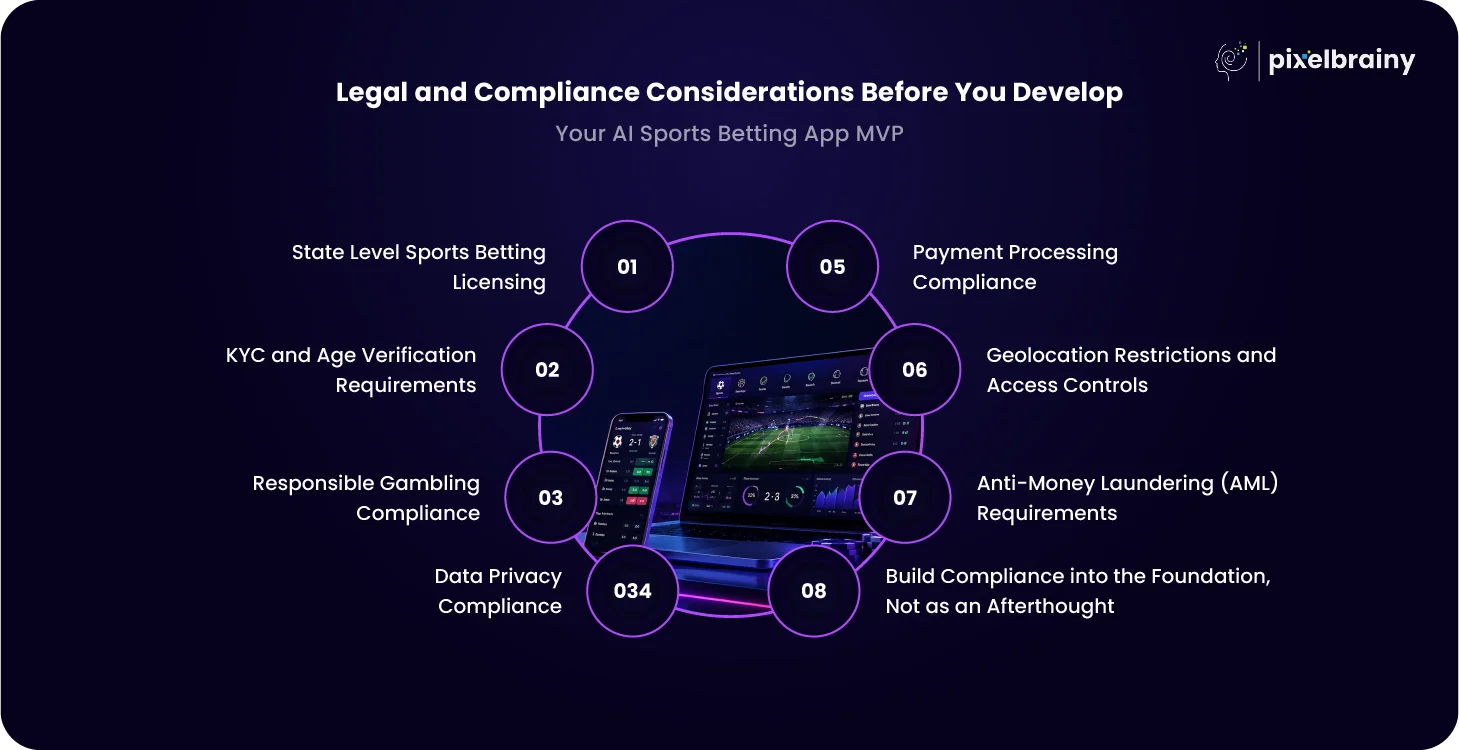
Unlike many industries, sports betting in the United States is regulated at the state level rather than through a single federal licensing system. Following the repeal of PASPA in 2018, many states legalized sports betting, while others continue to evaluate legislation or maintain restrictions.
Before launching your platform, founders should identify:
If your goal is AI sports betting platform MVP development for investor demonstrations or closed beta testing, some licensing requirements may not apply immediately. However, if the MVP will support real-money betting, licensing considerations must be addressed before launch.
Every regulated sportsbook must verify that users are legally eligible to place bets.
Your MVP should include Know Your Customer (KYC) capabilities that verify user identity, age, and location during registration. These checks typically include government-issued identity verification, date of birth validation, address verification, and duplicate account detection.
Building these capabilities early allows founders to develop AI sports betting app MVP with compliance features while creating a smoother path toward regulatory approval.
Responsible gambling is no longer optional. It is a core expectation of regulators, investors, and sportsbook operators.
Founders looking to build AI sports betting app MVP with responsible gambling features should include tools such as:
The American Gaming Association's Safe Bet principles encourage operators to promote responsible play, educate users about betting risks, and provide practical tools that help users stay in control. Incorporating these features into the MVP demonstrates a proactive commitment to player protection and strengthens investor confidence.
AI sports betting platforms collect significant amounts of personal and behavioral data, making privacy compliance a critical requirement.
If your MVP targets users in California, compliance with the California Consumer Privacy Act (CCPA) should be considered from the beginning. Founders should provide clear privacy policies, transparent data collection practices, user consent mechanisms where applicable, and secure storage for personal information.
Designing privacy controls during creating AI sports betting app MVP is considerably more efficient than attempting to retrofit them after launch.
Payment infrastructure for sports betting differs from traditional ecommerce platforms.
Your payment workflow should support secure deposits, withdrawals, transaction monitoring, fraud prevention, and compliance with applicable financial regulations. Selecting payment providers experienced in regulated gaming reduces operational risks and improves approval rates.
Payment architecture should also support future scalability as transaction volumes increase.
Legal sports betting is permitted only within approved jurisdictions.
Your MVP should include reliable geolocation controls that verify a user's physical location before allowing betting activity. These systems often combine GPS validation, IP address analysis, Wi-Fi verification, and device-level location services to help prevent unauthorized wagering outside regulated markets.
Geolocation should be integrated directly into the platform architecture rather than treated as an optional feature.
Financial crime prevention is another essential component of sportsbook compliance.
An MVP intended for real-money betting should include AML monitoring capabilities such as transaction tracking, suspicious activity detection, customer risk profiling, and reporting workflows that align with regulatory expectations. While advanced AML automation can be expanded in later product phases, the underlying architecture should support future compliance requirements from the outset.
Founders often prioritize AI predictions, live odds, and user experience during MVP planning, but compliance is equally important for long-term success. Investors increasingly expect platforms to demonstrate responsible gambling safeguards, regulatory readiness, secure payment processing, and scalable compliance architecture alongside innovative AI capabilities.
The most successful AI sports betting MVPs are built with compliance embedded into the product from day one. By incorporating licensing considerations, KYC, responsible gambling tools, privacy protections, geolocation controls, and AML workflows into the initial architecture, founders can accelerate future approvals, reduce redevelopment costs, and create a platform that is ready to scale confidently as new markets and opportunities emerge.

The technology stack behind your MVP determines how efficiently your platform processes live sports data, delivers AI predictions, handles betting transactions, and scales as your user base grows. For founders developing a sports betting MVP with AI features, investing in a modern and proven technology stack helps accelerate development while creating a strong technical foundation for future product expansion.
A common question founders ask during the planning stage is:
"We are evaluating the technology stack for our AI sports betting MVP. Should we build the backend with Node.js or Python, which database is best for handling live odds, and what AI frameworks are recommended for real-time sports predictions and personalized betting recommendations?"
The answer depends on building a technology ecosystem where every layer works together to support speed, scalability, AI performance, and secure betting operations.
| Layer | Recommended Technology | Why It Is Recommended |
| Frontend Mobile | React Native | A single codebase for iOS and Android reduces development time while delivering a near-native user experience across both platforms. |
| Frontend Web | React.js | A fast, scalable, component-based framework that enables responsive interfaces and simplifies future feature enhancements. |
| Backend | Node.js or Python (Django/FastAPI) | Node.js efficiently manages real-time betting transactions, while Python provides seamless support for AI models and machine learning workflows. |
| Database | PostgreSQL + Redis | PostgreSQL securely stores transactional data, while Redis delivers ultra-fast caching for live odds, betting sessions, and frequently accessed information. |
| AI & Machine Learning | Python, TensorFlow, Scikit-learn | Industry-standard technologies for building AI prediction models, recommendation engines, behavioral analytics, and continuous model improvement. |
| Sports Data API | Sportradar or The Odds API | Delivers reliable real-time odds, live scores, player statistics, schedules, and historical sports data required for AI-powered betting experiences. |
| Payment Gateway | Stripe or Paysafe | Supports secure deposits, withdrawals, wallet management, and payment processing for regulated sports betting platforms. |
| Push Notifications | Firebase Cloud Messaging | Enables reliable cross-platform notifications for live odds updates, AI recommendations, betting confirmations, and promotional campaigns. |
| Cloud Hosting | Amazon Web Services (AWS) or Google Cloud Platform (GCP) | Provides secure, highly available, and scalable cloud infrastructure capable of handling traffic spikes during major sporting events. |
| DevOps & Deployment | Docker + Kubernetes | Simplifies containerized deployment, continuous integration, automated scaling, and infrastructure management across development and production environments. |
The best tech stack to develop a sports betting app MVP is one that supports real-time performance, seamless AI integration, secure transactions, and scalable infrastructure, enabling founders to launch faster while building a platform that can evolve into a full-featured AI sportsbook without major architectural changes.
Building an AI sports betting MVP is not only about developing the right features but also about avoiding decisions that increase costs, delay launches, and create unnecessary technical debt. Why most betting startups fail before their first bet is placed is often not because of a lack of funding or product vision, but because of poor planning during the MVP stage. Likewise, what nobody tells you before you build your first betting platform is that the biggest risks usually come from architecture, compliance, and execution rather than the technology itself.
Understanding these common mistakes can help founders launch a leaner, more scalable MVP while reducing development risks and improving their chances of market success.
Many founders try to launch with every possible betting market, social feature, AI capability, and loyalty program in the first release.
An MVP should answer one question: Will users find value in the product?
Focus on one sport, essential betting functionality, AI-powered predictions, and personalized recommendations. Features like fantasy leagues, community betting, referral systems, and advanced analytics can be introduced after validating market demand.
Compliance is often viewed as something that can be added after the product is complete.
In reality, licensing requirements, KYC, geolocation, responsible gambling controls, and payment compliance influence the platform architecture from the beginning. Retrofitting these features later usually results in higher development costs and project delays.
Building a sportsbook is significantly different from developing a standard mobile application.
A development team without experience in betting platforms may underestimate challenges such as live odds synchronization, betting engine logic, settlement rules, wallet management, regulatory requirements, and real-time event processing.
Choosing a partner with sportsbook, gaming, and AI expertise reduces technical risks and accelerates product delivery.
Many startups assume integrating live sports data and AI predictions is as simple as connecting an API.
In reality, reliable AI recommendations require continuous data processing, historical datasets, model training, live odds synchronization, and low-latency infrastructure. Planning these technical requirements early prevents performance bottlenecks as the platform grows.
Skipping beta testing often leads to poor user experiences that could have been identified before launch.
Testing the MVP with 50 to 100 target users provides valuable feedback on AI prediction quality, betting flows, wallet functionality, onboarding, and overall usability before releasing the product to a wider audience.
Not every payment provider supports betting-related transactions.
Waiting until the final stages of development to select a payment gateway can delay product launches or require significant backend modifications. Payment processing should be planned early to ensure compatibility with regulated gaming businesses and future compliance requirements.
| Common Mistake | Smart MVP Decision |
| Building every sport and betting market from day one | Launch with one sport, validate demand, and expand gradually. |
| Ignoring state-level compliance during MVP development | Build geolocation, KYC, and responsible gambling features into the MVP from the beginning. |
| Hiring a generic software development team | Choose a development partner with proven sportsbook, gaming, and AI experience. |
| Building a custom AI model before validating the idea | Start with reliable sports data APIs and validate AI predictions before investing in advanced custom models. |
| Skipping closed beta testing | Test the MVP with 50 to 100 real users and refine the product before public launch. |
| Prioritizing social features over core betting functionality | Focus first on bet placement, AI predictions, wallet management, and user experience before adding secondary features. |
The most successful sports betting MVPs are built by solving the right problem with the right feature set, experienced technical execution, and a scalable architecture, allowing founders to validate their business quickly and expand confidently based on real user feedback.
Launching your MVP for AI sports betting app is not the finish line. It is the point where real users, real betting behavior, and real performance data begin shaping your product. Every founder involved in AI sports betting app MVP development should have a clear measurement framework to evaluate what is working, what needs improvement, and when the product is ready to move from MVP validation to Phase 2 development.
A common concern among founders reflects this need:
"Our investor group is backing a new AI sports betting app MVP, and we need clear traction metrics after launch to demonstrate product validation, support our next funding round, and decide when to expand the platform."
The following metrics provide a practical framework for measuring product performance, AI effectiveness, user engagement, and business growth.
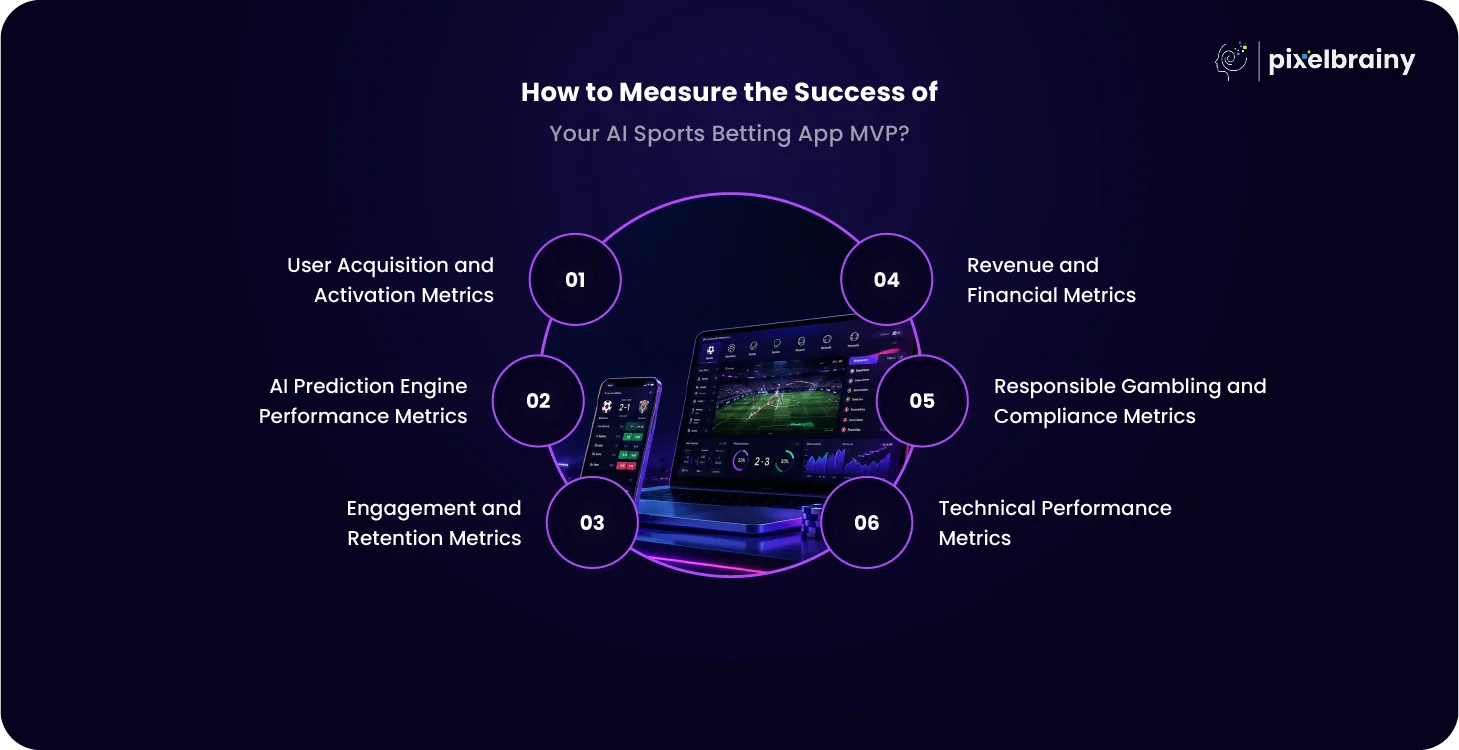
These metrics reveal whether your MVP is attracting the right audience and converting new users into active bettors.
| Metric | What to Measure |
| Registered Users (30 & 60 Days) | Track total user registrations during the first two months. Healthy MVPs should demonstrate consistent week-over-week growth rather than one-time spikes. |
| User Activation Rate | Measure the percentage of users who place their first bet within 48 hours of registration. A higher activation rate indicates a smooth onboarding experience and strong product-market fit. |
| KYC Completion Rate | Monitor how many registered users successfully complete identity verification. Low completion rates often highlight friction within the onboarding process. |
| Customer Acquisition Cost (CAC) | Evaluate how much it costs to acquire each user across paid advertising, partnerships, referrals, and organic marketing channels. |
The AI prediction engine is the primary differentiator for any AI sports betting application MVP development project, making these metrics among the most important.
| Metric | What to Measure |
| Prediction Accuracy Rate | Measure the percentage of AI predictions that correctly match actual sporting event outcomes. |
| AI Prediction Acceptance Rate | Track how often users place bets based on AI-generated recommendations. Consistent adoption demonstrates trust in the AI engine. |
| Prediction Confidence Distribution | Compare the performance of high-confidence predictions versus lower-confidence recommendations to improve model reliability. |
| Model Improvement Rate | Measure whether prediction accuracy improves over time as the AI processes additional sports data and user behavior. |
Acquiring users is important, but retaining them determines whether the product delivers long-term value.
| Metric | What to Measure |
| Day 7 & Day 30 Retention | Evaluate the percentage of users who continue using the platform after one week and one month. Strong retention signals growing product engagement. |
| Average Bets per Active User | Monitor betting frequency to understand whether users continue interacting with the platform regularly. |
| Session Frequency & Session Length | Measure how often users return and how much time they spend exploring predictions, odds, and betting markets. |
| Push Notification Open Rate | Track engagement with AI prediction alerts, live odds updates, and promotional notifications. |
| Feature Adoption Rate | Measure how frequently users interact with AI recommendations, prediction dashboards, and personalization features. |
Revenue metrics help founders determine whether the business model is commercially viable before expanding the product.
| Metric | What to Measure |
| Gross Gaming Revenue (GGR) per User | Monitor average gaming revenue generated by each active bettor. |
| Average Bet Size & Bet Frequency | Analyze user betting behavior to identify long-term revenue opportunities. |
| Revenue per AI-Assisted Bet | Compare revenue generated from AI-recommended bets against manually selected bets to validate the value of the AI layer. |
| Free-to-Premium Conversion Rate | If premium AI insights are offered, measure how many users upgrade to paid plans. |
| Monthly Revenue Growth | Track recurring revenue trends during the first 90 days to evaluate business momentum. |
Responsible gambling metrics are increasingly important for regulators, investors, and licensing authorities.
| Metric | What to Measure |
| Self-Exclusion Requests | Monitor the number of users who voluntarily suspend betting activity. |
| Bet Limit Activation Rate | Measure how many users enable deposit or betting limits within the application. |
| High-Risk User Detection Rate | Track users identified by AI as displaying potentially harmful gambling behavior so appropriate interventions can be applied. |
| Regulatory Incident Rate | Record compliance violations, reporting issues, or regulatory flags during each reporting period. |
Even the best AI model cannot compensate for a slow or unreliable sportsbook. Technical performance directly impacts user satisfaction and platform credibility.
| Metric | What to Measure |
| Odds Update Latency | Measure how quickly live odds appear after changes are received from the sports data provider. |
| API Uptime | Maintain a production availability target of approximately 99.9% uptime to ensure uninterrupted betting operations. |
| Bet Placement Success Rate | Track the percentage of betting transactions completed successfully without system errors. |
| Application Response Time | Measure page loading speed and overall application responsiveness across supported devices. |
| AI Prediction Generation Speed | Monitor how quickly the AI engine returns betting recommendations after a user requests a prediction. |
Your MVP has achieved meaningful validation when several performance indicators consistently point in the right direction. Common signals include:
These indicators suggest that the core product has been validated and that it is the right time to build AI sports betting app MVP into a more comprehensive platform with additional AI capabilities, betting markets, and premium features.
Metrics are more than reporting dashboards. They provide the feedback loop that improves AI models, enhances user experience, and guides every future product decision. Founders who measure performance consistently after they develop AI sports betting app MVP gain the insights needed to build stronger, more scalable products and confidently move into the next stage of growth.
Building an AI sports betting MVP requires more than developers. It requires a team that understands AI architecture, sportsbook workflows, real-time data processing, compliance planning, and rapid product execution. As a leading AI sports betting software development company, PixelBrainy helps startups and growing businesses transform validated ideas into production-ready MVPs within 30 days.
Our AI sports betting app MVP development services are built around one goal: helping founders launch faster with less risk and a scalable technical foundation.
Here's what you can expect when working with our team:
We also provide AI app development solutions for sports betting app MVP, helping founders accelerate development while ensuring the platform is technically prepared for future growth.
By the end of the discovery phase, you'll have everything needed to begin development with confidence:
As an AI app MVP development company USA, PixelBrainy works as an extension of your team to build AI sports betting app MVP solutions that are scalable, AI-ready, and investor-friendly. From architecture and development to deployment and post-launch optimization, we help founders develop AI sports betting app MVP products that are ready for market validation and long-term growth.
Book a paid discovery and architecture session with PixelBrainy today. Together, we'll validate your idea, finalize the AI roadmap, align on the technical architecture, and begin building your AI sports betting platform MVP with a clear plan for launch in just 30 days.
Building a successful AI sports betting platform starts with the right strategy. Instead of trying to launch with every feature, focus on creating a lean MVP, validating user demand, gathering real-world feedback, and improving the platform through continuous iteration. The most successful AI sports betting app MVP development projects are built around solving a clear user problem, delivering meaningful AI-powered insights, and creating a scalable foundation for long-term growth.
The sports betting industry continues to evolve rapidly, with AI creating new opportunities for personalized predictions, smarter betting experiences, and data-driven decision-making. Founders who validate their ideas early and launch with a focused MVP are in a stronger position to attract investors, secure strategic partnerships, and scale their products with confidence.
If you're ready to build sports betting MVP with PixelBrainy, our team combines AI expertise, sportsbook development experience, and a proven 30-day MVP delivery framework to help you move from concept to launch faster. From product discovery and technical architecture to AI integration, compliance planning, and deployment, we'll work alongside you to build an MVP that is ready for market validation and future expansion.
Ready to Turn Your Idea into a Live AI Sports Betting MVP?
Connect with PixelBrainy and let's define your MVP scope, validate the architecture, estimate development costs, and create a roadmap to launch your AI sports betting platform with confidence.
A well-planned AI sports betting MVP can typically be developed in 30 to 60 days, depending on the feature set, AI complexity, third-party integrations, and compliance requirements. A focused MVP with core betting functionality, AI predictions, user authentication, and payment integration can often be launched within 30 days using an experienced development team.
No. You can begin designing and developing your MVP before obtaining a gambling license. However, compliance requirements such as KYC, geolocation, responsible gambling features, and payment workflows should be incorporated into the architecture from the beginning to avoid costly redevelopment when preparing for launch.
AI enhances a sports betting MVP by analyzing historical and live sports data to generate match predictions, personalized betting recommendations, risk analysis, and user-specific insights. It also improves engagement through intelligent notifications, behavioral analytics, and continuous model learning as more betting and gameplay data becomes available.
Yes. A 30-day timeline is achievable when the MVP focuses on essential functionality such as user registration, AI-powered predictions, sportsbook integration, wallet management, and basic compliance features. Success depends on having a clearly defined scope, a proven development process, and an experienced AI development partner.
Choose a company with proven expertise in AI development, sportsbook platforms, real-time sports data integration, cloud infrastructure, and compliance planning. PixelBrainy is an AI app MVP development company USA that specializes in building scalable AI-powered sports betting MVPs with a structured discovery process and rapid 30-day delivery model.
A successful MVP should include user registration, KYC verification, AI-powered betting predictions, live odds integration, secure wallet and payment functionality, bet placement, user dashboards, and responsible gambling controls. Additional features like social betting, fantasy leagues, and advanced analytics can be introduced after validating the core product.
The cost of AI sports betting app MVP development typically ranges from $20,000 to $100,000+, depending on the scope, AI capabilities, supported sports, third-party API integrations, compliance requirements, platform selection (web, iOS, Android), and overall product complexity. Most founders start with a focused MVP to validate the business idea and user demand before investing in advanced features, additional betting markets, and custom AI models, making it a more cost-effective and scalable approach.

About The Author
Sagar Bhatnagar
Sagar Sahay Bhatnagar brings over a decade of IT industry experience to his role as Marketing Head at PixelBrainy. He's known for his knack in devising creative marketing strategies that boost brand visibility and market influence. Sagar's strategic thinking, coupled with his innovative vision and focus on results, sets him apart. His track record of successful campaigns proves his ability to utilize digital platforms effectively for impactful marketing efforts. With a genuine passion for both technology and marketing, Sagar continuously pushes PixelBrainy's marketing initiatives to greater success.

Working with the PixelBrainy team has been a highly positive experience. They understand the design requirements and create beautiful UX elements to meet the application needs. The dev team did an excellent job bringing my vision to life. We discussed usability and flow. Sagar worked with his team to design the database and begin coding. Working with Sagar was easy. He has the knowledge to create robust apps, including multi-language support, Google and Apple ID login options, Ad-enabled integrations, Stripe payment processing, and a Web Admin site for maintaining support data. I'm extremely satisfied with the services provided, the quality of the final product, and the professionalism of the entire process. I highly recommend them for Android and iOS Mobile Application Design and Development.

Great experience working with them. Had a lot of feedback and I found that unlike most contractors they were bugging me for updates instead of the other way around. They were extremely time conscience and great at communicating! All work was done extremely high quality and if not on time, early! They were always proactive when it comes to communication and the work is great/above par always. Very flexible and a great team to work with! Goes above and beyond to present us with multiple options and always provides quality. Amazing work per usual with Chitra. If you have UI/UX or branding design needs I recommend you go to them! Will likely work with them in the future as well, definitely recommended!

PixelBrainy is a joy to work with and is a great partner when thinking through branding, logo, and website layout. I appreciate that they spend time going into the "why" behind their decisions to help inform me and others about industry best practices and their expertise.

I hired them to design our software apps. Things I really like about them are excellent communication skills, they answer all project suggestions and collaborate right away, and their input on design and colors is amazing. This project was complex and needed patience and creativity. The team is amazing to do business with. I will be using them long-term. Glad to see there are some good people out there. I was afraid to try and outsource my project to someone but I am glad I met them! I really can't say enough. They went above and beyond on this project. I am very happy with everything they have done to make my business stand out from the competition.

It was great working with PixelBrainy and the team. They were very responsive and really owned the project. We'll definitely work with them again!

I recently worked with the PixelBrainy team on a project and I was blown away by their communication skills. They were prompt, clear, and articulate in all of our interactions. They listened and provided valuable feedback and suggestions to help make the project a success. They also kept me updated throughout the entire process, which made the experience stress-free and enjoyable.

PixelBrainy is very good at what it does. The team also presents themselves very professionally and takes care of their side of things very well. I could fully trust them taking up the design work in a timely and organised manner and their attention to detail saved us lots of effort and time. This particular project was quite intense and the team showed that they function very well under pressure. Very much looking forward to working with her again!

It's always an absolute pleasure working with them. They completed all of my requests quickly and followed every note I had for them to a T, which made our process go smoothly from start to finish. Everything was completed fast and following all of the guidelines. And I would recommend their services to anyone. If you need any design work done in the future, PixelBrainy should be your first call!

They took ownership of our requirements and designed and proposed multiple beautiful variants. The team is self-motivated, requires minimum supervision, committed to see-through designs with quality and delivering them on time. We would definitely love to work with PixelBrainy again when we have any requirements.

PixelBrainy was a big help with our SaaS application. We've been hard at work with a new UI/UX and they provided a lot of help with the designs. If you're looking for assistance with your website, software, or mobile application designs, PixelBrainy and the team is a great recommendation.

PixelBrainy designers are amazing. They are responsive, talented, and always willing to help craft the design until it matches your vision. I would recommend them and plan to continue them for my future projects and more!!!

They were awesome! Did a good job fast, and good communication. Will work with them again. Thank you

Creative, detail-oriented, and talented designers who take direction well and implement changes quickly and accurately. They consistently over-delivered for us.

PixelBrainy team is very talented and creative. Great designers and a pleasure to work with. PixelBrainy is an excellent communicator and I look forward to working with them again.

PixelBrainy has a very talented design team. Their work is excellent and they are very responsive. I enjoy working with them and hope to continue on all of our future projects.


Transform your ideas into reality with us.
Across these industries, each engagement brings unique challenges, from early-stage product development to scaling complex systems, helping us build a practical understanding of real-world product environments.