AI Summary Powered by PixelBrainy
Can your AI prediction engine consistently achieve more than 55% prediction accuracy before investors ask for technical proof instead of product vision?
For founders, CTOs, product leaders, and sports betting entrepreneurs, proving that an AI prediction engine works is often more valuable than showcasing a feature-rich betting platform. Investors today expect evidence backed by data, measurable model performance, and a validated technical approach before committing significant capital. This is where AI sports betting software PoC development becomes a strategic first step rather than an optional exercise.
If you plan to build AI sports betting software PoC, your objective is not to launch a production-ready sportsbook. Instead, the goal is to validate whether your machine learning prediction engine can accurately forecast sports outcomes using historical and real-time sports data while demonstrating that the chosen architecture is scalable for future product development.
Consider a realistic scenario. A sports betting startup has secured conditional approval for a $2 million Series A investment, but the board requires one critical milestone before releasing the funding. Within 10 weeks, the company must demonstrate an AI powered NFL prediction engine capable of achieving more than 55% documented prediction accuracy. Although the startup has three experienced backend engineers, none specialize in machine learning. Hiring an in-house AI team or engaging a large development agency without first validating the technical feasibility introduces unnecessary financial and engineering risks. In this situation, PoC development for AI sports betting software provides the fastest and most cost-effective way to prove whether the AI prediction approach is technically viable.
This guide explains the complete AI sports betting proof of concept development process, including defining measurable success metrics, selecting the right machine learning models, preparing historical sports datasets, designing scalable AI architecture, choosing the appropriate technology stack, estimating development costs, and evaluating prediction performance. It also answers how to create an AI sports betting software PoC with machine learning prediction engine while helping founders and CTOs understand how specialized AI development companies in the USA can deliver investor-ready PoCs within aggressive fundraising timelines.
An AI Sports Betting Software Proof of Concept (PoC) is a focused technical prototype built to validate whether an AI powered prediction engine can accurately forecast sports outcomes before investing in a full-scale betting platform. Unlike an MVP, which tests product usability and market demand, a PoC verifies the technical feasibility of the AI model using real historical sports data.
The primary goal of AI sports betting software PoC development is to determine whether machine learning algorithms can generate consistent, data driven predictions with measurable accuracy. It helps founders, CTOs, and investors evaluate if the selected AI approach is worth scaling into a commercial product.
A well-developed PoC typically includes historical data processing, feature engineering, machine learning model training, prediction APIs, and performance evaluation. It should prove that the AI engine can meet predefined accuracy targets, process reliable datasets, and support future scalability. By validating the core prediction capability early, businesses reduce development risk, optimize investment decisions, and build confidence before moving toward MVP or full-scale sportsbook development.
The most expensive mistake a sports betting startup or professional betting operation can make is not choosing the wrong technology. It is committing to full scale development before confirming that the core technical assumption the entire product is built on actually works.
In AI powered sports betting, every feature, from user experience to betting markets, depends on one thing: whether the prediction engine can consistently generate accurate and commercially viable outcomes. If that assumption proves incorrect, months of development effort and significant investment can quickly become wasted resources.
Most software products fail because of poor market fit or weak execution. AI sports betting platforms fail for a different reason. The machine learning model may simply be incapable of achieving the prediction accuracy required to create positive expected value. This cannot be determined through planning or technical expertise alone.
It must be validated using real historical data, rigorous testing, and measurable results. AI sports betting software PoC development allows teams to test this critical assumption before making large engineering commitments, significantly reducing technical and financial risk.
The traditional MVP approach works well for SaaS and consumer applications because the biggest uncertainty is customer adoption. In AI sports betting, the primary uncertainty is whether the prediction engine actually works. Building user registration, payment systems, dashboards, and bookmaker integrations before validating the AI model means investing in features that have little value if the prediction engine fails.
When you build AI sports betting software PoC, you validate the most important component first, ensuring every future development decision is based on proven technical capability rather than assumptions.
Imagine you are the CTO of a sports betting startup whose board has approved a $2 million Series A investment, provided you can demonstrate an NFL prediction engine with documented accuracy above 55% within 10 weeks. Your engineering team consists of three experienced backend developers, but none have machine learning expertise.
Before hiring AI engineers or partnering with a full-scale development agency, the logical step is to develop AI sports betting PoC that validates the prediction engine under real conditions. This focused approach proves whether your chosen algorithms, datasets, and technical architecture can satisfy investor expectations before scaling the team.
It also explains why many startups seek specialized AI sports betting PoC development services from experienced AI development companies capable of delivering investor ready proof of concepts within compressed timelines.
Sophisticated sports betting investors have seen countless pitch decks filled with impressive backtesting charts that later proved to be the result of overfitted models, look ahead bias, or carefully selected datasets.
A well-executed AI sports betting proof of concept development with documented walk forward validation across multiple seasons provides objective evidence that the prediction engine performs under realistic conditions. Founders who present validated AI performance enter investor meetings with far greater credibility than those showcasing a feature rich MVP backed only by assumptions.
A PoC does much more than validate prediction accuracy. It uncovers hidden challenges such as inconsistent historical data, ineffective feature engineering, latency limitations, model overfitting, and infrastructure bottlenecks.
Discovering these issues during AI sports betting prototype development requires only days of investigation, whereas finding them during production development often leads to weeks of rework, budget overruns, and delayed product launches. For professional bettors, a PoC also answers another critical question: can a profitable manual betting strategy actually be replicated and improved through machine learning before investing in full AI automation?
From a financial perspective, the decision is straightforward. A PoC is not an additional development expense. It is a cost reduction strategy that minimizes the risk of building a product around an unproven AI engine.
| Development Stage | Estimated Cost | Typical Timeline | Primary Objective |
|---|---|---|---|
| PoC Development | $15,000 to $60,000 | 4 to 10 weeks | Validate the AI prediction engine |
| MVP Development | $80,000 to $200,000 | 12 to 20 weeks | Validate user adoption and core product experience |
| Full Scale Development | $200,000 to $800,000+ | 6 to 18 months | Build a production ready AI sports betting platform |
For founders, CTOs, and professional betting operators, AI sports betting MVP PoC development is the financially responsible first step because it validates the prediction engine before significant engineering resources are committed.
The startups that secure investor confidence are not the ones with the flashiest MVPs, but the ones with a validated AI PoC that proves the prediction engine works before scaling.
Also Read: Top 15 Sports Betting App Development Companies in USA
A technically credible AI sports betting software PoC development is not measured by the number of features it includes. It is measured by whether it produces a clear, evidence-based answer to one question: Does the AI prediction engine work well enough to justify further investment?
Whether you plan to build an NFL prediction model or are exploring how to build smart AI sports betting PoC with NLP and live data integration for CTOs, every successful PoC should include the following non-negotiable components.
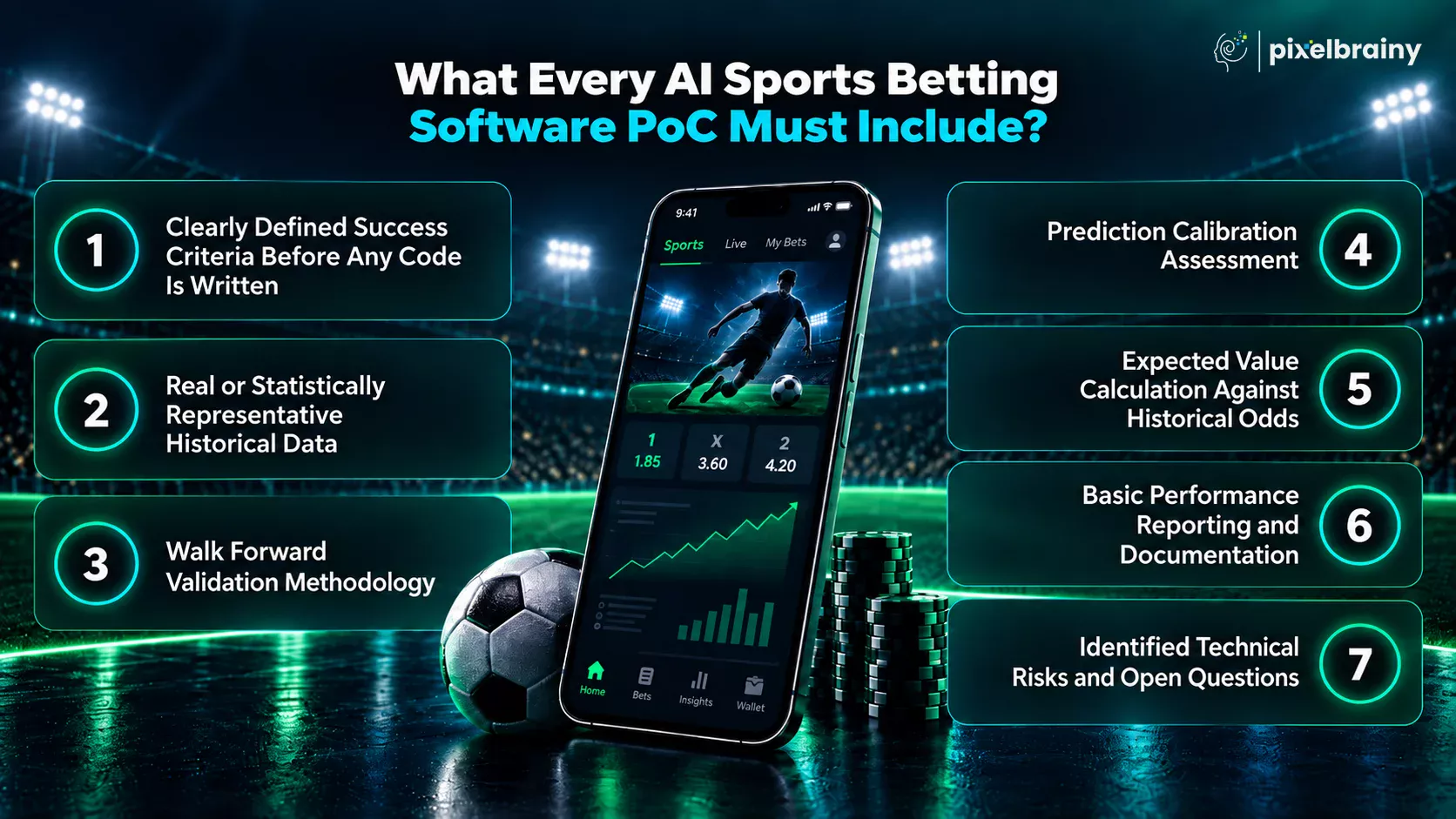
| Component | Why It Is Essential | Definition of Done |
|---|---|---|
| Clearly Defined Success Criteria | Eliminates ambiguity before development starts | Predefined KPIs with pass or fail benchmarks |
| Historical Sports Data | Ensures reliable model training and testing | Minimum three seasons of real historical data |
| Walk Forward Validation | Produces realistic prediction performance | Chronological training and testing methodology |
| Prediction Calibration | Measures probability reliability | Calibration curve and Brier Score analysis |
| Expected Value Analysis | Validates commercial profitability | Historical ROI and expected value calculation |
| Performance Reporting | Communicates technical findings | Comprehensive PoC evaluation report |
| Technical Risks & Open Questions | Supports future development planning | Documented risks and next-step recommendations |
One of the biggest reasons AI PoCs fail is the absence of measurable success criteria. Before development begins, founders, CTOs, and stakeholders should define exactly what constitutes success. This includes target prediction accuracy, acceptable API response time, expected paper trading performance, and model stability across multiple datasets.
For example, if your board requires an NFL prediction engine with more than 55% documented accuracy within 10 weeks, that benchmark becomes the primary success criterion. Establishing these metrics upfront ensures the PoC delivers a definitive pass or fail outcome instead of results that require subjective interpretation.
No AI prediction engine can outperform poor quality data. A build AI sports betting software PoC initiative should always rely on real historical sports data rather than synthetic, incomplete, or cherry-picked datasets. This includes historical game results, bookmaker odds, player statistics, injuries, weather conditions, and team performance metrics.
For major sports such as the NFL, NBA, or MLB, a minimum of three complete seasons of historical data is generally recommended to capture changing team dynamics, seasonal trends, and market behavior. High-quality datasets provide a realistic foundation for training and evaluating prediction models.
Traditional machine learning cross validation often produces misleadingly optimistic results because it unintentionally allows future information to influence model training. In sports betting, this creates unrealistic performance estimates.
Instead, developing AI sports betting PoC with backtesting engine and prediction accuracy validation should always include walk forward validation. This approach trains the model only on historical data available at a specific point in time and evaluates predictions on future matches. The result is a far more realistic assessment of how the model would perform in live betting environments.
Prediction accuracy alone does not determine whether an AI model is commercially useful. The model must also generate reliable probability estimates. If an event is predicted with a 60% probability, it should occur approximately 60% of the time over the long term.
Calibration testing bridges the gap between prediction accuracy and profitable betting strategies. Every PoC should evaluate calibration using techniques such as reliability diagrams and Brier Scores to ensure the model's confidence levels are trustworthy.
A prediction engine is valuable only if it creates profitable betting opportunities. Even a model with 56% accuracy may fail commercially if bookmaker odds require a significantly higher break-even threshold.
For this reason, every build AI sports betting PoC with real time odds integration and model validation project should calculate expected value (EV), simulated return on investment (ROI), and betting profitability using historical bookmaker odds. This demonstrates whether the model generates sustainable long-term value rather than simply achieving acceptable prediction accuracy.
A credible PoC should conclude with a structured performance report that both technical and business stakeholders can understand. The report should summarize prediction accuracy by market, calibration metrics, expected value, historical ROI, latency measurements, data quality assessment, and whether predefined success criteria were achieved.
This documentation becomes particularly valuable for startups preparing investor presentations or board reviews because it converts technical findings into measurable business outcomes.
A successful PoC should not only highlight what worked but also identify unresolved technical risks. These may include data quality limitations, feature engineering opportunities, infrastructure scalability, live data integration challenges, or regulatory considerations.
Documenting these open questions transforms the PoC into a practical roadmap for MVP and production development. It enables founders and CTOs to prioritize future engineering efforts while reducing technical uncertainty before committing larger budgets.
A successful AI sports betting PoC is not the one that builds the most features, but the one that provides clear technical evidence for whether the prediction engine is truly ready to move into full scale development.
A successful AI sports betting software PoC development should deliver technical validation quickly, not become a long product development project. For founders and CTOs working under investor deadlines, such as preparing a board demonstration within 8 to 10 weeks, the objective is to validate the prediction engine, not build a production sportsbook.
The roadmap below outlines the steps to build AI sports betting software PoC from idea to technical validation in 2026 while keeping the timeline realistic and execution focused.
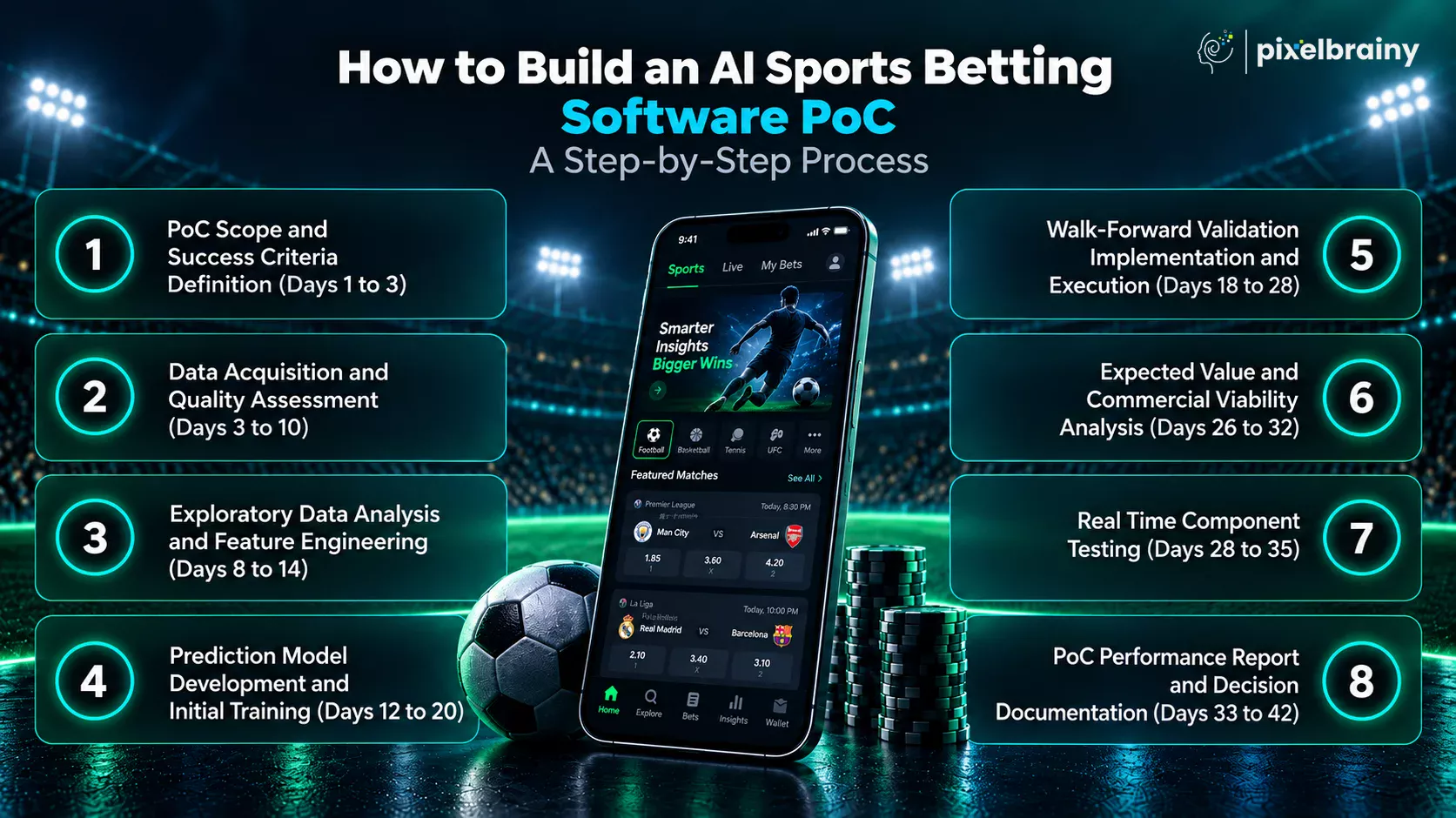
| Step | Timeline | Primary Deliverable |
|---|---|---|
| Define PoC Scope & Success Criteria | Days 1 to 3 | PoC specification document |
| Data Acquisition & Quality Assessment | Days 3 to 10 | Clean dataset and data quality report |
| Exploratory Data Analysis & Feature Engineering | Days 8 to 14 | Feature engineering specification |
| Prediction Model Development | Days 12 to 20 | Trained AI prediction model |
| Walk Forward Validation | Days 18 to 28 | Validation and calibration report |
| Expected Value Analysis | Days 26 to 32 | ROI and commercial viability report |
| Real Time Component Testing | Days 28 to 35 | Latency benchmark and paper trading results |
| Final PoC Report & Decision | Days 33 to 42 | Go or No Go recommendation |
Every successful PoC begins with one clearly defined technical objective. The team should identify the single most important question the PoC must answer, such as whether the AI model can achieve more than 55% prediction accuracy on NFL game outcomes. Define measurable success criteria, target sport, betting market, historical data period, validation methodology, and the business decision associated with each possible outcome.
Who is involved: CTO, Product Owner, AI Architect, Business Stakeholders
Deliverable: PoC specification document with success criteria and decision framework.
The next step is collecting reliable historical sports data, including bookmaker odds, game results, player statistics, injuries, weather conditions, and team performance metrics. Before model development begins, conduct a data quality audit to identify missing records, inconsistencies, duplicate entries, and look ahead bias that could invalidate the results.
Who is involved: Data Engineer, AI Engineer, Backend Engineer
Deliverable: Clean historical dataset and data quality assessment report.
Once the data is validated, explore distributions, correlations, and predictive patterns. Create meaningful features such as team form, Elo ratings, offensive efficiency, injury impact, and rolling averages. This stage helps identify which variables contribute the strongest predictive signal and lays the foundation for accurate model training.
Who is involved: Data Scientist, ML Engineer
Deliverable: Exploratory analysis report and feature engineering specification.
Now the development team can build AI sports betting software PoC by implementing the selected machine learning architecture. Train multiple models such as XGBoost, LightGBM, Random Forest, or Neural Networks, perform hyperparameter optimization, and compare performance while monitoring for overfitting.
Who is involved: ML Engineer, AI Architect
Deliverable: Trained prediction model with initial accuracy assessment.
Also Read: Top 12+ AI Model Development Companies in the USA
Instead of relying on standard cross validation, implement chronological walk forward validation. Train the model only on past data and evaluate it on future seasons to simulate real betting conditions. Collect prediction accuracy, calibration metrics, precision, recall, and confidence scores across every validation period.
Who is involved: ML Engineer, Data Scientist
Deliverable: Walk forward validation report with documented accuracy and calibration metrics.
Prediction accuracy alone does not guarantee profitability. Apply the model's probability estimates to historical bookmaker odds to calculate expected value (EV), simulated ROI, and bankroll performance using methods such as the Kelly Criterion. This determines whether the model can generate positive expected value under realistic betting conditions.
Who is involved: Quantitative Analyst, ML Engineer
Deliverable: Expected value analysis, simulated profit and loss report, and commercial viability assessment.
If live betting is part of the product vision, integrate the prediction engine with a live sports data API. Measure end to end latency from data ingestion to prediction output and run the system in paper trading mode to verify that predictions are generated within acceptable execution windows.
Who is involved: Backend Engineer, DevOps Engineer, ML Engineer
Deliverable: Latency benchmark report and initial paper trading results.
The final stage converts technical findings into business decisions. Compile all validation results into a comprehensive report that includes prediction accuracy, calibration performance, expected value, ROI, data quality assessment, latency metrics, technical risks, and a clear Go- or No-Go recommendation. This report becomes the primary artifact for board meetings, investor presentations, and future product planning.
For example, if you are a CTO preparing for a Series A board meeting in 10 weeks, this report should clearly demonstrate whether the AI prediction engine achieved the predefined success criteria and whether the company should proceed with hiring ML engineers or engaging an AI development partner. Similarly, startups with 8-week PoC deadlines often partner with experienced AI development companies in the USA that specialize in rapid sports data powered AI prototypes to accelerate delivery without compromising technical credibility.
Who is involved: CTO, AI Architect, Product Manager, Business Stakeholders
Deliverable: PoC performance report, stakeholder presentation, and documented Go- or No-Go recommendation.
A well-executed AI sports betting PoC is complete only when it delivers a clear technical decision backed by measurable evidence, not just a working machine learning model.
Also Read: AI Sports Betting App Development: Benefits, Steps and Cost
A successful AI sports betting software PoC development depends on a technology stack that enables rapid experimentation, reliable prediction accuracy, and measurable technical validation within a limited timeline. Since the objective of a PoC is to validate the AI prediction engine rather than build a production ready sportsbook, every technology should support faster model development, efficient data processing, and scalable testing.
For CTOs and founders planning to build AI sports betting software PoC, the technology stack should make it easier to train machine learning models, process historical sports data, integrate live odds, and generate investor ready performance reports. For example, if your board expects a working NFL prediction engine with more than 55% documented accuracy in just 10 weeks, using proven AI frameworks, cloud infrastructure, and sports data APIs significantly increases the chances of delivering a technically credible PoC within the deadline.
| Technology Layer | Recommended Technologies | Why It Is Required for the PoC |
|---|---|---|
| Programming Language | Python | The preferred language for AI development because it offers extensive libraries for machine learning, data processing, and API development, allowing teams to prototype quickly. |
| Machine Learning Frameworks | Scikit-learn, XGBoost, LightGBM, TensorFlow, PyTorch | Used to build, compare, train, and optimize multiple prediction models so the highest performing algorithm can be identified before production development. |
| Data Processing | Pandas, NumPy, Polars | Clean historical datasets, engineer predictive features, transform raw sports statistics, and prepare data for machine learning models. |
| Database | PostgreSQL, MongoDB | Store historical match results, betting odds, engineered features, prediction outputs, and model evaluation data in a structured manner. |
| Sports Data APIs | Sportradar, SportsDataIO, The Odds API | Provide access to historical match data, bookmaker odds, player statistics, injury reports, weather information, and live sports feeds required for accurate model training and testing. |
| API Framework | FastAPI | Expose the prediction engine through lightweight APIs, enabling stakeholders to test predictions without building a complete sportsbook application. |
| Workflow Automation | Apache Airflow | Automate data ingestion, preprocessing, model retraining, and scheduled workflows to reduce manual effort during experimentation. |
| Experiment Tracking | MLflow, Weights & Biases | Record datasets, model versions, hyperparameters, and evaluation metrics, ensuring every experiment is reproducible and easy to compare. |
| Cloud Infrastructure | AWS, Microsoft Azure, Google Cloud Platform | Provide scalable computing resources for model training, data storage, and API hosting without investing in dedicated infrastructure. |
| Containerization | Docker | Creates consistent development environments across all team members and simplifies deployment throughout the PoC lifecycle. |
| Version Control | Git, GitHub | Manage source code, track development changes, and enable collaborative engineering workflows during rapid PoC development. |
| Monitoring & Visualization | Prometheus, Grafana, Plotly | Monitor API latency, infrastructure health, prediction performance, and present technical results through dashboards for investors and stakeholders. |
A well-planned technology stack enables teams to validate the AI prediction engine faster, reduce technical uncertainty, and confidently decide whether the solution is ready for MVP or full-scale development.
Also Read: AI Sports Betting App MVP Development: Go from Idea to a Live AI Sports Betting MVP in 30 Days
A PoC result without a decision framework is just data. The purpose of AI sports betting software PoC development is not to generate an interesting technical report. It is to make a well-informed investment decision backed by measurable evidence that can be confidently defended to investors, board members, co-founders, and technical stakeholders.
Whether your goal is to secure Series A funding or decide whether to scale your engineering team, the PoC should provide a clear answer on whether the chosen AI prediction approach deserves further investment.
| PoC Outcome | Decision Trigger |
|---|---|
| All success criteria met | Proceed to full development with the validated architecture. |
| Core criteria met, secondary criteria failed | Proceed conditionally after completing a clearly defined remediation sprint. |
| Core criteria failed, secondary criteria met | Pause development and investigate the failed technical components before investing further. |
| All criteria failed or results are inconclusive | Do not proceed. Reassess the technical approach before allocating additional budget. |
A clear pass means the PoC achieved every predefined success criterion, including prediction accuracy, validation performance, calibration, and expected value targets. The underlying technical assumption has been validated, allowing the team to confidently build AI sports betting software PoC into a production roadmap.
However, a PoC validates the architecture under controlled conditions, not production scale. The full development plan should therefore include additional validation milestones to confirm that the same performance can be maintained with live data, larger workloads, and real-world infrastructure.
This is the most common outcome in AI sports betting proof of concept development. The prediction engine meets core business objectives, but secondary requirements such as latency, API performance, or market specific accuracy require improvement.
Before approving full development, determine whether these issues are technical blockers or simply engineering tasks that can be resolved within a defined timeline and budget. If remediation is realistic, proceed with a focused follow up sprint while documenting the exact milestones that must be completed before releasing the remaining development budget.
If prediction accuracy or expected value falls below predefined thresholds, resist making immediate assumptions. First verify that the historical data was representative, the datasets were sufficiently complete, walk forward validation was implemented correctly, and the selected model accurately represented the intended architecture.
If these conditions were met and results still failed, the evidence suggests that the proposed prediction strategy is not technically viable. In this case, the correct decision is to reassess the AI approach rather than continue investing in an ineffective architecture.
Inconclusive outcomes generally indicate unclear success criteria, insufficient historical data, or an overly limited PoC scope. Rather than moving directly into full development, identify the source of the uncertainty and conduct a targeted follow up investigation. Additional investment should only be approved after the PoC produces statistically meaningful and technically defensible results.
Different stakeholders evaluate PoC outcomes differently. Investors expect documented methodologies, walk forward validation across multiple seasons, calibration analysis, and expected value calculations against historical bookmaker odds. Boards expect success criteria that were defined before development began rather than adjusted after results were known.
Co-founders need transparent reporting that explains limitations, unresolved risks, and open technical questions alongside positive outcomes. Whether you develop AI sports betting PoC internally or through AI sports betting PoC development services, defensibility comes from transparent methodology, objective evidence, and honest interpretation rather than optimistic assumptions.
The final deliverable should be a transition document that converts PoC findings into a practical development roadmap. It should summarize the validated system architecture, confirmed prediction capabilities, unresolved technical risks, production performance benchmarks, and data source requirements that must remain consistent during future development.
For founders seeking an independent AI sports betting feasibility study development, this document also provides a technical foundation for evaluating agency recommendations and deciding whether the proposed architecture is truly feasible before committing significant engineering investment.
With a clear decision framework in place, the next step is understanding the cost of building an AI sports betting software PoC and the factors that influence its budget.
Understanding the cost of AI sports betting software PoC development is essential before allocating engineering resources or engaging an external AI development partner. Unlike MVP or full-scale platform development, a Proof of Concept is designed to answer one critical technical question: Can the AI prediction engine deliver measurable results that justify further investment? Since the scope is intentionally focused, the cost remains significantly lower while providing valuable technical and commercial validation.
For founders and CTOs preparing for investor presentations or board meetings, investing in a PoC is often the most cost-effective way to validate the prediction engine before committing to a larger development budget. For example, if your startup has 10 weeks to demonstrate an NFL prediction engine with more than 55% documented accuracy, a focused PoC provides the technical evidence needed without the expense of building a complete sportsbook.
| PoC Scope | Estimated Cost | Timeline | Best For |
|---|---|---|---|
| Basic AI Sports Betting PoC | $10,000 to $15,000 | 3 to 4 Weeks | Validating a single prediction model using historical sports data and basic accuracy metrics. |
| Standard AI Sports Betting PoC | $15,000 to $22,000 | 4 to 6 Weeks | Developing a machine learning prediction engine with feature engineering, walk forward validation, and performance reporting. |
| Advanced Investor Ready PoC | $22,000 to $30,000 | 6 to 8 Weeks | Building a comprehensive PoC with expected value analysis, calibration testing, real time data integration, API development, and stakeholder ready documentation. |
| Cost Factor | Impact on Budget |
|---|---|
| Sports Data Availability | Premium historical datasets and bookmaker odds increase licensing costs but improve model reliability. |
| Number of Sports or Markets | Supporting multiple leagues or betting markets requires additional data preparation and model training. |
| Machine Learning Complexity | Comparing multiple algorithms and tuning hyperparameters increases development effort. |
| Data Engineering | Cleaning, validating, and engineering high-quality features directly affects development time and prediction accuracy. |
| Live Data Integration | Connecting real time sports APIs adds implementation and testing effort. |
| Reporting Requirements | Investor ready dashboards, technical reports, and board presentation materials require additional documentation work. |
| Team Expertise | Experienced AI engineers and sports analytics specialists often deliver faster and more reliable PoC outcomes. |
Compared to the cost of developing an MVP or a production ready sportsbook, a PoC represents a relatively small investment with significant strategic value. Instead of spending months building features around an unproven prediction engine, businesses validate the technical foundation first. This reduces engineering risk, improves investor confidence, and helps founders make evidence-based product decisions before committing larger budgets.
For startups seeking funding, the return on investment is often measured not only by prediction accuracy but also by the confidence a validated PoC creates during board reviews and investor discussions.
A well-executed AI sports betting software PoC costing between $10,000 and $30,000 can prevent far larger development costs by proving whether the AI prediction engine is truly worth scaling.
Most AI sports betting software PoC development failures are not caused by an unsolvable prediction problem. They are caused by avoidable development and validation mistakes that produce misleading results and lead to poor investment decisions.
Identifying these mistakes before development begins costs nothing. Discovering them after presenting your PoC to investors or your board can cost both your funding opportunity and technical credibility.
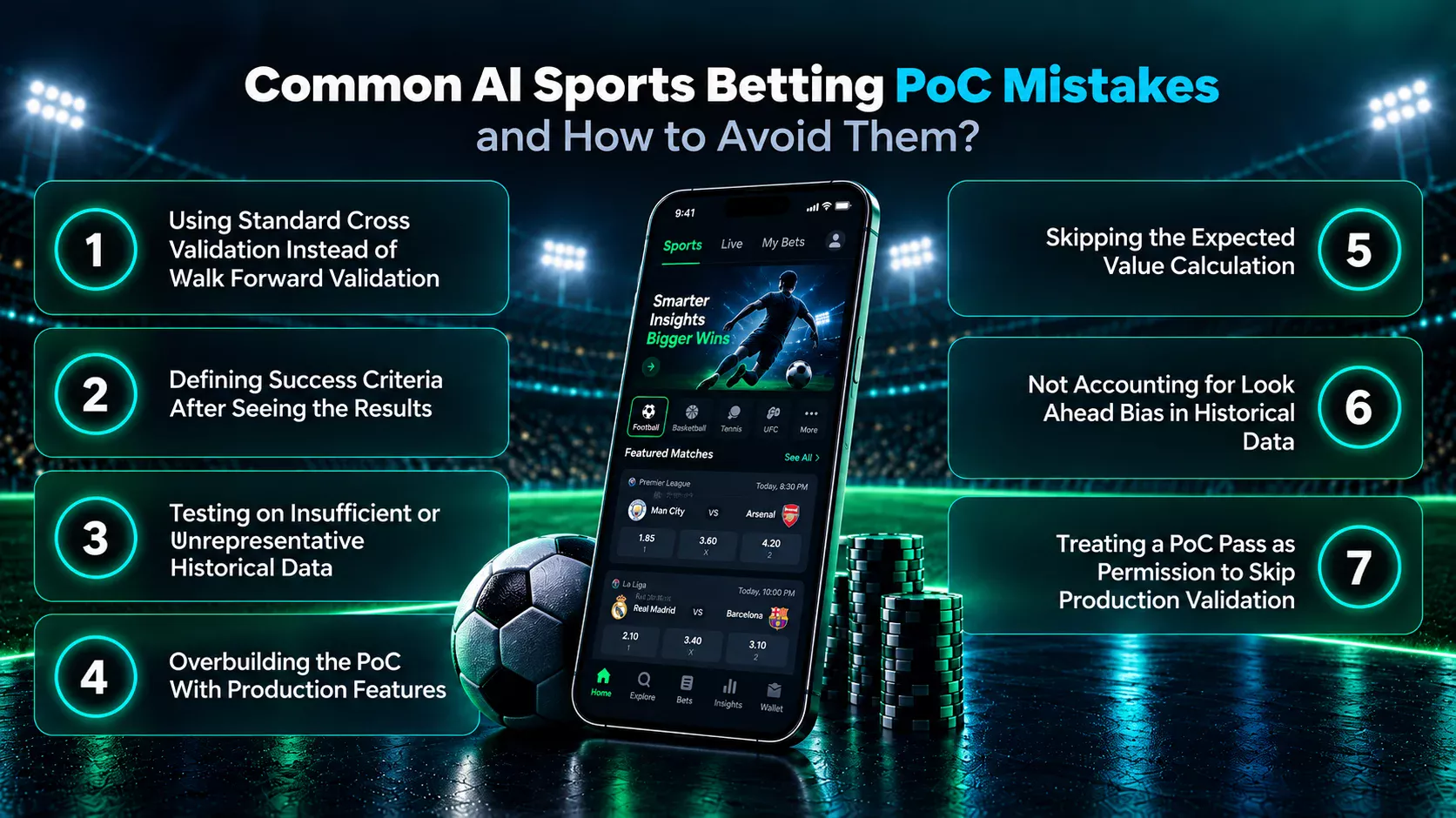
| Common Mistake | How to Avoid It |
|---|---|
| Using standard cross validation | Always implement walk forward validation with chronological data splits. |
| Defining success criteria after development | Document measurable pass or fail criteria before writing any code. |
| Testing on limited historical data | Use at least three complete seasons of representative historical data. |
| Overbuilding the PoC | Focus only on validating the AI prediction engine and supporting components. |
| Ignoring expected value calculations | Measure profitability against historical bookmaker odds, not just prediction accuracy. |
| Allowing look ahead bias | Validate that every dataset reflects information available before each historical event. |
| Skipping production validation after a successful PoC | Treat the PoC as the first validation milestone, not the final one. |
This is the most common and costly mistake in AI sports betting proof of concept development. Traditional cross validation randomly mixes historical data, allowing the model to learn from future events that would never have been available during live betting. This produces inflated accuracy results that cannot be replicated in production. Walk forward validation is the industry standard because it evaluates the model using only past information, making the results realistic and technically defensible.
Success criteria should never be adjusted to fit the outcome of the PoC. Doing so creates confirmation bias and turns the PoC into a demonstration instead of a decision-making tool. Before you build AI sports betting software PoC, document the required prediction accuracy, expected value, latency targets, and paper trading period. Predefined benchmarks ensure the final decision is objective rather than subjective.
Validating a model on a single season or carefully selected datasets rarely reflects real betting conditions. A credible PoC should use at least three complete seasons of historical data covering changing team performance, coaching strategies, injuries, and market conditions. This provides statistically meaningful results and increases investor confidence in the model's reliability.
Many teams spend valuable time building dashboards, mobile applications, user authentication, bankroll management, and bookmaker integrations during the PoC stage. While these features are important later, they do not validate the prediction engine. Every feature included in the PoC should directly contribute to answering the core technical question. If it does not improve technical validation, it belongs in the MVP or production phase instead.
Prediction accuracy alone does not determine commercial success. A model with strong accuracy may still lose money if bookmaker odds eliminate any betting advantage. Every develop AI sports betting PoC initiative should calculate expected value, simulate historical returns, and evaluate bankroll performance using historical odds. This confirms whether prediction accuracy translates into sustainable profitability.
Historical datasets often contain information that would not have been available before a game, such as updated injury reports or corrected statistics. Training models on this data creates unrealistic performance that disappears in live deployment. Every dataset should be reviewed for point in time accuracy before model training begins to eliminate look ahead bias and maintain technical credibility.
A successful PoC proves that the proposed AI approach works under controlled testing conditions. It does not guarantee production performance under live traffic, larger datasets, or changing market conditions. Teams using AI sports betting PoC development services should include additional validation milestones during MVP and production development, including live monitoring, scalability testing, and continuous model evaluation. This approach aligns with AI sports betting software PoC development best practices for technical validation and investor readiness in 2026 and reduces the risk of unexpected production failures.
For founders preparing for investor reviews or seeking an independent feasibility assessment after receiving conflicting technical advice, avoiding these mistakes ensures the PoC delivers objective evidence instead of misleading optimism. It also helps identify whether the proposed architecture is genuinely viable or whether fundamental technical changes are required before scaling.
Avoiding these mistakes today can save far more than your PoC budget tomorrow, while giving investors confidence that your technical decisions are based on evidence rather than assumptions.
Turning an AI sports betting idea into a technically credible Proof of Concept requires far more than machine learning expertise. It demands a structured development methodology, reliable sports data pipelines, investor focused validation, and a clear roadmap from experimentation to production. As one of the companies that develop PoC for AI sports betting software, PixelBrainy helps founders, CTOs, and sports betting businesses validate their AI prediction engines before they invest in MVP or enterprise scale platform development.
Whether your objective is preparing for a funding round, validating a new prediction strategy, or answering critical technical feasibility questions, our approach focuses on delivering measurable results instead of assumptions.
At PixelBrainy, we understand that investors do not fund AI ideas. They fund validated technical execution. That is why every PoC we build is designed to answer one business critical question: Should you move forward with full product development or refine the technical approach first?
Our team helps clients:
One of our recent engagements involved a sports technology startup preparing for an important investor review. The founding team had nine weeks to demonstrate that its AI engine could predict professional football outcomes with commercially viable accuracy before securing its next funding milestone.
Instead of building a complete betting platform, we developed a focused PoC that included historical sports data engineering, feature engineering, multiple machine learning models, walk forward validation, calibration analysis, expected value calculations, and an interactive reporting dashboard.
The final PoC achieved the predefined technical benchmarks established during project discovery and provided clear evidence that the selected AI architecture was suitable for MVP development. More importantly, it gave the leadership team a data driven foundation for investor discussions and engineering expansion. Client identity remains confidential under NDA.
Organizations looking for companies that develop PoC for AI sports betting software need more than AI developers. They need a partner that understands sports analytics, machine learning validation, investor expectations, and rapid product strategy.
Whether you want to create an AI sports betting PoC, explore how to develop an AI sports betting PoC, or need expert guidance to make an AI sports betting PoC before hiring a larger AI team, PixelBrainy delivers a structured process focused on technical validation, commercial feasibility, and faster decision making.
One of the most common questions we receive is:
"Before we hire ML engineers or engage a full development agency, can an experienced AI partner build a focused PoC that proves our prediction engine works before our next investor meeting?"
The answer is yes. Our PoC engagement model is specifically designed for founders and CTOs who need rapid technical validation within compressed timelines, helping them reduce risk before making significant engineering and funding commitments.
Connect with PixelBrainy to create an AI sports betting PoC that validates your prediction engine with the technical evidence investors and stakeholders expect before full scale development.
Building an AI powered sports betting platform should always begin with validation, not assumptions. A well-executed AI sports betting software PoC development helps founders and CTOs confirm whether their prediction engine can deliver measurable accuracy, positive expected value, and technical feasibility before investing in MVP or full-scale product development. Instead of committing significant budgets to an unproven concept, businesses that build AI sports betting software PoC first gain the evidence needed to make confident engineering and investment decisions.
Throughout this guide, we explored the complete AI sports betting proof of concept development process, from defining success criteria and selecting the right tech stack to validating prediction models and interpreting PoC results. By following a structured approach, you can reduce technical risk, strengthen investor confidence, and ensure every development decision is backed by data rather than speculation. Whether your objective is securing funding, validating a new AI strategy, or preparing for product development, a focused PoC is the smartest first step toward long term success.
Ready to build AI sports betting software PoC with confidence? Schedule a call with the PixelBrainy team to discuss your technical goals and discover how we can turn your AI sports betting vision into an investor ready Proof of Concept.
The timeline for AI sports betting software PoC development usually ranges from 4 to 8 weeks, depending on the project scope, data availability, and validation requirements. A focused PoC prioritizes prediction accuracy, machine learning validation, and technical feasibility instead of production features, allowing startups to evaluate the core AI engine within a compressed timeframe.
If your goal is to validate the AI engine quickly before raising funding or expanding your engineering team, partnering with experienced companies that develop PoC for AI sports betting software is often the faster and lower risk option. It provides access to AI specialists, proven methodologies, and sports analytics expertise without long term hiring commitments.
To create an AI sports betting PoC, you typically need historical match results, bookmaker odds, player statistics, injury reports, team performance metrics, and weather data. High-quality historical datasets covering multiple seasons help machine learning models identify meaningful patterns and produce technically reliable prediction results.
There is no universal benchmark because required accuracy depends on the betting market and bookmaker margins. Instead of focusing only on prediction accuracy, a credible AI sports betting proof of concept development should also validate expected value, calibration, and historical profitability to determine whether the model is commercially viable.
Yes. A well designed PoC can be built for sports such as the NBA, MLB, NHL, soccer, cricket, tennis, or mixed betting markets. However, many founders choose to develop AI sports betting PoC for a single sport first because it reduces complexity and provides faster technical validation before expanding to additional markets.
Investors generally focus on documented methodology rather than headline accuracy. They expect evidence of walk forward validation, calibration testing, expected value analysis, and transparent technical reporting. A professionally executed build AI sports betting software PoC project demonstrates that the prediction engine has been validated using industry accepted evaluation methods.
Absolutely. A successful PoC is designed to become the technical foundation for future development. Once the AI model is validated, the same architecture can be extended with user management, payment processing, bookmaker integrations, live betting, compliance, and other production features without rebuilding the prediction engine from scratch.
The most reliable approach is to conduct an AI sports betting software PoC development focused on validating the prediction engine using real historical sports data. A structured PoC identifies whether your proposed architecture, machine learning models, and data sources can achieve the predefined technical and commercial success criteria before significant development investment is made.

About The Author
Sagar Bhatnagar
Sagar Sahay Bhatnagar brings over a decade of IT industry experience to his role as Marketing Head at PixelBrainy. He's known for his knack in devising creative marketing strategies that boost brand visibility and market influence. Sagar's strategic thinking, coupled with his innovative vision and focus on results, sets him apart. His track record of successful campaigns proves his ability to utilize digital platforms effectively for impactful marketing efforts. With a genuine passion for both technology and marketing, Sagar continuously pushes PixelBrainy's marketing initiatives to greater success.

Working with the PixelBrainy team has been a highly positive experience. They understand the design requirements and create beautiful UX elements to meet the application needs. The dev team did an excellent job bringing my vision to life. We discussed usability and flow. Sagar worked with his team to design the database and begin coding. Working with Sagar was easy. He has the knowledge to create robust apps, including multi-language support, Google and Apple ID login options, Ad-enabled integrations, Stripe payment processing, and a Web Admin site for maintaining support data. I'm extremely satisfied with the services provided, the quality of the final product, and the professionalism of the entire process. I highly recommend them for Android and iOS Mobile Application Design and Development.

Great experience working with them. Had a lot of feedback and I found that unlike most contractors they were bugging me for updates instead of the other way around. They were extremely time conscience and great at communicating! All work was done extremely high quality and if not on time, early! They were always proactive when it comes to communication and the work is great/above par always. Very flexible and a great team to work with! Goes above and beyond to present us with multiple options and always provides quality. Amazing work per usual with Chitra. If you have UI/UX or branding design needs I recommend you go to them! Will likely work with them in the future as well, definitely recommended!

PixelBrainy is a joy to work with and is a great partner when thinking through branding, logo, and website layout. I appreciate that they spend time going into the "why" behind their decisions to help inform me and others about industry best practices and their expertise.

I hired them to design our software apps. Things I really like about them are excellent communication skills, they answer all project suggestions and collaborate right away, and their input on design and colors is amazing. This project was complex and needed patience and creativity. The team is amazing to do business with. I will be using them long-term. Glad to see there are some good people out there. I was afraid to try and outsource my project to someone but I am glad I met them! I really can't say enough. They went above and beyond on this project. I am very happy with everything they have done to make my business stand out from the competition.

It was great working with PixelBrainy and the team. They were very responsive and really owned the project. We'll definitely work with them again!

I recently worked with the PixelBrainy team on a project and I was blown away by their communication skills. They were prompt, clear, and articulate in all of our interactions. They listened and provided valuable feedback and suggestions to help make the project a success. They also kept me updated throughout the entire process, which made the experience stress-free and enjoyable.

PixelBrainy is very good at what it does. The team also presents themselves very professionally and takes care of their side of things very well. I could fully trust them taking up the design work in a timely and organised manner and their attention to detail saved us lots of effort and time. This particular project was quite intense and the team showed that they function very well under pressure. Very much looking forward to working with her again!

It's always an absolute pleasure working with them. They completed all of my requests quickly and followed every note I had for them to a T, which made our process go smoothly from start to finish. Everything was completed fast and following all of the guidelines. And I would recommend their services to anyone. If you need any design work done in the future, PixelBrainy should be your first call!

They took ownership of our requirements and designed and proposed multiple beautiful variants. The team is self-motivated, requires minimum supervision, committed to see-through designs with quality and delivering them on time. We would definitely love to work with PixelBrainy again when we have any requirements.

PixelBrainy was a big help with our SaaS application. We've been hard at work with a new UI/UX and they provided a lot of help with the designs. If you're looking for assistance with your website, software, or mobile application designs, PixelBrainy and the team is a great recommendation.

PixelBrainy designers are amazing. They are responsive, talented, and always willing to help craft the design until it matches your vision. I would recommend them and plan to continue them for my future projects and more!!!

They were awesome! Did a good job fast, and good communication. Will work with them again. Thank you

Creative, detail-oriented, and talented designers who take direction well and implement changes quickly and accurately. They consistently over-delivered for us.

PixelBrainy team is very talented and creative. Great designers and a pleasure to work with. PixelBrainy is an excellent communicator and I look forward to working with them again.

PixelBrainy has a very talented design team. Their work is excellent and they are very responsive. I enjoy working with them and hope to continue on all of our future projects.


Transform your ideas into reality with us.
Across these industries, each engagement brings unique challenges, from early-stage product development to scaling complex systems, helping us build a practical understanding of real-world product environments.