AI Summary Powered by PixelBrainy
Can a 12-person editorial team really keep up with 3 million subscribers demanding fresh stories every day without compromising the quality that built their audience?
Imagine a digital media company publishing around 200 original stories every month across its website and mobile applications. Its 12 writers are already working at full capacity, yet its 3 million subscribers expect new, engaging content almost every day. Hiring more writers could increase production, but it also brings higher salaries, longer hiring cycles, additional management requirements, and greater editorial coordination. The bigger challenge is determining whether AI can increase content capacity without turning quality into a trade-off.
This is where AI storytelling platform development becomes a strategic opportunity for digital publishers. Instead of using AI as a simple text generator, publishers can build an intelligent content production system that supports the complete storytelling workflow, from ideation and research to outlining, drafting, editing, personalization, quality evaluation, and publishing.
But there is an important distinction between AI-assisted storytelling and AI-autonomous publishing. AI can already perform many structured and repetitive tasks effectively, including generating story concepts, creating outlines, producing first drafts, rewriting content, summarizing research, adapting stories for different audiences, generating metadata, and repurposing existing content. However, originality, emotional depth, cultural sensitivity, factual judgment, narrative consistency, and final editorial approval can still require experienced writers and editors.
For organizations exploring storytelling platform development with AI, this means the right strategy is not to automate everything. It is to identify exactly which storytelling tasks AI can perform reliably, which tasks need human oversight, and which tasks should remain completely human-led.
That distinction should shape the entire custom AI storytelling software development process. Businesses researching how to create AI storytelling platform should begin with editorial benchmarks, quality thresholds, workflow analysis, and measurable business objectives before selecting AI models or development technologies.
The market opportunity is already significant. According to Grand View Research, the global generative AI in content creation market is estimated at $26.0 billion in 2026 and is projected to reach $80.1 billion by 2030, growing at a 32.5% CAGR from 2025 to 2030. The report was updated in July 2026, making it a relevant current-market indicator for businesses planning AI content investments.
For companies considering AI storytelling platform development services, the real goal is not simply to generate more stories. It is to build a scalable, measurable, human-supervised storytelling engine that enables a small editorial team to produce more high-quality content, faster and more efficiently, while protecting the voice, originality, and trust that readers expect.
An AI storytelling platform is an intelligent software system that uses generative AI, large language models, natural language processing, knowledge retrieval, recommendation algorithms, and workflow automation to help businesses create, manage, personalize, and distribute stories at scale. Unlike a basic AI story generator that produces text from a single prompt, an AI-powered storytelling platform can support the complete content lifecycle, including story ideation, research, outlining, character development, narrative generation, editing, quality evaluation, personalization, and publishing.
For digital media companies, AI storytelling software development creates a centralized environment where writers, editors, and AI systems can work together. The platform can understand a publisher's editorial guidelines, preferred writing style, audience segments, historical content, story formats, and publishing requirements. This makes storytelling platform development with AI more suitable for enterprise publishing workflows than generic AI writing tools.
The working process of an AI storytelling platform generally follows a structured workflow:
Story Brief → AI Ideation → Research & Knowledge Retrieval → Story Outline → Content Generation → AI Quality Check → Human Editing → Personalization → Publishing → Performance Analysis
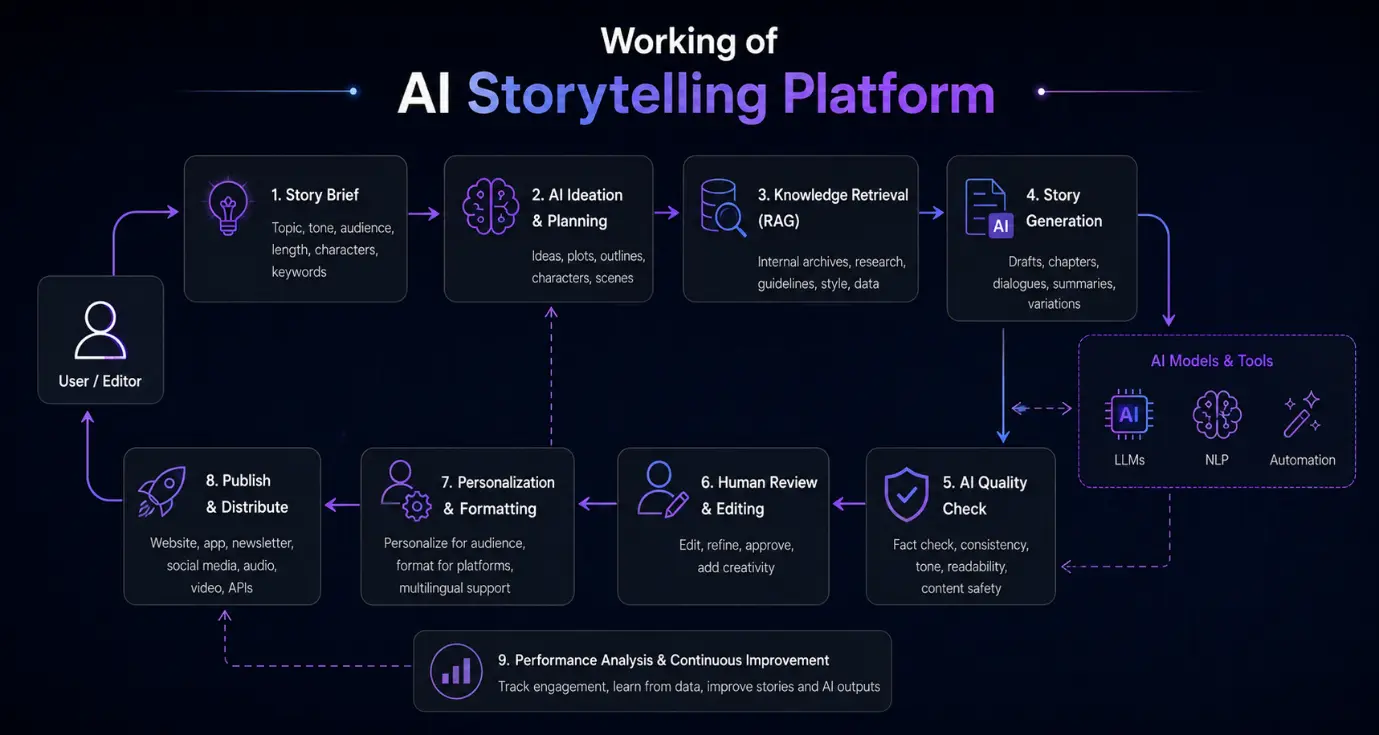
The process begins when a writer or editor provides instructions such as the topic, genre, target audience, tone, desired length, characters, setting, narrative style, keywords, and publishing channel.
The platform converts these requirements into structured instructions that AI models can process.
The AI storytelling system can generate multiple story concepts, plot directions, character profiles, chapter structures, scene ideas, conflicts, dialogue options, and possible endings.
Instead of replacing the writer, this stage gives the editorial team multiple creative starting points.
A sophisticated AI storytelling platform development solution can use Retrieval-Augmented Generation, or RAG, to connect an AI model with proprietary information such as previous stories, editorial guidelines, research documents, character databases, and approved content archives. RAG retrieves relevant information and provides it as context to the language model, helping produce more relevant and grounded outputs.
This is particularly valuable for publishers that need AI-generated stories to remain consistent with their existing content universe and editorial standards.
The selected AI model then generates the requested story, chapter, scene, dialogue, summary, or other content format.
A custom AI storytelling platform can use different models for different requirements, such as creative writing, summarization, translation, classification, quality evaluation, or multimedia generation.
Before publication, the platform can automatically evaluate content for:
The approved workflow then moves the content to writers or editors for final review. This human-in-the-loop approach allows AI to handle repetitive production tasks while experienced professionals retain control over originality, accuracy, emotional depth, and editorial judgment.
Once approved, stories can be distributed through websites, mobile applications, CMS platforms, newsletters, social media, audio channels, or other publishing systems. Engagement data can then help improve future recommendations, story formats, personalization, and AI workflows.
In simple terms, AI storytelling platform development connects human creativity with AI-powered content intelligence to create a faster, more scalable, and controlled storytelling workflow.
The digital storytelling industry is entering a phase where simply producing more content is no longer enough. Publishers, entertainment companies, content platforms, and media businesses are competing for audience attention across websites, mobile apps, search engines, AI answer engines, social platforms, audio channels, and personalized content feeds. At the same time, generative AI is moving from an experimental writing assistant into a core part of content workflows.
This creates a strong case for AI storytelling platform development in 2026. The opportunity is not about replacing writers with AI. It is about building proprietary infrastructure that connects human creativity, AI generation, audience data, editorial controls, content archives, and distribution channels into one intelligent storytelling ecosystem.
A relevant question for digital media businesses is:
Why should a digital publisher invest in a custom AI storytelling platform instead of simply subscribing to existing AI writing tools?
The answer lies in the strategic capabilities that a proprietary platform can create.
Many businesses initially adopt AI through separate tools for writing, summarization, image creation, translation, research, and content optimization. However, this creates fragmented workflows where writers repeatedly move information between different applications.
In 2026, the more strategic approach is to connect these capabilities within one AI storytelling platform.
A custom system can connect:
Content Brief → Research → Ideation → Story Development → AI Generation → Quality Evaluation → Human Editing → Personalization → Publishing → Analytics
This shift makes storytelling platform development with AI less about adding an AI writer and more about building an intelligent content production infrastructure.
The traditional publishing model largely depended on search engines, social distribution, newsletters, and direct traffic. AI answer engines are now becoming another discovery layer.
The Reuters Institute's 2026 journalism, media, and technology report highlights a shift toward more distinctive content as publishers respond to an environment where AI systems can generate personalized answers across a huge range of subjects. Publishers surveyed placed greater emphasis on original reporting, analysis, human stories, community building, and verification.
This creates a strategic reason to invest in custom AI storytelling software development. Publishers need systems that can help them produce distinctive, structured, trustworthy content while maintaining a recognizable editorial identity.
A generic AI writing application is accessible to competitors. A platform trained and configured around a publisher's own content ecosystem is different.
A custom AI storytelling software can connect with:
This creates a proprietary intelligence layer around the publisher's content.
The strategic opportunity is therefore not simply to use AI. It is to combine AI with information and workflows that competitors cannot easily replicate.
The growing adoption of creative AI provides another reason for investment.
Adobe's 2026 Creators' Toolkit Report found that 75% of surveyed creators describe creative AI as integrated or essential to their workflow, while 87% of creators using creative AI say it has accelerated the growth of their business or audience. The study surveyed more than 16,000 creators globally.
For media companies, this indicates that AI-assisted creation is moving beyond experimentation.
The opportunity is to build a controlled environment where AI supports professional storytelling rather than relying on disconnected consumer-grade tools.
Modern audiences increasingly expect content experiences that respond to their interests, preferences, and behavior.
A story platform can eventually support experiences such as:
Research from Alvarez & Marsal's 2026 media and entertainment study found that 88% of surveyed consumers expressed interest in adaptive AI-enabled content, while 69% wanted an active role in storytelling, including participating as a protagonist or created character.
This points toward a broader evolution from static content toward adaptive storytelling experiences.
A modern story does not have to remain a text article.
A single approved narrative can become:
Story → Illustration → Audio Episode → Video Script → Short Video → Social Content → Newsletter → Interactive Experience
This makes AI storytelling platform development services particularly relevant for media companies that want one centralized content pipeline.
Instead of developing separate AI systems for text, audio, images, and video, organizations can create an orchestration layer that manages multiple AI capabilities around the same story.
The 2026 FIFA World Cup also demonstrates the broader movement toward AI-supported content delivery, with broadcasters using AI for automated highlights, multilingual content, personalization, and multi-format audience experiences.
The AI content generation market is expanding rapidly. The Business Research Company estimates that the global artificial intelligence content generation market will grow from $4.81 billion in 2025 to $7.09 billion in 2026, representing a 47.3% CAGR.
For businesses, this signals an important transition.
The question is gradually shifting from:
"Should we experiment with AI-generated content?"
to:
"What AI infrastructure should become part of our long-term content operation?"
That distinction is particularly important for large publishers producing hundreds or thousands of stories every month.
Another reason to invest in AI storytelling platform development in 2026 is the rapid evolution of AI models.
Instead of building a platform around one specific model, businesses can create a model orchestration layer that allows them to select different models according to:
This approach protects the platform from becoming dependent on one AI provider and makes it easier to adopt better models as they become available.
AI-generated content introduces questions around accuracy, originality, copyright, provenance, transparency, and editorial accountability.
A proprietary platform can embed these controls directly into the content workflow.
For example, every story could maintain information about:
This creates an auditable content pipeline rather than treating AI generation as a black-box activity.
The competitive opportunity is not simply about adopting AI early. It is about building a proprietary system before competitors establish their own AI-powered editorial infrastructure.
A publisher that starts today can develop its own evaluation datasets, editorial feedback loops, story knowledge bases, audience models, content taxonomies, and AI workflows over time.
The longer these systems operate, the more valuable their proprietary data and workflow intelligence can become.
For a company publishing 200 stories every month with a 12-person editorial team and 3 million subscribers, the decision should not be based on whether AI can generate a complete story.
The better question is:
Which parts of our storytelling workflow can AI perform reliably today, which require human expertise, and how can we build a proprietary platform that connects both into one scalable publishing system?
That question provides a much stronger foundation for deciding whether to invest in AI storytelling platform development, what to automate first, and where human editorial control should remain mandatory.
In 2026, the biggest opportunity is not simply generating stories with AI, but building an intelligent storytelling infrastructure that makes AI, proprietary content data, and human creativity work together.
Not every business needs the same type of AI storytelling platform. A consumer story generator, children's learning platform, interactive fiction product, and enterprise narrative system may all use generative AI, but their users, content workflows, safety requirements, technical architecture, and monetization models are completely different.
Therefore, when planning AI storytelling platform development, founders should first define who will use the platform, what type of stories it will create, and how those stories will generate business value.
Here are the major types organizations can consider when they want to build AI storytelling platform products in 2026.
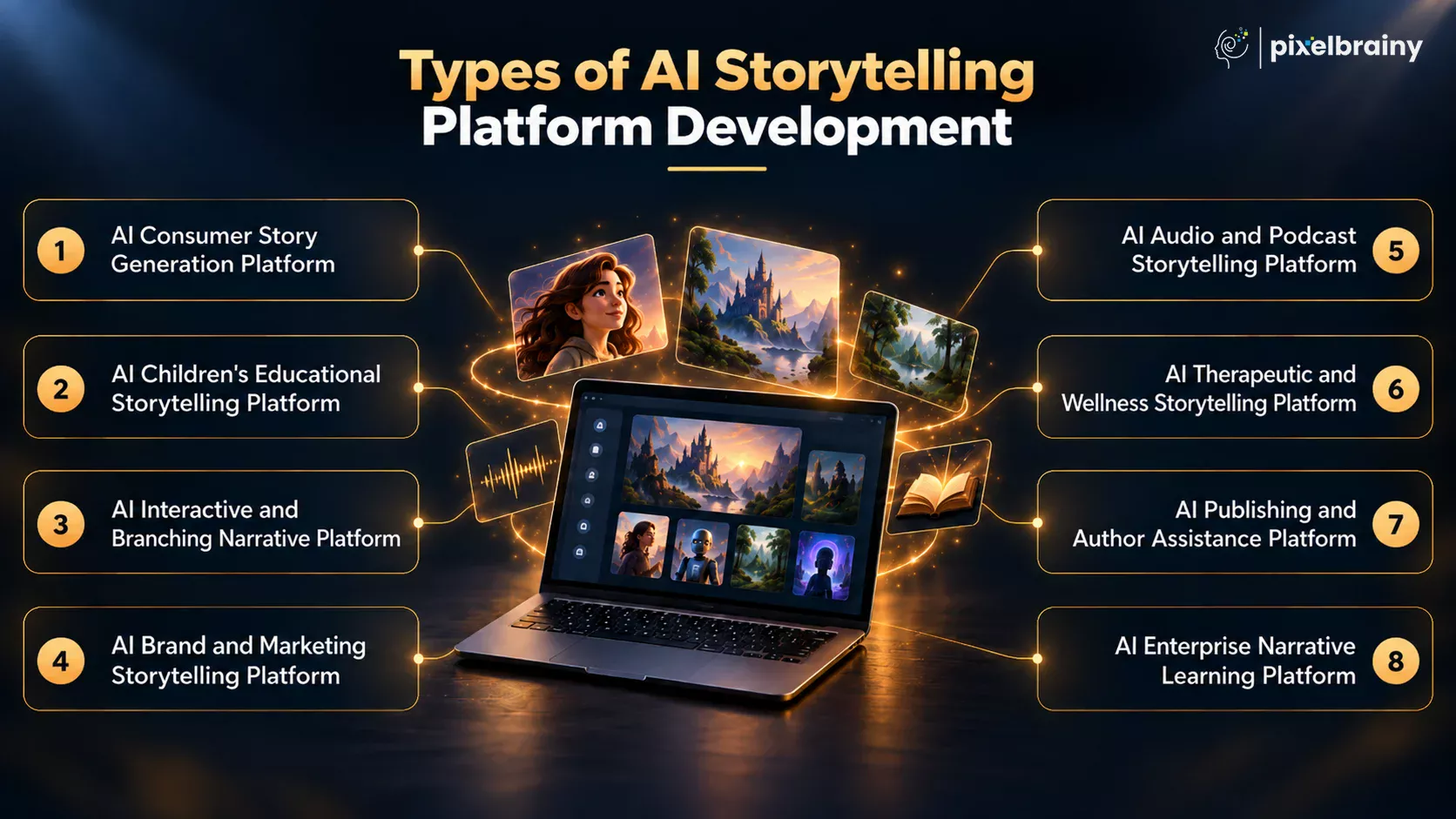
A consumer-facing platform allows individual users to create personalized stories by selecting genres, characters, settings, themes, story lengths, and emotional tones. Because this is the broadest consumer category, competition is high and simply generating text is unlikely to create sustainable differentiation.
Key product design implication: Focus on narrative quality, deep personalization, genre-specific expertise, intuitive story creation, and strong retention features rather than treating AI generation as the primary product differentiator.
This platform combines entertainment and learning by generating age-appropriate stories calibrated to a child's reading level, interests, language, and educational objectives. It can personalize stories around a child's name, favorite characters, vocabulary level, or learning goals provided by parents and teachers.
For example, a relevant founder query could be: "I am an edtech founder building an AI storytelling platform for children aged 6 to 12. How can I create personalized stories that incorporate each child's name, favorite characters, and learning objectives specified by parents and teachers while keeping the experience age appropriate, educationally useful, and safe?"
Key product design implication: Child safety, parental controls, data minimization, age-appropriate generation, content moderation, and privacy compliance must be foundational rather than added after development. For services covered by COPPA, the FTC requires specific protections around children's personal information, including parental notice and verifiable parental consent in applicable situations.
This type is particularly suitable for edtech founders, educational publishers, schools, and literacy-focused organizations.
An interactive narrative platform creates stories where reader or player decisions influence characters, events, relationships, and future story paths. The experience can support hundreds of possible narrative branches while maintaining consistency across the evolving story world.
Key product design implication: The architecture needs sophisticated narrative state management, character memory, world rules, branching logic, and continuity tracking so that every choice produces a coherent outcome.
This model is well suited to game studios, interactive fiction publishers, entertainment companies, and corporate learning applications.
This platform uses an organization's brand voice, messaging framework, customer profiles, and campaign objectives to generate marketing narratives, thought leadership content, campaign stories, case studies, and audience-specific content. It can help marketing teams create multiple content variations while maintaining consistent positioning.
Key product design implication: The platform needs a strong brand knowledge layer containing approved messaging, tone guidelines, terminology, audience segments, campaign information, and content approval workflows.
It is particularly suitable for marketing agencies, enterprise marketing teams, and companies developing proprietary content operations.
An AI audio storytelling platform can generate original audio drama scripts and transform them into narrated experiences using multiple AI voices. Advanced platforms can maintain character identities, voice consistency, sound design instructions, and narrative continuity across multiple episodes.
Key product design implication: The system should connect story generation with voice synthesis, character voice management, episode memory, sound design, audio editing, and distribution workflows.
This type is ideal for podcast networks, audiobook publishers, audio entertainment companies, and digital media platforms.
This platform generates narrative experiences designed around wellness or professionally defined therapeutic objectives, such as mindfulness exercises, resilience-building stories, emotional regulation activities, and narrative therapy prompts. Because these experiences can influence users' emotional wellbeing, content should be developed with appropriate professional oversight.
Key product design implication: Clinical or subject-matter review, emotional safety controls, escalation mechanisms, age-appropriate safeguards, and carefully defined content boundaries should be incorporated into the architecture.
This model can serve mental wellness organizations, wellness platforms, therapeutic practice tools, and organizations working with qualified mental health professionals.
An author-focused platform helps professional writers and publishers develop existing intellectual property. It can assist with chapter continuation, alternative plot exploration, character backstories, editing, companion content, and expansion of established story universes.
Key product design implication: Strong IP consistency, author voice preservation, version control, story-bible architecture, and permission-based content access are essential when working with proprietary literary content.
This type is particularly relevant to publishing houses, literary agencies, professional authors, and entertainment companies with established narrative IP.
An enterprise narrative learning platform uses AI to create interactive workplace scenarios where employees make decisions and experience different outcomes. Instead of passively consuming training material, learners can navigate realistic situations involving leadership, compliance, customer service, communication, ethics, and professional judgment.
Key product design implication: The platform needs scenario logic, role-based personalization, learning objectives, assessment mechanisms, analytics, and enterprise integrations with LMS and HR systems.
This model is suited to L&D technology companies, HR software providers, corporate training organizations, and large enterprises.
The platform type you choose first will determine your content safety architecture, IP consistency system, personalization engine, technical workflow, and monetization model for the entire AI narrative platform development process.
For publishers and entertainment businesses, AI storytelling platform development is not simply about generating stories faster. The larger opportunity is to create an intelligent content infrastructure that allows organizations to produce, personalize, manage, and monetize stories at a scale that traditional editorial workflows cannot easily support.
A custom AI powered storytelling platform development approach can connect generative AI with proprietary content libraries, audience data, editorial standards, story universes, and publishing systems. This creates a controlled environment where AI handles high-volume production tasks while human writers and editors continue to guide creative direction and quality.
For businesses planning to build AI storytelling platform, the following benefits can have the greatest commercial impact.
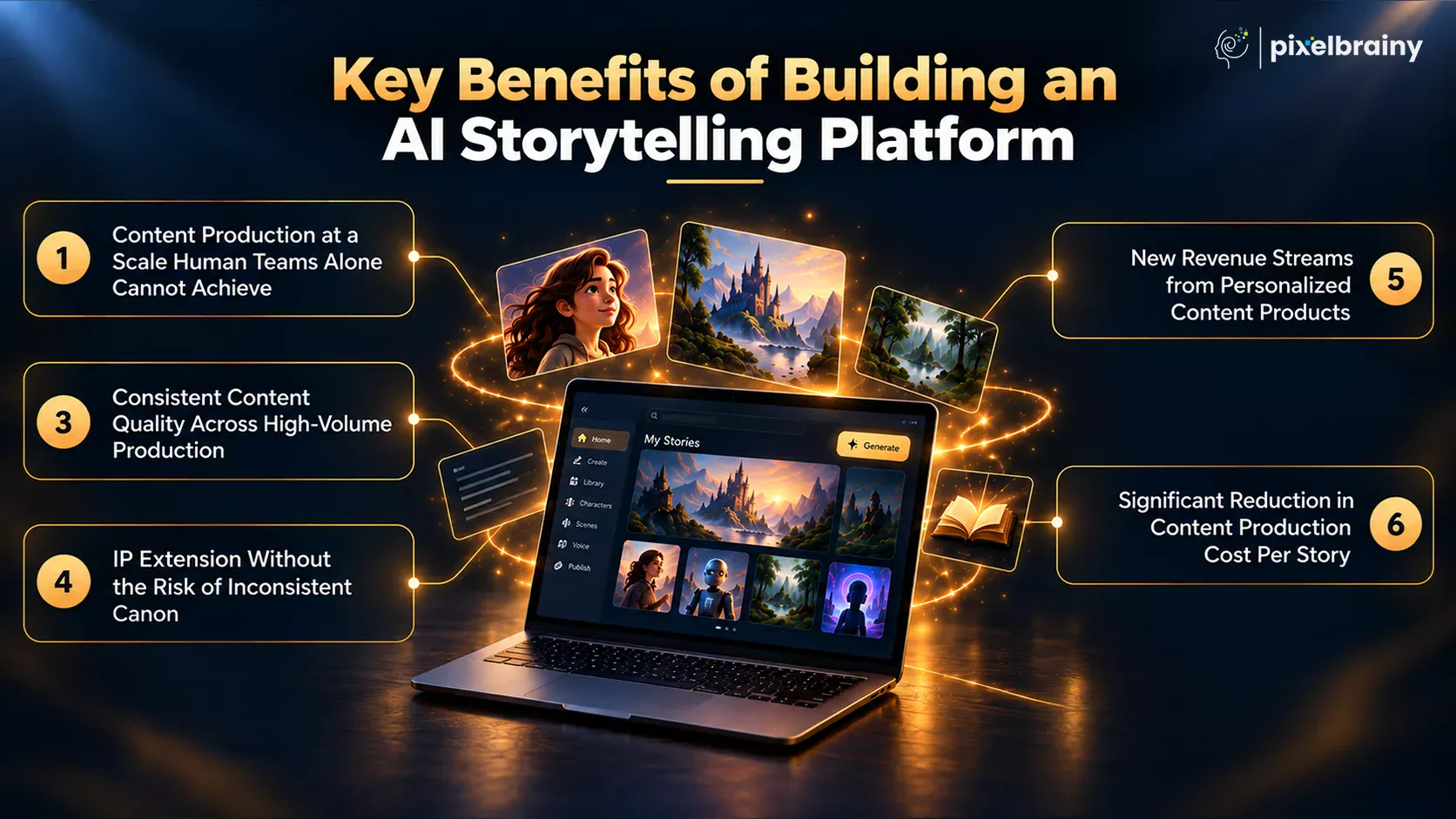
A growing publisher can quickly reach a point where audience demand exceeds the capacity of its editorial team. Writers need time to research, brainstorm, outline, draft, revise, fact-check, and prepare every story, making unlimited content production impossible through manual workflows alone.
Consider this real business query:
"Our editorial team cannot keep up with the content demand from our 3 million subscribers who are asking for daily new story content. We currently publish around 200 original stories per month with 12 writers. How can we use an AI storytelling platform to increase our content output without sacrificing editorial quality or completely replacing our writers?"
A custom AI platform can address this bottleneck by assisting with story ideation, research organization, outlines, first drafts, summaries, rewrites, localization, metadata, and content repurposing. Writers can then spend more time on creative decisions and high-value editorial work while AI handles repetitive production activities.
The result is not simply more AI-generated text. It is a higher-capacity editorial operation where the same team can potentially manage a significantly larger content pipeline.
Traditional publishing generally creates one story for thousands or millions of readers. Creating a separate version manually for every audience segment would require enormous editorial resources.
An AI powered storytelling platform can create controlled personalization based on factors such as:
For example, the same story could have different introductions, character emphasis, reading complexity, or recommended follow-up stories for different audience segments.
This makes personalization a core product capability rather than a manual editorial task.
Increasing content volume can create quality problems. Different writers may use different tones, structures, terminology, and editorial approaches. AI-generated content can introduce additional issues such as repetition, factual inconsistencies, generic language, or character continuity errors.
A custom storytelling platform can embed quality controls directly into the production workflow.
It can automatically check:
Editors can establish quality thresholds and route content that requires additional review.
This allows companies to develop AI storytelling platform systems that support consistency without removing human editorial control.
For publishers and entertainment companies, existing intellectual property can represent one of their most valuable assets.
An established story universe may contain hundreds of characters, locations, relationships, events, timelines, and narrative rules. Manually extending that universe across new stories, formats, and channels becomes increasingly difficult.
A custom platform can create a structured story bible and IP knowledge layer containing approved information about characters, events, locations, relationships, timelines, and world-building rules.
AI can then use this information when generating new content.
This can support:
The objective is not to let AI freely modify an IP universe. It is to create controlled AI-assisted expansion while preserving established canon.
Creating an AI storytelling platform can also transform content from a fixed product into a customizable experience.
Businesses can explore monetization models such as:
For example, a publisher could offer subscribers a premium feature that allows them to customize the genre, characters, narrative length, or reading experience of selected stories.
This creates opportunities to monetize personalization rather than relying exclusively on advertising, subscriptions, or traditional content sales.
Manual storytelling involves substantial costs across research, writing, editing, formatting, translation, publishing, and content repurposing.
AI can reduce the amount of human time required for repetitive tasks.
For example, after an approved story is created, the platform could automatically generate:
Story → Summary → Headline Options → Newsletter Version → Social Copy → Audio Script → Metadata → Multilingual Versions
Instead of assigning each transformation to a separate workflow, one AI-powered pipeline can coordinate these tasks.
The actual cost savings will depend on model usage, content complexity, editorial requirements, infrastructure, and the percentage of AI-generated work that requires human revision. Therefore, companies evaluating AI storytelling platform development services should measure cost per approved and published story, rather than cost per AI-generated word.
A well-designed AI storytelling platform turns storytelling from a high-volume manual process into a scalable, personalized, and commercially expandable content ecosystem.

A successful AI storytelling platform development project requires more than connecting a generative AI model to a text editor. The platform should provide a structured environment where writers, editors, publishers, creators, and readers can move from a story idea to a reviewed and publishable narrative through a controlled workflow.
When businesses build AI storytelling platform products, the core features should focus on everyday storytelling requirements such as content creation, editing, personalization, collaboration, quality control, and publishing. These foundational capabilities create the base for an AI powered storytelling platform without introducing the advanced features that require separate architectural considerations.
A useful real-world query for organizations planning AI storytelling platform development services is:
"We want to develop an AI storytelling platform for our digital media business. Which core features should we include in the first version so writers can generate stories faster, editors can maintain quality, and our team can publish content across web and mobile platforms?"
The answer starts with the following 15 essential features.
| Feature | What It Does and Why It Matters |
|---|---|
| AI Story Generator | An AI story generator creates complete narrative drafts from structured inputs such as topic, genre, characters, setting, tone, audience, and desired length. It gives writers a starting point while keeping creative control with the editorial team. |
| Story Idea Generator | A story idea generator helps users discover multiple concepts from a topic, theme, keyword, or audience requirement. It can suggest different plots, conflicts, characters, settings, and narrative directions before the writer begins drafting. |
| Story Brief Builder | A structured story brief builder converts basic user requirements into detailed creative instructions covering audience, genre, tone, length, characters, setting, objectives, and content guidelines. This creates clearer inputs for consistent AI-generated storytelling. |
| AI Story Outline Generator | The outline generator transforms an initial concept into an organized narrative structure containing introductions, scenes, conflicts, turning points, chapters, and conclusions. Writers can review and modify the structure before generating the complete story. |
| Character Profile Builder | A character profile builder allows writers to define names, personalities, backgrounds, motivations, relationships, goals, conflicts, and speaking styles. The platform can reuse these details when generating stories to maintain consistent character behavior. |
| Story Editor | An integrated AI story editor allows users to generate, revise, expand, shorten, rewrite, or refine selected sections without leaving the platform. Writers can experiment with different versions while preserving the original draft for comparison. |
| Genre and Tone Controls | Genre and tone controls allow users to specify whether a story should feel humorous, dramatic, mysterious, educational, adventurous, emotional, professional, or conversational. These controls help AI generation remain aligned with the intended storytelling experience. |
| AI Writing Assistant | An AI writing assistant supports writers during drafting by suggesting sentences, improving descriptions, refining dialogue, correcting grammar, simplifying language, and generating alternative passages. It functions as an editorial copilot rather than an autonomous replacement for writers. |
| Content Personalization | Personalization features allow the platform to adapt stories according to audience preferences such as language, reading level, interests, story length, genre preferences, and selected characters. This capability helps publishers create more relevant storytelling experiences at scale. |
| Content Quality Checker | A content quality checker evaluates generated stories against configurable requirements such as readability, grammar, repetition, tone, structure, factual claims, content guidelines, and brand standards. It can identify issues before content reaches the editorial approval stage. |
| Story Consistency Checker | A story consistency checker compares generated content against defined character details, story information, timelines, settings, and previous content. It helps identify contradictions that could reduce narrative quality, especially when writers develop longer or serialized stories. |
| Content Library | A centralized content library stores generated stories, drafts, approved versions, story briefs, characters, outlines, templates, and related assets. Searchable organization helps writers and editors quickly locate previous content and reuse approved material efficiently. |
| Collaboration and Approval Workflow | Collaboration tools allow writers, editors, reviewers, and administrators to work within the same storytelling workflow. Teams can assign drafts, leave comments, request revisions, track status, and approve content before publication. |
| Multilingual Story Generation | Multilingual generation enables users to create or adapt stories in different languages while maintaining the intended meaning, tone, characters, and narrative structure. This feature helps publishers expand storytelling experiences across international audiences without rebuilding every story manually. |
| CMS and Publishing Integration | CMS integration connects the AI storytelling platform with existing websites, mobile applications, publishing systems, newsletters, and distribution channels. Approved stories can move from editorial workflows into publishing systems without repetitive manual copying and formatting. |
The real value of AI storytelling platform development comes from connecting these features into one coherent workflow instead of developing them as isolated tools.
A typical experience can follow this path:
Story Brief → Idea Generation → Story Outline → Character Development → AI Story Generation → AI Editing → Quality Check → Human Review → Personalization → CMS Publishing
For example, a publisher could enter a story brief, generate five concepts, select one concept, create an outline, develop its characters, generate the first draft, refine specific sections using the AI writing assistant, run quality and consistency checks, send the story to an editor, personalize the approved version, and finally publish it through the connected CMS.
This workflow is particularly important when creating AI storytelling platform products for organizations that already have established editorial processes. The platform should complement those processes rather than forcing writers and editors to completely change how they work.
Businesses planning to develop AI storytelling platform products should avoid trying to include every possible AI capability in the first release. A focused MVP should establish reliable story creation, editing, quality control, collaboration, content management, and publishing workflows first.
Advanced capabilities such as autonomous storytelling agents, multimodal story generation, real-time adaptive narratives, predictive audience modeling, automated IP management, and sophisticated narrative intelligence can be evaluated separately after the foundational platform has demonstrated measurable value.
The core objective is to create a reliable storytelling environment where AI accelerates content production while writers and editors retain control over the final creative output.
In short, the right core features turn an AI storytelling platform from a simple content generator into a practical end-to-end storytelling workflow for modern media and entertainment businesses.
Once the foundational features of an AI storytelling platform are in place, businesses can introduce specialized capabilities that create stronger differentiation and support more sophisticated storytelling experiences. These non-ordinary features are not essential for every MVP, but they can become valuable for media companies, entertainment brands, publishers, gaming businesses, and organizations looking to develop AI storytelling platform products with capabilities beyond standard story generation.
For businesses planning AI storytelling platform development, the key question is not simply, "What advanced AI features can we add?" Instead, it should be, "Which specialized capabilities can create a storytelling experience that generic AI writing tools cannot easily replicate?"
A useful real-world query in this context is:
"We already have an AI storytelling platform that can generate and edit stories, but how can we differentiate our product from generic AI writing tools and create a more intelligent storytelling experience for our readers and content team?"
The following 10 non-ordinary features can help answer that question.
| Non-Ordinary Feature | What It Does and Why It Matters |
|---|---|
| Narrative Intelligence Engine | A narrative intelligence engine analyzes story structure, character development, pacing, conflicts, emotional progression, and narrative patterns. It can identify weak sections and recommend improvements, helping creators produce more compelling stories instead of relying only on basic text generation. |
| Dynamic Story Adaptation | Dynamic story adaptation allows the narrative to change according to reader behavior, preferences, choices, or engagement patterns. The platform can adjust pacing, character focus, story complexity, or narrative direction while preserving the central storyline and editorial boundaries. |
| AI Character Memory | AI character memory maintains information about a character's personality, relationships, history, motivations, preferences, and previous actions across multiple stories or episodes. This helps serialized storytelling platforms maintain believable characters instead of treating every generation as an isolated writing task. |
| Emotional Arc Intelligence | An emotional arc intelligence system analyzes how emotions develop throughout a story and identifies whether tension, excitement, fear, empathy, or resolution are appropriately distributed. Creators can use these insights to refine emotional pacing and strengthen audience engagement. |
| Story Universe Management | Story universe management creates a structured environment for managing characters, locations, timelines, relationships, events, objects, and narrative rules across an entire fictional universe. It is particularly valuable for publishers and entertainment companies managing large intellectual properties with multiple stories. |
| AI-Powered Reader Persona Simulation | Reader persona simulation allows creators to test how different audience profiles might respond to a story before publication. The system can evaluate narratives from perspectives such as young readers, genre enthusiasts, casual readers, or specific audience segments and provide structured feedback for refinement. |
| Predictive Story Engagement Engine | A predictive engagement engine analyzes historical content and audience behavior to identify story characteristics associated with stronger engagement. It can help creators evaluate potential topics, openings, story lengths, genres, and narrative formats before investing significant production resources. |
| Cross-Media Story Transformation | Cross-media transformation converts an approved narrative into multiple storytelling formats such as audio scripts, video scripts, illustrated scenes, interactive experiences, newsletters, and social content. This allows one core story asset to support multiple distribution channels while preserving its central narrative identity. |
| AI Story Experimentation Engine | An AI story experimentation engine enables publishers to test different openings, headlines, narrative lengths, character introductions, endings, and story formats with controlled audience segments. Performance data can then help determine which storytelling variations create stronger engagement without changing the underlying content strategy. |
| Story Provenance and AI Audit Trail | A story provenance system records how content was created, including AI models, prompts, source materials, generated versions, human edits, approvals, and publishing history. This provides greater transparency and accountability for organizations managing AI-generated content at enterprise scale. |
The key difference between a standard AI writing tool and a sophisticated AI powered storytelling platform is its ability to manage the entire storytelling experience, not just generate text.
For example, AI character memory can preserve a character's personality, relationships, and previous actions across multiple chapters. Similarly, story universe management can connect characters, locations, timelines, and events while maintaining consistency across an established fictional world.
Cross-media capabilities can also increase the value of AI storytelling platform development services by transforming one approved story into an article, audio episode, video script, newsletter, or interactive experience.
Advanced personalization and experimentation can further help platforms understand audience preferences and identify which narrative formats perform better.
Not every business needs all 10 features. Media publishers may prioritize story universe management and cross-media transformation, while entertainment platforms may focus on dynamic narratives and character memory.
When creating AI storytelling platform products, choose features based on your target audience, content IP, distribution channels, business model, and product objectives.
The right advanced features can turn an AI storytelling platform into a differentiated and intelligent storytelling ecosystem.
Also Read: How to Build an AI Avatar Generator Platform Like HeyGen
Building an AI storytelling platform requires more than integrating a generative AI model into a writing interface. A successful platform must connect business goals, audience needs, storytelling workflows, AI capabilities, content governance, editorial controls, and scalable technology into one product. Whether you want to build AI storytelling software for a publishing company, entertainment brand, or AI storytelling platform for media startups, the development process should move from validation to architecture, prototyping, development, testing, and launch.
A practical real-world query for founders is:
“We have a proven storytelling concept and an existing content library, but how can we develop an AI storytelling platform that can generate consistent stories, preserve our editorial style, support human review, and scale from an initial launch to millions of readers?”
Below are the steps to build AI storytelling platform from idea to launch.
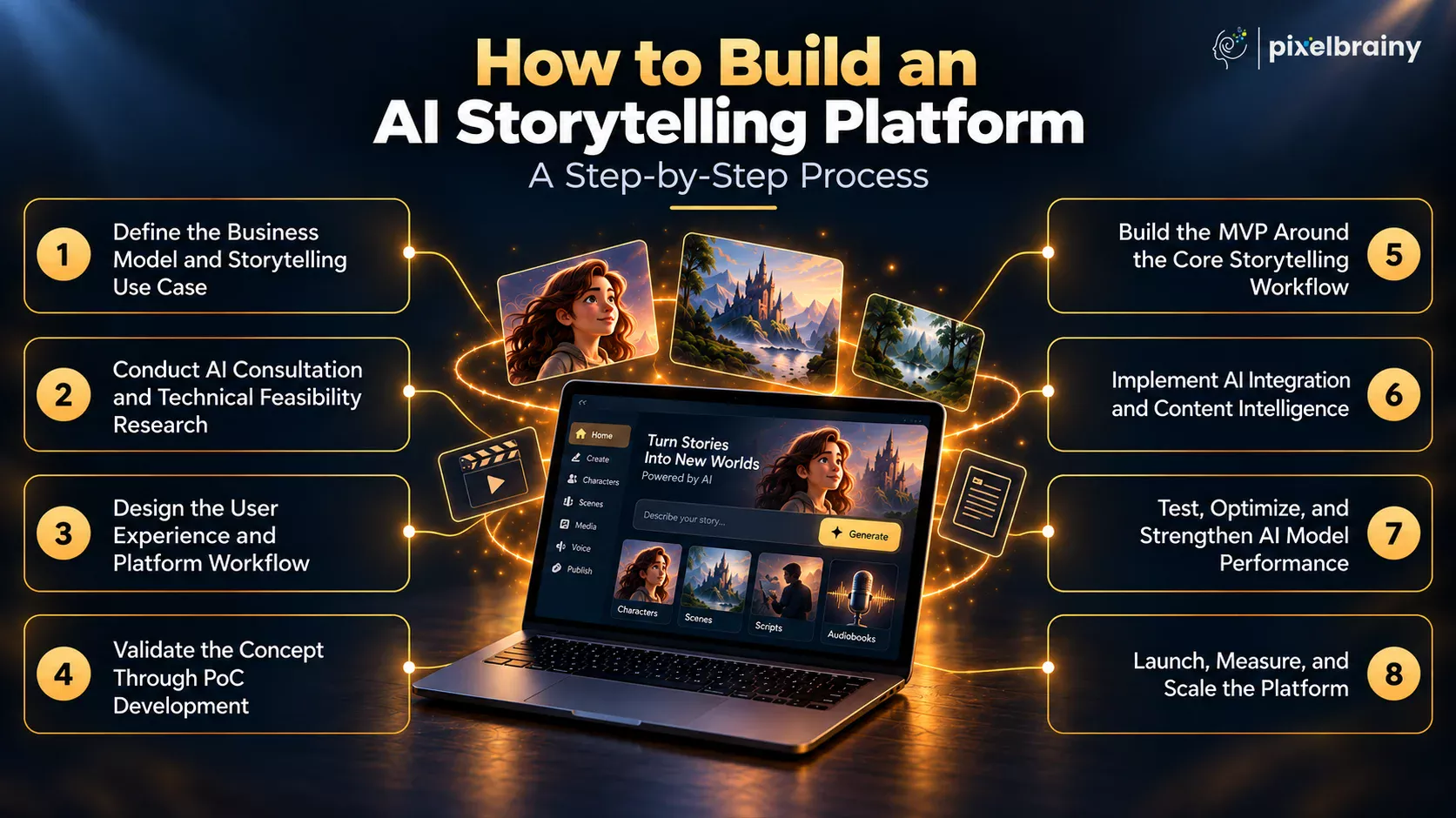
The first step in the development process of AI storytelling platform is defining exactly what the product needs to accomplish. Identify the target users, storytelling format, content volume, distribution channels, revenue model, and measurable business objectives. For example, a platform for professional publishers may prioritize AI-assisted article creation, while an entertainment product may focus on interactive fiction and character-driven narratives.
Document which tasks AI should perform and where humans must remain involved. Define success metrics such as stories produced per month, editorial acceptance rate, production time, cost per approved story, user engagement, and retention. This foundation prevents unnecessary features and provides a clear roadmap for AI storytelling platform development using AI.
Before development begins, evaluate whether the proposed storytelling experience is technically and commercially feasible. An AI consultation process can help identify suitable AI models, data requirements, integrations, infrastructure needs, privacy considerations, and expected operational costs.
Analyze your existing content library to determine whether it can support RAG, fine-tuning, structured knowledge retrieval, or other AI approaches. Create a feature priority matrix that separates essential capabilities from future enhancements. At this stage, also assess model performance using representative storytelling examples rather than relying only on generic benchmarks. The objective is to establish a practical technical foundation before significant engineering resources are committed.
The user experience should make AI feel like an integrated creative partner rather than a complicated technical system. A professional UI/UX design company can help translate complex AI workflows into simple experiences for writers, editors, administrators, or readers.
Map the complete user journey from creating a story brief to generating ideas, selecting an outline, developing characters, generating content, reviewing AI suggestions, approving the final version, and publishing it. Define interfaces for prompts, editing, regeneration, version history, collaboration, quality scores, and approval status. The design should clearly distinguish AI-generated content from human edits and provide users with control over every important creative decision.
Before building the complete platform, validate the highest-risk AI capabilities through PoC development. The proof of concept should use real or representative content from the target business rather than generic sample prompts.
Test the capabilities that will determine whether the product is viable, such as story generation quality, character consistency, retrieval accuracy, writing style preservation, content personalization, and automated quality evaluation. Compare different AI models and measure their performance against predefined editorial benchmarks. This stage should answer practical questions such as whether AI-generated stories require excessive editing, whether proprietary content improves output quality, and whether generation costs are commercially sustainable.
Once the concept is validated, begin MVP development with only the features required to deliver the core product experience. A typical first release could include user authentication, story briefs, AI story generation, story outlines, character profiles, AI editing, content quality checks, story management, editorial approval, and basic publishing integration.
For an AI storytelling platform for media startups, the MVP should prioritize measurable workflow improvements instead of attempting to support every storytelling format immediately. Establish analytics from the beginning so the team can measure generation time, editing effort, approval rates, user activity, AI costs, and published content performance. A focused MVP makes it easier to identify product gaps before scaling the platform.
Also Read: Top 10 AI MVP Development Companies in USA
The next stage focuses on connecting the platform with the AI systems that power storytelling. AI integration can include large language models, embedding models, vector search, moderation systems, recommendation engines, speech technologies, or image generation depending on the product scope.
Create an orchestration layer that manages prompts, model selection, context retrieval, generation parameters, response validation, and fallback behavior. Connect the platform with approved content sources through RAG when proprietary knowledge is required. Add quality evaluation to detect inconsistencies, unsupported claims, repetition, inappropriate content, or violations of editorial guidelines before stories reach publication.
Testing should cover both conventional software functionality and storytelling quality. Evaluate generated stories for narrative structure, readability, consistency, factual accuracy where relevant, brand voice, character behavior, and compliance with defined content policies.
Where business requirements justify it, AI model development can be considered for specialized capabilities. However, custom model work should only be pursued when standard models cannot meet measurable requirements. Establish a repeatable evaluation dataset and compare model performance over time. Conduct security testing, load testing, API testing, usability testing, and cost analysis before launch. Human editors should participate in evaluation because automated scores alone cannot fully determine whether a story meets the organization's creative standards.
Also Read: Top 12+ AI Model Development Companies in the USA
The final step in how to build AI storytelling software from scratch is controlled production launch. Begin with a defined user group, content category, or percentage of production rather than immediately exposing the platform to the entire audience. Monitor technical reliability, AI costs, content quality, editorial workload, user engagement, and business performance.
Use these results to improve prompts, workflows, models, interfaces, and personalization rules. As adoption increases, add infrastructure capacity, stronger security, additional integrations, and new storytelling formats. For organizations comparing AI product development companies in USA, it is important to select a partner that can support not only initial development but also ongoing optimization, model evaluation, maintenance, and product scaling.
A disciplined development process turns the idea of an AI storytelling platform into a measurable, scalable product that combines AI capabilities with human creative expertise.
The cost to develop an AI storytelling platform generally ranges from $25,000 to $200,000+, depending on the platform's complexity, AI capabilities, number of features, integrations, development team location, security requirements, and scalability needs. A simple AI storytelling MVP with basic story generation and editing can be developed at the lower end of the range, while an enterprise-grade platform with personalized storytelling, RAG, multiple AI models, advanced analytics, CMS integrations, and high-volume content generation can require a significantly larger investment.
For businesses planning the development budget of AI storytelling software, there is no single fixed price because every storytelling product has different requirements. The cost estimation of AI storytelling platform development should consider both initial engineering expenses and ongoing AI infrastructure costs such as model usage, cloud hosting, vector databases, monitoring, maintenance, and optimization.
So, what is the development pricing of AI storytelling platform products in 2026? A practical starting range is $25,000 to $200,000+, with the final AI storytelling platform development cost determined by the scope and technical architecture.
A useful real-world cost query is:
“We want to build an AI storytelling platform for our publishing business with story generation, personalization, editorial review, and CMS integration. What development budget should we plan for, and how will the cost change as we move from an MVP to an enterprise-scale platform?”
| AI Storytelling Platform Type | Estimated Development Cost | Typical Scope |
|---|---|---|
| Basic AI Storytelling Platform | $25,000 to $60,000 | AI story generation, story ideas, prompts, basic editing, user accounts, content library, simple dashboard, basic AI model integration, and responsive web interface |
| Advanced AI Storytelling Platform | $60,000 to $120,000 | Personalized storytelling, character profiles, story outlines, quality checks, RAG, multiple AI models, collaboration, analytics, multilingual generation, and CMS integration |
| Enterprise AI Storytelling Platform | $120,000 to $200,000+ | Advanced personalization, enterprise security, large-scale content generation, multi-model architecture, proprietary knowledge systems, advanced analytics, multiple integrations, governance, APIs, and scalable cloud infrastructure |
These figures are development planning estimates, not fixed quotations. The final price depends on the features, technology choices, AI architecture, development location, integrations, and level of customization required.
Several factors can significantly change the overall AI storytelling platform development cost.
A simple story generator requires fewer components than a complete storytelling ecosystem with AI generation, personalization, editorial workflows, analytics, content management, and publishing integrations.
Adding capabilities such as:
can increase development time and testing requirements.
Using third-party AI APIs is generally faster than developing or customizing proprietary models. Multiple models may also be required for different storytelling tasks.
If the platform needs to understand an organization's existing stories, editorial guidelines, characters, or proprietary content library, developers may need to implement RAG, embeddings, vector search, metadata systems, and document-processing pipelines.
Basic personalization may involve user-selected preferences, while advanced personalization can use reading history, audience behavior, content interests, language, and engagement data. More sophisticated personalization requires additional data infrastructure and recommendation logic.
A straightforward writing interface costs less than a sophisticated platform containing storyboards, character dashboards, collaborative editing, content management, analytics, and interactive storytelling interfaces.
Integrating the platform with existing CMS, CRM, analytics, authentication, payment, publishing, audio, or mobile systems can increase development effort.
A web-only platform generally requires less development than a product supporting web, iOS, Android, and administrative applications.
Enterprise platforms may require:
These requirements can significantly influence the development budget.
A platform designed for a few thousand users has different infrastructure requirements from one expected to serve millions of readers and generate thousands of stories daily.
Development rates vary according to the team's location, experience, specialization, and engagement model. AI engineering, machine learning, cloud architecture, and enterprise development expertise can also affect hourly or project-based pricing.
The initial development cost is not the complete investment. Businesses should also budget for:
For high-volume publishers, the most useful financial metric is not simply the cost per AI-generated story. Instead, calculate the cost per approved and published story, including AI usage, infrastructure, human editing, and operational expenses.
Businesses can control their initial investment by launching a focused MVP instead of developing every capability simultaneously. Start with essential functions such as story generation, editing, content management, quality checks, and human approval, then add personalization, advanced analytics, multimodal storytelling, and enterprise capabilities based on actual user demand.
A well-planned AI storytelling platform development budget balances initial technology investment with AI operating costs to create a scalable storytelling product without unnecessary development expenses.

A reliable AI storytelling platform needs a technology stack that can handle much more than text generation. The architecture must support AI model integration, story creation, content storage, knowledge retrieval, personalization, user management, analytics, security, and scalable publishing workflows. The right tech stack to build an AI storytelling platform should therefore be flexible enough to support changing AI models and growing content volumes without requiring a complete platform rebuild.
For businesses planning AI storytelling platform development, the technology stack will vary according to the target audience, story format, number of users, AI capabilities, and business model. A consumer storytelling application may require a lightweight architecture, while a large media company may need RAG, multi-model orchestration, enterprise security, CMS integrations, and high-volume cloud infrastructure.
A practical real-world query for this stage is:
“We want to build an AI storytelling platform that can generate personalized stories, maintain character consistency, connect with our existing content library, and support thousands of users. What technology stack should we use for the frontend, backend, AI models, database, RAG, cloud infrastructure, and security?”
| Technology Layer | Recommended Technologies | Purpose in AI Storytelling Platform |
|---|---|---|
| Frontend | React, Next.js, TypeScript | Builds responsive story creation interfaces, dashboards, editors, content libraries, personalization screens, and reader experiences. |
| Mobile App | React Native, Flutter, Swift, Kotlin | Supports mobile storytelling experiences across iOS and Android for readers, writers, and content creators. |
| Backend | Python, Node.js, FastAPI, NestJS | Handles business logic, user management, AI workflows, content processing, APIs, authentication, and platform operations. |
| AI Models | LLM APIs, open-source LLMs, specialized AI models | Generates stories, outlines, characters, dialogue, summaries, rewrites, translations, and other narrative content. |
| AI Orchestration | LangChain, LangGraph, custom orchestration layer | Manages prompts, model routing, multi-step workflows, context retrieval, AI agents, and generation pipelines. |
| RAG Layer | LlamaIndex, LangChain, custom RAG pipeline | Connects AI models with proprietary story archives, editorial guidelines, character information, research, and other approved knowledge. |
| Vector Database | Pinecone, Weaviate, Qdrant, pgvector | Stores embeddings and enables semantic search across stories, documents, characters, and other narrative knowledge. |
| Primary Database | PostgreSQL, MySQL | Stores users, stories, characters, metadata, permissions, workflows, subscriptions, and application data. |
| Caching | Redis | Improves application performance by caching frequently accessed data, sessions, prompts, and selected AI workflow results. |
| Cloud Infrastructure | AWS, Microsoft Azure, Google Cloud | Provides scalable computing, storage, databases, networking, AI infrastructure, backups, and production deployment capabilities. |
| Object Storage | Amazon S3, Google Cloud Storage, Azure Blob Storage | Stores manuscripts, images, audio files, generated assets, documents, and other large storytelling resources. |
| Authentication | OAuth 2.0, OpenID Connect, Auth0, Firebase Authentication | Manages secure user registration, login, social authentication, enterprise identity, and access control. |
| Analytics | Google Analytics, Mixpanel, Amplitude, custom dashboards | Measures story generation, user engagement, content performance, retention, conversion, editorial activity, and platform usage. |
| CMS Integration | REST APIs, GraphQL, webhooks, headless CMS APIs | Connects the AI storytelling platform with existing publishing systems and enables approved content to move into production workflows. |
| Security and Monitoring | OAuth, RBAC, encryption, OpenTelemetry, cloud monitoring | Protects user data, proprietary content, AI workflows, and enterprise systems while monitoring performance, errors, and infrastructure health. |
A typical architecture can follow:
Web/Mobile App → API Layer → Backend Services → AI Orchestration → AI Models + RAG → Databases → Quality Checks → CMS/Publishing
This architecture allows organizations to develop AI storytelling platform products that can evolve as AI models, user requirements, and content formats change.
The ideal AI storytelling technology stack combines flexible AI infrastructure, scalable software architecture, secure data management, and reliable content workflows to support storytelling from creation through publication.
Developing an AI storytelling platform involves more than connecting an application to a large language model. Storytelling requires creativity, consistency, context, emotional intelligence, editorial judgment, and audience understanding, while AI systems can sometimes produce inaccurate, repetitive, generic, or inconsistent content. Businesses planning AI storytelling platform development must therefore address technical, editorial, security, cost, and user experience challenges before taking the platform to large-scale production.
For organizations looking to build AI storytelling platform products, identifying these challenges early can reduce development risks and help create a system where AI supports human creativity rather than compromising content quality.
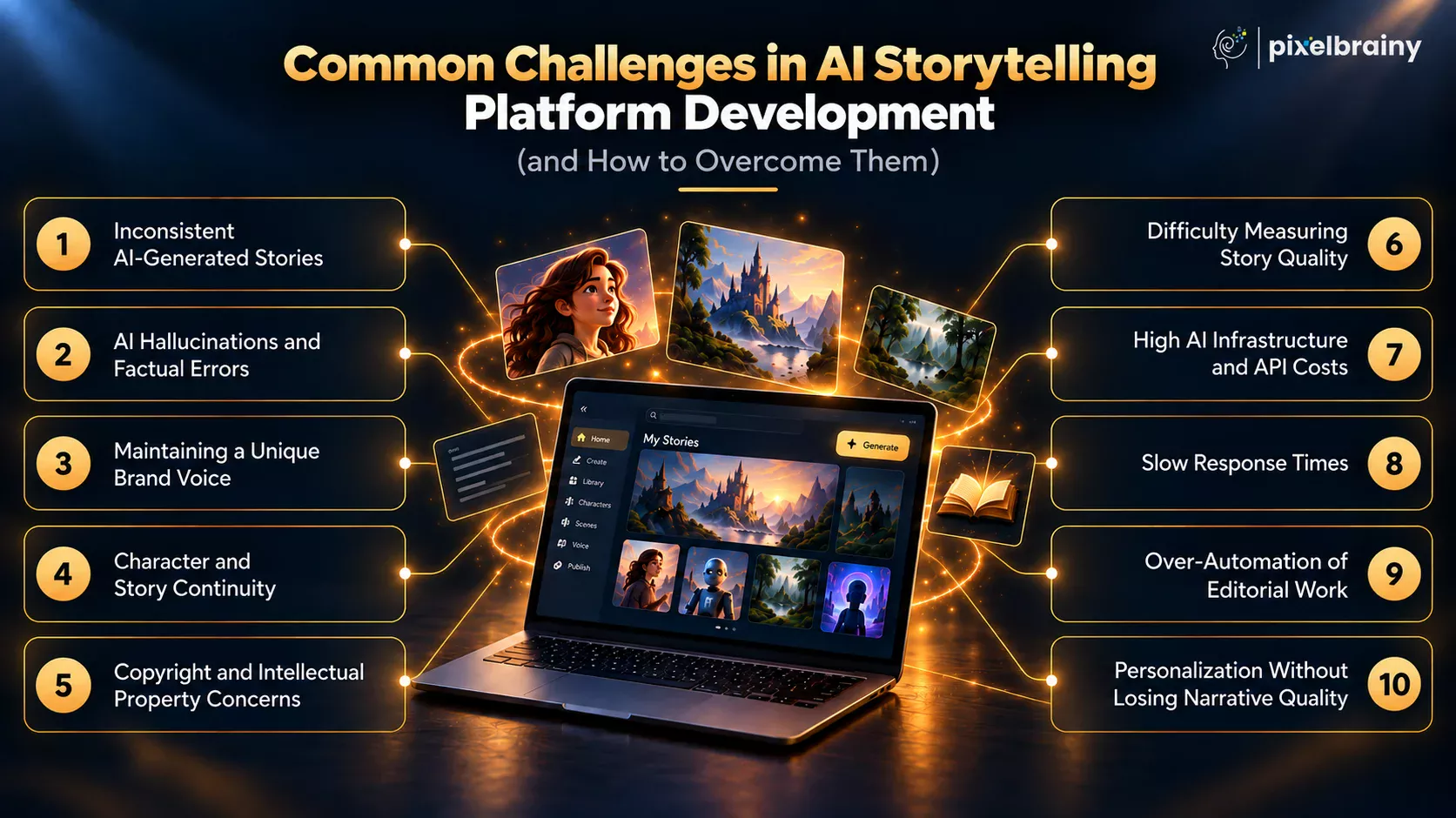
One of the biggest challenges in AI storytelling is maintaining consistent quality across generated content. The same prompt may produce different results, and long-form stories can sometimes contain contradictions in character behavior, timelines, locations, or narrative details.
How to overcome it: Create structured story briefs, character profiles, story memory, editorial guidelines, and automated consistency checks. Use evaluation datasets based on real content to measure quality before publishing.
AI models can generate information that sounds convincing but is inaccurate. This becomes particularly problematic for publishers creating factual narratives, historical stories, educational content, or stories based on real-world events.
How to overcome it: Implement RAG with trusted sources, source validation, fact-checking workflows, confidence thresholds, and human editorial review. AI-generated content involving sensitive or factual claims should receive additional verification before publication.
Generic AI models can produce grammatically correct content that still sounds similar to millions of other AI-generated stories. Publishers and entertainment brands need content that reflects their established identity.
How to overcome it: Build a brand voice layer using approved historical content, style guidelines, terminology, writing examples, and editorial feedback. Use these resources as controlled context during content generation.
Long-running stories create a major technical challenge because the AI needs to remember information from previous chapters and episodes.
For example, a character may be introduced as a 30-year-old journalist in one chapter and incorrectly described as a 25-year-old teacher later.
How to overcome it: Create structured character databases and story bibles containing character attributes, relationships, timelines, locations, and important events. Retrieve relevant information whenever new content is generated.
Publishers and entertainment companies often work with valuable intellectual property. AI-generated content can raise questions around source material, ownership, licensing, similarity, and unauthorized use.
How to overcome it: Maintain clear content provenance, track source materials, restrict access to proprietary IP, implement similarity detection where appropriate, and establish legal and editorial review procedures.
Unlike traditional software, storytelling quality cannot always be measured using a single technical metric. A story may be grammatically correct but emotionally weak, predictable, or unsuitable for its target audience.
How to overcome it: Develop a multi-dimensional evaluation framework covering factors such as narrative structure, readability, originality indicators, character consistency, brand alignment, factual accuracy, and human editorial acceptance.
Human evaluation should remain part of the quality measurement process.
Generating thousands of stories, regenerating sections, running quality checks, creating personalized versions, and processing large context windows can increase AI operating expenses.
How to overcome it: Use model routing, caching, prompt optimization, token limits, smaller models for simple tasks, and larger models only when additional reasoning or creative quality is required. Track cost per generated, reviewed, and published story.
Large AI models can sometimes take several seconds or longer to generate complex content. Long waits can negatively affect the experience for writers and readers.
How to overcome it: Use streaming responses, asynchronous processing, caching, optimized prompts, faster models for interactive tasks, and background processing for resource-intensive operations.
One of the biggest strategic mistakes in AI storytelling platform development is assuming that every storytelling task should be automated.
Human writers provide creative judgment, cultural understanding, emotional nuance, originality, and editorial responsibility that AI cannot consistently replicate.
How to overcome it: Establish a human-in-the-loop workflow. Let AI handle repetitive and assistive tasks while experienced writers and editors control creative direction and final approval.
Personalized storytelling can create better experiences, but excessive customization may damage the original narrative structure or produce inconsistent experiences between readers.
How to overcome it: Define which elements can be personalized and which must remain fixed. For example, the platform may personalize reading difficulty, character emphasis, or story recommendations while preserving the core plot and canonical events.
An AI storytelling platform may process unpublished manuscripts, proprietary characters, user profiles, reading behavior, educational information, or other sensitive data.
How to overcome it: Implement encryption, role-based access control, secure authentication, data minimization, audit logging, secure APIs, appropriate data retention policies, and strong cloud security practices.
Building the entire platform around one AI provider can create risks related to pricing changes, model updates, availability, performance, or changing API policies.
How to overcome it: Build a model abstraction and orchestration layer that allows multiple AI models to be evaluated and used according to quality, cost, speed, and task requirements.
A storytelling prototype may work effectively with hundreds of users but encounter performance and infrastructure problems when usage increases dramatically.
How to overcome it: Design for scalability from the beginning using cloud infrastructure, caching, database optimization, asynchronous processing, monitoring, load testing, and scalable API architecture.
Media organizations often already use CMS platforms, analytics tools, CRM systems, subscription systems, mobile applications, and internal content databases.
How to overcome it: Build API-first architecture and use REST APIs, GraphQL, webhooks, and dedicated integration services to connect the AI storytelling platform with existing infrastructure.
Readers may become skeptical if they believe a publisher is replacing human creativity entirely with automated content. Poor-quality AI stories can also damage audience trust.
How to overcome it: Maintain clear editorial standards, use human review where appropriate, monitor content quality, and develop a transparent AI content policy based on the organization's audience and publishing requirements.
The most effective approach is to treat these challenges as part of the product architecture rather than problems to solve after launch. Quality evaluation, human oversight, content provenance, story memory, security, model flexibility, and cost monitoring should be considered during the initial AI storytelling platform development process.
A successful AI storytelling platform does not eliminate every challenge of AI-generated content, but it builds the right technical and editorial safeguards to manage those challenges at scale.
Before businesses build AI storytelling platform products from scratch, studying successful platforms can reveal where the market is already validated and where opportunities for differentiation still exist. These products demonstrate that AI storytelling is not limited to generating paragraphs.
It can support fiction writing, character interaction, children's personalization, enterprise marketing, and interactive narrative experiences.
Sudowrite is an AI writing assistant designed specifically for fiction authors. Its capabilities include brainstorming, rewriting, scene generation, long-form drafting, Story Bible functionality, and AI models designed around creative writing workflows.
Primary users: Novelists, screenwriters, fiction writers, and creative authors.
Key lesson for founders: Sudowrite demonstrates why specialization matters in AI storytelling platform development. Instead of competing as a general-purpose writing tool, founders can build around narrative structure, character development, genre requirements, writer voice, and long-form storytelling. For anyone researching how to develop AI storytelling platform like Sudowrite or Jasper for creative writing, this specialized workflow is an important product benchmark.
Character.AI focuses on conversational AI characters and interactive experiences. Its Stories feature allows users to create adventures involving characters, premises, choices, and narrative progression, moving AI storytelling beyond traditional text generation.
Primary users: Consumers, creators, and audiences interested in AI characters, roleplay, and interactive fiction.
Key lesson for founders: Character.AI shows that interaction itself can become the storytelling product. When planning to develop AI storytelling platform, founders can differentiate through character behavior, user decisions, branching narratives, and replayable experiences rather than competing only on writing quality.
Storybird focuses on personalized children's storytelling, allowing users to create stories around children's interests and selected story elements. Its approach combines AI-generated narratives with a child-focused experience, making it relevant to parents, educators, and young readers.
Primary users: Parents, children, educators, and organizations focused on children's creative learning.
Key lesson for founders: Storybird illustrates how a clearly defined audience can create stronger differentiation. Founders can build around specific requirements such as age-appropriate storytelling, personalization, narration, educational objectives, parental controls, and reading development instead of creating another generic AI story generator.
Jasper approaches storytelling primarily from the marketing and enterprise content perspective. Its Brand Voice, Audiences, Knowledge, and Style Guide capabilities allow organizations to provide brand-specific context and generate content aligned with established messaging and communication requirements.
Primary users: Enterprise marketing teams, agencies, and brand content departments.
Key lesson for founders: Jasper demonstrates how proprietary context can become a competitive advantage. When businesses build AI storytelling platform products, integrating brand knowledge, audience information, editorial frameworks, and governance can create substantially more value than providing a standalone AI text generator.
INKO.RUN represents an emerging direction in AI-native storytelling. The platform combines AI-assisted creation with an interactive runtime, allowing creators to develop characters and worlds, design branching narratives, publish interactive stories, and engage with audiences.
Primary users: Interactive fiction creators, players, and AI-native storytellers.
Key lesson for founders: Emerging platforms such as INKO.RUN show how storytelling creation and consumption can exist inside the same product. For organizations planning AI storytelling platform development, this suggests opportunities to combine AI authoring, interactive experiences, audience participation, and content discovery into one ecosystem.
These market examples validate several distinct opportunities across fiction assistance, character interaction, children's personalization, enterprise storytelling, and interactive narratives. They also show why founders should define the specific storytelling problem, target audience, proprietary content, and business model before deciding which AI architecture to build. A specialized platform that combines AI capabilities with proprietary content, audience data, editorial workflows, or intellectual property can create a stronger market position than another general-purpose AI writing application.
The strongest AI storytelling platforms differentiate by owning a specific storytelling experience, not simply by providing access to a powerful AI model.
From understanding the market opportunity to identifying the right platform type, features, technology, costs, and challenges, it is now time to identify the right technology partner. For a media publisher or entertainment company, the ideal partner should understand that an AI storytelling product is not simply an AI writing tool. It is a specialized product where content quality, proprietary IP, audience experience, AI intelligence, and business objectives must work together.
PixelBrainy, as an AI product development company, brings experience in building AI-powered digital products for startups and enterprises, combining product strategy, user experience, artificial intelligence, and software engineering under one development ecosystem.
For a publisher with thousands of existing stories, the content archive itself can become a major source of product intelligence. PixelBrainy can help organizations transform proprietary content, editorial knowledge, audience requirements, and business rules into an AI-powered product architecture.
Instead of creating another generic story generator, the focus can be on creating a platform that understands the organization's unique content environment.
This can include capabilities such as:
This approach is particularly relevant to organizations looking for AI storytelling software development services where differentiation needs to come from the company's own content and expertise.
The major difference between a generic AI tool and an enterprise storytelling product is the layer built around the AI model.
PixelBrainy's AI product engineering approach can combine AI capabilities with:
Business logic + proprietary data + user experience + workflow intelligence + analytics + scalable software architecture
This allows organizations to create products where AI becomes part of the company's core technology rather than an external writing utility.
For a company planning to build AI storytelling platform, this distinction can determine whether the resulting product becomes another AI content tool or a proprietary platform with long-term business value.
PixelBrainy's publicly presented portfolio includes an AI-powered virtual learning assistant developed for the education sector. The confidential project focused on creating a personalized AI experience capable of supporting learners through interactive assistance, adaptive learning experiences, multilingual capabilities, and progress tracking.
The relevance to storytelling lies in the underlying product challenge: delivering personalized AI-generated experiences while maintaining structured information, user context, interaction quality, and scalable product architecture.
For a media or entertainment company, similar AI product engineering expertise can be applied to personalized storytelling, interactive narratives, content intelligence, character experiences, or AI-assisted editorial platforms without exposing confidential client information.
Organizations that want to develop AI storytelling platform products often have very different objectives.
A publisher may want to increase editorial capacity. An entertainment company may want to extend an established IP universe. An education company may want personalized learning stories. A marketing organization may want scalable brand narratives.
PixelBrainy's role is to translate that specific business objective into an AI product rather than forcing every organization into the same storytelling template.
For storytelling platform development integrating AI, this means the product can be designed around the organization's existing content ecosystem, audience, workflows, intellectual property, and growth strategy.
The value of an AI development partner should ultimately be measured by the product it helps create, not by the number of AI technologies it can list.
PixelBrainy brings together AI product engineering, AI consulting, UX/UI, AI agents, AI integration, and software development capabilities to help businesses move from an AI concept toward a production-ready digital product.
For organizations exploring an AI storytelling product, the partnership can focus on creating a platform that is useful to writers, valuable to readers, aligned with editorial standards, and commercially scalable.
Have an AI storytelling idea? Connect with PixelBrainy to turn your concept into a differentiated AI product.
From this above discussion, it is clear that AI storytelling platform development is no longer limited to experimenting with AI-generated stories. It is becoming a strategic opportunity for publishers, media companies, entertainment brands, educators, authors, and startups that want to create more scalable and personalized storytelling experiences.
The right AI storytelling platform can bring together story generation, audience personalization, editorial review, content quality, IP management, analytics, and multi-channel publishing within one connected ecosystem. However, successful implementation depends on selecting the right platform type, defining practical AI use cases, choosing the right technology stack, managing development costs, and maintaining appropriate human oversight.
For businesses exploring how to create an AI storytelling platform, the strongest strategy is to build around their proprietary content, audience expectations, creative workflows, and long-term business objectives rather than simply replicating an existing AI writing tool.
With the right product strategy and custom AI storytelling software development expertise, AI can become a powerful extension of human creativity while opening new opportunities for content production, personalization, and monetization.
Ready to turn your storytelling idea into a scalable AI product? Book an appointment with PixelBrainy today.
An AI storytelling platform typically takes 3 to 6 months for an MVP and 6 to 12 months for a production-ready platform. Timeline depends on AI complexity, personalization, RAG, integrations, mobile applications, editorial workflows, testing, and security. Enterprise platforms with advanced requirements may take longer.
In 2026, the cost to build an AI storytelling platform can range from $25,000 to $200,000 or more. A basic MVP may cost $25,000 to $60,000, while advanced and enterprise platforms require larger budgets because of AI architecture, integrations, security, personalization, infrastructure, and ongoing model usage.
Yes, an AI storytelling platform can maintain a specific author's voice and style by using approved writing samples, style guidelines, structured prompts, retrieval systems, and evaluation workflows. For established authors, a story bible and controlled reference library can help preserve vocabulary, tone, narrative patterns, character behavior, and stylistic consistency.
Choose a company with proven AI product engineering experience, strong LLM and RAG capabilities, scalable software expertise, and relevant content or media projects. Ask for measurable case studies, security practices, model evaluation methods, and post-launch support. PixelBrainy is one option to evaluate, especially for customized AI product development.
Yes, an AI storytelling platform can connect to an existing content library through RAG, embeddings, metadata, APIs, or structured databases. This allows AI models to retrieve approved stories, editorial guidelines, character information, and research when generating new content, while access controls help protect proprietary material.
Yes, human review can be built directly into the storytelling workflow. AI can first evaluate grammar, consistency, tone, factual claims, safety, and editorial requirements, then route stories to writers or editors for approval. This human-in-the-loop model helps publishers increase production capacity while maintaining established quality standards.
An AI storytelling platform may use one or several models depending on requirements. Large language models can handle ideation, outlining, drafting, and rewriting, while embedding models support retrieval and specialized models can handle moderation, translation, audio, or evaluation. A model abstraction layer helps manage quality, cost, and flexibility.
Measure business and editorial outcomes rather than generated word volume. Useful metrics include stories produced, editorial acceptance rate, average editing time, cost per approved story, reader engagement, completion rate, retention, personalization performance, and AI error rates. Comparing AI-assisted workflows with existing production processes provides a clearer return-on-investment picture.

About The Author
Sagar Bhatnagar
Sagar Sahay Bhatnagar brings over a decade of IT industry experience to his role as Marketing Head at PixelBrainy. He's known for his knack in devising creative marketing strategies that boost brand visibility and market influence. Sagar's strategic thinking, coupled with his innovative vision and focus on results, sets him apart. His track record of successful campaigns proves his ability to utilize digital platforms effectively for impactful marketing efforts. With a genuine passion for both technology and marketing, Sagar continuously pushes PixelBrainy's marketing initiatives to greater success.

Working with the PixelBrainy team has been a highly positive experience. They understand the design requirements and create beautiful UX elements to meet the application needs. The dev team did an excellent job bringing my vision to life. We discussed usability and flow. Sagar worked with his team to design the database and begin coding. Working with Sagar was easy. He has the knowledge to create robust apps, including multi-language support, Google and Apple ID login options, Ad-enabled integrations, Stripe payment processing, and a Web Admin site for maintaining support data. I'm extremely satisfied with the services provided, the quality of the final product, and the professionalism of the entire process. I highly recommend them for Android and iOS Mobile Application Design and Development.

Great experience working with them. Had a lot of feedback and I found that unlike most contractors they were bugging me for updates instead of the other way around. They were extremely time conscience and great at communicating! All work was done extremely high quality and if not on time, early! They were always proactive when it comes to communication and the work is great/above par always. Very flexible and a great team to work with! Goes above and beyond to present us with multiple options and always provides quality. Amazing work per usual with Chitra. If you have UI/UX or branding design needs I recommend you go to them! Will likely work with them in the future as well, definitely recommended!

PixelBrainy is a joy to work with and is a great partner when thinking through branding, logo, and website layout. I appreciate that they spend time going into the "why" behind their decisions to help inform me and others about industry best practices and their expertise.

I hired them to design our software apps. Things I really like about them are excellent communication skills, they answer all project suggestions and collaborate right away, and their input on design and colors is amazing. This project was complex and needed patience and creativity. The team is amazing to do business with. I will be using them long-term. Glad to see there are some good people out there. I was afraid to try and outsource my project to someone but I am glad I met them! I really can't say enough. They went above and beyond on this project. I am very happy with everything they have done to make my business stand out from the competition.

It was great working with PixelBrainy and the team. They were very responsive and really owned the project. We'll definitely work with them again!

I recently worked with the PixelBrainy team on a project and I was blown away by their communication skills. They were prompt, clear, and articulate in all of our interactions. They listened and provided valuable feedback and suggestions to help make the project a success. They also kept me updated throughout the entire process, which made the experience stress-free and enjoyable.

PixelBrainy is very good at what it does. The team also presents themselves very professionally and takes care of their side of things very well. I could fully trust them taking up the design work in a timely and organised manner and their attention to detail saved us lots of effort and time. This particular project was quite intense and the team showed that they function very well under pressure. Very much looking forward to working with her again!

It's always an absolute pleasure working with them. They completed all of my requests quickly and followed every note I had for them to a T, which made our process go smoothly from start to finish. Everything was completed fast and following all of the guidelines. And I would recommend their services to anyone. If you need any design work done in the future, PixelBrainy should be your first call!

They took ownership of our requirements and designed and proposed multiple beautiful variants. The team is self-motivated, requires minimum supervision, committed to see-through designs with quality and delivering them on time. We would definitely love to work with PixelBrainy again when we have any requirements.

PixelBrainy was a big help with our SaaS application. We've been hard at work with a new UI/UX and they provided a lot of help with the designs. If you're looking for assistance with your website, software, or mobile application designs, PixelBrainy and the team is a great recommendation.

PixelBrainy designers are amazing. They are responsive, talented, and always willing to help craft the design until it matches your vision. I would recommend them and plan to continue them for my future projects and more!!!

They were awesome! Did a good job fast, and good communication. Will work with them again. Thank you

Creative, detail-oriented, and talented designers who take direction well and implement changes quickly and accurately. They consistently over-delivered for us.

PixelBrainy team is very talented and creative. Great designers and a pleasure to work with. PixelBrainy is an excellent communicator and I look forward to working with them again.

PixelBrainy has a very talented design team. Their work is excellent and they are very responsive. I enjoy working with them and hope to continue on all of our future projects.


Transform your ideas into reality with us.
Across these industries, each engagement brings unique challenges, from early-stage product development to scaling complex systems, helping us build a practical understanding of real-world product environments.