 AI Summary Powered by PixelBrainy
What if you could validate your AI trading concept, attract early users, and strengthen your seed funding pitch without investing in a full-scale trading platform?
For US fintech founders with quantitative finance expertise, AI trading app MVP development offers a practical way to test market demand before committing significant capital. Rather than building every feature upfront, a minimum viable product (MVP) focuses on essential functionality, measurable user value, and technical feasibility.
The opportunity is growing alongside the broader AI market. According to Gartner’s September 2026 forecast, worldwide AI spending is projected to reach approximately $2.7 trillion in 2026, representing 49.5% year-over-year growth. While this forecast covers the overall AI market rather than trading applications specifically, it highlights the expanding investment in AI technologies.
To build AI trading app MVP successfully, founders must prioritize features that demonstrate clear product value. Essential AI trading app MVP features may include AI-powered market analysis, strategy backtesting, portfolio insights, risk indicators, and simulated trading. Selecting the right capabilities early helps manage development costs while generating actionable feedback from initial users.
One practical approach is learning how to build an AI trading app MVP with paper trading mode. This enables users to test simulated orders, evaluate strategy outputs, and explore trading workflows without risking real money. It also helps founders assess usability and validate product assumptions before introducing live trading. Meanwhile, custom AI trading app MVP development can support proprietary quantitative models, specialized market data pipelines, and differentiated analytics tailored to a specific audience.
This guide explores AI trading app MVP features, development costs, technology stacks, and launch strategies to help fintech founders validate their concepts, test core functionality, and gather user feedback before scaling. It also examines security and regulatory considerations, helping founders build a credible product, demonstrate early traction, and prepare a stronger case for seed funding.

An AI trading app MVP is the first usable version of a trading application that combines a clearly defined trading-related problem with a limited set of artificial intelligence capabilities. It allows a fintech startup to test its product concept with real users, evaluate its technical feasibility, and collect evidence of demand before investing in a full-scale platform.
Unlike a simple wireframe or clickable prototype, an MVP should deliver a functional user experience. Users should be able to perform the core activity the application was designed for, whether that means analyzing market data, exploring AI-generated insights, testing trading strategies, or simulating trades.
For example, a startup developing an AI-powered stock analysis platform might initially offer market data visualization, an AI-assisted research interface, watchlists, and paper trading. It would not necessarily need live brokerage execution, advanced portfolio optimization, or support for multiple asset classes in its first release.
The main difference is the scope of the product and the level of investment required to deliver it.
| Area | AI Trading App MVP | Full Trading App Platform |
|---|---|---|
| Product scope | One validated core use case | Multiple trading workflows |
| AI capabilities | One or two focused models or services | Multiple integrated models and advanced analytics |
| Trading mode | Paper trading or limited approved integrations | Potentially live execution and advanced order management |
| Market coverage | One selected market or asset class | Multiple markets and asset classes |
| User experience | Essential screens and workflows | Advanced customization and personalization |
| Integrations | Only those required for validation | Broader data, brokerage, and financial service integrations |
| Analytics | Core product and model performance metrics | Advanced reporting and operational analytics |
| Development investment | Focused on essential functionality | Greater investment across product, infrastructure, and operations |
An MVP does not mean releasing an unreliable or insecure product. Authentication, data protection, appropriate testing, and clear disclosure of AI limitations remain essential, even when the feature set is small.
Before development starts, the founding team should identify the assumptions that the product must validate.
For a quantitative finance founder, these questions are especially important. A strategy with promising historical performance does not automatically translate into a product that users will adopt. The MVP must test both the analytical capability and the user experience surrounding it.
The goal is to establish a credible foundation for the next development phase, supported by evidence rather than assumptions.
trading platform? Because an MVP helps founders validate customer demand, test AI capabilities, control initial development costs, and collect evidence before committing to a larger investment.
For US fintech startups, building an AI-powered trading product involves more than developing predictive algorithms. Teams must consider market data access, model performance, security, brokerage integrations, and applicable financial regulations. An MVP helps prioritize these requirements around one clearly defined customer problem.
The broader technology market also signals growing investment in AI. According to Gartner's September 2026 forecast, worldwide AI spending is projected to reach approximately $2.7 trillion in 2026, up 49.5% year over year. This figure covers AI spending across industries, not trading applications specifically, but it illustrates the scale of investment in AI technologies.
For founders planning AI trading app MVP development, the objective is not to build the biggest platform first. It is to prove that the core product solves a real problem, performs reliably, and offers enough value to justify further development.
One of the main benefits of AI trading app MVP development is the ability to test customer demand before investing in advanced features. Founders may assume users want predictive price signals, automated strategy recommendations, or AI-generated market summaries. Real user behavior may reveal different priorities.
For example, beta testing could show that traders value explainable market insights more than price predictions. This feedback helps refine the product roadmap, focus model development, and identify a clearer market position.
A complete trading platform may require advanced charting, real-time market data, brokerage integrations, portfolio management, AI inference, and security controls. Developing everything simultaneously can increase costs before the business has demonstrated demand.
An AI trading app MVP development strategy focuses on the essential features needed to test one use case. Teams can postpone complex integrations and advanced automation until the product demonstrates user interest and technical feasibility.
However, MVP development does not eliminate the need for secure architecture, appropriate data licensing, or regulatory review. Costs depend on model complexity, data requirements, and the product's intended functionality.
A functional MVP gives founders something concrete to demonstrate to potential investors beyond a prototype or business plan.
Useful early-stage metrics include:
These indicators help founders explain what has been validated, which assumptions remain uncertain, and how additional funding could support growth. They cannot guarantee investment, but they can strengthen a data-driven fundraising pitch.
AI models can behave differently as market conditions and incoming data change. Strong historical backtesting results alone do not establish reliable live trading performance.
A paper trading environment lets teams evaluate AI-generated signals, simulated orders, latency, data quality, and user workflows without placing real-money trades.
This is particularly valuable when developing AI trading app MVP features such as strategy testing, portfolio insights, and automated signal generation. Teams can identify duplicate signals, stale prices, unrealistic execution assumptions, and confusing risk disclosures before considering live trading.
An MVP helps teams understand which features users discover, which workflows they complete, and where they encounter friction. Analytics, interviews, and beta testing can reveal whether the product solves a meaningful problem.
These insights help founders prioritize improvements based on actual usage rather than assumptions, reducing the risk of spending development resources on low-value functionality.
A successful MVP should have a focused feature set without sacrificing essential engineering quality. Separating market data ingestion, AI inference, backend services, and the user interface can make future improvements easier.
This architecture supports the gradual addition of new quantitative models, market integrations, and portfolio tools as demand grows. The right approach depends on expected traffic, latency requirements, security needs, and long-term product goals.
Therefore, AI trading app MVP development enables fintech founders to validate market demand, test AI-driven trading workflows, and build investor confidence before scaling. Prioritizing essential features, measurable user feedback, and technical reliability helps businesses make smarter development decisions and establish a stronger foundation for long-term growth.
Successful AI trading app MVP development starts with a clearly defined user problem, a measurable business objective, and a focused set of features. Rather than launching a full-scale trading platform, fintech founders can validate demand by testing one core use case, such as AI-powered market analysis, stock screening, trading signals, or paper trading.
For US fintech startups, choosing the right AI trading app MVP features helps control initial development costs, assess technical feasibility, and gather meaningful user feedback. The goal is to demonstrate practical value, identify product-market fit signals, and use early results to guide future investment in the platform.
Below are six practical use cases to consider when planning an AI trading app MVP, along with their essential features and validation goals.
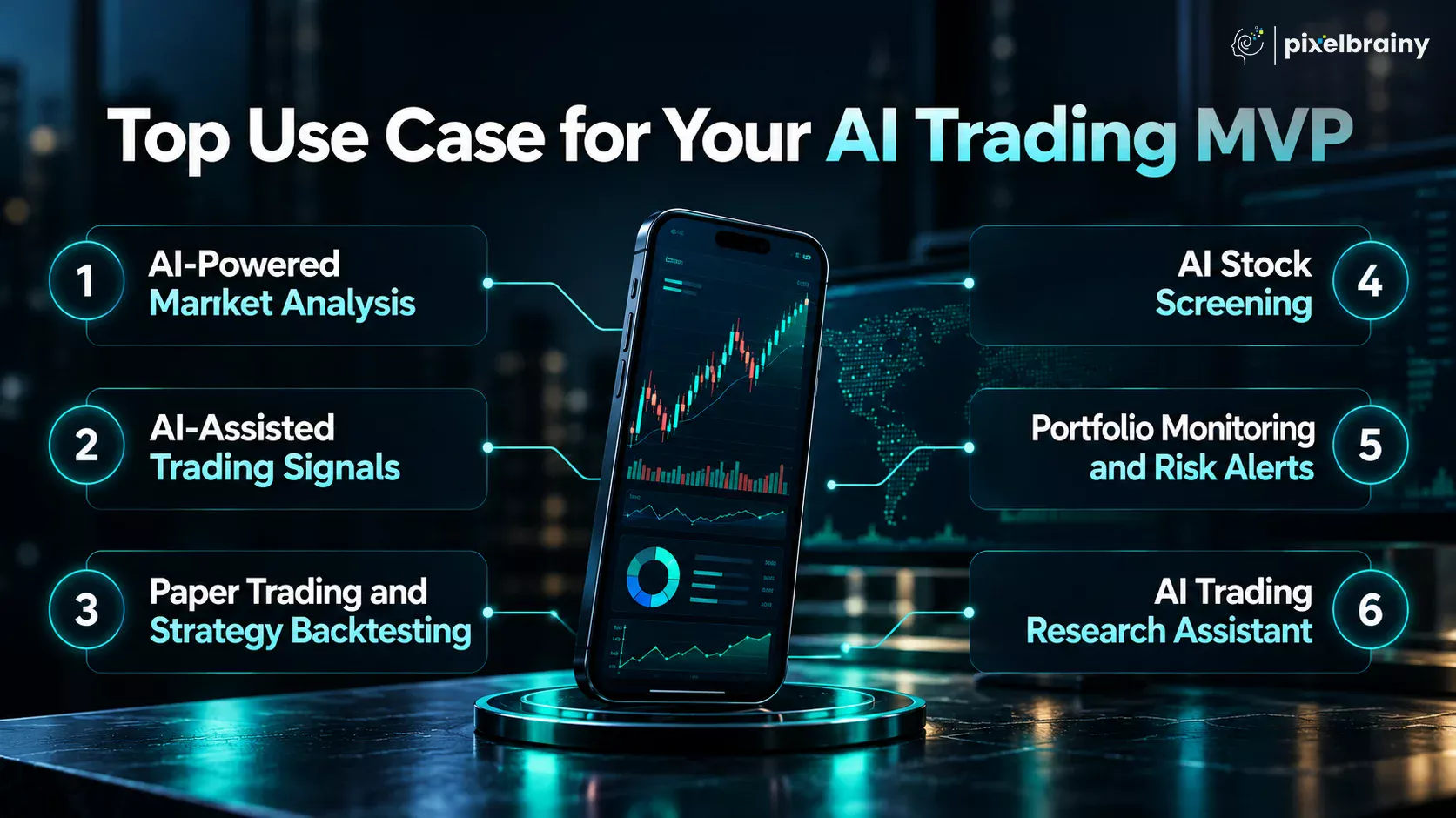
An AI market analysis MVP helps traders interpret price movements, review market trends, and summarize relevant financial information.
Key MVP features:
The primary validation goal is to determine whether AI-assisted analysis helps users research markets more efficiently. Keep verified market data separate from AI-generated interpretations to improve transparency and trust.
An AI trading signals MVP identifies potential trading opportunities using quantitative rules, technical indicators, or machine learning models.
Core features can include signal generation, timestamps, historical signal records, and explanations of the factors influencing each output.
Founders should evaluate signal quality using predefined measures such as directional accuracy, drawdown, turnover, transaction costs, and benchmark performance. Historical results alone do not establish future profitability. Products providing personalized investment recommendations may require additional regulatory review.
How do you build an AI trading app MVP with paper trading mode? Start with simulated orders, virtual funds, a portfolio dashboard, trade history, and basic performance reporting.
Paper trading allows users to test trading strategies without placing real-money orders. Combined with backtesting, it helps founders evaluate the trading workflow before introducing live execution.
Essential features include:
This use case helps teams test user engagement and identify weaknesses in strategy evaluation. Simulated results should not be presented as guaranteed real-world performance.
An AI stock screening MVP helps investors narrow a universe of securities using financial metrics, technical indicators, and selected criteria.
A first release can include customizable filters, saved screens, company summaries, and explanations of why stocks match a user's criteria.
The main objective is to determine whether the screening tool reduces research time and improves the relevance of investment research. Advanced portfolio optimization can follow once demand is validated.
A portfolio monitoring MVP helps users track allocations, concentration, price movements, and selected risk indicators.
Useful features include portfolio summaries, volatility indicators, concentration alerts, and configurable notifications. Accurate data, clearly defined update schedules, and reliable calculations are essential for user trust.
Founders can measure alert engagement, repeat usage, and whether users find portfolio insights useful.
An AI trading research assistant enables users to ask questions about securities, financial documents, quantitative metrics, and historical market data.
The MVP can support conversational queries, source-linked answers, financial document summaries, and explanations of basic indicators. Restricting the initial system to trusted sources makes answer quality easier to evaluate.
The product should disclose information gaps, avoid fabricated citations, and distinguish factual data from generated analysis.
| Use case | Complexity | Primary validation goal |
|---|---|---|
| AI market analysis | Low to medium | Research efficiency and user value |
| AI trading signals | Medium to high | Model quality and signal interpretation |
| Paper trading | Medium | Trading workflows and repeat engagement |
| AI stock screening | Low to medium | Research efficiency and feature adoption |
| Portfolio monitoring | Medium | Alert usefulness and recurring usage |
| AI research assistant | Medium | Answer quality and user trust |
Complexity is indicative and depends on data access, model development, integrations, and security requirements.
Therefore, founders pursuing custom AI trading app MVP development should select the use case that best matches their target audience, available data, and technical capabilities. For many early-stage fintech products, combining AI-powered market analysis with paper trading provides a practical way to validate demand, test core workflows, and build a foundation for future growth.
A successful AI trading app MVP focuses on essential capabilities that solve a specific user problem, demonstrate technical feasibility, and support early market validation. For fintech founders, building every feature upfront can increase development costs, extend launch timelines, and divert resources from validating the product's core value.
What features should an AI trading app MVP include at launch? The answer depends on the target audience, trading use case, data requirements, and business goals. A research-focused application may prioritize AI market analysis and stock screening, while a strategy-testing platform may need historical backtesting and paper trading.
The most practical AI trading app MVP development strategy is to build essential features first, measure user engagement, and defer expensive integrations or advanced automation until demand is established. The following table covers 15 important MVP features, their priorities, and what to build now versus later.
| Feature | Priority | What to build and what to defer |
|---|---|---|
| User Registration and Authentication | Build now | Provide secure registration, email verification, password recovery, and session management. Add multifactor authentication where appropriate. Defer complex enterprise identity integrations until customer requirements justify additional development. |
| User Profile and Preferences | Build now | Let users configure preferred markets, watchlists, analytical interests, and dashboard settings. Keep personalization straightforward in the first release. Defer advanced behavioral profiling until sufficient usage data is available. |
| Market Data Integration | Build now | Integrate reliable, appropriately licensed market data for the selected asset classes. Define refresh intervals, timestamps, and data quality checks. Defer expensive multi-exchange coverage until validated demand requires it. |
| Interactive Trading Dashboard | Build now | Display essential price charts, watchlists, market summaries, and portfolio information in one interface. Focus on usability and clear navigation. Defer elaborate visual customization and complex dashboard builders until users request them. |
| AI-Powered Market Analysis | Build now | Generate concise explanations of price movements, market trends, and selected indicators using relevant data. Identify source information and distinguish facts from model-generated interpretations. Defer complex multimodal analysis until the core workflow proves useful. |
| AI Stock Screener | Build now if relevant | Allow users to filter securities using selected technical indicators, fundamental metrics, or predefined criteria. Explain why results match the filters. Defer advanced natural-language screening and cross-market discovery until the initial feature gains traction. |
| AI Trading Signals | Build selectively | Generate model-based signals with timestamps, supporting factors, and historical records. Establish evaluation criteria before presenting performance claims. Defer automated execution and complex ensemble models until signal quality, risks, and user needs are properly assessed. |
| Historical Data and Backtesting | Build for strategy products | Let users evaluate defined strategies against historical data using documented assumptions. Account for relevant transaction costs and potential execution limitations. Defer large-scale optimization and distributed backtesting until demand or computational needs justify them. |
| Paper Trading Simulator | Build for trading products | Support virtual balances, simulated orders, trade history, and basic performance reports. Document assumptions for spreads, slippage, commissions, and order fills. Defer live brokerage execution until simulation, security, and compliance requirements are addressed. |
| Portfolio Tracking | Build if portfolio-focused | Show selected holdings, allocations, performance, and exposure using reliable price and position data. Clearly define supported data sources. Defer complex multi-account aggregation and advanced portfolio optimization until users demonstrate demand. |
| Risk Indicators and Alerts | Build core indicators | Display relevant measures such as volatility, concentration, and drawdown, with configurable notifications where appropriate. Explain what each indicator represents. Defer sophisticated predictive risk engines until their accuracy and practical value can be evaluated. |
| AI Research Assistant | Build selectively | Let users ask questions about supported securities, financial documents, and quantitative metrics. Provide source-linked answers and acknowledge missing information. Defer autonomous research agents and broad financial data coverage until answer quality is reliable. |
| Notifications and Watchlist Alerts | Build basic alerts | Notify users about selected price movements, watchlist changes, or completed analyses. Include clear preferences and delivery controls. Defer complex behavioral notifications and multi-channel orchestration until usage patterns justify the additional infrastructure. |
| Security, Audit Logs, and Access Controls | Build from day one | Protect accounts and sensitive data with appropriate access controls, encryption, logging, and secure development practices. Establish incident response procedures. Defer unnecessary enterprise-specific tooling, but never postpone essential security safeguards until after launch. |
| Analytics and User Feedback | Build from day one | Track activation, feature adoption, repeat usage, errors, and feedback to understand whether the MVP solves its intended problem. Use privacy-conscious analytics. Defer elaborate attribution systems and advanced predictive analytics until traffic and business needs warrant them. |
Feature priorities are indicative. Final scope depends on the product's intended use, target users, available data, technical requirements, and applicable regulations.
Therefore, prioritize the AI trading app MVP features that validate your core use case first, then expand the product based on measurable user demand, technical performance, and business results.
Building an AI trading platform with too many advanced capabilities before validating market demand can increase development costs, delay launch, and create unnecessary technical complexity. For fintech startups, AI trading app MVP development should focus on proving the core use case, collecting user feedback, and demonstrating that the product solves a meaningful problem before expanding its functionality.
Which features should you postpone until after launching an AI trading app MVP? Features that require substantial infrastructure, complex integrations, extensive model validation, or additional regulatory assessment are often better introduced after the initial product demonstrates user demand. However, postponing a feature does not mean delaying essential security, data protection, or compliance obligations.
The following table highlights 10 advanced features that founders can consider deferring until their MVP has been validated.
| Feature to Postpone | Why It Can Wait | When to Introduce It |
|---|---|---|
| Fully Automated Live Trading | Automated order execution requires brokerage integrations, order management, failure handling, and risk controls. Paper trading or user-confirmed orders can validate workflows before live automation. | After validating the trading strategy, execution reliability, risk controls, brokerage requirements, and applicable regulatory obligations. |
| Multi-Broker Integration | Supporting multiple brokers increases integration, authentication, testing, and maintenance complexity. A single suitable integration or simulated environment can validate initial demand. | When users request additional brokers or customer acquisition depends on broader brokerage compatibility. |
| Advanced Predictive AI Models | Multiple deep learning models, ensemble systems, and complex forecasting pipelines increase compute costs and make model behavior harder to evaluate. Simpler analytical workflows are easier to test. | When rigorous evaluation demonstrates a meaningful improvement over simpler baseline models. |
| High-Frequency Trading Infrastructure | Low-latency execution requires specialized infrastructure, optimized data pipelines, and extensive execution testing. It is unnecessary for many retail research and strategy-testing products. | When the target market, validated business model, operational capabilities, and infrastructure requirements justify the investment. |
| Multi-Asset and Global Market Coverage | Supporting equities, options, futures, foreign exchange, and digital assets increases data licensing costs, instrument-modeling complexity, and market-specific requirements. | When user demand and business performance justify broader market coverage and its associated obligations. |
| Advanced Portfolio Optimization | Complex allocation models, scenario simulations, and optimization engines require reliable data, defined assumptions, and careful validation. Basic portfolio tracking may be sufficient initially. | When users need sophisticated portfolio analysis and the team can reliably validate the results. |
| Social Trading and Copy Trading | Following traders, sharing strategies, and copying transactions add product complexity, user-protection requirements, and potential regulatory considerations. | After validating demand, establishing safeguards, and reviewing applicable investment and financial regulations. |
| Voice-Controlled Trading | Voice interfaces require speech recognition, intent interpretation, confirmation flows, and safeguards against misunderstood commands. Conventional interfaces are easier to validate. | When accessibility, hands-free research, or demonstrated user demand justifies the investment. |
| Advanced AI Trading Agents | Autonomous agents can introduce unpredictable behavior, higher compute costs, and more demanding evaluation requirements. Narrow, controlled AI tasks are easier to validate. | After validating accuracy, permissions, auditability, failure handling, and human oversight. |
| Enterprise Analytics and White-Label Customization | Complex reporting, tenant management, extensive branding controls, and organization-specific integrations can distract from validating the initial customer segment. | When enterprise customers demonstrate willingness to pay and their requirements create a clear commercial opportunity. |
Deferral priorities depend on the product's intended users, architecture, and business model. Security, privacy, data licensing, and applicable compliance requirements must be addressed from the outset, not postponed until after validation.
Therefore, a focused AI trading app MVP development strategy helps founders control scope, validate demand, and reserve expensive features for the stage when user evidence, technical readiness, and business priorities justify further investment.
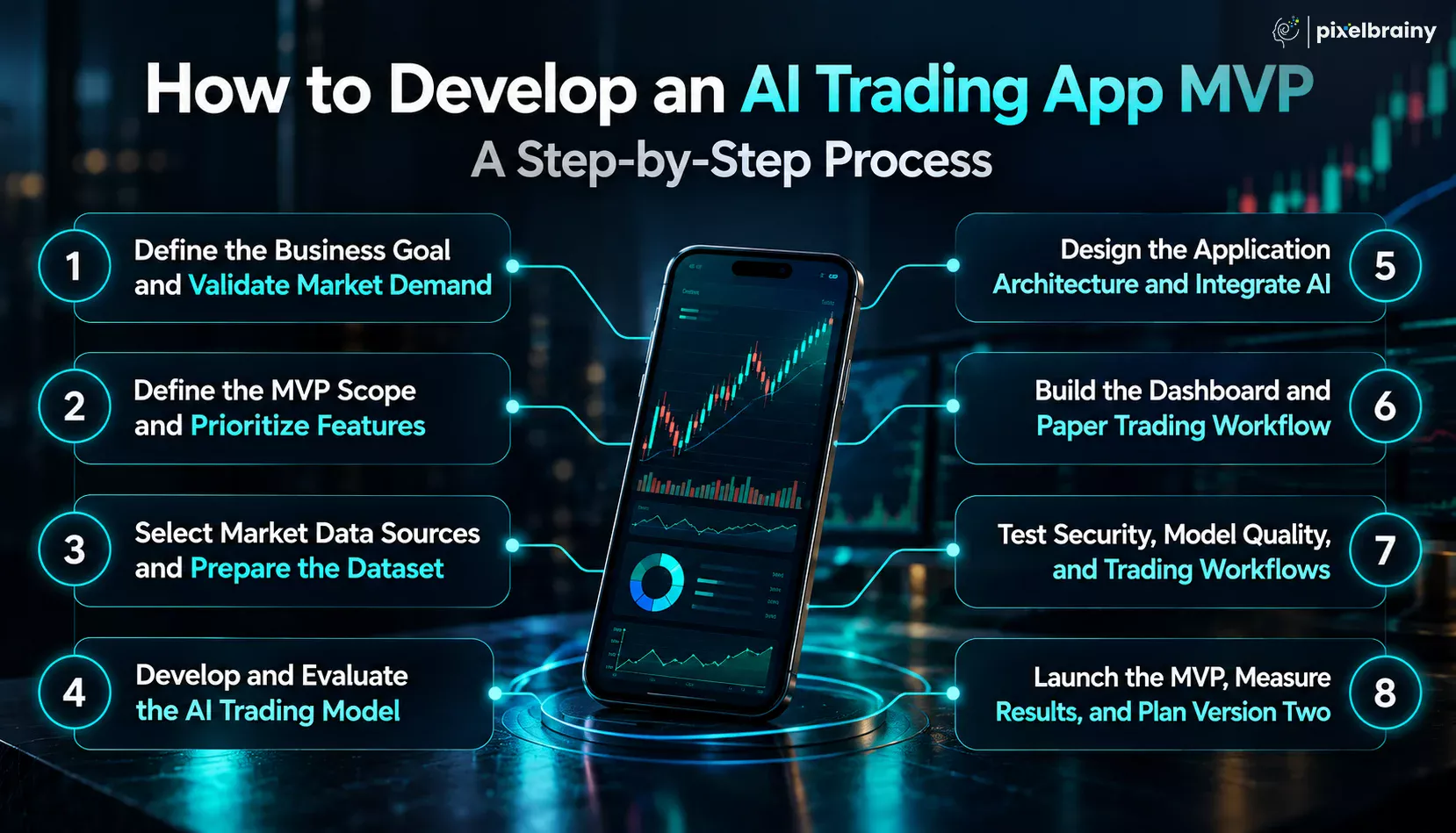
Developing an AI trading app MVP requires a structured approach that combines business strategy, quantitative research, AI engineering, and user validation. The goal is to launch a focused product that tests the core trading workflow without investing in a complete trading platform upfront.
What are the steps to develop an AI trading app MVP from idea to launch? The process typically includes market research, feature prioritization, data preparation, AI model development, application architecture, implementation, testing, and launch validation.
For example, a team of three co-founders building an AI-powered stock trading app may want AI signal generation, a portfolio dashboard, and paper trading in version one. Validating these capabilities through simulated trades before adding real-money brokerage integration can help assess model performance and user engagement while limiting early execution complexity.
The following eight steps explain how to build an AI trading app MVP from scratch, prioritize essential functionality, and prepare the product for launch.
Start by identifying your target audience, the trading problem your application solves, and the value it offers compared with existing tools. Research competitors, interview potential customers, and identify gaps in current solutions.
For founders making an AI trading app MVP, establish measurable goals such as user activation, repeat paper trading sessions, and engagement with AI-generated signals. An AI consultation can help evaluate technical feasibility, business opportunities, and potential risks before development begins.
Also Read: Top 10 AI Consulting Companies in USA
Create a roadmap that separates essential launch capabilities from features planned for version two. For a three-founder team, AI signal generation, a portfolio dashboard, and paper trading can form a focused initial release.
Real-money brokerage integration can usually wait until the core workflow has been validated. This approach to building an AI trading app MVP helps control costs, prevent scope creep, and establish clear acceptance criteria for every feature.
Also Read: Top 10 AI MVP Development Companies in USA
Identify the financial data required for your chosen use case, including historical prices, current market quotes, corporate fundamentals, or other relevant inputs. Evaluate provider reliability, data freshness, coverage, and licensing restrictions before selecting a source.
During the development process of an AI trading app MVP, establish repeatable data cleaning and validation pipelines. Prevent look-ahead bias and data leakage when preparing datasets, because these problems can make a model appear more accurate than it actually is.
Define the model's purpose before choosing an algorithm. Depending on the product, this may involve statistical methods, machine learning, or AI-assisted financial analysis.
Evaluate model performance using chronological training, validation, and out-of-sample testing. Measure relevant outcomes such as signal quality, drawdown, and performance after realistic transaction costs. Effective AI model development requires reproducible experiments and documented limitations.
If your team lacks specialized expertise, consider whether to hire AI developers with experience in quantitative finance, machine learning, and financial data engineering. Strong technical foundations are more valuable than adding complex models without measurable improvements.
Also Read: Top 20+ AI Development Companies In USA
Develop the backend, user interface, data pipelines, and model-serving components around your selected MVP features. Separating market data ingestion, AI inference, portfolio calculations, and paper trading services can make future improvements easier.
Effective AI integration ensures model outputs reach the application reliably and are displayed with appropriate context. Plan authentication, access controls, monitoring, and error handling from the beginning, while selecting infrastructure that matches your expected usage, latency requirements, and development budget.
Implement the portfolio dashboard, AI signal display, watchlists, simulated orders, virtual balances, and trade history. Make it easy for users to understand why a signal appeared and how simulated trades affect their portfolios.
When you create an AI trading app MVP, prioritize a complete user workflow over unnecessary visual complexity. Users should be able to review an insight, test a strategy, monitor simulated results, and provide feedback without requiring live brokerage access.
Include realistic assumptions for commissions, spreads, slippage, and order execution. Clearly communicate that simulated trading results do not guarantee performance in live markets.
Before release, test application functionality, data accuracy, API reliability, authentication, and failure recovery. Evaluate AI outputs against predefined criteria and investigate unstable results, data leakage, and misleading performance claims.
Test paper trading across different market conditions and execution assumptions. Review applicable US financial regulations based on the product's intended functionality. Independent security assessments and domain-specific testing can help identify weaknesses before beta users begin relying on the application.
Release the application to a controlled group of beta users. Track activation, repeat usage, paper trading activity, signal engagement, and feedback to determine whether the product solves the intended problem.
Use these findings to refine existing features before expanding the roadmap. Researching top AI trading software development companies may help when external expertise is needed, but evaluate their quantitative finance experience, security practices, and delivery capabilities carefully.
Introduce real-money brokerage integration when user demand, execution reliability, risk controls, and applicable regulatory requirements support the next stage.
Therefore, validate AI signals, portfolio tracking, and paper trading first, then introduce live trading when user evidence, technical readiness, and regulatory considerations justify expanding the MVP.
The cost to build an AI trading app MVP typically ranges from $20,000 to $120,000+, depending on the product's core functionality, AI model complexity, market data requirements, security measures, and third-party integrations. A basic AI market research application generally requires less investment than a quantitative trading MVP with custom models, historical backtesting, and paper trading capabilities.
How much does it cost to develop an AI trading app MVP with AI signals, a portfolio dashboard, and paper trading? For planning purposes, founders can use the $20,000 to $120,000+ range as an illustrative budget, then refine the estimate after defining the feature scope and technical requirements. This is a planning range, not a verified industry average or vendor quotation.
The following estimates outline common MVP types, their expected functionality, and the factors that influence development costs.
| AI Trading MVP Type | Estimated Cost (USD) | Typical Scope |
|---|---|---|
| Basic AI market research MVP | $20,000 to $40,000 | Core dashboard, selected market data, AI summaries, and user accounts |
| AI trading insights MVP | $35,000 to $70,000 | Market analysis, watchlists, model integration, analytics, and testing |
| AI trading MVP with paper trading | $45,000 to $90,000 | AI insights, simulated orders, virtual portfolio, and trade history |
| Quantitative strategy validation MVP | $60,000 to $120,000+ | Custom model evaluation, data pipelines, backtesting, simulation, and advanced metrics |
These are illustrative estimates rather than verified market averages. Costs overlap because the actual workload depends on the selected features, existing technology, data licensing, and engineering requirements. Live order execution, multi-asset support, and institutional-grade infrastructure can push costs beyond these ranges.
Integrating an existing AI service may reduce initial development effort. Developing proprietary quantitative models, specialized training pipelines, or advanced predictive systems generally requires more engineering and validation.
Market data costs vary according to asset coverage, historical depth, real-time access, usage, and redistribution rights. Include recurring data fees in your budget, not just initial integration expenses.
Brokerage APIs, financial data providers, and portfolio services require integration, authentication, error handling, and compatibility testing. Live trading integrations can add significant complexity compared with a paper trading MVP.
A focused web application may cost less than a platform with separate native mobile apps, advanced dashboards, administrative tools, and multiple user workflows. Feature scope and platform requirements directly affect development time.
Authentication, access controls, data protection, audit logging, security testing, and legal review contribute to the overall budget. Requirements depend on the product's functionality, users, and applicable regulations.
Hosting, AI inference, market data subscriptions, monitoring, bug fixes, and technical support create ongoing expenses after launch. Budget for these separately from one-time development costs.
Consider a hypothetical $60,000 AI trading app MVP development budget for a product that includes AI insights, a portfolio dashboard, and simulated trading.
| Workstream | Illustrative budget |
|---|---|
| Product discovery and UX design | $6,000 |
| Frontend and backend development | $19,000 |
| AI and market data integration | $12,000 |
| Paper trading and portfolio simulation | $8,000 |
| Testing and security work | $7,000 |
| Deployment and launch preparation | $3,000 |
| Contingency | $5,000 |
| Total | $60,000 |
This allocation is an example for planning, not a fixed quotation. Costs may change if your team already has a working quantitative model, requires extensive historical data, or needs specialist compliance support.
For founders comparing development partners, reviewing the expertise of AI trading software development companies can help establish realistic timelines, identify technical risks, and compare project proposals.
Therefore, the most cost-effective AI trading app MVP development strategy is to validate essential features first, control data and infrastructure expenses, and invest in advanced trading capabilities only when user feedback and business results justify the additional cost.
The technology stack directly affects the performance, reliability, scalability, and development cost of an AI trading application. For fintech founders, the right combination of frontend frameworks, backend services, financial data pipelines, AI frameworks, databases, and cloud infrastructure helps deliver a functional MVP without unnecessary engineering complexity.
What is the best tech stack for building an AI trading app MVP with AI signals, a portfolio dashboard, and paper trading? For many early-stage products, a practical stack combines React or Next.js for the frontend, Python with FastAPI for backend and AI services, PostgreSQL for structured financial data, Redis for caching, and cloud infrastructure from AWS, Google Cloud, or Microsoft Azure. The final architecture depends on data latency, model complexity, security requirements, and expected usage.
The following table outlines commonly used technologies for AI trading app MVP development, their roles, and when they make sense for an initial release.
| Technology layer | Recommended technologies | Purpose and MVP implementation |
|---|---|---|
| Frontend development | React, Next.js, TypeScript | Build responsive dashboards, watchlists, interactive charts, portfolio views, and AI-generated insights. TypeScript improves maintainability, while Next.js can support routing and server-rendered pages when needed. |
| UI and charting | Tailwind CSS, TradingView Lightweight Charts, Apache ECharts | Create responsive interfaces and visualize market prices, indicators, simulated trades, and portfolio performance. Confirm charting library capabilities and licensing requirements before commercial use. |
| Backend development | Python, FastAPI | Implement APIs for authentication, market data, AI inference, portfolio calculations, and paper trading. Python also integrates naturally with quantitative research and machine learning libraries. |
| AI and machine learning | pandas, NumPy, scikit-learn, PyTorch | Process financial datasets, engineer features, establish baseline models, and develop custom predictive systems when justified. Start with measurable baselines before investing in more complex models. |
| Large language model integration | OpenAI API or other suitable model APIs | Generate market summaries, explain quantitative indicators, and support financial research workflows. Ground responses in reliable data and evaluate accuracy, privacy, and provider requirements. |
| Financial market data | Licensed market data APIs and suitable provider SDKs | Retrieve historical prices, quotes, fundamentals, and other required financial information. Verify data freshness, asset coverage, exchange permissions, and redistribution terms. |
| Database | PostgreSQL | Store user profiles, watchlists, portfolios, simulated orders, trade history, and structured application records. Use appropriate indexing and transaction handling for consistency. |
| Caching and background jobs | Redis, Celery or comparable task queues | Cache frequently accessed information and process scheduled jobs such as data updates, notifications, and model tasks. Keep cached prices timestamped and handle stale data carefully. |
| Backtesting and quantitative analysis | pandas, NumPy, vectorbt or a suitable custom engine | Evaluate strategies against historical datasets, compare benchmarks, and estimate performance under documented assumptions. Account for look-ahead bias, transaction costs, and execution limitations. |
| Paper trading engine | Custom simulation service, backend APIs, PostgreSQL | Simulate order placement, virtual balances, position updates, and trade history. Define order-fill assumptions, slippage, commissions, and market-hour behavior consistently. |
| Real-time updates | WebSockets, server-sent events, or provider-supported streaming | Deliver market updates, status changes, and alerts when required. The necessary approach depends on the provider's capabilities and the application's latency requirements. |
| Cloud infrastructure | AWS, Google Cloud, Microsoft Azure | Host application services, databases, model endpoints, scheduled jobs, and monitoring. Begin with a manageable deployment and expand infrastructure as usage grows. |
| Security and authentication | OAuth 2.0 or OpenID Connect, multifactor authentication, managed secrets | Protect user accounts, API credentials, and sensitive application data. Apply least-privilege access, secure secret storage, encryption, and audit logging from the outset. |
| Testing and monitoring | pytest, Playwright, OpenTelemetry or cloud monitoring tools | Test API behavior, trading calculations, critical user workflows, and service reliability. Monitor failures, latency, data quality, and model performance after deployment. |
| Deployment and CI/CD | Docker, GitHub Actions or equivalent CI/CD tools | Package services consistently, automate testing, and deploy controlled releases. Use environment separation and rollback procedures to reduce deployment risks. |
For a first release, avoid introducing every technology in the table. A lean architecture could use Next.js, FastAPI, PostgreSQL, a licensed market data API, an existing AI service, and a single cloud provider.
Add Redis, background workers, streaming infrastructure, or custom model-serving systems only when actual workload and latency requirements justify them. Live brokerage integrations also require separate execution safeguards and additional security and regulatory assessment.
Therefore, the best AI trading app MVP tech stack is one that supports reliable data, measurable AI performance, secure paper trading, and future expansion without adding complexity before the product needs it.
Security and regulatory compliance are essential when building an AI trading app MVP in the USA, particularly when the application generates AI trading signals, tracks portfolios, processes financial data, or connects to brokerage accounts. Fintech founders need to consider data privacy, account security, AI transparency, market data licensing, and applicable financial regulations before launch.
Consider a US fintech startup developing an AI-powered stock trading app with AI signals, a portfolio dashboard, and paper trading. The founders want to validate their models before enabling real-money transactions. Can we launch an AI trading app MVP with paper trading first, and what compliance requirements should we address before introducing live trades? The answer depends on the app's specific activities. General market research, personalized investment advice, and automated trade execution can involve different legal obligations.
For startups planning to build an AI trading app MVP, the best approach is to assess regulatory exposure early, implement essential security controls, and validate the product in a controlled environment.
An AI trading app may face investment adviser or other securities-related requirements if it provides personalized investment advice or brokerage services.
SEC guidance for robo-advisers highlights disclosure and compliance obligations for firms providing automated investment advice.
Trading apps may process personal details, portfolio holdings, account identifiers, and transaction histories. Build data protection into the MVP from the beginning.
The FTC Safeguards Rule requires covered financial institutions under FTC jurisdiction to maintain an appropriate information security program. Confirm whether it applies to your business.
AI trading signals can be unreliable when models use poor-quality data, overfit historical patterns, or fail to adapt to market changes.
For example, if the app identifies a stock as a potential buying opportunity, clarify that the signal does not guarantee future returns.
Paper trading lets founders test AI signals, portfolio calculations, and simulated orders without immediately risking real money.
Key safeguards include:
For founders deciding whether to include brokerage integration in version one, paper trading is often the more practical starting point. It helps validate demand and system reliability before adding live execution. However, paper trading does not automatically remove other regulatory obligations.
Live brokerage connectivity introduces additional security and operational risks.
Treat brokerage integration as a separate development milestone and review applicable legal requirements before enabling real-money execution.
Access to a market data API does not necessarily grant unlimited rights to store, redistribute, display, or use data for AI training.
Before choosing a provider:
Clear licensing helps reduce legal risks and supports reliable AI-generated insights.
Monitoring helps teams investigate errors, detect suspicious activity, and respond to security incidents.
The MVP should include:
Applicable recordkeeping and breach-notification requirements depend on the business and its regulatory obligations.
The app's website, onboarding screens, and promotional materials should accurately describe its AI capabilities.
These practices help build user trust and reduce the risk of misleading financial claims.
Therefore, AI trading app MVP development in the USA should prioritize data security, transparent AI outputs, proper licensing, and a regulatory assessment tailored to the product. Starting with paper trading helps founders validate core features before taking on the added risks of live trading.
When businesses plan to develop and launch an AI trading app MVP, their goal should extend beyond deploying the application. A successful launch requires validating AI performance, attracting early adopters, measuring user engagement, and identifying improvements before investing in advanced features. For US fintech startups offering AI trading signals, a portfolio dashboard, and paper trading, the initial priority should be to demonstrate product value while maintaining security, reliability, and user trust.
How should a fintech startup launch an AI trading app MVP after development to attract early users and validate product-market fit? A practical strategy combines pre-launch testing, a controlled beta release, targeted marketing, and data-driven improvements. Rather than focusing only on downloads, businesses should evaluate whether users understand AI-generated insights, engage with core features, and continue using the application.
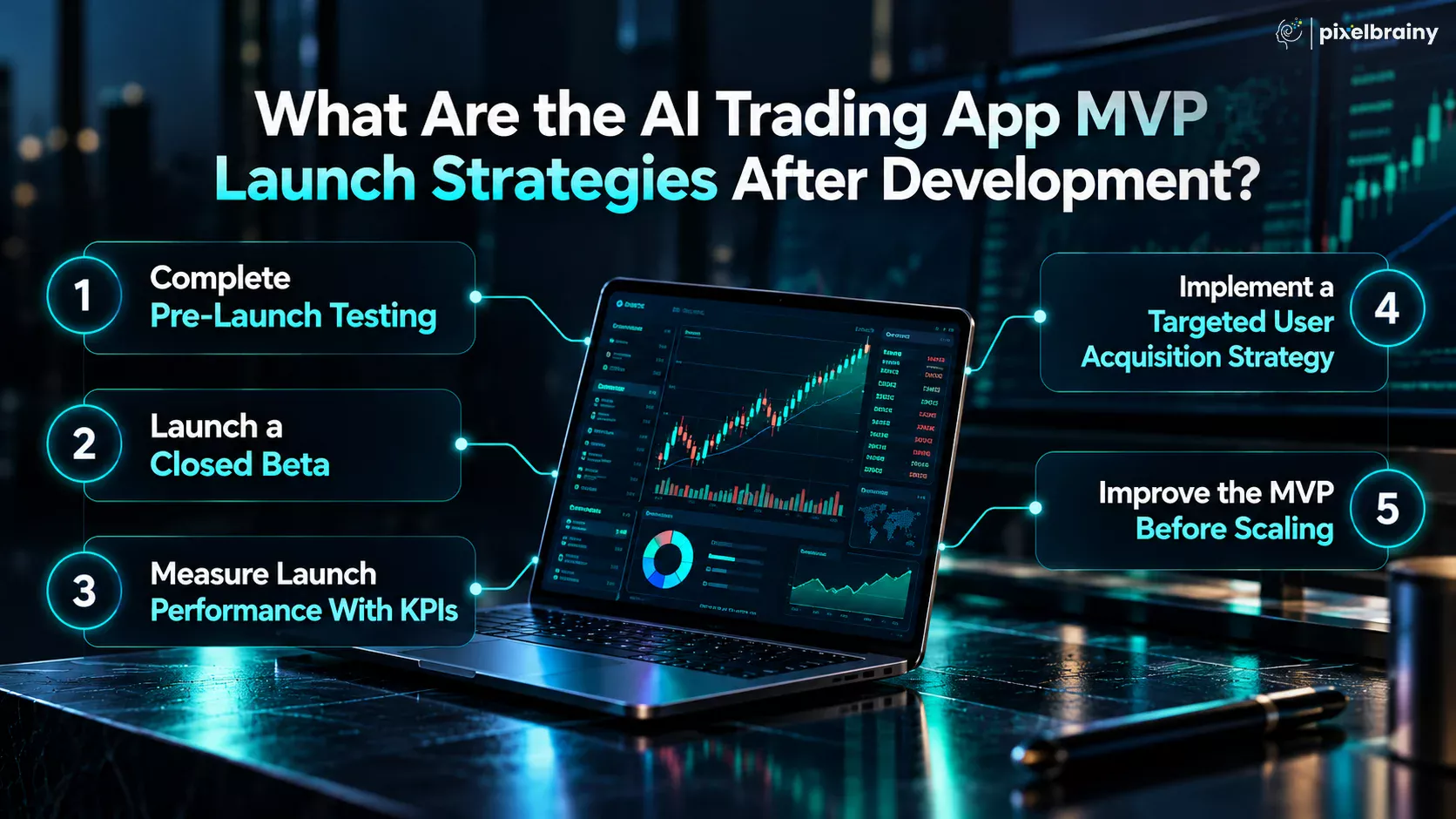
Before releasing the MVP, test the complete user journey, including registration, AI signal generation, portfolio calculations, notifications, and paper trading.
Resolve critical defects before inviting external users.
Introduce the application to a small group of target users, such as retail investors, quantitative finance enthusiasts, and traders interested in AI-assisted research.
Gather feedback on signal usefulness, dashboard usability, onboarding, and paper trading workflows. Monitor actual user behavior alongside survey responses to identify friction points and unmet needs.
A closed beta helps validate the core value proposition before expanding to a larger audience.
A data-driven AI trading app MVP launch strategy should track metrics that demonstrate product value, not just downloads.
| KPI | What It Measures |
|---|---|
| Activation rate | Users completing key onboarding actions |
| Feature adoption | Usage of AI signals, dashboards, and paper trading |
| User retention | Users returning over time |
| Paper trading engagement | Frequency of simulated trades and strategy testing |
| AI model performance | Results against defined benchmarks and testing assumptions |
| System reliability | Uptime, latency, and application errors |
| User feedback | Satisfaction and feature improvement opportunities |
Set measurable targets based on beta results. Evaluate AI performance carefully because historical and simulated results do not guarantee future returns.
Once the MVP demonstrates reliable functionality, focus on channels that reach the intended audience.
Ensure all promotional materials accurately describe AI capabilities and investment risks.
Use user feedback, engagement data, and technical performance metrics to prioritize improvements. Fix confusing workflows, unreliable data feeds, and underused features before expanding the product.
For example, if beta users frequently test AI signals through paper trading but rarely use advanced analytics, improve signal explanations and simulation workflows before investing in complex predictive models or live brokerage integration.
Therefore, a successful AI trading app MVP launch strategy combines controlled testing, targeted user acquisition, measurable KPIs, and continuous improvement. Validate demand and core functionality first, then scale marketing and features based on real user evidence.
Successful AI trading app MVP development requires more than building AI models and integrating market data. Fintech founders must validate demand, evaluate model performance realistically, select reliable data sources, and plan for ongoing operational costs. Overlooking these areas can increase development expenses, delay launch, and undermine user trust.
What are the most common mistakes when building an AI trading app MVP, and how can startups avoid them? For example, a fintech team may invest in advanced AI predictions and live brokerage integration before confirming whether users find its trading signals useful. A more effective strategy is to build around a clear user problem, validate the core features, and expand only when performance and customer feedback support further investment.
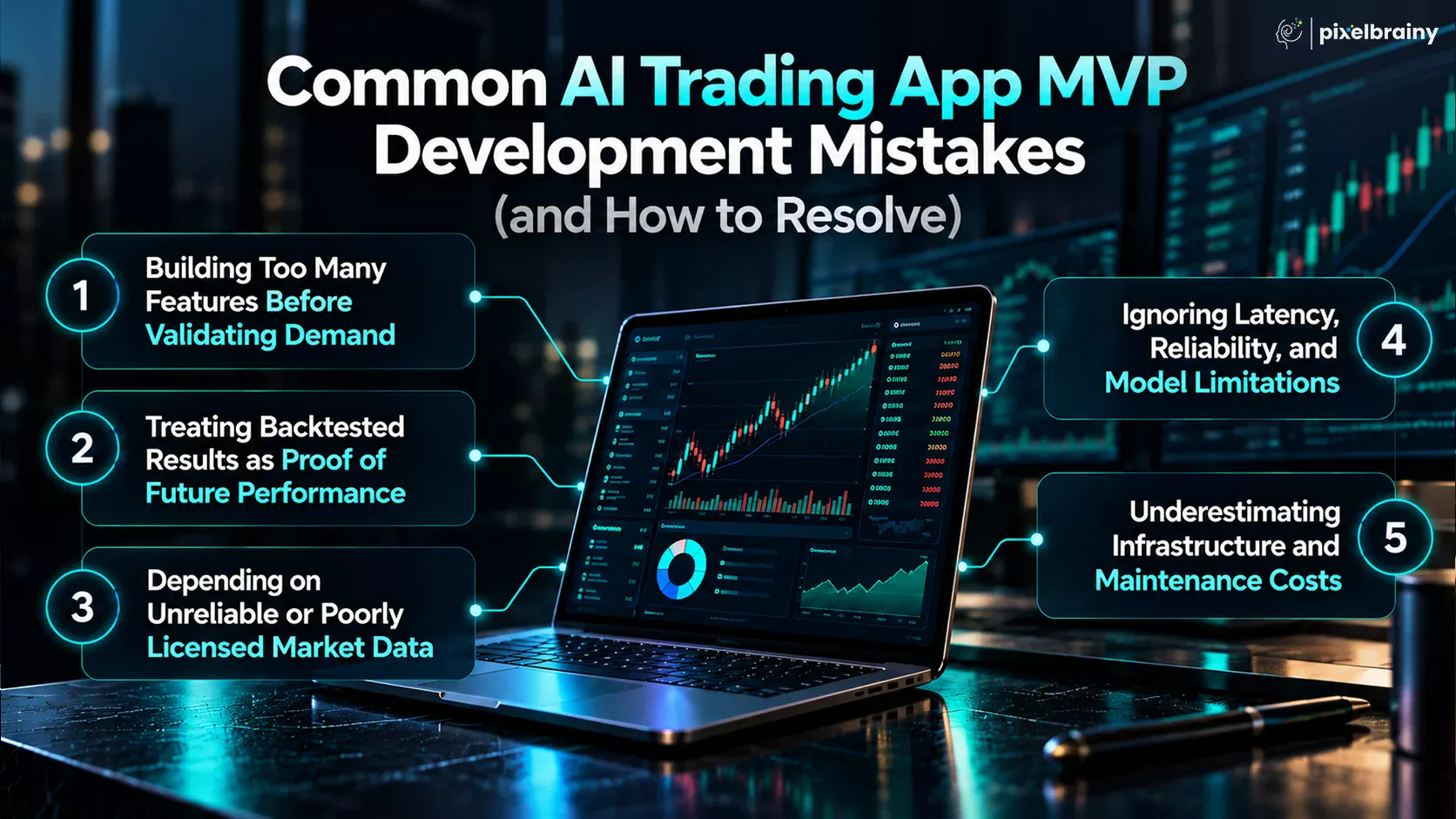
Adding automated trading, multiple broker integrations, advanced analytics, and social features too early can increase costs and development time.
How to resolve it:
Keep the initial MVP focused on proving its core value proposition.
A strategy that performs well on historical data may fail in live markets because of overfitting, changing market conditions, transaction costs, or unrealistic execution assumptions.
How to resolve it:
Communicate model limitations clearly and never guarantee future returns based on historical results.
Incomplete, delayed, or inaccurate financial data can distort AI signals and produce misleading analysis. Unclear licensing can also create legal and commercial risks.
How to resolve it:
Reliable, properly licensed data is essential for trustworthy AI trading functionality.
Slow APIs, service outages, and inaccurate model outputs can reduce user confidence. These issues become especially important when applications provide real-time insights or support trade execution.
How to resolve it:
The cost to build an AI trading app MVP includes more than initial development. Cloud hosting, market data subscriptions, AI inference, monitoring, security updates, and ongoing model evaluation can increase operating expenses.
How to resolve it:
Therefore, avoiding common AI trading app MVP development mistakes requires focused feature planning, realistic model validation, reliable data, strong monitoring, and a clear operating budget. These practices help fintech startups launch confidently and scale based on evidence rather than assumptions.
Businesses entering the AI-powered trading market need a development partner who understands both financial technology and practical AI implementation. For fintech founders, the challenge is to demonstrate meaningful AI capabilities, validate user demand, and control development costs without overengineering the first release. PixelBrainy supports this approach by focusing on business objectives, MVP architecture, essential trading workflows, and a roadmap for future product growth.
As a technology partner, PixelBrainy helps startups plan AI trading app MVP development services around their target users, core features, data requirements, and launch goals. The objective is to build a functional, testable product that demonstrates value before significant investment in production-grade quantitative infrastructure.
MVP-focused technical planning: Define the essential features required to validate the product, such as AI signals, portfolio dashboards, and paper trading, while postponing unnecessary complexity.
Practical AI architecture: Identify an appropriate approach for signal generation using established statistical methods, existing machine learning models, or custom models where justified by the use case and available data.
Fintech-oriented development: Consider market data integration, portfolio calculations, simulated order execution, risk indicators, and security requirements as part of the overall architecture.
Cost-conscious technology decisions: Select suitable frameworks, APIs, and cloud infrastructure without introducing expensive components before the MVP requires them.
A roadmap for future expansion: Prepare the architecture for additional assets, improved models, advanced analytics, or brokerage integration when validation results justify those investments.
Whether a startup wants to build AI trading app MVP for trading business or validate a new AI-powered investment research concept, PixelBrainy can help translate its requirements into a structured development plan.
A key question for founders evaluating development partners is: “We are evaluating development partners for our AI trading app MVP. How would you architect the AI signal generation component to demonstrate AI capability without spending the full cost of a production-grade quantitative model?”
An MVP-appropriate solution can begin with a modular signal-generation service that combines licensed market data, baseline quantitative indicators, and a lightweight machine learning model where suitable. The service can generate timestamped signals with supporting indicators and uncertainty information, while a separate paper trading engine evaluates simulated outcomes.
This approach allows founders to demonstrate AI functionality, measure performance against benchmarks, and gather user feedback before committing to more expensive model development. The architecture should also support reproducible testing, model version tracking, and clear disclosures about prediction limitations.
In a representative fintech MVP scenario, a startup needs AI-generated stock signals, a portfolio dashboard, and paper trading but wants to defer live brokerage integration.
The proposed scope would prioritize market data integration, a modular signal-generation service, portfolio tracking, simulated trade execution, and basic performance analytics. Initial testing would focus on signal quality, data reliability, usability, and simulated trading behavior. The project details are illustrative and do not represent a verified client engagement or performance result.
This approach reflects the planning required to develop AI trading app MVP solutions without prematurely committing to a complex production trading system. PixelBrainy can help founders assess the requirements to create AI trading app MVP products and plan trading app MVP development integrating AI around measurable business goals.
For fintech startups seeking a partner, PixelBrainy aims to bring together AI implementation, MVP discipline, and practical product engineering as a best AI trading software development company in USA option to evaluate.
Ready to validate your AI trading idea? Connect with PixelBrainy to discuss your MVP scope, architecture, and launch roadmap.
The growing adoption of AI in financial markets creates new opportunities for fintech startups to develop smarter, data-driven trading solutions. AI trading app MVP development provides a practical way to validate a business idea, demonstrate AI capabilities, and test essential features before investing in a full-scale platform. With a focused strategy, founders can control initial costs while gathering valuable insights to guide future product decisions.
As discussed throughout this guide, successful AI trading app development requires more than integrating an AI model. It involves selecting the right technology stack, prioritizing essential features, validating trading strategies through paper trading, managing security and regulatory requirements, and measuring user engagement after launch. A well-planned MVP helps reduce unnecessary complexity and establishes a foundation for scalable growth.
Partnering with an experienced AI trading software development company can help transform your concept into a functional product aligned with your business objectives. PixelBrainy can support your journey from initial planning to MVP launch and future enhancements.
Ready to turn your trading idea into reality? Book an appointment with PixelBrainy to discuss your AI trading app MVP development roadmap.
Startups can validate their ideas through AI trading app MVP development by launching core features such as AI-generated trading signals, portfolio tracking, and paper trading. This helps founders evaluate user demand, test trading workflows, and gather feedback before investing in advanced models or live brokerage integration.
Yes, businesses can build an AI trading app MVP using established machine learning models, statistical methods, and technical indicators. The right approach depends on the use case, data availability, and performance requirements. A custom quantitative model can be introduced later when testing demonstrates a clear need.
AI trading app MVP development typically takes around 8 to 16 weeks for a focused initial release. The timeline depends on feature complexity, AI integration, market data availability, testing requirements, and security controls. Custom models and brokerage integrations may require additional development time.
The estimated cost to develop an AI trading app MVP can range from $20,000 to $120,000 or more, depending on the application's functionality, AI complexity, data licensing, and infrastructure requirements. A focused MVP with paper trading generally requires less investment than a platform supporting advanced quantitative models and live execution.
Paper trading is one of the most valuable AI trading app MVP features because it allows founders to test simulated trades, portfolio calculations, and AI-generated signals without risking real capital. It also helps evaluate user engagement before introducing brokerage integration. However, simulated performance cannot guarantee results in live markets.
For custom AI trading app MVP development, a practical stack may include React or Next.js for the frontend, Python with FastAPI for backend and AI services, PostgreSQL for structured data, and AWS, Google Cloud, or Azure for infrastructure. The final stack should match the product's data requirements, security needs, and expected scale.
AI trading app MVP development in the USA may involve securities regulations, data privacy obligations, cybersecurity requirements, and market data licensing restrictions. Requirements depend on whether the application provides general market analysis, personalized investment advice, or live trade execution. Founders should consult qualified legal counsel to assess their specific business model.
PixelBrainy can help fintech founders plan AI trading app MVP development services around essential features, practical AI architecture, market data integration, paper trading, and future scalability. When evaluating PixelBrainy as a potential development partner, ask how its team would demonstrate AI capabilities without unnecessary model complexity and align the MVP scope with your budget, business objectives, and launch strategy.

About The Author
Sagar Bhatnagar
Sagar Sahay Bhatnagar brings over a decade of IT industry experience to his role as Marketing Head at PixelBrainy. He's known for his knack in devising creative marketing strategies that boost brand visibility and market influence. Sagar's strategic thinking, coupled with his innovative vision and focus on results, sets him apart. His track record of successful campaigns proves his ability to utilize digital platforms effectively for impactful marketing efforts. With a genuine passion for both technology and marketing, Sagar continuously pushes PixelBrainy's marketing initiatives to greater success.

Working with PixelBrainy has been a great experience. They took our vision for an AI-powered platform and turned it into a fully functional product. What impressed me most was their strong understanding of both design and development, and their ability to handle complex requirements with ease. The team was responsive, cooperative, and always open to feedback. They kept things organized, communicated clearly, and delivered quality work on time. I highly recommend PixelBrainy to anyone looking for a skilled and reliable development partner.

Working with the PixelBrainy team has been a highly positive experience. They understand the design requirements and create beautiful UX elements to meet the application needs. The dev team did an excellent job bringing my vision to life. We discussed usability and flow. Sagar worked with his team to design the database and begin coding. Working with Sagar was easy. He has the knowledge to create robust apps, including multi-language support, Google and Apple ID login options, Ad-enabled integrations, Stripe payment processing, and a Web Admin site for maintaining support data. I'm extremely satisfied with the services provided, the quality of the final product, and the professionalism of the entire process. I highly recommend them for Android and iOS Mobile Application Design and Development.

Great experience working with them. Had a lot of feedback and I found that unlike most contractors they were bugging me for updates instead of the other way around. They were extremely time conscience and great at communicating! All work was done extremely high quality and if not on time, early! They were always proactive when it comes to communication and the work is great/above par always. Very flexible and a great team to work with! Goes above and beyond to present us with multiple options and always provides quality. Amazing work per usual with Chitra. If you have UI/UX or branding design needs I recommend you go to them! Will likely work with them in the future as well, definitely recommended!

PixelBrainy is a joy to work with and is a great partner when thinking through branding, logo, and website layout. I appreciate that they spend time going into the "why" behind their decisions to help inform me and others about industry best practices and their expertise.

I hired them to design our software apps. Things I really like about them are excellent communication skills, they answer all project suggestions and collaborate right away, and their input on design and colors is amazing. This project was complex and needed patience and creativity. The team is amazing to do business with. I will be using them long-term. Glad to see there are some good people out there. I was afraid to try and outsource my project to someone but I am glad I met them! I really can't say enough. They went above and beyond on this project. I am very happy with everything they have done to make my business stand out from the competition.

It was great working with PixelBrainy and the team. They were very responsive and really owned the project. We'll definitely work with them again!

I recently worked with the PixelBrainy team on a project and I was blown away by their communication skills. They were prompt, clear, and articulate in all of our interactions. They listened and provided valuable feedback and suggestions to help make the project a success. They also kept me updated throughout the entire process, which made the experience stress-free and enjoyable.

PixelBrainy is very good at what it does. The team also presents themselves very professionally and takes care of their side of things very well. I could fully trust them taking up the design work in a timely and organised manner and their attention to detail saved us lots of effort and time. This particular project was quite intense and the team showed that they function very well under pressure. Very much looking forward to working with her again!

It's always an absolute pleasure working with them. They completed all of my requests quickly and followed every note I had for them to a T, which made our process go smoothly from start to finish. Everything was completed fast and following all of the guidelines. And I would recommend their services to anyone. If you need any design work done in the future, PixelBrainy should be your first call!

They took ownership of our requirements and designed and proposed multiple beautiful variants. The team is self-motivated, requires minimum supervision, committed to see-through designs with quality and delivering them on time. We would definitely love to work with PixelBrainy again when we have any requirements.

PixelBrainy was a big help with our SaaS application. We've been hard at work with a new UI/UX and they provided a lot of help with the designs. If you're looking for assistance with your website, software, or mobile application designs, PixelBrainy and the team is a great recommendation.

PixelBrainy designers are amazing. They are responsive, talented, and always willing to help craft the design until it matches your vision. I would recommend them and plan to continue them for my future projects and more!!!

They were awesome! Did a good job fast, and good communication. Will work with them again. Thank you

Creative, detail-oriented, and talented designers who take direction well and implement changes quickly and accurately. They consistently over-delivered for us.

PixelBrainy team is very talented and creative. Great designers and a pleasure to work with. PixelBrainy is an excellent communicator and I look forward to working with them again.

PixelBrainy has a very talented design team. Their work is excellent and they are very responsive. I enjoy working with them and hope to continue on all of our future projects.


Transform your ideas into reality with us.
Across these industries, each engagement brings unique challenges, from early-stage product development to scaling complex systems, helping us build a practical understanding of real-world product environments.