AI Summary Powered by PixelBrainy
How widely are businesses adopting artificial intelligence in 2026, and what do the latest numbers reveal about real‐world usage and business impact? As AI becomes a critical driver of digital transformation, leaders are increasingly searching for reliable AI adoption statistics 2026, AI usage by industry, and AI implementation statistics to benchmark progress and guide strategic investments.
According to recent research of McKinsey, 88 percent of organizations now use AI in at least one business function, a sharp increase from previous years as enterprises move beyond pilots into broader deployment. Meanwhile, GenAI use has grown rapidly, with a majority of companies reporting regular use of generative AI tools in business workflows. These adoption patterns show that AI is no longer confined to research labs but is influencing operations, customer experience, and decision making at scale.
Market projections also highlight the economic momentum behind AI. The global AI market has expanded significantly, with ongoing growth fueled by enterprise demand for intelligent automation, predictive analytics, and AI-enhanced applications.
Despite this growth, adoption rates and implementation maturity vary significantly across sectors, with industries such as finance, healthcare, manufacturing, and retail reporting some of the highest levels of usage. This variation underscores the importance of understanding AI usage by industry as well as macro AI market trends 2026.
This blog provides a comprehensive, data-driven analysis of AI adoption statistics in 2026, exploring global patterns, industry differences, business impact, and challenges. It is designed to help CTOs, founders, product leaders, and enterprise decision-makers interpret current trends and build practical AI strategies that deliver measurable results.

To understand how deeply artificial intelligence is embedded in modern businesses, it is essential to look at global adoption data. The following AI adoption statistics in 2026 provide a clear, fact-based view of how widely AI is used, how fast adoption is growing, and where organizations are investing.
1. According to McKinsey, The State of AI: Global Survey 88 percent of organizations report using AI in at least one business function.
Why it matters: This high adoption rate signals that AI is no longer experimental but a mainstream operational tool across corporate functions.
2. According to Gartner, Generative AI Adoption Forecast Over 80 percent of enterprises are expected to use generative AI APIs or deploy generative AI-enabled applications by 2026.
Why it matters: Generative AI is set to become embedded in enterprise systems, shaping product development, automation, and customer interactions.
3. According to Microsoft Report 2025, Global adoption of AI continued rising in 2025, with generative AI use rising among tools available to roughly one in six people worldwide.
Why it matters: Growing global usage reflects accelerating diffusion of AI technologies across both business and public sectors.
4. According to Digital Third Coast, 52 percent of large organizations have a dedicated AI adoption team.
Why it matters: Dedicated teams indicate a shift from ad-hoc AI experiments toward structured enterprise programs.
5. According to Fortune Business Insights, the global AI market size is projected to grow from an estimated $375.93 billion in 2026 to over $2.48 trillion by 2034 at a CAGR of 26.6 percent.
Why it matters: Sustained market growth suggests increasing AI spending, adoption, and integration across software, services, and infrastructure.
6. As per report of Precedence Research, the global generative AI market is expected to reach $55.51 billion in 2026 and grow significantly beyond.
Why it matters: Rapid expansion of the generative AI segment highlights its role as one of the fastest-growing subcategories in the broader AI market.
These AI implementation statistics clearly show that AI is a strategic priority for modern businesses. Adoption is high in sophisticated enterprises, generative AI tools are becoming standard, and organizations are investing in dedicated teams and infrastructure. Meanwhile, AI adoption rate statistics 2026 highlight market projections pointing to significant long-term economic growth and broader utilization of intelligent systems beyond early adopters.
How artificial intelligence is adopted in 2026 varies significantly by industry, driven by differences in data availability, regulatory pressure, operational complexity, and competitive intensity. While global AI adoption statistics in 2026 show widespread usage, a closer look at AI adoption in individual industries in 2026 and beyond reveals uneven maturity levels, distinct use cases, and sharply different business outcomes.
This section examines AI usage by industry, highlighting how sectors such as healthcare, financial services, retail, manufacturing, software, and emerging domains are implementing AI in real-world environments. By combining industry-specific AI adoption data, real deployment examples, and authoritative sources, this analysis helps businesses benchmark where they stand and identify where AI delivers the greatest impact.
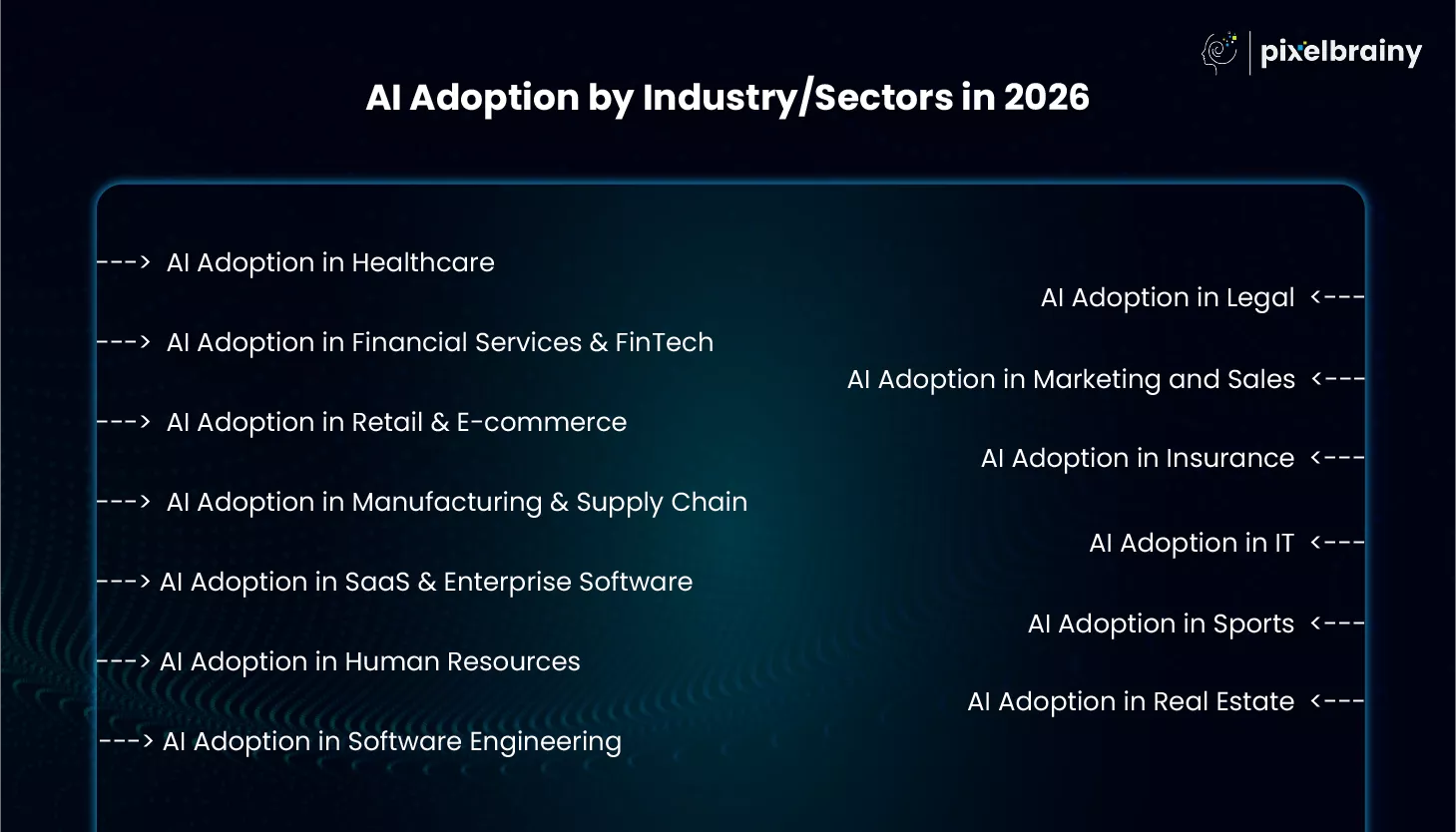
Artificial intelligence has rapidly transitioned from pilot projects to mission-critical applications in healthcare, affecting diagnostics, imaging, personalized care, and drug discovery. As organizations adopt AI technologies across clinical and operational functions, the industry is witnessing notable growth in market size, adoption rates, and measurable impact on outcomes and efficiency, with AI adoption statistics highlighting the accelerating pace of transformation.
AI is increasingly used in healthcare for:
Regulatory support and clinical governance are shaping deployment strategies, with many organizations balancing innovation with safety, privacy, and explainability standards that are critical in healthcare contexts.
Overall, AI adoption in healthcare in 2026 is robust, driven by market growth, organizational uptake, executive trust, and tangible use cases that improve clinical accuracy, operational efficiency, and patient experiences.
Artificial intelligence has deeply influenced the financial services landscape as banks, lenders, and FinTechs look to improve risk management, drive intelligent automation, and enhance customer experience.
By 2026, AI adoption in financial services is no longer limited to pilots; firms are embedding AI into core functions such as fraud detection, credit decisioning, compliance, customer service, and personalized financial products, with AI adoption statistics reflecting the rapid shift toward AI-driven financial ecosystems.
AI adoption in financial services in 2026 and beyond is characterized by pervasive use of machine learning, rapid growth in generative AI strategies, and tangible operational improvements in fraud prevention, risk management, and customer experience. However, governance, explainability, and integration remain key areas where firms must invest strategically to achieve measurable business value.
In 2026, retail and e-commerce companies are rapidly integrating artificial intelligence to enhance customer experience, streamline operations, and unlock new revenue streams. The shift from simple automation to intelligent and generative systems is reflected in measurable market growth, AI adoption statistics, and strategic investment—all pointing to AI as a core driver of modern retail competitiveness.
AI adoption in retail and e-commerce in 2026 is marked by strong investment, widespread use of AI-powered personalization, and rapid growth in capabilities such as demand forecasting and generative tools. While many retailers are still optimizing deployment, the trend shows AI becoming a core part of competitive retail operations.
Artificial intelligence has become an integral part of modern manufacturing and supply chain operations, enabling smarter production, higher quality outputs, and more resilient logistics networks. By 2026, many manufacturers and supply chain leaders are using AI technologies such as predictive maintenance, computer vision, and AI-IoT integration to reduce downtime, improve product quality, and strengthen operational efficiency, with AI adoption statistics reflecting the accelerating pace of transformation across the industry.
AI adoption in manufacturing and supply chain in 2026 is marked by meaningful integration of predictive analytics, computer vision, and AI-IoT technologies. While adoption levels still vary by region and company size, the clear trend is a shift from pilots to production-scale AI, generating measurable operational improvements, cost efficiencies, and stronger supply chain resilience.
Also Read: Top 20+ AI Development Companies In USA: Pioneering Innovation in the Market
In 2026, AI is no longer an optional add-on for SaaS and enterprise software. It has become a core differentiator, powering embedded features, intelligent assistants, and next-generation user experiences that help software vendors innovate faster and deliver more value to customers.
As enterprise demand for AI-rich applications grows, the SaaS landscape is reshaping around AI as a built-in capability rather than a separate module, with AI adoption statistics highlighting how deeply intelligence is now embedded across modern enterprise platforms.
AI adoption in SaaS & enterprise software in 2026 demonstrates how deeply AI has been woven into product design and delivery. From embedded intelligent features to built-in copilot assistants and advanced generative capabilities, AI is shifting from experimental to essential, giving forward-looking SaaS companies a clear competitive edge.
By 2026, human resources teams are increasingly adopting artificial intelligence to streamline hiring, workforce planning, employee engagement, and HR analytics. While many organizations are still building maturity around strategic AI deployment, HR functions are seeing measurable gains from automation and data-driven decision making, with AI adoption statistics demonstrating steady growth in AI-powered HR transformation.
AI adoption in human resources in 2026 shows that HR functions are increasingly integrating intelligent tools into daily operations. While adoption levels vary, particularly across regions and organization sizes, the trend toward AI-enabled recruitment, planning, and analytics is clear, and the HR AI market’s sustained growth supports broader strategic integration in the coming years.

In 2026, the legal industry is experiencing a rapid shift toward artificial intelligence, with many law firms and corporate legal teams adopting AI tools for research, document review, compliance, and workflow automation. While adoption levels vary by firm size and practice area, the pace of change reflects a broader trend toward maximizing efficiency, reducing routine tasks, and enhancing strategic legal work with data-driven insights.
AI adoption in legal in 2026 is characterized by rapid growth, diverse use cases, and measurable efficiency gains, yet widespread strategic integration still remains a work in progress. As generative AI tools mature and regulatory guidelines take shape, the legal profession is poised for continued transformation driven by intelligent automation and data-driven workflows.
In 2026, artificial intelligence has become a core tool for marketing and sales teams as brands seek deeper customer insights, stronger personalization, and measurable revenue impact. From predictive analytics to generative AI for content creation and customer interaction, AI adoption in marketing and sales is reshaping how companies attract, engage, and convert customers.
AI adoption in marketing and sales in 2026 is no longer experimental. High daily usage, strong investment intentions, and measurable revenue impact show that AI has become integral to strategy and execution. While adoption varies by organization size and maturity, the trend toward embedded AI tools and data-driven decision making is clear across both functions.
The insurance industry has increasingly embraced artificial intelligence as a strategic tool to improve underwriting, automate claims processing, enhance customer service, and strengthen risk assessment. In 2026, many insurers are moving beyond early experiments and pilot programs toward broader integration of AI capabilities at scale, driven by strong market growth, executive prioritization, and real operational impact.10. AI Adoption in Strategy and Corporate Offices.
AI adoption in insurance in 2026 shows strong strategic interest and growing implementation across underwriting, claims, pricing, and customer service. While many insurers are still scaling and formalizing AI operations, market expansion, executive prioritization, and real use cases point to deeper integration of AI technologies as insurers seek improved efficiency, customer experience, and competitive advantage.
Also Read: How to Build an AI Chatbot for Insurance Agencies?
Artificial intelligence has become deeply embedded in the IT industry, reshaping how software is developed, deployed, and managed. By 2026, IT teams are among the most active adopters of AI tools, using them not just for automation but also for innovation in areas such as code generation, infrastructure optimization, service desk automation, and security. The trend reflects both broad adoption of AI technologies across business functions and specific increases in usage within IT workflows.
AI adoption in IT in 2026 is extensive and growing, with high usage of AI tools among IT professionals, rising integration into core workflows, and projected productivity gains across software development, infrastructure, and support functions. While adoption remains uneven in some areas depending on skill level and governance maturity, the trend toward deeper AI integration is clear.
Artificial intelligence is reshaping the sports industry by powering advanced analytics, performance optimization, injury prevention, fan engagement, and strategic decision-making. By 2026, sports teams, leagues, and technology partners are increasingly integrating AI tools—from computer vision to predictive models—creating a new era of data-driven sports performance and operational insights.
AI adoption in sports in 2026 is on a clear growth trajectory, with expanding market value, broader team usage, and deeper integration into analytics, player development, and fan engagement. As technologies such as computer vision, predictive modeling, and advanced analytics mature, sports organizations are better equipped to leverage data for performance, strategy, and competitive advantage.
Also Read: Top Sports Betting App Development Companies in USA
Artificial intelligence is rapidly transforming the real estate industry as agents, property managers, brokers, and PropTech companies increasingly use AI to enhance property search, automate valuations, personalize recommendations, and streamline operations. By 2026, AI tools are becoming mainstream in both residential and commercial real estate workflows, supporting decision-making and improving customer experiences.
AI adoption in real estate in 2026 is accelerating as technologies mature and workflows evolve. While adoption levels vary across agents, brokers, investors, and property managers, AI-driven tools are increasingly integral to value creation, market insights, and competitive differentiation in the real estate sector.
Also Read: Top 12+ AI Real Estate Software Development Companies in USA
Software engineering has been one of the fastest-adopting domains of artificial intelligence, with developers and engineering teams increasingly relying on AI tools to write, test, and maintain code, improve productivity, and accelerate delivery. By 2026, AI adoption in software engineering is reflected not only in widespread use of coding assistants and generative models but also in the way modern development teams integrate AI throughout the software lifecycle.
AI adoption in software engineering in 2026 shows that developers are not just experimenting with AI—they are routinely using it to accelerate build cycles, improve quality, and enhance productivity. While adoption levels still vary by organization and tool maturity, the trend toward pervasive AI in developer workflows is clear and growing.
Also Read: Top 70+ AI Agent Use Cases Across Industries
Generative AI adoption in 2026 is not uniform across sectors. While overall generative AI adoption rate among businesses is rising rapidly, industry-specific data shows clear leaders, distinct use cases, and different maturity levels.
The following generative AI adoption statistics 2026 align enterprise usage with respected industries and sectors.
Across sectors, adoption varies:
According to Forrester generative AI industry outlook, Enterprises increasingly:
AI adoption in 2026 is no longer measured by experimentation but by its ability to deliver measurable productivity gains, revenue growth, and better decision-making. The following impact areas show how AI translates adoption into tangible business value.
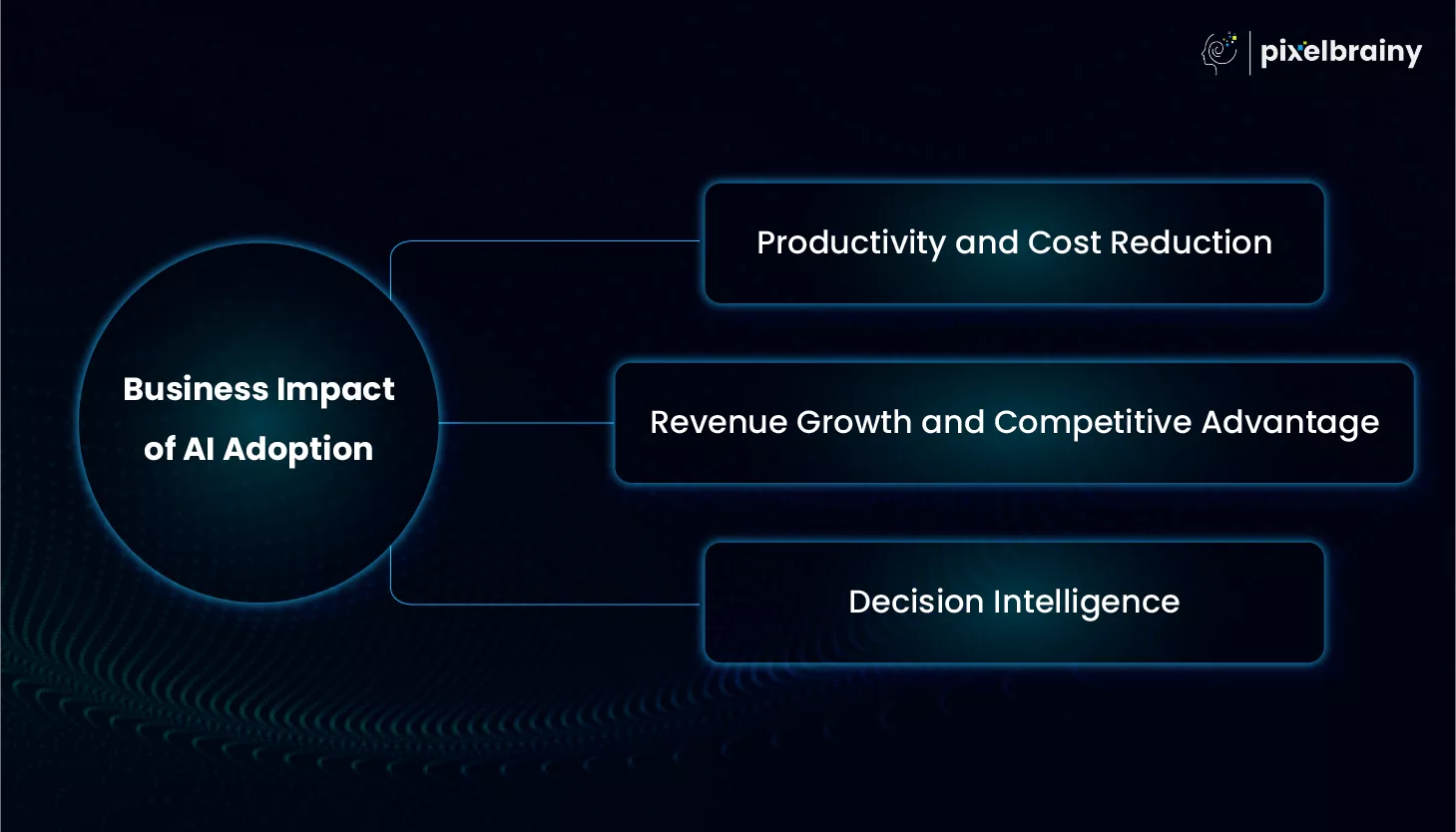
From this above impact areas, the business impact of AI adoption is clear. Companies that successfully deploy AI achieve meaningful productivity gains, unlock new revenue opportunities, and improve decision quality. The differentiator is no longer whether AI is adopted, but how effectively it is integrated into core business operations.
Also Read: A Guide To Choose Right AI Tools and Technologies For Your Business
High AI adoption statistics in 2026 show widespread use of AI technologies across industries, but usage alone does not guarantee business value. Many enterprises report adoption and experimentation, yet a smaller proportion measure or achieve meaningful ROI from their efforts.
This section explores the AI adoption vs ROI reality, drawing on research that highlights measurable returns and the challenges organizations face in turning AI implementation into tangible impact.
High adoption rates do not automatically translate into measurable business value. Many organizations see AI usage rise faster than measurable financial impact, especially where implementations are siloed or lack strategic alignment.
Meaningful ROI requires moving beyond experimentation and integrating AI into core workflows. Companies that tie AI initiatives to KPIs, performance dashboards, and business processes are more likely to capture value.
Where AI is fully embedded and measured, businesses report positive ROI figures—illustrating that the potential exists, but execution quality is the differentiator.
These AI ROI statistics 2026 show that while many businesses adopt AI technologies, only a subset are realizing measurable financial returns. For executives and decision-makers, this underscores the importance of aligning AI adoption with business outcomes, robust data practices, and operational integration rather than treating adoption as an end in itself.
Even though AI adoption facts in 2026 show broad uptake, many organizations are finding that scaling AI beyond pilots and gaining measurable value remains difficult.
Multiple studies confirm that technical, organizational, and strategic barriers continue to constrain how quickly enterprises can implement and benefit from AI at scale.
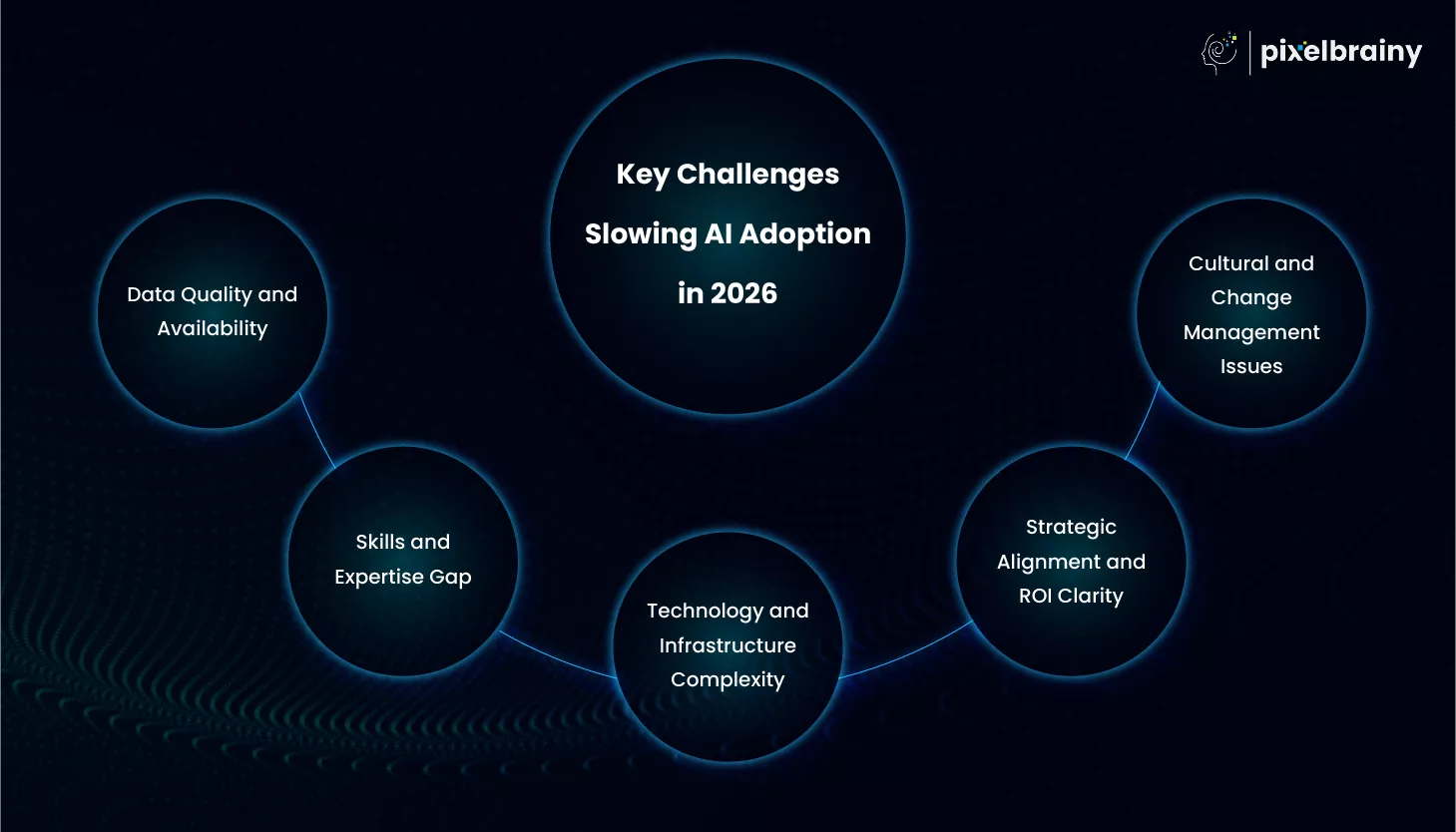
About 45 percent of organizations cite concerns about data accuracy, bias, and fragmented datasets as major barriers to AI adoption, reflecting broader trends highlighted in AI adoption statistics 2026.
Why this slows adoption: AI models depend on clean, well-structured, and representative data. When data is inconsistent, biased, or siloed across systems, model performance suffers and leaders delay broader deployment.
A significant percentage of organizations report difficulty finding qualified AI talent, with up to 69 percent citing this as a top barrier.
Why this slows adoption: Without experienced data scientists, ML engineers, and AI operations professionals, many AI projects stall, struggle to achieve quality deployment, or never reach production.
In a recent enterprise survey, 65 percent of organizations said that complexity in AI infrastructure and integration challenges make it difficult to achieve success.
Why this slows adoption: Many businesses adopt AI tools without upgrading underlying infrastructure, leading to fragmented environments, poor performance, and delays in moving from experimentation to operational AI.
Research finds that one of the key barriers to adoption is unclear strategic vision, combined with difficulties estimating ROI and aligning AI efforts with business goals.
Why this slows adoption: Projects without measurable KPIs and business alignment often struggle to get sustained executive sponsorship, slowing down long-term investment and scaling.
Many organizations identify resistance to change and lack of organizational readiness as barriers when implementing AI solutions.
Why this slows adoption: When teams are reluctant to adopt new workflows or when roles are unclear, AI tools are underutilized, and adoption rates may appear high on paper but yield limited real impact.
These challenges explain why high AI adoption rate businesses report does not always translate into broad, production-level execution or clear AI ROI statistics. In 2026, addressing data foundations, skills deficits, infrastructure complexity, strategic alignment, and organizational readiness is essential for turning adoption into measurable business outcomes.

With AI now embedded across business operations in 2026, organizations are shifting attention to how AI is implemented. The choice between building AI in-house, buying commercial tools, or combining both approaches plays a critical role in determining scalability, governance, and ROI, with AI adoption statistics underscoring how implementation strategy directly impacts long-term competitive advantage.
Many companies begin their AI journey by purchasing prebuilt AI tools such as SaaS platforms, APIs, or embedded AI features.
According to Gartner report, Off-the-shelf AI tools are commonly used for standardized use cases such as chatbots, CRM automation, document processing, and analytics.
Why companies choose this approach: Buying AI solutions enables faster deployment, lower upfront costs, and minimal internal engineering effort. This approach is well suited for non-differentiating functions where speed matters more than customization.
Limitations: Organizations often face constraints around data privacy, limited customization, vendor lock-in, and difficulty integrating AI deeply into proprietary workflows.
As AI maturity increases, many enterprises shift toward building custom AI models and systems tailored to their data, workflows, and business objectives.
As per report of McKinsey, organizations that build custom AI gain greater control over data, performance, and governance.
Why companies choose this approach: Custom AI enables differentiation, better alignment with internal systems, and stronger compliance controls, especially in regulated industries like finance, healthcare, and legal services.
Limitations: Building AI requires higher upfront investment, skilled talent, longer development cycles, and ongoing model maintenance.
Most enterprises in 2026 adopt a hybrid AI implementation strategy, combining commercial AI platforms with custom-built models.
In a study of Accenture, hybrid approaches allow companies to balance speed with customization, using third-party tools for general capabilities and custom AI for strategic use cases.
Why this works: The hybrid model reduces time to value while preserving flexibility, scalability, and data control. It also allows organizations to evolve AI capabilities incrementally as needs grow.
That’s why successful AI implementation is less about choosing build or buy in isolation and more about aligning the approach with business goals, risk tolerance, and long-term scalability. Organizations that adopt a thoughtful hybrid strategy are better positioned to move from AI adoption statistics to sustained business value.
The AI adoption market statistics point to a clear shift in how organizations view and use artificial intelligence. AI is no longer evaluated by experimentation levels or tool availability, but by its ability to create measurable operational and strategic value. For businesses, these statistics highlight several important implications.
High AI adoption rate businesses report means that using AI is no longer a differentiator on its own. Competitive advantage increasingly comes from how effectively AI is implemented, integrated, and scaled across core operations.
While AI implementation statistics show widespread deployment, only organizations that align AI initiatives with clear business outcomes see consistent returns. Productivity gains, faster decision cycles, and revenue impact are becoming the primary benchmarks for success.
Differences in AI usage by industry demonstrate that there is no universal AI playbook. Businesses must tailor AI strategies based on data maturity, regulatory requirements, and customer expectations specific to their sector.
The gap between adoption and ROI highlighted in AI adoption statistics 2026 suggests significant opportunity for organizations that focus on execution. Companies that invest in data readiness, governance, and talent are better positioned to outperform peers.
AI initiatives that treat AI as a long-term capability rather than a short-term project are more likely to scale successfully. This includes planning for integration, monitoring performance, and evolving models as business needs change.
These AI adoption statistics indicate that success in 2026 depends less on whether a company adopts AI and more on how strategically and effectively AI is embedded into business operations. Organizations that prioritize execution, alignment, and measurable outcomes will lead in the next phase of AI-driven growth.
As AI adoption statistics in 2026 show rapid growth across industries, many organizations face challenges turning AI initiatives into scalable, secure, and high-impact solutions. This is where PixelBrainy LLC, a trusted AI development company in USA, helps businesses move from AI adoption to real business outcomes.
PixelBrainy LLC works closely with startups, enterprises, and digital-first organizations to design, build, and deploy AI solutions aligned with business goals, data maturity, and long-term scalability.
How Our AI Services Align with Business and Industry Needs:
For CXOs looking to modernize operations or launch intelligent digital platforms, we build AI-powered applications that automate workflows, surface actionable insights, and support data-driven decision-making across industries such as healthcare, finance, retail, manufacturing, and SaaS.
Also Read: AI App Development Cost: From MVPs to Full-Scale AI App
We help enterprises deploy AI agents that operate across customer support, IT operations, and internal business processes. These agents reduce manual effort, improve response times, and scale operational capacity without increasing headcount.
Also Read: AI Agent Development Cost Guide: Factors and Cost Optimization Tips
Our AI consulting services support leadership teams in defining AI strategy, evaluating build-versus-buy decisions, and aligning AI roadmaps with business KPIs. This service is particularly valuable for CXOs navigating governance, ROI measurement, and enterprise-wide AI adoption.
For organizations focused on customer engagement, training, or digital interaction, we develop AI avatars that enable more natural, interactive experiences. These solutions are commonly adopted in customer service, education, marketing, and enterprise training environments.
Also Read: Top 12 AI Avatar Development Companies in USA
Many enterprises already have complex systems in place. Our AI integration services ensure AI capabilities are embedded into existing platforms, data pipelines, and enterprise tools without disrupting ongoing operations, a critical requirement for regulated and large-scale industries.
We design AI chatbots that go beyond basic automation, delivering contextual, industry-aware interactions for customer support, sales, and internal knowledge access. These solutions directly improve customer experience while reducing operational costs.
Also Read: How To Develop Custom AI Chatbot: Benefits, Types, And Cost
PixelBrainy LLC supports end-to-end AI product development for organizations building AI-driven offerings. From concept validation to deployment and optimization, we help product leaders bring scalable, market-ready AI solutions to life.
Who We Work With:
As AI adoption accelerates across industries, execution becomes the true differentiator. PixelBrainy LLC helps leadership teams transform AI strategies into scalable, secure, and high-impact solutions that deliver measurable business value.
From this above article AI adoption statistics in 2026 make one thing clear: artificial intelligence is now deeply embedded across industries, but real success depends on execution, not adoption alone. Organizations that translate AI initiatives into scalable systems, measurable ROI, and operational impact are pulling ahead of competitors that remain stuck at experimentation or fragmented deployment.
From generative AI and automation to decision intelligence and industry-specific use cases, businesses that invest in the right data foundations, governance models, and implementation strategies are better positioned for long-term growth. As AI continues to evolve, leaders must focus on aligning technology choices with business goals, industry requirements, and customer expectations.
Whether you are a CXO, founder, or enterprise decision-maker, the opportunity lies in turning AI potential into practical outcomes.
Ready to move from AI adoption to real business value?
Book an appointment with our AI experts to discuss your goals and next steps.
AI adoption statistics in 2026 provide a useful high-level view of market trends, but their value depends on how they are interpreted. Businesses should use these statistics as benchmarks rather than guarantees, combining them with internal data, industry context, and pilot results before making strategic decisions.
Differences in AI adoption by industry are driven by factors such as data availability, regulatory requirements, legacy systems, and risk tolerance. Highly regulated sectors often adopt AI more cautiously, while industries with digital-first operations tend to move faster.
No. High AI adoption rates do not always translate into strong returns. ROI depends on factors such as data quality, integration into core workflows, clear success metrics, and ongoing optimization rather than the number of AI tools deployed.
One of the most common mistakes is treating AI as a standalone technology project instead of a business transformation initiative. Without alignment to business objectives, governance, and operational ownership, AI implementations often fail to scale.
Organizations should prioritize AI use cases that align with measurable business outcomes, such as cost reduction, revenue growth, or decision improvement. Starting with high-impact, well-defined use cases helps build momentum and internal confidence.
Off-the-shelf AI tools work well for standard use cases, but custom AI development becomes important when data sensitivity, differentiation, or complex workflows are involved. Many businesses succeed with a hybrid approach that combines both.

About The Author
Sagar Bhatnagar
Sagar Sahay Bhatnagar brings over a decade of IT industry experience to his role as Marketing Head at PixelBrainy. He's known for his knack in devising creative marketing strategies that boost brand visibility and market influence. Sagar's strategic thinking, coupled with his innovative vision and focus on results, sets him apart. His track record of successful campaigns proves his ability to utilize digital platforms effectively for impactful marketing efforts. With a genuine passion for both technology and marketing, Sagar continuously pushes PixelBrainy's marketing initiatives to greater success.

Working with the PixelBrainy team has been a highly positive experience. They understand the design requirements and create beautiful UX elements to meet the application needs. The dev team did an excellent job bringing my vision to life. We discussed usability and flow. Sagar worked with his team to design the database and begin coding. Working with Sagar was easy. He has the knowledge to create robust apps, including multi-language support, Google and Apple ID login options, Ad-enabled integrations, Stripe payment processing, and a Web Admin site for maintaining support data. I'm extremely satisfied with the services provided, the quality of the final product, and the professionalism of the entire process. I highly recommend them for Android and iOS Mobile Application Design and Development.

Great experience working with them. Had a lot of feedback and I found that unlike most contractors they were bugging me for updates instead of the other way around. They were extremely time conscience and great at communicating! All work was done extremely high quality and if not on time, early! They were always proactive when it comes to communication and the work is great/above par always. Very flexible and a great team to work with! Goes above and beyond to present us with multiple options and always provides quality. Amazing work per usual with Chitra. If you have UI/UX or branding design needs I recommend you go to them! Will likely work with them in the future as well, definitely recommended!

PixelBrainy is a joy to work with and is a great partner when thinking through branding, logo, and website layout. I appreciate that they spend time going into the "why" behind their decisions to help inform me and others about industry best practices and their expertise.

I hired them to design our software apps. Things I really like about them are excellent communication skills, they answer all project suggestions and collaborate right away, and their input on design and colors is amazing. This project was complex and needed patience and creativity. The team is amazing to do business with. I will be using them long-term. Glad to see there are some good people out there. I was afraid to try and outsource my project to someone but I am glad I met them! I really can't say enough. They went above and beyond on this project. I am very happy with everything they have done to make my business stand out from the competition.

It was great working with PixelBrainy and the team. They were very responsive and really owned the project. We'll definitely work with them again!

I recently worked with the PixelBrainy team on a project and I was blown away by their communication skills. They were prompt, clear, and articulate in all of our interactions. They listened and provided valuable feedback and suggestions to help make the project a success. They also kept me updated throughout the entire process, which made the experience stress-free and enjoyable.

PixelBrainy is very good at what it does. The team also presents themselves very professionally and takes care of their side of things very well. I could fully trust them taking up the design work in a timely and organised manner and their attention to detail saved us lots of effort and time. This particular project was quite intense and the team showed that they function very well under pressure. Very much looking forward to working with her again!

It's always an absolute pleasure working with them. They completed all of my requests quickly and followed every note I had for them to a T, which made our process go smoothly from start to finish. Everything was completed fast and following all of the guidelines. And I would recommend their services to anyone. If you need any design work done in the future, PixelBrainy should be your first call!

They took ownership of our requirements and designed and proposed multiple beautiful variants. The team is self-motivated, requires minimum supervision, committed to see-through designs with quality and delivering them on time. We would definitely love to work with PixelBrainy again when we have any requirements.

PixelBrainy was a big help with our SaaS application. We've been hard at work with a new UI/UX and they provided a lot of help with the designs. If you're looking for assistance with your website, software, or mobile application designs, PixelBrainy and the team is a great recommendation.

PixelBrainy designers are amazing. They are responsive, talented, and always willing to help craft the design until it matches your vision. I would recommend them and plan to continue them for my future projects and more!!!

They were awesome! Did a good job fast, and good communication. Will work with them again. Thank you

Creative, detail-oriented, and talented designers who take direction well and implement changes quickly and accurately. They consistently over-delivered for us.

PixelBrainy team is very talented and creative. Great designers and a pleasure to work with. PixelBrainy is an excellent communicator and I look forward to working with them again.

PixelBrainy has a very talented design team. Their work is excellent and they are very responsive. I enjoy working with them and hope to continue on all of our future projects.


Transform your ideas into reality with us.
Across these industries, each engagement brings unique challenges, from early-stage product development to scaling complex systems, helping us build a practical understanding of real-world product environments.